U.S. Government work not protected by U.S. copyright
1
Evolution of a Reconfigurable Processing Platform for a
Next Generation Space Software Defined Radio
Thomas J. Kacpura NASA Glenn Research Center MS 54-1, 21000 Brookpark Road
Cleveland, OH 44135 216-433-6830 [email protected]
Joseph A. Downey at NASA Glenn Research Center MS 54-1, 21000 Brookpark Road
Cleveland, OH 44135 216-433-6588 [email protected]
Jeffery R. Anderson, Keith Baldwin Harris Corp Government Communications Systems Division
2400 Palm Bay Road NE Palm Bay, FL 32905 [email protected], [email protected]
Abstract — The National Aeronautics and Space Administration (NASA)/Harris Ka-Band Software Defined Radio (SDR) is the first, fully reprogrammable space-qualified SDR operating in the Ka-Band frequency range. Providing exceptionally higher data communication rates than previously possible, this SDR offers in-orbit reconfiguration, multi-waveform operation, and fast deployment due to its highly modular hardware and software architecture. Currently in operation on the International Space Station (ISS), this new paradigm of reconfigurable technology is enabling experimenters to investigate navigation and networking in the space environment.
The modular SDR and the NASA developed Space Telecommunications Radio System (STRS) architecture
standard are the basis for Harris’ reusable, digital signal
processing space platform trademarked as AppSTAR ™. As a result, two new space radio products are a synthetic aperture radar payload and an Automatic Detection Surveillance – Broadcast (ADS-B) receiver. In addition, Harris is currently developing many new products similar to the Ka-Band
software defined radio for other applications. For NASA’s next
generation flight Ka-Band radio development, leveraging these advancements could lead to a more robust and more capable software defined radio.
The space environment has special considerations different from terrestrial applications that must be considered for any system operated in space. Each space mission has unique requirements that can make these systems unique. These unique requirements can make products that are expensive and limited in reuse. Space systems put a premium on size, weight and power. A key trade is the amount of reconfigurability in a space system. The more reconfigurable the hardware platform, the easier it is to adapt to the platform to the next mission, and this reduces the amount of non-recurring engineering costs. However, the more reconfigurable platforms often use more spacecraft resources. Software has similar considerations to hardware. Having an architecture standard promotes reuse of software and firmware. Space platforms have limited processor capability, which makes the trade on the amount of amount of flexibility paramount.
TABLE OF CONTENTS
1. INTRODUCTION
E
RROR!
B
OOKMARK NOT DEFINED.
2. SCAN TESTBED / HARRIS KA-BAND SDR
DETAILS ...
E
RROR!
B
OOKMARK NOT DEFINED.
3. APPSTAR
™
... 3
4. FUTURE APP
STAR™
DIRECTION ... 55. NEXT GENERATION NASA KA-BAND SDR ... 6
6. SUMMARY AND CONCLUSIONS ... 7
REFERENCES ... 8
BIOGRAPHY
………..
8
1. INTRODUCTION
Space-based products are evolving from fixed function electronics to reprogrammable hardware and software platforms that are capable of multiple uses. This paper describes the evolution of a NASA/Harris Ka-Band Software Defined Radio (SDR) into a reconfigurable space platform that is suitable for developing other space applications. The paper also describes how previous developments can be leveraged to prepare for the next generation space flight software defined radio for NASA Ka-Band use.
2. SCAN TESTBED / HARRIS KA-BAND SDR
DETAILS
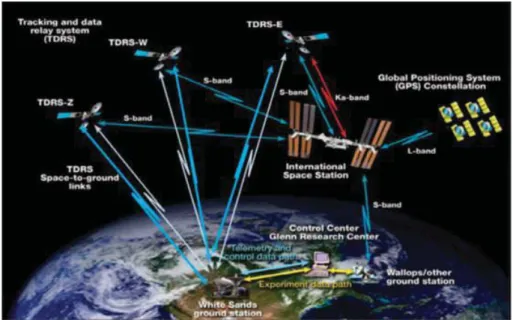
NASA’s Space Communication and Navigation (SCaN) Testbed flight experiment payload aboard the International Space Station (ISS) gives experimenters the unique opportunity to investigate SDR technology, navigation, and networking in the space environment (see Figure 1). The Testbed consists of three SDRs operating at L-band, S-band, and Ka-Band, along with the RF/antenna systems necessary for communications over the Tracking and Data Relay Satellite System (TDRSS) or direct-to-earth links. A reprogrammable avionics subsystem functions as the payload controller and is also available for experimenter use. SCaN Testbed allows experimenters to develop and verify new waveforms compliant with the STRS SDR architecture standard using verified space and ground
systems. These waveforms will be uploaded to the flight SDRs to assess performance and to better understand operational concepts for SDRs in space.
This paper focuses on NASA’s first generation Ka-Band software defined radio, shown in Figure 2, along with the SCaN Testbed payload. The SDR was delivered to the ISS on July 20, 2012, and is now fully operational, providing NASA with its first high-rate Ka-Band link through TDRSS.
In a September 13, 2012 press release, NASA announced opportunities for academia, industry, and government agencies to develop and carry out research and technology demonstrations using the Ka-Band SDR on the Space Communication and Navigation (SCaN) Testbed via Space Act Agreements. Experiments are already underway, including supporting checkout of the new TDRS-11 satellite, testing the new TDRS Digital Signal Distribution System (TDSD), and developing high-rate spectral-efficient modulations. More experiments are expected to begin later this year.
Figure 1. SCaN Testbed Operational Concept
3
Harris SDR Description
The NASA/Harris Ka-Band Software Defined Radio (SDR) is a fully programmable, reconfigurable SDR operating in the Ka-Band frequency range. The SDR was designed for fast deployment, due to its highly modular hardware and software architecture. Capable of in-orbit reconfiguration, radiation-tolerant signal processing, and high-rate communications greater than 100 Mbps, the product was specified, designed, built, and programmed to be compliant with NASA’s common architecture for software-defined radios: the Space Telecommunications Radio System (STRS) standard [3].
Figure 3. Harris SDR Chassis
SDRs offer greater flexibility over hardware radios by taking advantage of software to update and reconfigure the radio parameters without having to build new hardware. This reconfiguration can be used to update existing or upload new radio software/waveforms while in-orbit. Future waveforms are developed in a modular fashion, simplifying the ability to transition waveforms to new hardware platforms or incorporate new features in operational parameters. This extension of the software-defined capability allows NASA to benefit from the initial investment in the radio platform, yet tailor existing software and waveforms to meet specific future – or changing – mission requirements.
At the core of the NASA/Harris Ka-Band SDR is the STRS-compliant Operating Environment (OE). The STRS OE provides a stable framework for all applications to reside in, and uses a common set of software interfaces (API’s) as defined by the STRS standard. The software interacts with the hardware through an abstraction layer, which promotes re-use and portability of the waveform applications. After the STRS OE is loaded, the SDR can be commanded to load waveform applications from local memory. The files in memory include the Field Programmable Gate Array (FPGA) bit-streams, Digital Signal Processor (DSP) application, PowerPC application, and configuration files; together these files constitute a waveform application. More information on the Harris Ka-Band SDR’s hardware, software and performance can be found in [6].
Harris SDR Benefits
This SDR is the first reconfigurable Ka-Band SDR compatible with NASA’s open STRS architecture. The radio hardware platform, software, and waveform applications are compliant with the STRS operating environment, providing a consistent and extensible platform on which to construct and operate new NASA waveforms for space applications. New features can be added to existing space assets since the open architecture provides a framework for developing radios as well as reusing earlier modular components created by other NASA programs. The Ka-Band SDR has been proven flight-qualified for NASA missions as described above. In the future, the technology could be used for migrating X-band applications including radiometric data such as Doppler and ranging data to the Ka-Band in order to improve accuracy.
The modular architecture also benefits hardware evolution, allowing for the insertion of new hardware technologies as hardware components become obsolete. Thus the in-orbit asset becomes more extensible for a variety of future missions while remaining capable of supporting a standardized software framework. This allows NASA to better leverage its investments in radio technology by reusing the radio architecture across many missions, and adopting new component technologies, as needed, to take advantage of emerging science requirements and opportunities. This technology specifically provides a solution to the previous problem of uneconomical and inefficient single-solution radios, which were capable of very little reuse or extensibility across a variety of different space missions.
3. APP
STAR™
Rationale for starting with SCaN Testbed SDR
In an era of shrinking budgets, technology expansion, and world political instability, the space industry cannot afford the long, expensive development cycles of the past. Customers are requiring low cost, rapid development of systems that are responsive to today’s missions and reconfigurable for tomorrow’s needs even after launch. To meet these needs, Harris has developed the AppSTAR™ architecture based on proven modular reference designs, our waveform library, and the small footprint STRS software Operating Environment.
The capabilities of a space-based, reprogrammable signal processing and communications platform are useful for many kinds of missions beyond just the TDRSS science data relay. The modular SDR and the NASA STRS architecture are the basis for Harris’ reusable, digital signal processing space platform, known as AppSTAR™. The overarching goal aspect of this architecture is to leverage the program applications and feed the best practices feed back into the architecture - to be reused for future missions and reduce the Non-Recurring Engineering costs and delivery times of future systems. The present architecture leverages
high performance FPGA processors and a DSP to provide a balance between the performance of custom single function designs and the flexibility of software / firmware driven designs. The key to the AppSTAR™ architecture is the ability to develop portable applications and waveforms that are compliant to a common set of Software Application Interfaces (API) and are sufficiently abstracted from the hardware implementation to allow 3rd party programming and reuse. This has been done by maintaining compliance with the STRS OE and which significantly reduces application development cost and schedule.
Due to the implementation of a reconfigurable processing architecture, the mission performance of the payload can be updated in the future as the mission requirements change even after launch. Applications are stored in flash memory allowing quick mission reconfiguration, to the point of even allowing changing applications back-to-back on a single orbital pass. When combining this flexibility with a set of hardware reference designs, commercial off the shelf (COTS) products, the STRS OE, and the Harris open architecture heritage, AppSTAR™ is positioned well to meet the responsive mission needs of today and enable hosted, responsive, and demonstrate payloads of the future. At its fundamental level, AppSTAR™ has blurred the line between a Software Defined Radio (SDR) and a space payload by providing sufficient processing resources to implement waveforms in a reconfigurable processor that has been shown to support a diverse array of waveforms and applications such as high rate Ka-Band radio, Synthetic Aperture RADAR, and remote signal sensing. All of these functions are based on the same architecture thus creating more than an SDR, a Software Defined Payload (SDP). The baseline system is composed of a Payload Chassis that provides all of the necessary Spacecraft interfaces and waveform processing resources, and an up/down converter to translate the S-Band Intermediate Frequency (IF) from the chassis to the appropriate center frequency. To the baseline system, various RF modules can be added to support a plethora of applications.
Resulting Platforms
The baseline SDR architecture has been extended to a synthetic aperture radar (SAR) payload demonstrating how AppSTAR™ enables low-cost, responsive space payloads. This application, in turn, has enabled development of the Aireon ADS-B hosted payload receiver for the Iridium Next constellation.
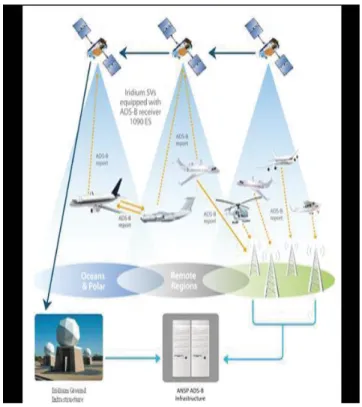
The ADS-B receiver is an integral component of a global satellite-based aircraft tracking system. Iridium NEXT is a space-based Low Earth Orbit (LEO) constellation of satellites that provide 24/7 global coverage, allowing an autonomous solution for surveillance over ocean, sea, polar, and remote areas, which ground radars currently do not cover. Aircraft position surveillance is based upon receiving ADS-B aircraft tracking messages per DO-260B (a Federal Aviation Administration safety certification standard) which
are currently in use by most of today’s aircraft. The Aireon hosted payload receives, demodulates, and transfers valid messages to Air Navigation Service Providers (ANSP) located on the ground as shown in Figure 4. This system is expected to ultimately transform air traffic management (ATM) providing a global satellite-based aircraft tracking system that will vastly improve the safety of the traveling public and save billions of dollars in fuel costs through increased efficiency, as planes fly more optimum routes with less wait time.
Figure 4. Iridium NEXT Global Air Traffic Surveillance The hosted payload mounts to the Earth Deck of the Iridium NEXT satellite as shown in Figure 5. The payload chassis integrates antenna panels into its structure providing a phased array antenna to form multiple beams that can be steered for scanning the spacecraft field of view and receiving ADS-B messages.
5
4.
FUTURE APPSTAR
™
DIRECTIONSWaP Tradespace
Harris has used the AppSTAR™ reference design as the digital signal processing platform for a significant number of other new products. Harris has customer interest driving the AppSTAR™ reference design into multiple branches to satisfy mission needs including Modular High Performance, Reconfigurable, and Size Weight and Power (SWaP) optimized payloads including Hosted Payloads.
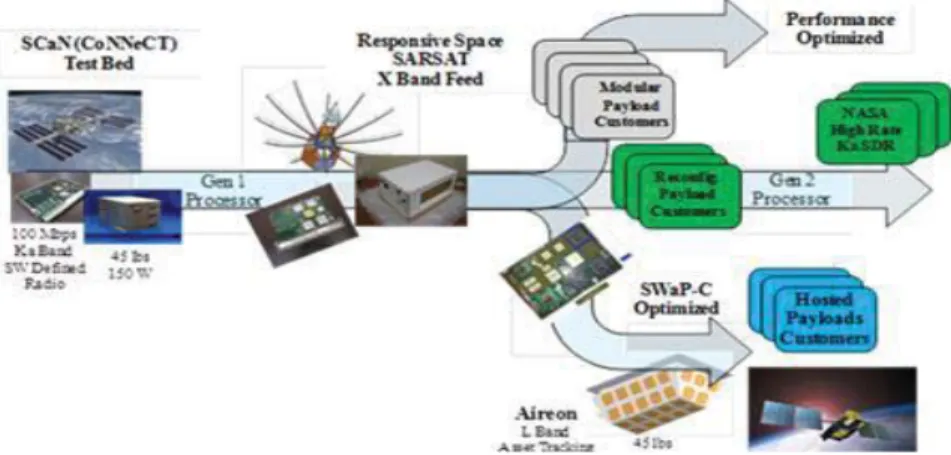
Figure 6 below summarizes a roadmap of products that have and are expected to evolve from the SCaN Testbed NASA/Harris Ka-Band SDR (shown at left). The ADS-B receiver described above was constructed with many of the Ka-Band SDR hardware and software modules, but with optimized signal processing to meet the mission size, weight, and power requirements. The modular SDP platform easily allowed this tailoring.
Based on market response, Harris has leveraged the AppSTAR™ architecture into three similar yet unique market paths which provide tailoring of the architecture to specific customer needs.
The Modular Market tends to be aligned with particular customers and mission needs for a baseline architecture that matches a sensor which is scalable as mission needs evolve over time. This market area may require more or less modules and applications updates, but tends to be variants of the same mission. In this area, the payload electronics SWaP and cost are considered, but are less critical than meeting the performance requirements of the sensor, which is the true mission enabler.
The SWaP-C Optimized Market tends to only be enabled if the mission requires very constrained packaging, cost, and schedule. The best example of this is in Hosted Payload applications, which are generally identified and developed after the primary payload is well into design and the residual deck space and resources are allocated to secondary missions. These secondary missions support needs that have been identified but not been met due to the prohibitive cost
of dedicating a launch and infrastructure to the mission. These missions are only considered if they meet an economically viable cost point, and fit into the SWaP available by the host. Additionally, since the host is already well into the design phase with launch dates defined, the hosted payload must meet a compressed schedule, and provide flexibility to meet interface requirements, and prove no impact and full compatibility with the primary payload. These applications require well defined yet flexible reference designs that have focused on Design to Cost models from both a manufacturing and parts procurement standpoint.
The final Main Market supports reconfigurable payloads which provide highly flexible and inclusive architectural reference designs focused on meeting the frequency plan, bandwidths, and data rates of a broad range of missions. For this market, waveforms and applications are designed to take advantage of the antenna aperture that is being flown. These payloads are generally targeted and launched with a specific mission to support, with the intent that as the mission matures or other missions are identified, additional waveforms and applications can be uploaded in support of those missions. In these cases, the mission is actually enabled by the payload flexibility. Here, performance and flexibility are weighted higher than SWaP-C. Next generation technology development efforts are focused on this mission path and its applications to take advantage of technology updates to enable new missions.
Looking forward, discussions are currently underway with Harris to further enhance SDR technology for space applications, including higher data rate capability, a robust flight package, and minimized power consumption. A second generation processor is planned for this use, along Figure 6. Roadmap of Current and Potential Products evolving from the
with operating environment enhancements that increase reliability, simplify uploading, operating new waveforms and minimizing the time to switch between applications.
Enhanced Capabilities
The first overall goal of the AppSTAR™ architecture is to maintain compatible waveform abstraction from the hardware platform and STRS Operating Environment compliance to enable portability and design reuse between platforms. This set of constructs provides a common framework across multiple platforms enabling consistent implementation and portability.
To truly take advantage of the reconfigurable aspects of the architecture and move towards a true payload implementation, Harris has been extending the STRS OE to include additional hierarchical framework layers to perform higher level mission operation by implementing Mission App and Mission Deck layers in the hierarchy. The Mission App layer provides the highest level of 3rd party programmability. This allows the automation of API calls based on App performance results, potentially making decisions autonomously on the next App to call therefore, setting the Concept of Operations (CONOPS) to implement advanced radio or payload behaviors which includes cognitive radio. The top level Mission Deck layer provides the ability to control radio or payload execution based on re-defined time-tagged scripts based on orbital position planning.
Development Environment Support
To support third party developers, Harris has created the AppSTAR™ Mission Developer’s Kit (MDK) which provides waveform and application development guides for the GPP software, the DSP, and FPGA-based firmware. This documentation supports and extends the resources that are already available through NASA with the intent of continuing support of the development of new applications and waveforms for the CoNNeCT/SCaN platform. There are also additional software development stations and a Multi-Mission Test Bed available for development and demonstrations, including one development station that is being made remotely accessible through the internet. These resources are available through Harris after a basic request submittal and schedule coordination.
5. NEXT GENERATION NASA KA-BAND SDR
Future SDR Requirements
As instruments create more data, the needs for higher data rate capability to return this data to earth will increase. A space qualifiable flight Ka-Band SDR will be a key component of realizing this need.
A brief survey was conducted of potential future missions. Near-Earth NASA missions that will require Ka-Band data communications include the Deformation, Ecosystem Structure and Dynamics of Ice (DESDynI) mission, the
Surface Water Ocean Topography (SWOT) mission, the Hyperspectral Infrared Imager (HyspIRI) mission, and the Joint Dark Energy Mission (JDEM). Mid-term deep space missions that will likely use Ka-Band frequency data include the Exobiology on Mars (ExoMars) mission, the Solar Probe Plus, and the Europa Jupiter System Mission (EJSM). Although some of the intended missions may change, this survey looks at key expected mission requirements.
These and other future NASA aerospace missions will benefit from the Ka-Band SDR as a new paradigm of reconfigurable technology. Key to this innovation is the ability to develop new portable applications and waveforms that are compliant to a common set of software application program interfaces (API) and are sufficiently abstracted from the hardware implementation to allow third-party programming and reuse. This has been accomplished by maintaining compliance with the STRS OE, which opens the market to new waveform developers and reduces reliance on a single developer. In addition, future missions can reuse the developed waveforms for new platforms, significantly reducing the application development cost and schedule. The use of SDRs reduces mission risk, since developers can leverage previously developed and flown waveform components, and only develop new code to meet new mission requirements.
To push SDRs to higher data rates, and maintain the total waveform design flexibility, new reconfigurable processing fabrics will need to be investigated. Space qualified processors such as FPGAs or general purpose graphics processors that provide sufficient I/O speed and processing performance are required to support data rates up to 2 Gbps or higher. In addition to the hardware process, the development environments must be updated to take advantage of the additional architectures and resources that are available.
Leveraging Lessons Learned
The design, fabrication and operation of the Harris SDR for the SCaN Testbed resulted in a number of lessons learned, as well as the development and operation of the SCaN Testbed. The lessons learned from a software perspective were documented [5].
The development of the AppSTAR™ product path has to some degree forced a transition from a program oriented culture to a product oriented culture. In the program culture, each customer receives the attention of a design team totally dedicated to optimally satisfying all of the program requirements with minimal interaction or influence from neighboring programs, either intentionally or unintentionally. Designs were historically started from a clean sheet of paper, leveraging the past experience of the individual designers and their mentors and reviewers to provide the customer an optimized solution. With high optimization comes high cost and unique design that requires extensive test and validation to guarantee
7 performance and life. Some unique and critical programs do require such an approach and can justify an effort based on requirements that truly push the envelope.
For other less stressing missions, the present economic and technical climate has provided the opportunity to push the mission uniqueness into reconfigurable resources instead of unique hardware, thus enabling tailoring of product-oriented culture with common products instead of starting from clean sheets of paper. The common products can range from hardware, to firmware, to software. The user of the product may not have been the original designer, and must rely on the accuracy and quality of the design documentation, modeling and testing. To commercial commodity developers, this is more of a common practice. But for those used to developing unique space products, it means new influences and interactions with other designers and programs and the need to form a centralized organization to manage and coordinate products. For Harris Space Payload programs, that structure is AppSTAR™. AppSTAR™ provides a single coordination group to manage a virtual product data book and support team maintaining awareness of other products to leverage, managing software and firmware development resources, and providing training and documentation to 3rd party application and waveform developers.
Benefits of Leveraging AppSTAR™ Platform
The present AppSTAR™ architecture provides design reuse from at least 5-10 years of product development starting from company funded independent research and development (IRAD) through refined design details perfected in market driven variations and program executions. This process has effectively shortened the payload delivery cycle from 5 years to 24 months with consequent reduction of development costs. With this approach, risk is driven out of future payloads as designs are reused and retested, with only the variations of the designs representing new risk instead of the entire design.
Depending on mission requirements and contract type, each mission’s initial SDP product price will be unique and profit from the baseline architecture reuse. Future related missions can leverage these initial efforts to further reduce costs of developing enhanced hardware and software platforms as well as waveform applications. Some of these savings realized are due to the use of a development of a library of reusable flight-proven modular hardware and software modules. Other cost savings result from the deployment of reconfigurable radios that can be updated for new needs after launch.
From the system perspective, a primary advantage is having a common design environment with a proven flight heritage from which new products can be evolved, rather than starting new. The proven flight heritage is key, since spacecraft developers desire to keep risk as low as possible to insure mission success, and successful flight heritage is one of the indicators that the technology is proven. When
changes need to be made for specific mission requirements, the modular platform allows hardware updates to be made at the board level rather than throughout the entire system. Software changes can utilize the existing infrastructure, and only update required functionality. An established software development environment allows changes to be made quickly and effectively resulting in higher reliability. Development systems, required for the operating environment software and the waveform firmware, and their maintenance costs can be spread over multiple efforts. The developers can leverage established components such as models and proven existing code from internal libraries and the NASA STRS waveform repository. Verification testing is also simplified compared to testing completely new code, using proven routines to perform unit level testing before being loaded to the SDP.
6. SUMMARY AND CONCLUSIONS
Space-based products are evolving from fixed function electronics to reprogrammable hardware and software platforms that are capable of multiple uses. This evolution of the NASA/Harris Ka-Band Software Defined Radio (SDR) into new uses is established by starting with a proven reconfigurable space platform for other space applications. In an environment that requires risk to be minimal, establishing a platform with a proven heritage has many benefits to future users.
The modular SDR and the NASA STRS architecture standard are the basis for Harris’ reusable, digital signal processing space platform trademarked as AppSTARTM. Two new resulting space radio products are a synthetic aperture radar payload and an Automatic Detection Surveillance – Broadcast (ADS-B) receiver. In addition, Harris is currently developing many new products leveraging this flexibility for other applications. For NASA’s next generation flight Ka-Band radio development, leveraging these advancements will lead to a more robust and more capable software defined radio.
The space environment has special considerations different from terrestrial applications that must be considered to qualify and operate any system in space. The unique mission requirements must also be considered as part of the requirements from any standardized platform. However, these unique requirements can make products that are expensive and limited in reuse. Space systems are usually limited in attributes such as size, weight and power, which require the tradespace on the amount of reconfigurability to be carefully considered. The more reconfigurable the hardware platform, the easier it is to adapt to the platform to the next mission, and this reduces the amount of non-recurring engineering costs, which is very common for terrestrial systems. However, the available mass, power allocated to the spacecraft communication equipment is tightly controlled, and justification for reconfigurable platforms which require more spacecraft resources needs to be carefully made. Software has similar considerations to
hardware. The available power is closely tied to the processor capability, and processor capability is directly related to the amount of flexibility with increased software capability.
The trade space for using a reconfigurable platform as the basis for a specific mission may be viewed differently when examined from a programmatic, rather than a specific, mission perspective. A programmatic view usually examines multiple missions, and identifies commonality that reduces overall cost. The reuse of a platform for multiple missions keeps individual mission costs lower, and promotes a more reliable and thoroughly tested platform. The non-recurring engineering costs are reduced through reuse of development tools and experienced developers, proven library of existing waveforms, and testing focused on the updates for each mission. The increased cost of power and mass to an individual mission may be offset programmatically by reduced costs when used by multiple missions. This tension between mission goals and program resources needs to be carefully understood when making these decisions. The ability to sustain a space platform that can be used for multiple markets can lower costs and keep new technology infused.
REFERENCES
[
1] Liebrecht, P., Schier, J., Bhasin, K., Bibyk, I., Butler, M., Hudiburg, J., Tai, W., Shames, P., “NASA’s Space Communications Integrated Architecture”, Proceedings of SpaceOps 2010 Conference, AIAA, 25-30 April 2010, Huntsville, Alabama.[2] Wallace Tai, Nate Wright, Mike Prior, and Kul Bhasin, “NASA Integrated Space Communications Network”, SpaceOps 2012
[3] Reinhart, R., Kacpura, T., Handler, L., Hall, C.,
Mortensen, D., Johnson, S., et al. Space Telecommunications Radio System (STRS) Architecture Standard, Release 1.02.1. NASA, Cleveland, OH, Technical Memorandum 2010-216809, Dec. 2010.
[4] Richard C. Reinhart, Thomas J. Kacpura, Sandra K. Johnson, James P. Lux, NASA’s Space Communications and Navigation Test Bed aboard ISS to Investigate Software Defined Radio, On-board Networking and Navigation Technologies, IEEE Aerospace and Systems Magazine, Volume 28, Number 4, April 2013.
[5] Thomas J. Kacpura, Denise M. Varga, SCAN Testbed Software Development and Lessons Learned, 63rd International Astronautical Congress, Naples, Italy, 2012. [6] Joseph A. Downey, Thomas J. Kacpura, Richard C. Reinhart, “Pre-flight Testing and Performance of a Ka-Band Software Defined Radio”, American Institute of Aeronautics and Astronautics, 30th International Communications Satellite Systems Conference, Ottawa, Canada, 2012.
BIOGRAPHIES
Thomas J. Kacpura received the B.E.E. degree in
Electrical Engineering from Gannon University in 1985 and the M.Eng degree from Rensselaer Polytechnic Institute in 1986. He is a registered Professional Engineer in the State of Ohio. Since 1990, he has provided support to the NASA Glenn Research Center. Activities include sounding rockets, Space Shuttle, and International Space Station microgravity experiment payloads. Also, development of space qualifiable phased array antennas and high data rate modems, and was a co-principal investigator in the Space Telecommunications Radio Standard (STRS) development. Thomas was the SDR development lead for the CONNECT SDRs and currently the Project Manager
for NASA’s next-generation compatibility test sets and advanced SDRs.
Joseph Downey received a B.S. in Electrical Engineering
from the University of Toledo in 2008 and a M.S. in Electrical and Computer Engineering from the Georgia Institute of Technology in 2013. Since 2008 he has worked at the NASA Glenn Research Center in the field of space-based software-defined radio technology. His current work includes efficient FPGA implementations of high-rate spectral-efficient communication techniques.