A meta-analysis of the past 25 years of weight
loss research using diet, exercise or diet plus
exercise intervention
WC Miller,1 DM Koceja,2and EJ Hamilton3
1The George Washington University Medical Center, Washington DC, USA;2The Departments of Kinesiology and3Recreation and Park Administration, HPER Building, Indiana University, Bloomington, IN USA
OBJECTIVE: The therapeutic effectiveness of diet, exercise, and diet plus exercise for weight loss in obesity was determined.
DATA SOURCES: All human research reported in English, published in peer-reviewed scienti®c journals within the past 25 y was reviewed.
STUDY SELECTION: Acceptance criteria (n493 from>700 studies) were that a therapeutic intervention of diet, exercise or diet plus exercise was employed, speci®cally for weight reduction in obese adult humans and that weight change was reported numerically. Only aerobic exercise studies were included, while drug, hormone and surgical treatments were excluded.
DATA EXTRACTION: All data were extracted by the same investigator from the original research report. Except for gender and program type, all extracted data were numerical.
DATA SYNTHESIS: ANOVA, with a Newman±Keuls post hoc test, was used to determine differences among programs (P<0.05). One analysis was performed on the group mean data and one based on effect sizes. Analyses were repeated using initial body weight, initial percent body fat and program length, as covariates.
RESULTS: Primarily, subjects aged 40 y have been studied (39.50.4 y, means.e.m.) who are only moderately
obese (92.70.9 kg, 33.20.5 body mass index (BMI), 33.40.7% body fat); for short durations (15.60.6 weeks). Exercise studies were of a shorter duration, used younger subjects who weighed less, had lower BMI and percentage body fat values, than diet or diet plus exercise studies. Despite these differences, weight lost through diet, exercise and diet plus exercise was 10.70.5, 2.90.4* and 11.00.6 kg, respectively. However, at one-year follow-up, diet plus exercise tended to be the superior program. Effect size and covariate analyses revealed similar program differences.
CONCLUSION: Weight loss research over the past 25 y has been very narrowly focused on a middle age population that is only moderately obese, while the interventions lasted for only short periods of time. The data shows, however,
that a 15-week diet or diet plus exercise program, produces a weight loss of about 11 kg, with a 6.60.5 and
8.60.8 kg maintained loss after one year, respectively.
Keywords:weight loss; meta-analysis; effect size; diet; exercise; weight control; obesity
Introduction
Most weight-loss programs are experimental and lack the validation through scienti®c research that is
demanded with other medicinal practices.1,2 Since
diet and exercise are the most frequently cited meth-ods for both men and women attempting weight loss,1 the purpose of this research was not to validate any one particular weight-loss program, but rather to determine how ef®cacious general diet and exercise programs were in reducing obesity.
Methods
Literature searchThe literature search began with a computer search of
Medline (US National Library of Medicine) which is inclusive of Index Medicus. Extensive cross-referen-cing and manual searches were also performed. All research reported in English, published in peer-reviewed scienti®c journals and conducted within the past 25 y was reviewed (1969±1994). The ®rst requirement for acceptance of a study into the meta-analysis, was that one of the primary study interven-tions had to be weight-loss therapy. The reason for this criteria was to eliminate studies where weight loss was an unexpected result of the intervention rather than a primary focus of the intervention. This distinc-tion eliminated the necessity for making subjective decisions about inclusion/exclusion for a study where
Correspondence: Wayne C Miller, PhD, Exercise Science Progams, The George Washington University Medical Center, 817 23rd Street NW, Washington DC 20052, USA.
Received 23 October 1996; revised 8 April 1997; accepted 12 June 1997
weight loss was accidental or not clearly an expected outcome.
The second requirement for acceptance of a study into the meta-analysis was that the intervention had to be either diet (D), exercise (E) or diet plus exercise (DE). The D intervention had to include some type of calorie restriction or reduced energy intake and only E studies using aerobic exercise were included. These acceptance criteria for the type of intervention kept the focus of the paper, which was to compare the effects of manipulating the energy balance through traditional D, E, or DE programs on body weight/ composition. In other words, if a change in body weight/composition could not be linked to a clear reduction in energy intake and/or increase in energy expenditure through aerobic exercise, the study was not included in the data set.
Other criteria for study acceptance were that the subject sample had to be overweight (as de®ned by original author(s) or by our predetermined
criteria of being either 120% ideal body
weight, body mass index (BMI) 27, or body
fat 30%), aged 18 y and that a numerical value
was given for weight change during the program. Studies that reported data in ®gures only, where no numerical values could be extracted, were excluded. Drug therapy, hormone therapy, and surgery treatment studies were not included. Beha-vioral and health education programs that did not include a D, E or DE component were excluded. Additional information was incorporated into the analyses from accepted studies that either reported data directly or reported data that could be converted to values for: duration of the intervention, change in percentage body fat, change in weight of body fat or follow-up data for any dependent variable over at least one year.
A total of 493 study groups from the>700 papers reviewed, met the minimal inclusion criteria. Sample sizes in the study groups analyzed ranged from 3± 2869, with the average number per experimental
group being 336 (means.e.m.). However, the
distribution of sample size for the groups analyzed was skewed to the left, with only 21 of the 493 study
groups having a sample size of 100 subjects. The
median as well as the mode for the sample size distribution was 12, with the frequency of 12 subjects per group occurring in 50 of the 493 groups. Only 26% of the sample populations were men, while 46% were women and 28% of the studies reported having either both genders within a group or did not report group gender at all. Data for control groups were not recorded nor analyzed, but the literature review revealed that less than half of the research studies included separate control groups. Diet programs were used in 269 of the research reports, E programs in 90 reports and DE in 134 reports.
The average degree of obesity, determined by BMI,
was 33.20.5, with a range 22.0±60.0; and for
percentage body fat the average was 33.40.7, with
a range 13.0±52.0. The variance for initial adiposity levels among samples in the D, E and DE groups would not have affected the analyses performed for several reasons. First, the standard deviations among the D, E and DE groups was evenly distributed. Second, the coef®cient of variation among sample groups was between 15% and 29%. Finally, in no case was the standard deviation for a sample group larger than the mean.
The age of the subjects for the inclusion studies ranged from 18±68 y. None of the participants in any of the studies reported having metabolic diseases, illness or were taking medications that may have affected weight loss. The actual weight change reported ranged from a gain of 2 kg to a loss of 55 kg. Length of the intervention ranged from 2±90 weeks.
Coding of variables
The second step in the analysis was to code the data from all of the studies that met the criteria for inclusion. Objectivity and reliability were main-tained during the coding process because all of the variables coded (except gender and program type) were numerical values. Coding for gender does not lend itself to subjective interpretation, whereas coding for the type of program might. Consequently, sub-jective coding for program type was avoided by strict adherence to predetermined guidelines. Program types were de®ned as D, E or DE. Guidelines for coding program type were subsequently based on a strict dichotomy. In other words, if exercise was prescribed for a particular weight-loss program, then exercise was coded as part of that program. Similarly, if a calorie restricted diet regimen of any type was pre-scribed for weight loss, then the program was coded for diet accordingly. All studies were coded by the same investigator (WCM).
All studies that were coded for exercise utilized an aerobic type of exercise protocol,3where the duration of exercise ranged from 14±120 min and the fre-quency of exercise was 2±7 d/week. The mode of exercise in a majority of the studies was either walking, jogging or a combination of walk-jog. Quantifying ®ndings
Conceptually, meta-analysis converts the ®ndings of a given study into data points called effect sizes (ES). These ES represent a common measure of treatment effectiveness. The ES of a single variable for an individual study represents the magnitude of treatment effect for that variable in that particular study. Thus, results from studies utilizing different methodologies can be equilibrated and compared by calculating each study's ES for the variable in question. ES for the dependent variables in each of the studies included in this meta-analysis were calculated by dividing the mean change in a variable measured for a group by the standard deviation (s.d.) for that group 942
(ESDXs.d.). Hence, the larger the ES for a particular group, the more consistent the effectiveness of treatment for that group. Once ES were calculated, statistical analyses were than performed on the ES.
Notwithstanding the strength of the meta-analysis using study ES as individual data points, many studies in the literature reviewed did not report the variance data necessary to compute ES. Other investigators have encountered this same problem and have conse-quently used the actual group mean as the ES in order to have enough data points to proceed with their
analyses.4,5 The choice of using the actual group
mean versus a calculated ES for a meta-analysis is somewhat a matter of preference and depends upon the variance in group results and/or the variance in the
number of subjects per group studied.5 For
compar-ison purposes, however, we performed both types of analyses, one on the actual group mean and one on the ES. Hence, if the results from the two types of analyses concur, one should be extremely con®dent in the ®ndings, regardless of their personal position on the use of ES for analysis. If the results from the two analyses differ, one should favor the ES analysis due to the fact that it is more valid for the studies included in this meta-analysis.
Statistical analysis
Initially, the ANOVA was used to compare subject demographics and program lengths as well as deter-mine differences in weight-loss success among the general program types of D, E and DE. The possibility that the initial subject pro®le may affect weight loss outcome variables was eliminated by performing two ANCOVAS where initial body weight and initial percentage body fat were used as covariates. More-over, another ANCOVA was used where length of program intervention was taken as the covariate. All of these analyses were performed on both the actual group mean data and the ES data. If signi®cance differences were found, then the Newman±Keuls post hoc test was employed. Signi®cance was declared at the P<0.05 level. All values are reported as
means.e.m.
Results
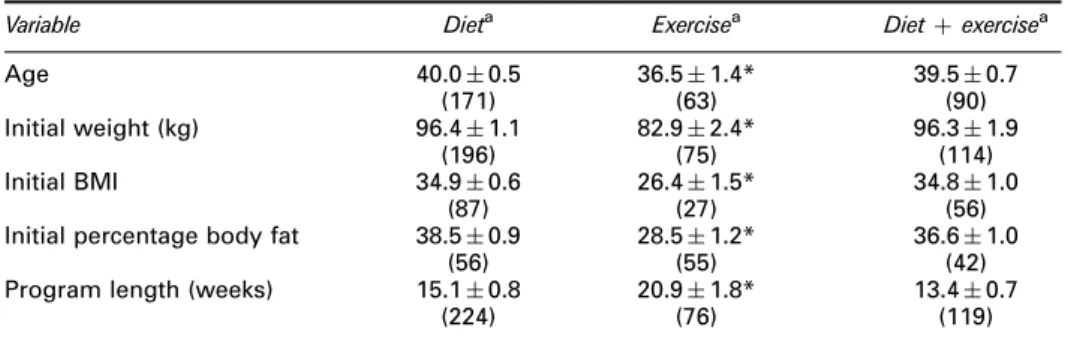
Table 1 contains the demographic data for subjects participating in the respective D, E and DE programs. It is evident that studies investigating the effectiveness of exercise alone on weight loss, have sample popula-tions that are different from those used in the D and DE studies. Subjects in the E studies were younger (36
vs40 y), weighed less (83vs96 kg), had lower initial
BMI values (26 vs. 35), and had a lower initial
percentage body fat (28% vs 37±38%) than those in
the D and DE studies. These differences for subject characteristics persisted even when the group demo-graphic data for the genders were compared separately for those studies where group gender could be identi-®ed (n355). In other words, both the women and the men in the E studies were characteristically different from those women and men in the D or DE studies (data not shown). Moreover, the length of intervention was 6±8 weeks longer for the E studies than for the D and DE studies.
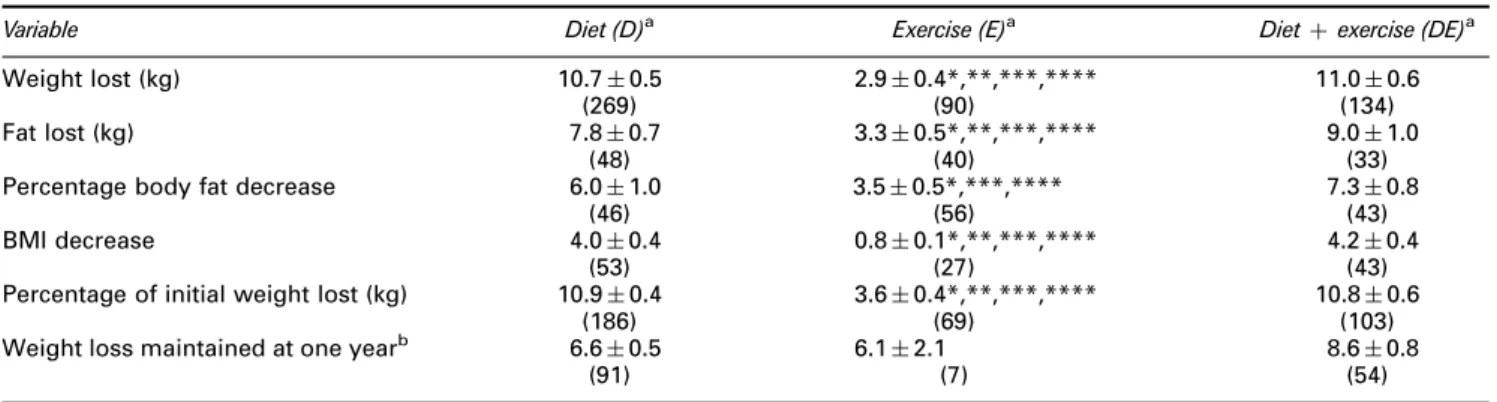
When programs were compared for changes in body composition, the E programs were clearly less effective than the D or DE programs (Table 2). In particular, weight lost, weight of fat lost, reduction in percentage fat, BMI decrease and percentage of initial weight lost, for the E programs were only 20±60% of that seen in the D or DE programs. These differences were conspicuous regardless of whether the analysis on mean data was done with or without the covariates of initial body weight, initial percentage body fat or initial BMI. However, when group mean data for program types were compared for maintained weight loss at one year post-program, no differences were found. It must be noted, however, that the initial weight loss in the seven E studies that provided
one-year maintenance data was 8.72.1 kg, which was
higher than the 2.90.4 kg for the 90 E studies
analyzed in the complete data set. Therefore, at one-year maintenance, the seven E study groups were able to maintain 70% of their initial weight loss. Initial weight loss for the D and DE subgroups that provided one-year maintenance data were not different from the D and DE study groups in the complete data set
Table 1 Subject demographics and program lengths.
Variable Dieta Exercisea Dietexercisea
Age 40.00.5 36.51.4* 39.50.7 (171) (63) (90) Initial weight (kg) 96.41.1 82.92.4* 96.31.9 (196) (75) (114) Initial BMI 34.90.6 26.41.5* 34.81.0 (87) (27) (56)
Initial percentage body fat 38.50.9 28.51.2* 36.61.0
(56) (55) (42)
Program length (weeks) 15.10.8 20.91.8* 13.40.7
(224) (76) (119)
BMIBody mass index. Data are meanss.e.m. *Signi®cantly different from other program types (ANOVA).aNumber in paranthesis represents the number of studies reporting data for
that particular variable.
(D9.00.8 vs 10.70.5; DE11.81.0 vs
11.00.6, respectively). Similar to the E groups,
the D and DE groups maintained 73% of their initial weight loss at one year after. Therefore, the overall result for weight-loss comparisons among program types remains; that there was no difference in main-tenance of weight loss among D, E and DE groups after one year.
The ES analysis also revealed that E programs were least effective in producing body compositional changes (Table 3). This was particularly true for weight lost and reduction in percentage body fat. The ES values for the D and DE programs revealed that these programs were twice as effective as the E programs (Table 3). However, some of the ES ana-lyses were weakened or not performed, due to a small number of studies reporting variance for changes in the dependent variables (Table 3).
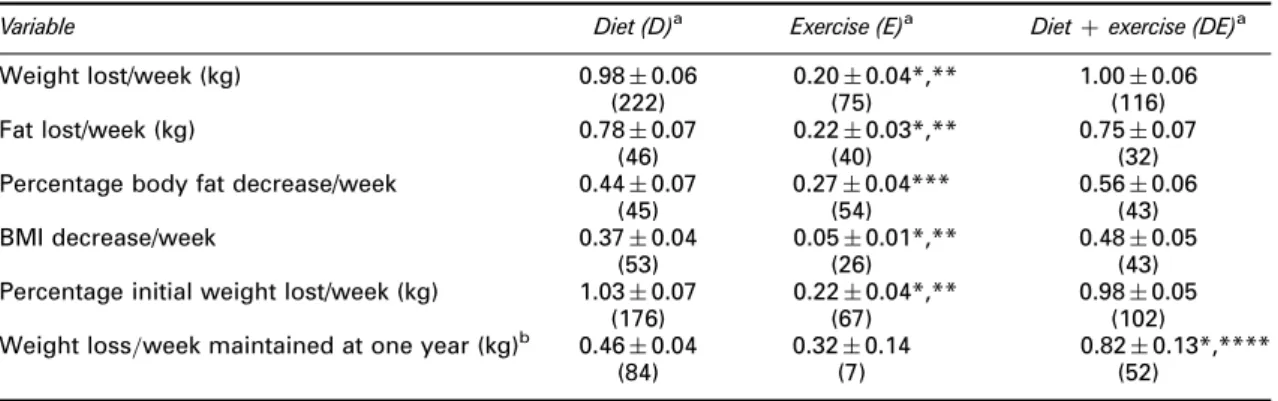
When length of the intervention was taken into account as a covariate, E programs were still least effective in altering body composition when com-pared to D and DE. For example, average weight loss in the D and DE programs was about 1.0 kg/week
compared to 0.2 kg/week for the E programs. The ®nding that E programs did not produce as great a change in body composition as the D and DE pro-grams was rather consistent, whether the analyses were performed with or without covariates on either the group mean data (Table 4) or ES data (Table 5).
Discussion
Descriptive data
The data that describes the different program types and the subject demographics reveal two important idiosyncrasies about the weight loss research con-ducted over the past 25 y. First of all, the research has been very narrowly focused. Variance among studies within each program type for the variables of age; initial body weight, BMI and percentage body fat is small (Table 1). This indicates that most of the weight loss research has been conducted on the same small subset of the obese population, namely, the moderately obese aged 40 y. Furthermore, therapeutic
Table 2 Body composition changes in obese adults following diet, exercise or diet plus exercise intervention.
Variable Diet (D)a Exercise (E)a Dietexercise (DE)a
Weight lost (kg) 10.70.5 2.90.4*,**,***,**** 11.00.6
(269) (90) (134)
Fat lost (kg) 7.80.7 3.30.5*,**,***,**** 9.01.0
(48) (40) (33)
Percentage body fat decrease 6.01.0 3.50.5*,***,**** 7.30.8
(46) (56) (43)
BMI decrease 4.00.4 0.80.1*,**,***,**** 4.20.4
(53) (27) (43)
Percentage of initial weight lost (kg) 10.90.4 3.60.4*,**,***,**** 10.80.6
(186) (69) (103)
Weight loss maintained at one yearb 6.60.5 6.12.1 8.60.8
(91) (7) (54)
BMIBody mass index. Data are meanss.e.m. *Signi®cantly different from other program types when ANOVA was run without covariates. **Signi®cantly different from other program types when analysis was run with initial body weight as a covariate. ***Signi®cantly different from other program types when analysis was run with intitial percentage body fat as a covariate. ****Signi®cantly different from other program types when analysis was run with initial BMI as a covariate.aNumber in paranthesis
represents the number of studies reporting data for that particular variable. (This number may have varied for the covariate analyses if a study did not report data for the covariate in question.) bNot enough studies included data for a covariate analysis using initial
percentage body fat or initial BMI as the covariate.
Table 3 Effect sizes (ES) for body composition changes in obese adults following diet, exercise or diet plus exercise interventiona.
Variable Diet (D)b Exercise (E)b Dietexercise (DE)b
ES kg lost 5.10.5*,** 2.10.5*** 5.50.7*,**
(141) (34) (68)
ES kg fat lost 5.51.2 2.10.7 7.91.6*
(29) (16) (16)
ES percentage body fat decrease 4.80.8** 3.01.1**** 7.42.5*,**,****
(20) (16) (15)
ES BMI decrease 2.20.5 0.70.9 3.72.0
(8) (7) (10)
BMIBody mass index. Data are meanss.e.m. *Signi®cantly different from E when ANOVA was run without covariates. **Signi®cantly different from E when analysis was run with initial body weight as a covariate. ***Signi®cantly different from other groups when analysis was run with intitial BMI as a covariate. ****Signi®cantly different from D when analysis was run with initial body weight as a covariate.aNumbers
were too small for ES analyses for percentage of initial weight lost and weight loss maintained at one year.
bNumber in paranthesis represents the number of studies reporting data for that particular variable. (This
number may have varied for the covariate analyses if a study did not report data for the covariate in question.)
intervention for this overweight individual has only lasted for 13±21 weeks. The second idiosyncrasy in the literature is that the studies investigating weight loss due to exercise alone, were conducted on a completely different sample than those dealing with D or DE. These E studies, like the D and DE studies, used a very narrowly de®ned sample population, which to many scientists cannot even be considered obese.1,6±9
Although the inclusion criteria for study acceptance called for an obese population, only one of the obesity de®ning parameters (BMI, percentage body fat, 120% ideal weight, author de®ned) needed to be met for inclusion. It is possible that in many of the E studies only one of the criteria was met for study acceptance, while the other criteria were not. This could well have been the case for studies where the author(s) de®nition of obesity was the acceptance criteria. Using an author-de®ned criteria for obesity is not unprece-dented in meta-analytical research in obesity;5 and may be better than having no exclusion criteria at all
for obesity, as other meta-analyses have done.4,5,10 Nonetheless, caution is warranted when interpreting comparative differences among program types. It may be that exercise is a more effective intervention
strategy for individuals who are more obese4,5 or
older than those included in the narrowly-de®ned population de®ned by this meta-analysis.
Program effectiveness
The results from this meta-analysis, which are more de®nitive than any individual study, indicate super-iority of the use of D or DE in reducing obesity during the period of treatment (Tables 2±5). This conclusion is supported by the covariate analyses, where initial body weight, BMI and percentage body fat are used as covariates, as well as the ES analyses. Depending upon the variable measured, the D and DE programs produced a three-to-®ve fold greater change in body composition than the E programs. By piecing together the data from three earlier meta-analyses, one might
Table 4 Body composition changes per week in obese adults following diet, exercise or diet plus exercise intervention.
Variable Diet (D)a Exercise (E)a Dietexercise (DE)a
Weight lost/week (kg) 0.980.06 0.200.04*,** 1.000.06
(222) (75) (116)
Fat lost/week (kg) 0.780.07 0.220.03*,** 0.750.07
(46) (40) (32)
Percentage body fat decrease/week 0.440.07 0.270.04*** 0.560.06
(45) (54) (43)
BMI decrease/week 0.370.04 0.050.01*,** 0.480.05
(53) (26) (43)
Percentage initial weight lost/week (kg) 1.030.07 0.220.04*,** 0.980.05
(176) (67) (102)
Weight loss=week maintained at one year (kg)b 0.460.04 0.320.14 0.820.13*,****
(84) (7) (52)
BMIBody mass index. Data are meanss.e.m. *Signi®cantly different from other program types when ANOVA was run without covariates. **Signi®cantly different from other program types when analysis was run with either initial body weight, initial percentage body fat or initial BMI, as a covariate. ***Signi®cantly different from DE when analysis was run without covariates. ****Signi®cantly different from other program types when analysis was run with initial body weight as a covariate.aNumber in paranthesis represents the number of studies reporting data for
that particular variable. (This number may have varied for the covariate analyses if a study did not report data for the covariate in question.)bNot enough studies included data for a covariate analysis using initial percentage body
fat or initial BMI as the covariate.
Table 5 Effect sizes (ES) for body composition changes per week in obese adults following diet, exercise or diet plus exercise interventiona.
Variable Diet (D)b Exercise (E)b Dietexercise (DE)b
ES Weight lost/week (kg) 0.520.06 0.130.03*,**,***,**** 0.610.11
(135) (34) (68)
ES Fat lost/week (kg) 0.500.08 0.180.06*,**** 0.610.13
(29) (16) (16)
ES Percentage body fat decrease/week 0.470.08 0.250.09*,** 0.630.20
(25) (16) (16)
ES BMI decrease/week 0.210.07 0.050.03 0.730.51
(8) (7) (7)
BMIBody mass index. Data are meanss.e.m. *Signi®cantly different from other program types when ANOVA was run without covariates. **Signi®cantly different from other program types when analysis was run with initial body weight as a covariate. ***Signi®cantly different from other program types when analysis was run with intitial percentage body fat as a covariate. ****Signi®cantly different from other program types when analysis was run with initial BMI as a covariate.aNumbers were too small for ES analyses for percentage initial weight lost and weight loss
maintained at one year.bNumber in parenthesis represents the number of studies reporting data for that particular
variable. (This number may have varied for the covariate analyses if a study did not report data for the covariate in question.)
foresee this conclusion. For example, Ballor and
Poehlman11 found that D programs resulted in a 10±
12 kg weight loss, while DE programs produced a 9 kg weight loss. These numbers compare to our value of about 11 kg for D and DE. Data from two other meta-analyses4,5 indicate that weight loss through E was only 1±2 kg, which is similar to our value of 2.9 kg. However, one must realize that piecing together data from three separate meta-analyses may not be the most appropriate way to make group comparisons for D, E and DE effectiveness, because the inclusion/exclusion criteria for each of these meta-analyses was different. One must also realize that the meta-analysis on the effects of exercise on body composition performed earlier5was done on relatively normal weight men (15±21% fat) and women (25± 28% fat). Furthermore, the number of data points in these three earlier meta-analyses was 25,4 87,5 and 53;11compared to 493 in the current study. Therefore, we feel that the data from this study unite and solidify any pieces of data that have been previously reported in the literature, either by review1 or by meta-analy-sis.4,5,11
As previously mentioned, expected weight loss for a 3±4 month weight-loss program is about 11 kg (<1 kg/week), with the ability to maintain about 70% of this loss after one year. These expectations represent an initial weight reduction of 11% of origi-nal body weight which dwindles to a 7±9% reduction after one year. These values fall within the generally accepted guidelines for rate of reduction, which are 1 kg/week or 1±2% of body weight/week, but slightly higher than more recent recommendations calling for
rates of about 0.5 kg/week.12 However, it must be
remembered that these data were derived from a moderately obese population and that a weight loss of less than 10 kg in a severely obese individual may be negligible and discourage adoption of a new healthier lifestyle.12
There is some weak evidence for the continued superiority of DE intervention over D and E after a one-year follow-up (see Table 4, weight lost/ week maintained at one year). When these values from the subgroup of studies providing one-year data, are compared to their own initial values for weight loss per week, the DE programs maintained 77% of their initial weight loss, while values for the D and E programs were 56% and 53%, respectively.
The conclusion that no data exists for long- term clinical trials evaluating various methods for volun-tary weight control1 is supported by this search. We found no E studies reporting data for maintenance up to 2 y post intervention and only a handful of D or DE studies reporting follow-up data 3 or 4 y post inter-vention. Hence, no analyses could be performed to compare program effectiveness beyond one year. Nevertheless, the average weight loss of the 16 D and DE studies that followed subjects for 3 y was 6±7 kg (data not shown).
There was no way of statistically estimating the potential bias for publishing studies that favor suc-cessful intervention. Although some of the studies included in the meta-analysis, reported negligible weight loss and even weight gain following interven-tion, we must assume that the bias, if any, would favor successful intervention. This assumption of the ten-dency to favor successful intervention in the published literature may be supported by the inclusion criteria which required the main focus of an accepted study to be weight-loss therapy. If one assumes that the ten-dency to publish only successful intervention strate-gies was evenly distributed across program types (D, E and DE), then the program comparison analyses would not have been affected. However, if one could include in the meta-analysis the research that was not published because of an inability to produce an effect, then this would lower the mean values for the depen-dent variables as well as diminish the ES values. The result would then be that D, E and DE programs are even less effective in reducing adiposity than reported here.
Recommendations
With the above limitations to the data base in mind, we have statistically evaluated the past 25 y of weight loss research and recommend that the pursuance of research take a different direction. We recommend that further investigations into diet and exercise ther-apy for the obese be directed at the severely obese and the elderly obese, who are at highest risk for obesity-linked complications. More research on these two obese subgroups will help determine if all the obese respond similarly to weight-loss intervention. We further suggest that long-term studies be performed to assess the effectiveness of exercise alone on body composition.
With respect to clinical application, we conclude that either a D or DE program would be most bene®cial on a short-term basis. We suggest, however, that due to the small amount of maintenance data in the literature, that clinicians consider an exercise component as part of the intervention and/or follow-up.
Acknowledgements
This research was supported in part by the Eleanor Naylor Dana Charitable Trust. Appreciation is also given to Christy Calderon for her library assistance. References
1 NIH Technology Assessment Conference Panel. Methods for voluntary weight loss and control. Ann Int Med 1993;119: 688±693.
2 Lustig A. Weight loss programs: failing to meet ethical standards?J Am Dietetic Assoc1991;91: 1252±1254. 3 American College of Sports Medicine.Guidelines for Exercise
Testing and Prescription, 5th ed. Williams and Wilkins: Baltimore, 1995.
4 Epstein LH, Wing RR. Aerobic exercise and weight.Addictive Behav1980;5: 371±388.
5 Ballor DL, Keesey RE. A meta-analysis of the factors affecting exercise-induced changes in body mass, fat mass and fat-free mass in males and females.Int J Obes1991;15: 717±726.
6 Miller WC, Wallace JP, Eggert KE. Predicting max HR and the HR-VO2relationship for exercise prescription in obesity.
Med Sci Sports Exerc1993;25: 1077±1081.
7 Bray GA. Pathophysiology of obesity. Am J Clin Nutr1992; 55: 488S±494S.
8 Franklin BA, Hodgson J, Buskirk ER. Relationship between percent maximal O2uptake and percent maximal heart rate in
women.Res Quart1980;51: 616±624.
9 Powers SK, Howley ET. Exercise Physiology Theory and Application to Fitness and Performance.William C. Brown: Dubuque, 1990. p. 390.
10 Black DR, Gleser LJ, Kooyers KJ. A meta-analytic evaluation of couples weight-loss programs. Health Psychol 1990; 9: 330±347.
11 Ballor DL, Poehlman ET. Exercise-training enhances fat-free mass preservation during diet-induced weight loss: a meta-analytical ®nding.Int J Obes1994;18: 35±40.
12 Miller WC, Eggert KE. Weight loss perceptions, character-istics and expectations of an overweight male and female population.Med Exerc Nutr Health1992;1: 42±46.