■
Airway pressure release ventilation (APRV) is a relatively new mode of ventilation, that only became commercially available in the United States in the mid-1990s. Airway pressure release ventilation produces tidal ventilation using a method that differs from any other mode. It uses a release of airway pressure from an elevated baseline to simulate expiration. The elevated baseline facilitates oxygenation, and the timed releases aid in carbon dioxide removal.Advantages of APRV include lower airway pressures, lower minute ventilation, minimal adverse effects on cardio-circulatory function, ability to spontaneously breathe throughout the entire ventilatory cycle, decreased sedation use, and near elimination of neuromuscular blockade. Airway pressure release ventilation is consistent with lung protection strategies that strive to limit lung injury associated with mechanical ventilation. Future research will probably support the use of APRV as the primary mode of choice for patients with acute lung injury. (KEYWORDS: acute lung injury, airway pressure release
ventilation, alveolar recruitment, alveolar derecruitment, lung protective strategies)
Airway pressure release ventilation (APRV) is a mode of ventilation that was first described in 1987.1,2 It uses a philosophy that differs fundamentally from that of conventional ventilation. Whereas conventional modes of
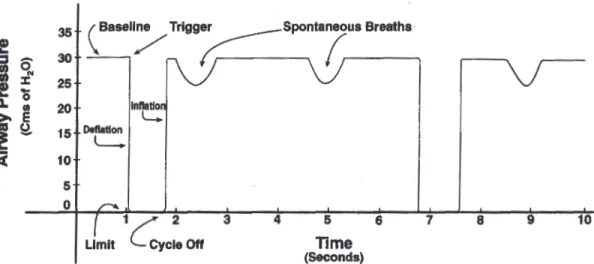
ventilation begin the ventilatory cycle at a baseline pressure and elevate airway pres-sure to accomplish tidal ventilation (Figure 1), APRV commences at an elevated baseline pressure (similar to a plateau pressure) and follows with a deflation to accomplish tidal ventilation (Figure 2). In addition, during APRV, spontaneous breathing may occur at either the plateau pressure or deflation pres-sure levels. This article provides a detailed examination of the terminology, indications, theoretical benefits, advantages, and disad-vantages of APRV as well as a discussion of application and weaning procedures. Airway Pressure Release Ventilation Defined
Airway pressure release ventilation has been described as continuous positive airway pres-sure (CPAP) with regular, brief, intermittent releases in airway pressure.3,4 The release phase results in alveolar ventilation and re-moval of carbon dioxide (CO2). Airway pres-sure release ventilation, unlike CPAP, facili-tates both oxygenation and CO2 clearance and originally was described as an improved method of ventilatory support in the presence of acute lung injury (ALI) and inadequate CO2 ventilation.2,5Airway pressure release ventila-tion is capable of either augmenting alveolar
Airway Pressure Release
Ventilation: Theory and Practice
P. Milo Frawley, RN, MS,* and Nader M. Habashi, MD†
▪ ▪ ▪ ▪ ▪ ▪ ▪ ▪ ▪ ▪
From *Maryland ExpressCare and †Department of Critical Care Medicine, University of Maryland Medical Center, Baltimore, Maryland.
Reprint requests to P. Milo Frawley, RN, MS, Mary-land ExpressCare, TGR25C, University of MaryMary-land Medical Center, 22 South Greene Street, Baltimore, MD 21201.
ventilation in the spontaneously breathing pa-tient or accomplishing complete ventilation in the apneic patient.6 The CPAP level drives oxygenation, while the timed releases aid in CO2clearance.
Technically, APRV is a time-triggered, pres-sure-limited, time-cycled mode of mechanical ventilation. In addition, APRV allows unre-stricted, spontaneous breathing throughout
the entire ventilatory cycle (Table 1). Advan-tages of APRV include: significantly lower peak/plateau airway pressures for a given tidal volume; the ability to superimpose spon-taneous breathing throughout the ventilatory cycle; decreased sedation; and near elimina-tion of neuromuscular blockade use.7,8 Fea-tures that distinguish APRV from other modes of mechanical ventilation include
sponta-Figure 1. Conventional volume targeted ventilation, e.g., synchronized intermittent mandatory ventilation (SIMV). Any mechanically delivered breath will be defined by its trigger, limit, and cycle off feature. In SIMV, the breath will be triggered by either the patient or by time, the volume delivered will limit the breath, and time will cy-cle the breath off into exhalation. Cms of H2O = centimeters of water.
Figure 2.Airway pressure release ventilation: this can also be defined by a trigger, limit, and cycle off feature. However, unlike other modes of ventilation, the trigger (time) initiates a drop in airway pressure. The amount of pressure change will be the limit. The cycle off will occur because of time. Airway pressure then returns to the baseline. Cms of H2O = centimeters of water.
neous breathing throughout the ventilatory cycle and an intermittent pressure release phase that results in a brief decrease in lung volume to assist ventilation.1,2
History of Mechanical Ventilation
The basic principles of ventilator design and management were founded upon patients who developed nonparenchymal respiratory failure (e.g., polio). In the absence of ade-quate research, those same principles were applied to patients with parenchymal respira-tory failure as well (e.g., ALI). Mode selection often was based on availability and simplicity of the ventilator, user experience, and tradi-tion, because little evidence existed to guide management.
In 1993, the American College of Chest Physicians (ACCP) consensus conference failed to “agree on an optimum mode of ventilation for any disease state or an opti-mum method of weaning patients from me-chanical ventilation.”9(p1834) The ACCP agreed that well-controlled clinical trials that defined the indications and uses of specific modes of ventilation were lacking. New technology must scientifically show a distinct advantage in safety, expense, ease of operation, or therapeutic outcome.10,11
Despite more than 30 years since its recognition, acute respiratory distress syn-drome (ARDS) continues to have a 30% to 50% mortality rate.12,13Recently, discovery of the potential for mechanical ventilation to produce ventilator-associated lung injury has resulted in the development of new lung protective strategies.14Lung protective strate-gies include those described in the “the open lung approach” promoted by Amato et al.15 The open lung approach uses reduced tidal volumes (6 mL/kg) to prevent high-vol-ume lung injury and over-distension of air-spaces. In addition, Amato et al.16used ele-vated end expiratory pressure (average positive end-expiratory pressure [PEEP] 16 cm water pressure), to prevent low volume lung injury from cyclic airway reopening.
The recently completed ARDSNet study compared conventional tidal volume (12 mL/kg) to reduced tidal volume (6 mL/kg).13 The results of the ARDSNet trial13 and a study conducted by Amato et al.16suggest an association between reduced tidal volume and improved outcome. Although the ARD-SNet trial targeted similar PEEP levels in both its groups, study protocols for maintaining saturation resulted in higher levels of set PEEP in the low tidal volume group. In addi-tion, to maintain similar targets for PaCO2, the low tidal volume group had much higher respiratory frequencies, resulting in the
de-TABLE 1 Classification of Common Modes of Mechanical Ventilation
Spontaneous
Mode Trigger Limit Cycle Off Breathing Flow of Gas
A-C Time or patient Volume Time No Constant
(volume)
A-C Time or patient Pressure Time No Decelerating
(pressure)
SIMV Time or patient Volume Time Yes Constant
(volume)
PSV Patient Pressure Flow of gas No Decelerating
PRVC Time or patient* Volume Time No Decelerating
APRV Time Pressure Time Yes Decelerating
Note: A mechanically delivered breath is made up of three distinct phases. The Trigger initiates the breath; the Limit will stop the breath from increasing, but does not initiate exhalation; and the Cycle Off, that switches the breath from inspiration to exhala-tion. Beyond this, modes may or may not allow unsupported, spontaneous breathing. The inspired gas may be delivered using either a constant or decelerating flow of gas.
*This mode is designed for patients with no breathing capacity, though they are able to trigger breaths.
A-C assist control; SIMV synchronized intermittent mandatory ventilation; PSV pressure support ventilation; PRVC pressure regulated volume control; APRV airway pressure release ventilation.
velopment of intrinsic PEEP. Therefore, the role of elevated levels of end expiratory pressure (PEEP) on survival of the low tidal volume group may have been obscured. De-spite improved survival with the low tidal volumes group, survival was less than that of Amato’s16combined approach (tidal volume reduction and PEEP elevation). As a result, the planned ARDSNet Assessment of Low tidal Volume and Elevated end-expiratory volume to Obviate Lung Injury (ALVEOLI) study will evaluate the role of higher levels of PEEP on survival. ARDSNet ALVEOLI will use data from the pressure-volume curve to develop the PEEP scale (PEEP scale = frac-tion of inspired oxygen:PEEP).
However, recent data suggest that deter-mining optimal PEEP from the pressure-vol-ume curve may be inaccurate.17In addition, recruitment to prevent cyclic airway closure (low volume lung injury) requires pressure in excess of 30 cm of water pressure. Com-plete recruitment exceeds the lower inflec-tion point used by Amato et al.16 to deter-mine optimal PEEP levels. Recruitment begins at the lower inflection point and continues to the upper inflection point.18–20 Therefore, elevated baseline airway pres-sure during APRV may produce near com-plete recruitment, thus minimizing low vol-ume lung injury from cyclic recruitment. Additionally, APRV is less likely to produce over-inflation or high-volume lung injury, as airway pressures are lowered (released) to accomplish ventilation.
Other lung protective strategies include optimization of current modes of ventilation and alteration of ventilator strategies to pre-vent or reduce pre-ventilator-associated lung in-jury. Current goals of ventilation include the following:
• avoiding extension of lung injury,
• minimizing oxygen toxicity by using mean airway pressure (Paw),
• recruiting alveoli by raising mean Pawby in-creasing PEEP and/or prolonging inspira-tion,
• minimizing peak Paw, • preventing atelectasis, and
• using sedation and paralysis judiciously.21 Although first described 11 years earlier,1,2 APRV may have benefits for preventing or limiting ventilator-associated lung injury.
Terminology
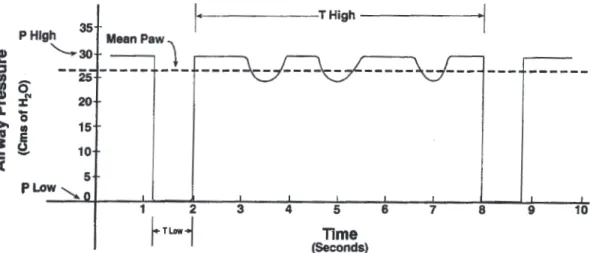
Unfortunately, a consistent vocabulary for APRV has failed to mature. Four commonly used terms include: pressure high (P High), pressure low (P Low), time high (T High), and time low (T Low).7P High is the baseline airway pressure level and is the higher of the two airway pressure levels. Other authors have described P High as the CPAP level,22 the inflating pressure,23 or the P1 pressure (P1). P Low is the airway pressure level re-sulting from the pressure release. Other au-thors may refer to P Low as the PEEP level,22 the release pressure,23 or the P2 pressure (P2). T High corresponds with the length of time for which P High is maintained; T Low is the length of time for which the P Low is held (i.e. for which the airway pressure is re-leased).
The mean airway pressure can be calcu-lated as follows:7
(P High T High) + (P Low T Low)
T High + T Low
Some ventilators may compute this auto-matically, making manual calculation redun-dant. Common terms associated with APRV are summarized in Table 2 and Figure 3.
Somewhat confusing to the understand-ing of APRV have been the subsequent de-scriptions of modes of ventilation that ap-pear very similar to it. Biphasic positive airway pressure (BIPAP)24,25 differs from APRV only in the timing of the upper and lower pressure levels. In BIPAP, T High usu-ally is shorter than T Low. One description of BIPAP25subdivides it into four categories, one of which is APRV-BIPAP.
Intermittent mandatory pressure release ventilation (IMPRV),26another mode of ven-tilation similar to and sometimes confused with APRV, synchronizes the release event with the patient’s spontaneous effort. The re-lease occurs after the patient’s second, third, fourth, fifth, or sixth spontaneous breath. Further, all spontaneous breaths are pressure supported to overcome the resistance associ-ated with breathing through the endotra-cheal tube and ventilator tubing. Synchro-nization does not occur with the raising of airway pressure, only the release. Because the concept of dyssynchrony in APRV has not been demonstrated clearly—and has
Figure 3.Airway pressure release ventilation terminology. Paw= airway pressure; P High = 30 centimeters of
wa-ter (cms of H2O); P Low = 0 cms of H2O, T High = 6.0 seconds; T low = 0.8 seconds; calculated mean Paw= 26.5
cms of H2O.
BiLevel ventilation28 is defined as aug-mented pressure ventilation that allows for unrestricted, albeit pressure-supported, spon-taneous breathing throughout the ventilatory cycle. Although similar to APRV, it incorpo-rates the option of pressure support in the air-way pressure waveform to augment sponta-neous breathing.
Indications for APRV
Airway pressure release ventilation was de-signed to oxygenate and augment ventila-tion for patients with ALI or low-compliance been stated not to be an issue—the necessity
of intermittent mandatory pressure release ventilation is questionable.10
Intermittent CPAP27is based on the prin-ciples of APRV but is intended for patients undergoing general anesthesia. Continuous positive airway pressure is applied at a level that will provide an adequate tidal volume, then removed for 1 second to pro-duce tidal ventilation, then reapplied. Un-like APRV, intermittent CPAP is not in-tended to restore normal functional residual capacity or improve oxygenation, and it can be discontinued abruptly.
TABLE 2 Summary of Airway Pressure Release Ventilation Terminology
Alternative Units of
Term Definition Names Measure
Pressure High Baseline airway pressure level CPAP level,22 Cm H 2O (P High)7 Higher of the two airway pressures Inflation pressure,23P1
Pressure Low Airway pressure level resulting from PEEP level,22Release Cm H 2O (P Low)7 pressure release. The lower of the two pressure,23P2
airway pressures
Time High Length of time for which P High is T1 Seconds (T High)7 maintained
Time Low Length of time for which P Low is T2 Seconds (T Low)7 maintained
Mean Paw (P High T High) (P Low T Low) — Cm H2O (T High T Low)7
CPAP continuous positive airway pressure; Cm H2O centimeters of water; PEEP positive end expiratory pressure;
lung disease.1,5,6 Airway pressure release ventilation also has been used successfully with patients with airway disease. Similar to CPAP, APRV can unload inspiratory muscles and decrease the work of breathing associ-ated with chronic obstructive pulmonary dis-ease.29 Unlike PEEP (an expiratory flow re-sistor, which decreases expiratory flow), peak expiratory flow rates are increased dur-ing the release phase of APRV, improvdur-ing expiratory flow limitation. Furthermore, dur-ing APRV, exhalation is not limited to the re-lease phase, as it is permitted throughout the respiratory cycle.
The main causes of hypoxemia associ-ated with ALI are shunting due to alveolar collapse and reduction in functional resid-ual capacity.1,7,30 Therefore, a primary goal of the treatment of ALI is recruitment of alveoli and prevention of derecruitment. Sustained plateau pressure is used to pro-mote alveolar recruitment, while being maintained at an acceptable level. In addi-tion, the number of respiratory cycles is minimized to prevent both the repetitive opening of alveoli and alveolar stretch, that may result in lung injury.
Patients in early-phase ALI often do not have impaired respiratory muscle strength or inadequate respiratory drive. Frequently, CPAP alone is sufficient to restore lung vol-ume and increase lung compliance. How-ever, when assistance with ventilation is re-quired, APRV can be used. Intermittent
airway pressure release allows alveolar gas to be expelled via natural lung recoil.1 Importance of Collateral Channels of Ventilation
Maintaining a constant airway pressure may be advantageous for several reasons. Con-stant airway pressure facilitates alveolar re-cruitment; enhances diffusion of gases; al-lows alveolar units with slow time constants to fill, preventing over-distension of alveoli; and augments collateral ventilation.31
Van Allen et al32 noted that complete ob-struction of an airway unit did not always re-sult in collapse of the alveoli and, therefore, hypothesized that alternative pathways must exist. The pores of Kohn, located in the septa of the alveoli and open only during inspira-tion,33 first were believed to be responsible. However, two additional pathways were later credited with playing a role: (1) Lambert’s canals connect terminal and respiratory bron-chioles with adjacent peribronchial alveoli, and (2) channels of Martin interconnect respi-ratory bronchioles and serve to bypass the main pathway (Figure 4).34
In normal, healthy lungs, collateral venti-lation may barely occur at the functional residual capacity level, i.e. end exhalation. However, alternative pathways may be opened at a higher lung volume.35 The role of alternative pathways in healthy lungs is very limited; but in disease states may be
portant.36 Although collateral ventilation is typically lost in pulmonary edema, collateral pathways may be reopened and oxygena-tion improved by increasing funcoxygena-tional resid-ual capacity.36 Sustained airway pressure, rather than intermittent periods of airway pressure, is more beneficial in the edema-tous, collapsed lung. Sustained breaths maintain a constant airway pressure and al-low collateral channels to assist in producing ventilation. Collateral ventilation efficiency drops as respiratory frequency increases.37 Airway pressure release ventilation uses these concepts, maintaining sufficient airway pressure for an adequate duration to open collapsed alveoli, thus improving recruit-ment of alveoli and increasing oxygenation.
Advantages
In patients with severe acute respiratory fail-ure, the use of APRV results in significantly lower peak Paw, when compared with con-tinuous positive pressure ventilation (CPPV). Lower airway pressures are thought to be as-sociated with a reduced risk of ventilator-as-sociated lung injury.14 Further, APRV re-quires lower minute ventilation than CPPV, suggesting less dead-space ventilation.23 Studies of patients with ALI have shown that APRV supports oxygenation and ventilation, while producing lower peak Pawthan volume assist-control ventilation5 and intermittent mandatory ventilation.8,11 Similarly, animal studies of injured lungs suggest lower airway pressure, reduced dead space ventilation, and improved oxygenation and ventilation, when compared with intermittent positive pressure ventilation.2
Airway pressure release ventilation re-cruits lung units by optimizing tory lung volume. Ideally, the end-inspira-tory pressure, which equates to P High or plateau pressure, should be kept beneath 35 cm of water pressure.9 This protective lung strategy has several positive effects. First, the preset pressure limit prevents, or limits, over-distension of alveoli and high-volume lung injury. Second, APRV affects tidal venti-lation by decreasing rather than increasing airway pressure. Decreasing lung volume for ventilation further limits air space over-dis-tension and the potential for high-volume
lung injury. Third, maintaining airway pres-sure optimizes recruitment and prevents or limits low-volume lung injury by avoiding the repetitious opening of alveoli.14
High-volume lung injury occurs as a re-sult of tidal ventilation above the upper in-flection point of the pressure-volume curve. Low-volume lung injury results from ventila-tion beginning beneath the lower inflecventila-tion point.17 Airway pressure release ventilation begins on the pressure-volume curve be-tween these two points and uses a release, not an increase, of pressure from its base-line. Therefore, oxygenation and ventilation occur predominantly within the upper and lower inflection points (Figure 5).
Calzia and Radermacher,38in their 10-year literature review of APRV, were unable to document any severe adverse effects of APRV and BIPAP on cardio-circulatory func-tion. One case report39 demonstrated an in-crease in cardiac output and blood pressure when APRV was used. Further, the authors suggested that it should be considered as an alternative therapy to pharmacologic or fluid therapy in the hemodynamically compro-mised, mechanically ventilated patient.
Animal studies indicate that APRV does not compromise circulatory function and tis-sue oxygenation, whereas CPPV can impair cardiovascular function significantly.40 Spon-taneous ventilation has a positive effect on the venous thoracic pump mechanism. Sup-pressing spontaneous breathing during CPPV can compromise cardiac function by decreas-ing venous return, thus cardiac output.4
The main advantage of APRV is that it al-lows for spontaneous breathing to occur at any point in the respiratory cycle. Depend-ing on the patient’s need, spontaneous breathing may involve only exhalation, only inspiration, or both.
The distribution of ventilation is signifi-cantly different when a spontaneous breath is compared with a mechanically controlled or assisted breath. Spontaneous breaths tend to improve ventilation-perfusion matching by preferentially aerating well-perfused, de-pendent lung regions. Mechanically deliv-ered breaths primarily ventilate areas away from those receiving maximal blood flow. This phenomenon is consistent with earlier research, which demonstrated that sponta-neous ventilation opens more alveoli,
im-proves regional gas exchange, and reduces atelectasis.41
Putensen et al.42,43 found that by allowing unsupported, spontaneous breathing (using BIPAP or APRV) in both dogs42and humans43 with ALI, ventilation-perfusion matching im-proved, as seen by a marked decrease in in-trapulmonary shunt. In humans, however, pressure support ventilation preferentially ventilated poorly or nonperfused lung units that already were well ventilated. Further-more, pressure support ventilation did not convert shunted areas to normal ventilation-perfusion units.43
Decreased need for sedation use or neuro-muscular blockade use with APRV7,8 and BI-PAP25 has been reported. Judicious use of se-dation and paralysis in the mechanically ventilated patient was recommended at the American-European Consensus Conference on ARDS.21 Unintentional, prolonged paralysis is now recognized as a complication of the long-term use of paralytics. In addition, a paralyzed diaphragm moves very differently with posi-tive pressure ventilation compared with an ac-tive contraction. The paralyzed diaphragm is displaced preferentially along the path of least resistance, that is, into the abdomen of the non dependent region. This displacement leads to favored ventilation of the nondependent lung
regions.41All of this contributes to both ventila-tion-perfusion mismatch and possible over-dis-tension of healthy alveoli, leading to further hypoxemia (Table 3).
Disadvantages
Consistent with other pressure-targeted modes of ventilation, APRV is affected by changes in lung compliance and/or resis-tance. Clinicians need to identify the scenar-ios that affect lung volume and monitor pa-tients for changes in their tidal volumes.
Because APRV is time-cycled, synchrony with the patient’s spontaneous respiration does not occur. If a release phase is not syn-chronous with the patient’s effort, discomfort may result. However, because APRV has a dy-namic pneumatic system, inspiration and exha-lation are facilitated at any time. Dyssynchrony with APRV has not been identified as a prob-lem in the majority of the literature to date.5,6,11 As with any new technology, staff stress and subsequent increased risk to the patient may be noted with the implementation of APRV. Adequate and appropriate on-site train-ing, coupled with off-site support services and backup, will help resolve some of the stress and decrease the risks associated with the
in-Figure 5.Pressure-volume curve. Conceptual drawing of airway pressure release ventilation occurring below the upper inflection point and above the lower inflection point, achieving goals of lung protective strategies.
troduction of APRV. Transferring patients to subacute areas as their disease processes im-prove, may cause these issues to be revisited. Further, these areas may not have access to ventilators capable of delivering APRV, which will require switching the patient to a different mode of ventilation. Similarly, traveling to other departments (e.g., radiology, hyperbaric oxygenation chamber) may require temporary discontinuation of APRV, causing undue anxi-ety or discomfort in some patients.
Finally, only limited research exists re-garding the clinical practice of APRV and its comparison with other modes. For example, APRV is suitable for ventilator weaning, though its superiority to mainstream modes, e.g. pressure support ventilation, has not been demonstrated. Weaning, in general, lacks a consensus, and this absence of ab-solutes exemplifies the great confusion within clinical practice and within the study of mechanical ventilation (Table 3).
Application of APRV
Little direction on the application of APRV can be found in the literature, other than as sug-gested by vendors and limited study proto-cols. However, based on an understanding of pulmonary physiology and pathophysiology, coupled with the theoretical understanding of mechanical ventilation44 and current recom-mendations from consensus conferences,9,21 the following technique has evolved.
When changing a patient’s mode of venti-lation to APRV, the initial settings are partly deduced from values of conventional ventila-tion. The clinician converts the plateau pres-sure of the conventional mode to P High and seeks an expired minute ventilation of 2 to 3 L/minute, less than when on conventional ventilation. This is accomplished by setting P High at the plateau pressure, with a ceiling level for the P High normally at 35 cm of wa-ter pressure. P Low is set at 0 cm of wawa-ter pressure. A P Low of zero produces minimal expiratory resistance, thus accelerating expi-ratory flow rates, facilitating rapid pressure drops. T High is set at a minimum of 4.0 sec-onds. A T High of less than 4.0 seconds be-gins to impact mean Pawnegatively. T Low is set between 0.5 and 1.0 seconds (often at 0.8 seconds). With these settings (P High = 35 cm of water pressure, P Low = 0 cm of water
pressure, T High = 4.0 seconds, T Low = 0.8 seconds), the mean Paw will equal 29.2 cm of water pressure. It is not possible for conven-tional volume targeted modes to maintain a mean Pawof 29 cm of water pressure and limit the peak or plateau pressures to 35 cm of wa-ter pressure, and still produce sufficient tidal ventilation.44
Application of APRV to newly intubated patients usually involves using standard pa-rameters and adjusting the settings accord-ingly. Commonly, in the patient with moder-ate to severe ALI we default to P High/P Low of 35/0 cm of water pressure and T High/T Low of 4.0/0.8 seconds and allow sponta-neous breathing to take place.44
When attempting to avoid alveolar over-distension, the clinician must be cognizant of the plateau pressure, as this is the best clinically available estimate of average alveo-lar pressure.9 Although based primarily on animal data, a plateau pressure (or P High) greater than 35 cm of water pressure is asso-ciated with lung injury and, therefore, should be kept beneath this level.
Rarely, an elevated P High (40–45 cm of water pressure) may be indicated, especially
TABLE 3 Advantages and
Potential Disadvantages of Airway Pressure Release Ventilation A
Addvvaannttaaggeess
1. Lower Pawfor a given tidal volume compared with volume-targeted modes, e.g., AC, SIMV 2. Lower minute ventilation, i.e., less dead space
ventilation
3. Limited adverse effects on cardio-circulatory function
4. Spontaneous breathing possible throughout entire ventilatory cycle
5. Decreased sedation use
6. Near elimination of neuromuscular blockade use
P
Pootteennttiiaall DDiissaaddvvaannttaaggeess
1. Volumes change with alteration in lung compliance and resistance
2. Process of integrating new technology 3. Limited access to technology capable of
delivering APRV
4. Limited research and clinical experience Paw airway pressure; A-C assist control;
SIMV synchronized intermittent mandatory ventilation; APRV airway pressure release ventilation.
for patients with low-compliance respiratory systems, (e.g., individuals with morbid obe-sity, abdominal distension, or chest wall edema), either for the purpose of oxygena-tion or ventilaoxygena-tion.44 Although not optimal, the increased P High would be less than the pressure generated by conventional modes to produce a similar response.22
The P Low of zero is selected because min-imal resistance to exhalation is the goal. Higher pressures may impede expiratory gas flow during passive lung recoil. The valid concern of collapsing alveoli with a P Low of zero is negated with the use of a short T Low (0.5–0.8 seconds) to maintain end expiratory lung volume.
The minimum T High duration is 4.0 sec-onds. The goal is to create a nearly continu-ous airway pressure level, which serves to recruit collapsed alveoli and maintain re-cruitment, thus optimizing oxygenation and compliance. As a patient’s lung mechanics improve, T High is progressively lengthened to 12 to 15 seconds, usually in 0.5 to 2.0 sec-ond increments.44A further advantage of the long T High is the reduction in the number of opening and closings of the small airways, one of the mechanisms implicated in the de-velopment of iatrogenic ALI.14
The T Low probably is the most closely studied of the 4 parameters. Early writings5,22 suggested a T Low of 1.5 seconds as the norm, which allows for complete emptying of the lungs. A longer T Low (3.0–4.0 seconds) in animals with ALI was associated with a de-crease in arterial oxygenation and the accu-mulation of hemorrhagic fluid in the endotra-cheal tube.5 An excessively long T Low encourages alveolar derecruitment, atelecta-sis, and airway closure during the release phase. Alternatively, an insufficient T Low po-tentially may result in inadequate exhalation, leading to dead space ventilation, hypercap-nia, and hemodynamic compromise.45 In-deed, an appropriately timed T Low is vital.44 Optimal release time allows for adequate ventilation while minimizing lung volume loss. Essentially, release time should impede complete exhalation in the slower compart-ments of the lung (i.e., areas of high compli-ance or high resistcompli-ance to exhalation) and generate regional intrinsic PEEP. Theoreti-cally, this will enhance alveolar recruitment.4,7 Calculation of T Low depends on expira-tory time constants (T), which are a product of the compliance of the respiratory system (CRS) and the resistance of the airways (RAW); that is, T = CRS RAW.4,45
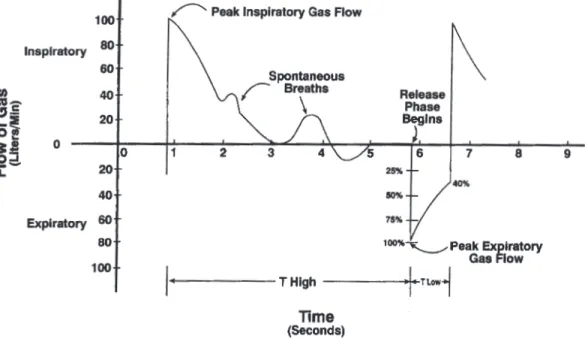
Low-compli-Figure 6.Inspiratory and expiratory flow of gas in airway pressure release ventilation.44In this example, T Low
terminates at 40% of the peak expiratory gas flow. Baseline airway pressure is then rapidly re-established. T High = 6.0 seconds; T Low = 0.8 seconds.
ance states, such as ARDS, will have lower (or shorter) expiratory time constants and therefore a lower (or shorter) T Low. High resistance diseases, such as asthma, will have longer time constants and require longer release times.45 Determining the cor-rect multiple of time constants to calculate T Low is a challenge of future research.
In practice, however, the clinician does not calculate the time constants for each patient, but rather relies on an approximation of the restriction of expiratory flow, as indicated by the expiratory flow of gas waveform (Figure 6). When expiratory flow falls to approxi-mately 25% to 50% of peak expiratory flow, the clinician stops the release time and allows the airway pressure to return to P High.44
The transition to APRV may not result in instant improvement in oxygenation. Consis-tent with observations of inverse ratio venti-lation,4the positive effects may take several hours to be realized. It appears that the re-cruitment of alveoli occurs “one by one.” Sydow et al.7demonstrated that the maximal beneficial effect of APRV upon oxygenation occurred 8 hours after implementation, with no further improvement after 16 hours. In earlier studies, data were collected within the first 60 minutes after transition to APRV and thus the full effect of time on alveolar recruitment was not appreciated.
Weaning From APRV
The current technique of weaning from APRV is guided by general principles of weaning used in clinical practice today. Knowledge of the signs of respiratory failure, as well as exclu-sion or correction of contributing factors pre-venting successful weaning, such as excessive secretions, bronchospasm, sepsis, anxiety, and diameter of endotracheal tubes and other dead space devices, are paramount. The approach in APRV is to maintain lung volume, improving both oxygenation and ventilation. As such, rarely does a specific point in time occur when weaning is “officially” commenced.
Primarily, the method to reduce support is through manipulation of P High and T High. P High will be lowered 2 to 3 cm of water pres-sure at a time, and T High will be lengthened in 0.5- to 2.0-second increments, depending on patient tolerance. The goal is to arrive at straight CPAP—usually at 12 cm of water pres-sure—and then the clinician either weans CPAP or simply extubates the patient at 6 to 12 cm of water pressure. Before switching to CPAP, P High often is approximately 14 to 16 cm of water pressure and T High is at 12 to 15 seconds (Table 4).44Patients with more severe forms of ALI or ARDS are weaned on a slower basis. Changes in mean Paw are monitored closely for their effect on oxygenation.
Simi-TABLE 4 Example of Airway Pressure Release Ventilation Settings in an
Uncomplicated Case of Acute Lung Injury43*
Calculated Mean
P High T High P Low T Low Airway Pressure
(cm H2O) (seconds) (cm H2O) (seconds) (cm H2O)
35 4.0 0 0.8 29.2 33 4.5 0 0.8 28.0 30 5.0 0 0.8 25.9 28 5.5 0 0.8 24.4 26 6.0 0 0.8 22.9 23 7.0 0 0.8 20.6 20 8.0 0 0.8 18.2 18 10.0 0 0.8 16.7 15 12.0 0 0.8 14.1
*Following the final settings, the patient was transitioned to CPAP of 12 cm of water pressure.
CPAP continuous positive airway pressure; Cm H2O centimeters of water; P High pressure high; T High time high; P
larly, exhaled minute ventilation is tracked in conjunction with CO2removal.
Conclusion
Airway pressure release ventilation can maintain oxygenation and ventilation at a level comparable to CPPV. Airway pressure release ventilation is associated with signifi-cantly lower peak airway pressures and dead space ventilation. Airway pressure re-lease ventilation uses almost constant airway pressure that not only facilitates alveolar re-cruitment but also sustains that rere-cruitment once it has occurred. Spontaneous, unsup-ported breathing during APRV may occur at any point in the ventilatory cycle. Sponta-neous breathing is advantageous because it decreases intrapulmonary shunting and im-proves venous return. The ability to avoid neuromuscular blockade and decreased use of sedation have resulted in fewer complica-tions and decreased drug costs. Finally, ven-tilator-associated lung injury, which can re-sult from both high- and low-volume lung ventilation, may be balanced and averted.
Few clinicians believe that any single, iso-lated treatment can be responsible for a ma-jor improvement in the outcome for patients with ARDS. Combination therapy is expected to be the standard, including such concepts as prone positioning and permissive hyper-capnia. Part of that therapy may include the ventilator strategy of APRV, which incorpo-rates the advantages listed above. The au-thors believe that future research will support the use of APRV as the mode of choice for patients with ALI and ARDS.
Acknowledgments
The authors thank Jill Kuramoto for her sug-gestions and constructive criticism, and Kris Dorman for reviewing the manuscript. References
1. Downs JB, Stock MC. Airway pressure release ventilation: a new concept in ventilatory sup-port. Crit Care Med.1987;15:459–461. 2. Stock MC, Downs JB, Frolicher D. Airway
pressure release ventilation. Crit Care Med.
1987;15:462–466.
3. Rasanen J. Airway pressure release ventila-tion. In: Tobin MJ, ed. Principles and Practice
of Mechanical Ventilation. New York: Mc-Graw-Hill, Inc.; 1994:341–348.
4. Burchardi H. New strategies in mechanical ventilation for acute lung injury. Eur Respir J.
1996;9:1063–1072.
5. Stock MC, Downs JB. Airway pressure release ventilation: a new approach to ventilatory support during acute lung injury. Respir Care Clin N Am.1987;32:517–524.
6. Garner W, Downs JB, Stock MC, Rasanen J. Airway pressure release ventilation (APRV): a human trial. Chest.1988;94:779–781.
7. Sydow M, Burchardi H, Ephraim E, Zielmann S, Crozier TA. Long-term effects of two differ-ent vdiffer-entilatory modes on oxygenation in acute lung injury: comparison of airway pres-sure release ventilation and
volume-controlled inverse ratio ventilation. Am J
Respir Crit Care Med.1994;149:1550–1556. 8. Davis K, Johnson DJ, Branson RD, Campbell
RS, Johannigman JA, Porembka D. Airway pressure release ventilation. Arch Surg.1993; 128:1348–1352.
9. Slutsky AS (chairman). ACCP consensus con-ference: mechanical ventilation. Chest. 1993; 104:1833–1859.
10. Rasanen J. IMPRV: Synchronized APRV, or more [editorial]? Intensive Care Med.1992;18: 65–66.
11. Rasanen J, Cane RD, Downs JB, et al. Airway pressure release ventilation during acute lung injury: a prospective multicenter trial. Crit Care Med.1991;19:1234–1241.
12. Milberg JA, Davis DR, Stienberg KP, Hudson LD. Improved survival of patients with acute respiratory distress syndrome (ARDS):
1983–1993. JAMA.1995;273:306–309.
13. Brower RG, Matthay MA, Morris A, et al. Ven-tilation with lower tidal volumes as compared with traditional tidal volumes for acute lung injury and the acute respiratory distress syn-drome. N Engl J Med.2000;342:1301–1308. 14. Dreyfuss D, Saumon G. Ventilator-induced
lung injury: lessons from experimental
stud-ies. Am J Respir Crit Care Med. 1998;157:
294–323.
15. Amato MBP, Barbas CSV, Medeiros DM, et al. Beneficial effects of the “open lung ap-proach” with low distending pressures in acute respiratory distress syndrome: a prospective randomized study on mechanical ventilation. Am J Respir Crit Care Med. 1995; 152:1835–1846.
16. Amato MBP, Barbas CSV, Medeiros DM, et al. Effect of a protective-ventilation strategy on mortality in the acute respiratory distress syn-drome. N Engl J Med.1998;338:347–354. 17. Hickling KG. The pressure-volume curve is
mathemat-ical model of ARDS lungs. Am J Respir Crit Care Med.1998;158:194–202.
18. Jonson B, Richard J-C, Straus C, Mancebo J, Lemaire R, Brochard L. Pressure-volume curves and compliance in acute lung injury: evidence of recruitment above the lower
in-flection point. Am J Respir Crit Care Med.
1999;159:1172–1178.
19. Gattinoni L, Pelosi P, Crotti S, Valenza F. Ef-fects of positive end-expiratory pressure on regional distribution of tidal volume and re-cruitment in adult respiratory distress
syn-drome. Am J Respir Crit Care Med. 1995;151:
1807–1814.
20. Carney DE, Bredenberg CE, Schiller HJ, et al. The mechanism of lung volume change dur-ing mechanical ventilation. Am J Respir Crit Care Med.1999;160:1697–1702.
21. Artigas A, Bernard GR, Carlet J, et al. The American-European consensus conference on ARDS, part 2: ventilatory, pharmacologic, supportive therapy, study design strategies and issues related to recovery and remodel-ing. Intensive Care Med.1998;24:378–398. 22. Valentine DD, Hammond MD, Downs JB,
Sears NJ, Sims WR. Distribution of ventilation and perfusion with different modes of me-chanical ventilation. Am Rev Respir Dis.1991; 143:1262–1266.
23. Cane RD, Peruzzi WT, Shapiro BA. Airway pressure release ventilation in severe acute respiratory failure. Chest. 1991;100:460–463 24. Baum M, Benzer H, Putensen C, Koller W, Putz G. Biphasic positive airway pressure (BI-PAP): a new form of assisted ventilation.
Anaesthesist.1989;38:432–458.
25. Hormann C, Baum M, Putensen C, Mutz NJ, Benzer H. Biphasic positive airway pressure (BIPAP): a new mode of ventilatory support.
Eur J Anaesthesiol.1994;11:37–42.
26. Rouby JJ, Ben Ameur M, Jawish D, et al. Con-tinuous positive airway pressure (CPAP) vs. intermittent mandatory pressure release ven-tilation (IMPRV) in patients with acute respi-ratory failure. Intensive Care Med. 1992;18: 69–75.
27. Bratzke E, Downs JB, Smith RA. Intermittent CPAP: a new mode of ventilation during
gen-eral anesthesia. Anesthesiology. 1998;89:
334–340.
28. Puritan Bennett Company. Two ventilating strategies in one mode: BiLevel. St. Louis, MO: Puritan Bennett Company; 1999. 29. Petrof BJ, Legare M, Goldberg P, Milic-Emili J,
Gottfried SB. Continuous positive airway pressure reduces work of breathing and dys-pnea during weaning from mechanical venti-lation in severe chronic obstructive pul-monary disease. Am Rev Respir Dis.1990;141: 281–289.
30. Smith RA, Smith DB. Does airway pressure release ventilation alter lung function after
acute lung injury? Chest.1995;107:805–808.
31. Davis K Jr., Branson RD, Campbell RS, Porembka DT. Comparison of volume con-trol and pressure concon-trol ventilation: is flow
waveform the difference? J Trauma. 1996;
41: 808–814.
32. Van Allen CM, Lindskog GE, Richter, HG. Col-lateral respiration: Transfer of air colCol-laterally between pulmonary lobules. J Clinical Invest.
1941;10:559.
33. Brashers VL, Davey SS. Alterations of pul-monary functions. In: McCance KL, Huether SE, eds. Pathophysiology: The Biologic Basis for Disease in Adults and Children. 3rd ed. St Louis, MO; Mosby; 1998:1165–1166.
34. Corrin B. Pathology of the Lungs.New York,
NY: Churchill Livingstone; 2000:4.
35. Terry PB, Traystman RJ, Newball HH, Batra G, Menkes HA. Collateral ventilation in man.
N Engl J Med.1978;298:10–15.
36. Delaunois L. Anatomy and physiology of col-lateral respiratory pathways. Eur Respir J. 1989; 2:893–904.
37. Menkes HA, Traystman RJ. Collateral
venti-lation. Am Rev Respir Dis. 1977;116:
287–309.
38. Calzia E, Radermacher P. Airway pressure re-lease ventilation and biphasic positive airway pressure: a 10-year literature review. Clinical Intensive Care.1997;8:296–301.
39. Falkenhain SK, Reilley TE, Gregory JS. Im-provement in cardiac output during airway pressure release ventilation. Crit Care Med.
1992;20:1358–1360.
40. Rasanen J, Downs JB, Stock MC. Cardiovascu-lar effects of conventional positive pressure ventilation and airway pressure release venti-lation. Chest.1988;3:911–915.
41. Froese AB, Bryan AC. Effects of anesthesia and paralysis on diaphragmatic mechanics in man. Anesthesiology.1974;41:242–255. 42. Putensen C, Rasanen J, Lopez FA.
Ventilation-perfusion distributions during mechanical ventilation with superimposed spontaneous breathing in canine lung injury. Am J Respir Crit Care Med.1994;150:101–108.
43. Putensen C, Norbert JM, Putensen-Himmer G, Zinserling J. Spontaneous breathing during ventilatory support improves ventilation-per-fusion distributions in patients with acute res-piratory distress syndrome. Am J Respir Crit Care Med.1999;159:1241–1248.
44. Habashi NM. APRV:Principles and Practice.
Luebeck, Germany: Draegerwerk. In press. 45. Martin LD, Wetzel RC. Optimal release time during airway pressure release ventilation in
neonatal sheep. Crit Care Med. 1994;22: