An Investigation of the Implicit Control of the Processing
of Negative Pictures
Jenny Yiend
University of OxfordAndrew Mathews
University of California, DavisBecky Weston
University of SouthamptonBarnaby D. Dunn and Rhodri Cusack
MRC Cognition and Brain Sciences UnitBundy Mackintosh
University of East Anglia and MRC Cognition and Brain Sciences Unit
The implicit control of emotion processing was investigated by varying encoding instructions for both negative and neutral pictures while measuring psychophysiological responses. Participants made com-parative judgments about consecutive pictures for blocks of neutral or negative content. The highly specified judgment task was designed to minimize variance in the implementation of implicit control of processing. Affective modulation of startle amplitude was significantly reduced during judgments involving nonnegative content (how “planned” an image was compared to its predecessor), compared to those that involved negative content (how “frightening” an image was compared to its predecessor), indicating successful implicit control of processing. The more attenuated affect modulation was, the less anxious individuals became during the task, suggesting that the implicit control of emotion processing is significantly associated with emotional experience. These data provide convergent evidence for a companion neuroimaging study because of the similar neural substrates thought to underlie affective modulation of startle. This supports the view that higher-level top-down pathways modulate activation of the amygdala.
Keywords:attention, startle, control, threat, emotion
The degree of control that individuals have over the processing of information related to negative emotion has been the subject of considerable research interest over recent years (Davidson, Jack-son, & Kalin, 2000; Gross, 2001, 2002; Ochsner & Gross, 2005). There is a long history within the psychological literature suggest-ing that some degree of control of emotion is possible. This dates back to Lazarus’ early work in which participants were required to watch evocative filmstrips (e.g., a gruesome workshop accident or a circumcision ritual: Lazarus, 1982; Lazarus & Opton, 1966). The critical manipulation involved listening to different soundtracks during viewing that encouraged intellectualisation (focusing on the cultural or technical contents) or denial (describing the people as actors who were not experiencing real pain). Both self report and psychophysiological responses were reduced relative to an
unin-structed control, providing possibly the first evidence of the influ-ence of top down control on emotional processing.
Since this seminal study, a considerable empirical and theoret-ical literature has developed around the role of cognitive appraisal in the modulation of emotion (e.g., Gross, 2001, 2002; Lazarus & Smith, 1988; Ochsner & Gross, 2005). Many studies have used explicit requests to participants to control their behavioral or emotional experience. For example, Ochsner and colleagues ex-amined neural activations associated with reappraisal by asking participants to ‘interpret photos so that they no longer felt negative in response to them’ (Ochsner, Bunge, Gross, & Gabrieli, 2002). In contrast to simply viewing the pictures, reappraisal reduced both amygdala activation and subjective experience of negative emo-tion. The same comparison also showed increased activation of prefrontal areas presumably linked to the implementation of reap-praisal strategies.
However, the above example, as well as many other studies, lack specificity over how participants implement the regulation of their emotions making interpretation difficult. Participants are generally told what to achieve, rather than how to achieve it. This point is illustrated by the psychophysiological study of Jackson and colleagues (Jackson, Malmstadt, Larson, & Davidson, 2000) in which students were instructed to either suppress or enhance their emotional response to negative pictures. Startle amplitudes were significantly decreased and increased respectively but the
Jenny Yiend, Department of Psychiatry, University of Oxford; Andrew Mathews, Department of Psychology, University of California, Davis; Becky Weston, Doctoral Programme in Clinical Psychology, University of Southampton; Barnaby D. Dunn and Rhodri Cusack, MRC Cognition and Brain Sciences Unit, Cambridge; Bundy Mackintosh, School of Medicine, Health Policy & Practice, University of East Anglia and MRC Cognition and Brain Sciences Unit, Cambridge.
Correspondence concerning this article should be addressed to Jenny Yiend, Department of Psychiatry, Warneford Hospital, Oxford OX3 7JX, United Kingdom. E-mail: [email protected]
authors acknowledge uncertainty concerning exactly what strate-gies participants used. Possibilities include specific cognitive pro-cesses such as appraisal or selective attention as well as changes in alertness, general task engagement, approach/withdrawal behavior or a varying combination of these. Recent studies have started to investigate some of these putative mechanisms of implementing control (e.g., Gross, 2002).
The Current Study
The objective of the current study was to investigate the degree of control that individuals have over emotional processing and how this influences their emotional experience, while minimizing the potential variance in how this control is executed. Psychophys-iological and functional imaging research has used increasingly specific instructions concerning how volitional control should be exerted, while retaining the explicit objective for participants to ‘control their emotion.’ An even more rigorous and constrained approach is to sacrifice the volitional aspects of control, focusing instead on ‘implicit control.’ For example, one might use a primary cognitive task where successful performance implicitly requires control of emotional processing. In this study, we chose to inves-tigate the latter phenomenon that we describe as “implicit control” in contrast to ‘volitional control,’ where participants have explicit knowledge of the experimenter’s requirement for them to manip-ulate emotional experience or behavior. We use the term “implicit” here, not in its strictest conceptual sense involving cognition in the demonstrable absence of awareness, but rather in an operational sense to denote a presumed consequence of our manipulation and one that may or may not have been known to participants.
Several neuroimaging studies have used methods of implicit control, such as specific judgments about the nature or content of task stimuli, to explore modulation of emotion processing (see Mathews, Yiend, & Lawrence, 2004, for a more extensive review). Consistent with the current hypothesis that the processing of negativity is amenable to top down effects, simply rating the subjective experience of viewing emotional stimuli has shown significant reduction of activation, compared to passive viewing in amygdala and insula (Taylor, Phan, Decker, & Liberzon, 2003). Emotional discrimination judgments enhance amygdala and other limbic activation compared to neutral judgments, such as age categorization (Gur, Schroeder, Turner, McGrath, Chan, Turetsky, et al., 2002). Furthermore, areas known to be associated with top down control have been directly linked to modulation of emotion processing by task manipulations in some studies. For example Hariri, Bookheimer, and Mazziotta (2000; see also Hariri, Mattay, Tessitore, Fera, & Weinberger, 2003) found that verbal labeling of facial emotion reduced amygdala response compared to perceptual matching and that this reduction correlated with a simultaneous increase in right prefrontal activation.
Anxiety and Implicit Control
One aspect of our investigation was to examine the relationship between the anxious mood elicited by our stimuli and the implicit control of the processing of those stimuli. There is a long tradition of research (see above) underpinned by the hypothesis that the experience of emotion can be significantly influenced by the manner in which cognitive processes act upon incoming emotion
relevant information. Our experiment involved a manipulation designed to influence the manner and extent of this cognitive processing and an objective measure (startle blink response) of the extent to which this was achieved. We therefore hypothesized that participants’ success at implementing our manipulation as indexed by startle blink response should be significantly related to their subjective emotional experience of viewing the stimuli. Those who were more successful at processing the nonemotional aspects of negative stimuli and ignoring their emotional content should ex-perience less anxiety as a result of viewing these stimuli. The cumulative effect of this should be captured by related changes in state anxiety across time.
There is a precedent in the recent literature for a specific relationship between individual differences in anxiety (or anxiety-related phenomena) and the effortful control of cognitive process-ing. For example better self reported attentional control is associ-ated with less attentional bias toward negative information (Derryberry & Reed, 2002), enhanced anterior cingulate activation and lower individual levels of anxiety (Mathews et al., 2004). Furthermore, anxiety-related differences in control form the basis of influential theories in individual differences (Eysenck, Deraks-han, Santos, & Calvo, 2007).
There is good reason to believe that the stimuli used in the present study (International Affective Picture System; Lang, Brad-ley, & Cuthbert, 1999) have sufficient impact to elicit significant emotional experience (e.g., Lang, Greenwald, Bradley, & Hamm, 1993). First, the stimuli were developed and standardized on this basis, using normative self-reported ratings of emotional experi-ence in response to passive viewing (Lang, Bradley, & Cuthbert, 1999). Second pictures were selected for use in this study accord-ing to these rataccord-ings to maximize their subjective emotional impact and included some of the most highly arousing and negatively valenced items. Finally, exposure to such stimuli can result in cumulative effects on mood state that extend beyond the task (Smith, Bradley, & Lang, 2005). Smith and colleagues showed that blocks of unpleasant pictures produced additive effects on state anxiety as well as physiological correlates (including startle blink response) leading them to suggest that such exposure may be a useful form of short term mood induction (Smith, Bradley, & Lang, 2005).
Startle Blink Response as a Dependent Measure
Affective modulation of startle was chosen as the main depen-dent measure because, of all the commonly used psychophysio-logical variables, startle is known to be the most specifically sensitive to the perception of threat (e.g., Stanley & Knight, 2004). It can serve as a continuous measure of the amplitude of a negative emotional context and is a well studied phenomenon in its own right (see Blumenthal, Cuthbert, Fillon, Hackley, Lipp, & van Boxtel, 2005; Cacioppo, Tassinary, & Berntson, 2007). This makes it ideally suited to quantifying the success of implementing instructions to increase or decrease the processing of emotional aspects of a stimulus.
Startle blink responses are reflexes produced by a series of involuntary eye muscle movements, in response to a trigger such as a sudden loud noise. Although reflexes are commonly consid-ered invariant, modulation by contextual factors has long been known (Bowditch & Warren, 1890). Startle can be affected by
stimuli (so called “lead” stimuli) presented before, during and after the startle eliciting stimulus itself (Dawson, Schell, & Bohmelt, 1999).Affective modulationof startle refers to the robust finding that startle response is significantly augmented in the presence of negative stimuli, such as threatening pictures (Bradley, Cuthbert, & Lang, 1999). This can be distinguished fromfear-potentiated startle, which usually refers to a similar augmentation elicited specifically during fear conditioning. One of the earliest examples of affective modulation was Vrana, Spence, and Lang’s (1988) seminal study, in which viewing unpleasant pictures elicited sig-nificantly larger startle responses (and pleasant pictures smaller) than viewing neutral pictures. This has been confirmed by the subsequent corpus of literature on affective modulation of startle (e.g., Dawson, Schell, & Bohmelt, 1999; Grillon & Baas, 2003).
A Conceptual Replication
A further reason for choosing affective modulation of startle as our dependent measure was its suitability to provide a conceptual replication for some key findings reported by Mathews et al. (2004). We conducted a neuroimaging study comparing emotional and neutral judgments made about pictures varying in negative content. Findings suggested that amygdala activations typically associated with uninstructed viewing of negative pictures were significantly reduced when judgments about nonemotional aspects of these pictures were required. This suggested that task instruc-tions to direct processing toward nonemotional content were suc-cessfully implemented. Prefrontal areas and cingulate cortex also showed significantly increased activations in this contrast, consis-tent with increased levels of “top down” control. Here we used a near-identical judgment task that remained clearly specified, al-lowing a high degree of experimental precision about processing undertaken. Specifically, we sought to validate these previous findings using an independent measure, affective modulation of the eyeblink startle response.
The neural pathways involved in affective modulation of startle are thought to map very closely onto those implicated in the data we sought to replicate (Mathews et al., 2004). Animal work points to three sets of neurones comprising startle circuitry with one of these, the nucleus reticularis pontalis caudalis, receiving excitatory projections from nuclei in the amygdala (Lee & Davis, 1997). Lesion studies suggest these projections may be essential for fear potentiation (Shi & Davis, 2001). Work in humans suggests sim-ilarities with the animal literature and points to analogous brain areas, especially the amygdala, involved in human fear-potentiated and affectively modulated startle (e.g., Angrilli, Mauri, Palomba, Flor, Birbaumer, Sartori, et al., 1996; Funayama, Grillon, Davis, & Phelps, 2001; Pissiota, Frans, Michelgard, Appel, Langstrom, Flaten, et al., 2003). Taken together this work suggests that affec-tive modulation of startle could serve as an appropriate additional indicator of amygdala modulation, allowing comparison with our fMRI data (Mathews et al., 2004).
Summary and Hypotheses
The present experiment examined whether processing of nega-tive material could be implicitly controlled by asking participants to alter the way in which emotional and neutral material was encoded and measuring contingent changes in the degree of
affec-tive modulation of startle. The task involved making either emo-tional (how frightening/how pleasant) or nonemoemo-tional (how planned/arranged) comparisons between consecutive pictures for sets of neutral and negative images. The ‘one-back’ task required comparisons between the currently viewed and the immediately preceding picture. This design feature was intended to produce a heavy working memory load, to constrain the extent of nonin-structed additional processing undertaken.1 Any effects should
therefore be relatively unambiguously attributable to the specific processing required by the task.
Our first prediction, based on previous findings, was that pro-cessing of negative material would be amenable to implicit top-down control, by means of instructed encoding. This was assessed in two ways, first by the direct contrast in startle amplitude to negative pictures under emotional (i.e., judgments of “how fright-ening”) and nonemotional (i.e., judgments of “how planned”) encoding conditions. Second, measures of affective modulation were obtained by subtracting the amplitude of startle while pro-cessing neutral pictures from that while propro-cessing negative pic-tures within each type of instruction. Implicit top-down control would be indicated if affective modulation were significantly greater under emotional encoding conditions (“how pleasant” for neutral pictures/“how frightening” for negative pictures) compared to nonemotional encoding (“how planned”).
Our second prediction was that greater success at implicitly controlling encoding would be associated with smaller increases in anxious mood because of the relatively reduced processing of negative information. This was assessed by correlations between mood change across the task and the indices described above of implicit top-down control.
Method
Design
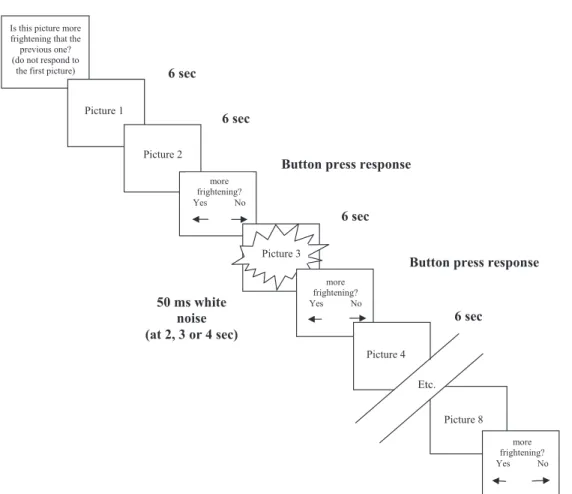
The within-participant design comprised two encoding condi-tions, emotional and nonemotional crossed with two picture types, negative and neutral. The task required participants to make cat-egorical decisions (Yes/No) according to how each picture com-pared with the previous one. Participants made the same compar-ison over blocks of eight consecutive pictures, before switching to a different comparison in a counterbalanced block design. In the nonemotional encoding condition participants were asked to assess each picture according to whether it was ‘more planned or ar-ranged by the photographer’ compared to the previous picture. In the emotional encoding condition participants categorized either whether the picture was “more pleasant” (neutral picture blocks) or “more frightening” (negative picture blocks) than the previous one. Short bursts of white noise acted as the startle probes. These were delivered according to a pseudo-randomized schedule at one of three possible time points during picture viewing and allowed us to assess the effects of type of encoding on the startle response. Figure 1 illustrates a typical experimental block.
1On each new trial the previous trial’s target picture now becomes the comparator picture for the newly presented item, thus leading to a contin-uous requirement to maintain and update working memory.
Participants
One hundred and forty individuals from the Medical Research Council Cognition and Brain Sciences Unit’s volunteer panel were invited to participate. In accordance with local ethical require-ments, letters of approach were sent requesting return of reply slips authorizing further contact. Exclusion criteria, were participation in similar studies, history of brain damage, current psychotropic medication use or treatment for psychiatric illness. Eligibility was ascertained through panel records and telephone screening con-ducted by a trained researcher (BW) before participation. Of eligible respondents, 31 agreed to participate but data from 12 were excluded as incomplete: one because of distress during the session and the rest because of either absent (5) or rapidly atten-uating (6) startle responses. The final sample of 19 comprised 14 female and 5 male (mean age 32, SD 11.6). Mean trait anxiety level was 35.4 (SD 9.1) and state anxiety level 34.2 (SD 9.2) measured by the Spielberger state-trait anxiety questionnaire (Spielberger, Gorsuch, Lushene, Vagg, & Jacobs, 1983).
Materials and Equipment
Pictures (64) were selected from the International Affective Picture System2(Lang et al., 1999) based on the normative ratings
provided and comprised 32 with negative ratings and content and
32 neutral. The content of pictures in both sets was individually matched for nonemotional content. For example, a picture of a large snarling dog was matched with another of a docile-looking dog, and a picture of an assault in progress (a man attacking a woman) was matched with a picture of a relaxed couple (man and woman). Negative and neutral stimuli were each divided into four sets of eight pictures, to yield two picture sets per encoding condition (nonemotional, emotional) for each valence (neutral, negative). Picture sets were randomly assigned to encoding con-dition automatically by the task presentation software. Within each set pictures for encoding were presented randomly and each pic-ture was shown twice during the experiment.
Startle probes were 50 millisecond bursts of white noise, deliv-ered at various delays and generated by MEL v.2.0 software (Schneider, 1988) in conjunction with an amplifier and were presented to subjects through headphones. The amplitude of the noise was set to 105 dB and confirmed using an oscilloscope. Reflex responses of the orbicularis oculi muscle to the probes were measured using two 4 mm Ag/Cl electrodes placed 1 cm apart on cleansed and abraded skin below the right eyelid (Tassinary &
2IAPS picture numbers are available on request from the corresponding author.
50 ms white noise (at 2, 3 or 4 sec)
Is this picture more frightening that the previous one? (do not respond to
the first picture)
Picture 1 Picture 2 more frightening? Yes No 6 sec 6 sec
Button press response 6 sec
Button press response 6 sec Picture 3 more frightening? Yes No Picture 4 Picture 8 more frightening? Yes No Etc.
Figure 1. Depiction of trial events during a typical emotional encoding block (in this case negative) of eight trials. Each block contained a total of three startle probes.
Cacioppo, 2000). Skin conductance and heart rate were also re-corded using standard psychophysiological recording electrodes; however, as no significant results were found on these measures we do not report these data further.
A BIOPAC MP100 system (BIOPAC Systems) was used to acquire the physiological data at a sampling rate of 1,000 Hz, using an online passband of 10 to 1,000 Hz (Tassinary & Cacioppo, 2000). Trial event data was collected digitally using the same system. Acqknowledge 3.71 software (BIOPAC Systems) was used to record and store all data for further offline analysis. Startle amplitude was calculated, conditional on the presence of an onset, as the mean amplitude within a 20 to 150 milliseconds window after probe onset (Tassinary & Cacioppo, 2000). Startle onset was defined by an algorithm based on the occurrence of a series of successive increments above a rolling 20-ms baseline.
Procedure
Participants were exposed to sample stimuli and probes before signing consent and undertook a screening practice task (free viewing of stimuli with three unpredictable probes) to confirm appropriate amplitudes of startle responding and allow habituation. Following a further practice for the encoding task (see below), participants com-pleted state and trait versions of the Spielberger state-trait anxiety questionnaire (STAI-T and STAI-S; Spielberger et al., 1983).
There were four experimental conditions: picture type, 2 (negative, neutral)⫻encoding type (emotional, nonemotional). Each condition was presented in blocks of eight trials of the same type (see Figure 1). Blocks were repeated four times per experimental condition, giving 16 blocks in total. Thus there were 128 trials overall (16 blocks⫻8 trials per block), 32 for each experimental condition. The order of presentation of blocks used one of six pseudorandom schedules coun-terbalanced across participants. Each schedule was generated by ran-dom ordering the four experimental conditions and repeating that order four times to generate 16 blocks.
During a practice phase, the judgments required were explained in detail and practiced. For the nonemotional comparisons it was explained that participants should consider how much prior thought and preparation the photographer had given to the arrange-ment and composition of the picture versus how much the picture was a spontaneous, spur of the moment shot. For the emotional comparisons participants were asked to imagine and rate how they would feel if they were involved in the scene depicted. Following practice, one-line versions of these task instructions were pre-sented at the outset of each block. In the neutral encoding blocks (negative and neutral pictures) the sentence read ‘Is this picture more planned than the previous one?’ and in the emotional encod-ing blocks ‘Is this picture more frightenencod-ing/pleasant than the previous one?’ For all judgments participants had to make a yes/no decision. Between individual trials participants saw a reminder corresponding to the relevant encoding block: ‘more planned?’ or ‘more frightening?’ Participants were instructed not to respond to the first image of each block, as no comparison could be made. Figure 1 illustrates a typical block.
Individual trials consisted of a fixed 6-s picture display, fol-lowed by a 4-s response window plus prompt. Startle probes occurred at one of three possible durations after picture onset: 2, 3, or 4 seconds. Probes were delivered according to a fixed random-ized schedule such that each block of eight trials contained three
probes, one at each delay. Thus, in each experimental condition there were a total of 12 probes. On average probes occurred on every other trial (approximately 20 seconds between probes, de-pending on time taken to make ratings) This ranged from consec-utive trials (probes approximately 10 seconds apart) to two trials (approximately 30 seconds apart). Finally, participants were asked to remove the electrodes and complete a further STAI—state and a STAI—trait questionnaire before being debriefed and paid. Each session took around 1.5 hours to complete and participants were paid at a standard rate of £5/hour plus travel expenses.
Results
Stimuli Ratings
The four stimuli sets were matched using the normative data supplied with IAPS. For neutral sets mean valence ratings (scale⫽ 9 positive to 1 negative) ranged from 5.6 to 5.8 and did not differ significantly (F⬍1). Similarly, emotional sets were matched on valence (F⬍1) with means ranging from 2.5 to 3.3. Mean levels of arousal in emotional sets averaged 5.9 to 6.6,F(5, 47)⫽1.3,ns, and in neutral sets 3.6 to 4.1 (F⬍1).
Startle Amplitude
3Startle response data were positively skewed therefore medians of the 12 raw data points per participant per condition were used in analyses.4 Values reported in the text are therefore across
participant means of within participant medians. Data was ex-tracted from Acqknowledge 3.71 raw data files using a custom designed software program. Trials with eyeblinks occurring im-mediately (⬍150 milliseconds) before the probe were automati-cally excluded by the software. Amplitude data was rectified automatically by the software before analysis.
A 2⫻2 repeated measures ANOVA was performed, with two within subjects factors, Picture (negative, neutral) and Encoding (neutral encoding, emotional encoding).5There was a main effect
of Picture,F(1, 18)⫽6.74,p⬍.05,2⫽.27, showing greater
startle amplitude during presentation of emotional than benign pictures (0.210,SD⫽.022 vs. 0.204,SD⫽.016). A trend toward an effect of Encoding, F(1, 18) ⫽ 3.94, p ⬍ .07, 2 ⫽ .18,
suggested that “emotional” encoding (i.e., how pleasant or how frightening) led to greater startle amplitudes (0.210,SD ⫽.023) than planned encoding (i.e., how planned or arranged by the photographer; 0.205,SD ⫽ .015). However, both of these were qualified by a significant Picture ⫻ Encoding interation, F(1,
3Startle latencies were also measured but showed no significant results and are therefore not reported.
4Medians were chosen in preference to outlier removal because of the limited number of observations per condition (12). The analyses described here but using means showed the pattern of data remained the same.
5Our design did not allow sufficient observations to perform a mean-ingful analysis according to probe SOA (2, 3, 4 seconds). Our purpose in choosing a range of SOAs was simply to avoid participants developing expectancies about probe onset. Bradley et al., (1993, 1996) suggest that any SOA between 500 and 5,000 milliseconds can be expected to reliably produce affective modulation of startle with IAPS lead stimuli.
18)⫽14.02,p⫽.001,2⫽.42. Table 1 shows the means and
standard deviations for each condition.
Bonferroni-corrected follow upttests indicated that changing the judgments made about negative pictures from neutral ones (how planned) to emotional ones (how frightening) significantly increased startle amplitude,t(18)⫽2.95,p⬍.01. This contrast assessed the efficacy of implicit control of emotion processing by contrasting type of encoding, while holding picture type (negative) constant. The significant difference suggests that startle response was influenced by selective processing of different picture at-tributes, consistent with our hypothesis and with previous imaging data. Furthermore, when instructions were intended to direct pro-cessing toward nonemotional aspects of negative pictures, then startle amplitude did not differ significantly from that produced for neutral pictures,ps⬎.5, suggesting implicit control of processing was sufficient to allow negative content to be responded to as if it were neutral. Startle amplitude was also significantly greater for emotional judgments of negative pictures than pleasantness judg-ments of neutral pictures,t(18)⫽3.34,p⬍.005, suggesting that making emotional judgments per se could not account for these differences.
As a direct test of our hypotheses, indices of affective modula-tion were calculated by subtracting startle amplitude in response to neutral pictures from that for negative pictures for each encoding condition separately. As shown in Figure 2, affective potentiation was significantly greater during emotional encoding (0.0104, SD ⫽.0136) than during nonemotional encoding (0.0009SD ⫽ .0076),t(18)⫽3.74,p⫽.001. Thus, as predicted, the degree of affective modulation of startle varied according to instructions, being significantly reduced when processing material nonemotion-ally, compared to processing the emotional valence.
Relationship Between Anxiety and Implicit Control of
Emotion Processing
The relationship between anxiety and startle in the ability to im-plicitly control the processing of negative material was examined using Spearman’s correlations because data were nonnormally dis-tributed. Two related indices of the modulation of startle blink re-sponse were used, one reflecting changes in absolute blink rere-sponse to negative pictures when encoding instructions were manipulated and the other reflecting changes in affective modulation of response under the same manipulation. We examined change in state anxiety across the task calculated by subtracting STAI-state scores taken immedi-ately after picture viewing (Time 2 anxiety level) from STAI-state scores taken immediately before (Time 1 anxiety level; this was taken afterthe extensive practice session, see Procedure). Thus, a negative change value indicated increase in anxiety.
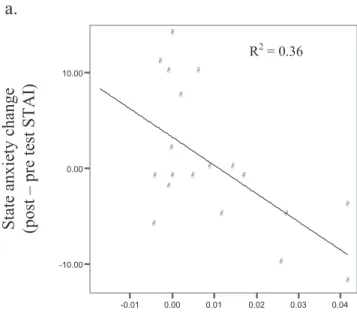
The first index of implicit control was the difference in startle response to negative pictures because of encoding (i.e., emotional minus nonemotional encoding for negative pictures). Larger val-ues of this index were taken to indicate more successful implicit control over how negative pictures were encoded. There was a significant negative correlation between this index and change in state anxiety across the session, rs ⫽ ⫺.43, p ⫽ .032,
suggesting that greater implicit control over encoding was associated with less anxiety increase during testing. The scat-terplot is shown in Figure 3(a).
The second index of implicit control was the difference inaffective modulation of startle amplitude between different encoding types. This was calculated by subtracting the size of affect potentiation during nonemotional encoding (negative—neutral pictures with “planned” instruction) from the size during emotional encoding (neg-ative—neutral pictures with emotional instruction: frightening or pleasant). The greater this index, the more successful the implemen-tation of encoding instructions, whether emotional or nonemotional. This index was significantly correlated with change in state anxiety across testing,rs⫽ ⫺.43,p⫽.032, suggesting the more affective potentiation was successfully modulated by instructions, the less anxiety increased during testing. The scatterplot is shown in Figure 3(b). There was no overall mean difference in anxiety level pre- to posttesting (34.16,SD⫽ 9.2; 34.5,SD ⫽10.8, respectively), and inspection of scatterplots confirms both increases and decreases in anxiety level across the session.
Thus, both indices of implicit emotional control showed significant negative correlations with change in state anxiety. Anxiety increased more in those participants who had less implicit control over encod-ing; that is, those who could not prevent responding to pictures emotionally even when instructed to encode them in a nonemotional manner. Conversely, those who implicitly controlled encoding most successfully (as indexed by their ability to modulate startle responses) also increased least in anxious mood. Taken together these results suggest that the ability to implicitly control the encoding of emotional material is a critical factor in the experience of emotional response to such material.
Pretest state anxiety levels (i.e., Time 1 score alone) did not correlate with the above index of state anxiety change (p⫽.17), nor with either index of control (ps⫽ 0.26, 0.57, for amplitude
-0.004 0 0.004 0.008 0.012 0.016
Emotional encoding Planned encoding
A ff ec tiv e p ote nt ia tio n (V ol ts )
Figure 2. Affective potentiation (startle amplitude to negative images— startle amplitude to neutral images) according to type of judgment made about images. Error bars represent⫾SEM(N⫽19).
Table 1
Mean Startle Amplitude in Volts According to Type of Picture and Type of Encoding
Picture type
Encoding
Emotional Nonemotional
Negative .215 (.029) .205 (.016)
change index and affective modulation index, respectively). Trait anxiety showed no significant correlations with these indices of implicit control (rss⬍.2,ps⬎.3), unsurprisingly given that the
sample was not preselected and therefore had a restricted range of trait scores (35.4,SD ⫽9.1). Neither were there any significant correlations with state anxiety level immediately before the study (rss⬍.3,ps⬎.1).
Discussion
The present study used the affective modulation of startle response to index the extent to which participants could successfully implement instructions to encode material in either emotional or nonemotional ways. We found convincing evidence that participants could alter their processing of emotional information as instructed because there
a.
-0.01 0.00 0.01 0.02 0.03 0.04 -10.00 0.00 10.00b.
-0.02 0.00 0.02 0.04 -10.00 0.00 10.00State anxiety change
(post – pre te
st STAI)
State anxiety change
(post – pre te
st STAI)
Change in startle amplitude to negative pictures due to
instructed encoding (‘frightening’ minus ‘planned’)
R2 = 0.36
R2 = 0.22
Change in affective potentiation of startle (negative – neutral lead
stimuli) due to instructed encoding (emotional minus nonemotional)
Figure 3. Variations in self-reported state anxiety are associated with changes in startle amplitude to negative pictures and its modulation by instructed encoding. (a) Reducing startle response to negative stimuli, using instructed nonemotional encoding reduces state anxiety. (b) Changing affective potentiation of startle by instructed encoding produces congruent changes in state anxiety.
was a significant reduction in startle response to identical negative pictures when the task required nonemotional rather than emotional content to be processed. We take this as evidence of implicit control of emotion processing, while acknowledging that there may be im-portant differences between this and more explicit requests for voli-tional control, that future work would need to address. Implicit control was also evidenced by significantly reduced affective potentiation of startle during nonemotional encoding. Given the precision of our experimental task, it seems likely that successful implicit control was implemented by selectively attending to either the emotional or nonemo-tional aspects of picture content. Between-participants variance in how control is implemented may account for some of the inconsistencies in earlier studies and it will be important for future work to continue tightening the specification of the experimental methods used to investi-gate control, be it implicit or explicit.
These data can be considered with reference to Lang and col-leagues’ motivational priming account of affective modulation of startle (e.g., Lang, Bradley & Cuthbert, 1997). In this account, the startle reflex is potentiated and inhibited by aversive and appetitive states, respectively, which themselves are induced by picture view-ing. The present data suggest that wider motivationally significant factors, such as participants’ compliance with task demands may also influence affective modulation of startle blink response. It is clear from the analyses assessing implicit control by varying emotional encoding that the manipulation of processing toward or away from emotional content significantly alters the affective modulation of startle. In the first index of implicit control (emo-tional vs. neutral encoding for negative pictures) the emo(emo-tional content wasidenticaland only the instruction to attend toward or away from emotional contents varied. That this produced changes in affective modulation suggests top down processing strategies are an important variable in affective modulation of startle.
The present data showed little evidence for significant modulating effects of stimulus valence when stimulus processing was directed to nonemotional aspects of the material (negative vs. neutral pictures compared on a nonemotional dimension). Although this finding po-tentially contradicts a strong version of the motivational priming account, such an interpretation would be premature. These data would need to be replicated in the presence of a suitable control condition before ruling out effects of valence, independent of selective attention. Indeed the significant association between less suppression of affec-tive modulation and increases in state anxiety suggests that processing of emotional valence per se plays a central role in affective modula-tion of startle, along the lines proposed by the motivamodula-tional priming account. As Lang et al. (1997) point out, if emotional circuitry is activated, as the amygdala clearly is during unpleasant picture view-ing, then reflexes, such as startle, known to be linked to these path-ways will inevitably be affected during the processing of such stimuli. The current data suggest that top-down pathways can act to reduce such emotional modulation, and also that affective modulation in-volves sufficient processing of emotion to lead to congruent changes in state anxiety.
Our data provide convergent evidence for some of the findings of Mathews et al. (2004). In our functional neuroimaging study, the extent to which neural activations associated with negative material were controlled was investigated using an identical one-back rating task. Effects of top down control were assessed by contrasting type of encoding (how frightening— how planned) during viewing of nega-tive stimuli: differential activation patterns were presumed to reflect
the success of controlled encoding mechanisms at increasing and decreasing the extent of emotional processing of the negative infor-mation. Results showed significant differential activations in areas including the amygdala, hippocampus, visual cortex, rostral anterior cingulated, and pulvinar. This suggested that although the stimulus information remained objectively negative, participants could alter the degree to which they encoded this information. Based on these results it was concluded that optional encoding processes can significantly modulate the extent of negative processing.
We now have convergent evidence from the current study using physiological measures with the same paradigm suggesting that responses to negative stimuli are amenable to implicit top-down control. This presumably reflects the modulatory action of higher cortical areas associated with implicit control on the level of activation of the amygdala. Furthermore, because of the relatively precise instructional manipulation used in both studies we can be reasonably confident about the manner in which this control is exerted. Participants were presumably able to focus processing resources on or away from the emotional elements of the stimuli by performing the respective judgment tasks required of them.
Because the hemodynamic response, upon which neuroimaging data depends, is a relatively delayed and indirect measure of neural activation it remains important to validate findings using different techniques. The neural circuitry underlying fear-potentiated startle in rats is known to involve amygdala modulation (Shi & Davis, 2001), thus, affect modulated startle in humans provides a second indirect measure of amygdala modulation. Thus, taken together, the data from both studies increase our confidence in the conclusion that the process-ing of negative stimuli by the amygdala can be modulated by optional encoding processes and is thereby amenable to implicit control.
Changes in self-reported anxiety across the session negatively correlated with successful implementation of implicit control of emotion processing. The larger the difference in startle amplitude because of the encoding manipulation (whether for negative pic-tures alone or affective modulation of startle) the smaller the increase (or larger the decrease) in state anxiety. Thus, the more this reflex could be successfully implicitly controlled the less negative was the subjective experience of the material overall. This suggests that the implicit control of emotional processing can confer beneficial effects for transient mood in the face of negative environmental stimuli. It is tempting to conclude that anxiety change was driven by the nature of the encoding, given that anxiety change occurred after encoding had taken place. However, it is possible that the stimuli used were more salient for some individuals, thus more successful in eliciting anxiety and more difficult to encode nonemotionally.
It is notable that the degree of anxiety change in many partici-pants was large, although in line with what might typically be expected in response to laboratory stressors. This could indicate that the way in which emotional material is encoded can have a powerful influence on mood, but it will be important to validate this with further replication. One way to do this would be to directly compare the mood effects of individual types of encoding, where even stronger effects might be predicted. These results were also necessarily limited because we did not preselect on any relevant trait dimension. Nevertheless taken together with the data from Mathews et al. (2004) there are clear indications that reduced control over emotional processing is associated with greater sus-ceptibility to anxiety-related effects in general, whether transient
or longer lasting and these findings warrant replication and exten-sion. It has been suggested that the utility of the startle method-ology has yet to be fully exploited in subclinical and clinical populations (Grillon & Baas, 2003) and we would concur with this view. It would be particularly instructive to use the present meth-odology to explore the limits of the relationship between implicit control of emotional processing and anxiety. It has been suggested that breakdown of such control represents the onset of clinical disorder (Mathews, 2004), which is certainly consistent with the limited evidence presented here and would be a topic readily amenable to testing using similar psychophysiological techniques. The findings presented here can be understood within the model proposed by Mathews and Mackintosh (1998). This suggests that stimulus information is represented in a competitive activation network. A threat evaluation system enhances the activation of any items recognized as potentially threatening thereby increasing au-tomatic selective attention and processing resources devoted to such items. This provides the basis for accounting for selective attentional effects toward emotionally salient information, and the affective modulation of startle can be seen as a physiological manifestation of this. Although most models of emotional infor-mation processing can account for these basic effects, few take account of the possible top-down effects on emotional processing. Mathews and Mackintosh’s (1998) model does this explicitly via an effortful “task demand” process that can enhance the activation of any item. Within this framework the emotional (activated by “frightening”/“pleasant” comparison) and nonemotional (“planned” comparison) aspects of the stimuli would constitute separate representations upon which the task demand unit would operate according to instructions, leading to changes in the “nat-ural” (noncontrolled) output of the system. Importantly this model also accounts for individual differences in responsivity to threat, in that the threshold for threat evaluation is proposed to be lower for those with elevated anxiety levels. The correlational data suggests that there may also be similar individual differences in the effectiveness or functioning of the task demand process itself.
There are limitations to the present study that could be construc-tively addressed by future work. First, our data need replication. This is a particularly important issue where dependent measures involve complex data extraction procedures that can be prone to artifacts. In the case of startle blink response parameters such as sampling rate and bandpass can introduce artifacts such as aliasing (see Blumenthal et al., 2005). Furthermore, we only considered one implicit form of control, namely instructed comparisons (frightening vs. planned). Requesting participants to intentionally implement instructions for controlling aspects of emotion processing and experience is arguably more ecologically valid. On the other hand, the benefits of using a very tightly controlled manipulation such as this include certainty and precision about the mechanism whereby effective implicit control is elicited. It would be instructive for future work to examine additional types of encoding task, both implicitly and explicitly instructed, to compare their effectiveness in influencing emotional sequelae. In addition, such studies should include checks of awareness within implicit conditions to assess participants’ understanding of the ma-nipulation. Another important question for future work will be to develop similar tests of what aspects of emotion processing, if any, are obligatory as well as controllable.
A further limitation of these data is the inherent problem of matching for task difficulty across type of encoding instruction. It
is possible that making judgments about how planned or prear-ranged an image is could be significantly more difficult than deciding how frightening something is. We attempted to mitigate against this in two ways, first by giving participants an extended period of practice in making the judgments and second by mea-suring reaction times to do so. Reaction times to make emotional or nonemotional judgments showed no evidence of any differ-ence.6In addition, had differences in difficulty between types of
encoding affected startle amplitude, as some studies suggest it can (Neumann, Lipp, & McHugh, 2004), then we would have expected to see such an effect across differently encoded neutral stimuli, and this was not apparent. Nevertheless, future study designs need to take account of this potential confound.
In summary, we have shown that processing of negative informa-tion can be implicitly controlled using specific instrucinforma-tions to process either emotional or nonemotional elements of stimulus material. Us-ing a highly specified experimental task, we removed as much am-biguity as possible about how participants were implementing implicit control strategies. Future work should investigate whether other, well-specified strategies are more or less effective in controlling emotion processing. We have reported psychophysiological evidence conver-gent with recent neuroimaging data further supporting the ability of top down control pathways to modulate activation of the amygdala. The successful implementation of this implicit control proved to be a modulator of individuals’ emotional response to the material, and this is likely to be an important area for further work both in healthy and emotionally disordered individuals.
6Reported in Mathews et al., 2004.
References
Angrilli, A., Mauri, A., Palomba, D., Flor, H., Birbaumer, N., Sartori, G., et al. (1996). Startle reflex and emotion modulation impairment after a right amygdala lesion.Brain: A Journal of Neurology, 119,1991–2000. BIOPAC Systems, Inc., USA. www.biopac.com
Blumenthal, T. D., Cuthbert, B. N., Filion, D. L., Hackley, S., Lipp, O. V., & van Boxtel, A. (2005). Committee report: Guidelines for human startle eyeblink electromyographic studies.Psychophysiology, 42,1–15. Bowditch, H. P., & Warren, J. W. (1890). The knee-jerk and its
physio-logical modifications.Journal of Physiology, 11,25– 64.
Bradley, M. M., Cuthbert, B. N., & Lang, P. J. (1993). Picture as prepulse: Attention and emotion in startle modification. Psychophysiology, 30, 541–545.
Bradley, M. M., Cuthbert, B. N., & Lang, P. J. (1996). Picture media and emotion: Effects of a sustained affective content.Psychophysiology, 33, 662– 670.
Bradley, M. M., Cuthbert, B. N., & Lang, P. J. (1999). Affect and the startle reflex. M. E. Dawson, A. M. Schell, & A. H. Bohmelt (Eds.), Startle modification: Implications for neuroscience, and clinical science. Cambridge: Cambridge University Press.
Cacioppo, J. T., Tassinary, L. G., & Berntson, G. G. (2007).Handbook of psychophysiology(3rd ed.). New York: Cambridge University Press. Davidson, R. J., Jackson, D. C., & Kalin, N. H. (2000). Emotion, plasticity,
context, and regulation: Perspectives from affective neuroscience. Psy-chological Bulletin, 126,890 –909.
Dawson, M. E., Schell, A. M., & Bohmelt, A. H. (Eds.), (1999).Startle modification.Cambridge: Cambridge University Press.
Derryberry, D., & Reed, M. A. (2002). Anxiety-related attentional biases and their regulation by attentional control.Journal of Abnormal Psy-chology, 111,225–236.
Eysenck, M. W., Derakshan, N., Santos, R., & Calvo, M. G. (2007). Anxiety and cognitive performance: Attentional control theory. Emo-tion, 7,336 –353.
Funayama, E. S., Grillon, C., Davis, M., & Phelps, E. A. (2001). A double dissociation in the affective modulation of startle in humans: Effects of unilateral temporal lobectomy.Journal of Cognitive Neuroscience, 13, 721–729.
Grillon, C., & Baas, J. (2003). A review of the modulation of the startle reflex by affective states and its application in psychiatry. Clinical Neurophysiology, 114,1557–1579.
Gross, J. J. (2001). Emotion regulation in adulthood: Timing is everything. Current Directions in Psychological Science, 10,214 –219.
Gross, J. J. (2002). Emotion regulation: Affective, cognitive, and social consequences.Psychophysiology, 39,281–291.
Gur, R. C., Schroeder, L., Turner, T., McGrath, C., Chan, R. M., Turetsky, B. I., et al. (2002). Brain activation during facial emotion processing. Neuroimage, 16,651– 662.
Hariri, A. R., Bookheimer, S. Y., & Mazziotta, J. C. (2000). Modulating emotional responses: Effects of a neocortical network on the limbic system.Neuroreport, 11,43– 48.
Hariri, A. R., Mattay, V. S., Tessitore, A., Fera, F., & Weinberger, D. R. (2003). Neocortical modulation of the amygdala response to fearful stimuli.Biological Psychiatry, 53,494 –501.
Jackson, D. C., Malmstadt, J. R., Larson, C. L., & Davidson, R. J. (2000). Suppression and enhancement of emotional responses to unpleasant pictures.Psychophysiology, 37,515–522.
Lang, P. J., Bradley, M., & Cuthbert, B. N. (1999).International affective picture system (IAPS).University of Florida: NIMH Centre for the Study of Emotion and Attention.
Lang, P. J., Bradley, M. M., & Cuthbert, B. N. (1997). Motivated attention: Affect, activation, and action. In P. J. Lang, R. F. Simons, & M. T. Balaban (Eds.),Attention and orienting: Sensory and motivational pro-cesses.New Jersey: Erlbaum.
Lang, P. J., Greenwald, M. K., Bradley, M. M., & Hamm, A. O. (1993). Looking at pictures: Affective, facial, visceral and behavioral reactions. Psychophysiology, 30,261–273.
Lazarus, R. S. (1982). Thoughts on the relationship between emotion and cognition.American Psychologist, 37,1019 –1024.
Lazarus, R. S., & Opton, E. M. J. (1966). The study of psychological stress: A summary of theoretical formulations and experimental findings. In C. D. Spielberger (Ed.),Anxiety and behaviour(pp. 225–262). New York: Academic Press.
Lazarus, R. S., & Smith, C. A. (1988). Knowledge and appraisal in the cognition-emotion relationship.Cognition and Emotion, 2,281–300. Lee, Y., & Davis, M. (1997). Role of the hippocampus, the bed nucleus of
the stria terminalis, and the amygdala in the excitatory effect of corticotropin-releasing hormone on the acoustic startle reflex.Journal of Neuroscience, 17,6434 – 6446.
Mathews, A. (2004). On the malleability of emotional encoding.Behaviour Research and Therapy, 42,1019 –1036.
Mathews, A., & Mackintosh, B. (1998). A cognitive model of selective processing in anxiety.Cognitive Therapy and Research, 22,539 –560. Mathews, A., Yiend, J., & Lawrence, A. D. (2004). Individual differences
in the modulation of fear-related brain activation by attentional control. Journal of Cognitive Neuroscience, 16,1683–1694.
Neumann, D. L., Lipp, O. V., & McHugh, M. J. (2004). The effect of stimulus modality and task difficulty on attentional modulation of blink startle.Psychophysiology, 41,407– 416.
Ochsner, K. N., Bunge, S. A., Gross, J. J., & Gabrieli, J. D. E. (2002). Rethinking feelings: An fMRI study of the cognitive regulation of emotion.Journal of Cognitive Neuroscience, 14,1215–1229. Ochsner, K. N., & Gross, J. J. (2005). The cognitive control of emotion.
Trends in Cognitive Sciences, 9,242–249.
Pissiota, A., Frans, O., Michelgard, A., Appel, L., Langstrom, B., Flaten, M. A., et al. (2003). Amygdala and anterior cingulate cortex activation during affective startle modulation: A PET study of fear. European Journal of Neuroscience, 18,1325–1331.
Schneider, W. (1988). Micro experimental laboratory: An integrated sys-tem for IBM PC compatibles.Behavior Research Methods Instruments & Computers, 20,206 –217.
Shi, C., & Davis, M. (2001). Visual pathways involved in fear conditioning measured with fear-potentiated startle: Behavioral and anatomic studies. Journal of Neuroscience, 21,9844 –9855.
Smith, J. C., Bradley, M. M., & Lang, P. J. (2005). State anxiety and affective physiology: Effects of sustained exposure to affective pictures. Biological Psychology, 69,247–260.
Spielberger, C. D., Gorsuch, R. L., Lushene, R., Vagg, P. R., & Jacobs, G. A. (1983).Manual for the State-Trait Anxiety Inventory.Palo Alto, CA: Consulting Psychologists Press.
Stanley, J., & Knight, R. G. (2004). Emotional specificity of startle potentiation during the early stages of picture viewing. Psychophysiol-ogy, 41,935–940.
Tassinary, L. G., & Cacioppo, J. T. (2000). The skeletomotor system: Surface electromyography. J. T. Cacioppo, L. G. Tassinary, & G. G. Berntson (Eds.),Handbook of psychophysiology(2nd ed., pp. 163–199). New York: Cambridge University Press.
Taylor, S. T., Phan, K. L., Decker, L. R., & Liberzon, I. (2003). Subjective rating of emotionally salient stimuli modulates neural activity. Neuro-image, 18,650 – 659.
Vrana, S. R., Spence, E. L., & Lang, P. J. (1988). The startle probe response: A new measure of emotion?Journal of Abnormal Psychology, 97,487– 491.
Received August 14, 2007 Revision received July 23, 2008