*Corresponding author. Tel.:#1-781-736-3290. E-mail address:[email protected] (J.B. Caplan).
Task dependence of human theta:
The case for multiple cognitive functions
Jeremy B. Caplan*, Michael J. Kahana , Robert Sekuler, Matthew Kirschen , Joseph R. Madsen
Volen Center for Complex Systems, Brandeis University, MS 013 Waltham, MA 02454, USA
Department of Neurosurgery, Children's Hospital, Boston, MA 02115, USA Department of Surgery, Harvard Medical School, Boston, MA 02115, USA
Accepted 13 January 2000
Abstract
The recent "nding of task-related theta oscillations in humans (M.J. Kahana, Sekuler, Caplan, Kirschen, Madsen, Nature 399 (1999) 781}784) raises a number of questions. We recorded from 345 intracranial electrodes in"ve patients with medically intractable epilepsy while they learned to navigate virtual mazes. Previously, we showed signi"cant dependence of theta on two di!erent task parameters, maze di$culty and study versus test modes. First, we show that these results hold for an additional 174 electrodes and two subjects, removing a previous confound between the two comparisons. Here we ask whether or not these two task parameters re#ect some common, or correlated, task-correlates of theta. 2000 Elsevier Science B.V. All rights reserved.
Keywords: Theta oscillations; Maze navigation; Intracranial EEG
1. Introduction
Theta (3}12 Hz) oscillations have long been observed in mammals during spatial
navigation and are thought to be intimately involved in such tasks [2,6}13]. In recent
work [3] our group demonstrated the relevance of theta to human brain function in a spatial navigation task. These results established the presence of theta in three epileptic patients and a signi"cant relationship between the occurrence of theta and
0925-2312/00/$ - see front matter 2000 Elsevier Science B.V. All rights reserved. PII: S 0 9 2 5 - 2 3 1 2 ( 0 0 ) 0 0 2 2 9 - 0
parameters of the task. One outstanding question concerns the nature of theta's role
or roles in this task. Correlation maps revealed clusters of electrode locations showing strong covariance within cluster but weaker covariance between clusters. Could these relatively independent clusters re#ect distinct functional roles that theta might play in
this task? It may be possible to address this question by examining how theta varies with task parameters. Here we take the example of two such parameters which we have previously shown to vary with theta * task di$culty and study versus test
modes [3]. Do these represent independent or correlated manipulations of task-related theta? If theta changes with more than one parameter, multiple parameters could all represent the same role or di!erent roles. Through various approaches we
examine the relationship between the sets of electrodes that exhibit each e!ect to
answer this question.
2. Methods
2.1. Subjects and recording
We tested"ve patients with pharmacologically refractory epilepsy. To localize the
epileptogenic focus, the patients had intracranial electrodes implanted for 1}2 weeks
during which time seizure and functional data were collected. The placement of the electrodes was determined by the clinical team. We sampled a total of 345 electrodes (Figs. 1 and 2). Intracranial electroencephalographic (iEEG) signal was sampled at 200 Hz (Telefactor, band-pass "lter: 0.5}100 Hz) for subjects 1}4 and at 256 Hz
(BioLogic, band-pass"lter: 0.3}70 Hz) for subject 5. The locations of the electrodes
were determined by an indirect stereotactic technique [11].
2.2. Procedure
Subjects learned to navigate 3-D rendered, virtual, multiple T-junction mazes. Subjects traversed a maze four times instudymode, in which arrows were placed on the walls to reveal the correct path. Then subjects traversed the same maze in test
mode, with the arrows removed, forcing them to rely on a learned representation of the maze. Subjects navigated a maze repeatedly until they traversed it three times consecutively without errors. Task di$culty was manipulated by varying maze length
between short (6-junction) and long (12-junction) mazes.
2.3. Theta episode analysis
To analyze the spectral characteristics, we wavelet transformed the raw signal (Morlet wavelet, window"6 cycles; [1]). Atheta episodewas de"ned as a duration
longer than three oscillatory cycles throughout which the wavelet power exceeded z"1 at a given frequency. Thez-transform was based on the distribution of wavelet
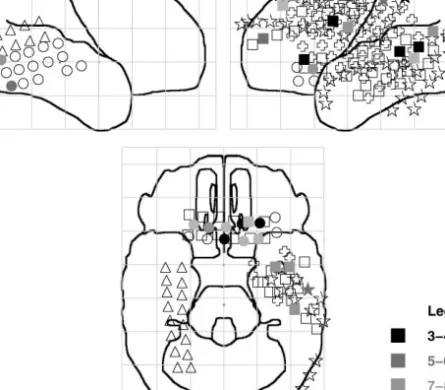
Fig. 1. Task di$culty e!ect. Electrode locations and task-dependent theta for all"ve subjects, shown on
three sketched views (right lateral, left lateral and inferior) of a standard brain. Circles, triangles, squares, crosses and stars represent subjects 1}5, respectively. Filled shapes represent electrodes showing a signi"
-cant (p(0.01) maze-di$culty e!ect in the range 3}10 Hz; peak frequency is represented by grayscale (see legend).
a given trial, percent trial time in theta,P
F, is the percentage of time during which theta episodes were present.
We compared P
F across the two task manipulations using a two-tailed Mann}
Whitney;-test. This was done at each central frequency separately over the range
3}10 Hz (1 Hz increments). For the summary topographic maps (Figs. 1 and 2), an
electrode was denoted as showing an e!ect if it reached signi"cance (p(0.01) atany
frequency within the range analyzed. The `peak frequencyadenotes the frequency exhibiting the most signi"cantp-value. The summary meanP
F values quoted in the text represent a union of oscillatory episodes across all frequencies in the range 3}10 Hz.
List length has a profound e!ect on performance in human memory tasks [5,9,10].
The analogue in our task is the maze-length manipulation: long mazes were more di$cult than short mazes for Brandeis undergraduates [4]. Another important
functional distinction is made between encoding versus retrieval processes [12]. In our task this roughly corresponds to comparingstudy(arrow) trials with error-freetest
trials. We therefore analyzed theta activity in relation to both these task manipula-tions. Long mazes tended to require more test trials than short mazes, as well as
Fig. 2. Study/test e!ect (see Fig. 1). Note electrodes that show both e!ects (see text).
involving more errors (e.g., wrong turns). We therefore only included the"rst four
study trials and last three (perfect) test trials in both comparisons to remove this confound. This put the two task comparisons on a similar footing, both involving analyses of the same set of trials, and removed trials in which maze length and study/test are correlated (imperfect test trials).
To look for pairs of electrodes that show correlated theta-band activity through the experiment, without reference to any speci"c task parameter we examined Pearson
rcorrelations. These were computed across all pairs of electrodes within a subject for the timecourse of theta power over all maze trials. The unit of measurement was average wavelet power across the 3}10 Hz band while the subject was in a particular
maze junction.
3. Results
First, we looked for electrodes that showed theta activity covarying with our two task parameters. Consistent with our previously reported results, for each patient the presence of theta oscillations covaried with maze di$culty; the percentage of a trial
time occupied by theta episodes (P
than for easier (6-junction) mazes (Fig. 1) at many brain locations (151 out of 345, p(0.01). No electrodes exhibited the reverse e!ect. For electrodes showing this e!ect,
meanP
F(including all frequencies in the range 3}10 Hz) was 8.6% for long maze trials
and 5.5% for short maze trials. Likewise, for the study/test comparison, in 40 out of 345 electrodes, P
F was greater in test than study trials (p(0.01). For electrodes
showing this e!ect, P
F was 9.1% for test trials and 5.8% for study trials. For this comparison as well, no electrodes showed the reverse e!ect. For subjects 2 and 4, no
electrodes were signi"cant in the study/test comparison; hence, we focus on the three
subjects who had electrodes showing both e!ects. 3.1. Common electrodes
A subset of electrodes showed both task dependencies (e.g., in the inferior frontal region of subject 1 and in the occipital strip of subject 3; see Figs. 1 and 2). If membership in one group were independent of membership in the other, one would expect some overlap by chance,
N N N
N
N .
For the three subjects where we see a study/test e!ect, the observed overlaps were not
signi"cantly di!erent from chance levels, even when we collapse across subjects
(s(2)"2.79,N"40,p"0.25). Hence, at this stage we could not reject the hypothesis
that the two sets of electrodes represent independent comparisons. However, if the two task manipulations in#uence a common process or correlated processes then for
electrodes showing only one e!ect, the non-signi"cant e!ect might simply lack the
statistical power to pass the signi"cance threshold. This appears to hold; when we
repeat thesanalysis just described, but using an initial threshold criterion ofp(0.1
instead of p(0.01 the overlap between the e!ects is signi"cantly greater than
expected by chance (s(3)"12.0,N"122,p(0.01). Note that here we exclude
sub-ject 1, who shows all 31 electrodes signi"cant for the maze di$culty e!ect and we
include subjects 2 and 4 (previously excluded) because at this threshold they have electrodes showing both e!ects. This argues that the two task dependencies are not
tapping independent theta-relevant task variable and that the previoussresult was due to a thresholding artifact.
3.2. Peak frequencies
An alternative account is that the maze length and study/test parameters in#uence
properties of theta di!erently at the same brain locations, for example, di!erent
frequencies of oscillations. The median peak frequency did not di!er between the two
e!ects for subjects 1 or 3. For subject 5 (across electrodes showing both e!ects) the
peak frequency was 2 Hz lower for the study/test than for the maze di$culty e!ect
(p(0.01). Further, the three electrodes in subject 5 showing both e!ects all di!ered in
locations as well as across subjects, which limits our ability to draw inferences from this line of analysis.
3.3. Correlations
Finally, the topography of correlations across the whole experiment suggests that theta activity frequently co-occurs in electrode pairs within a region but less so for pairs that cross obvious anatomic boundaries. If these clusters indicate independent roles for theta, we can ask whether the electrode clusters selected by the two task parameters are related to these. Considering only electrodes showing exactly one of the two e!ects, we compared the mean Pearsonrfor electrode pairs that both showed
the same e!ect (r
andr, maze di$culty and study/test mode e!ects, respectively)
with the those for pairs that each showed di!erent e!ects (r
). The values for r, r
andrwere 0.25, 0.28 and 0.24 for subject 3 and 0.23, 0.15 and 0.18 for subject 5. For subject 3, only r
and r di!ered at borderline signi"cance (p"0.057); for
subject 5, only r
and r di!ered signi"cantly (p(0.001). Hence, the agreement
between these two task parameters the clustering observed in the correlation maps is suggested, but not solid. These two task manipulations do not relate strongly to the correlation map clusters.
4. Discussion
We investigated the novel hypothesis that human theta has multiple cognitive roles. As an example, we tested this in relation to two particular task parameters. We"rst
replicated our original "ndings [3], showing maze di$culty and study/test e!ects
across twice as many electrodes as before (345 versus 171) including two additional subjects, and eliminated a potential confound between the two manipulations. This allowed us to assess whether the two task parameters in#uence theta in independent
ways. The number of electrodes showing both e!ects did not di!er signi"cantly from
chance but this was probably due to a signi"cance-thresholding artifact. We were
unable to "nd decisive evidence that these two task parameters a!ected theta in
a separable way. By applying analyses like those presented here to the numerous other parameters of this task it will be possible to further constrain the possible roles that theta has in human cognition.
References
[1] A. Grossmann, J. Morlet, Decomposition of functions into wavelets of constant shape, and related transforms, Mathematics#Physics, Vol. 1. World Scienti"c, Singapore, 1985, pp. 135}165. [2] P.T. Huerta, J.E. Lisman, Heightened synaptic plasticity of hippocampal CA1 neurons during
cholinergically induced rhythmic state, Nature 364 (1993) 723}725.
[3] M.J. Kahana, R. Sekuler, J.B. Caplan, M. Kirschen, J.R. Madsen, Human theta oscillations exhibit task dependence during virtual maze navigation, Nature 399 (1999) 781}784.
[4] M.J. Kahana, R. Sekuler, M.P. Kirschen, Optic#ow helps humans navigate synthetic environments,
Proceedings of the Association for Research in Vision and Ophthalmology, Ft. Lauderdale, FL, 1999. [5] B.B. Murdock, The serial position curve in free recall, J. Exp. Psychol. 64 (1962) 482}488.
[6] J. O'Keefe, M.L. Recce, Phase relationship between hippocampal place units and the EEG theta
rhythm, Hippocampus 3 (1993) 317}330.
[7] W.E. Skaggs, B.L. McNaughton, M.A. Wilson, C.A. Barnes, Theta phase precession in hippocampal neuronal populations and the compression of temporal sequences, Hippocampus 6 (1996) 149}172.
[8] V.S. Sohal, M.E. Hasselmo, GABA modulation improves sequence disambiguation in computa-tional models of hippocampal region CA3, Hippocampus 8 (1998) 171}193.
[9] S. Sternberg, High-speed scanning in human memory, Science 153 (1966) 652}654.
[10] E.K. Strong Jr., The e!ect of length of series upon recognition memory, Psychol. Rev. 19 (1912)
447}462.
[11] J. Talairach, P. Tournoux, Co-planar Stereotaxic Atlas of the Human Brain, Verlag, Stuttgart, 1988. [12] E. Tulving, Elements of Episodic Memory, Oxford University Press, Oxford, 1983.
[13] J. Winson, Loss of hippocampal theta rhythms results in spatial memory de"cit in the rat, Science 201