Institute for International Integration Studies
IIIS Discussion Paper
No.231 / October 2007
Should Bank Supervisors in Developing Countries Exercise
More or Less Forbearance?
Patrick Honohan
IIIS Discussion Paper No. 231
Should Bank Supervisors in Developing Countries
Exercise More or Less Forbearance?
Patrick Honohan
Disclaimer
Any opinions expressed here are those of the author(s) and not those of the IIIS. All works posted here are owned and copyrighted by the author(s).
September 2007
SHOULD BANK SUPERVISORS IN DEVELOPING
COUNTRIES EXERCISE MORE OR LESS FORBEARANCE?
Patrick Honohan
Institute for International Integration Studies, Trinity College Dublin
and CEPR
Thanks to participants at the FMG Workshop: “Cycles, Contagion and Crises” London School of Economics, June 28-29, 2007, for helpful comments.
___________________________
Abstract
Although forbearance has been associated with more costly financial crises, a trigger-happy approach to closing weak banks could also precipitate an avoidable systemic collapse. In sophisticated regulatory environments, there can be net benefits from at least occasional acts of forbearance. But we argue that three key structural
weaknesses in developing countries suggest that their regulators should have less forbearance discretion. This is because financial systems in developing countries tend to have worse information, less interdependence and greater agency problems.
SHOULD BANK SUPERVISORS IN DEVELOPING COUNTRIES
EXERCISE MORE OR LESS FORBEARANCE?
1. Introduction and overview
1.1 Introduction
Recent credit market pressures in several advanced economies have led to bank rescues, and to relaxed criteria for liquidity loans, and have re-awakened old debates on forbearance. But even if regulators in advanced economies can successfully forbear to intervene undercapitalized institutions without unduly damaging moral hazard consequences, it is less clear what the lessons for developing countries should be.
This paper argues that greater agency and information problems, and lower structural interdependence within financial markets, in developing countries argue for less regulatory discretion.
1.2 Overview
Forbearance got a bad name during the US Savings and Loan crisis. Explicit
relaxations in capital standards as well as lengthy periods of grace designed to allow undercapitalized or insolvent S&Ls to continue in operation were followed by massive abuses, involving excessive risk-taking, looting and fraud.
The reaction of numerous commentators to these relatively well-documented events was to call for the elimination of discretion and a zero-tolerance policy for capital adequacy. Steps in that direction were adopted in the US under the FDICIA
legislation, though the legislation fell well short of the absolutism advocated by some. Indeed, there is some cross-country empirical evidence suggesting that, for crises where data on the total fiscal costs are available and, where enough is known about the policy response to be able to say whether or not there was forbearance, those countries whose regulators have exercised forbearance have experienced more costly crises.
But the fragility of a stressed financial system and the imperfection of the rules defining capital and other regulatory standards imply that unthinking adherence to mechanical rules in a crisis situation could have large systemic consequences. That is why regulators in advanced economies have retained and exercised discretion. It is one thing to argue that a sophisticated regulatory structure operating in an accountable and independent way should be able to improve on a mechanical rules-based system, by adapting enforcement policy to contingencies, thereby avoiding a regulator-induced deepening of an incipient crisis (Goodhart, 2007, makes a convincing case). But what of regulators in developing countries where these preconditions do not prevail, and in particular where agency and information
problems are worse and banking systems less interdependent. Is tying the regulators’ hands more or less likely to worsen the financial stability experience in such
environments?
There is surprisingly little theoretical guidance as to whether these differences, between them, argue for or against less regulatory discretion. The severity of agency problems presumably call for less agent discretion. But the problems with accounting data seem to cut both ways: on the one hand they make it easier to conceal regulatory deficiencies; on the other hand accounting data might seem to be too unreliable to be used as the basis for a mechanical intervention rule. The lower degree of intermediary interdependence may reduce the risk of regulatory action precipitating damaging contagion, but evidence here is particularly thin.
Since data deficiencies are at the heart of this question, it is especially difficult to bring credible quantification to the debate. Even after bank failures crystallize, reliable data is scarce. In particular, obtaining a convincing measure of the frequency and scale of crises that were avoided through forbearance is elusive.
Given that a zero-tolerance policy cannot be robustly defended on empirical or theoretical grounds, but taking into account that contagion is less likely to be a problem, policy for developing countries should be nuanced. Enforcement need not be mechanical, but there should be a stronger presumption of enforcement in
developing countries, especially where information, agency and governance problems are thought to be severe. Measures to strengthen accountability and transparency of regulatory action should be adopted, together with a tightening of capital requirements to take account of the accounting uncertainties.
1.3 Outline
This paper begins (Section 2) by reviewing the main conceptual issues identified in the theoretical literature on capital adequacy rules and enforcement. These include analysis of the impact of regulation on (i) the ex ante discipline effect of bankers’ expectations of forbearance on their incentives to take risks; (ii) the danger of a strict closure rule resulting in what is ex post inefficient liquidation; (iii) contagion effects; and (iv) the effects of alternative assignments of enforcement between different public agencies. The concerns of this literature may, however, be somewhat misplaced when it comes to developing countries.
Sections 3 to 5 discuss (and present some evidence concerning) three important dimensions of the overall environment for regulation where conditions in developing countries seem far different to those in advanced economies. First, information is extremely poor: large accounting surprises are the norm rather than the exception (Section 3). Second, financial intermediaries display less interdependence (Section 4). Third, agency problems – affecting the performance of regulators as agents of the public interest – are more severe (Section 5).
Section 6 presents theoretical considerations why these three distinctive agency, information and structural features of developing country financial systems tilt the balance of advantage against forbearance. It draws on a simple model sketched in Appendix 2.
Section 7 reviews and extends the empirical literature on the contribution of
forbearance to banking crisis costs, pointing to the difficulties in obtaining decisive conclusions from available data. Concluding remarks are in Section 8.
2 Conceptual issues in the literature on regulation and forbearance
From the introductory discussion it will be clear that the topic of forbearance reaches in to many aspects of regulation. This hampers a unified theoretical treatment of the subject. Indeed, to quote Freixas and Rochet (1998), banking regulation involves “diverse issues, all of them worth devoting effort to, but so heterogeneous that no model can encompass the main issues”.
In all countries, banks operate under a set of standing regulations with regard to minimum capitalization. In addition there are typically limitations on lending to related parties and other rules about risk concentrations. There may be minimum liquidity ratios. Forbearance can mean waivers of any or all of these rules. Here we will focus on capital forbearance.
Confining attention to forbearance on capital adequacy regulation narrows the focus somewhat, but not by much. Despite the growing complexity and sophistication of the models employed in this part of the literature, they tend to emphasize some aspects more than others, and arguably underplay some dimensions that are important in developing country applications.
Thus, existing models emphasize:
(i) The effect of different degrees of regulatory enforcement on bank
risk-taking
(ii) Socially inefficient mid-stream liquidation due to enforcement of
regulations vis-à-vis a single bank
(iii) The danger that the solvency or liquidity difficulties of one bank will
create significant externalities for others, manifested through various forms of contagion
(iv) Different ways of structuring regulators’ incentives through assignment of
powers and responsibilities.
Most models characterize the policy issue simply as whether or not the bank should be closed. In practice a graduated response, involving a range of intermediate actions
or sanctions may be applied by the regulator: the bank can be obliged to take (or refrain from taking) specific actions; the frequency and intensity of on-site inspections and auditing can be stepped-up; management can be changed and boards of directors augmented. These nuances are missing from most (though not all) of the theoretical literature.
2.1 Impact of expected forbearance on bank risk-taking: the ex ante problem
Knowing that hitting a capital floor will trigger intervention, banks will adapt their
behaviour.1 On the other hand, an expectation of regulatory forbearance will tend to
reduce the behavioural effect of any regulation. This is the ex ante problem.
If tight capital requirements reduce risk, then easing them through expected
forbearance will likely increase risk. But, as is well known since the work of Kim and Santomero (1988) and Keeley and Furlong (1990), it may be a mistake to assume that a capital adequacy requirement will always reduce banking risk. After all, imposing a binding minimum capital standard on a bank is likely to alter the structure as well as the scale of the bank’s risk portfolio. Although the volume of risky assets will be lower, the bank will have altered the allocation in the direction of having riskier assets (and this effect may be so strong as to result in a net increase in the risk of bank failure).
Even in this perverse case, where imposition of capital requirements increases risk, it is conceivable that expected forbearance could increase it further. For example, in the model of Rochet (1992), bankers maximize a one-period-ahead mean-variance utility of wealth function taking into account limited liability and costs of bankruptcy, subject to satisfying a first period capital adequacy standard. Adding a cost of
breaching the minimum capital standard in the second period in this model would
reduce the risk taken by such a bank; but expected second period forbearance on the
capital rule would undo that effect.2
1 For an elegant recent modeling of this, see Elizalde and Repullo (2006)
2 This kind of two-period model continues to be explored with more realistic and flexible specifications of banking technology. For example, the banks in Kopecky and VanHoose (2006) can vary the level of loan monitoring in order to enhance the rate of return on loans and reduce the risk of violating
regulatory capital minima. Introducing a minimum capital standard here will result in lower lending but may not increase monitoring, though once the standard is in place, tightening it will increase monitoring.
Returning to the more conventional world where more capital means less risk, it may still not be optimal from the point of view of ex ante risk reduction to exclude all forbearance, considering the fact that capital can be a more costly way of funding lending. This is brought out especially by models which take the risk menu faced by the bank as being continuous (rather than assuming that bankers choose between just two levels of risk or effort). Following the suggestion by Allen and Saunders (1993) that the cost of deposit insurance effectively arises because regulators choose to forbear from prompt closure decisions, So and Wei (2004) provide such a model of such regulatory behavior, and combine it with the assumption that regulatory
forbearance is accompanied by intensified frequency of auditing by the regulator.3
The impact of the resulting moral hazard on the fair insurance premium is found to be much higher than that on the bank’s equity value in simulations reported by So and Wei, highlighting the way the bank can shift risk to the deposit insurer under forbearance. Nevertheless, their simulations suggest that a small amount of forbearance may be optimal – reflecting the difference between a discrete and continuous formulation.
But how easily could a regulator estimate and define the appropriate small amount of forbearance in an environment where accounting information is especially deficient, as in most developing countries? The applicability of these theories, all of which implicitly assume that banks’ actual capital position and the risk to which they are exposed are both calculable with a high degree of accuracy, seems probelmatic. This is even more evident in many studies focusing on the design of regulatory capital rules under Basel II. For example, Kerkhof and Melenberg (2004) discuss the relative merits of calibrating regulatory capital according to the Value at Risk VaR (i.e., the level of loss that can be avoided over a certain period with a given – say 99 per cent – probability) or according to the expected loss conditional on a tail event. But given the current precision of credit appraisal in most developing countries, the idea that either of these could be measured with any degree of precision let alone whether one could determine the relative precision with which they were being estimated seems
fanciful.4 Instead, as discussed in Section 3 below, capital measurement is a coarse science in developing countries.
The dangers of allowing a bank with low or negative capital to operate are clear. The temptation is for shareholders to gamble on risky ventures with negative expected returns, given that they have little more to lose (the so-called deposit-put). But excessive risk-taking by undercapitalized bankers may not be the worst that can happen, as is illustrated in Akerlof and Romer’s (1993) model of looting. In this very simple model, bank management exploits limited liability, combined with the
gullibility of depositors or the insouciance of the government as deposit insurer. It’s not just a question of the management taking excessive risk in the hope that the value of the bank will improve. In Akerlof and Romer’s model, management seeks to extract as much value as possible (by legal or perhaps also illegal means) from the cash flow of a bank with the full intention of driving the bank into insolvency. As Akerlof and Romer note, when a bank moves into the looting phase, the “normal economics of maximizing economic value is replaced by the topsy-turvy economics of maximizing current extractable value, which tends to drive the firm’s economic net
worth deeply negative.”5 Only an undercapitalized bank will opt for a looting
strategy. That is why this model is highly relevant for the analysis of forbearance. Indeed, it is the deliberate forbearance in the US allowing undercapitalized or insolvent intermediaries to function that motivated Akerlof and Romer’s paper. Numerous developing country cases, from Mexico to the Philippines, though less thoroughly documented, seem illustrative of this behaviour.
4 The reputation and credibility of accounts even in advanced economies has taken several severe knocks in recent years, making Akerlof and Romer’s (1993) complaints about inclusion of “goodwill” in the accounts of US Thrifts, and the transitory income-inflating effect of term transformation (when the yield curve is positively sloping) seem quaint these days.
5 In the real world, it is not always clear ex post whether loans going bad reflects high variance, or negative expected yields from the start. Akerlof and Romer suggest that a telltale indication of an bank that is being looted is the management’s lack of concern about maintaining adequate documentation on loans: if the bank is “going for broke” the management will want those risky loans well-documented in order to be able to recover them if the gamble pays off. But if they are deliberately “going broke” it is the liquidator and not the current management that will have to attempt collection, as the current management do not expect to be around when the loans come up for collection. Looters will also seek nonbank collaborators to help them construct what will eventually be loss-making loan transactions but which spin off large cash flows in the short-run. The collaborators may be either naïve or
unscrupulous; their involvement multiplies the social losses above the direct benefit to the looter. This deadweight cost of looting is exactly analogous to that demonstrated for corruption by Shleifer and Vishny (1993).
2.2 Inefficient liquidation: the ex post problem
Even if the forbearance policy has been carefully designed to induce optimal risk-taking, it can result in decisionmakers finding themselves in a position where they wish they could tear up the rule book. Intertemporal models such as the three period models, widely used for analysis of liquidity crises, generally have this feature. For instance the model of Dewatripont and Tirole (1994) focuses directly on the question of a rule for closing the bank in the second period that induces the bank’s managers to make adequate effort in the first period. This rule should not simply take account of the best estimate at the second period of the bank’s future profit in the third period; in addition, since first period profits of the bank are indicative of the managers’ effort, they should also be taken into account in the closure decision. Drawing on parallels with the modern theory of corporate finance, Dewatripont and Tirole show that the
best ex ante rule can be implemented by giving the regulator (as representative of the
depositors) control (i.e. the decision on whether or not to close) when first period performance falls below a certain floor, while leaving control with the shareholders otherwise. However, the solution is time inconsistent: there will be situations where the bank will be closed by the regulator even though its final period promises to be
profitable. This model does illustrate one example in which forbearance is ex post
inefficient but ex ante efficient. Banks are being closed “pour encourager les autres”, and not because leaving them open is going to worsen their net position.
The social costs that can be incurred by the process of closing a bank can militate in practice against enforcement of capital adequacy requirements, and in effect represent a reason for forbearance (as in Sleet and Smith, 2000). For example, even though a bank’s capital has fallen below the regulatory minimum, it may be holding illiquid assets which it would be socially inefficient to liquidate on closure. Likewise, the relationship capital that has been accumulated over the years by borrowers with their bankers could be lost.6
More generally, absent complete markets, it is possible for a tough regulatory
enforcement to seem ex ante optimal, but to prove time inconsistent. The authorities
6 On the other hand, cynics will point to the merits of breaking corrupt crony relationships between bank insiders and some of their preferred borrowers.
don’t want to close this bank, but only for fear of encouraging risky behaviour by other banks. 7
With two- or three-period models, one can make a clear distinction between the ex
ante and ex post problems. Things become a bit more blurred if we track the
evolution of a weakening bank through time. As a bank nears its capital minimum, the risk of being closed soon affects the banker’s incentive to conceal the true
situation and can increase risk taking. In such circumstances, a stochastic closure rule can be better than a strict no-forbearance rule.
For example, Shim (2006) presents a multi-period model8 in which the regulator
cannot fully detect the profits being made by the banker nor the level of risk-reducing effort. The regulator sets deposit insurance premium and minimum capital levels to incentivize the banker to make the necessary efforts both to achieve profits and not to conceal them, even if the bank is close to closure. As a result, Shim finds that while prompt corrective action is appropriate, it should be applied stochastically: allowing bankers to hope they may be recapitalized, in order that may continue to make some
efforts.9 Here again some forbearance turns out to be optimal—but then again, how
realistic is such a prescription for regulators in low-income environments? How easily can a regulator who is operating a stochastic forbearance rule be monitored?
This brief discussion of the literature on incentive effects—both ex ante and ex post— should be enough to show that these are sufficiently complex to have generated a prolonged and sophisticated literature which continues to generate conflicting theoretical conclusions regarding the optimality of forbearance, even when only one
7 In Mailath and Mester’s (1994) paper, which also uses a three-period set-up, the regulator is not looking at capital adequacy, but instead at an indicator of whether the bank has adopted a risky or safe strategy in the first period. The decision as to whether to close comes in the second period. In this case too the inability of welfare-maximizing authorities to commit to a tough closure policy can result in higher risk-taking than would otherwise occur.
8 The model is a rather abstract one, chosen in order to be able to exploit known results from stochastic control theory to derive the optimal program; however Shim shows that the model can be mapped to an implementation framework which has some comparability with real world banking regulation.
9 In a slightly different set-up Kocherlakota and Shim (2007) also explore optimal regulatory policy, but in an environment dominated by collateralized lending. Instead of moral hazard, the volatility of collateral values is emphasized. If collateral values are not highly volatile, then they show that an optimal closure rule will involve some forbearance: conditions under which a bank that is surely going to impose some costs on the deposit insurer (because of the decline in posted collateral values), is nevertheless allowed to stay in business given the expected social returns of its future operations. If collateral values are very volatile, then forbearance will not be optimal.
bank is being considered at a time. Additional complications arise because of the interdependence of banking firms.
2.3 Market interactions
In the real world there is more than one bank and the interaction of different banks also has a bearing on the consequences of regulatory closure decisions (cf. Goodhart et al., 2003, whose model also captures the linkage with monetary policy). One aspect here is the fragility represented by the possibility of a self-fulfilling depositor panic, analyzed for a single bank by Diamond and Dybvig (1983), and which underlies the fear that a disturbance in any part of the system could represent the trigger or coordinating event for a wider collapse. Such systemic collapses and their
vulnerability to extrinsic events are modeled by Allen and Gale (2007, Chapter 5). Linkages between banks on the lending side can crop up in several different relevant ways. For example, banks may make inferences about future prospects, including creditworthiness, that are based in part on looking over their shoulders at what other banks are doing (Honohan, 1999). Such information externalities are analyzed by a large and growing literature, (cf. Allen, Morris and Shin, 2006).
A contrasting form of interaction on the lending side arises with multi-bank lending, as well as with modern forms of structured asset-backed lending that also entail multiple lenders. These interactions have been modeled by Huang and Xu (2000) who integrate analysis of the interbank market with multi-bank project financing and the lender of last resort. Huang and Xu argue that having multiple financiers
strengthens the financial system by imposing a harder budget constraint on borrowers. They assume that a consortium of financiers will find it difficult to agree on
reorganization of a project in difficulty. 10 This will lead to socially inefficient closure of troubled projects, but the fact that a hard budget constraint is known to be in place will also improve the incentive for entrepreneurs to choose a better project in the first place. The lower average quality of projects, and the impossibility of detecting which
10 The way in which the market for asset-backed securities dried-up in 2007 could be an example of this kind of situation.
projects are good and which are bad, results in a pooling equilibrium in the interbank market potentially resulting in a collapse of the market due to the lemons problem.11 Diamond and Rajan (2005) show that a form of contagion leading to systemic
liquidity shortages may arise even without depositor panics or contractual links between banks. Their model requires banks to issue demandable debt (as a
disciplining device on the bankers) which they use to finance potentially late-maturing projects. Banks can choose between liquidating or refinancing late-maturing projects, but this choice is not available to a bank which experiences so many late projects that it suffers a rational depositor run. Indeed, given the sequence of information flows, it may in this case have to liquidate even the early maturing projects. The consequence for systemic liquidity depends on the distribution of late projects between banks and thus on how many are run and have to liquidate their projects at a loss. It is a feature of their model that recapitalization (by the authorities) of illiquid failing banks may destroy healthier banks and give rise to the need for massive recapitalization as the scramble for liquidity intensifies and projects are liquidated early. Instead, in their model, if the crisis cannot be resolved by a pure injection of liquidity into the system, recapitalization should be directed to the most liquid of the failing banks. More generally, they argue that intervention or forbearance policy needs to consider the general equilibrium, and not just the condition of each bank on its individual merits. Conversion of a relatively isolated solvency shock into a systemic meltdown through collapse of the interbank market is, however, much less likely in an environment such as that in many developing countries where the interbank market is very small and inactive. This point is taken up in Section 4 below.
2.4 Regulatory incentives and behavior
Thus far, the discussion has implicitly assumed that regulators are choosing their actions in accordance with social welfare optimization. This assumption may not be valid. Different agencies are typically assigned more narrowly defined objectives
11 Huang and Xu made the interesting suggestion that, when it comes to offering liquidity assistance to illiquid banks in the event of the pooling equilibrium leading to a collapse of the interbank market, the regulatory authorities should offer such assistance only at the price of a heavy rate of profits taxation. Offering such a contract can separate the solvent and illiquid from the insolvent, since the former will be reluctant to seek assistance. (Bagehot’s penalty rate and equity instead of debt injections would be variants of this idea.)
(such as representing the interests of depositors, as suggested by Dewatripont and Tirole). Accordingly, another strand of the literature examines the incentives of the regulator, when several alternative institutions are present, such as the central bank as monetary authority, the deposit insurer as issuer of contingent quasi-fiscal liabilities and the prudential regulator may be evaluated and rewarded on the basis of success in protecting the interests of depositors. The questions of interest in this strand include the assignment of powers and responsibilities between different agencies, and the specification of the agency’s explicit and implicit incentive structures. Indeed, as pointed out by Repullo (2000) and Kahn and Santos (2001), the deposit insurer and the central bank will experience a different impact on their profit and loss account in the case of closure. In Repullo’s three-period model, depositor withdrawals in the middle period may leave the bank subject to closure. If it is to survive, the central bank has to make a loan, thereby putting its own money at risk. It stands to lose all of its loan if the bank fails (especially if, as is usual) the central bank’s claim is junior to that of depositors. But the central bank’s liability in the failure may be limited to the loan it has made. The deposit insurer, on the other hand, could be liable to meet all of the depositors’ remaining claims if the bank fails in the final period. This illustrates the different incentives of the two institutions: the central bank may be more willing to keep the bank going than the deposit insurer. So it matters which of these two agencies has the responsibility to decide on closure.
Evidently, all of the analysis considered so far may be irrelevant if the regulator can be bribed for a small sum, or if the regulator’s political instructions are to forbear on the capital adequacy problems of a troubled bank. These are problems more likely to be encountered in developing countries (Section 5). In either case stated regulations will impose little cost on a bank whose true capital has dipped below the regulatory minimum.
Theories of corruption (cf. Shleifer and Vishny, 1993) and incentive structures for bureaucracy (cf. Prendergast, 2006) have a clear potential application here. Perhaps the most relevant strand of theoretical literature here, though, is exemplified by Glaeser and Shleifer (2001), who argue the case for simple and easily verifiable regulations over the subtle and complex. This is essentially the same case as is made for bright lines over lengthy codes in other aspects of regulation. Bright lines mean
lower verification and enforcement costs and greater ease of supervision of the regulatory agent by their principal. If the rules are clear, and verifiable, everyone can see when they are being violated: all market participants are called to witness and a new channel of market discipline is established. These benefits can be lost in the blurred environment of regulatory discretion and forbearance.
The literature on bright line standards in accounting presents similar conclusions in more elaborate models. For instance, Caplan and Kirschenheiter (2001) argue that use of “hard” bright line rules enhances the value of basic audits, limited to
verification of facts, though it may do little to help things if a higher level of “expert” auditors are conducting the audits. It may well be that the sophistication and
interpretive discretion of the typical bank supervisor could be classified as at “basic” rather than “expert”.12
3. Information deficiencies in developing countries
Casual discussion of forbearance tends to assume that estimating the value of a bank’s capital is a technical matter which can be done with a reasonable degree of confidence by well-trained regulators. The decision to forbear or not is, in this view, something which can be readily detected by all concerned. This is far from being the case in practice, however, especially in developing countries, and this fact must strongly influence the decision as to how much discretion to allow regulators in these countries.
The best way to illustrate the nature and extent of information problems is to illustrate by real world examples. We take five cases to illustrate the kinds of problem that arise.
First, there is the case of the Egyptian state-owned banks. After 2002 it was recognized that the four large state-owned banks that dominate Egypt’s banking system needed to be restructured and recapitalized, a process which is still under way,
12 As the accounting literature observes, very precise rules can create precise “safe havens” for malpractice; and this could present problems for bank accounting too (Nelson, 2003).
with one of them having been privatized in 2006. Undercapitalization was not indicated in the audited accounts of these banks; indeed, average capitalization of the banking system was about 10 per cent. The interesting thing, though, is the evidence that, from 1994 to 2001, bank management were likely aware at least partially, that the accounts they were presenting were optimistic. Appendix 1 shows the evidence for a pattern of profit reporting that strongly suggests a strategy of limiting loan loss provisioning to an amount that still left reported profits slightly positive. This example of earnings management – or what is sometimes called “upside-down
accounting” – carried out over an extended period by some of the largest banks on the African continent is a clear indication that apparent compliance with capitalization requirements is no guarantee of actual compliance, even when some agents in the system know that the accounts are misleading.
A second case is the Chinese banks. There are similarities here with the case of Egypt in that it concerns State-owned banks. Action by the authorities to recapitalize these banks has been ongoing since 1998. A complicated series of transactions had resulted by 2006 in net fiscal costs in excess of USD 300 billion equivalent—the largest banking bail-out in history (Honohan, 2007; Podpiera, 2005). This amount, which is unlikely to be the full account even for the four main state-owned commercial banks, does not include fiscal costs relating to other parts of the banking and nearbanking system, which could bring the grand total close to USD 500 billion – or about 50 per cent of reported 2001 GDP. Most of these transactions have been in the form of asset purchases by other state agencies at prices that have proved to be well above
recoverable values: the subsidy embedded in these transactions has not been officially acknowledged. To what extent the ultimate cost was known, and to what extent the need for an injection of funds on this scale only dawned gradually on regulators is hard to assess. Lardy (1998) set out a plausible account of how the banks had been deliberately used as an alternative to the use of artificial prices and direct transfers to support some state-owned enterprises in the process of China’s transition to a market economy. He foresaw significant deferred fiscal costs in this practice. A wide range of analysts’ forecasts for total losses was presented during the years 1998 to 2006; these generally presented a wide range or merely confined themselves to general statements such as that in the Fitch report of May 2002, to the effect that “in practice, the banking system is substantially insolvent”.
With such a wide range of estimates (even if some of the relevant regulatory authorities may have had more precise information – though with incoherent
governance structures at the banks in this period that assumption cannot be made) it is easy both to argue that this has been a large and protracted case of capital adequacy forbearance and at the same time to wonder whether the authorities really could have defined within any acceptable margin of error what recapitalization would be required to bring the banks up to regulatory standards.
Instead of attempting a fully realistic calculation of the banks’ capital and insisting that it should be brought up to regulatory minima, the authorities embarked on a multi-stranded decade-long effort to put the banks’ finances to rights. The negative capital position was never explicitly acknowledged, but it was corrected through a variety of restructuring mechanisms, mainly loan sales to newly created asset management companies (shifting the measurement issues to these nonbanks, while improving the precision of the estimate of capital of the banks). At the same time, the authorities also placed pressure on bank managements not through capital targets but instead by setting and enforcing (from 1998) a target for the proportion of the loan portfolio that was non-performing. Each of the four state-owned banks was required to lower this proportion by 2-3 percentage points per year. Top management of the banks were made accountable for achieving this target which was given a high profile. Indeed, judging from the annual reports of the banks, it appears to have been met. But NPL ratios, while readily measured, can be improved without achieving a substantive improvement in solvency prospects. Writing-off an NPL, or rescheduling the loan, are just two ways of lowering this ratio without improving the capitalization of the bank. That, despite these shortcomings, the Chinese authorities should have focused on NPLs rather than capital points to their recognition of the severe measurement difficulties with capital adequacy itself.
(It may reasonably be asked whether a state-owned bank needs to be held to a high level of capital. Without private shareholders, the adverse incentive effects of low capitalization are not so clear, and the role of capital as a buffer is also moot: the capital is owned by the state, so its loss entails the same fiscal cost as would be
is not widely accepted in the policy literature. In the Chinese case, it has been superseded by the decision to part-privatize the banks).
The case of Lebanon is more complex still. The Lebanese banks have sizable claims on the Government of Lebanon, which indeed is more heavily indebted to the banking system (relative to GDP) than any other government in the world. Lebanese banks also attract an extraordinarily high volume of deposits in relation to GDP, and over two-thirds of these are denominated in US dollars reflecting the high dollarization of the Lebanese economy generally as well as the sizable openness of that economy. The fiscal situation in the Lebanon has seemed unsustainable to many observers at different points over the past decade or more, as has the currency peg, which has been held for a decade. The banks’ claims on the government include some in local
currency and some denominated in USD. The Lebanese banks cannot survive a collapse of the currency and/or the market value of government debt. How should these sizable risks be factored into the accounting for Lebanon’s banks? At present, no special provisions are being made, and the accounts can be seen as fair and accurate conditional on survival of the currency and fiscal situation, but perhaps not otherwise. In practice, however, on two occasions in the past 5 years, just when default seemed increasingly unavoidable, a special donor conference has coughed up sizable transfers and loans to Lebanon allowing the evil day to be postponed. It is not inconceivable that this pattern could be repeated indefinitely. So what is the true value of the Lebanese banks’ portfolio and are they to be considered truly adequately capitalized? The difficulty of answering this question highlights the questionable precision of bank accounts in developing countries generally, even if the measurement problems are not so acute or indeed endogenous to the health of the banking system. We will pass over the numerous cases of other banking systems which were
overwhelmed by macroeconomic downturns and where ex post the degree to which
the final deteriorated condition of the banks owes more to the economic downturn and how much to flawed underwriting (or ‘crony capitalism’). These too point to the difficulty of providing a reasonable range for the ex ante underlying value of each bank’s capital.
There have also been several large individual bank failures in developing countries, often associated with fraud, which were so large as to have systemic ramifications. Perhaps the cleanest example of this, and a case where forbearance over a period of several months during which large liquidity loans from the central bank were looted by bank insiders, was that of Banco Latino in Venezuela 1994-95. The regulator was not equipped with adequate legislative support at the time of this crisis (thanks to parliamentary opposition likely fomented or at least abetted by looting bank owners). However, it appears that the regulator did not consider Banco Latino to be insolvent, yet allowed liquidity loans amounting to USD 9 billion (or about 15 per cent of Venezuela’s GDP) to be lost due to inadequate information about the bank’s balance sheet.13
Similar in magnitude, the failure of Banco Intercontinental (Baninter), the third largest bank in the Dominican Republic in May 2003 also revealed a huge accounting fraud. Here was a case of the diverted deposits fraud (Caprio and Honohan, 2005) where the
regulator is shown a set of accounts which omits a segment14 of the deposits which
have been placed with the bank, and which are being looted by insiders. Given the scale of the discrepancy in the case of Baninter (reportedly USD 2.2 billion equivalent to about a third of the end-2002 deposits in the banking system, or about 11 per cent of GDP; liquidity loans to Baninter and two other weak banks hit by contagious depositor withdrawals totaled more than twice that sum) it is hard to understand how
the regulator could not have suspected that something was amiss.15,16
Some have held out the hope that private rating agencies would have the necessary incentive and market information to do as well or better than the official regulator in sniffing out problematic sets of accounts, with a focus on default risks. An increasing number of banks in developing countries are being rated by the international rating
13 More than one bank was involved in this rather complex story. In essence, it appears to have been a version of the diverted deposits fraud discussed later.
14 As much as 90 per cent in the case of Imar Bank in Turkey in 2003 (Soral et al., 2006) 15 An IMF-World Bank FSAP assessment was carried out shortly before the collapse but did not pinpoint the failing bank or foresee the crisis.
16 Brownbridge (2002) describes the failure of Greenland Bank, Uganda. At June 1998, the managers were reporting the bank as solvent, but a special audit conducted by a big-5 international accounting firm found a net capital deficiency of USh 0.3 billion, or about 0.3% of the bank’s total assets. However, the audit and investigation conducted after its closure just nine months later in April 1999 found unreported deposits and assets and estimated a negative net worth of over UGX 62 billion, or about 60 per cent of total assets.
firms (Caprio and Honohan, 2004). However, they too have failed to anticipate large bank collapses, even those that were unrelated to macroeconomic downturns. For example, the failure in mid 1995 of Banco Nacional and Banco Economico in Brazil, with deficiencies totaling almost USD 10 billion, were not foreseen by international
analysts.17 And a December 2002 Fitch report on the Dominican Banking System
noted robust profitability and struck no note of caution, this just five months before the devastating banking collapse in that country already mentioned above.
The examples provided show that precise information is often not available to regulators—or other market participants—in developing countries. But this is not because of structural complexity in these markets; indeed, developing country banking systems display much less interconnectedness than do those of advanced economies.
4: Interconnectedness, contagion and liquidity
Interconnectedness is less in developing country financial systems. This arguable proposition, with its implication that a disturbance to one intermediary is less likely to be transmitted to others, is based on three distinct observations. First, interbank markets are typically small in relation to the size of the banking system and relatively inactive. Second, the financial systems are small relative to the economy. Third, large depositors and many of the larger firms have access to international financial markets. These considerations do not rule out the emergence of a contagious event spreading illiquidity through the system at large, but they reduce its likelihood. Interbank markets tend to be smaller and less active partly because of the limited diversity of banking activities, partly because of the limited use of derivatives and the
17 Neither of these Brazilian failures could easily have been foreseen from the published data. In particular, excessive asset growth was hardly evident: thus, although Nacional’s market share (among the five largest private banks) had increased from 14 to 26 per cent between 1990 and 1993, it had since fallen back; Economico’s market share had slipped in the five years before its failure. Furthermore, both banks were reporting a slightly lower share of non-performing loans than their peers. Admittedly, Nacional’s reported risk-weighted capital adequacy was, at about 9 per cent, well below that of the other large private banks, its shares were trading on a low price-earnings ratio, and other banks were no longer lending to it on the interbank market. But as late as November 1994 international analysts Salomon Brothers described it as a “strong” bank which they believed would be a “long-term winner”; and in June 1995, less than five months before the deposit run that precipitated the bank’s failure, they recommended the shares as a “hold”.
smaller volume of payments transactions related to securities trading, and partly because of the lower credit ratings of many banks in these countries. Indeed, the pattern in many countries is for the bulk of the interbank borrowing to be made by the local branches or subsidiaries of international banks who may have a smaller retail franchise and less direct access to local currency deposits.18
When interbank markets are small and the net takers are (in the event that they are unable to rollover their interbank borrowings) in a position to finance themselves from parent companies abroad, the likelihood of many types of events studied in the literature on liquidity crises is greatly reduced.
The small size of many financial systems also reflects the degree to which the economy is not inextricably permeated with contracts that depend on continuous smooth functioning of the financial system. Of course the widespread collapses of retail markets in Argentina in the crisis of 2001-2 does show how basic economic functioning does require the banking system on a continuous basis. On the other hand, the survival of the BRI village microfinance system through the 1998 banking crisis of that country displays the degree to which even some financial intermediation can survive the widespread failure of banks. The rapid recovery (helped by energy prices) of the Russian economy also points in the same direction. And the credit-less
“phoenix” recoveries documented by Calvo et al., (2007) also show that the
contribution of financial depth to growth is not simply to be measured by short-term fluctuations in credit in such economies.
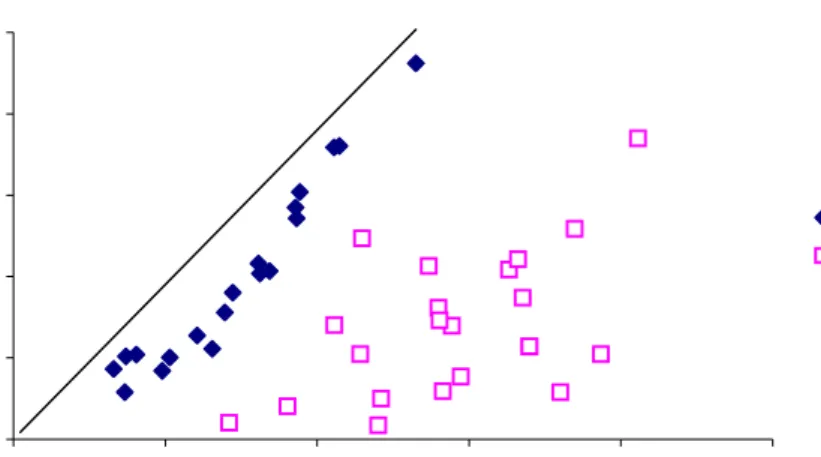
Finally, all developing country systems are small relative to global finance and in many countries there are appreciable links between the larger economic agents and the rest of the world. On the deposit side these are graphically illustrated by Figure 1 which shows the ratio of offshore bank deposits held by residents to domestic bank deposits. Although the phenomenon is strongest in Africa and Latin America, this reserve pool of liquidity (as well as international credit lines that are available to the
18 This is especially noticeable in the many countries where foreign currency deposits have begun to take a sizable fraction of the deposit market. Often it is the foreign banks that get a disproportionate share of the foreign currency deposits but are short of local currency to lend to their corporate clients.
larger firms) is appreciable and also makes the likelihood of the kinds of liquidity crunch described in several models smaller.
This is not to say that liquidity crises are impossible. Far from it. But many of the liquidity crises that have been seen are closely related to fears of exchange rate collapse or of default by national authorities—not to self-generated failures arising in the banking system.
The main type of bank-related liquidity crisis that these remarks do not speak to is depositor panic associated with a contagious reassessment of the solvency and liquidity of banks in general following revelation (whether from regulatory action or otherwise) of solvency problems somewhere in the system. There have undoubtedly been a number of such events in recent years.
The depositor response to the closure of banks in Indonesia is one such case.19 The
closure of 16 banks, accounting for about 3 per cent of the system, in Indonesia in October 1997 is often cited as an example of how lack of forbearance can trigger a panic. In fact a closer look at the situation supports quite the opposite view. It is acknowledged that the closure event heightened depositor uncertainty and contributed to considerable withdrawals over the following months. But these depositor
withdrawals were not irrational responses that caused other banks to fail. Instead, they were at least in part a response to the partial nature of the policy intervention, which left open most of the weak banks—almost all of them much larger than the closed 16—without indicating whether and on what basis there would be further closures. No wonder that depositors felt sure that the closures were only the start (audits made in mid 1998 confirmed that insolvency in the banking system was already entrenched by late 1997, cf. Enoch et al., 2001). The scale of deposit
withdrawals fed, and was exacerbated by, a collapse of the exchange rate, worsening the bank insolvency. The authorities decided in January 1998 to guarantee the full amount of bank deposits. By March of the following year a total of 79 of the 222
19 Kenyan depositors also ran from a class of banks that began to have difficulties in the late 1990s— though in this case too it seems that there were widespread problems in the class of banks affected by the runs.
banks in Indonesia (accounting for over 40 per cent of the total assets of the system) had been closed, merged or nationalized. (Fane and McLeod, 2002).
So while the handling of the banking weaknesses by means of the initial closure was highly destabilizing, and while the subsequent collapse of the exchange rate
undoubtedly aggravated the insolvency of the remaining banks (Radelet and Sachs, 1998), it seems likely that a more comprehensive intervention into weak banks (thus
less forbearance), accompanied by a clear statement of future closure policy, and
combined with a coherent macroeconomic strategy would have been better.
It might seem perverse to question the importance or frequency of contagion within developing country banking systems when so many systemic events have occurred. The point is, though, that what appears to be contagion is so often a common cause (e.g. a macro boom and bust cycle) or a simultaneous uncovering of a widespread deficiency (Honohan, 2000). Quite often, the denouement occurs after a change of government exposes a pattern of politically motivated forbearance, and this points to the pervasive agency problems that are so prominent in banking regulation in much of the developing world.
5: The double agency problem and the goals of regulators
The considerable recent investment in most developing countries in upgrading regulatory capacity cannot be assumed to have overcome the considerable agency problems that still exist. It is true that there has been a fairly direct institutional and policy transplantation of advanced country practice in the developing world over the past two decades. A process of regulatory convergence has occurred, at least on paper, assisted in the past decade by the Basel Core Principles and the formalized assessments of national compliance with these Principles carried out mostly under the auspices of the International Monetary Fund and the World Bank.
Yet even if the forms and even the legal powers are converging, account has to be taken of the differing nature and intensity of incentive and agency problems that surround the implementation of these regulatory structures. Even in advanced economies enjoying a sophisticated electorate and a free press, as well as relatively
efficient and impartial law enforcement, it is evident that regulators are subject to pressures and incentives that make it unrealistic to suppose that they are single-mindedly pursuing the public good.
Combining data on reported corruption in banking across countries, with the Barth et al. (2006) data on the structure and style of banking regulation, Beck et al. (2005) made the remarkable discovery that banking corruption was significantly correlated with the degree of regulatory discretion. The conclusion drawn by these authors is not only that granting bank regulators discretion creates rents which will be manifested in corrupt transactions between regulator and bank, but also that somehow a culture of corruption will effectively permeate the entire banking system leading to the need for borrowers to bribe bank officials and so on.
Of course it is realistic to think of the regulator as an agent of a higher level of government. To an extent, those who work as regulators may be self-selected by a desire to ensure safe and sound banking, or can become indoctrinated in a favorable regulatory culture. However, this does not mean that that the regulator will always pursue the public interest effectively. For one thing, uncovering errors, misjudgments and fraud in banking is not a simple task and requires skill, experience and assiduity. These qualities may not be sufficiently present in the regulatory authority.
But in addition, there are reasons why, even if problems are detected, enforcement is weak. This can be because delinquent insiders at regulated banks are prepared to bribe the regulator or because the regulator fears the consequences of enforcement action either at a personal or an institutional level. Despite efforts in most countries to protect individual regulators from being sued for carrying out their work in good faith, it seems to be astonishingly difficult to provide watertight protection in this regard. A decision to enforce regulatory action can mean years under the shadow of court proceedings for an individual regulator. In only 20 of 149 countries surveyed by Barth et al. are banks unable to appeal to courts against a decision of the supervisor.20
20 Even in the UK, where regulators enjoy a high degree of protection, regulatory action or inaction can result in lengthy litigation. The unsuccessful case taken by the liquidators of the BCCI against the Bank of England concluded only in 2005, almost 15 years after the failure of BCCI. Retired regulators in their 70s had to appear in court to defend their actions – or in this case inaction.
Besides, the delinquent bankers may themselves have political protection, being part of an integrated elite which embraces political, financial and industrial dimensions (as discussed in the wider context of financial globalization by Stulz, 2005).
Regulators who covertly forbear may never be found out. Although in some instances
forbearance is explicitly acknowledged and documented,21 it is often extraordinarily
difficult to detect deliberate under-enforcement.22 Under-enforcement will often not
show up immediately in bank failure, as banks can often survive for years in insolvency. There rarely is an audit trail establishing who knew what when. And when the bank failure is eventually detected, the original under-enforcer is unlikely to be still in charge of the desk. For one thing, the failure often emerges only after a change of political regime, when the relevant bankers have lost their political protection (and the chief regulator may have lost their job also). Besides, the failure will often become evident only during a more general economic downturn, and may often be blamed on that downturn, rather than on management failings of several years before.
Several agencies are typically involved in bank closure decisions. Although the banking supervisor may seem to be in the frontline of the decision, the big decisions are often taken elsewhere. Among the reasons for this are the fact that the banking regulator usually does not have the financial resources to meet liquidity needs of an
illiquid bank23 and that (despite the recommendation of the Basel Core Principles) the
banking regulator’s closure decisions are often subject to a political override.24 In fact, the key role of last resort lending by the central bank in several recent failures—most spectacularly in the Venezuelan and Dominican cases mentioned
21 As in the Turkish case discussed by Soral et al. (2006)—though even then, the bank concerned appears to have been concealing much fraud from the supervisor.
22The length of the unsuccessful attempts to prove “misfeasance” (a variant of negligence) by UK regulators in the case of the BCCI illustrate the problem even in an advanced economy context. In contrast, Shleifer and Vishny (1993) suggest that a good accounting system can often detect other forms of corruption such as, for example, the granting of licenses for a bribe to the responsible official instead of the license fee.
23 The insolvency of the FSLIC has been mentioned as one of the reasons for excessive forbearance in the US S&L Crisis (cf. Black cited in Akerlof and Romer, 1993, p.68)
24 India, Italy, New Zealand and francophone countries in Africa are among those where the law explicitly states that decision on closure is taken by a Government Ministry and not by an independent specific financial regulator (cf. World Bank Regulatory Survey).
above—highlights the fact that it is this agency which by default makes the decisions re closure by extending (or less often by not extending) liquidity loans to a troubled bank while the regulatory agency and deposit insurer stand by.
6 Interaction of information and agency problems
Do the heightened information and incentive problems in developing countries argue for or against forbearance? For example, if the regulator does not know how much capital the bank has, is this not an a priori reason for being flexible in terms of enforcing any given capital adequacy requirement? But being flexible means tolerating lower capital adequacy and in effect applying a lower capital adequacy standard. A simple model shows that, when the regulator also faces the
countervailing cost of enforcing the regulations, the net effect of higher uncertainty will be more failures, unless the regulators’ discretion to be flexible is constrained (Appendix 2). Heuristically the argument runs as follows.
Heightened uncertainty and information deficiencies increase the risk of bank failure for any given level of enforced capital adequacy. `The less precise the regulator’s estimate of the bank’s capital, the higher the probability that the bank is being allowed to operate with less capital than envisaged. Lower actual capital increases the risk of failure because the cushion of capital against unexpected loan and other losses is smaller, and probably also because risk-taking at lower capital levels may be higher by the usual limited liability argument.25
Given the pressure (from the banks) on regulators to forbear, i.e. not to require a capital injection into a bank thought to be undercapitalized, it is likely that increased uncertainty will in practice result in even more forbearance. The regulator’s decision on forbearance will be based on balancing these pressures to forbear against the risks of a failure which may be blamed on the regulator. A relaxation of standards will increase the risk of failure but will also respond to the pressure from bank insiders. If
what matters to the regulator were just the risk of bank failure, then the regulator may
be induced by higher uncertainty to increase the enforced level of capital adequacy.
25 Indeed, as uncertainty increases, the risk of failure increases more rapidly with falling levels of enforced capital adequacy.
However, this stiffening effect is reduced and may be reversed if the public is unable to detect forbearance.
The public’s limited ability to detect forbearance provides the argument for the adoption of some regime that will mechanically inhibit forbearance. A bright line regulatory regime constrains the regulator’s ability to conceal forbearance motivated by political pressures. According to the line of argument developed, this will result in decisions that are closer to the public interest.
If there are good policy reasons for forbearance in a particular instance, these can still be put forward in justification of such action
Summary of the argument of the model
In Appendix 2, then, we sketch a simple model of regulatory discretion, where regulators seek to minimize the sum of enforcement costs (the pressures placed upon them by the regulated intermediaries trying to avoid the imposition of additional capital requirements) and the expected costs resulting from their exposure to criticism for apparent forbearance in the case of failure.
The key element being modeled is the difference in information: the bank knows its capital position, the regulator has an imprecise estimate of it and the public have an even less precise estimate. The regulator is nominally charged with ensuring that the bank only operates when its capital-to-assets ratio is above a statutory threshold. The regulator is only an agent of this policy: it knows it will be criticized if bank failure emerges, but it also is under pressure from the bank insiders who don’t want the cost of recapitalization—and the more they have to recapitalize, the less they like it. The interesting question is how the regulator will balance these pressures, and how the balance will change as the precision of information in the economy deteriorates. Furthermore, will the outcome differ if the regime is one of bright-line enforcement, (interpreted here as enforcing capital in accordance with the general public’s
information concerning capital rather than the regulator’s better information which is opaque to the general public).26
We focus on the decisions of the regulator.
− On the one hand, the regulator does not want to the public to observe an
incident of bank failure (as this will be associated with social costs and, to the extent that the regulator is blamed for forbearance, private costs to the
regulator). These we call the regulator’s exposure cost.
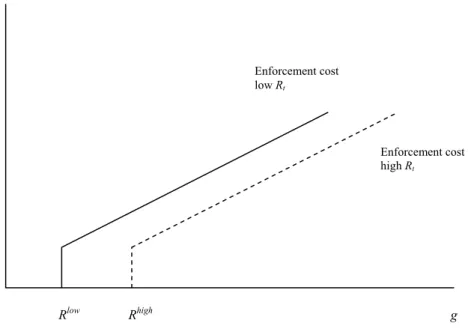
− On the other hand, enforcement that involves recapitalization will trigger
private costs to the regulator as bank insiders use political and other powers to
influence the decision.These we will call the regulator’s enforcement cost
(illustrated in Figure A2.1).
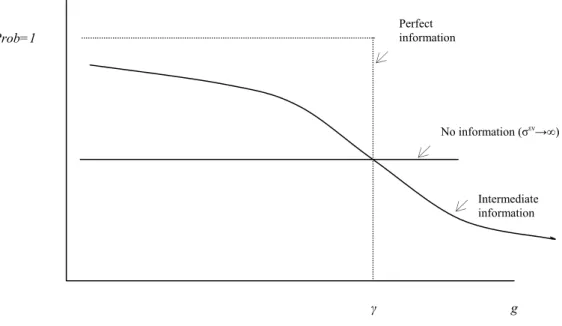
The probability of failure actually occurring (i.e. a negative capital being observed by the general public) will depend not only on required capital (g)27 but on the precision of the available information. Conditional on the enforced level of capital a fall in the precision of either the regulator’s or the public’s information increases the probability of failure (Figure A2.3).
Even if failure is observed, the regulator may not be blamed, unless the public come to believe that forbearance has been exercised. The inferred probability that
forbearance was exercised (conditional on failure) increases with the level of information precision (Figure A2.4.)
The product of the two probabilities (of failure and of being blamed for the failure) is the regulator’s exposure cost.
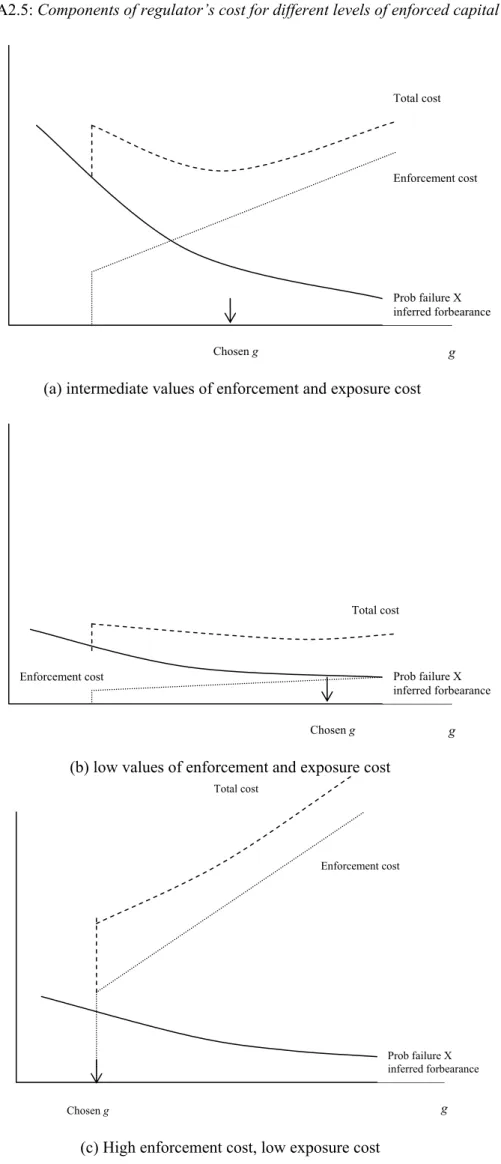
Putting together the enforcement and exposure costs, as in Figure A2.5a, shows the two-edged sword of information deficiencies. Even if the regulator does impose the
26 With a conventional enforcement regime, he fact that the public do not see the regulator’s signal means that the regulator can forbear without the public being fully aware of this. Given that political or other pressures from the bank insiders mean that requiring recapitalizations represents a costly policy for the regulator, the fact that forbearance can be concealed may influence the action of the regulator. However, with bright line enforcement, forbearance is visible to all.
27 Through two effects: a shift along the distribution of profit shocks and a change in the variance (Figure A2.2)
statutory capital requirement, lack of information by the public means that the regulator is still exposed to the risk that they may be blamed for a failure. On the other hand, it is also true that if, faced with severe pressures from the bank
shareholders, the regulator avoids imposing the full statutory capital ratio, the chances of this forbearance being suspected by the public may be low even in the event of
failure. So with low public information and severe pressures from bank
shareholders, regulators will tend to impose too little capital. Better information by the public (or – almost equivalently – bright line enforcement) will, in these
circumstances, tend to increase the actual capital levels enforced.
To see this, start with the case where public information is weak, so that the exposure
costs are low and do not decline much as enforced capital g increases. If enforcement
costs x are low both as to level and dependence on g, the regulator may even impose a
higher than statutory capital requirement for fear that he will be wrongly blamed for forbearance (Figure A2.5b). But with the same public information, a high
enforcement cost will tend to lower the enforced level of capital (Figure A2.5c). With better public information, the exposure cost curve is steeper, and this will have the effect of pushing the enforced capital level g up, even if enforcement costs are high.
The model thus strongly suggests that information deficiencies in developing
countries represent an argument for less, rather than more, regulatory discretion. Far from encouraging flexibility in response to information deficiencies, advisors should warn that such countries cannot afford to adopt the luxury of discretion.
7 Seeking empirical evidence
This Section reviews existing cross-country empirical evidence on the impact of forbearance on banking crisis costs, and discusses the difficulties that exist in extending it to answer the question posed by the present paper. There is little
convincing empirical evidence, one way or the other, on the effectiveness or risks of a policy of forbearance. It is hard even to obtain an empirical counterpart to the
The US case is a leading one. The prolonged period of forbearance during the US Savings and Loan crisis of the 1980s was held by many scholars to have contributed greatly to the scale and cost of this crisis. A consequence of the ensuing debate in the US was the enactment in 1991 of FDICIA, which inter alia mandates on regulators prompt corrective action where the banks and nearbanks under their remit become undercapitalized.28 Even if they do not amount to ‘zero tolerance’, the limitations on regulatory discretion under FDICIA appear to have reduced the amount of
forbearance. The sharp drop in the number of institutions which have had to be intervened since FDICIA were taken by enthusiasts as an indicator of the
effectiveness of prompt corrective action under the new Act. Thus, the percentage of undercapitalized banks in the US fell from 5 per cent in 1990 and 3 per cent in 1991 to about 0.2 per cent by 1996 (Benston and Kaufman, 1997). And there is evidence that supervisors have acted more quickly and more effectively to bring faltering banks back to health since the enactment of FDICIA (Kane et al. 2007). Confirming that the restrictions on forbearance in the Act are causal in this regard is less easy. (And not all of the evidence favours the interpretation that FDICIA has tightened forbearance as much as intended. For example, Hanweck and Spellman point to evidence from the market for subordinated debt, that market participants anticipate longer periods of forbearance than the maximum of 270 days envisaged in FDICIA.) But above all, it would be unwise to extrapolate experience from the US to the case of the developing countries for the reasons explored in Sections 3-5.
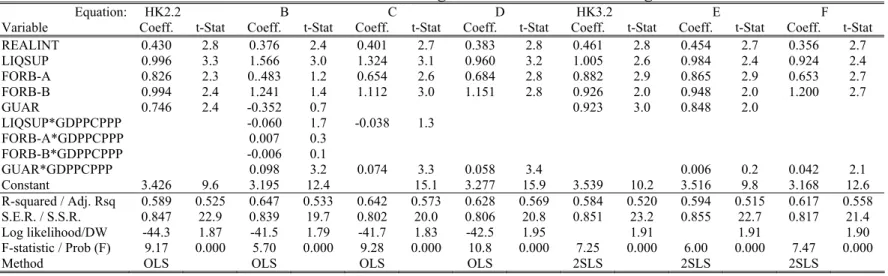
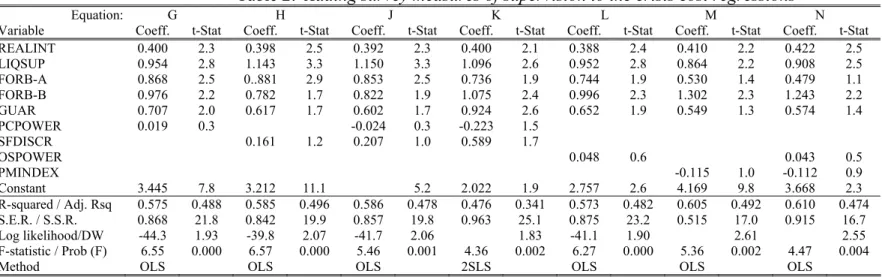
Cross-country experience with financial crises can be used to throw some empirical light relevant to developing countries. Looking at the fiscal costs associated with some 40 crises for which data were available, Honohan and Klingebiel (2003) found that capital forbearance (and other accommodating policies) tended to be statistically associated with higher fiscal costs (as a percentage of GDP). Although the sample covered a very wide range of income levels, their study did not attempt to assess whether these effects were more or less evident for low income countries. Table 1 show the results from extending the analysis in this way. Per capita GDP (measured at purchasing power parities) is interacted with each of the regulatory policies and
28 With this measured at market value wherever possible. The market valuation approach introduces a degree of procyclicality as indicated below if asset liquidations in the crisis depress market prices.