TAKEOVERS AFTER TAKEOVERS
Centre for Business Research, University of Cambridge Working Paper No. 363
by
Andy Cosh
Centre for Business Research University of Cambridge
Trumpington Street Cambridge CB2 1AG E-mail: [email protected]
Alan Hughes
Centre for Business Research Judge Business School Building
University of Cambridge Trumpington Street Cambridge CB2 1AG Email: [email protected]
June 2008
This Working Paper forms part of the CBR Research Programme on Corporate Governance
Abstract
We review five decades of takeover actively in the UK. We assess the relative characteristics of acquiring and acquired companies and the performance impacts of merger using both accounting and share price based measures. We conclude that the fundamental conclusions reached by Ajit Singh about takeovers and the market for corporate control in his seminal contributions of the 1970s remain true in the light of subsequent work.
JEL Codes: G34; Mergers, acquisitions, corporate governance
Keywords: Takeovers, Natural Selection, Market for Corporate Control
Acknowledgements
We are indebted to Paul Guest, Ajit Singh, Dennis Mueller and Charlie Conn for many stimulating discussions of this topic.
Further information about the Centre for Business Research can be found at the following address: www.cbr.cam.ac.uk
‘Insofar as the neoclassical postulate of profit maximization relies on the doctrine of economic natural selection in the capital market (via the takeover mechanism) the empirical base for it is
very weak’ (Singh, 1975, p. 954)
1. Introduction
In this chapter we reflect on the contribution Ajit Singh has made to the study of takeovers as part of the ‘natural selection’ process in a capitalist market economy. Our emphasis is on the seminal contributions in his 1971 book,
Takeovers – Their Relevance to the Stock Market and the Theory of the Firm
(Takeovers hereafter), and his subsequent article in the Economic Journal
(Singh, 1975). We consider in particular whether the key findings and interpretations in these contributions have stood the test of time.
The study of takeovers should be rooted in a specific institutional and historical context. We therefore concentrate solely, as Ajit did, on the UK, and consider only UK institutional and regulatory changes affecting the takeover process. There is, even so, a substantial subsequent literature (to which Ajit himself contributed) spanning the three decades since the original book and article were published. In a chapter of this kind we are inevitably confined to an illustrative rather than exhaustive discussion.
2. Takeovers
Takeovers had its origins in 1963 and Ajit’s collaboration with Robin Marris and Geoffrey Whittington. The book’s publication was delayed by the preparation of another book co-authored with Geoffrey Whittington, entitled
Growth, Profitability and Valuation (Singh and Whittington, 1968). As Ajit wrote at the time of the publication of Takeovers, ‘A study of surviving firms took precedence over an examination of those which did not survive – it is a moot point whether this is a correct order of priorities.’
The theoretical approach to the analysis in Takeovers is rooted in the theories of the firm proposed by William Baumol, Robin Marris and Oliver Williamson. These were linked to the 1930s work of Adolf Berle and Gardiner Means on the development of corporations with dispersed share ownership, and professional management whose motivations did not necessarily align with those of the shareholders. A pursuit of increased size for reasons of personal aggrandizement and higher rates of remuneration would, it was argued, predispose such companies to pursue size or growth at the expense of profits. In a world in which (following Means) there was limited product market competitive pressure, the role of disciplining managers and of aligning their
decision-making with the welfare of shareholders would come to rest with the stock market. It would become a market for corporate control which selected the fittest companies for survival (Manne, 1965). Marris in particular, emphasized takeovers as a disciplinary mechanism constraining managerial ambitions (Marris, 1964).
In Takeovers Ajit developed a set of hypotheses characterizing the market for control as a selection mechanism and used a newly constructed data set of company accounts to test them. The latter was in itself a substantial intellectual effort, carried out in collaboration with Geoffrey Whittington. It was subsequently developed and maintained through the efforts of Geoff Meeks, Joyce Wheeler and others, and has provided a rich resource for many subsequent takeover studies.
The empirical analysis in Takeovers seeks to compare, in turn, the performance characteristics of acquired companies relative to those companies that were not acquired; the characteristics of acquiring companies compared to the companies they acquire; and the characteristics of the acquiring companies compared to non-acquiring, non-acquired companies and companies in general. It also examines the impact of takeover on the subsequent performance of acquiring and acquired firms. In a market selection process ensuring stockholder welfare satisfaction through profit maximizing behaviour, the natural selection hypotheses are that acquiring companies will be superior profitability performers, acquired companies will be inferior performers, and takeover will improve profitability performance. Using the financial accounts for several hundred UK public quoted companies, Takeovers contains both univariate and multivariate analyses of the short- and long-run profit, growth and other financial characteristics of acquiring and acquired companies relative to each other, and to other companies on the stock market. The analysis is notable for its careful discussion of problems of pooling takeovers from different time periods and sectors, and for the care taken in comparing alternative methods of discriminating between groups of firms. Use is made of matched samples and of multiple discriminant analysis, with detailed checks of the robustness of the results (including, given the rather strong multivariate normality assumptions of the discriminant approach, some non-parametric checks). Analysing the impact of takeover on company performance raises the problem of the counterfactual of what the performance would have been in the absence of takeover. The counterfactual devised has been used in many subsequent studies. It involves taking the weighted combination of the companies involved in the takeover relative to their sectoral performance and comparing it with the post-takeover performance of the merged company, again normalized by sector performance.
The principal findings of the analysis in Takeovers were that takeovers had become the dominant form of corporate ‘death’; were becoming more intense over time; were, in contrast to the US, predominantly horizontal; and varied in intensity across industries and size classes. The likelihood of acquisitions in the largest size group was substantially lower and more strongly inversely related to company size than in the smaller size groups. Size, rate of growth, rate of profitability and stock market valuation ratio were all lower for acquired firms relative to those firms that were not acquired. This is what might have been expected on the basis of natural selection arguments. However, and much more significantly, the analysis showed clearly that there was an extremely large overlap between the acquired and non-acquired firms in terms of these characteristics. As a result, the ability to discriminate successfully between acquired and other firms was very low. Acquired and non-acquired companies, matched, for example, by size and industry, revealed very little difference between the groups. Where discrimination was successful, it tended to be in terms of short-run profitability, and in particular in terms of size. The overlap in characteristics between acquired and non-acquired companies increased between the period covered by Takeovers (1955–60) and that covered in the 1975 article (1967–70). By the latter period, an attempt to classify companies into acquired and surviving groups based on profitability alone would have had a 46 per cent probability of misclassification. The fact that size was a better discriminator in both periods led to the somewhat perverse implication that the best way to avoid takeover for a low profitability firm was not to increase profitability, but to grow, and that making takeovers may be the fastest way to do this.
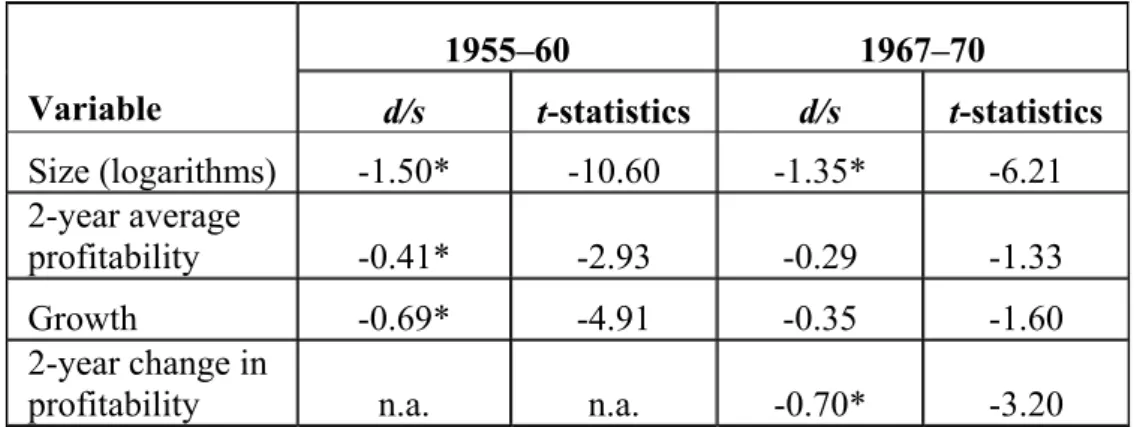
The analysis of acquiring companies suggested that they were larger, more dynamic and more profitable than the companies they acquired (but not necessarily compared to non-acquired, non-acquiring companies). Table 1 shows a selection of results drawn from the 1975 Economic Journal article, which includes key results from Takeovers.
The table shows that the most statistically significant difference is to be found when size is used as a discriminating variable. Profitability is significant only in the first of the two periods. The short-term change in profitability is, however, significant in the later period (the analysis was not carried out for the earlier years). A further detailed analysis reveals a considerable overlap between the acquired and acquiring companies, but the results provides some comfort for the proponents of a natural selection argument. However, when the impact of the takeover on performance is assessed, a disappointing result emerges. The impact on pre-tax profitability, in the period 1955–60, for example, shows that in the first year after takeover, 66 per cent of the firms have a worse
post-takeover performance when compared with the combined target and acquiring firm pre-takeover relative to industry profitability. Two years afterwards, 57 per cent have a worse takeover performance, and after three years, 77 per cent have a worse takeover performance. This outcome is not consistent with the prediction of the selection models.
Table 1. Differences between acquired and acquiring companies, 1955–60 and 1967–70
1955–60 1967–70
Variable d/s t-statistics d/s t-statistics
Size (logarithms) -1.50* -10.60 -1.35* -6.21 2-year average
profitability -0.41* -2.93 -0.29 -1.33
Growth -0.69* -4.91 -0.35 -1.60
2-year change in
profitability n.a. n.a. -0.70* -3.20
Notes: * Significance level: 1%;d is the difference in the means of the acquired and acquiring group, and s is the estimated common standard deviation. A minus sign for d/s indicates that acquired firms had a mean value below acquiring firms. Source: Singh (1975).
In addition to these central findings the analysis in Takeovers included an examination of a number of topics that became important issues in later research. Thus the analysis also looked at the extent to which takeovers led to executive dismissals, which might be deemed to be consistent with the selection mechanism. It revealed little difference in executive retention between successful and unsuccessful acquired firms. The analysis also contrasted hostile with friendly takeovers, again as a particular variant of the selection model, and found few differences between them.
As a result of these findings taken as a whole, Ajit concluded that the empirical basis for the takeover natural selection argument was very weak (Singh, 1975, p. 514).
We shall now examine how far these results and conclusions have stood the test of time.
3. Takeovers since Takeovers
3.1 The changing context of takeovers
There have been significant changes since the 1960s in both the nature of takeovers and the institutional framework in which they have occurred. Figures
1 and 2 show that takeovers have continued to occur in significant waves. The scale of these waves has, however, increased, as has the internationalization of the takeovers made by UK public companies. Figure 3 shows that the nature of share ownership has also changed dramatically. From the mid-1950s to the 1970s steady growth occurred in the importance of institutional investors as holders of UK equity, at the expense of individual shareholders. The decline of individuals as shareholders has continued unabated since the mid-1960s. What is most striking in Figure 3, however, is the major increase in overseas share ownership. The result has been that, from the early 1990s, the shares of UK institutional shareholders and pension funds have fallen. The internationalization of share ownership may potentially alter the extent to which shareholder interests are both perceived and acted upon by investors. To the extent that overseas investors (consisting of a mix of individuals, overseas sovereign funds and overseas institutional investors) bring with them different attitudes to the nature of shareholder company relationships, then so too may the nature of the takeover process change. Equally, to the extent that collaborating action is more difficult to undertake when investors are spread internationally, the role of ‘voices’ may be diminished.
Figure 1 The growth and internationalization of takeovers: the number of domestic and overseas acquisitions by UK acquirers, 1969–2006
0 500 1000 1500 2000 1 9 6 9 1 9 7 1 1 9 7 3 1 9 7 5 1 9 7 7 1 9 7 9 1 9 8 1 1 9 8 3 1 9 8 5 1 9 8 7 1 9 8 9 1 9 9 1 1 9 9 3 1 9 9 5 1 9 9 7 1 9 9 9 2 0 0 1 2 0 0 3 2 0 0 5 N u m b e r o f a c q u s it io n s Overseas Domestic
Source: Calculated from Office of National Statistics data.
Figure 2 The growth and internationalization of takeovers: the value of domestic and overseas acquisitions by UK acquirers, 1969–2006 (stock market prices, 2006)
0 50000 100000 150000 200000 250000 1 9 6 9 1 9 7 1 1 9 7 3 1 9 7 5 1 9 7 7 1 9 7 9 1 9 8 1 1 9 8 3 1 9 8 5 1 9 8 7 1 9 8 9 1 9 9 1 1 9 9 3 1 9 9 5 1 9 9 7 1 9 9 9 2 0 0 1 2 0 0 3 2 0 0 5 V a lu e o f a c q u is it io n s £ m i n 2 0 0 6 s h a re p ri c e s Overseas Domestic
Source: Calculated from Office of National Statistics data.
Figure 3 The rise and fall of institutional investors: beneficial ownership of UK shares, 1963–2006 0 10 20 30 40 50 60 '63 '64 '65 '66 '67 '68 '69 '70 '71 '72 '73 '74 '75 '76 '77 '78 '79 '80 '81 '82 '83 '84 '85 '86 '87 '88 '89 '90 '91 '92 '93 '94 '97 '98 '99 '00 '01 '02 '03 '04 '05 '06 Year % S h a re s
Rest of the world Insurance companies Pension funds Individuals Investment and Unit Trust and
Other Financial Institutions
Banks, Charities, Public Sector and Private Non-Financial Companies Source: ONS (2007) Share ownership: A Report on Ownership of Shares
as at 31st December 2006, London: ONS.
These developments have been accompanied by a decline in the incidence of public quoted company status. Figure 4 shows that the number of UK quoted companies has fallen, from almost 4,000 in the mid-1960s to fewer than 1,500
by the start of the twenty-first century. The number of international companies has remained more or less constant over this period. This trend is connected with the increasing importance of UK corporate reorganization via buy-outs, buy-ins and private equity takeovers that has led to the conversion of public companies to private status. By the start of the twenty-first century, between 20 per cent and 50 per cent of the value of total buy-out and buy-in activity was concerned with the conversion from public to private status (Wright et al., 2006).
Figure 4. The fall and fall of UK quoted companies: numbers of quoted UK and international companies on London Stock Exchange, 1966–2007
0 500 1,000 1,500 2,000 2,500 3,000 3,500 4,000 4,500 '66 '68 '70 '72 '74 '76 '78 '80 '82 '84 '86 '88 '90 '92 '94 '96 '98 '00 '02 '04 '06
No. of UK Companies No. of International Companies
Source: Stock Exchange historical statistics.
These major changes in the characteristics of the UK stock market, and the takeover process, has occurred at the same time as major changes in the regulatory framework affecting the takeover process. These changes have reflected dissatisfaction with the effectiveness of traditional forms of corporate governance in terms of board structure and function, and of the exercise of ‘voice’ and other direct activity by shareholders. They have also been fundamentally concerned with the operation of the takeover process itself.
These changes are reviewed in the context of governance and takeovers more generally in Cosh, Guest and Hughes (2007) ‘UK Corporate Governance and Takeover Performance’
A succession of reports in the 1990s led to the construction by 2003 of a combined code on corporate governance (Financial Reporting Council, 2003). The latest (2006) version of this combined code imposes obligations on
institutional shareholders to take a responsible and active role in relation to the companies whose shares they own. In terms of board composition and board operations, the combined code emphasizes the need for a single board with collective responsibilities and a standard-setting role with a clear division of responsibilities between chairman and chief executive. In addition, at least 50 per cent of board members for larger corporates should be independent, non-executive directors. It also established procedures governing the evaluation of board effectiveness, the appointment of directors, and for setting executive remuneration and long-term incentive schemes. Remuneration is to be linked clearly to performance. An audit committee of independent directors with sufficient experience will be responsible for presenting a balanced assessment of the company’s position and maintaining internal control procedures.1 The most recent report, in 2007, which has a bearing on these issues was related in particular to private equity firms and the need for transparency in their operations (Walker, 2007).
At the same time as these persistent attempts to improve internal board government structures and the relationship between key external investors and the board, there has been the development of the City Takeover Code to regulate the actual process of takeover itself. The City Code on Takeovers and the operation of the Takeovers Panel, which enforces it in the UK, has been designed essentially to protect shareholders’ interests and preserve an active market for corporate control. The focus is on shareholders alone and does not involve any discussion of wider stakeholder issues. The principal focus is on the equal treatment of stockholders. In particular, all bidders and shareholders are to be treated equally in relation to information and the timing of its release. Actions to frustrate bids that do not have shareholders’ approval are particularly frowned upon.
While neither the Combined Code nor the Takeovers Panel operate with the force of law, their close links with requirements for stock market listing and accepted behaviour has meant that they have in effect come to dominate the practice of behaviour in these two areas. The rationale behind the approach adopted by the Takeover Code is implicitly, if not explicitly, that the orderly workings of the market for corporate control through takeovers are an essential part of the operation of the capital market and that they should be free to operate in as unhindered a way as possible in the interests of shareholders. One might expect that the emergence of the Code into a dominant position would have influenced the extent to which takeovers occurred in the interests of shareholders, and that this would reinforce the kinds of regulatory changes associated with the adoption of the combined governance code (Cosh et al., 2007).
3.2 Pre-takeover characteristics
Hughes (1993) reviews thirteen studies that investigated the pre-takeover characteristics of acquired companies in the UK. These studies covered the period 1955 to 1986.2 He concluded that acquired companies are always less dynamic pre-merger than control group companies, even if the difference is not always statistically significant. In relation to pre-takeover profitability, however, he concluded in particular that the differences between the acquired and control group or acquiring companies are minimized in periods of merger boom, when the groups become virtually indistinguishable. Moreover, where profitability differences do distinguish the acquired from the rest, it is in terms of short-term profitability in the years immediately preceding acquisition or declines in profit performance in those periods. In virtually all studies, size is a significant distinguishing characteristic of acquired versus acquiring companies. Acquiring companies are always larger than acquired companies. However, it is also apparent that the liability to acquisition of medium-sized to larger companies increases in merger booms.
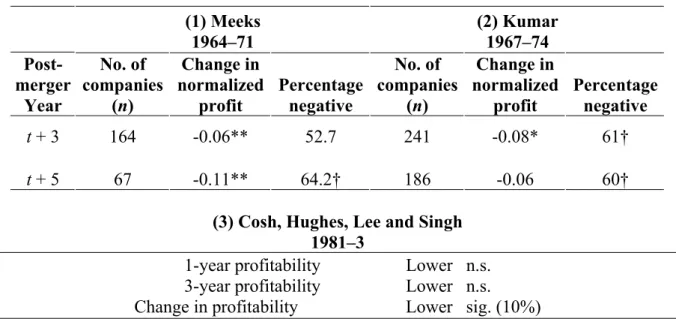
In terms of post-takeover performance Hughes reviewed six studies of changes in accounting performance as a result of takeover, and fourteen studies reporting event study share return effects, or matched control group comparisons of measures of shareholder return based on capital gains and dividends.3 The typical results using accounting studies and the Singh counterfactual and showing post-takeover falls are shown in Table 2.
Hughes concludes that there is evidence for improvements in profitability only in the case of diversifying mergers, but taken as a whole and in the case of horizontal acquisitions as a group, the impact on profitability is of a small variable, but negative movement in profitability in the post-merger compared to the pre-merger period. The studies focusing on short-term announcement effects on share returns show that any short-run gains for acquirers are outweighed by longer-term post-takeover losses. This is consistent with bids launched by acquirers with ‘overvalued’ stock. There is some evidence that the combined short-run share price effects on acquirers and acquired company shareholders are positive or neutral because the targets receive substantial bid premiums. However, even the combined effects become negative in the longer term. He concludes that taken as a whole these studies suggest that acquirers launch their bids when their prices are relatively high (either by accident or by design). They also show that whatever positive short-term effects are associated with bids in the longer-run they are followed by cumulatively negative effects on the acquirers’ shareholder performance.
Table 2 Changes in normalized profitability after merger in the UK, 1964–83 (1) Meeks 1964–71 (2) Kumar 1967–74 Post-merger Year No. of companies (n) Change in normalized profit Percentage negative No. of companies (n) Change in normalized profit Percentage negative t + 3 164 -0.06** 52.7 241 -0.08* 61† t + 5 67 -0.11** 64.2† 186 -0.06 60†
(3) Cosh, Hughes, Lee and Singh 1981–3
1-year profitability Lower n.s. 3-year profitability Lower n.s. Change in profitability Lower sig. (10%)
Notes: † Significantly different from 50% at the 5% level. * Significantly different from the zero at the 5% level. ** Significantly different from zero at the 1% level. a Net income/net assets.
Source: Hughes (1993).
There have been ten studies published since 1991, attempting to distinguish UK acquired companies from surviving companies.4 They span the period 1948–96. Some of these studies have been carried out using similar methods to those described in Takeovers, but others involve using hazard function estimation procedures as well as probit and logit analysis, rather than discriminant analysis. They include the full range of financial variables considered in Takeovers, as well as some share return variables. The studies include several attempts to establish whether the profitability characteristics of firms subject to hostile bids were different from those subject to friendly bids.
In general, the results of these studies are supportive of the key findings of the results reported in Takeovers. In particular, attempts to discriminate in terms of rate of return between acquired companies and the rest, which use logit and probit approaches, find extremely poorly estimated models with very low rates of successful classification (Powell, 1997; Thompson, 1997; Barnes, 1999). Similarly, univariate comparisons of pre-takeover share returns or profitability show no significant differences between acquired companies and the rest (Franks and Mayer, 1996; Kennedy and Limmack, 1996; Cosh and Guest, 2001). The exception to these findings is Nuttall (1999a) who reports in an analysis of 643 UK quoted companies in the period 1989–96 that Tobin’s q and the return on sales is statistically significantly negatively related to the probability of
acquisition. He does not, however, report on the probabilities of misclassification arising from this analysis.
Regarding the question of hostility, Kennedy and Limmack (1996) report no difference in pre-takeover share returns between disciplinary and non-disciplinary bids, and Powell (1997) similarly finds no difference between the profitability characteristics of hostile and friendly targets. This result is echoed in Franks and Mayer (1996) and Cosh and Guest (2001). While Cosh and Guest (2001) report no pre-takeover differences in profitability between hostile and friendly targets and various control groups, they do report a significant fall in short-term profitability in hostile takeovers compared to control groups and friendly acquisitions in the year before the acquisition takes place. This analysis covering the period 1985–96 is consistent with the finding in Singh’s original studies that short-term profitability falls may be related more closely to the acquisition probability than the average on medium-term rates of return before takeover. Cosh and Guest also report that the share return performance in the year before acquisition in hostile targets was significantly worse than for control groups and friendly targets, which reinforces this implication.
All the studies considered report that size is negatively related to the probability of takeover. The incidence of takeover declines with the size of the firm. In some periods, however, this may be non-linear, with the highest acquisition rates in medium-sized companies (see, for example, Dickerson et al., 2002). In general, however, greater size is related to a lower likelihood of acquisition. There is some evidence that larger companies are more likely to be subject to hostile takeovers, though, as we have seen, this is not related to their profit performance (see, for example, Powell, 1997).
All the studies referred to so far have used either univariate comparisons or logit/probit models, which are closely related to the approach based on multiple discriminate analysis that Singh used in his original work on takeovers. In an interesting series of studies, however, an alternative estimation procedure has been used. These are the studies by Dickerson and colleagues, who examined the period from 1948 to 1990, making use of an updated version of the original Singh/Whittington data set.
In Dickerson et al. (1998) a discrete time analogue of the Cox proportional continuous time hazard function is estimated. Thus, given that a firm has survived up to any point in the data period, the method estimates the impact that a change in, say, size or profitability will have in terms of a change in its probability of takeover. They estimate this function for 2,839 UK non-financial companies in the time period 1948–70. While size is included as a variable
affecting the conditional probability of acquisition along with measures of profitability, leverage, liquidity, investment, dividends and industry dummies, they do not report the change in conditional probability associated with changes in size. They do report, however, that higher dividends and higher investment both reduce significantly the conditional probability of takeover, with the impact of dividends being higher than that for investment in new assets. Since investment can increase the size of a company, they combine the total elasticity of investment and size, and show that it is only one-third as large as the effect of dividends. They conclude that the allocation of a marginal £1 of earnings by managers seeking to avoid acquisition would be to issue them in dividends rather than investing in assets. They do not regard these as being a trade-off between shareholder and manager interests, since this depends on the impact of investment of the future returns.
Dickerson et al. (2002) extended the analysis to the period 1970–91. This analysis covered 323 acquisitions in a sample of 892 UK-quoted companies. Using hazard function and probit analysis, they found that higher profitability, investment and dividends reduced the probability of takeover. In contrast to their findings for 1948–70, the impact of dividends is not always statistically significant. In the period after 1982 the impact of a change in profitability on the probability of being acquired was much lower. Their overall conclusion was that shareholders focus primarily on current profitability. These findings, using different estimation methods and including later time periods, confirm the important point in Singh’s original work that short-run changes appear to have a much greater impact than longer-run or average effects, and confirm more generally the earlier results using univariate methods summarized in Hughes (1993).
Singh’s further argument that a firm’s best way to avoid acquisition is to grow through acquisition itself receives strong support in Dickerson et al. (2003). They showed that making a previous acquisition has a negative impact on the probability of subsequently being acquired. In the period 1948–70, the probability of subsequently being acquired fell by 27 per cent, and in the period 1975–90 it fell by 32 per cent. This effect, they argued, is mainly because of the impact of the increase in size following acquisition.
3.3 Post-takeover performance
Twenty-eight studies of the impact of acquisition on performance in the UK have been published since 1990,5 covering takeovers occurring in the period 1948–2004. A wide range of performance variables was used in these studies. There is, however, a broad distinction between those performance analyses based on share price effects and those that focus on accounting returns.
There is a wide variation in the detail with which the share price effects are estimated. This is a result of the protracted discussions in the finance literature of the relevant benchmark to use when calculating whether the share returns experienced by a company are above what might have been expected. The other important distinction in share price studies is between those studies that focus on very short-term effects in time windows of a few days around merger events, and those that examine longer-run effects in the post-merger period (which can cover a period of up to 36 months, and occasionally longer). It is beyond the scope of this chapter to include a detailed discussion of the niceties of these alternative counterfactual estimates. There is a similar issue dealing with the appropriate accounting rate of return to use. This has also generated a distinctive methodological sub-literature, which is reviewed in recent studies of UK takeovers (see, for example, Conn et al., 2005); Powell and Stark, 2005; and Cosh et al.,2006).
If we focus on the returns experienced by the shareholders of acquiring companies, a fairly straightforward conclusion emerges. The announcement effects of takeover are bad for acquiring company shareholders: they most frequently lose wealth (Conn and Connell, 1990; Limmack, 1991; Sudarsanam
et al., 1996; Holl and Kyriazis, 1997; Sudarsanam and Maharte, 2003; Bild et al. ,2005; Conn et al., 2005; Cosh et al., 2006), or, in a few studies, are apparently made no worse off (Higson and Elliott, 1998; Cosh and Guest, 2001; Gregory and McCorriston, 2005; and Antoniou et al., 2007). No studies have reported positive effects.
If we turn now to long-run post-takeover share performance, another gloomy picture emerges. There is some evidence that, in some time periods, long-run positive impacts can occur. Thus, for example, Higson and Elliott (1998) show significantly negative long-run returns to acquirers in the periods 1975–80 and 1985–90, but positive returns in the period 1981–4. Negative long-run share impacts over 12 to 36 months after the bid period are reported for acquiring companies in Limmack (1991), Kennedy and Limmack (1996), Gregory (1997), Sudarsanam and Mahate (2003), Conn et al. (2005) (though for private acquisitions the negative effect is statistically insignificant), Gregory and McCorriston (2005) (though the decline is insignificantly different from zero), Alexandridis et al. (2006), Antoniou et al. (2006) (although the declines are statistically insignificant), Cosh et al. (2006), Antoniou et al. (2007) and Antoniou et al. (2008) . This is not a very happy story for the proponents of the view that the stock market selection process yields improvement in stock market performance as a result of the acquisition activity.
The studies of accounting performance as opposed to shareholder performance are more mixed. Approaches using variants of the original Singh normalization procedure typically find significantly negative impacts on most definitions of profitability. Negative impacts are found in Chatterjee and Meeks (1996) for the period 1977–84, but insignificantly positive effects for the period 1984–90 one year after the takeover is considered. They argue that the latter effects may reflect exploitation of changes in accounting standards in the mid1980s. Cosh et al. (1998) carried out a detailed study of profitability effects, correcting for possible selection bias in the allocation of companies into acquiring and acquired groups and allowing for regression to the norm in terms of profitability. They found that the normal tendency for profits to regress towards the mean was reinforced in the case of merging firms. Acquisition produces a deterioration in post-merger profitability compared to pre-merger profitability, which is faster than would be expected. Powell and Stark (2005), in a careful study of a variety of accounting measures and using results that allow alternatively for regression to the mean, or compare differences in normalized levels using the Singh procedures, find differences in results depending on the method and measure used. Thus, their analysis, covering the period 1985–93, shows significant improvement in operating performance in regression based models. These effects are weaker for pure cash flow measures compared to accruals-based measures. Analyses using Singh normalized rates of return show improvements that are lower than the regression model and are typically insignificantly different from zero. Bild et al., studying 303 acquisitions in the UK over the period 1985–96 find that the post-takeover profitability on equity is significantly higher in the takeover year and each of the three years afterwards compared to controls. Cosh et al. (2006) in a detailed analysis of 363 UK public non-financial takeovers in the period 1985–96 provide an analysis of multiple accounting return measures and compare regression and normalized counterfactuals. They concluded that there is a significantly positive impact when operating profit returns are used, but an insignificantly positive impact when post-takeover cash flow returns are used.
A number of the accounting studies have touched on the issue of hostile compared to non-hostile bids. Cosh and Guest (2001), in their study of sixty-five hostile and 139 friendly takeovers in the period 1985–96 show that profitability increases significantly post-merger in hostile takeovers, but that there is no significant change in friendly takeovers. The difference in the returns between these two groups is also statistically significant. This is consistent with a more positive interpretation of the market for corporate control, and achieves some support from those long-run share price studies that have tried to distinguish between hostile and other takeovers. Thus Sudarsanam et al. (1996), Gregory (1997) and Higson and Elliott (1998) reported positive or less negative
effects for hostile than other acquirers. Gregory and McCorriston (2005) reported no impact for hostility nor, despite their findings of significant profit differences between hostile and friendly takeovers, did Cosh and Guest (2001) find relatively improved share price performance in hostile takeovers. In fact they found insignificant negative declines in long-run returns for hostile takeovers combined with significantly negative returns for friendly takeovers. This is unrelated to the pre-acquisition performance of the target.
Taken as a whole, these results suggest that, in the short run, the shareholders of acquiring companies suffer significant wealth losses as a result of takeover. The bulk of the results also show that further long-run significant losses in shareholder wealth occur after the takeover has occurred. This does not suggest that there would be strong incentive effects for the shareholders of acquiring companies to encourage a process in which their managers are seen as the vanguard of a selection process to weed out inefficient firms. Acquisition simply makes them worse off.
If we focus instead on profit returns based on accounting data as a proxy for efficiency we find a much more mixed picture, which is clouded from the mid-1980s onwards by the possibility of accounting conventions distorting the results. For takeovers before then, Dickerson et al. (1997) may act as an overall summary. They analysed 1,143 acquisitions by 613 acquirers in the period 1948–77 and showed that acquisition has a significantly negative impact on profitability. The effect was a 4.07 percentage-point fall on average from the mean rate of return across all non-acquiring companies (the average being 16.45 per cent). In other words, there was a 25 per cent fall in profitability post-takeover. Dickerson et al. also report that these negative impacts were worsening over time and were much higher in the 1964–77 period than between 1948 and 1963.
So far, we have focused on acquisitions as single events. It is possible to argue that pooling together firms who make multiple acquisitions with firms that make a single acquisition may mask important differences between the two. Significant organizational learning effects may mean subsequent takeovers will yield better performance for the shareholders of the acquiring company than those earlier in the series. Cosh et al. (2004) tested this hypothesis for 1,486 merger series covering 3,019 public and private acquisitions, of which only 805 involved a single acquisition. They show, by using both long-run share return and profit rate measures, that there is a steady deterioration in performance until the series ends in shareholder wealth losses.
Taking these studies as a whole we conclude that support for the idea that a selection process may be at work is strongest in the findings of profit improvements for hostile as opposed to friendly takeovers, but even these hold only for some time periods and some measures. However,, acquiring company shareholders generally lose wealth no matter what the type of takeover.
4. Summary and conclusions
Our interpretation of the work that has been carried out on UK takeovers subsequent to Ajit Singh’s seminal studies is simple. Singh’s initial insight that the stock market was a very imperfect vehicle through which the natural selection process could be carried out has been supported substantially by subsequent work. This is most striking in relation to the inability to distinguish acquired companies from the rest in terms of their underlying profit or share price performance. Equally, there is very little evidence to support the view that the shareholders of acquiring companies should be motivated to support management who wish to carry out takeovers, on the grounds that they were extending their superior management skills to underperforming companies. Both the short-run and long-run share price impacts suggest that takeovers, on average, substantially worsen acquiring company shareholders’ wealth. The evidence on profit impacts have become somewhat more positive over time, but depend critically on whether the period is before or after the major accounting standards changes affecting takeovers, and on whether cash flow or other methods of profit measurement are used.
The takeover process as a whole seems to be characterized more easily in terms of either the pursuit of managerial self-interest or in terms of the hubris hypothesis proposed by Roll (1986): ‘If there really are no aggregate gains in takeover, the phenomenon depends on the overbearing presumption of bidders that their valuation is correct … there is little reason to expect that a particular individual bidder will refrain from bidding because he has learned from his own past errors’ (p. 200).
Of course, it may be the case (as the current authors have heard argued in each successive takeover wave that has occurred) that the latest wave will be different from those preceding it. Lessons will have been learnt, and the nature of the takeover process will have changed. In terms of regulatory reform and change, it does not seem as though the nature of the process has changed dramatically despite the extent of changes we have noted in this chapter. Nevertheless, the latest version of the ‘hope-springs-eternal’ argument is to be found in claims at the time of writing that the role of private equity in the latest wave will show substantial gains from takeover. One of the virtues of proposing this view while a wave is in progress is that it is difficult to evaluate the claims,
because the current wave is invariably not the one that features in the current academic literature. This is partly an effect of the lags in the publication of academic results, but also of the need to allow a number of years to pass to enable the estimation of post-merger performance effects. It remains to be seen whether in five or ten years’ time, when the dust has settled on the private equity boom, whether the conclusions that Ajit Singh drew in his original work will remain true. We repeat those conclusions and endorse them here: ‘insofar as the neoclassical postulate of profit maximization relies on the doctrine of economic natural selection in the capital market (via the takeover mechanism) the empirical base for it is very weak’ (Singh, 1975, p. 954).
Notes
1
The various reports leading up to this combined inclusion include Cadbury (1992); Greenbury (1995); Hampel (1998); Turnbull (1999); Higgs (2003).
2
These studies were Rose and Newbould (1967); Newbould (1970); Singh (1971); Buckley (1972); Kuehn (1975); Singh (1975); Davies and Kuehn (1977); Meeks (1977); Cosh et al. (1980); Levine and Aaronovich (1981); Pickering (1983); Kumar (1984); Holl and Pickering (1988); Cosh et al. (1989).
3
The accounting studies are Singh (1971); Utton (1974); Meeks (1977);Cosh et al. (1980); Kumar (1984); Coshet al. (1989). The share price studies also include Firth (1976, 1978, 1979, 1980); Franks et al. (1977); Barnes (1978); Barnes (1984); Sturgess and Wheale (1984); Dodds and Quek (1985); Franks and Harris (1986); Meadowcraft and Thompson (1986); Franks et al. (1988).
4
These studies are Franks and Mayer (1996); Kennedy and Limmack (1996); Powell (1997); Thompson (1997); Dickerson et al. (1998, 2002, 2003); Barnes (1999); Nuttall (1999); Cosh and Guest (2001).
5
These are Conn and Connell (1990); Limmack (1991); Chatterjee and Meeks (1996); Kennedy and Limmack (1996); Sudarsanam et al. (1996); Dickerson et al. (1997); Gregory (1997); Holl and Kyriazis (1997); Cosh et al. (1998) (2006); Higson and Elliott (1998); Manson et al. (2000); Cosh and Guest (2001); Tse and Soufani (2001); Raj and Forsyth (2002, 2003); Sudarsanam and Mahate (2003); Aw and Chatterjee (2004); Coakley and Thomas (2004); Abhyankaar et al. (2005); Bild et al. (2005); Conn et al. (2005); Gregory and McCorriston (2005); Powell and Stark (2005); Alexandridis et al. (2006); Antoniou et al.
References
Abhyankaar, A., K.-Y. Ho, and H. Zhao(2005) ‘Long-run Post-merger Stock Performance of UK Acquiring Firms: A Stochastic Dominance Perspective’, Applied Financial Economics, 15: 679–90.
Alexandridis, G. and A. Antoniou (2006) ‘Valuation Effects of Short Sale Constraints: The Case of Corporate Takeovers’, European Financial
Management, 12 (5): 747–62.
Antoniou, A., P. Arbour and H. Zhao (2006) ‘The Effects of the Cross-correlation of Stock Returns on Post Merger Stock Performance’, EFMA 2004 Basel Meetings Paper, Cass Business School Research Paper, September.
Antoniou, A., P. Arbour and H. Zhao (2008) ‘How Much Is Too Much: Are Merger Premiums Too High?’, European Financial Management, 14 (2): 268–87.
Antoniou, A., D. Petmezas and H. Zhao (2007) ‘Bidder Gains and Losses of Firms Involved in Many Acquisitions’, Journal of Business Finance & Accounting, 34 (7) & (8) (September/October): 1221–44.
Aw, M. S. B. and A. Chatterjee (2004) ‘The Performance of UK Firms Acquiring Large Cross-border and Domestic Takeover Targets’, Applied
Financial Economics, 14: 337–49.
Barnes, P. (1999) ‘Predicting UK Takeover Targets: Some Methodological Issues and an Empirical Study’, Review of Quantitative Finance and
Accounting ,12 (3): 283–301.
Barnes, P. A. (1978) ‘The Effect of a Merger on the Share Price of the Attacker’,
Accounting and Business Research, 8: 162–8.
Barnes, P. A. (1984) ‘The Effect of a Merger on the Share Price of the Attacker, Revisited’, Accounting and Business Research, 15: 45–9.
Bild, N., P. Guest and M. Runsten (2005) ‘The Effect of Takeover on the Fundamental Value of Acquirers’, Centre for Business Research, University of Cambridge (revd version, 17 August).
Buckley, A. (1972) ‘A Profile of Industrial Acquisition in 1971’, Accounting
and Business Research, 2: 243–52.
Cadbury, Sir A. (1992) The Financial Aspects of Corporate Governance, London: Financial Reporting Council.
Chatterjee, R. and G. Meeks (1996) ‘The Financial Effects of Takeover Accounting Rates of Return and Accounting Regulation’, Journal of Business Finance & Accounting, 23 (5) & (6): 851-868 (July).
Coakley, J. and H. M. Thomas (2004) ‘Hot Markets, Momentum and Investor Sentiment in UK Acquisition’, Finance Discussion Paper DP 04/09, University of Essex, January.
Conn, R. L. and F. Connell (1990) ‘International Mergers: Returns to U.S. and British Firms’, Journal of Business Finance & Accounting, 17 (5): 689-711: Winter.
Conn, R. L., A. Cosh, A., P. M. Guest and A. Hughes (2004), ‘Why must all good things come to an end? The performance of multiple acquirers’ in Academy of Management (Eds.) Creating actionable knowledge: Academy of Management Best Paper Proceedings (64th), 6-11 August 2004, New Orleans, Louisiana, USA.
Conn, R. L., A. Cosh, P. M. Guest and A. Hughes (2005) ‘The Impact on UK Acquirers of Domestic, Cross-border, Public and Private Acquisitions’,
Journal of Business Finance & Accounting, 32 (5) & (6): 815-870 (June/July).
Cosh, A. and P. Guest (2001) The Long-run Performance of Hostile Takeovers: UK Evidence’, ESRC Centre for Business Research Working Paper No. 215, Centre for Business Research, University of Cambridge, September. Cosh, A., P. M. Guest and A. Hughes (2006) ‘Board Share-Ownership and
Takeover Performance’, Journal of Business Finance & Accounting, 33 (3) & (4) (April/May): 459–510.
Cosh, A., P. M. Guest and A. Hughes (2007) ‘UK Corporate Governance and Takeover Performance’, CBR Working Paper Series (December).
Cosh, A., A. Hughes and A. Singh (1980) ‘The Causes and Effects of Takeovers in the United Kingdom’, in D. C. Mueller, (ed.), The Determinants and Effects of Mergers, Cambridge, Mass.: Oelgeschlager, Gunn and Hain: 227–70.
Cosh, A., A. Hughes, K. Lee and A. Singh (1989) ‘Institutional Investment, Mergers and the Market for Corporate Control’, International Journal of
Industrial Organization, March: 73–100.
Cosh, A., A. Hughes, K. Lee and A. Sing (1998) ‘Takeovers, Institutional Investment and the Persistence of Profits’, in I. Begg, and B. Henry (eds),
Applied Economics and Public Policy, Department of Applied Economics
Davies, J. R. and D. A. Kuehn (1977) ‘An Investigation into the Effectiveness of a Capital Market Sanction on Poor Performance’, in A. P. Jacquemin and H. W. de Jong (eds), Welfare Aspects of Industrial Markets, Leiden: Martinus Nijhoff.
Dickerson, A. P., H. D. Gibson and E. Tsakalotos, (1997) ‘The Impact of Acquisitions on Company Performance: Evidence from a Large Panel of UK Firms’, Oxford Economic Papers, 49: 344–61.
Dickerson, A. P., H. D. Gibson and E. Tsakalotos, (1998) ‘Takeover Risk and Dividend Strategy: A Study of UK Firms’, The Journal of Industrial
Economics, XLVI: 281-300, September.
Dickerson, A. P., H. D. Gibson and E. Tsakalotos, (2002) ‘Takeover Risk and the Market of Corporate Control: The Experience of British Firms in the 1970s and 1980s’, International Journal of Industrial Organization, 20 (8) (October): 1167–95.
Dickerson, A. P., H. D. Gibson and E. Tsakalotos, (2003) ‘Is Attack the Best Form of Defence? A Competing Risks Analysis of Acquisition Activity in the UK’, Cambridge Journal of Economics, 27: 337–357.
Dodds, J. C. and J. P. Quek (1985) ‘Effect of Mergers on the Share Price Movement of the Acquiring Firms: A UK Study’, Journal of Business
Finance and Accounting, 12: 285–96.
Financial Reporting Council (2003) The Combined Code on Corporate
Governance, London: Financial Reporting Council, July.
Financial Reporting Council (2005) Guidance on Audit Committees (The Smith
Guidance), London: Financial Reporting Council, October.
Firth, M. (1976) Share Prices and Mergers, Farnborough: Saxon House/Lexington Books.
Firth, M. (1978) ‘Synergism in Mergers: Some British Results’, Journal of
Finance, 33: 670–2.
Firth, M. (1979) ‘The Profitability of Takeovers and Mergers’, Economic
Journal, 89: 316–28.
Firth, M. (1980) ‘Takeovers, Shareholder Returns and the Theory of the Firm’,
Quarterly Journal of Economics, 94: 235–60.
Franks, J. and C. Mayer (1996) ‘Hostile Takeovers and the Correction of Managerial Failure’, Journal of Financial Economics, 40: 163–81.
Franks, J., C. Mayor and L. Renneboog (2001) ‘Who Disciplines Management in Poorly Performing Companies?’, Journal of Financial Intermediation, 10 (3) & (4): 209–48.
Franks, J. R. and R. S. Harris (1989) ‘Shareholder Wealth Effects of Corporate Takeovers: The UK Experience 1955–85’, Journal of Financial
Economics, August: 225–49.
Franks, J. R., J. E. Broyles and M .J. Hecht (1977) ‘An Industry Study of the Profitability of Mergers in the United Kingdom’, Journal of Finance, 32: 1513–25.
Franks, J. R., R. S. Harris and C. Mayer(1988) ‘Means of Payment in Takeovers: Results for the United Kingdom and the Unites States’, in A. J. Auerbach (ed.), Corporate Takeovers Causes and Consequences, Chicago: National Bureau of Economic Research/University of Chicago Press.
Greenbury, Sir R. (1995) Directors’ Remuneration, London:CBI.
Gregory, A. (1997) ‘An Examination of the Long Run Performance of UK Acquiring Firms’, Journal of Business Finance & Accounting, 24 (7) & (8): 971-1002, (September).
Gregory, A. and McCorriston, S. (2005) ‘Foreign Acquisitions by UK Limited Companies: Short- and Long-run Performance’, Journal of Empirical
Finance ,12: 99–125.
Hampel, R. (1998) Committee on Corporate Governance, Final Report, London: Gee Publishing.
Higgs, D. (2003) Review of the Role and Effectiveness of Non-executive
Directors, London: Department of Trade and Industry.
Higson, C. and J. Elliott (1998) ‘Post-takeover Returns: The UK Evidence’,
Journal of Empirical Finance, 5: 27–46.
Holl, P, and J. F. Pickering (1988) ‘The Determinants and Effects of Actual Abandoned and Contested Mergers’, Managerial and Decision
Economics, 9: 1–19.
Holl, P. and D. Kyriazis (1997) ‘Wealth Creation and Bid Resistance in UK Takeover Bids’, Strategic Management Journal, 18 (6): 483–98.
Hughes, A. (1993) ‘Mergers and Economic Performance in the UK: A Survey of the Empirical Evidence 1950–1990’, in M. Bishop, and J. A. Kay(eds),
European Mergers and Merger Policy, Oxford : Oxford University
Kennedy, V. A. and R. J. Limmack (1996) ‘Takeover Activity, CEO Turnover, and the Market for Corporate Control’, Journal of Business Finance &
Accounting, 23 (2): 267-285, March.
Kuehn, D. A. (1975) Takeovers and the Theory of the Firm, London: Macmillan. Kumar, M. S. (1984) Growth, Acquisition and Investment, Cambridge:
Cambridge University Press
Levine, P. and S. Aaronovitch (1981) ‘The Financial Characteristics of Firms and Theories of Merger Activity’, Journal of Industrial Economics, 30: 149–72.
Limmack, R. J. (1991) ‘Corporate Mergers and Shareholder Wealth Effects: 1977–1986’, Accounting and Business Research, 21 (83): 239–51.
Manne, H. (1965), ‘Mergers and the Market for Corporate Control’, Journal of
Political Economy, 73: 110-120.
Manson, S., R. Powell, A. W. Stark and H. M. Thomas (2000) ‘Identifying the Sources of Gains from Takeovers’, Accounting Forum, 24 (4): 319–43. Marris, R. (1964), The Economic Theory of Managerial Capitalism. London:
Macmillan.
Meadowcroft, S. A. and D. J. Thompson (1986) ‘Empirical Analysis of Returns to Pre-merger Shareholdings’, Mimeo, Institute of Fiscal Studies.
Meeks, G. (1977) Disappointing Marriage: A Study of the Gains from Merger, Cambridge : Cambridge University Press.
Newbould, G. D. (1970) Management and Merger Activity, Liverpool: Guthstead.
Nuttall, R. (1999a) ‘An Empirical Analysis of the Effects of the Threat of Takeover on UK Company Performance’, Working Paper No. 5, Nuffield College, University of Oxford, 3 February.
Nuttall, R. (1999b) ‘Takeover Likelihood Models for UK Quoted Companies’, Working Paper No. 6, Nuffield College, University of Oxford, 3 January. Pickering, J. F. (1983) ‘Causes and Consequences of Abandoned Mergers’,
Journal of Industrial Economics, 31: 267–81.
Powell, R. G. (1997) ‘Modelling Takeover Likelihood’, Journal of Business Finance & Accounting, 24(7) & (8): 1009-1030, (September).
Powell, R. G. and A. Stark (2005) ‘Does Operating Performance Increase Post-takeover for UK Takeovers? A Comparison of Performance Measures and Benchmarks’, Journal of Corporate Finance , 11: 293–317.
Raj, M. and M. Forsyth (2002) ‘Hostile Bidders, Long-term Performance, and Restructuring Methods: Evidence from the UK’, American Business
Review, 20(1): 71-81, January.
Raj, M. and Forsyth, M. (2003) ‘Hubris Amongst UK Bidders and Losses to Shareholders’, International Journal of Business, 8 (1): 1-16.
Roll, R. (1986) The Hubris Hypothesis of Corporate Takeovers, Journal of
Business, 59: 197-216.
Rose, H. B. and G. D. Newbould (1967) ‘The 1967 Takeover Boom’, Moorgate
and Wall Street, Autumn: 5–24.
Singh, A. (1971) Takeovers: Their Relevance to the Stock Market and the
Theory of the Firm, Cambridge: Cambridge University Press.
Singh, A. (1975) ‘Take-overs, Economic Natural Selection, and the Theory of the Firm: Evidence from Postwar United Kingdom Experience’,
Economic Journal, 85 (339), September: 497–515.
Sturgess, B. and P. Wheale (1984) ‘Merger Performance Evaluation: An Empirical Analysis of a Sample of UK Firms’, Journal of Economic Studies, 11: 4.
Sudarsanam, S. and A.A. Mahate (2003) ‘Glamour Acquirers, Method of Payment and Post-acquisition Performance: The UK Evidence’, Journal of Business Finance & Accounting, 30 (1) & (2) (January/March): 299-342.
Sudarsanam, S. and A. A. Mahate (2006) ‘Are Friendly Acquisitions Too Bad for Shareholders and Manager? Long-Term Value Creation and Top Management Turnover in Hostile and Friendly Acquirers’, British
Journal of Management, 17: 7–30.
Sudarsanam, S., P. Holl and A. Salami (1996) ‘Shareholder Wealth Gains in Mergers: Effect of Synergy and Ownership Structure’, Journal of Business Finance & Accounting, 23 (5) & (6): 673-698, July.
Thompson, S. (1997) ‘Takeover Activity Among Financial Mutuals: An Analysis of Target Characteristics’, Journal of Banking & Finance, 21: 37–53.
Tse, T. and K. Soufani (2001) ‘Wealth Effects of Takeovers in Merger Activity Eras: Empirical Evidence from the UK’, International Journal of the
Economics of Business, 8 (3): 365–77
Turnbull, N. (The Turnbull Report) (1999) Internal Control: Guidance for
Utton, M. A. (1974) ‘On Measuring the Effects of Industrial Mergers’, Scottish
Journal of Political Economy, 21: 13–28.
Walker, D. (2007) Disclosure and Transparency in Private Equity, Consultation document, July, The Walker Working Group, London.