Benny Mandler, Fabio Antonelli, Robert Kleinfeld, Carlos Pedrinaci,
David Carrera
, Alessio Gugliotta, Daniel Schreckling, Iacopo Carreras,
Dave Raggett, Marc Pous, Carmen Vicente Villares, Vlad Trifa
COMPOSE
a journey from the Internet of Things to the
Internet of Services
Project facts
•
Start date: November 2012 / End date: October 2015
•
Duration: 36 months
•
Project cost: 7,40 M
€
•
Programme Acronym: FP7-ICT
•
Challenge: Pervasive and Trusted Network and Service Infrastructures
•
Objective: ICT-2011.1.2-b Internet of Services
Partners
OBJECTIVES
•
Provide an IoT enabling ecosystem
•
Easily and securely develop, deploy, share and maintain services
based on Internet-connected smart objects
•
Use-case driven: to implement and validate the proposed
architecture and methods by means of prototypical deployments
•
Cover the whole service lifecycle by integrating a number of
innovative technological enablers in a coherent way
–
Service design and execution environment
•
To study and identify new business models and value chains
•
To promote the standardization and adoption by the industry at large
EXPECTED RESULTS OF THE PROJECT
•
Complete Ecosystem for value added services based on
Service Objects
•
Pla:orm and technology adop=on
•
Lower barriers to develop, select, combine and use value
added services
–
Open the door for SMEs to par=cipate – leading to higher innova=on
–
Integrate IoT and IoC through the IoS
–
S=mulate innova=on: open source approach, standardiza=on and
open interfaces
–
Move IoT into the mass market
–
Introduce novel business models based on the Objects Market
WP distribution
7
FP7-ICT-2011-8-1.2 Large-scale integrating project (IP) proposal: COMPOSE
Proposal Part B page 34
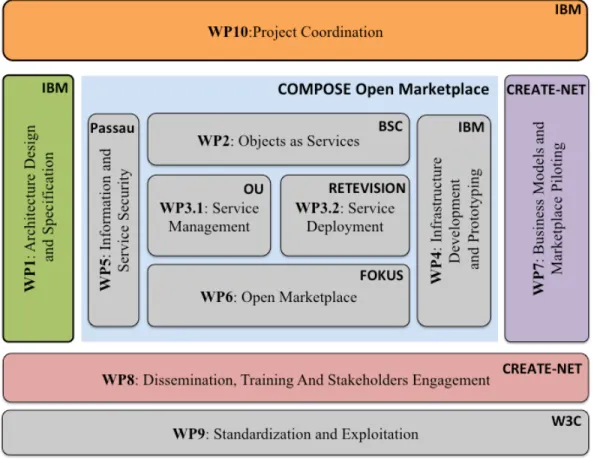
WP1 is dedicated to gathering and analysing requirements and designing components models and the overall
architecture to produce a detailed design to drive the implementation of the
COMPOSE open marketplace. WP2 is responsible for research, design, and development of objects management for rendering them accessible and
interoperable as high-level services.
WP3.1-2 cover research, design, and
development of service management and deployment, focusing on aspects of efficient discovery, recommendation, composition of services, and their efficient and distributed deployment. WP4 focuses on the design and development of a highly scalable and flexible communication and runtime infrastructure for smooth
integration of service objects and their compositions. WP5 is responsible for research and development of security mechanisms for enabling developers to design secure service and
applications by guarding the information flow before and during the deployment of services. WP6 focuses on enabling the complete COMPOSE ecosystem by designing and developing a software development kit (SDK) and web-based cross-platform frontend for facilitating access to the COMPOSE ecosystem. WP7 handles the analysis of the COMPOSE ecosystem in the business context and develops application scenarios for piloting COMPOSE technology and its assessment in a realistic setting. WP8 is in charge of dissemination activities, spreading the scientific and technical achievements of the project, and organizing trainings for engaging stakeholders. WP9
facilitates the standardization and exploitation activities. WP10 is devoted to overall project coordination activities.
The architecture design is viewed as an iterative process, starting out from requirements gathered, and evolving as additional tasks have matured. The use cases and security related requirements will feed the architecture in a
relatively early phase, and some of the other technical tasks, mainly from WP2 and WP3, will have their particular influence injected at re-enhancements phases of the architectural design. We view WP5 on security as walking hand-in-hand with the architecture WP, in order to ensure that security aspects are taken into consideration from the initial design of the system and are assimilated into all relevant work packages. In order to have a secure solution we intend to take into account security aspects in all layers of the system, smart objects and service objects (WP2), services creation and composition (WP3.1), service deployment (WP3.2), platform underlying runtime infrastructure (WP4), and external facing elements (WP6).
9
Platform – Objects data management
Approach
Services (WPs - 3.1 - 3.2 - 4) Interface Real-time Stream Processing Smart ObjectsGeo-Distributed In-Memory Cache
(DRAM+Flash) Geo-Distributed K/V Store (FLASH+HDD+SAN) Services Front-End Users ? Large Analytics Centers
Object Actuation Data Caching Data Processing Data Replication
Performance Availability Coherence Security
Active Storage API (CRUD + Embedded primitives + Analytics)
Actuate STREAMS Developers BRAIN D A T A Open Data D A T A
Simple example
11 COMPOSE COMPOSE RUNTIME COMPOSEDATA STREAM SERVICE
AVG DATA LAYER user def PIG query MAX
DATA STREAM + ANALYTICS
COMPOSE interfaces COMPOSE Sensors OBJECT SERVICE Temperature 1 2 3 4 5 6 7 8
Internals
APACHE JENA REPOSITORY COUCH BASE Services EVRYTHNG REST RDF API SPARQL API ONTLOLOGY API INFERENCE APISTORE API (N3 Triples) ZORBA
A n aly ti cs In vo ca ti o n (p re -re g is te re d ) CRUD Se m an ti c PIG REST CRUD STORM UDFs DBDriver OBJECT REGISTRY CRUD NEO4J / IBM DHT / ?
Data Adapter Module Data Adapter Module
GetCapabilities.sensorML to SSNO
?
13
Platform - Services
Objectives
•
Manage COMPOSE services allowing and assisting
users in defining new services out of existing objects and
content-provisioning channels, discovering existing
services efficiently, creating new composite services, and
proactively recommending services
–
Advanced Services and Things Discovery Engine
–
Advanced Services and Things Recommender
Dynamic Large-Scale Discovery
•
Distributed service discovery based on the
underlying communication infrastructure
–
Highly scalable, supports organic growth, takes
advantage of peers internal to the platform
•
Utilize publish / subscribe mechanisms
•
Potentially use a DHT service
Service Recommender
•
Proactive advertising of services to users
•
Leverage data gathered over time
concerning the interaction of users with
services as well as the characteristics of
the different services
•
Utilize available data on non-functional
properties of COMPOSE entities to favour
active and reliable services
Assisted Service Composition Engine
•
Assist users in creating new and secure service
compositions in the Marketplace
•
Exploit advanced caching and indexing techniques in
order to provide highly efficient composition support
•
Analytical methods developed in WP5 will be used to
provide feedback if users compose services in critical or
insecure ways
Three accompanying use-cases
•
Scenario 1:
“
Smart space: Augmented Shopping
Experience
”
–
An indoor shopping environment, focusing on
personalized interactions with objects for enabling
an augmented shopping experience
•
Scenario 2:
“
Smart City: Barcelona
”
–
Exploit the city-scale infrastructures in Barcelona,
focusing on the integration of heterogeneous
devices and technologies for searching cross-data
opportunities, taking advantage of the wide set of
existing sensors
•
Scenario 3:
“
Smart Territory: Trentino
”
–
Pilot on a geographically broad scale in Trentino,
focusing on the integration of highly distributed
objects and utilization of smartphones as service
objects for enabling territory monitoring and
Smart city: some details
Description
•
The Smart City pilot creates new services and applications mashups built on the top
of the COMPOSE marketplace. The resources and services available at the city of
Barcelona will be gathered by the COMPOSE engine and allowed to be used to
define and compose new services by its users.
Main stakeholders
•
Citizens and tourists.
•
Barcelona city hall.
•
Sensor networks operator.
Data collected
•
These are the resources that should be accessible through the COMPOSE platform:
•
Barcelona's Open Data repositories (assets information, public transportation
networks, traffic status and forecast, etc.).
Smart city: some details
Smart city: some details
COMPOSE PLATFORM
Smart Territory: some details
23
Context:
• Tourism and sport in the Trentino Region
Objective:
•Improve tourists' experience while
skiing
,
mountain biking
,
trekking
through COMPOSE platform capabilities.
[Other interesting sports that could be considered are
sailing
and
climbing
.]
Scenario Description:
Context
2
Smart Territory: some details
Main Objects and Data:
•
Meteo sensors
collecting weather data like temperature,
humidity, wind, rain, radar images etc.
•
Meteo Forecasts
: the meteo agency can provide localized
and customized weather forecasts on a periodic basis.
•
Smartphones as sensors
:
Scenario Description:
Objects & Data
•
Smartphones as sensors
:
• accelerometer,
GPS,
gyroscope,
magnetometer,
camera, microphone, temperature and humidity;
• crowd-sensed
data:
direct
observations
of
the
environmental
conditions
coming
from
end
users
(images, text messages) etc.
Smart Territory: some details
25
• Type of data:
Measured Data:
•Phisical Sensed Data:
about 120 points of sampling of physical
parameters (temperature, humidity, wind, rain, etc).
•Images, webcams (~10 stations)
•Structured data:
meteo radar, wind profiler, ..
Forecating:
• meteo forecasts, specialized reports (wind, sliding snow,..)
Scenario Description:
Meteo Data Details
5