A Comprehensive review of Artificial Bee Colony Algorithm
KamalamBalasubramani*
[Research Scholar,Vels University]Department of Information Science and Engineering, Atria Institute of Technology, Bangalore–560024, India.
E-mail: [email protected]
Karnan Marcus
Department of Computer Science and Engineering, Tamil Nadu College of Engineering, Coimbatore-641659, India.
ABSTRACT
The Artificial Bee Colony (ABC) algorithm is a stochastic, population-based evolutionary method proposed by Karaboga in the year 2005. ABC algorithm is simple and very flexible when compared to other swarm based algorithms. This method has become very popular and is widely used, because of its good convergence properties. The intelligent foraging behavior of honeybee swarm has been reproduced in ABC.Numerous ABC algorithms were developed based on foraging behavior of honey bees for solving optimization, unconstrained and constrained problems. This paper attempts to provide a comprehensive survey of research on ABC. A system of comparisons and descriptions is used to designate the importance of ABC algorithm, its enhancement, hybrid approaches and applications.
General Terms: Algorithm, Swarm, Convergence, Constrained, Optimization Keywords: Artificial Bee Colony, stochastic, evolutionary method, foraging behavior,
1. INTRODUCTION
Computational researchers have been greatly interested in the natural sciences as source of modeling examples. We find various swarming behaviors in nature such as honey bees, bird flocking, ant colonies, animal herding, and many more. Many researchers have been influenced by the behaviors of these biological entities and phenomena. Swarm intelligence models the population of interacting agents or swarms that are able to self-organize, which gave birth to swarm intelligence and population based algorithms such as Ant Colony Optimization, Particle Swarm Optimization, Fish Schooling, Bee Colony Optimization etc. In computational intelligence, algorithms based on swarm behavior have been developed and successfully applied to solve computational and complex problems in different areas.
Honey bees are one of the most well studied social insects, many studies have been developed based on the different bee behaviors. Interaction between insects contributes to the collective intelligence of the social insect colonies.
Artificial Bee Colony (ABC), a swarm intelligence based algorithms was introduced by [Karaboga D (2005)], inspired by the intelligent behavior of honey bees. ABC algorithm was developed based on the model of the foraging behavior of honey bee colonies proposed by [Tereshko CV, LoengarovA (2005)] for numerical optimization problems.
2. ARTIFICIAL BEE COLONY ALGORITHM
2.1 Behavior of Bees
Social insect colonies can be considered as dynamical system gathering information from environment and adjusting its behavior in accordance to it. While gathering information and adjustment processes, individual insects do not perform all the tasks because of their specializations. Generally, all social insect colonies behave according to their own division of labors related to their morphology. Foraging is an important behavioral characteristic of honey bees.
[Visscher and Seeley (1982)] found that the colony routinely foraged several kilometers from its nest (median 1.7 km, 95% of foraging within 6.0 km), frequently adjusted its distribution of foragers on its patches, and worked relatively few patches each day (mean of 9.7 patches accounted for 90% of each day's forage). These foraging patterns indicate that the foraging strategy of a honeybee colony involves surveying the food source patches within a vast area around its nest, pooling the reconnaissance of its many foragers, and using this information to focus its forager force on a few high-quality patches within its foraging area.
[Tereshko (2000)], [Tereshko and Lee (2002)]and[Tereshko, Loengarov (2005)] developed a model of foraging behavior of a honeybee colony based on reaction–diffusion equations. This method that proposes the application of collective intelligence of honeybee swarms consists of three essential components: food sources, employed foragers, and unemployed foragers. It defines two leading modes of the honeybee colony behavior: recruitment to a food source and abandonment of a source. Tereshko explains the main components of his model as below:
Food Sources: In order to select a food source, a forager bee evaluates several properties related to the food source such as its closeness to the hive, richness of the energy, taste of its nectar, and the ease or difficulty of extracting this energy. For simplicity, the quality of a food source can be represented by only one quantity although it depends on various parameters mentioned above.
Employed foragers: An employed forager is employed at a specific food source which she is currently exploiting. She carries information about this specific source and shares it with other bees waiting in the hive. The information includes the distance, direction and the profitability of the food source.
Unemployed foragers: A forager bee that looks for a food source to exploit is called unemployed. It can be either a scout who searches the environment randomly or an onlooker who tries to find a food source based on the information provided by the employed bee. The mean number of scout bees is about 5–10%.
The exchange of information among bees is the most important occurrence in the formation of collective knowledge. While examining the entire hive it is possible to distinguish some parts that commonly exist in all hives. The most important part of the hive with respect to exchanging information is the dancing area. The information about the quality of food source is communicated by employed bees to onlooker bees in the dancing area. The related dance is called waggle dance. The onlooker could watch numerous dances and chooses to employ herself at the most profitable source. There is a greater probability of onlookers choosing more profitable sources since more information is circulating about the more profitable sources. Employed foragers share their information with a probability which is proportional to the profitability of the food source, and the sharing of this information through waggle dancing is longer in duration. Hence, the recruitment is proportional to profitability of a food source.
It is important to note that not all bees start foraging simultaneously. The experiments have confirmed that new bees begin foraging at a rate proportional to the difference between the eventual total number of bees and the number of bees presently foraging.
2.2. Artificial Bee Colony (ABC) algorithm
In ABC algorithm, the actual position of a food source corresponds to a probable solution to the optimization problem and the amount of nectar found in a food source represents the quality (fitness) of the associated solution. The number of employed bees is equal to the number of onlooker bees and the number of employed bees is equal to the number of food sources. Each employed bee is assigned to an individual food source. This algorithm is an iterative process, starts by initializing all employed bees with randomly generated food sources i.e., solution represented by a D-dimensional real-valued vector. For each iteration every employed bee finds a food source in the neighborhood of its current food source and evaluates its nectar amount i.e., fitness.
In general the position of ith food source is represented as Si = (Si1, Si2, ………. ,SiD). Information is shared by the
employed bees after returning to the hive, onlooker bees go to the region of food source explored by employed bees at Si based on probability Pi defined as
Pi = fiti
fitk FS k=1
Where FS is total is total number of Food Sources. Fitness value fitiis calculated by using the equation
fiti=
1 1+f(Si)
Where f(Si) denotes the objective function considered. The onlooker finds its food source in the region of Si by using the
following equation
Snew= Sij+ r*( Sij- Skj )
Where Snew is the new food source exploited by onlooker and k is the solution in the neighborhood of i, r* is the random
number in the range -1 to +1 and j is the dimension of the problem considered.If the new fitness value is better than the fitness value achieved so far, then the bee moves to the new food source leaving the old one, otherwise it retains the old one itself. The information is shared with onlooker bees after all employed bees complete this process. Each onlooker bee selects its food source according to the probability given above. Hence good food sources are well accommodated with onlookers. Every bee will search for a better food source for a certain number of cycles (limit) and if the fitness value does not improve then that particular bee becomes scout bee.
Pseudo code of the ABC algorithm is given below: Initialization
Move the employed bees onto the food sources and evaluate their nectar amounts Place the onlookers depending upon the nectar amounts obtained by employed bees Send the scouts for exploring new food sources
Memorize the best food sources obtained so far If a termination criterion not satisfied go to step 2
Otherwise stop the procedure and display the best food source obtained so far.
[Karaboga (2005)] proposed a simple yet powerful population-based algorithm, artificial bee colony (ABC), to solve the numerical optimization problems. The original Artificial Bee Colony algorithm is powerful meta-heuristic optimization tool used for solving unconstrained problems. ABC has the advantages of very simple, strong robustness, fast convergence,
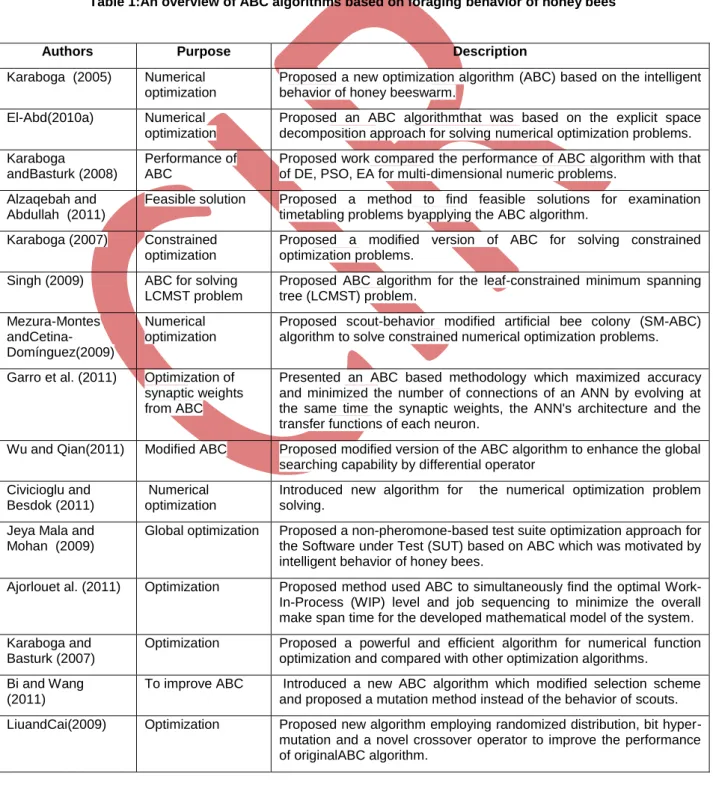
high flexibility and fewer setting parameters. Many studies have proved the superiority of ABC in terms of performance when compared to many other known optimization algorithms. Numerous ABC algorithms are developed based on foraging behavior of honey bees for different optimization problems. The original ABC can be applied only to continuous problems. However, the method can also be expanded to the discrete problems using discrete numbers. Extensive review of these works are listed in Table1 and discussed in this section.
[Civicioglu and Besdok (2011)] statistically compared the numerical optimization results of the Cuckoo-search (CK), Particle swarm optimization (PSO), Differential evolution (DE) and Artificial bee colony (ABC) algorithm. The results revealed that PSO algorithm maintained its stochastic behavior capacity better than the ABC algorithm while searching for the global optimum value and it provided more successful results than the ABC algorithm. Still the observations also indicated that ABC algorithm had a very successful decision mechanism that decides which areas within the search space required to be surveyed in more detail.
[Bi and Wang (2011)]proposed an improved algorithm called Fast Mutation Artificial Bee Colony Algorithm (FMABC). In the proposed method, pheromone and the sensitivity model was used for the selection of food sources by onlookers instead of the traditional roulette wheel selection model and also proposed a mutation strategy based on opposition-based learning instead of the behavior of scouts. Based on the tested results on a set of benchmark functions, identified that the solutions produced by FMABC were better than those produced by the standard ABC algorithm.
Table 1:An overview of ABC algorithms based on foraging behavior of honey bees
Authors Purpose Description
Karaboga (2005) Numerical
optimization
Proposed a new optimization algorithm (ABC) based on the intelligent behavior of honey beeswarm.
El-Abd(2010a) Numerical
optimization
Proposed an ABC algorithmthat was based on the explicit space decomposition approach for solving numerical optimization problems. Karaboga
andBasturk (2008)
Performance of ABC
Proposed work compared the performance of ABC algorithm with that of DE, PSO, EA for multi-dimensional numeric problems.
Alzaqebah and Abdullah (2011)
Feasible solution Proposed a method to find feasible solutions for examination
timetabling problems byapplying the ABC algorithm.
Karaboga (2007) Constrained
optimization
Proposed a modified version of ABC for solving constrained optimization problems.
Singh (2009) ABC for solving
LCMST problem
Proposed ABC algorithm for the leaf-constrained minimum spanning tree (LCMST) problem. Mezura-Montes andCetina-Domínguez(2009) Numerical optimization
Proposed scout-behavior modified artificial bee colony (SM-ABC) algorithm to solve constrained numerical optimization problems.
Garro et al. (2011) Optimization of
synaptic weights from ABC
Presented an ABC based methodology which maximized accuracy and minimized the number of connections of an ANN by evolving at the same time the synaptic weights, the ANN's architecture and the transfer functions of each neuron.
Wu and Qian(2011) Modified ABC Proposed modified version of the ABC algorithm to enhance the global
searching capability by differential operator Civicioglu and
Besdok (2011)
Numerical optimization
Introduced new algorithm for the numerical optimization problem solving.
Jeya Mala and Mohan (2009)
Global optimization Proposed a non-pheromone-based test suite optimization approach for
the Software under Test (SUT) based on ABC which was motivated by intelligent behavior of honey bees.
Ajorlouet al. (2011) Optimization Proposed method used ABC to simultaneously find the optimal
Work-In-Process (WIP) level and job sequencing to minimize the overall make span time for the developed mathematical model of the system. Karaboga and
Basturk (2007)
Optimization Proposed a powerful and efficient algorithm for numerical function
optimization and compared with other optimization algorithms. Bi and Wang
(2011)
To improve ABC Introduced a new ABC algorithm which modified selection scheme
and proposed a mutation method instead of the behavior of scouts.
LiuandCai(2009) Optimization Proposed new algorithm employing randomized distribution, bit
hyper-mutation and a novel crossover operator to improve the performance of originalABC algorithm.
Authors Purpose Description
Brajevic et al. (2011)
Constrained Optimization
Presented an improved ABC algorithm for constrained problems which contain discrete and continuous variables.
Zhiwei et al. (2011) Image threshold
selection
Introduced a new method to separate objects from background automatically.
Karaboga and Akay (2009)
Numerical function optimization
Used ABC for optimizing a large set of numerical test functions. The results producedwere better than or similar to thoseof other population-based algorithms.
Subotic et al. (2011) Speed gain Three different approaches in parallelization of ABC algorithm were
implemented to achieve speed gains by using independent parallel runsapproach.
Zouet al. (2010) To select image
threshold
Proposed a new method to select image threshold automatically based on ABC algorithm.
Saab et al. (2009) Dynamic problem Presented two unsupervised scenarios for two kinds of bees which are
scouts and foragers in order to identify their activities during the food foraging.
Yan and Li (2011) Improve ABC Introduced an algorithm to improve premature convergence issue of
the ABC algorithm and accuracy of the optimal value. Mezura M and
Velez K (2010)
Constrained Optimization
Proposed A novel algorithm to solve constrained real parameter optimization problems.
Tsai et al. (2009) Numerical
optimization
Introduced an algorithm to improve numerical optimization problems.
Wang (2011) Image registration Proposed a novel image registration method which combines the
normalized cross correlation(NCC) criterion and the ABC algorithm.
Zhao et al. (2010) Direction finding Proposed a novel method for direction finding in the impulse noise
environment. Karaboga et al.
(2007)
To train ANN Proposed ABC which has capabilities in searching optimal weight set
which trained an Artificial Neural Network (ANN) Stanarevic et al.
(2010)
To improve ABC algorithm
Proposed an improved ABC algorithm (Smart Bee ABC) for constrained problems which considered the initial population to be feasible.
Sharma and Pant (2011)
To enhance ABC optimization
Introduced an algorithm to enhance the performance of ABC by including a concept of greedy bee which was always directed towards the best food location.
El-Abd (2010b) ABC optimization Used Benchmarking for noiseless Function Test bed and showed that
the performance of ABC algorithm was better.
Cuevas et al. (2011) A multi-modal
optimization
The proposed method to detect single or multiple circles from a digital image through only one optimization pass.
Bacanin et al. (2011)
Optimization Implemented Karaboga’s ABC algorithm in C# with corresponding
flexible GUI for easy modifications and applications to different optimization problems.
Fonseca et al. (2007)
Protein structure prediction
Proposed ABC meta-heuristic using hill-climbing as local search to generate good solutions to the protein structure prediction problem. Mezura-Montes et
al. (2010)
constrained numerical optimization
Proposed a novel algorithm based on the foraging behavior of honey bees to solve constrained numerical optimization problems with focus on improving the way the feasible region is approached by using a new operator.
Akay and Karaboga (2011)
Image compression ABC optimization tool is used to determine the thresholds to produce
the best compressed image in terms of both compression ratio and quality.
Karaboga and Gorkemli (2011)
combinatorial optimization
Proposed a new ABC algorithm called Combinatorial ABC for Traveling Salesman Problem(TSP)
Authors Purpose Description
Zou, et al. (2011) multi-objective
optimization
Proposed a novel algorithm based on ABC to deal with multi-objective optimization problems.
Babayigit Bilal, et al. (2012)
Modified ABC for optimization
Proposed a new ABC algorithm for numerical optimization to improve the exploitation capability of ABC algorithm.
[Brajevic et al. (2011)] presented an improved ABC algorithm for constrained optimization problems (SC-ABC). SC-ABC algorithm used Deb’s rule and it was tested on four standard engineering constrained benchmark problems which contain discrete optimization and continuous variables. They compared the result obtained with results reached by simple constrained particle swarm optimization (SiC-PSO).The result obtained using ABC was better when it was applied to same problems.
[Zhiwei et al. (2011)] proposed Automatic Threshold Selection Based on Artificial Bee Colony Algorithm, a new algorithm to select image threshold(tool to separate objects from the background) automatically based on ABC algorithm. Test results indicated thenewly proposed algorithm succeeded in finding optimal threshold to segment images.
[Saab et al. (2009)] proposed a new optimization algorithm based on ABC. Authors have considered two unsupervised scenarios for the scout and forager bees to identify their activities during the food foraging. They designed the new algorithm based on the analysis of their activities. They also proposed to use the new algorithm as the functions in the processing engine of the artificial bee colony system.
[Zou et al. (2011)] proposed an improved algorithm based on Artificial Bee Colony to deal with multi-objective optimization problems. ABC algorithm based on the intelligent foraging behavior of honey bee swarm used less control parameters and it was found to be very efficient in solving multimodal and multidimensional optimization problems. Proposed algorithm used the concept of Pareto dominance to determine the flight direction of a bee and it maintained non dominated solution vectors which were found in an external archive. Performance of the proposed algorithm indicated that the proposed method can be considered as a viable alternative to solve multi-objective optimization problems.
[Babayigit Bilal et al.(2012)] has presented a modified ABC algorithm (ABC clobset) for numerical optimization problems to improve the exploitation capability of ABC algorithm. This method proposed a different probability function and also a new searching mechanism. The results indicated that the performance the proposed method was much better compared to basic ABC algorithm.
3. HYBRID APPROACH
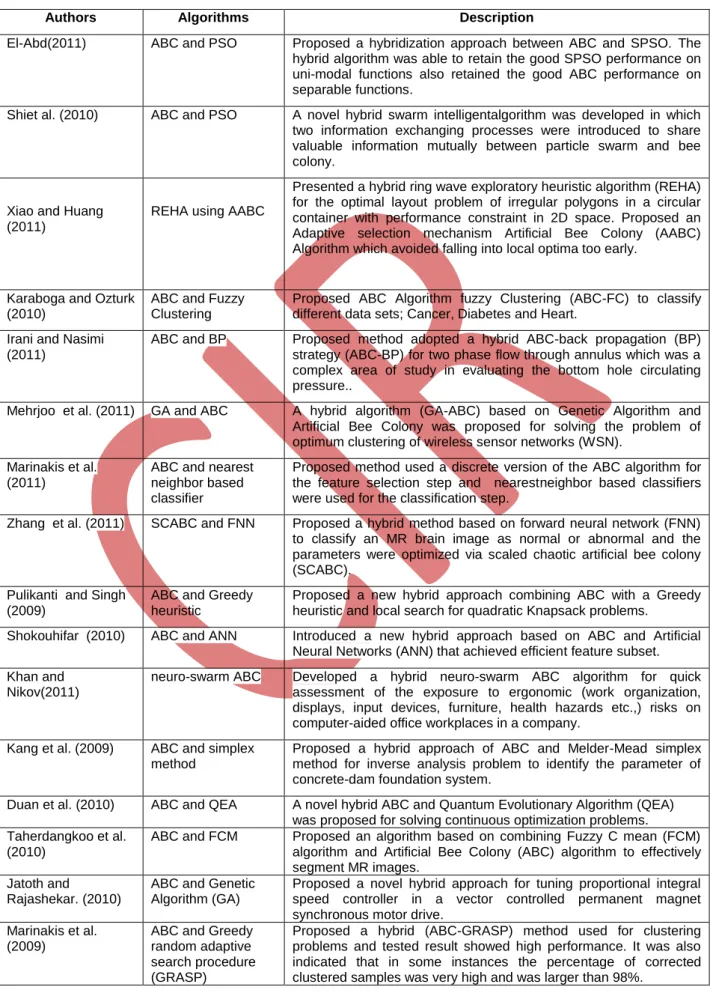
The hybridization approach is a component-based one where the ABC algorithm is augmented with another component (algorithm) for enhancing the efficiency of ABC Algorithm optimizer. This section describes the hybrid approaches of various techniques. Important hybridization approaches are listed in Table 2 and discussed in this section.
[Karaboga and Ozturk (2010)] used Artificial Bee Colony algorithm to fuzzy clustering of medical data which are widely used benchmark problems. Compared ABC algorithm with Fuzzy C-Means (FCM) algorithm and showed that the Artificial Bee Colony algorithm is verysuccessful in optimization of fuzzy clustering.
[Taherdangkoo et al. (2010)] proposed an algorithm based on combining Fuzzy C mean (FCM) algorithm and Artificial Bee Colony (ABC) algorithm to effectively segment MR images. They calculated the two new parameters; difference between neighboring pixels in the image and the relative location of the neighboring pixels which were introduced by researchers to improve the performance of FCM using the artificial bee colony (ABC) algorithm. Authors compared ABC algorithm with the optimization algorithms such as PSO, GA and ANN and found that the ABC performed very well in terms of performance speed and not getting entangled in local places.
[HorngMing-Huwi et al. (2011)] proposed an algorithm based on Linde-Buzo-Grey(LGB) and ABC algorithm to construct a codebook for vector optimization for image compression. In this paper, ABC associated with the LBG (ABC-LBG) algorithm proposed to search for the optimal codebook that minimizes the distortion between the input vectors and the code words of codebook. Authors have compared the results of proposed method with other algorithms like LBG, PSO-LBG, QPSO-LBG and HBMOLBG and have established that ABC-LGB algorithm on most of the occasions performed better.
Table 2: An overview of ABC and other approaches (Hybrid Approach)
Authors Algorithms Description
El-Abd(2011) ABC and PSO Proposed a hybridization approach between ABC and SPSO. The
hybrid algorithm was able to retain the good SPSO performance on uni-modal functions also retained the good ABC performance on separable functions.
Shiet al. (2010) ABC and PSO A novel hybrid swarm intelligentalgorithm was developed in which
two information exchanging processes were introduced to share valuable information mutually between particle swarm and bee colony.
Xiao and Huang (2011)
REHA using AABC
Presented a hybrid ring wave exploratory heuristic algorithm (REHA) for the optimal layout problem of irregular polygons in a circular container with performance constraint in 2D space. Proposed an Adaptive selection mechanism Artificial Bee Colony (AABC) Algorithm which avoided falling into local optima too early.
Karaboga and Ozturk (2010)
ABC and Fuzzy Clustering
Proposed ABC Algorithm fuzzy Clustering (ABC-FC) to classify different data sets; Cancer, Diabetes and Heart.
Irani and Nasimi (2011)
ABC and BP Proposed method adopted a hybrid ABC-back propagation (BP)
strategy (ABC-BP) for two phase flow through annulus which was a complex area of study in evaluating the bottom hole circulating pressure..
Mehrjoo et al. (2011) GA and ABC A hybrid algorithm (GA-ABC) based on Genetic Algorithm and
Artificial Bee Colony was proposed for solving the problem of optimum clustering of wireless sensor networks (WSN).
Marinakis et al. (2011)
ABC and nearest neighbor based classifier
Proposed method used a discrete version of the ABC algorithm for the feature selection step and nearestneighbor based classifiers were used for the classification step.
Zhang et al. (2011) SCABC and FNN Proposed a hybrid method based on forward neural network (FNN)
to classify an MR brain image as normal or abnormal and the parameters were optimized via scaled chaotic artificial bee colony (SCABC).
Pulikanti and Singh (2009)
ABC and Greedy heuristic
Proposed a new hybrid approach combining ABC with a Greedy heuristic and local search for quadratic Knapsack problems.
Shokouhifar (2010) ABC and ANN Introduced a new hybrid approach based on ABC and Artificial
Neural Networks (ANN) that achieved efficient feature subset. Khan and
Nikov(2011)
neuro-swarm ABC Developed a hybrid neuro-swarm ABC algorithm for quick
assessment of the exposure to ergonomic (work organization, displays, input devices, furniture, health hazards etc.,) risks on computer-aided office workplaces in a company.
Kang et al. (2009) ABC and simplex
method
Proposed a hybrid approach of ABC and Melder-Mead simplex method for inverse analysis problem to identify the parameter of concrete-dam foundation system.
Duan et al. (2010) ABC and QEA A novel hybrid ABC and Quantum Evolutionary Algorithm (QEA)
was proposed for solving continuous optimization problems. Taherdangkoo et al.
(2010)
ABC and FCM Proposed an algorithm based on combining Fuzzy C mean (FCM)
algorithm and Artificial Bee Colony (ABC) algorithm to effectively segment MR images.
Jatoth and
Rajashekar. (2010)
ABC and Genetic Algorithm (GA)
Proposed a novel hybrid approach for tuning proportional integral speed controller in a vector controlled permanent magnet synchronous motor drive.
Marinakis et al. (2009)
ABC and Greedy random adaptive search procedure (GRASP)
Proposed a hybrid (ABC-GRASP) method used for clustering problems and tested result showed high performance. It was also indicated that in some instances the percentage of corrected clustered samples was very high and was larger than 98%.
Authors Algorithms Description
Ming-HuwiHorng et al.(2011)
ABC and Linde-Buzo-Grey algorithm
Proposed method ABC-LBG used for constructing codebook for vector quantization. The algorithm is more reliable and the reconstructed images get higher quality compared to other methods. Jin Fuien et al.
(2013)
ABC and Back propagation neural network
The proposed method of combining artificial bee colony algorithm and back propagation neural network so that a nonlinear model can be identified and an inverted pendulum can be controlled.
JIA Ruin. et al. (2012)
ABC and PSO Proposed a hybrid algorithm for solving nonlinear system of
equations by combining Artificial Bee Colony algorithm and Particle Swarm Optimization algorithm. Results obtained show that the hybrid algorithm has feasibility and validity in solvingnonlinear system of equations.
4. APPLICATIONS
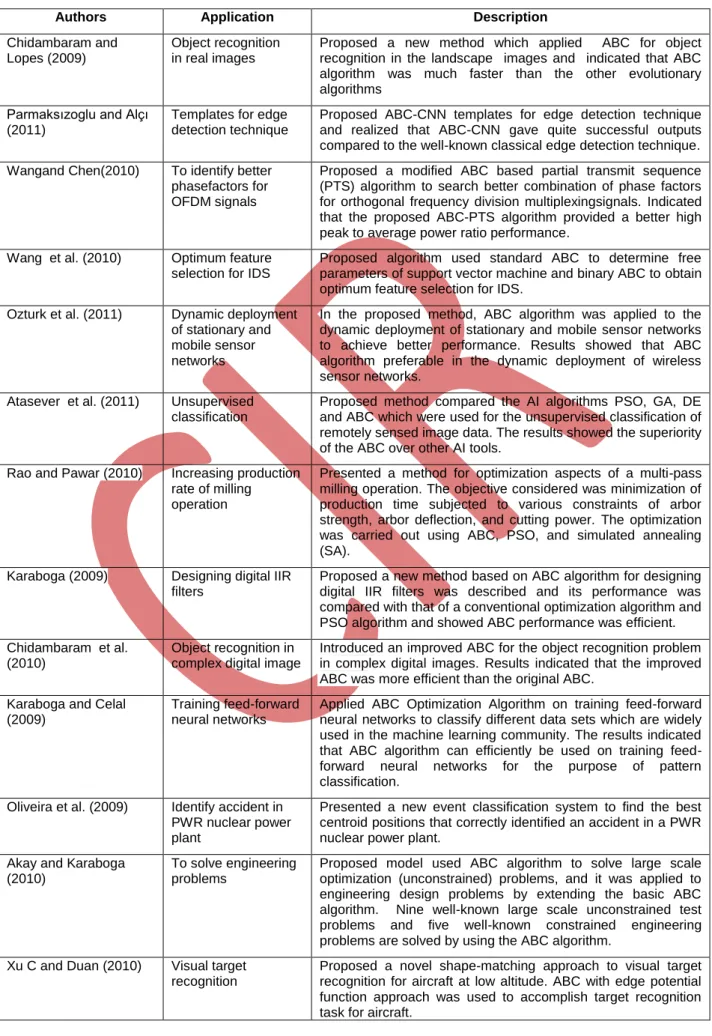
Standard ABC algorithm is effectively used for solving uni-modal and multi-modal numerical optimization problems and also to solve many difficultcontinuous, unconstrained optimization problems. Improved versions of ABC introduced for constrained optimization problems. Constrained Optimization problems are encountered in numerous applications in scientific field such as target identification, Structural optimization, engineering design, VLSI design, allocation and location problems, economics and in many other fields. Use of ABC in Various applications are listed in Table 3 and discussed in this section.
[Chidambaram and Lopes (2009)] proposed a new method which applied the Artificial Bee Colony Algorithm (ABC) to recognize objects in the images. The objective was to find a pattern or reference image (template) of an object somewhere in a target landscape scene. Considering that it may be translated, scaled, rotated and/or partially occluded to identify th e given reference image in the target landscape image. The best solutions obtained in their experiments with gray scale and color images indicated that ABC algorithm was much faster than the other evolutionary algorithms and with comparable accuracy. They also claimed that to the best of their knowledge, this was the first application of the ABC algorithm to this sort of problem.
[Wang et al. (2010)] proposed the model ABC-SVM to determine free parameters of SVM(Support vector machine) and feature selection at building IDS(Intrusion Detection System). The experimental results indicated that the ABC-SVM achieved higher accuracy compared to Particle swarm optimization (PSO) and GA (Genetic Algorithm)-SVM algorithms.
Table 3: An overview of ABC applications
Authors Application Description
Chidambaram and Lopes (2009)
Object recognition in real images
Proposed a new method which applied ABC for object recognition in the landscape images and indicated that ABC algorithm was much faster than the other evolutionary algorithms
Parmaksızoglu and Alçı (2011)
Templates for edge detection technique
Proposed ABC-CNN templates for edge detection technique and realized that ABC-CNN gave quite successful outputs compared to the well-known classical edge detection technique.
Wangand Chen(2010) To identify better
phasefactors for OFDM signals
Proposed a modified ABC based partial transmit sequence (PTS) algorithm to search better combination of phase factors for orthogonal frequency division multiplexingsignals. Indicated that the proposed ABC-PTS algorithm provided a better high peak to average power ratio performance.
Wang et al. (2010) Optimum feature
selection for IDS
Proposed algorithm used standard ABC to determine free parameters of support vector machine and binary ABC to obtain optimum feature selection for IDS.
Ozturk et al. (2011) Dynamic deployment
of stationary and mobile sensor networks
In the proposed method, ABC algorithm was applied to the dynamic deployment of stationary and mobile sensor networks to achieve better performance. Results showed that ABC algorithm preferable in the dynamic deployment of wireless sensor networks.
Atasever et al. (2011) Unsupervised
classification
Proposed method compared the AI algorithms PSO, GA, DE and ABC which were used for the unsupervised classification of remotely sensed image data. The results showed the superiority of the ABC over other AI tools.
Rao and Pawar (2010) Increasing production
rate of milling operation
Presented a method for optimization aspects of a multi-pass milling operation. The objective considered was minimization of production time subjected to various constraints of arbor strength, arbor deflection, and cutting power. The optimization was carried out using ABC, PSO, and simulated annealing (SA).
Karaboga (2009) Designing digital IIR
filters
Proposed a new method based on ABC algorithm for designing digital IIR filters was described and its performance was compared with that of a conventional optimization algorithm and PSO algorithm and showed ABC performance was efficient. Chidambaram et al.
(2010)
Object recognition in complex digital image
Introduced an improved ABC for the object recognition problem in complex digital images. Results indicated that the improved ABC was more efficient than the original ABC.
Karaboga and Celal (2009)
Training feed-forward neural networks
Applied ABC Optimization Algorithm on training feed-forward neural networks to classify different data sets which are widely used in the machine learning community. The results indicated that ABC algorithm can efficiently be used on training feed-forward neural networks for the purpose of pattern classification.
Oliveira et al. (2009) Identify accident in
PWR nuclear power plant
Presented a new event classification system to find the best centroid positions that correctly identified an accident in a PWR nuclear power plant.
Akay and Karaboga (2010)
To solve engineering problems
Proposed model used ABC algorithm to solve large scale optimization (unconstrained) problems, and it was applied to engineering design problems by extending the basic ABC algorithm. Nine well-known large scale unconstrained test problems and five well-known constrained engineering problems are solved by using the ABC algorithm.
Xu C and Duan (2010) Visual target
recognition
Proposed a novel shape-matching approach to visual target recognition for aircraft at low altitude. ABC with edge potential function approach was used to accomplish target recognition task for aircraft.
Authors Application Description
Taspinar et al. (2011) To reduce
computational complexity of PTS in OFDM
Proposed ABC-PTS (Partial transmit sequence) algorithm used ABC algorithm for reducing the computational complexity of the PTS in the orthogonal frequency division multiplexing (OFDM) system. Result showed that the ABC-PTS was highly successful in reducing the computational complexity of the conventional PTS and Bit Error Rate (BER) performances in the OFDM system. Shokouhifar and Abkenar (2011) MRI Fuzzy Segmentation of Brain Tissue
Proposed algorithm discussed the shortcoming of traditional FCM clustering algorithm for MR images segmentation, which do not guarantee high accuracy especially for noisy or abnormal images. Suggested a Modified Intensity matrix using ABC before performing FCM clustering algorithm, in order to avoid sensitivity to noise.
Yin et al. (2011) Job shop scheduling
problem (JSSP)
Introduced a promising hybrid algorithm that combined the DABC and fast local search, the pairwise based local search was proposed to solve Job shop scheduling problem (JSSP). Zhang and
Lenan(2011)
Human face pose estimation
Proposed a novel face pose estimation method using a six-point template as the correspondence between the object space and the image space. The method was based on the ABC algorithm and Rossler attractor to solve the six-point template.
Karaboga and Ozturk (2009)
Data clustering In this work, ABC was used for data clustering on benchmark
problems and the simulation results indicate that ABC algorithm can efficiently be used for multivariate clustering.
Kurban and Beşdok (2009)
To train neural networks
Proposed method used ABC Algorithm to train radial basis function (RBF) neural networks for classification purposes.
Brajevic (2011) To solve vehicle
routing problem
Proposed method used ABC algorithm for capacitated vehicle routing problem. The twelve benchmark instances of small scale problems were tested. The results indicated that the performance of the algorithm was good and robust.
Shayeghi and Ghasemi (2011)
Load Frequency Control (LFC)
In the proposed method ABC algorithm have been successfully applied to the robust design of Proportional Integral Derivative (PID) controllers for solution of the LFC problem in the restructured power system.
Chifuet al. (2010) Web service Proposed method uses a composition graph model and a matrix
of semantic links to search for the optimal composition solution.
Bolajiet al. (2011) To solve CBC-TT Presented the ABC algorithm for tackling the curriculum-based
course timetabling problems (CBC-IT). The results showed that algorithm was capable of solving timetabling problems. Although the results produced by the algorithm were not comparatively better than those already reported in the literature.
Saeedi et al. (2009) Object extraction from
Light Detection And Ranging (LIDAR)
Introduced a new clustering method based on the ABC in extracting buildings and trees form LIDAR data. The method employed ABC for searching the set of cluster centers that minimizes a given clustering metric.
Li and Chan (2011) Image restoration Proposed a method to deal with the problem of adaptive image
noise cancelling. A hybrid learning method was devised for training of the proposed system, including ABC and the recursive least square estimator (RLSE) algorithm. Two cases for image restoration were used to test the proposed approach. Experimental results showed good restoration quality.
Rao (2010) To solve problem in
distributed system
Introduced new method which applied ABC algorithm for capacitor placement problem in distribution systems. The method helped in improving the voltage profile and reduction of power loss.
Authors Application Description
Rao et al. (2008) Distribution N/W
Configuration for Loss Reduction
Presented method used artificial bee colony algorithm for determining the sectionalizing switch to be operated in order to solve the distribution system loss minimization problem.
Geng (2011) Color Image
segmentation
Proposed a method using ABC algorithm to describe the implementation process of an image segmentation algorithm, and the results showed that proposed method was a potential image segmentation algorithm.
Akdagliet al. (2011) Micro strip antennas
resonant frequency
Proposed a novel and simple expression for resonant length to calculate the resonant frequency of C-shaped compact microstrip antennas operating on UHF band applications ABC algorithm was used to obtain an expression.
Ozturk et al. (2010) Reactive power
optimization (RPO)
RPO with ABC algorithm was applied in a power system. The results showed that active power loss and cost function results taken from ABC were more optimal.
Dahiya et al. (2011) Software testing Presented an ABC based novel search technique for automatic
generation of structural software tests. Test cases were symbolically generated by measuring fitness of individuals with the help of branch distance based objective function. Tested Results indicated that the new technique was a reasonable alternative for test data generation, but did not perform very well for large inputs.
Shukranet al. (2011) Data Mining Proposed the use of the ABC algorithm as a new tool for Data
Mining particularly in classification tasks.
Hadidi et al. (2010) Optimization of
construction project
A modified ABC algorithm was proposed for size optimization of planar and space truss structures. The results obtained by the proposed algorithm outperformed the classic ABC.
Hemamalini and Simon (2008)
To solve non-convex ELD problem
Proposed method successfully applied ABC algorithm to solve
non-convex economic load dispatch (ELD) problem of units with
valve point effect. Benitez and Lopes
(2009)
Protein Structure prediction
Proposed method used parallel models of ABC algorithm for protein structure prediction. Results indicated that the parallel models achieved a good level of efficiency.
Deng-Zu HE et al.(2012) To solve Logistics
location problem
Modified algorithm Cloud model-based ABC algorithm is proposed to overcome Logistics location problem.
Yana Mazwan et al. (2012)
To solve classification problem in Neural Network
To help Functional Link Neural Network (FLNN)to overcome the complexity structure of MLP by using single layer architecture and propose an Artificial Bee Colony algorithm for training the FLNN.
HancerEmrah et al. (2012)
Image Clustering Proposed method used ABC algorithm to find the centres of the
clusters specified by the user.The results obtained show that ABC can be used for image clustering.
[Kurban and Besdok (2009)] used ABC Algorithm to train RBF networks for the purpose of classification. Training procedures involved selecting the optimal values of the parameters such as weights between the hidden layer and the output layer, spread parameters of the hidden layer base function, Centre vectors of the hidden layer and bias parameters of the neurons of the output layer. Additionally, number of neurons in the hidden layer was very important for complexity of the network structure. The performance of the proposed algorithm was compared with the traditional derivative GD, and novel KF and GA methods. ABC algorithms showed better performance than derivative based methods for known classification problems such as Iris.
[Akdagli et al. (2011)] presented a novel and simple expression for resonant length to calculate the resonant frequency of C-shaped compact micro strip (CMA) antennas operating on UHF band applications. 144 antennas with different patch dimensions and varied substrate dielectric constant values were simulated. An expression was obtainedby using the simulated data in the ABC algorithm.The resonant frequencies resulting from the formulation presented in their work were
compared with results obtained from the previous method reported in the literature. The results show that the proposed expression was easy to compute and offers the design engineers an accurate estimation of resonant frequency.
[Suguna and Gowder (2011)] Proposed a method which used improved Rough set based attribute reduction with ABC algorithm to find the final subset of attributes. The performance was analyzed with five different medical datasets such as Dermatology, Cleveland Heart, HIV, lung cancer and Wisconsin and compared the result with six other reduct algorithms. The result from this approach reached great accuracy of 92.36%, 86.54%, 86.29%, 83.03% and 88.70% respectively. [Benitez and Lopes (2009)] proposed method used ABC algorithm for protein structure prediction using the 3 Dimensional Hydrophobic-Polar model with Side-Chains 3DHP-SC. Two parallel approaches for the ABC were implemented; a master-slave approach and a hybrid-hierarchical approach. Parallel models performance compared with sequential version for 4 benchmark instances. Results indicated that the parallel models achieved a good level of efficiency and the hybrid – hierarchical approach improved the quality of solutions found.
[HancerEmrah et al. (2012)] proposed ABC algorithm to find clusters of an image where number of clusters are specified. Hierarchical algorithms are not dynamic i.e., if a data point is assigned to cluster, it cannot be assigned to any other cluster. The other disadvantage of these algorithms is that lack of information about size of clusters which might cause overlapping. The proposed method is applied to three benchmark images and the results demonstrate both analytically and visually that ABC algorithm can be successfully applied to image clustering.
CONCLUSION
ABC algorithm is very simple and very flexible when compared to other swarm based algorithms as ABC does not require external parameters such as cross over rate and mutation rate etc., as in case of genetic algorithms, differential evolution and other evolutionary algorithms.
Standard ABC algorithm was first developed for numerical optimization problems; expanded by suitable
modifications for solving numerous unconstrained and constrained problems
Many studies have compared the performance of ABC with other swarm based algorithms such as Particle
Swarm Optimization (PSO), Differential evolution (DE) and also with classical optimization algorithms in some cases. Most of the studies indicated that ABC outperformed or the performance was equal to other methods.
Some studies indicated that hybrid approach; ABC algorithm augmented with another component such as PSO,
ANN, EA, GA etc., for enhancing the efficiency of ABC Algorithm.
REFERENCES
Ajorlou S, Shams I, Aryanezhad MG (2011), Optimization of a Multiproduct CONWIP-based Manufacturing System using Artificial Bee Colony Approach, IMECS, Hong Kong
Akay B, Karaboga D (2011), Wavelet Packets Optimization using Artificial Bee Colony Algorithm, IEEE
Akay B, Karaboga D(2010), Artificial bee colony algorithm for large-scale problems and engineering design optimization, Journal of Intelligent Manufacturing, Springer Link
Akdagli A, Bicer MB, Ermis S (2011), A novel expression for resonant length obtained by using artificial bee colony algorithm incalculating resonant frequency of C-shaped compact microstrip antennas, Turk J ElecEng& Comp Science Alzaqebah M, Abdullah S (2011), Artificial bee colony search algorithm for examination timetabling problems, Int. J. Phys.
Sci.
Atasever UH, Ozkan C, Sunar F (2011),TheUse of Artificial Intelligence Optimization Algorithms in Unsupervised Classification, EARSeL
Babyigit Bilal, ResulOdzemir (2012) A modified artificial bee colony algorithm for numerical function optimization,IEEE Bacanin N, Tuba M, Brajevic I (2011), Performance of object-oriented software system for improved artificial bee colony
optimization, International Journal of Mathematics and Computers in Simulation
Benitez CMV, Lopes HS (2009), Parallel Artificial Bee Colony Algorithm Approaches for Protein structure prediction using 3DHP-SC model, IDC
Bi X, Wang Y (2011), An Improved Artificial Bee Colony Algorithm, IEEE
Bolaji AL, Khader AT, Al-betar MA, Awadallah M (2011), Artificial Bee Colony Algorithm for Curriculum-Based Course Timetabling Problem, ICIT
Brajevic I (2011), Artificial bee colony algorithm for the capacitated vehicle routing problem, Proceedings of the European Computing Conference
Brajevic I, Tuba M, Subotic M (2011), Performance of improved ABC algorithm on standard constrained engineering problem, International Journal of mathematics and Computers in Simulation, issue 2, Vol. 5
Chidambaram C, Lopes HS (2009), A new approach for template matching in digital images using an Artificial Bee Colony Algorithm, World Congress on Nature & Biologically Inspired Computing
Chidambaram C, Santa, Lopes HS (2010), An Improved Artificial Bee Colony Algorithm for the Object Recognition Problem inComplex Digital Images Using Template Matching, IJNCR
Chifu VR, Pop CB, Salomie I, Dinsoreanu M, Nicu AN, Suia DS (2010), Selecting the Optimal Web Service Composition based on a Multi-Criteria Bee-inspired Method, Paris, France
Civicioglu P, Besdok E (2011), A conceptual comparison of the CK, PSO, DE and ABC algorithms, Springer
Cuevas E, Sencion-Echauri F, Zaldivar D, Perez-Cisneros M (2011), Multi-circle detection on images using artificial bee colony optimization
Dahiya SS, Chhabra JK , Kumar S (2011), Application of Artificial Bee Colony Algorithm to Software Testing, Information Sciences, Volume 181
Duan HB, Xu CF, Xing ZH (2010), A hybrid ABC and quantum evolutionary algorithm for continuous optimization problems, IJ neural syst,
El-Abd M (2010a), A Cooperative Approach to The Artificial Bee Colony Algorithm, CEC
El-Abd M (2010b), Black-Box Optimization Benchmarking for Noiseless Function Testbed using Artificial Bee Colony Algorithm, GECCO’10, Portland, Oregon, USA
El-Abd M (2011), A Hybrid ABC-SPSO Algorithm for Continuous Function Optimization Swarm Intelligence (SIS), IEEE Symposium
EmrahHancer, Celal Ozturk and DervisKaraboga(2012), Artificial Bee Colony Based Image clustering Method, WCCI 2012.IEEE
Fonseca R, Paluszewski M, Wint P (2007), Protein Structure Prediction Using Bee Colony Optimization Metaheuristic Garro BA, Sossa H, Vazquez RA (2011), Artificial neural network synthesis by means of artificial bee colony algorithm Geng R (2011), Color Image Segmentation Based on Self-Organizing Maps, Advances in Key Engineering Materials Hadidi A, Azad SK, Azad SK (2010), Structural optimization using artificial bee colony algorithm, 2nd International
Conference onEngineering Optimization, Lisbon, Portugal
HE Deng-Zu,JIARui-min (2012) A Cloud Model-Based Artificial Colony Algorithms Application in The Logistics Location Problem, International Conference on Information Management, Innovation Management and Industrial Engineering IEEE.
Hemamalini S, Simon SP (2008), Economic Load Dispatch with valve-point effect using Artificial Bee Colony algorithm, NSC
Irani R, Nasimi R (2011), Application of artificial bee colony-based neural network in bottom hole pressure prediction in underbalanced drilling, Journal of Petroleum Science and Engineering
Jatoth RK, Rajashekar.A (2010), Speed control of PMSM by hybrid genetic Artificial Bee Colony Algorithm, ICCCCT Jeya Mala D, Mohan V (2009), ABC Tester - Artificial Bee Colony Based Software Test Suite Optimization Approach,
International Journal of Software Engineering, 15-43
Jin Feihu, GuangShu (2013) Back Propagation Neural Network Based on Artificial Bee Colony Algorithm,IEEE 2013 Kang F, Li J, Xu Q (2009), Structural inverse analysis by hybrid Simplex artificial bee colony algorithm, computers and
structures
Karaboga D (2005), “An Idea Based on Honey Bee Swarm for Numerical Optimization,” Technical Report-TR06, Erciyes University, Computer Engineering Department, Turkey
Karaboga D (2007), Foundations of Fuzzy Logic and Soft Computing, Springer
Karaboga D, Basturk B (2008), On the performance of artificial bee colony (ABC) algorithm, Applied Soft Computing, Volume 8, Issue 1
Karaboga D, Akay B (2009), “A comparative study of artificial bee colony algorithm”, Appl. Math.Comput., pp.108–132 Karaboga D, Akay B, Ozturk C (2007), Artificial Bee Colony (ABC) Optimization Algorithm for Training Feed-Forward
Neural Networks, Modeling Decisions for Artificial Intelligence, Lecture Notes in Computer Science
Karaboga D, Basturk B (2007), A powerful and efficient algorithm for numerical function optimization: artificial bee colony algorithm, J Glob Optim 39:459–471 Springer
Karaboga D, Celal O (2009), Neural Networks Training by Artificial Bee Colony Algorithm on Pattern Classification, Neural Network World
Karaboga D, Gorkemli B (2011), A Combinatorial Artificial Bee Colony Algorithm for Traveling Salesman Problem, International Symposium on Innovations in Intelligent Systems and Applications, Istanbul, Turkey
Karaboga D, Ozturk C (2009), A novel clustering approach: Artificial Bee Colony (ABC) algorithm, Applied Soft Computing, Elsevier
Karaboga D, Ozturk C (2010), Fuzzy clustering with artificial bee colony algorithm, Sci. Res. Essays
Karaboga N (2009), A new design method based on Artificial Bee Colony Algorithm for digital Filters, Journal of the Franklin Institute, Vol. 346, no. 4, pp. 328-348
Khan K, Nikov A (2011), An approach for quick ergonomic risk evaluation of companies with computer-aided workplaces, Proceedings of the European Computing Conference
Kurban T, Beşdok E (2009), A Comparison of RBF Neural Network Training Algorithms for Inertial Sensor Based Terrain Classification, Sensors
Li C, Chan F (2011), Complex-Fuzzy Adaptive Image Restoration–An Artificial-Bee-Colony-Based Learning Approach, Intelligent Information and Database Systems, Springer
Liu X, Cai Z (2009), Artificial bee colony Programming Made Faster, Fifth International Conference on Natural Computation
Marinakis Y, Marinaki M, Matsatsinis N, Zopounidis C (2011), Discrete Artificial Bee Colony Optimization Algorithm for Financial Classification Problems, International Journal of Applied Metaheuristic Computing, 2(1), 1-17
Marinakis Y, Marinaki.M, Matsatsinis.N (2009), A hybrid discrete Artificial Bee Colony – GRASP algorithm for clustering,
CIE
Mehrjoo S, Aghaee H, Karimi H (2011), A Novel Hybrid GA-ABC based Energy Efficient Clustering in Wireless Sensor Network, Canadian Journal on Multimedia and Wireless Networks Vol. 2
Mezura-Montes E, Cetina-Domínguez O (2009),Exploring promising regions of the search space with The scout bee in the Artificial Bee Colony for Constrained optimization [94]
Mezura-Montes E, Damian-Araoz M, Cetina-Domıngez O (2010), Smart Flight and Dynamic Tolerances in the Artificial Bee Colony for Constrained Optimization
Ming-Huwi-Horng, Ting-Wei Jiang(2011) The Artificial Bee Colony algorithm for Vector Quantization in imageCompression,IEEE
Oliveira IMS, Schirru R, Medeiros JACC (2009), On the Performance of an Artificial Bee Colony Optimization Algorithm applied to the accident diagnosis in a PWR Nuclear Power Plant, International Nuclear Atlantic Conference
Ozturk A, Cobanli S, Erdogmus P, Tosun S (2010), Reactive power optimization with artificial bee colony algorithm, Scientific Research and Essays Vol. 5 (19), pp. 2848-2857
Ozturk C, Karaboga D, Gorkemli B (2011), Probabilistic Dynamic Deployment of Wireless Sensor Networks by Artificial Bee Colony Algorithm, Sensors, Vol. 11 (6), pp. 6056-6065
Parmaksızoglu S, Alçı M (2011), A Novel Cloning Template Designing Method by Using an Artificial Bee Colony Algorithm for Edge Detection of CNN Based Imaging Sensors, Sensors Vol. 11, Pages 5337-5359
Pulikanti S, Singh A (2009), An ABC for the Quadratic Knapsack problem, ICONIP 2009,pp. 196-205
Rao RS (2010), Capacitor Placement in Radial Distribution System for Loss Reduction Using Artificial Bee Colony Algorithm, International Journal of Engineering and Natural Sciences
Rao RS, Narasimham SVL, Ramalingaraju M (2008), Optimization of Distribution Network Configuration for Loss Reduction Using Artificial Bee Colony Algorithm, International Journal of Electrical Power and Energy Systems Engg., Spring
Rao RV, Pawar PJ (2010), Parameter optimization of a multi-pass milling process using non-traditional optimization algorithms, Applied soft computing
RuiminJIA,Dengxu HE (2012), Hybrid Artificial Bee Colony Algorithm for Solving Nonlinear System of Equations, 2012 Eighth International Conference on Computational Intelligence and Security,IEEE
Saab SM, El-Omari NKT, Owaied HH (2009), Developing Optimization Algorithm Using Artificial Bee Colony System Saeedi S, Samadzadegan F, El-Sheimy N (2009), Object Extraction FromLidar Data Using An Artificial Swarm Bee Colony
Clustering Algorithm, CMRT09
Seeley TD (1995), The Wisdom of the Hive, Harvard University Press, Cambridge, Mass, USA Sharma TK, Pant M (2011), Enhancing the Food Locations in an Artificial Bee Colony Algorithm, IEEE
Shayeghi H, Ghasemi A (2011), Market based LFC design using artificial bee colony, International Journal on “Technical and Physical Problems of Engineering”
Shi X, Li Y, Guan H, Wang L, Liang Y (2010), An integrated algorithm based on artificial bee colony and particle swarm optimization, Sixth International Conference on Natural Computation
Shokouhifar M (2010), A Hybrid approach for effective Feature selection using neural networks and Artificial Bee Colony Algorithm, KMV
Shokouhifar M, Abkenar GS (2011), An Artificial Bee Colony Optimization for MRI Fuzzy Segmentation of Brain Tissue, International Conference on Management and Artificial Intelligence
Shukran MAM, Chung YY, Yeh W, Wahid N, Zaidi AMA (2011), Artificial Bee Colony based Data Mining Algorithms for ClassificationTasks, Modern Applied Science, Volume 5, Pages 217-231
Singh A (2009), An artificial bee colony algorithm for the leaf-constrained minimum spanning tree problem, Applied Soft Computing Volume 9, Issue 2
Stanarevic N, Tuba M, Bacani N (2010), Modified artificial bee colony algorithm for constrained problems optimization, International Journal of Mathematical Models and methods in Applied Sciences
Subotic M, Tuba M, Stanarevic N (2011), Different approaches in parallelization of the artificial bee colony algorithm, International Journal of Mathematical Models and Methods in Applied Sciences, Issue 4, Volume 5
Suguna N, Gowder KT (2011), An independent Rough set approach Hybrid with Artificial Bee Colony Algorithm for Dimensionality Reduction, Am.J.Applied Science
Taherdangkoo M, Yazdi M, Rezvani MH (2010), Segmentation of MR Brain Images Using FCM improved by Artificial Bee Colony (ABC) Algorithm, ITAB
Taspinar N, Karaboga D, Yildirim M, Akay B (2011), PAPR reduction using artificial bee colony algorithm in OFDM systems
Tereshko CV, Loengarov A (2005), “Collective Decision-Making in Honey Bee Foraging Dynamics”, Computing and Information Systems Journal, ISSN 1352-9404, vol. 9, No 3
Tereshko V (2000), Reaction–diffusion model of a honeybee colony’s foraging behavior, in: M.Schoenauer (Ed.), Parallel Problem Solvingfrom Nature VI, Lecture Notes in Computer Science, vol. 1917, Springer–Verlag, Berlin
Tereshko V,Loengarov A (2005), Collective decision-making in honeybee foraging dynamics, Computing and Information Systems Journal 9 (3)
Tereshko V, Lee T (2002), How information mapping patterns determine foraging behavior of a honeybee colony, Open Systems and Information Dynamics 9 181–193
Tsai P, Pan J, Liao B, Chu S (2009), Enhanced Artificial Bee Colony Optimization, International Journal of Innovative Computing, Information and Control ISSN
Visscher PK, Seeley TD (1982), Foraging strategy of honey bee colonies in a temperate deciduous forest, Issue 6, 63:1790–1801
Wang J, Li T, Ren R (2010), A real time IDS based on ABC – Support Vector Machine Algorithm, IWACI
Wang S (2011), Artificial Bee Colony used for Rigid Image Registration, International Journal of Research and Reviews in Soft and Intelligent Computing, Vol. 1, No. 2
Wang Y, Chen W (2010), A PAPR Reduction Method Based on Artificial Bee Colony Algorithm for OFDM Signals, IEEE Transactions on Wireless Communications, Vol. 9, Issue:10, Pages: 2994 – 2999
Wu B, Qian CH (2011), Differential Artificial Bee Colony Algorithm for Global Numerical Optimization, Journal of Computers, VOL. 6
Xiao R, Huang Z (2011), An intelligent approach to the irregular polygon layout problem based on adaptive artificial bee colony algorithm, International Journal of Computer Applications in Technology
Xu C, Duan H (2010), ABC optimized edge potential function approach to target recognition for low-altitude aircraft, pattern recognition letters
Yana Mazwin Mohmad Hassim and RozaidaGhazali(2012) Training a Functional Link Neural NetworkUsing an Artificial Bee Colony for Solving a Classification Problems,Journal of Computing press,N.Y
Yan G, Li C (2011), An Effective Refinement Artificial Bee Colony Optimization Algorithm Based On Chaotic Search and Application for PID Control Tuning, Journal of Computational Information Systems, pp. 3309-3316
Yin M, Li X, Zhou J (2011), An efficient job shop scheduling algorithm based on Artificial Bee Colony, Scientific Research and Essays Vol. 5(24), pp. 2578-2596
Zhang Y, Lenan WU (2011), Face Pose Estimation by Chaotic Artificial Bee Colony
Zhang Y, Wu L, Wang S (2011), Magnetic Resonance Brain Image Classification By An Improved Artificial Bee Colony Algorithm, Progress In Electromagnetics Research, Vol. 116
Zhao D, Gao H, Diao M, An C (2010), DirectionFinding of Maximum Likelihood Algorithm using Artificial Bee Colony in the Impulsive Noise, International Conference on Artificial Intelligence and Computational Intelligence
Zhiwei Y, Zhengbing H, Huamin W, Hongwei C (2011), Automatic Threshold Selection Based on Artificial Bee Colony Algorithm, IEEE
Zou W, Zhu Y, Chen H, Shen H (2011), A Novel Multi-Objective Optimization Algorithm Based on Artificial BeeColony, GECCO’11, Dublin, Ireland, ACM
Zou W, Zhu Y, Chen H, Zhu Z (2010), Cooperative Approaches to Artificial Bee Colony Algorithm, International Conference on Computer Application and System Modeling