Bachelor’s Degree in Computer Science and Engineering.
2018-2019
Bachelor’s Thesis
“Intelligent Android Malware Family
Classification using Genetic Algorithms
and SVM”
Sara Yuste Fernández Alonso
Pedro Isasi Viñuela
Yago Sáez Achaerandio
Leganés, July 2019
This work is licensed under Creative Commons Attribution – Non Commercial – Non Derivatives
2
ABSTRACT
As of April 2019, Android was the most popular mobile operating system amongst smartphone users[1]. Its high popularity, combined with the extended use of smartphones for everyday tasks as well as storing or accessing sensitive and personal data, has made Android applications the target of numerous malware attacks over the last few years and in the present.
The malware attacks have been perfected to target specific vulnerabilities in the operating system or the user; thus specializing in types of malware and families within each type. The malware is usually distributed in infected applications (or APKs), which contain malicious behaviours that can be found looking into their code (known as static analysis) or analysing the behaviour of the application while running (known as dynamic analysis).
This document describes the implementation of an intelligent system that aims to classify a series of malicious APK samples obtained from the free repository ContagioDump. These samples are classified inside the type and family they belong to.
To create the classifier system, a Support Vector Machine (SVM) is implemented using Python’s library Scikit Learn. A series of attributes are extracted from the samples of malicious APK by analysing the code of the APKs via static analysis, using Python’s library Androguard, which contains a parser that allows to interact with all the relevant parts of the APK file. The attributes obtained are very high in number, and for that reason a Genetic Algorithm is used to optimize the attributes that the SVM uses in the learning process. The algorithm codifies a subset of attributes from all the attributes extracted in the static analysis, and is evaluated using the accuracy score obtained when training the SVM with said subset.
As a result, a subset of attributes and a trained model for the classification are obtained. This model is then tested with a new set of malware samples, belonging to all the families classified in the learning.
The present document contains the explanation of the process of designing, creating and testing the system. It is developed as bachelor’s thesis for computer science and engineering degree in Universidad Carlos III de Madrid.
Keywords
3
RESUMEN
En abril de 2019, Android era el sistema operativo móvil más popular entre los usuarios de smartphones[1]. Debido a su popularidad, y el uso extendido para tareas diarias entre los usuarios, que además usan sus teléfonos móviles para guardar y acceder datos sensibles y privados, Android ha sufrido un gran número de ciber ataques en los últimos años, y sigue recibiendo ataques constantemente.
Estos ataques maliciosos se han ido especializando para atacar a vulnerabilidades específicas del dispositivo o de los usuarios, diferenciándose en tipos y familias de malware. Este malware se distribuye habitualmente en aplicaciones (o APKs) infectadas. Es posible analizar el comportamiento malicioso de estas aplicaciones infectadas, bien analizando el código de la aplicación (conocido como análisis estático) o estudiando el comportamiento de la aplicación mientras es ejecutada (análisis dinámico).
El presente documento describe la implementación de un sistema inteligente de clasificación de muestras de malware en tipos y familias de malware. Las muestras utilizadas son una serie de APKs infectadas obtenidas del repositorio gratis ContagioDump.
La creación del sistema clasificador se ha llevado a cabo desarrollando un programa que usa una Máquina de Soporte Vectorial (SVM, por sus siglas en inglés), haciendo uso de la librería de Python Scikit Learn. Las muestras de APKs maliciosas se analizan de forma estática para obtener una serie de atributos, usando la librería de Python Androguard, que proporciona un parser y una interfaz para interactuar y utilizar todas los elementos relevantes del código de las APKs.
El número de atributos obtenidos en dicho análisis es muy alto, por lo que se utiliza un algoritmo genético para optimizar el proceso de aprendizaje de la SVM, seleccionando un subgrupo de atributos que se usan en el aprendizaje. El algoritmo genético codifica el subgrupo de atributos a usar, y es evaluado según el porcentaje de acierto obtenido al entrenar la SVM con el subgrupo codificado.
Como resultado del trabajo, se obtienen un subgrupo de atributos óptimos en los que basar el análisis de una APK, y un modelo clasificador entrenado. Este modelo se pone a prueba con una nueva serie de muestras de aplicaciones maliciosas, representativas de todos los tipos y familias analizados anteriormente.
Este documento incluye la explicación del proceso de diseño, creación y evaluación del sistema implementado. El sistema ha sido desarrollado como Trabajo de Fin de Grado de la carrera de Ingeniería Informática en la Universidad Carlos III de Madrid.
Palabras clave
Algoritmos genéticos, Redes de neuronas, SVM, Android, APK, malware, Inteligencia Artificial.
4
AKNOWLEDGMENTS
I’d like to thank all the people who have helped and supported me during the creation of this work, without whom this thesis could have never been possible.
To my supervisors, Pedro Isasi and Yago Sáez, for all their corrections, advice and support during all the development of this thesis.
To my boyfriend Santi, and friends, who have been supportive and lifted me up through the most stressful moments.
I would also like to thank all the professors and staff from the university that have contributed to making my university experience valuable and positive. To the cleaning and maintenance staff that keeps the campus a pleasant space, the staff from dining and café areas, and all my professors, both lecturers and lab professors.
5
TABLE OF CONTENTS
1. INTRODUCTION ... 11 1.1. Motivation ... 11 1.2. Objectives ... 11 1.3. Document Structure ... 122. STATE OF THE ART ... 13
2.1. Android ... 13 2.1.1. APK ... 13 2.1.2. Android Malware ... 14 2.2. Artificial Intelligence ... 18 2.2.1. History ... 18 2.2.2. Techniques ... 20 2.3. Similar work ... 29
2.3.1. Static and dynamic Android malware analysis ... 29
2.3.2. AI applied to Android malware analysis ... 29
2.3.3. Evolutionary algorithms in Android malware analysis ... 30
2.3.4. Android malware family classification... 30
3. SYSTEM ANALYSIS ... 31 3.1. Approach ... 31 3.2. Requirements ... 31 3.3. Operating Environment ... 37 3.4. Use cases ... 38 3.5. Traceability Matrix ... 38 4. SYSTEM DESIGN ... 39 4.1. Design overview ... 39 4.2. Technologies ... 39 4.2.1. Python ... 39 4.3. System Architecture ... 40
4.3.1. Introduction to component diagram ... 40
4.3.2. Component diagram ... 41 4.4. Classes ... 42 4.4.1. Identification of classes ... 42 4.4.2. Class diagram ... 42 4.5. Flowchart ... 44 5. IMPLEMENTATION ... 45
6
5.1. Process overview ... 45
5.2. Attribute extraction: APK Static analysis ... 46
5.2.1. Constructor ... 46 5.2.2. Get_calls ... 46 5.2.3. Get_manifest_info ... 47 5.3. Data pre-processing ... 48 5.3.1. Create_header ... 48 5.3.2. Create_data ... 49
5.4. Intelligent malware classification ... 51
5.4.1. Genetic Algorithm ... 51
5.4.2. Classifier: Support Vector Machine ... 56
5.4.3. Integration of GA and SVM ... 58
5.5. Improvements made to original implementation ... 59
6. EVALUATION ... 60
6.1. Description of the experimental environment ... 60
6.2. Evaluation of the genetic algorithm ... 61
6.2.1. Tests done with improved version of original implementation ... 63
6.3. Evaluation of SVM ... 65
6.4. Evaluation of final model ... 70
6.5. Analysis of experimental results ... 72
7. MANAGEMENT ... 73 7.1. Planning ... 73 7.2. Budget ... 75 7.2.1. Direct costs ... 75 7.2.2. Indirect costs ... 76 7.2.3. Risk ... 76 7.2.4. Total costs ... 76
8. LEGAL AND SOCIO-ECONOMIC ENVIRONMENT ... 77
8.1. Legal ... 77
8.1.1. Intellectual property and open source projects ... 77
8.2. Socio-Economic impact... 78
8.2.1. Smartphones: private and sensitive information ... 78
8.2.2. Cybercrime ... 78
9. CONCLUSIONS ... 80
9.1. Personal and technical conclusions ... 80
7
GLOSSARY OF TERMS ... 82
8
TABLE OF FIGURES
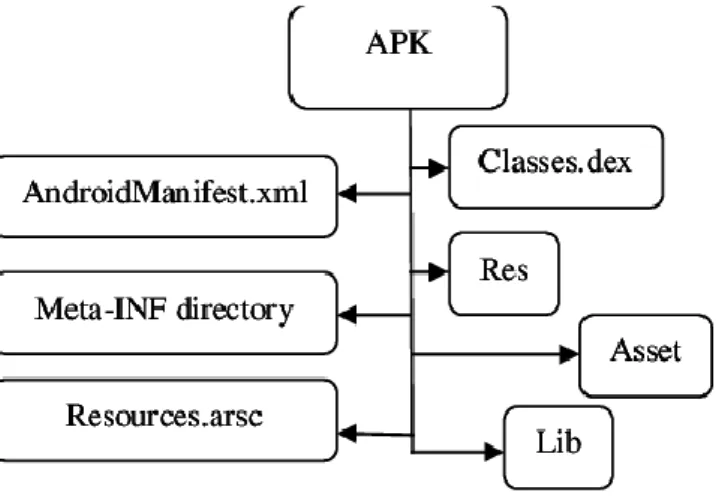
Figure 1: Structure of an APK ... 13
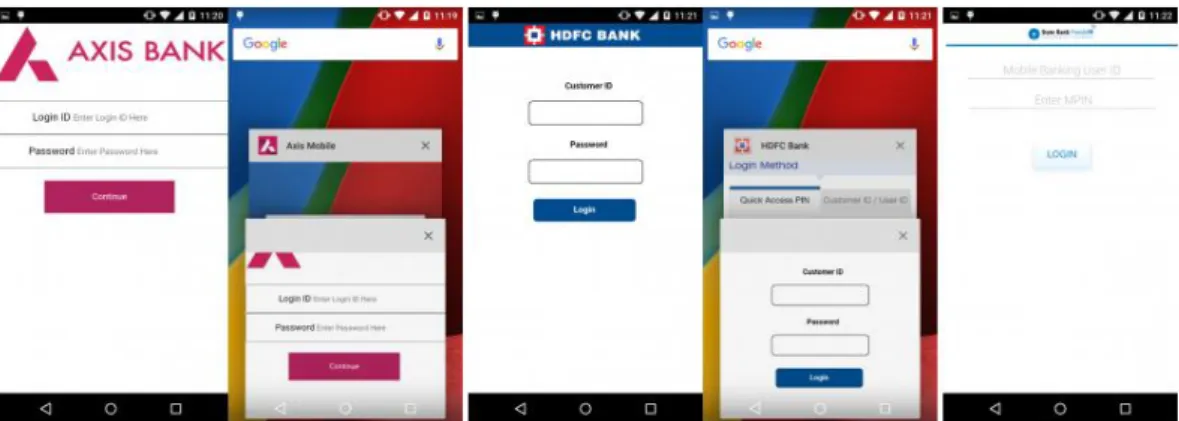
Figure 2: Overlay on banking Apps ... 15
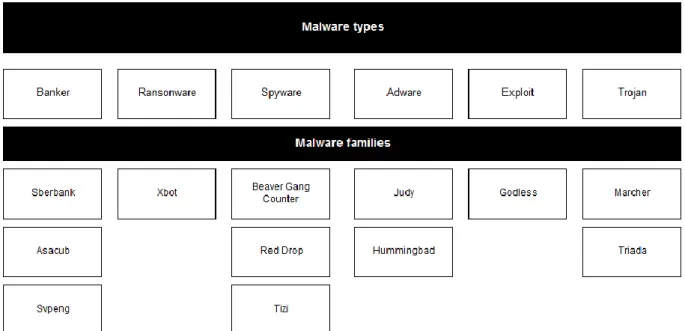
Figure 3: Malware types and families ... 16
Figure 4: The Bombe ... 18
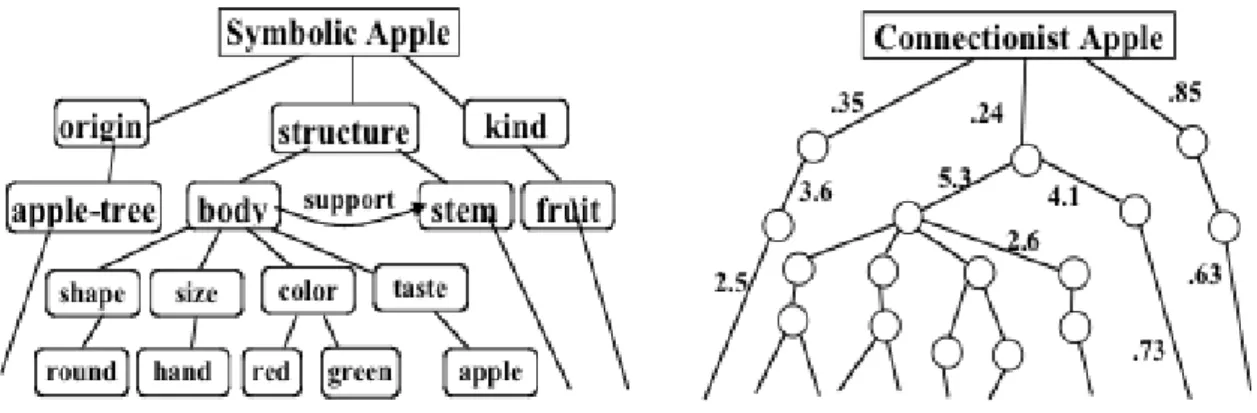
Figure 5: Symbolic VS Sub symbolic AI... 21
Figure 6: Example of automated handwriting recognition using Machine Learning... 22
Figure 7: Unsupervised Learning ... 23
Figure 8: Reinforcement learning ... 23
Figure 9: Map of AI (Corea, 2018) ... 25
Figure 10: Simple perceptron ... 27
Figure 11: Artificial Neural Network... 27
Figure 12: Support Vector Machine... 28
Figure 13: Operating Environment ... 37
Figure 14: Component notation ... 40
Figure 15: Subsystem notation ... 40
Figure 16: Dependency between components... 41
Figure 17: Component diagram ... 41
Figure 18: Notation of classes ... 42
Figure 19: Relationship between clases ... 43
Figure 20: Class diagram ... 43
Figure 21: Flowchart ... 44
Figure 22: Format of file with attributes extracted from APK ... 47
Figure 23: Pseudo code for create_header ... 49
Figure 24: Pseudo code for create_data ... 50
Figure 25: Format of training data ... 50
Figure 26: Example of training data ... 50
Figure 27: Pseudo code for create_genome ... 53
Figure 28: Pseudo code for fitness_score ... 53
Figure 29: Pseudo code for mutate ... 53
Figure 30: Pseudo code for create_population ... 54
Figure 31: pseudo code for selection ... 54
Figure 32: Pseudo code for crossover ... 55
Figure 33: Pseudo code for create_datasets ... 56
Figure 34: Pseudo code for fit ... 57
Figure 35: Pseudo code for predict ... 57
Figure 36: Pseudo code for accuracy_score ... 57
Figure 37: Malware samples used in the system ... 60
Figure 38: Evolution of genetic algorithm, 10% mutation rate ... 61
Figure 39: Evolution of genetic algorithm, 20% mutation rate ... 62
Figure 40: Evolution of genetic algorithm, 50% mutation rate ... 62
Figure 41: Evolution of improved genetic algorithm, 10% mutation rate ... 63
Figure 42: Evolution of improved genetic algorithm, 20% mutation rate ... 64
9
Figure 44: MIT License for open source projects ... 78
10
INDEX OF TABLES
Table 1: Operating Environment notation ... 37
Table 2: Flowchart notation ... 44
Table 3: Evaluation of SVM, experiment 1 ... 65
Table 4: Evaluation of SVM, experiment 2 ... 66
Table 5: Evaluation of SVM, experiment 3 ... 67
Table 6: Evaluation of SVM, experiment 4 ... 68
Table 7: Evaluation of SVM, experiment 5 ... 68
Table 8: Evaluation of SVM, average accuracy... 69
Table 9: Evaluation of final model ... 70
Table 10: Naming of classes in confusion matrix ... 71
Table 11: Confusion matrix ... 71
Table 12: Planning of the project ... 74
Table 13: Estimated personnel costs ... 75
11
1.
INTRODUCTION
This document describes the implementation of an intelligent Android malware classification system. The objective of the developed system is to classify a series of malicious Android applications (or APKs) samples in the types and families of malware which they belong to. In order to develop this system, the code from the APK samples is analysed to obtain information about its behaviour and characteristics, and a Support Vector Machine is used to classify the samples analysed. A genetic algorithm is implemented to optimize the learning of the Support Vector Machine, by selecting a subset of characteristics or features from the samples which the SVM uses to train.
1.1. Motivation
As of April 2019, Android operating system was the most popular operating system amongst smartphone uses with 70.22% of the market share[1]. The everyday use of smartphones has been growing unsteadily for the past few years, and more and more users are now using their smartphones to store and access personal and sensitive data, such as banking information. It has also become an essential asset for users, who rely on their smartphones for many of their daily tasks.
For these reasons, Android OS is often targeted by malicious applications that aim to steal data or damage the device. New families of malware are discovered daily, and cyber security experts often struggle trying to keep up with all the new malicious applications, evaluating their risks and which users they might affect.
Although there are many effective extended methods to detect whether an application is malicious, even available in the market (most mobile antivirus services perform this task), there haven’t been so many attempts at trying to identify the family of malware an application belongs to, which could eventually help cyber security experts determine the threat it poses more efficiently, and therefore act on it sooner.
One of the reasons why this last task is not so commonly found in antivirus or other similar services is the continuously changing nature of malware families. There are new versions coming out almost on a daily basis, and trying to find a deterministic way to decide which family a malicious APK belongs to seems almost impossible and not scalable.
Artificial Intelligence methods present an alternative way to perform this classification. Due to the ability of AI algorithms to learn, adapt and generalize, an AI based system could bring an scalable and adaptable solution to this problem.
1.2. Objectives
The objective of the work describe here is implement an intelligent classifier that provides an efficient and scalable solution to the problem described before, with the final purpose of classifying Android malware samples in their right type and family of malware.
12 In this document, an intelligent classification using AI algorithms (artificial neural networks, more precisely a Support Vector Machine) is proposed. Furthermore, to obtain a more efficient system, a Genetic Algorithm is used as an optimizer for the features used in the learning. By using these two methods in combination, an adaptable solution is found, which performs a classification of the malicious apps in an effective and adept way. This solution can be used in further research and help cyber security analysts in the early detection of threats.
The project will be developed entirely using open source means, to allow easier further implementations, investigation and improvements. For the development of the project, a series of malicious APK samples are obtained from the free online repository ContagioDump, and the implementation of the system is done in Python programming language using the libraries Scikit Learn and Androguard.
1.3. Document Structure
The present document is structured as it follows:
First, a STATE OF THE ART is detailed. This section gives an explanation of all the techniques and theory relevant for the work explained in this document, along with some similar work developed in the area.
then, an exhaustive definition of the developed system is given. this definition is divided in three sections, ordered from more high level detail to low level detailed functioning of the system: first section is SYSTEM ANALYSIS, where the most important components and requirements for the system are identified. in the second place, the SYSTEM DESIGN is shown, including the technologies, detailed components and classes of the system. lastly, the IMPLEMENTATION
of the system is included, with low level detail of all the components
of the system.Later, the tests used to measure the performance of the system are detailed in the EVALUATION section, followed by an analysis of the MANAGEMENT (budget and planning) and LEGAL AND SOCIO-ECONOMIC ENVIRONMENT related to the work described in this document. This last section aims to understand the legal and socio economic implications this work has, related to topics such as intellectual property or data protection. Finally, a series of personal and technical CONCLUSIONSare presented.
13
2.
STATE OF THE ART
2.1. Android
Android is a mobile operating system (OS) is based in the Linux operating system, developed by Android Inc., first meant to improve the operating system of digital cameras. In 2004, Android Inc. decided to use the OS in mobile phones. The company was later acquired by Google in 2005.
The first public version of Android OS was launched in 2007. Earlier that same year, Apple had launched the first iPhone. Unlike iPhone’s operating system iOs, Android could power many different phone models. It quickly gained popularity amongst smartphone users.
Android was ranked as the most popular mobile operating system in April 2019 by Net MarketShare[1]. Due to its high popularity, it has quickly become an interesting target for numerous malware attacks.
2.1.1. APK
An Android Package Kit (APK) is the file format used for distributing and installing mobile apps in the Android operating system.
APKs can be installed from a computer or from the mobile device. The most common installation method is using the device’s official store application Google Play Store, although the installation can be done manually.
There are other alternative Android app stores, but some of these are not reliable as they contain malicious software (malware) apps.
An APK file contains all the source code for a certain application. When an android app contains malicious behaviours, it is possible to analyse the source code found in the APK file to find these behaviours.
DEX
DEX (Dalvic Executable) is the compiled code of an Android program. An Android application is defined by the .dex files which are then zipped to a single .apk file, along with other elements that are not relevant for the work described in this document.
14 2.1.2. Android Malware
Malicious software (or malware) applications are applications that seek to find vulnerabilities in the system or the user and exploit them to either cause damage to the system or the device, or obtain sensitive information.
With the growth of popularity and usage of personal mobile devices, malware targeted at mobile operating systems has become increasingly popular over the last few years. Mobile phone users store vast amounts of personal information (contacts, pictures, credentials) in their devices, and use their mobile phones for many daily activities (such as business, social, information search).
By infecting a personal mobile device with malware, the attacker can gain access to user’s most sensitive and personal information. Furthermore, if the device is damaged or the user loses access to it, it can cost the user a high timely or economical investment to recover.
Android operating system has become a preferred target to attackers for two main reasons: first, because it is the most popular mobile operating system amongst smartphone users. Second, because an Android allows to view the user’s activity in real time; thus an attacker can intercept a safe application’s launch and display the malicious app instead, without the user noticing. This vulnerability becomes particularly interesting for some types of malware as it will be explained later on.
For these reasons, Android attackers have developed different specialized malware applications aimed to attack different vulnerabilities.
Android malware types
Malware applications can be grouped in types attending to which vulnerability is attacked. For each type, there are certain “families” of malware applications that behave similarly. There are also “versions” of the families previously mentioned. The scope of this work is limited to identifying types and families of malicious APKs.
Some of the most popular malware types are listed and explained below. Bankers
These malicious apps are aimed at stealing the user’s banking related information that is on the user’s device.
The target of these malware apps are mobile banking apps. Mobile banking apps are applications that allow a user to access their bank accounts comfortably from their smartphones, and perform any transactions with them.
Banker malware typically impersonates the user’s mobile banking app, by using similar interface and logo, and then captures the user’s credentials (account number, log in details) as they attempt to log in. This allows an attacker to directly steal from the user’s bank account. Overlay of banker malware on top of official baking app is shown on Figure 1.
15 Figure 2: Overlay on banking Apps
Ransomware
Ransomware apps encrypt all or some of the data stored in the user’s device, preventing the user from accessing it until they agree to pay a ransom, usually via an anonymous internet payment.
Spyware
Spyware is a type of malware that infiltrates in the user’s device, then collects and stores information from the user, including internet usage data and personal or sensitive information,. Its usual purpose is to then sell the user’s internet usage data, capture credit card or bank information, or steal the user’s personal identity.
Adware
Adware hides in the user’s device and serves the user advertisements. It sometimes also stores information about the user’s behaviour and preferences to later use this information to target the user with certain ads. This software generates revenue either by getting paid by the advertisers to display a certain advertisement, or via “pay-by-click” if the user clicks on the advertisement.
Exploit
Exploit malware takes advantage of vulnerabilities in the software or security flaws to gain access to private networks and scale privileges. This can allow a remote intruder to access a device or a network remotely. Sometimes it is used to infiltrate other malware like Trojans or Spyware. Exploit malware is sometimes sent to the user via email or other web sites, or the user is lured into executing the exploit via social engineering.
Trojan
A Trojan is a type of malware that is usually hidden or disguised as legitimate software. Once the user has installed the Trojan in the system, it gains access to the user’s data and can delete, block, modify, copy or disrupt the normal functioning of the device. There are several types of Trojans, such as Backdoors, which provide remote access to the device to the attacker, or Exploits, as explained above. Any of the malware types described before can be installed in the device via a Trojan.
16 Android malware families
Figure 2 shows some of the families that can be found in each of the malware types described above. Due to the amount of android malware apps, there is a gross number of families of each type; thus there are many other families that aren’t shown in this figure.
Figure 3: Malware types and families
Android malware analysis: static and dynamic
An Android APK can be analysed to detect malicious behaviours using two methods: Static and dynamic analysis.
Static analysis uses the code of the application to extract attributes that can determine the way the application performs. The code can be found in the .dex component of an apk, which contains the compiled code of the whole application (as seen in 2.1.1). The attributes are extracted without running the application. Some examples of these attributes are: system calls, permissions the application requests, calls to the Android library, all methods inside an APK, and how they interact within each other, flow diagrams (which illustrate all the function in the APK’s code, taking the main( ) function as start point, trying to represent the whole functionality of an APK in a graph). There are other attributes that can be extracted without running the application which are not found in the compiled code, such as the size of the APK. Dynamic analysis, on the other hand, extracts attributes from the application while it’s running. These can be network traffic, battery usage, sent SMS and phone calls, information leaks, etc. Dynamic analysis is costly in time and memory when performed. However, it is unaffected by techniques that aim to make static analysis more difficult, such as code obfuscation, which consists in transforming the code into a semantically equivalent version (with identical functionality) but much harder to understand by an analyst. Obfuscation can also be used for other purposes, such as protecting intellectual property. Some obfuscation methods can be found in Different obfuscation Techniques for Code protection[2]
17 Static analysis provides a quick, low cost way to analyse APKs, and has been used in multiple occasions for malware analysis (as shown on 2.3.1). However, dynamic analysis can be more reliable, as it is unaffected by code obfuscation techniques.
Some authors use hybrid approaches, where static and dynamic analysis are combined to extract a richer set of attributes compared to either analysis performed separately.
18 2.2. Artificial Intelligence
Artificial Intelligence is an area of computer science that aims to simulate the intelligent behaviours of humans in machines. It includes a wide range of techniques that can mimic some human abilities (such as: computer vision, speech recognition, natural language processing); exploit the machine’s high computational power to improve efficient solving of problems, such as optimization or decision models; and can implement learning.
2.2.1. History
The origin of Artificial Intelligence (AI) is unclear, as it is based on the work of many mathematicians and scientists who started theorizing about machines that could solve complex problems inspired by human-like reasoning since the 17th century[3]. However, most authors[3][4][5] place the work of English mathematician Alan Turing during the 1940s and 1950s as the starting point of AI.
In 1936, Alan Turing published “On Computable Numbers, with an Application to the Entscheidungsproblem”[6], a paper where he proposed a “universal machine”; a computer
capable of solving any computable function, nowadays known as Turing machines, which provided the basis for the theory of computation.
During the Second World War, he worked on breaking the machine the Germans were using to encrypt all their messages, Enigma. Turing and his team designed and built the Bombe, a machine that could decipher Enigma’s code, based on his previous work.
19 After his work during WWII, he became more interested in the concept of being sentient. This thought was the foundation for his later research regarding machine intelligence. In 1950, he published “Computer Machinery and Intelligence”[7], a research paper where he theorized about the creation of machines capable of “thinking”. On the same paper, he proposed what is known as the Turing Test to test the machine’s intelligence. The fundamental idea of this test, which he called “The Imitation Game”, was to test the machine’s intelligence based on its ability to make a human believe that it (the machine) is human, when engaging in conversation. The first reference to the term “Artificial Intelligence” was made during the Dartmouth Conference, organized by computer scientist John McCarthy in 1956. Since then, numerous computer scientists and researchers have worked on the field of AI, trying to solve different problems. One of the most famous AI problems was creating a machine that was capable of playing Chess. The first paper about developing a chess playing program was written by Claude Shannon in 1950[8]. It wasn’t until 1997 that IBM’s Deep Blue defeated the then world Chess Champion.
The interest on the field of Artificial Intelligence has experienced progressions and regressions over time[9]. It was popular until the 1960s, but the little progress in the learning capabilities of the existing models resulted in a decrease in interest until the 1980s, when some successful applications were achieved, as well as more funding was provided.
From its origins in the 1950s, there are two approaches that can be differentiated within Artificial Intelligence: the first one based on logic, using formal rules to manipulate symbols; and the second one based on biology, such as artificial neural networks, which are inspired by the functioning of biological brains.
For the first 20 years after 1950, research was focused on the logic based approach mentioned above. Although the first mathematical model of neurons dates back to 1943, the biology based approach didn’t receive much attention during that period. In the 1980s, a new algorithm for learning in neural networks was reinvented[10] (it had already been proposed in 1963[11]), resulting in an increased interest in this type of algorithms.
However, as researchers became more interested in Artificial Intelligence, the field grew and new algorithms and techniques appeared, creating new more complex divisions within the field as the logic based as opposed to biology inspired division mentioned above.
In the next section of this document, a detailed explanation of the different techniques and algorithms known in AI is presented.
20 2.2.2. Techniques
The objective of this section is to explain the different techniques or algorithms known in the field of Artificial Intelligence in depth. Since it’s such a broad field of study, it is often hard to find a clear way of organizing and presenting all techniques. In this document, a division proposed by Francesco Corea[12] will be used as reference.
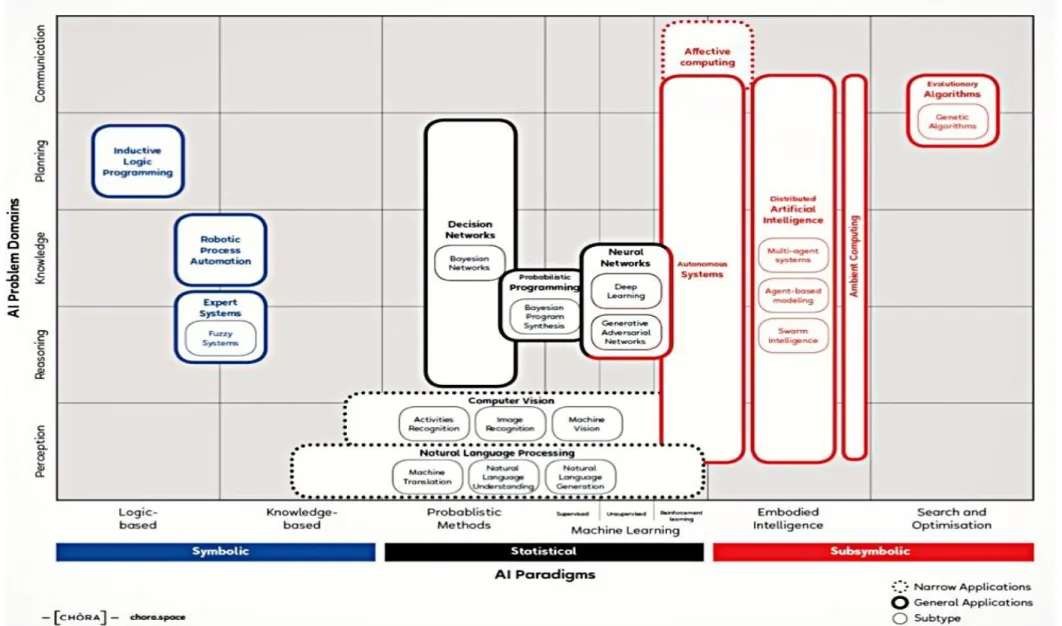
First, each sub division and some of the most relevant elements of such sub division are explained. The full “map of AI” with the techniques classified on each division is shown after the explanations. Finally, a more detailed explanation for the two algorithms used in the work proposed in this thesis is given.
As proposed by Corea, the field of AI can be divided attending to two dimensions: AI paradigms (approaches to solve problems) and AI problem domains (types of problems).
AI Problem domains
When looking at the types of problems an AI approach can solve, Corea defines five main domains: Perception, Reasoning, Knowledge, Planning and Communication.
To better understand each domain, it is interesting to compare it with the human cognitive ability it aims to mimic.
Perception includes the problems that in humans “solve” using their senses. It includes the techniques capable of operating with sensorial inputs (sounds, images, etc) by converting them to a usable format; for example Natural Language Processing and Computer Vision. Natural Language Processing allows a machine to understand, process and even create information in the form of human speech (that is, not structured data expressed in a human language). Computer Vision includes all techniques that allow a machine to process and understand images captured with a camera, similarly to human vision.
Reasoning refers to the capability to solve problems. This includes the capability of, given a problem definition, being able to offer a solution to said problem, in a similar way to how humans solve mathematical problems. An example of reasoning can be found in tagging pictures: deciding if a picture given has a cat or a dog in it. Here, the definition of the problem is the description of the image and the question “does this picture have a cat or a dog in it?”; and the solution would be saying “it has a cat” or rather “it has a dog”.
Knowledge is the capability to represent and understand the world. The world is the reality that affects the machine, and can be narrowed down in some cases. For example, some automations executed by robots only take into account the actions and elements the robot can interact with; if the robot is tasked with loading boxes to a truck, “the world” is limited to the actions it can perform (up, down, grab, release, for example) and the elements it can interact with (box, truck).
Planning is the capability of setting and achieving goals. An example for a planning problem would be deciding a plan to get from point A to point B, as when planning a road trip.
21 Communication is the capability of understand language and communicate. It differs from Natural Language Processing(NLP) in the communication between the machine and the human; NLP problems aim to process the language input, not necessarily trying to communicate.
AI Paradigms
AI Paradigms refer to the different approaches or types of algorithms that exist in the field. Corea divides this dimension in three main types: Symbolic, Statistical and Subsymbolic. Symbolic approaches use logic based and knowledge based algorithms to solve problems. It manipulates symbols, with inference and search algorithms, to build rules, ontologies, plans or goals. Sometimes referred to as “GOFAI” (Good Old Fashioned AI), as author John Haugeland named it in his book “Artificial Intelligence: The Very Idea”[13].
Subsymbolic AI (also known as “connectionist AI”) was originally inspired by the biological brain. It creates connections between nodes, creating a network, and performs calculations in the connections of said network that provide a solution. The outcome model could be compared to a connection map, opposed to the rule tree or plan that is obtained with symbolic AI. To compare it with the biological brain, it assigns conductivity properties (or weight) to the connections between neurons (or nodes) and then modifies this conductivity for each connection until, when a problem is passed through the network, the outcome is a solution to the problem.
Compared to symbolic AI, Subsymbolic AI provides less knowledge and understanding upfront and is more difficult to explain, but performs better for perceptual problems. It is also more scalable, and more robust against noise. The opacity of this paradigm is a problem known by researchers[14], but that doesn’t deny its many applications in AI problems.
Figure 4 illustrates the different understanding of the solution provided by the models obtained with symbolic and subsymbolic AI.
Figure 5: Symbolic VS Sub symbolic AI
Finally, Statistical AI uses probabilistic methods and mathematical tools to build models that reflect information about data. Machine learning algorithms, which have become increasingly relevant over the years[15], are a subdivision of this approach.
22 Machine Learning
Machine Learning algorithms are broadly used due to their ability to provide general solution to a problem using specific samples as reference (or “learn”) and their applications in many different kinds of problems.
The functioning of machine learning algorithms can be summarized as the creation of mathematical models using sample data (“training” data), that describe patterns found in said data. Once the model has been created, it can be shown similar data that wasn’t used to train it, and find a similar patterns in it, which allows the model to recognize this new data. This capacity of being able to create general solutions from specific examples is known as learning. A metaphor to understand the process of machine learning can be created with the learning process of a human. When a human is learning to read and write, he or she is shown a series of “perfect” letters of words – usually generated in a computer, and asked to write them down. By seeing these symbols repeatedly, the human is eventually able to recognize them even when they’re not perfect, such as in handwriting.
In a similar way, a machine learning algorithm can be shown a series of letters, or numbers, and it will find patterns in the symbols. After the learning, if the algorithm is shown a new type of handwriting containing the same symbols the training data provided, it will be able to generalize the pattern learned and recognize said symbols.
In order to learn from the training data, a series of “features” or characteristics must be extracted from it. These features describe the data point and are usually expressed as a vector of values 𝑥𝑖 which define the data point. For example, in the example given, the features extracted from a picture of a handwritten symbol could be: RGB value for each pixel in the image, dimensions of image, etc. These features must be defining of all possible images in the training data and it is required that they can be extracted from all data points.
Figure 6: Example of automated handwriting recognition using Machine Learning
Within machine learning, are three types of learning: Supervised, unsupervised and reinforcement learning.
23 SUPERVISED LEARNING
Supervised learning uses solved examples to train from. The training data provided contains not only examples of the problem, but a tag or value with the solution that would be valid for said example.
In the handwriting example explained before, supervised learning would need a series of example handwritten numbers of letters, along with a tag for the value they represent. The set shown in Figure 5 would be a valid training set for supervised training.
UNSUPERVISED LEARNING
Unsupervised learning lacks a value or tag for each example or sample in the training data. It is given a series of data points or samples, and finds patterns in them according to the distance between the points. For this learning to work it is needed to define the calculation of distance between points.
An example of an unsupervised learning would be trying to sort a drawer with pens and pencils. One can sort them by color, shape, size… since there is no prior definition to which sorting is correct, the groups which will be formed are unpredictable.
Figure 7: Unsupervised Learning REINFORCEMENT LEARNING
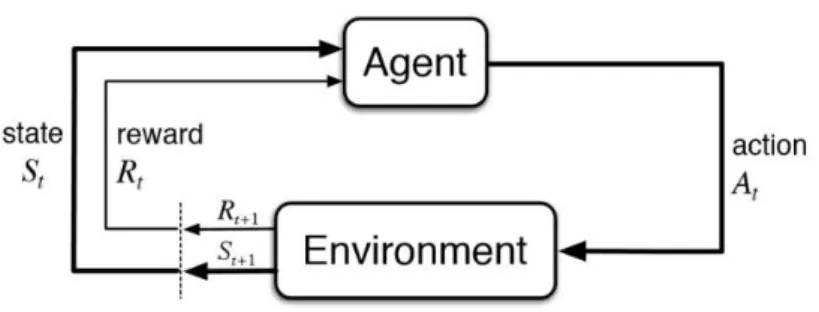
Reinforcement learning assigns a value of “reward” or “punish” for each action possible. The algorithm will tend to maximize reward (or minimize punishment). It can be compared to the process of training a pet to learn certain tricks; giving treats when the pet does the trick correctly, so the pet learns to perform the trick more often in order to get the reward.
24 Map of AI
The divisions explained above can be better understood when presented in the “Map of AI” proposed in the article by Corea[12] (Figure 8). As seen on this map, some fields are not entirely belonging to one of the divisions inside a dimension, and many of them can be used for a wide range of problem domains. The two techniques used in the development of the model are further explained down below.
25 Figure 9: Map of AI (Corea, 2018)
26 Genetic algorithms
Genetic algorithms are a subset of evolutionary algorithms, used to solve optimization problems.
Evolutionary algorithms are inspired by biological evolution, where individuals compete for resources, randomly combine their features to create new individuals and suffer random alterations (mutations) in time. Each individual can be defined as more or less fit (fitness score) to adapt to the environment, and therefore more or less likely to survive and pass on its features to the next generation.
Similarly, a genetic algorithm contains a population of individuals and a series of operators that can be applied to each individual. Each individual codifies a possible solution to the optimization problem at hand (called “genome”), and the possible operators are mutating the individual, calculating the fitness value for each individual and selecting the best individual who will contribute to the creation of new individuals, combining the individual’s codification with other individual (crossover), and finally replacing or adding new individuals to the population.
As well as in biological evolution, any possible way of selecting which individuals combine their features, mutating, or even competing (or collaborating) can be implemented. The population will tend to “evolve” towards the optimal solution, which would be the “perfect” individual.
Artificial Neural Networks: SVM
Artificial neural networks are a family of algorithms loosely based on the architecture and functioning of the biological brain.
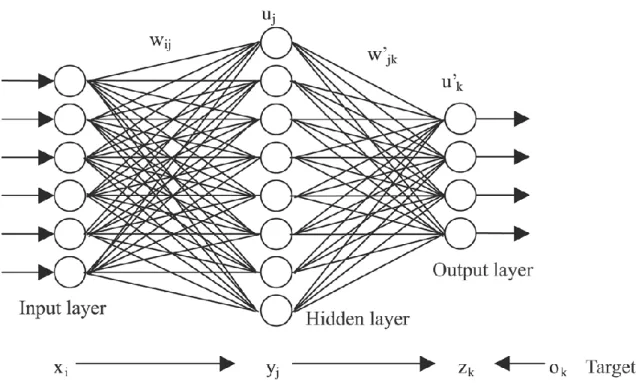
An artificial neural network (ANN) is formed by several layers of nodes or neurons. The neurons on each layer are connected to the neurons on the next layer, with a “connectivity strength” (called “weight) associated to each connection.
One of the first neural networks proposed was the simple perceptron. This model has only one layer and one neuron in said layer. The input data is a vector of values 𝑥𝑖 which are connected to the neuron with a corresponding vector of weights 𝑤𝑖 for each connection.
The neuron then combines both vectors as follows: 𝑓(𝑥) = ∑( 𝑥𝑖𝑤𝑖) + 𝜃
𝑁 𝑖=1
𝑓(𝑥) = 𝑥1𝑤1+ 𝑥2𝑤2+ ⋯ + 𝑥𝑁𝑤𝑁+ 𝜃
Where 𝜃 , or “bias”, is independent from all input values.
After that combination is performed, the output value is used in the activation function, a function that defines the solution or output given by the model. For example, this function can be a simple threshold function such as:
27 𝑓(𝑥) = {1 𝑖𝑓 ∑( 𝑥𝑖𝑤𝑖) + 𝜃 > 0
−1 𝑜𝑡ℎ𝑒𝑟𝑤𝑖𝑠𝑒
Where 1 and -1 are different classes. For example, if trying to classify a handwritten symbol as a number or a letter, 1 could mean it is a number and -1, a letter.
Figure 10: Simple perceptron
A neural network connects several neurons which can behave like the model explained above, in several successive layers. The fist layer is called input layer, the last layer is called output layer, and the layers in between are known as hidden layers. It receives a vector of values 𝑥𝑖 with a series of weights 𝑤𝑖 and combines them in successive layers by applying a function to the values and weight in each neuron. The output of each layer is then processed by the next layer in a similar way.
28 Support Vector Machine (SVM)
A support vector machine is a type of Artificial Neural Network which is widely used in classification problems.
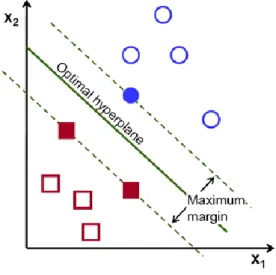
The goal of the SVM is to find a hyperplane in an n dimension space (n being the number of features) that separates the data points of different classes.
It can be imagined as a wall (in a 3 dimension space) that separates two species of animals in a room; the goal of the learning is to move the wall along the room until there are no two animals from different species together. There are many hyperplanes that give a solution, the goal is to find the one that maximizes the distance between all data points of each class: this is done so future data points can be classified with more confidence.
Figure 12: Support Vector Machine
Support vectors are data points close to the hyperplane and influence the latter’s position. They help maximizing the distance between data points of different classes.
The process of learning in a SVM can be seen as changing the position of the hyperplane and support vectors until the maximum distance between data points is achieved.
29 2.3. Similar work
Due to the popularity of Android amongst users, Android devices face constant threats as new malware appears. For this reason, many researchers have attempted to develop an automated, smart solution to identify malicious APKs efficiently, providing models that can adapt to such growing and changing environment.
2.3.1. Static and dynamic Android malware analysis
As explained in section 2.1.2, based on the attributes used to analyse the APK sample, analysis can be divided in static and dynamic. Static analysis extracts features from the application without running it; these can include system calls, size of application, permissions, etc. It is less time and resource consuming than dynamic analysis, but in some cases, such as obfuscation of the code of the application (a technique often used by attackers to make malware APKs harder to detect), it doesn’t perform as well. Some examples of static malware analysis are the work from Sahs and Khan[16], who used a SVM to classify whether a sample was malicious using permissions and API calls; Shabtai[17] used permissions as well, but also framework methods and classes to classify if a sample was malicious or not; Yerima et al. [18] used a Bayesian classifier and extracted features such as permissions, API calls and Linux commands to determine if an application was malicious; and finally, Xiaoyan et al.[19]
extracted permissions from the APK code, and used a linear SVM in comparison to other classifiers such as RandomForest, Bayes or J48 decision tree to determine if the application was malicious. SVM gave the best results.
Dynamic analysis extracts attributes from the running application, such as network traffic, battery usage, etc. This method needs more resources and time that the static approach, but it is not affected by obfuscation in the code. Some authors like Wei et al.[20], who used the tool DroidBox to extract features from the behaviour of the application while running in a sandbox environment, focused on the network behaviour of the malware. They achieved about 93% accuracy comparing different algorithms using data mining open source libraries WEKA and FastICA. Ham and Choi[20] extracted features divided in categories: network, SMS, CPU power
usage, process, memory Native and Virtual Memory. They then compared different techniques such as SVM, Naïve Bayes, RandomForest, to determine if an application was malicious, and concluded that SVM gave the best results, obtaining almost 100% accuracy in some cases, although it gave some false positives in benign applications.
There are also hybrid approaches, which use both static and dynamic attributes to determine if an application is malicious. For example, the work of Patel and Buddhadev[22], who extracted
features such as API calls and permissions from static analysis and used them in combination with network traffic which was captured with dynamic analysis. They then used a Genetic Algorithm based machine learning technique to create a rule based system. They finally obtained a 96.43% detection rate to detect malicious applications.
2.3.2. AI applied to Android malware analysis
There are several works that apply AI to malware analysis in Android. Due to the adapting ability of AI algorithms, these techniques offer very valuable results for malware analysis.
30 Most of the tools developed are aimed at being able to differentiate malicious from legit APKs. Pektas et al.[23] use online machine learning in an attempt to detect new Android malware, by extracting a series of attributes using Cuckoo Sandbox environment, which performs a hybrid analysis. They obtained an 89% accuracy using this method.
Sharma and Sahay[24] propose an approach to identify metamorphic malware comparing the performance of different classification algorithms using the tool WEKA. They extracted features using static analysis, and tested their model with unknown malware. The highest accuracy obtained was 97.95%, using RandomForest.
Altyeb[25] extracted the permissions from the Android app, and then performed feature selection with information gain algorithm, and finally compared NaiveBayes, RandomForest and J48 to classify Android applications as malware or goodware. The algorithm achieved the highest precision of 89,8% accuracy with lowest false positive rate of 11%.
2.3.3. Evolutionary algorithms in Android malware analysis
Some authors use evolutionary algorithms in the analysis of malware applications in Android. Since evolutionary algorithms are mainly used for optimization, in most cases they are used in combination with some classification technique.
Zubair et al.[26] developed a family malware classification framework based on the network
behaviours of the malware samples, and then propose a classification framework based on network behaviour in which they analysed the applicability of various evolutionary (as well as non-evolutionary) algorithms. Their work was focused on malware family classification. They concluded that evolutionary algorithms such as supervised classifier system provided an effective solution for malware family classification.
Firdaus et al.[27] used static analysis to extract features from a series of applications, to then apply statistical and genetic search to select optimal features for various classifiers to detect Android malware. They tested the following classification algorithms: NaiveBayes, Functional Trees, J48, RandomForest and Multilayer Perceptron, obtaining the best results with Functional Trees. Their work is restricted to identifying malicious apps.
2.3.4. Android malware family classification
Although most studies are focused on determining whether an application is malicious or not, some work has been done in classifying the malware samples in their corresponding families, such as the previously mentioned by Zubair et al.[26].
Li et al.[28] created a machine learning based system called DroidADDMiner, which used API data dependence paths to detect, classify (types) and characterize (families) Android malware. The system gave a 98% detection rate, and 96% accuracy when classifying the samples in their families.
Yusoff and Jantan[29] developed a malware classification framework based on malware target and operation behaviour, and used a genetic algorithm to optimize the classification system as well as help in malware prediction. They experimented with a series of classification algorithms; Naïve Bayes, SVM, Decision Tree and KNN.
31
3.
SYSTEM ANALYSIS
In this section, the system is analysed in order to determine all the requirements and conditions that will need to be met in the development. Throughout this section, the problem presented in this document is examined and a series of high level definitions of the system are given, aiming to outline the solution for the problem. The design of the solution will be explained in the next section, SYSTEM DESIGN.
The section will first describe the approach taken for the implementation of the system, referring to the choices made regarding analysis and learning possibilities. Later, a series of user requirements that the system shall be compliant with are proposed. The operating environment of the system is then presented. Finally, use cases and traceability matrix are explained.
3.1. Approach
Before designing the system, the developer must take into account that there are several approaches that can be used for analysing Android malware. As explained in STATE OF THE ART, the extraction of attributes can be static, dynamic or hybrid. Also, the learning process can be supervised, unsupervised or reinforced.
For the implementation of the work described in this document, a series of malicious APKs were obtained from the malware repository ContagioDump. This APKs are already classified inside of their types and families, and are available for free in said repository. More details about these APKs will be given in the section 5.
The extraction of attributes was performed via static analysis. The reason to choose this analysis was the benefits it provides regarding time and resource consumption, as well as the results that it has proven to give as seen in similar work in section 2.
For the learning, since the APKs had already been classified in their types and families, a supervised learning approach was used. The learning was performed by a Support Vector Machine, and a Genetic Algorithm was used to optimize the attributes for the learning. The SVM was chosen as algorithm for the classification based on the work examined in section 2.3, where it became clear that many authors concluded this algorithm gave the best results when analysing Android malware. This process is explained in depth in section 5.
3.2. Requirements
Based on the objectives of the work presented here, a series of user requirements will now be defined. These requirements will define the functionalities of the system to implement, with the following format:
• ID: Used to identify each requirement. This ID will use the format UR-XXX, where UR stands for “User Requirement”, and is followed by a three digit number starting on 001 and increasing in one for each requirement.
• Description: Detailed description of the requirement’s objective.
32 • Priority: Each requirement will have either low, medium or high priority, to help to
plan the development process.
❖ UR-001
• Description: design an intelligent system that can classify malware APK samples in types and families of malware.
• Justification: The goal of the project is to develop and Android malware classification system
• Priority: High
❖ UR-002
• Description: The whole project will only use open source tools.
• Justification: The project should not require software license. Open source code allows for easy future work improvements and later research.
• Priority: High
❖ UR-003
• Description: Use a genetic algorithm to optimize the parameters for the learning. • Justification: The project aims to explore the performance of genetic algorithms
in malware classification, and how they can improve the learning process. • Priority: High
❖ UR-004
• Description: Use an AI classification technique for the learning.
• Justification: The project’s objective is to provide an intelligent scalable solution for Android malware analysis.
• Priority: High
❖ UR-005
• Description: The genetic algorithm will have a limit of 1000 learning cycles. • Justification: The genetic algorithm needs stopping criteria. In the work
proposed, this criterion can only be time or evaluation dependant. • Priority: Medium
❖ UR-006
• Description: Once trained, maximum running time for the system will be limited to 1 minute.
33 • Justification: Although the training and refining process can take a long time, once a final model is found the system needs to provide a solution given a sample within reasonable time.
• Priority: Medium
❖ UR-007
• Description: The output of the system is a subset of attributes and the trained model.
• Justification: The system will provide an optimal subset of attributes and a trained SVM as a result of training and testing.
• Priority: High ❖ UR-008
• Description: The system will use a total of 1175 malicious APK samples for training and testing.
• Justification: raining data needs to be sufficient. • Priority: High
❖ UR-009
• Description: The malicious APK samples will belong to the malware types: banker, ransomware, spyware, adware, trojan, exploit.
• Justification: Training data needs to be diverse and representative of the problem.
• Priority: Medium
❖ UR-010
• Description: For each malicious APK belonging to a malware type as described in UR-008, there will be representative samples of at least one family within the malware type.
• Justification: Training data needs to be diverse and representative of the problem.
• Priority: High
❖ UR-011
• Description: All malware samples will be obtained from the free repository ContagioDump.
• Justification: UR-002 • Priority: High
34 ❖ UR-012
• Description: The system will be developed entirely in Python programming language and open source libraries.
• Justification: UR-002 • Priority: High
❖ UR-013
• Description: The attributes extracted from the APKs will be obtained via static analysis.
• Justification: Static analysis is less time and resource consuming than dynamic analysis.
• Priority: High
❖ UR-014
• Description: The attributes extracted from the APKs will be: for each call to an Android library present in the APK, number of times said call is implemented in the code; permissions asked by the APK; size of the APK.
• Justification: The attributes proposed are representative of the behaviour of the APK and can be obtained via static analysis.
• Priority: Medium
❖ UR-015
• Description: The training dataset will have a common attribute format for all APKs.
• Justification: The attributes must exist on all samples in order to learn from them. Since not all APKs have the same usage of Android libraries nor permissions, the chosen format must represent all possibilities.
• Priority: High
❖ UR-016
• Description: Format of training dataset. Dataset will contain a series of rows representing each APK, where each row will be a list of values for:
▪ All possible calls to an Android library: value equals number of times the APK makes a certain call
▪ All possible permissions: Boolean, True if the APK asks the permission and False if it doesn’t
▪ size of the APK: numeric value ▪ Class: type and family of the APK) • Justification: UR-015
35 • Priority: High
❖ UR-017
• Description: Codification of the genetic algorithm
▪ The genome of the genetic algorithm will describe a subset of the attributes obtained with the static analysis
• Justification: The genetic algorithm must codify a solution for the problem. • Priority: High
❖ UR-018
• Description: Implementation of the classifier
▪ The classifier will be implemented using Python’s opensource library Scikit Learn
• Justification: UR-002 • Priority: Medium
❖ UR-019
• Description: Integration genetic algorithm and classifier model
▪ Fitness score for the genetic algorithm corresponds to the accuracy score obtained by the classifier when training with the subset of attributes codified in the genome
• Justification: The genetic algorithm is used to optimize the learning process. • Priority: High
❖ UR-020
• Description: Test dataset
▪ A sub dataset with enough samples representative of each family and type of malware will be extracted from the original training dataset and will not be used for training.
▪ Said dataset will be used to test the system
• Justification: The system must prove to be compliant with a representative sample of malicious APKs.
• Priority: High
❖ UR-021
36 ▪ The results obtained with the SVM and GA will be tested using the test
dataset described in UR-020.
▪ A series of tests [\ref evaluation] will be performed to ensure the quality of the system
• Justification: UR-020. • Priority: High
37 3.3. Operating Environment
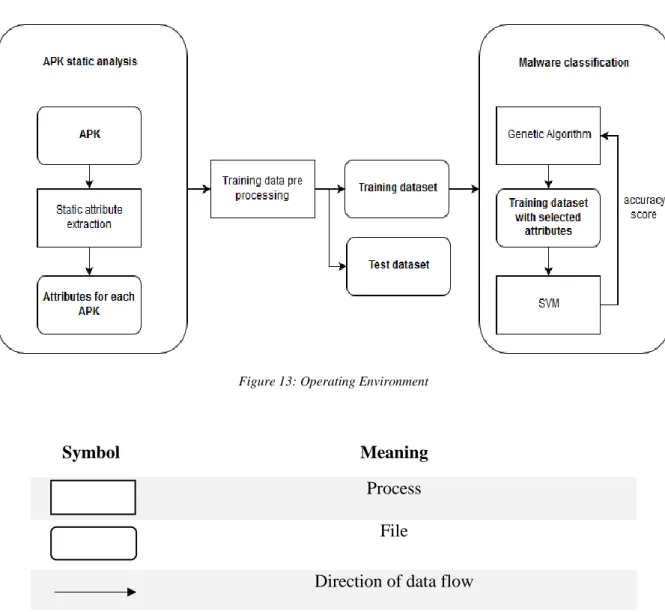
The system has two main modules: static analysis of APKs and intelligent malware classification.
The first one provides the data that is used to train the second. Before the data can be used by the second, it is pre-processed and two datasets are created: training and test. In the second module, a genetic algorithm (GA) selects a series of attributes from the training dataset that are then used by a Support Vector Machine (SVM) to obtain a classification model. The accuracy obtained with the SVM is then fed back to the GA, which uses it as fitness score to evolve. The test dataset will later be used in the evaluation of the system (see EVALUATION).
A visual schematic overview of the system design is shown in Figure 12. The symbols used in this schematic are explained in Table 1.
Figure 13: Operating Environment
Symbol Meaning
Process File
Direction of data flow Table 1: Operating Environment notation
38 3.4. Use cases
Use cases define the possible interactions that a user can have with the system. This section is usually included in reports about software engineering projects. However, the work described in this document allows no possible interactions with a user. Therefore, there are no user cases that can be defined.
3.5. Traceability Matrix
Traceability matrix provides an overview of the relationship between user requirements and use cases. Since there are no use cases possible for this project, there will be no traceability matrix shown.
39
4.
SYSTEM DESIGN
This section will explain the design of the system implemented. Firstly, an overview of the design of the system is shown, followed by an explanation of the technologies used in the project is given, followed by a general schematic overview of the architecture of the system using a component diagram. An explanation about the classes in the system, along with a class diagram, are given in the next section. Lastly, this section includes a flowchart showing the behaviour of the system.
4.1. Design overview
The system to implement must be a classifier for malicious APKs, that given a sample classifies it inside its type and family of malware. The attributes will be extracted from each sample via static analysis (see 2.3.1), which consists on analysing the APK’s code without running it. Since the number of attributes obtained is too big, once the attributes have been extracted, a genetic algorithm will be used to optimize the attributes used in the classifier.
This optimization will be done by using each individual from the genetic algorithm to codify a subset of attributes, train the classifier with said attributes, and then measure the accuracy of the trained model. The accuracy obtained will be then fed back to the genetic algorithm as fitness score for each individual.
4.2. Technologies
The whole project was developed using open source technologies, and the data was obtained from free samples available on the site ContagioDump. All the code was implemented in Python programming language.
4.2.1. Python
Python is a general purpose programming language which has gained popularity for data science and machine learning implementations over recent years. It was used for all the different modules of the project. The APK analysis was implemented using Python’s library Androguard, and the classification algorithm was implemented using Python’s library Scikit Learn.
Androguard
Androguard is a Python tool that allows to interact and work with Android files. It can be used through a CLI or graphical frontend, or as a library inside of own code. For this system, it was used as a library inside the code for APK analysis.
Scikit Learn
Scikit Learn is an open source machine learning library for Python. It integrates several algorithms and tools for different purposes such as classification, regression, clustering, dimensionality reduction, model selection pre-processing. It was used to implement the classifier model (Support Vector Machine).
40 4.3. System Architecture
In this section, the architecture of the system will be explained using a component diagram. According to UML[30], a component diagram shows components of the system, along with their relationships, interfaces, or ports between them.
4.3.1. Introduction to component diagram
A component is a logical or physical unit that represents a functionality within the system. The idea behind component based design is that if needed, the components can be deployed and re deployed independently. A component is represented as shown on Figure 13:
Figure 14: Component notation
Components that work together to achieve the same functionality can be grouped in subsystems. The definition of these subsystems was outlined in section 3. When two components are in the same subsystem, they will be represented as shown on Figure 14:
Figure 15: Subsystem notation
Moreover, components can have dependencies between them. This dependency occurs when a component uses a functionality that other component performs. Dependencies are represented as shown on figure 15 below:
41 Figure 16: Dependency between components
4.3.2. Component diagram
42 4.4. Classes
This section contains a detailed specification of the classes within the system. These classes are first identified and then, a class diagram with all the classes in the system and relationships between them is provided.
4.4.1. Identification of classes
As explained before, the system has two main functionality units: APK analyser and classification of malware, which uses a genetic algorithm and SVM. Between the two functionalities, a third is added to prepare the data for training.
The classes in the system correspond to these functionalities:
Analyse: Extracts the attributes for the learning from the APK code with static analysis. PrepareData: Used to format and pre-process the attributes extracted with Analyse and create data for training and testing.
Classifier: Contains the functionality of the SVM used for classifying the samples. It communicates with the Individuals in the population as they define the attributes to use for the learning (therefore the format of the training and test dataset), and calculates the fitness for each individual. It also needs the data created in PrepareData to select the relevant rows of information in the file created by said class.
Individual: Each individual is defined by a genome and a fitness value. Population: It’s a list of Individuals.
4.4.2. Class diagram
This section illustrates all the classes in the system, their methods, attributes and the relationships between them. The notation used to describe a class is shown in figure 17:
Figure 18: Notation of classes
Where fields refer to the attributes of the class, and a method will be described with the data type it receives as parameters and the return value. Type is a data type.
The relationship between two classes is shown with an arrow that points from the class using a value or data from another class, to the class that provides said data or value. The arrow is tagged with the method from the former class that requests data from the latter.
43 Figure 19: Relationship between clases
Find below an schematic view of all classes in the system and the relationships between them:
44 4.5. Flowchart
In this section, a flowchart is used to explain the activities in the system. The symbols used in this chart are explained in table 2:
Symbol Meaning
Start Process Decision
Finish
Direction of data flow
Table 2: Flowchart notation