Cloud Providers that Support IPv6
John VailEast Carolina University
Department of Technology Systems
The author wishes to gratefully acknowledge Nepho6, particularly Mo Khalid and Ciprian Popoviciu for all their support and help in identifying this topic, and to thank all of the cloud service providers that took the time to answer my inquires.
Abstract
Any organization in the planning stages of transitioning to the cloud and/or IPv6 should architect the transition with both in mind instead of separately tackling each. Moving to the cloud is a natural progression for organizations recognizing the need for agility while also lowering the total cost of ownership. With the availability of IPv4 address nearing exhaustion, forward looking organizations are also planning for their adoption of IPv6. With that in mind, this paper explores various cloud providers and their abilities to effectively accommodate customers utilizing IPv6.
Introduction
The depletion of available publically routable Internet Protocol version 4 (IPv4)
addresses is close at hand. Network Address Translation (NAT) and other workarounds have staved off the inevitable – until now. On February 3, 2011, the Internet Assigned Numbers Authority (IANA) issued the remaining five /8 address blocks equally to the five regional internet registries (RIR), and as such American Registry for Internet Numbers (ARIN) will no longer be able to receive additional IPv4 resources from the IANA (ARIN, 2012). In April of 2011, the released the last block of IPv4 addresses in its available pool. The event was, “a key turning point in IPv4 exhaustion for the Asia Pacific, as the remaining IPv4 space will be ‘rationed’ to network operators to be used as essential connectivity with next-generation IPv6 addresses” (APNIC, 2011). On September 28, 2010 Vivek Kundra, who was the United States Federal Government Chief Information Officer (CIO) until last August, mandated that all federal agencies upgrade their public-facing Web services -- including Web, email, DNS, and ISP services to native IPv6 by Sept. 30, 2012. There is a second deadline of Sept. 30, 2014 for federal agencies to upgrade internal client applications that communicate with public Internet servers to use native IPv6 (Marsan, 2010) (Datatek Applications Inc.). Seven global Internet Service Providers (ISP) and heavily trafficked websites including Google, Yahoo, Facebook, and Bing have all
committed to being available via IPv6 on IPv6 World Launch day this June 6th
(Electronista, 2012). The change to IPv6 is coming and now the choices for
organizations are whether they are going to be an early adopter or whether they are going to come to the party late as a follower.
Strong arguments have been made that early adoption of IPv6 will gain organizations economic advantages (Ramos) (InfoWeapons). With proper planning, the economic cost of IPv6 implementation within an organization can be lessened by specifying IPv6 support when refreshing and replacing hardware and software within their lifecycles. Implementing IPv6 in an orderly manner will keep an organization from being subject to inflated expenses due to last minute deployment needs, and will help to deter last minute improvisations. “IPv6 adoption can be a significant undertaking and naturally poses challenges” (Grossetete, Popoviciu, & Wettling, 2008). Now is the time for organizations to begin planning for deploying IPv6, as well as for them to implement strategies to mitigate the risks. Detailed planning is critical for an organization to navigate the process smoothly and securely (Frankel, Graveman, Pearce, & Rooks, 2010).
Similar to the migration to IPv6, the migration to and governance of cloud services must be thoroughly planned. If an organization adopts cloud services on an ad-hoc basis, corporate data will likely get spread across differing platforms and locations. If this happens the organization may become reliant on questionable partners, the organization’s information technology infrastructure may become extremely difficult to change, and the benefits that the cloud once promised will turn into liabilities (van Ommeren, van den Berg, & al, 2011). One significant benefit of cloud computing is ability to enable an organization to react quickly, something also called agility in the marketplace. When an organization adopts cloud services without a clear plan, agility may seem to improve in the short term, but eventually it will deteriorate. Agility deteriorates because of increasing complexity, because of services that are not
integrated, and because of the difficulties inherent in switching from one cloud provider to another. Conversely, if cloud services are implemented according to, and part of, an organization’s strategic plan, agility improves dramatically over time, and is lasting (van Ommeren, van den Berg, & al, 2011). Moving to using cloud services must be
structured and part of an organization’s long term strategy.
Both the cloud and IPv6 are technologies whose time has come. IPv6 as a technology has been in implementation since 1998 (Deering & Hinden, 1998); and cloud services have been around since 1999 when Salesforce.com offered their applications through a web site (Mohamed, 2009). So these are not new technologies per se, but businesses and organizations have been slow to adopt them. This will soon change since the U.S. Federal Government has committed to adoption of both of these technologies,
providing the tipping point for widespread acceptance and use of cloud services and IPv6.
There are enormous benefits to planning an organization’s migration to the cloud and IPv6 together, as well as downsides by not doing so. Synergies can be created when an organization includes both cloud migration and IPv6 in their strategic and tactical planning. Any time an organization plans a transition there are requirements that need to be addressed. Cloud computing and IPv6 are complementary technologies and each should be analysed in the context of the other while in the planning stages. At the very least, by doing so the organization foregoes a duplication of effort, since items like lifecycle refresh, application compatibility, etcetera would be done at the same time instead of separately. More importantly, when the two technologies are analysed together, decisions can be made that optimize both technologies providing options that might not otherwise be apparent if the two technologies were planned for
independently of each other.
The Problem to be Studied & the Contributions of this Paper
As technologies, cloud computing and IPv6 are not particularly new. Despite this fact, many organizations have been slow to adopt these technologies and instead are taking a wait and see attitude. Some organizations, like the U.S. Federal Government and the Internet Society, have taken actions to instigate adoption of these technologies.
Adoption of cloud services are on the rise as, “[s]ix out of 10 U.S. companies already have at least one application in the cloud, and 71 percent expect to increase spending on cloud services in the next 12 months” (Brousell, 2012).
The shift in adoption is occurring quickly in some companies, and there may be a tendency to adopt the technologies one at a time instead of simultaneously—that is begin with cloud computing and then work in IPv6 connectivity later. Organizations, as they consider implementing new technologies, make a significant commitment of time, energy, and resources. If an organization is to benefit from the synergies created from planning both IPv6 and cloud computing together, organizations must evaluate Cloud Service Providers (CSP) against an additional criterion: IPv6 readiness. Organizations in the process of adopting IPv6 and cloud computing need to know which cloud service providers are prepared for IPv6. At a minimum, the organization must protect this investment for the IPv6 transition. If it is a multinational organization, Ipv6 accessibility is a necessity.
This paper recognizes that the most efficient way to implement cloud computing and IPv6 over the long term is to plan, and effectuate that implementation, as a singular process. As a consequence, the goal of this paper is to provide a comprehensive list of North American CSPs that are offering their Infrastructure as a Service (IasS), Platform as a Service (PaaS), and Software as a Service (SaaS), natively via IPv6. As companies are planning an integrated approach to implementation of cloud computing and IPv6 technologies, it is best to identify and adopt CSPs with native IPv6
connectivity; which will increase the company’s current and long term efficiency by avoiding duplication of effort and benefiting from the synergy created.
Relation to Existent Literature
A key indicator that this study is needed is that relevant literature, with the exception of one blog, is nonexistent. Even the Internet-Draft, Cloud/DataCenter SDO Activities Survey and Analysis (Khasnabish & JunSheng, 2011), which presents a snapshot of industry standards activities related to Cloud and Data Center computing, networking and services including relevant features and functions, and is a survey of current activities of cloud standards development organizations (SDOs,) does not have any mention of IPv6.
The paper “Comparing Public-Cloud Providers” (Li, Yang, Kandula, & Zhang, 2011) is similar to this study in that it attempts to address how to choose a provider, but their criteria for selection is based upon metrics rating application performance. The article “Blueprint for the Intercloud - Protocols and Formats for Cloud Computing
Interoperability” (Bernstein, Ludvigson, Sankar, Diamond, & Morrow, 2009) gets closer, but only defines cloud computing as a datacenter, and it only briefly mentions IPv6 compatibility – instead proposing to use Location Identity Separation Protocol (LISP) as a solution.
Mo Khalid rightly points out that if Information Technology (IT) organizations, “…are doing the planning to choose the right Cloud delivery models and the right Service Providers, they might as well do the IPv6 assessment and planning at the same time” (Khalid, Plan the move to the Cloud with IPv6 as a key Capability, 2011). “The
meticulous planning that Enterprises are going through for the Cloud contain all the same underlining components which are part assessment and analysis for determining IPv6 readiness” (Khalid, Plan the move to the Cloud with IPv6 as a key Capability, 2011). Organizations need to determine if the CSPs they are evaluating are delivering IPv6 services all across the layers of the TCP/IP stack (Khalid, Plan the move to the Cloud with IPv6 as a key Capability, 2011).
A blog titled “The World is ready for IPv6, What about Cloud providers?” by
lazarovicedo on the web site In Cloud We trust is another article that closely relates to this papers position. The author spoke of the need to move to IPv6 because IPv4 is running out of available addresses, and mentioned seven (7) cloud services that are IPv6 ready, or are almost done with the transition (lazarovicedo, 2011). It is a start, and relevant in that it is another vehicle to engage people in a discussion regarding the cloud and IPv6. What the blog article does not do, and this study will, is give organizations that are in the planning stages of implementing IPv6 and cloud computing a survey of North American cloud service providers that are definitively natively connectable by IPv6. While this study may not present an exhaustive listing of
clouds, it will focus on and provide data from those cloud service providers listed in Garner’s golden quadrant, as well as others, categorize where they fit in relation to their offerings, and list those cloud service providers that have connectivity to their cloud services natively using the IPv6 protocol.
Definitions, Descriptions of Data, Etc.
The term cloud is a buzzword that has gained momentum lately. Many are using the term as part of a marketing plan to gain market share, but their services may only tentatively or peripherally be truly cloud services. The Telecommunications Industry Association (TIA) issued a White Paper on August 18, 2011 defining what the cloud is, stating “[e]ssentially, cloud computing is the use of resources (e.g., servers, data, applications) in the Internet (Telecommunications Industry Association, 2011).” For the purpose of this paper, we will define cloud services as the on-demand provision of computational resources (data, software, etc.) via a computer network, rather than from a local computer.
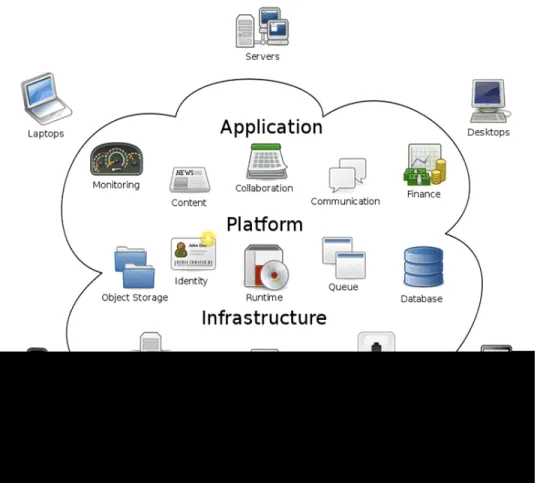
Clouds come in several varieties, and offer several different types of services. Clouds can be public, private, or a hybrid of public and private. The services offered via the cloud can be extremely varied, but for the most part they can fall into one of three categories: Infrastructure as a Service (IaaS), Platform as a Service (PaaS) or Software as a Service (SaaS). There are other services offered via the cloud; for example security is one that has gained momentum recently as well. To allow this study to remain tightly focused, cloud vendors that offer hardware and/or software solutions to create private clouds hosted by their customers, or vendors that offer specialized, bolt-on services that are engineered to assist organizatibolt-ons in cbolt-onnecting to or securing access to the cloud have been omitted. It is, however, an area ripe for further research.
A public cloud is a place where a cloud service provider makes resources like applications or storage available over the internet as a free service, or as a pay as the resources are accessed or utilized. Several different organizations may be utilizing and sharing the same physical resources inside the cloud. Some cloud service
providers offer virtual private clouds to allow organizations the benefit of outsourced cloud computing and hosting of data without having to share those resources with other organizations. The term private cloud often refers to when organizations
themselves host centralized data and/or computing, but for the purposes of this study those organizations will not be included. A hybrid cloud uses elements from the public and private cloud models and is maintained by the organization in conjunction with the cloud service provider, whereas public clouds are maintained almost exclusively by the cloud service provider.
IaaS can be defined by an organization outsourcing the technology to support its operations; including servers, storage, and networking components. The service provider owns, houses, and maintains all the technology needed – with the exception of the computers the organization uses to access the IaaS. PaaS is very similar to IaaS, but when an organization uses a PaaS, they are not responsible for the operating system upkeep (patches, etc.) or the integration middleware. And in SaaS, everything from the applications to the networking involved is controlled by the cloud service provider. Figure 2 shows a simplified diagram of the delineation between what the organization directly controls and what the cloud service provider controls.
It needs to be noted that some organizations refer to Storage as a Service as SaaS, but for the purposes of this study those companies that provide cloud storage will be considered under Infrastructure as a Service.
Methodology
A descriptive quantitative based study was conducted, whereby data was collected in order to answer questions concerning the current status of cloud service providers providing native IPv6 access to their hosted solutions. North American cloud service providers were researched to determine whether or not their cloud based solutions were available via IPv6 natively. Organizations that did not offer IaaS, PaaS, or SaaS in the cloud were not surveyed. Examples of Cloud Providers that were omitted include those that only offer hardware and/or software that an organization would use to create their own private cloud, or those that only offer cloud security. The intention of this study was to determine if an organization that has committed to utilizing IPv6 addressing could connect to a public cloud, an hybrid cloud, or a private cloud hosted offsite by a cloud service provider without having to use any translation mechanisms. The first step was to see if the cloud service provider had information on the web that affirmed their IPv6 connectivity. If that information was not easily discerned, the next step was to contact the cloud service provider to inquire whether or not their cloud based solutions were available natively via IPv6. Some representatives tried to hedge by saying that their organization would be ready, “when the time comes.” The last step was to confirm affirmations. Forty (40) cloud service providers were researched, and this research has only gone as far as identifying cloud service providers that claim IPv6 connectivity. It will take further research to confirm and test these claims as well as the extent of the support available for the services.
Due to the nature of the cloud, cloud service providers and their data centers can be located all over the globe. Regulatory requirements for some organizations preclude them from having their technology hosted in countries other than their own. When an organization uses a cloud service provider, their data could be in, or processed by, a server or networked attached storage (NAS) anywhere on the planet. The technology
involving cloud computing has advanced ahead of the law’s ability to keep pace. Laws governing data may be those in the country where the headquarters of the
organization is located, those where the cloud service provider is located, those where the cloud service provider’s data centers are located, or even those of the countries where the data just passes through (Trappler, 2011). So it is essential for an
organization to identify jurisdiction so that when the contract is drawn up the parties can specify the governing law under which any disputes would be resolved, and include provisions for the location of the court where such disputes would be heard.
For the purpose of this study however, the research focused on North American cloud service providers, although one located in the United Kingdom was also included. The author’s home Internet service provider (ISP), Time Warner Cable, does not offer IPv6 connectivity at this time so a tunnel broker was used. Ipconfig confirmed that the computer had an IPv6 address and Test-ipv6.com confirmed IPv6 connectivity. However the results also mentioned, “Your DNS server (possibly run by your ISP) appears to have no access to the IPv6 Internet, or is not configured to use it. This may in the future restrict your ability to reach IPv6-only sites.” This confirmed that Time Warner Cable, in my location, is not IPv6 ready. The tunnel brokers were set up as a way to verify connectivity of IPv6 addresses.
Main Results
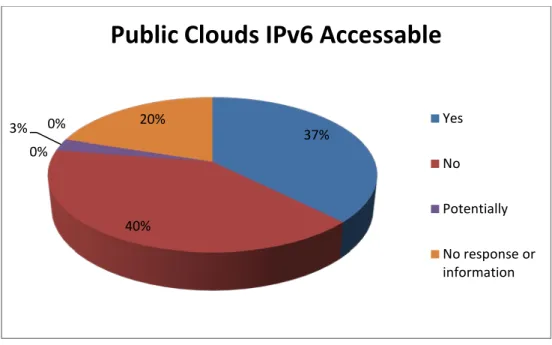
Figure 3 shows that of the forty (40) cloud service providers investigated, fifteen (15) purport to be accessible natively via IPv6, sixteen (16) admit that they are not available natively via IPv6 (or state that it will be available soon), and eight (8) either did not respond to email or phone inquiries or did not have the information readily available on the World Wide Web. One cloud service provider is listed as having the potential to be available natively via IPv6: Google. They are not listed as available in this study, but rather as potentially available, because they will enable IPv6 on request for networks where IPv6 access will provide the same or better quality of experience of Google services as IPv4 for their search (including image search, blog search and code search), Alerts, Docs, Sites, Finance, Gmail (including POP and IMAP), Health, iGoogle, News, Reader, Picasa Web Albums, Maps, YouTube, and App Engine. A few of the larger web site operators have IPv6 addresses, but have concerns that end users may experience slow or otherwise impaired access to web sites that have both IPv6 and IPv6 addresses. In an attempt to shield users with impaired access that would
negatively affect their access to certain websites and related Internet resources until IPv6 World Launch day this June 6th, several of the large web site operators, like
Google, have implemented Domain Name Server (DNS) whitelisting. This practice means that only entities on the whitelist will receive IPv6 addresses when a request to resolve a domain name is received.
Figure 3. Cloud Service Providers Natively Available via IPv6.
It is interesting to note that over one third of the cloud service provider’s surveyed are available natively via IPv6. It is interesting because, according to Google, as of March 20th of this year, less than one half of one percent of Google users have IPv6
connectivity - although three times in March it did spike over .5% (Google, 2012). Adoption of IPv6 by Google users is trending upwards (Figure 4), indicating that user IPv6 connectivity is gaining slowly but is still nowhere near widespread adoption. The depletion of available IPv4 addresses will hasten adoption, as will IPv6 World Launch day, so it is good to see cloud service providers proactively addressing the issue.
Figure 4 . IPv6 Connectivity of Google Users
The eight (8) companies investigated that do not have information readily available claiming IPv6 access to their clouds, and the sixteen (16) companies that do not have
37%
40% 0%
3% 0% 20%
Public Clouds IPv6 Accessable
Yes No Potentially No response or informationIPv6 connectivity to their clouds will not be specifically mentioned here in this study. The fifteen (15) cloud service providers that are available natively via IPv6 are:
Bluelock (IaaS), providing Enterprise Cloud Computing, Hybrid Cloud Computing, and Private Cloud Computing; and is classified as a leader in Garners Magic Quadrant. Their URL is
Brightbox (IaaS), based in the United Kingdom, provides Cloud Servers that are directly accessible via IPv6. Their URL is http://brightbox.com/.
Cloudflare (PaaS), secures and optimizes web sites. Their URL is http:// www.cloudflare.com/.
Dropbox (IaaS), offers storage and collaboration services. Their URL is http:// www.cloudflare.com/.
HP (IaaS, PaaS, and SaaS), offers private, public, and hybrid clouds; and is offering a private beta: HP Cloud Compute and HP Cloud Object Storage. Their URLs are
.
Linode (IaaS), is a Xen Virtual Private Server (VPS) hosting company. Their URL is http://www.linode.com/.
NTT Communications (IaaS), offers (among other services) data center services, managed private networks, and managed IT services. Their URL is http:// www.us.ntt.com/en/.
Oxygen Cloud (IaaS), offers secure access to storage, file synchronization, and file sharing using Android, iOS, or Windows operating systems. Their URL is
Rackspace (IaaS and PaaS), provides a fully managed public cloud, on-demand storage & content delivery, and Cloud Sites – a managed PaaS; and is classified as a visionary in Garners Magic Quadrant. Their URL is http://rackspace.com/ cloud/.
Softlayer (IaaS), offers dedicated server hosting and cloud server hosting; and is classified as a visionary in Garners Magic Quadrant. Their URL is
Softlayer.com.
Tata Communications (IaaS and SaaS), offers (among other services) data center services, content delivery services, and voice over internet protocol services; and
is classified as a niche player in Garners Magic Quadrant. Their URL is http://www.tatacommunications.com/.
Virtacore Systems (IaaS), offers public, hybrid, and private clouds; and is classified as a niche player in Garners Magic Quadrant. Their URL is http:// virtacore.com/.
Windows Azure (PaaS), offers a platform as a service. Their URL is http:// www.windowsazure.com/.
Windstream (IaaS), offers public, private and hybrid clouds, as well as storage. Their URL is http://www.windstream.com/.
And XO Communications (IaaS and PaaS), which offers (among other services) online data backup and cloud storage services, web site and email hosting services, and voice over internet protocol services. Their URL is http:// www.xo.com/.
Conclusions
Cloud service providers, as well as the customers they support, rely heavily on internet protocol addresses to integrate and connect end users with storage, servers, and other network resources. The internet protocol addresses are also central to the
management frameworks and scripts utilized by cloud service providers to enable automation and control. Managing connectivity is more complex and critical for cloud service providers that offer infrastructure as a service than those that offer software as a service because the infrastructure as a service provider must also deal with
customers who configure and control their own virtual images (MacVitte, 2011). Internet protocol addresses are also utilized by customer controlled applications and services to identify integrated external or third party services, so it is necessary that a cloud service provider be fully prepared to support IPv6 if its customer’s architecture has implemented IPv6.
That does not mean that cloud service providers that offer software as a service can adopt a laissez-faire attitude towards IPv6. Customer applications deployed in a cloud could integrate back into the customer’s datacenter, which could rely on IP addresses for security or integration. Despite it being less complex to integrate and deploy IPv6 effectively for the software as a service provider than the infrastructure as a service provider, it is interesting to note that none of the software as a service vendors identified in this investigation was available via IPv6.
The United States Federal Government committing to converting their information systems to IPv6 and the cloud is a strong indicator that the cloud and IPv6 are
technologies whose time for adoption is now. Other international organizations, agencies and governments have also committed to IPv6 adoption – either out of necessity or for economic advantage. This does not mean that there are no longer any problems implementing either technology. Even mature well utilized technologies still have issues. But most issues in implementing IPv6 and cloud computing can be mitigated with planning, and forethought.
This research has only gone as far as identifying cloud service providers that claim IPv6 connectivity. It will take further research to confirm and test these claims.
Works Cited
APNIC. (2011). Key Turning Point in Asia Pacific IPv4 Exhaustion. Brisbane: Asia Pacific Network Information Centre.
ARIN. (2012). IPv4 IANA Free Pool Depletion – FAQ. Retrieved 01 26, 2012, from ARIN: https://www.arin.net/resources/request/ipv4_depletion.html
Barr, J. (2011, May 24). Elastic Load Balancing - IPv6, Zone Apex Support, Additional Security. Retrieved 03 24, 2012, from Amazon Web Services Blog: http://aws.typepad.com/aws/2011/05/elastic-load-balancing-ipv6-zone-apex-support-additional-security.html
Bernstein, D., Ludvigson, E., Sankar, K., Diamond, S., & Morrow, M. (2009). Blueprint for the Intercloud - Protocols and Formats for Cloud Computing Interoperability. 2009 Fourth International
Conference on Internet and Web Applications and Services (pp. 328-336). IEEE Computer Society.
Brousell, L. (2012, April 1). Cloud Spending Heading Up. CIO, p. 12.
Daigle, L. (2004, September). WHOIS Protocol Specification. Retrieved 03 07, 2012, from Internet Engineering Task Force: http://www.ietf.org/rfc/rfc3912.txt
Datatek Applications Inc. (n.d.). DoD US Govt IPv6 Mandate. Retrieved 3 30, 2012, from Datatek: http://datatekcorp.com/index.php/ipv6-portal/ipv6-resources/131-dod-mandate
Deering, S., & Hinden, R. (1998, 12). Internet Protocol, Version 6 (IPv6) Sprcification. Retrieved 02 21, 2012, from Internet Engineering Task Force: http://tools.ietf.org/html/rfc2460
Electronista. (2012, 01 17). ISP's, sites team up on World IPv6 Day. Retrieved 02 21, 2012, from Electronista:
http://www.electronista.com/articles/12/01/17/world.ipv6.day.to.launch.standard.is.june.6/ Frankel, S., Graveman, R., Pearce, J., & Rooks, M. (2010). Guidelines for the Secure Deployment of IPv6.
Google. (2012). IPv6 Statistics. Retrieved 03 24, 2012, from Google: http://www.google.com/intl/en/ipv6/statistics/
Grossetete, P., Popoviciu, C., & Wettling, F. (2008). Global IPv6 Strategies. Indianapolis: Cisco Press. InfoWeapons. (n.d.). The Second Internet (based on IPv6) for Decision Makers. Retrieved 03 24, 2012,
from InfoWeapons: http://www.infoweapons.com/content/ipv6-decision-makers
Khalid, M. (2011, September 26). Plan the move to the Cloud with IPv6 as a key Capability. Retrieved 03 31, 2012, from Nephos6: http://www.nephos6.com/blog/
Khalid, M. (n.d.). Roadmap for IT Organization Transition to Cloud Based Service Delivery. Retrieved 01 26, 2012, from Nephos6: http://www.nephos6.com/pdf/Nephos6_Cloud_Transition.pdf Khasnabish, B., & JunSheng, C. (2011, 12 28). Cloud/DataCenter SDO Activities Survey and Analysis.
Retrieved 03 25, 2012, from Internet Engineering Task Force: http://tools.ietf.org/html/draft-khasnabish-cloud-sdo-survey-02
lazarovicedo. (2011, July 27). The World is ready for IPv6, What about Cloud providers? Retrieved 01 27, 2012, from In Cloud We trust: http://www.incloudwetrust.net/profiles/blogs/the-world-is-ready-for-ipv6-wh?xg_source=activity
Li, A., Yang, X., Kandula, S., & Zhang, m. (2011). Comparing Public-Cloud Providers. IEEE Internet
Computing, 50-53.
MacVitte, L. (2011, June 11). IPv4 to IPv6 switch: When protocols collide. Retrieved 03 25, 2012, from ZDNet UK Edition: http://www.zdnet.co.uk/news/cloud/2011/06/11/ipv4-to-ipv6-switch-when-protocols-collide-40093062/2/
Marsan, C. D. (2010, September 28). White House issues IPv6 directive. Retrieved 02 21, 2012, from NetworkWorld: http://www.networkworld.com/news/2010/092810-white-house-ipv6-directive.html
Mohamed, A. (2009, March). A history of cloud computing. Retrieved 02 21, 2012, from ComputerWeekly.com: http://www.computerweekly.com/feature/A-history-of-cloud-computing
Ramos, W. (n.d.). Transition to IPv6 in the USA. Retrieved 03 24, 2012, from Portal IPv6:
http://portalipv6.lacnic.net/en/ipv6/ipv6/government/transition-ipv6-usa-walter-ramos Telecommunications Industry Association. (2011, August 18). White Paper on Cloud Computing.
Retrieved 03 07, 2012, from TIA:
Trappler, T. J. (2011, 12 13). Cloud adviser: Where's your data? Retrieved 03 06, 2012, from Computerworld:
http://www.computerworld.com/s/article/9222627/Cloud_adviser_Where_s_your_data_ van Ommeren, E., van den Berg, M., & al, e. (2011). Seize the Cloud. Retrieved 01 26, 2012, from