PRACTICAL GUIDELINES TO FORMULATE AN OPERATIONAL
RISK APPETITE STATEMENT FOR CORPORATE
ORGANISATIONS: A SOUTH AFRICAN PERSPECTIVE
J. Young*Abstract
Risk appetite is currently a much debated topic and a new concept being researched and implemented by various large organisations. However, currently there seems to be much confusion on this topic in terms of an overall risk appetite statement. Uncertainty exists, for example, if there must be a statement for each primary risk type the organisation faces, or should there be an overall risk appetite statement for the organisation? This article approaches a risk appetite statement from an operational risk perspective, which could serve as a platform for other risk types. Therefore, the significance of this research aims to provide guidelines to corporate organisations during the setting of a realistic operational risk appetite statement that could add value during the pursuance of business objectives within the approved tolerance levels.
Keywords: Risk Appetite, Risk Tolerance, Operational Risk, Key Risk Indicators, Risk And Control Self-Assessments, Scenarios, Loss History, Risk Control, Risk Appetite Statement, Business Strategy, Risk Exposures, Qualitative Statement, Quantitative Statements, Zero Tolerance, Risk Thresholds, Economic Capital
* University of South Africa, PO Box 52185, Wierda Park Centurion, Pretoria, South Africa, 0149 Telephone: +27 12 429 3010
Mobile: +27 8307 6265 Email: [email protected]
1. Introduction
The focus on operational risk increased since the publication of the regulatory framework by the Basel Committee on Banking Supervision in June 2006 (Basel 2006). This framework deals with guidelines to link a minimum capital requirement to the risks to enhance greater consistency of capital adequacy. This focus is especially applicable to the banking industry, mainly due to the regulatory requirements placed on the industry by the central banks. According to Jobst (2007), the New Basel Capital Accord underscores the need to heed new threats to financial stability from operational risk. As such, it became crucial to understand the concept of operational risk management, because the new capital rules require from banks to allocate a capital charge to operational risk and not only credit and market risk. Therefore, operational risk was accepted as one of the major risk types that must be managed by banks alongside credit and market risks. According to Wikipedia (June 2014), the topic of market and credit risk has been the subject of much debate since mid-1990. However, the financial crisis in 2008 indicated that there are still challenges in managing credit and market risk
which lead to Basel III regulations for banks. Although the New Capital Accord focused more on capital charges for credit and market risk, various events such as the September 2001 terrorist attacks, losses due to rogue trading (Barings Bank amongst others) indicate the importance of operational risk management. Furthermore, operational concerns such as unauthorised processes, inadequate systems, human resource problems and certain external events, elevated the management of operational risk as a primary risk type even more.
During the establishment of an operational risk management framework, various practical problems were encountered. Of these problems were, for example, defining operational risk, the measurement thereof, and identifying suitable methods to manage it and how it could add value by being managed.
A concept that currently seems to be under scrutiny and imposing practical challenges for a number of corporate organisations, that implemented an operational risk management framework, is that of a risk appetite statement. It seems that there is currently not a generally accepted definition for risk appetite and there are various views on what it should be. For example the
Institute of Operational Risk (2009), state that operational risk appetite might be accurately described as the operational risk it is prepared to tolerate. Notwithstanding this wide description, various definitions and views on operational risk appetite and the practicalities thereof still seem to be vague and unsure. According to Carey (2005), risk appetite is a term that is frequently used throughout the risk management community, but seems that there is a lack of useful information on its application. In order to address this vagueness on the term of operational risk appetite and its practical application, the research question that is applicable to this research is if there are clear guidelines for understanding the concept and the implementation thereof?
Therefore, this article aims to provide guidelines to formulate a realistic operational risk appetite statement that would add value to the management of the related risk exposures. A summary of the results of a survey to determine the status of the implementation of an operational risk appetite statement will conclude and serve as the basis for the findings of this article. These guidelines could also assist organisations during the developing process or as a benchmark to compare their current approach towards formulating a practical operational risk appetite statement.
In order to achieve this goal, it is necessary to start with a background of the development of operational risk, how it progressed to being a critical risk type to be managed and its current status to ensure a value-adding management process.
2. Operational risk management
The establishment of operational risk management as a separate management discipline started with accepting a suitable definition thereof. As such, the current definition proposed by the Basel Committee on Banking Supervision (2003), is widely accepted as the definition of operational risk, namely: the risk of losses due to inadequate or failed internal processes, systems or people, or because of external events. This definition excludes strategic and reputational risk, but includes legal risk. Although this definition provides a clear demarcation of the sub-risks (people, processes, systems and external events), the next challenge was to quantify and qualify the risk exposures in such a manner that it can be managed. Therefore, a next step was to identify methods to quantify and qualify the operational risk exposures, of which the most popular methods (also mentioned in the New Basel Accord (Basel II) in 2003) are the following:
• Loss history. This methodology involves the use of loss data (external and internal) to
identify the risks based on incidents that happened in the past which can be used to avoid or manage similar risk incidents. Young (2014) states that a loss event database is the only method that provides both financial and quantitative measures of operational risk.
• Risk and control self-assessments (RCSA). According to Young (2014), this method is a bottom-up approach to evaluate operational risk. The self-assessment process involves the identifying and rating of the inherent risks and existing control measures in order to determine the residual risks that are critical to be managed. This method focuses on potential future risk exposures that should be managed.
• Key Risk Indicators (KRIs). The identification of KRIs can result from the RCSA process and should be managed on a regular basis in order to focus on the current risk exposures and to serve as an early warning of a potential risk incident to management.
• Scenarios. The use of scenarios involves the expert opinions, concerns and experience of key role-players in the organisation to identify potential threats and risk exposures for the organisation (Young 2014).
Based on the globally accepted definition and abovementioned methodologies, organisations can manage their operational risks in a more structured way. It also benefits various organisations in the same industry, such as the banking industry, in the sense that the risks aimed at the industry as a whole can be managed by means of a combined effort instead of on an individual basis.
A question that currently exists is how organisations are approaching the challenges relating to operational risk appetite?
3. Operational risk appetite
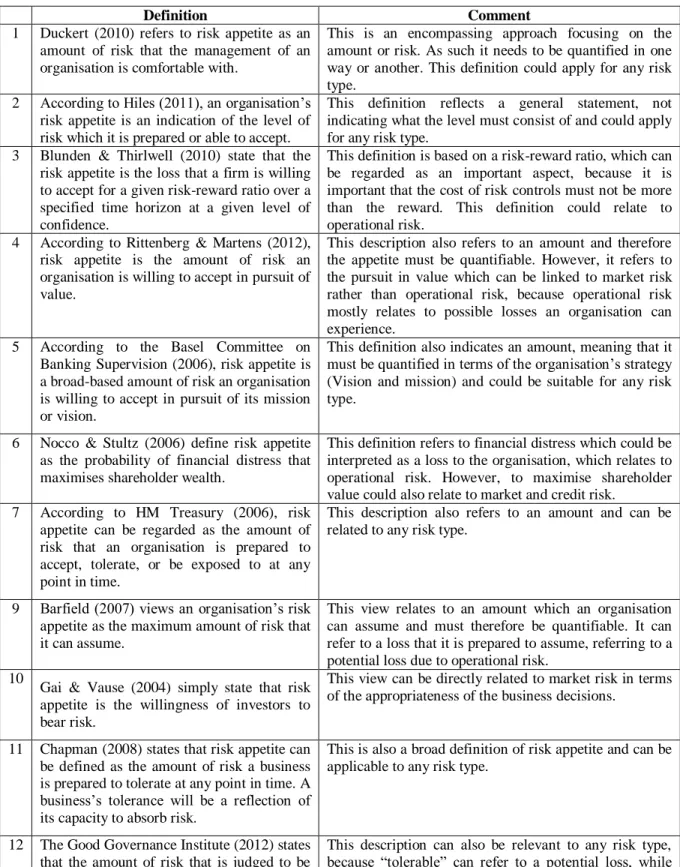
A good starting point to establish an operational risk appetite process is to define it in such a way that it is clear and acceptable to all role-players. However, currently there are a number of definitions, which could cause some confusion, especially where a unified risk appetite is defined for various risk types such as market risk, credit risk and operational risk. If one should consider some of these definitions, it becomes clear that there are different definitions aimed at different risk types. For example, a report by the Deutsche Bundesbank (2005) defines risk appetite as the willingness of investors to bear risks. This definition is clearly related to a bank and its market risk. Additional views and definitions for risk appetite and the possible link to a primary risk type are reflected in Table 1:
Table 1. Definitions of risk appetite
Definition Comment
1 Duckert (2010) refers to risk appetite as an amount of risk that the management of an organisation is comfortable with.
This is an encompassing approach focusing on the amount or risk. As such it needs to be quantified in one way or another. This definition could apply for any risk type.
2 According to Hiles (2011), an organisation‟s risk appetite is an indication of the level of risk which it is prepared or able to accept.
This definition reflects a general statement, not indicating what the level must consist of and could apply for any risk type.
3 Blunden & Thirlwell (2010) state that the risk appetite is the loss that a firm is willing to accept for a given risk-reward ratio over a specified time horizon at a given level of confidence.
This definition is based on a risk-reward ratio, which can be regarded as an important aspect, because it is important that the cost of risk controls must not be more than the reward. This definition could relate to operational risk.
4 According to Rittenberg & Martens (2012), risk appetite is the amount of risk an organisation is willing to accept in pursuit of value.
This description also refers to an amount and therefore the appetite must be quantifiable. However, it refers to the pursuit in value which can be linked to market risk rather than operational risk, because operational risk mostly relates to possible losses an organisation can experience.
5 According to the Basel Committee on Banking Supervision (2006), risk appetite is a broad-based amount of risk an organisation is willing to accept in pursuit of its mission or vision.
This definition also indicates an amount, meaning that it must be quantified in terms of the organisation‟s strategy (Vision and mission) and could be suitable for any risk type.
6 Nocco & Stultz (2006) define risk appetite as the probability of financial distress that maximises shareholder wealth.
This definition refers to financial distress which could be interpreted as a loss to the organisation, which relates to operational risk. However, to maximise shareholder value could also relate to market and credit risk.
7 According to HM Treasury (2006), risk appetite can be regarded as the amount of risk that an organisation is prepared to accept, tolerate, or be exposed to at any point in time.
This description also refers to an amount and can be related to any risk type.
9 Barfield (2007) views an organisation‟s risk appetite as the maximum amount of risk that it can assume.
This view relates to an amount which an organisation can assume and must therefore be quantifiable. It can refer to a loss that it is prepared to assume, referring to a potential loss due to operational risk.
10
Gai & Vause (2004) simply state that risk appetite is the willingness of investors to bear risk.
This view can be directly related to market risk in terms of the appropriateness of the business decisions.
11 Chapman (2008) states that risk appetite can be defined as the amount of risk a business is prepared to tolerate at any point in time. A business‟s tolerance will be a reflection of its capacity to absorb risk.
This is also a broad definition of risk appetite and can be applicable to any risk type.
12 The Good Governance Institute (2012) states that the amount of risk that is judged to be tolerable and justifiable is the risk appetite.
This description can also be relevant to any risk type, because “tolerable” can refer to a potential loss, while “justifiable” can refer to market or credit risk.
From the above definitions and views, it can be deduced that a definition for risk appetite can be generalised to suit all risk types or it can be applicable to a specific risk type. However, Carey (2005) states that risk appetite is a term that is frequently used throughout the risk management
community, but it seems that there is a lack of useful information on its application outside of financial risk areas or other risks that can easily be translated into financial terms. In order to address the lack of information, it might be useful to have a definition and understanding of risk appetite for
each major risk type faced by an organisation. According to the Institute of Operational Risk (2012), expressing operational risk appetite is a question of defining what is acceptable and unacceptable to an organisation for each risk type. By determining the parameters for each risk type, it can be decided what is a tolerable threshold.
Based on the abovementioned definitions it is clear that a definition for risk appetite should include a quantification factor in order to determine the “amount” of risk. From an operational risk perspective, the risk exposures can, for example, be quantified by means of the value of losses that occurred in the past. Therefore, when considering a definition for operational risk appetite, the ”amount” can be related to the losses experienced by the organisation. However, there are also other methods to quantify the operational risks, for example by using rating scales and Key Risk Indicators, which will be addressed later in this article.
A further conclusion based on the above descriptions, relates to the strategic business objectives at a specific “point in time”. It seems imperative that an operational risk appetite definition should incorporate a reference to the business strategy (vision, mission and objectives) in order to prevent it from becoming an independent concept removed from the actual business. Chapman (2008), for example, confirms the previous conclusion by stating that a risk appetite is the degree of risk that a business is prepared to accept in pursuit of its objectives. An organisation‟s business strategy and strategic objectives can change and it is therefore important that the risk appetite must be adapted accordingly. Therefore, it seems necessary to include a time factor in a definition in order to ensure that the risk appetite is adapted according to the business strategy and or a changing business environment.
Another concept seems to be what is tolerable for the organisation. This can be interpreted as tolerable in terms of risk-reward or financial losses. In terms of operational risk management, the risk appetite should ensure that the costs of controls to mitigate the risks should not exceed the benefits it can generate. In agreement with this statement, the Institute of Operational Risk (2012) states that “…operational risk is more likely to be mitigated downwards as long as the cost of mitigation does not exceed the expected loss”. Furthermore, it must indicate the potential financial losses that an organisation must be able to tolerate after mitigating control measures. Therefore, it seems there are, at a minimum, four concepts that should be included in a definition for operational risk appetite, namely, amount, tolerance, time-factor and business objectives. Therefore a definition for operational risk appetite could be:
The amount of risk an organisation is prepared to tolerate at a given point in time in terms of losses in pursuit of business objectives.
Although this definition can be regarded as yet another view, what is imperative is that every organisation must define its own definition of operational risk appetite and ensure that it is known throughout the organisation.
Similar to the approach to embed operational risk, after defining it, the next step to establish an operational risk appetite process, can be to determine the various methodologies to assist with the management thereof. Because operational risk appetite is an integral part of an operational risk management process, the methodologies should be the same. Adding to this view the Institution of Operational Risk (2012) states that the risk and control self-assessments; internal loss event reporting; and scenario analysis provides a clear indication of proportional response to the perceived materiality of the associated risks. Therefore, the methodologies mentioned earlier should be applied for setting the operational risk appetite. The contribution of each methodology can be described as follows:
• Loss history. According to Young (2014), the analysis of losses can provide information from trend analysis, which can serve as a basis for the implementation or upgrading of risk control measures. According to the Committee of Sponsoring Organisations (COSO) (2004), quantitative techniques are dependent on the quality of the supporting data and assumptions. These are most relevant for exposures that have a known history and frequency of variability, and which allow reliable forecasting. In addition, the loss data indicates the value of loss incidents which happened in the past during the implementation of business strategies and can be used to quantify the risk exposure and therefore determine the “amount” of risk for the organisation when determining the operational risk appetite.
• Key Risk Indicators (KRIs). According to Hoffman (2002), operational risks will not be effectively identified without first identifying the key risk indicators of operational risk. By managing specific KRIs during the efforts to achieve the business objectives, it identifies the primary residual risks which could influence the achievement of business objectives. One of the criteria of managing a KRI is to determine a threshold. According to Young (2010), a tolerance threshold must be determined by management and must only change according to changing circumstances. Carey (2005) states that a threshold becomes an actual manifestation of the risk appetite as risk management becomes more strictly aligned with management and the organisation‟s desire to accept certain levels of risk. It is clear that the KRIs can be used in determining an acceptable risk
appetite especially as far as the setting of the “tolerable” thresholds for the risks is concerned.
• Risk and control self-assessments (RCSAs). According to Young (2014), risk and control self-assessments are internally driven analysis of risks, controls and their implementation, with the objective of determining a common understanding of the strengths and weaknesses of the operational risk environment. A typical process involved during RCSAs is to identify the inherent operational risks, rating these risks and assessing it against control measures. The final result is the rated residual risks that must be managed. The methodology includes the use of rating scales to determine the likelihood and impact of the risks. For example the likelihood scale could be as follows:
o Level 1: Low probability of occurring o Level 2: Medium
o Level 3: High probability of occurring The impact rating scale can be linked to a value, for example:
o Level 1: Low impact (< x Financial value) o Level 2: Medium impact (Between x and y Financial values)
o Level 3: High impact (> z Financial value) These scales can also be used to determine the operational risk appetite especially concerning potential future risks.
• Scenarios. Scenarios can also be used in addition to RCSAs to identify potential risks to be considered during the formulating of the business strategies and objectives.
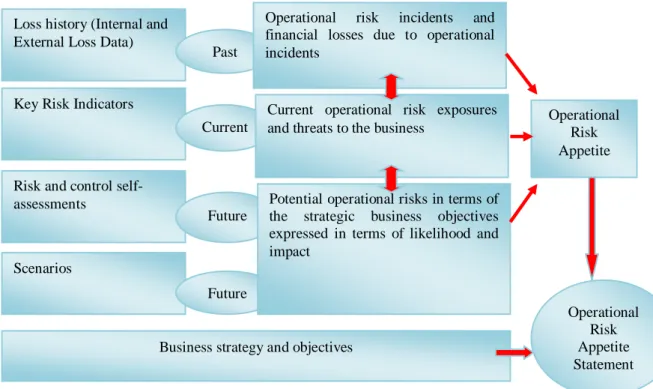
The selection of the appropriate risk measurement methodology should be made based on the nature of the business and the seriousness of the potential influence of operational risks. This would indicate the depth of the data required to consider in determining the risk appetite. Figure 1 illustrates how these methodologies can be integrated to provide input to set an operational risk appetite statement.
Figure 1. Integrated methodologies to determine operational risk appetite
(Author’s conceptualisation)
According to a study undertaken by Marsh and the University of Nottingham (2009), risk appetite plays a key role in supporting an organisation‟s strategy and achieving of business objectives. As such, it is clear that once the business strategy and objectives are set that the risk appetite can be determined by using the said methodologies. A question that arises is at what stage must the risk appetite be determined, before
the finalisation of the business strategy or afterwards? Seeing that that the operational risk appetite often relates to the downside of business (losses and or what can go wrong), it should be set at the same time and therefore part of the strategic planning process. The primary reason could be seen that the risk appetite will add value during the implementation of the strategy by providing continued risk guidelines for decision-making and Loss history (Internal and
External Loss Data)
Risk and control self-assessments
Key Risk Indicators
Scenarios
Past
Current
Future
Future
Operational risk incidents and financial losses due to operational incidents
Current operational risk exposures and threats to the business
Potential operational risks in terms of the strategic business objectives expressed in terms of likelihood and impact
Operational Risk Appetite
Business strategy and objectives
Operational Risk Appetite Statement
ensuring that threats and potential threats are proactively dealt with by means of control measures. A risk appetite can, therefore, provide guidance on the limits of the risks threatening the successful achievement of strategic objectives. According to Wikipedia (2013a), by defining its risk appetite, an organisation can arrive at an appropriate balance between uncontrolled innovation and excessive caution. It can provide guidance on the level of risk permitted and encourage consistency of the approach across an organisation. Defined acceptable levels of risk also means that resources are not spent on further reducing risks that are already at an acceptable level.
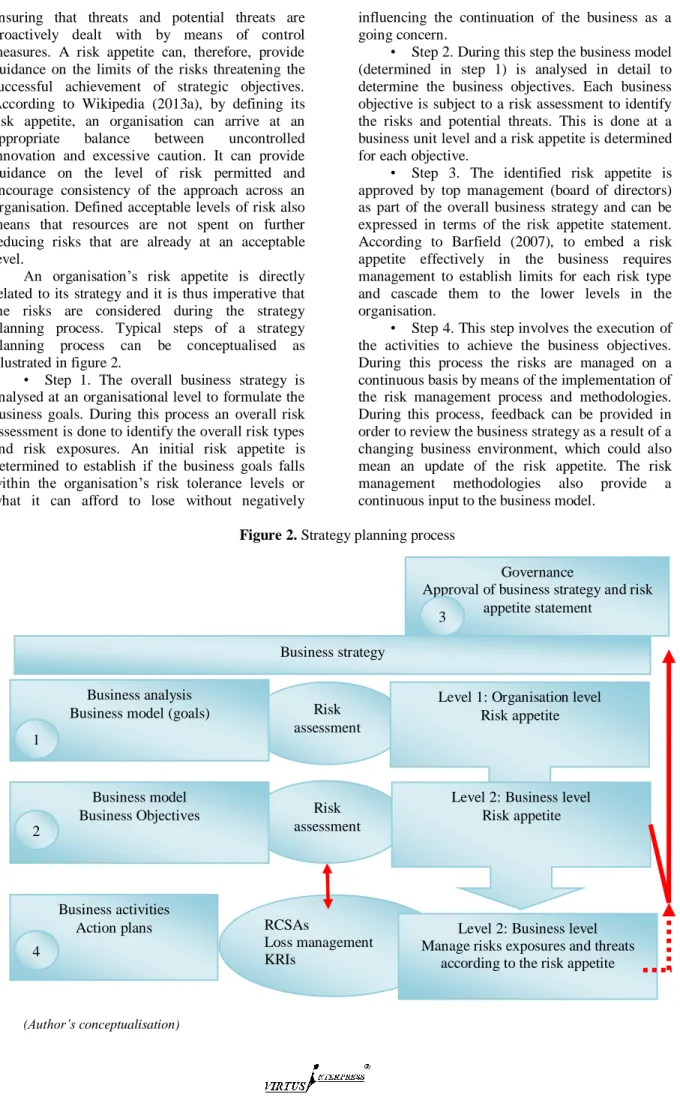
An organisation‟s risk appetite is directly related to its strategy and it is thus imperative that the risks are considered during the strategy planning process. Typical steps of a strategy planning process can be conceptualised as illustrated in figure 2.
• Step 1. The overall business strategy is analysed at an organisational level to formulate the business goals. During this process an overall risk assessment is done to identify the overall risk types and risk exposures. An initial risk appetite is determined to establish if the business goals falls within the organisation‟s risk tolerance levels or what it can afford to lose without negatively
influencing the continuation of the business as a going concern.
• Step 2. During this step the business model (determined in step 1) is analysed in detail to determine the business objectives. Each business objective is subject to a risk assessment to identify the risks and potential threats. This is done at a business unit level and a risk appetite is determined for each objective.
• Step 3. The identified risk appetite is approved by top management (board of directors) as part of the overall business strategy and can be expressed in terms of the risk appetite statement. According to Barfield (2007), to embed a risk appetite effectively in the business requires management to establish limits for each risk type and cascade them to the lower levels in the organisation.
• Step 4. This step involves the execution of the activities to achieve the business objectives. During this process the risks are managed on a continuous basis by means of the implementation of the risk management process and methodologies. During this process, feedback can be provided in order to review the business strategy as a result of a changing business environment, which could also mean an update of the risk appetite. The risk management methodologies also provide a continuous input to the business model.
Figure 2. Strategy planning process
(Author’s conceptualisation) RCSAs Loss management KRIs Risk assessment Risk assessment Business analysis
Business model (goals)
Level 1: Organisation level Risk appetite Business model Business Objectives Business activities Action plans Business strategy
Level 2: Business level Risk appetite
Governance
Approval of business strategy and risk appetite statement
Level 2: Business level Manage risks exposures and threats
according to the risk appetite 1
2
4
It is clear that determining a risk appetite is an integral part of a strategy planning process. This view is supported by COSO (2004) whereby it is stated that risk appetite is directly related to an organisation‟s strategy. However, it is also clear that the risk appetite is a dynamic process that must also be updated in accordance with any changes in the business strategy. The next section deals with the way the risk appetite can be expressed in terms of a risk appetite statement.
4. Risk appetite statement
An organisation can express its risk appetite in the form of a risk appetite statement. According to Wikipedia (September 2013b), the results of the risk appetite process should be documented in a risk appetite statement, covering each risk category. Such a statement will ensure that managers can perform their business responsibilities with sufficient guidance within the allowed levels/boundaries of risk. According to Protiviti (2011), a risk appetite statement establishes a common understanding between executive management and the board of directors regarding desirable risks underlying the execution of the organisation‟s strategy. The Good Governance Institute (2012) states that if an organisation does not have a risk appetite statement, it will face control problems and managers will be running their business with insufficient guidance on the levels of risk that they are permitted to take. The Institute of Operational Risk (2012) also cited the British Standard by stating: “The organisation should prepare a risk appetite statement, which may provide direction and boundaries on the risk that can be accepted at various levels of the organisation, how the risk and any associated reward are to be balanced and the likely response”. It was mentioned earlier that it is important to set a risk appetite for each risk type. For operational risk, the appetite statement would concentrate on the downside of risks rather than business opportunities.
Barfield (2007) states that establishing a clear risk appetite statement has important consequences in terms of management information and performance management requirements. As such, it is important that the risk information generated by loss incidents, risk and control self-assessments and key risk indicators are accurately reported and escalated to the right levels of management to use as input to monitor the risks. The business risks must be monitored in order to ensure that the business actions remain within the boundaries of the approved risk appetite.
The manner that the risk appetite is expressed is therefore imperative and the limits of the risk that
can be taken must be clear. As such, the risk appetite must be expressed in the same terms as those used in assessing the risk (HM Treasury 2006). Therefore, the operational risk appetite statement should be expressed in terms of the methodologies (Losses, KRIs and RCSAs). Because operational risk mostly relates to the downside of risk, the risk appetite statement should indicate the amount of the potential losses that the organisation is prepared to tolerate while pursuing the business objectives. Although the aim is not to incur any losses and therefore any organisation should have a zero-tolerance for operational risk, the reality proved that risk events and losses do occur in the pursuing of business objectives. Therefore, an organisation must be realistic when expressing its operational risk appetite and be prepared for these losses. As such, the operational risk appetite statement can be expressed in terms of the following:
• Qualitative statements. Due to the challenge in quantifying operational risks this is a popular way of expressing an organisation‟s operational risk appetite. According to Marsh (2009), qualitative statements can be useful and assist to fill the gaps of an organisation‟s appetite for risk by expressing certain attitudes, for example to avoid regulatory sanctions or reputational damage. Another advantage of these statements is that it can be easily communicated across the organisation and can be integrated, for example, into an organisation‟s policies and ethical value statements. A typical example of such a statement is:
Company X has zero-tolerance for: o Unethical business practices o Reputational risk
o Non-compliance to regulations
Although a company has a zero-tolerance towards these type of actions, it does not mean that it will not occur. It is therefore imperative that corrective and disciplinary actions should be incorporated into the related policies.
• Quantitative statements. These risk appetite statements are linked to some form of measure such as value, percentage or volume.
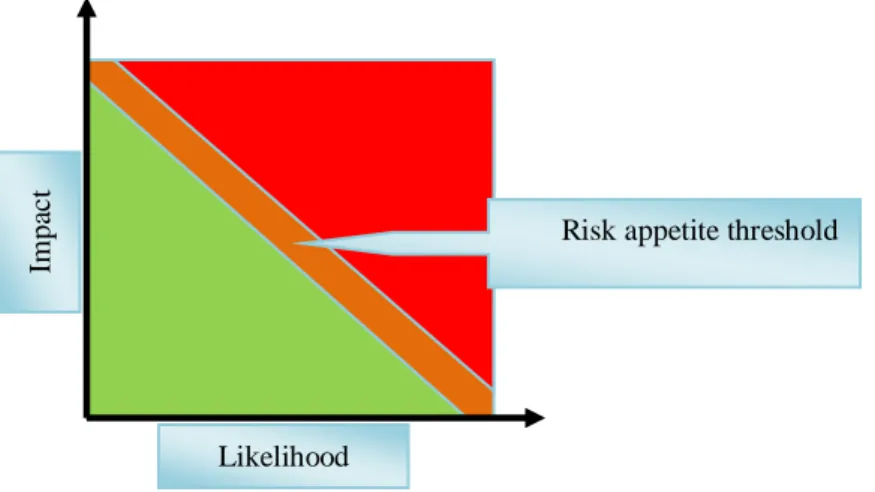
o Operational risk appetite statement based on risk and control self-assessments. Based on the RCSA methodology, an operational risk appetite statement can include a matrix (Figure 3), which includes the impact and likelihood scales and a risk appetite threshold.
Figure 3. Operational risk appetite matrix
According to Marsh (2009) this approach makes it easy to communicate throughout the organisation, because it is based on the already existing RCSA methodology and approved rating scales of the impact and likelihood of risk events.
o Operational risk appetite statement based on key risk indicators. Another operational risk appetite statement can be based on the Key Risk Indicator process. This approach is based on setting thresholds for a number of key risks. These thresholds will serve as an indication (early warning) when an approved threshold is breached.
According to the Institute of Operational Risk (2010a), the concept of a threshold is to establish boundaries that, when exceeded, alert the organisation to a potentially significant change in risk exposure. This approach is also acceptable and widely used throughout the organisation. It is, however, important that the KRI must be clearly defined and that a threshold is approved by top management. A typical example is illustrated in figure 4 below.
Figure 4. Operational appetite based on key risk indicators
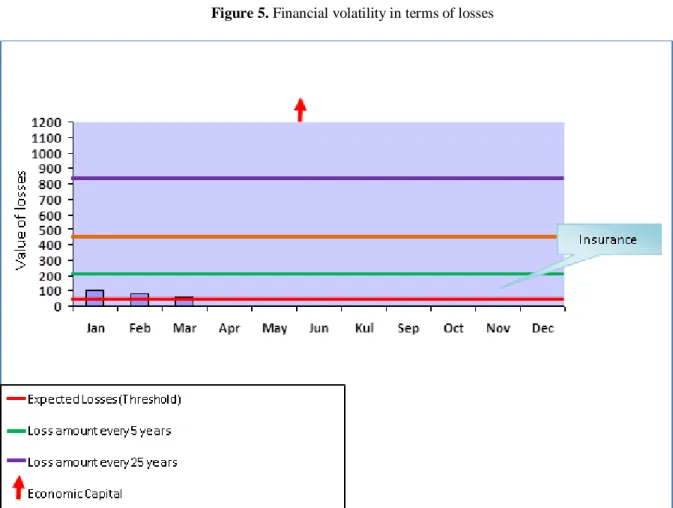
o Operational risk appetite statement based on financial volatility. Operational losses are inevitable during the pursuing of business objectives. Therefore, most organisations take out insurance to cover losses that breach a certain amount. Due to the unexpected nature of operational incidents and consequent losses, some organisations allocate an economic capital for these catastrophic-type losses to ensure that the organisation can absorb these losses and continue should such an event occur. In the banking industry
this capital charge is determined by the central banks in the form of regulatory capital, based on the New Basel Accord. The fundamental objective of this Accord is to develop a framework that would strengthen the soundness and stability of the international banking system while maintaining sufficient consistence that capital adequacy regulation will not be a significant source of competitive inequality among internationally active banks (Basel 2004). Im pa c t Likelihood
Depending on the business environment, the organisation should determine the financial volatility in terms of potential losses as well as the capital allocation for operational risk. The financial volatility can be expressed as follows:
Expected loss Value
Loss incident every 5 years = Loss value Loss incident every 25 years = Loss value Economic Capital = Value.
This can be illustrated graphically in Figure 5 below.
Figure 5. Financial volatility in terms of losses
The Economic Capital is determined by a separate process based on given formulas and should cover the unexpected catastrophic loss which could cause the downfall of the organisation. The organisation can decide on an insurance threshold, normally covering losses above the expected and tolerable loss level.
It is clear that thresholds play a crucial role in the setting of a risk appetite statement and it is therefore imperative that top management is involved in the process.
5. Responsibilities of top management According to the Association of Insurance and Risk Managers (2010), it is important that the board sets rules for risk-taking in respect of all types of risk and at a board level, risk appetite is seen as a driver of strategic risk decisions. As such, it is clear that the setting of a risk appetite statement is an integral part of the business strategy planning process. It can thus be concluded that top management plays a crucial role in the process of setting an operational
risk appetite statement for the organisation. According to Mongiardino and Geny (2007), a clear description of the role of the board of directors and its committees in setting the risk appetite for the organisation is required, which implies that top management should play an active role in this regard. According to COSO (2004), the board should be aware of the organisation‟s risk appetite, concur with it and review the organisation‟s portfolio view of risk and consider it against the risk appetite. According to the Institute of Operational Risk (2012), sound governance requires that the operational risk appetite must be owned by the board of directors and established with their full engagement. Therefore, it seems that the process of establishing a risk appetite starts with the board, indicating that it is initiated by a top-down approach. However, the use of the methodologies for operational risk management is based on a bottom-up approach because the risks must be managed at the closest level to the actual exposure. Therefore, the risk information that can be used to set a realistic operational risk appetite
should be received by means of a bottom-up reporting process. On the other hand, it can be deduced that the top-down approach can be viewed as embedding a culture of risk management, which includes the setting of a risk appetite statement. The board should therefore be responsible for embedding the risk management culture and specifying the process to set a risk appetite statement. This can be achieved by including the process and roles and responsibilities in a risk management policy. It is, furthermore, imperative that the board approves the applicable thresholds involved in the operational risk appetite statement, mainly because the ultimate responsibility for the approval of the risk appetite lies with the board. In support of this statement, the Institute of Operational Risk (2012) states that a benefit of the operational risk appetite is to enable the board to exercise appropriate oversight and corporate governance by defining the nature and level of risks it considers acceptable and setting boundaries (thresholds) for business activities. It is however, important to note the dynamic nature of the business environment, which could cause a change in strategy and by implication also an adaption of the risk appetite statement and the approved thresholds.
The aligning of the risk appetite with the business strategy is an important part of setting the operational risk appetite, and therefore, important that it is driven by top management. According to COSO (2004), the board must be aware and concur with the organisation‟s risk appetite. The role and responsibility of top management regarding the setting of a realistic operational risk appetite can be summarised as follows:
• Embedding of a risk management culture in the organisation, which should include the process of formulating a risk appetite statement for each primary risk type such as operational risk, credit risk and market risk.
• Approval and communication of a risk management policy, indicating the roles and responsibilities at all management levels to determine an operational risk appetite statement. According to the Institute of Operational Risk (2010b), the board must approve the policies developed by senior management and set the risk appetites for the various operational risks.
• Ensuring that risks are managed according to the risk management framework and that accurate and reliable information is reported to the various management levels during the strategy planning process and the execution of activities to achieve the business objectives.
• Approval of the qualitative and quantitative operational risk appetite statements, including the thresholds.
• Monitoring the progress towards the achievement of business objectives within the tolerance levels set by the approved risk appetite.
• Approval of requests to change the approved thresholds and statements aligned with changing business strategy and objectives.
Although this list could be analysed into more specific responsibilities towards the setting of an operational risk appetite statement, it could be used as a guideline when an organisation considers the development and implementation of a risk appetite process.
6. Guiding criteria
Based on the abovementioned literature review, it is possible to determine a non-exhaustive list of criteria that could assist and support the development and or evaluating of an organisation‟s operational risk appetite process. A summary of these criteria is as follows:
• The process of formulating an operational risk appetite statement should be part of an organisation‟s risk management process.
• The process of setting a risk appetite statement should be incorporated into a formal policy of the organisation and approved by the board of directors.
• A formal and communicated definition of an operational risk appetite should be established for the organisation.
• The operational risk management tools (RCSA, KRIs, Loss History and Scenarios) should be used as an input to formulate the operational risk appetite.
• The risk appetite statement should form an integral part of the strategy planning process of the organisation at various management levels.
• There should be a separate risk appetite statement for each main risk type for the organisation (For example: operational risk, credit risk and market risk).
• The operational risk appetite process should be a combination of a top-down and bottom-up approaches. The bottom-bottom-up approach should include the supplying of relevant information (based on the risk management methodologies) and specific risks at the various business levels. The top-down approach should include the approved risk appetite statements for each risk type, based on the approved business strategies.
• The operational risk appetite statement should include qualitative and quantitative statements which consist of the approved thresholds (boundaries and tolerance-levels).
• The operational risk appetite statement should be communicated to all levels of the organisation.
• Changes to the thresholds should be approved by top management based on the changing business environment and strategies.
In order to substantiate the arguments of this article, a brief survey was undertaken to confirm the current status as well as the criteria which can assist during a practical approach to formulate an operational risk appetite statement.
7. Research methodology
In order to determine the current status of the use of an operational risk appetite statement as part of a risk management process, it was decided to use the South African banking industry as the target population for a survey. A reason for using banks in South Africa is based on the fact that the banking industry can be regarded as one of the leading industries when it comes to risk management due to the regulatory requirements enforced by the South African Reserve Bank, which are mostly based on the guidelines by the Basel Committee on Banking Supervision. The data was collated by means of a closed questionnaire which was distributed electronically as well as physically to various role-players in the industry. The target population was identified across a variety of roles within the bank; for example, members of the board of directors (top management), risk managers, business managers, compliance officers and financial managers. The main reason for distributing the questionnaire to the aforementioned was that these positions can be regarded as the main role-players during the
organisation‟s strategy and risk management processes.
The aim of the questionnaire was, firstly, to determine the current status of operational risk management as a specific management discipline as well as the status of formulating a risk appetite. Secondly, it aims to rate the criteria for a practical approach to formulate an operational risk appetite statement and confirm the role and responsibilities of top management.
The questionnaire requested respondents to indicate on a 5-point Likert scale their views and experiences regarding specific questions on the status of the implementation of an operational risk and appetite statement. The response was analysed in terms of descriptive statistics according to the following scale: 1. Do not know 2. To no degree 3. To some degree 4. To a moderate degree 5. To a degree 6. To a full degree 7. Research results
The questionnaires were randomly distributed to various role-players in the banking industry of South Africa. A total of 70 questionnaires were distributed and 29 were returned on the due date which represents a 41.4% response. Figure 6 indicates the positions of the respondents, while Figure 7 indicates the years of experience.
Figure 6. Positions of respondents
Forty-eight per cent of the respondents fall in the top management and business management categories, indicating that most respondents should be familiar with the business of banking and should know the role and responsibilities of top
management. According to the years of experience, 62% of the respondents have more than 10 years‟ experience in banking, indicating a vast experience in this field. 4 10 3 2 10 Top management Business management Risk management Compliance management Other
Figure 7. Years of experience
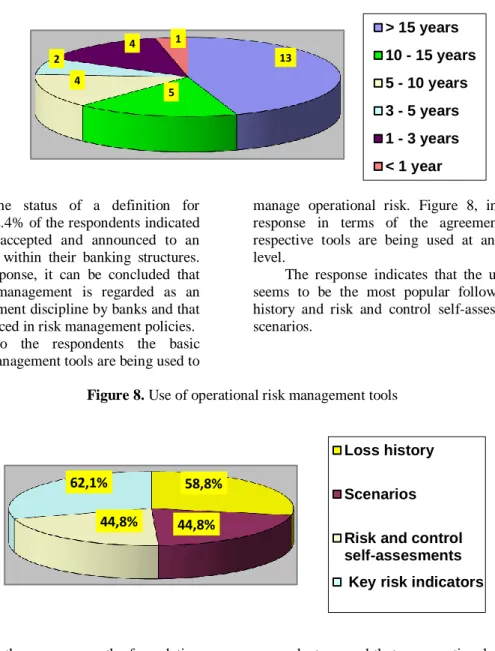
Regarding the status of a definition for
operational risk 72.4% of the respondents indicated that it has been accepted and announced to an acceptable degree within their banking structures. Based on this response, it can be concluded that operational risk management is regarded as an important management discipline by banks and that it has been announced in risk management policies. According to the respondents the basic operational risk management tools are being used to
manage operational risk. Figure 8, indicates the response in terms of the agreement that the respective tools are being used at an acceptable level.
The response indicates that the use of KRIs seems to be the most popular followed by loss history and risk and control self-assessments and scenarios.
Figure 8. Use of operational risk management tools
To determine the response on the formulation of a separate risk appetite for the primary risk types, 72.4% of the respondents agreed that an organisation should formulate a separate risk appetite for different risk types, such as credit, market and operational risk. Subsequently, 62.1% of the respondents agreed to the following definition of an operational risk appetite: “The amount of risk an organisation is prepared to tolerate at a given point in time in terms of losses in pursuit of business objectives”. However, only 17.2% of the respondents fully agreed that a formal definition for operational risk appetite had been formulated. As such, it can be concluded that the defining of operational risk appetite is still at a grassroots level. Similarly, 51.7% of the
respondents agreed that an operational risk appetite should be an integral part of a bank‟s risk management process. However, 24% of the respondents indicated that they either do not know or that the setting of an operational risk appetite should be part of a risk management process to a lesser degree. The main conclusion in this regard is that the setting of a risk appetite should be an integral part of a risk management process, however, it seems that this aspect still needs to be formulated in more understandable terms.
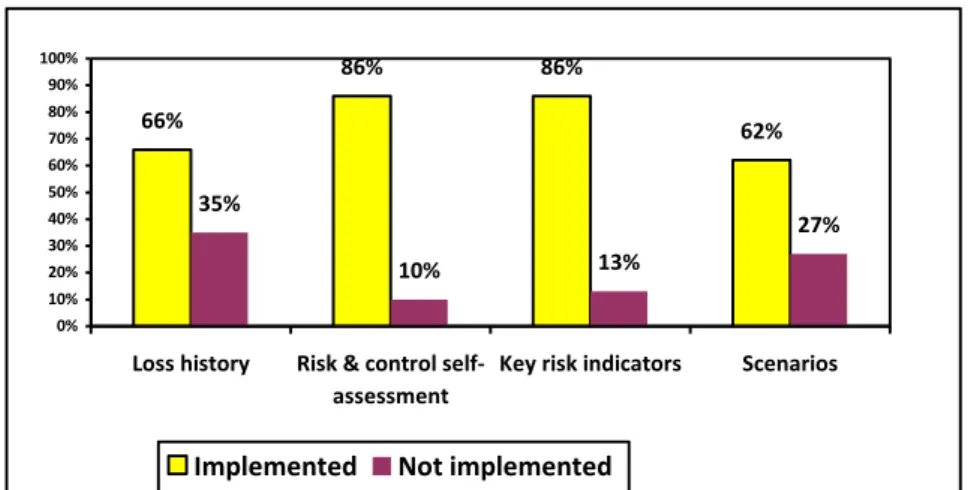
The use of the operational risk management tools is essential in setting a realistic operational risk appetite. This view is supported by most respondents and illustrated in figure 9.
13 5 4 2 4 1 > 15 years 10 - 15 years 5 - 10 years 3 - 5 years 1 - 3 years < 1 year 58,8% 44,8% 44,8% 62,1% Loss history Scenarios
Risk and control self-assesments Key risk indicators
Figure 9. Utilisation of operational risk management tools as an input to determine the operational risk appetite 66% 86% 86% 62% 35% 10% 13% 27% 0% 10% 20% 30% 40% 50% 60% 70% 80% 90% 100%
Loss history Risk & control self-assessment
Key risk indicators Scenarios
Implemented Not implemented
The response indicates that 66% agree that loss history is used to a total degree during a risk management appetite process, while 35% indicated that it is not implemented. Similarly, 86% agreed that risk and control self-assessments and key risk indicators are used to a total degree, while 10% and 13%, respectively, indicated that it is not implemented. Sixty-two per cent indicated that scenarios are used, while 27% indicated that it is used to a lesser degree for a risk appetite management process. As such, it can be deduced that, in general, banks are mostly still in a development phase regarding a process for operational risk appetite and the use of operational risk tools. Similarly, the relative high percentages of the response for not using the loss history and scenarios could indicate that these two risk management tools can still be exploited further to assist in the setting of an operational risk appetite.
Sixty-two per cent of the respondents indicated that a process to formulate an operational risk appetite statement has been included in a risk policy. However, 37.9% did not agree that there is a formal process in place. As such it can be concluded that the development of a formal process
to formulate an operational risk appetite statement should be included in the risk policy, but this still requires some attention.
According to the response, 86.7% of the respondents agreed that the setting of an operational risk appetite statement should be an integral part of a bank‟s strategy planning process, while 51.7% agreed that it is currently the case. As such, it can be concluded that although most respondents agreed that the setting of an operational risk appetite should be part of a bank‟s strategy planning process, it still requires some attention to ensure that the process is formalised.
Risk appetite statements should benefit organisations during specific processes. According to the response, (refer to figure 10), the respondents agreed that an operational risk appetite statement would benefit the following processes:
• The risk management process • The audit management process • The compliance management process • The strategy planning process
• The execution of activities to achieve business objectives
Figure 10. Benefit of risk appetite to processes
58% 48% 65% 72% 69%
0%
20%
40%
60%
80%
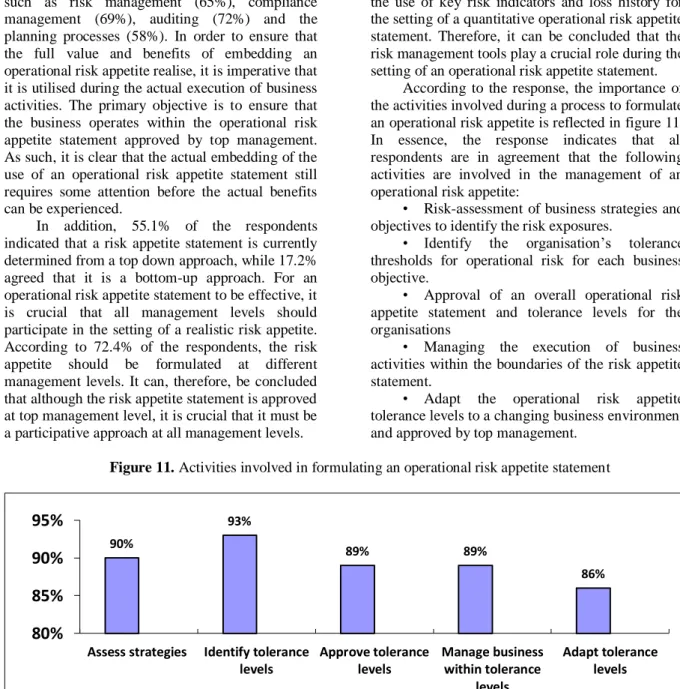
Strategy planning Business execution Risk management Audit ComplianceFrom the abovementioned response, it can de concluded that although most respondents agreed that an operational risk appetite statement would benefit the mentioned processes, it is clear that currently the benefits are not yet embedded into the actual operations of the business. On the other hand, only 48% agreed that the operational risk appetite process would benefit the business processes. It seems that the risk appetite is currently more applicable to the advisory functions such as risk management (65%), compliance management (69%), auditing (72%) and the planning processes (58%). In order to ensure that the full value and benefits of embedding an operational risk appetite realise, it is imperative that it is utilised during the actual execution of business activities. The primary objective is to ensure that the business operates within the operational risk appetite statement approved by top management. As such, it is clear that the actual embedding of the use of an operational risk appetite statement still requires some attention before the actual benefits can be experienced.
In addition, 55.1% of the respondents indicated that a risk appetite statement is currently determined from a top down approach, while 17.2% agreed that it is a bottom-up approach. For an operational risk appetite statement to be effective, it is crucial that all management levels should participate in the setting of a realistic risk appetite. According to 72.4% of the respondents, the risk appetite should be formulated at different management levels. It can, therefore, be concluded that although the risk appetite statement is approved at top management level, it is crucial that it must be a participative approach at all management levels.
Regarding the qualitative and quantitative approaches to an operational risk appetite statement, 89.7% of the respondents fully agreed that it should be a qualitative statement and 82.7% agreed that it should be a quantitative statement. According to the response, it is clear that an operational risk appetite statement should be qualitative and quantitative in nature. At the same time, 48.2% of the respondents fully agreed to the use of risk and control self-assessments, 79.3% to the use of key risk indicators and loss history for the setting of a quantitative operational risk appetite statement. Therefore, it can be concluded that the risk management tools play a crucial role during the setting of an operational risk appetite statement.
According to the response, the importance of the activities involved during a process to formulate an operational risk appetite is reflected in figure 11. In essence, the response indicates that all respondents are in agreement that the following activities are involved in the management of an operational risk appetite:
• Risk-assessment of business strategies and objectives to identify the risk exposures.
• Identify the organisation‟s tolerance thresholds for operational risk for each business objective.
• Approval of an overall operational risk appetite statement and tolerance levels for the organisations
• Managing the execution of business activities within the boundaries of the risk appetite statement.
• Adapt the operational risk appetite tolerance levels to a changing business environment and approved by top management.
Figure 11. Activities involved in formulating an operational risk appetite statement
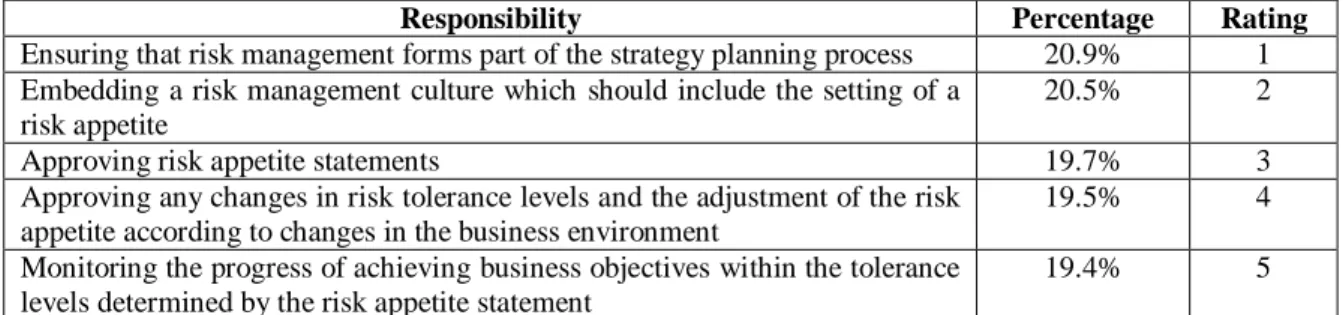
Table 2 provides the response on the importance of the responsibilities of top management towards an operational risk
management appetite process rated in priority order. 90% 93% 89% 89% 86%
80%
85%
90%
95%
Assess strategies Identify tolerance levels Approve tolerance levels Manage business within tolerance levels Adapt tolerance levels
Table 2. Priority rating of the responsibilities of top management regarding an operational risk appetite
Responsibility Percentage Rating
Ensuring that risk management forms part of the strategy planning process 20.9% 1 Embedding a risk management culture which should include the setting of a
risk appetite
20.5% 2
Approving risk appetite statements 19.7% 3
Approving any changes in risk tolerance levels and the adjustment of the risk appetite according to changes in the business environment
19.5% 4
Monitoring the progress of achieving business objectives within the tolerance levels determined by the risk appetite statement
19.4% 5
The most important responsibility of top management regarding the setting of an operational risk appetite was rated (20.8%) as the ensuring that risk management forms part of the strategy planning process. This rating emphasises the principle that risk management should form an integral part of an organisation‟s strategy planning process and can also be regarded as the first important step in formulating a realistic risk appetite. While the lowest priority was rated at 19.4%, there is no activity that was not rated and the rating is almost evenly spread across the five main responsibilities. It can, therefore, be deduced that the respondents fully agreed with the important role and responsibilities of top management to participate in the setting, approval and management of an operational risk appetite process.
Conclusions
This study provided some insights into the establishing an operational risk appetite process and the formulation of an operational risk appetite
statement. It is evident that operational risk management is an independent risk management discipline within a banking environment; although there are still management issues to be refined such as the setting of an operational risk appetite. Currently, various views and theories exist regarding an actual definition and the strategic fit of an operational risk appetite. Therefore, based on various views and definitions, this article formulated a definition for operational risk appetite as: the amount of risk an organisation is prepared to tolerate at a given point in time in terms of losses in pursuit of business objectives. This can also be regarded as a starting point in developing an operational risk appetite statement.
The primary conclusions drawn from the empirical research can be summarised into a checklist that could also serve as a guideline to evaluate the development, implementation and management of an operational risk appetite process (Refer to Table 3).
Table 3. Checklist to evaluate the implementation of operational risk appetite
# Guiding criteria
1 Each primary risk type should have a separate risk appetite
2 An organisation should adopt a common definition for operational risk appetite
3 The accepted definition and process to formulate an operational risk appetite should be included in a formal risk policy
4 The primary operational risk tools should be used to provide data to top management as an input to set the operational risk appetite:
Loss history
Risk and control self-assessments
Key risk indicators
Scenarios
5 Setting of an operational risk appetite should be an integral part of the organisation‟s strategy planning process
6 Setting an operational risk appetite should be a combination of a top-down and bottom-up approach, involving all management levels of the organisation.
7 The organisation‟s operational risk appetite should be formulated in terms of an approved operational risk appetite statement, consisting of:
a qualitative statement; and
a quantitative statement
8 The following activities should be incorporated into an operational risk appetite process:
Determine the organisation‟s tolerance thresholds for operational risks (losses) for each strategic objectives
Approval of an overall operational risk appetite statement for the organisation
Manage the execution of business activities within the boundaries of the risk appetite statement
Adapt the operational risk appetite thresholds to the changing business environment 9 The main responsibilities of top management regarding risk appetite are:
Embedding a risk management culture which should include the setting of a risk appetite
Approving the risk appetite statements
Ensuring that risk management forms an integral part of the strategy planning process
Monitoring the progress of achieving business objectives within the set tolerance levels of the risk appetite statements
Approving of any changes in the tolerance levels of the risk appetite statements The findings of the empirical research,
culminating in the abovementioned checklist, could add value to address the vagueness on the term of operational risk appetite and its practical application. As such, the research question of this article can be answered by the providing of clearer guidelines for understanding the concept and the implementation of an operational risk appetite process.
A risk appetite statement is only a risk management tool and should be regarded as a contributing factor to assist in decision-making during the striving to achieve strategic business objectives. Although the findings of the study are based on the banking industry, it is quite possible that the results might be the same for any other organisation because of the generic nature of the identified concepts related to an operational risk appetite. This possibility could be tested in subsequent research.
It is finally recommended that organisations evaluate the status of implementing an operational risk appetite statement by using the abovementioned checklist. Although the checklist is non-exhaustive, it could surely add value to serve as a guideline to clarify some uncertainties on this topic.
References:
1. Association of Insurance and Risk Managers. 2010. A Structured Approach to Enterprise Risk Management. www.airmic.com (1-18).
2. Barfield, R. 2007. Risk Appetite – How Hungry are You? The Journal: Special Risk Management Edition, PWC, London.
3. Basel Committee on Banking Supervision. 2003. Sound Practices for the Management and Supervision of Operational Risk. Bank for International Settlements.
4. Basel Committee on Banking Supervision. 2004. International Convergence of Capital Measurement and Capital Standards. Bank for International Settlements.
5. Basel Committee on Banking Supervision. 2006. International Convergence of Capital Measurement and Capital Standards: A Revised Framework. Bank for International Settlements.
6. Blunden, T & Thirlwell, J 2010. Mastering Operational Risk: A practical guide to understanding operational risk and how to manage it. 1st edition. Edinburgh: Pearson.
7. Carey, M. 2005. Determining Risk Appetite. ICM
London South West.
http://www.continuitycontrol.com/ feature0170.htm. Accessed 11 March 2009.
8. Chapman, RJ. 2008. Simple tools and techniques for enterprise risk management. John Wiley & Sons Ltd. West Sussex, England.
9. Committee of Sponsoring Organizations (COSO) of the Treadway Commission. 2004. Enterprise Risk Management – Integrated Framework.
10. Deutsche Bundesbank, 2005. Risk appetite in a dynamic financial market environment. A monthly
Report, October 2005 (85 – 97).
https://www.bundesbank. Downloaded on 11 March 2009.
11. Duckert, GH 2010. Practical Enterprise Risk Management: A business process approach. 1st edition. Hoboken: John Wiley & Sons.
12. Gai, P. & Vause, N. 2004. Risk Appetite Concept and Measurement. Financial Stability Review, December, Bank of England, London.
13. Good Governance Institute. GGI Board Briefing: Defining Risk Appetite and Managing Risk by Clinical Commission Groups and NHS Trusts. January 2012. Published by Good Governance Institute. ISBN: 978-1-907610-12-7
14. Hiles, A. 2011. The Definitive Handbook of Business Continuity Management. 3rd edition. West Sussex: John Wiley & Sons, Ltd.
15. HM Treasury. 2006. Managing Your Risk Appetite: A Practitioner‟s Guide. Thinking about Risk Series, November, HM Treasury, London.
16. Hoffman D.G. 2002. Managing operational risk: 20 firm wide best practice strategies. Chicago, USA: Wiley.
17. Institute of Operational Risk. 2009. Operational Risk Sound Practice Guidance. Risk Appetite. December 2009.
18. Institute of Operational Risk. 2010a. Operational Risk Sound Practice Guidance. Key Risk Indicators. November 2010.
19. Institute of Operational Risk. 2010b. Operational Risk Sound Practice Guidance. Operational Risk Governance. September 2010.
20. Institute of Operational Risk. 2012. Operational Risk Sound Practice Guidance. Risk Appetite. October 2012.
21. Jobst, A.A. 2007. The treatment of operational risk under the New Basel framework: Critical Issues. Journal of Banking Regulation Volume 8, 4 (316 – 352) Palgrave Macmillan Ltd, 2007.
22. Marsh Risk Consulting and the University of Nottingham Business School. 2009. Research into definition and application of the concept of risk appetite. AIRMIC. June 2009.
23. Mongiardino, A. and Geny, H. 2007. Financial Services: The Need for More Robust and Transparent Disclosures. GARP Risk Review. A Publication of the Global Association of Risk Professionals. January/February 2007.
24. Nocco, BW. & Stultz, RM. 2006. Enterprise Risk
Management: Theory and Practice
(http://ssrn.com/abstract=921402).
25. Protiviti Risk and Business Consulting. 2011. Board Perspectives: Risk Oversight. A progress report available at www.protiviti.com.
26. Rittenberg L & Martens F 2012. Enterprise Risk Management: Understanding and Communicating Risk Appetite. COSO (Committee of Sponsoring Organisations of the Treadway Commission).
Available at http://www.coso.org/documents/ERM-Understanding%20%20Communicating%20Risk%20 Appetite-WEB_FINAL_r9.pdf Accessed 3 March 2014.
27. Young, J. 2010. Towards developing guiding principles for managing operational risk appetite. Journal: Corporate Ownership and Control. Sumy, Ukraine. Volume 8, Issue 1, fall 2010 (176 – 187). 28. Young, J. 2014. Operational Risk Management. 2nd
Edition. Pretoria. Van Schaik Publishers.
29. Wikipedia (2013a), the free encyclopaedia – Risk
appetite.
http://www.hm-treasury.gov.uk/thinking_about_risk.htm
http://en.wikipedia.org/wiki/Risk_appetite Accessed 27 September 2013.
30. Wikipedia (2014), the free encyclopaedia -
Operational Risk.
http://en.wikipedia.org/wiki/operational_risk Accessed 18 June 2014.
31. Wikipedia (2013b), the free encyclopaedia - Risk appetite.
http://www.protecht.com.au/resources/articles/what-is-risk-appetite. Accessed 27 September 2013.