thesis (PhD), Manchester Metropolitan University.
Downloaded from:
http://e-space.mmu.ac.uk/621125/
Usage rights:
Creative Commons: Attribution-Noncommercial-No
Deriva-tive Works 4.0
Please cite the published version
Student Perceptions on Skills and
Learning Challenges in the Use of
Educational Technology in a
Low-Contact, Blended and Professional
Learning Context: A Grounded Theory
of ‘Improvised Learning’
Paul Catherall
Technology in a Low-Contact, Blended and
Professional Learning Context: A Grounded
Theory of ‘Improvised Learning’
Paul Catherall
A thesis submitted in partial fulfilment of the
requirements of the
Manchester Metropolitan University for the
degree of Doctor of Philosophy
Department of Information and Communications
the Manchester Metropolitan University
i
This research project provides an original contribution to knowledge, comprising a grounded and unified theory of improvisational behaviours via Blended Learning and suggests a new paradigm of self-regulated, improvisational learning for potential application beyond the field of study. The study comprises an original Grounded Theory of ‘Improvised Learning’ demonstrating the most prevalent challenges, strategies and behaviours of students undertaking Higher Education programmes in a campus-based, low-contact teaching environment. The participant group were typically undertaking accredited professional programmes (usually related to a profession such as nursing or accounting). The students engaged in ‘Blended Learning’ i.e. study on-campus
alongside use of learning technologies such as a Virtual Learning Environment (VLE). The research project used Grounded Theory as an holistic methodology to investigate the experience of students in this study context. The main data collection phase consisted of informal individual or group discussions held in classes, open plan Library areas or IT Labs.
Grounded Theory is a sociological methodology designed to formulate a new (Grounded) theory from a ‘substantive area’, i.e. a participant group typically comprising a shared vocational role or activity. Key elements of Grounded Theory include an emphasis on induction-based
conceptualisation of theory from descriptive participant indicators and the continuous comparison of data for the emergence of ‘theoretical categories’ or codes. The ultimate aim of Grounded Theory is to demonstrate how conceptual categories inter-relate within a common theoretical explanation for the behaviour of participants (the ‘core category’).
This grounded study of professional learners identified a number of theoretical models of behaviour for engaging with Blended Learning, including innovative self-led use of Information Technology and collaborative learning. The emergent ‘core category’ - reflecting all dependant codes or variables was defined as ‘Improvised Learning’, explaining conceptually how students employ self-led strategies and skills to engage with disparate systems, environments and resources.
ii
I would like to acknowledge the kind cooperation of the staff and students at the former North East Wales Institute of Higher Education (NEWI) now Glyndŵr University, Wrexham, and in particular to Brian Jones, Dr. Arnaz (Ben) Binsardi, Brian Heath and Dr. John Leung.
I would also like to thank my Director of Studies, Jonathan Wilson for his support, comments and suggestions in developing this research project and the supervisory team: Dr. Sheila French, Prof. Jenny Rowley, Richard Eskins and former supervisory team member, Margaret Kendall. Gyda gyflwyniad arbennig i fy rhieni, fyn ngwraig Sharon Catherall, fy mrawd Gareth Catherall ac i Arthur a Mair Jones ar gyfer pob eu gymorth a galondid yn y gorffennol.
iii
Contents Page
PREFACE………...………...…...1
CHAPTER 1 (a): INTRODUCTORY CONTEXT...3
Part 1: Introductory Statement………...……….………3
Part 2: Structure of the Thesis...………...……….…4
i. Treatment of the Literature...5
Part 3: Historical Background to the Study………...…...6
i. The Shift from Networked Learning Resources to the Virtual University...7
ii. The Expansion of Computing and Internet Lifestyles...8
Part 4: Recent Developments in the Student-Learner Environment……….……...……...10
i. Adoption of the VLE...10
ii. The emergence of TEL (Technology Enhanced Learning)...11
iii. Drivers for Flexible Learning and Vocationalisation of Higher Education...12
iv. The University for Industry...13
v. Lifelong Learning, Flexible Learning and the Information Society...14
vi. Widening Access and Web Usability...15
vii. Emergence of Information and Communications Technology-related Literacies...16
Part 5: Personal Factors that Motivated the Work………...………...…...20
i. Personal Influences during the late 1990s/ early 2000s...20
ii. The development of networked infrastructure in the UK Higher Education Sector...21
iii. Note on ‘Service Level Agreements’ (SLAs)...21
iv. The role of Private Equity...22
v. HEI Landscape and Vocational Learning Trends at Glyndŵr University...23
vi. Expansion of Remote and Overseas Online Learning...26
iv
CHAPTER 1 (b): THE CONTEXT OF LEARNING AND TEACHING USING INTERNET AND
WEB BASED TECHNOLOGIES...30
Part 1: Introductory Statement………...…30
Part 2: The Context of Learning Technologies and Theory...30
i. Note on Contextual Theory and Technologies for the Study, Defining Theory...30
ii. Definitions of Learning via Educational Technology...31
iii. Web Based Learning and Web 2.0...33
iv. The VLE (Virtual Learning Environment) and MLE (Managed Learning Environment).34 v. Blended, Online, Virtual and Distributed Learning...35
vi. Synchronous and Asynchronous Learning...37
vii. Hybridisation of University Platforms...38
viii. Instructional Design - Reusable Learning Objects, Open Educational Resources...38
ix. Self-Regulated/ Managed Learning...43
x. Collaborative Learning, Social Learning and Informal Learning...45
xi. M-Learning (Mobile Learning), Ubiquitous, On-Demand Learning...46
xii. Personalised Learning, MOOCs and Mashups...49
xiii. Constructivist Theory and E-Learning...51
xiv. Behavioural Theories and E-Learning...53
xv. Adaptive Learning...54
xvi. The Role of Industry, Corporatisation and Globalisation in E-Learning...56
xvii. Critical Perspectives on E-Learning...58
xviii. Learning Approaches/Styles for Technology Enhanced Learning...61
Part 3: Recent Trends in Learning Technologies/Student Centred Learning...66
i. Recent Developments for Collaborative Learning Technologies...66
ii. Recent Developments for Mobile Technologies...69
v
vi. Developments for Learning Technologies and Information Literacy...73
vii. Recent Developments for Game/ Gamification Learning Technologies...75
viii. Recent Developments for Peer Facilitated Learning via Learning Technologies...76
ix. Trends toward Open Source Uptake by Institutional Systems...76
x. Internet Control Trends in World Regions...77
xi. Key Reports on Emerging Technologies and Educational Challenges………...….78
Part 4: Concluding Statement...84
CHAPTER 2: THE METHODOLOGY……….………...……86
Part 1: Introductory Statement………...….86
Part 2: Summary of the Grounded Theory Methodology…..………...…..87
i. Note on Grounded Theory Terms...88
Part 3: Grounded Theory Principles………...…90
i. Explanation for Literature Review Contribution in Grounded Theory...100
Part 4: Branches of Grounded Theory and Rationale for the Chosen Methodology…...101
i. Overview of Grounded Theory Types...101
ii. Critiques of Glaser’s Methodology in Context to Traditions of Qualitative Enquiry...107
iii. Rationale for Selection of the Methodology...119
iv. Flow Chart of Grounded Theory Process...121
Part 5: Concluding Statement………...………...…..122
CHAPTER 3: RESEARCH DESIGN………...……...124
Part 1: Introductory Statement………...…..124
Part 2: Development of the Research Proposal………...…...125
i. The Glaser Seminar and Appraisal of the Methodology/ Proposal...132
vi
ii. Ethical Approval Process...139
Part 5: Approaches for Data Coding………...…140
i. Aid Memoire Experiment and Discussions...140
ii. Interview Style and Approach...141
Part 6: Explanation of Interview Memoing Technique vs. Recording………...142
Part 7: Overview of the Practical Research Phases………...…………...…..161
i. Overview of the Research Pilot Study (2007)...161
ii. Overview of the Full Phase Study (2008)...163
Part 8: The Pilot Study: A Theory of Self-Led Multi-Systems Traversing…….…...163
i. Table of Developed (Descriptive) Codes...169
Part 9: Approaches for Full Data Coding/Analysis………..…...…...181
i. Rationale for Re-Analysis of Data, Methodology Appraisal, Assimilation of Pilot...181
Part 10: Selection and Explanation of Tools and Methods……….…...………...190
i. Excel as a Qualitative Data Analysis Tool...191
ii. Use of Excel Tools and Features for Grounded Theory Analysis...192
iii. Explanation of the Workbook and Sorting Structure, Worksheet 1 Memo Data...199
iv. Worksheet 2 Substantive Code (Categories) Creation...203
v. Worksheet 3 - Selective Coding to validate Developing Indicators...205
vi. Worksheet 3a Coding and Selective Coding from the Pilot Interviews...207
vii. Worksheet 4 Early Theoretical Codes (Categories) from Theory Bits/ Insights...209
viii. Worksheet 5 Developed Theoretical Codes (Categories)...211
ix. Worksheet 6 High Level Theoretical Codes (Categories)...213
x. Worksheet 7 Key Theoretical Sensitivity from the Literature...215
xi. Worksheet 9 Core Category...217
xii. Sorting Templates via Microsoft Office Drag and Drop Functionality...218
vii
CHAPTER 4 (a): PRESENTATION OF THE EMERGENT THEORY………...…...…...228
Part 1: Introductory Statement………...…….228
Part 2: Open Coding to Generate Substantive Categories…………..……...……...……...229
i. Categorisation of Memo Indicators for Early Indicators/ Control Terms...229
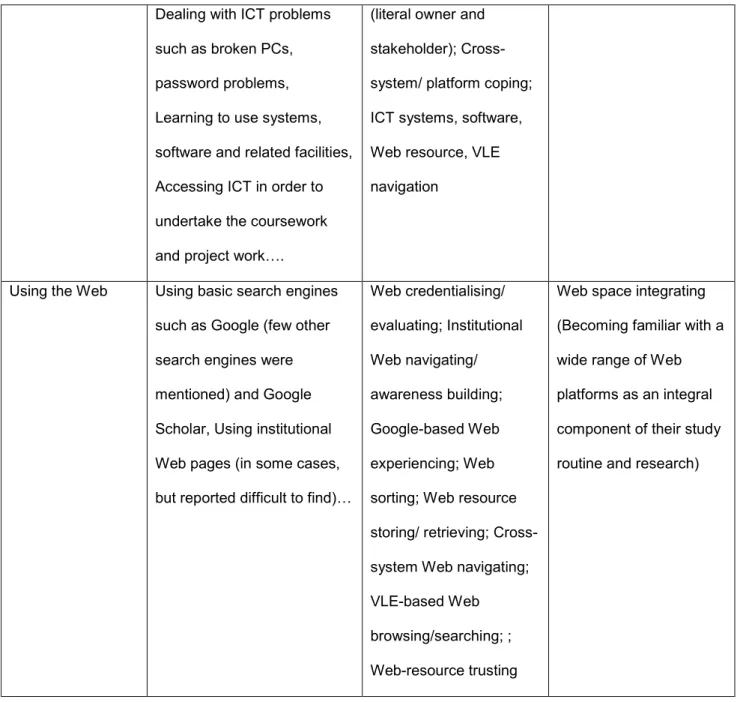
ii. Sample Control Terms....with Properties and Example Memo Comments... 245
iii. Generating the Substantive Codes...251
iv. Pilot Derived Developed Descriptive Codes...252
v. Full Research Phase Derived Developed Descriptive Codes...259
vi. Summary of All Substantive Descriptive Codes...264
vii. Cumulative (Aggregated) Theory Bits/ Insights with Substantive Codes... 273
Part 3: Early Theoretical Codes………...276
i. Emergence of Early Theoretical Codes...276
ii. Summary of all Early Theoretical Codes...279
iii. Theoretical Sensitivity – contributions from the literature to Theoretical Codes...297
Part 4: Developed Theoretical Codes………...………...………300
i. Summary of all Developed Theoretical Codes...301
ii. Emergence of High Level Theoretical Codes...306
iii. Common Properties of the High Level Theoretical Codes...307
Part 5: Visual Structure of the Emergent Theory………...….312
Part 6: Note on Derivation of Theory via Inductive Data Analysis………...…323
Part 7: The Emergent Core Category……….…...…325
Part 8: Concluding Statement………...………...…...……….328
CHAPTER 4 (b): EXPLANATION OF THE THEORY OF IMPROVISED LEARNING……...329
Part 1: Introductory Statement...329
viii
Part 3: Early Theoretical Codes Contributing to the Theory………...…………...343
i. Sample Theory Bit/ Insight from Substantive Codes Contributing to Core Category....344
ii. Summary of Early Theoretical Code Properties Contributing to the Core Category...347
iii. Early Theoretical Codes in Context to Related Insight...348
Part 4: Developed/ High Level Theoretical Codes Contributing to the Theory……...368
i. Summary of Developed Theoretical Code Properties Contributing to Core Category...369
ii. Summary of High Level Theoretical Code Properties Contributing to Core Category..377
Part 5: Summary of Properties of the Core Category ‘Improvised Learning’……..…...381
Part 6: Further Insight Arising from the Core Category ‘Improvised Learning’...386
i. Improvisation via Motivational and Self-Regulated/ Managed, Coping Behaviours...386
ii. Improvisational Behaviours – Supplementing, Adapting, Enhancing, Exploiting...388
iii. Transitional Improvisation Behaviours...390
iv. Longitudinal Strategies for Improvisation...390
v. On-Demand/ Just-In-Time Improvisation...391
vi. Passive and Active Improvisational Behaviours...392
vii. Holistic and Transcendent Characteristics of ‘Improvised Learning’...395
Part 7: Concluding Statement……….……….………...399
CHAPTER 5: DISCUSSION IN RELATION TO THE LITERATURE………...…...400
Part 1: Introductory Statement………..…...………….400
i. Summary of Findings...400
ii. Rationale for Retrospective Review of Literature in Improvisational Theory...401
Part 2: Discussion on Prior Improvisational Theory and Blended Learning Studies...403
i. The Origins and Context of Improvisational Theory...403
ii. Dewey’s Theory of Situated Learning and Improvisation...407
ix
vi. The Role of Improvisation for Organisational Change and Knowledge...419
vii. Discussion in Context to Studies of Blended Learning and ‘Improvised Learning’...423
viii. Discussion on ‘Transitional Physicalisation of Online Learning’...447
ix. Discussion on ‘Self-Regulated Engagement’ and ‘Multi-tasking Commitments’...453
x. Discussion on ‘Network Building/ Engaging’ and ‘Socialisation of Learning’...457
xi. Discussion on ‘Adaptive Virtualisation’ and ‘On-Demand Exploitation/ Improvisation.461 xii. Discussion on ‘Navigating diverse platforms, equipment, locations’...466
xiii. Discussion on ‘Resolving and Negotiating WWW usage issues’...473
xiv. Further Observations on the Literature in Relation to Findings...476
Part 3: Findings in Context to Recent Trends...480
i. ‘Improvised Learning’ in Context to Collaborative Learning Technologies...480
ii. ‘Improvised Learning’ as a Perspective for Mobile/ Personal Learning Technologies..481
iii. ‘Improvised Learning’ as a Perspective for Cloud Based Technologies...481
iv. ‘Improvised Learning’ as a Perspective for Video/Lecture Capture/Flip Classroom....482
v. ‘Improvised Learning’ as a Perspective for Information Literacy...483
vi. ‘Improvised Learning’ as a Perspective for Game-like/ Gamification Learning... 484
vii. ‘Improvised Learning’ as a Perspective for Peer Facilitated Learning...485
viii. Significance of ‘Improvised Learning’ for the Globalisation Context...486
ix. ‘Improvised Learning’ for Insight into Critical Perspectives...487
x. Improvised Learning’ as a Perspective for the Role of Tutors and Mentors...487.
xi. The Role of ‘Improvised Learning’ for Open Educational Resources...488
Part 4: Holistic and Transcendent Characteristics of ‘Improvised Learning’...489
i. The Theory of ‘Improvised Learning’ as a Facet of E-Learning ...489
ii. ‘Improvised Learning’ as a Model for Student Engagement with E-Learning...490
iii. The Role of ‘Improvised Learning’ for Virtual/ Online Learning...490
x
vii. ‘Improvised Learning’ as a Perspective for Active and Transmissive Learning...498
viii. ‘Improvised Learning’ as a Perspective of Adaptive Learning...499
ix. ‘Improvised Learning’ as a Perspective for Longitudinal Insight and Development...500
x. ‘Improvised Learning’ as a Model for Distributed Learning...503
xi. ‘'Improvised Learning’ As a Perspective for Self-Regulated, Hybrid Learning...504
xii. ‘Improvised Learning’ as a Perspective for Instructional Design...505
xiii. ‘Improvised Learning’ as a Perspective for Situated Experiential Learning...506
Part 5: Further Potential Research Suggested by Research Outcomes……...507
Part 6: Concluding Statement………...………...…519
CHAPTER 6: CONCLUSION………...……....…521
Part 1: Introductory Statement………..…...521
Part 2: Summary of the Research Aims………...….521
Part 3: Summary of Research Outcomes...…………...…..522
i. Concise Summary of the Core Category ‘Improvised Learning’...522
ii. Summary of Properties of the Core Category ‘Improvised Learning’...522
iii. Summary of Further Insight Arising from the Core Category ‘Improvised Learning’... 527
iv. Summary of Findings in Context to Prior Theory and Studies...531
v. Summary of Findings in Context to Literature on Improvisation...533
vi. Findings in Context to Recent Trends for Learning Technologies...537
vii. Original Approaches for the Generation of Grounded Theory……….…...…….540
viii. Additional Implications for Research and Practice in the Substantive Area...542
ix. Additional Implications for Research and Practice Beyond the Substantive Area...544
Part 4: Summary of Potential Gaps or Omissions Raised by the Literature...…546
Part 5: Summary of Original Aspects of the Thesis and Contribution to Knowledge...546
xi
xii
Figure Page
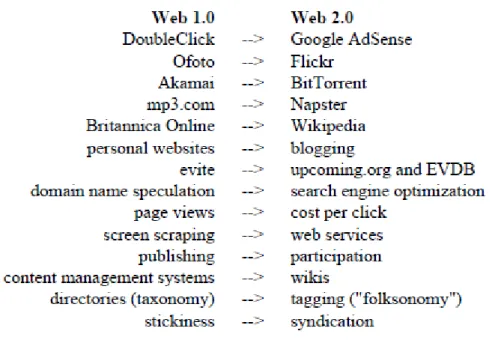
Figure 1: Comparing Web 1.0 and Web 2.0 Platforms...34
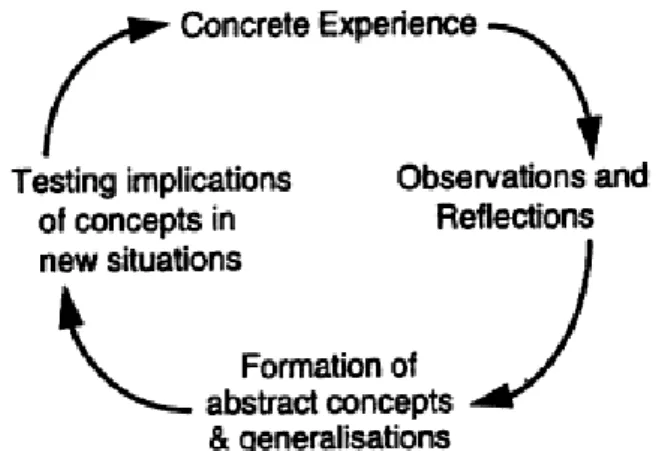
Figure 2: Kolb’s Learning Cycle...39
Figure 3: Bloom’s Taxonomy - Cognitive Domain...40
Figure 4: Bloom’s Taxonomy – Affective Domain...40
Figure 5: Bloom’s Taxonomy – Psycho-Motor Domain...41
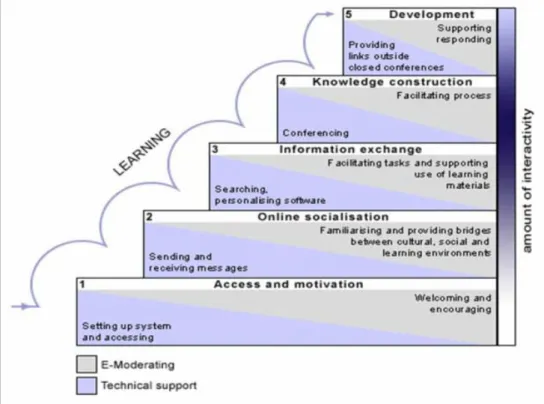
Figure 6: Salmon’s E-Moderating Perspective...46
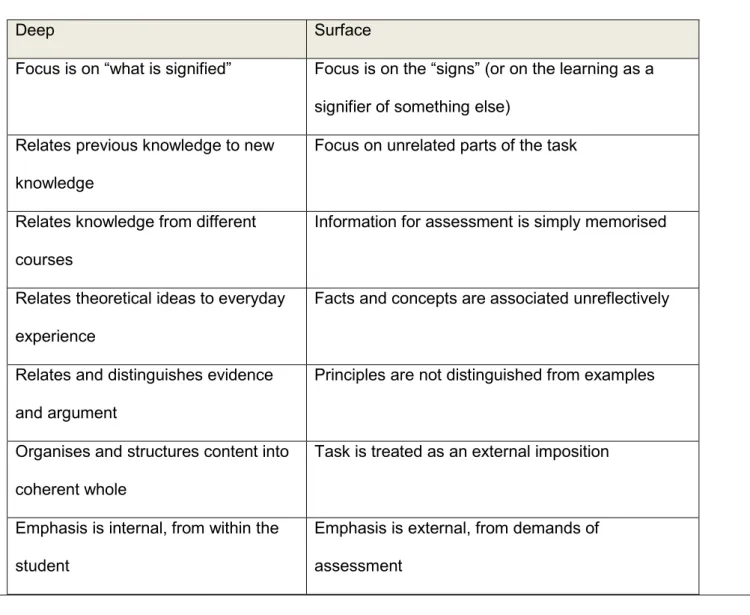
Figure 7: Deep and Surface Learning Summary by Atherton...62
Figure 8: Honey and Mumford’s Adapted Learning Cycle of Kolb...65
Figure 9: Flowchart of Grounded Theory Processes...121
Figure 10: Memo form for Substantive Indicator and Properties with Theory Bit/ Insight...162
Figure 11: Emergent Theoretical Code derived from the Pilot Study...177
Figure 12: Tentative Core Category and Emergent Theoretical Codes...178
Figure 13: Tentative Core Category Mapped to all Developed Level Descriptive Codes...179
Figure 14: Tentative Core Category Mapped to all High Level Theoretical Codes...180
Figure 15: Visual Characteristics of the Excel Workbook for Data Input...192
Figure 16: Tabulated Access to Workbook Content ...193
Figure 17: Filters in the Excel Workbook...193
Figure 18: Filtering the Descriptive Code Properties Heading...194
Figure 19: 'Excel Formula for Frequency of Control Terms used for Memo Descriptive Codes'..194
Figure 20: 'Excel Formula for Frequency Distribution (%) of Control Terms...'...195
Figure 21: Visual example of Frequency/ Frequency Distribution for….Substantive Categories.196 Figure 22: Control Term Generation in the Excel Workbook...197
Figure 23: Example of Control Term Generation for Theory Bits...198
xiii
Figure 27: Visual Characteristics of ‘Worksheet 2 - Substantive Code (Categories) Creation’....205
Figure 28: Visual Characteristics of ‘Worksheet 3 - Selective Coding...’...207
Figure 29: Visual Characteristics of ‘Worksheet 3a - Coding and Selective Coding...’...208
Figure 30: Visual Characteristics of ‘Worksheet 4 - Early Theoretical Codes...’...209
Figure 31: Theory Bit/ Insight (refined as Control Term) in Worksheet 4...210
Figure 32: Structural overview of the ‘Early Theoretical Codes’ in Worksheet 4...211
Figure 33: Visual Characteristics of ‘Worksheet 5 - Developed Theoretical Codes...’...213
Figure 34: Visual Characteristics of ‘Worksheet 6 - High Level Theoretical Codes...’...215
Figure 35: Visual Characteristics of ‘Worksheet 7 - Key Theoretical Sensitivity...’...216
Figure 36: Visual Characteristics of ‘Worksheet 9 - Core Category’...218
Figure 37: Sorting Templates via Microsoft Office Drag and Drop Functionality...219
Figure 38: Early Sorting Development...220
Figure 39: Later Stage Sorting Development...220
Figure 40: Advanced Stage Sorting Development...221
Figure 41: Final Stage Sorting Development...222
Figure 42: Example Hierarchy Visualisation Features...223
Figure 43: Hierarchy Cells Demonstrating Editing Mode and Resulting Structure...224
Figure 44: using the Text Pane for Editing Hierarchies...224
Figure 45: Full Preview of a Hierarchy...225
Figure 46: A Complex Hierarchy...225
Figure 47: Venn Diagram with Text Pane...226
Figure 48: Filtering all dependant Memo comments (Example shown is 'Commitment Issues')..233
Figure 49: Indicators sorted to create Substantive Codes...264
Figure 50: Substantive Code: Study and Research Challenges (in two parts)...266
Figure 51: Substantive Code: Study and Research Approaches...266
xiv
Figure 55: Substantive Code: Skills challenges...271
Figure 56: Substantive Code: Technical Challenges...271
Figure 57: Substantive Code: Resourcing for Study...272
Figure 58: Theory Bit (Aggregated Control Terms) Sorted into Early Theoretical Codes...278
Figure 59: Early Theoretical Code: Self-Management of Study Regime and Programme...281
Figure 60: Early Theoretical Code: Exploiting Facilities and Services (in two parts)...282
Figure 61: Early Theoretical Code: Resolving and Supplementing ICT Problems...282
Figure 62: Early Theoretical Code: Engaging with and Negotiating Online Communications...283
Figure 63: Early Theoretical Code: Acquiring and Supplementing Study Skills (in two parts)...284
Figure 64: 'Early Theoretical Code: Resolving and Supplementing Information Literacy...'...286
Figure 65: Early Theoretical Code: Engaging with and Negotiating Digital Platforms...287
Figure 66: Early Theoretical Code: Physicalisation of Virtual Learning...287
Figure 67: 'Early Theoretical Code: Virtualisation of Learning to accommodate Remote Study’.289 Figure 68: Early Theoretical Code: Learning Resources Capital Acquisition...289
Figure 69: Early Theoretical Code: Organisation of Learning Assets...290
Figure 70: 'Early Theoretical Code: Supplementing and Innovating Literature Searching...'...291
Figure 71: Early Theoretical Code: Virtualisation and Engagement for Online Feedback...291
Figure 72: Early Theoretical Code: Socialisation of Learning for Group/Peer Working...293
Figure 73: Early Theoretical Code: Engaging with and Negotiating Remote Group Working...293
Figure 74: Early Theoretical Code: Resolving and Networking for Acquisition of ICT Support....294
Figure 75: Early Theoretical Code: Engaging with and Negotiating VLE and course content...295
Figure 76: Early Theoretical Code: Managing and Negotiating Work-Study Relationships...295
Figure 77: Early Theoretical Code: Resolving and Negotiating WWW usage issues...296
Figure 78: Early Theoretical Code: Developing Confidence in Technologies...296
Figure 79: Relationship of Early Theoretical Categories to....Multi-tasking Commitments...302
xv
Figure 83: Relationship of Early Theoretical Categories….Adaptive Virtualisation of Learning...304
Figure 84: Relationship of Early Theoretical Categories….Socialisation of Learning...305
Figure 85: Relationship of Early Theoretical Categories….On-Demand Exploitation...305
Figure 86: Relationship of Early Theoretical Categories….Navigating diverse platforms...306
Figure 87: Key Properties within….‘On-Demand Exploitation/ Improvisation’...308
Figure 88: Developed Code 'Physicalisation of Online Learning' ...309
Figure 89: Developed Code 'Network Building/ Engaging'...310
Figure 90: Hierarchy of Core, High Level and Developed (Theoretical) Categories...313
Figure 91: Full Hierarchy Demonstrating….of Component Theoretical Codes/ Insight...322
Figure 92: Sorting Table Displaying Core Category, High Level, Developed…Codes...327
Figure 93: Venn Diagram of Core Category with Developed….High Level Codes...334
Figure 94: Early Theoretical Code: ‘Self-Management of Study Regime and Programme’...350
Figure 95: Early Theoretical Code, ‘Exploiting Facilities and Services’...350
Figure 96: Early Theoretical Code, ‘Resolving and Supplementing ICT Problem’...351
Figure 97: Early Theoretical Code, ‘Engaging with and Negotiating Online Communications’....352
Figure 98: Early Theoretical Code, ‘Acquiring and Supplementing Study Skills’...353
Figure 99: Early Theoretical Code, ‘Resolving and Supplementing Information…’...354
Figure 100: Early Theoretical Code, ‘Engaging with and Negotiating Digital Platforms’ ...356
Figure 101: Early Theoretical Code, ‘Physicalisation of Virtual Learning’ ...357
Figure 102: Early Theoretical Code, ‘Virtualisation of Learning to....Remote Study’...358
Figure 103: Early Theoretical Code, ‘Learning Resources Capital Acquisition’...359
Figure 104: Early Theoretical Code, ‘Organisation of Learning Assets’ ...360
Figure 105: Early Theoretical Code, ‘Supplementing and Innovating Literature Searching…’....361
Figure 106: Early Theoretical Code, ‘Virtualisation and Engagement for Online…’...362
Figure 107: Early Theoretical Code, ‘Socialisation of Learning for Group/Peer Working’ ...363 Figure 108: Early Theoretical Code, ‘Engaging with and Negotiating Remote Group Working’ .364
xvi
Figure 111: Early Theoretical Code, ‘Managing and Negotiating Work-Study Relationship’...366
Figure 112: Early Theoretical Code, ‘Resolving and Negotiating WWW usage issues’...367
Figure 113: Early Theoretical Code, ‘Developing Confidence in Technologies/Low Contac…’ .367 Figure 114: Developed Theoretical Code, ‘Multi-tasking Commitments’...370
Figure 115: Developed Theoretical Code, ‘Self-Regulated Engagement’...371
Figure 116: Developed Theoretical Code, ‘Transitional Physicalisation of Online Learning’...372
Figure 117: Developed Theoretical Code, ‘Network Building/ Engaging’...373
Figure 118: Developed Theoretical Code, ‘Socialisation of Learning’...374
Figure 119: Developed Theoretical Code, ‘Adaptive Virtualisation of Learning’...375
Figure 120: Developed Theoretical Code, ‘On-Demand Exploitation/ Improvisation’...376
Figure 121: Developed Theoretical Code, ‘Navigating diverse platforms, equipment...’...377
xvii
Table Page
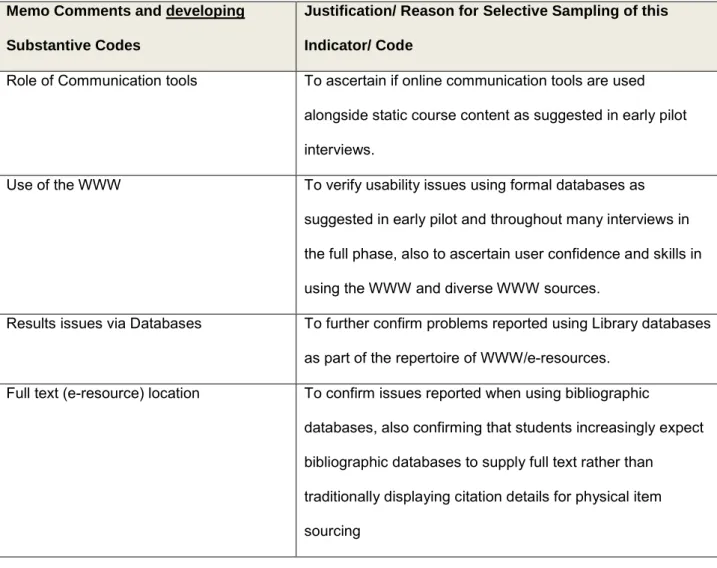
Table 1: Example pilot phase selective sampling (codes raised during interviews)...156
Table 2: Example full phase selective sampling (codes raised during interviews)...157
Table 3: Example Excel content - Derived from ‘Worksheet 1: Memo Data…’...166
Table 4: List of Open Codes from the Pilot Study...168
Table 5: Table of Developed (Descriptive) Codes from the Pilot Study...174
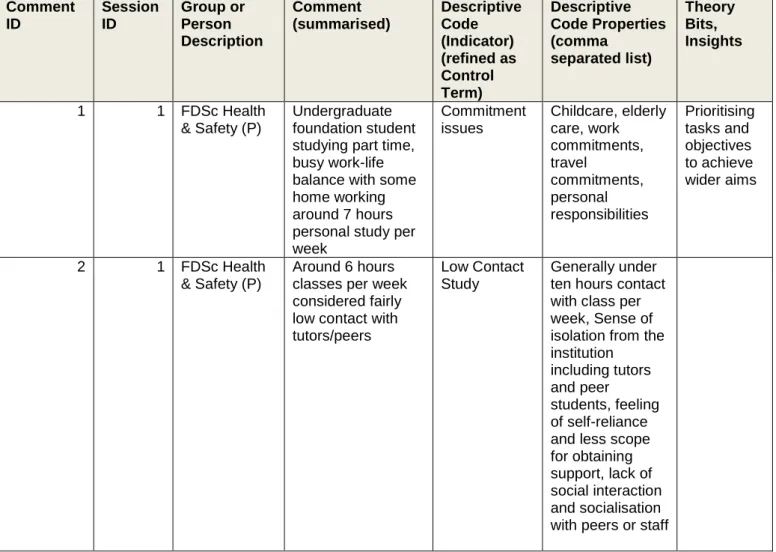
Table 6: Example Comment Data - Derived from ‘Worksheet 1: Memo…’...230
Table 7: Using the Excel Filter tool to Visualise Dependant Memo Comments...235
Table 8: Using the Excel Filter tool to Visualise Dependant Memo Comments...237
Table 9: Memo Descriptive Codes in Order of Frequency...245
Table 10: Pilot-Derived “Developed Descriptive Categories/Codes”...258
Table 11: Emerging Developed Descriptive Codes...261
Table 12: Example Substantive Code (Remote Learning Characteristics)...262
Table 13: Tables used in Worksheet 4 Demonstrating Informal Theory Bits...279
Table 14: Key Theories which Contributed to the Development of Early Theoretical Codes...300
Table 15: Summary of the High Level Theoretical Codes - Derived from Worksheet 6...306
Table 16: Example Frequency and Frequency Distribution for Early Descriptive Indicators...337
xviii
Appendix Page
Appendix 1: Unpublished Paper following the Annual Grounded Theory Seminar...638
Appendix 2: Original Proposal...651
Appendix 3: Revised Proposal...660
Appendix 4: Ethical Approval Application...671
Appendix 5: Research Information Sheet...676
Appendix 6: Aide Memoire...677
Appendix 7: Memo Form...681
Appendix 8: Presentation Abstract at TIRI Research student seminar (on Pilot Study)...682
Appendix 9: Presentation Handout at TIRI Research student seminar (on Pilot Study)...684
Appendix 10: Practical Research Excel Worksheet Samples...721
Table 1: Worksheet 1 - Memo Data including Descriptive (Indicator) Codes (Categories)...721
Table 2: Worksheet 2 - Substantive Code (Categories) Creation...725
Table 3: Worksheet 3 - Selective Coding - to validate developing Indicators Codes...736
Table 4: Worksheet 3a - Coding and Selective Coding from the Pilot Interviews...739
Table 5: Worksheet 4 - Early Theoretical Codes (Categories)...749
Table 6: Worksheet 5 - Developed Theoretical Codes (Categories)...761
Table 7: Worksheet 6 - High Level Theoretical Codes (Categories)...765
Table 8: Worksheet 7 - Key Theoretical Sensitivity from the Literature...768
Table 9: Worksheet 9 - Core Category...777
Appendix 11: Memo Indicator Control Terms used to Develop Substantive Codes...781
Appendix 12: Index of All Theory Bits and Control Terms...796
Index 1: All Theory Bits...796
Index 2: Theory Bit Control Terms...810
xix
Sorting Table 3: Early Theoretical Codes sorted into Developed Theoretical Codes...828 Sorting Table 4: Developed/ High Level Codes sorted with Core Category...829 Appendix 15: Hierarchical visual representation of all theoretical codes...830 Appendix 16: Hierarchical visual representation of theoretical codes (Minus theory bits)..831 Appendix 17: Introduction to the Blackboard VLE at Glyndŵr University 2007/08...832 Appendix 18: Conference Presentation Abstract on Research Project, October 2013...844
PREFACE
This PhD arose mainly from personal experiences working at Glyndŵr University based in Wrexham, North Wales (formerly the North East Wales Institute of Higher Education) in a technical and e-learning related development and support role from 2001-2009 and following earlier experiences during the late 1990s working at the same institution in a junior library related role.
The research project arose as a proposal to examine the field of ‘E-Learning’ – broadly representing the use of emergent World Wide Web (WWW or ‘Web’) based interfaces to information and learning applications, however it became evident a more defined focus would be required to define a suitable research question or activity within this broad field; a solution presented itself in the form of the Grounded Theory methodology, a sociological approach based around interrogation of
participant responses for identifying participant group concerns.
The working research title eventually defined in the proposal ‘Student perceptions on skills and learning challenges in the use of educational technology in a part-time, distributed and professional study context’ reflected a desire to address the
conditions, challenges and support needs of an increasingly prolific trend toward part time or low contact study facilitated by emergent learning technologies such as the VLE (Virtual Learning Environment) in a distributed i.e. multi-platform, multi-location and multi-context learning environment.
It is felt by the researcher (a professional working in E-Learning delivery for several years) that the wider field of E-Learning has remained relatively static in recent years, thus supporting the continuing relevance and currency of this research project; this factor is largely confirmed by re-appraised of the literature (also see
Chapter 5: Discussion In Relation To The Literature, Part 3: Findings in Context to Recent Trends). Indeed, many of the behaviours demonstrated in the practical research reflect the anecdotal student experience in 2014 (and for the period of the final thesis submission in 2017); many theoretical insights discovered provide evidence of ongoing challenges, concerns or behavioural strategies employed by students or learners regardless of context or place. Indeed, wider application of the emergent Theory also reflects what is perhaps the key aim of the Grounded Theory methodology, namely to discover and conceptualise transcendent behavioural patterns which apply beyond the immediate participant context, organisation, or field of study.
CHAPTER 1 (a): INTRODUCTORY CONTEXT
Part 1: Introductory Statement
A number of motivations can be identified regarding this study, in particular, trends in the provision of digital and online-based educational delivery since the early 2000s and associated wider aspects of information services supporting teaching and learning. These developments can be summarised in terms of an increasing prevalence for digital and computing behaviours and lifestyles, both within the managed environment of the Higher Education campus, and externally across society. These trends are also seen alongside increasing advocacy and innovation across the spheres of educational delivery and information technology, but also advocacy and intervention via government and official bodies to utilise, exploit and adapt the emerging dimension of digital and online technologies. In addition to these trends, other motivations for the study can be seen in the form of individual
professional development and experience, including work in early Web based systems and wider experience in support and teaching roles within Higher
Education. These trends and motivations will provide a detailed background to the study, illustrating emerging learning technologies and the student experience in context to sector, industrial and governmental developments.
Part 2: Structure of the Thesis
The first chapter of the thesis provides the background context, the student-learner environment and the developments in learning technologies that motivated the work in the first instance, this will consist of two sub-parts, Chapter 1 (a) discusses the historical, policy, societal and motivational factors in the study, Chapter 1 (b) explores the context oflearning and teaching using Internet and Web based technologies. The second chapter will present the methodology of Grounded Theory, entering a high level discussion of the principles of Grounded Theory, including discussion surrounding positivist and constructivist approaches to the methodology used in the study. The third chapter will provide a detailed overview of the research design, including a description of coding practices used within the chosen methodology, Grounded Theory. The fourth chapter will provide two sub-parts, including Chapter 4 (a), providing a presentation of the component or
dependent properties of the Grounded Theory resultant from the study (‘Improvised Learning’), focused on how the theory was derived through inductive data analysis. Chapter 4 (b) will provide an explanation of the theory emergent from the research, focused on the Grounded Theory of ‘Improvised Learning’ that emerged via
application of the Grounded Theory methodology to investigate students’ perceptions on the use of learning technologies. The fifth chapter will provide an analytical
discussion of the theory in relation to the literature, including a retrospective review of the literature on improvisation across educational and other sectors. The sixth chapter will provide a conclusion for the study, including a summary of the original research aims, an outline of the findings and summary of implications for future research which could be prompted by the resultant theory of ‘Improvised Learning’.
This chapter will also outline approaches to potentially operationalise the research findings within the Higher Education sector and also for other sectors, such as Further Education.
i. Treatment of the Literature
It may be necessary to briefly consider the discussion chapter in context to the methodology used. It should be noted that the methodology selected, Grounded Theory is a qualitative research methodology based around the coding of participant responses following open discussion. The methodology requires the categorisation, comparison and verification of developed codes to define forms of behaviour which demonstrate interchangability in their properties. Through successive sorting, comparison and related techniques, increasingly refined or higher level codes are defined to explain behaviours as theoretical codes, indicating motivations and strategies continually engaged by participants to overcome their concerns. Due to this inductive approach in coding responses as data, it is considered necessary to approach the surrounding literature in a manner which avoids empting or pre-conceiving participant responses or emergent theory explaining behaviours. Personal professional experiences, practice and prior professional writing of the candidate are acknowledged via discussions of research motivations (shown in the current chapter). Following chapters of the thesis will demonstrate how the research was approached in accordance with principles of the chosen methodology (Glaser’s variant of Grounded Theory) comprising an objectivist, positivist, emic and empirical position when approaching the substantive area, the research context/environment and participant data. These principles are discussed in Chapter 2: The Methodology,
Part 3: Grounded Theory Principles. Further approaches/ techniques used to approach the research in the context of avoiding pre-conception and ‘a priori’ knowledge are also discussed in Chapter 2: The Methodology, Part 4: Branches of Grounded Theory and Rationale for the Chosen Methodology and Chapter 3: Research Design, Part 5: Approaches for Data Coding.
Research methods/ techniques or processes to mitigate and respond to personal preconception and experience are therefore outlined in early chapters of the thesis. Chapter 5: Discussion in Relation to the Literature will demonstrate contextual reference and comparison with the literature in accordance with principles of Grounded Theory such as ‘Theoretical Sensitivity’, where comparisons with prior literature and theory have supported or verified emergent coding.
The discussion chapter can be seen to provide a largely retrospective process occurring substantially following the practical research phase and development of theoretical perspectives via the chosen methodology. Consultation of some literature sources, applied in the context of the methodology to assist or complement data collection during the practical research phase is explained in Chapter 2: The Methodology, Part 3: Grounded Theory Principles and elsewhere in this thesis.
Part 3: Historical Background to the Study
Prior to the years represented by the practical phase of the research project (approx. 2007-2008) the UK Higher Education Sector had experienced considerable change following the adoption of networked information systems and development of
Information and Communications Technology (ICT) literacy amongst educators, academic related staff and the student population (Haywood et al., 2004).
During the mid to late 1990s, the emergence of widely accessible networked computing facilities within HEIs (Higher Education Institutions), driven to a large extent by the Higher Education network operator JANET (Joint Academic Network) had opened new frontiers in institutional operations, supporting a diverse range of networked systems, such as Library Management Systems and their associated OPACs (Online Public Access Catalogue), Email and early bibliographic Library systems such as Dialog. The trend toward Increasing prevalence of ICT in HEIs during the late 1990s is outlined by Michael Yohe (1996, p.14), outlining emerging trends for user expectations of networked services and barriers to these demands, limited by network infrastructure, resources and platforms, commenting that “...We measure in minutes the time from delight that the library catalog is online to anger that the full text of all listed books is not instantly available on the screen.”
The rapid adoption of home computing during the late 1990s ensured a medium for popular access to networked University systems and applications for learning and teaching. The Higher Education sector (and particularly younger or emerging HEI providers) would also be heavily influenced by government drivers for widening participation and advocacy for an industry-led University sector, with ICT providing a catalyst for innovative approaches to the delivery of teaching and user support.
i. The Shift from Networked Learning Resources to the Virtual University
Naughton(1999, p.238) illustrates the transition toward more usable networked systems, commenting that “…the Net before Berners-Lee was akin to using MS-DOS or UNIX - you could do almost anything provided you knew the lingo.” Graphical User Interface (GUI) based Operating Systems such as the Apple Macintosh and
early Web browsers such as ‘Mosaic’ offered a more usable interface to networked applications (Policinski, 2012). Web-based networks were supported by technologies such as ‘Perl’, relational databases such as Oracle/SQL, standards for reliable
infrastructure such as Open Systems Interconnection and TCP/IP (Paris, 2004, p.455; Qiu, 2006, p.92), security applications such as SSL and LDAP (Akram and El-Seoud, 2007, p.74) and development of JANET, the Higher Education network (Greenhalgh, 2001, p.13). The early 2000s were characterised by HEI adoption of Content Management Systems (CMS), allowing for management of Web content without requiring specialist skills (Williamson and McKay, 2002, p.505) and the Virtual Learning Environment (VLE), providing tools for debate, assessment and interactive learning (Heaton-Shrestha et al., 2005, p.371). The term Managed Learning
Environment (MLE) described wider integration of student-facing systems and administrative functions (Carter, 2005 p.484; JISC, 2000; McKimm, Jollie and Cantillon, 2003, p.870). Toward the late 1990s terms such as Virtual University (Chellappa, Barua and Whinston, 1997, p.56), Virtual Library (Van Drie and Lajiness, 1998 p.274) or Virtual Campus (Maher, 1999, p.376) were used to define a unified, remotely accessible network, described by Chellappa, Barua and Whinston (1997, p.56) as “…electronic workspaces and global libraries that provide richer functionality and features than their physical analogs.”
ii. The Expansion of Computing and Internet Lifestyles
The period before the 2000s saw a dramatic rise in home computing, widely extending access to the Internet and related behaviours (Wyatt and Farrar,1994, p.204). There were 16 million Internet users worldwide by 1995 and 1,173 million by
2007 (Internetworldstats, 2013). By 2008 162 million domain names had been registered (Verisign, 2014). By the early 2000s, emergence of the Web as an
accessible, interactive interface to the Internet was described as “Web 2.0” - typified by Social Networks such as MySpace (O’Reilly, 2005); this period saw an expansion in Internet behaviours such as use of e-mail, social networking for informal
communications, content-sharing, use of Web blogs and engagement in commercial online services (O’Reilly, 2005, p.1). Search Engines also provided an accessible interface for the Internet (Cho and Sourashis, 2004, p.20). These developments implied societal changes and impact on the HEI sector (Barnatt, 2008, p.49). Tim Berners-Lee’s conceptual ‘Semantic Web’ (Berners-Lee, 2001) proposed integration and personalisation across a range of networked devices, prompting World Wide Web Consortium (W3C) standards such as XML (Extensible Markup Language) allowing for more sophisticated integration of Web-based systems, this syndicated approach was termed “Web 3.0” (Hendler and Berners-Lee, 2010, p.28). Social Networks such as MySpace acted as a driver for Internet engagement and set new expectations for networked services. Selwyn (2011, p.2) describes the trend for self-led access to networked services as the “networked self”. The rise of mobile computing from the 2000s via PDAs (Personal Digital Assistants), smartphones and tablet computers accompanied the expansion of wireless connectivity such as 2G and mobile applications or ‘apps’. Urban and Sultan (2015, p.31-32) comment on the ubiquity of mobile technologies, describing the struggle of HEIs to meet demands for mobile, ubiquitous computing behaviours commenting that “…many higher education institutions (and educators) now find themselves expected to catch up with this world of social media…”
Part 4: Recent Developments in the Student-Learner Environment
i. Adoption of the VLE
By the early 2000s the VLE (Virtual Learning Environment) had become the de-facto model for learning platforms, including commercial VLE systems such as Blackboard and Open Source VLEs such as Moodle (Moodle Partners, 2016). A 2005 study for implementation of a VLE at Kingston University, Surry comments on the increasing prevalence of the VLE model and its flexibility for delivering learning at a distance, offering “...the management of teaching materials, synchronous and asynchronous communication...” (Heaton-Shrestha et al., 2005, p.370). A UCISA 2005 VLE survey in 2005, reflected the prevalence of commercial VLEs such as Blackboard (42%) and WebCT (40%) with lower adoption of Open Source platforms such as Moodle (13%), reflecting a trend away from experimentation and hosting multiple VLE platforms (UCISA, 2003) toward more focused institutional adoption of platforms (UCISA, 2005, p.8). In 2006 WebCT was acquired by the Blackboard Corporation (Casey, 2008, p.45), resulting in reduced usage of the (Blackboard owned) WebCT VLE and a shift toward the Moodle VLE as an Open Source solution (UCISA, 2010, p.2). A UCISA survey (2014) found all institutions have surveyed continued to rely on a traditional VLE model for delivering e-learning needs, with the most prevalent VLE being Moodle (62%) reflecting increasing uptake of this Open Source platform, the report also reflected adoption of commercial solutions such as Pearson eCollege and Coursera. The VLE platform therefore remains a significant model for ICT facilitated education, with many of the original software providers and platforms remaining important stakeholders for UK HEIs into the current decade (UCISA, 2014).
ii. The emergence of TEL (Technology Enhanced Learning)
‘TEL’ or ‘Technology Enhanced Learning’ is cited as a term for delivery of learning via digital systems, originating via learning applications dating from the 1960s
(Duval, Sharples and Sutherland, 2017, p.4). TEL has been defined by Bayne (2014, p.5) as “...the interface between digital technology and higher education teaching...”, indicating that TEL is a prevalent term for UK policy-makers in a “social, economic and political context” (Duval, Sharples and Sutherland, 2017, p.6), although globally, terms such as “‘educational technology’ and ‘E-Learning’ still dominate." (Bayne, 2014, pp.5-6). Duval, Sharples and Sutherland (2017, p.5) indicate the significance of learning design in defining TEL, reflecting “accumulated research into how we learn" and comprising a “single system” approach across a rage of theory and practice. Kirkwood and Price (2013, p.6) emphasise an institutional context, however Duval, Sharples and Sutherland (2017, p.6) contrast the role of informal, mobile and personalised behaviours which inform “design for effective learning”. Kirkwood and Price (2013, p.6) offer critical perspectives on TEL’s ‘enhancement’ qualifier, also suggesting “...it is rare to find explicit statements about what TEL actually means...”. Kirkwood and Price (2013) further query TEL advocacy focused on applications rather than pedagogy, similarly Bayne (2014, p.7) suggests TEL comprises “essentialism” - an obligatory context, limiting “...capacity to be critical about education and its relation to technology". Duval, Sharples and Sutherland (2017, p.9) also query barriers for students having English language or accessibility needs, suggesting that TEL cannot represent a “determinist approach” for all
students, also emphasising the need for further research into TEL implications for teaching and learning.
iii. Drivers for Flexible Learning and Vocationalisation of Higher Education
During the mid to late 2000s, UK HEIs experienced a sustained growth in part time study; Universities UK (2012) indicate “...students studying part time for their first degree increased by over 90% over this period.” The Higher Education Statistics Agency (HESA) indicates a similar increase in part time entry to HEIs by school entrants and rising participation levels from lower socio-economic groups (HESA, 2011); in 2003/4 UK-wide participation in HE by these groups was 28.6%, rising to 29.5% in 2007/08. These trends reflect HESA statistical returns for young entrants from POLAR 2 ‘Low participation neighbourhoods’, rising for UK-wide coverage from 8.6% in 2005/06 to 10.1% in 2008/09, similar trends can be seen for disabled
student entry, with UK wide coverage at 3.6% in 2004/05 rising to 4.7% in 2008/09 (Higher Education Statistics Agency, 2014).
Trends in the non-traditional entry would prompt advocacy within the HE sector and UK government to develop a more accessible model for educational delivery. The government white paper ‘Widening Participation in Higher Education’ (2003) outlined widening access targets for non-traditional entrants as a driver for raising academic achievement (UK Government - Department for Education and Skills, 2003, p.7). Government advocacy during the early 2000s could be seen to promote Higher Education delivery of vocational training as a facilitator for economic growth and to facilitate widening access for socio-economic backgrounds atypical of traditional University entrants. From the early 2000s many of these concerns would be
expressed in UK government policy via white papers and would be adopted by HEI providers seeking to expand their market and engage in new relationships with communities and industry.
iv. The University for Industry
The 1996 government’s ‘National Committee of Inquiry into Higher Education’ report, known as the ‘Dearing Report’ outlined recommendations for sustainability of the HE sector, for expansion, widening access and implementation of a new framework for qualifications (Dearing, 1997, Ch.1.4). A number of initiatives were launched to improve relationships between the UK HEI sector and industry, to create national schemes for widening entry across post-statutory education and for skills
development. These programmes reflected government aims for an increased HEI role in industry via white papers such as ‘The Learning Age’ (1998) and ‘The Future of Higher Education’ (2003). This approach was often expressed as ‘Market-led’ or ‘Demand-side education’, an attempt to facilitate skills and expertise preferred by industry rather than sourced by educational providers (the ‘Supply side’). This
‘Demand side’ approach is described in the paper ‘21st Century Skills: Realising Our Potential’ (2003) outlining an approach “led by the needs of employers and learners.” (UK Government - Home Office, 2003a, p.87). Schemes which sought to integrate post-statutory education in industry included the UfI (University for Industry), a virtual University launched by the UK government in 2001 and the UK ‘LearnDirect’
programme, allowing typically adult learners to access short technology and
business programmes via 2000 nationwide facilities. Other schemes included the UK e-university (UKeU), providing online programmes for adult returners. The
introduction of Foundation Degrees in 2001 also allowed HEI entry from the workplace (UK Government - Home Office, 2003a, p.82).
v. Lifelong Learning, Flexible Learning and the Information Society
Alongside widening access to Higher Education during the early 2000s, UK governments would reflect on the emerging uptake of ICT across the general population. The use of learning technologies would be presented as a facilitator for ‘Flexible Learning’ and ‘Lifelong Learning’ to facilitate trends toward part time study and flexible working characterised by short term contracts and expectancy for multiple job roles over an individual’s lifetime (Dearing, 1997, Ch.4). The imperative to facilitate ‘lifelong learning’ is emphasised in the government paper ‘The Future of Higher Education’ (2003), commenting that ‘lifelong learning’ represents
“...educational progression linked to a process of continuous personal and
professional development.” (UK Government - Department for Education and Skills, 2003b, p.16). The 1997 ‘Dearing Report’ reflected on a contemporary UK transition from traditional industries toward retail and services characterised by expertise rather than labour; the report advocated the expansion of Higher Education to facilitate these trends, also advocating emerging Information and Communications Technologies to facilitate training needs (Dearing, 1997, Ch.4.9-14). During the late 1990s, these developments were accompanied by a reduction in HEI funding, expansion of tuition fees and loans and policy transition from the government-funded, post-16 HEI model, resulting in a more diverse student demographic and part time student market (Blandin and Machin, 2004, p.5). These trends would be reflected in an expansion of post-92 and polytechnic HEIs, often embracing the widening access and ‘demand-side’ agenda. Jones and Thomas (2006, p.618) comment “...there is a tendency towards the utilitarian approach, particularly amongst the new universities...”
vi. Widening Access and Web Usability
At the time of embarking on the current research project, the issue of widening access for Higher Education support comprised a significant motivation for study. Contemporary levels of declared disability stand at approximately 44,000 within the UK, an increase of over 50% since the 2010-11 academic year (HEFCE, 2017); the most common disabilities declared include learning disabilities such as “dyslexia, dyspraxia or Attention Deficit Hyperactivity Disorder” and half of students “had a specific learning difference." The Disability Rights Commission (2004) had outlined challenges faced by users with impaired vision or other access issues, pointing out the need for a universal approach to access as defined by the US 501 Web
Accessibility legislation and by the World Wide Web Consortium (W3C) Web Content Accessibility Guidelines (The Disability Rights Commission, 2004, p.1).
Persson et al. (2014, p.507), reflects on the concept of “design for all”, commenting how unified concepts of usability and accessibility can ensure wider usability across a range of devices, technologies and applications, similarly, Catherall (2007, p.99) comments on difficulties for HEIs in ensuring Web accessibly in a context of
increasing prevalence of commercial, enterprise level systems which can often be difficult to modify in contrast to locally developed platforms.
Varonis (Varonis, 2015. p.125) lists key design elements for Web accessibility, including contrast, personalisation and compatibility for platforms such as ‘screen readers’, to “...make content accessible to students with visual needs, including students outputting the screen to a tactile Braille display...”, also commenting on Web design for motor impaired students.
It should perhaps be noted that accessibility for Web based, online or digital content has been subject to critical perspectives, such as Liasidou (2014, p.169), suggesting that it can be difficult for policy makers and those advocating accessibility to decide or determine what characteristics constitute equalities or social justice in an
educational context, suggesting that whilst "...there is agreement on the centrality of a social justice discourse in bringing about inclusive education reforms, the notion of social justice is ambiguous and contested...", this view is echoed by Persson et al. (2014, p.505), suggesting that formal technical standards still lack coverage in areas such as the ISO (International Standards Organisation) regime, indicating "...there is no consensus on formulating the concept of accessibility in different areas, not even within the ISO standardization community." Varonis (2015, p.120) also points out wide discrepancies in the implementation of Web standards amongst software developers and organisations.
vii. Emergence of Information and Communications Technology-related Literacies
A number of information technology related ‘literacies’ are cited in the present thesis, it can be seen that a growing narrative or advocacy surrounding literacies or
competencies has developed over recent years (Jones and Flannigan, 2006, p.6). It may be useful to outline a comparison of some key ‘literacies’ which have emerged, such as ‘Digital Literacy’ - which seeks to define a pluralistic or broad range of learning strategies in relation to learning technologies (Knobel, 2008, p.1), ‘ICT (Information and Communications Technology) literacy’ - which typically defines “generic skills” related to the use of computers and related technologies (Oliver and
Towers, 2000, p.381) and ‘Information literacy’ – which typically defines wider learning approaches for the management, processing and critical use of information derived from a range of media sources (Bent and Stubbings, 2011, p.2).
Digital Literacy has been defined as a “plurality” of skills and competences (Knobel, 2008, p.1) and an “assortment of cognitive-thinking strategies” relating to “digital information”(Jones and Flannigan, 2006, p.6), also including “...cognitive, motor, sociological, and emotional skills... ...in digital environments.” (Eshet-Alkalai, 2004, p.93). Further definitions outlined by Jones and Flannigan (2006, p.6) include skills for interpretation of graphical interfaces (“photo-visual literacy”) , skills for re-using digital content (“reproduction literacy”), skills to “construct knowledge” from non-linear online sources (“lateral literacy”), skills to evaluate and assess digital content (“information literacy”) and literacy for use of diverse media formats (“New Media literacy”). Digital literacy is also defined in terms of collaboration for student peers “...to coordinate with others to create something truly original.” (Alexander et al., 2017, p.2). These definitions often cite reflective and interpretive processes (Jones and Flannigan, 2006), stressing higher level, critical behaviours contrasting with "standadized operational" literacies (Knobel, 2008, p.2). Critical perspectives on digital literacy also query “neutral” or “functional” emphases on acquisition of digital content and “technical know-how“ potentially lacking “cultural awareness”
(Buckingham, 2006, p.263-266), also querying wider “symbolic or persuasive aspects of digital media” (Fabos, 2004, p.95) and critical awareness for “high-end design”, potentially lending “credibility” to digital media (Buckingham, 2006, p.267). Alexander et al. (2017, p.20-21) queries societal inequalities for development of ‘digital literacy’, reflecting barriers of “race and class”, for “older people or women in
some cultural contents” and Internet censorship in some world regions which “makes it difficult for them to actually apply this expertise without substantial personal risk...” In contrast to digital literacy, ICT literacy often refers to generic technologies such as wordprocessors or Web browsers (Harskamp et al., 2004, p.72) citing students’ capacity “to make appropriate use of ICT” via a “range of communication tools” (Oliver and Towers, 2000, p.381). Vlieghe (2017, p.401), suggests that “policy-makers... ...regard it as a practical skill.” Katz and Macklin (2007, p.50) however emphasise wider “researching and communicating” skills. O’Connor et al. (2002, p.16) suggests that ICT literacy allows students to “access, manage, integrate, evaluate and create information...” ICT literacy is also discussed as a requirement in terms of economic and employment skills for the ‘knowledge society’
(Sianou-Kyrgiou, and Tsiplakides, 2012, p.56).
Critical perspectives however query the impact of ICT literacy, suggesting this perspective can lack wider reflective and critical skills (Vlieghe, 2017, pp.401-403) and querying ICT literacy as a potentially limited solution to educational challenges (Sianou-Kyrgiou, and Tsiplakides, 2012, p.56). Katz and Macklin (2007, p.50) query ICT as “an end-in-itself”, failing to consider learner “complacency” for ICT literacy due to familiarity with social media and mobile devices and “distraction” in class use of ICT. Riis (2015, p.385-386) comments on the “entanglement of ethics and
technology” and need for critical awareness across formal and informal contexts. The “socioeconomic” impact of ICT literacy is queried by Sianou-Kyrgiou, and Tsiplakides (2012), suggesting “grammatical” forms for ICT literacy allowing for “a critical attitude vis- à-vis ICT.” Vlieghe (2017, pp.403) queries ICT literacy as “...a profound shift in what it means to become an educated person.”
for equalities inherent in societies, suggesting that “...ICT may exacerbate existing social inequalities…” (Sianou-Kyrgiou, and Tsiplakides, 2012, p.57).
Information literacy is typically defined as a specific range of skills for critical
reflection, evaluation, effective use and management of information sources. Writing in a SCONUL (UK Society of College, National and University Libraries) paper outlining "The SCONUL Seven Pillars of Information Literacy”, Bent and Stubbings, (2011, p.2) suggest that information literacy comprises “...the ways in which
information and data is created and handled, learning skills in its management and use and modifying learning attitudes..." These ‘Seven Pillars of Information Literacy’ comprise distinct competencies which can be selected for “different contexts and for different ages and levels of learner” , these include the “identify” pillar, describing skills to “identify a personal need for information...” and evaluating “information currency “, the “Scope” pillar outlining skills to assess bias inherent in media and to address “current knowledge” and “gaps” whilst the “Plan” pillar defines skills to “construct strategies for locating information and data “ and identification of “new tools” to explore unfamiliar sources (Bent and Stubbings, 2011, p.2-9).
Bruce (2004, p.1) comments on the role of information literacy in terms critically negotiating diverse information sources, similarly, Parker (2003, p.223) emphasises “...the ability to recognise when information is needed, then to be able to locate and evaluate...”, similarly, Johnston and Webber (2003, p.337) discuss critical and strategic research behaviours in contrast to information retrieval. Critical
perspectives also query a prevalent narrative of digital literacy framed in context to libraries and librarians, suggesting omission of consideration for learning processes and a focus on electronic databases in contrast to wider, non-digital sources
Part 5: Personal Factors that Motivated the Work
i. Personal Influences during the late 1990s/ early 2000s
Experiences during the late 1990s/ early 2000s working at the North East Wales Institute of Higher Education (NEWI, later re-named Glyndŵr University) and sessional lecturing, contributed to a sense of change in trends for learning and teaching, these trends included the expansion of off-campus networked services, increasing reliance on ICT and an increasingly Part Time, vocational demographic. Glyndŵr University was felt to offer conditions suitable for the research project, reflecting sector-wide trends such as widening access for non-traditional entrants and implementation of learning technologies to facilitate Part Time and reduced contact programmes. VLE implementation is illustrated in the growth to 411
registered ‘instructor’ accounts and 373 online ‘course sites’ within the Blackboard VLE by October 2008. The ‘NEWI IT Services Strategic Plan 2007-2010’ reflected the growing importance of learning technologies “...as an enabler and performance improvement service.” (Stockton/ NEWI IT Services, 2007, p.1). Additional trends noted included an increasing reliance on educational technologies for HEIs and potential disparity for ICT competencies within contemporary society (Byrne, 2003). Further trends at this time reflected challenges of ICT for non-traditional or older entrants and inequalities for Internet connectivity (Cullen, 2001; Friesen, 2003).
ii. The development of networked infrastructure in the UK Higher Education Sector
During the early 2000s, the HEI sector experienced considerable infrastructure-based advocacy and support via the JISC and JANET agencies for adoption of VLE systems, deployment for associated E-Learning technologies and improvement of core network infrastructure (Mayes and de Freitas, 2004; JISC - the Joint Information Systems Committee, 2004b); however, there remained many unanswered questions surrounding the viability of expanded ICT deployment and in particular, for remote study and distance learning. These questions included the matter of academic and operational staff ICT literacy for managing online learning (McPherson and Nunest, 2008, p.439; Rockwell, et al. 1998) and feasibility for deployment of virtual libraries and resources for study - an expensive and somewhat limited facility in terms of digitisation capacity prior to the late 2000s (Byrne, 2003, p.415).
iii. Note on ‘Service Level Agreements’ (SLAs)
By the early 2000s, ‘Service Level Agreements’ (SLAs) had begun to emerge within HEI operational planning and management, establishing formal agreements between university departments, external stakeholders and commercial partners to outline mutual expectations between stakeholders, to ensure quality assurance, define workflows and to allocate resources such as spending or expertise (LTSN, 2003). Helo, Gunasekaran and Rymaszewska (2017. p.19) define Service Level
Agreements in terms of a contractual arrangement between stakeholders to ensure delivery of organisational services, particularly in terms of expectations for a
commercial partnership or licensed service, commenting that “Service level agreements (SLA) can specify the offered service at each stage and condition.” Service Level Agreements can be seen to have played a role for HEI infrastructure, in terms of external partnerships to deliver services such as 24/7 student enquiry support and capacity to deliver virtual learning in a potentially remote, overseas and non UK time zone. These overheads and challenges are emphasised in an LTSN (Learning and Technology Support Network) report, commenting on the increased demands for 24/7 networked learning and potential role of Service Level Agreements to define services and respond to student expectations:
“...How will they get library support? How will academic staff deal with their
questions? Will they be able to access student services? ...Service level agreements may be necessary to manage the expectations of students who are learning online.”
(LTSN, 2003, p.15).
iv. The role of Private Equity
One question for deployment of educational technology posed often in the late 1990s, but still largely unresolved by the mid 2000s concerned the potential and growing role of non-traditional educational providers, technology-focused
corporations such as Microsoft and other sources of private equity or external stakeholders for the delivery of Higher Education via technology (Noble, 1997; Cullen, 2001; Friesen, 2003). This debate was closely aligned with questions or potential concerns for the systemisation of learning and loss of traditional pedagogic, social and cultural experiences inherent in class based learning. These concerns were queried by David Noble (1997), questioning the uptake of systemised learning -
to the detriment of traditional class based collegiate and experiential learning as a “headlong rush to implement new technology with so little regard for deliberation of the pedagogical and economic costs and at the risk of student and faculty". For Noble, this trend is linked directly to issues of automation, including the displacement of educators and potential for rapid commercialisation of learning, commenting that “...beneath that change, and camouflaged by it, lies another: the commercialization of higher education. For here as elsewhere technology is but a vehicle and a disarming disguise.” (Noble, 1997, p.107). For a wider discussion on the role of commercial providers for learning technologies and related issues, see the sub-section shown in Chapter 5, the Discussion chapter, entitled ‘Significance of ‘Improvised Learning’ for the Globalisation Context’.
v. HEI Landscape and Vocational Learning Trends at Glyndŵr University
Glyndŵr University, based in Wrexham, North Wales came into existence in July 2008 when the North East Wales Institute of Higher Education (NEWI) was awarded TDAPs (Taught Degree Awarding Powers), after previously awarding autonomously awarded degrees validated by the University of Wales consortia.
The HEI landscape in Wales is currently characterised by eight Higher Education providers funded via HEFCW/ Higher Education Funding Council for Wales; in 2010 there were over 140,000 enrolments in HEI courses in Wales, of which 34% were part time, with around 1 in 6 students undertaking studies in the medium of the Welsh language - however, this figure is much lower for HEI providers in border regions such as Wrexham (HEFCW, 2011). In 2010, the HEI sector in Wales contributed more than £2 billion annually to the Welsh economy (HEFCW, 2010).