2019
Use of soft computing and numerical analysis in
design, analysis and management of pavement
systems
Orhan Kaya Iowa State University
Follow this and additional works at:https://lib.dr.iastate.edu/etd Part of theCivil Engineering Commons
This Dissertation is brought to you for free and open access by the Iowa State University Capstones, Theses and Dissertations at Iowa State University Digital Repository. It has been accepted for inclusion in Graduate Theses and Dissertations by an authorized administrator of Iowa State University Digital Repository. For more information, please [email protected].
Recommended Citation
Kaya, Orhan, "Use of soft computing and numerical analysis in design, analysis and management of pavement systems" (2019).
Graduate Theses and Dissertations. 17035. https://lib.dr.iastate.edu/etd/17035
by
Orhan Kaya
A dissertation submitted to the graduate faculty
in partial fulfillment of the requirements for the degree of
DOCTOR OF PHILOSOPHY
Major: Civil Engineering (Transportation Engineering; Civil Engineering Materials)
Program of Study Committee: Halil Ceylan, Major Professor
Jing Dong Sunghwan Kim Omar G. Smadi Paul G. Spry Peter C. Taylor
The student author, whose presentation of the scholarship herein was approved by the program of study committee, is solely responsible for the content of this dissertation. The
Graduate College will ensure this dissertation is globally accessible and will not permit alterations after a degree is conferred.
Iowa State University
Ames, Iowa
2019
DEDICATION
TABLE OF CONTENTS
Page
LIST OF FIGURES ... vi
LIST OF TABLES ... xii
ACKNOWLEDGMENTS ... xiii
ABSTRACT ... xiv
CHAPTER 1. GENERAL INTRODUCTION ... 1
Motivation ... 4
Objectives ... 5
Dissertation Organization ... 6
References ... 8
CHAPTER 2. NEURAL-NETWORK BASED MULTIPLE-SLAB RESPONSE MODELS FOR TOP-DOWN CRACKING MODE IN AIRFIELD PAVEMENT DESIGN ... 10
Abstract ... 10
Introduction ... 11
Synthetic Database Development ... 14
ANN Model Development ... 19
Mechanical-Load-Only Case ... 19
Use of individual input parameters (approach 1) ... 19
Use of dimensional analysis (approach 2) ... 23
Simultaneous Mechanical and Thermal Loading Case ... 29
Use of individual input parameters (approach 1) ... 29
Use of dimensional analysis (approach 2) ... 30
Summary, Conclusions and Future Work ... 34
Acknowledgements ... 36
References ... 36
CHAPTER 3. NUMERICAL ANALYSIS OF LONGITUDINAL CRACKING IN WIDENED JOINTED PLAIN CONCRETE PAVEMENT SYSTEMS ... 39
Abstract ... 39
Introduction ... 40
Numerical Modeling Approach ... 42
Single Axle Load Simulations ... 44
Single Axle Load Simulation Results ... 46
Truck Load Simulations ... 49
Three-Axle Truck with 6.1 m (20 ft.) Axle Spacing Placed on a Single Slab ... 50
Four-Axle Truck with 7.0 m (23 ft.) Axle Spacing with both Axle Groups Partially Placed on Adjacent Slabs ... 54
Shoulder Design Alternatives Simulations ... 59
Tied PCC Shoulder ... 62
HMA Shoulder ... 62
Shoulder Design Alternatives Simulations - Summary of Findings ... 66
Conclusions, Discussions, and Recommendations ... 66
Acknowledgements ... 69
References ... 70
CHAPTER 4. EVALUATION OF RIGID AIRFIELD PAVEMENT CRACKING FAILURE MODELS ... 71
Abstract ... 71
Introduction ... 72
Objectives ... 72
Review of Current FAARFIELD Rigid Airfield Pavement Design Methodology ... 73
Inclusion of Top-down and Bottom-up Failure Modes in Rigid Airfield Pavement Design ... 78
Stress Comparisons ... 79
Design Slab Thickness Calculations ... 89
Conclusions ... 94
Recommendations ... 97
Acknowledgements ... 98
References ... 98
CHAPTER 5. DEVELOPMENT OF A FRAMEWORK FOR PROJECT AND NETWORK LEVEL PAVEMENT PERFORMANCE AND REMAINING SERVICE LIFE PREDICTION MODELS FOR IOWA PAVEMENT SYSTEMS ... 100
Abstract ... 100
Introduction ... 101
Objectives ... 102
Descriptions of Overall Approaches and Data Preparation ... 103
Project Level Pavement Performance Model Development and Accuracy Evaluations ... 109
Project Level Pavement RSL Model Development and Results ... 112
Network Level Pavement Performance Model Development and Accuracy Evaluations ... 118
JPCP Pavement Performance Models for Network Level ... 120
Flexible Pavement Performance Models for Network Level ... 125
Composite (AC over JPCP) Pavement Performance Models for Network Level ... 132
Network-Level Pavement RSL Model Development and Results ... 139
JPCP RSL Models for Network Level ... 140
Flexible Pavement RSL Models for Network Level ... 145
Composite (AC over JPCP) Pavement RSL Models for Network Level ... 149
Discussion: Comparisons between Statistical and AI based Network Level Pavement Performance Models ... 153
JPCP Pavement Case ... 154
Flexible Pavement Case ... 155
Composite (AC over JPCP) Pavement Case ... 156
Conclusions and Recommendations ... 157
Overall Conclusions ... 157
Conclusions for JPCP ... 160
Conclusions for Flexible Pavements ... 161
Conclusions for Composite (AC over JPCP) Pavements ... 162
Recommendations ... 163
Acknowledgements ... 164
References ... 164
CHAPTER 6. CONCLUSIONS, RECOMMENDATIONS AND CONTRIBUTIONS OF THIS STUDY TO THE LITERATURE AND TO THE PAVEMENT ENGINEERING FIELD ... 167
Conclusions ... 167
Recommendations ... 174
Contributions of this Study to the Literature and to the Pavement Engineering Field ... 177
LIST OF FIGURES
Page
Figure 1.1 A data-driven and efficient pavement design, analysis and management
concept ... 5
Figure 1.2 Modeling methods used in this study ... 6
Figure 2.1 Accuracy improvement using different number of cases in the
development of ANN models in terms of (a) R2 and (b) MSE ... 17
Figure 2.2 Aircraft loading conditions ... 18
Figure 2.3 Twelve individual input parameters used in the development of ANN
models (mechanical-load-only case) ... 20
Figure 2.4 ANN network architecture (individual input parameters,
mechanical-load-only case) ... 21
Figure 2.5 Accuracy comparison using different number of hidden neurons in the
development of ANN models in terms of (a) R2 and (b) MSE ... 22
Figure 2.6 FEAFAA solutions vs. ANN predictions for (a) σxx, max, top-tensile; (b) σyy,
max, top-tensile; (c) τxy, max, top; (d) δmax (individual input parameters,
mechanical-load-only case) ... 23
Figure 2.7 ANN network architecture (dimensional analysis, mechanical-load-only case) ... 28
Figure 2.8 FEAFAA solutions vs. ANN predictions for (a) σxx, max, top-tensile; (b) σyy,
max, top-tensile; (c) τxy, max, top; (d) δmax (dimensional analysis,
mechanical-load-only case) ... 29
Figure 2.9 Fourteen types of individual input parameters (simultaneous mechanical and thermal loading case) ... 30
Figure 2.10 FEAFAA solutions vs. ANN predictions for (a) σxx, max, top-tensile; (b) σyy,
max, top-tensile; (c) τxy, max, top; (d) δmax (individual input parameters,
simultaneous mechanical and thermal load case) ... 31
Figure 2.11 FEAFAA solutions vs. ANN predictions for (a) σxx, max, top-tensile; (b) σyy,
max, top-tensile; (c) τxy, max, top; (d) δmax (dimensional analysis, simultaneous mechanical and thermal load case) ... 33
Figure 3.1 FEA model definitions ... 42
Figure 3.2 Single-axle load cases ... 45
Figure 3.3 Top and bottom tensile stress ratio distribution for single axle mechanical load combined with three different temperature load scenarios; (a) ΔT=
0 ◦C (0 ◦F), (b) - 5.5 ◦C (-10 ◦F), and (c) ΔT= -11◦C (-20 ◦F) applied on
various locations in both traffic and wander directions. ... 47
Figure 3.4 Top-to-bottom tensile stress ratio distribution for various combined
mechanical and temperature load cases ... 49
Figure 3.5 Failure mechanism for longitudinal cracking from field investigation ... 50
Figure 3.6 Three-axle truck with 6.1 m. (20 ft.) axle spacing – discretized truck load .... 51
Figure 3.7 Three-axle truck with 6.1 m. (20 ft.) axle spacing – top tensile stress
distribution for three wander distances and two temperature load cases ... 52
Figure 3.8 Three-axle truck with 6.1 m. (20 ft.) axle spacing – top-to-bottom tensile stress ratio distribution ... 53
Figure 3.9 Three-axle truck with 6.1 m. (20 ft.) axle spacing – top tensile stress
distribution ... 54
Figure 3.10 Top tensile stress transfer mechanism in four-axle truck ... 55
Figure 3.11 Four-axle truck – discretized truck load ... 56
Figure 3.12 Four-axle truck – top tensile stress distribution for four temperature load cases ... 56
Figure 3.13 Four-axle truck – top-to-bottom tensile stress ratio distribution ... 57
Figure 3.14 Four-axle truck – top tensile stress distribution ... 58
Figure 3.15 Comparisons of tensile stress distributions between a three-axle truck
and a four-axle truck ... 58
Figure 3.16 Shoulder design alternatives ... 60
Figure 3.17 Widened and regular size slabs with shoulder design alternatives ... 61
Figure 3.18 Top-to-bottom tensile stress ratio and top tensile stress comparisons between a widened slab with partial-depth tied PCC shoulder and a
Figure 3.19 Comparisons of tensile stress distributions between widened and regular slabs with an HMA shoulder ... 64
Figure 3.20 Top-to-bottom tensile stress ratio comparisons between widened slab with an HMA shoulder, regular slab an HMA shoulder and regular slab with a full-depth tied PCC shoulder ... 65
Figure 4.1 Slab thickness determination in FAARFIELD ... 74
Figure 4.2 Maximum (a) tensile and (b) principal stress distribution at the bottom
and top slab surfaces for 2,000 cases ... 83
Figure 4.3 Top-to-bottom (a) tensile and (b) principal stress ratio distribution for
2,000 cases ... 85
Figure 4.4 Top-to-bottom (a) tensile and (b) principal stress ratio distribution for
various temperature gradient cases ... 86
Figure 4.5 Distribution of applied mechanical load... 87
Figure 4.6 Distribution of critical pavement response locations where maximum top (a) tensile and (b) principal stresses were observed ... 88
Figure 4.7 Mechanical load locations: (a) corner load and (b) edge load ... 90
Figure 5.1 Pavement performance and RSL model development stages ... 104
Figure 5.2 Comparisons between before and after data preparation methodology was applied in a flexible pavement section based on three pavement
performance indicators: a) IRI, b) longitudinal cracking and c)
transverse cracking (US 18, MP 212.74 to 214.39, E, Traffic (AADTT): 1,885, Construction year: 2000) ... 108
Figure 5.3 IRI prediction model results and equations for a new JPCP, new flexible and composite (AC over JPCP) pavement sections as examples ... 110
Figure 5.4 Project level “tunable” pavement performance prediction automation tool . 112 Figure 5.5 IRI model changes as more data points are added into the model
development dataset as an example for a flexible pavement section (IA 3, MP 039.09 to 044.12, E, Traffic (AADTT): 500, Construction year: 1999) ... 113
Figure 5.7 RSL distribution for JPCP pavement sections (a) based on pavement
section ID and (b) based on pavement length ... 115
Figure 5.8 RSL distribution for flexible pavement sections (a) based on pavement
section ID and (b) based on pavement length ... 116
Figure 5.9 RSL distribution for composite (AC over JPCP) pavement sections (a)
based on pavement section ID and (b) based on pavement length ... 117
Figure 5.10 Network level pavement performance prediction automation tool ... 119
Figure 5.11 Comparisons between measured pavement condition records and ANN model predictions using a) transverse cracking, b) IRI (approach 1) and c) IRI (approach 2) ANN models for JPCP pavements ... 121
Figure 5.12 Comparisons between measured pavement condition records and ANN model predictions using a) transverse cracking, b) IRI (approach 1) and c) IRI (approach 2) ANN models, respectively, for a JPCP pavement section as an example (IA 5, MP 85.24 to 88.06, N, Traffic (AADTT): 799, Construction year: 1999) ... 123
Figure 5.13 Comparisons between measured pavement condition records and ANN
model predictions usinga) rutting, b) longitudinal cracking, c)
transverse cracking, d) IRI (approach 1) and e) IRI (approach 2) ANN models for flexible pavements ... 127
Figure 5.14 Comparisons between measured pavement condition records and ANN model predictions using a) rutting, b) longitudinal cracking, c)
transverse cracking, d) IRI (approach 1) and e) IRI (approach 2) ANN models, respectively, for a flexible pavement section as an example (US 18, MP 212.74 to 214.39, E, Traffic (AADTT): 1,885,
Construction year: 2000) ... 129
Figure 5.15 Comparisons between measured pavement condition records and ANN model predictions using a) rutting, b) longitudinal cracking, c)
transverse cracking, d) IRI (approach 1) and e) IRI (approach 2) ANN models for composite pavements ... 134
Figure 5.16 Comparisons between measured pavement condition records and ANN model predictions using a) rutting, b) longitudinal cracking, c)
transverse cracking, d) IRI (approach 1) and e) IRI (approach 2) ANN models, respectively, for a composite pavement section as an example (US 20, MP 1.64 to 4.37, E, Traffic (AADTT): 2,848, Restoration year: 2004) ... 136
Figure 5.17 Network level RSL calculation steps ... 140
Figure 5.18 RSL distribution for JPCP pavement sections(a) based on pavement
section ID and (b) based on pavement length, when transverse cracking model and percent cracking threshold limit of 15% were used ... 141
Figure 5.19 RSL distribution for JPCP pavement sections (a) based on pavement section ID and (b) based on pavement length, when IRI (approach 1)
model and threshold limit of 170 in/mile were used ... 143
Figure 5.20 RSL distribution for JPCP pavement sections (a) based on pavement section ID and (b) based on pavement length, when IRI (approach 2)
model and threshold limit of 170 in/mile were used ... 144
Figure 5.21 RSL distribution for flexible pavement sections(a) based on pavement
section ID and (b) based on pavement length, when rutting model and threshold limit of 0.4 in. were used ... 146
Figure 5.22 RSL distribution for flexible pavement sections(a) based on pavement
section ID and (b) based on pavement length, when IRI (approach 1)
model and threshold limit of 170 in/mile were used ... 147
Figure 5.23 RSL distribution for flexible pavement sections (a) based on pavement section ID and (b) based on pavement length, when IRI (approach 2)
model and threshold limit of 170 in/mile were used ... 148
Figure 5.24 RSL distribution for composite pavement sections (a) based on pavement section ID and (b) based on pavement length, when rutting
model and threshold limit of 0.4 in. were used ... 150
Figure 5.25 RSL distribution for composite pavement sections (a) based on pavement section ID and (b) based on pavement length, when IRI
model (approach 1) and threshold limit of 170 in/mile were used ... 151
Figure 5.26 RSL distribution for composite pavement sections (a) based on pavement section ID and (b) based on pavement length, when IRI
model (approach 2) and threshold limit of 170 in/mile were used ... 152
Figure 5.27 Accuracy comparisons between statistical and ANN based network
level IRI models for JPCP pavements ... 155
Figure 5.28 Accuracy comparisons between statistical and ANN based network
Figure 5.29 Accuracy comparisons between statistical and ANN based network
LIST OF TABLES
Page
Table 2.1 Ranges of inputs used for FEAFAA batch runs ... 18
Table 2.2 Accuracy comparison of the ANN models in predicting pavement
responses for different cases ... 34
Table 3.1 FEA model inputs ... 43
Table 4.1 Types and ranges of input parameters used in FEAFAA runs ... 80
Table 4.2 Types of input parameters used in FEAFAA runs for thickness
calculations ... 89
Table 4.3 Slab Thickness comparisons using FAARFIELD Version 1.42 design
methodology ... 93
Table 4.4 Summary of slab thickness comparisons ... 94
Table 5.1 Pavement condition rating thresholds determined by FHWA (10) ... 106
Table 5.2 Summary of input and output parameters used in three ANN Models
development for JPCP pavements ... 121
Table 5.3 Summary of input and output parameters used in five ANN models
development for flexible pavements ... 126
Table 5.4 Summary of Input and output parameters used in five ANN models
ACKNOWLEDGMENTS
First of all, I would like to thank my major professor, Dr. Halil Ceylan, for his
support in this study. I especially admire his technical knowledge, academic dedication
and multitasking.
Furthermore, I would like to thank my committee members, Drs. Sunghwan Kim,
Jing Dong, Peter C. Taylor, Omar G. Smadi and Paul G. Spry for their guidance and
support throughout the course of this research. Special thanks are extended to Dr.
Sunghwan Kim who inspired me with his diligence with respect to work discipline,
academic dedication and patience.
In addition, I would like to thank the Ministry of National Education of Turkey
for providing me with a scholarship and educational opportunity in the U.S.
Last but not least, I would like to thank my beloved parents, Mustafa and Fatma,
and siblings, Osman, Okan and Handan, for their endless love and support throughout my
ABSTRACT
There are a number of components of pavement engineering, including pavement
management, pavement analysis and design, and pavement materials. Historically, the
field of pavement management has been interested in monitoring post-construction
condition, timing of preventive maintenance and rehabilitation treatments, and economic
analysis of alternatives. On the other hand, the field of pavement analysis and design has
dealt with optimizing pavement structure; with optimum structure, a pavement system is
expected to survive during its service life for given traffic and climate conditions. The
performance of pavement materials has been improved to achieve the long-lasting and
lower-maintenance pavement systems. A data-driven comprehensive approach
considering all aspects of pavement engineering together could be a future direction for
advancing pavement engineering practices.
In order to achieve a data-driven comprehensive approach considering all aspects
of pavement engineering together as outlined above, a data-driven and efficient pavement
design, analysis and management concept has been proposed in this study. To serve as
elements of this concept, several models related to pavement structural response models,
pavement performance prediction models, and pavement remaining service life (RSL)
models have been developed. First, to enable faster three-dimensional finite element
(3D-FE) computations of design stresses, artificial neural network (ANN)-based surrogate
computational pavement structural response models were developed. These models
produce an estimate of the top-down bending stress close to that computed by 3D-FE
analysis in rigid airport pavements in a fraction of the time. Second, longitudinal cracking
their longitudinal cracking potential was evaluated using numerical analysis. Third, the
Federal Aviation Administration’s (FAA) current rigid airfield pavement design
methodology has been evaluated in great detail to better identify research gaps and
remaining needs with respect to cracking failure models so that recommendations could
be made as to how current methodology could be improved to accommodate top-down
and bottom-up cracking failure modes. Fourth, a detailed step-by-step methodology for
the development of a framework for pavement performance and RSL prediction models
was explained using real pavement performance data obtained from the Iowa Department
CHAPTER 1. GENERAL INTRODUCTION
Pavements are designed to withstand several types of loads, including traffic and
environmental loads, and pavements develop structural responses such as stresses, strains,
and deflections when they are exposed to such loads. Structural-response models have been
developed to estimate structural response of pavements to various load types and magnitudes.
State-of-the-art practice in pavement response modeling is to use mechanistic-based models.
Mechanistic-empirical pavement design guide (AASHTOWare Pavement ME Design
computer program) uses finite-element analysis (FEA) based pavement response models for
rigid pavement design and analysis, while it uses two approaches (two-dimensional nonlinear
finite-element analysis for the most general case of nonlinear unbound material behavior and
multilayer elastic theory (MLET) for the case of purely linear material behavior) for flexible
pavement design and analysis (NCHRP 2003). Similarly, with the arrival of New Large
Aircraft (NLA) and associated design challenges for pavement designers, including
increasing airplane weights and complex gear configurations, the Federal Aviation
Administration (FAA) has adopted layered elastic theory for flexible airport pavement design
and three-dimensional finite-element (3D-FE) procedures for rigid airport pavement design
(FAA 2014). In summary, numerical analysis techniques such as finite-element models
comprise state-of-the-art practice for rigid pavement structural response modeling and, along
with LEA, they also represent state-of-the art practices for flexible pavement structural
response modeling.
Pavement performance models are used to evaluate how pavement performance
changes over time. Pavement performance models can be categorized into two groups,
Sundin and Braban-Lexdoux 2001; Albuquerque and Broten 1997). Deterministic models
estimate single condition values at a given time in the design life of pavements, while
probabilistic models estimate the probability of each condition value at a given time (Chen
and Mastin 2016). Most state highway agencies (SHAs) use deterministic models as part of
their pavement management systems for various reasons, including (1) ease of explanation of
models to users and (2) ease of incorporating models into their pavement management
systems (PMS) (Wolters and Zimmerman 2010).
Mechanistic-empirical pavement design guide (AASHTOWare Pavement ME Design
computer program) follows mechanistic-empirical pavement design methodology in which
empirical transfer functions relate pavement structural responses to pavement performance
estimations (NCHRP 2003). FAA’s pavement thickness design computer program FAA Rigid and Flexible Iterative Elastic Layer Design (FAARFIELD) also follows a
mechanistic-empirical design methodology in its pavement design computations (FAA 2014).
SHAs are required to develop performance-based approaches in their pavement
management decision-making processes based on the Moving Ahead for Progress in the 21st
Century (MAP-21) Federal Transportation Legislation (HR 2012). One performance-based
approach to facilitating the pavement management decision-making process is to use
remaining service life (RSL) models. RSL for pavements can be defined as the time frame
between the present time and the time when a significant rehabilitation treatment or
reconstruction should occur (FHWA 2018). Although application of a structural overlay or
reconstruction would normally be regarded as a sign for termination of pavement service life,
(FHWA 2018). RSL models, developed to predict the remaining life of pavements, are being
used as elements of the pavement management process. (Elkins et al. 2013).
Multiple advantages of RSL have been reported in the literature (Mack and Sullivan
2014) and its key positive features include:
Estimation of the time, expressed in years, before rehabilitation would be required for
any given road section
Ease of understanding (especially for public)
Can be a multi-conditional measure developed from any type of functional and/or
structural data
Allowing agencies to distinguish between two road sections with the same current
condition (i.e., the same current International roughness index (IRI))
Providing deeper insight by converting “condition measures” into an “operational
performance” measure that tells how well or how long the road will continue serving the public
Providing an ideal tool for addressing the transportation planning and performance
management criteria requirements of MAP-21 legislation
Soft computing techniques such as artificial neural networks (ANNs) have been used
to model complex pavement engineering problems (Kaya et al. 2017, Kaya et al. 2018).
ANN-based models are very effective tools for modeling pavement response and
performance, complex problems where various inputs are involved, and by providing
complex relationships between inputs and outputs. They have great potential for producing
accurate stress predictions in a fraction of the time required by traditional FE-based design
computation times. They can also easily and quickly produce pavement performance
predictions, especially in network level analysis where thousands of pavement scenarios with
various traffic loads, thicknesses, and conditions can be analyzed in seconds.
Motivation
There are a number of components of pavement engineering, including pavement
management, pavement analysis and design, and pavement materials. Historically, the field
of pavement management has been interested in monitoring post-construction condition,
timing of preventive maintenance and rehabilitation treatments, and economic analysis of
alternatives. On the other hand, the field of pavement analysis and design has dealt with
optimizing pavement structure; with optimum structure, a pavement system is expected to
survive during its service life for given traffic and climate conditions. The performance of
pavement materials has been improved to achieve the long-lasting and lower-maintenance
pavement systems. A data-driven comprehensive approach considering all aspects of
pavement engineering together could be a future direction for advancing pavement
engineering practices. In such an approach: (1) mechanisms between various pavement
materials and structures must be well-understood and well-modeled, (2) for given pavement
structures under various traffic and climate conditions, pavement performance must be
well-evaluated, (3) remaining service lives based on pavement performance model results must be
well-estimated, and (4) to optimize RSL, various pavement preservation or rehabilitation
techniques should be considered during the pavement design process. If such a data-driven
comprehensive approach could be achieved, pavement structures would be better-optimized
and designed during the design stage, potentially avoiding excessive costs because of
overdesign or early failure of pavements. Such a system could be efficient, interrelated,
Objectives
To achieve a data-driven comprehensive approach that considers all aspects of
pavement engineering together, as outlined above, this study proposes the data-driven and
efficient pavement design, analysis, and management concept portrayed in Figure 1.1. In this
concept, pavement structural response models relate structural, traffic and climatic inputs to
pavement responses, and the pavement responses are related to pavement performance
indicators using pavement performance-prediction models. Finally, pavement
remaining-service-life models are used to relate pavement performance predictions to remaining service
life estimations.
Figure 1.1 A data-driven and efficient pavement design, analysis and management concept
Figure 1.2 shows modeling methods that have been used in the development of
models described in Figure 1.1. As part of this study, the following methods have been used
in development of pavement structural response models, pavement performance prediction
models, and pavement remaining-service-life models: soft computing and numerical analysis
Source: Bolling (2012) Pavement Structural Response Models Pavement Performance Prediction Models Pavement Remaining Service Life Models
methods were used in the development of pavement structural response models; soft
computing and statistical methods were used in the development of pavement
performance-prediction models, and soft computing and statistical methods were used in the development
of pavement remaining-service-life models.
Figure 1.2 Modeling methods used in this study
Dissertation Organization
This dissertation consists of six chapters:
Chapter 1 provides some background about this study, including its motivation and
objectives.
Chapter 2 discusses development of ANN-based surrogate computational response
models or procedures (suitable for implementation in FAARFIELD 2.0, a research version of
the FAARFIELD computer program) that return close estimates of top-down bending
stresses in rigid airport pavements normally computed through 3D-FE analysis. The
Soft Computing and Numerical Analysis Soft Computing and Statistical Methods
Soft Computing and Statistical Methods
Source: ky.acpa.org
developed ANN-based surrogate computational response models enable faster 3D-FE
computations of design stresses in FAARFIELD 2.0, making it suitable for routine design.
Chapter 3 demonstrates longitudinal cracking mechanisms of widened jointed plain
concrete pavements (JPCP) and evaluates their longitudinal cracking potential using
numerical analysis. The critical load configuration with the highest longitudinal cracking
potential for widened JPCP is identified. Three different shoulder design alternatives are also
compared in terms of their contribution to mitigation of longitudinal cracking potential.
Chapter 4 evaluates FAA's current rigid airfield pavement design methodology in
great detail to better identify research gaps and needs with respect to cracking-failure models,
and provides recommendations for how current methodology could be improved to
accommodate both top-down and bottom-up cracking failure modes.
Chapter 5 describes a detailed step-by-step methodology for development of a
framework for pavement performance, and RSL prediction models using real pavement
performance data obtained from the Iowa DOT PMIS database. To develop RSL models,
project and network level pavement performance models are initially developed using two
approaches: a statistically (or mathematically) defined approach for project-level model
development, and an artificial intelligence (AI) based approach for network-level model
development. Using pavement performance models for various pavement performance
indicators (IRI for project level models, and rutting, percent cracking, and IRI for network
level models) and the Federal Highway Agency (FHWA)-specified threshold limits for these
pavement performance indicators, RSL models are then developed for three pavement types:
flexible pavements, JPCP, and composite (Asphalt concrete (AC) over JPCP) pavements.
Chapter 6 describes and summarizes conclusions, recommendations, and
contributions of this study to the literature of the pavement-engineering field.
The research work described in Chapters 2 through 5 can be used as part of the
proposed data-driven and efficient pavement design, analysis, and management concept.
References
Albuquerque, N. M., and Broten, M. (1997). “Local agency pavement management
application guide.” Project 1-37A, Washington State Dept. of Transportation, Olympia, WA. Bolling, D. (2012). “Pavement preservation: Getting ahead of the curve for locals”.
Proceedings of the 37th Annual Rocky Mountain Asphalt Conference and Equipment.
Chen, D. and Mastin N. (2016). “Sigmoidal models for predicting pavement performance conditions. ASCE J. Perform. Constr. Facil., 2016, 30(4): 04015078.
FAA. (2014). “Airport design”. FAA Advisory Circular (AC) No: 150/5300-13A.
FHWA. (2018). “Pavement health track remaining service life (RSL) forecasting models, Technical Information”.
G. E. Elkins, T. M. Thompson, J. L., Groeger, B. Visintine, and G. R. Rada. (2013). “Reformulated pavement remaining service life framework”. FHWA.
HR. (2012). “Moving ahead for progress in the 21st century act (MAP–21)”. An Act
to authorize funds for Federal-aid highways, highway safety programs, and transit programs, and for other purposes, 112 Congress, 2nd Session. Enacted October 1, 2012.
Kaya, O., A. Rezaei-Tarahomi, H. Ceylan, K. Gopalakrishnan, S. Kim, and D.R. Brill. (2018). “Neural network–based multiple-slab response models for top-down cracking mode in airfield pavement design”. Journal of Transportation Engineering, Part B: Pavements, 2018. 144 (2).
Kaya, O., A. Rezaei-Tarahomi, H. Ceylan, K. Gopalakrishnan, S. Kim, and D.R. Brill. (2017). “Developing rigid airport pavement multiple-slab response models for top-down cracking mode using artificial neural networks”. Presented at 2017 TRB Annual Meeting, Washington D.C.
Mack, J. W. and Sullivan, R. L. (2014). “Using remaining service life as the national
performance measure of pavement assets”. Proceedings of the 93rd Annual Meeting of the
NCHRP (2003). “Guide for mechanistic-empirical design of new and rehabilitated pavement structures”. Champaign, IL.
Sundin, S., and Braban-Lexdoux, C. (2001). “Artificial intelligence-based decision support technologies in pavement management.” Comput. Aided Civ. Infrastruct. Eng., 16(2), 143– 157.
Wolters, A. S., and Zimmerman, K. A. (2010). “Current practices in pavement performance modeling, project 08-03 (C07), task 4 report: Final summary of findings.” Penn DOT, Harrisburg, PA.
CHAPTER 2. NEURAL-NETWORK BASED MULTIPLE-SLAB RESPONSE MODELS FOR TOP-DOWN CRACKING MODE IN AIRFIELD PAVEMENT
DESIGN
A journal paper published in Journal of Transportation Engineering: Part B, Pavements
Orhan Kaya, Adel Rezaei-Tarahomi, Halil Ceylan, Kasthurirangan Gopalakrishnan,
Sunghwan Kim and David R. Brill
Abstract
The Federal Aviation Administration (FAA) has recognized for some time that its
current rigid pavement design model, involving a single slab loaded at one edge by a single
aircraft gear, is inadequate with respect to top-down cracking. Thus, one of the major
observed failure modes for rigid pavements is poorly accounted for in the FAA Rigid and
Flexible Iterative Elastic Layer Design (FAARFIELD) design software. A research version
of the FAARFIELD design software (Version 2.0) has been developed, in which the
single-slab three-dimensional finite element (FE) response model is replaced by a four-single-slab
3D-FE model with initial temperature curling to produce reasonable thickness designs
accounting for top-down cracking behavior. However, the long and unpredictable run times
associated with the four-slab model and curled slabs make routine design with this model
impractical. Artificial intelligence (AI) based alternatives such as artificial neural networks
(ANNs) have great potential to produce accurate stress predictions in a fraction of the time.
ANNs could be practical replacements for a full 3D-FE computation that requires long
computation times. In the development of ANN models, both individual input parameters and
dimensional analysis have been considered and accuracy of predictions from both methods
was compared. ANN models for only mechanical and simultaneous mechanical and thermal
was observed that very high accuracies were achieved in predicting pavement responses for
all cases investigated.
Introduction
Airport pavements are designed to withstand repeated loading imposed by aircraft, to
resist detrimental effects of traffic, and to endure deterioration induced by adverse weather
conditions (e.g., extreme hot or cold weather) and other influences. A typical civil airport is
serviced by a fleet of aircraft with different weights and gear configurations and the airport
pavement is thus designed to withstand the repeated traffic loading of the entire range of
aircraft, not just the heaviest aircraft (FAA 2014), over many years. Historical airport
pavement design methodologies were based on simplified formulas (California Bearing Ratio
(CBR) and Westergaard equations) combined with observations of field performance. With
the arrival of New Large Aircraft (NLA) and the associated design challenges for pavements,
including increasing airplane weights and complex gear configurations, the FAA adopted
layered elastic theory for flexible airport pavement design and three-dimensional finite
element (3D-FE) procedures for rigid airport pavement design. These mechanistic-empirical
design methodologies, implemented in the FAA Rigid and Flexible Iterative Elastic Layer
Design (FAARFIELD) design software (Version 1.41), are robust and can be adapted for
addressing future gear configurations without modifying the underlying procedures (FAA
2014).
For rigid pavement design, FAARFIELDuses a 3D-FE computer program called
NIKE3D_FAA to compute the maximum horizontal stress at the bottom edge of the Portland
Cement Concrete (PCC) slab as the pavement structural life predictor. NIKE3D_FAA is a
modification of the NIKE3D program originally developed by the Lawrence Livermore
limiting horizontal stress at the bottom of the PCC slab, cracking of the surface layer, (the
only rigid pavement failure mode considered by FAARFIELD), is controlled. FAARFIELD
currently does not consider the failure of subbase and subgrade layers. For a given airplane
traffic mix over a particular subgrade/subbase, FAARFIELDprovides the required rigid
pavement slab thickness (FAA 2009).
The FAA has also developed FEAFAA (Finite Element Analysis – FAA), which
makes use of NIKE3D, as a stand-alone tool for 3D-FE analysis of multiple-slab rigid airport
pavements and overlays. It computes accurate responses (deflections, stresses and strains) of
rigid pavements to individual aircraft landing gear loads. FEAFAA is a research and analysis
tool; however, it is not a full-pledged design tool as it lacks the empirical components of
FAARFIELD. At the same time, FEAFAA allows more options and greater configurability
than the standard 3D-FE mesh implemented in FAARFIELD.
The FAA’s current rigid pavement design model, involving a single slab loaded at one edge by a single aircraft gear, is inadequate to account for top-down cracking. Thus, one
of the major observed failure modes for rigid pavements is poorly accounted for in the
FAARFIELD rigid design procedure. To account for the influence of top-down cracking in
thickness design, research version of the FAARFIELD design software has been developed,
in which the single-slab three-dimensional finite element (3D-FE) response model is replaced
by a four-slab 3D-FE model with initial temperature curling and variable joint spacing
(FAARFIELD Version 2.0). However, the long and unpredictable run times associated with
the four-slab model and curled slabs make routine design with this model impractical. To
expand the FAARFIELD design model beyond the current one-slab model, the FAA is
Artificial intelligence (AI) based alternatives such as artificial neural networks (ANNs) have
great potential to produce accurate stress predictions in a fraction of the time of traditional
FE-based design programs. ANNs could be practical alternatives to replace a full 3D-FE
computation that requires long computation times.
The capability of ANN-based surrogate response models to successfully compute all
components of tensile stresses as well as deflections at the bottom of jointed concrete airfield
pavements has already been illustrated by many studies (Ceylan et al. 1999; Ceylan 2002;
Rezaei-Tarahomi et al. 2017a). Some of the input parameters used in these response models
were function of type, level, and location of the applied gear load, slab thickness, slab
modulus, subgrade support, pavement temperature gradient, and the load transfer efficiencies
of the joints.
The objective of this paper is to develop ANN-based surrogate computational
response models or procedures (suitable for implementation in FAARFIELD (Version 2.0))
that return a close estimate of the top-down bending stress computed by NIKE3D in rigid
airport pavements. This will enable faster 3D-FE computations of design stresses in
FAARFIELD (Version 2.0) making it suitable for routine design. To develop these ANN
models, the authors used FEAFAA, the FAA software for stand-alone 3D-FE rigid pavement
stress computations. A synthetic database consisting of FEAFAA input parameters and the
associated critical pavement responses were created to develop ANN-based surrogate
computational response models. This database was developed using the following automated
process:
Step 1: Generate several cases with randomly generated FEAFAA input parameters
Step 2: Run FEAFAA one case at a time
Step 3: Extract critical pavement responses from FEAFAA output file
Step 4: Enter the extracted critical pavement responses into the database
Step 5: Repeat steps 2-4 for all the cases generated in step 1
In the FEAFAA batch runs, two different load cases were considered and ANN
models were developed for these two cases: Case 1: mechanical-load-only, and Case 2:
simultaneous mechanical and temperature loading. During the ANN model development for
each loading case, two approaches were followed:
Approach 1: Use all individual input parameters as independent inputs in the
development of ANN models
Approach 2: Use dimensional analysis to reduce the number of inputs in the development
of ANN models
The feasibility of dimensional analysis in the ANN model development for the
top-down cracking mode was also investigated. The purpose was to evaluate whether ANN
models with acceptable prediction accuracies can be obtained with a reduced number of input
parameters (Langhaar 1951; Taylor 1974). Dimensional analysis has been successfully used
in the past in developing pavement response prediction models (Ceylan 2002; Khazanovich
et al. 2001; Ioannides 2005; NCHRP 2003), making it a promising approach.
Synthetic Database Development
To develop an extensive database of input-output records from FEAFAA 2.0, a tool
was developed by using the C# programming language together with the AutoIt® scripting
tool (Autoit 2017) that minimizes the required time to supply the software with inputs and to
automatically perform batch runs, obtain the outputs, and then perform the post processing.
The post-processing can extract the critical pavement responses along with critical pavement
response locations. For each FEAFAA run, critical pavement responses on the top surface of
the PCC slab were specified and collected.
A preliminary analysis was carried out to determine the minimum number of samples
(i.e., FEAFAA batch runs) to ensure the robustness of the ANN models and to eliminate any
possible errors associated with sampling. A set of batch runs were executed for ANN model
development using the six-wheel Boeing B777-300ER mechanical-load-only case, σxx, max,
top-tensile (individual input parameters, mechanical-load-only case), which will be discussed later
in this paper. The preliminary analysis used groups of 100, 250, 500 and 939 normally
distributed random sampling numbers within the predefined range. Ten consecutive ANN
models were developed for each group (100, 250, 500 and 939) to quantify the variance
between each ANN model developed, if any. That is, a total of 40 ANN models were
developed for this preliminary analysis. Rezaei-Tarahomi et al. (2017b) also evaluated
sensitivity of critical pavement responses to each input variation.
The accuracy of ANN models was quantified by statistical indices R2 (Coefficient of
determination) and MSE (Mean squared error) as defined in Equations (2.1) and (2.2). In
addition, the standard deviations of statistical indices for ten consecutive ANN models per
each group were calculated and presented as error bar along with average of each statistical
index in Fig. 2.1. 𝑅2 = (1 𝑛× ∑ [(𝑦𝑗𝑠𝑜𝑙𝑢𝑡𝑖𝑜𝑛−𝑦𝑚𝑒𝑎𝑛𝑠𝑜𝑙𝑢𝑡𝑖𝑜𝑛)×(𝑦𝑗𝑝𝑟𝑒𝑑𝑖𝑐𝑡𝑖𝑜𝑛−𝑦𝑚𝑒𝑎𝑛𝑝𝑟𝑒𝑑𝑖𝑐𝑡𝑖𝑜𝑛)] 𝜎𝑠𝑜𝑙𝑢𝑡𝑖𝑜𝑛×𝜎𝑝𝑟𝑒𝑑𝑖𝑐𝑡𝑖𝑜𝑛 𝑛 𝑗=1 ) 2 (2.1) 𝑀𝑆𝐸 = 1 𝑛× ∑ (𝑦𝑗 𝑝𝑟𝑒𝑑𝑖𝑐𝑡𝑖𝑜𝑛 − 𝑦𝑗𝑠𝑜𝑙𝑢𝑡𝑖𝑜𝑛)2 𝑛 𝑗=1 (2.2)
Where,
ysolution = Critical pavement response from FEAFAA
yprediction = Same critical pavement response predicted by ANN models
σsolution = Variance of critical pavement response from FEAFAA
σprediction = Variance of same critical pavement response predicted by ANN models
Fig. 2.1 shows the accuracy improvement as the number of samples increases in
terms of mean and standard deviation of R2 and MSE. The mean R2 increases and the
average value of MSE decreases as the number of samples increases. In particular, the
variance (standard deviation) of R2 and MSE within each group decreases as the number of
samples increases.
These results indicate that the accuracy of the ANN models increase with the number
of samples. Above 500 samples, the accuracy improvement curve started to level off. A
model using 500 samples provided comparable accuracy to a model using nearly double the
number of samples. Based on this result, the authors decided to use 500 samples for each
variable for further development of the ANN models.
Table 2.1 displays the FEAFAA input parameters and their ranges used for the batch
runs. Input parameters with only one value indicate those parameters not varied. A Boeing
B777-300ER, with a gross weight of 777,000 lbs., was used as the representative aircraft for
all cases. Because of symmetry of the problem, only one of the two main aircraft gears was
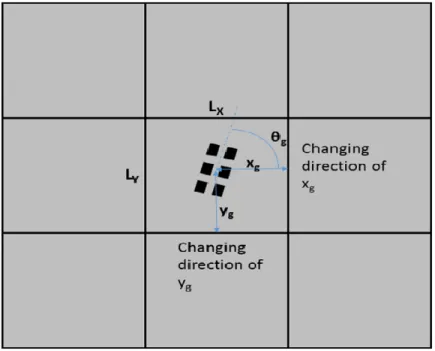
analyzed. Nine slabs with varying slab dimensions (Lx, and Ly), loading angle (θg) and gear
(a)
(b)
Figure 2.1 Accuracy improvement using different number of cases in the development of
Figure 2.2 Aircraft loading conditions
Table 2.1 Ranges of inputs used for FEAFAA batch runs
Inputs Range
Min Max
PCC Slab
Modulus GPa (psi) 20.7 (3×10⁶) 48.3 (7×10⁶)
Thickness cm. (in.) 25.4 (10) 61 (24)
Poisson Ratio 0.15 0.20
Granular Subbase
Modulus GPa (psi) 0.1 (15,000) 0.3 (50,000)
Thickness cm. (in.) 51 (20) 127 (50)
Poisson Ratio 0.35
Subgrade Modulus GPa (psi) 0.02 (3,000) (0.21) 30,000
Poisson Ratio 0.4
Slab Dimension m. (ft.) 6.1 (20) 9.1 (30)
Slab Number of Elements 30
Number of Slabs 9
Foundation Number of Elements 30
Loading Angle (deg.) 0 90
Temperature Gradient oC/cm. (oF/in.) 2.3
Thermal Coefficient 1/oC (1/oF) 7.4×10⁻⁶
(4.1×10⁻⁶)
12.9×10⁻⁶
(7.2×10⁻⁶)
ANN Model Development
ANN models were developed for both mechanical-load-only and simultaneous
mechanical and thermal load cases. For each case, both ‘approach 1’ and ‘approach 2’ were followed in the model development. In the ANN model development, a two-layer
feed-forward network was trained using a Levenberg-Marquardt algorithm (LMA) in the
MATLAB environment (MATLAB 2017).
Mechanical-Load-Only Case
The authors executed a batch run of 439 cases of B777-300ER gear loading (no
thermal load), from which they obtained the critical pavement responses required for
development of ANN models. The input variables defining the batch run set, with their
ranges, are given in Table 2.1.
Use of individual input parameters (approach 1)
As shown in Fig. 2.3, twelve input variables were used in the ANN model
development. Among these 12 input parameters, three represent the slab properties, three
represent pavement foundation properties, three represent loading location, two represent
slab size, and equivalent joint stiffness represents the joint stiffness properties of the
pavement system.
For the top-down cracking mode, stresses and deflections at the top of the slab
surface are of great interest, so critical pavement stresses and deflections at the top of the slab
surface were extracted for each case and used as outputs in the ANN model development.
The critical pavement responses used as individual outputs in the ANN model development
are as follows:
σxx, max, top-tensile
τxy,max, top
δ max
Where,
σxx, max, top-tensile = Maximum tensile stress in the x direction on top of the slab surface σyy,max, top-tensile = Maximum tensile stress in the y direction on top of the slab surface τxy,max, top = Maximum shear stress on top of the slab surface
δ max = Maximum deflection
Figure 2.3 Twelve individual input parameters used in the development of ANN models (mechanical-load-only case)
Fig. 2.4 shows the ANN network architecture employed in the model development.
The ANN network consists of twelve inputs, one hidden layer with 40 hidden neurons, and
one output layer. A separate ANN model was developed to predict each pavement response.
Therefore, one output layer showing the related pavement response to be predicted and the
Figure 2.4 ANN network architecture (individual input parameters, mechanical-load-only case)
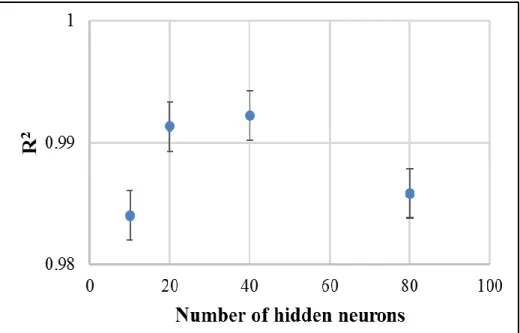
The choice of forty hidden neurons used in the hidden layer of the ANN network
architecture was made as a result of a sensitivity analysis conducted for that study. Using 500
samples for all input variables, ANN models were developed using 10, 20, 40 and 80 hidden
neurons. Fig. 2.5 shows the accuracy comparison of ANN models using different numbers of
hidden neurons. To eliminate any sampling problems, ten consecutive ANN models were
developed for each hidden neuron case. The variation in each case was quantified by the
standard deviation (Fig. 2.5). It was determined that 40 hidden neurons produced the highest
(a)
(b)
Figure 2.5 Accuracy comparison using different number of hidden neurons in the
development of ANN models in terms of (a) R2 and (b) MSE
Fig. 2.6 shows pavement response comparisons between the FEAFAA solutions and
For all pavement response types, in the ANN model development, 307, 66 and 66 cases were
used for training, testing and validation, respectively. For all pavement response types, ANN
models successfully replicated FEAFAA pavement response solutions. Validation and test
sets produced high accuracies comparable to the training set in all pavement response types.
This demonstrates the ANN models’ success in generalization (i.e., they did not memorize
the relationship) and so they are robust and valid.
(a) (b)
(c) (d)
Figure 2.6 FEAFAA solutions vs. ANN predictions for (a) σxx, max, top-tensile; (b) σyy, max,
top-tensile; (c) τxy, max, top; (d) δmax (individual input parameters, mechanical-load-only case)
Use of dimensional analysis (approach 2)
As mentioned previously, dimensional analysis has been used successfully in
Ioannides 2005; NCHRP 2003). Dimensional analysis has been evaluated in some FE based
pavement design and analysis applications such as ISLAB 2000 (Khazanovich 2001).
However, FEAFAA has certain unique features that no other available FE based pavement
design and analysis applications have. Among these are the use of “infinite” elements to
represent subgrades of infinite depth and a unidirectional spring element used for modeling
linear elastic joints between adjacent slabs. FEAFAA includes horizontal interfaces in its
three-dimensional model that meet the requirements of a full unbonded interface between the
slab and base course and a full bond at all other horizontal interfaces (Brill 1998). Most of
the available FE based applications have used the simplified Winkler foundation concept to
characterize the subgrade and the load transfer efficiency (LTE) concept for joints. These
unique features needed to be incorporated in the dimensional analysis.
In FEAFAA, an equivalent shear stiffness kjoint, characterizes the joint, in units of
force per relative vertical displacement per unit length of the joint. Joints were modeled in
such a way that they act as linear elastic springs between adjacent slabs, transmitting vertical
loads between adjacent slabs in shear through the joint. The shear force is assumed linearly
proportional to the relative vertical displacement between slabs (Hooke’s law) (Brill 1998).
A value for kjoint can be either input to FEAFAA directly or the software can calculate a value
from dowel bar diameter, dowel bar spacing and joint opening information. The range of
values for kjoint used in this study is shown in Table 2.1. In some previous studies, joints have
been characterized by the LTE concept and a dimensionless parameter of AGG/kl (explained
later in this paper) was used to represent joint behavior of the pavement (Ceylan 2002;
Ioannides 2005). However, for FEAFAA, kjoint has to be used in joint characterization and a
In FEAFAA, subgrade is modeled as an elastic solid; therefore, it is characterized by
elastic properties: the elastic modulus (Esubgrade) and Poisson’s ratio. In addition, the subgrade
is assumed to have infinite thickness.
Dimensionless parameters identified in the previous studies were analyzed to find out
whether they can also be used in this study. The dimensionless parameters identified in the
previous studies (Ceylan 2002; Ioannides 2005; NCHRP 2003) were as follows:
AGG/kl, xg/Lx, yg/Ly, a/l, Lx/l, Ly/l, l Where,
AGG = Aggregate interlock factor
k = Modulus of subgrade reaction
l = Radius of relative stiffness of the slab-subgrade system
xg = x-coordinate of applied gear load
yg = y-coordinate of applied gear load
Lx and Ly = Length and width of the slab
a = Radius of the applied load
Analyzing the parameters above, it was determined that AGG had to be replaced with
characterization of the subgrade. Since k cannot be used and k is included in radius of
relative stiffness (l) equation (Equation 2.3), this equation should be revised for this study.
Original ‘l’ equation is shown as lks, where ks stands for k value of the subgrade (s):
𝑙𝑘𝑠 = √ 𝐸 ℎ3 12 (1−𝜇2) 𝑘 4 (2.3) Where, h = Slab thickness E = Modulus of elasticity of PCC
µ = Poisson's ratio for PCC
Based on the previous studies and considering the input parameters used in FEAFAA, the following parameters were determined to be used in dimensional analysis.
• kjoint heff/Esubgrade l,
• xg/Lx, • yg/Ly, • a/l, • Lx/l, • Ly/l Where,
heff = Effective thickness of two
heff equation used (Khazanovich et al. 2001),
ℎ𝑒𝑓𝑓 = √ℎ𝑃𝐶𝐶3 +𝐸𝐵𝐴𝑆𝐸 𝐸𝑃𝐶𝐶 ℎ𝐵𝐴𝑆𝐸 3 3 (2.4) Where, hPCC =Slab thickness
hBASE =Base thickness
EPCC = Modulus of elasticity of PCC
EBASE = Modulus of elasticity of base
Original l equation (Equation 2.3) was revised to make all of the parameters
dimensionless by taking into account the physical meaning of the original equation. The
revised ‘l’ equation is shown in Equation 2.5 as ‘lEs’, where E stands for Esubgradeand
subgrade (s), respectively. Note that only difference between lEs and lks is that k and h in the
lks equation were replaced by Esubgradeand heff.
‘l’ equation used in dimensional analysis: 𝑙𝐸𝑠=√
𝐸 ℎ𝑒𝑓𝑓3
12 (1−𝜇2) 𝐸𝑠𝑢𝑏𝑔𝑟𝑎𝑑𝑒
3
(2.5)
The critical dimensionless pavement responses used as outputs in the ANN model development are as follows:
σxx, max, top-tensile × h2/P
σyy,max, top-tensile × h2/P
τxy,max, top × h2/P
δ max × Esubgrade × 𝑙𝐸𝑠 2 /P Where,
h = Slab thickness
P = Applied load (a combined weight on 6 wheels in one leg of the main gear of Boeing
B777-300ER)
Fig. 2.7 shows the ANN network architecture employed in the model development if
dimensional analysis is used in the model development. As can be seen in the figure, the
output layer. The main benefit of using dimensional analysis is that the ANN model is
developed with far fewer input parameters: only six input parameters are needed in
dimensional analysis (approach 2), compared to fourteen parameters when using individual
input parameters (approach 1). Using fewer input parameters can save considerable
computational time and other resources.
Figure 2.7 ANN network architecture (dimensional analysis, mechanical-load-only case)
Fig. 2.8 shows pavement response comparisons between the FEAFAA solutions and
ANN predictions for (a) σxx, max, top-tensile,(b)σyy, max, top-tensile, (c) τxy,max, top and (d) δmax,if
dimensional analysis is used in the model development. For all pavement response types, in
the ANN model development, 307, 66 and 66 cases were used for training, testing and
validation, respectively. For all pavement response types, ANN models successfully
Simultaneous Mechanical and Thermal Loading Case
The authors executed a batch run of 500 cases of combined mechanical and thermal
loading, from which they obtained the critical pavement responses required for development
of ANN models. The input variables defining the batch run set, with their ranges, are given in
Table 2.1.
(a) (b)
(c) (d)
Figure 2.8 FEAFAA solutions vs. ANN predictions for (a) σxx, max, top-tensile; (b) σyy, max,
top-tensile; (c) τxy, max, top; (d) δmax (dimensional analysis, mechanical-load-only case)
Use of individual input parameters (approach 1)
In this approach, all individual varied input parameters were used in ANN models as
input parameters. Fig. 2.9 shows the 14 input parameters that must be used in the ANN
mechanical and thermal load case and the mechanical-load-only case is the inclusion of two
variables to simulate thermal loading. The two additional variables are shown in Fig. 2.9 as
slab temperature properties.
Figure 2.9 Fourteen types of individual input parameters (simultaneous mechanical and thermal loading case)
The ANN network architecture consisted of 14 inputs, one hidden layer with 40
hidden neurons, and one output layer.
Fig. 2.10 shows pavement response comparisons between the FEAFAA solutions and
ANN predictions for (a) σxx, max, top-tensile,(b)σyy, max, top-tensile, (c) τxy,max, top and (d) δmax. For all
response types, 350, 75 and 75 cases were used for training, testing and validation,
respectively. Similar to the previous findings, for all pavement response types, ANN models
successfully reproduced FEAFAA solutions.
Use of dimensional analysis (approach 2)
The authors executed the feasibility of using dimensional analysis in the ANN model
development for the combined mechanical and thermal load case. The only difference
compared to the mechanical- load-only case is the inclusion of dimensionless parameter to
Korenev’s original dimensionless temperature gradient (Equation 2.6) has been successfully used to represent thermal loading (Khazanovich 2001).
𝛷 =2𝛼(1+𝜇)𝑙2 ℎ2 𝑘 𝛾𝛥T (2.6) (a) (b) (c) (d)
Figure 2.10 FEAFAA solutions vs. ANN predictions for (a) σxx, max, top-tensile; (b) σyy, max,
top-tensile; (c) τxy, max, top; (d) δmax (individual input parameters, simultaneous mechanical and thermal load case)
Equation 2.6 was revised to be applicable to FEAFAA as follows:
𝛷𝑚 = 2𝛼(1+𝜇)𝑙𝑚2
ℎ2
𝐸𝑠𝑢𝑏
Where,
α = Coefficient of thermal expansion
ΔT = Temperature difference through the slab thickness γ = Unit self-weight of PCC slab
h = Slab thickness
l= Radius of relative stiffness of the plate-subgrade system
μ = Plate Poisson’s ratio
k = Modulus of subgrade reaction
Esub = Subgrade elastic modulus
Including the dimensionless thermal gradient obtained through Equation 2.7 and other
parameters used for mechanical-load-only case, seven dimensionless parameters were
determined to be used as inputs in the ANN model development:
• kjoint/Esubgrade l, • xg/Lx, • yg/Ly, • a/l, • Lx/l, • Ly/l, • Φm
In that case, as the ANN network architecture, sixteen inputs, one hidden layer with
40 hidden neurons along with one output layer was used.
Fig. 2.11 shows pavement response comparisons between the FEAFAA solutions and
dimensional analysis is used in the model development. For all pavement response types, in
the ANN model development, 350, 75 and 75 cases were used for training, testing and
validation, respectively. Similar to previous findings, ANN models successfully reproduced
FEAFAA solutions for all pavement responses.
(a) (b)
(c) (d)
Figure 2.11 FEAFAA solutions vs. ANN predictions for (a) σxx, max, top-tensile; (b) σyy, max,
top-tensile; (c) τxy, max, top; (d) δmax (dimensional analysis, simultaneous mechanical and thermal load case)
Table 2.2 compares accuracy of the ANN models for predicting pavement responses.
Accuracy is expressed by the statistics R2 and MSE. All ANN models successfully predicted
pavement responses for both mechanical-load-only and combined mechanical and thermal
predicted pavement responses as accurately as those developed using individual input
parameters.
Table 2.2 Accuracy comparison of the ANN models in predicting pavement responses for different cases
Summary, Conclusions and Future Work
The FAA is seeking practical alternatives to running the 3D-FEM stress computation
that can reduce the time to give accurate stress predictions. Artificial intelligence (AI) based
alternatives such as artificial neural networks (ANNs) have great potential and have been
successfully used in pavement engineering to solve similar problems for decades.
This paper investigated the feasibility of developing ANN-based surrogate
computational response models or procedures (suitable for implementation in FAARFIELD
(Version 2.0)) that returns a close estimate of the top-down bending stress computed by
NIKE3D in rigid airport pavements. These models would enable faster 3D-FE computations
of design stresses in FAARFIELD (Version 2.0) making it suitable for routine design. To
develop these ANN models, FEAFAA, the FAA’s computer program for stand-alone 3D-FEM analysis of multi-slab rigid pavements, was used.
Loading Case Method
Accuracy - 𝑹𝟐 (𝑴𝑺𝑬)
σ
xx,max,
top-tensile
σ
yy,max,
top-tensile
τ
xy,max, top δmax
Mechanical-load- only case
Individual input parameters 0.995 (141) 0.980 (303) 0.995 (211) 0.998 (7.4x10⁻⁸) Dimensional analysis 0.996 (2.2×10⁻⁸) 0.996 (1.6×10⁻⁴) 0.998/ (1.6×10⁻⁴) 0.999 (8.7×10⁻³) Simultaneous mechanical and temperature load case Individual input parameters 0.996 (3,268) 0.994 (3,104) 0.994 (644) 0.997 (4.9×10⁻⁴) Dimensional analysis 0.999 (1.4×10⁻³) 0.999 (1.8×10⁻³) 0.999 (2.5×10⁻⁴) 0.999 (53)
To develop ANN-based surrogate computational response models, a synthetic
database consisting of FEAFAA input parameters and the associated critical pavement
responses was created. In the FEAFAA batch runs, two different loading cases were
considered and ANN models for these two cases were developed: mechanical-load-only and
simultaneous mechanical and temperature loading. During the ANN model development for
each loading case, two approaches were followed:
Use all individual input parameters as independent inputs in the development of ANN
models (approach 1)
Use dimensional analysis to reduce the number of inputs in the development of ANN
models (approach 2)
Specific conclusions of this paper are listed below:
ANN was found to be a promising alternative in returning very close estimates of the
top-down bending stress computed by NIKE3D in rigid airport pavements. By using the
ANN models, very accurate stress predictions can be produced in a fraction of time
compared to the significant amount of time needed to perform a 3D-FE computation. For
instance, stress predictions for thousands of cases can be predicted in seconds using ANN
models compared to days, if not months, using 3D-FE computation.
Dimensional analysis was found to be a promising method to reduce the input feature
space in ANN model development. It produced accuracies similar to those produced
using individual input parameters in the model development (see Table 2.2).
An advantage of using dimensional analysis in the development of ANN models is that it
significantly reduces the number of required input parameters. For example, six
pavement responses, compared to fourteen individual input parameters needed for
mechanical-load-only case.
Another advantage of using dimensional analysis in the development of ANN models is
that the use of these models can be extended for any types of pavements with the same
pavement layer configurations and the next generation aircraft with the same gear
configurations, if applicable. As long as the dimensionless parameters for the pavements
and the next generation aircraft cases are within the ranges that the ANN models were
developed, the models can be directly used for these pavements and aircraft without any
modification.
Future studies will focus on creating ANN models for other airplane types.
Acknowledgements
The authors gratefully acknowledge the Federal Aviation Administration (FAA) for
supporting this study. The contents of this paper reflect the views of the authors who are
responsible for the facts and accuracy of the data presented within. The contents do not
necessarily reflect the official views and policies of the FAA and Iowa State University. This
paper does not constitute a standard, specification, or regulation.
References
Autoit (2017). <https://www.autoitscript.com/site/autoit/> (Aug. 1, 2017).
Brill, D. R. (1998). Development of advanced computational models for airport pavement
design. FAA Report DOT/FAA/AR-97/47. Federal Aviation Administration (FAA), Washington, D.C., Available at: http://www.tc.faa.gov/its/worldpac/techrpt/ar97-47.pdf (accessed on May 18, 2015).
Brill, D. R. (2000). Field verification of a 3D finite element rigid airport pavement model.
FAA Report DOT/FAA/AR-00/33. Federal Aviation Administration (FAA), Washington, D.C.