University of Huddersfield Repository
Aboaisha, HosainThe Optimisation of Elementary and Integrative Content-Based Image Retrieval Techniques
Original Citation
Aboaisha, Hosain (2015) The Optimisation of Elementary and Integrative Content-Based Image Retrieval Techniques. Doctoral thesis, University of Huddersfield.
This version is available at http://eprints.hud.ac.uk/26164/
The University Repository is a digital collection of the research output of the University, available on Open Access. Copyright and Moral Rights for the items on this site are retained by the individual author and/or other copyright owners. Users may access full items free of charge; copies of full text items generally can be reproduced, displayed or performed and given to third parties in any format or medium for personal research or study, educational or not-for-profit purposes without prior permission or charge, provided:
• The authors, title and full bibliographic details is credited in any copy; • A hyperlink and/or URL is included for the original metadata page; and • The content is not changed in any way.
For more information, including our policy and submission procedure, please contact the Repository Team at: [email protected].
THE OPTIMISATION OF ELEMENTARY AND INTEGRATIVE
CONTENT-BASED IMAGE RETRIEVAL TECHNIQUES
HOSAIN ABOAISHA
A thesis submitted to the University of Huddersfield
in partial fulfilment of the requirements for
the degree of Doctor of Philosophy
School of Computing and Engineering
University of Huddersfield
P a g e 2 | 181
Copyright Statement
I. The author of this thesis (including any appendices and/or schedules to this
thesis) owns any copyright in it (the “copyright”) and he has given the University of Huddersfield the right to use such Copyright for any administrative, promotional, educational and/or teaching purposes.
II. Copies of this thesis, either in full or in extracts, may be made only in accordance with regulations of the University Library. Details of these regulations may be obtained from the Librarian. This page must form part of any such copies made.
III. The ownership of patents, designs, trademarks and any and all other intellectual property rights except for the Copyright works, for example graphs
and tables (“Reproductions”), which may be described in this thesis, may not be
owned by the author and may be owned by third parties. Such Intellectual Property Rights and Reproductions cannot and must not be made available for use without the prior written permission of the owner(s) of the relevant Intellectual Property Rights and/or Reproductions.
P a g e 3 | 181
Acknowledgements
First and foremost, I thank Allah (God) for granting me the ability to complete this research. Second, I would wish to convey my earnest gratitude to my academic supervisor Dr. Zhijie Xu, for his counsel and patience throughout this research. His advice was highly valued, particularly regarding the design and implementation of the system prototype. His constant encouragement greatly helped me to reach my destination.
Third, my thanks also go to Dr. Idris El-Feghi from the University of Tripoli, Libya, for his consultations and recommendations.
Fourth, many thanks to my office mate Dr. Jing Wang from the University of Huddersfield, UK, for enjoyable discussions and providing valuable information.
Fifth, I should also acknowledge my friend Mr. Ezzeddin Elarabi for his continuous support and encouragement during my study.
Last but not least, my thanks go to my family for their support and encouragement, and for their patience.
P a g e 4 | 181
Dedication
…
... ...I started this work before the revolt of the Libyan people against their tyrant. Now the revolution is over, I would like to dedicate this work to the souls of the
brave martyrs who have sacrificed their lives for their beloved country so that the word of Allah will always be up above.
P a g e 5 | 181
Abstract
...
Image retrieval plays a major role in many image processing applications. However, a number of factors (e.g. rotation, non-uniform illumination, noise and lack of spatial information) can disrupt the outputs of image retrieval systems such that they cannot produce the desired results. In recent years, many researchers have introduced different approaches to overcome this problem. Colour-based CBIR (content-based image retrieval) and shape-based CBIR were the most commonly used techniques for obtaining image signatures. Although the colour histogram and shape descriptor have produced satisfactory results for certain applications, they still suffer many theoretical and practical problems. A prominent one among them is the well-known “curse of dimensionality “.
In this research, a new Fuzzy Fusion-based Colour and Shape Signature (FFCSS) approach for integrating colour-only and shape-only features has been investigated to produce an effective image feature vector for database retrieval. The proposed technique is based on an optimised fuzzy colour scheme and robust shape descriptors.
Experimental tests were carried out to check the behaviour of the FFCSS-based system, including sensitivity and robustness of the proposed signature of the sampled images, especially under varied conditions of, rotation, scaling, noise and light intensity. To further improve retrieval efficiency of the devised signature model, the target image repositories were clustered into several groups using the k-means clustering algorithm at system runtime, where the search begins at the centres of each cluster. The FFCSS-based approach has proven superior to other benchmarked classic CBIR methods, hence this research makes a substantial contribution towards corresponding theoretical and practical fronts.
P a g e 6 | 181
List of Publications
Aboaisha, Hosain, Xu, Zhijie and El-Feghi, Idris (2012); An investigation on efficient feature extraction approaches for Arabic letter recognition. In: Proc.
Queen’s Diamond Jubilee Computing and Engineering Annual Researchers’
Conference 2012: CEARC’12. University of Huddersfield, Huddersfield, pp.
80-85. ISBN 978-1-86218-106-9.
Aboaisha, H., El-Feghi, I., Tahar, A., and Zhijie Xu (March 2011); Efficient features extraction for fingerprint classification with multilayer perceptron neural network, 8th Int. Multi-Conference on Systems, Signals and Devices, 2011, pp. 22-25.
Aboaisha, Hosain, Xu, Zhijie and El-Feghi, Idris (2010); Fuzzy Fusion of Colour and Shape Features for Efficient Image Retrieval. In: Future Technologies in Computing and Engineering: Proc. Computing and Engineering Annual Researchers' Conference 2010: CEARC’10. University of Huddersfield, Huddersfield, pp. 31-36. ISBN 9781862180932.
El-Feghi, I.; Aboasha, H.; Sid-Ahmed, M.A.; Ahmadi, M. (Oct. 2010)
“Content-Based Image Retrieval based on efficient fuzzy colour signature, IEEE
P a g e 7 | 181
List of Abbreviations and Notations
AF Average Feature
AR Aspect Ratio
CFSD Colour Frequency Sequence Difference CBIR Content-Based Image Retrieval
CCH Conventional Colour Histogram CSS Curvature Scale Space
DFT Discrete Fourier Transform DHMM Discrete Hidden Markov Model DIP Digital Image Processing FCH Fuzzy Colour Histogram
FFCSS Fuzzy Fusion of Colour and Shape Signature FDs Fourier Descriptors
LM Legendre Moments
OCR Optical Character Recognition OGs Orthogonal Moments
PCA Principal Component Analysis PZMs Pseudo-Zernike Moments
SAD Sum-of-Absolute Difference method
SPCA Shift-Invariant Principal Component Analysis SGDs Simple Global Descriptors
ZMs Zernike Moments
SVM Support Vector Machine TM Template Modification
P a g e 8 | 181
List of Figures
Figure 1-1 General Composition of CBIR Systems ... 19
Figure 2-1 CBIR Processes ... 30
Figure2-2 The Central Pixel with Surrounding Pixels (a) Brighter, (b) Equally Bright or (c) Darker ... 32
Figure 2-3 The Structure of iPure CBIR System (courtesy of Aggarwal and Dubey (2000))……… 43
Figure 2-4 Texture Features Extraction using Wavelet Transform ... 49
Figure 2-5 Representation of Fingerprint ... 53
Figure 2-6 Some Steps Required before Extracting Face Features ... 54
Figure 3-1 Representation of the Digital Image ... 64
Figure 3-2 Representation of RGB Colour Space ... 65
Figure 3-3 HSV Space ... 66
Figure 3-4 The Membership Function Describing the Relation between a Person’s Age and the Degree to which that Person is Considered Young ... 71
Figure 3-5 Two Representations of Membership Function of the Fuzzy Set that Represents “Real Numbers Close to 6” ... 72
Figure 3-6 A Triangular Membership Function ... 74
Figure 3-7 Triangular Membership Function �x, , , ... 74
Figure 3-8 Trapezoidal Membership Function �x, , , , ... 75
Figure 3-9 Gaussian Membership Function �- x-c σ ... 76
Figure 3-10 Generalized Bell Membership Function � x, , , = + x-ca b ………. ... 76
P a g e 9 | 181 Figure 3-11 Two Different Images which have Same Colour Histogram
Distribution………... . 78
Figure 3-12 Proposed FCH Technique Recognises the Difference between Romanian Flag and Chadian Flag ... 79
Figure 3-13 Hue Fuzzy Subset Centres ... 80
Figure 3-14 Saturation of RED Colour ... 81
Figure 3-15 Brightness Value Fuzzy Subsets of RED Colour ... 81
Figure 3-16 Representation Grey Level when R=G=B ... 82
Figure 4-1 The Classification of Shape Techniques ... 87
Figure 4-2 Example of Shape Detection by Converting an Original Image into Binary Image……….. 87
Figure 4-3 Shape Analysis Pipeline ... 89
Figure 4-4 Pixel-based Boundary Representations a) Outer contour; b) Inner contour………97
Figure 4-5 Examples of Convexity and Non-convexity ... 98
Figure 4-6 Examples of Shape Convexities... 98
Figure 4-7 Examples of Shape Eccentricity. ... 101
Figure 4-8 Examples of Solidity of Shapes. ... .102
Figure 4-9 Examples of Rectangularity ... 102
Figure 4-10 PZM Bases when n=4 ... 109
Figure 4-11 PZMs Bases when n=8 ... 110
Figure 4-12 (a) Object binary image, (b) Original image as a colour image ... 110
Figure 4-13 Differences between Original Image Representation ... 111
Figure 4-14 Sample of Set A1 Used to Test Scaling ... 113
Figure 4-15 Sample Images from Set B of MPEG-7 ... 114
P a g e 10 | 181
Figure 4-17 Samples of Sea Marine Fish from Set C, First Group ... 115
Figure 5-1 The Prototype Pipeline ... 119
Figure 5-2 Representation of the FCH Signature ... 120
Figure 5-3 Clustering Groups ... 127
Figure 5-4 FFCSS Signature Design ... 131
Figure 6-1 Recall and Precision for FCH and CCH for Different Databases ... 139
Figure 6-2 Selected Images for Testing FCH and CCH with Change in Light Intensity……… 140
Figure 6-3 Probability Density Functions for Salt and Pepper Noise ... 143
Figure 6-4 Probability Density with Mean Value 0.5 for both Salt and Pepper Noise……… 144
Figure 6-5 Results Obtained Using VARY Database... 145
Figure 6-6 Retrieval Results Obtained Using FCH and CCH with Database of Flags of 224 Countries ... 147
Figure 6-7 Retrieval Results Obtained Using FCH and CCH with the Author’s Own Database of Aboaisha Images ... 150
Figure 6-8 Query Image Used to Test Performance of the PZM Approach .. 151
Figure 6-9 Retrieved Results using PZM Technique with database MPEG7-set B………... 151
Figure 6-10 Query Image... 152
Figure 6-11 Presentation of the FCH Signature ... 153
Figure 6-12 Images Retrieved Using FCH Based CBIR ... 153
Figure 6-13 The Presentation of The PZM Signature ... 154
Figure 6-14 Images Retrieved Using PZM Descriptor ... 154
P a g e 11 | 181
List of Tables
Table 3-1 Properties of Fuzzy Sets ... 73 Table 5-1 Representation the Features of all 42 Bins ... 121 Table 6-1 NRS Values Obtained for Ten Query Images with Thirteen Levels of Relative Brightness for FCH and CCH. ... 142
P a g e 12 | 181
Table of Contents
Copyright Statement ... 2 Acknowledgements ... 3 Dedication…... ... 4 Abstract... ... 5 List of Publications ... 6List of Abbreviations and Notations ... 7
List of Figures ... 8
List of Tables ... 11
Table of Contents ... 12
Chapter 1. Research Background ... 17
1.1 Motivation ... 21
1.2 Aims and Objectives ... 22
1.3 Research Methodology ... 23
1.4 Thesis Structure ... 24
Chapter 2. Literature Review of Content- Based Image Retrieval ... 26
2.1 Introduction ... 26
2.2 Image Annotation... 27
2.3 CBIR Systems and Techniques ... 27
2.3.1 Texture Content-Based Image Retrieval ... 31
P a g e 13 | 181
2.3.3 Shape Content Based Image Retrieval ... 35
2.3.4 Hybrid Content Based Image Retrieval ... 39
2.4 Feature Extraction ... 45
2.4.1 Texture Feature Extraction ... 48
2.4.2 Colour Feature Extraction ... 49
2.4.3 Shape Feature Extraction ... 52
2.4.4 Domain Specific Features ... 53
2.5 Applications of CBIR ... 57
Chapter 3. Colour-Based CBIR ... 62
3.1 Introduction to Colour-Based CBIR ... 62
3.2 Colour Space ... 63
3.3 Conventional Colour Histogram (CCH) ... 68
3.4 Colour CBIR Component Based on Fuzzy Set Theory ... 69
3.4.1 Membership Function ... 73
3.5 Fuzzy Systems ... 77
3.5.1 Fuzzy Colour Histogram (FCH) ... 77
3.5.2 Subsets Centres (FCH) ... 80
3.5.3 Membership Function for FCH ... 82
Chapter 4. Shape-Oriented CBIR ... 85
4.1 Introduction ... 85
4.2 Shape Formation ... 86
P a g e 14 | 181
4.2.2 Shape Analysis ... 88
4.3 Flexible Shape Extraction ... 90
4.3.1 Landmark Points ... 90
4.3.2 Polygon Shape Descriptor... 90
4.3.3 Dominant Points in Shape Description ... 90
4.3.4 Active Contour Model Approaches ... 91
4.4 Segmentation... 92
4.4.1 Concept of Segmentation ... 92
4.4.2 Edge and Line Detection ... 93
4.5 Shape Feature Extraction ... 95
4.5.1 Introduction to Shape Descriptors ... 95
4.5.2 Shape Signatures ... 96
4.6 Boundary-Based Shape Descriptors ... 96
4.6.1 Simple Global Descriptor (SGDs) ... 96
4.6.2 Fourier Descriptor (FD) ... 99
4.6.3 Curvature Scale Space (CSS)... 99
4.7 Region-Based Shape-Retrieval Descriptors ... 100
4.7.1 Simple Global Descriptors (SGDs) ... 100
4.7.2 Invariant Moments ... 103
4.7.3 Hu Moments... 103
4.7.4 Zernike Moments (ZMs) ... 104
P a g e 15 | 181
4.7.6 Pseudo-Zernike Moments (PZMs) ... 107
4.7.7 PZM Descriptor Design ... 108
4.7.8 Moments-based Approaches and Their Pros-and-Cons ... 111
4.8 Evaluation of CBIR Based on Shape Features ... 112
4.9 Image Processing for Local Shape ... 115
Chapter 5. Fuzzy Fusion of Colour and Shape Signatures (FFCSS) ... 117
5.1 Image Database ... 117
5.2 Prototype Pipeline ... 118
5.3 Colour-Based CBIR Component ... 120
5.4 Shape-Based CBIR Components ... 122
5.5 Data Clustering and Indexing ... 125
5.6 Integration Rules for Mixing Colour and Shape Features ... 129
5.7 FFCSS Feature Extraction ... 131
Chapter 6. Experimental Results and Evaluation ... 133
6.1 Performance Measures of Query Results of FCH... 133
6.1.1 Recall and Precision ... 134
6.1.2 Lighting Intensity Test ... 139
6.1.3 Noise Test ... 143
6.2 Results and Discussion for FCH ... 144
6.3 PZM Descriptor Evaluation and Results... 150
6.4 FFCSS Prototype System ... 152
P a g e 16 | 181
6.6 FFCSS Results and Discussion ... 157
Chapter 7. Conclusions and Future Work ... 158
7.1 Conclusions ... 158
7.2 Future Work ... 161
References... ... 162
Appendix A: Representation of Pseudo-Zernike Moments (PZMs) ... 178
Appendix B: FCH Query Images and their Retrieval Results Comparing to the CCH Results... 179
P a g e 17 | 181
Chapter 1. Research Background
The continually increasing demands for multimedia storage and retrieval have promoted research into and development of various rapid image retrieval systems. Many applications such as anti-terrorism, policing, medical image databases, security data management systems are faced with having to acquire, store and access an ever growing number of captured digital images and video recordings. Research is needed to produce ever faster and more efficient processes and procedures.
The term information retrieval was first devised by Calvin Moores in 1951 based on (Gupta and Jain 1997). Generally, information retrieval is the description of a particular process by which a prospective user of information can process a
request for information into the useful collection of query “hints and clues” for data.
Generally, there are two kinds of image retrieval systems: First, text-based systems which were introduced in the 1970s. These systems use keywords to describe each image in a database of collected images, which often suffer from limitations such as: the subjectivity of the user, and the need for manual annotation. They also require significant amount of human labour to maintain the systems and the work is often tedious and painstakingly slow. This text-based approach is usually valid only for a single language (Yong, Huang et al. 1998). The second are the so-called content-based retrieval systems which are multimedia-based search engines used to retrieve desired images, audios, and even videos from large databases containing collections of higher dimensional
P a g e 18 | 181
data of varied formats. In this research the “content” is limited to images and their
related characteristics hence the name “content-based image retrieval” (CBIR).
The CBIR systems extract visual features based on such considerations as a study to image texture, colour, and shape patterns (El-Feghi, Aboasha et al. 2007).
Even though CBIR was first introduced in the 1980s it is still an active field in computer vision research and over the past two decades has been the one of the most active research areas in digital imaging (Yasmin and Mohsin 2012). CBIR is a technique which relies on the visual content features extracted from a query image such as texture, shape and colour to retrieve target images in terms of feature similarities from the image databases. The potential of CBIR was recognised after a number of successful applications such as facial recognition (Belhumeur, Hespanha et al. 1997; Gutta and Wechsler 1998) being published, and research into CBIR soon became widespread.
A group of researchers claimed that the concept of Query By Image Content (QBIC) proposed in the 1990s was the real start of modern CBIR systems (Flickner, Sawhney et al. 1995). One of the early QBIC systems was devised by researchers at IBM to interrogate large image databases, and the underlying algorithms used enabled the system to locate images within the database which have similarities with the sample images in the form of sketches, drawings, and colour palette. Virage is another outstanding commercial system for image retrieval (Bach, Fuller et al. 1996) and is capable of applying visual content features as primitives for face and character recognition.
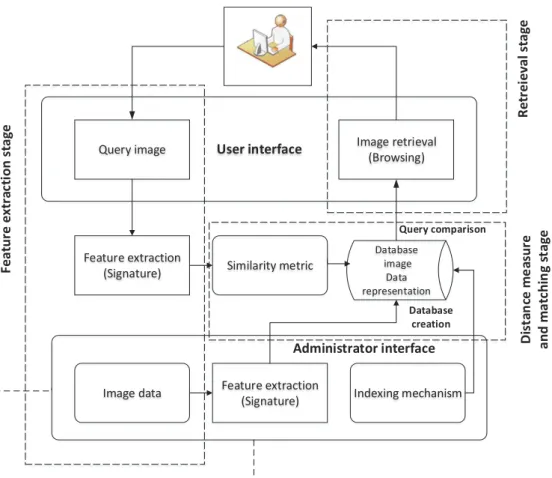
P a g e 19 | 181 The key in any effective image retrieval system is the feature representation scheme. Significant work has been done to identify visual features and their extraction methods (Cheng, Chen et al. 1998) (Laaksonen, Oja et al. 2000); (Jing, Mingjing et al. 2005). Most current CBIR systems engage three key processing stages as shown in Figure 1-1.
User interface Similarity metric Feature extraction (Signature) Database image Data representation Image retrieval (Browsing) Query image Indexing mechanism Image data Feature extraction
(Signature) Administrator interface R e tr e ie v a l st a g e F e a tu re e x tr a ct io n s ta g e D is ta n ce m e a su re a n d m a tc h in g s ta g e Query comparison Database creation
Figure 1-1 General Composition of CBIR Systems
The most challenging problem facing CBIR systems is the so called semantic
gap: “the lack of coincidence between the information that one can extract from
the visual data and the interpretation that the same date have for a user in a given situation” (Smeulders, Worring et al. 2000). That is the retrieval is of an image represented by low level visual data and without any high-level semantic interpretation. A set of low level visual features cannot always precisely represent high-level semantic features in the human perception. The essential issue in CBIR
P a g e 20 | 181 is that the user searches for semantic similarity, but the database can only reach homogeneity by data processing.
There are many conventional CBIR systems which have been widely used for general applications in image retrieval. Although, they have successfully produced good retrieval results in many applications, they still have major drawbacks (Qi and Han 2005):
1. They are too sensitive to visual signal distortion.
2. They have struggled to bridge the gap between low level features and
the user’s high level query semantics.
3. They are limited due to the lack of information about the spatial domain feature distribution.
In shape-based CBIR, discrimination power is required for a precise description, but when low level features are extracted these features usually lack the discrimination power required for accurate retrieval and this leads to inefficient retrieval performance (Kiranyaz, Pulkkinen et al. 2011).
There are five major approaches used to reduce the ‘semantic gap’ problem:
Ontology-based techniques which rely on qualitative definitions of key semantic concepts and g are suitable for relative simple semantic features. Machine learning is capable of learning more complex semantic characteristics and is relatively easy to compute if the application problem can be well modelled. The Relevance feedback techniques are powerful tools to refine query results through modifying existing query samples till the users are satisfied. In order to improve the retrieval accuracy of CBIR techniques, this project has been focusing on reducing the semantic gap by using the Relevance feedback approach. The
P a g e 21 | 181 FFCSS devised in this research bridges the gap between low level visual feature and high level semantic meaning through PZM iterations and the changing of moments parameters to satisfy users need. In the meantime, this research also focuses on the colour part of the object ontology through implementing the FCH method. Because the fuzzy membership function for weighting the colour
features is more efficient than conventional “precise” methods. The FFCSS
combines the advantages from both the Relevance feedback and object ontology for colour distribution, which leads to improved retrieval accuracy and speed. A new development in the field is called the Web Fusing that is considered as one of the state-of-the-art approaches in high image semantic level and its advantage stemmed from the vast knowledge pool on the Internet (Liu, Zhang et al. 2007).
CBIR techniques can be based on a single type of image features such as colours, shapes, or textures. Feature extraction using a single type of features is often inadequate. (Mianshu, Ping et al. 2010).
For bridging the gap between low level and high level concepts, advanced approaches are required and the techniques proposed in this research depend on the combination of different feature genres. Describing an image by combining multi-features is expected to give better results through enhancing the discrimination power of visual features to better interpret queries.
1.1 Motivation
CBIR is an attractive area of research because it is an active element of many important systems. In medical diagnosis imaging systems, where the medical
P a g e 22 | 181 database is growing extremely fast, the effective use of such an immense system needs efficient CBIR-based indexing and retrieval technologies.
CBIR in also needed to ease access to the huge databases of digital images available on the internet, as well as supporting the enormous volumes yielded by digital cameras and scanning machines, where text retrieval and manual indexing become tedious and time consuming, if at all possible.
Traditional single feature CBIR techniques are relative simple to implement. However, the conventional colour-oriented and shape-oriented CBIR standalone features struggled to bridge the gap between the pixel values and the meaningful interpretation of an image. For example the colour histograms of some images look the same statistically but are completely irrelevant semantically.
This research studies difficulties that occur when using just individual features and to demonstrate how integrating these features can result a more efficient search clause for CBIR.
1.2 Aims and Objectives
The main aims of this research can be summarised as follows:
To develop an efficient CBIR approach through the integration of fuzzy fusion of colour and shape features to produce superior performance on accuracy and speed over other conventional CBIR approaches.
To design a new optimised fuzzy colour histogram-based technique for extracting representative colour feature vectors (signature) in high performance searching.
P a g e 23 | 181 To harness the power of shape feature moments for retrieval robustness
in the presence of noise and variations.
1.3 Research Methodology
The general goal of this research is to investigate solutions to current CBIR problems through objectively and systematically analyse elementary and integrative CBIR techniques. The methodology follows in this context:
The problem identification process for this project starts with studying the challenges faces the CBIR application domain, including problem definition such as the problem of semantic gaps and curse-of-dimensionality. Then, the investigation moves on to how the proposed system would tackle the identified problems. The new methods are anticipated to add novel contributions to existing knowledge.
The research started by designing the first component of FFCSS, which is the FCH. By using fuzzy colour the so called curse of dimensionality can be avoided because the signature is compact by design.
The next stage of composition of the system was extracting the PZM descriptor feature and the orthogonal moments. PZM is used in this research because it has been successful applied to computer vision and pattern recognition.
The final stage was to merge FCH and PZM and link them together to define a strong and unified feature vector. There were many research methods used during the testing of the prototype system.
P a g e 24 | 181
1.4 Thesis Structure
This dissertation is composed of seven chapters arranged in the following order: Chapter 1- Research Background: introduces a brief of research background of CBIR and provides a summary of the proposed research contributions.
Chapter 2- Literature Review: reviews CBIR and current state-of–the-art techniques. An investigation of colour-based CBIR, shape-based CBIR and integration-based CBIR techniques are provided, and their advantages and limitations are discussed.
Chapter 3- Colour-based CBIR: provides an overview of colour-based CBIR concepts such as colour space, colour conversion and colour fuzzy techniques. A novel algorithm for computing the fuzzy fusion-based colour bins is presented, which relies on the fuzzy colour histogram.
Chapter 4- Shape-based CBIR: describes shape feature extraction, analysis, classification and segmentation. Several types of shape descriptor techniques are described. The pseudo-Zernike moments descriptor (PZM) which is the other vital component to build the proposed system (FFCSS) is introduced.
Chapter 5- Fuzzy Fusion of Colour and Shape Signature (FFCSS): introduces the prototype pipeline, design of FFCSS algorithms, and evaluation databases.
Chapter 6- Experimental Results and Evaluation: presents the evaluation of the results for FCH component, PZM component alone, and the final fusion FFCSS prototype. To examine the correctness and robustness of the proposed system, the FCH and PZM and the FFCSS systems are compared and how the FFCSS outperforms the FCH and PZM is described.
P a g e 25 | 181 Chapter 7- Conclusions and Future Work: summarises the dissertation with a discussion of proposed algorithms and framework. The possibility of extension work is also discussed.
Appendix A- Representation of Pseudo-Zernike Moments: illustrates the computation of PZM in different levels.
Appendix B- Fuzzy Colour Histogram Algorithm and Results: shows the different query images for FCH and their retrieval results.
P a g e 26 | 181
Chapter 2. Literature Review of Content-
Based Image Retrieval
2.1 Introduction
With the rapid growth of digital devices for capturing and storing multimedia data, multimedia information retrieval has become a major research topic with image retrieval as one of the key challenges. In digital image processing and image retrieval systems, CBIR is an area of interest and has been applied widely in many computerised image applications (Hoi, Lyu et al. 2006). CBIR was first developed in the early 1990s to overcome the problems of the time-consuming manual-based image annotation approach. The image annotation was used to describe images in words and through searching process the user search word to bring similar text and corresponding image to that description. Although it is easy to build, it faces many challenges and it will discuss in Section 2.2.
The continuing rapid growth and enormous volume of the image collection databases in media technology demands more accurate search and retrieval approaches, since conventional database searches based on textual queries can, at best, provide only a partial solution to the problem. Database images are often not annotated with textual descriptions, and the vocabulary needed to describe
the user’s concept is not known to the user or may not exist. Moreover, a particular
image can rarely be defined by a unique description. Thus, recently there has been immense activity in building direct content-based image search engines.
P a g e 27 | 181 In CBIR, the image can be represented using visual features such as colour, texture, and shape or by combining different features. The features of all images in the database are extracted and compared with query image (Aggarwal, Ashwin et al. 2002). For any problem in CBIR, the solution starts from the image analysis and feature definition, the goal is to minimise the data and information which are not important, so that the redundant information can be neglected. The first task in any image analysis process is to select the criteria for identifying key information.
2.2 Image Annotation
Image annotation is defined as describing an image using a text format. Automatic image annotation or image classification is an important area in the field of machine learning and pattern recognition. Retrieval systems have traditionally used manual image annotation for indexing and responding to a query by retrieval from the image collection. These image collections are groupings of items, often documents or images. In image digital libraries, this designates all the works included, usually selected based on a collection management plan.
Manual image annotation suffers from several drawbacks. It is invariably tedious work, especially in large databases. It is also an expensive and labour intensive procedure, and it is limited to one language and is subjective to the user (Rahman, Desai et al. 2006).
2.3 CBIR Systems and Techniques
The term “content based image retrieval” (CBIR) was first used by (Kato 1992) to
describe how to retrieve images automatically, based on the features of their contents. During the last two decades, valuable progress has been achieved
P a g e 28 | 181 through research into both the theoretical and practical aspects of CBIR, and the literature shows a variety of approaches to describing images based on their content.
CBIR is considered an image search mechanism which can retrieve desired
images relevant to the user’s query from a large collection of images in a
database. CBIR search techniques are sometimes denoted as query-by-image-content (QBIC) and the best known commercial CBIR approach was proposed and prototyped by IBM (Flickner, Sawhney et al. 1995), where a number of algorithms are deployed to allow users to form query clauses by combining multiple features such as colour, textures, and shapes.
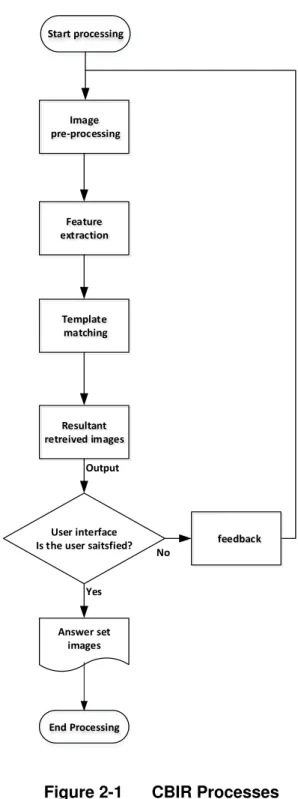
CBIR operates on a different principle, retrieving stored images from a collection by comparing features automatically extracted from the query image with the targeted image sets. The commonest features used are statistical measures of colour, texture or shape. CBIR processes can be divided into five stages as illustrated in Figure 2-1.
The fundamentals stages of CBIR processes are:
A first step which often requires segmentation, removal of image noise, and the conversion of the images into appropriate colour models.
The second step is feature extraction, where the visual signals are often transformed into one or two dimensional vectors. In most cases, those features are coded texture, colour, and shape descriptors (El-Feghi, Aboasha et al. 2007).
P a g e 29 | 181 The third step is the actual retrieval of images. This consists of template
matching where chosen features are used as matching tools and criteria for weighting the most similar images.
The aforementioned processes in general explore the algorithmic ability to compute dissimilarities - distance measures - between the query image and the images in the database.
There is a large quantity of research and discussion concerning this development. Generally speaking, the signatures of an image should have two significant characteristics; it must be as representative of the image as possible; and it must be of reasonable dimensions. These two characteristics are essential to an accurate retrieval system in order to avoid the so-called a curse of dimensionality that incurs excessive computational cost (Smeulders, Worring et al. 2000).
Yong, et al. (1997) proposed a technique for converting image signatures in the image processing domain to a weighted signature in the information retrieval domain. This technique is unlike previous CBIR approaches, which were based only on image processing, but here the system, named the Multimedia Analysis and Retrieval System (MARS) was based on exploring the approach in both image processing and information retrieval. Yong, et al. also applied the relevance feedback technique from the information retrieval domain to assess retrieval results. MARS attempted to close the gap between high-level and low-level visual features and to reduce the subjectivity of the user through refining the
user’s query automatically at a feedback stage. It is considered as one of the first image retrieval approaches to apply a relevance feedback.
P a g e 30 | 181 Image pre-processing Feature extraction Template matching Resultant retreived images feedback Output User interface Is the user saitsfied?
End Processing Answer set images Yes No Start processing
Figure 2-1 CBIR Processes
It also integrated two techniques to improve the retrieval process:
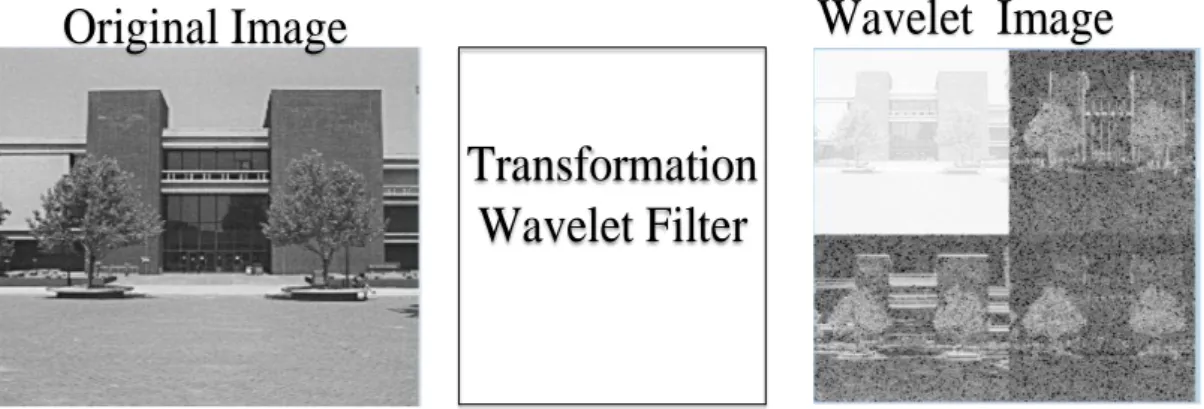
Firstly, obtain the features vector, convert the feature vector to a weighted vector and then use relevance feedback to evaluate the retrieved results. To extract a feature, Wavelet representation was used. The system receives a given image and a wavelet filter transferred that image into co-correlated sub-region. The feature extraction of orientation and scale of the original image is taken sub-region
P a g e 31 | 181 by sub-region. Then the co-occurrence matrix representation approach used to extract texture features. Next the wavelet and co-occurrence feature vectors are combined to produce multiple components of both features as feature vectors.
2.3.1 Texture Content-Based Image Retrieval
The ability to retrieve images on the basis of texture similarity may not seem very useful, but can often be important in distinguishing between areas of images with similar colour histograms (such as sky and sea, or leaves and grass). A variety of techniques have been used for measuring texture similarity. The most established ones rely on comparing values of what are known as second-order statistics calculated from the query and stored images.
Essentially texture measures calculate the relative brightness of selected pairs of pixels from each image. From these it is possible to calculate measures of image texture such as the degree of contrast, coarseness, directionality and regularity (Tamura, Mori et al. 1978), or periodicity, directionality and randomness (Liu and Picard, 1996). Alternative methods of texture analysis for retrieval include the use of Gabor filters (Manjunath and Ma 1996). Texture queries can be formulated in a similar manner to colour queries, by selecting examples of desired textures from a palette, or by supplying an example query image. The system then retrieves images with texture measures most similar in value to the query. A recent extension of the technique is the texture thesaurus developed by Manjunath and Ma (1996). This method retrieves texture regions in images on the basis of similarity to an automatically-derived “codebook” representing important classes of texture within the collection.
P a g e 32 | 181 The local pattern is considered to be one of texture as obtained by the CBIR technique, and this is considered similar to human perception. The well-known method used to describe local patterns is called a texture spectrum (histogram of all local patterns) and was first presented by He and Wang. This method is based on the idea of reducing the grey scales into three classes and counting all possible intensity patterns in a 3x3 window frame. The grey level value of the central pixel is compared with each of its eight neighbours. Each of the eight pixels is assigned the value 0 if its grey level value is less than the central value, 1 if the value is greater than central pixel and 2 if the pixels are of are equal value. The central pixel itself is not given any value and by using this method the number of grey levels is minimised to 3. The probability of possible combination is 38 =6561, and each pattern takes a value between 0 to 6561. Figure 2-2(a) shows the central pixel with all surrounding pixels brighter, whereas figure 2-2(b) illustrates the situation where the central and eight surrounding pixels are of equal brightness, and figure 2-2(c) depicts the patterns when all eight surrounding pixels are darker than the central pixel.
2 2 2 1 1 1 0 0 0
2 2 1 1 0 0
2 2 2 1 1 1 0 0 0
(a) (b) (c)
Figure2-2 The Central Pixel with Surrounding Pixels (a) Brighter, (b) Equally Bright or (c) Darker
Local contrast variations can be obtained using horizontal and vertical stripes instead of only light and dark spots which are compared with the central pixel. Jalaja and colleagues described several useful features such as surrounding contrast (SC) to describe any set of stripe patterns around the central pixel. These researchers used an alternating contrast (AC) texture feature to calculate the
P a g e 33 | 181 occurrence frequency of any local pattern. Then they measured the frequency of occurrence by using local horizontal contrast and vertical contrast. The results showed that the contrast texture feature has benefits over other texture CBIRs. The pattern combinations were extended to a maximum possible of 324, with each pattern taking a value of between 0 to 324.
2.3.2 Colour Content-Based Image Retrieval
Several methods for retrieving images on the basis of colour similarity have been described in the literature (Yabuki, Matsuda et al. 1999; Seaborn, Hepplewhite et al. 2005; Falomir, Martí et al. 2010) but often are variations of the same principle. Each image added to a collection is analysed and a colour histogram computed which shows the proportion of pixels of each colour within the image. The matching technique most commonly used, histogram intersection, was first developed by (Swain and Ballard 1990).
The colour histogram for each image is stored in the database. At search time, the user can either specify the desired proportion of each colour (75% olive green and 25% red, for example), or submit an example image from which a colour histogram is calculated. Either way, the matching process retrieves those images whose colour histograms match those of the query to within specified limits. Variations of this technique are now used in a high proportion of current CBIR
systems. Methods of improving on Swain and Ballard’s original technique include
the use of cumulative colour histograms (Pass, Zabih et al. 1997) combining histogram intersection with some element of spatial matching (Lazebnik, Schmid et al. 2006), and the use of region-based colour querying (Carson, Belongie et al. 1997).
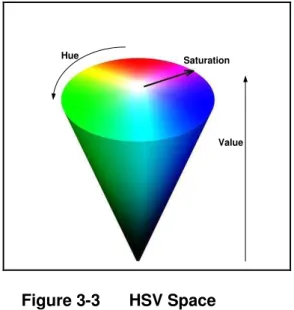
P a g e 34 | 181 The colour histogram serves as an effective representation of the colour content of an image. The colour histogram is easy to compute and effective in characterising both the global and local distribution of colours in an image. In addition, it is robust to translation and rotation about the view axis and changes only slowly with scale, occlusion and viewing angle. This is a very effective method if the colour pattern is unique compared with the rest of the data set. Any pixel in the image can be described by three components in a given colour space (for instance, red, green, and blue components in RGB space, or hue, saturation, and value in HSV space). The distribution of the number of pixels for each quantised bin, can be defined for each component and a corresponding histogram produced. Clearly, the more bins a colour histogram contains, the stronger discrimination power it has. However, a histogram with a large number of bins will not only increase the computational cost, but will also be inappropriate for building efficient indexes for image databases (Jung Uk, Seung-Hun et al. 2007).
Zhenhua and colleagues (2009) proposed a new method of colour feature extraction that depends on colour frequency. They used the HSV colour model instead of the RGB model because the RGB is suitable for display but is not appropriate for human perception (Zhang and Lu 2004). Thus the first step in their process is to change from RGB to HSV and complete the representation phase. Next is the colour quantisation process to reduce the number of distinct colours and this should be completed before feature extraction. The colour frequency sequence difference (CFSD) was proposed to solve problems associated with the colour histogram such as high dimensionality of signature which leads to high computation requirements. These researchers used scalars to describe the colour feature of an image. Then the CFSD technique is integrated with
P a g e 35 | 181 information entropy. Every image has a specific value of entropy but one value of entropy can apply to more than one image. Their experimental results showed outstanding accuracy of retrieval. The colour histogram is easy to calculate but faces several challenges such as the curse of dimensionality even with quantisation of the colour space. By using the CFSD method, the curse of dimensionality can be alleviated.
2.3.3 Shape Content Based Image Retrieval
In CBIR applications, shape features highlight local and global spatial distributions of the image patterns. Those shapes are defined by 2-D regions obtained from low-level pixel colour and distribution features, which are groups of connected image pixels sharing similar colours or textures. Generally speaking, the idea of image shapes is based on images appearing to share the same properties in the real world image scene defined by human vision systems, which is judged by human brains as geometric/affine invariant, noise/occlusion resistant and motion independent (Yang, Kpalma et al. 2008) .
Unlike texture, shape is a fairly well-defined concept and there is considerable evidence that natural objects are primarily recognised by their shapes (Biederman 1987). A number of characteristics of object shape are computed for every
identifiable “item” within each stored image. Queries are then activated by
comparing the same set of features from the query image, and retrieving those stored images whose features most closely match those of the query.
Two main types of shape feature are commonly used – global features such as aspect ratio, circularity and moment invariants (Wei, Li et al. 2009). Niblack et al. considered local features such as sets of consecutive boundary segments
P a g e 36 | 181 (Mehrotra and Gary 1995). Alternative methods proposed for shape matching have included comparison of directional histograms of edges extracted from the image (Jain and Vailaya 1998).
Queries to shape retrieval systems are formulated either by identifying an example image to act as the query, or a user-drawn sketch (Kato, Kurita et al. 1992). Shape matching of 3-D objects is a more challenging task particularly where only a single 2-D view of the object in question is available. While no general solution to this problem is possible, some useful attempts have been made into the problem of identifying at least some instances of a given object from different viewpoints. One approach has been to build up a set of plausible 3-D models from available 2-D images, and match them with models already in the database (Chen and Stockman 1990). Another is to generate a series of alternative 2-D views of each database object, each of which is matched with the query image as done by (Shokoufandeh, Dickinson et al. 2002). Related research issues in this area include defining 3-D shape similarity measures (Shum, Hebert et al. 1996).
To develop an improved shape feature-based method for querying image databases, the Pseudo Zernike Moment (PZM) was adopted as a shape feature vector. To characterise shape features there are many approaches such a chain code, invariant moments, Fourier descriptors and the Zernike moment. In addition, statistical techniques to extract shape features are commonly used in pattern recognition due to their precise nature in computation and their inclusion of global and local features of the image.
As an example of shape detection, (Yong-Xianga, Cheng-Minga et al. 2007) proposed a new technique for object contour tracking of images of fruit based on
P a g e 37 | 181 the chain code descriptor. They used the chain code for feature extraction as one of the contour tracking methods because of its simplicity, effectiveness and accuracy, and less storage of data is needed. The properties of the applied chain code include circumference, graph perimeter height and width. At the beginning, the pre-processing of the image is as follows: first image enhancement is used to improve the quality of the grey-scale image to obtain the binary image. Next step in the segmentation relies on the grey level threshold. The small non-connected regions are deleted as noise. Now the target binary image is ready for contour extraction. After the contours of the image of the fruit have been extracted using a graph contour tracking method, the next step is for the chain code to compute relevant characteristics and features of the fruit.
Shape feature extraction is considered as most powerful feature in CBIR with which to extract meaningful information (Choras 2007). Although colour and texture features are used in analysing the fundamental apparent-based features images, the shape feature is more effective when dealing with detecting objects in binary images. There are many approaches used to extract shape features. The chain code technique is simple to implement and requires less storage.
Another application associated with shape CBIR, is a new multi-view based ear signature extraction technique developed by (Heng and Jingqi 2007; Liu, Zhang et al. 2007). The ear is rich in geometric features and using just a single frontal view of an ear image has proved adequate for most recognition tasks but there is still scope for improvement. Using a multi-view image-based reconstruction method that uses side, front and rear views of the ear makes the discrimination
power much stronger. The first component in Liu’s technique is a sampling system
P a g e 38 | 181 lighting. The idea behind this is to avoid the effect of affine transformation on the ear shape. The second stage uses Tchebicef radial polynomials to obtain high-order invariant moments of the ear. These geometric shape features are extracted from both front and rear views of the ear including length, area and width. Liu and his colleaugues have used a neural network for the Principle Component Analysis (PCA). PCA is a statistical algorithm for converting a set of features of correlated variables into a set of linearly independent vectors, or uncorrelated parameters and these parameters are called the principal components. The uncorrelated variables should be fewer than or equal to the original correlated variables hence reduce the feature vector dimensions.
The coming steps of the PCA algorithm can be summarised as (Moore 1981); Extract the feature matrix from the data and the feature vector is
represented by the columns of the matrix.
Compute the covariance for whole matrix to obtain linear independence between the properties.
Obtain the eigenvalues by calculating the characteristic determination. Obtain the converting feature for orthogonal linear transformation.
Orthogonal moments are commonly used for pattern recognition. The most famous of the orthogonal moments are the Zernike moment (ZM) and Legendre Moment (LM). Although ZM and LM are extensively used for pattern recognition, they belong to the continuous moments category and this may cause error and loss of precision when the order of the moments increases and moment transformations required. An important advance in shape CBIR came in 2006 when Wang and colleagues successfully combined two types of orthogonal
P a g e 39 | 181 moments: the Tchebichef and the Krawtchouk (Xianmei, Yang et al. 2006). They used discrete time Hidden Markov Model (HMM) to combine these orthogonal moments.
In the training phase they applied pre-processing steps including noise removal, linearisation and boundary determination. The next stage was the feature extraction stage which is transferring of a 2-D image into a 1-D vector. Then the recognition stage which is measuring the distance between the 1-D vectors. Wang and his colleagues divided their research into two main parts. First, a theoretical investigation of the Ktawchouk and Tchebichef moments. In the second part, they concentrated on the integration of discrete orthogonal moments and features of DHMMs for recognition of off-line handwritten Chinese. The proposed technique has demonstrated outstanding accuracy in retrieval, better results than conventional HMM recognition, but processing speed is rather low.
2.3.4 Hybrid Content Based Image Retrieval
The idea behind combining image features is to overcome such problems as semantic gap, complexity of segmentation and when two different objects have the same distribution of colour. A single feature may not adequately describe an image, and this suggests that a series of features may be the best way to represent an image. For example, (Liu, Jia et al. 2008) presented a new CBIR method for integrating colour and texture. They demonstrated that using more than one single feature improved performance of the retrieval process. As signatures they extracted the HSV colour histogram, the co-occurrence matrix as texture feature, and the moment invariant as shape feature. Unlike the single
P a g e 40 | 181 visual feature approach that can describe only parts of the image content, using a fusion of low-level features can improve retrieval.
Another example of feature integration-based CBIR by (Shahbaz Khan, Anwer et al. 2012) proposed the use of colour attributes to describe colour presentation and distributions for object recognition. Object recognition often engages the process of detecting an object and its location accurately to yield a robust object recognition system (Aslandogan and Yu 1999). Commonly shape features are used for object recognition but Aslandogan and Yu used colour as well because the use of colour attributes is more efficient and compact, and when integrated with the shape features increases the system reliable. Their algorithm was evaluated by using the Pascal Visual Object Classes (VOC) database (Everingham, Van Gool et al. 2010). This method is easy to implement and shows high performance.
Another popular CBIR system is Virage which was released by Alta Vista in the 1990s to facilitate image searching as its counterpart from Yahoo-Excalibur. The most prominent rivalry of these systems is VisualSEEK, which was developed by Columbia University and released in 1996, which introduced a novel approach for image searching by using visual features from collections of image databases (Smith and Chang 1996). It resulted in a computer program that combines spatial query techniques with image indexing. The regional colours and their distributions are located, after that the technique seeks the images that include the most similar sequences of similar regions. It is claimed that this process is similar to
P a g e 41 | 181 Each image is divided into regions which have feature properties: firstly using a system of colour representation using colour sets, and secondly spatial features such as location and size. This is done for each separate region. Images are checked for similarity by comparing the relationship between their regions. The system assesses queries that provide colour, size and spatial layout and of arrangement of colour regions. (Chang, Chen et al. 1997) also considered several special issues about spatial query layout such as: capsulation and overlap of regions. They found VisualSEEK used a completely different approach to colour histograms and mean colour, because the approach used by VisualSEEK uses salient image regions and their associated colours and locations, to compare images. This combination of image contents and their spatial features leads to the benefit of using several colour and special queries and makes the searching query a powerful search.
Another popular system is Photobook (Pentland, Picard et al. 1996). Photobook directly searches the contents of the image through the use semantics-preserving image compression, with the advantage that it reduces the images to a set of perceptually significant coefficients. The semantics-preserving query searching depends on two important conditions: firstly, the search has to be efficient enough to be more interactive because the searching which is required long time to process just only one image is useless. Secondly, the ability to search should be a similarity metric for comparing image features or shapes. Pentland et al., introduced three types of photobook description: the search based on appearance, a second based on textural features and the third used 2-D shapes. These three approaches were designed by the Massachusetts Institute of Technology (MIT). The photobook is an interactive tool that allows the user to
P a g e 42 | 181 browse and search the content of images in large databases. This technique uses the query tool to search for the content of images and does not rely on text image annotation. Pentland, et al. used regional colours and their relative locations for segmentation.
The MARS system (Yong, Huang et al. 1997) was also popular in the 90s because it has a wide variety of query methods based on integrations between the image regions, their colour and spatial information.
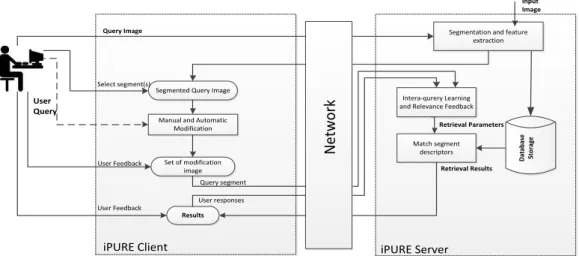
Aggarwal and Dubey (2000) proposed an efficient system called iPURE standing for Perceptual and User-friendly Retrieval. It attempted to include the subjectivity of the user during the retrieval process by utilising the then novel idea of intra-query modification and learning. The devised system yields an objective level view of the query image using an effective colour segmentation approach. The estimation of user perception is extracted from the user feedback. The feedback consists of successive iterations and this leads to improved precision in searching the database, hence reducing the overheads of searching and downloading. Comparing this system to others showed that iPURE outperformed most other CBIR systems. For example, in the VisualSEEK system, the user is restricted to manual manipulation of the global features of the image while the iPURE technique adjusts retrieval results automatically. In comparison, QBIC relies on user query assignment of different weighting properties, such as shape, colour and texture, where the assignment is not an easy task even for experts with significant knowledge of the features in the database. Figure 2-3 illustrates the structure of the iPURE CBIR system.
P a g e 43 | 181 Segmentation and feature
extraction Da ta b a se Sto ra g e Intera-qurery Learning and Relevance Feedback
Match segment descriptors
User Query
Segmented Query Image
Manual and Automatic Modification Set of modification image iPURE Server iPURE Client Results User Feedback Retrieval Parameters Ne tw o rk Query segment User responses User Feedback Select segment(s) Query Image Input Image Retrieval Results Ne tw o rk
Figure 2-3 The Structure of iPure CBIR System (courtesy of Aggarwal and
Dubey (2000))
Several studies in archaeology and history have focused on extracting character patterns from degraded historical documents. Many researchers use character pattern retrieval (CPR) to enhance the degraded historical documents. (Takakura, Kitadai et al. 2010) presented a similarity evaluation of Chinese character pattern to detect missing shape parts. They used historical documents to obtain 4911 Chinese character patterns called Kanji. They used feature extraction of patterns as the key and retrieved the most similar character from the archives as follows: The first step was to implement a feature matrix. In their approach they created a shape feature repository of the Chinese patterns using the chain code technique. The pixels were scanned to obtain non-liner characteristics. They applied a 3x3 pixel character pattern series for character recognition and acquired four different orientations of chain code features. Then, the next step was using the chain code to perform the contour tracking.
They then defined the 4 directional windows using an 8x8 grid Gaussian function for each direction. The distinctive features for a single Chinese character were recorded in a 64x4 matrix. However, there were still problems in the sampling
P a g e 44 | 181 stage due to missing character sections, which was overcome by extracting the
average colour from the “non-grey zones” and embedding the average colours
into the missing sections. For further improvement, they proposed another method, called Template Modification (TM). This method does not create feature matrices of the template in the grey level. They used the binary image of the Chinese character pattern instead of using colour and grey scales because the historical documents (Mokkans) are too noisy to apply the gradient features of CPR. They improved the similarity evaluation method by proposing a feature extraction method based on simple presentation of gradient features, which had shown better repeatability than the chain code method on the trade-off of small degradations in retrieval accuracy.
In 2011, (Selvarajah and Kodithuwakku 2011) proposed a hybrid approach which combined texture and colour features for improving retrieval performance. They explored the colour histogram moment and used Discrete Wavelets Transform (DWT) to present a new approach that combined both colour and texture features. The DWT was selected because it can yield multi-resolution features of a discreet wavelet and simplifies the estimation of the edge of objects.
The process was; initially a 2-D DWT was computed through decomposing the given image into two sub-bands: the lower frequency band and the higher frequency band. The authors completed a three-level discrete wavelet transformations and explored 10 wavelet coefficients. They took 10 sets of measurements and then obtained the mean and standard deviation of the horizontal, vertical and diagonal data spreads. They then computed the histogram colour moments by using the mean and standard deviation of the horizontal, vertical and diagonal of the 10 coefficients. Then for the similarity measurement
P a g e 45 | 181 they used the Sum-of-Absolute Differences (SAD) method for block matching of images. At system runtime, users submit a query image to the system for feature extraction, and then the feature set is compared to all image features in the database against a customisable threshold for determining the retrieval results. By using this fusion approach, more information on multi-resolution level can be encapsulated and utilised.
All approaches described above have limitations over sensitivity issues such as
noise, image distortion, and struggled to bridge the gap between the user’s high
level semantic concepts and the low level image features.
As a consequence, a number of techniques such as spatial colour, colour correlogram, and colour coherence vector have been introduced in many CBIR systems to alleviate the shortcomings by using spatial information to find a special range of colour distribution in more details in spatial domain (Huang, Kumar et al. 1997; Rao, Srihari et al. 1999; Suryani and Guojun 2003). These approaches concentrate on the human perception and lead to the so-called semantic-based image retrieval. The conception is that the user defines the association of visual contents with semantic meanings of regions or objects.
2.4 Feature Extraction
Feature extraction is defined as the transformation of the content of an image into
a suitable feature space. The process is one of obtaining the image’s “signature vectors” that extract and preserve the measures of characteristics of interest such
as texture. The features of an image can be categorised into two groups; general-purpose features and domain-specific features. The most used general-general-purpose features are texture, colour and shape. Examples of domain-specific features
P a g e 46 | 181 often arise with special applications such as electronic pulses recorded from remote sensing devices, and volumetric scanning data from medical devices.
The two main requirements that are desired in any signature vector are discrimination power and the size of feature vector. The feature vectors should have the ability to represent all image details and the discrimination power is a way to uniquely describe an image and distinguish it from other visually similar images. The main aim of feature extraction is to establish appropriate and suitable feature vectors (signatures) that encapsulate the most meaningful and important information about the examined objects. It is one of the core processes in all pattern recognition systems.
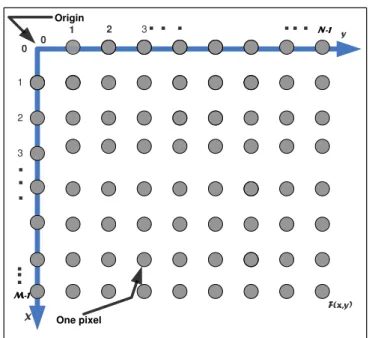
In digital image processing (DIP) systems, the feature selection rules need to be justified with great care (El-Feghi, Tahar et al. 2011). Any digital images can be represented by a 2D grid of pixels. Thus, for classifying and recognising the properties of individual or groups of pixels, feature “descriptors” are often used, which are usually just a set of numbers in predefined formats and ranges. From this point of view, the studied subject patterns can be compared and recognised by matching the descriptors of an object against the extracted descriptors from unknown objects. For evaluating the retrieved results, effective descriptors should have four properties:
They should be able to determine a complete feature set; thus two objects or regions should have identical descriptors if they are of the same shape. They should be based predominately on invariant properties to ensure
P a g e 47 | 181 They should be of moderate dimension. As such, the descriptors will only
take into account unique and meaningful feature information for distinguishing different objects. Any redundant information should be removed to make the feature descriptor as compact as possible, and to avoid the curse-of-dimensionality.
They should be descriptive or congruent. That is, similar objects can be recognised if, and only if they have similar descriptors.
Based on the literature review carried out in this project, most of today’s
recognition systems only take into account subsets of these four criteria (Nixon and Aguado 2008). There are two types of feature extraction methods that have been deployed in these developed systems, the low-level-based and high-level feature-based strategies. Low-level features are well studied and can be extracted automatically from an image through statistical means such as a colour histogram, lines and corners. High-level feature methods are concerned with
finding “shapes” in spatial terms that are often heavily influenced by pattern sizes
and orientations (Liu, Zhang et al. 2007).
There are many semantic features such as colour layout and textures which are based on the basic characteristics of the images. Features in general can be categorised in three classifications, depending on their description methods.
Low-level features: are the visual features such as colour or texture that can be obtained using computer vision approaches.
Intermediate level features: obtained when segmentation techniques are applied to extract interest regions and can be fully automated by computer programs.