Methylation Matters in Child Development: Toward
Developmental Behavioral Epigenetics
Marinus H. van IJzendoorn,
1Marian J. Bakermans-Kranenburg,
1and Richard P. Ebstein
21
Leiden University and
2Hebrew University and National University of Singapore
ABSTRACT—Child development might be conceptualized as experiences becoming sculpted in the organism’s DNA through methylation, one of the major epigenetic mecha-nisms of change. This article introduces some of the basic biological mechanisms of methylation, discusses research on animal models, and highlights some of the most impres-sive methylation studies on human development. Although assessment of methylation levels still is under debate, saliva-derived methylation might tremendously enhance the opportunities for noninvasive epigenetic studies on child development. It seems worthwhile to add methyla-tion to the G·E equation to fully appreciate the effects of the environment on child and adult functioning. KEYWORDS—methylation; attachment; child development; parenting; trauma; nurture
How is it possible that one twin of a monozygotic twin pair devel-ops cancer or depression and the other twin remains free of phys-ical or mental illness? The answer is simple: If identphys-ical twins have spent large part of their adult lives exposed to different environments, they are not identical anymore. Their genome undergoes epigenetic (Greek epi = ‘‘above’’ the genome) modifi-cations that affect gene expression without actually changing the sequence of the DNA letters.Epigeneticscan be defined as the
study of biochemical modifications of the DNA influencing gene expression without altering the structural base-pair sequence itself. The epigenome is not a stable entity but, instead, dynami-cally interacts with the environment. Although changes in struc-tural DNA sequences (mutations) occur rarely during the life course, epigenetic changes resulting in permanent alterations in gene expression, including silencing of genes, occur more fre-quently than was ever imagined. Child development might be conceptualized as experiences becoming sculpted in the organ-ism’s DNA through methylation, one of the major epigenetic mechanisms of change.
Fraga et al. (2005) discovered substantial epigenetic ences between aging monozygotic twins that led to rather differ-ent behavioral and health profiles. They focused on a widely studied epigenetic mechanism, namely, the silencing of genes by methylation. Epigenetic differences turned out to be larger with growing age and more divergent life experiences. Martin (2005) labeled this phenomenon ‘‘epigenetic drift.’’ An example of epi-genetic drift is that of a 3-year-old monozygotic twin pair who has about 1,000 genes with differential gene expression, whereas a 50-year-old twin pair shows more than 5,000 differently expressed genes (Fraga et al., 2005). Hence, the environment has a major impact on expression across the genome, not only in utero and during the first few years after birth but throughout development (Meaney, 2010).
Here, we argue that child development defined as the dynamic interplay between the environment and the individual child is mediated by a series of epigenetic modifications of specific genes resulting in stable and persistent changes in physiology, cogni-tion, emocogni-tion, and behavior. Methylation and other epigenetic changes (such as histone acetylation) constitute the molecular mechanism by which the environment affects the physiology and behavior of the developing child and development becomes liter-ally embodied in environmentliter-ally induced signatures on the epi-genome. Sweatt and colleagues (Sweatt, 2009) showed that the transfer of learning experiences to long-term memory in rats is
MJBK and MHvIJ were supported by awards from the Netherlands Organization for Scientific Research (MJBK: VIDI Grant 452-04-306, VICI Grant 400-04-182; MHvIJ: SPINOZA prize).
Correspondence concerning this article should be addressed to Marinus van IJzendoorn, Leiden University, Wassenaarseweg 52, 2333 AK Leiden, Leiden, The Netherlands; e-mail: vanijzen@fsw. leidenuniv.nl.
ª2011 The Authors
Child Development Perspectivesª2011 The Society for Research in Child Development DOI: 10.1111/j.1750-8606.2011.00202.x
supported by changes in methylation patterns in hippocampal and other cortical regions. Embodiment of experiences takes place through methylation-dependent changes in gene expres-sion, producing the proteins and enzymes required for signal transfer, storage, and retrieval.
GENETICS AND EPIGENETICS
The double helix of DNA (built from the four nucleotides cyto-sine, thymine, guanine and adenine) is a specific, meaningful sequence in gene coding regions that contains instructions for the production of specific proteins (Ebstein, Salomon, Chew, Zhong, & Knafo, 2010). It is the structural part of the genome, which is relatively stable across the individual’s lifetime and, through inheritance, across generations. Before the discovery of the double helix DNA structure, the termepigenetics was coined by Waddington (1942) to indicate the transformation of the geno-type into a phenogeno-type. Nowadays, epigenetics refers to biochemi-cal modifications of the DNA influencing gene expression without altering the DNA sequence itself (Tamashiro & Moran, 2010). Whereas evolutionary adaptations of the structural gen-ome to changing environments would take numerous generations depending on the strength of selection, epigenetic adaptations occur immediately at any point in an organism’s life course. Epi-genetic change starting from fertilization onward both accounts for differentiation of tissues and cells and allows a flexible response to environmental challenges and changes throughout the lifespan.
Epigenetic regulation of gene expression underlies embryonic development and explains how, although each body cell contains the same sequences of DNA, cells differentiate at some point from one another. For example, neurons in the hippocampus sup-port memory, whereas in the adrenal gland other, cells produce cortisol. Specialization of cell functioning is created by an orchestration of silencing some genes and expressing others, depending on the role the cell plays in the reproduction and adaptation of the body (Zhang & Meaney, 2010).
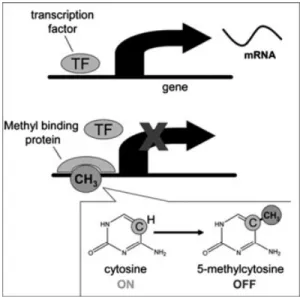
Methylation of DNA is one of the most widely studied epige-netic means of gene silencing (Tamashiro & Moran, 2010). A methyl molecule (CH3) is covalently linked to cytosine (at CpG
sites). CpGs are grouped in clusters called ‘‘CpG islands,’’ and, in mammals, 60%–90% of the CpG islands are methylated (Jeltsch, 2002). When methylation occurs in gene-promoter regions, gene expression is altered. Methylated CpG islands attract capping proteins that, in turn, hinder access to the gene for transcription factors that induce gene expression (see Figure 1, derived from Zeisel, 2007). Methylation thereby serves as a kind of cork on a bottle of champagne: It down-regulates potentially ubiquitous gene expression (the ‘‘bubbles’’) and ulti-mately limits the level of protein that the specific gene encodes. Once CpG islands are methylated, the methylation pattern is faithfully reproduced each time the gene is copied; thus, the effects of methylation are preserved. In the medical sciences,
methylation and other epigenetic processes are central to the study of cancer and its treatment, because hypermethylation of growth-inhibiting genes may be one of the causes of cancerous growth (Esteller, 2008; Szyf, 2010).
ANIMAL MODELS
An impressive example of environmental influences on DNA methylation and subsequent phenotypical characteristics can be found in the agouti gene in mice. With a certain variant of the agouti gene, normally black mice display a yellow coat, along with obesity and tumorigenesis. But if a specific regulatory area of the gene (AvyIAP) is methylated, for example, because of a methyl-rich diet, its expression is blocked, resulting in a regular black, nonobese phenotype. Most remarkably, this methylation pattern and its associated phenotype are inherited by the next generation (Dolinoy, 2008). Maternal dietary supplementation with genistein, the major isoflavone present in soy, shifts the coat-color distribution of Avy⁄a offspring toward pseudoagouti (brown). Notably, the phenotype change is accompanied by changes in six CpG sites within AvyIAP, protecting these ani-mals from the adverse effects of this allele. On the basis of these animal experiments, it has been suggested that a soy-based methyl-rich diet, such as is common in Asian populations, might—through methylation—protect these populations against certain types of cancer.
Intergenerational transmission of epigenetic changes has also been demonstrated in rats. In an ingeniously designed set of experimental and cross-fostering studies, Meaney, Szyf, and their colleagues (Weaver et al., 2004; Zhang & Meaney, 2010) showed that rodent maternal behavior toward offspring (licking and
Figure 1. DNA methylation silencing gene expression. Methylation attracts capping proteins that hinder access to the gene for the transcription factors that normally turn on gene expression and formation of messenger RNA (mRNA; Zeisel, 2007).
grooming and arch-back nursing) resulted in long-term changes in responses of the offspring to stress. These changes reflected permanently altered methylation patterns affecting the expres-sion of the glucocorticoid receptor gene (Szyf, Weaver, Cham-pagne, Diorio, & Meaney, 2005), with consequences for the next generation’s parenting behavior and stress regulation (Cham-pagne, 2008; Meaney & Szyf, 2005). Pharmacological treatment (infusion of methionine into the lateral ventricle) of male off-spring raised by highly sensitive mothers reversed the epigenetic change and resulted in exploratory behavior similar to offspring of neglectful mothers (McGowan, Meaney, & Szyf, 2008).
Low-quality maternal care affects not only the pups’ stress physiology but also their brain morphology, in a way that on the face of it seems disadvantageous (lower neural density) but that actually enhances learning and memory processes under stress-ful conditions. The early experience of ‘‘neglect’’ thus prepares the individual optimally for the stressful life that is to be expected (Champagne, 2008). Another type of prenatal program-ming was found in growth-related genes of children conceived during the Dutch famine in the winter of 1944 (the period of Ger-man occupation), preparing these children for a life of hardship and food scarcity (Heijmans, Tobi, Lumey, & Slagboom, 2009; Heijmans et al., 2008). It is important to note that methylation is notgoodorbadin itself—it is an environmentally primed adap-tation that may or may not be adaptive to future environments (in the case of the children conceived during the Dutch famine, e.g., the abundant nutritional environment of the postwar years led to increased prevalence of cardiovascular disease in adulthood).
Suomi, Szyf, and colleagues studied methylation patterns in rhesus monkeys raised by their mother or in a nursery (S. Suomi, personal communication, March 9, 2010; Szyf, 2010). This dif-ference in rearing condition was comparable to the highly sensi-tive versus neglectful parenting in Meaney’s rat model, with similarly large differences in phenotypical behavior and stress regulation patterns. Rearing condition of the rhesus monkeys radically affected methylation level of numerous genes, not only in cells taken from the prefrontal cortex but also in T lymphocyte cells (white blood cells that are involved in immunity responses of the organism). Higher as well as lower methylation levels were observed in the nursery-raised monkeys, and most striking was the genome-wide absolute difference in methylation patterns between the two groups in both brain- and blood-derived DNA (S. Suomi, personal communication, March 9, 2010; Szyf, 2010). Extreme rearing conditions might be reflected not only in decreased or increased methylation of DNA in cells located in the brain but also in the blood and may be other parts of the body. Hence, peripheral cells and their methylation patterns might in some situations be a good proxy for what is going on in the brain.
A MOVE TO HUMAN DEVELOPMENT
Translating effects of studies on rodents to human beings is attractive, but it should be realized that a pup’s development is
not isomorphic with human development and that the all-over experimental round-the-clock control of the animals’ environ-ment is both impossible and unthinkable with humans. However, in a groundbreaking quasi-experimental study of human suicide victims with or without certified child maltreatment and a matched comparison group, Meaney’s team (McGowan et al., 2009) recently demonstrated epigenetic reprogramming that pre-sumably occurred in the postnatal period in humans.
The authors carefully selected the brains of deceased individ-uals stored in the Quebec Suicide Brain Bank and, on the basis of psychological autopsies, matched suicide victims with and without a history of abuse on psychiatric disorders, such as depression. They also selected age- and gender-matched victims of sudden, nonsuicidal death. One of their remarkable findings was that glucocorticoid receptor gene expression in the hippo-campus of suicide victims was decreased through methylation (which in rat studies is known to reduce the sensitivity of the crucial feedback loop whereby circulating cortisol down-regu-lates the HPA axis, thus preventing deleterious effects of this hormone) butonly in the group with abuse experiences, not in the suicide group without abuse or in the comparison group. The altered glucocorticoid receptor gene expression affects stress reg-ulatory functioning, with increased risk for psychopathology as a result. Thus, in a manner similar to that of the rodent model, family life can change set-points of the human stress system by affecting gene expression.
In a similar vein, Keller et al. (2010) found that, compared to postmortem samples of the Wernicke area of nonsuicide con-trol subjects, similar brain samples from suicide subjects showed higher levels of DNA methylation specifically in the brain-derived neurotrophic factor promoter IV, which plays a key role in growth and repair of neural connections in the brain. How-ever, genome-wide methylation levels were comparable among the subjects. Unfortunately, in this study, early life experiences such as abuse or prenatal maternal depression were not taken into account. Oberlander and his colleagues (Devlin, Brain, Aus-tin, & Oberlander, 2010; Oberlander et al., 2008) showed that prenatal maternal depression affects methylation patterns of the SLC6A4 promoter encoding the transmembrane serotonin trans-porter and of the GR glucocorticoid receptor gene involved in cortisol stress responses. Thus, prenatal exposure to maternal depression may ‘‘program’’ child development through epigenetic processes.
In addition, in a series of studies on the Iowa adoptee sample, it was shown that early abuse experiences have epigenetic conse-quences for dealing with later adversity. Methylation status of the 5HTT promoter associated CpG islands was related to reports of abuse during childhood (Beach, Brody, Todorov, Gunter, & Philibert, 2010), and expression levels of the transporter were inversely related to the degree of methylation depending on the promoter genotype (Philibert et al., 2007). The idea that methyl-ation may be a biological basis for the impact of adverse experi-ences on human psychological development (e.g., Yehuda &
Bierer, 2009) was further supported by the finding that higher levels of methylation in the 5HTTLPR were associated with increased risk of unresolved responses to loss or other trauma in carriers of the usually protective 5HTTLPRllvariant (van IJzen-doorn, Caspers, Bakermans-Kranenburg, Beach, & Philibert, 2010).
For humans, conditions of chronic poverty may, in fact, be a close approximation of the constant manipulation of the environ-ment used in research with rats or rhesus monkeys (Hackman, Farah, & Meaney, 2010). Unfavorable socioeconomic conditions in early life are related to up-regulation of genes that convey adrenergic signals to leukocytes, and down-regulation of genes related to the glucocorticoid receptor. Through this epigenetic mechanism, low early-life socioeconomic status (SES) may lead to increased susceptibility to infectious and cardiovascular dis-eases, even when later SES, lifestyle practices, and perceived stress are controlled (Miller et al., 2009). This was demonstrated in a study that followed 1,131 graduates of Johns Hopkins Medi-cal School over 40 years and found that in this group of highly educated, affluent physicians, low early-life SES conferred a 2.4-fold increase in the risk of incident coronary heart disease by age 50 years (Kittleson et al., 2006).
CAVEATS
Human behavioral epigenetics is an emerging field still in its earliest stage. Only a handful of studies on epigenetics in human behavioral development have been reported thus far, and a myriad of basic measurement issues still have to be addressed.
The stability of methylation across time is one of the critical unknowns in the epigenetics equation. Wong et al. (2010) mea-sured DNA methylation across the promoter regions of the dopa-mine receptor 4 gene (DRD4), the serotonin transporter gene (5HTTLPR), and the monoamine oxidase A gene (MAOA) using DNA sampled in monozygotic twin pairs at both 5 and 10 years of age. They confirmed methylation differences between twin pairs at age 5 but found disappointingly low stability of methyla-tion levels from 5 to 10 years of age, at least in 5HTTLPR and MAOA. Methylation of DRD4 showed more stability. In contrast, Talens et al. (2010) recently reported rather high stability figures for CpG methylation in selected regions derived from blood as well as buccal cells, even across a large timespan of 20 years. Because Wong et al. did not systematically assess changes in the environment, it is unclear whether methylation instability was a reflection of the changing environment. In their study, little evidence was found for heritability of methylation levels, sug-gesting that methylation patterns are indeed epigenetic phenom-ena and represent environmental signatures.
Another measurement issue is the comparability of methyla-tion levels assessed in DNA from various parts of the body. If only brain tissue provides adequate insight into the effects of methylation on brain functioning, methylation studies on living human beings’ psychological development are seriously limited
(McGowan et al., 2009). Basic questions are whether and to what extent methylation levels in DNA derived from saliva, blood, or brain tissue are comparable, and whether the functional implica-tions of these methylation levels are the same. Currently epige-neticists are divided about this issue (Brennan et al., 2009; Philibert et al., 2007, Philibert, Caspers, Beach, Bakermans-Kranenburg, & van IJzendoorn, in press). Suomi’s findings of comparable genome-wide methylation differences between mother versus nursery-reared rhesus monkeys in the prefrontal cortex and in T lymphocytes seem to point to white blood cells as adequate proxies for what happens in the brain, at least in a global way (S. Suomi, personal communication, March 9, 2010; Szyf, 2010). In their study of DNA methylation, Talens et al. (2010) compared the methylation levels of candidate loci in blood and buccal cells and found that for half of the loci tested, DNA methylation measured in blood was a strong marker for that in buccal cells. Across the eight loci studied, the average corre-lation amounted to .65. Buccal cells as a source of methycorre-lation information in humans would, of course, greatly enhance the opportunities for noninvasive epigenetic studies on child devel-opment. But prospective researchers of epigenetics should be aware of the fact that, for some time to come, it will remain far more difficult and expensive to conduct methylation studies than it is to collect, extract, and genotype structural DNA sequences. Behavioral scientists, however, could still play crucial roles in epigenetic studies, bringing sound theory and methodological expertise on measuring behavioral and environmental factors to addressing the numerous outstanding epigenetic questions in child development.
PROSPECTS AND SPECULATIONS
Traditional behavioral and molecular genetics are based on the assumption of an invariable genotype and a largely irrelevant (shared) environment. Monozygotic twins, however, are not iden-tical phenotypically, especially regarding pathological behaviors, and the expression of genes is continuously in flux, presumably reflecting an ever changing internal as well as external environ-ment. Epigenetic studies make clear that the environment pene-trates the genome at its core, and influences the expression or nonexpression of genes. Gene · Environment interactions have been interpreted as the genetic moderation of environmental influences on child development. From an epigenetics perspec-tive, environmental pressures are hypothesized to regulate levels of methylation along specific genes. Hence, it seems worthwhile to add methylation to the G ·E equation to fully appreciate the effects of the environment on child and adult functioning (see Figure 2). In fact, the findings of our study on methylation and unresolved trauma might be cast in terms of G ·M·E where M stands for methylation status (van IJzendoorn et al., 2010).
Differential genetic susceptibility is defined as the varying susceptibility of individuals with specific genotypes to both nega-tive and posinega-tive environments, for betterandfor worse (Belsky,
Bakermans-Kranenburg, & van IJzendoorn, 2007). For example, we found meta-analytic evidence for the moderation by dopa-mine-related gene polymorphisms of the associations between negative and positive rearing environments and developmental outcomes in children. Children with the less efficient dopamine-related genes did worse in negative environments than the com-parisons without the ‘‘genetic risk,’’ but they also profited most from positive environments (Bakermans-Kranenburg and van IJzendoorn, 2011).
How does DNA methylation fit into this model of differential susceptibility? Dopamine-system genes such as DRD4 show rather high levels of methylation, a moderate stability across time, and no heritability of liability to methylation (Wong et al., 2010). The evidence on the heritability of methylation still is prelimin-ary, and genes involved in the methionine metabolism may be relevant despite lack of convincing evidence from twin studies. The potential absence of heritability, however, would refute the idea that some individuals are genetically more easily subjected to methylation than others and therefore might be more open to the environment, for better and for worse. A possible mechanism might be prenatal methylation, causing some individuals to be prenatally programmed in a way that makes them postnatally more liable to respond negatively to adversity (e.g., see Ober-lander et al., 2008). However, if these individuals are postnatally exposed to positive environments, demethylation might occur rather quickly and lead to more optimal development in response to the enhanced quality of the child-rearing environment.
TOWARD DEVELOPMENTAL BEHAVIORAL EPIGENETICS
The application of epigenetics to the study of child development is a fascinating next step in unraveling the intricate interplay between rearing environment and the child’s genome. Prime among the new questions to be addressed are those concerning intergenerational transmission of epigenetic changes (Franklin & Mansuy, 2010; Meaney, 2010) and the reversibility of DNA methylation in children through psychosocial intervention (Bakermans-Kranenburg, van IJzendoorn, Pijlman, Mesman, &
Juffer, 2008; Cicchetti, Rogosch, & Toth, 2006; Dozier, Albus, Fisher, & Sepulveda, 2002) or pharmacological treatment (Nara-yan & Dragunow, 2010). From an epigenetic perspective, divisions between genes, brain, and behavior are artificial, as the environment becomes embodied in the epigenome. It is the epigenomic modified DNA sequence that results in protein syn-thesis, which, in turn, canalizes development. In fact, to a large extent, nature is nurture. Methylation matters if one wants to understand how the early environment leaves its lasting imprint on the child.
REFERENCES
Bakermans-Kranenburg, M. J., & van IJzendoorn, M. H. (2011). Differential susceptibility to rearing environment depending on dopamine-related genes: New evidence and a meta-analysis.
Development and Psychopathology,23, 39–52.
Bakermans-Kranenburg, M. J., van IJzendoorn, M. H., Pijlman, F. T., Mesman, J., & Juffer, F. (2008). Experimental evidence for differential susceptibility: Dopamine D4 receptor polymorphism (DRD4 VNTR) moderates intervention effects on toddlers’ externalizing behavior in a randomized controlled trial.
Developmental Psychology,44, 293–300.
Beach, S. R. H., Brody, G. H., Todorov, A. A., Gunter, T. D., & Philibert, R. A. (2010). Methylation at SLC6A4 is linked to family history of child abuse: An examination of the Iowa adoptee sample. American Journal of Medical Genetics Part B,
153B, 710–713.
Belsky, J., Bakermans-Kranenburg, M. J., & van IJzendoorn, M. H. (2007). For better and for worse: Differential susceptibility to environmental influences. Current Directions in Psychological Science,16, 300–304.
Brennan, E. P., Ehrich, M., Brazil, D. P., Crean, J. K., Murphy, M., Sadlier, D. M., et al. (2009). Comparative analysis of DNA methylation profiles in peripheral blood leukocytes versus lymphoblastoid cell lines.Epigenetics,4, 159–164.
Champagne, F. A. (2008). Epigenetic mechanisms and the transgenerational effects of maternal care. Frontiers in Neuro-endocrinology,29, 386–397.
Cicchetti, D., Rogosch, F. A., & Toth, S. L. (2006). Fostering secure attachments in infants in maltreating families through preventive interventions.Development and Psychopathology,18, 623–649. Devlin, A. M., Brain, U., Austin, J., & Oberlander, T. F. (2010). Prenatal
exposure to maternal depressed mood and the MTHFR C677T variant affect SLC6A4 methylation in infants at birth.PLoS ONE,
5, e12201. 1–8.
Dolinoy, D. C. (2008). The agouti mouse model: An epigenetic biosensor for nutritional and environmental alterations on the fetal epigenome.Nutrition Review,66(Suppl. 1), S7–S11.
Dozier, M., Albus, K., Fisher, P. A., & Sepulveda, S. (2002). Interventions for foster parents: Implications for developmental theory.Development and Psychopathology,14, 843–860.
Ebstein, R. P., Salomon, I., Chew, S. H., Zhong, S., & Knafo, A. (2010). Genetics of human social behavior.Neuron,65, 831–844. Esteller, M. (2008). Epigenetics in cancer. New England Journal of
Medicine,358, 1148–1159.
Fraga, M. F., Ballestar, E., Paz, M. F., Ropero, S., Setien, F., Ballestar, M. L., et al. (2005). Epigenetic differences arise during the lifetime Figure 2. The influence of the environment on the phenotype is
moderated not only by genes but also by methylation (G·M·E, where M stands for methylation status).
of monozygotic twins. Proceedings of the National Academy of Science,102, 10604–10609.
Franklin, T. B., & Mansuy, I. M. (2010). Epigenetic inheritance in mammals: Evidence for the impact of adverse environmental effects.Neurobiology of Disease,39, 61–65.
Hackman, D. A., Farah, M. J., & Meaney, M. J. (2010). Socioeconomic status and the brain: Mechanistic insights from human and animal research.Nature Reviews Neuroscience,11, 651–659.
Heijmans, B. T., Tobi, E. W., Lumey, L. H., & Slagboom, P. E. (2009). The epigenome. Archive of the prenatal environment.Epigenetics,
4, 526–531.
Heijmans, B. T., Tobi, E. W., Stein, A. D., Putter, H., Blauw, G. J., Susser, E. S., et al. (2008). Persistent epigenetic differences associated with prenatal exposure to famine in humans. PNAS,
105, 17046–17049.
Jeltsch, A. (2002). Beyond Watson and Crick: DNA methylation and molecular enzymology of DNA methyltransferases.ChemBioChem,
3, 274–293.
Keller, S., Sarchiapone, M., Zarrilli, F., Videticˇ, A., Ferraro, A., & Carli, V. (2010). Increased BDNF promoter methylation in the Wernicke area of suicide subjects.Archives of General Psychiatry,67, 258– 267.
Kittleson, M. M., Meoni, L. A., Wang, N.-Y., Chu, A. Y., Ford, D. E., & Klag, M. J. (2006). Association of childhood socioeconomic status with subsequent coronary heart disease in physicians.Archives of Internal Medicine,166, 2356–2361.
Martin, G. M. (2005). Epigenetic drift in aging identical twins.PNAS,
102, 10413–10414.
McGowan, P. O., Meaney, M. J., & Szyf, M. (2008). Diet and the epigenetic (re)programming of phenotypic differences in behavior.
Brain Research,1237, 12–24.
McGowan, P. O., Sasaki, A., Dymov, S., LaBoonte´, B., Turecki, G., Szyf, M., et al. (2009). Epigenetic regulation of the glucocorticoid receptor in human brain associates with childhood abuse.Nature Neuroscience,12, 342–348.
Meaney, M. J. (2010). Epigenetics and the biological definition of Gene ·Environment interactions.Child Development,81, 41–79. Meaney, M. J., & Szyf, M. (2005). Maternal effects as a model for
environmentally-dependent chromatin plasticity. Trends in Neuroscience,28, 456–463.
Miller, G. E., Chen, E., Fok, A. K., Walker, H., Lim, A., Nicholls, E. F., et al. (2009). Low early-life social class leaves a biological residue manifested by decreased glucocorticoid and increased proinflammatory signaling.PNAS,106, 14716–14721.
Narayan, P., & Dragunow, M. (2010). Pharmacology of epigenetics in brain disorders.British Journal of Pharmacology,159, 285–303. Oberlander, T. F., Weinberg, J., Papsdorf, M., Grunau, R., Misri, S., &
Devlin, A. M. (2008). Prenatal exposure to maternal depression, neonatal methylation of human glucocorticoid receptor gene
(NR3C1) and infant cortisol stress responses.Epigenetics,3, 97– 106.
Philibert, R., Caspers, K., Beach, S. R. H., Bakermans-Kranenburg, M. J., & van IJzendoorn, M. H. (in press). Reply.Biological Psychiatry. Philibert, R. A., Madan, A., Anderson, A., Cadoret, R., Packer, H., &
Sandhu, H. (2007). Serotonin transporter mRNA levels are associated with the methylation of an upstream CpG island.
American Journal of Medical Genetics,144B, 101–105.
Sweatt, J. D. (2009). Experience-dependent epigenetic modifications in the central nervous system.Biological Psychiatry,65, 191–197. Szyf, M. (2010, April). The long-lasting epigenetic impact of early
life adversity. Key-note at the millennium neonatology: Building for the future, Women & Infants Hospital of Rhode Island, Providence.
Szyf, M., Weaver, I. C., Champagne, F. A., Diorio, J., & Meaney, M. J. (2005). Maternal programming of steroid receptor expression and phenotype through DNA methylation in the rat. Frontiers in Neuroendocrinology,26, 139–162.
Talens, R. P., Boomsma, D. I., Tobi, E. W., Kremer, D., Jukema, J. W., Willemsen, G., et al. (2010). Variation, patterns, and temporal stability of DNA methylation: Considerations for epigenetic epidemiology.FASEB Journal,24, 3135–3144.
Tamashiro, K. L. K., & Moran, T. H. (2010). Perinatal environment and its influences on metabolic programming of offspring.Physiology & Behavior,100, 560–566.
van IJzendoorn, M. H., Caspers, K., Bakermans-Kranenburg, M. J., Beach, S. R. H., & Philibert, R. (2010). Methylation matters: Interaction between methylation density and 5HTT genotype predicts unresolved loss or trauma.Biological Psychiatry,68, 405– 407.
Waddington, C. H. (1942). The epigenotype.Endeavour, January,1942, 18–20.
Weaver, I. C., Cervoni, N., Champagne, F. A., D’Alessio, A. C., Sharma, S., Seckl, J. R., et al. (2004). Epigenetic programming by maternal behavior.Nature Neuroscience,7, 847–854.
Wong, C. C. Y., Caspi, A., Williams, B., Craig, I. W., Houts, R., Ambler, A., et al. (2010). A longitudinal study of epigenetic variation in twins.Epigenetics,5, 1–11.
Yehuda, R., & Bierer, L. M. (2009). The relevance of epigenetics to PTSD: Implications for the DSM-V. Journal of Traumatic Stress,
22, 427–434.
Zeisel, S. H. (2007). Nutrigenomics and metabolomics will change clinical nutrition and public health practice: Insights from studies on dietary requirements for choline.American Journal of Clinical Nutrition,86, 542–548.
Zhang, T. Y., & Meaney, M. J. (2010). Epigenetics and the environmental regulation of the genome and its function.Annual Review Psychology,61, 439–466.