Submitted to Coopis2000, # P66
Multi-Agent Cooperative Transactions for E-Commerce
Qiming Chen, Umeshwar DayalHP Labs
1501 Page Mill Road, MS 1U4 Palo Alto, California, CA 94303, USA
+1-650-857-3060
{qchen,dayal}@hpl.hp.com
Abstract
E-Commerce is a distributed computing environment with dynamic relationships among a large number of autonomous service requesters, brokers and providers. With the increasing automation of e-commerce applications, we will see the use of software agents that cooperate to perform business transactions. Multi-agent cooperative transactions are different in their requirements both from conventional atomic transactions executed under centralized control and from nested transactions executed under hierarchical control. Cooperative transactions require peer-to-peer protocols based on inter-agent communication. In this paper, we develop a cooperative mulit-agent transaction model that includes peer-to-peer protocols for commit control and failure recovery. The significance and feasibility of this approach have been demonstrated in a prototype implemented at HP Labs, using our dynamic agent infrastructure.
1. Introduction:E-Commerce Automation
This work focuses on providing a framework for multi-agent cooperative transactions that occur in E-Commerce automation. E-Commerce applications operate in a dynamic and distributed environment, dealing with a large number of heterogeneous information sources with evolving contents and dynamic availability [24]. They typically rely on distributed and autonomous tasks for information search, fusion, extraction and processing, without centralized control.
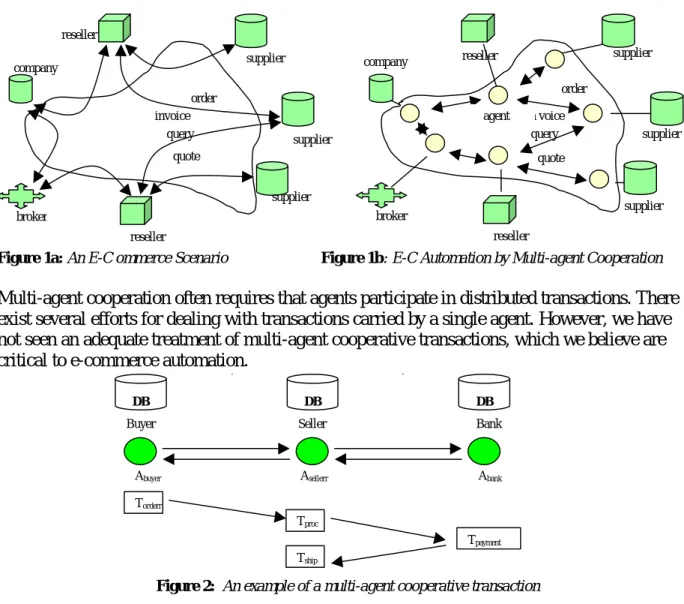
An E-Commerce scenario (Figure 1a) typically involves the following activities: identifying requirements, brokering products, brokering vendors, negotiating deals, and making purchase and payment transactions. Today, these activities are initiated and executed primarily by humans. In the future, with the increasing automation of e-commerce, we see them being conducted by software agents (Figure 1b).
Software agents are personalized, continuously running and semi-autonomous computational entities that are driven by a set of beliefs, desires and intentions (BDI). They can be used to
mediate between users (clients) and servers (service providers) to automate a number of the most time-consuming tasks in E-Commerce [3,16,18,19,20,22]. Moreover, agents can selectively preserve data and themselves become dynamic information sources, or data containers. E-Commerce automation can thus be accomplished through multi-agent cooperation, where agents perform various market activities and cooperate by exchanging data as well as programs.
One feature that distinguishes Internet-based e-commerce from traditional “brick and mortar” commerce is that agents can form dynamic partnerships that exist for only as long as they are needed. For example, agents that re-sell products, agents that supply products, and agents that provide brokering services may form a dynamic partnership for the duration of a specific
business transaction. Also, agents may switch roles; for example, an agent may be a buyer in one transaction, a broker in another, and seller in a third.
Figure 1a: An E-C ommerce Scenario Figure 1b: E-C Automation by Multi-agent Cooperation
Multi-agent cooperation often requires that agents participate in distributed transactions. There exist several efforts for dealing with transactions carried by a single agent. However, we have not seen an adequate treatment of multi-agent cooperative transactions, which we believe are critical to e-commerce automation.
Figure 2: An example of a multi-agent cooperative transaction
Figure 2 shows an example of a cooperative transaction that involves three agents, representing a
supplier order company reseller invoice supplier supplier reseller broker query quote supplier order company reseller In voice supplier supplier reseller broker query quote agent DB DB DB
Buyer Seller Bank
Abuyer Asellerr Abank
Torderr
Tproc
Tship
buyer, a seller, and a bank. The transaction consists of several steps: the buyer agent initiates the transaction by placing an order; the seller agent processes the order; the bank agent approves payment; and the seller agent ships the items ordered.
In this paper, we shall discuss the cooperation of multiple agents for carrying out e-commerce transactions. Multi-agent cooperative transactions have the following characteristics that distinguish them from conventional distributed “flat” or nested transactions [23].
• For conventional transactions, commit control is either centralized (e.g., a TP monitor coordinates two-phase commit among the sub-transactions comprising a distributed transaction) or strictly hierarchical (for nested transactions, each parent sub-transaction controls its children sub-transactions; commits pass up the transaction hierarchy from child to parent, until the entire transaction commits through the top level). In contrast, a multi-level cooperative transaction is not centrally controlled, but based on a peer-to-peer protocol, as the transaction may involve multiple agents with self-interests, acting on behalf of different parties. Each party typically has its own databases and possibly its own TP monitor. There is no single controller or top level transaction.
• Failure recovery also requires cooperation. For example, sub-transactions carried by multiple agents may fail individually; a peer belonging to another party may not cooperate; a
transaction (e.g. purchase) may be cancelled by one party unilaterally (e.g., a buyer may switch to another vendor); and the effects of one agent may need to be compensated by another agent.
• In conventional nested transactions, the delegation of work from a parent sub-transaction to a child sub-transaction is “conceptual” -- the parent initiates the child and passes to it the locks that it holds; when the child completes, it commits its updates to the parent by releasing its locks to the parent. In multi-agent cooperative transactions, the delegation of work between sub-transactions is not conceptual, but “physical” through inter-agent communication. These features, however, imply that inter-transaction dependencies are set up as participating agents are bound by peer-to-peer protocols. We shall discuss the cooperative transaction commit control and failure recovery mechanisms underlying these protocols. In previous work, we had developed mechanisms for nested transactions, flexible commit control, and failure recovery across transaction hierarchies [8-10]. We adapt these mechanisms to work for multi-agent cooperative transactions.
Although our cooperative transaction mechanisms are independent of the underlying agent infrastructure, our experience has shown that implementing these mechanisms using a dynamic agent infrastructure we have developed at HP Labs. has several advantages [5-7]. The
infrastructure allows us to create transaction services and launch transactions dynamically on demand. Thus, a business partnership can be created dynamically and maintained only for the required duration such as a single transaction. Agents can flexibly switch roles and modify their capabilities to participate in such dynamic business partnerships. Furthermore, agents may
cooperate in different application domains. Thus, a purchasing agent may participate in one transaction to buy printers, and then switch to another transaction to buy office supplies or building maintenance services. Our dynamic agent infrastructure allows multi-agent cooperation to be based on dynamic ontology. By dynamic ontology, we mean that the vocabulary, concepts, rules and facts underlying agent interaction may be different from domain to domain, and may vary from transaction to transaction. To automate agent cooperation, it is necessary to provide a standard format for encoding messages with meaningful structure and semantics, as well as a domain ontology that agents can readily exchange and interpret. This format should be common for agent communication as well as for E-Commerce data exchange in general. Since the
extensible markup language, XML [2], is becoming the standard for data interchange on the Web, we use it as the standard for inter-agent communication.
Our dynamic agent infrastructure for E-Commerce supports dynamic behavior modification of agents, a significant difference from other agent platforms [4,5]. A dynamic agent does not have a fixed set of predefined functions, but instead, it carries application-specific actions, which can be loaded and modified on the fly. This allows a dynamic agent to participate in different
transactions and dynamically formed partnerships. Dynamic agents communicate using XML, and candynamically load and exchange different ontologies and XML interpreters for tasks in different domains. Through messaging, dynamic agents can expose their knowledge, abilities and intentions, present requests and exchange objects. They can move to the appropriate locations for high-bandwidth conversation with other agents. They can also manage their own resources across actions. With these features, our dynamic agent infrastructure provides a suitable platform for deploying and managing multi-agent cooperative transactions for e-commerce automation applications.
In Section 2, we briefly describe our dynamic agent infrastructure. In Section 3, we give an example of a multi-agent cooperative transaction and contrast such transactions with
conventional distributed transactions, nested transactions, and workflow models. In Sections 4-6, we describe our multi-agent cooperative transaction model, and the mechanisms for commit control and failure recovery, respectively. Related work will be covered in Section 7 with conclusions.
2. Dynamic Agent Infrastructure
To participate flexibly in cooperative transactions that arise in e-commerce automation, agents need to have dynamic behavior while maintaining their identity and consistent communication channels, as well as retaining data, knowledge and other system resources to be used across applications.
It is neither sufficient for an agent to be equipped with a fixed set of application-specific functions, nor practical for the above capabilities to be developed from scratch for each agent. This has motivated us to develop a dynamic-agent infrastructure [4,5]. The infrastructure is Java-coded, platform-neutral, light-weight, and extensible. Its unique feature is the support of dynamic
behavior modificationof agents; and this capability differentiates it from other agent platforms and client/server-based infrastructures.
A agent has a fixed part and a changeable part (Figure 3). As its fixed part, a dynamic-agent is provided with light-weight, built-in management facilities for distributed
communication, object storage and resource management. A dynamic agent is capable of carrying data, knowledge, and programs as objects, and executing the programs. The data and programs carried by a dynamic agent form its changeable part. All newly created agents are the same; their application-specific behaviors are gained and modified by dynamically loading Java classes representing data, knowledge, and application programs. Thus, dynamic agents are general-purpose carriers of programs, rather than individual, application-specific programs.
Figure 3: Dynamic Agent as Program Carrier
Below we describe the architecture and coordination of dynamic agents in more detail. Other features such as mobility are not covered in this paper. (For details, see [5-7].)
Built-in Facilities. Each dynamic agent is provided with several light-weight built-in facilities for managing messaging, data and program object storage, action activation, GUI, etc. A
message-handler is used to handle message queues, for sending, receiving and interpreting inter-agent messages. The interaction styles include one-way, request/reply, and publish/subscribe (selective broadcast). Message forwarding is also supported. An action-handler is used to instantiate and execute application programs (Java classes). One dynamic agent can carry multiple action programs. An open-server-handler is used to provide a variety of continuous services, which can be started and stopped flexibly at dynamic agent run-time. A resource-handler is used to maintain an object-store for the dynamic agent; it contains application-specific data, Java classes, and instances, including language interpreters, addresses and any-objects (namely, instances of any class).
A carried application, such as a transaction or a sub-transaction, when started, is offered a reference to the underlying built-in management facilities, and can use this reference to access the APIs of the facilities, for accessing and updating application-specific data in the object-store, and for performing inter-agent communication through messaging.
Coordination. Every dynamic-agent is uniquely identified by its symbolic name. Similar to FIPA [13], a coordinator agent is used to provide a naming service, mapping the name of each agent to its current socket address. The coordinator itself is a dynamic agent, with the added distinction that it maintains the agent name registry and, optionally, resource lists. When a
Application-specific Actions Interface API Agent Services
Fixed part Changeable part
dynamic agent, say A, is created, it will first attempt to register its symbolic name and address with the coordinator by sending a message to the coordinator. Thereafter, A can communicate with other dynamic agents by name. When A sends a message to another dynamic agent whose address is unknown to A, it consults the coordinator to obtain the address. If A is instructed to load a program but the address is not given, it consults the coordinator or the request sender to obtain the address. Each dynamic agent also keeps an address-book, recording the addresses of those dynamic agents that have become known to it, and are known to be alive.
In a multi-agent system, besides a naming service, other types of coordination may be required, and these are provided either by the coordinator or by other designated dynamic agents that provide brokering services. A resource-broker maintains a hierarchically structured agent capability registry. The leaf-level nodes referring to the dynamic agents carry corresponding programming objects (action modules). Agents contact the resource-broker when acquiring or dropping new programming objects, and when they need a program such as a domain specific XML interpreter. A request-broker is used to isolate the service requesters from the service providers (i.e. dynamic agents that carry the services) allowing an application to transparently make requests for a service. An event-broker delivers events, treated as asynchronous agent messages, to event subscribers from event generators. Event notification may be point-to-point, where the event subscribers know the event generators and make the subscriptions accordingly; or multicast, where one or more event-brokers are used to handle events generated and
subscribed to anywhere in the given application domain. These event distribution mechanisms allow agents to subscribe to events without prior knowledge of their generators. The above resource, event and request brokers can be used to handle the transaction dispatching, tracking and notification among multiple agents belonging to the same party or agent group.
Hierarchical, multi-level name services across multiple agent groups can be built, if needed. Agent communication across enterprises is supported by a global naming service such as HP E-speak.
3. Example of a multi-agent cooperative transaction
Let us consider a purchase process including individual transactions, Torder, Tproc, Tpayment, and Tship, which is carried out by agents belonging to a buyer, a seller and a bank that issued a credit card to the buyer. We compare the implementation of this process by transactional agent
cooperation with other approaches, distributed transactions, nested transactions, and transactional workflow. (Although each of the constituent transactions may be nested, for simplicity we do not discuss transaction nesting in this example.)
Purchase process as a distributed transaction
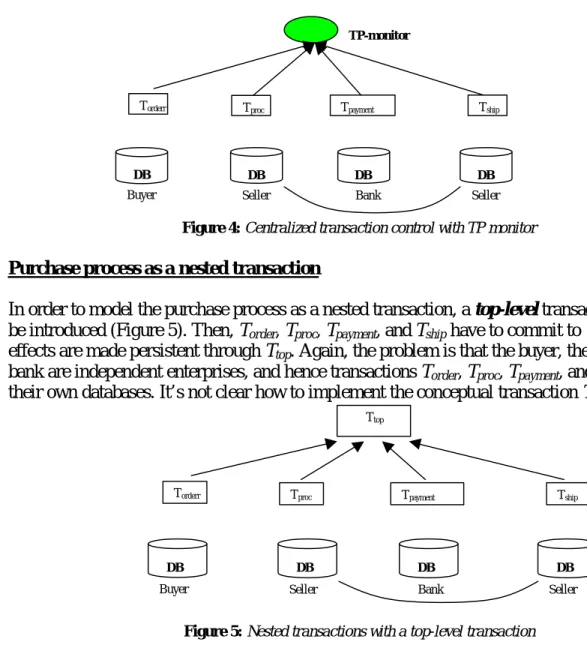
In the typical approach to implementing a distributed transaction, a TP-monitor has to be employed for providing centralized control. The constituent (sub) transactions, Torder, Tproc,
Tpayment, and Tship participate in a two-phase commit protocol coordinated by the TP-monitor, as shown in Figure 4. In our purchase process, however, the buyer, seller, and bank agents belong to different enterprises, and hence the use of a single TP-monitor is unrealistic.
Figure 4: Centralized transaction control with TP monitor
Purchase process as a nested transaction
In order to model the purchase process as a nested transaction, a top-level transaction, Ttop, must be introduced (Figure 5). Then, Torder, Tproc, Tpayment, and Tship have to commit to Ttop, i.e., their effects are made persistent through Ttop. Again, the problem is that the buyer, the seller and the bank are independent enterprises, and hence transactions Torder, Tproc, Tpayment, and Tship commit to their own databases. It’s not clear how to implement the conceptual transaction Ttop.
Figure 5: Nested transactions with a top-level transaction
Purchase process as transactional workflow
The purchase process may be modeled as a transactional workflow (Figure 6). A workflow system provides flow control for business process automation. A business process often involves multiple steps, such as Torder, Tproc, Tpayment, and Tship . Each step represents a logical piece of work that contributes to the process. A workflow process represents the integration and
synchronization of multiple actions. Although these actions and the agents executing the actions
Torderr Tproc Tpayment
TP-monitor Tship DB Seller DB Bank DB Seller DB Buyer
Torderr Tproc Tpayment Tship
DB Seller DB Bank DB Seller DB Buyer Ttop
can be distributed, they are scheduled and coordinated by a centralized workflow engine. However, in our example, the purchase process involves tasks that are executed in different enterprises, which are not under the control of a single workflow engine.
Figure 6: Centralized workflow control
Purchase process as transactional agent cooperation
Agent cooperation is protocol based, rather than centrally controlled by any coordinator. A multi-agent cooperative activity is the interaction of multiple autonomous activities, possibly bound by certain protocols. The success of a cooperative activity requires the common
understanding of and agreement on the underlying protocols by all the participating agents. Our example purchase process, which includes individual transactions, Torder, Tproc, Tpayment, and Tship, is carried out through the cooperation of agents belonging to the buyer, the seller and the
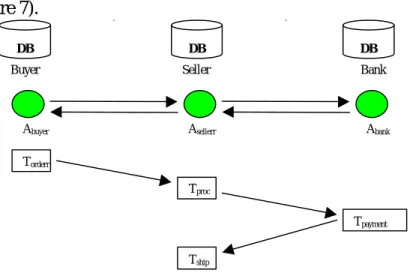
bank.that issued credit card to the buyer. These agents are denoted Abuyer, Aseller and Abank respectively (Figure 7).
Figure 7: Transactional agent cooperation
§ Transaction Torder is executed by agent Abuyer and commits to the database on the buyer’s side. The tasks of this transaction include filling a shopping basket, making an order with the
Torderr Tproc Tpayment Tship
Workflow engine
Abuyer Asellerr Abank
DB DB DB
Buyer Seller Bank
Abuyer Asellerr Abank
Torderr
Tproc
Tship
credit line for payment.
§ Transaction Tproc is executed by agent Aseller and commits to the database on the seller’s side. The tasks of this transaction include processing the order, checking inventory, sending a payment request to the bank, etc.
§ Transaction Tpayment is made by agent Abank and commits to the database on the bank’s side. The tasks of this transaction include verifying the payment request, checking credit, approving the payment, etc.
§ Transaction Tship is made by agent Aseller and commits to the database on the seller’s side. The major tasks of this transaction are making the shipment and updating inventory.
The entire purchase process is not controlled by any common top-task, but accomplished through conversation among agents. An agent can request another agent to perform an action, or can delegate an action to another agent. For example, the buyer agent may delegate a price
comparison task to another agent; the buyer agent requests the seller agent to process an order; the seller agent requests the bank agent to approve the buyer’s credit. The results of these transactions are passed between agents via messaging. Agents are autonomous and act in their own self-interests. An agent may fail, or the transaction may be cancelled by any participating agent. If any exception condition occurs, such as the credit checking fails, or the shipment cannot be made, certain compensation transactions are executed. For instance, the buyer needs to update his database entry, indicating that the purchase and the payment were not made.
Difference between multi-agent cooperative transactions and conventional transactions
In summary, multi-agent cooperative transactions differ from conventional transactions in the following aspects.
• The participating agents may represent different enterprises with self-interests.
• The component transactions forming a business process may be individual transactions running in different enterprises and committing to different databases.
• The component transactions are not controlled by a central TP monitor or workflow engine.
• In general, there is no top-level transaction to which the component transactions can commit.
• The synchronization of agents carrying out the component transactions is protocol-based and accomplished through peer-to-peer communication.
4. A Multi-agent Cooperative Transaction Model
Transactions are atomic operations. However, agents have typically been characterized as autonomous carriers of operations. How to support atomic transactions by autonomous agents is the key to dealing with cooperative transactions.
We consider the following two situations:
• cooperation of multiple agents belonging to the same party (i.e., within a single enterprise).
different enterprises).
4.1Nested transactions for multi-agent cooperation within a single enterprise
First, we focus on processes executed within a single enterprise. Modeling such a process as a single flat transaction is unnecessary in most cases. Such processes are often organized as nested transactions. A transaction may consist of hierarchically structured sub-transactions to be
executed by the same or different agents. A sub-transaction represents a logical piece of work that contributes to the whole transaction, and may be delegated by an agent to another. Thus, a transaction tree may actually map to an agent organization tree, with each agent corresponding to one or more sub-transactions.
A transaction hierarchy has a multilevel specification, or template. Each (sub) transaction may have sequential, concurrent or conditional steps as sub-transactions. The agent carrying a (sub) transaction, T, maintains the templates of sub-transactions beneath T. These sub-transactions may consist of all the descendant transactions of T, or only the child transactions of T, should the detailed steps of those child transactions be determined by their respective hosting agents.
We incorporate the ideas of contingency and non-vital transactions for providing failure protection. The failure of a non-vital transaction can be ignored by its parent, and a failed
transaction T may be replaced by the contingency transaction T∗ associated with it. A transaction at any level may be paired with a contingency transaction that may in turn have its own
contingency transaction. A transaction T may also be paired with a compensation transaction T° that can logically undo its effects (e.g. a flight reservation may be compensated for by canceling that reservation). The contingency transaction or the compensation transaction associated with a transaction T may be flat or hierarchical and can be structured differently from T, and executed by a different agent. The notion of vitalness underlies the failure recovery of multi-agent transactions, namely, when and via which path to eliminate of compensate for, certain previous effects.
4.2. Task delegation between agents
In a transaction hierarchy, a parent transaction may delegate tasks to a child transaction [12], and such delegation is typically implemented by passing locks [23]. When these transactions are carried by separate agents, task delegation is made by exchanging data containers through inter-agent communication. Thus, we adopt a container model rather than the lock model for dealing with the data flow between agents; that is, agents pass data, rather than locks, during transaction delegation. Delivering locks to agents running remotely has many more sensitive security and implementation problems than checking out data.
Each transaction carried by an agent is associated with a data container managed by the hosting agent. This container holds the data checked out from databases or passed from other agents. The
data objects in the container are accessible only to the transaction carried by the hosting agent. When agent A delegates a transaction T to agent B, it is A's responsibility to deliver sufficient data to B for executing T, according to the transaction specification.
Agent-based task delegation offers certain flexibility in transaction control. For example, when the agent, say P, carrying a parent transaction determines that the agent carrying a child
transaction is dead without performing the assigned task, P can re-assign the task to another agent.
However, when a parent transaction and a child transaction are carried by different agents, additional dependencies are introduced between these agents. For instance, suppose that after a child transaction has purchased a ticket, the carrying agent, C, became unreachable by the agent, P, carrying the parent transaction. Then, how does P know whether the ticket was purchased or not. In order to support reliable task delegation and commit control, the following protocols have to be followed.
§ All communication between agents involved in a transaction is based on a hand-shake protocol with acknowledgement.
§ A 2PC-like protocol should be used in the commitment of a child transaction to its parent transaction if the child transaction is an open transaction [43] that updates the database; § An agent delegating a task to another agent must keep a copy of the delegated task and
corresponding data container in order to re-delegate to another agent, if necessary. § Every agent that carries a transaction in a transaction hierarchy must log the status of the
whole family of transactions, including all its direct ancestors and all the descendents beneath it. In this way, the persistent effects made by open transactions are known to their ancestors, so if the internal results are lost due to the failure of the carrying agents, they can be re-generated. The agent coordinator keeps track of all the agents.
4.3. Contracting transactions for inter-enterprise multi-agent cooperation
A basic assumption is that an inter-enterprise cooperative transactional process, such as a
purchase process or an auction process, is considered as an atomic transaction only conceptually, meaning that every participating party honors the results based on certain “contracts”. The concept of contract is rather broad, such as making an agreement, exchanging information, making a purchase, and so on. A contract involves multiple parties, and usually is not controlled by a single party. For example, a purchase is made by two separate but contracting transactions, one on the buyer side and the other on the seller side. The contract, representing the interaction of multiple participating transactions belonging to different business processes, is not a single transaction physically carried by any agent. It is initiated by one agent sending a request to another, and completed along with the completion of a buying transaction and a selling
transaction. The results of a contract are shared by the participating transactions, and thus visible to the interactive business processes. The agents participating in a contract communicate in terms of messaging.
In [11] we modeled a contract transaction as either the parent transaction or the child transaction of the participating transactions. However, since agent-carried transactions are physically
handled by different "engines" (agents), such a model would be impractical. It cannot be assumed that when a buyer agent sends an order to a seller agent, a third agent should be
necessarily introduced to hold a contract transaction "purchase". Nor is it reasonable to assume that the contract transaction is carried by the buyer agent or the seller agent. In fact, such a contract transaction is just a virtual entity, representing the combination of two actual transactions, buy and sell, with cross-transaction dependencies introduced between them.
Certain component transaction templates such as shopping, negotiation, auctions, are provided as common protocols for interaction among agents. These templates serve as the building blocks for transactional agent interaction.
4.4. Cross-transaction dependencies
The relationship between two transactions, say Ta and Tb, involved in a contract, can be expressed in terms of inter-transaction dependencies. For example, in a purchase process, the buyer side and the seller side have individual peer transactions committing to their own
databases. There exist dependencies, such as start dependency and failure dependency, between these peer transactions. For example, a selling transaction, Tsell, must be triggered by a buying transaction, Tbuy, and if Tbuy aborts, Tsell also aborts.
In multi-agent cooperative transactions, the enforcement of transaction dependencies is not centralized, but accomplished through point-to-point or multicast event notification. If transaction Tbuy has a commit dependency on Tsell, Tbuy must wait until it receives a commit notification from Tsell to commit, and such a notification may be sent in two ways: point-to-point communication or multicasting, depending on the application. Further, some dependencies can be mutual; e.g., Tsell also depends on the commit of Tbuy to commit. To avoid ambiguity, or circular dependencies, we introduce the following special cross-transaction dependencies. Consider two transactions, say Ta and Tb, that are involved in a contract. Ta and Tb are individual transactions without commit-to relationship, but dependent on each other to commit. Like a regular transaction, a transaction involved in a contract such as Ta , experiences state transition at run time. In addition to a regular transaction, it has a special state: settle, meaning that it has reached agreement with the other transactions involved the same contract. Ta and Tb can commit provided they are in the settle state (or prepare to commit state) which represents a mutual dependency between them.
The most important dependencies between two transactions Ta and Tb participating in a contract are the follows.
• Ta ↔ settle Tb (mutual settle dependency), i.e. Ta and Tb cannot commit until they reach agreement on the contract;
• Ta ←ac Tb, (mutual abort/compensate dependency), i.e. if Ta aborts, then Tb must be either aborted or compensated for.
The notion of vitalness is used to isolate failures from transactions participating in a contract. The failure of one participant may not have a critical impact on another participant, and failing to make a contract may not be fatal to either of them. A transaction participating in a contract may have different vitalness to its parent transaction and peer transactions. Such vitalness may be one-directional or bi-directional.
5. Commit Control
In nested transactions, data objects held by a transaction are visible to its descendants, meaning that a sub-transaction can access without conflict any object currently accessed by one of its ancestors. Thus, a transaction T can acquire objects from databases or inherit objects from its parent or ancestors; these objects form the access set of T. A transaction Ti may delegate the commit/abort responsibility of its operations on certain objects to another transaction Tj, which form a delegate set.
Unlike conventional transactions, the access-set of a transaction T is physically carried by the hosting agent of T, AT. When we say that set is visible by T’s sub-transactions, we mean that those sub-transactions can send a query to AT for checking out the data objects in the access set visible to them. AT must validate the requesters before sending out the data.
The data about a contract are visible to all participating transactions and their hosting agents. Since a contract is simply conceptual, rather than a transaction carried by a hosting agent, contract related data is acquired through message exchange between the agents participating in the contract.
If transaction P is a parent of T (denoted T ≤ P), then we can further introduce the following notions.
• Transaction T commits-to P means that T delegates the commit/abort responsibility for its entire access set to P (and P is called the commit scope of T.) This. In agent-carried
transactions, if T and P are carried by different host agents, then the host agent for T should send its entire results to the host agent for P.
• Transaction T commits-through P to G means that T ≤ P ≤ G and the commit/abort responsibility of T's entire access-set is directly or transitively delegated from T to P, and then from P to G. For agent-carried transactions, this involves a sequence of messages among the corresponding hosting agents.
• Transaction T commits-over P to G means that T ≤ P ≤ G and T commits-to G without committing through P. This means that if P is carried by a separate agent, that agent would be bypassed.
The commit scope of a closed transaction T is its parent transaction. Typically, T commits-through its parent to higher-level ancestors level by level up to the top-level transaction. Its effects are made visible to public only after the top-level transaction commits to database. These semantics enforce the atomicity of each sub-transaction with respect to its parent, and
consequently, enforces the top-level atomicity of the whole transaction hierarchy. The commit scope of an open transaction T is the database, making its results visible to public. In this way concurrency is improved in executing other transactions requiring those results [23,43].
For applications requiring enhanced concurrency and transaction protection at selected levels of a transaction hierarchy, the atomicity property of closed nesting is too rigid and the data
protection of open nesting is too weak. In order to balance concurrency and protection in a flexible way, we introduced the notion of scoped transaction [10]. This extension allows the results of a transaction to be visible to the top-level transaction (and hence to all the sub-transactions) of a process, but they are still kept internally within the scope of that process.
6. Failure Recovery
Transactions are characterized by logical atomicity, but agents are characterized by autonomy. When multiple agents are involved in a logically atomic transaction, each agent may individually fail. A failure may be caused by the transaction itself, referred to as a transaction failure, or by the failure of a component, such as an agent, a communication channel, or a computer, referred to as a component failure. Using agents provides flexibility for transaction failure recovery. For example, a sub-transaction may be delegated to an alternative agent in case of failure. In general, failure recovery also requires cooperation among multiple agents.
For agent specific component failure handling, the mechanisms listed in Section 4.2 are
necessary. Next we shall further discuss the following special issues in multi-agent cooperative transaction failure handling.
• Failure recovery along a single transaction hierarchy, where sub-transactions may be carried by multiple agents.
• Failure recovery across transaction hierarchies; this usually means across enterprises as well. For example, a purchase may be considered as an atomic activity logically, but actually involves two related but individual transactions, one for the buyer side and one for the seller side. A failure on one side may have impact on the other, and the failure recovery in this situation requires certain special mechanisms.
6.1. Hierarchical Failure Handling
Failure handling in a transaction hierarchy consists of two tasks: identifying the failure recovery scope, and top-down undoing of the sub-transactions in that scope.
Identify failure recovery scope
In a transaction hierarchy, the failure of a sub-transaction may propagate to its parent or higher level ancestors. However, aborting the whole business process can be aborted in the following cases.
• First, when a transaction is non-vital to its parent, its abortion can be ignored, and the parent transaction can continue.
• Next, when the failure of a child transaction is recognized as the result of agent malfunction, the parent transaction may delegate the sub-transaction to another agent.
• Finally, when a transaction can be replaced by a contingency transaction acting as its exception handler, upon its abortion the process can continue by retrying the contingency transaction. Therefore, when a transaction T fails, before reaching the top, the "abort-up" chain can terminate at such a closest ancestor of T, say R, that is non-vital or associated with a contingency transaction, and from there the process may roll forward. In either case, sub-transactions beneath R should be first undone in terms of two general functions: abort and compensation, where those with effects internal to R are aborted and those committed over R, such as the database or the top-level transaction, are compensated for in the corresponding scope. As R is the root of the transaction subtree to be logically undone upon T's failure, we call it the Rollback Root (RR) of T (Figure 8).
Figure 8: Determine undo scope
Top-down logical undo
When a sub-transaction in a transaction hierarchy fails and causes its parent or higher level ancestors to abort, its RR, say TRR, is the highest ancestor in the abort-up chain, the root of the transaction sub-tree to be logically undone, and possibly, the restart point for rolling forward through an alternative path. We described a detailed two phase failure handling algorithm in [8]. Here, we apply the mechanism to a distributed agent environment.
The logical undo is performed by aborting or compensating for the transactions in the undo scope, i.e. a sub-tree of transactions. Compensating the effects of a transaction only provides a logical equivalence of undoing, without necessarily restoring the objects updated by that transaction to their original states, or eliminating side effects that may have affected other transactions already (e.g. a hotel reservation may be compensated for by canceling that
Originally failed Rollback Root (RR) Failure handling scope
reservation). Whether the effects of a transaction under TRR should be aborted or compensated for, depends on the visibility scope of these effects. In general, if a transaction is in-progress or tentatively committed (to parent), then it should be aborted (with its committed sub-transactions compensated for). This is because its effects are still internal to the subtree rooted by TRR.
Otherwise, if it has committed over TRR to the top-level transaction or database, then it should be compensated for in the corresponding scope (if its effects are not compensated for at a higher level) since its effects have been externalized beyond TRR already. However, for a closed sub-transaction that has committed to its parent, compensation is never applicable; its effects may be eliminated either by aborting or by compensating an ancestor at a higher level.
Compensating for the effects of a transaction may be done by the agent that originally carries that transaction, or by another agent.
6.2. Cross-Transaction Tree Failure Handling
Many e-commerce processes are transactional. Very often, such a process is conceptually atomic but actually made by separate transactions running by different parties. In case of failure, the participating transactions are recovered individually. However, due to the presence of contracts between those transactions, a failure occurring in one transaction tree (or sub-tree) may have to be transferred to the other sub-trees, which gives rise to the need for failure handling across transaction hierarchies. In [11], we introduced a “contract transaction” as the conceptual unit for linking the transaction trees. As explained in Section 5, we now treat contracts as conceptual, and implement them by pure peer-to-peer transaction interactions in the form of inter-agent
communications.
Figure 9: Failure transfer across transactions of different enterprises
In the transaction tree where a failure originally occurs, the parent and (direct) ancestors up to the RR of the originally failed transaction, are still in-progress, since they may not terminate until all its child transactions terminate. However, in a transaction tree where a failure is transferred in, the transaction to which the failure is transferred in, and its ancestors, may be committed and need to be compensated for, since their results have become invalidated as a result of such failure. This is shown in Figure 9. To handle such a situation both RR and scoped-rollback algorithm should be extended.
T’
Originally failed
Failed as a result of T’s failure
Failure transfer across enterprises
Need perform failure processing accordingly
Enterprise A Enterprise B
This transaction is in-progress This transaction may not be in-progress
agent
Let us consider two cooperative transactions with sub-transactions Ta and Tb respectively, which are involved in a contract. Assume that the contract is vital to both sides. When Ta fails itself or in the undo scope as a result of other sub-transaction’s failure, the failure is transferred to Tb, then each transaction tree has an individual recovery scope for undoing. When Ta fails, its parent and (direct) ancestors up to the RR of it, are still in-progress. However, when this failure is transferred to Tb, the situation may be different.
§ Tb has not started: failure handling on Tb is not necessary at this time.
§ Tb is in-progress: it can be treated as the original failure point in the transaction tree; the RR of Tb, should be determined as the root of recovery in the same way as described before. § Tb has completed: it should be invalidated, that is, compensated for at the same or a higher
level.
In the last case, the invalidation of Tb causes its parent to be aborted (if the parent is in-progress and Tb is vital to it) or invalidated (if the parent has committed, regardless of the vitalness of Tb to it, since in this case Tb has committed through its parent or ancestors; even if Tb is defined with a compensation transaction, the commit scope of that compensation is unclear). Such invalidate/abort signal may propagate up to Tb 's ancestors, but may or may not terminate at the RR of Tb, because the RR of Tb may also be in different situations as listed below.
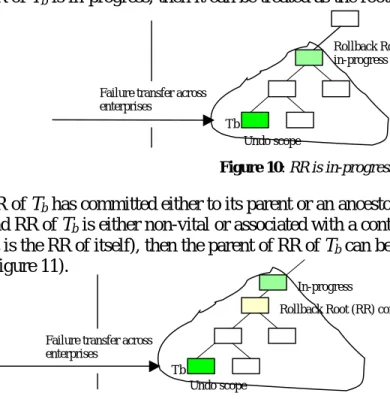
(a) RR of Tb is in-progress, then it can be treated as the root of recovery (Figure 10).
Figure 10: RR is in-progress
(b) RR of Tb has committed either to its parent or an ancestor, but its own parent is in-progress and RR of Tb is either non-vital or associated with a contingency transaction (that is, RR of Tb is the RR of itself), then the parent of RR of Tb can be chosen as the root of recovery (Figure 11).
Figure 11: RR is committed but its parent is in-progress
(c) Both the RR of Tb and its parent or even other ancestors have committed, that means the RR
Failure transfer across enterprises
Tb
Rollback Root (RR) in-progress
Undo scope
Failure transfer across enterprises
Tb
Rollback Root (RR) committed to parent
Undo scope
of Tb cannot be simply taken as the root of undoing. To handle this situation, first we need to find out such a transaction, say, Th, that is the highest committed ancestor of the RR of Tb, and then consider the RR of Th. If the RR of Th is an in-progress transaction, then it is taken as the extended rollback root (eRR) of Tb for recovery; otherwise RR of Th must be Th itself, in this case the parent of Th is taken as the eRR of Tb for recovery (Figure 12).
Figure 12: Two cases of extended recovery root eRR
In general, the eRR of the transaction as Tb described above is an in-progress (i.e. uncommitted) transaction, unless the highest committed ancestor of Tb is the top-level transaction.
7. Related Work and Conclusions
E-commerce is a distributed transactional environment [4,33,35]. The development of agent-mediated e-commerce automation has given rise to the need for supporting cooperative transactions [25,29]. Although cooperative problem solving has been studied by many researchers, the concept of cooperative transactions involving multiple autonomous agents is rarely addressed.
E-commerce applications require the cooperation of multiple in-progress transactions. This is actually a missing link in the previous work. Because of the atomicity property, in-progress atomic transactions and closed nested transactions [23,36] cannot exchange partial results for cooperation. Open nested transactions [43] may exchange partial results only by making them persistent. This can also be found in DOM [3,14-16], Saga [21], nested Sagas [20], ACTA [12,27], ConTract [42] and others [22,28]. Cooperating through exchanging interleaved persistent partial results suffers the loss of data protection, since those partial results are
accessible not only to the participating processes but also to others when these processes are still in progress.
Cooperating transactions carried by multiple agents are also different from handling transaction groups in the conventional sense. The cooperative transactions are individual transactions
Failure transfer Tb Rollback Root (RR) committed Undo scope Tr
Th Highest committed ancestor of Tr Recover root of Th eRR Failure transfer Tb Rollback Root (RR) committed Undo scope Tr
Th Highest committed ancestor of Tr
belonging to different parties. However, traditionally a transaction group represents a single piece of work hosted by a single party. Sub-transactions in a transaction group cooperate under the same parent transaction with weaker concurrency and failure semantics. For example, in a Cooperative Transaction Hierarchy [37], cooperative transactions that form groups refer to those at a leaf level. The Transaction Tool Kit [40] approach adopts the "two stage control-sphere" rule that limits the responsibility of a parent transaction only to its child transactions; and the
"stepwise transfer" rule that requires upward and downward inheritance of object locks to be made level by level.
To support multi-agent cooperative transactions, it is necessary to handle failures across
transactions. Common to all the existing approaches is that they lack the capabilities for allowing the interaction of multiple transaction hierarchies and for handling failure over and across
transaction trees.
In [8-10] we have extended multilevel transaction commit and recovery model, but without considering cross-transaction tree dependencies. In [11] we introduced the concept of contract transactions without discussing the corresponding mechanism for handling failures across transaction trees. In this paper, we have merged these concepts are merged and applied them in the context of agent-carried cooperative transactions.
Our approach is not restricted to any particular agent platform [6,7]. However, we believe that the dynamic agent infrastructure we have developed at HP labs provides a well-supported environment for running cooperative transactions. The capability of exchanging and carrying programs, and the flexibility of switching roles and language interpreters tremendously enhances the potential of using dynamic agents to carry cooperative transactions. For example, these capabilities make transaction delegation straightforward, allow the transactions hosted by one agent to be compensated for by another, and so on. These capabilities significantly differentiate our dynamic agent infrastructure from existing distributed computing environments based on interface-based middleware such as CORBA [13], and from other agent platforms.
XML is important for E-Commerce [2,5,17,24]. In fact, several agent communication languages such as FIPA[19], KQML[18,34], may be converted to simple XML form. However, the
required ontology varies from domain to domain [26,30-32], and if a problem domain is dynamically formed based on a specific application, its ontology is also dynamic. Dynamic agents allow the exchange of domain specific ontology, particularly XML interpreters, to allow dynamic agents to participate in multiple applications, to switch applications, and to form dynamic partnerships.
To summarize, multi-agent cooperative transactions are different in their requirements both from conventional atomic transactions executed under centralized control and from nested transactions executed under hierarchical control. Cooperative transactions require peer-to-peer protocols based on inter-agent communication. We have developed a cooperative mulit-agent transaction
model that includes peer-to-peer protocols for commit control and failure recovery. Our
experience also shows the flexibility of dynamic agents for supporting cooperative transactions. The purpose of developing dynamic agent infrastructure is not to support AI applications directly. Dynamic agents are not AI agents, although they may carry intelligent programs. Instead, this infrastructure supports a new kind of dynamic computation paradigm, and we believe that such a paradigm is essential for implementing cooperative transactions occurring in e-commerce automation applications. The significance and feasibility of this approach have been demonstrated in a prototype implemented at HP Labs.
REFERENCES
[1] Aglets, "Programming Mobile Agents in Java", IBM, http://www.trl.ibm.co.jp/aglets/, 1997.
[2] T. Bray, J. Paoli, C. M. Sperberg-McQueen, “Extensible Markup Language (XML) 1.0 Specification”, February 1998, (http://www.w3.org/TR/REC-xml)
[3] A.Buchmann, M.Ozsu, M.Hornick, D.Georgakopoulos, and F.A. Manola"A transaction model for active distributed object systems", A. Elmagarmid (ed) Transaction Models for Advanced Database Applications, Morgan-Kaufmann, 1992. [4] A. Chavez and P. Maes, Kasbah: An Agent Marketplace for Buying and Selling Goods, Proc. of PAAM96, 1996.
[5] Q. Chen, Meichun Hsu, Umesh Dayal, Martin Griss, “Incorporating Multi-Agent Cooperation, Dynamic Workflow and XML for E-Commerce Automation”, Proc. Fourth International Conference on Autonomous Agents, 2000, Span.
[6] Q. Chen, P. Chundi, Umesh Dayal, M. Hsu, "Dynamic-Agents", International Journal on Cooperative Information Systems, 1999, USA.
[7] Q. Chen, P. Chundi, U. Dayal, M. Hsu, "Dynamic-Agents for Dynamic Service Provision", Proc. of 3rd Int. Conf. on Cooperative Information Systems (CoopIS'98), 1998, USA.
[8] Q. Chen and Umesh Dayal, "Failure Recovery across Transaction Hierarchies", Proc. of 13th International Conference on Data Engineering (ICDE-97), 1997, UK.
[9] Q. Chen and Umesh Dayal, "A Transactional Nested Process Management System", Proc. of ICDE-96, 1996. [10]Q. Chen and Umesh Dayal, "Commit Scope Control in Nested Transactions", Proc. of EDBT'96, 1996, France. [11]Q. Chen, Umesh Dayal, "Contracting Transaction Hierarchies", Proc. of RIDE'96, 1996, USA.
[12]P.K. Chrysanthis and K.Ramamritham"Acta: The saga continues", A. Elmagarmid (ed) Transaction Models for Advanced Database Applications, Morgan-Kaufmann, 1992.
[13]CORBA, "CORBA Facilities Architecture Specification", OMG Doc 97-06-15, 1997.
[14]U. Dayal and M. Hsu and R. Ladin, “Organizing Long Running Activities with Triggers and Transactions”, Proc. ACM-SIGMOD'90, 1990.
[15]U. Dayal and M. Hsu and R. Ladin, “A Transactional Model for long Running Activities”, Proc. VLDB'91, 1991. [16]D.McCarthy and U.Dayal, "The architecture of an active database system", Proc. ACM-SIGMOD'89, 1989. [17]Document Object Model, http://www.w3.org/DOM/
[18]T. Finin, R. Fritzson, D. McKay, R. McEntire, “KQML as an Agent-Communication Language”, Proc. CIKM'94, 1994. [19]Foundation for Intelligent Physical Agents(FIPA)- FIPA97 Agent Specification, http://www.fipa.org/
[20]H.Garcia-Molina, D.Gawlick, J.Klein, K.Kleissner, and K.Salem"Modeling long-running activities as nested sagas"Bulletin of the IEEE Technical Committee on Data Engineering, 14(1), 1991.
[21]H.Garcia-Monina and K.Salem"Sagas", Proc. ACM-SIGMOD'87, 1987.
[22]D.Georgakopoulos, M.Hornick, P.Krychniak, and F.Malona"Specification and managemnet of extended transactions in a programmable transaction environment", Proc. Data Enginering'94, 1994.
[23]J.Gray and A.Reuter"Transaction processing: Concepts and techniques"Morgan Kaufmann Publishers, 1993.
[24]R. J. Glushko, J. M. Tenenbaum and B. Meltzer, “An XML Framework for Agent-based E-Commerce”, CACM 42(8), March, 1999.
[25]M. Griss, G. Bolcer, L. Osterweil, Q. Chen, R. Kessler "Agents and Workflow -- An Intimate Connection, or Just Friends?", Panel, TOOLS99 USA, Aug 1999.
[26]R. S. Gray. Agent Tcl: A flexible and secure mobile-agent system. Dr. Dobbs Journal, 22(3):18-27, 1997. [27]T.Haerder and K.Rothermel"Concurrency control issues in nested transactions"VLDB Journal 2(1), 1993.
[28]S.Heiler, SHaradhvala, S.Zdonik, B.Blaustein, and A.Rosenthal"A flexible framework for transaction management in engineering environments", A. Elmagarmid (ed) Transaction Models for Advanced Database Applications, Morgan-Kaufmann, 1992.
[29]N.R. Jennings, P. Faratin, MJ. Johnson, P O'Brien & ME Wiegan, "Using Intelligent Agents to Manage Business Processes". Proc. of PAAM96, U.K., 1996, pp. 245-360.
[30]N. R. Jennings (1999) "Agent-based Computing: Promise and Perils" Proc. IJCAI-99, Sweeden. 1429-1436. [31]T. John, Intelligent Agent Library/Factory, release 4 (http://www.bitpix.com)
[32]N.Krishnakumar and A.Sheth"Specification of workflows with heterogeneous tasks in meteor", Proc. VLDB'94, 1994. [33]P. Maes, R. H. Guttman and A. G. Moukas, “Agents that Buy and Sell”, CACM 42(8), March, 1999.
[34]S.A. Moore, "KQML and FLBC: Contrasting Agent Communication Languages," proceedings. 32nd Hawaii international conference on system sciences, 1998,
[35]A.G. Moukas, R. H. Guttman and P. Maes, “Agent Mediated Electronic Commerce: An MIT Media Laboratory Perspective”, Proc. of International Conference on Electronic Commerce, 1998.
[36]E.Moss"Nested transactions", MIT Press, 1985.
[37]M.Nodine and S.Zdonik"Cooperative transaction hierarchy: A transaction model to support design applications", Proc. of VLDB'90, 1990.
[38]Odyssy, "Agent Technology: Odyssey", General Magic, http://www.genmagic.com, 1997.
[39]B. Perry, M. Talor, A. Unruh, “Information Aggregation and Agent Interaction Patterns in InfoSleuth”, Proc. of CoopIS’99, UK, 1999.
[40]R.Unland and G.Schlageter"A transaction manager development facility for non-standard database systems", A. Elmagarmid (ed) Transaction Models for Advanced Database Applications, Morgan-Kaufmann, 1992.
[41]Voyager, "Voyager Core Package Technical Overview", Object Space, http://www.objectspace.com/voyager/technical_white_papers.html, 1997.
[42]H.Wachter and A.Reuter"The contract model", A. Elmagarmid (ed) Transaction Models for Advanced Database Applications, Morgan-Kaufmann, 1992.
[43]G.Weikum and H.Schek"Concepts and applications of multilevel transactions and open nested transactions", A. Elmagarmid (ed) Transaction Models for Advanced Database Applications, Morgan-Kaufmann, 1992.