Pacific Edge’s Project Office
Improving Enterprise Initiatives
An IDC White Paper
Analysts: Andrew Goloboy and David A. Shiang
Management Summary
Building new products, introducing new services, launching new busi-nesses, and entering new markets — today’s companies must respond to changing competitive pressures and shifting customer requirements faster than ever. Speed, flexibility, and responsiveness have become the new mantras, challenging the traditional command-and-control style of management that makes the customer a low priority. With deregulation, globalization, technology, the Internet, and other forces bringing new forms of competition to the market at an unprecedented rate, companies can no longer think that they “own the customer.”
How does automating enterprise initiatives satisfy the need for efficient management of scarce project resources?
The new enterprise project landscape has grown beyond isolated workgroups, serial project management, and fixed process schedules. By Web-enabling applications software and incorporating collabora-tive technologies such as Extensible Markup Language (XML) into applications, independent software vendors are helping companies manage their virtual organizational networks, project portfolios, and dynamic resources. This new type of application creates reliable results as companies deliver products, services, and output (e.g., marketing programs).
IDC believes that Pacific Edge has the necessary vision to bring practical functionality to the myriad of global users involved in cross-department, enterprisewide projects. Its enterprisewide approach to producing reliable results gives Pacific Edge a strong foundation for future growth.
Pacific Edge’s strategy for enabling interenterprise and intraenterprise resource sourcing, allocation, reporting, and management of critical project information raises the bar for disciplined collaboration. The company’s leadership efforts in developing pmXML, an XML schema for project management, will further enhance its credibility and market position.
Copyright © 2000 IDC. Reproduction without written permission is completely forbidden.
External Publication of IDC Information and Data—Any IDC information that is to be used in advertising, press releases, or promotional materials requires prior written approval from the appropriate IDC Vice President or Country Manager. A draft of the proposed document should accompany any such
Printed on recycled materials One way that companies respond to the need for speed and flexibility is
to form distributed teams to get work done. When product life cycles are shrinking to months instead of years, when companies such as eTrade, VerticalNet, or Priceline.com are turning traditional business models on their head, companies can no longer conduct business as usual in the volatile market. The days of establishing quasi-permanent, entrenched departments that perform isolated functions are over. This White Paper examines how today’s companies are increasingly initiating projects to accomplish core business processes across the enterprise. We also examine the challenges that this represents for what is traditionally called project management. We discuss why legacy project management applications, which focus on isolated workgroups, serial projects, and fixed process schedules, are inadequate to meet the needs of all the workers, managers, and executives both loosely and tightly connected with projects.
A new category of workforce management applications has emerged that addresses some of the limitations of legacy project management applications. These workforce management applications better inform workers, managers, and executives about cross-project resource needs, collaborative resource availability, and critical success measurement. We will profile Pacific Edge Software Inc., a software supplier with an enterprise application approach that provides reliable results in delivering projects. Pacific Edge offers Project Office, a workforce management application with a foundation in traditional project man-agement, which combines the power and configureability of a custom application with the ease and economy of ready-to-use software.
The Changing Nature of Projects in a Decentralized Business
Environment
As companies strive to keep overhead to a minimum, today’s employees must work cross-functionally in a time-sensitive manner on specific activities in support of the business. The best companies are increasingly using project teams, often geographically dispersed groups consisting of people from multiple departments, to attack specific business processes such as new product development. In addition, companies are collabo-rating on projects in increasing numbers. Today, it is common to find “virtual” 24-hour global teams that come and go according to the dictates of the marketplace. Such teams may last only a few weeks or months and disband once the mission is accomplished. Employees may flexibly serve on multiple project teams, playing different roles on each instead of being tied to one department and performing one specific function.
This highly decentralized, business-process-specific approach to accomplishing work requires a new kind of management tool that enables everyone who is involved in the work access to timely informa-tion for the purpose of reporting on, tracking, or measuring (or some combination of these processes) the project. For example, a team that is involved in building a new product will want to track the time and activities of all those involved in the process to properly analyze costs and return on investment. A research and development organization must track activities that are specific to its processes. If key players do not have access to easy-to-use time tracking tools or if managers do not have access to project analytics, then critical information will slip through the cracks, and performance will suffer. Managers will not be able to accurately compare projects in their portfolio to determine return on investment and productivity levels.
The New Project Landscape
The development of products and services today is wider in scope and involves more participants than in the past. Coupled with the necessity of taking work out of business processes, this means that companies can no longer afford the luxury of employing people whose sole responsibility is to take data from one data source and enter it into another when it would be more effective and efficient for the source of the data to enter it into the correct repository in the first place. In addition, projects are taking on a more collaborative nature, and knowledge repositories are becoming part of the fabric of business intelligence. Companies therefore must find ways of better managing their processes and make sure that solutions are integrated into core systems where possible.
However, many companies use homegrown point solutions or cobble together disparate applications to manage the development of products and services. Spreadsheets, accounting solutions, project management tools, and the like are in widespread use, but their inadequacies soon become apparent as complexity and scale increase. Project management tools may offer depth of functionality, but they are difficult to integrate with enterprise applications. Companies that require a flexible, extensible platform must go beyond traditional point solutions for several reasons.
Traditional project management solutions are not optimized to allow access to all involved with a project. First, they are heavily scheduling-centric, and they are often primarily concerned with critical paths and work activities. Second, they often require a significant training invest-ment, meaning that users must involve themselves in more detail and complexity than is justified for someone who simply wants to report time spent on projects or who wants to access management reports. If a solution is not easy to use, it will find a limited audience despite the benefits it may bring.
Furthermore, the typical project management tool is very good for managing single projects but less adequate for managing a portfolio of projects. Managers who need key metrics of project performance often find themselves wishing for better off-the-shelf tools. Traditional tools are not meant to be highly collaborative, which would enable companies to use the information as a key component of knowledge management. They were also architected prior to widespread use of the Internet and do not readily allow information sharing. Their design often requires complex software installations on the desktop.
Traditional solutions were also designed with product-related projects in mind. Service-based projects, which are becoming increasingly important to the global economy, were given less attention. As a result, professional services firms and other service companies had to modify existing tools to fit their businesses, often at considerable cost.
As a result of the design limitations of project management tools and the changing business environment that puts collaboration and knowledge sharing at a premium, such tools have found limited usage in the new business model of virtual departments within companies and in supply chain exchanges reaching across companies. They have not been readily adopted by project participants who may have an occasional need to use them or by managers who need to strategically manage projects. To address the limitations of legacy project management tools, workforce management applications that leverage XML and other collaborative technologies have emerged to better inform workers, managers, and executives about cross-project resource needs, collaborative resource availability, and critical success measurement.
XML enablement, which facilitates intercompany communication, and rules-based alerts are pushing the boundaries of project management into new strategic areas. Opportunities exist for leadership efforts in develop-ing a standardized XML schema that will facilitate integration among workforce management, human resources, manufacturing, professional services, and other integrated or interfaced enterprise applications.
Introducing Pacific Edge Software Inc.
Founded in 1998, Pacific Edge is a privately held company based in Kirkland, Washington, that develops enterprise software that works within and between businesses to automate and streamline the delivery of projects. Version 1.0 of its Project Office core product interfaced with the scheduling components of traditional project management solutions. The product offered customers a way to simply and effectively monitor and manage their resources and allowed all project participants to have the necessary level of access to automated solutions.
The Project Office suite of applications is designed to provide the control, adaptability, and return on investment that companies demand. The suite aggregates point solutions including project initiation,
budgeting, planning, workforce management, time and expense tracking, and document-and-deliverable tracking (see Figure 1).
Project Office stresses a collaborative approach to the collection and distribution of project information. In addition, the product brings critical project information to other employees besides the professional project manager.
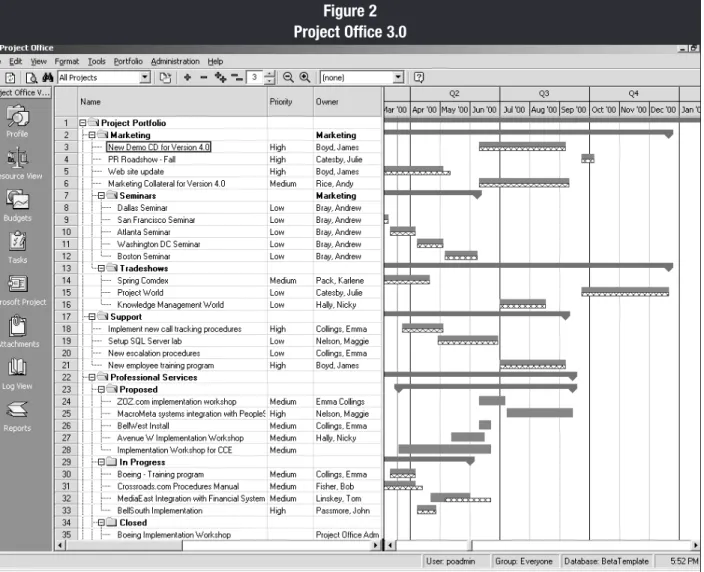
For companies that require detailed scheduling, Project Office 3.0, the latest release, offers seamless integration with Microsoft Project (see Figure 2). Project information is saved to and retrieved from a Microsoft SQL Server database to facilitate enterprise-level analysis, reporting, and data integration.
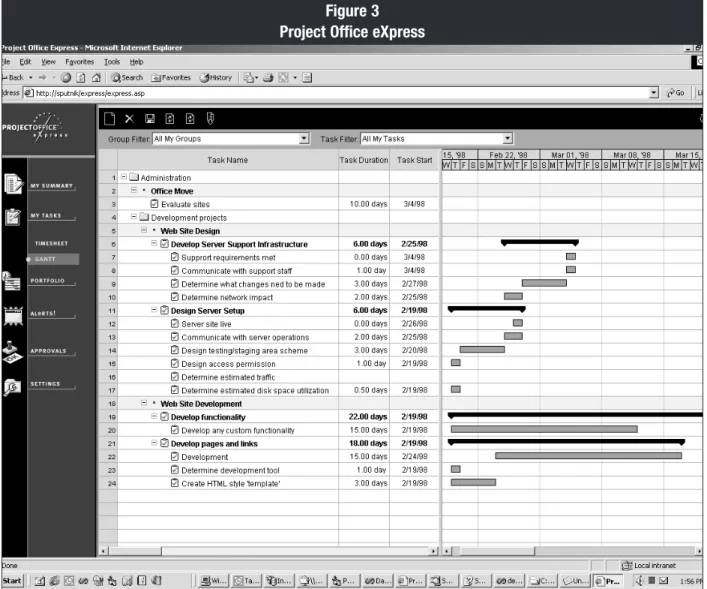
Project Office eXpress is a browser-based application that allows users to receive and report project information on the Web (see Figure 3). This means that project participants can be tied into the process no matter where they are located.
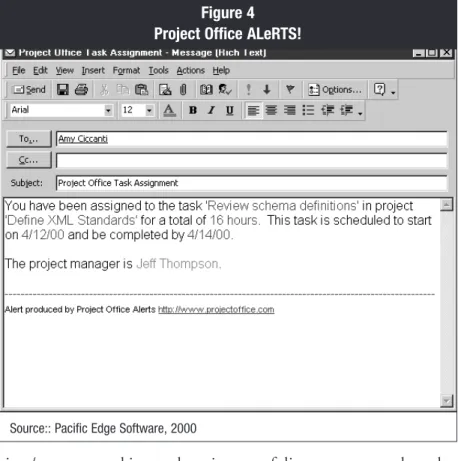
The company recently introduced Project Office ALeRTS!, a customiz-able option that alerts users when a specific event or business rule has been violated (see Figure 4). Project Office ALeRTS! compiles all changes and other information and then either sends them to a user as email or stores them on an HTML page that can be displayed in Microsoft
Figure 1
Project Office Functionality
Outlook or Project Office eXpress. This function can be very useful to managers who need “exception reporting” and other key information. The latest release of Project Office puts Pacific Edge in the enviable position of being able to meet the needs of small to medium-sized organizations or departments as well as large environments, including deployments with over 10,000 users and projects. The solution is ASP-ready, and therefore companies can license or obtain it from a third party.
Project Office addresses the specific needs of the markets it serves. For example, pharmaceutical companies are using the solution to streamline new product development, IT organizations are managing software implementations and upgrades, high-tech companies are implementing first-to-market initiatives, and retail chains are managing store openings. The product is highly configurable and can be implemented quickly.
Figure 2 Project Office 3.0
Organizations using Project Office are as diverse as the product applications. Pacific Edge customers include Ceridian Employment Services, Airborne Express, Getty Images, Costco, Microsoft, and U.S. Department of Housing and Urban Development.
Pacific Edge’s leadership efforts in developing the pmXML schema for the project management industry will enhance its credibility and market position. By fostering the adoption of industry standards, the company will help grow the overall market for the type of solutions that it offers. IDC research indicates that 43% of large companies and 31% of medium-sized firms have implemented or plan to implement XML-enabled applications by yearend (see Figure 5).
A Focus on Reliable Results
Project Office has evolved into a solution that not only fulfills customer expectations for project management functions such as
Figure 3 Project Office eXpress
time/expense tracking and project portfolio management but also extends into newer areas such as business-to-business (B2B) project collaboration, workforce management, business intelligence, and information analysis. Project Office 3.0 adds increased back-end database functionality that incorporates XML technology, enabling customers to share information within their company as well as with outside constituencies.
IDC places Project Office 3.0 in the workforce management application market. The software extends traditional human resource, project man-agement, and industry-specific (e.g., professional services automation) application functionality to better manage the acquisition, deployment, and retention of workers. Web-enabled collaboration is now a key component of workforce management.
Project Office’s collaborative, transactional, and analytic functionality automates the deployment of workers to projects or teams across enterprises. Interenterprise collaboration, supported by applications such as Project Office, will drive the growth of the workforce manage-ment market over the next five years.
Figure 4 Project Office ALeRTS!
Customer Success Stories
Helping Diverse Teams Work More Effectively at a Global
Pharmaceutical Company
One of the world’s largest pharmaceutical companies is currently using Project Office to help its global research and development teams more effectively manage and execute projects. The company had been using another packaged software solution for project management, but the solution wasn’t delivering as promised. The company, therefore, reviewed the available solutions and, after a lengthy decision-making process, decided on Project Office.
According to the director of research and development, the company chose Product Office for three main reasons: product approach, cost, and people. “The simplicity and technical elegance of Project Office was an important factor, as the solution is very intuitive and easy to use. Costs were very competitive, and the Pacific Edge team was very helpful and willing to go the extra mile.”
Now the giant pharmaceutical company can more effectively perform budgeting, resource allocation, time tracking, and project planning across highly interdependent global teams. In addition, the Pacific Edge solution is integrated with the financial reporting system, making it easier to determine project profitability and other key metrics. Management has a much better understanding of project performance, which helps increase productivity. Eventually, more than 700 people worldwide will use the system and work together more effectively.
Figure 5
United States XML Adoption By Organization Size
Q. Does your company use or plan to implement XML-enabled applications?
Improving Project Time Tracking at Ceridian Employer Services
Ceridian Employer Services is one of the country’s largest providers of human resource management solutions. With more than 5,000 employees across 40 locations in North America, the company pioneered the service bureau concept and became the first payroll processing bureau in the world.
Tracking time spent on projects has long been a challenge for Ceridian. In the past, many employees used spreadsheets to report their hours. Typically, these spreadsheets were sent to the appropriate organization for processing, and discrepancies were settled via an iterative “back-and-forth” resolution process. The amount of time spent on such time-consuming and wasteful activity prompted the company to seek a better solution. An IT director, who had used Project Office in a previous job, knew its capabilities and brought Pacific Edge into Ceridian. Now, 300 Ceridian professional services employees scattered throughout the country and an additional 50 IT staff members in Minnesota use the product.
Productivity has increased dramatically, as there is no longer any need to send spreadsheets back and forth to resolve time-tracking problems. Patty Latvala, IT project manager, says, “We’ve got much better visibility into projects, and there has been a significant reduction in time reporting errors.” The company will eventually expand usage of Project Office modules to more than 1,000 professionals and add performance reporting, which will enable even more comprehensive project management. One particular feature that Latvala praises is the product’s ability to give different users customized views of projects. For example, managers can access a high-level view of the performance of multiple projects, administrators see the details, and professionals have input into their own projects. “We’ve become much more strategic about managing our projects,” she says, “and in the future we will implement additional features of Project Office to do even more.”
Key Challenges Facing Pacific Edge
There is no doubt that results-driven companies can benefit from disciplined collaboration, focused oversight, and efficient implementa-tion of workforce management applicaimplementa-tions. However, Pacific Edge faces competition, both direct and indirect, from a number of more visible players with greater revenues.
Pacific Edge’s strategy of relying on others to bring to market critical path and scheduling transaction functionality while it concentrates on virtual organizational networks, project portfolio, and dynamic resource optimization benefits makes sense as long as these other companies do not invade its space. If the company is unable to rapidly grow the sales organization both domestically and internationally, this strategy could pose a roadblock to the high growth Pacific Edge seeks. The company also has be wary of enterprise application suite providers
that have the ability to bring project management, collaborative, and business intelligence capabilities to their installed bases through devel-opment, partnerships, and/or acquisition.
In addition, Pacific Edge is targeting customers in industries in which the advantages of its solution may not yet be recognized. Potential customers need to be educated about the benefits and competitive advantages that Project Office brings. As a result, the company needs to do a significant amount of missionary work to have its solution adopted as a de facto standard.
Conclusion
IDC believes that Pacific Edge has the potential to become a leading player in a new market by automating new product, service, and output (e.g., marketing program) development. Its strategy of leaving critical path and detailed scheduling functionality to other vendors makes sense in the near term because it allows the company to focus on the emerging areas of disciplined collaboration, focused oversight, and efficient imple-mentation. The company can also focus on serving the needs of management and others who are not professional project managers. The enthusiastic response from customers indicates that the company’s application approach is in tune with market needs. The company’s enter-prise approach to managing resources, its single database philosophy, its numerous successful customers, and its top-down planning methodology for mapping out projects give the company a strong foothold in a new and emerging market: workforce management applications. In addition, its leadership in XML enablement is commendable.
Pacific Edge’s long-term mission is “to become the single worldwide standard for creating, storing, analyzing, and exchanging project infor-mation in and between businesses.” This is a tall order and would be a challenge for an established global organization with vast resources, let alone a two-year-old private company. However, lofty ambitions are not a detriment.
To realize its goal, Pacific Edge will have to execute well in a highly competitive environment. The company has an excellent management team and adequate funding to allow it to achieve significant market share. Based on our discussions with customers, the company is making good inroads, has a strong offering, and is well positioned in a new and emerging market that improves the process of delivering products, services, and output.
NORTH AMERICA Corporate Headquarters 5 Speen Street Framingham, MA 01701 508-872-8200 IDC Canada
36 Toronto Street, Suite 950 Toronto, Ontario Canada M5C2C5 416-369-0033
IDC Irvine
18831 Von Karmen Ave, Ste 200 Irvine, CA 92612 949-250-1960 IDC Mt. View 2131 Landings Drive Mountain View, CA 94043 650-691-0500
IDC New Jersey
120 Wood Ave South, Suite 509 Iselin, NJ 08830
732-632-9222
IDC New York
2 Park Avenue Suite 1505 New York, NY 10016 212-726-0900
IDC Texas
100 Congress Ave, Suite 2000 Austin, TX 78701 512-469-6333
IDC Washington
8304 Professional Hill Drive Fairfax, VA 22031 703-280-5161
ASIA/PACIFIC
IDC Asia/Pacific (Hong Kong)
12/Floor, St. John's Building 33 Garden Road
Central, Hong Kong 852-2530-3831
IDC Asia/Pacific (Singapore)
71 Bencoolen Street, #02-01 Singapore 189643 65-226-0330
IDC Australia
Level 4, 76 Berry Street North Sydney NSW 2060, Australia 61-2-9922-5300
IDC China
Rm.610-612 Time Square No. 88 Xi Chang'an Avenue Xicheng District Beijing 100031 China PRC 86-10-6833-1179 IDC India Ltd. Cyber House 35 (4 Bays) Echelon Institutional Sector 32 Gurgaon 122002 Haryara, India 91-124-381673 IDC Japan
10F The Itoyama Tower 3-7-18, Mita Minato-ku Tokyo 108-0073, Japan
IDC Korea Ltd
13th Floor, Textile Center 944-31, Daechi-3Dong Kangnam-Ku Seoul, 135-713 Korea 82-2-528-5100
IDC Malaysia
Suite 23.1 23rd Floor Menara Genesis 33 Jalan Sultan Ismail
50250 Kuala Lumpur, Malaysia 60-3-244-3715
IDC New Zealand
Level 7, 246 Queen Street Auckland, New Zealand 64-9-309-8252
IDC Philippines
7F, SEDCCO 1Bldg Rada Street Corner Legaspi Street Legaspi Village Makati City, Philippines 632-750-9477
IDC Taiwan Ltd.
10F, 31 Jen-Ai Rd, Sec 4, Taipei 106, Taiwan, R.O.C. 886-2-2731-7288
IDC Thailand
27 Soi Charoen Nakorn 14 Charoen Nakorn Road, Klongtonsai Klongsan Bangkok 10600, Thailand 66-2-439-4591-2
IDC Vietnam
37 Ton Duc Thang Street Unit 1606
District-1 Hochiminh City Vietnam 84-8-910-1235
EUROPE, MIDDLE EAST, AND AFRICA IDC Austria
c/o Loisel, Spiel, Zach Consulting Mayerhofgasse 6
A-1040 Vienna, Austria 43-1-50-50-900
IDC Benelux (Belgium)
29 Avenue Louis Gribaumont B-1150, Brussels, Belgium 32-2-779-46-04
IDC Benelux (The Netherlands)
A. Fokkerweg 1 1059 CM Amsterdam The Netherlands 31-20-669-2721
IDC Central Europe (ECE)
Male Namesti 13
Praha 1 110 00, Czech Republic 420-2-2161-2260
IDC Central Europe (Germany)
Westerbachstr. 23A 61476 Kronberg/Ts., Germany 49-6173-7098-0
IDC Central Europe (Switzerland)
WTC, Leutschenbachstrasse 95 CH-8050 Zürich, Switzerland 41-1-308-3619
IDC Egypt
39 Iraq Street
Mohandesseen, Cairo, Egypt 20-2-336-7355
IDC France
Immeuble La Fayette 2, Place des Vosges, Cedex 65 92051 Paris la Defense 5, France 33-14-904-8000 IDC Hungary Bajcsy-Zsilinszky út. 57 Building 3, Rooms 103-104 H-1065 Budapest, Hungary 36-1-153-0555/ext. 165, 166 IDC Israel 4 Gershon Street Tel Aviv 67017, Israel 91-124-381-673 IDC Italy Viale Monza, 14 20127 Milano, Italy 390-2-284-571 IDC Nigeria House 2, 'C' Close 403 Road, 4th Avenue New Extension, Festac Town Lagos, Nigeria
234-1-883585
IDC Nordic (Denmark)
Jagtvej 169B
DK-2100 Copenhagen, Denmark 45-39-162222
IDC Nordic (Finland)
Jarrumiehenkatu 2 FIN-00520 Helsinki, Finland 358-9-8770-466 972-3-561-1660
IDC Nordic (Sweden)
Box 1096 Kistagången 21 S-164 25 Kista, Sweden 46-8-751-0415 IDC Poland/ProMarket Wrobla 43 02-736 Warsaw, Poland 48-22-644-4105 IDC Portugal
c/o Ponto de Convergencia S.A. Rua Leopoldo de Almeida 4A 1750 Lisbon, Portugal 351-1-758-3126 IDC Russia c/o PX Post, RDS 186 Ulitsa Zorge 10 Moscow 125525 Russian Federation 7-501-929-9959
IDC South Africa
c/o BMI-TechKnowledge 3rd Floor, 356 Rivonia Blvd. PO Box 4603, Rivonia, 2128 South Africa 27-11-803-6412 IDC Turkey
Tevfik Erdonmez Sok. 2/1 Gul Apt. Kat 9D; 46 Esentepe
Istanbul, Turkey 90-212-275-0995
IDC U.K.
6 Dukes Gate, Acton Lane Chiswick, London W4 5DX United Kingdom 44-181-987-7100 IDC U.K. 2 Bath Road Chiswick, London W4 1LN United Kingdom 44-181-987-7100 LATIN AMERICA IDC Miami
Latin America Headquarters 5301 Blue Lagoon Drive, Suite 490 Miami, FL 33126
305-267-2616
IDC Argentina
Trends Consulting
Rivadavia 413, 4th Floor, Suite 6 C1002AAC, Buenos Aires, Argentina 54-11-4343-8899
IDC Brasil
Alameda Ribeirão Preto, 130 cj 41 01331-000 São Paulo
SP Brazil 55-11-253-7869
International Data Corp. Chile
Luis Thayer Ojeda 166 Piso 12 Providencia, Santiago 9, Chile 56-2-231-0111 IDC Colombia Carrera 40 # 103-78 Bogota, Colombia 571-533-2326 IDC Mexico Select - IDC
Av. Nuevo Leon No. 54 Desp. 501 Col. Hipodromo, Condesa C.P. 06100 Mexico, D.F. 52-5-256-1426
IDC Venezuela
Trends Consultores Av. Francisco de Miranda Centro Perú, Torre A, Piso 9 Of. 91, Chacao 1060 Caracas, Venezuela 58-2-261-0352
IDC delivers accurate, relevant, and high-impact data and insight on information technology to help orga-nizations make sound business and technology decisions. IDC forecasts worldwide IT markets and adoption and technology trends, and analyzes IT products and vendors, using a combination of rigorous primary research and in-depth competitive analysis. IDC is committed to pro-viding global research with local content through more than 500 analysts in more than 40 countries worldwide. IDC’s customers com-prise the world’s leading IT suppliers, IT organizations, and the financial community. Additional information on IDC can be found on its Web site at http://www.idc.com.
IDC is a division of IDG, the world’s leading IT media, research, and exposition company.