Sparrow: Distributed, Low Latency Scheduling
K. Ousterhout, P. Wendell, M. Zaharia and I. Stoica. In Proc. of SOSP 2013
(Some) useful concepts picked up from OS
Scheduler, preemption, shortest-job first, RPC,
gang-scheduling, fair-share scheduling,
…
(In no particular order)
Jobs and scheduling for data analytics
Large data analytics clusters
Running ever shorter and higher-fanout jobs
What for? Finance, language translation,
Jobs and scheduling for data analytics
Jobs composed of short tasks
Produced from frameworks that stripe work
across 1
3machines (e.g., Dremel, Spark,
…
)
Targeting task running in ~100ms
4
Map Reduce/Spark/Dryad
Job
Task Task Task
Map Reduce/Spark/Dryad
Job
Job latencies decreasing rapidly
2004: MapReduce batch job 2009: Hive query 2010: Dremel query 2012: Impala query 2010: In-memory Spark query 2010: In-memory Spark streamingScheduling challenges
Millisecond latency
Quality placement
Fault tolerant
High throughput
Fixing centralized schedulers is not an option
Sparrow schedules tasks in clusters
using a decentralized, randomized approach
support constraints and fair sharing and
provides response times within 12% of ideal
Adapts power-of-two-choices to parallel task
scheduling, introducing three techniques
–
Batch sampling
–
Late binding
Per-task sampling
A direct application of power of two choices
For each task in a job, the scheduler
– Randomly selects two workers
– Probes each worker (a lightweight RPC) for queue length – Places task in shortest queue
Per-task Sampling
Scheduler Scheduler Scheduler Scheduler Worker Worker Worker Worker Worker WorkerJob
Per-task sampling
10 Scheduler Scheduler Scheduler Scheduler Worker Worker Worker Worker Worker WorkerJob
Per-task sampling
A direct application of power of two choices
For each task in a job, the scheduler
–
Randomly selects two workers
–
Probes each worker (a lightweight RPC) for queue
length
–
Places task in shortest queue
For comparison
–
Random
–
Omniscient – greedy, based on complete
Better than random, >2x worst than opt
12
Simulated Results
100-task jobs in 10,000-node cluster, exp. task durations
!"
!#"
!$""
!$#"
!%""
!%#"
!&""
!&#"
!"
!"'%
!"'(
!"')
!"'*
!$
+
,-./0-,
!1
23
,!43
-5
6/78
+708/3
9,:;17-<
=302->2,0?
100-task jobs in 10,000-node cluster, exp. task duration
Higher load, harderto find a free worker where to place a task
Response time grows with tasks/jobs
!"
!#"
!$""
!$#"
!%""
$
$"
$""
$"""
&
'()*+('
!,
-.
'!/.
(0
6'7!,1(2
Per-task sampling
14 Scheduler Scheduler Scheduler Scheduler Worker Worker Worker Worker Worker WorkerJob
Task 1 Task 2An unlucky draw
And a
lucky one
Batch sampling
Scheduler Scheduler Scheduler Scheduler Worker Worker Worker Worker Worker WorkerJob
4 probes (d=2)Batch sampling
16 Scheduler Scheduler Scheduler Scheduler Worker Worker Worker Worker Worker WorkerJob
4 probes (d=2)Per-task and Batch
Per-task versus Batch Sampling
!"
!#"
!$""
!$#"
!%""
$
$"
$""
$"""
&
'()*+('
!,
-.
'!/.
(0
6'7!,1(2
819:;
Batch sampling – better, still 1.92x opt
18
Simulated Results
100-task jobs in 10,000-node cluster, exp. task durations
!"
!#"
!$""
!$#"
!%""
!%#"
!&""
!&#"
!"
!"'%
!"'(
!"')
!"'*
!$
+
,-./0-,
!1
23
,!43
-5
6/78
+708/3
9,:;17-<
=7>?@
A302-?2,0>
Late binding
Sample-based scheduling performs poorly
under load
–
Select based on queue length, coarse predictor of
wait time
• Better predictors using estimates of task durations is hard
–
Race condition – multiple schedulers picking the
Late binding
Late binding
–
Workers put task internal work queue, hold back
response
–
When task gets to the front, worker replies RPC
–
Scheduler assigns job’s tasks to first
m
workers
–
…
and sends no-ops to the rest (proactive)
Cost
–
Idle while sending RPC – a 2% efficiency loss
–
Fraction of time idle while requesting tasks
(
d
* RTT) / (
t + d *
RTT)
20
Late binding benefits
Simulated Results
!"
!#"
!$""
!$#"
!%""
!%#"
!&""
!&#"
!"
!"'%
!"'(
!"')
!"'*
!$
+
,-./0-,
!1
23
,!43
-5
6/78
+708/3
9,:;17-<
=7>?@
=7>?@A67>,!=20820B
C302-?2,0>
Within 5% of Opt 0.55x of batch samplingHandling constrains and policies
Job constraints, e.g.,
run in workers with GPU
–
Trivially handled, pick
dm
candidate from the
subset
Per-task constraints, e.g.,
run where input is
–
Use per-task sampling, improved with
–
…
sharing information across tasks when possible
–
…
use late-binding
Handling constrains and policies
Resource allocation policies, under load
–
Strict priorities through multiple queues on workers
• FIFO, earliest deadline first, shortest job first, class, … • Trade accuracy for simplicity (no global information but
low priority jobs can run first) • No preemption
–
Weighted fair sharing
Sparrow implementation
Sparrow works for 1+ concurrent frameworks
– Front end + executor (long-lived processes responsible for executing task w/o startup overhead)
– Node monitor federates resources usage bet/ co-located frameworks 24 Spark Frontend App X Frontend Sparrow scheduler Spark Frontend Sparrow scheduler Worker
Sparrow Node Monitor
Spark Executor App X Executor
Worker
Sparrow Node Monitor
Spark Executor
Worker
Sparrow Node Monitor
App X Executor
Scheduler service: submitRequest()/ taskComplete()
Sparrow and Spark’s native scheduler
How does Sparrow compare to Spark’s native
scheduler?
!"
!#"""
!$"""
!%"""
!&"""
!'"""
!("""
!"
!#"""
!$"""
!%"""
!&"""
!'"""
!("""
)
*+,-.+*
!/
01
*!21
+3
/4+5!678490-.!21+3
:,485!.490;*!+<=*>7?*8
:,488-@
A>*4?
All tasks in a job are of same duration; ideal job response time is duration of a task
Spark’s centralized
TPC-H queries: background
A common benchmark for analytics workloads;
representative of ad-hoc queries on business data
Shark queries compiled into
multiple spark stages
Each stage triggers a
scheduling request using
submitRequest()
Task in first stage constrained
to machines holding input data
Stages have different number of
tasks, durations and un/constrained queries
26
Shark: SQL execution engine
Spark: Distributed in-memory analytics framework
TPC-H Queries
TPC-H Queries
!"
!#""
!$"""
!$#""
!%"""
!%#""
!&"""
!&#""
!'"""
*
+,-./,+
!0
12
+!32
,4
'%$5!32+674 #&8)!32+674 599$!32+674*:/6.2
;+<=>:,?!,:2-@1/A
B:>CD!,:2-@1/A
B:>CD!E!@:>+!F1/61/A
G6+:@
95
75
25
50
Percentiles
5
95 75 50 25 5 Random Per-task binding Batch sampling Batch + late bindingEffect of probe ratio
280
50
100
150
200
250
300
1
1.1
1.2
1.5
2
3
R
es
pons
e T
im
e (m
s)
Probe Ratio
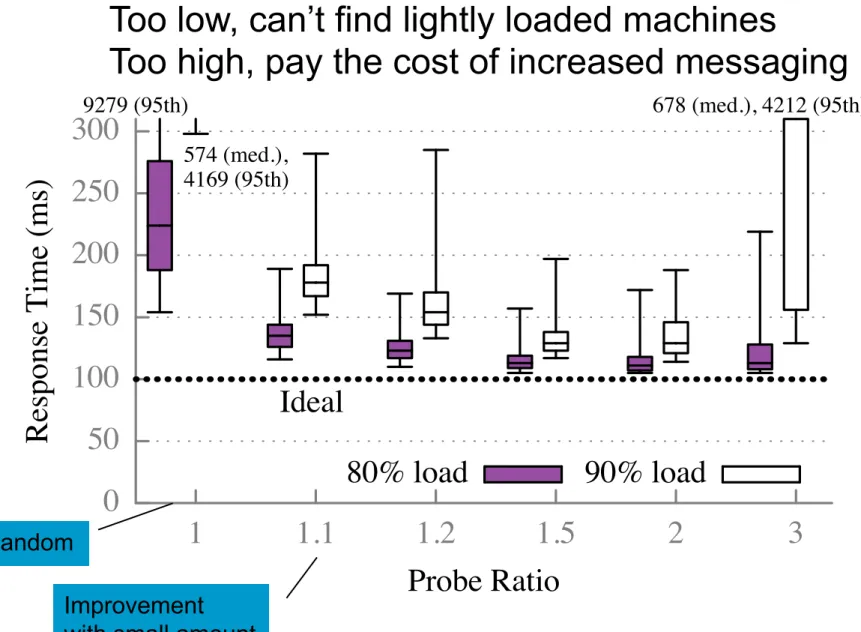
9279 (95th) 574 (med.), 4169 (95th)Ideal
678 (med.), 4212 (95th)80% load
90% load
Figure 14: Effect of probe ratio on job response time
at two different cluster loads. Whiskers depict 5th
and 95th percentiles; boxes depict median, 25th, and
75th percentiles.
7.9 How sensitive is Sparrow to the probe
ratio?
Changing the probe ratio affects Sparrow’s performance
most at high cluster load. Figure 14 depicts response
time as a function of probe ratio in a 110-machine
clus-ter of 8-core machines running the synthetic workload
(each job has 10 100ms tasks). The figure demonstrates
that using a small amount of oversampling significantly
improves performance compared to placing tasks
ran-domly: oversampling by just 10% (probe ratio of 1
.
1)
reduces median response time by more than 2
.
5
×
com-pared to random sampling (probe ratio of 1) at 90% load.
The figure also demonstrates a sweet spot in the probe
ratio: a low probe ratio negatively impacts performance
because schedulers do not oversample enough to find
lightly loaded machines, but additional oversampling
eventually hurts performance due to increased
messag-ing. This effect is most apparent at 90% load; at 80%
load, median response time with a probe ratio of 1
.
1 is
just 1
.
4
×
higher than median response time with a larger
probe ratio of 2. We use a probe ratio of 2 throughout
our evaluation to facilitate comparison with the power
of two choices and because non-integral probe ratios are
not possible with constrained tasks.
7.10 Handling task heterogeneity
Sparrow does not perform as well under extreme task
heterogeneity: if some workers are running long tasks,
Sparrow schedulers are less likely to find idle machines
on which to run tasks. Sparrow works well unless a large
fraction of tasks are long
and
the long tasks are many
or-ders of magnitude longer than the short tasks. We ran
a series of experiments with two types of jobs: short
jobs, composed of 10 100ms tasks, and long jobs,
com-posed of 10 tasks of longer duration. Jobs are submitted
0
50
100
150
200
250
300
10s
100s
S
hort
J
ob R
es
p. T
im
e (m
s)
Duration of Long Tasks
16 core, 50% long
4 cores, 10% long
4 cores, 50% long
666
2466
6278
Figure 15: Sparrow provides low median response
time for jobs composed of 10 100ms tasks, even when
those tasks are run alongside much longer jobs.
Er-ror bars depict 5th and 95th percentiles.
to sustain 80% cluster load. Figure 15 illustrates the
re-sponse time of short jobs when sharing the cluster with
long jobs. We vary the percentage of jobs that are long,
the duration of the long jobs, and the number of cores
on the machine, to illustrate where performance breaks
down. Sparrow provides response times for short tasks
within 11% of ideal (100ms) when running on 16-core
machines, even when 50% of tasks are 3 orders of
mag-nitude longer. When 50% of tasks are 3 orders of
magni-titude longer, over 99% of the execution time across all
jobs is spent executing long tasks; given this, Sparrow’s
performance is impressive. Short tasks see more
signifi-cant performance degredation in a 4-core environment.
7.11 Scaling to large clusters
We used simulation to evaluate Sparrow’s performance
in larger clusters. Figure 3 suggests that Sparrow will
continue to provide good performance in a 10,000 node
cluster; of course, the only way to conclusively evaluate
Sparrow’s performance at scale will be to deploy it on a
large cluster.
8 Limitations and Future Work
To handle the latency and throughput demands of
low-latency frameworks, our approach sacrifices features
available in general purpose resource managers. Some of
these limitations of our approach are fundamental, while
others are the focus of future work.
Scheduling policies
When a cluster becomes
over-subscribed, Sparrow supports aggregate fair-sharing or
priority-based scheduling. Sparrow’s distributed setting
lends itself to
approximated
policy enforcement in
or-der to minimize system complexity; exploring whether
Sparrow can provide more exact policy enforcement
13
Random
Improvement
with small amount
Too low, can’t find lightly loaded machines
Failure impact
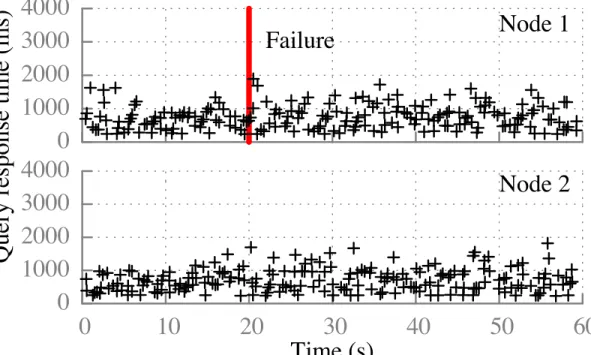
29 0 1000 2000 3000 4000 0 10 20 30 40 50 60 Time (s) 0 1000 2000 3000 4000 Q ue ry re spons e t im e (m s) Failure Node 1 Node 2Figure 11: TPC-H response times for two frontends submitting queries to a 100-node cluster. Node 1 suf-fers from a scheduler failure at 20 seconds.
constrained tasks, Sparrow provides a performance im-provement over per-task sampling due to its use of late binding.
7.4 How do scheduler failures impact job
response time?
Sparrow provides automatic failover between schedulers and can failover to a new scheduler in less than 120ms. Figure 11 plots the response time for ongoing TPC-H queries in an experiment parameterized as in §7.1, with 10 Shark frontends that submit queries. Each frontend connects to a co-resident Sparrow scheduler but is ini-tialized with a list of alternate schedulers to connect to in case of failure. At time t=20, we terminate the Sparrow scheduler on node 1. The plot depicts response times for jobs launched from the Spark frontend on node 1, which fails over to the scheduler on node 2. The plot also shows response times for jobs launched from the Spark fron-tend on node 2, which uses the scheduler on node 2 for the entire duration of the experiment. When the Sparrow scheduler on node 1 fails, it takes 100ms for the Spar-row client to detect the failure, less than 5ms to for the Sparrow client to connect to the scheduler on node 2, and less than 15ms for Spark to relaunch all outstand-ing tasks. Because of the speed at which failure recov-ery occurs, only 2 queries have tasks in flight during the failure; these queries suffer some overhead.
7.5 Synthetic workload
The remaining sections evaluate Sparrow using a syn-thetic workload composed of jobs with constant dura-tion tasks. In this workload, ideal job compledura-tion time is always equal to task duration, which helps to isolate
0 1000 2000 3000 4000 5000 6000 0 1000 2000 3000 4000 5000 6000 R es pons e T im e (m s) Task Duration (ms) Spark native scheduler
Sparrow Ideal
Figure 12: Response time when scheduling 10-task jobs in a 100 node cluster using both Sparrow and Spark’s native scheduler. Utilization is fixed at 80%, while task duration decreases.
experiments run on a cluster of 110 EC2 servers, with 10 schedulers and 100 workers.
7.6 How does Sparrow compare to Spark’s
native, centralized scheduler?
Even in the relatively small, 100-node cluster in which we conducted our evaluation, Spark’s existing central-ized scheduler cannot provide high enough throughput to support sub-second tasks.5 We use a synthetic work-load where each job is composed of 10 tasks that each sleep for a specified period of time, and measure job re-sponse time. Since all tasks in the job are the same du-ration, ideal job response time (if all tasks are launched immediately) is the duration of a single task. To stress the schedulers, we use 8 slots on each machine (one per core). Figure 12 depicts job response time as a function of task duration. We fix cluster load at 80%, and vary task submission rate to keep load constant as task du-ration decreases. For tasks longer than 2 seconds, Spar-row and Spark’s native scheduler both provide near-ideal response times. However, when tasks are shorter than 1355ms, Spark’s native scheduler cannot keep up with the rate at which tasks are completing so jobs experience infinite queueing.
To ensure that Sparrow’s distributed scheduling is necessary, we performed extensive profiling of the Spark scheduler to understand how much we could increase scheduling throughput with improved engineering. We did not find any one bottleneck in the Spark sched-uler; instead, messaging overhead, virtual function call overhead, and context switching lead to a best-case throughput (achievable when Spark is scheduling only a single job) of approximately 1500 tasks per second. Some of these factors could be mitigated, but at the ex-pense of code readability and understandability. A
clus-5 For these experiments, we use Spark’s standalone mode, which
relies on a simple, centralized scheduler. Spark also allows for
schedul-Spark Client 1 Spark Client 2 Scheduler 1 Scheduler 2
✗
Detect failure 100ms Failover 5ms Re-launch queries 15msLimitations/future work
Scheduling policies – can they do better than
approximate?
Inter-job constraints (e.g.,
tasks of job A cannot run
with those of B
) – hard to do w/o drastic changes
Gang scheduling – no central point where to do it
Query-level policies – easy to extend, FIFO
…
Want to try?