FY2022-2024 Request for Proposals
Deadline for Pre-Proposal Submittal: February 19, 2021Deadline for Full Proposal Submittal: May 18, 2021 Table of Contents
1. Summary ... 2
2. Introduction - MIT Sea Grant ... 2
3. FY2022-2024 Topics and Topic Selection ... 4
4. Proposal Information ... 5
4.1 Funding ... 5
4.2 MIT Sea Grant Marine Advisory/Extension Staff ... 5
4.3 RFP Schedule ... 5
5. Specific Preproposal and Full Proposal Instructions ... 6
5.1 Preproposal Instructions ... 6
5.2 Full Proposal Instructions ... 9
5.3 Full Proposal Evaluation Criteria ... 13 “Our mission is to conduct and support research and develop technology to enable scientific
investigation into problems surrounding the ecosystem health and human use of coastal and marine environments. Our education and outreach efforts disseminate the results of our MIT Sea Grant-funded research, and research conducted by our AUV Lab and Marine Advisory staff in
collaboration with industry, state and federal partners. These stakeholder engagement, education and outreach efforts are meant to encourage stewardship and implementation of sustainable and useful technologies that help answer management questions in support of public policy and industry through the use of relevant, evidence-based and scientifically sound information. Efforts in
research, education, and outreach are designed to address critical marine and coastal issues at the state, regional, national and global levels that have been identified by Massachusetts constituents and which are within the areas of focus for the National Sea Grant College Program.”
1.
Summary
The purpose of this document is to provide details and instructions on how to apply for the FY22 MIT Sea Grant Request for Proposals (RFP). Research at MIT Sea Grant is directed by four Focus Areas and their Objectives and Outcomes as outlined in the MIT Sea Grant Strategic Plan. The Focus Areas, Objectives, and Outcomes guide us in supporting scientific and /or technology development research that aims to understand and improve ecosystem health and the human use of coastal and marine environments. This RFP outlines focused research Topics that are in line with our Strategic Plan and provides instructions on how to select a proposal Topic to discuss with MIT Sea Grant. Instructions on submitting preproposals and full proposals, as well as the evaluation process for each phase and specific evaluation criteria used, are described in detail. Important Dates and Details:
Topic Selection: January 14 - February 19, 2021.
Preproposals Due: February 19, 2021 by 5pm.
Full Proposals Due: May 18, 2021 by 5pm
Eligibility: All researchers from academic, research and educational institutions within the state of Massachusetts who are eligible to submit a proposal according to his/her home institution may apply.
Requested Funding: Budget requests may not exceed $100,000 annually, for a total of
$200,000 over a two-year period. A 50% non-federal match is required.
Submitting: Submittals are through eSeaGrant, our online proposal system. Please contact Mary Newton Lima, Research Program Coordinator ([email protected]) for access as soon as possible in order to avoid missing the deadline due to technical issues.
Contact Information:
Topic Selection: Michael Triantafyllou, Director, [email protected]
RFP Process: Mary Newton Lima, Research Program Coordinator, [email protected]
Budgets: Caroline Johnston, Financial Administrator, [email protected]
eSeaGrant: Mary Newton Lima, Research Program Coordinator, [email protected] OR
Ben Bray, Web Developer, [email protected]
MITSea Grant Marine Advisory Services Group: (Click here for webpage)
2.
Introduction - MIT Sea Grant
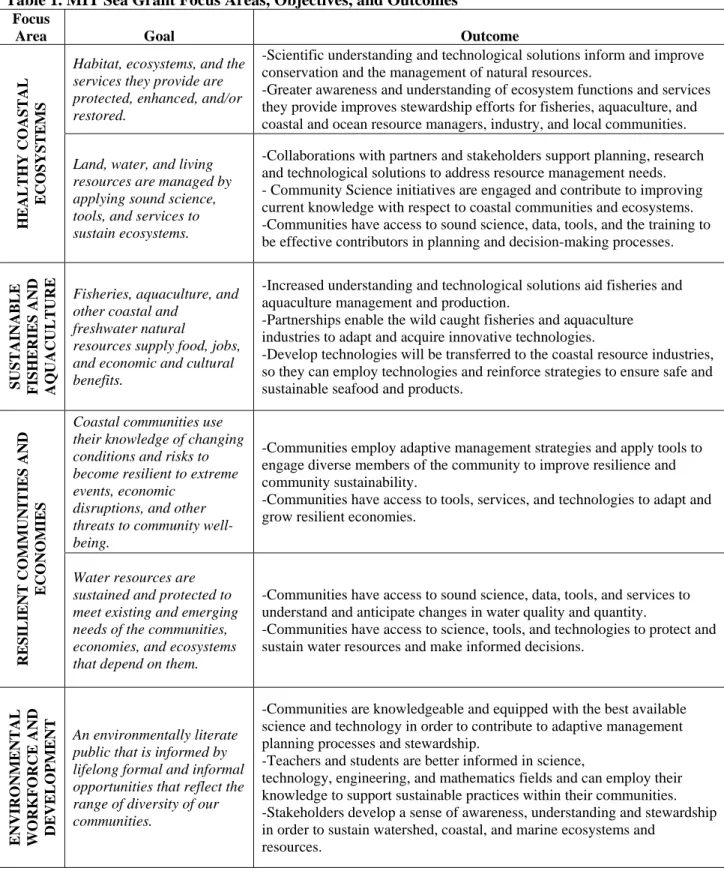
The Massachusetts Institute of Technology’s (MIT) Sea Grant College Program (MIT Sea Grant) is part of NOAA’s National Sea Grant College Program (NSGCP), one of the 34 programs located in coastal and Great Lakes states. Every year, MIT Sea Grant issues an annual (RFP) for research projects that contribute to the improved understanding, utilization and/or management of coastal and marine resources related to our four Focus Areas and associated goals and outcomes in the MIT 2018-2023 strategic plan (see Table below). Our efforts in research, technology development, education, and outreach are designed to address critical marine and coastal issues that have been identified by Massachusetts constituents and are within the Focus Areas of the 2018-2023 MIT Sea Grant and National Sea Grant College Program strategic plans. The four Focus Areas and related MIT Sea Grant Goals and Outcomes are described in detail in our MIT Sea Grant Strategic Plan and summarized here:
Table 1. MIT Sea Grant Focus Areas, Objectives, and Outcomes Focus
Area Goal Outcome
HEALTH Y C O AST A L ECOSYSTE M S
Habitat, ecosystems, and the services they provide are protected, enhanced, and/or restored.
-Scientific understanding and technological solutions inform and improve conservation and the management of natural resources.
-Greater awareness and understanding of ecosystem functions and services they provide improves stewardship efforts for fisheries, aquaculture, and coastal and ocean resource managers, industry, and local communities.
Land, water, and living resources are managed by applying sound science, tools, and services to sustain ecosystems.
-Collaborations with partners and stakeholders support planning, research and technological solutions to address resource management needs. - Community Science initiatives are engaged and contribute to improving current knowledge with respect to coastal communities and ecosystems. -Communities have access to sound science, data, tools, and the training to be effective contributors in planning and decision-making processes.
SUST AI NAB LE FISHE R IES AND AQ UA C U LTURE
Fisheries, aquaculture, and other coastal and
freshwater natural
resources supply food, jobs, and economic and cultural benefits.
-Increased understanding and technological solutions aid fisheries and aquaculture management and production.
-Partnerships enable the wild caught fisheries and aquaculture industries to adapt and acquire innovative technologies.
-Develop technologies will be transferred to the coastal resource industries, so they can employ technologies and reinforce strategies to ensure safe and sustainable seafood and products.
R E SILIEN T C O M M UN ITIES AND ECONOM IE S
Coastal communities use their knowledge of changing conditions and risks to become resilient to extreme events, economic
disruptions, and other threats to community well-being.
-Communities employ adaptive management strategies and apply tools to engage diverse members of the community to improve resilience and community sustainability.
-Communities have access to tools, services, and technologies to adapt and grow resilient economies.
Water resources are sustained and protected to meet existing and emerging needs of the communities, economies, and ecosystems that depend on them.
-Communities have access to sound science, data, tools, and services to understand and anticipate changes in water quality and quantity.
-Communities have access to science, tools, and technologies to protect and sustain water resources and make informed decisions.
ENVIRONMENTAL WORKFORCE A
N
D
DEVELOPMENT
An environmentally literate public that is informed by lifelong formal and informal opportunities that reflect the range of diversity of our communities.
-Communities are knowledgeable and equipped with the best available science and technology in order to contribute to adaptive management planning processes and stewardship.
-Teachers and students are better informed in science,
technology, engineering, and mathematics fields and can employ their knowledge to support sustainable practices within their communities. -Stakeholders develop a sense of awareness, understanding and stewardship in order to sustain watershed, coastal, and marine ecosystems and
resources.
One of MIT Sea Grant’s cross-cutting principles is to enhance Diversity, Equity and Inclusion (DEI). MIT Sea Grant is striving to enhance cultural understanding and enable Sea Grant to pursue its vision and mission effectively and efficiently. Our program and the NSGCP encourages applicants from underrepresented racial and ethnic groups, individuals with
disabilities and individuals from economically or educationally disadvantaged backgrounds that have inhibited their ability to pursue a career in Science, Technology, Engineering, and Math (STEM).
3.
FY2022-2024 Topics and Topic Selection
Each year, MIT Sea Grant selects certain topic areas to focus on in the RFP that are high priority research topics to Massachusetts and take advantage of MIT Sea Grant’s unique abilities to address issues impacting coastal and marine waters; conduct innovative research to increase the capabilities of industry and resource managers; and ensure communities have access to science, tools, and technologies to support informed decision-making for the conservation of sustainable marine resources. The specific topics for this year are as follows:
1. Offshore aquaculture: The focus is on novel technologies to enable offshore installation and operation. We particularly encourage submissions within three topic areas:
a. “Intelligent nets” capable of sensing changing environmental parameters, controlling water flow, and monitoring fish movements for monitoring at-sea conditions,
infrastructure, and operations.
b. Autonomy for surface and underwater craft for inspection and maintenance of offshore farms – autonomy algorithms should be open, extensible, and applicable to a wide variety of platforms and missions
c. Very low power physical, chemical, or biological sensors for farm monitoring
2. Ocean acidification: The focus is on ocean monitoring using physics-based data inference, fusing diverse sources of data with a focus on, but not limited to, computer monitoring systems for Boston Harbor or the Gulf of Maine. Data from drifters, buoys, and satellite sources are all of interest.
3. Technology for observation and underwater manipulation: Focusing particularly on
shallow water applications, this area builds on past topics in underwater re-charging, wireless power transmission, and data communication. Principal obstacles in underwater monitoring and manipulation include:
a. Re-charging rapidly and effectively, and re-charging using renewable energy devices; b. Transferring data reliably at high rates;
c. Equipping underwater and surface vehicles with manipulation capabilities targeting aquaculture applications
4. Machine Learning for Fisheries Management: Monitoring and assessment of fisheries
resources is a timely, costly, and resource intensive process. Advances in artificial
intelligence and machine learning for computer assisted image recognition, quantification, and real-time monitoring of target species is a need expressed by a variety of stakeholders, including local, state, and federal resource managers, industry participants, and local communities. Research that supports and/or leads to the development of user-friendly systems for commercial, recreational, and species of concern to assist in monitoring and
assessments would support the MIT Sea Grant Focus Area, Sustainable Fisheries and Aquaculture. This technology can be applied to both wild and aquaculture fisheries.
An informational Open House for the FY2022 RFP was held virtually on Thursday, January 14, 2021 to provide guidance for interested applicants. Meeting slides are available for download here. Applicants are expected and encouraged to review the Topics and materials presented at the Informational Open House, select a research topic, and contact MIT Sea Grant
([email protected]) to discuss the topic prior to preproposal submittal to ensure the topic is appropriate to this RFP.
4.
Proposal Information
4.1 Funding
The maximum allowable annual research budget request is $100,000, for a total of $200,000 for a two-year project. This does not include the required matching funds provided by the PI, which amount to at least 50% of the figure requested from MIT Sea Grant. Projects may be up to two years in length.
The Principal Investigator (PI) must not be the recipient of other MIT Sea Grant funding during the period of the grant (i.e., 2/1/2022 to 1/31/2024). The Director may, at his/her discretion, remove a proposal from further consideration at any point in the process if an investigator has overdue obligations to MIT Sea Grant under a previous research award or contract.
4.2 MIT Sea Grant Marine Advisory Services Group
Sea Grant research proposals featuring strong research accompanied by meaningful
engagement/extension components will be considered more competitive, whether or not MIT Sea Grant Marine Advisory staff are formally involved. All Marine Advisory staff have experience designing, developing and implementing outreach/education projects. Most have experience conducting needs assessments and evaluations. Many conduct applied research themselves. Review our website to locate staff who might be able to help you or identify others who could help, which will inform your engagement/extension budgeting needs. Involving MIT Sea Grant Marine Advisory staff early in the proposal planning and preparation process increases the likelihood that they will be able to contribute value to the project and/or commit time and effort if needed.
4.3 RFP Schedule
The proposal process is initiated in January of each year when the RFP Open House is
announced. These deadlines are strictly enforced and the contents of proposals must be complete by the dates and times given in the RFP Schedule presented in Table 2. Pre-proposals and/or full proposals that are incomplete or not submitted by the deadlines will not be moved forward in the competition, and rebuttals submitted after the deadline will not be included in the review process. This is a multi-step process, so please be aware of each due date.
FY2021 RFP Open House invitation announced January 7, 2021
RFP Open House, 12 – 2pm (Virtual) January 14, 2021
RFP announced and details will be available on this website January 22, 2021 Review the materials presented at the Informational Open House and
contact MIT Sea Grant to discuss research topic.
January 14 through February 19, 2021
Pre-proposals due by 5:00 pm local time February 19, 2021
Pre-Proposals distributed to MIT Sea Grant Advisory Committee March 10, 2021 MIT Sea Grant Advisory Committee pre-proposal review meeting April 6, 2021 Encouragement/non-encouragement of Full Proposal submissions sent
to Principal Investigators April 13, 2021
Full proposals due by 5:00 pm local time May 18, 2021
Full Proposals distributed to peer reviewers May 25, 2021
Peer reviewers’ evaluations of full proposals due to MIT Sea Grant June 23, 2021 Blinded peer reviewer comments sent to Principal Investigators June 30, 2021 Optional PI rebuttals due by 5:00 pm local time July 30, 2021 Proposals, blinded peer reviews and rebuttals sent to Technical Review
Panel, Advisory Committee, and the Federal Program Officer August 6, 2021
Technical Review Panel Meeting September 8, 2021
MIT Sea Grant Advisory Committee second meeting and full proposal
funding recommendations September 10, 2021
Letter of Intent detailing funding selections sent to the National Sea
Grant Office for approval September 27, 2021
Beginning of FY 2022 funding February 1, 2022
5.
Specific Preproposal and Full Proposal Instructions
Once the PI has selected a topic, please contact the Research Program Coordinator
([email protected]) as soon as possible for access to eSeaGrant, MIT Sea Grant’s online submission portal in order to avoid missing the deadline due to technical issues.
5.1 Preproposal Instructions
A preproposal is required in order to submit a full proposal. Preproposals must be submitted to MIT Sea Grant through eSeaGrant by 5:00 pm local time on February 19, 2021. This section
explains each eSeaGrant form that is part of the submittal. Please read the detailed directions in eSeaGrant for further instruction.
5.1.1 Start Here (Required)
You will be asked to assign a title to your proposal and to provide some topical keywords. The project initiation and completion dates are set by default but can be changed if your proposal is less than two years in duration.
5.1.2 Resumes/CVs: Principal Investigator (Required) and Co-Principal Investigator (Optional)
Enter information for the PI and Co-Principal Investigators (co-PI), including name, mailing address, email address, phone number, university/organization, and Department. When entering phone numbers, omit all spaces and non-numeric characters. Note that The PI must be eligible to submit a proposal according to his/her home institution.
Attach a CV/resume at the bottom of the forms for each PI and co-PI. CVs must be no more than two pages long and submitted as PDFs.
5.1.3 Additional Personnel (Optional)
List graduate students, post docs and staff that will be involved in the project and are listed in the budget. Resumes or CVs are not required for these individuals.
5.1.4 Preproposal Narrative (Required)
The project narrative may be up to four pages long and must be double-spaced, in 12 pt Times New Roman font with 1-inch margins. References/bibliography are not included in the page count and can be appended to the end of the narrative. Please upload a PDF of the project narrative
The narrative should address the following:
Identify the marine-related problem, issue, need or hypothesis requiring this work. You must identify the project’s relevance to one or more MIT Sea Grant goals and outcomes as detailed in the MIT Sea Grant Strategic Plan and Table 2, including how these will be advanced by supporting the proposed work.
Describe your approach. Include theoretical studies, laboratory analyses, fieldwork, and the approximate amount of time needed for these activities.
Explain how this project contributes to the basic scientific discipline involved. Explain how this project demonstrates support, cooperation and/or collaboration with
industry, government and community groups with the state of Massachusetts.
Describe how the work addresses stakeholder-driven needs and how results will be made available to the user and/or general public. Describe any associated outreach and/or educational activities.
Describe how the proposed activity broadens the participation of individuals from
underrepresented groups in STEM fields and how this research will have broader societal impacts on stakeholders from underrepresented or underserved communities.
5.1.5 Preproposal Funding Request for Years One and Two (Required)
Enter the first and second-year MIT Sea Grant requested funds, and the matching funds you will provide. Note that matching funds must be at least 50% of the funds requested from Sea Grant and the matching funds must come from non-federal sources.
5.1.6 Suggested Reviewers (Optional)
You may provide contact information for potential peer reviewers. Reviewers should be scientific peers who are qualified to provide independent and knowledgeable reviews of your project in the full proposal phase. MIT Sea Grant peer reviewers should not be from
Massachusetts institutions. DO NOT INCLUDE individuals with whom you have had any of the following relationships in the past three years:
All persons in your field with whom you have had consulting/financial arrangement/ conflicts-of-interest, including receiving compensation of any type (e.g. money, goods or services.)
All co-authors on publications, including pending publications and submissions. All collaborators on projects, including current and planned collaborations.
It is also best to omit former mentors, advisors, or students. If your recommendation falls into one of these categories, please indicate this in your submission.
5.1.7 Preproposal Summary (Required)
Once you are satisfied with your submittal, you may submit by clicking SUBMIT on the Proposal Summary form. This will time-stamp your submission and generate an
acknowledgement email for your records. If you have not pressed the SUBMIT button by the deadline, your preproposal will not be processed and will not move forward in the
competition. No exceptions can be made. 5.1.8 Pre-Proposal Evaluation
All pre-proposals submitted through eSeaGrant by 5:00 pm local time on the due date (February 19, 2021) will be evaluated by the MIT Sea Grant Advisory Committee. The MIT Sea Grant Advisory Committee is comprised of a diverse group of academic, industry, and professional stakeholders that advise the Director on program initiatives relevant to stakeholder needs, the MIT Sea Grant Focus Areas, Goals, and the Sea Grant mission. All members are required to sign a Non-Conflict of Interest form as part of agreeing to serve and no Advisory Committee member will take part in the review of any proposal with which they have a Conflict of Interest.
The MIT Sea Grant Advisory Committee will read all pre-proposals (except as noted above) and rate each one on the basis of scientific soundness, relevance to the MIT Sea Grant Strategic Plan, rationale, innovativeness, and responsiveness to the RFP and provide one overall score using the scoring criteria outlined in section 5.3 with a score from 1 (poor) to 5 (excellent). The Advisory Committee will then meet to select the pre-proposals that will receive a recommendation to submit a full proposal. MIT Sea Grant Marine Advisory staff who do not have a conflict of interest may also participate in the meeting or separately review preproposals for education, outreach, stakeholder engagement components, and relevance to the MIT Sea Grant Strategic Plan.
5.2 Full Proposal Instructions
Based on the outcome of the pre-proposal evaluation process, principal investigators whose projects are scientifically sound and are aligned with the MIT Sea Grant Objectives and Outcomes will be encouraged to submit a full proposal. Full proposals will not be accepted unless a preproposal was submitted and reviewed. Per the NSGCP’s National Competition Policy, all PIs who submitted preproposals are eligible to submit full proposals, even if they are not encouraged. However, preproposals that are not encouraged are unlikely to be successful at the full proposal stage. MIT Sea Grant will inform all PIs as to whether or not they are
encouraged to submit a full proposal by April 13, 2021. Full proposals must be submitted to MIT Sea Grant through the eSeaGrant online portal by 5:00 pm local time on May 18, 2021.
The rest of this section explains the eSeaGrant forms that are part of the full proposal submittal. 5.2.1 Start Here (Required)
You will be asked to assign a title to your proposal and to provide some topical keywords. The project initiation and completion dates are set by default but can be changed if your proposal is less than two years in duration.
5.2.2 Budget (Required)
You are strongly encouraged to begin the budget preparation process early. If your budget is completed with justifications in eSeaGrant 5 business days before the deadline, the MIT
Sea Grant Program Support Team will review it for completeness and correctness. If the
budget is incorrect, it may lead to the proposal being removed from further consideration. Please contact the MIT Sea Grant Financial Officers Caroline Johnston ([email protected]) or Alexis Pappey ([email protected]) with any questions you may have regarding the budget.
The budget must include all direct (including fringe benefits) and indirect costs of the project. Be sure to indicate which salaries and wages are subject to indirect costs, and those not subject to indirect costs on the worksheets. Applicants must budget for all costs of the project, including anticipated salary and wage increases for year 2 and costs of the extension, communications, and publication activities.
Detailed information on how to fill out the budget worksheets can be found on the Budget Instructions tab in the Budgets form. You will need to fill out an online budget worksheet for each year and each year of each subaward.
Home Institution Approval: Applicants should contact the appropriate office of their home institution to obtain the current rates for fringe benefits and indirect costs. In addition, the PI’s home institution must review and approve the proposal’s budget, including matching fund estimates, prior to submission to MIT Sea Grant.
Matching Funds: By law, every MIT Sea Grant-funded investigator is required to match 50% of
the contributions from NOAA with funding from non-federal sources. For example, if you are requesting $100,000 from MIT Sea Grant, you are required to provide at least $50,000 from qualified, non-federal matching sources.
The source of matching funds must be specified in the budget. Sources of matching funds include but are not limited to: private foundation grants, state and local government contracts, co-sponsorship by industry, up to one month's salary per year for the PI, waived tuition,
salaries, wages / benefits of investigators and students working on the project, expendable supplies and equipment, ship time, and donated supplies, space or equipment. Foreign
government funds also qualify, but funds from federal sources do not. Note that matching funds from an external source require a letter of commitment as stated in Section 5.2.11.
Budget Justifications: Budget justifications must be prepared for each budget category (e.g., Salaries and Wages, Fringe Benefits). This feature is integrated into the eSeaGrant online tool and justifications must be entered as line by line descriptions. Failure to include complete budget justifications, or if the budget justifications do not match the budget worksheet, may result in your proposal being removed from the competition. Subcontracts must have their own budget justifications.
Please refer to the NOAA Grants Management Division’s (GMD) Budget Narrative Guidance and eSeaGrant’s budget justification examples for complete guidance on developing your budgets with proper justification.
5.2.3 Resumes/CVs: Principal Investigator (Required) and Co-Principal Investigator (Optional)
Enter contact information for the Principal Investigator (PI) and Co-Principal Investigators, including name, mailing address, email address, phone number, university/organization, and Department. When entering phone numbers, omit all spaces and non-numeric characters. Attach a CV/resume (PDF, 2-page maximum, page numbers, headers, or footers) at the bottom of the forms for each. Only CVs submitted as PDFs and that are two pages or less will be accepted. The CV will not be uploaded until the Save button is clicked on.
5.2.4 Additional Personnel (Optional)
List additional personnel such as sub-awardees, graduate students, post docs and staff that will work on the project and listed in the budget. While Resumes or CVs are not required for these individuals, please include them if they are considered key staff. Format requirements are the same as in section 5.2.3.
5.2.5 Objectives, Methodology, Rationale, Data Management Plan Summary (Required) Please provide a brief summary of each of the following: objectives, methodology, rationale, and Data Management Plan. See the eSeagrant form for more detailed instructions.
5.2.6 Focus Areas and Classifications (Required)
In the form fields in eSeagrant, please select a Primary Focus Area, Secondary Focus Area, and up to two Sea Grant Classifications. See the eSeagrant form for more detailed instructions. 5.2.7 Proposal Narrative (Required)
The project narrative may not exceed fifteen (15) double-spaced pages, in Times New Roman font (at least 12 pt font), and with 1-inch margins. Narratives longer than 15 pages WILL NOT be accepted. The 15-page limit for project narratives includes items a-g in the list below and all tables and figures. References and literature citations (h) should demonstrate your familiarity with the literature of your topic, may be single-spaced and do NOT count against the page limit. The project narrative should address the following as explicit sections:
b. Project objectives
c. General work plan and milestones
d. Anticipated outcomes (including how the project advances MIT Sea Grant’s Strategic Plan)
e. Coordination with other program elements f. Project Timeline
g. Outreach and/or Stakeholder Engagement Plan h. References and literature citations
5.2.8 Current and Pending Support (Required)
Demonstrating that your project has other sources of support will strengthen your application. Make sure you complete every field. Failure to provide complete information for these sources of support may delay consideration of your proposal.
5.2.9 Data Management Plan (Required)
Data and information collected and/or created under NOAA grants and cooperative agreements, including this RFP, must be made visible, accessible, and independently understandable to general users, free of charge and in a timely manner, except where limited by law, regulation, policy or by security requirements. NOAA grant applications for projects expected to produce environmental data must include a Data Management Plan (DMP) to make the data available. The plan must conform to NOAA’s Data Sharing Directive for Grants, Cooperative Agreements, and Contracts. PIs are expected to fully execute the plan.
A typical DMP is no more than two pages long (4600 characters), and includes the sections listed below:
Description of data to be generated by the project, including file format, likely size, etc. A tentative date by which data will be shared (no later than two years after the data are
collected or created)
Standards to be used for data/metadata format and content Policies on data stewardship and preservation
Procedures for providing access, sharing, and security
If your university or institution has established data-sharing practices and policies, you may base your DMP on theirs. If your project does not generate datasets, a simple statement to that effect is all that is necessary to satisfy the DMP requirement. Please refer to the MIT Sea Grant Data Sharing Directive Policy found on eSeaGrant for more information.
5.2.10 Letters of Support (Optional)
Letters of support are optional. However, if other organizations are described as contributing to your project in the narrative portion of your proposal, it is advisable to include a letter of support from them detailing their intentions and commitment. Upload as a PDF. In addition, letters of support from stakeholders that will benefit from the work may also be submitted.
5.2.11 Letters of Commitment (Required for cost-sharing and subawards) A letter of commitment is required from:
The contractor of each subaward
Any external source for cost-sharing (match) For MIT PI’s: if you are using another PI’s salary
Failure to provide letters of commitment for either of these may impact consideration of your proposal. Please note federal funds, including equipment purchased with federal funds, cannot be used as match.
5.2.12 NEPA Short Form (Required)
You are required to submit a copy of NOAA's Abbreviated Environmental Compliance
Questionnaire (i.e., NEPA) form in order to receive funding for your research. Please leave the field ‘Grant number and/or Project ID’ blank.
Download the form at the bottom of this website. Address each question as completely as possible, attaching PDFs of permits if applicable. Avoid answering any question with “N/A” or any other version of ‘Not Applicable”. If a question does not pertain to your work, state how the work does not pertain to the question being asked. Detailed responses will help with NEPA evaluations and determinations. Imprecise answers or “N/A” may result in delays in your proposal’s review.
Per the requirements in the NEPA, potential PIs must include with their full proposal a list of all state and federal permits required to complete the project, including copies of the permits that have already been acquired, in the appropriate section of the questionnaire. Applications of pending permits are not required but must be listed. If a partner institution will be responsible for acquiring permits, this should be stated in the application. The responsibility for acquiring
permits lies with the funded PI, and failure to secure permits may result in delayed receipt of funds or changes to the scope of work proposed.
Funded PIs are required to share with the Sea Grant program proof that all required permits and permissions have been granted prior to expending funds on the work covered by the permit. If permits are still pending, funds may be expended on portions of the project that do not require permitting, such as student support, statistical work, and project planning. Absence of required permits will result in the NSGO placing restrictions on the award until those permits are provided, and host institutions may have additional restrictions on such funds, per their own policies.
5.2.13 Suggested Reviewers (Optional)
You may give us contact information for potential peer reviewers. Reviewers should be scientific peers who are qualified to provide independent and knowledgeable reviews of your project in the full proposal phase. MIT Sea Grant peer reviewers should not be from Massachusetts
institutions. Do not include individuals with whom you have had any of the following relationships:
All co-authors on publications within the past three years, including pending publications and submissions.
All collaborators on projects within the past three years, including current and planned collaborations.
All persons in your field with whom you have had consulting/financial arrangement/ conflicts-of-interest in the past three years, including receiving compensation of any type (e.g. money, goods or services.)
It is also best to omit former mentors, advisors, or students. If your recommendation falls into one of these categories, please indicate this in your submission.
5.2.14 Proposal Summary (Required)
Once you are satisfied with your submittal, you may submit by clicking SUBMIT on the Proposal Summary form. This will time-stamp your submission and generate an
acknowledgement email for your records. If you have not pressed the SUBMIT button by the deadline, your full proposal will not be processed. No exceptions can be made.
5.2.15 Full Proposal Evaluation
Per the NSGCP National Competition Policy Guidance, each full proposal will receive a minimum of three written peer reviews for each proposal. Peer reviewers will be experts in the field(s) which are covered in the proposals and will be chosen to avoid any potential conflict of interest. In the event that an in-state reviewer needs to be used, the selection will be justified to the federal program officer. Peer reviewers will be tasked with evaluating the proposal package using the criteria identified in the Evaluation Criteria section (section 5.3) of this RFP. Each reviewer will be asked to rate their proposal and submit their entire review to MIT Sea Grant via eSeaGrant.
Blinded peer reviews for each proposal will be sent to the PI of that proposal by June 30, 2021. The PIs then have until 5:00 pm Eastern time on July 30, 2021 to respond to the reviewer’s comments. Rebuttals are optional and not required of any PI.
The full proposal, blinded peer reviews, and the PI's rebuttals (if provided) are submitted to a Technical Review Panel (TRP) which meets in September for extensive discussion of the technical merits of the full proposals.
The Director will present the results of the TRP to the MIT Sea Grant Advisory Committee for additional programmatic insight and discussion and will make the final funding
recommendations based on the TRP’s rank order except in instances where the Director may deviate from the rank order based on certain selection factors:
1. Strategic priority;
2. number of proposals within each Topic;
3. diversity in applicant pool (e.g., institution, geography, career stage, end-user groups); 4. prior award performance (e.g., timeliness of reports); and
5. availability of funding.
Final funding recommendations will then be submitted by the MIT Sea Grant Director in a Letter of Intent to the National Sea Grant Office for final approval. Principal Investigators will be informed of the funding decision following final authorization by the National Sea Grant Office and the GMD.
5.3 Full Proposal Evaluation Criteria
Below are criteria used by both peer reviewers and technical review panelists in evaluating proposals for funding by the MIT Sea Grant program. As part the review process, all reviewers
are assessed for conflicts of interest. Peer and TRP reviewers will provide a written review of the proposal taking into consideration the list below:
1. Rationale - the degree to which the proposed activity addresses an important issue, problem, or opportunity in development, use, or management of marine or coastal resources. 2. Scientific or Professional Merit - the degree to which the activity will advance the state of the science or discipline through use and extension of state-of-the-art methods.
3. Innovativeness - the degree to which new approaches to solving problems and exploiting opportunities in resource management or development, or in public outreach on such issues will be employed; alternatively, the degree to which the activity will focus on new types of important or potentially important resources and issues.
4. Qualifications and Past Record of Investigators - degree to which investigators are qualified by education, training, and/or experience to execute the proposed activity; record of achievement with previous funding.
5. Appropriate and Cost-Effective Budget - Adequacy of the proposed budget to
accomplish objectives and of the budget justification in explaining the need for resources. 6. Outreach: Evaluate the degree to which investigators have incorporated an
engagement/extension plan for the research findings or tools they plan to develop, the degree to which stakeholder or end-user awareness or buy-in has been sought, and the likelihood the work will inform the public and decision-makers as a result of the efforts. 7. Relationship to Sea Grant Priorities - degree to which the proposed activity relates to priorities, goals, and outcomes provided in the MIT Sea Grant Strategic Plan.
Reviewers will then assign an overall proposal score by choosing one of the following: 5 - Excellent - Exhibits outstanding scientific quality; demonstrates research strategy and methods well-designed to address problem; contributes to basic discipline as well as more general Sea Grant goals in marine resource development, use, management; and has outlined a meaningful engagement plan, including the identification of stakeholders and/or linkages to user groups
4 - Very Good - With careful consideration of recommended changes, would be rated Excellent 3 - Good - Routine but acceptable scientific quality; needs revision in some major part of the proposal; for example, the methodology, linkage to user groups, clarification of relationship to similar projects, or major budget changes necessary to achieve objectives
2 - Fair - Marginal scientific approach to a potentially interesting problem; limited
understanding of how proposed research related to general Sea Grant goals; major deficiencies in problem definition, research strategy, and methods; inadequate institutional support