Experimental-Teaching: ‘Help-sheet’ in Examination of
Engineering-students
Diana Starovoytova
School of Engineering, Moi University P. O. Box 3900, Eldoret, Kenya
Abstract
The-purpose of this-unfunded, miniature-study is to-examine the-potentials of student-created ‘help-sheets’ and attitudes of undergraduate-students, towards the-sheets, used, at university-examinations, at school of Engineering. A-specifically-designed-experiment, a-survey, and a-document-analysis, were used, as main-instruments, for this-study. A-paired t-test was run on sample of 24 students, to-determine whether there was a-statistically-significant mean-difference, between the-student-performances at the-CAT#1 (where ‘help-sheets’ were-used) and: (1) CAT #2, where ‘help-sheets’ were not used; (2) final-exam; and (3) student-average weighted-mean-score, for the-previous-year. Moreover, unpaired-t-test was-employed, to-compare performance, between the-students, who used ‘help-sheet’ (in CAT #1) and these who did not, assuming unequal-variances. Mean; Standard-Deviation (SD); and Standard-Error of the-Mean (SEM) were calculated via Minitab 17.3.1. This-study revealed vast-diversity, in the-quality and composition, of student-created ‘help-sheets’. Moreover, positive-attitudes towards ‘help-sheets’, were identified, in-particular: 88% of the-class have-prepared and utilized their-‘help-sheets’ for the-experiment; 76% reported to-be less-nervous, than usual; 95% agreed, that the-use of ‘help-sheet’ was-beneficial; and 81% confirmed, that they would-like to-use the-same-approach, in other-subjects. Comparisons of student performance indicated, that the-preparation and use, of student-created ‘help-sheets’ have no impact on student-performance. Academic-performance, however, is just one-of the-many variables, potentially influenced, by the-use of ‘help-sheets’. As-such, the-research-findings show students self-reported reduction of test-anxiety; moreover cheating at-examinations, being-considered as pervasive-practice, at-the school, was not observed, during this-experiment. The-main-recommendations, of the-study were: (1) to-use ‘help-sheets’ in-examinations, on the-grounds that they potentially-reduce both; test-anxiety, and cheating, at-examinations; (2) to-deal with test-anxiety, lecturers should-help students, mastering-it, by self regulation relaxation-techniques; and (3) specific-areas, for future (more-deeper)-research, were identified. Moreover, to-give a-broader-reflection on the-subject-matter, the-following-topics were-also elaborated upon: Traditional examination-modes: ‘closed-book’ vs. ‘open-book’; Alternative-examination-approach: student created reference-material (‘help-sheet’); Cheating, at-exams, at local-context; and Anxiety (concepts, types, mechanism, and consequences; test-anxiety; and self-regulating relaxation-techniques). The-author trusts, findings of this-study, in-conjunction with theoretical-background, given, adds to-the-body of knowledge, on experimental-teaching, particularly, on the-use of student-prepared reference-materials, such-as ‘help-sheets’, at university-examinations. The-results of the-experiment can also-help university-lecturers decide, whether to-allow their-students to-use ‘help-sheets’.
Keywords: ‘cheat-sheet’, test anxiety, exam type, exam performance.
1. Introduction.
1.1. Traditional-examination-modes: ‘closed-book’ vs. ‘open-book’
University-examinations have-traditionally been-categorized, in-relation to-the-freedom, for-students, to-bring reference-materials, into-examinations, as ‘closed-book’ (the-most-common) and ‘open-book’.
In a-‘closed-book’ examination, students are not permitted to-bring any-reference-materials, into the examination-venue; they-are-required to-rely only on their-memory, to-recall the-information, needed. The-ability of a-student to-recall-information is at the-lowest-level of Bloom’s-Taxonomy of educational-objectives, in the-cognitive-domain. Arguably, a-student must master this-ability, before moving-on, to-higher-levels, and it-is ‘closed-book’ examinations, that place ‘a premium on accurate and extensive recall’ (Gupta, 2007). Heijne-Penninga et al. (2008) found-out, that with medical-students, a ‘closed-book’ exam, actually encourages more in-depth-engagement with the-course-material.
In-contrast, with ‘open-book’ type: ‘the student is allowed to make use of any materials at his disposal, including textbooks, lecture notes and dictionaries, but does not obtain answers directly or indirectly from other students’ (Kalish, 1958).
‘Open-book’ examination are seen as a-student-centred-approach, to-education, by: (1) reducing the-anxiety, in the-form of ‘fear and emotional blocks’ experienced (Tussing, 1951); (2) a-shift, in-emphasis, from memorization, to-reasoning; by-promoting higher-order-thinking-skills and prompting ‘students to exhibit their-levels of skill in-analyzing, synthesizing and evaluating course-material’. Many-educators consider the-allowance, for reference-materials, enables them to-create examination questions, which coincide with more real-world type-problems, and favour ‘open reference testing’ to-get more-comprehensive real-world solutions
(Brightwell et al., 2004; Baillie & Toohey, 1997). Supporters of the-method, also-believe, that reference-materials reduce the student’s need to-reiterate-knowledge, and to-be-assessed simply on the-skill of rote-memorization (Hubbard, 1997); (3) Students, also-report to-have greater-optimism, and more-confidence (student-attitudes towards-a-course do improve) in-their-answers with ‘open-book’ examinations (Theophilides & Koutselini, 2000). Williams & Wong (2009) also-found, that students prefer ‘open-book’ exams, compared to ‘closed-book’ ones; and (4) reduction of temptation to-cheat, during-examination (Tussing, 1951). Besides, Schumacher et al. (1978) found-out, on significantly-higher-average-scores, when students had-access to a-textbook, during their-examination.
There-are also counter-arguments to-the-use of ‘open-book’ examinations. These include: (1) a-degradation of the-seriousness of examinations, that can-lead to superficial-learning (Kalish, 1958). In-addition, ‘open-book’ exams may-encourage less-studying, particularly among-those-students, who need to-study the-most. Weaker-students seem-to-rely-more on their-notes and texts, than academically stronger-Weaker-students, and Weaker-students, that use their-notes most, end-up doing more-poorly, on exams (Boniface, 1985); (2) excessive-time, spent looking-up for answers (Rakes, 2008; Vanderburgh, 2005; Theophilides & Koutselini, 2000), and an-underestimation of time, needed to-search in-references, a-tendency to-learn from reference, for first-time, during the-examination(Gupta, 2007). Boniface (1985) also-found-out, that students, who spend more-time than others, referring to-books, tend to-end-up with poorer-marks; (3) less-motivation, for student mental-organization of the-material (Gupta, 2007). According to Feldhusen (1961), students prepare-less, for an’ open-book’ examination, which-may-ultimately decrease their-overall learning; and (4) a-false-sense of confidence; e.g., Yu
et al. (2010) suggest, that ‘open-book’ examinations can-cause students to-be lulled ‘into too much of a sense of
security and, if they had not prepared adequately, the book was not very useful anyway’, which results in inadequate-preparation.
Besides, studies by Bacon (1969), and Kalish (1958) found, that average-scores were not affected, when comparing ‘open-book’ and ‘closed-book’ examinations, and concluded that ‘open-book’ examinations may-benefit some-students, more than others.
On-the-other-hand, increasingly, instructors are experimenting with alternatives to the-traditional ‘closed-book’ and ‘open-‘closed-book’ examination-modes. Between ‘closed’ and ‘opened’ extremes, examiners can constrain students to-access to-reference-materials, to-varying-degrees; this form of examination, can-be-referred-to as a-‘restricted-examination’. One-such-form, of restricted-examination, allows students to-bring their-own-prepared reference-material, or ‘cheat-sheets’, into the-examination-setting (Sanborn et al., 2012).
1.2. Alternative-approach to examination: student-created reference-material
Various-disciplines use different-types of assessment and examinations, and many-disciplines also-assess different-levels of Bloom’s hierarchy (see Bloom, 1956), of educational-objectives, in the-cognitive-domain. The-two-extremes—‘open-book’ and ‘closed-book’ examinations—are widely practiced, with different level of success. At-university-level, however, a-lecturer, should-look for new-ways, to better-teach their-students, in this-modern-age, by using an-intermediary-methods of examination. An-emerging-alternative allows students to-bring self-prepared-reference-material, such-as a ‘cheat-sheet’ of hand-written-notes. This-form of examination has the-potential to-offer many of the-benefits of an ‘open-book’ examination, while overcoming some of its-limitations.
For-instance, students can-be allowed, by a-lecturer, to-use some-student-prepared reference-materials, during-examinations, while maintaining academic-integrity. Students, are given the-opportunity, to-prepare a-sheet of notes, ahead of time, to-use-it, on the-exam. These-reference-materials have various-names (crib a-sheets, reference-data-cards, formula-sheets, cheat-sheets, summary-sheet, aid-sheet, etc.), but they all serve the-same-purpose—to-shift the-student’s preparation-focus, away-from rote memorization (based on repetition or so-called ‘cramming’), and allow the-student to-focus on course-concepts, and on application of the-provided-information, consequently enhancing student-learning via meaningful-learning, associative-learning, and active-learning. Ironically, the-most-common-name used, for such-reference materials, is ‘cheat-sheets’. The-name, however, implies that students might-use the-sheets, without the-course-lecturer’s knowledge, to-cheat, during an-examination. The-author of this-paper used different-terminology--‘help-sheet’, instead of ‘cheat-sheet’, to-intentionally-remove possible-negative perception, associated with the-act of cheating, and consequently, with ‘cheat-sheet’ itself.
The-effect of student-created ‘cheat-sheet’s, has-been less-explored than ‘open-book’, nevertheless, Dickson & Miller (2005) suggested, that ‘cheat-sheets’ did not improve performance, and did not reduce student-anxiety. In-later-study, the-same-authors modified the-study, and the-results showed that students performed-better, when they had-access to their ‘cheat-sheets’ and from-this, they-concluded, that cheat-sheets did not encourage greater-learning, but did assist students, during an-examination (Dickson & Miller, 2008). According to de Raadt Moodle (2012), however, Dickson & Miller failed to-take into account, that cheat-sheets are intended to-relieve students of the-burden of memorization, yet memorization seems-to-be what their-experiment
was measuring.
Moreover, studies by Allen & Leary (2010), and Erbe (2007) suggest, that student-created ‘cheat-sheets’
can, indeed,reduce examination-anxiety, while increasing learning, particularly in-courses, that assess on
the-first three-levels of Bloom’s taxonomy. The-study of Sanborn et al. (2012) reveals that students, who-create and use ‘cheat-sheets’, performed better, on-average, in an-introductory programming examination. Some-studies find an-improvement, in performance when students use ‘cheat-sheets’ (Skidmore & Aagaard, 2004), while others find no effect (Dickson & Miller, 2005). On-the-other-hand, Gupta (2007), points-out on an-increased student-workload, due to the-responsibility placed on students, to-prepare, and select reference-material.
1.3. Research purpose
Examination is often-linked to student-anxiety; many-researchers have-studied the-link and whether some-anxiety is healthy and productive, or crippling, to-the-student, who-would, otherwise, do well. Use of student-prepared reference-materials, is suggested, as a-method to ‘increase student-learning, and reduce test-anxiety’ (Erbe, 2007).Besides, Busari & Uwakwe (2001), and Moline & Borkivec (1994), have linked, high-level of anxiety, to poor-learning-outcomes, in-school. Students, in-their-study, also-believed, that being-able to-use notes, ‘help-sheets’, and texts, during an-exam, would-improve grades, and decrease their-anxiety.
Moreover, in a-review of introductory-programming assessment, Daly & Waldron (2004), suggest, allowing ‘students to bring in a handwritten A4 ‘cheat-sheet’ which can contain whatever they want. The process of creating the ‘cheat-sheet’ may also be educational’.
The-purpose of this-unfunded, miniature-study is to-examine the-potentials of student-created ‘help-sheets’ within the-context of a-compulsory-course -- Industrial Pollution & Control, at the-school of Engineering (SOE). The-findings of this-study will-add to the-body of knowledge on experimental-teaching, particularly, on use of student-prepared reference-materials, such-as ‘help-sheets’, at examinations. The-results of the-experiment can also-help university-lecturers decide, whether to-allow their-students to-use ‘help sheets’. To-give a-broader-perspective, the-following-issues are also-elaborated-upon: Cheating, at-exams, at local-context, and Anxiety (concepts, types, mechanism and consequences; test-anxiety, and self regulating relaxation-techniques).
2. Materials and Methods.
2.1. Approaches used
This-study adopted an ex-post-facto research-design. In-such-design, the-independent-variables have already occurred; the-researcher cannot manipulate them. A-specifically-designed-experiment, survey, and a-document-analysis were used, as main-instruments, for this-study.
Besides, analogous to Starovoytova & Namango (2017), in-order to-conduct survey and perform a-document-analysis, the-study was-divided into 3-steps, which shown in Figure 1.
Figure 1: Sequential-steps of the-study (Starovoytova & Namango, 2016a).
To-find informative-synopsis regarding Kenya, and its-educational-system, interested-readers, can-refer to Starovoytova et al. (2015). Besides, study by Starovoytova & Cherotich (2016) provides valuable-particulars, on the-university and the-school of Engineering, where the-study was-conducted.
2.2. Data Collection and Analysis
The-questioner was pre-tested, to-ascertain its-validity and reliability. To-estimate reliability, the-correlation co-efficient was used, according to Kothari (2004). The-Statistical-Package for Social-Sciences (SPPS-17, version 22)-computer software-program was applied, to-compute the Cronbach’s alpha co-efficient. Descriptive-statistics was employed to-analyze both; qualitative and quantitative-data.
A-paired t-test was run on a-sample of 24 students, to-determine whether there was a-statistically significant mean-difference, between the-student-performances at the-CAT#1 (where ‘help-sheets’ were-used) and: (1) CAT #2, where ‘help-sheets’ were not used; (2) final-exam; and (3) student-average weighted-mean-score, for the-previous-year. Moreover, unpaired-t-test was employed, to-compare performance, between the-students, who used ‘help-sheet’ (in CAT #1) and these who did not, assuming unequal-variances.
Paired t-tests are a-form of blocking, and have-greater-power than unpaired-tests, when the-paired- units are similar with-respect to ‘noise-factors’ that are independent of membership, in the-two-groups, being-compared (Rice, 2006). In a-different-context, paired t-tests can-be-used to-reduce the-effects of confounding-factors, in an-observational-study. To-determine, whether the-mean-scores, were statistically- significant, a 95% confidence-level was-used. Mean; Standard-Deviation (SD); and Standard-Error of the-Mean (SEM) was calculated via Minitab 17.3.1.
The-four ‘assumptions’ was-met, to-qualify for the-paired t-test: (1) The-dependent-variable should-be measured, at the-interval, or ratio-level (i.e., they are continuous; e.g. in-this-study, test-performance is used (measured from 0 to 100%); (2) independent-variable should-consist of two-categorical, ‘related-groups’ or ‘matched-pairs’, e.g. in-this-study, ‘matched-pairs’ were-used; (3) There should-be no significant-outliers in the-differences, between the-two-groups; and (4) The-distribution of the-the-differences, in the-dependent variable, between the-two-groups should-be approximately normally distributed (normality was checked via the-Shapiro-Wilk test of normality).
3. Results and analysis.
3.1. Validation of the instrument
Questionnaire-data was-coded, entered into-SPSS and checked for-errors. Cronbach's-alpha-test of internal consistency was performed, and established high-inter item-consistency (Cronbach's a > 0.83).
3. 2. Description of the-experiment
Trial, of new-assessment-techniques (such-as student-prepared ‘help-sheets’), in final-exams, at the-school, is not procedural; hence, this-experimentation was-conducted on Continuous Assessment Test (CAT), where limited-freedom, on assessment-tools, is acceptable. Normally, there are at-least two-cats, done during a-semester, for every-examinable-course. CAT#1 was the-subject of this-experimentation. The-CAT was conducted, in a-class of 24 students, at the-middle of the-second-semester, at the-department of Manufacturing, Industrial & Textile Engineering, School of Engineering, Moi University.
The-course-lecturer, have explained the-purpose and the-essence of the-experiment, to the-students. This-experiment investigates the-effectiveness of ‘help-sheets’ as study-aids, under typical-test taking-conditions. She also-instructed the-students, one-week, in-advance, that they are free to-include, in their-‘help-sheet’ any -information, they believe is relevant. Restrictions, however, were put, such-as: (1) ‘help-sheet’ size is A4, double-sided; and (2) the-sheet must be self-hand-written by-pen (and not by-pencil). Forcing students to-hand-write, their ‘help-sheets’, is a-mechanism, to-ensure, that students make some effort to-produce the-sheet, rather than simply printing course-notes, or photocopying another-student’s sheet. At the-very-least, students need to-review the-course-material, in-order to-prepare their-‘help-sheets’.
The-CAT consisted of five-compulsory-questions up to Bloom’s Level III cognitive-skills: knowledge, comprehension, and application. As-mentioned, in-the-next-section, the-course-material was-presented, mainly, at conceptual-level, therefore, it was-logical, that concept-inventory-survey was-used in-selected questions, of the-CAT, to-evaluate retention. Concept-inventories are an-assessment-tool, used to assess students’ understanding of fundamental-concepts and identify common-misconceptions. The-use of concept-inventory surveys has been well-established, in the-literature (Jacobi, 2003).The-CAT was set on two-major-topics of the-course: Air-pollution, and Water-Pollution. The-marks-allocation (air: water) was 20:10. The-students were-given one hour, to-complete the-CAT, during which, as instructed-earlier, they have-used, prepared by them, ‘help-sheets’.
Students were-required to-submit their ‘help-sheet’ separately and incognito. Students were also explained, prior to the-experiment, that participation, in it, was voluntary.
Besides, participants were not allowed to-use a-programmed-calculator, a-mobile-phone, or any-other study-aid (besides a ‘help-sheet’). In-order-to-ensure that participants were not using any-unauthorized-aids; they were vigilantly-monitored by two-academic-staff. After taking the-CAT, participants were asked to-complete a-short-survey, about their-experience and attitudes, towards ‘help-sheets’, and related-issues. To-evaluate the-impact of student-preparation-time, a time-survey was used. The-time-survey has-been used and tested, extensively, for-example, in the United-States Military Academy’s Department of Civil & Mechanical Engineering. The-students were asked to-report how many-hours they-had-spent, to-prepare their ‘help-sheets’. Bias was-eliminated, in-the-survey, since the-data was-collected-anonymously and students were advised, that the-results will-be-used only for the-purpose of the-experiment.
3.3. The-background of the-examined-course
A-senior-level compulsory 3unit-course (offered at the-last--5th year of undergraduate-engineering-study),
examined in this-research, Industrial Pollution & Control, combines elements of major-forms of pollution (air, water, solid-waste, radioactive-waste, hazardous-waste, noise-pollution, and vibration-pollution) alongside with their-respective-control-methods. The-course was-designed, specifically, for non environmentalists— engineering-students, hence, numerous-complex-phenomena, were presented only at conceptual-level. The-course is well-established, with several-updates, to-the-organization and content, over the-last ten-years. Continuity of the-course is maintained, from year-to-year, through a-single course-lecturer, who originally, designed the-course. Furthermore, the course’s assessment-methods vary little, from one-year, to-the-other. The-subject was taught, to the-students, by the-same-instructor; all-the-students were given the-same course-package, including: texts-notes, PPTs, relevant-videos, and an-interactive-tutorial, they also-done identical-final-exams. 3.4. Analysis of the questioner.
3.4.1. Analysis of part1: Demographic-Characteristics
Out of the-class of 24, only 3 students (12.5%) were females, while the-rest 87.5% males. The-students were between 24 and 28 years-old.
3.4. 2. Responses to the-questioner
The-questions appear below, in the-exact-form, they were given to the-students. The-following-narrative shows responses, question-by-question.
Q1.Have you utilized your ‘help-sheet’ for this CAT? 17(81%) answered affirmative, while the remaining 4 (19%) said ‘NO’
Q2. How much time have you spent, to prepare your ‘help-sheet’?
The-majority 9 (43%) spent one-hour, 4(19%) indicated that they use 2 hours; 3(14 %) utilized 30 minutes, while 1 person (4.7 %) indicated that they spent 4 hours, 3 hours, 45 minutes, and 15 minutes, on-the-exercise, respectively.
Wachsman (2002) concluded that, just the-time, spent creating a-cheat-sheet contributed to-better-performance. The-logical-pattern would-be: the-more-time spent on preparation, the-higher the-to-better-performance.
Erbe (2007) also-states, that while students spend a-lot of time, preparing their ‘cheat-sheets’, they do not actually refer to-them often, during the-examination:
Preparing the cheat sheets proved to be sufficient for learning what was on the test. This was the major difference between handing out information composed by me and having the students find their own. Students tailored the information to their own needs and wrote down information they still needed to learn. The act of writing and organizing the-information, for the ‘cheat sheet’ allowed most-students to-fill-in the-holes, in their-knowledge.
Q3. Were you less nervous, than usual, about the CAT? Yes, No.
16 students (76%) replied confirmatory, while the-rest 5(24%) said ‘NO’. University-examinations, for-students, are usually-associated with-some-anxiety. Due to-importance of the-issue, it-will-be-discussed, substantively, in the-Discussion-section, of this-paper.
Q4. Was the exercise beneficial or just a waste of time? Yes, No; and WHY?
Vast majority- 20 students (95%) agreed, that the exercise was beneficial, pointing-out, that it gave them chance to summarize the-material; make-them to-read-more, to-figure-out which-material to-include; it also-helped them to-reduce-anxiety; it also-makes it easier, to-obtain higher-grades.
Q5. Would you like to use the-same-approach, in other-subjects? Yes, No.
17 respondents (81%) confirmed, that they would-like, while 4(19 %) replied ‘NO’, explaining that the-exercise can make one lazy in thinking; it also-encourages unproductive and illegitimate study-mode; as-well-as it teaches students to use ‘short-cuts’.
3.5. Analysis of ‘Help-sheets’
Out of the-total number of 24 students, in-the-class, who sat the-CAT#1, 21 ‘help-sheets’ were collected, which indicates that 84% of students chose to-create a ‘help-sheet’, and the-remaining 4 (16%) of students either decided not to-generate a ‘help-sheet’, or they have-missed, the-previous-lecture, where the-brief on the-help-sheet-experiment, was-given, leaving them with no awareness of such-possibility; hence, the-response-rate, in-this-experiment, was 84%.
Two-gauge-aspects were of interest of examination, of ‘help-sheets’: Arrangement aspect of the ‘help-sheet’ were-limited to: (1) density of the-information; (2) structure (organized, with sub-topics); and (3) order of the-presented-information (summary-sheet followed the-sequence of content, presented in the-course-notes and PPTs). Substance-aspect, on-the-other-hand, concentrated on the-following: (1) Abstract-representations (charts, tabulations, and/or diagrams); (2) Formulas; and (3) Examples of Problem (with solution).
very-different-sub-topics, as to-be difficult, for them, to-memorize, as-follows: Air pollution topic: Problems with solutions were listed by 11 students (52.4%); Formulas (52.4%); Types of plumes and wind dispersion (a-labeled-diagram)- 9 students (42.9%); Health-effects of air-pollution - 8(38%); Major air-pollutants (names and formulas) – 7(33%); Inversion concept of atmospheric phenomena (diagram, with explanations) - 5(23.8%); Branches of meteorology - 4 (19%); Atmospheric-fronts - 3 (14.3%); Major-effects of air-pollution - 2 (9.5%); Chemical composition of dry-air - 2 (9.5%); Corriolis-effect - 2 (9.5%); Ozone - 2 (9.5%); and Concepts of athospheric-stability-1(4.8%); Water pollution topic: Wastewater treatment steps – 8 (38%); Indicators of water-pollution - 2 (9.5%); BOD calculation - 2 (9.5%); and Water Laws - 1(4.8%).
The-inclusion of solutions, to-problems, in-‘help-sheets’, revealed a-poor-conceptual-comprehension, by-the-students. Previous-studies also-showed, that students struggled with-problems, different from-what they-had-seen in class, demonstrating a-lack of conceptual-understanding. Students study, by-memorizing procedures, and do not understand, or exhibit the-deeper-comprehension, of the-purpose of the-analysis. This can-be-demonstrated by a student’s inability to-correctly-answer a-question, unless it-is posed, in the-exact-same-way, it was presented in-class. Surface-learning results in-procedures, which are quickly forgotten, because they are not truly-understood (Hubbard, 1997). Besides, most-likely, these students hoped, that problems in the-CAT would-be the-same, as-problems, given in-class, which-was not the-case, in the-experiment.
On-the-other-hand, students, who-included abstract-representations of content, in-their ‘help-sheets’, would-need to-have-reached the-higher SOLO relational or extended-abstract-levels (Biggs & Collis, 1982). Moreover, students were-given a-limited-space, to-write-on, hence, they must summarize (or code) the material, that they are examined on. This-study revealed poor-ability to-summarize and extract the-essence of a-material. Other-studies, however, suggest that, coding helps students, memorize, and understand, more information (see Wickelgren (1975) for-summary).
From the-analysis of presented-data, it can-be-also-observed, that the-absolute-majority of the-respondents perceived Air-pollution-topic to-be more-difficult, than Water-pollution. This reflected in-much-more detailed-coverage of the-topic, in sheets’, and in-addition 8 (38%) of the-respondents, prepared their-‘help-sheets’ only on the-topic of Air-pollution.
This-study revealed vast-diversity, in the-quality and composition, of student-created ‘help-sheets’. Visco et al. (2007) analyzed the ‘cheat-sheets’ that students created, for a-chemical-engineering examination. They also-found great-variety, among students’’ cheat-sheets’ and suggested that the ‘goodness’ of a ‘cheat-sheet’ does not necessarily map-to examination-performance. This-study also found, a-variety of features, in-student’s ‘help-sheets’, which is in-accord, with-the-findings of Visco et al. (2007). Moreover, Erbe (2007), also-noticed a-variety, in-the-content, and composition, of ‘cheat-sheets’, constructed, by-her-students.
The ‘help-sheets’ were also-analyzed on the-structure, of presented-material, and revealed that majority of students did not follow any. Besides, none of the-respondents divided the ‘help-sheet’ into columns. Students also-used only one-color-pen, either blue or black, pointing-out on the-lack of documentation-skills, particularly on the-partitioning and highlighting of important-information. Finally, the ‘help-sheets’ were examined on accuracy and correctness of presented-information, and concluded, that it-was-average, for the-vast-majority of respondents.
Ordering ‘help-sheet’ content to-match course-content, may-indicate a-more-thorough, start-to finish-approach, when creating their-sheets, and, conceivably, learning-more, from this-experience. Besides, ordering relates to-higher examination-performance; e.g., according to Gharib & Phillips (2012), students who ordered the content of their ‘cheat-sheets’ to-match the-ordering of course-content, performed, on-average, 13% better, than the-mean. In-this-study only 19% of the-students followed the-course-content, exactly.
3.6. Comparison of students’-performance
3.6.1. Paired t-test results: Comparison of performance between CAT #1 and weighted-mean-score (for the-previous-year).
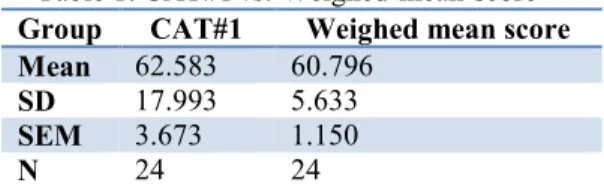
The-weighted-mean-score gives an-excellent-indication of academic-aptitude of a-student. At-the-school, it-is normally computed at the-end of each-academic-year. For the-year four, students did 16 courses, totalling 49 units. Table 1 shows the comparison (using a two-sample t-test, assuming unequal-variances) of performance on CAT#1 and students’ weighed-mean-score.
Table 1: CAT#1 vs. Weighed-mean-score
Group CAT#1 Weighed mean score Mean 62.583 60.796
SD 17.993 5.633
SEM 3.673 1.150
N 24 24
P value and statistical-significance: The two-tailed P value equals 0.5828. The-traditional-cutoff for
conventional-criteria, this-difference is considered to-be not statistically-significant. Confidence interval: The mean of CAT#1 minus Weighed-mean-score equals 1.788. 95% confidence-interval of this-difference: From - 4.850 to 8.425. Intermediate values used in calculations: t = 0.5571; df = 23; standard error of difference = 3.208. The weighed-mean-score averages were not statistically-different, indicating that students had relatively the-same-ability.
3.6.2. Unpaired t-test results: Comparison of performance between students, who used ‘help-sheet’ (in CAT #1) and these who did not.
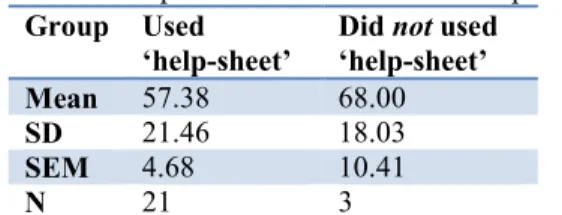
Relative-performance of students, with and without, ‘help-sheets’, was measured. The-results are presented in Table 2, followed by its-analysis.
Table 2: Used ‘help-sheet’ vs. Did not used ‘help-sheet’ Group Used ‘help-sheet’ Did not used ‘help-sheet’ Mean 57.38 68.00 SD 21.46 18.03 SEM 4.68 10.41 N 21 3
P value and statistical significance: The two-tailed P value equals 0.4250. By conventional-criteria, this
difference is considered to be not statistically-significant. Confidence interval: The-mean of ‘used help-sheet’ minus ‘did not used’ equals -10.62; 95% confidence interval of this difference: From -37.71 to 16.48.
Intermediate values used in calculations:t = 0.8128; df = 22; standard error of difference = 13.065.
In a t-test for equality of means, with roughly equal-variance, there was no significant-difference between the two groups (p=0.4250; t=0.8128). This-indicates that preparation and use of help-sheets did not increased the-students’ performance.
3. 6. 3. Paired t-test results:Comparison of performance between the-two CATs
Table 3 shows comparison of performance between two CATs.
Table 3: CAT # 1 vs. CAT # 2
Group CAT # 1 CAT # 2 Mean 58.71 58.79
SD 21.01 18.60
SEM 4.29 3.80
N 24 24
P value and statistical-significance: The two-tailed P value equals 0.9888. By conventional-criteria,
this-difference is considered to be not statistically-significant. Confidence interval: The mean of CAT #1 minus CAT #2 equals -0.08; 95% confidence interval of this-difference: from -12.20 to 12.04; Intermediate values used
in calculations:t = 0.0142; df = 23; Standard error of difference = 5.859.
3.6.4. Paired t-test results: Comparison of performance between CAT #1and the-final-exam (for these students who used ‘help-sheet’).
The-impact on learning and short-term retention is evaluated using a test-retest-assessment. The-final examination is used, to-evaluate-retention, as students have-been-tested on the-course-concepts, during a-within-semester examination (CAT) and is then, retested on the-final-examination.
Table 4 shows the-results of comparison. P value and statistical-significance: The two-tailed P value equals 0.1416. By conventional-criteria, this-difference is considered to-be not statistically-significant.
Confidence interval: The-mean of Final-Exam minus CAT #1 equals - 6.29. 95% confidence-interval of
this-difference: From -14.84 to 2.26. Intermediate values used in calculations: t = 1.5220; df = 23; standard error of difference = 4.134.
Table 4: Final Exam vs. CAT #1
Group Final Exam CAT #1 Mean 56.29 62.58
SD 11.79 17.99
SEM 2.41 3.67
N 24 24
4. Discussion.
The-findings of this-study indicate, that the-preparation and use, of student-created ‘help-sheets’ have no impact on student-performance. This agrees with findings of Dickson & Miller (2005), and contradicts the-suggestions of Sanborn et al. (2012); Erbe (2007); Skidmore & Aagaard (2004); and Daly & Waldron (2004) that the-process of creating a ‘cheat-sheet’ can improve student-outcomes.
‘help-sheets’. To-give a-broader-reflection on-the-subject-matter, the-issues of cheating, and test-anxiety, are addressed, in the-following-sections.
4.1. Cheating, at exams, at local-context, and relevance of ‘help-sheets’ to cheating
There is an-adequate-consensus, among-researchers and educators, that cheating, at-examinations, is widely-practiced, by students, and it poses a-serious-problem, across-college-campuses (UNESCO, 2009; McCabe & Trevino, 1996; Spiller & Crown, 1995; Aiken, 1991).
Besides, the-following more-recent-studies, at-local-context, at-the-subject-school, were conducted: (1) Study by Starovoytova & Namango (2016a) --”Factors Affecting Cheating-Behavior at Undergraduate Engineering”, showed, that:
65% of respondents declared that cheating is, in fact, a common-phenomenon in the SOE; 60% of students also affirmed, that it is, actually, difficult to eradicate cheating in examinations in the SOE; and 70% of students acknowledged that they use mobile-phones to Google or to assess notes, during examinations. The results also illustrate that cheating, undeniably, is a very-real-issue of massive concern at SOE.
(2) Another-study entitled: “Faculty Perceptions on Cheating in Exams in Undergraduate Engineering” by Starovoytova & Namango (2016b), exposed, that: ‘81% of the-respondents agreed that students frequently indulge in-examination-malpractice, clearly revealed that cheating, indeed, is a-significant-problem, in-the-SOE’. (3) Finally, the-latest-study by Starovoytova & Arimi (2017), entitled: “Witnessing of Cheating-in-Exams Behavior and Factors Sustaining Integrity” concluded, that:
only 18% of the-students admitted that they-have-never cheated; however, they have-witnessed an-array of cheating-techniques used by their-classmates, which illustrates, that students are
exceedingly-inventive and opportunistic, in-nature, and they are ready-to-use any-method, to-achieve their-ultimate-goals (mainly, good-grades). 22% of those never-cheated, confessed that they-were afraid of being caught by the-invigilators; while only 6% stated that ‘I was afraid of being reported by my fellow classmates’. The-absence of ‘risk’ (fear of penalties), is above all, attention-grabbing, to this-study, as it implies that SOE’ students do-not bothered-much about getting-caught cheating.
The-above-studies painted a-depressing-picture of prevalent-cheating, at the-school. In-contrast, during-this experiment, no attempts to-cheat, were-observed; this-fact can-be considered, in-the-context of ‘help-sheets’ being a-contributing-factor to-reduction, of-temptations, to-cheat; which, in-itself is beneficial, in-promoting ethical-learning-experiences. This-finding is in accord with the-similar-conclusion by Tussing (1951).
On-the-other-hand, examination, for-students, is usually-associated with-some-anxiety. In-this-study, 76% of the-respondents, reported to-beless-nervous, than usual, because of ‘help-sheets’, which is analogues to Allen & Leary (2010), and Erbe (2007), who suggest, that student-created ‘cheat-sheets’ can, indeed, reduce examination-anxiety.
On-the-other-hand, many of academicians, generally, perceive test-anxiety, as something-normal, unavoidable, and insignificant, and hence, as something not deserving their-attention. Anxiety, however, is a-rather-complex-phenomenon, which, therefore, will-be-discussed, in the-following-section, alongside with, related-to-it, issues.
4.2. Anxiety
4.2.1. The-concepts, types, mechanism, and consequences
All of us, might-have, experienced anxiety, which is a-natural-response-mechanism to a-perceived, or real, threat, or danger. According to Osa-edoh & Okonta (2006), anxiety is a-diffuse, vague, and highly unpleasant-feeling of fear and apprehension. McMahon (1976) viewed anxiety as a-generalized-feeling of uneasiness, usually accompanied by physiological-upset.
Anxiety can-be-classified into three-types: (1) Reality anxiety, arising from dangers or threats, in the external-world; (2) Neurotic anxiety, caused by impulses, threatening-to-break-through ego’s control, resulting behavior that will-be-punished, in-some-way; and (3) Moral anxiety arising from a-real or contemplated-action, in-conflict with individual’s superego or moral-values, and arousing-feelings of guilt (Colemam,1976).
According to Nolen-Hocksema (2004), four-types of symptoms, that make-up anxiety, are: (1)
physiological, or somatic, symptoms, including muscle-tension, heart-palpitations, stomach-pain, and the-need
to-urinate; (2) behavioral, causing avoiding situations, because of fears; (3) emotional, primarily a-sense of fearfulness and watchfulness; and (4) cogmotive, including unrealistic-worries, that something bad is happening, or is about to-happen.
The-first-two-symptoms, make-up, what-is known-as, fight or flight-response (also-called the-emergency-reaction). Humans are designed, in-such a-way, that one can fight-off or flee, from threats, to-safety, facing perceived, or real-danger. One’s heart-rate, blood-pressure, and breathing-rate, dramatically-increase, while muscles become tense. At the-same-time, certain unessential-activities, such as-digestion, slow-down;
saliva and mucus dry-up, thereby increasing the-size of air-passages, to-lungs, this-is-why one gets a-dry-mouth, when anxious. The body’s natural-painkillers, endorphins, are also-secreted, and surface-blood-vessels constrict, to-reduce bleeding, in-case of injury (Nolen-Hoekscma, 2004).
These-physiological-changes begin in the-brain, when one faced with danger, consequently leading to process of activating the-chemical and anatomical-circuitry of fear (Yehuda, 1999). Two neuro-endocrine-systems are activated: the-autonomic-nervous (especially the-sympathetic-division) and the-adrenal-cortical system. The sympathetic-system acts-directly on-smooth-muscles and internal-organs, to-produce some of the-body-changes, for-example, increased heart-rate, and elevated-blood-pressure. The-sympathetic-system also-stimulates the-release of number of hormones, including epinephrine (adrenaline) and more-epinephrine, which perpetuate a-state of physiological-arousal (Nolen-Hock-Sema, 2004).
On-other-hand, the adrenal-cortical-system releasing corticotrophin-release-factor, which signals the-pituitary gland, to-secrete Adreanocorticotropic hormone (ACT II), the-bodies major-stress-hormone. ACT II, in-turn, stimulates the outer-layer of the-adrenal-glands (the-adrenal-cortex), resulting in-the release of a-group of hormones, the-major-one being cortisol. The-amount of cortisol, in-blood or urine-samples, are often, used, as a-measure, of stress. ACT II, also-signals the-adrenal-glands, to-release about 30 other-hormones, each of which plays a-role, in-body’s adjustment, to-emergency-situations. Eventually, hormones signal hippocampus, a-part of brain, that help-regulate-emotion, to-turn-off this-physiological-cascade, when the-threatening-stimulus has passed (Nolen-Hoeksema, 2004).
At-moderate-levels, anxiety is normal, and, even, expected. It-often-provides the-motivation, needed, to-give an outstanding-performance, in all-situations. High-levels of anxiety, however, are distressing, and interfere with effective-functioning (Osinowo & Imhonde, 2004), leading, at some-instances, to anxiety disorders, where the-frequency and intensity of anxiety-responses, are out of proportion, to the-situation, that trigger them (Passer & Smith, 2001). People with-anxiety-disorders, always think of catastrophes, and they-do magnify-them, into-reality. They anticipate that the-worst will-happen, and they-feel powerless, to-cope effectively (Clark, 1988; Watson et al., 1985).
Generalized-Anxiety-disorders (GADs), have-been associated with abnormal-levels of certain-neuro transmitters, in-the-brain. Neuro-transmitters are special-chemical-messengers, which help move information, from one-nerve-cell to the-next-nerve-cell. If the-neuro-transmitters are out of balance, messages cannot get through-the-brain, properly. This-can-alter the-way the-brain reacts, in certain-situations, leading to-even-more-anxiety. Victims of extreme-anxiety are not able to-concentrate, think of solution, or adaptation, to the-present-problem (Busari & Uwakwe, 2001; Moline & Borkivec, 1994).
4.2.2. Test-anxiety and self-regulating relaxation-techniques
Students are motivated to-do-well, in-examinations, for several-reasons, such-as: (1) to-master the-subjects
(mastery goal orientation); (2) to-perform-well and get good-grades (performance goal orientation); or (3)
to-rank-well, among peers, and to-impress-others (social goal orientation). Motivation is an-important psychological-factor, which directly-influences students’ achievement (Dowson & Mclnerney, 2003). For-example, Dilworth (1991), points-out on reward or promise of rewards, from-school, award of prizes, praise and encouragement, as some of the-motivations-to do-well, at-exams.
According to Seligman et al. (2001), test anxiety is the-uneasiness, apprehension, or nervousness, felt, by students, who have a-fear of failing an-examination. Students suffering from test-anxiety may experience any of the-following: the-association of grades with personal-work; embarrassment by a-teacher, taking a-class, which is beyond their-ability; fear of alienation, from parents or friends; time-pressures, or feeling a-loss of control. Emotional, cognitive, behavioral, and physical-components, can-all be-present in-text-anxiety. Sweating, dizziness, headcheese, racing-heartbeats, nausea, fidgeting, and drumming on-a-desk, are all common.
It-is absolutely-normal, for students, to-feel a-little-nervous, and stressed, before a-test, however, the- nervousness can-be so-strong, that it interferes with their-concentration, and consequently, performance (Bowen & D’Arcy, 2003). According to Olatoye & Afuwape (2003), and Hurlock (1972), test-anxiety is the-psychological-state of mind, of a-candidate, about a-test, as-expressed by-the-level of worry, fear, uncertainty, concern and helplessness, expressed before, during, or, even, after a-test. Sgoutas-Emch et al. (2007) reported that the-level of perceived-preparedness, self-efficacy, previous-exposure, to-the-course materials, and test-anxiety, significantly predicted students’ achievement in a-science-course. In-addition, Thomas & Gadbois (2007) reported that test-anxiety was a-significant-predictor, of mid-term-examination grades.
Test-anxiety can-manifest in: (1) physical-indicators (perspiration; sweaty-palms; feeling too-hot or cold; headaches; upset-stomach; nausea; rapid heart-beat; shallow or irregular-breathing; dizziness; and muscle-tightness); (2) emotional-indicators (feeling guilty, angry, depressed, or unsure); (3) behavioral-indicators (procrastination and avoidance; excessive-study; over or under-eating; poor-nutrition; sleeping much, or too-little; fatigue or inability to-relax; and alcohol, or drugs-misuse); and (4) cognitive-indicators (negative or defeating self-talk; excessive-worry; difficulty with-concentration or focus; difficulty retrieving, or selecting-key-terms or concepts; difficulty organizing, integrating or expressing thoughts; going-blank on exam-questions;
and remembering the-correct-answers, only after the-exam is over).
Some-accelerators of exam-anxiety are: (1) insufficient exam-preparation (cramming night-before the-exam; inadequate time-management; poor study-skills, or study-habits); (2) worrying about: past exam-performance; poor-present-exam-performance; negative-consequences of poor-exam-performance; and how others are doing, on the-exam, compared to you; (3) stimulant-use (caffeine, nicotine, alcohol, performance enhancing-drugs, antidepressants, Amphetamines, and Cocaine, among-others); and (4) some-medical conditions (like hyperthyroidism, hypothyroidism, vitamin B12 deficiency, or hypoglycemia) can increase anxiety-levels, if left untreated.
An-optimal-level of arousal is necessary, to-best complete a-task, such as an-examination; however, when the- anxiety, or level of arousal, exceeds that optimum, it results in dramatic-decline in-performance. Therefore, lecturers should-help-students, to-deal with test-anxiety, by mastering self-regulation relaxation- techniques.
The-most-widely-discussed anxiety-self-regulation-techniques include: progressive-muscle-relaxation; EMG biofeedback-training; finger-temperature biofeedback-training, and autogenic-training (Lehrer et al, 1994). In-addition, more-simpler-techniques, such-as: controlled-breathing-strategies; and visualization strategies, e.g., five-finger relaxation-techniques (Yoga), can-be trained, and routinely-performed.
Beside, there-are both; short-term and long-term relaxation-techniques, which help control emotional (somatic) and worry (cognitive) test-anxiety. Selected-examples of the relaxation-techniques are: (1) the-tensing and differential-relaxation-method; (2) the-palming-method; and (3) deep-breathing.
For-example, the-cue-controlled relaxation-response-technique is the-best long-term relaxation technique. It-is-presented on side two of the audiocassette ‘How To Reduce Test Anxiety’ (Nolting, 1986). Cue-controlled-relaxation means one can induce one’s own-Cue-controlled-relaxation, based on-repeating certain-cue words, to-oneself. In-essence, one is taught-to-relax and then, silently-repeat cue-words, such-as ‘I am relaxed’. After enough-practice one can-relax, during tests.
On-the-other-hand, negative self-talk (cognitive-anxiety) is defined as the-negative-statements one tells oneself, before, and during-tests. Negative-self-talk causes students to-lose-confidence, and, even, to-give-up on tests. Students need to-change their-negative-self-talk to positive-self-talk, without making unrealistically ambitious-statements. Some-students, however, might-have difficulty stopping their-negative self-talk; these-students need to-use a ‘thought-stopping-technique’ to-overcome their-worry, and become relaxed. To-stop one’s negative-thoughts, in the-classroom, or during a-test, one should silently-shout to oneself ‘Stop’ or ‘Stop thinking about that’. After one’s silent shout, one need either to-relax, or repeat one of positive-self-talk-statements. One may have to-shout,to-oneself, several-times, during a-test, or while-doing homework, to-control negative-self-talk. After every-shout, one should use a-different relaxation-technique, or positive-self-talk-statement.
From the-author’ personal-experiences, relaxation-techniques, do really-work, because they interrupt the-worry-response, before it can-cause high-uncontrollable-anxiety, or negative-emotions. Test-anxiety – worrying about the-outcome of the-exam, and experiencing negative-emotions, during the-exam – is associated with poor-performance, on-exams (Tyrone, 1980). Therefore, students, with high-worry-anxiety, should-practice these-technique, and choose the-best-one(s), suited, for them. Once these-procedures are learned, the-relaxation-body-response will-take the-place of an-anxiety-the-relaxation-body-response.
5. Conclusion and Recommendations.
This-paper describes an-experiment, which investigated the-effects of preparing and using ‘help-sheets’ on students’ attitudes and test-performance. The-study revealed overall-positive-attitudes, by the-students, towards ‘help-sheets’ and vast-diversity, in the-quality, and composition, of student-created ‘help-sheets’. The-findings of this-study also-indicate, that the-preparation and use, of student created ‘help-sheets’ have no impact on student-performance. Nevertheless, the-findings also-showed, that students feel less-anxious, with the-use of ‘help-sheets’. Knowing the-negative-impact that anxiety might-have on student performance, any-potential-reduction in-test-anxiety, alone, may-be a-valid-reason, to-supplement the-traditional ‘closed-book’ exams, which is currently, the-only mode, used in the-examinations, at the-school, with the-use of ‘help-sheets’.
In-addition, during-this-experiment, no attempts, by students, to-cheat, were-observed; this-fact can-be-considered, in-the-context of ‘help-sheets’ being a-contributing factor to-reduction, of temptations, to-cheat; which, in-itself, is beneficial, in-promoting ethical-learning experiences. The-author, therefore, recommends use of ‘help-sheets’ in-examinations, on the-grounds that it potentially-reduces test-anxiety, and cheating, at-examinations. The-results of the-experiment can-also-help engineering-lecturers decide, for themselves, whether to-allow their-students to-use ‘help-sheets’. Moreover, lecturers should help-students, to-deal with test-anxiety, by mastering self-regulation relaxation-techniques.
Regarding further-research: The-author’s evaluation, based on-grade-data, therefore, it-is necessary to-determine, whether or not, other-variables, such-as: motivation to-succeed in the-course, or academic-level of study (undergraduate, Master’s and Doctorate), might-have an-impact on the-results. The-future-studies
would-also-benefit, from wider-analysis, in: (1) other-engineering-courses; (2) other-knowledge-domains; and also (3) different-levels of study (starting from 1st year thru 5th). In-this-study, the-reduction of test-anxiety was
self-reported, by the-students, hence, an-investigation of the-relationship between test anxiety (measured before a-test) and the-test-performance should-be conducted.
6. Acknowledgment.
The-author wishes to-thank the-5th year students of MIT, SOE, MU, for their-openness to new-a-approach, and
their-participation, in-this-experiment.
References.
Aiken, L. (1991). “Detecting, understanding, and controlling for cheating on tests”, Research in Higher
Education, 32.
Allen, A. and Leary, M. (2010). “Self-Compassion, Stress, and Coping”, Social and Personality Psychology Compass, Volume 4, Issue 2. DOI: 10.1111/j.1751-9004.2009.00246.x
Bacon, F. (1969). “Open book Examinations”, Education and Training, 11(9).
Baillie, C. and Toohey, S. (1997). “ The 'power test': Its impact on student learning in a materials science course for engineering”, Assessment & Evaluation in Higher Education, 22(1).
Biggs, J. and Collis, K. (1982): Evaluating the quality of learning: The SOLO taxonomy (Structure of the
Observed Learning Outcome). New York, Academic Press.
Bloom, B. (1956): Taxonomy of Educational Objectives, Edwards Bros., Ann Arbor, Michigan. Boniface, D. (1985). “Textbooks during open-book examination”, Educational Research, 27.
Brightwell, R.; Daniel, J. and A. Stewart, A. (2004). “Evaluation: Is an open book examination easier?”,
Bioscience Education e-Journal, 3.
Busari, A. and Uwakwe, C. (2001). “The effect of stress inoculation training techniques in the management of worry as a self handicapping strategy in intellectual performance”, Niger. J. Emot. Psychol, 3 (1).
Clark, D, (1988). A cognitive model of fanic attacks. In S. Rachman and J. D. Arcy (2004): Test Anxiety and performance. Available [Online]: File//A: test%2003%20-answerhtm. (January 25, 2017).
Coleman, J. (1976). “ Differences between experiential and classroom learning” in Keeton, M. T. (ed.)
Experiential Learning. San Francisco, Jossey-Bass.
Bowen, R. and D’Arcy, C. (2003).” Response of patients with panic disorder and symptoms of hypomania to cognitive behavioral therapy for panic”, Bipolar Disord. 5.
Daly, C. and Waldron, J. (2004): Assessing the Assessment of Programming Ability. Proceedings of the 35th
SIGCSE technical symposium on Computer science education (SIGCSE '04), Norfolk, Virginia, USA,
March 3-7.
De Raadt Moodle, M. ( 2012). Student-Created Cheat-Sheet in Examinations: Impact on Students Outcomes. Paper presented at the Fourteenth Australasian Computing Education Conference (ACE2012), Melbourne, Australia, January 2012, Conferences in Research and Practice in Information Technology, Vol.123. Dickson, K. and Miller, M. (2005). “Authorized crib cards do not improve exam performance”, Teaching of
Psychology, 32.
Dickson, K. and Bauer, J. (2008). “Do students learn course material during crib sheet construction?” Teaching
of Psychology, 35.
Dilworth, M. (1991).Motivation, Rewards and Incentives, Washington DC: America Association College Teacher Education.
Dowson, M. and Mclnerney, D. (2003). “What do high school students say about their motivational goals? Towards a more complex and dynamic perspective on student motivation”, Contemp. Educ. Psychol, 28 (1). Erbe, B. (2007). “Reducing Text Anxiety while Increasing Learning - The Cheat Sheet”, College Teaching,
55(3).
Feldhusen, J. (1961).”An Evaluation of College Students' Reactions to Open Book Examinations”, Educational
and Psychological Measurement, 21(3).
Gharib, A. and Phillips, W. (2012).” Test Anxiety and Performance on Open Book and Cheat Sheet Exams in Introductory Psychology”, IPEDR, Vol. 53 (1); DOI: 10.7763.
Gupta, M. (2007). “Open-book examinations for assessing higher cognitive abilities”, Microwave Magazine, 8(6).
Heijne-Penninga, M.; Kuks, J.; Hofman, W. and Cohen-Schotanus, J. (2008). “Influence of open- and closed-book tests on medical students learning approaches”, Medical Education, 42.
Hubbard, R. (1997). “Assessment and the process of learning statistics”, Journal of Statistics Education, 5(1). Hurlock, E. (1972). Child Development (5th Ed) New York: Hill Book Company.
Jacobi, A.; Martin, J.; Mitchell, J. and Newell, T. (2003). A concept inventory for heat transfer. in Frontiers in
Electrical and Electronics Engineers.
Kalish, R. (1958). “An experimental evaluation of the open-book examination”, Journal of Educational
Psychology, 49.
Kothari, C. (2004). Research Methodology: Methods and Techniques. New Delhi: New Age International Publishers Ltd.
Lehrer, P.; Carr, R.; Sargunarj, D. and Woolfolk, R. (1994). “Stress management techniques: Arc they all equivalent or do they have specific effects?” Biofeedback and self-Regulation, 19.
McCabe, D. and Trevino, L. (1996). “What we know about cheating in college: Longitudinal trends and recent developments”, Change, 28.
McMahon, KB. (1976) Abnormal Behaviour Englewood Cliff, New Jersey: Prentice-Hall, Inc.
Moline, S, and Borkivec, T. (1994). The Penn State of Worry Questionnaire: Psychometric properties and association characteristics in GCL Davey, F Tallis (Eds) Worry: Perspectives on Theory, Assessment and Treatment. Chi Chester UK: Willey.
Nolen-Hooksema, S. (2004). Abnormal Psychology. New York: McGraw-Hill Companies, Inc.
Nolting, P. (2000). Math Study Skills Workbook, Your Guide to Reducing Test Anxiety and Improving Study Strategies. Houghton Mifflin Company.
Olatoye, R. and Afuwape, M. (2003). “Test anxiety as a determinant of examination misdemeanor among some Nigerian Secondary School Students”, Ibadan J. Educ. Stud, 3(182).
Osa-edoh, G. and Okonta, J. (2006). Anxiety and Test Performance: Implications For Counseling. Available [Online]: anxiety-and-test-performance-implications-for-counseling (January, 22, 2017).
Osinowo, O. and Imhonde, O. (2004). A step into Clinical Psychology. Nigeria: Soben Enterprises. Passer, M. and Smith, R. (2001). Psychology. New York: McGraw-Hill Higher Education.
Rakes, G. (2008). “Open book testing in online learning environments”, Journal of Interactive Online Learning, 7(1).
Rice, J. (2006), Mathematical Statistics and Data Analysis, Third Edition, Duxbury Advanced.
Sanborn, M.; Purchase, K. and Brock, B. (2012). Kicking out the Crutch: The Impact of Formula Sheets on Student Performance and Learning. Paper was completed and submitted in partial fulfilment of the Master Teacher Program, a 2-year faculty professional development program conducted by the Center for Faculty Excellence, United States Military Academy, West Point, NY, 2012.
Schumacher, C.; Buztin, D.; Finberg, L.and Burg, F. (1978). “The Effect of Open- vs. Closed-Book Testing on Performance on a Multiple-Choice Examination in Pediatrics”, Pediatrics, 61(2).
Seligman, M.; Walker, E. and Rosenthal, D. (2001). Abnormal Psychology.New York Norton Inc.
Sgoutas-Emch, S.; Naget, E. and Flynn, S. (2007). “Correlates of Performance in Biological Psychology: How can We Help?” J. Instr. Psychol, 34(1).
Skidmore, R. and Aagaard, L. (2004). “The relationship between testing condition and student learning scores”,
Journal of Instructional Psychology, 31.
Spillar, S. and Crown, D. (1995). “Changes over time in academic dishonesty at the collegiate level”,
Psychological Reports, 76.
Starovoytova, D. and Arimi, M (2017). “Witnessing of Cheating-in-Exams Behavior and Factors Sustaining Integrity”, Journal of Education and Practice, ISSN 2222-1735 (Paper) ISSN 2222-288X (Online), Vol.8, No.10.
Starovoytova D. and Namango, S. (2017). “Scientific Research, Writing, and Dissemination (Part 1/4): Boosting
Research Quality”, Journal of Education and Practice, ISSN 2222-1735 (Paper) ISSN 2222-288X (Online),
Vol.8, No.22.
Starovoytova, D. and Namango, S. (2016 b). “Faculty perceptions on cheating in exams in undergraduate engineering”, Journal of Education& Practice, Vol.7, No.30, ISSN 2222-1735 (Paper), ISSN 2222-288X (Online).
Starovoytova, D. and Namango, S. (2016a). “Factors Affecting Cheating-Behavior at Undergraduate Engineering”, Journal of Education and Practice, ISSN 2222-1735 (Paper) ISSN 2222-288X (Online), Vol.7, No.31.
Starovoytova, D.; Tuigong, D.; Sitati, S.; Namango, S. and Ataro, E. (2015). “Potential of Theory of Innovative Problem Solution (TRIZ) in Engineering Curricula”, International Journal of Innovative Science,
Engineering & Technology, Vol. 2 Issue 5, ISSN 2348 –7968.
Starovoytova, D. and Cherotich, S. (2016). “Analysis of Masculinities Across Engineering Disciplines”,
Research on Humanities and Social Sciences, Vol.6, No.18, ISSN 2224-5766(Paper).
Theophilides, C. and Koutselini, M. (2000). “Study Behavior in the Closed-Book and the Open-Book Examination: A Comparative Analysis”, Educational Research and Evaluation, 6(4).
Thomas, C. and Gadbois, S. (2007). “Academic Self-handicapping: The Role of Self-concept, Charity and Student and Learning Strategies”, Br. J. Educ. Psychol, 77(1).
Tussing, L. (1951). “A Consideration of the Open Book Examination”, Educational and Psychological
Measurement, 11(4).
Tyrone, G. (1980). “The measurement and treatment of test anxiety”, Review of Educational Research, 50. UNESCO (2009). Philip Altbach, P.; Reisberg, L. and Rumbley, L. Trends in Global Higher Education:
Tracking an Academic Revolution. Paris
Vanderburgh, P. (2005). “Open-book tests and the student-authored exam questions as useful tools to increase critical thinking”, Advances in Physiology Education, 29(3).
Visco, D.; Swaminathan, S.; Zagumny, L. and Anthony, H. (2007): Interpreting Student-Constructed Study Guides. Proceedings of the 114th Annual ASEE Conference & Exposition, Honolulu, Hawaii, USA, June 24-27.
Wachsman, Y. (2002). “Should Cheat Sheets be Used as Study Aids in Economics Tests?”, Economics Bulletin, Vol. 1, No. 1.
Watson, D.; Clark, L.; Weber, K.; Assenheimer, J.; Strauss, M. and McCormick, R. (1995). “Testing a tripartite model: II. Exploring the symptom structure of anxiety and depression in student, adult, and patient samples”, Journal of Abnormal Psychology, 104.
Wickelgren, W. (1975). Coding and Dynamics of Memory. Final Report. Published by the National Institute of Education, Office of Research Grants.
Williams, J. B. and Wong, A. (2009). “The efficacy of final examinations: A comparative study of closed-book, invigilated exams and open-book open-Web exams”. British Journal of Educational Technology, 40. Yehuda, R. (1999). Risk Factors for Posttraumatic Stress Disorder. Washington, DC: American Psychiatric Press. Yu, B.; Tsiknis, G. and Allen, M. (2010): Turning Exams into A Learning Experience. Proceedings of the 41st