The Effect of ROI Evaluation for Training on Job Performance
"Case Study: Islamic University of Gaza"
Abedallh M. Aqel 1, Yaser A. Alshorafa2,Youssef M. Abu Amuna3, Alkurd A. Mohamed4
1
Master degree in Business Administration Gaza, Palestine, 2Assistant Professor, Business Administration Department, College of Business, Islamic University of Gaza, Gaza, Palestine, 3Assistant Professor, Department of Information Technology, Faculty of
Engineering and Information Technology, Al-Azhar University, Gaza, Palestine, 4Master degree in Business Administration, Business Administration Department, College of Business, Islamic University of Gaza, Gaza, Palestine.
1
[email protected], 2 [email protected], 3 [email protected], 4 [email protected]
Abstract: The study aimed to identify the effect of return on investment evaluation for training on job performance conducted by a case study on Islamic University of Gaza, Palestine. To achieve the objectives of the study, the researchers used the questionnaire as a main tool to collect data, and the descriptive and analytical approach to conducting the study. The study population consisted of (892) employees working at IUG, Palestine. The researchers used the stratified random sample method and the multiple regression method to measure the effect. The study tool was distributed on the sample (263). Further interviews were conducted with high level management. The results of the study showed that there is an exploitation of the university's resources in training and qualifying employees through holding specialized programs and courses implemented by the specialized authorities at the university, with an average direct relationship between the evaluation of the return on investment in training and job performance. Training also contributes to the acquisition of new skills by the employees and the increase in knowledge outcomes of the employees that qualify them in the job they work for. The study recommended the necessity of working on holding more training programs that are suitable for the employee's time frame to facilitate their enrollment, and selecting work-related programs to develop their skills and solve problems facing them during work while developing these programs to enhance the culture of knowledge exchange between workers at the same job level. Also the study recommended adopting accountability policies for employees with low job performance and setting standards that motivate them.
Keyword: return on investment, training, ROI evaluation, university, job performance.
1.INTRODUCTION
Training is one of the main factors that contribute to the improvement and development of the human cadre through the refinement of skills, knowledge and science and the development of various capabilities in order to raise the level of performance among workers.
Institutions do not place most of their effort in training and assessing the return on investment. This will cause many problems and difficulties because of the rapid changes that occurred inside and outside organization. Training must leads to increasing productivity and achieving goals with the least time, effort, and high quality. [1]
The process of training program evaluation is the last stage for it. It is a basic process for determining the true value of the training program. It is a process through which important information is obtained, which can be used to judge the validity of the training program, the method used to implement it, its goals and the results of the training program. [2]
Training in the current age is an important means of development. If it is used and invested, it helps to develop the efficiency of the tool and work to raise productivity. The results of many studies and research have shown that training has an important role to develop civilization and general culture, work on progress and prosperity, and the importance of training lies where it is the basis for the development of human. [3]
The primary purpose of the evaluation is to determine the effectiveness of the training program in achieving the goals for which the workers were trained, as the managers of senior departments make decisions based on their evaluation of the training program. The evaluation process is the last stage in training, but it is one of the basic stages of training programs, which is an attempt to understand, clarify and identify the extent to which the objectives of training programs have been achieved, through carefully and systematically planned steps that work to identify weaknesses and address them and strengths and develop them in the training program. [4]
From the foregoing it becomes clear the importance of studying the return on investment in training and its impact on job performance in institutions in general and the higher education institutions sector, especially in the Islamic University, because of its effective role in the advancement and development of society, therefore it should focus on training workers and assessing the return on investment in training and knowledge The output of training on employee performance for employee development and community development in general.
In view of the literature review, the study raises the question of:
Q1.What is the level of ROI evaluation for training at the IUG?
Q3.Is there is a relationship between ROI evaluation for training and job performance at IUG?
2.LITERATURE REVIEW
2.1 Training
Training is defined as the effort planned by the organization to facilitate employee development according to job requirements. It is the procedures through which human cadres are developed and equipped with the skills required at work that work to develop skills, knowledge and information. [5] [6]
Training is also defined as a set of sequential and arranged steps that aim to improve skills, knowledge and advanced methods of the trainees in order to raise the level of productivity and develop performance.
Alaklibi, 2012, Asfaw et. al, 2015 and defined training as pre-planned activity that aims to provide the training as skills and knowledge in order to Development of performance. [7][8]
From the above, the concept of training can be summarized from the viewpoint of researchers as a set of activities and steps prepared in advance that aim to refine the skills and knowledge of workers in order to raise the level of their productivity and improve their performance in order to achieve the goals of the organization.
Training is one of the important and necessary management processes for each organization in order to achieve the goals of the organization and keep abreast of continuous development.
There are studies that divided the importance of training into two parts, its importance to workers and its importance to the organization.
The importance of training for workers are to increase job satisfaction with them, helps to improve and develop the performance of workers, and helps to support career for workers. Also it helps workers to acquire new skills and knowledge.
As for organization, training helps the organization to achieve its goals, improve performance of the organization as a whole, contributes to reducing absenteeism rates and contributes to reducing career turnover rates. [9]
From the viewpoint of the researchers, the training process is important and cannot be abandoned because it helps to develop and develop the human cadre and improve its performance, and therefore this reflects positively on the organization, which helps it achieve its goals and keep pace with development.
*training principles
The training process contains a set of important principles that should be observed in all stages and are as follows: [10] [11]
1. Legitimacy: Training should be conducted according to the institution's laws and regulations.
2. Realism: Training must be conducted based on training needs.
3. Objectives: The training objectives should be clear and easy to achieve in terms of quantity, quality and cost. 4. Inclusivity: The training should include all job requirements in terms of values, attitudes and knowledge, as well as all job levels in the institution.
5. Gradual: The training should start with the treatment of simple, then more complex, issues.
6. Flexibility: The training system and its operations must evolve, especially in relation to the means, tools and methods, with developments that occur in each field, and the need to train trainers to understand these developments and use them in the service of the training process.
7. Keeping up with time: This is through satisfying the future training needs of the trainees.
*Stages of the training process
1. Determining the training needs: It is considered the first and most important stage of the training process as it is considered the basis of the training process and helps to achieve the best performance in the training process and through which the target group of training is determined. When the training needs are identified, the institution must take into account different job levels to be trained because the jobs differ in terms of requirements, responsibilities and problems. [12]
2. Designing the training process: It is the stage through which the main functions and tasks of training are defined that meet the training needs and work to formulate the general objectives of the training programs and determine the time period of the training process and identify the competent trainer and then choose the category that needs training. [13]
3. Implementation of the training process: At this stage, training is carried out on the ground, where the equipment and procedures required by the training process are implemented in terms of preparing the place where the training will be held, ensuring the readiness of the necessary materials for training, providing the training material, and explaining the training goals for the trainees. [14] [15] 4. Evaluating the training process: It consists in evaluating the efficiency of the training process, knowing what has been achieved from the goals previously set, identifying strengths and weaknesses, and providing those in charge of the training process with feedback. [16]
2.2 ROI evaluation for training
Many organizations do not evaluate their training undertakings and those who do, repeatedly evaluate training inadequately. The reason for this is a general assumption that training will eventually have a positive result.
The basis of the ROI concept in the training programs is from the science of accounting and finance. One of the widespread methods used in determining the return on investment is the analysis of benefits and costs.
The concept of spending on training at the present time is merely costs and expenses to perform jobs to become an
investment in capital assets due to its effective return in increasing productivity and achieving the goals of the institution.
Despite that, there is a big difference between spending on training in industrial countries and what is spent in developing countries. Organizations spend in the industrial countries from 2 to 3% of general expenses while developing countries spend 1%.
The process of evaluating the return on investment in training is a continuous, non-stop process that aims to make decisions through a deep study of the goals and results of the training process, which aims to develop and improve the performance of workers. [17]
The primary objective of assessing ROI for training is to identify the extent to which the previously identified goals have been achieved, to identify weaknesses, and to work to address them, strengths, focus on and develop them.
Researchers define evaluation of the return on investment in training as the financial, physical and moral benefits and that accrues to the institution through investing in training. The importance of investing in training does not differ according to the size and quality of the organization, it is necessary and important for large and small organizations, as the institutions suffer from administrative problems and training contributes to solving them because training is an urgent necessity for various businesses to develop performance in various levels and areas of administrative work, whether functional, executive or technical Until the advisory. [18] [19]
The evaluation of the return on investment in training helps to achieve the following: [20]
1. Determine the effectiveness of the training. 2. Evaluate the training methods used.
3. Providing managers with information about training. 4. Determine the areas of improvement for the employees. 5. Proving that training contributes to achieving the goals of the organization.
6. Know whether training should be continued or stop the training program.
The researchers believe that the importance of evaluating the return on investment in training is that it helps employees to maintain their jobs and develop their career path, and to know the change in employee behavior.
* ROI assessment levels in training
There are many models to measure ROI for training like: Kirkpatrick (1959), Parker (1973), Hamblin (1974), AT & T (1979), and Phillips (1997).
The Kirkpatrick model is acceptable to professionals in measuring the ROI on training, and it is considered more common model.
Donald Krikpatrick provided an intellectual framework that could serve as a basis to determine the nature of the information that needs to be gathered in preparation for the return measurement process.
It is considered one of the most powerful and comprehensive models in showing the impact of training at the individual and organizational level.
Kirkpatrick provide the following three fundamental reasons why organizations must evaluate training:
1. Validate the contributions of training to the organisation’s objectives and goals.
2. Choose whether to prolong or terminate a training program.
3. Attain figures on how to improve subsequent training program.
Fig. 1 shows the Kirkpatrick model of ROI evaluation for training program. [21]
Fig. 1. Kirkpatrick Pyramid for Program Evaluation
Source: Kirkpatrick, D. (1967). Evaluation of Training. In R. Craig & I. Mittlel (Eds.), Training and Development Handbook., New York: McGraw-Hill.
1. Reaction: The intended reaction is the degree of interaction between the parties of the training process, meaning that there can be a positive reaction to the training course by the trainees, and this leads to continuation, or vice versa, there may be a negative reaction to the training course and this leads to drop out of the training course. [22]
2. Degree of learning: What is meant by the degree of learning is what was acquired by the trainees during the training course in terms of skills, knowledge, attitudes and culture. The difference in the knowledge, skills and principles of the trainees and their return on their job performance after the training course is evaluated. [23] 3. Application: the application means the application of different skills, knowledge and sciences to the practical reality in order to develop the performance of employees and the full advancement of the organization. [24]
4. Measuring the results of applying performance: Knowing the benefit that has accrued to each of the individuals in terms of quality of performance, creativity and mastery, and the performance of the organization as a whole in terms of the level of productivity and the development of the organization and keeping update with development through the application of what has been gained in training. [25] [26] There are a set of tools and means by which to evaluate the return on investment in training, which takes place after the trainee returns from training: [27] [28]
• Survey the opinions of the trainee heads about the change that occurred in the employee's performance and behavior. • Trainees' performance evaluation reports before and after training to assess change in behavioral skills and trends. • Tests to identify trends and attitudes before and after training to measure the progress of the trainee.
• Productivity reports, volume of production and costs to measure the actual improvement in the enterprise's economic efficiency.
• Post-training periodic surveys to measure progress and degree of improvement in performance.
• Comparing the training needs that have been developed and the corresponding training programs to meet them.
• Calculating the costs spent on the trainee throughout the training period.
• Performance tests that demonstrate the level of skills and academic and practical achievement obtained by the trainee. • Accidents and injuries at work.
• Turnover rates. • Absenteeism rates.
• The size of complaints from workers as well as from customers.
* Difficulties in assessing ROI in training
Checking the progress of the trainees in terms of applying the skills and knowledge that were achieved during the training is not easy as some of skills are intangible. Thus, the proses of evaluating the ROI for training programs have many difficulties: [29] [30]
1. There are tangible aspects that can be measured and evaluated, such as the cost of the training program and the level of savings, but there are intangible areas that are difficult to assess and measure, such as changing employee behavior, employee loyalty and job satisfaction for employees.
2. There are training programs that are easy to measure ROI in them, such as sales representatives programs. Sales volume can be measured in the organization before and after training, but there are training programs that need to be observed and highly accurate in order to reach their return, such as the office management program or the management of meetings, communication, communication and leadership skills.
3. Training objectives are often set without formulating them as measurable units.
4. Difficulty in setting performance measurement units that applies to all jobs because the majority of jobs differ from each other due to the different nature of the job's work. 5. The calculation of the return in some aspects may be more related to the human estimate and the extent of its awareness of the interest obtained, and this may differ from one person to another.
* Dimensions of investment in human capital
The importance of caring for the development and development of the human capital stems from a multidimensional perspective: [31] [32]
1. Cultural dimension: The increasing percentage of trainees and qualified for the labor market is reflected in the civilizational and cultural development of society, increasing the individual's knowledge and adherence to what is related to his homeland of religious beliefs and cultural heritage, and increasing the degree of awareness of what is going on around him.
2. Economic dimension: Through qualified and trained labour, economic development programs are implemented in a way that achieves sustainable development. In addition to that the person who is scientifically qualified has the opportunity to work as a good citizen who contributes to revitalizing the economic cycle.
3. Social dimension: As training develops the individual's professional and intellectual capabilities, which makes him more able to understand social problems and establish family ties, and the individual's sense of self.
4. Scientific dimension: The training helps provide the human workers whom capable of creativity and innovation. This contributes to making various civilizational moves and making technical progress in various areas of life and continuous improvement in the standard of living.
5. Security dimension: The unemployment rate decreases, as the level of education and training increases, which contributes to achieving security stability for the community, in addition to the conviction of individuals themselves of the necessity of this stability.
Meyer et al. claim that organizations disregard the measurement of T & D exertions, thus, the evaluation of training programs is becoming more significant ever than before. [33]
In general, the evaluation of T & D has become a problem that organizations encounter daily. A major contributing factor to this problem is that trainers do not possess the necessary skills to evaluate training and development Erasmus et al. & Sachdeva argues that employees attendance of training programs will not automatically result in a positive outcome, as other training programs can have a negative impact. Thus, this has raised a question about the significance of evaluating training programs. [34] [35]
2.3 Job performance
Job performance is the first goal that the organization seeks to achieve in purpose of increase the efficiency of the organization and the development of the production process. Therefore, this leads to improvement of the organization and keep pace with development.
The job performance occupies a distinguished and distinctive place within any institution, whether governmental or private, as the final outcome of all activities within the institution, at the individual, institution and state level. We can consider job performance as mix outcomes from skills; knowledge and intellectual capabilities that workers have in the institution in order to accomplish the tasks and tasks assigned to them.
The job performance is a set of administrative behaviors and behaviors through which workers perform the tasks assigned to them in order to achieve the overall goals of the organization, as the performance is affected by the circumstances surrounding individuals
Job performance is defined by the employees performing their duties and tasks according to the quality indicators. [36] Also it is defined as the means by which job tasks are accomplished based on the job description. [37]
The researchers agree that job performance is the way workers carry out the responsibilities and tasks assigned to them in the fastest time, less cost and effort.
* Elements of job performance
1. Quality of work: It is the extent of the individual’s awareness of his work that he does and the desire, technical skills, ingenuity and ability to organize and carry out the work without making mistakes. [38]
2. Organization environment: It consists of internal and external factors, and includes internal factors
Which affect the effective performance: the organization, its structure, goals, resources, strategic position and the procedures used, while the external factors that shape the organization environment and affect the effective performance are: economic, social, technological, cultural, political and legal factors. [39]
3. Knowledge of job requirements: It includes general knowledge, technical and vocational skills, general background on the job and related fields.
4. The amount of work performed: that is, the amount of work that an employee can accomplish in the normal circumstances of work, and the amount of the speed of this completion. [40]
5. Perseverance and trust: It includes seriousness and dedication to work, the ability of the employee to take responsibility for the work and complete the work in its appointed times, and the extent of this employee's need for guidance and guidance by supervisors, and evaluation of the results of his work. [41]
* Job performance limitations
First: Internal limitations [42]
1. Capabilities: Personal characteristics and skills necessary to perform the job and are sometimes called competencies or personal characteristics, such as ability, endurance and intuitive speed that must be available in someone who performs a job.
2. Realization of the role: It indicates the direction in which the worker believes that it is necessary to direct his efforts at work through him. In other words, the worker’s performance is determined by the extent of his understanding of the role he or she performs through the job in which he works. 3. Perseverance and trust: This includes dedication and seriousness in the work and the ability to take responsibility, the completion of work on time and the need for guidance and direction.
4. Effort: It is the effort resulting from the worker obtaining the support and incentives, which indicates the physical, motor and mental energies that the worker exerts to perform his task.
Second: External limitations: [43]
1 - Business requirements: It relates to each of the duties, responsibilities, tools and expectations expected from In addition to the methods, methods, tools and equipment used in the worker's exercise of his duties and his works.
2 - Organizational environment: It refers to the prevailing organizational environment in the institution in which the job is performed. It usually includes the working environment, supervision, availability of resources, administrative systems, and structure Regulatory, communication system, authority, leadership style, incentive system, reward and punishment.
From previous literature review, the following hypothesis in this research can be written as:
H0: There is a statistically no significant effect for ROI for training evaluation on job performance at IUG.
3. RESEARCH DESIGN
3.1 Study population and sampling
This study conducted on (892) employees working at IUG. A pilot sample of (30) units was used to study the tools of the study, to verify the validity and stability of these tools. The research sample consist from (263) unit using stratified random sample method as shown in table (3).
Table 1: Study Sample
No. Job Title Nomber
1 Management 133
2 Academic 130
Total 263
(215) questionnaires were retrieved with a rate of recovery (81.7%), as the percentage is considered excellent and can be relied upon strongly in disseminating the results of the study.
3.2 Research instrument
Since the nature of hypothesis and the variables involved are the ones that control the selection of the appropriate tool, accordingly, the researchers have prepared a measure for that study commensurate with its objectives and requirements, the elements of ROI evaluating for training tools and job performance.
The process of designing and preparing the study scale has gone through several stages and steps:
1. Review the literature of ROI evaluating for training, and previous studies on the subject of the current study.
2. Collect and define scale paragraphs.
3. Formulation of the standard expressions according to the study sample.
4. Set the meter instructions. 5. Correct the meter.
The first dimension (Independent variable) referring to ROI evaluating for training consist of (32) paragraphs. The instrument was created according to Kirkpatrick model. [44] The second dimension (dependent variable) of the instrument which measure job performance was developed by authors from (18) paragraphs.
Also Trustees validity has been conducted by a group of experts in finance, training, management, and planning. Those statements were further revised and modified by the experts in a subsequent stage before drafting the final version of the questionnaire.
A 10-point Lekert scale of agreement was used for measurement, running from “Strongly Agree” to “Strongly Disagree”, with a Neutral category for scale midpoint. Several statistical tools were used for data analysis and hypothesis testing, including reliability correlation using Cronbach’s alpha, “ANOVA”, and Multiple Regression.
3.3 Validity and reliability assessment
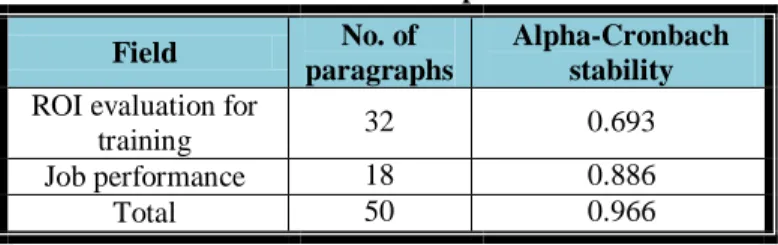
The study adopted Cronbach’s α and split half to measure the internal consistence reliability of the questionnaire. The results showed that Cronbach’s α valueS for all dimensions were > (0.5). It indicated that the design of the questionnaire had a high internal consistency as shown in table (2).
Table 2: Coefficients of Alpha Cronbach Field No. of
paragraphs
Alpha-Cronbach stability
ROI evaluation for
training 32 0.693
Job performance 18 0.886
Total 50 0.966
The results showed that Cronbach’s α values for all dimensions were > (0.5). It indicated that the design of the questionnaire had a high internal consistency as shown in table (2).
Table 3: Split Half Method Field No. of
paragraphs Split half
ROI evaluation for
training 32 0.974
Job performance 18 0.947
Total 50 0.987
The results showed that split half values for all dimensions were > (0.5). It indicated that the design of the questionnaire had a high internal consistency as shown in table (3).
3.4 Data analysis and discussion of results
Descriptive analysis for independent variable (ROI evaluation for training) to determine weighted average and rank for paragraphs are shown in table (4).
Table 4: Descriptive Analysis for ROI evaluation for training
NO. Sub-Field Mean Dev. Weight Rank
1 Reaction 7.74 1.00 77.39 1 2 Degree of Learning 7.54 1.08 75.39 2 3 Application 7.43 1.12 74.33 4 4 Measurement 7.53 1.16 75.31 3 Total 7.56 0.99 75.58
According to previous table (4), the relevant importance can be shown as following:
1. It is clear that there is a high degree of agreement on the field, where the relative weight for ROI evaluating for training reached 75.58% and an average of (7.65) and a standard deviation of (0.99).
2. The first sub-field "reaction" ranked first with a relative weight reached 77.93% with an average of (7.74) and a standard deviation of (1.1).
3. The third sub-field "application" ranked last with a weight of 74.33% with an average of (7.43) and a standard deviation of (1.12).
4. The researchers explain this high level to the content of the training material appropriate to the nature of the employees' job. Also the university uses its available resources for training, and the university is also keen to attract trainers with high experience in the field of training. While for the accumulation of knowledge that training programs do not contribute to maintaining employees with high knowledge to prevent their transfer to destinations other.
5.The most important of which is that the university seeks, through training courses, to increase the knowledge outcome of the trainees in order to accomplish the tasks assigned to them with high efficiency and effectiveness.
6. Added to previous point, it is obvious that the university seeks to provide employees with new skills that qualify them in the job they work through training.
7. One of challenges in training program that the university holds the training courses at the wrong time for the employees, as the staff time is continuous and the training courses are not implemented in the appropriate periods. Job performance descriptive analysis as dependent variable is shown in table (5) to determine weighted average and rank for paragraphs.
Table 5: Descriptive Analysis for Job Performance NO. Field Mean Dev. Weight Rank
1 Employees do their
jobs with high job efficiency.
7.77 1.34 77.74 1
2 Employees complete
their work according to the required quality standards.
7.54 1.35 75.36 5
3 Employees have an
NO. Field Mean Dev. Weight Rank
help them get the job done.
4 Staff work to strictly
implement instructions. 7.65 1.30 76.49 4
5 High performers are
motivated. 6.83 1.89 68.33 14
6 Those who perform
poorly are held
accountable.
6.54 2.01 65.42 16
7 Employees evaluated
according to annual and monthly plans.
7.20 1.71 71.96 13 8 Employees strive to continuously improve their performance. 7.51 1.42 75.09 6 9 Employee performance is evaluated based on clear scientific foundations and criteria. 7.37 1.69 73.69 10
10 More than one party
interferes with job evaluation that has no connection to my work.
6.11 2.47 61.07 18
11 Staff are keen to get
the work done quickly. 7.31 1.52 73.10 11
12 Employees have the
ability to take
responsibility for daily workloads.
7.49 1.41 74.88 7
13 Employees provide
business interest in their personal interests.
7.38 1.59 73.75 9
14 Workers keep their
work secrets. 7.70 1.73 77.02 3
15 Employees can adapt
and cope with any
changes in the
organization.
7.43 1.55 74.29 8
16 The desire of the
employees is available
to work after the
official working hours
to accomplish the
required job
performance.
6.29 2.06 62.86 17
17 Employees make use
of all the resources available to them while performing their job.
7.29 1.64 72.92 12
18 Employees participate
in the decision-making process to improve job performance.
6.63 2.01 66.29 15
Total 7.21 1.16 72.10
According to previous table (5), the relevant importance can be shown as following:
1. The respondents agreed that ROI evaluation for training is practicing among the ministry (72.10%).
2. The respondents agreed that paragraph (1) "Employees do their jobs with high job efficiency" is very important in job performance.
3. The results of the analysis also showed the weakness of performance appraisal. This is clear from paragraph (10) "More than one party interferes with job evaluation that has no connection to my work".
Researchers explained such weakness in the procedures of job performance appraisal to many factors started with financial current crisis in Palestinian Authority. This reflect negativity on number of new students each year and the income of IUG.
This leads to less management control, wrong procedures in job performance evaluation, and lake of skilled employees. 4. The analysis also showed that the university is concerned with the job performance of its employees and the employees' knowledge of the nature of their work, duties and responsibilities.
Step wise regression used to test whether there is an impact for independent variable (ROI evaluation for training) on the dependent variable (job performance). The results are shown in Table (6) and (7).
Table 6: Anova Test
Field Model DF F Job performance Regression 2 86.17 R R2 Resident 260 Sig 0.715 0.511 Total 262 0.000
Table 7: Step Wise Dependent Variable Model B T Sig Constant 0.983 1.964 0.051 Job performance Reaction 0.484 6.251 0.000 Measurement 0.333 3.741 0.000 Variables excluded Degree of Learning 1.02 5.321 0.058 Application 1.32 3.582 0.21
The results of Anova test in table (6) indicate that sig. is less than (0.05) for independent variable (ROI evaluation for training), which mean that there is significant statistically effect for independent variable (ROI evaluation for training) on job performance.
Pearson coefficient and regression coefficient sign for independent variable was positive. This result means whenever the value of independent variables increase, there will be increase in job performance.
Changes in the independent variable is responsible for the interpretation of a rate (r2= 51.1%)) of all the changes that occur in job performance, and there is a rate (100 - r2) due to other factors specific to the other independent variables and
other factors not mentioned in the model, in addition to the random error.
The results of step wise in table (7) indicate that:
1. Job performance, which represents the dependent variable, is influenced substantially and statistically by each of the variables (measurement, reaction).
2. Significance level are less than (0.05), which means that we can rely on the previous model and circulating the sample results on research community.
3. According to step-wise regression, some factors eliminated from the model for lack of statistical significance (degree of learning, application).
Therefore, the results of the analysis proved the existence of a relationship between the independent variable and the dependent variable. According to that, we accept hypothesis H1 and refuse H0. The H1 hypothesis can be written as:
H1: There is a statistically significant effect for ROI for training evaluation on job performance at IUG.
Table (7) determines the figure of step-wise regression equation for the impact of ROI evaluation for training on job performance. This equation can be written as follow:
Job performance =0.983+ (0.484 * Reaction) + (0.333* Measurement)
4. CONCLUSION
According to data analysis, the authors recommend that IUG must work on holding training courses at times that are suitable for employee's free time to facilitate their enrollment. Also, IUG must look on selecting and developing training programs that enhance and develop problem-solving skills in a rapid manner.
Management must focus on choosing quality training programs that keep employees with high knowledge and experience to reduce work turnover at the university.
Add to that, to adopt with rapid changes, IUG has to develop training programs to enhance the culture of knowledge exchange for workers at the same job level at university, the necessity of employee participation in the decision-making process because of its great impact in improving their job performance.
HR department must select employees with a specialization and a link to the jobs that they will evaluate their job performance.
According to results that showed overlap proses in job performance appraisal, planers in IUG have to adopt accountability policies for employees with low job performance and setting standards that motivate them. Researchers encourage setting a new system of material and moral incentives to encourage employees to work after the official working hours, which leads to raising their level of productivity.
Continuous training programs must be conducted periodically to provide continuous T & D that are core and train its current employees and new employees to acquire new knowledge and skills.
REFERENCES
[1]Masaada, E. (2008). Employee performance strategy, 1st ed., Dubai: Publications of Mohammed bin Rashid Al Maktoum Secondary School, UAE.
[2]Altaey, Y., Alfadel, M., & Alabady, H. (2006). Human Resoursec Mnagement, 1st ed., Aman: Alwaraqu publishing, Jordan.
[3]Leopold, J. (2002). Human Resource in Organizations, Personne education, Inc., Upper Saddle River, New jersey, USA.
[4]Aburahma, I, A. M., Abu Amuna, Y. M., & Aqel, M. A. (2020). The Relationship between GHRM Practices and Organizational Performance, International Journal of Academic Management Science Research (IJAMSR), pp. 1-8.
[5]Noe, R. (2010). Employee Training and Development, 5th ed., McGraw - Hill International Edition,Singapore.
[6]Setiawati, T., & Ariani, I. (2020). Influence of Performance Appraisal Fairness and Job Satisfaction through Commitment on Job Performance, Review of Integrative Business and Economics Research, vol. 9, issue 3, pp. 133-151.
[7]Alaklibi, A. (2012). The role of training in changing pocess at public organizations, Alnahda Journal, College of Science and Arts, Shaqra University, vol. 13, issue 2, pp. 111-115.
[8]Asfaw, M., Argaw, D., & Bayissa, L. (2015). The impact of training and development on employee performance and effectiveness: A case study of district five administration office, Journal of Human Resource and Sustainability Studies, vol. 3, issue 4, pp. 188-189.
[9]Curado, C., & Martins, S. (2014). Training Evaluation levels and ROI: the Case of a Small Logistics Company. European Journal of Training and Development, vol. 38, issue 9, pp. 845-870.
[10]Darshani, R. (2018). The Impact of Training and
Development on Employee Job
Performance, Semanticscholar, vol. 2, issue 1, pp. 10-19.Available
at https://www.semanticscholar.org/author/R.K.N.D.-Darshani/119150605 (Accessed 25 june 2020)
[11] Abu Amuna, Y. M., Aburahma, I, A. M. (2019). Enhancing Entrepreneurial Abilities through Various Crowdfunding Models, International Journal of Academic Management Science Research (IJAMSR), vol.3, issue 5, pp. 11-21.
[12]Sanghi, S. (2014). Human Resource Management. India: VIKAS Publishing House PVT Ltd.
[13]Ridwan, M. (2014). Total Quality Management in Training, 1st ed., Cairo: Management Professional Experience Center, Egypt.
[14]Rishani, N. (2018). The Relationship among Performance Appraisal Satisfaction, Career Development and Creative Behavior. The Journal of Developing Area, vol. 52, issue 3, pp. 109-124.
[15]Abu Amuna, Y. M. (2019). Crowdfunding Financing Model effect on Entrepreneurship Aspirations, International Journal of Academic Accounting, Finance & Management Research (IJAAFMR), vol. 3, issue 1, pp. 53-60.
[16]Samwel, O. (2018). Effect of Job Satisfaction on Employees' Commitment and Organizational Performance-Study of Solar Energy Companies in Lakezone Regions, Tanzania. International Journal of Economic and Management, vol. 4, issue 4, pp. 823-835.
[17]Alhata, A. (2016). The Status of Return on Training Assessment of Institutes and Training Centers of Ministry of Education and Higher Education in Gaza Strip and Its Impact on Planning Training, Msc Dissertation, IUG, Palestine.
[18]Subramanian, S., Sinha, V., & Gupta, D. (2012). A study on Return on Investment of Training programme in a Government Enterprise in India. Vikalpa, vol. 37, issue 1, pp. 31-48.
[19]Halawa, A., Sharma, A., Bridson, J. M., Prsecott, D., Lyon, S., Guha, A., & Taylor, D. (2017). How Online Coursework Improves the Attainment in Clinical Transplantation. The Online Journal of Distance Education and e-Learning, vol. 1, issue 5, pp. 56-61.
[20]Abu Amuna, Y. M. (2018). the Electronic-Crowd Funding and its Impact on the Entrepreneurship: A Field Study, PHD Dissertation, Suez Canal University, Egypt.
[21]Kirkpatrick, D.L. (1967). Evaluation of Training. In R. Craig & I. Mittlel (Eds.), Training and Development Handbook. 87-112. New York: McGraw-Hill.
[22]Ward, S., Parkin, G., &Medsker, K. (2006). LES is more (when evaluation training), Performance Improvement, vol.45, issue 8, pp. 8 -13.
[23]Curado, C., & Martins Teixeira, S. (2014). Op Cit., p. 850.
[24]McLean, S., & Moss, G. (2003). They’re Happy, But Did They Make a Difference? Applying Kirkpatrick’s Framework to The Evaluation of a National Leadership Program, Revue Canadienne D’valuation de Program, vol. 18, issue 1, pp. 1-23.
[25]Mat, B. & Al Yahiya, S. (2013). Evaluation of Effectiveness of Training and Development - The Kirkpatrick Model. Asian Journal of Business and Management Sciences, 2(11), 14-24.
[26]Abu Amuna, Y. M. (2019). Entrepreneurship, Crowdfunding Platforms and Sponsors Interaction, International Journal of Academic Management Science Research (IJAMSR), vol. 3, issue 1, pp. 53-60.
[27]Salleh, M., Amin, A., Muda, S., & Halim, M. A. S. (2017). Fairness of Performance Appraisal and Organizational Commitment. Canadian Center of Science and Education, vol. 9, issue 2, pp. 121-128.
[28]Sachdeva, S. (2014). Effectiveness Evaluation of Behavioral Training and Development Programmers. The SIJ Transactions on Industrial, Financial & Business Management (IFBM), 2(4), 218-226.
[29]Reed, C. (2014). The Training Practices of Large Organizations in New Zealand, Msc Dissertation, University of Waikato, New Zealand.
[30]Noe, R. (2010). Op Cit, p. 35.
[31]Jayakumar, D., & Sulthan, A. (2014). Employee Perception towards effective Training program: A Study on Some Selective Private Commercials Banks, European Journal of Business and Management, vol. 5, issue 12, pp. 62-74.
[32]Abu Amuna, Y. M. (2019). The Impact of Crowdfunding Financial Attributes On Entrepreneurship Risk Taking, Al-Mithqal For Economic & Administrative Sciences, Especial Edition, The International Conference on Business Information Technology and Intellectual Economics, pp. 513-520.
[33]Mdhlalose, D. (2020). An Evaluation of the Impact of Training and Development on Organisational Performance: A Case Study of the Gauteng Provincial Department of Economic Development, Journal of
Human Resource and Sustainability Studies, vol. 8, issue 1, pp. 48-74.
[34]Erasmus, J., Leodolff, Z., Mda, V., & Nel, S. (2009). Management Training and Development in South Africa 5th ed., Cape Town: Oxford University Press Southern Africa.
[35]Sachdeva, S. (2014). Effectiveness Evaluation of Behavioural Training and Development Programmes, The Standard International Journal Transactions on Industrial, Financial & Business Management, vol. 2, pp. 218-226
[36]Abu MOuamer , F., Khalil, M., Abu Amuna, Y. M., & Aqel, A. (2020). Impact of Applying Fraud Detection and Prevention Instruments in Reducing Occupational Fraud: Case study: Ministry of Health (MOH) in Gaza Strip, International Journal of Academic Accounting, Finance & Management Research (IJAAFMR), vol. 4, issue 6, pp. 35-54.
[37]Long, C. S., Kowang, T. O., Chin, T. A., & Hee, O. C. (2016). Improving Organisational Performance through Training Function: A Review. International Business Management, vol. 10, pp. 475-478.
[38]Almatrooshi, B., Sing, S. K., & Farouk, S. (2016). Determinants of Organisational Performance: A Proposed Framework. International Journal of Productivity and Performance Management, vol. 65, pp. 844-859.
[39]Anlesinya, A., Bukari, Z., & Eshun, P. (2015). The Effect of Employee Development on Performance of Public-Sector Organisations in Ghana: Evidence from Controller and Accountant General’s Department, Accra. International Journal of Management and Commerce Innovations, vol. 2, pp. 283-290.
[40]Salha, M. (2015). The Degree of Practicing Management by Walking Around by the School Principals and "its Impact on Job Performance"From UNRWA Teachers' Prespective, Msc Dissertation, IUG, Palestine.
[41]Alejla, T. (2009). Creativity Administrative and Its Relationship with The Performance of Managers in The Ministries of Gaza Strip, Msc Dissertation, IUG, Palestine.
[42]Salha, M. (2015). Op Cit., p. 44.
[43] Alnadeem, R. (2014). Managerial Communication and Its Relationship with The Quality of Job Performance at Palestinian Universities in Gaza Governorates, Msc Dissertation, IUG, Palestine.
[44]Kirkpatrick, D. L., & Kirkpatrick, J. D. (2006). Evaluating Training Programs: The Four Levels, 3rd ed., San Francisco, CA: Berrett-Koehler Publishers, Inc.
![Fig. 1 shows the Kirkpatrick model of ROI evaluation for training program. [21]](https://thumb-us.123doks.com/thumbv2/123dok_us/559193.2566449/3.918.474.865.341.561/fig-shows-kirkpatrick-model-roi-evaluation-training-program.webp)