DOI: 10.12928/TELKOMNIKA.v16i5.10271 2428
Optimum Network Reconfiguration using
Grey Wolf Optimizer
Ridha Djamel Mohammedi1,Rabie Zine*2, Mustafa Mosbah3,Salem Arif4 1
Department of Electrical Engineering, University of Djelfa, Djelfa, Algeria 2
Department of Mathematics, Faculty of Sciences and Humanities, Aflaj, Prince Sattam Bin Abdulaziz University, Saudi Arabia
3,4
LACoSERE Laboratory, Department of Electrical Engineering, Amar Telidji University of Laghouat, Algeria
*Corresponding author, e-mail: [email protected]
Abstract
Distribution system Reconfiguration is the process of changing the topology of the distribution network by opening and closing switches to satisfy a specific objective. It is a complex, combinatorial optimization problem involving a nonlinear objective function and constraints. Grey Wolf Optimizer (GWO) is a recently developed metaheuristic search algorithm inspired by the leadership hierarchy and hunting strategy of grey wolves in nature. The objective of this paper is to determine an optimal network reconfiguration that presents the minimum power losses, considering network constraints, and using GWO algorithm. The proposed algorithm was tested using some standard networks (33 bus, 69 bus, 84 bus and 118 bus), and the obtained results reveal the efficiency and effectiveness of the proposed approach.
Keywords: reconfiguration, power loss, grey wolf optimizer, radial distribution networks
Copyright © 2018 Universitas Ahmad Dahlan. All rights reserved.
1. Introduction
A power system can be divided to different phases, generation phase, transmission phase and distribution phase. The distribution phase is the important one that presents liaison between transmission system and consumer. Distribution networks are in many cases exploited in a radial configuration [1], power flux has just a way to transit from source to load. Radial configuration allows insuring easily network maintenance and fast fault detection with short-term network restoring. To move from a configuration to another it is enough to change switchers states (opened or closed) so as to reduce active losses, balance loads between feeder or maximize, in case of line fault the number of restored customers[2]. Distribution network reconfiguration was proposed the first time by A. Merlin et al [3]. The distribution network reconfiguration is considered as a non-linear and/or discreet combinatory programming problem. To determine an optimal reconfiguration, one has to perform a sequence of adequate commutation operation by considering all aspects of network constraints (technique, security and topology) [4].Distribution network reconfiguration can minimize active losses [5].
To determine optimal distribution network reconfiguration, different methods based meta-heuristic optimization proposed in literature as, Modified Tabu Search Algorithm [6].Modified PSO Algorithm[7,8]. Adaptive Particle Swarm Optimization [9]. Genetic Algorithm [10]. Artificial Bee Colony Algorithm [11]. Differential Evolution[12]. Artificial Immune Systems [13]. Gravitational Search Algorithm [14]. Harmony Search algorithm [15]. Hybrid Big Bang-Big Crunch Algorithm [16]. Biogeography Based Programming Algorithm [17]. Cuckoo Search Algorithm [18]. Runner-root Algorithm [19].Stochastic Dominance Concepts [20]. In this paper, a metaheuristic technique called (GWO) based on graphs theory is proposed to find the optimal reconfiguration of an electrical network in order to minimize active losses. This is concretized by an adequate adjustment of switches states. The remainder is organized as follows: The second section is dedicated to distribution network reconfiguration problem, definitions and methods associated. In the third section, we gives the mathematical programming model of the proposed problem. In the fourth section, we shows the application of GWO technique to network reconfiguration problem. The fifth section presents some simulation results relative to standard networks.
2. Problem Formulation 2.1. Objective Function
In distribution network level, active losses reduction can be established by network topology changing. Active power losses, due to current flow in an electrical conductor, is given by (1) ∑ ∑ { ( )} (1) with ( ) and
where , refer toactive and reactive power sat bus i. , refer to active and reactive powers at bus j.
is the branch resistance between buses i and j.
are voltage and angle at bus i. are voltage and angle at bus j.
N represents the number of buses in the network.
To insure a steady operation of the network is necessary to respect network exploitation constraints such as equality and inequality constraints given in the following section.
2.2. Equality Constraints
Its defined by load flow equations, corresponding to one operation point of the network, for a given load and generation. They are given as follows:
{ ∑ ( ) ( )
∑ ( ) ( )
(2)
where: is the admittance matrix corresponding to buses i and j.
2.3. Inequality Constraints
The nodal voltages in all network remains within admissible limits, which are given by
(3)
where: and are the extremal (Min/Max) voltages of i th
bus.
(i) The transiting currents are limited by the line thermal limits so that
(4)
where is the apparent power flow at distribution system lines between buses i and j, is
permitted rating of lines ij. 2.4. Radiality Constraint
This constraint is relative to network topology that indicates radiality conservation of exploitation schemes, so there is no power loop in the scheme[21].
2.5. Connectivity Constraint
Obviously, it is necessary to have all buses under electrical voltage. 2.6 Constraints-Handling Mechanism
2.6.1. EqualityConstraints
In distribution networks, Newton-Raphson and Gauss-Seidel methods are not more appropriate to solve the power flow problem because, in cases, they diverge due to different typical characteristics related to transmission network where, the configuration is generally radial with, high ratio R/X [22]. For that raison, backward-forward sweep(BFS) technique is used in this work to analyze the power flow.
2.6.2. Inequality Constraints
Physical problems enclose generally constraints that have to be fulfilled. The constraints' set defines the feasible set. Indeed, a solution that not verify one or many constraints is said to be non-feasible and cannot be considered as ideal solution, even if it optimizes the objective function. Therefore, penalty function is necessary to favor feasible solutions. Hence the objective function must be replaced by the following function see [23-26].
∑ ( )
∑
(5)
where:F is the objective function value, and are expressed as:
{ (6) { (7)
Where: and represent the penalty factors which are selected as 10.000.
So, a penalty function is used (for topology constraints) in the case of existing power loops or isolated loads as follows:
(8)
where is the existing power loops number, is the number of isolated loads, and are penalty factors.
3. Grey Wolf Optimizer Algorithm
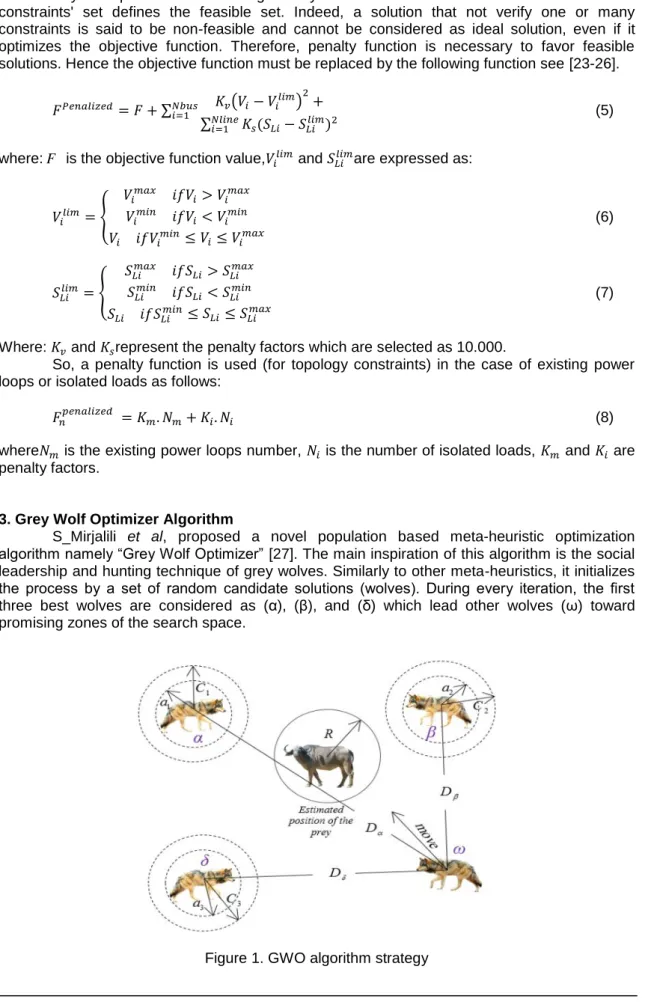
S_Mirjalili et al, proposed a novel population based meta-heuristic optimization algorithm namely “Grey Wolf Optimizer” [27]. The main inspiration of this algorithm is the social leadership and hunting technique of grey wolves. Similarly to other meta-heuristics, it initializes the process by a set of random candidate solutions (wolves). During every iteration, the first three best wolves are considered as (α), (β), and (δ) which lead other wolves (ω) toward promising zones of the search space.
Grey wolves tend to encircle the prey when the hunt. The encircling behavior can be formulate as follows: ⃗ ⃗⃗⃗⃗⃗ ⃗ | ⃗ ⃗⃗⃗⃗⃗ ⃗| (9) ⃗ ⃗ ⃗ (10) ⃗ (11) where: t is the iteration number, ⃗and ⃗are the coefficient vectors, ⃗the prey position vector, ⃗⃗⃗⃗⃗refers tothe grey wolf position vector. are random vectors in the interval [0, 1] and the variable ⃗ decreases linearly from 2 to 0 with iteration steps given by
⃗ ⁄ (12)
Is worth noticing that each mega wolf is required to update its position with respect to , and simultaneously as follows: ⃗⃗⃗⃗⃗⃗ | ⃗⃗⃗⃗⃗ ⃗⃗⃗⃗⃗ ⃗| (13) ⃗⃗⃗⃗⃗ | ⃗⃗⃗⃗⃗ ⃗⃗⃗⃗⃗ ⃗| (14) ⃗⃗⃗⃗⃗ | ⃗⃗⃗⃗⃗ ⃗⃗⃗⃗⃗ ⃗| (15) ⃗⃗⃗⃗⃗ ⃗⃗⃗⃗⃗ ⃗⃗⃗⃗⃗⃗ ⃗⃗⃗⃗⃗⃗ (16) ⃗⃗⃗⃗⃗ ⃗⃗⃗⃗⃗ ⃗⃗⃗⃗⃗⃗ ⃗⃗⃗⃗⃗ (17) ⃗⃗⃗⃗⃗ ⃗⃗⃗⃗⃗ ⃗⃗⃗⃗⃗⃗ ⃗⃗⃗⃗⃗ (18) ⃗ ⃗⃗⃗⃗⃗ ⃗⃗⃗⃗⃗ ⃗⃗⃗⃗⃗ (19) It was argued by S_Mirjalili et al that the parameters A and C force the grey wolf optimizer algorithm to explore and exploit the search space [27]. Half of the iterations is devoted to exploration (| | ) and the rest is used for exploitation (| | ). The parameter C also changes randomly to solve the local optima stagnation during optimization.
4. Application of the GWO to the Proposed Problem 4.1. Decision variables
Because of the design of the network, the fundamental loops are numbered from 1 to BL, respectively. One switch from every BL loops is opened to keep the network radial with considering constraints. This contributes to reduce the generation of non feasible configurations during each steps of the algorithm.
(20)
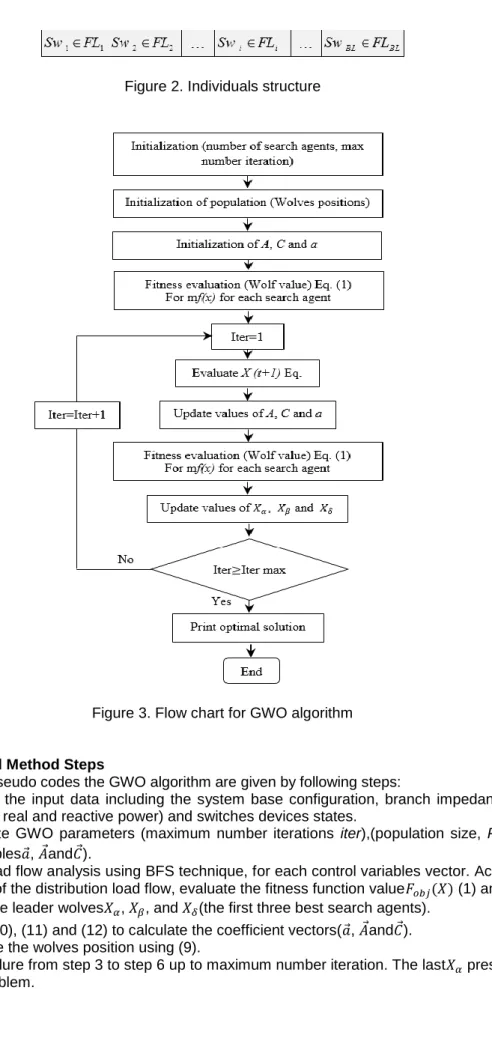
where: X is the state variables and represents the open switch number that is selected from the ith fundamental loop. So, the size of X is equal to the number of distribution system fundamental loops. The number of network fundamental loops is identical to the tie switches number. Moreover, Figure 2 show the encoding of individuals, where each candidate switch is denoted by discrete integer corresponding to the respective loop vector. Figure 3 shows the flow chart for Grey Wolf Optimizer algorithm.
Figure 2. Individuals structure
Figure 3. Flow chart for GWO algorithm
4.2. Proposed Method Steps
The pseudo codes the GWO algorithm are given by following steps:
Step 1: Define the input data including the system base configuration, branch impedance and bus data (load real and reactive power) and switches devices states.
Step 2: Initialize GWO parameters (maximum number iterations iter),(population size, PS),and (vectors variables ⃗, ⃗and ⃗).
Step 3: Runload flow analysis using BFS technique, for each control variables vector. According to the results of the distribution load flow, evaluate the fitness function value (1) and (5).
Step 4: Update leader wolves , , and (the first three best search agents). Step 5: Use (10), (11) and (12) to calculate the coefficient vectors( ⃗, ⃗and ⃗). Step 6: Update the wolves position using (9).
Repeat procedure from step 3 to step 6 up to maximum number iteration. The last present the solution of problem.
5. Simulations and Discussion
In order to test the efficiency of the proposed technique, the application is performed on some standard networks with different sizes such as 33_bus network [28], 69_bus [29], 84_bus [30] and 118_bus [31].
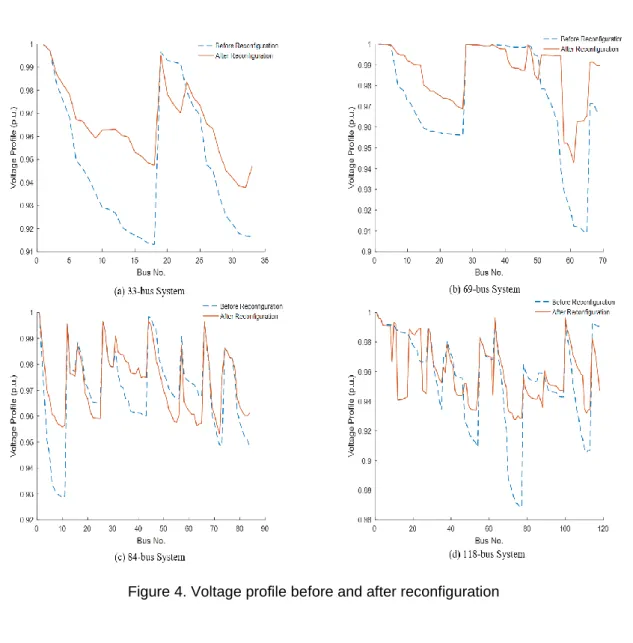
From the comparison of the second and the fifth columns in Table 1, we can see that, for all test system, the total active power losses are reduced significantly after reconfiguration. Figure 4, represent the voltage profiles of all test systems. So, we can note that, for all nodes, the voltage levels of the radial distribution systems are improved and placed in an acceptable margin. The results obtained using GWO method is compared with Particle Swarm Optimization(PSO) method and the results are given in Table 2.
Table 1. Result of Simulation Before Reconfiguration After Reconfiguration
Test System Real Power
Loss (kW)
Minimum node voltage (pu)
Branches switched out Real Power Loss (kW) Minimum node voltage (pu) Loss reduction (%) 33_bus 202.66 0.9131 7-14-9-32-37 139.51 0.9378 31.16 69_bus 224.78 0.9092 14-70-69-58-61 99.58 0.9427 55.70 84_bus 531.81 0.9285 55-7-86-72-88-89-90-83-92-39-34-40-62 470.32 0.9532 11.56 118_bus 1297.86 0.8688 42-12-23-51-48-58-39-95-71-74-97-107-85-109-34 905.19 0.9322 30.26
Table 2. Comparisons of Average with Previous Method Test system Methods Optimal configuration Real powerloss (kW)
Minimum node voltage (pu) 33-bus PSO 7-14-9-32-37 142.12 0.9336 Proposed GWO 7-14-9-32-37 139.51 0.9378 69-bus PSO 13-70-69-58-61 99.67 0.9427 Proposed GWO 14-70-69-58-61 99.58 0.9427 84-bus PSO 61-7-86-72-13-89-90-82-92-39-34-42-54 476.91 0.9503 Proposed GWO 55-7-86-72-88-89-90-83- 92-39-34-40-62 470.32 0.9532 118-bus PSO 42-119-32-52-47-60-39-125-128-73-71-82-130-108-23 949.61 0.9122 Proposed GWO 42-12-23-51-48-58-39-95-71-74-97-107-85-109-34 905.19 0.9322 6. Conclusion
This paper presents GWO technique to determine the optimal distribution networker configuration. The objective function considered in this study is, minimizing active losses under technique and topologic constraints. This technique is based on Grey Wolf Optimizer which, was tested on different standard networks (33_bus, 69_bus, 84_bus and 118_bus). Compared to PSO method, the simulation results proved the superiority of the proposed method (GWO) in terms of robustness and quality improvement.
References
[1] D Shirmohammadi, HW Hong. Reconfiguration of electric distribution networks for resistive line losses reduction.IEEE Transactions on Power Delivery.1989; 4: 1492-1498.
[2] L Tang, F Yang, J Ma. A survey on distribution system feeder reconfiguration: Objectives and solutions. in 2014 IEEE Innovative Smart Grid Technologies-Asia (ISGT ASIA).2014: 62-67.
[3] A Merlin, H Back. Search for a minimal-loss operating spanning tree configuration in an urban power
distribution systems. Proc. 5th Power System Computation Conference (PSCC), Cambridge,
UK.1975: 1-18.
[4] S Civanlar, J Grainger, H Yin, SS Lee. Distribution feeder reconfiguration for loss reduction.IEEE
Trans on Power Delivery.1988; 3(3): 1217-1223.
[5] ME Baran, FF Wu. Network reconfiguration in distribution systems for loss reduction and load balancing.IEEE Trans ons on Power Delivery.1989; 4(2).
[6] AY Abdelaziz, FM Mohamed, SF Mekhamer, MAL Badr. Distribution system reconfiguration using a modified Tabu Search algorithm.Electric Power Systems Research.2010; 80: 943-953.
[7] KK Kumar, NV Ramana, S Kamakshaiah. Design and Development of Modified PSO Algorithm for Network Reconfiguration.International Review of Electrical Engineering.2013; 8(5): 1586-1593. [8] W Wu-Chang, T Men-Shen. Application of Enhanced Integer Coded Particle Swarm Optimization for
Distribution System Feeder Reconfiguration.IEEE Transactions on Power Systems.
2011; 26: 1591-1599.
[9] N Gupta, A Swarnkar, KR Niazi. Reconfiguration of Distribution Systems for Real Power Loss Minimization Using Adaptive Particle Swarm Optimization.Electric Power Components and
Systems.2011; 39: 317-330.
[10] S Das, D Das, A Patra. Reconfiguration of distribution networks with optimal placement of distributed generations in the presence of remote voltage controlled bus.Renewable and Sustainable Energy
Reviews.2017; 73: 772-781.
[11] L Nguyen Tung, A Nguyen Quynh. Application Artificial Bee Colony Algorithm (ABC) for
Reconfiguring Distribution Network. in 2010.ICCMS '10. Second International Conference on
Computer Modeling and Simulation.2010: 102-106.
[12] D Pal, S Kumar, B Tudu, KK Mandal, N Chakraborty.Efficient and Automatic Reconfiguration and
Service Restoration in Radial Distribution System Using Differential Evolution.in Proceedings of the
International Conference on Frontiers of Intelligent Computing: Theory and Applications (FICTA).2013; 199:365-372. SC Satapathy, SK Udgata, BN Biswal, Eds., ed: Springer Berlin Heidelberg.
[13] LW de Oliveira, EJde Oliveira, FV Gomes, IC Silva Jr, ALM Marcato, PVC Resende. Artificial Immune Systems applied to the reconfiguration of electrical power distribution networks for energy loss minimization.International Journal of Electrical Power & Energy Systems.2014; 56: 64-74.
[14] YM Shuaib, MS Kalavathi, CC Asir Rajan. Optimal Reconfiguration in Radial Distribution System Using Gravitational Search Algorithm.Electric Power Components and Systems.2014; 42: 703-715.
[15] DS Rani, N Subrahmanyam, M Sydulu. Improved Music Based Harmony Search algorithm for
Optimal Network Reconfiguration. in 2012 Annual IEEE India Conference (INDICON).
2012: 1030-1035.
[16] M Sedighizadeh, M Esmaili, M Esmaeili. Application of the hybrid Big Bang-Big Crunch algorithm to optimal reconfiguration and distributed generation power allocation in distribution systems.Energy.2014; 76: 920-930.
[17] A Kouzou, RDMohammedi. An efficient biogeography-based optimization algorithm for smart radial distribution power system reconfiguration.First Workshop on Smart Grid and Renewable Energy
(SGRE), Doha Qatar. 2015.
[18] A Kouzou, RD Mohammedi. Distribution Network Reconfiguration Using Cuckoo Search Based Optimization. Fourth inter conf on Elec Eng, Boumedes, Algeria, 2015.
[19] TN Thuan et al. Multi-objective electric distribution network reconfiguration solution using runner-root algorithm.Applied Soft Computing. 2017; 52: 93-108.
[20] G Chicco, A Mezza. Assessment of optimal distribution network reconfiguration results using stochastic dominance concepts.Sustainable Energy, Grids and Networks.2017; 9: 75-79.
[21] U Agarwal, UP Singh.Graph Theory. University Science Press/Laxmi Publications. 2009.
[22] U Eminoglu, MH Hocaoglu. Distribution Systems Forward/Backward Sweep-based Power Flow Algorithms: A Review and Comparison Study.Electric Power Components and Systems. 2008; 37: 91-110.
[23] RD Mohammedi, M Mosbah, A Hellal, S Arif. An efficient BBO algorithm for optimal allocation and
sizing of shunt capacitors in radial distribution networks. Inter Conf Elec Ing (ICEE2015) Uinivrsity of
Boumerdes. 2015.
[24] M Mosbah, RD Mohammedi, S Arif, A Hellal. Optimal of shunt capacitor placement and size in
algerian distribution network using particle swarm optimization. ICMIC-2016, IEEE Proceeding,
Algiers, Algeria. 2016.
[25] M Mosbah, A Hellal, RD Mohammedi, S Arif. Genetic algorithms based optimal load shedding with
transient stability constraints.IEEE Proceeding Inter Electri Scien and Techno in Maghreb.2014: 1-6.
[26] M Mosbah et al. Optimal sizing and placement of distributed generation in transmission systems. ICREGA-2016, Belfort, France. 2016.
[27] SM Mirjalili, A Lewis. Grey wolf optimizer.Advances in Engineering Software.2014; 69: 46-61. [28] ME Baran, FF Wu. Network reconfiguration in distribution systems for loss reduction and load
balancing.IEEE Transactions on Power Delivery.1989; 4: 1401-1407.
[29] ME Baran, FF Wu. Optimal capacitor placement on radial distribution systems.IEEE Transactions on
Power Delivery.1989; 4: 725-734.
[30] S Ching-Tzong, L Chu-Sheng. Network reconfiguration of distribution systems using improved mixed-integer hybrid differential evolution.IEEE Transactions on Power Delivery.2003; 18: 1022-1027. [31] D Zhang, Z Fu, L Zhang. An improved TS algorithm for loss-minimum reconfiguration in large-scale