A Practical Guideline to the Implementation of Online Shops
Andreas Bartelt and Jochen Meyer
Oldenburger Forschungs- und Entwicklungsinstitut
für Informatik-Werkzeuge und -Systeme (OFFIS)
Escherweg 2, D-26121 Oldenburg, Germany
[email protected], [email protected]
Abstract
Implementing an Online Shop can be a risky project, since there’s no widespread and profound knowledge and experiences. This guideline is intended to support manag-ing the organizational, technical and human challenges in Online Shop implementation projects.
An overview of the implementation process is given. Sub-sequently the development of a concept, using the services offered by a company to its customers, is discussed. Pro-totyping, Realization and Operation of the Online Shop are further topics. The last part introduces some practical ’Helper’ tools for the implementation of Online Shops.
1 Introduction
Subsumption Electronic Commerce is a growing market
and many different kinds of businesses are already con-ducted and emerging. Before you are going to implement a special application, it should be clear what you are do-ing. Timmers uses in [5] the term business modelin the context of electronic markets, which makes it possible to subsequently classify Electronic Commerce applications. A business model is described as “an architecture for the prod-uct, service and information flows, including a description of the various business actors and their roles, a description of the potential benefits for the various actors and a descrip-tion of the sources of revenues”. Various business models are E-Auctions, E-Procurement or E-Malls. One major and currently often applied business model is that of an E-Shop, better known as an Online-Shop.
Online-Shops An Online-Shop has two main purposes
for a company which likes to sell goods and services over the Internet, merchandisingandorder processing(cf. [4], [5]). There are several functions supporting these purposes, e.g. hypermedia presentation techniques and multimedia
which support merchandising. Order processing can be sup-ported, for example, with an online basket, with online pay-ment or depending on the traded goods with digital delivery. These functions are integrated into a software called Com-merce Server(orMerchant Server) which is used to run an Online-Shop. The technology of Commerce Servers is still evolving, but there are already some standard software ap-plications covering this area.
Online-Shops are not isolated elements in a company. They have to use the information of the company, like prod-uct lists, catalog strprod-uctures or customer data. The need to be integrated into the companies business processes: an or-der, e.g. should usually be forwarded immediately into the company’s ERP system.
Timmers [5] sees the benefits looked for from a com-pany’s perspective “in increased demand, a low-cost route to global presence and cost reduction of promotion and sales. The benefits for the customers can be lower prices, a wider choice, better information, and convenience of select-ing, buying and delivery, including 24-hour availability”.
Implementation For the implementation of a concrete
Online Shop for a company it is very helpful to have a practical and handy guideline for the whole implementa-tion process. Such a guideline will be presented here. It has evolved through our practical experiences in setting up Online Shops.
Guideline To get a coarse structure of the
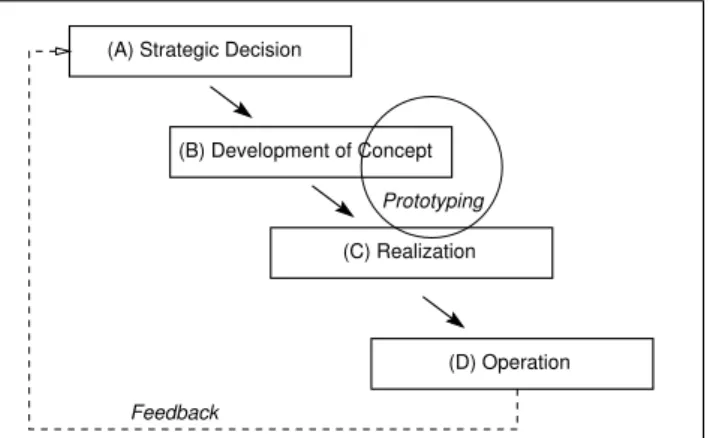
implemen-tation process for the Online Shop, it can be split into four major steps as shown in figure 1.
(A) The first step is thestrategic decisionto implement an Online Shop in the company. The decision should be supported by global goals to which the shop is directed, e.g. to create a new marketing channel or simply to gain an ad-vantage over the competitors.
(B) Thedevelopment of a conceptfor the Online Shop is the second and often the most extensive step. Business and technical issues, e.g. the structure of the offer made by the
(C) Realization (A) Strategic Decision
(D) Operation (B) Development of Concept
Prototyping
Feedback
Figure 1. Implementation Steps
company, the technical architecture for the data exchange between the online shop and the ERP system or the software to use, have to be clarified. The concept development step will be elaborated in detail later.
(C) In the third steprealization, the Online Shop is in-stantiated by configuration and customization of electronic commerce standard software and/or by programming and web design. Other important parts in this step are testing and marketing of the online shop.
(D) The final step is theoperationof the online shop, which often is outsourced today. An important success fac-tor for the Online Shop is the actuality of the information provided and prompt responses to customer questions and orders.
(Prototyping:) An integral part of the process model is the prototyping of the solution. It supports in finding a good business model in the concept phase and also can speed up development of the final solution. Prototyping is discussed in detail in section 3.
(Feedback:) As shown in figure 1 with the dashed line from operation to strategic decision, feedback is required. Online Shops are a very new part of the business processes of companies, this feedback has to be processed in modified or new strategic decisions.
Process models This practical guideline compiles
tech-niques from different process models. The four steps shown in figure 1 are based on a classical waterfall process model [1] for simplicity. The integrated prototype should be seen in conjunction with a potential use of the evolution-ary model [1] in the steps ’Development of Concept’ and ’Realization’, since today often the companies can not give explicit and clear requirements and specifications for their Online Shop.
2 Developing a concept
Starting with the strategic decision to implement an On-line Shop, the most complex step is the development of an initial concept. The concept is the basis for realization and later operation. It is guided by the goals defined in the strategic descicion, since these goals should be reached by the resulting system. In general a business model as men-tioned in the beginning is instantiated.
Concept Structure An Online Shop is a computer based
system which consists of many separate elements and in-teracts with several other computer based systems, such as the company’s ERP system or customer’s systems. It also interacts with humans: with customers through their web browsers or with the administrators of the Online Shop through the administration interface. A basic step is to iso-late and name the elements of the Online Shop (refer to sec-tion 5.2 for examples).
To develop a concept for an Online Shop, it is useful to structure these elements. There can be different views on the bulk of elements. It helps to cluster all relevant ele-ments into groups. But what are the most relevant criteria for clustering?
One first proposal in our projects for clusters was pre-sentation and design,functionalityand theenvironment of the Online Shop. This clustering had no deeper underlying criteria.
Another proposal is to use a technical view and build up the clusters from thesoftware architecture elementsof an Online Shop. This represents a good view for the software developer.
The last proposal is to use aservicescentered approach. All Online Shop elements are used to offer various kinds of services to the customers. This is an intuitive view for the company and customers.
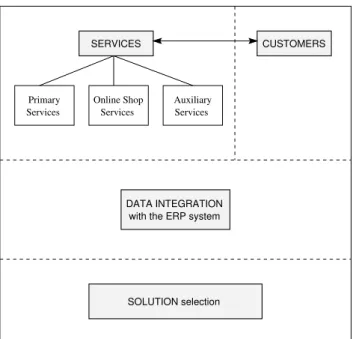
The SERVICES approach The main clusters in the
services centered approach are
the SERVICES offered, including a substructure to re-duce complexity,
the customers which will use the services offered, the technical data integration with the ERP system, which has to fulfill the requirements stated by the ser-vices offered and
the solution/software selection, as a base for the real-ization of the planned services.
The clusters to be considered are shown in figure 2. The main sequence in which the clusters should be handled at development time is from top to bottom.
Services Online ShopServices AuxiliaryServices
DATA INTEGRATION with the ERP system Primary
SOLUTION selection
CUSTOMERS SERVICES
Figure 2. Concept clusters
2.1 Customers
An Online Shop offers services to customers. There should be a good match between the offered services and the targeted customers, also considering the new media to be used.
In Business-to-Consumer eCommerce there often is a discrepancy between the typical internet user - male, be-tween 30 and 40 years old, academic - and the typical re-tail customer: female and in the early 40’s. In Business-to-Business eCommerce there often is much more certainty about the customers, e.g. a wholesale company knows it’s retail stores and what they expect.
This should be in mind, designing the offer - or - vice versa defining the customers to be reached with the offer.
2.2 SERVICES
By means of an Online Shop a company is offering a complex bundle of services to its customers. These ser-vices are partly inside the Online Shop and partly outside the shop, in the latter case directly provided by the com-pany. An integral part of the implementation process is the decision on the services to be offered by various means of the Online Shop. To make it possible to handle the com-plexity of the service bundle, a structure over the potential service types is defined.
Primary Services Primary services are the offer of
products and services the company provides in its core
busi-ness field. Primary services are basically concerned with the steps information, order, logistics, and payment.
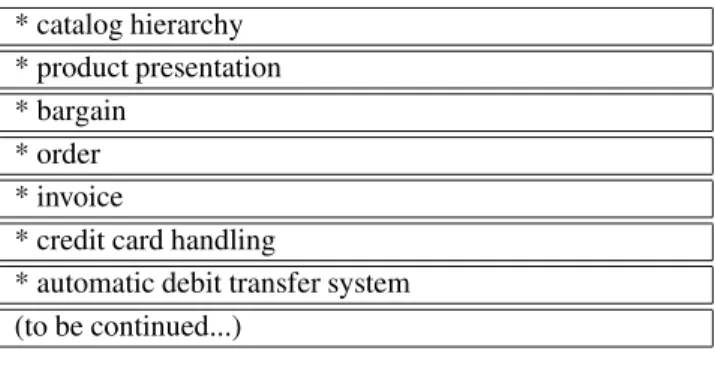
A music compact disc retailer, e.g. may inform its cus-tomers of the available CDs, receive an order and deliver the CD via postal mail. The payment also has to be managed, e.g. byinvoice or credit card. (See also the Helper at section 5.2.1 for a list of possible primary services.)
The applicability of products and services for online commerce is often structured with a chart that classifies the potential products and services along two dimensions: product complexity and emotional product relation of the customer. In order to be easy sellable, products should be simple and rational. This is true for most of the products in the mail order business. Cars are complex and can raise emotions, they are harder to sell online. This is just a rule of thumb - each scenario is idividual, but the risk of failure is higher when complex and emotional products are to be sold. One should also have the targeted customer in mind.
Online Shop Services Online Shop services are made
possible only due to the installation of the Online Shop and directly serve the primary services. These are mainly the typical surplus values, examples are a comfortable search function, actual product availability information, One-to-One Marketing (e.g., favorite products), 24 hours / 7 days a week availablity for information and ordering, list of new products or order tracking. Digital payment or digital deliv-ery (e.g., music with MP3 download files) can also be spe-cial Online Shop services. (See also the Helper at section 5.2.2.)
Auxiliary Services Services of auxiliary type are
needed to support the operation and economic success of the shop in general. They differ from Online Shop services as they donotdirectly serve the primary services. Exam-ples are the presentation of useful background information which is of interest to the customer community, special re-bates in the Online-Shop or a contest to enhance the cus-tomer binding. Another auxiliary service field is security. Using a security service like using the https protocol can generate confidence at the customer’s side. (See also the Helper at section 5.2.3.)
Excluded Services It is useful to state what willnotbe
offered by the Online Shop. For example, if payment is only done by invoice out of the ERP system, no services related to payment have to be discussed.
2.3 Data Integration
To provide the specified services the Online Shop re-quires the related data. Typically these are data about prod-ucts, a catalog structure and customer information. The
On-line Shop will generate orders which have to be processed by the company.
Concerning the type of conncetion between the Online Shop and the ERP system one can distinguish three models:
Online: The Online Shop has automatic synchronous access to the required data
– Integrated: This is a special form of Online, where the Online Shop is provided by the com-pany’s ERP system (an example is SAP’s ITS-system)
Nearline: The data inside the Online Shop are auto-matically, periodically and asynchronously updated
Offline: The Online Shop is set up and updated manu-ally
For some hints to a typical technical realization of the inte-gration see section 5.3.
2.4 Solution selection
As soon as the various parts of the offered services are specified, the targeted customers are defined and the Data Integration needs are clarified, the base for a successful re-alization has to be selected.
The commerce server software, standard or individual (if standard, which software to choose?) and the shop hosting (inhouse or sousourcing) has to be selected.
3 Prototyping
Prototyping should begin and help with the development of the concept. Its also useful at the realization step.
We have seen from experience that a practice which in-tegratesPrototypingis important for the success of Online Shop implementation projects. A major element in this con-text is the way a prototype can help to improve the com-munication of the project partners at an early stage. Today most companies do not know much about Online Shopping, especially about the details and scenarios unique to their business area. However, these issues can be critical for the success of the Online Shop, having in mind the customers and the competitors.
A prototype can help at an early stage to develop a con-crete notion of Online-Shopping. The prototype can be used to discuss the special details which are unique to the com-pany or the business branch.
Consequently Prototyping should be an integral part of a practical process model for the implementation of Online Shops.
Building a prototype To set up a prototype of an Online
Shop it is usually sufficient to generate a set of basic screen masks (e.g., the main screen, product lists, product display, basket). Using a standard software for Online Shops one can also very easily set up a simple prototype shop with some basic functionality to discuss about. To further en-hance the prototype with little effort, company logos and layouts from the corporate identity may be used.
4 Realization and Operation
4.1 Realization
Based on the concept and the prototype, using only the specification or also the coding of the prototype, the Online Shop can be realized.
As a result of the solution selection in the concept phase eCommerce standard software will be used or individual programming of a solution is needed. In the latter case, which will not be covered here, a complete software devel-opment project is on its way.
When eCommerce standard software is used, it has to be configured in accordance to the services needed and cus-tomized to the company’s requirements. It should be con-sidered that often additionally individual programming has to be done to fully satisfy the company’s needs as specified in the concept.
The web design is another important part of the realiza-tion step. Personal tastes of design by the developers are different, focus the design which seems to be most useful to the targeted customers.
One central issue of the online shop should be actual data. So the data integration with the ERP system as speci-fied in the concept must be realized and set up for continous operation. There are often major efforts necessary to real-ize the data integration, depending on the interfaces of the Online Shop and the ERP system and the kind of coupling choosen.
Testing should be done extensively. A simple first test could be done by a member of the own sales force staff, or by a pilot customer.
Marketing is an important part for the success of the on-line shop. The strategy will depend on the business branch and the targeted customers - but as a general guideline many customers today are reached through conventional offline marketing. Promote the shop in the paper catalogs, the notepaper etc. Online marketing through search engines, banners or portals should also be considered.
4.2 Operation
In the operation phase the complete integration of the Online Shop into the company’s business processes has to
be guaranteed. Actual data has to be provided in the Online Shop, quick responses to customer questions and orders are of the essence.
Statistics and feedback should be collected for a poten-tial redesign or smaller additions and changes.
5 Helper
This section introduces some practical Helper tools, which proved useful in projects for the implementation of online shops. These tools are small and simple and should be easy understandable for all project members.
Since this is in general the implementation of stan-dard software, one can confer to the implementation of other standard software, e.g. ERP software. The Helpers used here are basically conferable to theAccelerators(cf. [2]) used in the ASAP initiative for SAP implementations. These are various tools, documentations, and programs used to speed up, to standardize and to assure quality of an SAP implementation.
The following sections introduce some practical first Helpers which proved useful.
5.1 “Shop-Cloud” - Environment of an Online Shop
This Helper is a diagam of a “cloud”, which shows the potential environment of an Online Shop (see figure 3).
Company
Online Shop systemERP
and services should be offered? What products? Customer What type of like to reach? customers would we ? Homepage (static) INTERNET * Offline * Nearline * Online * Integrated Coupling: Web-Designer Shop-* Developer / Consultant * Hosting Shop-/ Commerce-Server Producer general company information Search Information, Invite Offers product information Offer,
What Online Shop services and auxiliary services
should be offered? ? Helper "Shop-Cloud" Delivery Payment Ordering
Figure 3. Helper “Shop-Cloud”
The diagram can be used as a starting point for the analy-sis of the real world scenario and the planned configuration. Change it to the required needs. To give an example, the payment methods may be discussed. Should the payment be done on account or should digital payment methods be offered. The payment arrow in the cloud can then be moved from the box representing the company to the Online-Shop, adding a digital payment system there.
Usage: The graphic is by intention open and at some points fuzzy designed. Use it to discuss the represented is-sues, add issues and change the diagram to suit your con-crete scenario. Use it with your project partners, the com-pany, or only internally to get quickly a raw concept for the project.
Timing:Use the diagram at the beginning of the project, when the raw business model has to be clarified.
5.2 Proposal lists
An Online Shop may provide various kinds of features and services. In proposal lists these possible features and services are enumerated.
It would be possible to assign the elements to sub groups, use another granularity or hierarchically refine the elements. For simplicity the elements here are only assigned to the major service type groups.
Usage: Pick from the lists the elements appropriate for the concrete scenario. Use the listed elements as starting point for new ideas, which may be special to your setting. Also refinement of the elements may be useful.
Timing: Use the proposal lists in the concept phase of the project.
5.2.1 Primary Services Proposal list
* catalog hierarchy * product presentation * bargain
* order * invoice
* credit card handling
* automatic debit transfer system (to be continued...)
5.2.2 Online Shop Proposal list
* search function
* One-to-One product list / favorite products * realtime availability information
* all time availability of services (24 hours a day, etc.) * order tracking
* logistic tracking (to be continued...)
5.2.3 Auxiliary Services Proposal list
* background information for the customer community * special rebates for Online Shop orders
* contest to enhance customer binding * security functions to support customer trust (to be continued...)
5.3 Patterns for Data Exchange
When ERP systems and Online Shops are loosely and automatically coupled via the exchange of data files - which happens frequently - the definition of data exchange for-mats are necessary. This paragraph covers patterns for typi-cal data structures and discusses syntactic exchange formats with a proposal to use XML for this purpose.
Usage: Discuss with technical project partners, add, change.
Timing:From the beginning of technical concept aspects to the realization and also usable for documentation.
5.3.1 Product Data
The table below shows a typical example of a product data exchange structure. A short name of every field, a descrip-tion, the type, numerical or textual, the length and a remark column are shown.
Name Description Type Len Rem.
prodno Number of product N
prodname Name of product T 30
proddesc Description of prod. T 255
ean European Art No T
price Price N netto
stock Stock N
entity Entity T 10 kg, ...
picfile name of picture file T 255
5.3.2 Other Data and handling of the Data
To keep this section short, the example patterns for the Cat-alog Structure Data, theCustomer Dataand theOrder Data are not shown. The Order Data is special in the way it may be transferred, maybe simply a fax to an agency is used or it is send via email to a host and parsed there. The product data, e.g., may be transferred periodically and automatically via FTP to the Online Shop.
5.3.3 XML
You may define yourself a simple exchange format, like a newline for every new field and a special delimeter line for
every new record. A better way is to use the new XML standard.
The eXtensibleMarkupLanguage [6] is a new, but al-ready broadly accepted standard, which allows to define other markup languages via Document Type Definitions (DTD). You may define a DTD for each type of data to be exchanged (Product Data, Customer Data, . . . ).
The use of XML will result in data exchange applications which are robust and flexible, e.g. to future changes in the structure of the exchanged data.
5.4 Miscelleanous Helpers
Further proposed Helpers can be session diagrams, order diagrams, or check lists. Session diagramscan show a typ-ical user session, in UML syntax (see [3]), from a login to a final order. The objects could be the customer, the On-line Shop and the ERP system. Order diagramscan show in sequence the very detail of actions taken when an order is given and processed.Check listscan enumerate questions to consider in every step of the implementation process.
6 Conclusion
A practical guideline for the implementation of Online Shops was presented. Priority was on the project phase de-velopment of a concept. The starting basis for the concept are the services offered by the company to their customers, which are strutured into primary services, Online Shop ser-vices and auxiliary serser-vices. Another priority was to give practical help with the so called ’Helper’ tools.
Topics not - or with low priority - covered are a case study, a systematic commerce server and solution provider selection, and an in-depth discussion of the data integration with ERP systems.
References
[1] H. Balzert. Lehrbuch der Technik: Software-Entwicklung. Spektrum, Akad. Verl., Heidelberg; Berlin; Ox-ford, 1996.
[2] H. Brand. SAP R/3-Einführung mit ASAP: Technische Im-plementierung von SAP R/3 planen und realisieren. SAP-Expertenwissen. Addison Wesley Longman, 1999.
[3] B. Oesterreich. Objektorientierte Softwareentwicklung mit der Unified Modeling Language. R. Oldenbourg Verlag, München, Wien, dritte edition, September 1997.
[4] H. Stark, M. Stevensen, and B. Barling. On-line Commerce. Ovum evaluates. Ovum Ltd., 1997.
[5] P. Timmers. Business models for electronic markets. Elec-tronic Markets, 8(2):3–8, 1998.
[6] W3C. Extensible markup language (xml). WWW, April 1999. http://www.w3.org/XML/, Created by Dan Connolly.