econ
stor
Der Open-Access-Publikationsserver der ZBW – Leibniz-Informationszentrum Wirtschaft
The Open Access Publication Server of the ZBW – Leibniz Information Centre for Economics
Nutzungsbedingungen:
Die ZBW räumt Ihnen als Nutzerin/Nutzer das unentgeltliche, räumlich unbeschränkte und zeitlich auf die Dauer des Schutzrechts beschränkte einfache Recht ein, das ausgewählte Werk im Rahmen der unter
→ http://www.econstor.eu/dspace/Nutzungsbedingungen nachzulesenden vollständigen Nutzungsbedingungen zu vervielfältigen, mit denen die Nutzerin/der Nutzer sich durch die erste Nutzung einverstanden erklärt.
Terms of use:
The ZBW grants you, the user, the non-exclusive right to use the selected work free of charge, territorially unrestricted and within the time limit of the term of the property rights according to the terms specified at
→ http://www.econstor.eu/dspace/Nutzungsbedingungen By the first use of the selected work the user agrees and declares to comply with these terms of use.
zbw
Leibniz-Informationszentrum Wirtschaft Leibniz Information Centre for Economics Eymann, Torsten et al.Working Paper
Preliminary specification and design documentation
for software components to achieve catallaxy in
computational systems
Bayreuth reports on information systems management, No. 2
Provided in Cooperation with:
University of Bayreuth, Chair of Information Systems Management
Suggested Citation: Eymann, Torsten et al. (2007) : Preliminary specification and design documentation for software components to achieve catallaxy in computational systems, Bayreuth reports on information systems management, No. 2, http://nbn-resolving.de/ urn:nbn:de:bvb:703-opus-3062
This Version is available at: http://hdl.handle.net/10419/52645
Bayreuther Arbeitspapiere zur Wirtschaftsinformatik
Information Systems Management
Bayreuth Reports on Information Systems Management
2005
Torsten Eymann / Werner Streitbergern / Michael Reinicke / Felix Freitag / Pablo Chacin / Isaac Chao / Björn Schnizler / Daniel Veit
Preliminary specification and design documentation
for software components to achieve Catallaxy in
computational systems
vorläufiger Ergebnisse, die i. d. R. noch für spätere Veröffentlichungen überarbeitet werden. Die Autoren sind deshalb für kritische Hinweise
dankbar.
which will usually be revised for subsequent publications. Critical comments would be appreciated by the authors.
Alle Rechte vorbehalten. Insbesondere die der Übersetzung, des Nachdruckes, des Vortrags, der Entnahme von Abbildungen und Tabellen – auch bei nur auszugsweiser Verwertung.
All rights reserved. No part of this report may be reproduced by any means, or translated.
Authors: Information Systems and Management Working Paper Series
Edited by:
Prof. Dr. Torsten Eymann
Managing Assistant and Contact:
Raimund Matros Universität Bayreuth
Lehrstuhl für Wirtschaftsinformatik (BWL VII) Prof. Dr. Torsten Eymann
Universitätsstrasse 30 95447 Bayreuth Germany
Email: [email protected] ISSN
Torsten Eymann, Werner Streitberger, Michael Reinicke, Felix Freitag, Pablo Chacin, Isaac Chao, Björn Schnizler, Daniel Veit
application networks
D2.1 Preliminary specification and design
documentation for software components to
achieve Catallaxy in computational systems
Torsten Eymann, Werner Streitberger, Michael Reinicke (Bayreuth)
Felix Freitag, Pablo Chacin, Isaac Chao (Barcelona)
Björn Schnizler, Daniel Veit (Karlsruhe)
Executive Summary.
CATNETS EU IST-FP6-003769 Project Deliverable D2.1
This Report is about the preliminary specifications and design documentation for software components to achieve Catallaxy in computational systems.
Document Id. CATNETS/2005/D2.1/v1.0
Project CATNETS EU IST-FP6-003769
Date Date 2005-02-28
Distribution Public
CATNETS Consortium
This document is part of a research project partially funded by the IST Programme of the Commission of the European Communities as project number IST-FP6-003769. The partners in this project are: LS Wirtschaftsinformatik (BWL VII) / University of Bayreuth (coordina-tor, Germany), Arquitectura de Computadors / Universitat Politecnica de Catalunya (Spain), Information Management and Systems / University of Karlsruhe (TH) (Germany), Diparti-mento di Economia / Università delle merche Ancona (Italy), School of Computer Science and the Welsh eScience Centre / University of Cardiff (United Kingdom), Automated Rea-soning Systems Division / ITC-irst Trento (Italy)
University of Bayreuth
LS Wirtschaftsinformatik (BWLVII) 95440 Bayreuth
Germany
Tel: +49 921 55-2807, Fax: +49 921 55-2816 Contactperson: Torsten Eymann
E-mail: [email protected]
Universitat Politecnica de Catalunya
Arquitectura de Computadors Jordi Girona, 1-3
08034 Barcelona Spain
Tel: +34 93 4016882, Fax: +34 93 4017055 Contactperson: Felix Freitag
E-mail: [email protected]
University of Karlsruhe
Institute for Information Management and Systems Englerstr. 14 76131 Karlsruhe Germany Tel: +49 721 608 8370, Fax: +49 721 608 8399
Contactperson: Daniel Veit E-mail: [email protected]
Università delle merche Ancona
Dipartimento di Economia Piazzale Martelli 8 60121 Ancona Italy Tel: 39-071- 220.7088 , Fax: +39-071- 220.7102
Contactperson: Mauro Gallegati E-mail: [email protected]
University of Cardiff
School of Computer Science and the Welsh eScience Centre
University of Caradiff, Wales Cardiff CF24 3AA, UK United Kingdom
Tel: +44 (0)2920 875542, Fax: +44 (0)2920 874598
Contactperson: Omer F. Rana E-mail: [email protected]
ITC-irst Trento
Automated Reasoning Systems Division Via Sommarive, 18
38050 Povo – Trento Italy
Tel: +39 0461 314 314, Fax: +39 0461 302 040
Contactperson: Floriano Zini E-mail: [email protected]
Version Date Author Changes
1.0 2005-02-15
MRWS First release candidate draft 1.1
2005-03-08
TE Added sections on existing taxonomies and Catallaxy back-ground
1.2 2005-03-18
Content
1 Introduction... 6
2 Identification of Fundamental Components in Related ALN ... 7
2.1 Service Provisioning Phases ... 7
2.1.1 Service Discovery ... 8
2.1.2 Service Selection / Matching / Scheduling ... 8
2.1.3 Execution ...12
3 The Catallaxy as an economic self-organization framework...13
4 Fundamental components in CATNETS...17
4.1 Market Model ... 18
4.2 Components ... 22
4.3 Lifecycle of Agents ... 25
4.4 Interactions between market participants ... 26
4.5 Additional conditions for Catallaxy realisation ... 29
4.5.1 Service discovery...29 4.5.2 Negotiation ...32 4.5.3 Adaptation of strategy...35 5 Mappable applications ...38 5.1 BitTorrent ... 38 5.2 PlanetLab ... 39 5.3 Coral... 40 6 Summary ...43
7 Appendix: Documentation of CatNet.v1...46
7.1 Components Code ... 46
7.2 Simulation Environment and Documentation ... 48
1 Introduction
This deliverable describes the work done in the first 6 months of task 2.1, " Software compo-nents: Specification and design of software components, based on theoretical and experimen-tal experience from related and the assessment projects, so that Caexperimen-tallaxy can be implemented in any computational system including the simulation and prototype software” from WP2, "Fundamental components”. The document is divided in four parts: The introduction with a placement of the CATNETS idea to existing Grid taxonomies, a description of the Catallaxy concept as such, the presentation of the fundamental components identified so far, and the mapping of the concept to the candidate ALN implementations for the "proof-of-concept" prototypes in later work packages.
The findings of task 2.1 come in two parts. This deliverable D2.1 presents the preliminary
findings so far, which are needed for achieving a common understanding of the Catallaxy and the requirements for both simulation and prototype implementation. Feedback from these joint efforts will enter into a reviewed and more detailed version D2.2, which will present the
final specification of the fundamental components. D2.2 is scheduled for Month 18 (February 2006).
2 Identification of Fundamental Components in Related ALN
The focus of this section is on the presentation and evaluation of existing mechanisms for allocating resources in a Grid-like Application Layer Network (ALN). ALNs are software architectures that allow the provisioning of services requiring larger amounts of resources, which can be obtained from computing systems connected over simple communication infra-structures such as the Internet. In general, Grid computing, Peer-to-Peer networks, On-Demand Computing and Service-oriented Architectures can be subsumed under this category. A particular resource allocation problem in these concepts is how to match the distributed demand for a service, with an existing, but unclear supply situation.
Using self-organization for such computing system problems, instead of a centralized match-maker, has recently gained attention by the start of large industrial research concepts like IBM’s Autonomic Computing or HP’s Adaptive Computing initiatives. The key motivation aspect for self-organization lies in the increasing size and complexity of today’s information systems, which has led to a non-negligible growth of their control costs. Autonomic Comput-ing uses a biological paradigm as a design and control metaphor, the autonomic nervous sys-tem (Kephart and Chess). The core properties of the Autonomic Computing concept, the CHOP circle of self-configuring, self-healing, self-organization and self-protection is an elec-tronic realization of the respective mechanisms of the human body.
Abundant biological paradigms distract from the existence of self-organizing resource alloca-tion mechanisms elsewhere, which could, and have been used for engineering and controlling computer systems. In the physical world, for example, the proven ability of a free-market economy to adjudicate and satisfy the conflicting needs of millions of human agents recom-mends it as a decentralized organizational principle (Wellman; Kephart, Hanson et al.; Ey-mann and Morito 2004).
Applying Economic concepts to allocating or scheduling resources in computing systems is not a new idea (see (Huberman 1988; Clearwater) for overviews). An early attempt at using economic ideas has been Agoric Open Systems (AOS) (Miller and Drexler; Lavoie, Baetjer et al.). AOS were defined as software systems that use market mechanisms for resource alloca-tion, and encapsulate informaalloca-tion, access paths and resources in objects traded by economic actor processes. Similar projects have been Mariposa (Stonebraker, Devine et al.), Popcorn (Regev and Nisan), and Spawn (Waldspurger, Hogg et al.).
The basic problem can be characterized by having a number of processors, supplying comput-ing power to a demand situation composed of computation jobs. The particular question is how supply and demand can be matched to each other, if the actual situation on both sides is unclear. In closed environments, e.g. parallel computing, this question usually can be assumed away, as the number of processors is fixed and the arrival of computational jobs is determinis-tic.
2.1 Service Provisioning Phases
However, the advent of large, open distributed networks of processors, like in Grid comput-ing, has spurred new interest in this question. Generalizcomput-ing, to match a particular computation request to a processor service in a Grid, four phases have to be conducted: service discovery, matching requests to services, scheduling the matched services and finally execution (Krauter, Buyya et al. 2001; Nabrzyski, Schopf et al. 2003).
2.1.1 Service Discovery
Finding service instances is a computationally demanding task. Existing sophisticated ap-proaches for service discovery have been realized using flooding algorithms or distributed hash tables (DHT) (Ratnasamy, Francis et al. 2001; Balakrishnan, Kaashoek et al. 2003). The result of the service discovery phase is a list of candidate service provider instances. In this article, we assume that more than one service can provide access rights, and more than one client demands access – otherwise, the discovery phase would be trivial to implement and usual client/server mechanisms apply.
2.1.2 Service Selection / Matching / Scheduling
For all kinds of ALN, different taxonomies have already been published to capture the exist-ing diverse resource allocation approaches in a common framework.
Wolski et al. distinguish between using (1) centralized omnipotent resource control or (2)
localized application control (Wolski, Brevik et al. 2003). This distinction is also made in Figure 1, in the horizontal axis. The first is usually not a scalable solution either in terms of execution efficiency or fault robustness, because the broker is a bottleneck and single point of failure. The second approach can lead to unstable resource assignments as agents adapt to compete for resources.
Most of the actual research relies on the existence of a centralized point of information. GARA (Roy and Sander 2003), LEGION (Grimshaw, Wulf et al. 1994), ECOGRID (Abramson, Buyya et al. 2002), PLANETLAB (Chun, Culler et al. 2003) and RADAR (Rabinovich and Aggarwal) are among the examples for the centralized category. Condor-G (Frey, Tannenbaum et al. 2002), DARWIN (Chandra, Fischer et al. 2001), and most Globus-based implementations (Foster, Kesselman et al. 1999) typically use a centralized matchmaker instance to evaluate the candidate list.
The matchmaker instance selects the apparently optimal match from the list, according to global optimization considerations on latency, distance or bandwidth usage, depending on the current network state. The requesting client receives one singular matching partner. Clients and service providers update the centralized resource broker in a continuous frequency about their requests and effective availability.
Decentralized mechanisms, like in most file sharing networks, e.g. Gnutella (Adar and Huberman 2000) or Kazaa, have no central point to collect supply and demand before match-ing. Each client decides for himself which service provider to match to based on technical parameters like estimated download time. APPLES (Casanova, Obertelli et al. 2000), WIN-NER (Arndt, Freisleben et al. 1999) or MARS (Gehring and Reinefeld 1996) are other exam-ples for localized control. The problem of localized control is the missing assurance on alloca-tion stability (Wolski, Brevik et al. 2003).
Two formal approaches to the Grid resource allocation problem are control theory (Burghes and Graham 1980) and economics. As a means of achieving stability without relying on a centralized information base, Wolskiet al. propose to use Economic mechanisms in favour of Control theory, whose findings they describe as "elusive". The distinction between
"Eco-nomic" approaches and others corresponds to the second category in Figure 1, on the vertical axis.
MILLENIUM (Chun and Culler 2000), G-COMMERCE (Wolski, Brevik et al. 2003), and ECOGRID (Buyya 2002), Nimrod/G (Buyya, Abramson et al. 2002) are examples given for thosecomputational economies.
Centralized approaches implement auctioneers, like in ECOGRID, or comparable electronic marketplace instances (Gomoluch and Schroeder 2003), which collect bids and offers from the Grid nodes, and match supply and demand like a stock market mechanism does. As an example, Wolski et al. have in G-COMMERCE, agents (producers and consumers), the commodity objects (tagged with a price), and a centralized institution they call "The First Bank of G". This institution uses a "tâtonnement" (Walras 1954; Cheng and Wellman 1998) sequential auctioneering approach, combined with a polynomial method for finding general market equilibria by Smale (Smale 1976). The price setting of the individual producers and consumers uses local knowledge about the resources, and the single-variable utility functions are expressed in budget units only.
Subcategories of computational economies are commodities markets and auction markets. In a commodity market, resources are interchangeable, and a buyer accessing a resource does so from a pool of equivalent choices, without the ability to specify which resource exactly will be purchased. In an auction market, buyers explicitly specify the particular resource or good instance to access. The fine distinction is that in a commodity market the (single) price is set, so that all buyers and sellers are satisfied, while the auction market has specific prices, for each buyer-seller pair. In the centralized control case, this price setting is done by the (com-modity) resource broker or the auctioneer, while in the localized case, each seller is its own auctioneer, or sets the price according to some local optimization rule.
Summarizing, either the client (decentralized case) or a resource broker (centralized case) have to select a match out of several possible pairings, which satisfies both parties. Satisfac-tion can be ideally measured either by technical parameters (fast execuSatisfac-tion time, low band-width usage, minimal communication overhead) or by translating these to economic metrics, e.g. utility as minimal direct access costs or as a function of waiting time saved. In principle, existing service matching mechanisms can thus be visualized as a 2x2 matrix shown in Figure 1.
Matching by a Coordinator Instance Match selection by Peer Client Ranking using technical parameters Resource Auctioneers, e.g. EcoGrid, Nimrod/G Usual Resource Brokers, e.g. Condor
File Sharing, e.g. Gnutella Ranking using economic parameters (open)
Figure 1: A portfolio of Grid Service matching mechanisms
In another taxonomy, Gomoluch and Schroeder (Gomoluch and Schroeder 2003) distinguish resource allocation concepts according to the dimensions:
1. State-based vs Model-based: Are the allocations based on a current snapshot of the system state (state-based), which is expensive to obtain, or on a model, which predicts the system state and which may be inaccurate (model-basedorpredictive)?
2. Pre-emptive vs Non-pre-emptive: Are tasks assigned to hosts once (non-pre-emptive) and then stay there, or can they migrate if it turns out at a later stage that it is advanta-geous to leave the machine (pre-emptive)?
Again, these two questions unfold a 2x2 portfolio, where most of the existing Grid allocation models fit into.
State-based, non-preemptive strategies are the easiest to implement. A known environment state is evaluated, and a new state of increased optimality is computed (usually by a central institution). The execution phase allocates demand statically to supply, until the next compu-tation cycle occurs. SPAWN and POPCORN are examples for this category.
Pre-emptive strategies allow the migration of an ongoing job from one resource to the other. Technically, this creates a lot of security and stability problems; in the context of the initial matching process, the distinction is not necessary and shall not be followed here.
Model-based approaches to resource allocation involve two very challenging problems: how to obtain an initial model/prediction and how to adapt the model as time passes. In principle, the participants predict a future state of the environment, and use a model-based strategy to
act accordingly, in order to improve their outcome. In the centralized case, the global outcome will be considered by the central institution (assumed that it is not possible, though, to sense the current environment state). In the decentralized case, all participants try in parallel to im-prove their own outcome, with a priori unknown effects on the total. A model-based example is Nimrod/G (Buyya, Abramson et al. 2002).
Krauter et al. (Krauter, Buyya et al. 2001) have developed a comprehensive multi-dimensional taxonomy for Grid resource management systems for distributed computing, tak-ing into account "machine organization within the Grid, resource model, dissemination proto-cols, namespace organization, data store organization, resource discovery, QoS support, scheduler organization, scheduling policy, state estimation, and the rescheduling". Some of these categories will be highlighted.
The machine organization category distinguishes between flat vs. hierarchical organization. In a flat organization, all machines directly communicate with each other without going through an intermediary. This corresponds to localized application control, if the machines are consid-ered to be peers. Hierarchical communication has one or more machines being superior to others; in the centralized control case, the resource broker would be considered superior. Im-plicitly, communicating flat vs. hierarchical corresponds also to the question, whose optimiza-tion goal is superior. Flat organizaoptimiza-tions with peers have all local goals equal; in hierarchical organizations, being "above" usually means having priority if goals conflict.
In the resource discovery and dissemination category, the terms are defined as "discovery is initiated by a network application to find suitable resources within the Grid. Dissemination is initiated by a resource trying to find a suitable application that can utilize it. […] Resource dissemination is categorized by the approach taken to updating the resource information." The authors distinguish between a batch/periodic dissemination approach, where information about the resource is push-sent in time intervals to the prospective clients or a broker instance, or pulled by the latter. In comparison, Online/On-Demand dissemination has push-sending by the resources, whenever a change in resource supply occurs or an actual access request is re-ceived.
Different combinations of scheduler organization, state estimation, rescheduling, and schedul-ing policy classifications can be implemented in a Grid resource management system, as those categories are orthogonal to each other. Of those, the scheduler organization category distin-guishes classically between centralized, hierarchical and decentralized approaches, which needs not be repeated. Of more interest is the question of how the current environment state is estimated.
Figure 2: State Estimation Taxonomy (Krauter, Buyya et al. 2001)
"In Grid systems, state estimation is always done on partial or stale information due to infor-mation propagation delay in large distributed systems" (Krauter, Buyya et al. 2001). Differing
from (Gomoluch and Schroeder 2003), the authors thus focus on model-based approaches, where they only distinguish whether the models take only historical data into account (non-predictive), or try to predict future states. Of particular interest for CATNETS are those ap-proaches, which include adaptive and pricing prediction. Pricing prediction uses market dy-namics and price signals, to estimate future states. Adaptive, machine-learning approaches try to optimize behaviour in multi-dimensional, potentially unknown distributions of several vari-ables. Both approaches can complement each other, which CATNETS will exploit.
Summarizing all taxonomies, the CATNETS scheduling approach is defined by localized ap-plication control using economic mechanisms, as the single agents all set their prices and bids locally. However, it has aspects both of a commodity market (the single agents trying to adapt to a fictive market price) as well as an auction market (the agents bidding for a specific re-source, even in the Catallaxy case). CATNETS employs client-based economic decision-making mechanisms with a model-based prediction of the system state (Gomoluch and Schroeder 2003) and allocation via bargaining models (Buyya, Abramson et al. 2002). Within the same layer (resources vs. application), it uses a flat communication model. Dissemination of information is on-demand, as the price signals reflect the actual (but constantly changing) situation at the time of requesting access. The prices also allow the participants to predict fu-ture states of the Grid; improving the accuracy of that prediction is subject of machine-learning adaptation.
These characteristics form the upper right corner of Figure 1, which is only sparsely populated otherwise. One apparent implementation has been MojoNation (Mojo Nation 2003), but it failed due to missing control of pricing schemes and control of money supply.
2.1.3 Execution
For interfacing with the execution phase, the matching phase ends regardless of the mecha-nism with the matched partners agreeing on quality of service (QoS) parameters (e.g. sched-uled time and duration, guaranteed lower bounds on bandwidth, storage or processor time), compiled and fixed in the service level agreement (SLA).
In the execution phase, client access the scheduled services, usually according to the informa-tion stated in the SLA. If the SLA gets breached by either side, contingency procedures have to be taken. While posing serious questions and motivating further research, these security issues are not in the focus of the current project.
3 The Catallaxy as an economic self-organization framework
The purpose of this section is to provide an insight into the economic fundament of the decen-tralized Grid scheduling algorithm. As there is no common, agreed-upon understanding on the actual implementation of the Market mechanism, and it is at the current time impossible to excerpt a formal, mathematical description of that mechanism from Economics literature, the following text will concentrate on the concept. However, as the final purpose is an actual Grid implementation, we will try to get as specific as possible.
Friedrich August von Hayek (Hayek, Bartley et al.), and other Austrian economists under-stood the market as a decentralized coordination mechanism, as opposed to a centralized command economy (note that Austrian, or Neo-Austrian economics, describe an Economics line of thought, rather than only the geographical heritage of its prosponents). Apart from po-litical macroeconomic thoughts, his work also provides concrete insight on the working mechanisms of economic coordination. The emergence of software agent technology and in-creasing size of information systems leads to the possibility of implementing Hayek’s Catal-laxy concept and using the ensuing "spontaneous order” as a concrete proposal for both the design and coordination of information systems. However, a formal description of this self-organizing market mechanism does not so far exist.
The Catallaxy concept bases on the explicit assumption of self-interested actions of the par-ticipants, who try to maximize their own utility and choose their actions under incomplete information and bounded rationality (Simon). The term Catallaxy comes from the Greek word "katallatein”, which means, "to barter” and at the same time, "to join a community.” The goal of Catallaxy is to arrive at a state of coordinated actions, the "spontaneous order”, which comes into existence through the bartering and communicating of the Community members with each other and thus, achieving a community goal that no single user has planned for (Hayek, Bartley et al. 1989). The main characteristics of the Catallaxy (Hoppmann) are that x Participants work in their own interest to gain income. Every system element is a utility
maximizing entity, which requires the definition of utility itself, of means to measure and compare income and utility, and to express a desire to reach a defined goal. For humans, these definitions have not necessarily to be explicit or thoroughly defined; for information system elements, this explicitness is required.
x Human action always takes place in a world of uncertainty (Horwitz 2003). Participants subjectively weigh and choose preferred alternatives in order to reach an income or utility maximization goal. In Neo-classical economic theory, the "homo oeconomicus” is a com-pletely rational utility maximizer. He can choose an alternative action out of total knowl-edge about the environment. Hayek’s claim was that such an "objective” choice is not possible because of "constitutional ignorance”, that it is (inevitably) impossible to know each and every detail of the environment state. For large and very dynamic information systems, this is inherently true, and overcoming it by central means requires synchroniza-tion and restricsynchroniza-tion of possible acsynchroniza-tions of the single elements.
x Participants communicate using commonly accessible markets, where they barter about access to resources held by other participants. The development of prices for a specific good, whether they are increasing or decreasing, leads buyers to look for alternative sources of procurement and thus enhances the dynamics of the market. Note that a market here is nothing more than a communication bus – it is not a central entity of its own, which collects all information and matches market participants using some optimization mechanisms, which would contradict "constitutional ignorance”.
In human economic systems, these institutions are implicit; for a realization in distributed information systems, the properties of utility maximization, strategies and the exchange of
offers need to be explicitly specified and implemented. Formal descriptions for using eco-nomic mechanisms in distributed computing systems can be found in (Ferguson, Nikolaou et al. 1996).
As a blueprint for other possible forms of Service Grids (Gomoluch and Schroeder 2003) or Application Layer Networks, we describe the concept using a simple web services scenario of a PDF conversion service (Catnet Project; T-Online AG):
Adobe’s PDF file format is a common exchange file type for mixed text and graphics docu-ments, mostly due to its preservation of layout specifics. The files are created using the (usu-ally loc(usu-ally installed) Acrobat Distiller service, which converts from e.g. Microsoft Word or Postscript files. In an "on-demand” Service Grid, Distiller web services are available in the network, hosted by independent vendors and directly accessible from the software applica-tion, competing with each other for the clients’ demand. The word-processor client programs transparently address such a networked PDF conversion service instance in the background, without disturbing the user’s course of work. Clients and service provider instances bargain on access prices on a case-by-case basis, taking into account the current and prospective de-velopment of supply and demand to increase the monetary utility of their respective owners. Services instances are situated on host computers, which, for simplicity, are assumed to pro-vide processor power and storage on a fixed cost basis.
Economic actors are straightforwardly implemented as intelligent software agents (Wooldridge). Agents are embedded in an environment; whose state they experience through
sensors; which lead to a comparison of an actual environment state with a desired environ-ment state using an internal world model; and where they try to influence the environment state using effectorstowards that more desirable state.
Market Environment Agent Sensor: Price Signals Effector: Ask/Bid Offers Adaptation of Price Setting Strategies
Figure 3: Properties of Digital Business Agents (cf. (Wooldridge))
Figure 3 shows a Digital Business Agent (Eymann) working in a market environment. Sensors and effectors are realized as price signals incoming from and outgoing to the market environ-ment. If the agents’ utility goals are not met by the present ownership situation, they negotiate with each other in order to maximize utility by exchanging resource access rights (e.g. using an alternating offers protocol (Rosenschein and Zlotkin)). Bartering forms a sequence of ef-fectors and sensors, this leads under partial and bounded knowledge to an adaptation of the agent’s internal model. Implementing Edgeworth bartering (Varian), the agents trade bilater-ally and secretly with each other, if the internal world model prognoses utility increase out of the potential transaction. Setting the price right is the most important action decision. Sellers intent to obtain the highest possible price for the service access they offer, buyers want to pay the lowest possible price for the service. To that respect, the seller offers (Asks) will be higher than the reservation prices, while buyer offers (Bids) will probably be lower. A too high price
in the face of competition will not lead to many transactions, while a price too low leads to less income per transaction.
The constant price signaling between entities propagates changes in the scarcity of resources throughout the system, and leads to constant adaptation of the system as a whole. Imperfect knowledge makes it thus necessary to adapt the agent’s price setting strategies dynamically in order to maximize individual utility. This is achievable using feedback learning algorithms (Evolutionary algorithms, Numerical optimization, or hybrid methods like Brenner’s VID model (Brenner), which are all principally interchangeable (Müller and Eymann)).
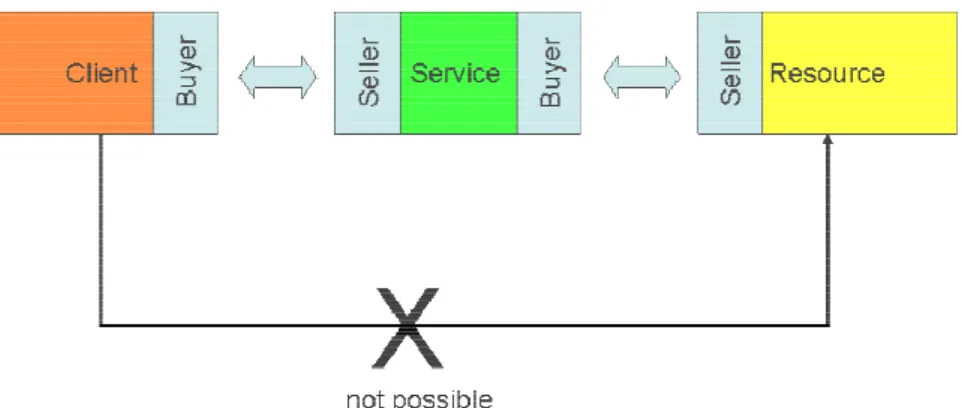
In our example, three types of market agents appear (see Figure 4): the client agents, the ser-vice instance agents and the resource agents (as embodiments of the hardware/network pro-vider). The market environment itself is not a solid object – it is a communication platform, implicitly realized by the network provider, communicating the effector actions of all other agents in the environment.
Figure 4: Interaction relations in the Service Market
x The Client is a computer program on a certain host, which needs access to a web service to fulfil its design objectives. It tries to access that service at an arbitrary location within the computer network, use it for a defined period, and then continues with its own pro-gram sequence. Client propro-grams run on a connected network resource, usually a personal computer. The business strategy of the client computes the fixed cost of purchasing a local copy of Adobe Distiller against the variable cost of using such available On-Demand ser-vices, multiplying the forecast number of uses with the access price. If the client user does not need to convert to PDF so often, it will rely on a certain price and availability level of the service provider and refrain from buying an expensive local copy; if the usage fre-quency is above a certain number, it is in total cheaper to buy that exclusive copy. In an environment where services have to be paid for access, the utility gain of clients is the dif-ference between their private value (of what the access is worth) and the actually paid
transaction price:
,
C
i i p
u
v
p
(1)x A Service is an instantiation of a general application function, embodied in a computer program. A Service Copy is an instance of the service; a resource computer, which pro-vides both storage space and bandwidth for the access of the service, hosts it. The business model of the service provider leads to set the access price so that the majority of clients decide to rely on the on-demand option. In theory, the price will be equal to the marginal cost of processing the penultimate access, which means that it is exactly so high that the consumer is undecided whether to buy the local copy or access the remote service
(pro-vided that both prognoses the same number of accesses in a given time span). If the ser-vice provider is able to distribute several instances (serser-vice copies) in the network, he might be able to sell each copy access for a different price, according to the time of day, the geography of the network or the willingness of clients to pay. Each redundant web Service Copy is thus a miniature business, like a retailer’s branch store. Like the clients, the service providers also have a private value for service access (sa) . In addition, there is private value for buying network resource access (ra) from the hosting node:
, ,SC sa sa ra ra
j p j p j
u
p
v
v
p
(2)x A Resource denotes a host computer, which provides a limited number of storage space and access bandwidth for service transmission. The network connections between the re-sources are simulated to be of equal length and thus of equal transmission time and costs. The resources and network owner (the network provider) allows service providers and cli-ents to communicate using cables, routers, gateways and other, hardware or software net-work layer instances. For the usage of these resources, he gains income from all partici-pants – the more participartici-pants, the more money can the network provider make. However, more participants means more traffic in the network, and above some level the traffic can get so extensive that the existing resources are no longer sufficient. However, if the di-mensioning of resources is too large, the income from the participants might not be high enough that the resource investment is economically justified. In the long run, the network provider will provide enough network resources for the average use, but will be vulner-able to usage spikes. These resources incur costs, and the network provider aims to fill these costs and to make profits by increasing the usage of the resources:
(3) , R k
u
p
v
p k Ru
Summing up all utility functions over the number of respective participants, the parameter Social welfare utility (SWF) measures how the aggregate of all the individual utility is maxi-mized. The equation thus can be written as
C SC
SWF i j k
U
¦
u
¦
u
¦
(4)After each successful trade, the sum of all utilities of all participants increases. A fictive final state would have maximum overall utility and is Pareto-optimal, which means that no single agent can propose a change that does not decrease any other’s utility. However, as ALN nodes appear and disappear dynamically, such a solid state may never be reached. Under the restric-tion of an imperfect knowledge situarestric-tion, a total optimal value of SWF can only be measured in hindsight.
4
Fundamental components in CATNETS
Application Layer Networks (ALN) encompass heterogeneous resources by a high number of geographically distributed devices and administrative domains, which are logically coupled together for providing processes on application level. This comprises both computational and data services.
We expect ALNs to be shaped by lots of basic services that can be dynamically combined to value-added complex services (like in Service-oriented architectures (Singh and Huhns 2005)). These basic services require a set of resources, which need to be co-allocated to pro-vide the necessary computing power (like in computational Grids). The orchestration and cus-tomization of these basic services and resources can be understood as an inherent service, that must be accomplished by the network as well, due to the complexity and the expertise re-quirements which must be hidden from the application.
We thus divide the playing field in two layers, the application layer and the resource layer. Layers, both in software (Bachmann, Bass et al. 2004) and networks (Tanenbaum 1996), al-low to hide complexity and to provide common interfaces at the vertical touching points. In these two layers, we contemplate three different roles, which are:
- complex services (application layer),
- basic services (application layer and resource layer) and
- resources (resource layer).
Application Layer Resource Layer Complex Service Basic Service Resource Application Layer Resource Layer Complex Service Basic Service Resource
Figure 5: Layered-view on ALNs
Basic services thus offer the interface to accessing computational resources for complex ser-vices, while hiding the orchestration and implementation details. In existing Grids, this more user-centered view is not needed, as the computation requests are already expressed in appro-priate semantics (in what we call the resource layer). In Service-oriented computing, users define complex business job requirements, which are then broken up into collections or se-quences of basic services that together provide the desired functionality.
In both layers, the participants similarly have various objectives, tasks, strategies and demand patterns, which might change dynamically and unpredicted during life time. Traditional ap-proaches, using centralized policies require complete state information which is not available in dynamic and complex networks (Krauter, Buyya et al. 2001). As an acceptable system-wide performance matrix is impossible to define, we use an economics-based paradigm for the management or resource allocation and orchestration (Buyya 2002).
The economics-based paradigm is derived from human economies, where decentralisation and heterogeneity are successfully managed. These models, when involving decentralized deci-sion-making, are based on exchanging and acting on price signals. The participants work for their own utility; thus, they evaluate the signals received and act according to some utility function, which predicts an utility increase out of the effect of that action. On a system-wide
scale, a bird's eye view on such market dynamics shows continuous matching of demand and supply, a case of emergent coordination. If trying to deliberately construct such automated markets, we are searching for coordination mechanisms, which take the dynamicity of the market into account.
This section will provide a detailed presentation of the market models, which are understood as fundamental components for the Catallaxy Realisation. Two different market approaches are compared, the baseline and the Catallactic market. The baseline market is a centralized market with one centralized matchmaker. This instance tries to fulfil all clients’ requests by matching providers’ offers with clients’ requests (see D1.1). A completely decentralized mar-ket is the Catallactic marmar-ket. In this marmar-ket there is no central matchmaker, the clients negoti-ate with the services directly, abstaining from global knowledge.
Both markets are two stage markets. One market is contemplated as a service market, a client (complex service) requests a set of basic services to achieve the desired functionality. The other market is a resource market. On this market the basic service buys and co-allocates the required resources, which allow it to deliver its own part of the required service functionality. For a circumstantial comprehension of the markets, the terms used are definable as:
Complex Service: (Former client in CatNet.v1) A modular software application which needs a set of basic service capabilities for fulfilling its goals.
Complex Service Logic: Translates the requirements of a complex service to a set or se-quence of modular basic services.
Basic Service: A module includable in a complex service.
Basic Service Logic: Translates basic service (depending on the multi-attributive require-ments of the clients) in resource policy.
Co-Allocator: Tries to accomplish resource policy, obtained from Basic Service Logic. Pol-icy can be split to several Local Resource Managers.
Local Resource Manager (equals manageable entity): Manageable interface to Resources, which hides resources hardware (low level) details.
Resource: Low level resources can be obtained by Local Resource Managers.
In the remainder of this section, we compare our market model with existing implementations in our own assessment project CATNET, Bittorrent, PlanetLab, and Coral. The purpose is to nearer specify what functionality and what components need to be placed in the particular participating objects.
4.1 Market Model
Current Grid Computing architectures exhibit fairly static resource infrastructure which is connected by physical stable links (e.g. enterprise grid). The shift to a pervasive grid, that could exist ubiquitously, demands for a more dynamic consideration of resources and
connec-tions. In CatNet.v1 the used market model addressed grids with a comparably static resource infrastructure. An overview of the market is shown in Figure 6. The Client requests a service transaction and inquires the available service copies for an offer. These copies will after re-ception of the request try to contract the resources on their current resource node to be able to offer the service. If resources are available and contractable, the service copies begin to nego-tiate with theclient. This is an m:n:1 relationship. The client and the service copy negotiate in an m:n market, as services are available for everybody and clients could contact all service copies. Service copies could fail. Possible reasons for failure can be software updates or loss of connectivity.
Service Copy and Resource build an n:1 relation, as only local resources can be contacted. This is contemplated as the second market.Clients request demands in random time intervals, set by the simulation environment. The service copy could be understood as business process to be included in application software on the client side.
Client m n Service Copy Service Copy first market Service Copy Resource Node Resource Node 1 second market AService Copy only can buy a fixed resource bundle from the node she is located on.
Figure 6. Market model of predecessor CatNet.v1
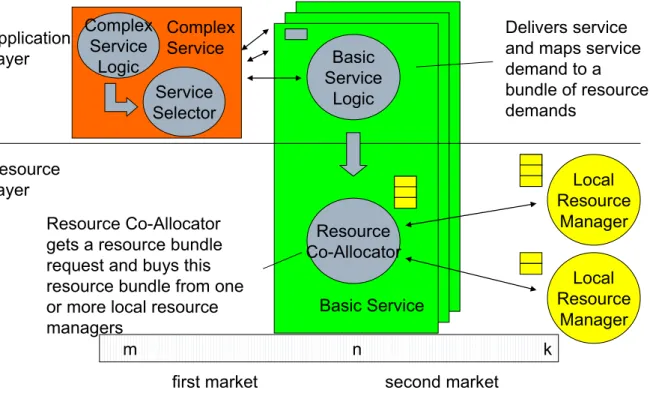
CATNETS extends the CatNet.v1 market to a complete two stage market, to match dynamic-ity of application areas in future grid technologies (Figure 7). The market is understood as a decentralized control mechanism for services and resources. To satisfy the needs of future application domains in grid and peer-to-peer networks, several alterations to the primary model are proposed:
The client is replaced by a complex service, and could be represented by a modular software application which needs (remote) basic service capabilities for execution. The intention be-hind this perception is that the client and the complex service are shielded from the details on the resource layer and site. Ideally, both only interact with the basic services which are lo-cated in the system. Resources are not visible for them at any time. The complex service con-tains a service selector instance that selects and contracts the basic service.
Thebasic service is split in the basic service logic and a resource allocator. The logic is able to negotiate with the complex service and to translate the requirements for service execution in a resource specification (e.g. CPU, storage and quality of service requirements, etc.).
The resource allocator gets the resource specification and broadcasts the respective demand to the local resource managers. This comprises bundles and co-allocative negotiations. Bun-dles are understood as an n-tupel of resource types (e.g. CPU, storage, and bandwidth); co-allocation describes obtaining resources for one single service transaction from various local resource managers at the same time. Local resource/job scheduling is not in the focus of the project and will not be further analyzed: The local resource manager hides all details of the allocation.
On the first market,complex service and basic service negotiate, whereascomplex service acts as a buyer, the basic service as a seller agent. The same market roles can be found at the re-source layer, the rere-source allocator is the buyer agent, the local resource manager acts as seller agent.
Contemplating the second market, it is extended to a n to k market: n service copies can bar-gain with k resource services to fulfil their service demands. This takes dynamic resources into account. Resources are in our view entities that can fail like basic services which are sub-ject to maintenance and inspection procedures or link failures.
Complex Service Logic Local Resource Manager m n k Basic Service Logic Resource Co-Allocator Local Resource Manager
first market second market Application Layer Resource Layer Basic Service Resource Co-Allocator
gets a resource bundle request and buys this resource bundle from one or more local resource managers
Delivers service and maps service demand to a bundle of resource demands Service Selector Complex Service
Figure 7. CATNETS market model
In CATNETS, a deviating scenario is possible. In prevailing grid applications, the application layer is not considered in particular; both markets are located on resource layer. The transla-tion to resource specificatransla-tions is done on the complex service logic that maps its own resource demands to a resource selector, which buys resources from different resource allocation in-stances. Figure 8 shows this model as an alternative to the generic CATNETS market model.
Complex Service Logic Local Resource Manager m n k Resource Allocator Local Resource Manager
first market second market Application Layer Resource Layer Resource Selector Resource Allocator Complex Service
Figure 8. Alternative CATNETS market model
This model includes certain drawbacks concerning complexity on the client side. It is pre-sumed, that the client/complex services owns knowledge about the translation process form his demands to resources. In the upper model the knowledge is split and sourced out to the network of basic services, which allows reducing complexity and performance claims from clients, which gives the opportunity to model light-weighted clients (like mobile phones, PDAs).
CS
SS
BS
5
4
3
2
1
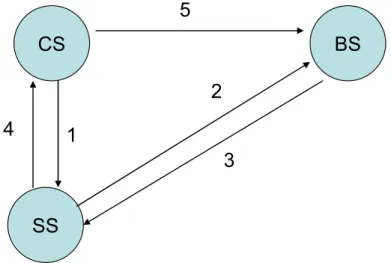
Figure 9. Execution of a service transaction as a high-level sequence diagram
Figure 9 depicts the general sequence of how to deploy a service. The complex service (CS) sends a requestBasicService to the Service Selector (SS), which contacts all discovered and available basic service instances in an asynchronous communication (step 1). The Basic Ser-vice initiates the negotiation process (steps 2 and 3) if it can contract a resource bundle for service completion. The Service Selector informs the complex service on which service can used for execution of his job (step 4). In step 5 the CS uses the BS according to the services delivered by the SS.
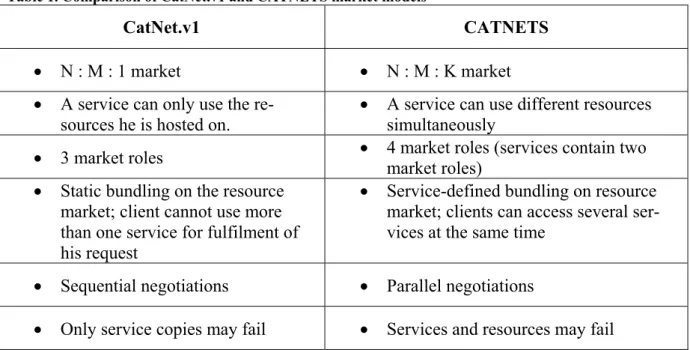
Summing up, CatNet.v1 and CATNETS can be compared like presented in Table 1. Table 1. Comparison of CatNet.v1 and CATNETS market models
CatNet.v1 CATNETS
x N : M : 1 market x N : M : K market x A service can only use the
re-sources he is hosted on.
x A service can use different resources simultaneously
x 3 market roles x 4 market roles (services contain two market roles)
x Static bundling on the resource market; client cannot use more than one service for fulfilment of his request
x Service-defined bundling on resource market; clients can access several ser-vices at the same time
x Sequential negotiations x Parallel negotiations
x Only service copies may fail x Services and resources may fail
4.2 Components
Within the market model every participant has a distinct role. Figure 10 depicts the relevant use cases of these roles. All roles will be described in the following section.
x The CS offers itself to the client (offerComplexService) which is outside of our focus, so it does not exist in the diagram.
x For job completion the CS requests a BS (requestBasicService). The request is gener-ated by the complex service logic which knows which types of basic services are nec-essary for execution (selectBasicService). This SS is exclusively activated when there is a request received and is similar to a bill explosion in logistics.
x SelectBasicService is called by the Service Selector. The Service Selector successively calls a search algorithm (searchService), a rankItemList procedure, a bilateral negotia-tion procedure (negotiateItem) and after each successful transaction a clearing method (doClearing). The search should deliver all available basic services which could pro-vide the desired service (searchService). This list is thereafter sorted by the ranking process (rankItemList). The service selector will then initiate the negotiation with the listed services in the ranked order and his expected service-dependant utility increase (negotiateItem).
x The basic service logic, building the opponent in the first market, offers a basic service (offerBasicService) and uses the same negotiation procedure like the service selector. Note, that there is no advertising possible, thus this is a demand driven market.
For offering a basic service, the basic service logic needs to contract the required resources (on resource layer). This translation request can be done in advance, during negotiation and after the contract with the complex service.
1. Contracting resources in advance requires a calculated forecast for the future de-mand (Buyya 2002). For a centralized allocation mechanism this might be suitable as demand and supply fluctuations can be absorbed over the whole network. In de-centralized decision-makers, this is quite a complex task, as demand and supply can change rapidly, and the decision-makers will not be able to anticipate this situation by their local knowledge. Therefore, they will be exposed to a higher risk of bankruptcy.
2. Contracting resources after closing the service contract might lead to insufficient resource offers on the resource market and thus to unaccomplishable contracts. Economically considered, this leads to high risks in reputation on the market. 3. Contracting the resources during negotiation is considered as best suited. Before
giving a first proposal to the opponent, the negotiation is delayed and a contract is trying to be accomplished with several local resource managers. This has the in-herent advantage, that supply changes in the resource market can be transferred immediately to the service market. This reduces risks for the basic service and bal-ances both markets. If there are not sufficient resources available, the basic service needs to contract resources for a higher price and claims that surplus in the ongo-ing negotiation from the complex service.
We will focus on possibility 3, as it seems to be beneficial.
x For service execution the basic service logic requests a resource bundle ( request-ResourceBundle). The further process of contracting/allocating the resource is done by the resource co-allocator. The selection of a resource bundle is done analogous to the selection of a service, with the exception, that a bundle is re-quested (selectResourceBundle), whereas on service market only one service can be negotiated per request.
x The local resource managers offer resource bundles (offerResource). The resource bundle could be a tuple consisting of bandwith, CPU, and storage. The manager is the seller agent of the resource market, having the ability to negotiate with the re-source allocator (negotiateItem). The negotiation is also initiated by the resource co-allocator.
x Finally, the clearing is invoked by the seller or buyer side of the markets ( doClear-ing). The decision on this fact is unimportant, due to the fact that the modelled agents are benevolent.
EU-IST Project IST-FP6-003769 CATNETS CATNETS - Ev aluation of th e C atallax y par adig m for decentr alized op eration of d y namic app lication n - 24 - L o ca l R e s o u rce M a n a g e r m p le x S e rv ic e L o g ic Ba s ic S e rv ic e L o g ic Re s o ur c e C o -A llo re q u e s tB a s ic S e rv ic e tr a n s fo rm R e q u e s tT o Re s o u rc e s o ffe rR e s o u rc e o ff e rB a s ic S e rv ic e req u e st R e s o u rc e B u n d le se le c tR e so u rc e B u n d le se le c tB a si c S erv ic e o ff e rC o m p lex S e rv ic e ran k It e m lis t ne g o ti a te It e m rv ic e S e le c to r sea rc h It em searc h S erv ic e se arch R es o u rc e «e xt e n d » do C le a ri n g «e xt e n d » «e xt e n d » «e xt e n d » «e xt e n d » «e xt e n d » «e xt e n d » «e xt e n d » «a cc e ss » «a cc e ss » «a cc e ss » « a cce ss » case diagr am of the ser vice acquisiti on pr ocess
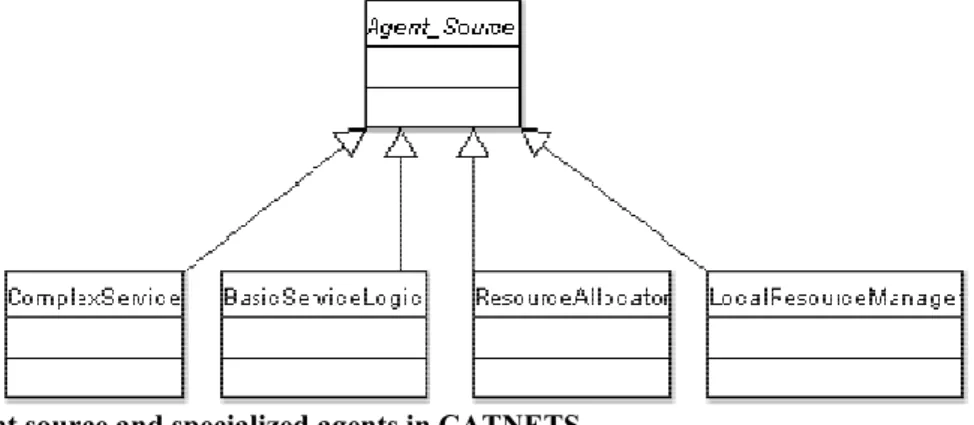
Every player in the market can be modelled as a software agent. The players get their basic functionality (communication, learning algorithms, strategies etc.) from an agent source ab-stract class. In Figure 11 the service agents contains the buyer and the seller. The specializa-tion and concrete implementaspecializa-tion of the agent source is done in the derived components’ classes.
Figure 11. Agent source and specialized agents in CATNETS
The basic service and the resource allocator are modelled as separate agents, as the complex-ity should be reduced. Both will need a special interface to exchange their transformation specification (prices, market development, etc.) from service supply to resource demand.
4.3 Lifecycle of Agents
Initialisation Selleragent Buyeragent Information Matching Execution Negotiation Evaluation Identification of Demand Offer service/ resource Search and Selection Send Information/ Reputation Negotiate usage conditions Negotiate usage conditions Payment and Usage Provisioning Exchange evaluation Exchange evaluation Transaction phasesFigure 12. Lifecycle of agents
This section presents a general model of transaction phases and the mappings of this model to the buyer and seller agents. The lifecycle starts with an initialisation phase, which is split into an information subphase and a matching subphase.
x The initialisation phase prepares the agents for the proceeding negotiation phase. In the information phase the buyer agents (resource co-allocator and complex service) try to identify the demand. The seller side (basic service and local resource manager) of-fers his selling items.
x The matching brings together the buyer and seller agent. The buyer agent initiates this process after specification of his demands. Seller agents can support the buyer agents with additional information of the service or their reputation.
x A parallel, bilateral exchange of information between buyer and seller agents shapes the negotiation phase. The usage conditions between seller and buyer agents are multi-attributive items (like basic service on the first market and resource bundles on the second market).
x The execution phase contains deployment and clearing of the contracted service, which the seller agent delivers on demand. Often the evaluation phase is omitted and the process begins again.
x In CATNETS, the evaluation phase analyzes the business relationship between the buyer and seller. Information about evaluation is exchanged between them. This in-formation is used to optimize the next business relation ship between a seller and buyer agent.
4.4 Interactions between market participants
The sections above gave a short overview over the interaction of the market participants. Here we will present a deeper insight of these interactions and classify them into the widely ac-cepted taxonomies of grid economics literature.
There are several generic models to shape the negotiation behaviour of the agents. A general framework is presented in (Buyya 2002).
- Commodity markets,
- Posted Price model,
- Bargaining model,
- tender/contract-net model,
- auction model,
- bit-based proportional resource sharing,
- Community/coalition/bartering/share holders model and
- monopoly/oligopoly etc.
In our decentralized architecture an iterative bilateral negotiation protocol, similar to a con-tract-net, is used because we have a state of incomplete information. Both agents approximate to the trade-off point in iterative steps exchanging offers and counter-offers. This process is described as monotonic concession protocol (Rosenschein and Zlotkin 1994).
A preliminary model of our protocol is shown in Figure 13. For clarity, the basic service is split in its buyer and seller side – basic service login (seller side) and resource co-allocator (buyer side).
The complex service requests a basic service, according to his process demand. The basic service translates this request to resource layer and the resource co-allocator and starts the negotiation with several local resource managers. The local resource manager analyses the request and creates an offer and this process iterates until an agreement (accept) or reject is
reached. If an accept is reached, the resource allocator confirms and informs the basic service about the contracted resources. The basic service continues the negotiation with the complex service, using the information from contracting the resources. The negotiation on resource layer is processed only once. It is impossible to renegotiate a resource contract. The resuming negotiation with the complex service uses the same negotiation protocol and after an accept the payment process is initiated which pays the basic service and the resource. A reject on the service market will lead to a reject ton the resource market.
/ ResourceCoAllocator / LocalResourceManager / BasicService / ComplexS ervice 1 : \request / cfp\ 2 : \translateRequest\ 3 : \request / cfp\ 4 : \bargain\ 5 : \propose / reject\ 6 : \bargain\ 7 : \propose / reject\ 8 : \accept\ 9 : \confirm\ 10 : \inform\ 11 : \propose\ 12 : \bargain\ 13 : \propose / reject\ 14 : \bargain\ 15 : \propose / reject\ 16 : \bargain\ 17 : \accept\ 18 : \confirm\ 19 : \invokeS ervice / pay\
20 : \pay\
4.5 Additional conditions for Catallaxy realisation
For the realisation of the Catallaxy paradigm several additional conditions have to be imple-mented in the decentralized CATNETS architecture.
The preceding service discovery phase can be discussed and implemented separately, depend-ing on the application concerns. Discovery is necessarily required to initiate the match-ing/negotiation procedure and therefore must deliver sufficient service offers to allow a selec-tion between those items. However, it does not necessarily involve
Considering the preparation and calculation of price proposals, a negotiation module is re-quired that constitutes the interface between internal perception of the environment and the surrounding (sensor and effector). These negotiation strategies need to use learning mecha-nisms, to react to changes in the environment and to implement a method that adapts to the behaviour of the surrounding agents.
4.5.1 Service discovery
The main project interest is the service selection process. However, a successful search, deliv-ering an (unsorted) list of suitable services, is a necessary precondition for the sorting and selection process. This is implied by the effect, that clients lack global, persistent knowledge about the system’s states in a dynamic surrounding and whether a suitable service/resource exists and is still alive/available for consumption.
Implementing a central catalogue for service discovery, like shown in common web search machines (e.g. Google) or former file sharing systems (Napster etc.) is contemplated as an essential obstacle for a decentralized operation of dynamic application networks and counter-productive for the evaluation, as this implies misallocations resulting form the discovery process. Thus, solely decentralized discovery mechanisms are accounted for evaluation.
4.5.1.1 Unstructured discovery
The simplest decentralized search method is using an unstructured flooding mechanism (Gnutella 2000, Karl Aberer, Magdalena Punceva, Manfred Hauswirth and Roman Schmidt, Improving Data Access in P2P Systems, Matei Ripeanu (Ripeanu 2001), Peer-to-Peer Archi-tecture Case Study: Gnutella Network). Flooding works under the assumption of a nodes’ neighbour relations. Queries are not transmitted to a central catalogue, but instead distributed among the peers: A search request is forwarded to all neighbours and all neighbours behave respectively (Figure 14). This flooding is limited by a time-to-live parameter (TTL) that re-stricts an infinite search. Every node, storing the required item, send a list of all content matching the query to the originating node the same way back and waits for a direct download request by him. Gnutella uses this unstructured overlay network in that the topology of the overlay network and the placement of the resources (files) is largely unconstrained.
Peer Request Initiator Peer Peer Peer Peer Request Messages Service Provision
Figure 14. Decentralized Service Discovery in Gnutella
Obviously, the load of each node grows linearly with the total number of queries, which grows with system size. So, this approach is not scalable. It implies that elevated network traffic has to be accepted under the constraint, that an existing service is not reliably discov-ered in large diameter networks, due to the time-to-live parameter and the decreased search space. Several improvements have been made to increase the search behaviour of the flooding mechanism, and delimit the network consumption of the algorithm. The improvements are mainly developed to reduce the message emergence, like e.g. k-random walker search, adap-tive TTL, one hop replication etc.
For example, the GIA algorithm combines some innovations to P2P systems:
- A dynamic topology adaptation protocol, that aligns nodes in short reach of high capacity nodes,
- one hop replication of data pointers, so all neighbours maintain pointers to the content offered by their immediate neighbours,
- an active flow control, to abandon overloaded hot-spots,
- a search protocol, that is based on biased random walks, directing queries to to-wards high capacity nodes.
Simulations showed that these improvements provide a three to five orders of magnitude in the total capacity of the system and retains robustness to failures. A distinguished melioration of the flooding mechanism is the percolation search algorithm described in (Sarshar, Boykin et al. 2004), which limits the search messages by concentrating on highly connected nodes and building request-individual internal hierarchies in the (power-law) service network. The percolation search algorithm consists of
(i) Content Caching: An initial replication of a node’s content list or directory in the random walk visited nodes,
(ii) Query Implantation: A query first executes a short random walk and implants its query request on the visited nodes and
(iii) Bond Percolation: A probabilistic broadcast scheme for propagating queries. Percolation simulation results showed, that unstructured P2P networks can be made scalable. Following Gnutella’s lead, other decentralized (file sharing) systems have become popular. KaZaA is using FastTrack, which adopts supernodes that have higher bandwidth and
connec-tivity. Associated supernodes contain pointers to the content of the peers and each search re-quest is forwarded from the peers to the supernodes. Only between the supernodes the flood-ing mechanism is implemented. This approach appears to offer better scalflood-ing performance; however, its scalability in comparison to Gnutella has neither been analyzed nor measured (Making Gnutella-like P2P Systems Scalable).
4.5.1.2 Structured discovery
In contrast to unstructured overlay networks, structured search algorithms promise a guaran-teed item discovery and a reduced message emergence. The usage of distributed hash tables (DHTs) in CHORD (Balakrishnan, Kaashoek et al. 2003), CAN (Ratnasamy, Francis et al. 2001), Pastry (Rowstron and Druschel 2001), TAPESTRY (Zhao, Kubiatowicz et al. 2001), VICEROY (Malkhi, Naor et al. 2002) offers a guaranteed search and distribute the search process to the connected nodes in the network. The search does not rely on random search behaviour in the network but calculates the closest known node on the straight way to the re-quested service instance. Thus, a performance of O(log N) can be guaranteed, which improves Gnutella’s performance of O(n) (Chawathe, Ratnasamy et al. 2003).
Distributed Hash Tables (DHTs) are a class of systems that provide "hash-table like semantics at Internet scale”. The original rationale was to provide a scalable replacement for not scalable Gnutella-like file sharing systems. In recent years a lot of research has been done on these DHTs. All of these proposals are structured overlay networks, where both data placement and overlay topology are completely controlled.
For unstructured networks, churn does not cause big problems as long as it is not discon-nected by all of its neighbours. A peer can then re-run the bootstrap algorithm, to replace it-self to reconnect to the system and a new location. DHTs, in contrast, are highly vulnerable to churn, that causes significant overhead: Most DHTs require O(log n) repair operations after each failure. Unpredicted failures, where peers cannot inform the network about that expected breakdown, require even more time to discover the failure and replicate lost data and pointers. Anticipating a high churn rate, the overhead caused by the repair operations of the DHTs can easily overwhelm low-bandwidth nodes (Chawathe, Ratnasamy et al. 2003).
Existing networks show complex network characteristics and tolerance to node deletions (Ripeanu, Foster et al. 2002; Saroiu, Gummadi et al. 2002). However, client-based protocols that guarantee the global emergence of scale-free networks with tuneable properties have not been implemented.
4.5.1.3 Evaluation
For the selection of a search algorithm, CATNETS related criteria have to be taken in special consideration. Scalability, simulation ability and applicability for dynamic networks have to be taken into account as both simulation and prototype should behave the same in service dis-covery to exclusively measure the effect on service selection. However, DHTs lack scalability in dynamic networks, as state changes (e.g. churns) lead to high overhead and might influence the simulation behaviour considerably. They are expected to burden the execution process of the simulation in an unacceptable and unpredictable manner and thus cannot be favoured for implementation in CATNETS, as they constitute a risk for the project goals. Contrariwise, newer, revised flooding algorithms (GIA, Percolation Search) in unstructured overlay net-works are under development and offer a scalable and easy implementable mechanism, abdi-cating the performance losing risks of DHTs.