Strategic Plan Goal: 1
Promote educational excellence through the preparation and certification of professional educators
♦ Sustain high quality standards for the preparation and performance of professional educators and for the accreditation of credential programs
November 2011
5A
Action
Professional Services Committee
Annual Report on Teacher Development Programs:
Paraprofessional Teacher Training Program and Alternative
Pathway to Certification (Intern) Program
Executive Summary:
This agenda item presents
the 2010-11 report to the Legislature on the
Paraprofessional Teacher Training Program and
also provides information on the Alternative
Pathway to Certification (Intern) Program.
Recommended Action:
Staff recommends
approval of the Paraprofessional Teacher Training
Program Report for transmittal to the Legislature.
Presenters:
Marilynn Fairgood, Consultant, and
Nadine Noelting, Administrator, Professional
Services Division
PSC 5A-1
Annual Report on Teacher Development Programs:
Paraprofessional Teacher Training Program and
Alternative Pathway to Certification (Intern) Program
Introduction
The Commission on Teacher Credentialing (Commission) oversees two teacher development programs that share common goals of assuring quality preservice preparation and improving access to the teaching profession. Staff annually report on the progress of these two programs to the Commission. In the past these programs have had stable per participant funding; however, in the 2008-09 budget year Local Education Agencies (LEAs) were given flexibility in how they fund the programs. Staff continues to try to collect information about the programs even though there are no longer any state requirements for programs to report expenditures or information on participants to the Commission.
This agenda item will present two separate reports: one is the mandated report to the Legislature on the Paraprofessional Teacher Training Program (PTTP), a report which requires Commission approval for transmittal (Appendix A); the other is an update on the Alternative Pathway to Certification Program (Intern Program) for 2010-2011 (Appendix B) for Commission information only.
Background
Both the Paraprofessional Teacher Training Program and the Intern Program are important options for professional development and of guided/mentored teaching experiences for an individual who wants to start a career as a credentialed teacher in California public schools. A brief description of each program and its role within the Learning to Teach Continuum follows. • The Paraprofessional Teacher Training Program
This program offers public school paraprofessionals (including teacher aides, teacher assistants, and others) the opportunity to complete their undergraduate education and enter a teacher preparation program upon earning a bachelor’s degree. State funding of $3,500 per year was previously provided for each program participant. However, as part of the revised 2008-09 budget, the Governor and the Legislature changed how funds for General Fund Proposition 98 programs were allocated for the program. The allocation is no longer a per participant allocation, but rather part of a block grant in which the LEA has flexibility in how funds are used. Typically, participants receive support from their LEAs for tuition, fees, books and related educational expenses. Participants completing the program must teach in a public school setting for the same number of years as they received support in the program or they must pay back the funds used. Many participants choose to enter the Intern program after completing the bachelor’s degree in order to complete their teacher preparation and earn a preliminary California teaching credential. The PTTP has been operating since 1995.
PSC 5A-2
•
The Alternative Pathway to Certification (Intern) ProgramThe Intern Credential was established in 1967, and the funding for the programs implementing this alternative route to a credential was established in 1993. Intern Programs are operated by districts and by universities which have applied to the Commission for approval to operate the program. Candidates must demonstrate subject matter competence for a specific credential prior to participation in a Commission-approved District or University Internship program, and must complete at least 120 hours of preservice preparation before they are issued an intern credential to work in a classroom. Through the 2007-08 school year, state funding of $2,500 per participant was provided to sponsors of qualified programs, and an additional $1,000 was given for “enhanced” programs that met certain program standards (i.e., for programs offering an additional 40 hours of English learner preservice training plus an additional 40 hours of site-based support, and for programs which did not concentrate interns in the lower decile schools). As with the Paraprofessional Program, the Governor and the Legislature changed how funds for General Fund Proposition 98 programs were allocated in 2008-2009. The allocation is no longer a per participant allocation, but rather part of a block grant with local flexibility.
Funding and Participation
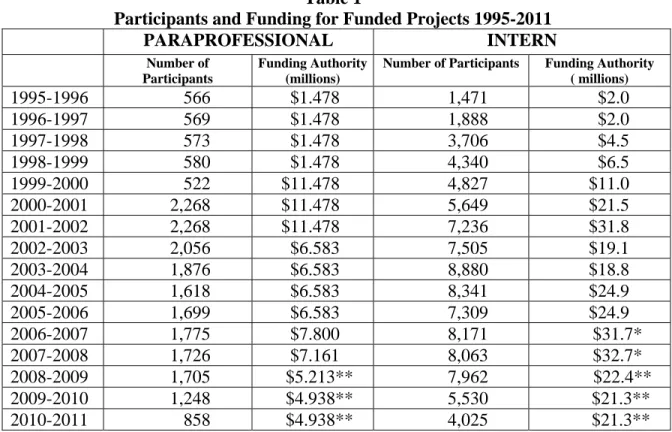
Table 1 provides an overview of the number of participants and the funding status for each of the programs from 1995 to 2011, while Table 2 provides a summary overview of the program legislation, program status and participation over time.
Table 1
Participants and Funding for Funded Projects 1995-2011
PARAPROFESSIONAL INTERN
Number of Participants
Funding Authority (millions)
Number of Participants Funding Authority ( millions) 1995-1996 566 $1.478 1,471 $2.0 1996-1997 569 $1.478 1,888 $2.0 1997-1998 573 $1.478 3,706 $4.5 1998-1999 580 $1.478 4,340 $6.5 1999-2000 522 $11.478 4,827 $11.0 2000-2001 2,268 $11.478 5,649 $21.5 2001-2002 2,268 $11.478 7,236 $31.8 2002-2003 2,056 $6.583 7,505 $19.1 2003-2004 1,876 $6.583 8,880 $18.8 2004-2005 1,618 $6.583 8,341 $24.9 2005-2006 1,699 $6.583 7,309 $24.9 2006-2007 1,775 $7.800 8,171 $31.7* 2007-2008 1,726 $7.161 8,063 $32.7* 2008-2009 1,705 $5.213** 7,962 $22.4** 2009-2010 1,248 $4.938** 5,530 $21.3** 2010-2011 858 $4.938** 4,025 $21.3**
*Includes monies for enhanced participants added by SB 1209 (Chap. 517, Stats. 2006).
PSC 5A-3 Table 2
Overview of Funded Projects 2009-2010
Paraprofessional Intern Authorizing Legislation SB 1636 (Roberti) Statutes of 1990 AB 1161 (Quackenbush) Statutes of 1993 Authorizing Statute 44390-44393 44380-44386 Number of Years in Operation 16 17 Number of Projects 22 68
(includes 8 District Intern Programs) Number of Participants 858 4,025 Amount of Funding Per Participant 2010-2011
Variable – became Tier III program with funding flexibility. Prior to flexibility, funding was $3,500 per participant.
Variable – became Tier III program with funding flexibility.
Prior to flexibility, funding was $2,500 (regular) or $3,500 (enhanced) per participant depending on the program provided.
Program Goals/Target Participants
• Create local career ladders to enable school
paraprofessionals to become certificated classroom teachers.
• Respond to teacher shortages and improve instructional services to paraprofessionals. • Diversify the teaching
profession.
• Meet shortage needs of districts. • Attract non-traditional students,
including career changers.
• Provide a teacher preparation option that blends theory with practice and offers cohort, district and program support.
Recommendation
Staff recommends the approval of the California School Paraprofessional Teacher Training Program, An Annual Report to the Legislature as Required by SB 1636 (Chap. 1444, Stats. 1990), for transmittal to the Legislature. The report is provided as Appendix A.
Appendix A
California School Paraprofessional Teacher
Training Program
An Annual Report to the Legislature as Required
by SB 1636 (Chap. 1444, Stats. 1990)
This report was developed by Marilynn Fairgood of the Professional Services Division of the Commission on Teacher Credentialing. For more information about the content of this report, contact [email protected].
December 2011
This report, like other publications of the Commission on Teacher Credentialing, is not copyrighted. It may be reproduced in the public interest, but proper attribution is requested.
Commission on Teacher Credentialing 1900 Capitol Avenue
Sacramento, California 95811 (888) 921-2682 (toll free)
This report is available at http://www.ctc.ca.gov
Commission on Teacher Credentialing
1900 Capitol Avenue Sacramento, CA 95811
(916) 445-0184 Mary Vixie Sandy Executive Director
Blackburn, Constance Teacher Representative 2012 Casallas, Erick Cooney, C. Michael Teacher Representative Public Representative 2013 2013 Cuevas, Eddie Teacher Representative 2015 Darling-Hammond,
Linda
Faculty Member 2015
Evans, Marlon Public Representative 2012
Gahagan, Charles Teacher Representative 2013
Harris, Kathleen Teacher Representative 2013
Hinde, Alicia Teacher Representative 2012
McInerney, Carolyn School Board Member 2012 Oropeza-Enriquez, Irene Ramirez, Nancy Administrative Services Representative Public Representative 2011 2013 Stymeist, Louise Non-Administrative Services
Credential Representative
2015
Sun, Ting Public Representative 2011 Zeiger, Richard Zumot, Michelle Designees, Superintendent of Public Instruction Ongoing Ex-Officio Members
Martin, Shane Association of Independent California Colleges and Universities
Perry, Janis California Postsecondary Education Commission Sloan, Tine University of California
California School Paraprofessional Teacher Training Program
An Annual Report to the Legislature
2011
Table of Contents
Executive Summary ...1
I. Program Description ...2
II. Program Funding History ...3
III. Program Outcomes ...4
IV. Program Policy Issues ...5
A. Increased Cost Pressures ...5
B. Classified and Certificated Personnel Layoffs ...6
C. Effects of Public Education Policy ...7
D. Reimbursement Requirement ...10
V. Participant Demographics and Local Program Funding A. Number, Ethnicity and Economic Status of Paraprofessionals Recruited ...11
B. Economic Status of Participants ...11
C. Program Funding Levels ...12
D. Academic Progress of Participating School Paraprofessionals ...14
E. Meeting the Demand for Bilingual and Special Education Teachers ...14
F. Numbers of Program Graduates and Service ...15
VI. Degree to Which the Paraprofessional Teacher Training Program Can Meet Teacher Demand ...16
Appendix
Appendix A: Program Sites………...17The California School Paraprofessional Teacher Training Program:
A Report to the Legislature
Executive Summary
The primary purpose of the California School Paraprofessional Teacher Training Program (PTTP) is to create local career ladders that enable school paraprofessionals – including teacher assistants, library-media aides, and instructional assistants – to become certificated classroom teachers in K-12 public schools. This pathway to teaching program was established in 1990 by Chapter 1444 of the Statutes of 1990 (SB 1690, Roberti), which added sections 69619 to 69619.3 to the State Education Code. The PTTP program was subsequently expanded by Chapters 737 and 831 of the Statutes of 1997 (The Wildman-Keeley-Solis Exemplary Teaching Training Act of 1997), which added sections 44390 to 44393 to the State Education Code. Chapter 554 of the Statutes of 2007 (SB 193, Scott) was signed into law in October 2007. SB 193 amended the law, which now includes a mandate for common entry and participation criteria for new PTTP participants.
Section 44393 of the Education Code requires the Commission on Teacher Credentialing (Commission) to report to the Legislature regarding the status of the California School Paraprofessional Teacher Training Program. This report fulfills the Commission’s requirement to report to the Legislature the following information:
• the number of paraprofessionals recruited;
• the academic progress of participating school paraprofessionals;
• the number of paraprofessionals recruited who are subsequently employed as teachers in the public schools;
• the degree to which the program meets the demand for bilingual and special education teachers as well as meeting teacher needs in shortage areas as determined by the school district or county office of education;
• the degree to which the program or similar programs can meet the demand if properly funded and executed; and
• other effects of the program on the operation of the public schools.
• This report also includes the economic status of participants the number of paraprofessionals recruited who are fully credentialed;
• the degree to which the program or similar programs can meet the demand if properly funded and executed; and
• other effects of the program on the operation of the public schools.
In summary, the PTTP continues to meet mandates included in law. The 2009-2010 program realized a reduction in the number of statewide programs and participants but still includes the participation of 22 local programs that support 858 participants at some funding level. As of summer 2011, the PTTP has produced a total of 2,175 fully-credentialed program graduates.
The California School Paraprofessional Teacher Training Program
I. Description of the California School Paraprofessional Teacher Training ProgramThe California School Paraprofessional Teacher Training Program (PTTP) provides academic scholarships and other related academic support services to individuals recruited from paraprofessional job classifications, seeking a preliminary California teaching credential as a K-12 teacher (with special emphasis on individuals seeking to become a bilingual, special education, K-3 teacher, or a teacher in another field of identified district need). PTTP programs are sponsored by local school districts, county offices of education and/or consortia that apply to the Commission for program funding based on a competitive grant application process. Participating districts are responsible for local efforts in terms of recruiting and enrolling participants in the program, monitoring the progress of participants in accordance with each participant’s individual education plan, providing supplementary academic support services as needed by participants, assigning mentors or “buddies” to facilitate continued progress and expending state program funds in support of participants’ certification goals. Participants do not directly receive program funds. Instead, the program sponsor expends state program funds on behalf of the participants for the tuition, fees, books and other services at an institution of higher education (IHE) while the participant is completing his/her education and/or teaching credential preparation.
Senate Bill 193 and Common Program Entry Requirements
In October 2007, Senate Bill 193 (Scott) was signed into law and became effective January 1, 2008. The bill includes, among other things, common program entry requirements for new PTTP participants that mirror the paraprofessional employment criteria included in the No Child Left Behind Act. Prior to participation in the PTTP, participants must provide verification of: possession of an associate or higher level degree or, completion of at least two years of study at a postsecondary education institution or, a passing score on a formal academic assessment, based upon a job analysis for validity purposes, that demonstrates knowledge of, and the ability to assist in the instruction of reading, writing, and mathematics. Additionally, SB 193 requires that new PTTP participants must obtain a Certificate of Clearance prior to participation in the program. This character and identification clearance is the same clearance that is required for student teachers and other certificated staff prior to working with children in the public schools. Typical Certification Path for PTTP Participants
The typical certification path for a PTTP participant is to be accepted into the PTTP, complete degree and subject matter requirements and complete an internship program which culminates in full teacher certification. The PTTP graduate would then enter the Beginning Teacher Support and Assessment (BTSA) program to complete an induction program that builds upon the skills of the newly credentialed teacher and supports him/her through the first two years of certificated employment. Twenty-nine out of 32 program sponsors not only administer a PTTP program but are also responsible for administration of local intern and BTSA programs. PTTP program sponsors that place a focus on recruitment of paraprofessionals seeking special education certification also have a collaborative relationship with their Special Education Local Plan Area (SELPA). PTTP program administrators report that these programs offer PTTP participants the opportunity to participate in some of their seminars and trainings at no cost to the participant. These collaborative relationships result in enrichment for PTTP participants as the skills and
knowledge paraprofessionals already possess are enhanced by the academic support and professional development activities offered by the local intern, BTSA and SELPA. This additional support facilitates participant success in fulfilling degree and certification requirements.
II. Program Funding History
Initial Funding and Program Expansion
Although the initial legislation authorizing the California School Paraprofessional Teacher Training Program was enacted in 1990 and amended in 1991, funding for program implementation was not provided until the 1994-95 state budget. The PTTP was identified at that time as a pilot program, with a legislative requirement to recruit a maximum of 600 paraprofessional participants. Initial program funding in the 1994-95 state budget was set at $1.478 million in local assistance funds for program implementation, and $60,000 in funds was added to the budget of the Commission on Teacher Credentialing to administer the program. These state operations funds were available for that fiscal year but were not included in subsequent budgets. For the other fifteen years that the Commission has administered the program, administrative costs have been sustained in the base budget of the Professional Services Division of the Commission.
Subsequent expansion legislation (1997) required the PTTP to recruit a minimum of 600 paraprofessionals and established an expenditure cap of $3,000 in state funds per participant per year. However, no funding was allocated for the required program expansion. Additional funding became available in the 1999-2000 state budget through a $10 million program augmentation, bringing program funding to $11.478 million. PTTP program funding was reduced in July 2002 in response to fiscal challenges faced by the state. The PTTP allocation was reduced from $11.478 million to $6.583 million.
Although there have been increases in tuition costs, the PTTP received no funding increase from 1999-2000 until the Budget Bill Act of 2006-07. The Budget Bill Act of 2006-07 allocated a PTTP per capita funding increase of $500. As of July 1, 2007, program funding increased from $6.583 million to $7.80 million and participants receive $3,500 annually to support their teacher certification goal.
Tier III Funding Designation
The PTTP began the 2010-2011 fiscal year with a statewide program allocation of $4.938 million. As part of the 2008-2009 mid-year budget negotiations, the Governor and Legislature changed how funds for Proposition 98 programs are allocated. Senate Bill X3 4 (Chap. 12, Stats. 2009) identified the PTTP as a Tier III program and the total program allocation was reduced. The Tier III status provides a school district or county office of education the flexibility to reallocate funds intended to be used in support of paraprofessionals for other educational purposes. Local Education Agencies (LEAs) that use the flexibility provision must hold a local public hearing prior to reallocation of funds. Even if PTTP funds are reallocated, the LEA is still deemed to be in compliance with program and funding requirements contained in statute, regulatory and provisional language. In 2011, the Legislature extended funding for all local assistance programs and the PTTP is scheduled to receive funding as a Tier III program through fiscal year 2014-2015. It is anticipated that the statewide program will receive an annual allocation reduction each year the program continues to be funded.
III. Program Outcomes
As of summer 2011, 2,175 graduates of the California School Paraprofessional Teacher Training Program have successfully completed the program by earning a California Preliminary Teaching Credential. An additional 61 current program participants are presently serving as a teacher of record in K-12 public schools while completing a District or University Intern program (49 participants), or serving on an emergency or provisional permit (12 participants).
The statewide PTTP served 858 participants during 2010-2011 within 235 local school district/college and university partnerships. A list of program sponsors and partner colleges and universities can be found in Appendix A.
Of the 847 participants responding to the survey, 146 are enrolled at the community college level; 312 are working on completing their B.A. degrees at a California four-year college/university; and the remaining 389 are enrolled in a teacher preparation program at a California four-year college/university and/or a district or university intern program.
Current program participants continue to represent a range of cultural and linguistic minority groups (including 344 Latino/Hispanic, 88 African-American, and 12 Southeast Asian participants, among others). Fifty-eight percent (488) of program participants responding to the survey are minority group members. Forty-five percent (388) are fluent in another language. Twenty-seven percent of participants responding to the question identified their household annual income range as being either (a) under $10,000 (54), or (b) between $10,000 and $20,000 (176). Forty-two percent (359) indicated they are heads of households and 39% (336) pay all or part of their own medical insurance coverage. Forty Percent (341) also indicated that they are the first in their family to attend college. Figure 1 below illustrates the cultural diversity of program participants:
Figure 1
Ethnicities of Program Participants
African American 10% Asian Indian 3% Caucasian 34% Latino or Hispanic 40% SE Asian American/SE Asian 1% Pacific Isander/Filipi no 2% Native American Alaskan 1% Decline to State 2% Other 7%
IV. Program Policy Issues
A. Increased Cost Pressures on Program Sponsors and Participants
Education Code Section 44393 mandates that each participant shall receive no more than $3,500 in annual financial assistance through the grant. Costs that exceed the annual $3,500 expenditure cap must be paid by the participant. While the per capita remains in statute, funding changes that went into effect as a result of 2008-2009 mid-year budget negotiations allow program sponsors to financially support program participants at any dollar level. If an LEA chooses to exercise the flexibility option it may choose to reallocate all PTTP funds but continue to support participants. This will result in no negative effect on the local program and its participants. The LEA may also choose to reallocate all PTTP funds and provide only partial financial support to PTTP participants. This action will typically require participants to seek additional financial support through student loans. Program sponsors are not required to report to the state the level of support they provide in support of participants. A program sponsor may also choose to dedicate all reallocated PTTP funds to support other educational efforts, no longer support its participants and terminate its participation in the statewide PTTP.
College and University Costs
Program sponsors report that increases in tuition and student fees at all three public systems of higher education in California continue to have a direct impact on participants and local program budgets, resulting in budget shortfalls to provide required services to participants. In 2011-2012, the estimated average tuition and student fees are $13,200 for the University of California. The basic undergraduate tuition fee for the California State University is $5,472 and the California Community Colleges cost is $26 per unit, or $72 - $104 per course.1 Average graduate fees for enrollment in teacher preparation programs offered by the University of California are $14,554 and $6,348 at the California State University. Even at the $3,500 full support level allowed in statute, the tuition costs are much higher than what is provided through the PTTP.
Participant and Program Sponsor Funding Shortfalls
To address participant funding shortfalls, program sponsors urge participants to take advantage of available grants, scholarships and loans. 2010-2011 program sponsors that continue to support their participants fund them at a reduced level to ensure that all participants receive some fiscal program support. Programs continue to report that participants receive loans to cover out-of-pocket costs.
Currently, the PTTP reimbursement requirement remains in statute. Many PTTP participants have taken out significant amounts of educational loans which must be repaid at a time when employment as a teacher has become less and less secure. If a participant fails to earn a teaching credential and has incurred substantial debt through the loan process s/he must not only reimburse the State of California and the PTTP as required in law but must also repay the student loans. The continued practice of obtaining student loans has heavy financial implications on participants and can result in financial devastation. It is unknown if participants choose to continue in the program only to avoid the requirement to reimburse the state should they fail to earn a teaching credential.
1
For many years, program sponsors regularly used other sources of funding, including other grants and surplus funds, in support of the PTTP and its participants. In 2010-2011, few LEAs have surplus funds that can be reallocated in support of their local PTTP.
With the exception of the per capita that is included in law, all other provisions of the PTTP authorizing statutes, Education Code Sections 44390-44393, remain intact and in force. Commission staff understands the flexibility option that is provided in law related to Tier III funding eliminates program sponsor reporting requirements to the Commission, but will continue nonetheless to request limited fiscal data from program sponsors so that the Commission can satisfy mandated state agency reporting requirements. While current economic times present a great challenge to every agency, many program sponsors persevere and continue to administer effective local PTTPs that meet legislative mandates. It is anticipated that additional substantial local budget shortfalls and an urgent demand to provide additional financial support for PTTP participants will increase through 2014-2015.
B. Classified and Certificated Personnel Layoffs
Program sponsors began to express concern about classified and certificated personnel layoffs in 2004. In 2010-2011, layoffs of both classified and certificated employees continue to be a concern for PTTP participants and program graduates. Four programs reported that they lost five participants to a reduction in force, or RIF.
Each PTTP Report to the Legislature has cited certificated employee layoffs as a program challenge since 2005. Also reported are the effects of Class Size Reduction (CSR) legislation and its implementation, the resulting oversupply of elementary teachers and other circumstances that affect the PTTP. Another challenge is that local education agencies continue to face diminishing numbers of student enrollees, resulting in a reduction of certificated staff. This further increases the oversupply of multiple subject credentialed teachers in the state.
Because employers must rehire fully-credentialed, experienced teachers prior to making a contract offer to a newly credentialed teacher, recent program graduates can no longer look forward to and easily obtain immediate employment within their communities. The PTTP was developed to allow individuals to remain within their communities following full certification, and many are not financially able to relocate to find employment, even if it was available. In 2010-2011, nine program sponsors reported that 20 fully-credentialed PTTP graduates had not been hired to serve in certificated assignments and were still seeking employment.
The surplus of fully-qualified credential holders also adversely impacts the need for internship credential holders. Entering an internship program following completion of the B.A. degree is the preferred employment option for PTTP participants, since serving on an internship credential also allows the holder to earn a salary while serving as a teacher of record. Internships have dropped dramatically since the holder only can be hired when an employer certifies that a fully-credentialed teacher is not available.
2010-2011 program sponsors report that they continue to experience problems placing interns. One sponsor reported it could not place even one intern within its LEA. Another program reported that it had trouble placing each of its interns although all were eventually placed in an internship assignment.
If no internship position is available, paraprofessionals are asked to complete a traditional program that includes student teaching. This forces participants to make the difficult decision of requesting a leave of absence to complete student teaching. This outcome presents a staffing hardship for the employer and places a severe financial hardship on the participant since no salary is earned while the paraprofessional is on leave. To support paraprofessionals in their effort to complete a traditional teacher preparation program, one program sponsor reported that the district now allows paraprofessionals to use vacation time so that they can complete the student teaching requirement.
PTTP sponsors have redesigned their local projects to continue to meet local employer needs and remain an effective teacher development program by placing a focus on recruitment of paraprofessionals seeking science, mathematics and special education certification. PTTP administrative staff also counsel their participants to explore the possibility of adding another full teaching authorization (e.g., the holder of a Multiple Subject credential adding a Single Subject credential pursuant to California Code of Regulations, Title 5, Section 80499) so that they may be more competitive in today’s market. Program sponsors report that local program administrative staff continues to work with their human resource divisions to not only secure employment for PTTP participants but for program graduates as well.
C. Effects of Public Education Policy
The PTTP is a multi-year program that requires multi-year commitments from participants, program sponsors and the State of California. Many program participants cannot afford to personally finance their educations and rely on the financial support received through the PTTP to partially finance their education. Current increases in tuition costs coupled with the fact that some LEAs have no discretionary funds to support professional development activities such as the PTTP makes PTTP financial support a welcomed opportunity for those who are in pursuit of a teaching credential.
Pursuant to Senate Bill X3 4, the PTTP is now a Tier III funded program. Funds disbursed in support of participants for the fiscal years 2008-2009 though 2014-2015 are flexible and LEAs have the authority to reallocate the funds for other purposes. Program sponsor and participant concern about future funding of the PTTP and whether participants will be able to complete degree and certification requirements have become a new reality as a result of the different funding designation.
Reallocation of Funds
Inclusion of the PTTP program into the block grant Tier III process has produced a variety of effects on the program and its ability to continue to meet California teacher shortage needs in a timely manner. Funds reported as reallocated in 2010-2011 are approximately triple the amount reported in the 2009 legislative report, with LEAs reallocating $399,232 in support of other efforts.
Of the seven program sponsors reporting that their LEAs reallocated PTTP funds, one program reported that reallocated funds were used to fully support their participants and there was no negative impact to their program. Another program sponsor reported that all PTTP funds were reallocated and then disbursed to LEA programs on a priority basis. Participants of the program are allowed to complete no more than six units of coursework per school term and were provided a book stipend of $200 per school term. The program sponsor can no longer cover the cost for
summer classes, for multiple subject participants to take the state-mandated California Subject Examinations for Teachers (CSET) or for single subject participants who choose the examination route to meet the subject matter competence requirement. This change may result in delayed academic progress and the opportunity to have the PTTP cover the cost of the participant completing the CSET. A third program sponsor reported for the second consecutive year that all PTTP funds were reallocated for other educational purposes and that no funding was provided for its participants. It is unknown how PTTP participants were supported by this particular program during 2010-2011.
It is anticipated that 2011-2012 reallocated PTTP funds will exceed the 2010-2011 amount and that the number of local programs and program participants will continue to decrease through 2014-2015. Due to the uncertain economic environment, there can be no assumption that funding generated through other sources will be available through those same sources during 2011-2012. Termination of Participation in the Statewide PTTP
Three local program sponsors (Azusa Unified School District, Bellflower Unified School District, and San Jose Unified School District) terminated their participation in the statewide PTTP in 2010-2011. One additional program sponsor, Chula Vista Elementary School District, has notified Commission staff that the program will not support PTTP participants during 2011-2012. Participants of a program that chooses to terminate its participation in the statewide PTTP do not have to reimburse the PTTP funds expended on their behalf by the program even though the participants have not completed all degree and certification requirements. Because the participant reimbursement requirement ends for those participants who are in good academic and program standing when the program sponsor decides to terminate its participation in the statewide program, there may appear to be a financial incentive for programs to opt out of the program but continue to support the individuals in whatever ways they want.
Participant Enrollment
According to participant data reported by programs, the 2010-2011 PTTP served a total of 858 participants. This total is 390, or 31%, fewer participants than was reported in the 2009-2010 Report to the Legislature. Program participants identified by the program partners that terminated their statewide PTTP program participation in 2010-2011 total 9. Many prospective program participants are reluctant to begin the program, given the fiscal constraints on support for their participation in the program along with the necessity to incur significant loan debts coupled with the specter of job insecurity once the program has been completed.
PTTP funds are provided through the Proposition 98 local assistance fund. These are taxpayer dollars. The uncertain fiscal environment and the Tier III funding designation for the PTTP places continued operation and administration of local programs in jeopardy. Considering these factors, in March, 2011, the decision was made that the statewide PTTP would no longer accept new participants. The rationale for this decision is that Commission staff believes that it would be fiscally irresponsible to allow new participants to continue to enroll in a program that has an uncertain future. New participants may also begin the program only to have funding terminated by a program sponsor that makes the decision to reallocate all PTTP funds. Program sponsors were advised that they should continue to support current participants and were asked to no longer advertise participation in the statewide PTTP until further direction is received from the Legislature related to continued program funding and the program’s funding designation.
The actual participation status of seven of the remaining programs (Hayward Unified School District, Napa Valley Unified School District, Ontario-Montclair School District, Riverside Unified School District, Sweetwater Unified School District, Tri-County-Sutter County Office of Education and West Contra Costa Unified School District) is unknown. These seven programs are not included in the total program and participant numbers. Although the programs were asked to provide information about program and participants’ status, Commission staff has not received notification that the programs remain operational or if they have exercised the funds flexibility option and are no longer serving participants. If these programs terminate their participation in the PTTP in 2010-2011 it will mean a loss of seven additional program sponsors. Loss of Participants with Advanced Academic Training
Participants preparing to enter an internship credential program or complete traditional student teaching are typically at the post-baccalaureate degree level with college and university fees charged accordingly. Reallocation of PTTP funds that results in the termination of local program funding for these participants has a negative effect on the participant, the program sponsor and the State of California. In these cases, the participant may be faced with the decision to either postpone program advancement or terminate participation in the PTTP. The loss of participants at such an advanced level of academic training may also result in the loss of funds already invested by the State of California and the loss of future California public school teachers. Continued Effective LEA and IHE Collaboration
A notable program success continues to be the effective collaboration between school districts and postsecondary institutions. Some of these relationships have been established since 1995 and the trust that has been cultivated between program partners allows postsecondary institutions to enroll PTTP participants each school term without concern about tuition payment.
While some program sponsors are large LEAs that administer a number of programs that generate funds, many of the LEAs participating in the PTTP are small and have no additional resources that allow them to fill local budget shortfalls. If the shortfalls cannot be filled by the LEA, participants may not be able to complete coursework, thus further delaying their academic progress. Local budget shortfalls coupled with the scheduled annual program reductions may stress program sponsors’ relationships with partner institutions of higher education (IHE). If program sponsors cannot meet their obligation to pay participant tuition and other institutional fees, IHEs may have to begin to reconsider how or if they will be able to support continuing participants.
Each year, through its web-based consent form process, the Commission collects data about the participants in the PTTP. These data are collected to assure accountability in funding and to provide information about those who participate in the program. In 2009-2010, the PTTP enrolled 1,248 paraprofessionals. The 2010-2011 consent forms include confirmation of 858 current program participants. This total is 390, or 31% fewer confirmed participants than reported in the 2009-2010 PTTP Report to the Legislature.
While Commission staff has participant demographic data for the 858 participants and 25 program graduates, the true number of participants is unknown. Program sponsors are given annual advance notification each year about the Commission’s statutory reporting requirement to the Legislature, the need for completion of the PTTP Annual Report and the need to collect limited fiscal data that must be reported to the Legislature. Commission staff also issues
reminders about the need for these reports. Since the 2008-2009 Tier III funding designation, the number of program sponsors responding to Commission staff requests has decreased.
Twenty-two (22) programs submitted PTTP Annual Reports in 2010-2011. This is six fewer than the number reporting in 2009-2010. Twenty (20) programs submitted Final Expenditure Reports. It is unknown why programs have not reported as required. Commission staff has speculated that the lack of submission of reports and updated data could be due to the fact that the PTTP is designated as a Tier III funding program and, since the Department of Education has no reporting requirements for its local assistance programs, the local PTTPs are following suit. Commission staff is also aware that many PTTP Program Directors and Coordinators have other responsibilities in addition to administration of their local PTTP. Programs sponsors may be overwhelmed with additional responsibilities and simply have not had time to dedicate to recordkeeping as in the past.
Commission staff has also been reduced in response to California’s fiscal emergency. This staff reduction has resulted in limited human resources for monitoring local assistance programs and for assuring that program sponsors respond to Commission requests for data. Due to the fact that there is limited staff and that local assistance programs are not required to report how Tier III funds are used, it has become increasingly difficult for Commission staff to collect the required data so that the data can be reported to the legislature as required in law.
D. Reimbursement Requirement
Participants are subject to a reimbursement provision contained in Education Code Section 44393(d)(4) that mandates that “any participant who does not fulfill his/her obligations ” (i.e., to graduate from an postsecondary institution with a bachelor’s degree, complete all of the requirements to obtain a multiple subject, single subject, or education specialist teaching credential, and complete one school year of classroom instruction in the district or county office of education for each year that he or she received assistance for books, fees and tuition while attending an institution of higher education under the program) must repay the financial assistance received while participating in the program. Included in the same subsection of the law are provisions for deferral of reimbursement for PTTP participants who are released from employment due to reductions in force (RIF), for participants who suffer from a serious illness, and for participants who cannot find a teaching position.
Although the PTTP has been successful in producing 2,175 fully certificated teachers for California public schools, there are some participants who do not earn a teaching credential due to various reasons and must reimburse the state of California. In September 2007, the Commission entered into a partnership with the California Franchise Tax Board and the State Controller’s Office to implement the Interagency Intercept Collections Program. Through this process, state funds are recovered from dropped PTTP participants who fail to earn a teaching credential and do not qualify for one of the reimbursement deferrals identified in law. Recovered state funds are reverted back to the Proposition 98 reversion account.
Dropped participants, who are typically low wage earners, have advised Commission staff of the financial hardship they experience when they must reimburse the program. In light of the current economic environment, the program’s Tier III funding designation combined with the shortage of certificated employment opportunities might offer a rationale for reconsideration of the reimbursement requirement.
V. Participant Demographics and Local Program Funding
A. Number, Ethnicity and Economic Status of Paraprofessionals Recruited
Each year, through its web-based consent form process, the Commission collects data about the participants in the PTTP. These data are collected to assure accountability in funding and to provide information about those who participate in the program. In 2010-2011, the PTTP enrolled 858 paraprofessionals. Fifty-eight percent of program participants responding to the question are minority group members. Eight hundred forty-nine (849) participants responded to the question asking if they are fluent in a second language. Of those, 45% stated that they are fluent in a second language. As illustrated earlier in the report in Figure 1 and described in Table 1 below, the2010-2011PTTP served a culturally and linguistic diverse group of participants.
Table 1
Current Participants by Ethnicity Program Year 2010-2011
(Data Source: 2010-2011 Participant Consent Forms)
Ethnicity Numbers Percentage
African American 88 10%
Asian American/Asian Indian 22 3%
Caucasian 292 34%
Latino/Hispanic 344 40%
Native American/American Indian 6 1%
Pacific Islander/Filipino 16 2%
Southeast Asian 12 1%
Other 58 7%
Declined to State 20 2%
Total 858 100%
B. Economic Status of Participants
Of the 858 participants responding to this question in the annual participant data collection, 27% identified their household annual income range as being either (a) under $10,000 (54), or (b) between $10,000 and $20,000 (176). Table 2 identifies the income range for those paraprofessionals who responded to this question.
Table 2
Economic Status of Current PTTP Participants in Terms of Income Range per Household
(Data Source: 2010-2011 Participant Consent Forms)
22 Program Sites Total Participants Under $10,000 $10,000 - $20,000 $21,000 - $40,000 $40,000 and Over Total Responses TOTALS 858 54 176 307 310 847
Eight hundred forty-seven (847) participants responded to questions asking if they are the head of the household and if they pay for their medical benefits. Of those respondents, 42% indicated they are heads of households and 39% pay all or part of their own medical insurance coverage. Participants were also asked if they are first-generation college students. Of the Eight hundred forty-seven (847) participants who responded to this question, 341 (40%) indicated that they are the first in their family to attend college.
C. Program Funding Levels
Table 3 shows the state funding level for each local PTTP program site for the 12-month period from July 2010 through June 2011. As a result of the 2008-2009 mid-year budget negotiations, program funding was reduced and LEAs were granted the authority to re-direct program funds. The actual annual cost per participant and the distribution of program resources per participant vary, depending on many factors, including the numbers of participants who attend a community college (lower tuition and fee costs), the numbers who attend a four-year college or university campus (higher tuition and fee costs) and the numbers of participants who complete the program and exit during the year. Each program lists the number of participants served and the 2010-2011 allocation.
Table 3 identifies the funding and status of the twenty-nine programs including those that terminated their participation, reallocate funds, or did not report the status of their participants (status unknown). The three programs that terminated their participation in the program during 2010-2011 (Azusa Unified School District, Bellflower Unified School District, and San Jose Unified School District) and all other programs that previously served participants or terminated their participation in the statewide program are reflected in the table below because each one of the programs will continue to receive PTTP funding through 2014-2015. Although advance notice was provided and follow-up requests made, seven programs, Hayward Unified School District, Napa Unified School District, Ontario-Montclair School District, Riverside Unified School District, Sweetwater School District, Tri-County (Sutter County) and West Contra Costa Unified School District, did not submit their annual report.
Table 3
Paraprofessional Teacher Training State Funding Allocations
(Data Source: 2010-2011 Expenditure Reports)
Paraprofessional Program Sites Grant Awards: FY 10-11 Total Numbers of Participants Status of Program Alameda County Office of Education $399,205.68 97
Antelope Valley Union $78,105.44 14
Azusa Unified School District $23,142.36 Terminated
ABC/Bellflower Unified School District $14,463.97 Terminated Chula Vista Unified School District $14,463.97 3
Clovis/Fresno Consortium $303,743.41 32 Reallocated $
East Side Union High School District $26,035.15 5
Enterprise/Shasta Consortium $75,212.65 16 Reallocated $ Fresno County Office of Education $260,351.50 59 Reallocated $
Glendale Unified School District $8,678.39 Served last participant Hayward Unified School District $17,356.76 0 Status unknown
Imperial County Office of Education $164,889.28 10 Kern County Superintendent of Schools $341,349.74 89 Kings County Office of Education $78,105 15
Lennox Unified School District $57,855.88 Terminated
Los Angeles County Office of Education $66,534.27 8 Reallocated $ Los Angeles Unified School District $746,340.95 96
Merced Area Consortium $159,103.69 Terminated
Merced County Office of Education $173,567.66 51 Reallocated $ Monterey County Office of Education $127,282.95 22
Napa Valley Unified School District $11,571.17 0 Status Unknown
Oceanside Unified School District $17,356.76 Terminated
Ontario-Montclair Unified School District $11,571.17 0 Status Unknown Orange County Department of Education $329,778.56 84
Palmdale Unified School District $52,070.30 9 Reallocated $
Riverside County Office of Education $57,855.88 14
Riverside Unified School District $63,641.48 0 Status Unknown San Francisco Unified School District $179,353.25 34 Reallocated $ San Joaquin County Office of Education $407,884.01 89
San Jose Unified School District $11,571.17 Terminated
Santa Clara County Office of Education $80,998.24 18
Sonoma County Consortium $144,639.72 38
Sweetwater Union High School District $5,785.59 0 Status Unknown
Tri-County Paraprofessional Program $54,963.09 0 Status Unknown
Ventura County Office of Education $312,421.79 55
West Contra Costa Unified School District $60,748.68 0 Status Unknown Totals $4,938,000.00 858
Programs reported that 41% of grant funds disbursed ($2,045,672) were expended for tuition, books, and other college/university fees.All program sponsors (including collaborating colleges and universities) provide in-kind support to participants in addition to the state funding allocations. Program sponsors reported that they provided $166,622 of in-kind support for paraprofessionals participating in the PTTP. In-kind expenses range from program sponsors contribution for books to space costs and computers. When in-kind costs are factored into the equation, educational costs prove to be even higher. It should be noted that the level of in-kind support for the program varies from locality to locality due to variations in local resources. PTTP reallocated funds totaled $399,232.
D. Academic Progress of Participating School Paraprofessionals
The PTTP program currently serves 858 paraprofessional participants who have not yet completed the program and earned a California preliminary teaching credential. Table 4 reflects the academic progress of current participants. A complete list of the participating districts and universities can be found in Appendix A.
Table 4
Academic Progress of Current PTTP Participants
(Data Source: 2010-2011 Annual Reports and Participant Consent Forms)
22 Paraprofessional Programs Total Number of Participants Enrolled in Community College Enrolled in BA Program Enrolled in Teacher Preparation Program TOTALS 858 146 323 389
E. Meeting the Demand for Bilingual and Special Education Teachers
Table 5 below shows the degree to which the current PTTP participants are preparing to earn bilingual or special education certification. A total of 482 (57%) of those responding are seeking bilingual or special education authorizations. It should be noted that with the implementation of Senate Bill 2042 in 2001 and SB 1059 in 2002, all SB 2042 Multiple or Single Subject credentials include an English learner authorization. Due to current market trends, the demand for special education trained teachers remains high and most programs have placed a focus on recruitment and training of paraprofessionals seeking Education Specialist teaching authorizations.
Table 5
Certification Goals of Current PTTP Participants
(Data Source: 2010-2011 Annual Reports and Participant Consent Forms)
22 Paraprofessional Programs Total Number of Participants Bilingual Crosscultural Language and Academic
Development (BCLAD) MS & SS Special Education Multiple Subject and Single Subject TOTALS 858 148 334 376
F. Numbers of Program Graduates and Service in Public Schools
As of summer 2011, 2,175 graduates of the School PTTP have successfully completed the program by earning a California preliminary teaching credential. An additional 61 current program participants are presently serving as a teacher of record in K-12 public schools while completing a District or University Intern program ( 49 participants), or serving on an emergency or provisional permit (12 participants).
The PTTP is in its fifteenth year of operation and the majority of the graduates of the original 13 programs and some graduates of the current programs have fulfilled their certificated service requirement. Many are no longer in contact with program sponsors, have moved from the area and are serving in another local education agency, or are now retired. The frequency with which participants have had to move from their local community to seek certificated employment has increased. The current employment crisis has also had an impact on program sponsors resulting in numerous changes in local program administration and/or the addition of other duties to the PTTP administrator. This makes it challenging for program sponsors to monitor the employment paths of program graduates.
The 2010-2011 annual reports from program sponsors include data about 2010-2011 program graduates and their employment in the public schools. In the past, program graduates could look forward to swift placement in certificated positions. During 2010-2011, nine program sponsors reported that 20 fully-credentialed program graduates are waiting to be placed in certificated assignments. It is our hope that these fully-credentialed graduates will gain certificated employment as quickly as possible.
Senate Bill 1614 (Chap. 840, Stats. 2006) requires the Commission to assign a Statewide Educator Identifier (SEID) to each educator to whom it has issued a document. It is anticipated that fully credentialed graduates of the PTTP and their continued employment within the public schools of the State of California will be monitored through the SEID and California Longitudinal Teacher Integrated Data Education System, or CalTIDES, when it becomes operational. Commission staff will also continue to work with program sponsors who can identify those program graduates who are currently employed in the California public schools. VI. Degree to Which the Paraprofessional Teacher Training Program Meets Teacher Demand
The PTTP was established to address local employer needs and teacher shortages, particularly in the areas of bilingual education, English language learner education, and special education. The
number of successful program graduates from the program and their areas of certification demonstrate a dedication and commitment to the education of California’s children.
The current economic climate and continued employment uncertainty has created a new reality for an effective teacher development program that has previously met its legislative mandates. Educators will continue to retire and new teachers will be needed to replace retirees. For the past fifteen years, and continuing through today, the Paraprofessional Teacher Training Program has produced more than 2,100 educators for the State of California. Despite its challenges, the PTTP remains a career ladder program that fulfills local employer teacher needs. Taking these factors into consideration, continued full funding and operation of the PTTP will positively impact teacher shortage areas in critical need areas during the 2011-2012 school year.
Appendix A
Local Education Agency, California Community College, and California
Four-Year College and University Program Partnerships
State law mandates that participating local education agencies enter into articulation agreements with participating campuses of the California Community Colleges and/or the California State University, the University of California and private institutions of higher education that offer accredited teacher training programs. The table below identifies the collaborative partnerships of the 22 PTTP sites. These partnerships include written articulation agreements with 50 campuses of the California Community Colleges, 21 California State University campuses, 4 campuses of the University of California and 15 independent colleges and universities. These partnerships with postsecondary institutions contribute to the program’s goal of creating innovative teacher education models. It should also be noted that program participants are being trained for service in 235 school districts and/or county offices of education.
CALIFORNIA SCHOOL PARAPROFESSIONAL TEACHER TRAINING PROGRAMS 2010-2011 PROGRAM SITES PARTICIPATING LOCAL EDUCATION AGENCIES PARTICIPATING CALIFORNIA COMMUNITY COLLEGES PARTICIPATING UNIVERSITIES Alameda County Program
Alameda County Office of Education Alameda Unified School District Albany Unified School District Berkeley Unified School District Castro Valley Unified School District Dublin Unified School District Emery Unified School District Fremont Unified School District Hayward Unified School District Livermore Joint Unified School District New Haven Unified School District Newark Unified School District Pleasanton Unified School District San Leandro Unified School District San Lorenzo Unified School District
Chabot Community College Los Positas Community College
California State University, East Bay
National Hispanic University University of San Francisco
Antelope Program
Antelope Valley Union High School District
Antelope Valley Community College
California State University, Bakersfield, Antelope Valley Campus
Chula Vista Program
Chula Vista Elementary School District Southwestern Community
College
San Diego State University Clovis/Fresno
Program
Clovis Unified School District Fresno Unified School District
Fresno City College Reedley College State Center Community College - Clovis and Madera
California State University, Fresno
Fresno Pacific University East Side Union
High School Program
East Side Union High School District National Hispanic University
Enterprise/ Shasta Program
Shasta County Office of Education Anderson Union High School District Cascade Elementary School District
Simpson College
PROGRAM SITES PARTICIPATING LOCAL EDUCATION AGENCIES PARTICIPATING CALIFORNIA COMMUNITY COLLEGES PARTICIPATING UNIVERSITIES
Columbia School District
Enterprise Elementary School District Gateway Unified School District Grant School District
North Cow Creek Elementary School District Redding School District
Igo, Ono, Platina Elementary School District Shasta Union Elementary School District Whitmore Elementary School District Fresno County
Program
Fresno County Office of Education Fresno City College
Reedley Community College
State Center Community College - Clovis and Madera Centers
California State University, Fresno
Fresno Pacific University
Imperial County Program
Imperial County Office of Education Brawley Elementary School District Brawley Union High School District Calexico Unified School District Calipatria Unified School District Central Union High School District El Centro Elementary School District Holtville Unified School District
San Pasqual Valley Unified School District Seeley Union School District
Imperial Valley College San Diego State University,
Imperial Valley Campus
Kern County Program
Kern County Superintendent of Schools Arvin School District
Bakersfield City School District Delano Elementary School District Delano High School District Edison School District
Elk Hills Elementary School District Fruitvale School District
General Shafter Elementary School District Kernville School District
Lamont School District Mojave Unified School District Muroc Unified School District Pond School District
Sierra Sands School District South Fork School District Taft City School District
Tehachapi Unified School District
Bakersfield Community College
Cerro Coso Community College
West Kern Community College
California State University, Bakersfield
Fresno Pacific University
Kings County Program
Kings County Office of Education Armona Union Elementary School District Central Union Elementary School District Corcoran Joint Unified School District Hanford Elementary School District Hanford Joint Union High School District Island Union Elementary School District Kit Carson Union School District Lemoore Elementary School District Lemoore Union High School District Pioneer School District
Reef-Sunset Union School District
West Hills Community College
College of Sequoias
California State University, Fresno
Fresno Pacific College Chapman University National University Los Angeles Program * Now divided into Districts A
Los Angeles Unified School District East Los Angeles College
Los Angeles City College Los Angeles Southwest College
California State University, Los Angeles
California State University, Dominguez Hills
PROGRAM SITES PARTICIPATING LOCAL EDUCATION AGENCIES PARTICIPATING CALIFORNIA COMMUNITY COLLEGES PARTICIPATING UNIVERSITIES
through K Los Angeles Mission
College
Los Angeles Valley College Pasadena Community College
Santa Monica Community College
Pierce Community College West Los Angeles College
California State University, Dominguez Hills
California State University, Northridge
University of California, Los Angeles
Los Angeles County Program
Los Angeles County Office of Education California State University,
Dominguez Hills
California State University, Long Beach
California State University, Los Angeles
California State University, Northridge
California State Polytechnic University, Pomona Azusa Pacific University Point Loma Nazarene University
Merced County Program
Merced County Office of Education Atwater Elementary School District Delhi Unified School District
Dos Palos-Oro Loma Joint Unified School District El Nido Elementary School District
Hilmar Unified School District Le Grand Elementary School District Livingston Union School District Los Banos Unified School District
McSwain Union Elementary School District Merced City School District
Merced River Union Elementary School District Merced Union High School District
Planada Elementary School District Winton Elementary School District
Merced Community College California State University, Fresno
California State University, Stanislaus
University of California, Merced
Monterey County Program
Monterey County Office of Education Alisal Unified School District Gonzalez Unified School District Greenfield Union School District King City High School District
Monterey Peninsula Unified School District North Monterey County Unified School District Salinas City Elementary School District Salinas Unified High School District San Ardo Union School District San Lucas Union School District Soledad Unified School District
Cabrillo College Hartnell Community College
Monterey Peninsula College
California State University, Monterey Bay
CalStateTEACH Chapman University
Orange County Program
Orange County Department of Education Brea Olinda Unified School District Capistrano Unified School District Cypress School District
Magnolia School District
Newport Mesa Unified School District Orange Unified School District
Saddleback Valley Unified School District Santa Ana Unified School District
Cypress Community College Irvine Valley Community College
Santa Ana Community College
Saddleback Community College
California State University, Fullerton
California State University, Irvine
PROGRAM SITES PARTICIPATING LOCAL EDUCATION AGENCIES PARTICIPATING CALIFORNIA COMMUNITY COLLEGES PARTICIPATING UNIVERSITIES Palmdale Program
Palmdale School District Antelope Valley Community
College
California State University, Bakersfield
Riverside County Program
Riverside County Office of Education College of the Desert
Riverside Community College
California State University, San Bernardino
San Francisco Program
San Francisco Unified School District City College of San
Francisco
San Francisco State University
University of San Francisco San Joaquin
Program
San Joaquin County Office of Education Banta Elementary School District Calaveras County Office of Education Ceres Unified School District Elverta School District Escalon Unified School District Jefferson Elementary School District Lincoln Unified School District Linden Unified School District Lodi Unified School District Manteca Unified School District New Jerusalem School District North Sacramento School District Oak View School District Oakley Union School District Paradise Unified School District Placer County Office of Education Plumas Elementary School District Rio Linda Unified School District Sacramento City Unified School District Stanislaus Union School District Stockton Unified School District Tracy Unified School District Turlock Unified School District Yuba County Office of Education
American River College Cosumnes River College Folsom Lake College Sacramento City college Modesto Junior College San Joaquin Delta College Yuba College
California State University, Chico
California State University, Sacramento
California State University, Stanislaus
Chapman University National University University of the Pacific
Santa Clara County Program
Santa Clara County Office of Education Milpitas Unified School District Oak Grove School District
None National Hispanic University
Sonoma County Program
Sonoma County Office of Education Del Norte County Office of Education Humboldt County Office of Education Lake County Office of Education Mendocino County Office of Education Nevada County Office of Education Alexander Valley Unified School District Arcata School District
Arena Union Elementary School District Dunham School District
Ferndale Unified School District Fieldbrook School District Forestville Union School District Fort Bragg Unified School District Fortuna Union Elementary School District Fortuna Union High School District Freshwater School District Garfield School District
Healdsburg Unified School District Horicon Elementary School District
Klamath-Trinity Joint Unified School District Lakeport Unified School District
College of the Redwoods Mendocino Community College
Santa Rosa Junior College
Humboldt State University Sonoma State University Dominican University of California
PROGRAM SITES PARTICIPATING LOCAL EDUCATION AGENCIES PARTICIPATING CALIFORNIA COMMUNITY COLLEGES PARTICIPATING UNIVERSITIES
Loleta Union Elementary School District Mattole Unified School District McKinelyville Union School District Mendocino Unified School District Middletown Unified School District Monte Rio Unified School District
Northern Humboldt Union High School District Novato Unified School District
Oak Grove Union School District Petaluma School District
Piner-Olivet Union School District
Point Arena Joint Union High School District Potter Valley School District
Rohnerville School District
Round Valley Unified School District Santa Rosa City Schools
Southern Humboldt Unified School District Ukiah Unified School District
Upper Lake Union Elementary Waugh School District
West Side Union High School District
West Sonoma County Union High School District Willits Unified School District
Wilmar Union School District Windsor Unified School District Ventura County
Program
Ventura County Schools
Santa Barbara County Office of Education Briggs Elementary
Conejo Valley Unified School District Fillmore Unified School District Golden Valley Charter School Hueneme Elementary School District Las Virgines Unified
Mesa Union School District Moorpark Unified School District Mupu Elementary School District Oak Park Unified
Ocean View Elementary School District Ojai Unified School District
Oxnard Elementary School District Oxnard Union High School District Pleasant Valley Elementary School District Rio Elementary School District
Santa Clara Elementary Santa Paula Union High
Simi Valley Unified School District Somis Union School District Ventura Unified
Vista Real Charter School
Alan Hancock College Cuesta Community College Community College Moorpark Community College
Santa Barbara City College Ventura Community College District
California State University, Los Angeles
California State University, Northridge
California State University, Channel Islands Campus Azusa Pacific University California Lutheran University Chapman University National University University of California, Santa Barbara University of LaVerne TOTAL: 22 235 50 40
Appendix B
Alternative Pathway to Certification
(Intern) Program Report
2010-2011
Commission on Teacher Credentialing
Prepared by
Nadine Noelting, Administrator
October 2011
Table of Contents
Background and Purpose.………..……… ...….…….…..1
Description of Participants ...2
Program Evaluation Surveys...4
Comple