Oneida County
Prepared by:
January 2012
Comprehensive
Emergency Management Plan
(CEMP)
ONEIDA COUNTY
2012
ONEIDA COUNTY
2012
Comprehensive Emergency Management Plan Table of Contents - Page 2
TABLE OF CONTENTS
Section I General Considerations and Planning Guidelines A. Introduction
B. Policy Regarding Comprehensive Emergency Management C. Purpose and Objectives of the Plan
D. Legal Authority and Policy
E. Related Laws, Policies and Guidance F. The Planning Team
G. Community Characteristics H. Concept of Operations
I. Plan Review, Maintenance and Updating
Section II Risk Reduction
A. Oneida County Hazard Mitigation Plan
B. Hazard Mitigation Coordination and Leadership C. Identification and Analysis of Potential Hazards D. Risk Reduction Program, Policies and Actions
E. Integrating Emergency Management Programs and Resources F. Emergency Response Capability Assessment
G. Identification and Monitoring of Hazard Areas H. Identification and Protection of Critical Facilities I. Identification and Protection of Vulnerable Populations J. Training of Emergency Personnel
K. Public Education and Awareness
Section III Response
A. County Organization and Assignment of Responsibilities 1. The Oneida County Chief Executive Officer
2. Role of the Emergency Manager Executive Authority and Succession 3. Executive Management Group
4. Department and Agency Participation 5. Organization of the Emergency Response
ONEIDA COUNTY
2012
Comprehensive Emergency Management Plan Table of Contents - Page 3 B. Emergency Operations Center (EOC)
1. EOC Purpose and Objectives 2. Primary and Alternate EOCs
3. Organization of the Oneida County EOC 4. ICS Organization at the EOC
5. EOC Response Assignments and Agency Services 6. EOC Technology and Resource Requirements
C. County Response Activation Levels
D. Emergency Declarations, Orders, Suspensions and Authorities 1. Declaring a State of Emergency
2. Emergency Orders and Suspension of Local Laws 3. Coordination of Emergency Orders
4. Evacuations
5. Executing Declarations, Emergency Orders and Suspensions 6. Use of Local Government Resources and Requesting Assistance 7. Coordination of Local Forces in Disasters
8. Requesting State Disaster Assistance
E. Public Information
1. Concept of Operations
2. Public Information and the Incident Command System (ICS) 3. Disaster Public Information Activities
4. Planning for Public Information Needs
5. Joint News Center (JIC) F. Human Services
1. Concept of Operations
2. Disaster Human Services Committee 3. Agency Participation
4. Human Services Leadership 5. Human Services Assessment 6. Human Service Task Groups
7. Potential Disaster Human Service Requirements 8. Disaster Human Services Assistance
ONEIDA COUNTY
2012
Comprehensive Emergency Management Plan Table of Contents - Page 4 9. Disaster Food and Meal Requirements
10.Human Services References and Resources
G. Public Warning and Notification 1. Emergency Alert System (EAS) 2. News and Press Releases 3. NY Alert
4. Reverse 9-1-1 5. Route Alerting
6. Site and Hazard Specific Warning and Alerting
H. Situation Reporting
Section IV Recovery A. Disaster Assessment
B. Disaster Assessment Process C. Assessment Organization D. Assessment Resources
ONEIDA COUNTY
2012
Comprehensive Emergency Management Plan Table of Contents - Page 5 List of Appendices and References
Plan References Available Online to View and Download - New York State Executive Law, Article 2-B
- Emergency Declarations, Questions, Answers and Forms - Emergency Planning Guide for Local Officials
- Oneida County Hazard Mitigation Plan - NIMS and ICS Resource Center - NY Alert
Appendices
Appendix I NYS Executive Law, Article 2-B
Appendix II Emergency Declaration, Questions, Answers and Forms Appendix III Oneida County Executive Order No. 1 of November 30, 2011 Appendix IV Oneida County Hazard Analysis (HAZNY)
Appendix V Assessment and Situation Reporting Guide and Forms
Record of Plan Changes
List of Tables
Table 1: Oneida County Population
Table 2: Select U.S. Census Data for Oneida County Table 3: Hazard Levels
Table 4: Oneida County Hazard Mitigation Strategies Table 5: Risk Reduction Goals
Table 6: Integration of Emergency Management Programs Table 7: Hazard Monitoring
Table 8: Vulnerable Populations
Table 9: Local Emergency Management Training Table 10: NIMS ICS Training
Table 11: Exercise Preparedness Training Table 12: Types of Emergency Exercises
ONEIDA COUNTY
2012
Comprehensive Emergency Management Plan Table of Contents - Page 6 Table 14: Oneida County Emergency Operations Center Agencies
Table 14a: Executive Order Staff Assignments
Table 15: ICS Function and Response Activities by Agency Table 16: EOC Support Departments
Table 17: Estimating Worksheet – EOC Technology Requirements Table 18: Human Services Task Groups
List of Figures
Figure 1: Comprehensive Emergency Management Cycle Figure 2: Maps – Oneida County in New York State
Figure 3: Map – Oneida County Cities, Towns and Villages Figure 4: Development of Risk Reduction Goals and Objectives Figure 5: Emergency Preparedness Cycle
Figure 6: Progressive Exercise Activities Figure 7: ICS Organization
Figure 7a: Unified Command Figure 8: ICS Area Command Figure 9: ICS EOC Transition
Figure 10: EOC / ICS Organization - Basic Figure 11: EOC / ICS Organization – Expanded Figure 12: Public Information Organization Figure 13: Human Services EOC Organization Figure 14: Disaster Assessment Participation
ONEIDA COUNTY
2012
Comprehensive Emergency Management Plan (CEMP) Section I - page 1
Section I
General Considerations and Planning Guidelines
A. Introduction
Preparation and implementation of a County Comprehensive Emergency
Management Plan (CEMP) is recognized by local governments as a fundamental strategy for community disaster preparedness and response, and is endorsed by the State of New York and the federal government as an essential policy for effective public safety. Each local government, department, agency, institution and facility in Oneida County has an independent responsibility to prepare for disasters, and there is a complimentary need to develop a county-wide plan and policies that insure an integrated and coordinated local approach to managing emergencies. Consolidated county planning and unified local organization are critical to effective coordination of emergency assistance; which includes the ability to access vital resources from the state and federal governments and obtain mutual-aid from neighboring counties, jurisdictions, the private sector and other support organizations.
B. Policy Regarding Comprehensive Emergency Management
This plan adopts the Comprehensive Emergency Management System; a nationally recognized disaster planning model that organizes the basic management structure and resource capabilities of the county in a way that can address all hazards that impact the community; and that such planning shall consider all phases of disaster management, which includes prevention, mitigation and recovery - as well as response.
Hazard Specific and All-Hazards Planning
A wide variety of emergencies, -- natural and man-made, technical and human caused -- can result in injuries and loss of life, property damage and the disruption of
essential public services. The scope of certain hazards and the kind of resources required to address critical impacts often require specific and unique planning efforts, some of which are included in the appendices to this plan. But the number of
potential hazards and types of emergencies is so extensive that it is not always practical to prepare a plan for each situation or circumstance. The comprehensive emergency management process recognizes that the authorities, leadership and resources a community uses to manage emergencies are essentially the same for any disaster, so the best approach is to effectively organize the community’s personnel and capabilities in a system designed to address all potential hazards. In an all-hazards approach, county leadership and organization, and the resources of all jurisdictions and agencies, can be mobilized to address risk reduction, response and recovery for any type of hazard anywhere in the county.
ONEIDA COUNTY
2012
Comprehensive Emergency Management Plan (CEMP) Section I - page 2
Comprehensive Planning
It is increasingly evident in local emergencies and can be seen in high profile
disasters across the nation and around the world, that managing emergencies involves much more than responding to a hazard when it occurs. Experience locally with flood prevention and fire protection provide ample evidence that much can be done to stop flooding and serious fires from occurring, and if these and other hazards cannot be eliminated, actions can be taken to reduce the impacts when they do occur. In this manner, emergency management has extended far beyond what a community does to respond to threats when they occur, and it is now expected that communities and government leaders will take steps and implement proactive policies to prevent hazards and reduce risks.
The comprehensive emergency management process calls for disaster planning to be addressed in three interrelated phases, where each step interacts in an ongoing cycle, one leading naturally into another. The phases of comprehensive emergency
management include the following:
• Risk Reduction (Prevention and Mitigation)
Prevention refers to those activities which eliminate a hazard or reduce the
number of occurrences of disasters
Mitigation refers to actions that lessen the impact of hazards when they do
occur
• Response
Response is the actions taken to provide protection and essential public safety services when an emergency occurs, or response is sometimes initiated in advance of an imminent hazard. Response actions generally address the immediate life safety, health, community protection and essential public service demands created by the emergency.
• Recovery
Recovery activities are those taken following a disaster to restore the
community to its pre-emergency state, which includes repairs and rebuilding and restoration of public services.
ONEIDA COUNTY
2012
Comprehensive Emergency Management Plan (CEMP) Section I - page 3 Figure 1: Comprehensive Emergency Management Cycle
Legal Consideration
New York State Executive Law, Article 2-B, Section 23 provides authority for local governments to prepare comprehensive emergency management plans; and if such plans are prepared, they must include provisions for prevention and mitigation, response and recovery.
ONEIDA COUNTY
2012
Comprehensive Emergency Management Plan (CEMP) Section I - page 4 C. Purpose and Objectives of the Plan
The purpose of this plan is to establish policies and organize resources to implement a comprehensive emergency management program for Oneida County that reduces disaster risks, improves emergency response and insures effective recovery from disasters and emergencies.
Plan Objectives
• Establish policies and provisions that will implement a comprehensive emergency management program in Oneida County that addresses risk reduction, prevention and mitigation and recovery
• Prepare a county comprehensive emergency management plan that follows recommendation and guidance established by the State of New York and the Federal Emergency Management Agency (FEMA)
• Identify legal authorities, policies and plans related to disaster and emergency management
• Establish a county program than coordinates emergency plans and integrates local disaster management
• Establish county organizational structures and management systems for addressing disaster and emergency prevention, mitigation, response and recovery
• Provide basic policy and organizational information related to emergency programs and disaster response required by public officials and emergency personnel
• Include a disaster risk and vulnerability assessment for Oneida County
• Identify appropriate alerting, notification and communications systems for public officials and emergency personnel
• Identify systems for warning the public of disaster threats and establish systems for informing the public about emergency protective measures and the status of disaster recovery
• Establish systems for monitoring disaster threats and assessing emergency impacts
• Implement programs and policies to insure the safety of disaster responders and emergency workers
ONEIDA COUNTY
2012
Comprehensive Emergency Management Plan (CEMP) Section I - page 5
• Establish facilities, resources and policies for a county Emergency Operations Center (EOC)and the use of Incident Command Posts (ICP)
• Apply the National Incident Management Systems (NIMS) as a policy for disaster management in Oneida County
• Establish policies and requirements for managing human needs in a disaster
• Establish systems and capabilities to coordinate disaster services, operations, resources and mutual-aid with the state and federal governments and
neighboring counties and jurisdictions
D. Legal Authority and Policy
New York State Executive Law, Article 2-B, Section 23 provides legal authority for counties and local governments to prepare comprehensive emergency management plans.
Section 20 of Executive Law, Article 2-B establishes that it shall be the policy of New York State that:
• Local government and emergency service organizations will continue their essential role as the first line of defense in times of disaster, and that the state provide appropriate supportive services to the extent necessary
• Local chief executives take an active and personal role in the development and implementation of disaster preparedness programs and be vested with
authority and responsibility in order to insure the success of such programs
• State and local natural disaster and emergency response functions be coordinated using recognized practices in incident management in order to bring the fullest protection and benefit to the people
ONEIDA COUNTY
2012
Comprehensive Emergency Management Plan (CEMP) Section I - page 6 Oneida County Executive Order No. 1 of 2011establishes the following requirements:
• Acknowledges state policy that the Chief Executive of the County of Oneida is responsible for the execution and implementation of provisions that require the utilization of all existing county resources and the services available through county offices, departments, boards, commissions or agencies
• The County Executive will establish and direct County agencies and public officers to perform specific duties to execute and implement the relevant emergency management provision of Article 2-B
• The Director for Emergency Services, under the direction of the Chief Executive, shall coordinate the performance of specific emergency functions and responsibilities as designated by the Emergency Order
• All officers of Oneida County shall continue regular county government operations to the extent permitted by a disaster at the County Emergency Operating Center (EOC) or locations as conditions may dictate, will follow lines of succession established by local law for the continuity of government and shall develop a continuity of operations plan as prescribed by the Director of Emergency Services
• All county officers and agencies shall be responsible for plans and training to provide an efficient and coordinated response to emergencies
E. Related Laws, Policies and Guidance State and Federal Legislation, Policies and Guidance
New York State Emergency Planning Guide for Community Officials, 2008
Developing and Maintaining Emergency Operations Plans, FEMA Comprehensive Preparedness Guide (CPG) 101, Version 2.0, 2010
Robert T. Stafford Disaster Relief and Emergency Assistance Act – establishes
policies and resources for providing disaster preparedness and emergency assistance from the federal to state and local governments
Disaster Mitigation Act of 2000 (DMA 2000), Public Law 106-390 – provides
policies and support for risk reduction and hazard mitigation programs and planning
ONEIDA COUNTY
2012
Comprehensive Emergency Management Plan (CEMP) Section I - page 7
New York State Homeland Security Strategy
Homeland Security Presidential Directive 5 (HSPD-5) 2003 – establishes the
National Incident Management System (NIMS) and the National Response Framework (NRF) to implement a single, comprehensive nationwide system for managing disasters and emergencies
Homeland Security Presidential Directive 7 (HSPD-7) 2003 – policies and programs
for Critical Infrastructure Identification, Prioritization and Protection
Homeland Security Presidential Directive 8 (HSPD-8) 2011 - establishes programs
and policies for national preparedness and support to state and local governments
National Continuity Policy, National Security Presidential Directive 51 and
Homeland Security Presidential Directive 20, 2007 – establishing national continuity programs and policies applicable to federal emergency operations and support to state and local governments
National Fire Protection Association (NFPA) 1600 Standard on Disaster, Emergency Management and Business Continuity Programs, 2010
National Strategy for Pandemic Influenza, 2005
Federal Emergency Planning and Community Right-to-Know Act (EPCRA), SARA
Title III, Section 303 – planning for facilities with extremely hazardous substances
Federal Superfund Amendments and Reauthorization Act, SARA Title I, CFR
1910.120 (Hazardous Waste Operations and Emergency Response) – planning for
employee protection from hazards
NYS Labor Law , Article 2, Section 270-a (Public Employee Safety and Health)
Federal Clean Air Act, Section 112(r) – requirement for risk management planning at facilities with hazardous substances
Federal Energy Regulatory Commission (FERC) Emergency Action Planning
Guidelines for Dams, and companion NYS DEC regulatory requirements for dam
owners and operators
NYS Labor Law, Section 475- crowd control planning for places of assembly
State Education Law, Section 2801-a, and Regulations of the Commissioner of
Education (School District safety and emergency response plans)
ONEIDA COUNTY
2012
Comprehensive Emergency Management Plan (CEMP) Section I - page 8
10 NYCRR 415.26 (requirements for nursing home disaster plans)
18 NYCRR 485.6(f) (requirements for disaster and emergency plans at adult homes,
residences or shelters)
42 CFR 483.470(h), (i) (emergency planning for long-term care facilities for the
mentally retarded
6 NYCRR 360-1.9(h); 360.1.14(g); and 373-2.4 (emergency planning requirements
for solid waste, hazardous waste treatment, storage and disposal facilities)
Public Health Law, Section 1125; 10 NYCRR 5-1.33; Section 401 of the Public
Health Security and Bioterrorism Preparedness and Response Act of 2002 –
public water supply emergency planning
14 CFR 139.325 – airport emergency planning
H.R. 3858 Pet Evacuation and Transportation Standards Act of 2006; and NYS Executive Law. Article 2-B A09292A, P.E.T.S. Act – standards and provisions for disaster planning to address the needs of pets and service animals
Relevant and Complimentary Plans
The National Response Framework (NRF) 2008 NYS Comprehensive Emergency Management Plan NYS Hazard Mitigation Plan, 2008
National Pandemic Influenza Implementation Plan, 2006 NYS Pandemic Influenza Plan, 2008
NYS Fire Mobilization & Mutual Aid Plan Oneida County Hazard Mitigation Plan, 2008 Oneida County Hazard Analysis (HAZNY), 2011
Oneida County Public Health Emergency Operations Plan Oneida County Hazardous Material Plan,2003
ONEIDA COUNTY
2012
Comprehensive Emergency Management Plan (CEMP) Section I - page 9
Oneida County Fire Mobilization & Mutual Aid Plan, 2003 Oneida County Terrorism Incident Annex, 2003
Oneida County Health Emergency Preparedness Plan, 2003 Oneida County Mental Health Plan
Oneida County Community Right to Know Plan Oneida County Mass Casualty Plan, 2011 Oneida County Shelter List, 2003
Regional Highway Task Force Plan, 1999 (NYS Transportation Infrastructure Plan) Oneida County RACES Communication Plan, 2011
ONEIDA COUNTY
2012
Comprehensive Emergency Management Plan (CEMP) Section I - page 10 F. The Planning Team
Effective emergency planning requires coordination, trust and cooperation among numerous local agencies and governments. Each has authority, responsibility and wide ranging resources to address local emergency preparedness, response and
recovery. State and local policies identified in the previous section note that authority and leadership for emergency planning is assigned to the Oneida County Executive and that responsibility for preparation and implementation of the plan and its provisions is delegated to the Emergency Services Director; and it is further
established that all county officers and agencies have responsibility to participate in emergency planning, training and coordination.
To seek the required organizational participation and multi-agency coordination necessary for an effective Comprehensive Emergency Management Plan (CEMP), Oneida County has established a planning team of core agency representatives who will guide inter-agency involvement and input in preparation and maintenance of this plan. Principal, representatives from the following Oneida County departments and regional agencies form the planning team that guides development, implementation and maintenance of this Oneida County Comprehensive Emergency Management Plan.
County Executive Assistant to the County Executive Director of Emergency Services Director of Public Health
Commissioner of Planning Commissioner of Public Works
Sheriff Commissioner of Social Services
ONEIDA COUNTY
2012
Comprehensive Emergency Management Plan (CEMP) Section I - page 11 G. Community Characteristics
Geographic
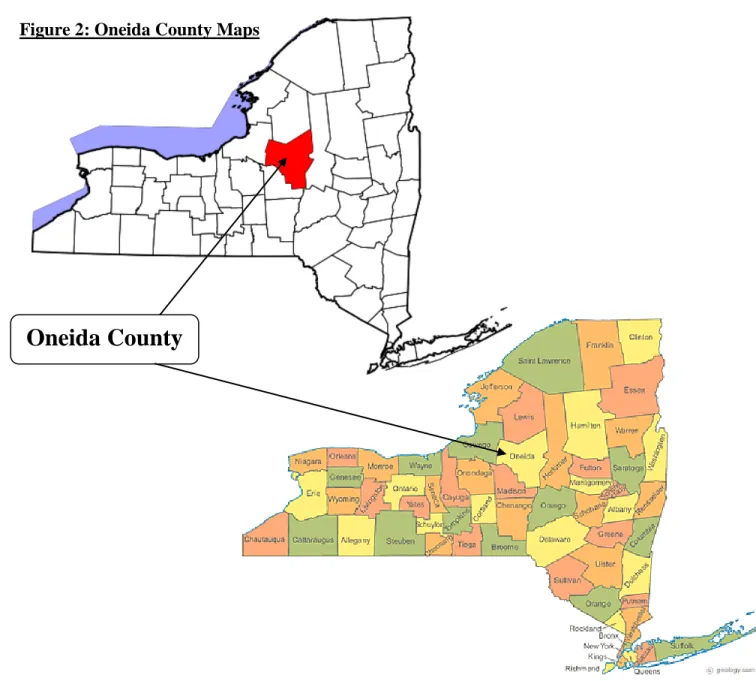
Oneida County is located in the central upstate region of New York State, in an area historically referred to as the ‘Leather stocking’ region. The county consists of 1,219 square miles which is primarily rural and is known for its green, rolling valleys and rounded hills that characterize the heartland of New York State. The county is bordered by Lewis County to the north, Herkimer County to east, Otsego and Madison Counties to the south and Oswego County to the west. Residential,
commercial and vacant land uses account for 70% of the total acreage, while 30% of the land is used for agricultural purposes.
Figure 2: Oneida County Maps
ONEIDA COUNTY
2012
Comprehensive Emergency Management Plan (CEMP) Section I - page 12
Population and Demographics
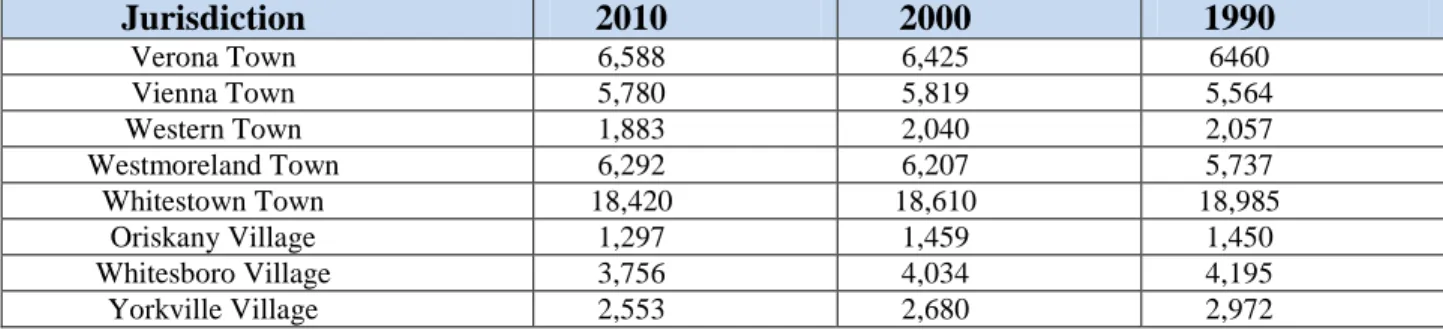
The total county population in 2010 was 234,878, a decrease of 591 people or 0.3% since the 2000 Census. The population is distributed among 48 political subdivisions and in 2010 there were 197.3 persons per square mile.
Table 1: Oneida County Population
Jurisdiction 2010 2000 1990
New York State 19,541,453 17,990,455 17,558,165
Oneida County 234,878 235,469 250,836
New York Mills Village 3,327 3,216 3,534
Remsen Village 575 513 518
Sylvan Beach Village 897 1,088 1,119
Waterville Village 1,583 1,749 1,664
Annsville Town 2,888 2,957 2,786
Augusta Town 1,934 1,926 2,070
Oriskany Falls Village 732 645 795
Ava Town 757 714 792 Boonville Town 4,596 4,572 4,246 Boonville Village 2,072 2,158 2,220 Bridgwater Town 572 1,671 1,591 Bridgewater Village 470 523 537 Camden Town 5,012 5,028 5,134 Camden Village 2,231 2,338 2,552 Deerfield Town 3,975 3,906 3,942 Florence Town 1,180 1,085 852 Floyd Town 3,899 3,885 3,856 Forestport Town 1,747 1,692 1,556 Kirkland Town 10,194 10,138 10,153 Clinton Village 1,942 1,954 2,238 Lee Town 6,887 6,875 7,115 Marcy Town 8,932 9,453 8,685 Marshall Town 2,334 2,167 2,125
New Hartford Town 20,018 21,169 21,640
New Hartford Village 1,847 1,886 2,111
Paris Town 4,539 4,609 4,414 Clayville Village 1,978 449 463 Remsen Town 1,813 1,939 1,739 Rome city 33,443 34,922 44,350 Sangerfield Town 2,626 2,610 2,460 Sherrill City 3,113 3,147 2,864 Steuben Town 1,127 1,191 1,008 Trenton Town 4,699 4,698 4,682 Barneveld Village 291 336 272
Holland Patent Village 586 441 411
Prospect Village 341 341 312
Utica City 58,170 60,679 68,637
Vernon Town 5,410 5,819 5,338
Oneida Castle Village 605 637 671
ONEIDA COUNTY
2012
Comprehensive Emergency Management Plan (CEMP) Section I - page 13
Jurisdiction 2010 2000 1990 Verona Town 6,588 6,425 6460 Vienna Town 5,780 5,819 5,564 Western Town 1,883 2,040 2,057 Westmoreland Town 6,292 6,207 5,737 Whitestown Town 18,420 18,610 18,985 Oriskany Village 1,297 1,459 1,450 Whitesboro Village 3,756 4,034 4,195 Yorkville Village 2,553 2,680 2,972
Table 2: Select U.S. Census Data for Oneida County
Oneida County NYS
Population, 2010 234,878 19,378,102
Population, percent change, 2000 to 2010 -0.3% 2.1%
Population, 2000 235,461 18,976,811
Persons under 5 years old, percent, 2009 5.6% 6.3% Persons under 18 years old, percent, 2009 21.5% 22.6% Persons 65 years old and over, percent, 2009 16.3% 13.4% Language other than English spoken at home, pct age
5+ 10.1%
28.5%
Veterans, 2005-2009 21,701 1,064,754
Mean travel time to work (minutes), workers age 16+ 19.2 31.4
Housing units, 2009 103,876 8,017,881
Homeownership rate, 2005-2009 68.2% 55.7% Housing units in multi-unit structures, percent,
2005-2009 30.7%
50.5%
Median value of owner-occupied housing units,
2005-2009 $97,000
$300,600
Persons per household, 2005-2009 2.33 2.64 Median household income, 2009 $45,663 $54,554 Persons below poverty level, percent, 2009 14.4% 14.2%
ONEIDA COUNTY
2012
Comprehensive Emergency Management Plan (CEMP) Section I - page 14
Government
Oneida County is governed by a County Legislature and has 26 townships, 3 cities and 19 incorporated villages.
ONEIDA COUNTY
2012
Comprehensive Emergency Management Plan (CEMP) Section I - page 15 H. Concept of Operations
1. Local governments and their emergency service organizations are the essential first line of defense in responding to disaster and emergencies
2. Primary responsibility for responding to emergencies rests with each unit of local government – county, towns, villages and cities; and with its local Chief Executive Officer– County Executive, Supervisors and Mayors
3. NYS Executive Law, Article 2-B empowers local chief executives of political subdivisions to use the resources of the local government to cope with disasters and emergencies. Execution of this authority and responsibility for coordinating local resources is typically delegated - but not transferred - to a local Emergency Manager or Disaster Coordinator
4. When responding to a disaster, local jurisdictions are required to first apply and
maximize the use of their own facilities, equipment, supplies, personnel and resources 5. When local resources are inadequate, the Chief Executive of a town, village or city may
request and obtain assistance from other political subdivisions and the County 6. The County, under direction of the County Executive and with organizational
supervision by the County Emergency Services Director, has the responsibility to coordinate requests for assistance from local governments, and has the authority to direct and coordinate County disaster operations.
7. The County may obtain assistance from other counties or the State when the emergency or disaster is beyond the resources of Oneida County. Assistance to local governments from other counties, the state and federal governments must be coordinated through Oneida County
8. Oneida County will use the National Incident Management System (NIMS) Incident Command System (ICS) to manage all emergencies requiring multi-agency response. 9. Local requests for assistance to the State will be submitted through Oneida County to
the regional office of the New York State Office of Emergency Management (OEM) 10. State and federal assistance are only provided as supplemental resources to county and
municipal efforts
11. Direction and control of state emergency management activities and resources is exercised by the Chairman of the New York State Disaster Preparedness Commission (DPC) and coordinated by the State Office of Emergency Management(OEM)
12. Requests for state military forces and equipment, even those located within Oneida County, can only be provided at the direction of the Governor, and must be requested through Oneida County and the State Office of Emergency Management(OEM) 13. When an emergency or disaster clearly exceeds the management and resource
capabilities of state and local governments, the Governor may request federal assistance from the President through the Federal Emergency Management Agency (FEMA)
ONEIDA COUNTY
2012
Comprehensive Emergency Management Plan (CEMP) Section I - page 16 I. Plan Review, Maintenance and Updating
1. Responsibility and Agency Support
State and local policies identified in this plan provide that authority and leadership for emergency planning is assigned to the Oneida County Executive and that
responsibility for preparation and implementation of the plan and its provisions is delegated to the Emergency Services Director. Participation in the planning process is required by all county officers and agencies and the plan establishes a core
planning team to assist in plan development, maintenance and implementation. This plan can be updated or revised at any time and certain elements and critical features; such as emergency contacts, notifications and key resources may require regular modification and updating. Section 23 of New York State Executive Law, Article 2-B requires that all plans and revisions for comprehensive emergency
management developed by local governments shall be submitted to the NYS Disaster Preparedness Commission annually.
2. Review and Updating Process
The review of the Oneida County Comprehensive Emergency Management Plan (CEMP) shall include an evaluation of the following areas.
Reassess the role, influence and success of the Planning Team including; the
composition and participation of its members and the Committee’s ability to exercise leadership that leads to effective implementation of the plan, its provisions and policies
Evaluate the status and progress associated with policies and objectives established for the plan and any revisions that are needed
Review the role, participation, capabilities and resources of the departments and agencies that support and are responsible for implementation of the plan
Reassess the hazards, risk and vulnerabilities the County faces and determine if changes or modifications are needed. Base the evaluation on new or modified data, current available information and changes to existing resources and capabilities
Insure that continuing citizen and public participation are incorporated in the planning process
Review technological systems and support capabilities that are used or available for plan implantation
ONEIDA COUNTY
2012
Comprehensive Emergency Management Plan (CEMP) Section I - page 17
Review and update plan evaluation and training requirements, including schedules for training and exercising
Monitor changes or modifications of laws and regulations related to the plan and emergency management programs
Monitor the availability and status of funding and resources that can be used to enhance the plan and local emergency management capabilities
Review relationships, programs and policies that integrate the plan and resources with those emphasized at the state and federal levels and with mutual aid available within the region
The Planning Team shall meet at least annually, or more often as needed to review and update the plan. The following situations or conditions will require that the Planning Team meet more frequently to evaluate plan issues, reviews and updates.
There are significant changes related to risks, vulnerabilities and capabilities associated with hazards that can impact Oneida County
A disaster or emergency occurs and a timely review or evaluation is necessary to determine if plan resources would contribute to the recovery; or when the disaster indicates that objectives and provisions of the plan require modification
Problems are identified that impede or threaten timely and successful implementation of any of the objectives and/or provisions of the plan
There are changes to key personnel responsible for implementation of the plan; including those on the Planning Team and those representing participating departments, jurisdictions and support agencies
There are issues or concerns regarding the ability of departments or support agencies to carry-out provisions and responsibilities identified in the plan
Grants, funding or other resources become available that require immediate action or support by the Planning Team to insure applicable objectives and provisions of the plan are addressed
Changes to legislation or authority require a review of plan policies and direction
Local training and exercising highlight modifications or changes that need to be addressed in the plan
ONEIDA COUNTY
2012
Comprehensive Emergency Management Plan (CEMP) Section I - page 18 3. Ongoing Monitoring by All Participating Agencies
Planning team members and principal representatives of all participating departments and agencies are responsible for advising and timely notification to the Emergency Services Office of changes to provisions and resources related to the plan. The Oneida County Emergency Services Director is responsible for organization and collection of information needed to review and update the plan, and will provide guidance and notifications necessary to insure regular plan maintenance and updating occurs as needed.
Continuous and regular monitoring of the Comprehensive Emergency Management Plan should be performed by each participating agency and department and should focus on the following.
The status, progress and any problems associated with the agency’s capability to implement provisions and responsibilities outlined in the plan
Maintain and update notification, contact and communications information for the agency
Monitor information about potential hazards, risks and threats
Identify resources, opportunities and funding that can be used to improve emergency management capabilities
Maintain contact and dialogue about emergency management issues and programs with other organizations in your specific area of service; including those at the local, regional, state and/or national levels
Identify ways that citizen and public participation can be incorporated in the emergency management process
ONEIDA COUNTY
2012
Comprehensive Emergency Management Plan (CEMP) Section II - page 2
Section II Risk Reduction
A. Oneida County Hazard Mitigation Plan
The risk reduction program and goals for Oneida County are contained in the Oneida County Hazard Mitigation Plan (see List of Appendices and References).
The Oneida County Hazard Mitigation Plan is a multi-jurisdiction mitigation plan that addresses natural hazards of concern throughout the county. The Hazard Mitigation Plan meets multiple objectives, but its main purpose is to engage local communities in the process of hazard identification, risk assessment and the development of integrated hazard mitigation strategies. The Oneida County plan conforms to regulations set forth in the federal Disaster Mitigation Act of 2000 and is complimentary to the New York State Hazard Mitigation Plan. The Oneida County Hazard Mitigation Plan emphasizes disaster risk reduction goals and proposals that were identified by community leaders and municipal officials and serves as a guide for local decision making when considering development and projects that can impact or promote hazard
mitigation and risk reduction.
Hazard mitigation is any action taken to eliminate or reduce the occurrence or impact of a natural hazard. Mitigation actions must be technically feasible, cost effective and environmentally sound; examples can include relatively inexpensive and simple activities like installing a hazard warning device, or an expensive and complex project such as an engineered flood control levee. The Oneida County Hazard Mitigation Plan establishes objectives and projects for each of the county’s municipalities and helps them identify and mobilize resources that can be used to implement improvements that will reduce risks associated with natural hazards.
B. Hazard Mitigation Coordination and Leadership
The Oneida County Hazard Mitigation Plan represents a collaborative planning process engaged in by the county, each local jurisdiction and several area organizations that are responsible for hazard mitigation and risk reduction measures. The Oneida County Hazard Mitigation Planning Committee has been created to ensure the plan accurately reflects local risk reduction needs and that community participation is integrated into an overall county wide mitigation strategy. The committee includes one or more representatives from each of Oneida County’s 48 municipalities, several county departments, plus representatives from police and fire departments, hospitals and support agencies in the region.
Each jurisdiction in Oneida County is responsible for identifying at least one representative to participate in activities of the county Hazard Mitigation Planning Committee and also serve as principal coordinator for hazard mitigation efforts in their community. The planning effort is led by the Oneida County Department of Emergency Services and the Oneida County Soil and Water Conservation District.
ONEIDA COUNTY
2012
Comprehensive Emergency Management Plan (CEMP) Section II - page 3 C. Identification and Analysis of Potential Hazards
The Oneida County Hazard Mitigation Planning Committee used the Hazards Analysis - New York (HAZNY) program to evaluate and rank potential hazards that can impact Oneida County. This HAZNY is the method used throughout New York State to identify and analyze hazards and establish priorities for planning that will reduce or eliminate risks associated with natural and man-made threats. A report of the HAZNY prepared in 2007 is included in the Oneida County
Hazard Mitigation Plan (2008). A review of the HAZNY was conducted in 2011, resulting in
revisions to the evaluations for 11 of the 32 hazards. A summary of the 20011 review and revisions is included as Appendix IV to this plan.
Hazard Analysis – New York (HAZNY)
HAZNY is the State’s interactive hazard evaluation program that examines the likelihood, frequency and potential impacts associated with a wide range of hazards that can affect communities, citizens and property.
The HAZNY evaluates 32 potential hazards that could affect Oneida County and was first prepared by the Hazard Mitigation Planning Committee in 2007, and the results were included in the 2008 edition of the Oneida County Hazard Mitigation Plan. In 2011, the committee
conducted a review of the HAZNY that produced a re-evaluation and modification of the analysis for 11 hazards. Noted below are the results of the baseline 2007 HAZNY and the modifications made as a result of the 2011 review. A full update and revision of the HAZNY will be conducted when the Hazard Mitigation Plan is updated in 2013. In examining the 32 potential hazards that could affect Oneida County, the HAZNY evaluates the following features associated with each hazard.
Potential Impact – Would the hazard impact parts or all of the County
Cascade Effects – Can the hazard prompt or result in other risks and danger
Frequency - How often is the hazard likely to occur
Onset – Is their warning of the hazard
Duration – How long will the hazardous conditions last
Recovery – How long will it take for the community to recover from the hazard
ONEIDA COUNTY
2012
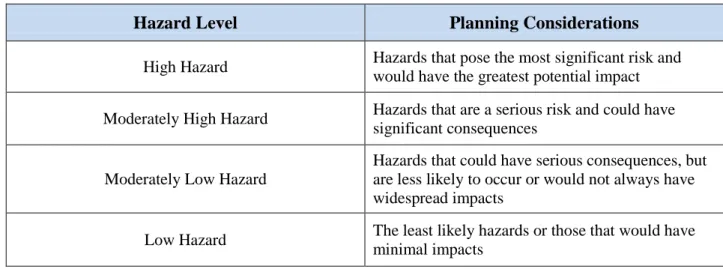
Comprehensive Emergency Management Plan (CEMP) Section II - page 4 The planning committee rated the hazards, assigning each a numerical value and placing them in one of four categories.
Table 3: Hazard Levels
Hazard Level Planning Considerations
High Hazard Hazards that pose the most significant risk and would have the greatest potential impact Moderately High Hazard Hazards that are a serious risk and could have
significant consequences
Moderately Low Hazard
Hazards that could have serious consequences, but are less likely to occur or would not always have widespread impacts
Low Hazard The least likely hazards or those that would have minimal impacts
The HAZNY produced the following results for Oneida County: High Hazards
NONE – to be ranked as a high hazard means that death and injury are likely in high numbers and the event would have widespread catastrophic impacts
Moderately High Hazards
SEVERE STORM FIRE LANDSLIDE EPIDEMIC ICE STORM TERRORISM
HAZARDOUS MATERIALS (IN TRANSIT) FLOOD*
WINTER STORM (SEVERE)
HAZARDOUS MATERIALS (FIXED SITE)*
Moderate Low Hazards
TRANSPORTATION ACCIDENT* UTILITY FAILURE EXTREME TEMPERATURES WATER SUPPLY CONTAMINATION EXPLOSION CIVIL UNREST TORNADO HURRICANE DAM FAILURE* ICE JAM WILDFIRE Low Hazards FUEL SHORTAGE DROUGHT*
ONEIDA COUNTY
2012
Comprehensive Emergency Management Plan (CEMP) Section II - page 2 * The 2011 review of the HAZNY resulted in the following modifications
Hazard 2007 HAZNY 2011 HAZNY Review
Flood Moderately Low Hazard Moderately High Hazard
Hazardous Materials (Fixed Site) Moderately Low Hazard Moderately High Hazard Transportation Accident Moderately High Hazard Moderately Low Hazard Dam Failure Moderately High Hazard Moderately Low Hazard
Drought Moderately Low Hazard Low Hazard
The HAZNY determined that the hazards identified in the following groups pose special or unique risks for Oneida County.
Hazards that Occur Most Often
SEVERE STORM FIRE
LANDSLIDE
TRANSPORTATION ACCIDENT
HAZARDOUS MATERIALS (IN TRANSIT) SEVEREWINTER STORM
FLOOD
EXTREME TEMPERATURES
Hazards Likely to Present the Greatest Threat to Life
(defined as serious injury and death in extremely large numbers)
ICE STORM TERRORISM
DAM FAILURE HURRICANE
EPIDEMIC HAZARDOUS MATERIALS (FIXED SITE)
Hazards That Can Occur with No Warning
SEVERE STORM LANDSLIDE EPIDEMIC DAM FAILURE UTILITY FAILURE FLOOD TORNADO WILDFIRE
HAZARDOUS MATERIALS (IN TRANSIT) HAZARDOUS MATERIALS (FIXED SITE) WATER SUPPLY CONTAMINATION TRANSPORTATION ACCIDENT
ONEIDA COUNTY
2012
Comprehensive Emergency Management Plan (CEMP) Section II - page 2 D. Risk Reduction Program, Policies and Actions
Developing an Integrated Countywide Risk Reduction Program
The multi-jurisdiction Hazard Mitigation plan (see List of Appendices and References) prepared for Oneida County outlines the process and establishes the objectives and actions that form the County’s risk reduction program. Preparation of county wide hazard mitigation goals and objectives were based on the findings and results of the Hazard Analysis (HAZNY, Appendix IV) and a review of the Risk and Vulnerability Assessments contained in the Hazard Mitigation plan.
The Oneida County Hazard Mitigation Plan identifies seven types of strategies for addressing risk reduction and hazard mitigation.
Table 4: Oneida County Hazard Mitigation Strategies
Mitigation Type Mitigation Actions
Emergency Services Improved organization, capabilities and resources
Disaster Preparedness Planning, training, exercising, warning systems, communications Education and Awareness Training and information for government, businesses, media,
responders and citizens
Structural Design and Development Standards
Codes, building standards, zoning and regulatory enforcement Reduced vulnerability utility design
Application of disaster resistant materials Special hazard zone or floodplain requirements
Structural Protection and Retrofitting
Removal, raising or relocation of structures at risk Redesign and placement of critical utilities
Remodeling with disaster resistant design and materials Fire protection, warning and security systems
Drainage, debris and landscape management Generators, utility protection and back-up
Property Protection
Stream corridor management, including stream debris clearance Dikes, dams, levees, walls, drainage, retention, diversion Stream bank stabilization
Natural Resource Protection
Preservation and protection of wetlands, watersheds, drainage basins, woodlands, sloped terrain and habitat
ONEIDA COUNTY
2012
Comprehensive Emergency Management Plan (CEMP) Section II - page 3 Proposed risk reduction projects and mitigation actions included in the Hazard Mitigation plan are developed by evaluating the hazard specific facts, records and data associated with each objective. Proposed risk reduction measures are then assessed to determine how the following considerations will affect successful implementation of the objective.
• Technical and engineering feasibility
• Legal and environmental concerns
• Resources and funding exist or are potentially available
• Public interest exits or can be attained
• Political support exists or can be organized
The following process is applied to develop risk reduction goals and hazard mitigation objectives.
Evaluation of Hazard Specific Data, Analysis and Findings Outlined in the Oneida County Hazard Mitigation Plan
Review of Hazard Profiles Review of Risk Assessment Review of Vulnerability Assessment
Development of Proposed Risk Reduction Goals and Hazard Mitigation Objectives
Political support exists or can be
organized Public interest and
support exist or can be attained Realistic funding opportunities are available or can be attained Proposal is technically, legally, environmentally and engineering feasible
Development of Risk Reduction Goals and Hazard Mitigation Objectives
ONEIDA COUNTY
2012
Comprehensive Emergency Management Plan (CEMP) Section II - page 4
Risk Reduction and Hazard Mitigation Objectives for Oneida County
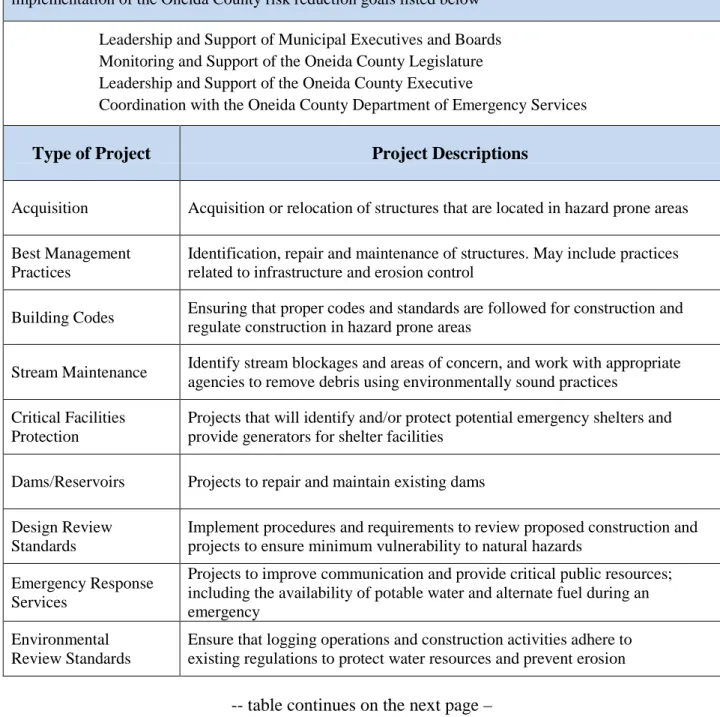
The following is a summary of the types of risk reduction and mitigation measures that are included in the Oneida County Hazard Mitigation plan (see List of Appendices and References). The plan includes specific mitigation actions for each jurisdiction in Oneida County, as well as proposals that call for regional, multi-jurisdiction or county wide participation.
Table 5: Risk Reduction Goals
Integrated leadership and support by the following officials and executive boards is essential to successful implementation of the Oneida County risk reduction goals listed below
Leadership and Support of Municipal Executives and Boards Monitoring and Support of the Oneida County Legislature Leadership and Support of the Oneida County Executive
Coordination with the Oneida County Department of Emergency Services
Type of Project Project Descriptions
Acquisition Acquisition or relocation of structures that are located in hazard prone areas Best Management
Practices
Identification, repair and maintenance of structures. May include practices related to infrastructure and erosion control
Building Codes Ensuring that proper codes and standards are followed for construction and regulate construction in hazard prone areas
Stream Maintenance Identify stream blockages and areas of concern, and work with appropriate agencies to remove debris using environmentally sound practices
Critical Facilities Protection
Projects that will identify and/or protect potential emergency shelters and provide generators for shelter facilities
Dams/Reservoirs Projects to repair and maintain existing dams Design Review
Standards
Implement procedures and requirements to review proposed construction and projects to ensure minimum vulnerability to natural hazards
Emergency Response Services
Projects to improve communication and provide critical public resources; including the availability of potable water and alternate fuel during an emergency
Environmental Review Standards
Ensure that logging operations and construction activities adhere to existing regulations to protect water resources and prevent erosion
ONEIDA COUNTY
2012
Comprehensive Emergency Management Plan (CEMP) Section II - page 5
Risk Reduction Goals - continued
Type of Project Project Descriptions
Hazard Threat Recognition
Tree pruning in developed areas where dead or dying tree limbs threaten utility lines and can cause power outages
Hazard Warning System
Implement the Reverse 9-1-1 system for Oneida County and provide related local warning systems
Health &Safety Maintenance
Dry hydrant installation for rural fire protection, identification and location of vulnerable residents who may require special services in a disaster, and an improved list of shelters for each community
Post-Disaster Mitigation
Improve resource management capabilities; to include mutual-aid, emergency contracting and private sector support that can supply labor, equipment and specialized technology needed for post-disaster debris removal, cleanup and recovery
Public Education &
Outreach Education of the public regarding disaster preparedness
Real Estate Disclosure Ensure that potential homebuyers and builders are aware of hazard prone areas
Structural Retrofitting
Improved drainage and runoff systems, the extension of public water to residents with inadequate water supply, and the repair or replacement of faulty septic systems that pose public health risks
Storm water Management Regulations
Improved application of DEC Municipal Separate Storm Sewer System permits to protect surface water contamination due to storm water Stream Corridor
Restoration
Stream corridor management activities that include regular stream maintenance programs, stream bank stabilization and maintenance easements
ONEIDA COUNTY
2012
Comprehensive Emergency Management Plan (CEMP) Section II - page 6 E. Integrating Emergency Management Programs and Resources
Multiple programs and services provided by a wide range of governments and agencies
contribute to the risk reduction profile and resources for Oneida County. A county strategy and policies that integrate the direction and opportunities available through these programs is essential to an effective emergency management capability in the county.
Table 6: Integration of Emergency Management Programs
Integrated leadership, participation and support by the following officials and executive boards is essential to an effective emergency management capability in Oneida County
Leadership and Support of Municipal Executives and Boards Monitoring and Support of the Oneida County Legislature Leadership and Support of the Oneida County Executive
Coordination with the Oneida County Department of Emergency Services
Emergency Management Programs Supporting Agencies and Resources
Emergency Preparedness Training and Exercises Hazard Mitigation
Response and Recovery Resources
Oneida County Department of Emergency Services NYS Office of Emergency Management(OEM) Federal Emergency Management Agency (FEMA) Fire and Hazardous Materials Services
Fire Protection and Prevention Hazardous Material Response Teams Rescue Services
Incident Management
Municipal and Volunteer Fire Departments Oneida County Fire Coordinator
NYS Office of Fire Prevention and Control NYS Office of Emergency Management(OEM) Federal Emergency Management Agency (FEMA) Emergency Medical Services (EMS)
Disaster Medical Services
Mass-Casualty Incident Management Emergency Medical Transportation
Area EMS, Ambulance and Fire Services Oneida County Health Department Area Hospitals and NYSDOH Public Health Emergency Services
Influenza and Disease Management Hazardous Materials Health Impacts Environmental Health Threats Terrorist Incident Health Exposures
Hospitals, Medical and Assistance Facilities
Oneida County Health Department Area Hospitals and Medical Providers
Nursing Homes, Medical Care and Assistance Facilities NYS Department of Health
NYS Office of Emergency Management(OEM) U.S. Public Health Service
Federal Centers for Disease Control (CDC) Law Enforcement Disaster Preparedness
Terrorism Preparedness and Response Public Security
Disaster Public Safety Services Transportation Emergencies
Area Police and Law Enforcement agencies Area Colleges and Universities
NY State Police
NYS Department of Correctional Services NYS Parks Police
NYS Office of Emergency Management(OEM) Federal Bureau of Investigation (FBI)
ONEIDA COUNTY
2012
Comprehensive Emergency Management Plan (CEMP) Section II - page 7 Integration of Emergency Management Programs - continued
Emergency Management Programs Supporting Agencies and Resources
Flood and Natural Hazards Preparedness, Response and Recovery
Municipal Public Works and Highway Departments Oneida County Department of Public Works
Oneida County Soil and Water Conservation District NYS Office of Emergency Management (OEM) NYS Department of Environmental Conservation NYS Department of Transportation
NYS Thruway Authority NYS Division of Canals
Federal Emergency Management Agency (FEMA) U.S. Army Corps of Engineers
School Preparedness and Emergency Response
Area School Boards and Administrators Oneida County Sheriff’s Department BOCES
NYS Department of Education U.S. Department of Education NY State Police
Transportation Emergencies Air/Rail/Highways/Waterways
Area Fire and EMS Services Areas Police and Law Enforcement Oneida County Aviation Services
Oneida County Department of Public Works NYS Office of Emergency Management(OEM) NYS Department of Environmental Conservation NYS Department of Transportation
NYS Division of Canals
Disaster Human Services Community Shelters Disaster Mental Health Crisis Counseling
American Red Cross Salvation Army
Area Fire and Law Enforcement Agencies Oneida County Mental Health Department Oneida County Health Department NYS Disaster Human Needs Task Force
ONEIDA COUNTY
2012
Comprehensive Emergency Management Plan (CEMP) Section II - page 8 F. Emergency Response Capability Assessment
Each jurisdiction in Oneida County, as well as each department and agency that provides support and services in an emergency is responsible for assessing their response capabilities for dealing with disasters and emergencies.
A capability assessment should include an evaluation of the jurisdiction or agency’s ability to provide disaster services and support in the following areas.
Estimate of the populations to be served Availability of personnel
Personnel and staff training Management and supervision capability Resources and equipment Labor relations
Communications and technology Mutual aid resources Notifications systems/procedures Emergency contracting
Warning and alerting the public Finance and purchasing systems Disaster assessment Emergency facilities and power
In evaluating community or agency capabilities, jurisdictions and departments should work with the Oneida County Department of Emergency Services to consolidate and coordinate capability assessment activities with regional and state initiatives; such as those undertaken by the NYS Office of Emergency Manage mentor efforts conducted by area law enforcement and public health agencies for counter-terrorism and related preparedness programs.
ONEIDA COUNTY
2012
Comprehensive Emergency Management Plan (CEMP) Section II - page 9 G. Identification and Monitoring of Hazard Areas
The Oneida County Hazard Mitigation Plan (see List of Appendices and References)identifies hazard and risk areas associated with hazards that have defined geographic profiles.
Areas included in the Hazard Mitigation plan where specific hazard sites or locations can be identified and monitored include the following.
Table 7: Hazard Monitoring
Hazard Area Monitoring Agencies
High risk flood zones
Local government officials and boards Local Floodplain Management Officers Local Buildings and Codes officials Local Planning and Zoning Boards Soil and Water Conservation District
NYS Department of Environmental Conservation Federal Emergency Management Agency
U.S. Army Corps of Engineers
Areas susceptible to erosion, slope failure and landslide
Local government officials and boards Local Floodplain Management Officers Local Buildings and Codes officials Local Planning and Zoning Boards Soil and Water Conservation District
NYS Department of Environmental Conservation
Areas at risk to dam failure
Dam owners and operators Local government officials
NYS Department of Environmental Conservation U.S. Department of Energy
Areas near major transportation facilities including highways, rail, marine and airports
Oneida County Public Works Oneida County Aviation Railway operators
NYS Department of Transportation NYS Thruway Authority
NYS Division of Canals NY State Police
Federal Aviation Administration
ONEIDA COUNTY
2012
Comprehensive Emergency Management Plan (CEMP) Section II - page 10 Hazard Monitoring - continued
Hazard Area Monitoring Agencies
Sites and areas where hazardous materials are used, stored and/or transported
Facility owners and operators
Local Emergency Planning Committee (LEPC) Oneida County Fire Coordinator
Local Fire Departments
Oneida County Health Department
NYS Department of Environmental Conservation NY State Police
NYS Office of Fire Prevention and Control NYS Department of Transportation
Natural gas and fuel pipelines
Pipeline owners and operators
NYS Department of Environmental Conservation U.S. Department of Energy
Oneida County Fire Coordinator Local Fire Departments
High density areas with structural fire hazards and areas at risk to wildfires
Local government officials Local Fire Departments
Oneida County Fire Coordinator
NYS Office of Fire Prevention and Control NYS Department of Environmental Conservation
H. Identification and Protection of Critical Facilities
The Oneida County Hazard Mitigation Plan identifies critical facilities for each jurisdiction in Oneida County. Critical facilities in a municipality include the following kinds of systems and structures.
* Fire, police, 9-1-1 dispatch, ambulance and related emergency services facilities * Hospital and primary care medical facilities
* Facilities that house vulnerable populations, including the elderly and disabled * Community shelters and human services facilities
* Municipal and agency emergency operations facilities * Public works and highway maintenance facilities
* Roads, streets and rights-of-way providing access for emergency services * Essential public utilities; including water and wastewater systems
ONEIDA COUNTY
2012
Comprehensive Emergency Management Plan (CEMP) Section II - page 11 * Communications and warning technology and systems
* Facilities using, transporting and storing hazardous materials * High hazard dams
* Natural gas and fuel pipelines and transfer areas * Power plants and electrical substations
Facility owners and operators have responsibility for site specific emergency planning. Assistance is typically available from support agencies representing their industry or area of service and plans should be coordinated with this Oneida County Comprehensive Emergency Management plan through the county Office of Emergency Services.
I. Identification and Protection of Vulnerable Populations
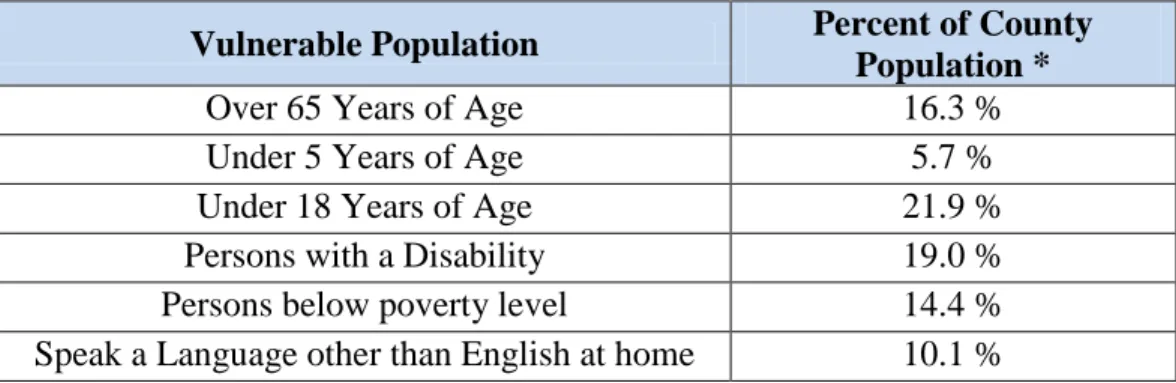
The Oneida County Hazard Mitigation Plan identifies special populations that may have heightened risks or response needs associated with hazards that can impact Oneida County. For each jurisdiction in the county, the Hazard Mitigation Plan lists the percent of population in the following vulnerable population groups. Services and resources needed to assist vulnerable populations are provided by numerous departments and agencies in the county and coordinated by the Oneida County Disaster Human Services Committee described in Section III, Response of this plan.
Table 8: Vulnerable Populations
Vulnerable Population Percent of County
Population *
Over 65 Years of Age 16.3 %
Under 5 Years of Age 5.7 %
Under 18 Years of Age 21.9 %
Persons with a Disability 19.0 %
Persons below poverty level 14.4 % Speak a Language other than English at home 10.1 % * U.S. Census, 2010
ONEIDA COUNTY
2012
Comprehensive Emergency Management Plan (CEMP) Section II - page 12 J. Training of Emergency Personnel
Each department, organization and jurisdiction that participates in emergency management services and activities for Oneida County has the responsibility to promote and take part in training that will assure effective implementation of the policies and provisions of this plan. Training is sponsored and/or conducted using the opportunities and resources available among the following agencies and is coordinated with the Oneida County Department of Emergency Services.
Oneida County Department of Emergency Services Oneida County Fire Coordinator
Oneida County Sheriff’s Department Oneida County Health Department
Oneida County Mental Health Department Oneida County Department of Public Works Local Fire, EMS and Law Enforcement Agencies Area Colleges and Universities
BOCES
American Red Cross
NYS Office of Emergency Management (OEM) NYS Office of Fire Prevention and Control (OFPC) NYS Department of Health
NY State Police
NYS Office of Counter Terrorism
NYS Division of Criminal Justice Services NYS Office of Cyber-Security
NYS Department of Environmental Conservation NYS Department of Transportation
NYS Education Department
NYS Disaster Human Needs Task Force
Federal Emergency Management Agency(FEMA)
Figure 5: Emergency Preparedness Cycle
ONEIDA COUNTY
2012
Comprehensive Emergency Management Plan (CEMP) Section II - page 13 Regular training programs and opportunities offered locally or in the region focus on the following emergency management topics or skills, but other training programs are often scheduled to address special training needs and related priorities.
Table 9: Local Emergency Management Training
Program Training Subjects
Emergency Management
Emergency Management Professional Development Emergency Planning, Exercise Design and Evaluation Public Officials and Information Officer Workshops EOC Operations and Disaster Recovery Workshops Mass Fatality and Mass Care Training
Community Emergency Response Training (CERT)
Fire Services
Fire Suppression and Prevention Fire Command and Management Hazardous Materials Management
Code Enforcement and Arson Investigation
Emergency Response To Terrorism and Hazardous Materials Technical Rescue
NYS Academy of Fire Science
Wildfire Academy and Incident Management Homeland Security
NY State Preparedness Training Center
Counter Terrorism and Cyber-Security Training for Emergency Responders, Emergency Professionals and Government Officials Incident Command System (ICS) Incident Management Training for Emergency Responders, Public
Safety Officers and Government Executives Police, Law Enforcement and
Security
Counter-Terrorism Preparedness and Response Community, Home, and Personal Safety School Preparedness and Safety
Emergency Medical Services First Responder and Emergency Medical Technician Training Hospitals and Health Care Facilities Emergency Preparedness and Response
Public Health
Bio-Terrorism Preparedness and Response Emergency Preparedness and Response
Influenza Pandemic and Strategic National Stockpile (SNS) Schools and Colleges Community and Emergency Responder Education
American Red Cross
Disaster Services
Home and Family Preparedness Shelter Management
ONEIDA COUNTY
2012
Comprehensive Emergency Management Plan (CEMP) Section II - page 14
National Incident Management System (NIMS) Training
Homeland Security Presidential Directive (HSPD-5) Management of Domestic Incidents calls for the establishment of a single, comprehensive national incident management system. This policy has been further endorsed by the State of New York in Executive Order 26.1, and by Oneida County in Executive Order No. 1 of 2011. The National Incident Management System (NIMS) provides a systematic and cooperative approach to guide departments and agencies at all levels of government, as well as the private sector and other support organizations, in responding to emergency incidents and protecting life, property and the environment.
The above directives and endorsements require that all local governments and emergency response organizations in Oneida County comply with NIMS implementation efforts, which includes participation in ICS training and application of the ICS system in an emergency. Further information regarding ICS training and guidance regarding the types of ICS training that apply to various local government employees and emergency responders can be obtained from the Oneida County Department of Emergency Services and the NYS Office of Emergency Management (OEM).
The most common ICS training programs that are provided for local government employees and emergency personnel in New York State and Oneida County include the following:
Table 10: NIMS ICS Training Programs
Course Title Format Participants
ICS 100 Introduction to the Incident Command System On line or Classroom
All personnel involved with emergency planning, response or recovery efforts
ICS 200 Basic ICS Classroom* All personnel that perform emergency response and resource management functions
ICS 300 Intermediate ICS Classroom For response personnel who manage and/or supervise emergency functions, resources and/or personnel ICS 402 ICS for Executives Classroom For executives, elected officials, board and legislative
members and agency directors
ONEIDA COUNTY
2012
Comprehensive Emergency Management Plan (CEMP) Section II - page 15 Based on the management or emergency response roles of local officials and emergency personnel, employers typically consider the following ICS courses when determining the kinds of training their staff will need to meet NIMS requirements.
IS – 700 ICS Awareness
ICS-701 Multiagency Coordination Systems ICS-702 NIMS Public Information Systems ICS-703 NIMS Resource Management
ICS-704 NIMS Communications and Information Management IS – 800 National Response Framework (NRF)
ICS-400 Advanced ICS
Exercise Program
Effective training for emergency response and the successful application of a comprehensive emergency management plan includes implementation of a progressive exercise program. Compliance with Homeland Security Presidential Directive (HSPD) – 5 Management of
Domestic Incidents and the accompanying endorsements of HSPD - 5 by New York State and
Oneida County also call for the establishment of a local exercise and evaluation program. The exercise program and activities for Oneida County follow the standards outlined in the federal Homeland Security Exercise and Evaluation Program (HSEEP), which is a capabilities-based exercise methodology designed to build a self-sustaining exercise program that applies standards for designing, developing, conducting and evaluating exercises of all types.
Disaster and emergency exercises have two purposes and most exercises are designed to address both these goals.
Training - to provide emergency personnel with training, familiarization and experience in apply