Durham Research Online
Deposited in DRO:
29 June 2018
Version of attached le:
Published Version
Peer-review status of attached le:
Peer-reviewed
Citation for published item:
AlManei, Mohammed and Salonitis, Konstantinos and Tsinopoulos, Christos (2018) 'A conceptual lean implementation framework based on change management theory.', Procedia CIRP., 72 . pp. 1160-1165.
Further information on publisher's website:
https://doi.org/10.1016/j.procir.2018.03.141Publisher's copyright statement: c
2018 This manuscript version is made available under the CC-BY-NC-ND 4.0 license
http://creativecommons.org/licenses/by-nc-nd/4.0/
Use policy
The full-text may be used and/or reproduced, and given to third parties in any format or medium, without prior permission or charge, for personal research or study, educational, or not-for-prot purposes provided that:
• a full bibliographic reference is made to the original source • alinkis made to the metadata record in DRO
• the full-text is not changed in any way
The full-text must not be sold in any format or medium without the formal permission of the copyright holders. Please consult thefull DRO policyfor further details.
Durham University Library, Stockton Road, Durham DH1 3LY, United Kingdom Tel : +44 (0)191 334 3042 | Fax : +44 (0)191 334 2971
ScienceDirect
Available online at www.sciencedirect.com Available online at www.sciencedirect.com
ScienceDirect
Procedia CIRP 00 (2017) 000–000www.elsevier.com/locate/procedia
2212-8271 © 2017 The Authors. Published by Elsevier B.V.
Peer-review under responsibility of the scientific committee of the 28th CIRP Design Conference 2018.
28th CIRP Design Conference, May 2018, Nantes, France
A new methodology to analyze the functional and physical architecture of
existing products for an assembly oriented product family identification
Paul Stief *, Jean-Yves Dantan, Alain Etienne, Ali Siadat
École Nationale Supérieure d’Arts et Métiers, Arts et Métiers ParisTech, LCFC EA 4495, 4 Rue Augustin Fresnel, Metz 57078, France
* Corresponding author. Tel.: +33 3 87 37 54 30; E-mail address: [email protected]
Abstract
In today’s business environment, the trend towards more product variety and customization is unbroken. Due to this development, the need of agile and reconfigurable production systems emerged to cope with various products and product families. To design and optimize production systems as well as to choose the optimal product matches, product analysis methods are needed. Indeed, most of the known methods aim to analyze a product or one product family on the physical level. Different product families, however, may differ largely in terms of the number and nature of components. This fact impedes an efficient comparison and choice of appropriate product family combinations for the production system. A new methodology is proposed to analyze existing products in view of their functional and physical architecture. The aim is to cluster these products in new assembly oriented product families for the optimization of existing assembly lines and the creation of future reconfigurable assembly systems. Based on Datum Flow Chain, the physical structure of the products is analyzed. Functional subassemblies are identified, and a functional analysis is performed. Moreover, a hybrid functional and physical architecture graph (HyFPAG) is the output which depicts the similarity between product families by providing design support to both, production system planners and product designers. An illustrative example of a nail-clipper is used to explain the proposed methodology. An industrial case study on two product families of steering columns of thyssenkrupp Presta France is then carried out to give a first industrial evaluation of the proposed approach.
© 2017 The Authors. Published by Elsevier B.V.
Peer-review under responsibility of the scientific committee of the 28th CIRP Design Conference 2018. Keywords:Assembly; Design method; Family identification
1. Introduction
Due to the fast development in the domain of communication and an ongoing trend of digitization and digitalization, manufacturing enterprises are facing important challenges in today’s market environments: a continuing tendency towards reduction of product development times and shortened product lifecycles. In addition, there is an increasing demand of customization, being at the same time in a global competition with competitors all over the world. This trend, which is inducing the development from macro to micro markets, results in diminished lot sizes due to augmenting product varieties (high-volume to low-volume production) [1]. To cope with this augmenting variety as well as to be able to identify possible optimization potentials in the existing production system, it is important to have a precise knowledge
of the product range and characteristics manufactured and/or assembled in this system. In this context, the main challenge in modelling and analysis is now not only to cope with single products, a limited product range or existing product families, but also to be able to analyze and to compare products to define new product families. It can be observed that classical existing product families are regrouped in function of clients or features. However, assembly oriented product families are hardly to find.
On the product family level, products differ mainly in two main characteristics: (i) the number of components and (ii) the type of components (e.g. mechanical, electrical, electronical).
Classical methodologies considering mainly single products or solitary, already existing product families analyze the product structure on a physical level (components level) which causes difficulties regarding an efficient definition and comparison of different product families. Addressing this
Procedia CIRP 72 (2018) 1160–1165
2212-8271 © 2018 The Authors. Published by Elsevier B.V.
Peer-review under responsibility of the scientific committee of the 51st CIRP Conference on Manufacturing Systems. 10.1016/j.procir.2018.03.141
ScienceDirect
Procedia CIRP 00 (2018) 000–000
www.elsevier.com/locate/procedia
2212-8271 © 2018 The Authors. Published by Elsevier B.V.
Peer-review under responsibility of the scientific committee of the 51st CIRP Conference on Manufacturing Systems.
51st CIRP Conference on Manufacturing Systems
A conceptual lean implementation framework based on change
management theory
Mohammed AlManei
a, Konstantinos Salonitis
a,*, Christos Tsinopoulos
baManufacturing, Cranfield University, Cranfield, MK43 0AL, UK bBussiness School, Durham University, Durham, DH1 3LE, UK
* Corresponding author. Tel.: +44 (0)1234 758344. E-mail address: [email protected]
Abstract
Over the last two decades, numerous studies have been presented on the drivers and barriers that companies face when they try to implement lean. Such studies have mostly been based on conducting surveys through questionnaires and interviews, and have targeted specific industrial sectors and / or geographic boundaries. For helping companies implement lean, a number of frameworks have been developed. Most of them though, look like more as roadmaps, prescribing the sequence of the various lean tools that have to be adopted without considering the complexity of the human factor. It comes thus as no surprise, that many companies have failed and were not able to reap the benefits of lean manufacturing. In all literature reviewed, successful lean implementation is accompanied by a change in the way companies value the different dimensions of work. One of the major challenges of lean implementation is guiding the change journey as detailed in the implementation plan. Lean manufacturing requires change in structure, system, process, and employee behaviour. In the present paper, a conceptual framework based on change management theory is proposed and discussed.
© 2018 The Authors. Published by Elsevier B.V.
Peer-review under responsibility of the scientific committee of the 51st CIRP Conference on Manufacturing Systems.
Keywords: lean implementation; change management; lean maturity
1.Introduction
Lean manufacturing and management when successfully implemented can help organizations improve their processes, reduce and even eliminate waste. A number of lean implementation frameworks have been presented in the past, most of them starting with house of lean. Recent studies of the authors summarized these frameworks [1, 2]. However, although a number of companies have attempted to introduce lean thinking, only few have had successful and sustainable results. In the USA, a study undertaken by the Lean Enterprise Institute in 2004 [3] presented a survey of over 900 executives, resulting that only 4% considered that their lean efforts were at an “advanced” stage, exhibiting high lean maturity. Such an advanced state means that their lean implementation had become the standard way of operating internally and was being extended to their strategic suppliers.
AlManei et al. [2] discussed in detail the reasons why lean initiatives fail. Through an extensive literature review, they resulted that the common root causes that lead to lean initiatives failure are related to: lack of supply chain integration, lack of leadership commitment, lack of employee involvement, poor understanding of lean tools and techniques and finally objecting business systems. It is thus obvious that introducing lean in not a straight forward easy endeavor, and there is a plethora of stakeholders (leadership, employees, customers, suppliers etc.) that need to be considered.
On the other hand, lean can be considered as any other change introduced to an organization. And as such a number of resistance points need to be overcome, at the same time the drivers for lean chance need to be reinforced. AlManei et al. [2] conducted a force field analysis that is summarized in fig. 1. This can serve as a starting point for comprehending the complexity of introducing lean.
Mohammed AlManei et al. / Procedia CIRP 72 (2018) 1160–1165 1161
2 Author name / Procedia CIRP 00 (2018) 000–000
Fig. 1. Lean drivers and barriers – force field analysis (based on [2]). In the present paper, a conceptual lean implementation framework based on the most appropriate change management model will be presented. For selecting the change management model that is better suited for this study, the various change management theories are reviewed and discussed under the prism of lean manufacturing implementation. Then the conceptual framework is presented and discussed.
2.Change management literature review
Change is identified as the behavioural shift of “the organization as a whole, from one being to another”. One the other hand management of change has been identified as “the process of continually renewing an organization’s direction, structure, and capabilities to serve the ever-changing needs of external and internal customers”. In general it can be stated that change in an organisation becomes necessary when the organisation is no longer aligned to its external environment and its survival is threatened [4]. However, organizations are constantly faced with harsh competition, and therefore they are under pressure to adjust strategies, technology, processes etc. to survive. Change is a steady on-going process, and not an one-off situation.
Change Management thus is the area of study that aims to facilitate the transition of individuals, teams or the whole organization by managing them. The purpose is thus to lead and guide the process from the current state to the intended future state by managing and controlling the different difficulties (especially the ones originating from the human side) in order to overcome resistance [5].
2.1. Types of change
Change can be classified based on a number of different perspectives. Indicatively it can be characterised based on the scale of change attempted to radical and incremental change, thus it ranges from the change of a single business process to the transformation of the whole organisation. Furthermore, change can be core or peripheral. Balogun and Hope Hailey
[6] classified change based on the intended outcome (transformational vs. small change) and as a function of the change process (rapid vs. incremental) in order to assess the ease and likelihood of achieving the change. Based on the matrix shown Fig. 2, change can thus be characterized as evolution (large scale change carried out over a long period of time), revolution (again large scale change that however is carried out in a very short period of time, usually as a result of externally imposed changes), adaptation (a small scale change that is brought about gradually) and finally a reconstruction (a small scale change rapidly carried out). In a similar way, Huy and Minzberg [7] classified organizational change as organic, systematic and dramatic.
Fig. 2. Types of change (based on [6]).
Alternatively, change can be categorised through the closely related scope and scale of an initiative. The scale defines ‘who’ or ‘what’ will be changed, whereas the scope is defined by the number of people affected. Increasing scale of a change can be described as fine tuning, incremental adjustment, modular transformation and corporate transformation [8]. Alongside this the scope can be categorised into individual, group or whole organisation.
Alternatively, the view of categorising the change initiative into three classifications which merge scale and scope offers an alternative approach [9].
1. Transformational Change – Typically takes years.
embarking on a change to improve customer satisfaction
2. Bounded Change – Scope is more limited than
transformational with clear boundaries.
3. Deliverable-led Change – More closely aligned with the
description of a project, but can take from days to years. Depending on who originates the change and how it is introduced, change can be defined as “bottom-up” and “top-down”. Obviously, the bottom-up change originates at the lower levels of an organization and the top-down change is driven by the senior levels. Both of these present specific advantages and limitations. Bottom-up due to the fact that is designed by practitioners has credibility and can be more easily accepted by other practitioners. On the other hand though, it can take quite more time in order to be introduced and adopted across the organization, with not always predictable outcome. On the other hand, top-down change can be considered to be more structured and systematic as the whole organization is considered from the planning phase. It involves usually consultation with the responsible for implementing change. The key success factor is engaging practitioners, negotiating and agreeing the terms of change.
In the literature, there is a lot of reference to the externally initiated change, by for example national or international policies and initiatives. It has been noted however, that this type of change is more likely to be objected by the employees.
2.2. Coping with change and organization culture
Any significant change involves uncertainty, ambiguity and anxiety to the individuals involved. Carnall studied the adjustment to change and identified five main states of development: denial stage, defense stage, discarding stage, adaptation stage and internalization phase [10].
One of the literature review findings is that a key issue in successfully implementing change is a matter of successfully changing the organisational culture, so that on-going change becomes the accepted norm. However, it should be noted that culture is embedded in the history of the organisation and experiences of its members, structured and formulated gradually over time, and thus it is not susceptible to rapid change.
Robbins and De Cenzo [11] identified a number of characteristics of organisational culture that impact on change, such as:
• Professional identity
• Team vs. individual emphasis
• People focus
• Subunit integration
• Control
• Risk and innovation
• Conflict and different views
• Means-ends orientation and
• External focus.
2.3. Models of leading change
The models of leading change are classified into two major groups, the rational ones and the social process ones. Rational models are considered as more traditional; their governing assumption is that the organisation and the employees’ behaviour are ordered and controllable. Thus the leadership and management of change can be thought as systematic and logical process involving a number of steps as can be seen in Fig. 3. Such an approach works relatively well for initiatives that the change implemented is of relatively small scale and the goals are clear and agreed.
Fig. 3. Rational model of organisational changed (based on [12]). Another traditional model, based on the rational approach, was presented by Lewin [13]. He characterizes his approach
as planned model, composed of three phases, namely, unfreeze, change and re-freeze. Within the unfreezing phase, considered to be the more important, the focus is in establishing the need for change, preparing the stakeholders, and setting the plan for change. Force field analysis, as described previously, can help assess the possibility of success of the upcoming change (for example if the factors supporting the change outweigh the factors against). The second stage, the change stage, is about implementing the planned change. This considered being the hardest phase, as a lot of opposition to the change is expected and needs to be overcome. Finally, the third stage focuses in establishing stability once the changes have been made. The change implemented is accepted by the organization, and the new practices, procedures etc. are standardized and become the norm. This last phase is criticized nowadays, as due to the fast pace, usually there is not enough time to standardize before the next change initiative unfreezes the current state.
Social process models of leading organisational change are paying more attention to the human dimension. They focus more on the social process of change. A well-known model for the leadership of processes is provided by Kotter [14] and was based on research on change in a wide range of organisations. His model is composed of eight steps for leading change. It highlights areas where significant advantages for change management can be seen. Steps 3 and 4 describe how creating and communicating a vision is essential, the benefits of which are increasing motivation of employees, aligned improvement projects and freeing up resources to work on the transformation process. A lack of employee engagement in change initiatives is often cited as reason why lean projects fail. Kotter updated the eight-step model in 2012 [15] where the eight steps became eight accelerators.
Fig. 4. Kotter’s model for leading change [14]
Both Kotter and Lewin models are focused on the organizational changes. There are other change models that are focusing on individual change. Examples of such include ADKAR [16] model and Covey’s 7 habits model [17]. ADKAR is a research-based, individual change model that represents the five milestones an individual must achieve in
order to change successfully (1. Awareness of the need for
change, 2. Desire to support the change, 3. Knowledge of how to change, 4. Ability to demonstrate new skills and behaviours and 5. Reinforcement to make the change stick). A potential
Mohammed AlManei et al. / Procedia CIRP 72 (2018) 1160–1165 1163
4 Author name / Procedia CIRP 00 (2018) 000–000
problem with this model is that focusing on an individual often may not work in a hierarchy structure (which is the typical management structure in many large organisations), those on senior management posts have more influence and final say on change direction.
Along with ADKAR and Lewis, “7 habits of highly effective people” model presented by Stephen Covey [17] focuses on an individual approach to change management rather than organizational. However, the habits outlined are valuable also to those within an organisation who are leading or guiding change. The seven habits focus on personal change and interacting with others. Given these habits are based on becoming a highly effective person, it is unsurprising to find that there are many synergies between this and the models presented by Kotter which focus on change leadership.
The change management theories explored above have common themes (table 1). The literature reviewed repeated many common themes, supporting arguments for their importance as a factor to consider when making change. This also highlights potential gaps within each framework. For instance, improving individual skills is overlooked by Kotter when focussing on leading change. Yet many logical arguments are presented within the works of Lewin, Covey and ADKAR which suggest this should be accounted for when implementing a change process.
Table 1. Common Individual Change Themes.
Change model
Theme Kotter
[14] Lewin [13] Covey [17] ADKAR [16]
Communication X X
Individual flexibility X X X
Urgency / criticality X X
Personal drive X X X
Improving Individual Skills X X X Strong team-working X X X
Whilst many authors of change management theories do not limit their theories to particular classifications of change, it is possible to propose a logical suggestion for their suitability as shown in fig. 5. The works of Covey, ADKAR and Lewin focus on individual change and are therefore more aligned with the smaller scale/scope projects which will only impact smaller numbers of people. In focussing on the leadership of change, Kotter’s eight steps more closely aligns with larger scale changes which have the potential to impact a large number of people. The principles outlined with the eight steps can also be used within project orientated (bounded) changes which can affect a team of people. A number of these smaller projects may make up a major change initiative, for which the leadership focus of the eight steps is ideally suited.
More recent approaches draw on ideas from chaos and complexity theory [18]. In this case, organisations are understood as dynamic entities and operate as complex adaptive systems. Change is achieved through learning, testing out new ideas, evolution and adaptation. Olson and Eoyang [19] compared traditional and complex adaptive system models of the change process as shown in Table 2.
Fig. 5. Change Theories Linked by Project Size
Table 2. Traditional and complex adaptive system approaches to organisational change (based on [19]).
Traditional Complex adaptive systems
Few variables determine outcomes Innumerable variables determine outcomes
The whole is equal to the sum of
the parts The whole is different from the sum of the parts Direction is determined by design
and the power of a few leaders Direction is determined by emergence and the participation of many people Individual and organisational
behaviour is knowable, predictable and controllable
Individual and organisational behaviour is unknowable, unpredictable and uncontrollable Causality is linear – every effect
can be traced to a specific cause Causality is mutual – every cause is also an effect, and every effect is also a cause
Relationships are directional Relationships are empowering All systems and organisations are
essentially the same Each system and organisation is unique Efficiency and reliability are
measures of value Responsiveness to the environment is the measure of value Decisions are based on facts and
data Decisions are based on tensions and patterns Leaders are experts and authorities Leaders are facilitators and supporters 3.Proposed framework for lean implementation
The literature review has shown that the link between the organisational change management and the lean manufacturing implementation has not been discussed in detail. As it has been highlighted, change is not a one-off project, but rather a continuous process with impact both on processes and people. In order to successfully implement any change project (such as lean implementation), the business strategy needs to be aligned with the personal goals and objectives. This can be achieved by practicing change management. As was highlighted in the previous sections, the lean implementation is accompanied by a change in the way the company values the different dimensions of work. One of the major challenges of lean implementation is guiding the change journey as detailed in the implementation plan. This is because lean manufacturing requires change in structure, system, process, and employee behaviour.
The literature review on change management helped construct a number of questions with regards the implementation of the change management programme. These questions can be summarized into:
• Is lean transformation a rapid or an incremental change?
• What will be the outcome of the change, a “readjustment”
or a “transformation”?
• How will the employees cope with the change?
• Which model would be more appropriate for leading the
change?
• What lessons can be learnt from the reported failed change
initiatives?
In order to answer these questions, the nature of the proposed change must be understood and comprehended. A company that is embarking in a change programme for applying lean principles is said to be going through a lean transformation.
It is clear from the literature review results, that a lean transformation involves changing the culture of the company. Besides the obvious implementation of tools and techniques for eliminating waste in the production (equipment and processes) it requires a radical change in the way the company handles the relationships with customers and suppliers. Therefore, such a change cannot be considered a rapid transformation, as considerable time is required for altering the culture. Thus, the change is considered an “incremental” one. Furthermore, the size of the change is such that cannot be considered a readjustment. Based thus on the classification of change, the change is considered to be “evolution”, i.e. a large scale change that will be carried out over a long period of time.
Based on the discussion of the various models of leading change, it was decided that the Kotter’s model for leading
change, which has shown it success in a number of studies in the past, will be the basis for the proposed framework. Kotter’s model is characterized as a social model and as such fits better to the type of the change. The basic assumption of the rational models that the organisation and the employees’ behaviour are ordered and controllable is not valid in the case of lean manufacturing change. As shown in the literature review change brings uncertainties and disadvantages as well as benefits, and may give rise to resistance by those committed to existing methods and practices.
Based on the analysis, a number of key principles of change management can be applied to lean transformation. These can be summarized into:
• Strategic Alignment
• Management Commitment
• Sense of Urgency
• Stakeholder Involvement
• Organizational Structure
• Goals and Objectives
• Transformation Plan
• Monitoring and Nurturing
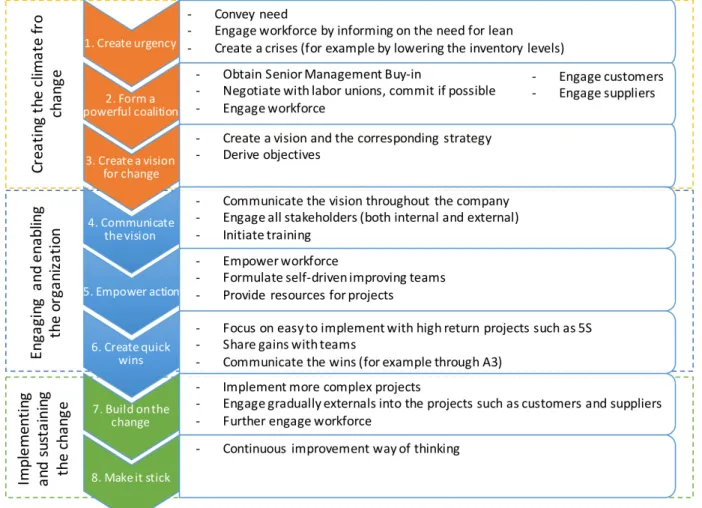
Therefore, the Kotter’s model for leading change was mapped to a lean transformation initiative as can be seen in Fig. 6. The eight steps of Kotter’s model are grouped into three main classes as shown. Steps 1 to 3 enable the creation of the necessary climate for change. This can be considered the most critical stage, as the final success of the lean implementation depends largely on that. In Fig. 6, specific tools that have been already tried for the lean implementation
Mohammed AlManei et al. / Procedia CIRP 72 (2018) 1160–1165 1165
6 Author name / Procedia CIRP 00 (2018) 000–000
are mapped into these steps and structured. As was highlighted in the literature review [1, 2, 20] leadership and management commitment are the key factors for the lean manufacturing implementation. The change to lean manufacturing must be driven by strong leadership. This is why it is integrated in the first phases of the change management programme. Additionally, the engagement of the workforce is critical, and thus need to be considered from the very first stages.
The next steps (4 to 6) deal with the engagement and enabling within the organization. That is why the focus is on the communication within the organization, the preparation of the taskforce through training and enabling them to work on their projects through ownership and responsibility of the projects. Towards the final step of this stage, implementation of simple projects that can have easy wins (harvest the low hanging fruits) can radically increase the commitment of both the management and the workforce into the lean implementation change programme.
Final steps 7 and 8 builds up on the early wins for the full deployment of lean tools and methods, and most importantly sustaining the change and the lean thinking.
Fig. 7. Lean tools roadmap
4.Lean tools roadmap
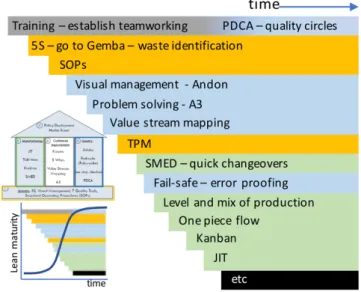
The conceptual framework proposed (fig. 6) highlights the key milestones in the lean journey. However, this does not provide details on the lean tools to be introduced, and focuses more on the surpassing the change objections within the organization. The conceptual framework thus needs to be complemented by a lean tools / methods roadmap. The various tools will be implemented in steps 5, 6 and 7 of the conceptual framework, although the learning of such tools can be expected to be initiated earlier.
For selecting which tools to use first, the “house of lean” can be used. Starting with the foundations of the “house”, the focus should be in securing stability and setting up standards. Tools usually used during this phase include 5S, establishing TPM, visual aids, problem solving thinking, A3, “go to
Gemba” initiatives and SOPs. All these tools can be implemented during stage 6 of the conceptual framework in order to lead to quick wins. In a study presented by Salonitis and Tsinopoulos [1] these specific tools were the ones identified as the more mature ones for companies that have recently embarked into their lean journey. The degree of understanding of lean tools can be also used in order to assign these into stages 6 and 7 of the conceptual framework.
A generic “lean implementation curve” can been suggested with the relevant tools ordered in the sequence to be applied. A proposal of such curve is shown in fig. 7, mapping most of the lean tools to an implementation timeframe. The classification of these tools as per “house of lean” is also color coded. It should be noted that such a timeframe needs to be tailored to the needs and lean maturity of the organization to be introduced to.
5.Conclusions
In the present paper, a conceptual framework for the implementation of lean manufacturing based on change management is proposed. For deciding which change management model to be used, the available models presented were reviewed. Furthermore, the conceptual framework was complemented by a lean tools roadmap, highlighting the sequence of lean tools to be implemented. The next step to this study will be the validation of both the framework and the lean tools roadmap in real manufacturing organizations. References
[1] Salonitis K, Tsinopoulos C. Drivers and Barriers of Lean Implementation in the Greek Manufacturing Sector. Procedia CIPR, 2016;57:189-194
[2] AlManei M, Salonitis K, Xu Y. Lean implementation frameworks: the challenges for SMEs. Procedia CIRP, 2017;63:750-755
[3] Lean Enterprise Institute (2004) www.lean.org
[4] Price ADF, Chahal K. A strategic framework for change management. Construction Management and Economics 2006;24:237-251.
[5] Goff L. Managing at wrap speed. Computerworld 1994;28/43:93
[6] Balogun J, Hope Hailey V. Exploring Strategic Change. 2008; 3rd ed. Pearson Ed.
[7] Huy QN, Mintzberg H. Rhythm of Change. MIT Sloan Management review, 2003.
[8] Hughes M. Change management. 2006; London: Chartered Institute of Personnel and Development.
[9] Newton R. Change Management: Financial Times Briefing. 2011; Pearson Ed. [10] Carnall C. Managing Change in Organizations. 2007; 5th ed.; Pearson Ed. [11] Robbins S, De Cenzo D. Fundamentals of Management. 2008; 6th ed.
Pearson Ed.
[12] Olson E, Eoyang G. Facilitating Organizational Change. 2001; an Francisco: Jossey-Bass/Pfeiffer.
[13] Lewin K. Frontiers of Group Dynamics. Human Relations 1947;1:5-41 [14] Kotter J. Leading Change. 1996;Boston: Harvard Business School Press [15] Kotter J. Accelerate!. Harvard Business Review. 2012. Available at:
https://hbr.org/2012/11/accelerate
[16] Prosci.com. (n.d.). ADKAR Model | Prosci. [online] Available at: https://www.prosci.com/adkar
[17] Covey S. The 7 habits of highly effective people. 2004; Simon & Schuster. [18] Stacey R. Complexity and Organizational Reality. 2010; 2nd ed., Routledge [19] Olson E, Eoyang G. Facilitating Organizational Change. 2001;San Francisco:
Jossey-Bass/Pfeiffer.
[20] Alefari M, Salonitis K, Xu Y. The role of leadership in implementing lean manufacturing. Procedia CIRP, 2017;63:756 – 761.
![Fig. 1. Lean drivers and barriers – force field analysis (based on [2]).](https://thumb-us.123doks.com/thumbv2/123dok_us/115907.2513414/3.892.66.425.106.410/fig-lean-drivers-barriers-force-field-analysis-based.webp)
![Fig. 4. Kotter’s model for leading change [14]](https://thumb-us.123doks.com/thumbv2/123dok_us/115907.2513414/4.892.108.384.835.1077/fig-kotter-s-model-for-leading-change.webp)
![Table 2. Traditional and complex adaptive system approaches to organisational change (based on [19])](https://thumb-us.123doks.com/thumbv2/123dok_us/115907.2513414/5.892.53.441.592.778/table-traditional-complex-adaptive-approaches-organisational-change-based.webp)