SANTIAGO CASTROVIEJO, CARLOS AEDO & LEOPOLDO MEDINA
Management of floristic information on the Internet: the Anthos
solution
Abstract
Castroviejo, S., Aedo, C. & Medina, L.: Management of floristic information on the Internet: the Anthos solution. – Willdenowia 36 (Special Issue): 127-136. – ISSN 0511-9618; © 2006 BGBM Berlin-Dahlem.
doi:10.3372/wi.36.36109 (available via http://dx.doi.org/)
Anthos is the name of a database and search system for quality-controlled chorological and taxo-nomic information on the vascular plants of Spain. It provides a trustworthy solution for the hand-ling of accepted names and their synonyms, based on an analysis of nomenclatural relations. It is based on the MS SQL-Server relational database system. Information can be found on any plant, us-ing its accepted name or synonyms or vernacular names. The geographical search options include lists of all plants of a given territory, a province, a region or an area delimited by its UTM coordi-nates. Additional information is available in the form of photographs or drawings, chromosome numbers, vernacular names and synonyms.
Key words: taxonomy, flora, Iberian Peninsula, Balearic Islands, Canary Islands, database model.
Introduction
The name of a species is like a drawer in which knowledge is stored. When a new species is de-scribed, a hook is created to hang on all the data that may be found about it, be they morphologi-cal, ecologimorphologi-cal, cytologimorphologi-cal, geographimorphologi-cal, molecular, phylogenetic, etc. Of course the drawer and the hook are no more than metaphors. The information connected by the specific name is scattered over a multitude of scientific publications, which appear from time to time in different places.
Apart from experienced, professional botanists, anyone looking for information about a given plant would have to spend whole days hunting through a well-stocked library, uncertain in the end whether all significant publications were traced. A number of useful indices have been drawn up to mitigate this problem, e.g., the Index Kewensis and the Gray Card Index, together accessible in the International Plant Name Index (IPNI 2005),the Kew Record for Taxonomic Literature (in KBD 2005), Chromosome Number Reports (IPCN 2005), Index Londinensis (Stapf 1929-31, 1941), In-dex Holmiensis (Tralau 1969-81, Lundqvist & Nordenstam 1988, Lundqvist 1992, Lundqvist & Jäger 1995-98).Each of these indices covers a special field, but together they do not cover all the
information.
Until recently, the floristic data of a territory were published in printed form, as a flora or a catalogue. These two formats served different purposes: the former gave keys, descriptions, etc. of the plants, the latter only the names of the plants present. To reach the included information the users needed experience; they had to know the names of the plants, the possible synonyms of these names, how to look for information in the catalogue, and so on. In fact, the complexity of the taxonomic and floristic data, including the related geographical, cytological and iconographi-cal details, put the matter beyond the reach of the general public.
This is now changing with the introduction of computer tools, the storage capacity of which provides algorithms for complex searches and which generate a rapid response to the enquiry over any distance by Internet. This innovation is prominent in botanic publications, e.g., Döring & Güntsch 2003, Wilson 2003, Berendsohn & al. 2000, 2002, Berendsohn 2001, 2002, Gewin 2002, Edwards & al. 2000, Jones & al. 2000, Sugden & Pennisi 2000, Pando & al. 1999, Zhon & al. 1996, Mayr 1995.
Numerous attempts have been made to develop botanical databases or plant information sys-tems. Examples are ILDIS (International Legume Database Information System) (Bisby 2000: 2311), Species 2000 (Bisby 2003), an access system to databases like ILDIS; ERIN (Environmen-tal Resources Information Network) (ERIN 2005) in Australia; TROPICOS in the Missouri Botan-ical Garden, USA (TROPICOS 2005); Euro+Med PlantBase (Euro+Med 2005), GBIF (Global Biodiversity Information Facility) (GBIF 2005); BIOCAT (Banc de Dades de Biodiversitat de Catalunya) (BDBC 2005) in Spain.
In September 1999 an agreement was signed in Spain by the Consejo Superior de Investi-gaciones Científicas and the Fundación Biodiversidad to set up a database of the flora of Spain, operating from the Royal Botanic Gardens, Madrid. The programme was called “Anthos. Sistema de información sobre las plantas de España”. It was designed to provide information about the plants in Flora Iberica (Castroviejo & al. 1986-) and the checklist of the Canary Islands (Hansen & Sunding 1993) but it can be used for any other territory as we will explain in the fol-lowing paragraphs.
The problem of synonyms
To make plant life available for human use, groups of similar plant individuals have to be recog-nized and named. Consequently taxonomy and nomenclature are involved, two separate tasks that are, however, complementary. Taxonomy deals with the system of classification, while no-menclature involves the application of a set of previously agreed rules (Greuter & al. 2000) that gives the precise name to each accepted species and its synonyms. The rules are important be-cause the same plant taxon may have been recognized and described more than once, each time under a different name. In that case the same plant taxon will have different names, used in dif-ferent publications and bearing difdif-ferent information. The rules help to determine which name is to be used correctly, but details of the species in the bibliography must still be sought not only under its correct name but also under each of its synonyms.
The first requirement, therefore, in a rigorous search, is to know all the names that may have been applied to the same species, the synonyms. This may appear simple but it is a question that can only be elucidated by taxonomy. That one synonym stands as equivalent to another, at least when they are heterotypical, can be determined only by the study of the plants in question. The number of synonyms of each name that is regarded as correct within a classification can be very high. The number of synonyms mentioned in a publication depends on (a) the amount of study devoted to the flora, and (b) the severity of the taxonomic studies carried out in its preparation. This can be illustrated by some examples:
– In an exhaustive study, such as a monograph, the number of synonyms is very high. In Gera-nium (Geraniaceae),for example, 2202 different names have been found for 416 accepted
taxa, which gives a rate of 5.3 synonyms (Aedo 2005). In Erodium (Geraniaceae), 1080 names have been found for 81 accepted taxa, a rate of 13.3 synonyms (unpublished data). – These rates are usually lower in the floras. In the well-known Flora Europaea (Tutin & al.
1964-80), a total of 40 665 names are used, according to the database Flora Europaea (ESFEDS database). In the prologue to the last of the five volumes (Tutin & al. 1980), Hey-wood states that only 11 557 different species are recognized and described. But if we count the names in bold type, those on which information is given (the 4194 accepted subspecies and other taxa of various ranks), the figure reaches 17 555 names, of which 14 578 are at specific rank, and of these, 1585 have at least two subspecies. The total number of accepted subspecies is 4194. To know the total number of taxa accepted in Flora Europaea (excluding hybrids and infrasubspecific categories), we have to add the number of species to that of the subspecies, sub-tracting from the latter the number of typical subspecies (1585), and that gives 17 187 names considered as correct for the recognized taxa. Since 40 665 is the total number of names used, and the number of accepted taxa is 17 187, the rate of synonyms for each name considered cor-rect is found to be 2.4.
– In Flora Iberica (Castroviejo & al. 1986-), we found 23 831 synonyms in the families studied (15 194 heterotypic, 6800 homotypic and 1837 misapplications) for the 3795 names consid-ered as correct. After subtraction of the misapplications, the average number of synonyms of each accepted name is 6.3.
– These figures are assumed to be similar in the European flora, particularly for neighbouring countries such as France, Portugal, Italy, Greece, etc., where both the degree of variability and the level of studies are similar. The figures for the tropics may be much lower, since the scant collection of the flora and the lesser knowledge of its variability suggest that fewer names have been proposed. The very recent catalogue of the plants of Panama (Correa & al. 2004) and the database W3TROPICOS (TROPICOS 2005) of the flora of Panama give an av-erage of 1.4 synonyms of each name considered correct, although we have to admit that these sources do not include full synonymy.
All of this shows that the existence of so many synonyms in the botanic literature requires that any search for information about a plant must include searches under all synonyms.
In the Anthos programme, gathering information on the flora of the Iberian Peninsula and the Balearic and Canary Islands, the taxonomy adopted (within the possibilities of the treatments) are those of Flora Iberica (Castroviejo & al. 1986-) and, for the groups not yet treated, Greuter & al. (1984-89) and Tutin & al. (1964-80), for the Canary Islands Hansen & Sunding (1993). In to-tal we have 40 630 different names, of which 10 121 are considered as correct either at the spe-cific or infraspespe-cific rank: 7528 species, 2094 subspecies, 493 varieties and 5 forms and nothosubspecies.
The CITAS table of chorological information, which contains the name of the plant and the place where it was found, has at present 1 121 436 name entries. Of course, many of them refer to different places where the same plant is found, often under the same name. By eliminating those entries in which the name of the plant is repeated, the total number of entries is reduced to 33 868. This shows that the various authors, whose work has been used to assemble the CITAS table, have used 33 868 different names for the plants of the Iberian Peninsula and the Balearic and Canary Islands.
The difference between the two figures, the total number (40 630) of different names, those considered correct and the synonyms, gathered in our table of nomenclature (NOMEN) and the total number (33 868) of different names used by the authors gathered in our chorological table (CITAS), gives the number of names which have probably never been used except when they were created. This number, 6762, concerns the names of Iberian plants that have likely never been used in any Spanish or Portuguese flora or catalogue.
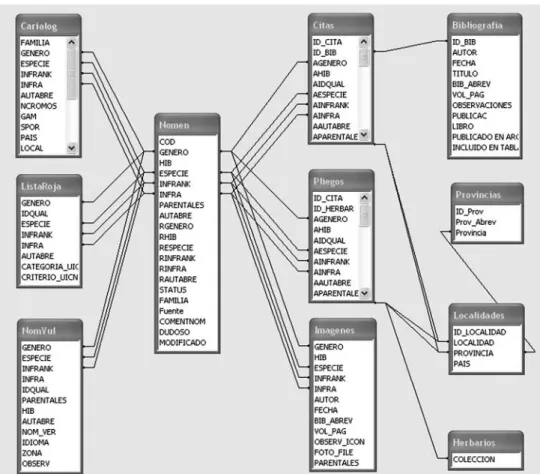
To assess the quality of the information detected in the chorological studies, we compared the fields GENERO, ESPECIE, INFRANK, INFRA of the 10 121 different names considered correct in the NOMEN table with the same fields of the 33 868 names in the CITAS table
(Fig. 1). In the Spanish botanical bibliography, only 33.4 % of the names of the plants used for the chorological information were the same as those now regarded as correct. This means that if we have this information in a database and do not know how to use the synonyms, we loose up to 66.6 % of the information stored.
The consequence is that to manage the botanical data drawn from the bibliography and from the herbaria, the search must include an automatic selection of all names that have been applied to the plant, and that these must be used to obtain all information stored in the database. With the growing volume of data of every kind appearing in the bibliography, manual systems of docu-mentation have become ineffective; they are time-consuming and can not provide a guarantee of completeness.
Then again, synonyms can involve differences of opinion among botanists when they apply the same name to different groups of plants. In taxonomy this is indicated as ‘sensu’ (often used for misapplications, at least in the American taxonomic tradition). Berendsohn (1995) consid-ered this at length when he proposed the concept of ‘potential taxa’ which was not generally ac-cepted because of its intrinsic complexity.
The Anthos system (www.programanthos.org)
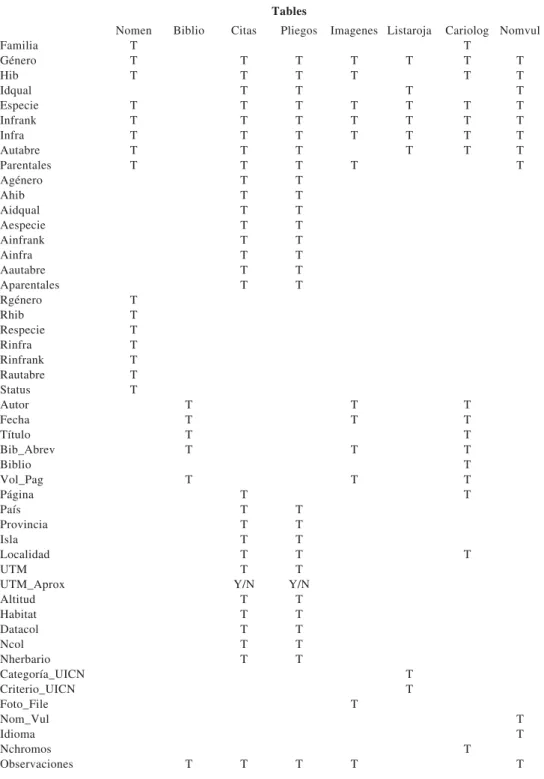
The initial aim of the Anthos programme is to present data from the bibliography, although those of herbarium sheets can also be incorporated. The system consists of a set of related tables (Table 1).
Table 1. Fields and types of data of the tables used by the Anthos database. Type of data (T = text; Y/N = yes/no) in the main fields and tables. Some fields used for internal management of the database are not in-cluded.
Tables
Nomen Biblio Citas Pliegos Imagenes Listaroja Cariolog Nomvul
Familia T T Género T T T T T T T Hib T T T T T T Idqual T T T T Especie T T T T T T T Infrank T T T T T T T Infra T T T T T T T Autabre T T T T T T Parentales T T T T T Agénero T T Ahib T T Aidqual T T Aespecie T T Ainfrank T T Ainfra T T Aautabre T T Aparentales T T Rgénero T Rhib T Respecie T Rinfra T Rinfrank T Rautabre T Status T Autor T T T Fecha T T T Título T T Bib_Abrev T T T Biblio T Vol_Pag T T T Página T T País T T Provincia T T Isla T T Localidad T T T UTM T T
UTM_Aprox Y/N Y/N
Altitud T T Habitat T T Datacol T T Ncol T T Nherbario T T Categoría_UICN T Criterio_UICN T Foto_File T Nom_Vul T Idioma T Nchromos T Observaciones T T T T T
The relations between names are based on taxonomies published by the authors of the generic syntheses and the counterchecked relations in an earlier computer application (Castroviejo & al. 1996). From a single name, a consultation will therefore draw on the whole series of its syn-onyms. For this purpose each type of information – taxonomic, chorologic, iconographic, de-scriptive, etc. – has a table with the following common fields: GENERO, which includes the generic name; SPECIES, with the name of the species; INFRANK, with the infraspecific rank (subsp., var., f., etc.) when appropriate; INFRA, with the name of the infraspecific taxon when appropriate, and AUTABRE (author string), with the abbreviated name of the authors of the taxon, whether this is specific or infraspecific.
The most important tables
– NOMEN is the table with taxonomic and nomenclatural information. Every entry of a name has to include the following information: (a) the name itself with the above-mentioned fields – GENERO, ESPECIE, INFRANK, INFRA and AUTABRE; (b) the accepted name (which may be exactly the same as that in a); (c) the basic name (which again may be the same as in a). In other words, the system provides all information required for the detection of syn-onyms, both homotypical and heterotypical.
– CITAS contains all chorological data drawn from the bibliography. In addition to the name used in the publication (whether considered as correct or as one of the synonyms after its corporation into the fields of GENERO, ESPECIE, INFRANK, INFRA and AUTABRE), it in-cludes geographic information under the fields PAIS, PROVINCIA, ISLA, LOCALIDAD, UTM and ALTITUD, with the geographical data of the place where the plant was collected, always georeferenced in UTM coordinates to within 10 km.
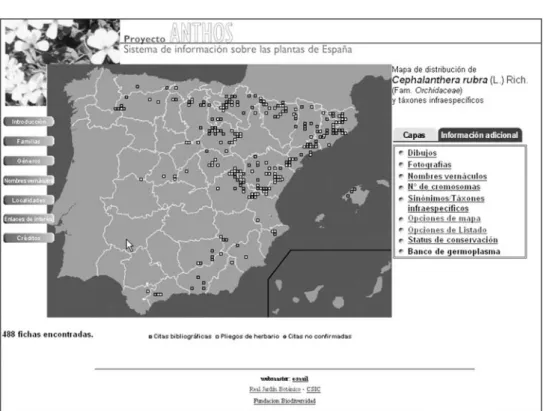
Fig. 2. Anthos output – distribution ofCephalantera rubra(L.) Rich. in Spain, based on literature and herbar-ium data.
To come to terms with the problem of the ‘sensu’ mentioned earlier, a double entry is made of the fields containing the name of the plant. In the first entry, the name appears as written by the initial author, while in the second it is given in the form considered correct (when this is known). When we are quite certain that the author made an incorrect interpretation, we intro-duce the name we consider correct. In this way, the original version of the information is maintained but the record can be managed without complications. The enquirer will use first the information given in the corrected entry.
– BIBLIOGRAFIA presents the bibliographic references of all the sources of information used in the databases, so the source can be checked.
The secondary tables
– IMAGENES contains references to drawings and photographs, both stored in JPEG form. The available digital images of drawings are taken from the following works: 1837 from Castro-viejo & al. (1986-) and 996 from the classical works (Willkomm 1852-62, 1881-92, Boissier 1839-45, Hoffmansegg & Link 1809-40, Lange 1864-66). At present, 11 253 photographs and plates of 5459 plant species are available.
– CARIOLOG presents the chromosome number data, with the author, the title of the work and the bibliographic reference to the journal or book in which they appeared.
– NOMVUL gives the common or vernacular names of each plant and an indication of the lan-guage (Spanish, Portuguese, Basque, Catalan or Galician) in which these names are used. – PLIEGOS contains chorological data drawn from herbarium specimens.
– LISTAROJA gives the information drawn from the Red List (Aizpuru & al. 2000).
– LOCALIDADES contains all localities of the publications included in CITAS and the herbar-ium labels included in PLIEGOS. They are linked to the province and to the country to which they belong (some of them are now in Portuguese territory).
– PROVINCIAS gives all the provinces of Spain and Portugal as they appear in Flora Iberica, with their abbreviations.
The algorithm(sequence of searches in the Anthos programme)
Two different types of information can now be sought: plant-based (geographical distribution, synonyms, vernacular names, drawings, photographs, etc.) and locality-based (lists of the plants found there).
(a) The sequence of commands for searching information about a plant can start with the sci-entific name or with the vernacular name. If we write the scisci-entific name, the sequence is: (1) Se-lect from the NOMEN table all the other associated names (the one considered correct and all the synonyms). (2) From the CITAS table, take out all entries linked to each one of them. (3) Repeat this operation with the tables IMAGENES, etc. (4) From the data drawn from the table CITAS, de-rive the map that will appear on the screen (Fig. 2). This will give a map of the species, with win-dows that will allow us to change the basic map of the distribution or else obtain additional information about the selected species, whether in the form of plates, photographs, synonyms, number of chromosomes, vernacular names, as well as any infraspecific taxa that may exist.
If the user wishes to find information about the synonyms, the list is shown drawn from the NOMEN table. If his interest lies in the number of chromosomes, vernacular names, etc., the sys-tem turns from this list of names to consult the tables CARIOLOG, NOMVUL, etc.
Should he wish to see a plate or photograph in the IMAGENES table, the process is similar and uses all names taken from NOMEN.
In this way, two rather important objectives are achieved: information can be sought by using either the accepted name of the plant or a synonym, and the database preserves the original infor-mation as it was published, even though the original name has fallen into disuse.
When information is sought under a vernacular name, the programme searches the NOMVUL table and presents the various scientific names that may be appropriate. The user types one of them and then follows the steps as before.
of a province or locality or from one or several of the UTM coordinates. The system is similar in both cases: once the UTM coordinate(s) or the locality are selected, the search proceeds to the CITAS table and selects all the entries that satisfy the terms of the request, drawing up a relation-ship of names that are passed to the NOMEN table and transformed into the name that is consid-ered correct. The relationship is shown alphabetically on the screen.
Completeness of the information
The chorological data now provided by Anthos may be considered as fairly representative of the information published on the Spanish flora. The system stores some 650 000 entries in the CITAS table. Considering the approximately 8300 taxa in Spain (c. 7200 on the peninsula and the Balearic Islands and c. 1070 on the Canary Islands, Beltran Tejera & al. 1999: 12), we find that each one is quoted about 78 times in the mean. Of course: information is scarce about some plants and abundant in others. Related to the land surface, the stored information reaches an av-erage of 1.2 plants quoted per km². A very prudent estimation of the total number of quotations for Spain approaches two million, so a lot has to be done to incorporate all the published material into the CITAS table. We presume that the caryological data, vernacular names and the red list are better covered as they are brought up to date periodically.
The users of Anthos
The Anthos project is designed to give access to botanical and chorological information to the heterogeneous group of scientists, experts in biodiversity and amateur botanists. The demands for information from scientists are in the spheres of taxonomy and floristics, so clear and com-plete data in these areas must be provided. Professionals working in land management and con-solidation, or in the preservation and protection of species, require distribution maps of plants and supporting data, and these must be particularly reliable and detailed.
Our statistics show an average of 160 consultations a day on weekdays, of which we estimate a 5 % interested in the functioning of the programme. During the weekend and on official holi-days, access falls to about 55 visits per day. From the IP addresses of logged users we have found that 74.3 % are from Spain, 7.4 % from Portugal, 6.8 % from other EU countries, 7.8 % from the Americas and 3.7 % from unidentified places.
Concluding remarks
The next financial period of three years (2006-09) will centre on the following objectives: (a) Completion of the bibliographic work. A close to 100 % coverage of Spanish and Iberian botanical publications, which we estimate at two million items, is attempted .
(b) Improvement of the floristic and geographical data. The data in Anthos contain errors re-sulting from both the original data and their transcription into the database, mostly misspellings and incorrect coordinates. In addition to periodic corrections by revising sets of entries, an auto-matic method of reporting errors by the users is installed, and these are corrected without delay.
(c) Development of a new environment of geographic information. Advances in digital car-tography and especially in map servers require an updating to improve service to users. A map server is being designed that will include all the information offered by Anthos and will facilitate analyses to explain the distribution of plants in the study area.
Acknowledgements
We wish to express our thanks to the many people who helped so generously in the development of the programme. In the first place the representatives of the Government (Juan Luis Muriel, Secretario General de Medio Ambiente (MMA), and Antonio Serrano, Secretario General del Territorio y la Biodiversidad (MMA)) and the Fundación Biodiversidad (Mercedes Tauler, María
Artola and Germán Alonso) for financial support. We owe the first steps of the technical devel-opment to Francisco Pando, Félix Muñoz and Juan Armada, and later to Silvia Lusa, all of whom have given invaluable help. We are much obliged to Mercedes Monzó, responsible of the data in-put process. And we owe sincere thanks to the many users who have helped us by sending mes-sages warning us of errors or contributing information. Our gratitude concerns also to the editors and two anonymous reviewers for their helpful comments on an earlier version of this manuscript.
References
Aedo, C. 2005: Geraniumtaxonomic information system. – Published on the Internet http:// www.rjb.csic.es/Geranium/index_geranium.html
Aizpuru, I. & al. 2000: Lista Roja de la flora vascular española (valoración según categorías IUCN). – Conserv. Veg.6:11-38.
Beltrán Tejera, E., Wildpret de la Torre, W., León Arenciabia, M. C., García Gallo, A. & Reyes Hernández, J. 1999: Libro Rojo de las especies de la flora canaria incluidas en el Anexo 2 de la Directiva 92/43/CEE del Consejo. DGCONA, Ministerio de Medio Ambiente. – Madrid. BDBC 2005: Biodiversity data bank of Catalonia. – Published on the Internet http://biodiver.
bio.ub.es/biocat/homepage.html.
Berendsohn, W. G. 1995: The concept of “potential taxa” in databases. – Taxon44:207-212. — 2001: ENHSIN & BioCASE – Access to European Collections. 17th annual meeting of the
Taxonomic Databases Working Group (TDWG), Sydney, November 2001, Abstract Vol-ume. – Sydney.[CrossRef]
— 2002: BioCASE – A Biological Collection Access Service for Europe. – Alliance News 29(6):6-7.
— , Costello, M. J., Emblow, C., Güntsch, A., Hahn, A., Koenemann, J., Thomas, C., Thomson, N. & White, R. 2000: Concepts for a European Portal to Biological Collections. In: Berend-sohn, W. G. (ed.), Resource identification for a Biological Collection Information Service in Europe. – Berlin.
— , Döring, M., Gebhardt, M. & Güntsch, A. 2002: BioCASE – A Biological Collection Access Service for Europe. Trends and developments in biodiversity informatics. Symposium: Key Innovations in Biodiversity Informatics, Indaiatuba, Brasil 2002, Abstract Volume. – Pub-lished on the Internet http://www.cria.org.br/eventos/tdbi/bis(biocase).
Bisby, F. A. 2000: The quiet revolution: biodiversity informatics and the Internet. – Science 289:2309-2312.[CrossRef]
— 2003: Species 2000: an architecture and strategy for creating the Catalogue of Life. – Ab-stracts, Proceedings of the fourth biennial meeting of the Systematics Association, Dublin, Ireland, 18.-23.8.2003. – Dublin.
Boissier, P. É. 1839-45: Voyage botanique dans le midi de l’Espagne1-2.– París.
Castroviejo, S., Aedo, C., Pando, F., Muñoz Garmendia, J. F. & Sánchez Laulhé, F. 1996: Flora Iberica en CD-ROM1-4.–Madrid.
Castroviejo, S. (ed. gen.) & al. 1986-: Flora iberica. Plantas vasculares de la Península Ibérica e Islas Baleares1-8, 10, 14, 21.– Madrid.
CONABIO 2005: Comision Nacional del Uso y Conocimiento de la Biodiversidad
Correa, M. D., Galdames, C. & Stapf, M. 2004: Catálogo de las plantas vasculares de Panamá. – Panamá.
Döring, M. & Güntsch, A. 2003: Technical introduction to the BioCASE software modules. 19th annual meeting of the Taxonomic Databases Working Group (TDWG 2003), Oeiras, Lisbon 2003, Abstract. – Published on the Internet http://www.tdwg.org/2003meet/paperabstracts/ TDWG_2003_Posters_Markus_Doring_1.htm).
Edwards, J. L., Lane, M. A. & Nielsen, E. S. 2000: Interoperatibility of biodiversity batabases: biodiversity information on every desktop. – Science289:2312-2314.
ERIN 2005: Environmental Resources Information Network. – Published on the Iternet http:// www.deh.gov.au/erin/
GBIF 2005: The Global Biodiversity Information Facility. – Published on the Internet http:// www.europe.gbif.net:80/portal/index.jsp
Gewin, V. 2002: All living things, on line. – Nature418:362-363.
Greuter, W., Burdet, H. M, & Long, G. 1984-89: Med-Checklist. A critical inventory of the vas-cular plants of the circum-mediterranean countries1, 3-4.– Genève & Berlin.
— , McNeill, J., Barrie, F. R., Burdet, H. M., Demoulin, V., Filgueiras, T. S., Nicolson, D. H., Silva, P. C., Skog, J. E., Trehane, P., Turland, N. J. & Hawksworth, D. L. 2000: International Code of Botanical Nomenclature (Saint Louis Code). XVI International Botanical Congress, St Louis, Missouri, July-August 1999. – Regnum Veg.138.
Hansen, A. & Sunding, P. 1993: Flora of Macaronesia. Checklist of vascular plants. – Sommer-feltia17.
Hoffmannsegg, J. C. & Link, H. F. 1809-40: Flore portugaise1-2.– Berlin.
IPCN 2005: Index to Plant Chromosome Numbers Data Base. – Published on the Internet http:// mobot.mobot.org/W3T/Search/ipcn.html
IPNI 2005: International Plant Name Index. – Published on the Internet http://www.ipni.org/in-dex.html.
Jones, A. C., Sutherland, I., Embury, S. M., Gray, W. A., Whiteal, R. J., Robinson, J. S., Bisby, F. A. & Brandt, S. M. 2000: Techniques for effective integration, maintenance and evolution of species databases. – Pp. 3-13 in: Gunther, O. E. & Lenz, H. J. (ed.), Proceedings of the 12th International Conference on Scientific and Statistical Database Management. – Pub-lished on the Internet http//www.computer.org/proceedings/ssdbm/0686/0686toc.htm. KBD 2005: Kew Bibliographic Databases. – Published on the Internet http://www.kew.org/
kbd/jsp/more_about_bibliographies.jsp.
Lange, J. M C. 1864-66: Descriptio iconibus ilustrata plantarum novarum. – Copenhague. Lundqvist, J. 1992: Index holmiensis7.– Stockholm.
— & Jäger, E. 1995-98: Index holmiensis8-9.– Stockholm. — & Nordenstam, B. 1988: Index holmiensis6.– Stockholm.
Mayr, E. 1995: Systems of ordering data. – Biol. Philos.10:419-434.[CrossRef]
Pando, F., Muñoz Garmendia, J. F. & Aedo, C. 1999: Manual de las bases de datos nomen-claturales de Flora Mycologica Iberica y Flora Iberica. – Cuad. Fl. Micol. Ibérica14:3-58. Stapf, O. (ed.) 1929-31, 1941: Index londinensis1-6+ Suppl.1-2.– Oxford.
Sugden, A. & Pennisi, E. 2000: Diversity digitized. – Science289:2305. Tralau, H. (ed.) 1969-81: Index holmiensis1-5.– Stockholm.
TROPICOS 2005: Missouri Botanical Garden’s VAST (VAScular Tropicos) nomenclature data-base and associated authority files. – Published on the Internet http://mobot.mobot.org/ W3T/Search/vast.html.
Tutin, T. G., Heywood, V. H., Burges, N. A., Valentine, D. H., Walters, S. M. & Webb, D. A. (ed.) 1964: Flora europaea1.– Cambridge, etc.
— , — , —, Moore, D. M., Valentine, D. H., Walters, S. M. & Webb, D. A. (ed.) 1976-80: Flora europaea2-5.– Cambridge, etc.
Willkomm, H. M. 1852-62: Icones et descriptiones plantarum novarum1-2.– Leipzig. — 1881-92: Illustrationes florae hispanicae insularumque balearicum1-2.– Stuttgart. Wilson, E. O. 2003: The encyclopedia of life. – Trends Ecol. Evol.18(2):77-80.[CrossRef] Zhon, Y., Jung, S., Pramanik, S. & Beaman, J. H. 1996: Data model and comparison and query
methods for interacting classifications in a taxonomic database. – Taxon 45: 223-241.[CrossRef]
Address of the authors:
Santiago Castroviejo, Carlos Aedo, Leopoldo Medina, Real Jardín Botánico, CSIC, Plaza de Murillo 2, ES-28014 Madrid, Spain; email: [email protected].