Mayo: A Framework for Auto-generating
Hardware Friendly Deep Neural Networks
Yiren Zhao
∗University of Cambridge Cambridge, UK [email protected]
Xitong Gao
†Shenzhen Institute of Advanced Technology, Chinese Academy of Sciences
Shenzhen, China [email protected]
Robert Mullins
University of Cambridge Cambridge, UK [email protected]Chengzhong Xu
Shenzhen Institute of Advanced Technology, Chinese Academy of Sciences
Shenzhen, China [email protected]
ABSTRACT
Deep Neural Networks (DNNs) have proved to be a convenient
and powerful tool for a wide range of problems. However, the
ex-tensive computational and memory resource requirements hinder
the adoption of DNNs in resource-constrained scenarios. Existing
compression methods have been shown to significantly reduce the
computation and memory requirements of many popular DNNs.
These methods, however, remain elusive to non-experts, as they
demand extensive manual tuning of hyperparameters. The effects
of combining various compression techniques lack exploration
be-cause of the large design space. To alleviate these challenges, this
paper proposes an automated framework,Mayo, which is built on top of TensorFlow and can compress DNNs with minimal human
intervention. First, we present overriders which are
recursively-compositional and can be configured to effectively compress
indi-vidual components (e.g.weights, biases, layer computations and gradients) in a DNN. Second, we introduce novel heuristics and
a global search algorithm to efficiently optimize hyperparameters.
We demonstrate that without any manual tuning,Mayogenerates a sparse ResNet-18 that is 5.13×smaller than the baseline with no loss in test accuracy. By composing multiple overriders, our
tool produces a sparse 6-bit CIFAR-10 classifier with only 0.16%
top-1 accuracy loss and a 34×compression rate.Mayoand all com-pressed models are publicly available. To our knowledge,Mayois the first framework that supports overlapping multiple
compres-sion techniques and automatically optimizes hyperparameters in
them.
CCS CONCEPTS
•Computing methodologies→Computer vision;•Mathematics
of computing→Arbitrary-precision arithmetic;•Software and
its engineering→Software libraries and repositories;
KEYWORDS
Deep Neural Network, Pruning, Quantization, Automated
Hyper-parameter Optimization
∗ †
Xitong Gao and Yiren Zhao contributed equally to this work.
1
INTRODUCTION
Deep Neural Networks (DNNs) achieve state-of-the-art
perfor-mance on both vision [17] and speech [9] applications by leveraging
parameter-rich networks learning from massive amount of data.
Traditionally, the substantial computational resources required by
DNNs are prohibitively expensive in low-powered environments,
making the deployment of large neural networks a challenging
endeavour.
DNNs are, in general, inherentlyredundant, which means that many operations in DNNs compute highly-correlated results. We
can exploit this fact to accelerate DNNs without a detrimental
impact on accuracies. Researchers have proposed various
com-pression techniques. For instance, sparsity-inducing regularization
methods [21] encourage sparsity in DNNs, enabling us to prune
computations by skipping those of negligible importance.
Quantiza-tion techniques [12] use low-precision arithmetic instead of 32-bit
floating-points traditionally used by CP Us and GP Us. Low-rank
approximation (LRA) [15] identifies redundancies in DNNs by
sin-gular value decomposition, then eliminates them by reducing the
rank of the singular matrix. These optimizations directly engender
computation or memory savings in a custom hardware design.
Although these techniques demonstrate high effectiveness in
compressing DNNs with minimal loss of accuracies, they are often
associated with large hyperparameter design spaces. For instance,
the compression of different components (weights, activations,etc.) in each layer can be configured differently. The search process of
suitable hyperparameters that provide high compression rates and
minimal impact on accuracies in DNNs is often time-consuming,
and demands expertise in the respective methods and the
underly-ing network structure. In addition, it has been shown that many of
these compression methods can be used jointly [7]. The
composi-tional nature encourages us to chain them to achieve even higher
compression rates, yet it further exacerbates the difficulty in
find-ing the optimal settfind-ings, due to the combinatorial explosion of the
hyperparameter design space and the fact that the interplay among
these compression methods is not well-understood.
In this paper we present a new framework,Mayo, to assist the explorations of various compression techniques with hardware
design in focus, as the first step toward a fully automated DNN
architecture optimizer that rivals manual tuning by human experts.
A typical layer computation in a DNN forward pass can generally
be represented byxi =fi(xi−1,Θi), where of thei-th layer, fi is
the underlying algorithm,xi−1is the input, andΘirepresents the trainable parameters. Our framework contains a wide range of
oper-ations which we calloverridersthat can be fully customized to over-ride various components in the computation above. For instance,
the layer computation can be replaced withxi =f˜i(xi−1,Θ˜i), where
the parametersΘ˜iand the functionf˜i are hardware-efficient vari-ants ofΘiandfigenerated by the respective overriders. Overriders can also be composed by chaining multiple overriders in sequence.
Finally,Mayocan efficiently explore the design space of hyperpa-rameters within overriders to achieve high compression rates while
minimizing the impact on the accuracies of DNNs.Mayocan be easily applied in the scenarios including but not limited to:
• trade off inference speed and accuracy; and
• slim large models on a smaller dataset with fewer labels using transfer learning [26].
This paper makes the following contributions:
• We introduce theMayoframework by discussing the sup-ported compression techniques, and explain how we use
novel heuristics to automatically derive some
hyperparam-eters based on input conditions (Section 3.1).
• We propose a resource-aware search algorithm that can au-tomatically optimize hyperparameters in overriders while
minimizing the impact on accuracies (Section 3.2).
• Building upon the contributions above, we present two case studies. First, we demonstrate howMayocan obtain state-of-the-art compression rates automatically with
fine-grained pruning (Section 6.1). In the second case study,
we show the optimization results of chaining pruning and
quantization methods, and further demonstrate that
non-linear quantization works better than the non-linear variants
on pruned DNNs (Section 6.2).
2
RELATED WORKS
2.1
Compression Techniques
A wide range of compression techniques have proven to be
effec-tive for lowering the computation and memory requirements in a
pretrained DNN.
Pruning directly reduces the number of connections. Guoet al.[5] propose dynamic network surgery for fine-grained pruning, using
adjustable threshold conditions to remove individual weights and
their connections from the DNN. Maoet al.[24] show the extra overhead of fine-grained pruning on SIMD architectures, but
sug-gest that a coarse-grained variant has a faster inference time at the
cost of a lower compression rate. The granularity of pruning and
the pruning ratio are therefore often varied to provide a suitable
trade-off between performance and DNN’s accuracy.
Quantization methods enable each parameter to be represented
with much narrower bit-width than the 32-bit single-precision
floating-point typically used in CP U- or GP U-based DNN
imple-mentations. In the extreme case, the parameters can be binary
values [11]. This significantly reduces the memory requirements
for parameters. Furthermore, quantized intermediate computations
in DNNs use low-precision arithmetic, which in turn save
com-putational resources. These methods use number representations
and arithmetics based on, for instance, fixed-point arithmetic [6],
logarithmic [20], powers of 2 [27],etc.Similar to pruning, quan-tization provides diverse design trade-offs among speed, energy
expenditure and accuracy.
Besides these techniques, there are many alternative
compres-sion methods. For instance, low-rank approximation [15, 23]
re-duces the rank of the weight matrix while minimizing the deviation
from the original.
Hanet al.[7] further demonstrate that combining a series of com-pression algorithms gives even higher comcom-pression rates, and show
that many popular large-scale DNNs can be compressed in size
dramatically. Their methodology, however, tweaks
hyperparame-ters by hand. With compositionality in mind, we designMayoto scalably explore the design space, steering the interaction of
multi-ple compression methods to automatically optimize the trade-off
relationship between speed and accuracy.
2.2
Existing Tool-chains and Frameworks
Various frameworks have been developed to fine-tune DNNs for
resource-constrained scenarios. Gyselet al.[6] proposeRistretto to compress models mainly using fixed-point quantizations. Milde
et al.[25] introduceADaPTION which also performs fixed-point quantizations, but further extends them to to support stochastic
round-off behaviours. Zhouet al.[28] presentDoReFa-Netwith
TensorPack, and they are the first to propose training with limited-precision gradients.
3
OPTIMIZATIONS
Quantization methods allow us to configure hyperparameters (e.g.the bit-widths) used by individual components in a DNN, directly
re-ducing the hardware resource usage while increasing the round-off
and overflow errors incurred. The resulting search space of
hyper-parameters to trade off resources with accuracy may however be
infeasible to traverse exhaustively. In this section we explain how
to automate and accelerate the search procedure. Our approach
is two-fold. In Section 3.1, we first introduce various quantization
methods used inMayo, and the corresponding heuristics to sen-sibly determine some of the hyperparameters. We then continue
to explain in Section 3.2 how all remaining hyperparameters are
selected automatically.
3.1
Quantizations and Heuristics
For custom hardwares, the most pervasive quantization method
is fixed-point quantization. Ann-bit fixed-point number with a binary point positionpcan represent a real valuexwith:
x=2−p×m1m2. . .mn, (1)
where the bitsm1m2. . .mndenote a binary integer in 2’s-compliment.
It is clear from Equation (1) that the range of representable
val-ues are bounded by[−2−p2n, 2−p(2n−1)], and values outside this range are quantized by saturation,i.e.represented by one of the bounds accordingly. Moreover, the choice ofpalso affects accuracy aspyields round-off error bounded by 2−p.
We observe that saturated values often have greater impact on
accuracy than the precisionpused. We thus iteratively adjustpfor each set of parameters such that the mean quantization error,i.e.the mean of the sums of round-off and saturation error,i.e.kx−x˜k1, the`1-distance between the data and the quantized variant, is minimized. In contrast to Courbariauxet al.[3], our algorithm is a search procedure, which preventspto oscillate between consecutive iterations.
Mayoadditionally implements amini-floatquantization, which follows the IEEE-754 floating-point standard [14], but allows
arbi-trary bit-widths to be used. A mini-float can represent real values
with:
x=(−1)s×2e−b×1.m1m2. . .mp, (2)
wheresis the sign bit, the exponenteis ak-bit non-negative integer, the biasbis a constant offset applied toe, and thep-bitm1m2. . .mp
represent the mantissa bits, here 1.m1m2. . .mpindicates an
un-signed fixed-point number in binary.
A mini-float quantization scheme(k,b,p)has three hyperparam-eters, the combinations of all possible values are thus infeasible to
explore exhaustively. We therefore reduce the search space to the
bit-widthn=k+p, and algorithmically determine the quantiza-tion scheme fromnand the input data by minimizing the incurred quantization error. Our approach is similar to the algorithm
de-scribed for fixed-point. For a given bit-widthn, we iterate through mantissa widthsp ∈ [0,n], and usek =n−pas the exponent widths. With givenkandp, it is now possible to compute a biasb so that no overflow occurs in the quantized values. Using the above
(k,b,p), we can deduce the round-off error in a way similar to the fixed-point case, and finally find the hyperparameter combination
that minimizes the error.
Quantization with powers of 2 is a degenerate form of the
mini-float that uses no mantissa,i.e.p=0. Our heuristic search process also works for this specialized form to search forb, givenkand the input data. This method results in the following representable
values:
x =(−1)s ×2e−b. (3) In hardware implementations, multiplications with powers of 2 can
be achieved with barrel shifters, which in general are much cheaper
than multipliers.
It is noteworthy thatMayoapproximates all quantization meth-ods using floating-point numbers, this approximation may
intro-duce round-off error that are not captured in this tool.
3.2
Automated Hyperparameter Optimization
The techniques detailed above reduce quantization design to the
choice of quantization bit-widths, significantly reducing the size of
the hyperparameter exploration space. In this section we further
extend our methodology to automatically explore the remaining
hyperparameters.
Without a loss of generality, here we adopt the view that a
hyper-parameterγis associated with a predefined performance penalty cost(γ)monotonic toγ. For instance, we may use the computa-tional or memory utilization estimates as the penalty function of
γ. With this notion, we greedily decrement the hyperparameterγt with the highest cost until the accuracy requirement can no longer
be met.
Algorithm 1Hyperparameter Optimization
1: procedureOptimize(N,αbudget,Γ,∆,s)
2: B←
3: whileΓchanged∨ I(Γ)/B, do
4: t←argmaxt∈I(Γ)/Bcost(γt)
5: γt←γt−δt 6: α←train(N,Γ,s) 7: ifα≥αbudgetthen 8: continue 9: ifδt ≥ϵtthen 10: backtrack(N,Γ) 11: δt ←δt 2 12: else 13: B=B∪ {t}
Algorithm 1 is a high-level description of our greedy search
with backtracking, which accepts a DNNNand produces a fine-tunedNwith a set of minimized hyperparametersΓas its output, while satisfying the desirable accuracy targetαbudget. Here, the inputΓinitializes all hyperparameters to their upper bounds, and∆ specifies the stride sizes used to decrement hyperparameters. The
function train(N,Γ,s)fine-tunesNwithΓforssteps and returns the final accuracy ofN,I(Γ)denotes the indices that can be used to address hyperparameters, backtrack(N,Γ)returnsN andΓto their previous states. Finally,δt ∈∆is the stride used to decrement
γt,ϵtis the lower bound onδt, andBblacklists hyperparameters that can no longer be minimized without degrading the accuracy
belowαbudget.
4
FEATURES
Mayois built on top of TensorFlow [1] and specializes in DNN compression with quantization methods in Section 3.1, pruning
techniques [5], LRA [15],etc.These methods are implemented as objects calledoverridersinMayo. Overriders can be flexibly applied to not only parametersΘi, but also the underlying algorithmfi, and even the gradient of each layer computationxi =fi(xi−1,Θi). The design of overriders provides an abstraction for various
com-pression techniques.
An overriderд∈G, configured with suitable hyperparameters, takes a multi-dimensional array as input, and produces a new array
with the same shape as the compressed variant. ParametersΘican thus be simply substituted using any overriderдparam∈G:
˜
Θi =дparam(Θi). (4) Moreover, overriders can be used to customize other components
in a DNN. For example, we can customize the activation function
to replacefiwithf˜i, using an overriderдactivation∈G, where for
any inputxi−1and parametersΘi, we have:
˜
fi(xi−1,Θi)=дactivation(fi(xi−1,Θi)). (5)
Finally, overriders are recursively-compositional. Multiple
over-riders can be chained in sequence, which in turn provides greater
compression opportunities. For example, given a pruning overrider
дand a quantizing overriderh, the composition of them is also an overrider that can be applied to any components,i.e.h◦д∈G. In 3
Mayo Ristretto ADaPTION DoReFa Pruning fine-grained 3 7 7 7 coarse-grained 3 7 7 7 Quantization fixed-point 3 3 3 3 dynamic fixed-point 3 3 3 7 mini-float 3 3 3 7 log 3 7 7 7 shift 3 3 3 7 Layer-wise customization 3 3 3 7
Automated hyperparameter optimization 3 7 7 7
Compression method chaining 3 7 7 7
Customizable components w/a/g w/a w/a w/a/g
Configuration format YAML Caffe Caffe Python
Table 1: A comparison: Ristretto [6], ADaPTION [25], DoReFa [28] andMayo.
this case, for any parametersΘ:
˜
Θ=h(д(Θ)). (6)
InMayo, DNNs are described in a readable format calledYAML[2]. Individual components (e.g.weights, biases, activations and gra-dients) of each layer can be flexibly customized by specifying the
overriders and the associated hyperparameters to use. Each
com-ponent in each layer can therefore be customized differently by
having different overriders.
5
COMPARISONS TO EXISTING
FRAMEWORKS
Table 1 compares the features ofMayoto the compression frame-works mentioned in Section 2.2. Here, the customizable components
w,aandgrespectively denote the weight parameters, activation and gradients of each layer computation. Most of the existing
frame-works focus purely on quantizations. In contrast, quantization is
just one of the many classes of overriders inMayo.Mayofurther supports other compression techniques such as fine- and
coarse-grained pruning, and LRA. Additionally,Mayois highly flexible: it can customize the compression techniques used by any individual
components in each layer. It is also the first tool that supports
chaining multiple compression techniques.
Mayofurther automates hyperparameter optimization. Both
RistrettoandADaPTIONsupport fine-tuning quantized DNNs, but the process of manual hyperparameter optimization is often
time-consuming and requires extensive knowledge in both the
compres-sion method and the underlying network structure. For example, a
common flow inADaPTION is to manually allocate bit-widths in a layer-wise manner and tweak them repeatedly until the accuracy
and bit-width criteria are met. Mayocompletely automates the manual process, and provides a trade-off between the compression
rate and test accuracy.
6
EXPERIMENTS
In this section, we present two case studies. The first one applies
fine-grained pruning on a wide range of vision DNNs to
demon-strate our automated hyperparameter optimization in Section 3.2.
The second showcases the quantization methods in Section 3.1, and
examines the effects they have on a DNN and its pruned variant.
6.1
Fine-grained Pruning
In this case study, we override weight parameters of each layer
using a fine-grained pruning method known as dynamic network
surgery (DNS) [5], where each layer is associated with a
hyper-parameter to trade-off sparsity with the network accuracy. We
use automated hyperparameter optimization to compress a wide
range of DNNs. Our optimization is resource-aware, as we define
the penalty function of each hyperparameter to be the number of
remaining active parameters in the layer. Table 2 shows 2–90× compression rates on them, where ER and CR respectively denote
error rate and compression rate. Here, LeNet-5 [18] classifies the
MNIST dataset [19]. CifarNet is a custom-built classifier for the
CIFAR-10 dataset [16]. Finally, AlexNet [17], SqueezeNets [13] 1.0
and 1.1, MobileNetV1 [10], and ResNet-18 [8] classify images in
Im-ageNet [4]. Moreover,Mayofully supports the depthwise-separable convolution layers and residual connections respectively found in
MobileNetV1 and ResNet-18.
Table 3 shows our automated pruning comparing against other
published results with manual optimization. The first (Na¨ıve) and
the second (Deep Compression) methods produced by Hanet al.[7] respectively show grained pruning with and without
fine-tuning to regain the lost accuracy due to pruning. As Hanet al. ap-plies multiple compression passes, we only consider their pruning
results for a consistent comparison. The third method is the original
DNS used by Guoet al.[5]. They manually tailored the hyperpa-rameters to obtain a compression rate of 17.7×. InMayo, although the top-1 error increases by 1.05%, we managed a much higher
compression rate at 21.8×, as we allow each layer to adopt different hyperparameter values. For the larger DNNs such as MobileNetV1
and ResNet-18,Mayorespectively achieves compression rates of 2.97×and 5.13×, with top-1 accuracy losses of only 0.76% and
−0.28%.
Model Name Original ER Increase in ER CR
LeNet-5 [18] 0.7%/0% 0%/0% 90.1× CifarNet 8.63%/0.34% 0.25%/-0.04% 6.39× AlexNet [17] 44.14%/21.40% 1.27%/0.20% 21.83× SqueezeNet 1.0 [13] 43.55%/20.76% 0.27%/0.11% 2.07× SqueezeNet 1.1 [13] 43.01%/20.22% 0.73%/0.36% 2.16× MobileNetV1 [10] 29.25%/10.47% 0.76%/1.58% 2.97× ResNet-18 [8] 31.02%/11.32% -0.28%/-0.55% 5.13×
Table 2: Fine-grained pruning with automated hyperparam-eter optimization.
Model Error rates Compression rate
Na¨ıve [7] 57.18%/23.23% 4.4×
Deep Compression [7] 42.77%/19.67% 9×
DNS (Original) [5] 43.09%/19.99% 17.7×
DNS (Mayo) 44.14%/21.40% 21.8×
Table 3: A comparison of fine-grained pruning results on AlexNet [17].
6.2
Quantized Sparse and Dense Models
Our next case study is based on CifarNet, which has a top-1 accuracy
of 91.37% and only 1.3Mparameters. Our baseline is significantly smaller than the VGG-based CIFAR-10 classifier (top-1 93.66% with 20Mparameters) in [22]. We consider a pretrained CifarNet and its pruned variant as the dense and sparse models, and
respec-tively apply fixed-point, dynamic fixed-point, shift and mini-float
quantizations.
The quantization results on the sparse and dense CifarNet
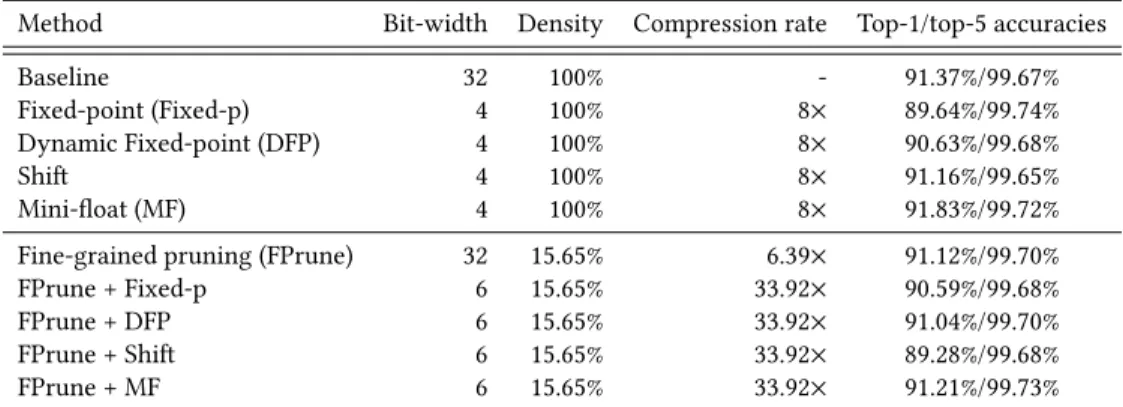
base-lines are shown in Table 4. For the dense model,Mayoquantizes the networks to a bit-width of 4, and the sparse variants are quantized
to 6.
Figure 1 shows the weight distributions of the pre-quantized
base-lines. For the dense model, a large number of parameters are
cen-tralized around zero and quantization methods that can faithfully
represent near-zero values give better test accuracies (mini-float
and shift). In contrast, representable fixed-point values distribute
evenly across the entire quantized range, and thus they struggle
to accommodate a largely uneven distribution. Shift quantization
shows the worst performance on sparse models but has relatively
good performance on dense models. As it quantizes values close to
zero with much less round-off error, it fits the weights distribution
of the dense models better than that of the sparse variant. Overall,
for CifarNet,Mayoachieves a compression rate of 33.92x with only 0.16% top-1 accuracy loss by jointly using fine-grained pruning and mini-float quantization. 0.075 0.050 0.025 0.000 0.025 0.050 0.075 0.100 Values 0 200 400 600 800 1000 1200 1400 1600 Number of elements
(a) Dense weights
0.03 0.02 0.01 0.00 0.01 0.02 0.03 Values 0 50 100 150 200 250 Number of elements (b) Sparse weights
Figure 1: Weight distributions of the final convolutional layer in dense and sparse CifarNets.
7
CONCLUSION
In this paper, we present theMayoframework that can automat-ically compress a pretrained neural network for saving the
com-putational and memory resources. It optimizes the quantization
procedure and reduces the exploration space. In addition, it
per-forms a greedy search to find optimal combinations of parameters
for multiple overriders, thus fully automates the process of model
compression. In terms of features,Mayospecializes in chaining various compression techniques and can flexibly customize
individ-ual components (weights, activations, gradients,etc.) using them in a DNN.
The results demonstrate that Mayo can achieve compression rates
exceeding the previous state-of-the-art results using fine-grained
pruning, without any manual hyperparameter tuning. Furthermore,
we show results of different quantization methods on an original
and pruned DNN, and observe that non-linear approaches provides
better trade-offs between accuracy and compression rate than linear
quantization for both sparse and dense models. Mayoand the compressed networks used in the paper are released to the public.∗
∗
Available at: https://github.com/deep- fry/mayo. 5
Method Bit-width Density Compression rate Top-1/top-5 accuracies Baseline 32 100% - 91.37%/99.67% Fixed-point (Fixed-p) 4 100% 8× 89.64%/99.74% Dynamic Fixed-point (DFP) 4 100% 8× 90.63%/99.68% Shift 4 100% 8× 91.16%/99.65% Mini-float (MF) 4 100% 8× 91.83%/99.72%
Fine-grained pruning (FPrune) 32 15.65% 6.39× 91.12%/99.70%
FPrune + Fixed-p 6 15.65% 33.92× 90.59%/99.68%
FPrune + DFP 6 15.65% 33.92× 91.04%/99.70%
FPrune + Shift 6 15.65% 33.92× 89.28%/99.68%
FPrune + MF 6 15.65% 33.92× 91.21%/99.73%
Table 4: Quantizations on the sparse and dense CifarNets.
ACKNOWLEDGMENTS
This work is supported by the Chinese National Basic Research
Program (973 Program, No. 2015CB352400), the National
Natu-ral Science Foundation of China (Grant U1401258), and the
Sci-ence and Technology Planning Project of Guangdong Province
(2015B010129011). We thank EPSRC for providing Yiren Zhao his
doctoral scholarship.
REFERENCES
[1] M. Abadi, P. Barham, J. Chen, Z. Chen, A. Davis, J. Dean, M. Devin, S. Ghemawat, G. Irving, M. Isard, M. Kudlur, J. Levenberg, R. Monga, S. Moore, D. G. Murray, B. Steiner, P. A. Tucker, V. Vasudevan, P. Warden, M. Wicke, Y. Yu, and X. Zhang. TensorFlow: A system for large-scale machine learning. InUSENIX Conference
on Operating Systems Design and Implementation, 2016.
[2] O. Ben-Kiki, C. Evans, and B. Ingerson. YAML ain’t markup language.yaml.org, 2005.
[3] M. Courbariaux, Y. Bengio, and J.-P. David. Training deep neural networks with low precision multiplications. InInternational Conference on Learning
Representations, 2015.
[4] J. Deng, W. Dong, R. Socher, L.-J. Li, K. Li, and L. Fei-Fei. ImageNet: A large-scale hierarchical image database. InIEEE Conference on Computer Vision and Pattern
Recognition, 2009.
[5] Y. Guo, A. Yao, and Y. Chen. Dynamic network surgery for efficient DNNs. In
Advances in Neural Information Processing Systems, 2016.
[6] P. Gysel, J. Pimentel, M. Motamedi, and S. Ghiasi. Ristretto: A framework for empirical study of resource-efficient inference in convolutional neural networks.
IEEE Transactions on Neural Networks and Learning Systems, 2018.
[7] S. Han, H. Mao, and W. J. Dally. Deep compression: Compressing deep neural networks with pruning, trained quantization and Huffman coding.International
Conference on Learning Representations (ICLR), 2016.
[8] K. He, X. Zhang, S. Ren, and J. Sun. Deep residual learning for image recognition. InIEEE Conference on Computer Vision and Pattern Recognition, 2016. [9] G. Hinton, L. Deng, D. Yu, G. E. Dahl, A. r. Mohamed, N. Jaitly, A. Senior,
V. Vanhoucke, P. Nguyen, T. N. Sainath, and B. Kingsbury. Deep neural networks for acoustic modeling in speech recognition: The shared views of four research groups.IEEE Signal Processing Magazine, 29(6):82–97, 2012.
[10] A. G. Howard, M. Zhu, B. Chen, D. Kalenichenko, W. Wang, T. Weyand, M. An-dreetto, and H. Adam. MobileNets: Efficient convolutional neural networks for mobile vision applications.CoRR, abs/1704.04861, 2017.
[11] I. Hubara, M. Courbariaux, D. Soudry, R. El-Yaniv, and Y. Bengio. Binarized neural networks. InAdvances in Neural Information Processing Systems. 2016. [12] K. Hwang and W. Sung. Fixed-point feedforward deep neural network design
using weights+1, 0, and−1. InSignal Processing Systems, 2014.
[13] F. N. Iandola, M. W. Moskewicz, K. Ashraf, S. Han, W. J. Dally, and K. Keutzer. Squeezenet: Alexnet-level accuracy with 50x fewer parameters and<1mb model size.CoRR, abs/1602.07360, 2016.
[14] IEEE standard for floating-point arithmetic.IEEE Std 754-2008, 2008. [15] M. Jaderberg, A. Vedaldi, and A. Zisserman. Speeding up convolutional neural
networks with low rank expansions.CoRR, abs/1405.3866, 2014.
[16] A. Krizhevsky, V. Nair, and G. Hinton. The CIFAR-10 and CIFAR-100 datasets.
http://www.cs.toronto.edu/ kriz/cifar.html, 2014.
[17] A. Krizhevsky, I. Sutskever, and G. E. Hinton. Imagenet classification with deep convolutional neural networks. InAdvances in Neural Information Processing
Systems 25. 2012.
[18] Y. LeCun, L. Bottou, Y. Bengio, and P. Haffner. Gradient-based learning applied to document recognition.Proceedings of the IEEE, 86(11):2278–2324, 1998. [19] Y. LeCun, C. Cortes, and C. J. Burges. The MNIST database of handwritten digits. [20] E. H. Lee, D. Miyashita, E. Chai, B. Murmann, and S. S. Wong. LogNet: Energy-efficient neural networks using logarithmic computation. InIEEE International
Conference on Acoustics, Speech and Signal Processing, 2017.
[21] B. Liu, M. Wang, H. Foroosh, M. Tappen, and M. Penksy. Sparse convolutional neural networks. InIEEE Conference on Computer Vision and Pattern Recognition, 2015.
[22] Z. Liu, J. Li, Z. Shen, G. Huang, S. Yan, and C. Zhang. Learning efficient con-volutional networks through network slimming. InInternational Conference on
Computer Vision, 2017.
[23] P. Maji and R. Mullins. 1D-FALCON: Accelerating deep convolutional neural network inference by co-optimization of models and underlying arithmetic implementation. InInternational Conference on Artificial Neural Networks, 2017. [24] H. Mao, S. Han, J. Pool, W. Li, X. Liu, Y. Wang, and W. J. Dally. Exploring the regularity of sparse structure in convolutional neural networks.IEEE Conference
on Computer Vision and Pattern Recognition, 2017.
[25] M. B. Milde, D. Neil, A. Aimar, T. Delbr ¨uck, and G. Indiveri. ADaPTION: Tool-box and benchmark for training convolutional neural networks with reduced numerical precision weights and activation.CoRR, abs/1711.04713, 2017. [26] S. J. Pan and Q. Yang. A survey on transfer learning. IEEE Transactions on
Knowledge and Data Engineering, 2010.
[27] A. Zhou, A. Yao, Y. Guo, L. Xu, and Y. Chen. Incremental network quantization: Towards lossless CNNs with low-precision weights.International Conference on
Learning Representations (ICLR), 2017.
[28] S. Zhou, Z. Ni, X. Zhou, H. Wen, Y. Wu, and Y. Zou. DoReFa-Net: Training low bitwidth convolutional neural networks with low bitwidth gradients.CoRR, abs/1606.06160, 2016.
![Table 1: A comparison: Ristretto [6], ADaPTION [25], DoReFa [28] and Mayo.](https://thumb-us.123doks.com/thumbv2/123dok_us/365075.2540200/4.918.137.787.125.394/table-a-comparison-ristretto-adaption-dorefa-and-mayo.webp)
![Table 3: A comparison of fine-grained pruning results on AlexNet [17].](https://thumb-us.123doks.com/thumbv2/123dok_us/365075.2540200/5.918.479.836.128.546/table-comparison-fine-grained-pruning-results-alexnet.webp)