ISSN 1818-4952
© IDOSI Publications, 2014
DOI: 10.5829/idosi.wasj.2014.29.dmsct.30
Corresponding Author: S. RamKumar, CSE, School of Computing, SASTRA University, India.
Towards Efficient Load Balancing and Green it Mechanisms in Cloud Environment
S. RamKumar, V. Vaithiyanathan and M. Lavanya
1 2 2
CSE, School of Computing, SASTRA University, India 1
School of Computing, SASTRA University, India 2
Abstract:Cloud Environment allows users to access on-demand IT resources over the cyberspace based on pay per use pattern. Optimizing the resource utilizationand reducing the amount of active server machine usage in clouds become a challenging task. The major intend of this work is to builda model which supports balancing the workload in cloud datacenters and minimizing the amount of active servers to support Green-IT model.Based on the conventional Earliest Deadline First(EDF) algorithm, this work presents an Adaptive Earliest Deadline First (AEDF) algorithm for load balancing problem in order to achieve efficient consumption of cloud resources and also to support Green Computing technology. Comparing with traditional load balancing algorithm,the proposed method achieves high throughput, minimized cost and effective scheduling of tasks. Our proposed model supports both Load balancing and Green-IT technology.
Key words: Cloud Environment Green Computing Load balancing Resourceutilization
INTRODUCTION software based virtualization techniques. Hybrid
Cloud Computing [1, 2] is the model for delivering based virtualization machinery and traditional Para-IT resources, in which the resources are retrieved from the virtualization techniques. Para-virtualization is the cyberspace using pay per use pattern. It allows the cloud virtualization technique used in xen server and it serves consumer to extent the infrastructure dynamically in the interfaces to the virtual machine. Para-virtualization within rapid period. In nature, the cloud contains uses the kernel for guest os is exactly loaded and virtualization of resources (i.e. software and hardware) compiled before installing in to the virtual machine. This these resources are maintained and managed in cloud hybrid virtualization technique can decrease the environment itself. Cloud environment provides several complications and overhead in the conventional virtual
characteristics: machines.
On-demand utilization. Green IT it can maximize the utilization of cloud resources Network of Shared Resources. in energy efficient manner. The Green IT also reduces the Elastic Provisioning. energy expenditure. This proposed work intends to attain Fine – grained metering. the both Load balancing technique and Green IT Virtualization in cloud computing is the constructing
virtual system instead of real system, it may be an Green IT: Maximize the consumption of cloud computational resources, hardware platforms, software virtual resources, also it decreases the cost of cloud platforms, storage machine depends upon the user IT services and minimize the amount of active server requirements. Now a day’s several investigations are machine.
focused on constructing efficient virtualization Load Balancing: Allocate the workload technologies for IT purposes (i.e. Green computing and across several computers, servers and other cloud computing). Hardware based virtualization resources to attain efficient resource machinery introduced for reducing the constraints of the consumption.
virtualization [3] is the combination of both hardware
This work presents Green Computing technology or
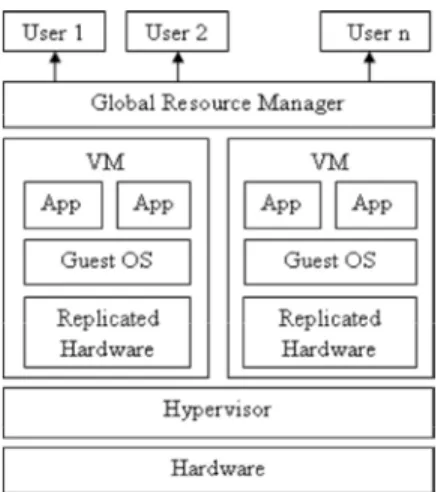
Fig. 1: Cloud Server Architecture
In Green computing the amount of physical machines used should be minimized and also this technology reduces the energy consumption by turning off the idle systems. Load balancing technique [4] is essentially used in distributed system environment. There are various algorithms used for task scheduling in cloud environment which allocates the cloud virtual machine for user’s on-demand request. Load balancing methods are categorized into two types: Static workload balancing algorithms and dynamic workload balancing algorithms. Static methods are mainly appropriate for homogenous platforms and this algorithm is not suitable for dynamic modifications of attribute for the period of execution. Whereas dynamic algorithms provides flexibility and it considers the various kinds of attributes in both static period and during on-demand. These methods can produce efficient throughput in on-demand environment. In Cloud computing improving the efficiency of cloud server is becomes the challenging task. The key concern is balancing the load [5] in datacenters to increase effectiveness of the host system and cloud environment should support Green-IT technology.
In this work, we presented the inventive model based on Green computing technique and also based on traditional Earliest Deadline First(EDF) algorithm this work presents Adaptive Earliest Deadline First(AEDF) algorithm for efficient scheduling and execution of tasks. This paper organized as: Section II provides related works of load balancing algorithm and green computing techniques. Section III discusses the implications of green computing and cloud virtual server optimization. Section IV presents proposed system and algorithms. Section V discusses the experimental works and Section VI concludes the work.
Related Works: Zhen xiao, Weijia song et al [6] proposed the new technique that dynamically allocates resources depends upon application requirements and it minimizes the sum of servers to be used for resource allocation process.Based on the skewness algorithm this paper also provides measuring of inconsistency consumption of various resources on the server.This work which concludes by reducing the skewness measure the cloud consumer’s can avoid overload and enhance the comprehensive consumption of resources in the server.
In order to avoid overloading problems in Real-time distributed systems, Suaib Akhter, Mahmudur Rahman Khan et.al [7] proposed the innovative approach which is the mixture of both EDF (Earliest Deadline First) algorithm and RM (Rate-monotonic) algorithm. It is the combination both dynamic scheduling algorithm (EDF) and static scheduling algorithm (RM). This algorithm prevents the system entering in to the overloaded state with successful completion all tasks in the system. This system model assures efficient consumption of resources and efficiency of the system.
In paper [8] Young Choon Lee, Albert Y.Zomaya proposed a new model for energetic usage of resources in cloud environment. This paper presentsthe task consolidation algorithm, to which increases the resource consumption effectively. And also it takes account into both alive and empty status of the energy consumption.This method allocates each job to the resource for performing the job without loss of performance of that job.
In paper [9, 10] introduces various load balancing algorithms and green computing techniques in clouds. Shridhar G.Domanal and G.Ram Mohana Reddy [9] introduces virtual machine allocated load balancing algorithm for efficient access of cloud virtual machines resources. This algorithm which assigns the arriving demands to the every available virtual machines in an well-organized manner. Yatendra Sahu, R.K.Pateriya et.al [10] presents a new balancing algorithm for cloud server efficient utilization. In order to balancethe workload we have to migrate the virtual machines host from highly loaded server to least loaded server. This method can minimize the cost with efficient consumption of applicable resources.
Zhanghui Liu and Xiaoli Wang [11] proposed theinnovative scheduling approach, which enhances the both job execution period and resource consumption ratio. Depends upon this scheduling approach, this work also enhances the existing PSO algorithm by applying simple mutation method and other automatic-adapting weight methods by arranging the fitness measures.
0 0 Workload Threshold (S) = n n i i= E i= CSiWli <=
∑
∑
[7] EDF – Earliest Deadline First is a on-demand servers to be densely overloaded whereas other servers scheduling algorithm which allocates the tasks in priority are simply in idle state or slightly overloaded. Uniform
queue. distribution of load will enhance the performance of this
Implementing Load balancing algorithm in IaaS cloud migration technique. So we require an effective load environment is becomes the challenging task. In paper balancing mechanism to balance the various workloads [12] L.Shakkeera,Latha Tamilselvan and et.al proposed effectively to enhance the consumption of cloud server new framework which implements the load balancing resources. This paper presents new Adaptive Earliest method on Infrastructure as a Service (IaaS) cloud Deadline First (AEDF) algorithm to achieve balancing the environment for efficient access of cloud virtual workload perfectly and effective utilization of cloud resources.This Quality of Service (QoS) load balancing resources.
mechanisms intends to reduce the application cost.
In this [12] proposed work the task mechanism used Green Computing: The major objective of green based on the cost table which allocating the jobs to the computing is to minimize the use of risky resources and virtual machines in efficient manner. increasing the energy ability of resources in efficient Resource Scheduling is a major raising issue in cloud manner. Green computing or Green ITtechnology is environment for efficient consumption of resources. minimizes the use of amount of active cloud server In paper [13] Haihua Chang and Xinhuai Tang developed machine. Also, this technique achieves energy savings by the scheduling method depends upon on-demand turned off idle physical machines temporarily.“Skewness” load balance. This algorithm considers various algorithm is used to measure the inequality in the data-processing control machines and also it considers consumption of various resources on the server. The various data-transferring capacity nodes. It chooses the challenging problem in green computing is to minimize the “optimal” virtual machine to satisfy the job for increase amount of active server machines during slightly loaded the effectiveness of cloud environment. Also, it decreases without loses of performance.
the regular response period of jobs. Our proposed green computing method will invoked Jinhua Hu, Jianhua Gu et al [14] introduced the when the server workload threshold beyond the maximum. unique method for efficient scheduling of virtual machine Once the server reaches the workload threshold beyond resources for load balancing issues. Based on the genetic maximum then the arriving resource requests from cloud algorithm operation, this approach solves the issues of users are redirected to the next cloud server.i.e. server that load inequality and it decreases the migration cost of satisfies the workload threshold condition. The following traditional methods. method is used to evaluate the workload threshold of
[4] Load Balancing is a method which disseminates particular server s: the workload among several computing resources and it
is used to enhance the resource utilization. (1)
Implications of Load Balancing and Green Computing
Load Balancing: In Cloud environment, the cloud Where E is the execution time of particular Task T in the consumers have to consider some issues and challenges task set.CS1 is the cloud server which executes the task when maintains the load between cloud resources.Load and Wli is the workload threshold of particular server S. balancing is computer networking method which So, the all remaining servers are in idle state in order to disseminates theworkload across several computers, minimize the energy consumption. It tends to minimize the servers and other resources to attain efficient resource amount of physical machines being used and it sustains consumption and intend to increase the throughput. If the Green computing technology.
amount of consumers to the appropriate virtual system
goes beyond then, workload balancing server will force to Proposed System
forward the arriving consumer request to the another Load Balancing: For Load Balancing issues in cloud virtual systems. environment, we introduced a Adaptive Earliest Deadline But, this general method is not suitable for when First (AEDF) algorithmto achieve balancing the various considering the efficiency, throughput and time. In the workload nicely and effective utilization of cloud server meantime on-demand arriving of load will cause a few resources.Based on the conventional Earliest Deadline
First (EDF) algorithm, this proposedAEDF algorithm is AEDF Load Balancing Functioning Workflow: The used for efficient scheduling and execution of tasks. The AEDF algorithm provides optimal result for load balancing major objective of this work is to support workload in cloud environment. Fig. 1 shows functional workflow of balancing in cloud datacenters and minimize the amount the proposed method.
of active server usage to support Green computing model. Proposed Modelof Load Balancing System: Effective Load balancing mechanism is used to enhance the efficient consumption of resources and scheduling of tasks. This Adaptive Earliest Deadline First (AEDF) algorithm is based on threshold value to attain the effective scheduling and utilization of resources. The following algorithm describes the load balancing mechanism for various incoming tasks in clouds.
Algorithm: Adaptive Earliest Deadline First (AEDF) for Workload Balancing.
Input: Task Set (T , T ,...T ),Deadline(D ,D D ),1 2 n 1 2,.... n
Execution Period(E E E ).1, 2,.... n
1. Initialize: NT (New Time), ST (Service Time) =0; 2. WhileTask Set queue! = NULL
3. Calculate U = E / Di i i
4. Assign Threshold TH=0.5 5. If (T (U )) < THi i
6. Insert T into EDF queuei
7. Else
8. Insert T into AEDF queuei
9. End If 10. End While
11. While EDF Queue! = NULL
12. Schedule Task using EDF Fig. 2: AEDF Load Balancing functioning workflow 13. End While
14. While AEDF Queue! = NULL Based on the threshold value condition the minimum 15. Schedule T with Min (D )i i utilization valued tasks will follow conventional EDF 16. NT = E + STi scheduling to execute the tasks. When the task utilization 17. If (T (i+1) (i+1)E ) + NT < = Di+1 rate goes beyond the threshold value then the tasks are
18. Schedule Ti+1 scheduled in AEDF queue based on deadline of
19. Else corresponding tasks. The experimental analysis shows
20. T Ti+1= i+2 AEDF achieves efficient scheduling and consumption of
21. End If cloud resources for load balancing problems.
22. End While
The major goal of above AEDF algorithm is to Green computing is to minimize the amount of active optimize the load balancing in cloud environment and server machine in cloud environment.Thus Green IT alsothis method is intend to utilize the cloud resources intends to achieve energy savings by turned off the idle efficiently.The concluding results of AEDF method shows physical machines temporarily.Our proposed green better scheduling of tasks and effective consumption of computing method will invoked when the server workload resources then the traditional EDF algorithm. threshold beyond the maximum.
0 0 n E n CSiWli i i= <= i=
∑
∑
0 n i=∑
Pseudo code: Green computing Technique The above stated algorithm for Green IT is Input:Cloud Servers (Cs ,Cs ,...Cs ),1 2 n
Task Set (T T ,...T ),1, 2 n
Ready Queue (RQ),
Task Set Worst Case Execution Time – WCET (E ,E ,....E ),1 2 n
Workload Threshold (Wl ,Wl ,...Wl ).1 2 n
1. Initialize: Remaining Workload(rl)=0; 2. If
3. Assign RQ = RQ = CSi 4. While RQ! = NULL
5. If Ti (Ei) Cs (Wli) – Cs (rli)< = i i
6. Cs state =’Active’i
7. Remaining servers(Cs) state=’idle’ 8. Assign Tito Csi 9. Cs (rli) =i Ti (Ei) 10. Increment i 11. Else 12. Increment j 13. Cs state=’Active’j 14. rlj = 0 15. End If 16. End While
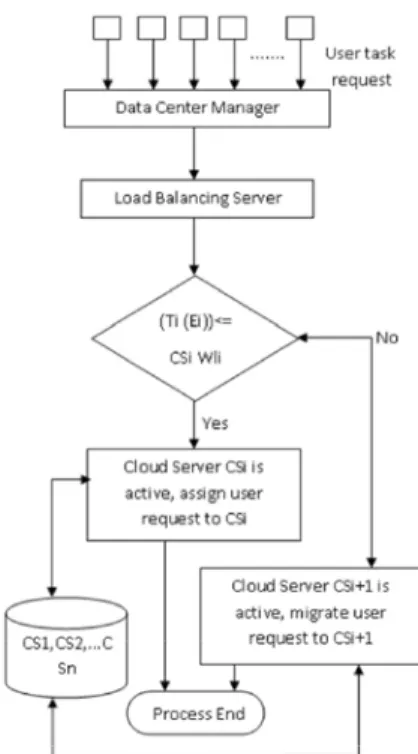
Green Computing Operational Workflow Model: The following workflow diagram depicts datacenter manager to optimize the cloud server.
Fig. 3: Green computing Operational workflow
intendedfor optimizing the cloud server.While any task request come from cloud consumer for accessing the cloud service then the tasks are allocated to the appropriate virtual machine for accessing the services.
This proposed method of green computing assigns the user request to cloud server virtual system based on the workload threshold mechanism. Assume that each server has different disc image. This workload threshold mechanism reduces the amount of active server accessing and it effectively reduces theunnecessary energy consumption.
RESULTS
The proposed method works better than conventional EDF algorithm. To demonstrate the proposed method 10 sample tasks are given as input to the initial queue. Each task includes its own Deadline (D ,D ,....D ) and Execution time(E ,E ,....E ).1 2 10 1 2 10
Based on the utilization time of each task, the tasks are scheduled either in EDF queue or ADEF queue. For effective scheduling the task in the task set should be executed within the deadline of corresponding task.
After scheduling of all tasks, the deadline for each task is calculated and compared with the traditional system.Table 2. Shows the comparison analysis of the proposed method which effectively minimizes the number of deadline missed tasks and it improves the resource consumption.
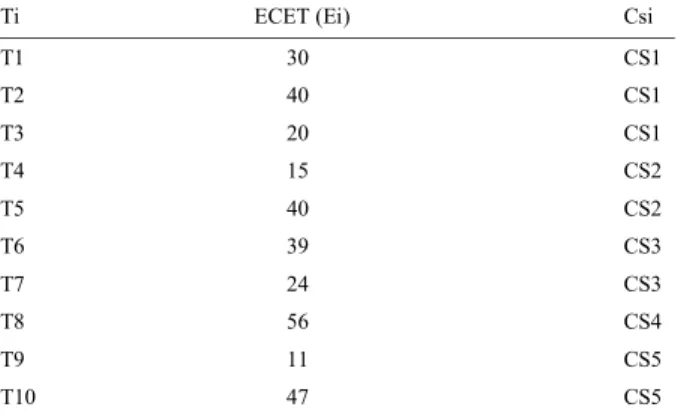
Green Computing: In this proposed method, the Green IT approach is achieved based on workload threshold of each server in cloud environment. For analysis we have taken 10 sample tasks(T ,T ,...T ) with corresponding1 2 n
execution period (E ,E ,....E ). Assume that each server has1 2 n
different disc image. Depends upon the workload threshold of cloud server (using Eq.no.1) this method achieves minimal utilization of active servers and it reduces the cost of cloud IT services.
Table 1: Input Task Set Ti Di Ei Ui T1 30 10 0.333 T2 30 15 0.5 T3 10 3 0.3 T4 40 35 0.875 T5 20 15 0.75 T6 40 27 0.675 T7 50 26 0.52 T8 35 9 0.257 T9 56 20 0.357 T10 70 25 0.357
Table 2.Correlation Analysis
Algorithm EDF Concerted EDF & AEDF
Amount of missed Tasks 7 3
Table 3.Optimization model for minimizing active cloud servers
Ti ECET (Ei) Csi
T1 30 CS1 T2 40 CS1 T3 20 CS1 T4 15 CS2 T5 40 CS2 T6 39 CS3 T7 24 CS3 T8 56 CS4 T9 11 CS5 T10 47 CS5 CONCLUSION
Optimizing the cloud datacenter to balance the workload in clouds becomes a challenging task. In order toavoid overloading issue in cloud environment, this work presents an innovative Adaptive Earliest Deadline First (AEDF) algorithm to achieve efficient consumption of cloud virtual resources and effective load balancing. The major intend of this work is to build a model which supports both workload balancing mechanism and reduced utilization of number of active servers to support green computing technology. Thus, the proposed green computing approach is based on workload threshold of cloud server.When comparedwith several traditional load balancing techniques,the results of this proposed algorithm presented hereshows efficient resource consumption, minimized cost of cloud resourcesandreduced amount of active server utilization.
REFERENCES
1. Gianmario Motta, Nicola Sfrondrini and Danielo Sacco, 2012. ”Cloud computing: An architectural and technological overview”, in International Joint Conference on Service Sciences.
2. “Introduction to Cloud Computing”, url: www.priv.gc.ca.
3. Inhyuk kim, Taehyoung Kim and Young Ik Eom,”NHVM:Design and Implementation of Linux Server Virtual Machine using Hybrid Virtualization Technology”, in IEEE, International Conference on Computational Science and Its Applications, 2010. 4. Klaithem Al Nuaimi, Nader Mohamed, et al., ”A
Survey of Load balancing in Cloud Computing: Challenges and Algorithms”, in IEEE, 2 Symposiumnd
on Network Cloud Computing and Applications, 2012.
5. Nidhi Jain Kansal and Inderveer Chana, 2012. ”Cloud Load Balancing Techniques: A step Towards Green Computing”, in IJCSI, International Journal of Computer Science Issues.
6. Zhen Xiao, Weijia Song and Qi Chen, 2013. ”Dynamic Resource Allocation Using Virtual Machines for Cloud Computing Environment”, IEEE Transactions on Parallel and Distributed System, 24: 6.
7. Suaib Akhter, A.F.M., Mahmudur Rahman Khan and Shariful Islam, 2012. “Overload Avoidance Algorithm for Real-Time Distributed System”, in International Journal of Computer Science and Network Security (IJCSNS), 12: 9, September 2012.
8. Young Choon Lee and Albert Y. Zomaya, 2010. ”Energy efficient utilization of resources in cloud computing systems”, Springer Science.
9. Shridhar G. Domanal and G. Ram Mohana Reddy, 2014. ”Optimal Load Balancing in cloud Computing by Efficient Utilization of Virtual Machines”, IEEE.
10. Yatendra Sahu, R.K. Pateriya and Rajeev Kumar Gupta, 2013. ”Cloud Server Optimization with Load Balancing and Green Computing Techniques Using Dynamic Compare and Balance Algorithm”, in IEEE, 5th International Conference on Computational Intelligence and communication Networks.
11. Zhanghui Liu and Xiaoli Wang, 2012. ” A PSO-Based Algorithm for Load Balancing in Virtual Machines of Cloud Computing Environment”, Springer-Verlag Berlin Heidelberg, pp: 142-147.
12. Shakkeera, L., Latha Tamilselvan and Mohamed 14. Jinhua Hu, Jianhua GU, et al., ”A Scheduling Imran, 2013. ”Improving Resource Utilization using Strategy on Load Balancing of Virtual Machine QoS Based Load Balancing Algorithm For Multiple Resources in Cloud Environment”, IEEE 3 Workflows in IaaS Cloud Computing Environment”, International symposium on parallel Architecture, in Journal on Communication Technology. Algorithms and Programming.
13. Haihua Chang and Xinhuai Tang, 2011. ”A Load-Balance Based Resource-Scheduling Algorithm under Cloud Computing Environment”, Springer-Verlag Berlin Heidelberg, pp: 85-90.