SEVENTH FRAMEWORK PROGRAMME Research Infrastructures
INFRA-2011-2.3.5 – Second Implementation Phase of the European High Performance Computing (HPC) service PRACE
PRACE-2IP
PRACE Second Implementation Project
Grant Agreement Number: RI-283493
D3.2.2
Presentation Kit for Schools and the General Public
Final
Version: 1.0
Author(s): Peter Stefan, Barbara Toth, NIIF Date: 22.02.2013
Project and Deliverable Information Sheet
PRACE Project Project Ref. №: RI-283493
Project Title: PRACE Second Implementation Project Project Web Site: http://www.prace-project.eu Deliverable ID: D3.2.2
Deliverable Nature: Report Deliverable Level:
PU*
Contractual Date of Delivery: 28 / February / 2013
Actual Date of Delivery: 28 / February / 2013 EC Project Officer: Leonardo Flores Añover
* - The dissemination level are indicated as follows: PU – Public, PP – Restricted to other participants (including the Commission Services), RE – Restricted to a group specified by the consortium (including the Commission Services). CO – Confidential, only for members of the consortium (including the Commission Services).
Document Control Sheet
Document
Title: Presentation Kit for Schools and the General Public ID: D3.2.2
Version: <1.0 > Status: Final
Available at: http://www.prace-project.eu Software Tool: Microsoft Word 2007 File(s): D3.2.2.docx
Authorship
Written by: Peter Stefan, Barbara Toth, NIIF Contributors: Stelios Erotokritou, CaSToRC
Audrey Gerber, IUCC Emma Hogan, ICHEC Tiina Leiponen, CSC Georgi Prangov, NCSA Danica Stojiljkovic, IPB
Document Status Sheet
Version Date Status Comments
0.1 13/January/2013 Draft 0.2 25/January/2013 Draft 0.3 30/January/2013 Draft 0.4 05/February/2013 Draft 0.5 07/February/2013 Draft 0.6 18/February/2013 Draft
Document Keywords
Keywords: PRACE, HPC, Research Infrastructure, outreach, schools, brochure, game, video, teenager, general public, presentation kit, shooting stars, dare to think the impossible, social media, dissemination.
Disclaimer
This deliverable has been prepared by the responsible Work Package of the Project in accordance with the Consortium Agreement and the Grant Agreement n° RI-283493. It solely reflects the opinion of the parties to such agreements on a collective basis in the context of the Project and to the extent foreseen in such agreements. Please note that even though all participants to the Project are members of PRACE AISBL, this deliverable has not been approved by the Council of PRACE AISBL and therefore does not emanate from it nor should it be considered to reflect PRACE AISBL’s individual opinion.
Copyright notices
2013 PRACE Consortium Partners. All rights reserved. This document is a project document of the PRACE project. All contents are reserved by default and may not be disclosed to third parties without the written consent of the PRACE partners, except as mandated by the European Commission contract RI-283493 for reviewing and dissemination purposes.
Table of Contents
Project and Deliverable Information Sheet ... i
Document Control Sheet ... i
Document Status Sheet ... ii
Document Keywords ... iii
Table of Contents ... iv
List of Figures ... iv
List of Pictures ... iv
References and Applicable Documents ... v
List of Acronyms and Abbreviations ... vi
Executive Summary ... 1
1 Introduction ... 2
2 Communication challenge ... 3
3 Presentation Kit for Schools and the General Public ... 4
3.1 Introductory letter to education authorities ... 4
3.2 Video teaser/introduction ... 4
3.3 Web portal (www.daretothinktheimpossible.com) ... 4
3.3.1 Video presentations of HPC applications ... 5
3.3.2 HPC information ... 7
3.4 Interactive Online Video Game ... 8
3.5 Print Brochure ... 9 4 Social Media ... 11 4.1 Facebook page ... 11 4.2 Twitter ... 11 4.3 YouTube ... 12 5 Outreach in operation ... 13 5.1 Outreach Workflow ... 13
5.2 Social media training ... 14
6 Summary ... 15
7 Annex ... 16
7.1 Introductory letter ... 16
7.2 Survey results of the game testing ... 17
7.2.1 Finland ... 17
7.2.2 Hungary ... 19
List of Figures Figure 1: Dissemination Ecosystem ... 4
Figure 2: Outreach Workflow ... 14
List of Pictures Picture 1: The layout of the homepage www.daretothinktheimpossible.com ... 5
Picture 2: The layout of the video selections on www.prace-ri.eu ... 6
Picture 4: Interview segment Climate Science video ... 7
Picture 5: The layout of “What are supercomputers used for?” from www.daretothinktheimpossible.com ... 8
Picture 6: The Main page of the online video game ‘Shooting Stars’ ... 9
Picture 7: The display of the levels of the online game ... 9
Picture 8: The layout of the print brochure (pages 1 and 4) ... 10
Picture 9: The layout of the print brochure (pages 2 and 3) ... 10
Picture 10: The design of the Facebook page ... 11 References and Applicable Documents
[1] www.daretothinktheimpossible.com [2] www.prace-ri.eu
[3] http://www.youtube.com/watch?v=d3B2DAkglCM
List of Acronyms and Abbreviations
Below is an extensive the List of Acronyms used in previous deliverables. Please add additional ones specific to this deliverable and delete unrelated ones.
AISBL Association International Sans But Lucratif
(legal form of the PRACE-RI)
BSC Barcelona Supercomputing Center (Spain)
CaSToRC Computation-based Scienc e and Technology Research Center (Cyprus) CINECA Consorzio Interuniversitario, the largest Italian computing centre (Italy) CPU Central Processing Unit
CSC CSC - IT Centre for Science (Finland) DoW Description of Work
EC European Community EGI European Grid Infrastructure
EPCC Edinburg Parallel Computing Centre (represented in PRACE by EPSRC, United Kingdom)
FZJ Forschungszentrum Jülich (Germany)
GB Giga (= 230 ~ 109) Bytes (= 8 bits), also GByte Gb/s Giga (= 109) bits per second, also Gbit/s
GB/s Giga (= 109) Bytes (= 8 bits) per second, also GByte/s
GÉANT Collaboration between National Research and Education Networks to build a multi-gigabit pan-European network, managed by DANTE. GÉANT2 is the follow-up as of 2004.
GENCI Grand Equipement National de Calcul Intensif (France)
GFlop/s Giga (= 109) Floating point operations (usually in 64-bit, i.e. DP) per second, also GF/s
GHz Giga (= 109) Hertz, frequency =109 periods or clock cycles per second GPGPU General Purpose GPU
GPU Graphic Processing Unit
HPC High Performance Computing; Computing at a high performance level at any given time; often used synonym with Supercomputing
ISC International Supercomputing Conference; European equivalent to the US based SC0x conference. Held annually in Germany
ICHEC Irish Centre for High-End Computing (Ireland) IP Implementation Phase
IPB Institute of Physics Belgrade (Serbia)
IUCC Inter-University Computation Center (Israel) JSC Jülich Supercomputing Centre (FZJ, Germany) KB Kilo (= 210 ~103) Bytes (= 8 bits), also KByte
LRZ Leibniz Supercomputing Centre (Garching, Germany) MB Mega (= 220 ~ 106) Bytes (= 8 bits), also MByte
MB/s Mega (= 106) Bytes (= 8 bits) per second, also MByte/s
MHz Mega (= 106) Hertz, frequency =106 periods or clock cycles per second MoU Memorandum of Understanding.
NIIF National Information Infrastructure Development Institute (Hungary)
NCSA Executive agency “Electronic communication networks and information systems” (Bulgaria)
OS Operating System
PRACE Partnership for Advanced Computing in Europe; Project Acronym PM Person Months
STRATOS PRACE advisory group for STRAtegic TechnOlogieS TB Tera (= 240 ~ 1012) Bytes (= 8 bits), also TByte
TERENA Trans-European Research and Education Networking Association
TFlop/s Tera (= 1012) Floating-point operations (usually in 64-bit, i.e. DP) per second, also TF/s
Tier-0 Denotes the apex of a conceptual pyramid of HPC systems. In this context the Supercomputing Research Infrastructure would host the Tier-0 systems; national or topical HPC centres would constitute Tier-1
Executive Summary
This document describes the purpose, design, contents, and planning process of the PRACE Presentation Kit for Schools and the General Public.
The Presentation Kit (deliverable D3.2.2) attempts to communicate an overview of the world of HPC to high school students, a target audience that to date has not been addressed by PRACE. The rationale for addressing the audience is the fact that science is advancing at a dizzying pace, with research being more and more dependent on faster and more powerful computational power. While perhaps exaggerating the point to a degree, the Kit communicates the message that HPC will be like today’s PCs, and that any researcher, organization or country for that matter that does not embrace and understand the central role supercomputing plays in scientific research will surely lag behind. As HPC develops, it will no longer be the sole privilege of academia scientists, and as a society, we must expose our burgeoning scientists to the tool that is the cornerstone of tomorrow’s discoveries.
In order to effectively communicate this message, the ‘Dare to Think the Impossible’ educational campaign includes both a high-level overview of the outreach program and HPC for teachers and the general public. Use of the slogan ‘Dare’ is both challenging and arouses curiosity, and is a compelling invitation to students to explore and learn more on their own through channels they are familiar with, such as YouTube and Facebook. These in turn are designed to drive traffic to the “www.daretothinktheimpossible.com” portal and to the PRACE website.
Care was taken to design the all the content in such a way to address the students, with bold images that allude to exciting discoveries and images of cutting-edge researchers on the forefront of scientific discovery. The content engages, challenges and invites students to join a journey, imagine, dream and learn more about what part they can play in future inventions and developments.
The entertaining video clips and Facebook page are designed to draw young people to the informative web portal. There they are invited to play an entertaining online video game that modestly illustrates what can be done with supercomputing. Printed material and introductory letters support these materials among educational administrators curriculum designers and teachers. The result is a more educated, more aware and more knowledgeable community of potential HPC users.
The Presentation Kit complements other PRACE dissemination activities, including and centred on social media campaign in each country targeted to local technology education forums, and more. This plan relies on building network of “owners” in each member country responsible for spearheading the campaign.
1 Introduction
Within the Second Implementation Phase of PRACE Research Infrastructure (2IP) the Third Work Package (WP3) is responsible for creating D3.2.2 “Presentation Kit for Schools and the General Public”. Task 3.2 covers the submission of this deliverable.
This task differs from PRACE’s usual dissemination activities, which focus primarily on science and industry. While PRACE has enjoyed a fairly successful interaction with leading scientific research institutions, it is important that PRACE takes into account other scientists and most notably, high school students and the general public – Europe’s potential and future scientists.
Recognising that there are numerous ways to direct and attract our diverse target audiences to the www.daretothinktheimpossible.com informational portal and increase awareness of the importance of HPC, we deployed a multi-pronged approach using a variety of available media to achieve this goal. The media selected, print, digital, online and social, are contemporary, interactive and most importantly relevant and familiar tools to all the target audiences. These include the following:
Introductory letter
Video teaser clips (YouTube)
Facebook page
Twitter campaign
www.daretothinktheimpossible.com web portal
Shooting Stars online video game
Print brochure
www.prace-ri.eu
The Presentation Kit is comprised of these tools. Each element of the Kit has a defined and specialised role in reaching the target audience. In combination they represent a current, youth-focused and effective method of communicating our message and driving traffic to the main element – the website.
This deliverable is structured as follows: 2. Communications Challenge;
3. An overview of the approach, including the challenges and obstacles in reaching this untapped target audience and using communication vehicles previously not employed by PRACE;
4. Detailed description of each element in the Kit;
5. Practical details of the outreach strategy and dissemination tactics; 6. Summary.
2 Communication challenge
To date, PRACE has been engaged in communicating mainly to universities, scientific players, and industry representatives. Since these are the primary beneficiaries of PRACE’s services, dissemination and outreach activities have been targeted towards them. They are the ones who need PRACE’s resources for scientific research; they execute their simulations or code on PRACE infrastructure. However, supercomputing cannot exist in a vacuum, or only for its own sake. Wider audiences should know that the major scientific breakthroughs and exciting outcomes are achieved only through extensive use of HPC and computational science. Scientific discovery is not the domain of the academia alone. Discoveries in the laboratory affect the lives of people the world over, whether it be curing diseases, predicting and preparing for natural disasters to save lives, or developing more efficient transportation and sustainable energy platforms. PRACE needs to engage young students and inspire them with the work of current computational scientists, in the hope that they will take an interest in computational science and be encouraged to plan a career in making future discoveries of their own.
The core message is centred on answering these fundamental questions:
How does scientific research affect our lives?
What is HPC?
What is HPC used for?
How can society benefit from the results of HPC?
Our target audience includes high school students, between the ages 15 and 18 as well as the general public.
Engaging secondary school teenagers requires a rather different approach than methods used in the past by PRACE. It involves opening new avenues of interactive communication. Presumably, neither teenagers nor the general public are familiar with the special jargon used in supercomputing and the sciences. They also lack background in information research tools. The selected communication approaches had to be based on their existing knowledge and built on it.
In addition, language barriers needed to be taken into account. The language and terminology used by the general public and secondary school students is different from the language commonly used in PRACE dissemination materials. It is also highly unlikely that the majority of the target audience are fluent in English and understand the scientific concepts and jargon. To overcome these obstacles, media this age group is familiar with was selected. This includes short and entertaining video clips, and a dynamic and informative Facebook page to invite further exploration. The www.daretothinktheimpossible.com site offers information in compelling short video clips. These video clips highlight the practical, very real uses in language that can be understood by all, supported by striking, bold visuals. The online video game, Shooting Stars, illustrates simulating astronomical forces and makes it fun. All this is centred on the strategy of speaking in a language and form that this age group is intimately familiar with and uses on a day-to-day basis.
3 Presentation Kit for Schools and the General Public
A combination of print, online, social media and interactive video are used to invite, attract and direct young students and educators to the www.daretothiktheimpossible.com website. The figure below illustrates the elements of the Kit, how they are interconnected and the dissemination ecosystem they create.
Figure 1: Dissemination Ecosystem
3.1 Introductory letter to education authorities
This letter is addressed to teachers and education officials and describes the Presentation Kit itself, within the framework of the main goals and work of PRACE, and explains how the items included in the Kit can be beneficial to students. A template, or sample, was created. Each PRACE member country will distribute this letter, or something similar, in the local language. The entire workflow process is described in section 5.1-Outreach Workflow.
3.2 Video teaser/introduction
Teaser videos are a modern tool employed in marketing. Their purpose is to gain widespread attention and build interest and expectation through curiosity in the target audience. A teaser video was created to help promote the interactive game and web portal. This two-minute video clip, shot using greenbox techniques, is designed to encourage curiosity and invite viewers give the online video game a try. The teaser video will be promoted through social media.
website that invites them to learn about HPC and scientific research in an intuitive, fun way they are familiar with.
The ‘Dare to Think the Impossible’ campaign website is the core of the Kit. It has multiple features, outlined in further detail below, which includes the following:
Video presentation of HPC applications
HPC information
Link to online video game
Picture 1: The layout of the homepage www.daretothinktheimpossible.com 3.3.1 Video presentations of HPC applications
The six video clips produced by the WP3 in the PRACE-1IP project were leveraged in this package and serve as a powerful multimedia instrument capable of reaching and engaging individuals, communities, and society as a whole.
Picture 2: The layout of the video selections on www.prace-ri.eu
The use of the videos extends and strengthens the existing PRACE dissemination and outreach efforts targeted at quite diverse audiences, ranging from secondary school students, young students and researchers, to those strongly involved in the development of HPC in Europe and other countries.
the general public. Five topics – Climate Science, Astrophysics, Life Science, Engineering and Clean Energy - were selected as engaging and relevant to the target audience. The topics were chosen to appeal to a wide variety of interests. For each topic, a representative scientist was chosen and their interview footage was edited into a short presentation on HPC in their field and their research. Each video consists of four key components:
1. An inspiring opening sequence where the audience is invited to consider challenges facing mankind (in the relevant topic)
2. Interview footage of the chosen scientist interspersed with:
3. Relevant visualisations to illustrate the topic and power of HPC, and 4. A call to action to “dare to think the impossible” and visit the website.
Picture 4: Interview segment Climate Science video
The videos uploaded to the campaign website do not exceed three and a half minutes. This length is intended to grab and keep the attention of our target group. This length also makes them ideal for use in the classroom.
Each module has a title and accompanied with a short description to guide the audience to an active video window. Approval is still pending for the concept.
3.3.2 HPC information
The ‘Dare to Think the Impossible’ campaign website contains interesting and relevant information on HPC. The featured topics are:
What is HPC?
What are supercomputers used for?
HPC in Action (videos of the scientists featured)
What is PRACE?
The information is presented in a simple, approachable yet informative manner and is designed to complement the video presentations of HPC applications by providing an introduction to HPC. In keeping with the tone of the ‘Dare to think the impossible’ campaign,
thought-provoking questions about the challenges that face mankind are posed and the ability of HPC to contribute to their resolution is explored.
Picture 5: The layout of “What are supercomputers used for?” from www.daretothinktheimpossible.com
3.4 Interactive Online Video Game
Our target group is so overwhelmed with the massive effect of continuously being exposed to new information that getting their attention is a real challenge. The online game created is designed to be appealing enough to serve this purpose. Thanks to this game, high school students can learn about the significance of HPC in a fun, relaxed and engaging way without pressure.
The idea of creating a video game emerged during the webpage creation process. Since young people live so much their lives in a virtual online environment, the choice of an online interactive video game was deemed an appropriate channel to reach them. The game can be shared and discussed in social media. It can also be used as part of entertaining and fresh teaching material during the classes in physics, mathematics, computing and more.
‘Shooting Stars’ – video game
The objective of the video game is to create a stable star system that is as complex as possible. The player shoots celestial bodies into orbits in such a way as to prevent them colliding with one another, or with the sun. The final score of each level is determined by how many planets, or celestial bodies, remain in the system before it becomes unstable. The game consists of 18 levels. Each level explores another challenge. To upgrade the level of your game you have to accomplish the mission defined at each level. The game ends when the
Picture 6: The Main page of the online video game ‘Shooting Stars’
Teenagers from Finland and Hungary tested the online game. After testing the game, students were asked to complete an online survey on their first impressions of ‘Shooting Stars’. Their follow-up comments and remarks were included during the refinement of the game.
Picture 7: The display of the levels of the online game
3.5 Print Brochure
This brief printed overview of the ‘Dare to Think the Impossible’ educational campaign includes both a high-level overview of the outreach program and HPC. It supports the general campaign and is addressed to teachers, the general public, as well as a compelling invitation to students to explore and learn more on their own through channels they are familiar with,
such as YouTube and Facebook. These in turn are designed to drive traffic to the “www.daretothinktheimpossible.com ” portal and to the PRACE website.
Care was taken to design the content in such a way to address the students, with bold images that allude to exciting discoveries and images of cutting-edge researchers on the forefront of scientific discovery. The content engages, challenges and invites students to join a journey, imagine, dream and learn more about what part they can play in future inventions and developments.
The content of the brochure communicates indirectly the rationale behind the initiative to reach out to 15 to 18-year-old students and expose them to the world of HPC as a cornerstone to high impact research and development. The non-standard size and layout of the brochure was selected to make it “stand out” from other printed materials. The brochure also includes references to the PRACE organisation, highlighting the EU-backed initiative and reflecting its pan-European importance and priority. PRACE’s website, HPC centres and projects are cited and referenced.
Picture 8: The layout of the print brochure (pages 1 and 4)
4 Social Media
Considering our target audience, social media is an inevitable must. It is important for the campaign to appear on the most popular sites. The target group is interactive, computer literate, and uses the Internet on a daily basis. The target group wants to retrieve information in a simple way, as fast as possible, prefers interoperability and the use of various platforms.
4.1 Facebook page
Facebook is considered to be today’s most prevalent social networking community, a big hit among teenagers and the general public as well, and therefore an ideal platform for promoting the ‘Dare to Think the Impossible’ campaign.
The target group visits Facebook daily. Using this site gives the opportunity for the video game and the webpage to go viral. All that is needed is to post the ‘Dare to Think the Impossible’ webpage or ‘Shooting Stars’ game on their Facebook page, and the network of interest expands exponentially.
Maintaining a Facebook page requires a person who is responsible for this task. This role will be fulfilled by a PRACE member who has person months (PM) in this WP, but has not fully participated in these activities yet.
Picture 10: The design of the Facebook page
4.2 Twitter
Twitter is another popular online social networking channel. Here you have 140 characters to send and receive brief text-messages. This micro-blogging site attracts high-ranking politicians, experts and celebrities. It is a simple method of distributing URL links, and sharing pieces of information. Plans include linking the Facebook page and Twitter accounts in order to maximize the benefits of social media.
4.3 YouTube
YouTube is the world’s most popular video-sharing site, where videos can be uploaded to share and receive comments. It is a simple and effective tool for storing and distributing PRACE videos. The intention is to upload the ready-made and approved videos to YouTube and embed them into the campaign website.
The popularity of the videos can be measured by the number of viewers, the number of likes and the comments.
5 Outreach in operation
Dissemination is only successful when it reaches the target audience. Once the Presentation Kit is ready, an operational plan must be put in place to support the established strategy. This section briefly summarizes a workflow on how the whole dissemination kit can be passed towards the targeted audience, both to teachers and high-school students, through national educational bodies in the most sustainable way.
5.1 Outreach Workflow
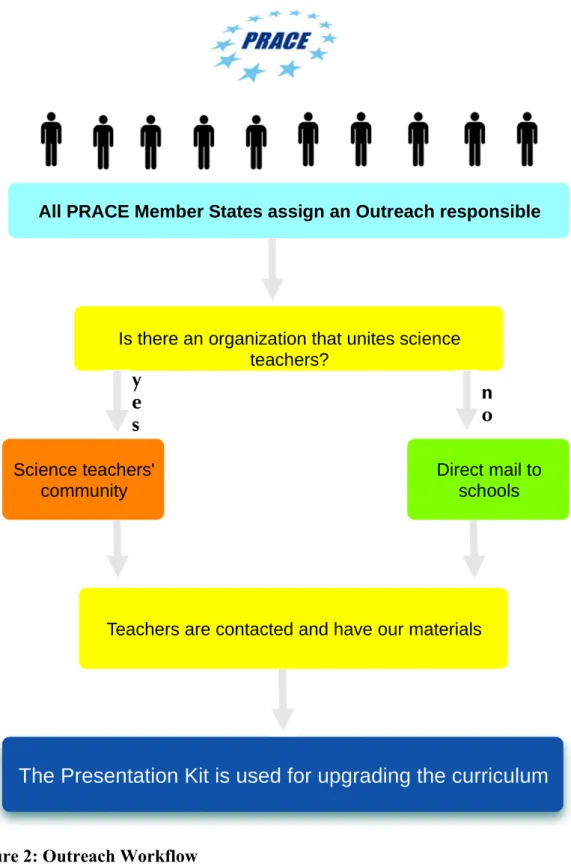
The target audiences for the campaign are not a homogenous population. Therefore, PRACE members must implement a two-pronged approach.
The use of social media is the fastest and most effective way to reach the primary target audience and with the widest reach. These include Facebook, Twitter and YouTube. Our presence in these channels will hopefully ensure that we can grab the audience’s attention and direct it to the campaign website, the informational core and the centralized location from which all Kit’s elements are accessible.
Initiating and maintaining relationships with schools, educational administrators and curriculum developers requires a different approach. Since the education system in member countries is different, each country must be handled in a tailored way. All WP3 members will be assigned to be in charge of their country and others. These assignments will be made at the upcoming face-to-face meeting in Helsinki, 06-08.03.2013. The task for each will be to contact the national association of teachers, or Ministries at a national level, to promote the ‘Dare to Think the Impossible’ campaign as a way to increase awareness of HPC. Also, we will exploit PRACE contacts, such as like teacher’s PRACE, TERENA PR network, EGI and HPC forum sites and organizations. These existing networks will be leveraged as dissemination channels.
Direct promotion is extremely time-consuming and difficulties could be encountered due to language and cultural differences, since it cannot be assumed that teachers approached speak English. Local assistance will be needed to get the relevant materials localized emphasizing local correspondences, like large local computing centres, large scientific achievements assisted by HPC.
Figure 2: Outreach Workflow 5.2 Social media training
Is there an organization that unites science teachers?
Science teachers' community
Direct mail to schools
Teachers are contacted and have our materials
The Presentation Kit is used for upgrading the curriculum
All PRACE Member States assign an Outreach responsibley e s
n o
6 Summary
The PRACE-2IP WP3 Outreach Team conducted regular teleconferences every two weeks to ensure the successful completion of D3.2.2 ‘Presentation Kit for Schools and the General Public’. Due to the proactive participation and cooperation of all the team members, the result is a well-designed Presentation Kit that embraces appropriate new channels of communication, as well as leverages traditional ones.
With this pilot project, we expanded the horizons of communication and dissemination with material that is both entertaining and educational. Going forward, we feel it is prudent to follow up and receive feedback from our target audiences in order to further understand their expectations and needs. Social media will surely play a major role in making this happen.
7 Annex
This section contains an example of the Introductory letter that will be sent to teachers and education officials, and the result of the game testing by Finnish and Hungarian students.
7.1 Introductory letter
Once upon a time, students learned mathematics without calculators. They did library research without computerized catalogues. And looked up information without a PC, the Web
or search engines. Then came PCs, the Internet, grid computing and Google. And education and research lived happily ever after. The end.
Not quite! This story has a long way to go!
The quest for computational power to meet the basic needs of education, research and science is ongoing and progressing at an electrifying pace High performance computers are tomorrow’s PCs. Students who are not familiar with this infrastructure will find themselves behind the times.
PRACE, the Partnership for Advanced Computing in Europe, is an EU and member-funded consortium of High Performance Computing centres that grants core hours on supercomputers to researchers in high impact scientific R&D across all disciplines. Hungary is a proud member of PRACE, and Hungarian researchers use PRACE high performance computers to enhance competitiveness and benefit society. NIIFI represents Hungary within this project.
PRACE is educating tomorrow’s researchers about
the power of supercomputing with the Dare to think
the Impossible educational program. The campaign
focuses on students , ages 15 to 19, as well as the general public. The campaign encompasses a variety of media, including an informational website, social media, brochures, videos, and an astronomy-themed online video game. The program’s modules introduce students to HPC in a language they can understand, engage them in an interactive demonstration of what supercomputing can do, and invite them to join a community to explore real life examples of exciting research being carried out today with the help of PRACE supercomputers.
Today’s high school students are tomorrow’s researchers
and inventors. We invite you to challenge them to Dare
7.2 Survey results of the game testing 7.2.1 Finland
In Finland a group of high school kids tested the game and gave their comments.
’SHOOTING STARS’ feedback
1. Had you ever heard of HPC before today?
Yes 0 %
No 63,64 %
Not sure 36,36 %
2. Are you considering a career in?
Definitely yes Maybe yes Unsure Maybe no No
Science 0 % 18,18 % 36,36 % 9,09 % 36,36 %
Computing 9,09 % 9,09 % 27,27 % 9,09 % 45,45 % Engineering 0 % 9,09 % 36,36 % 18,18 % 36,36 %
Mathematics 0 % 0 % 40 % 10 % 50 %
3. Did you like the game? I liked it very much 18,18 % I liked it 45,45 %
It was ok 36,36 %
I didn’t like it 0 % It was terrible 0 %
4. What did you like about the game? It was nice to use our brains. It was fun.
Cool, but too simple. Cool.
5. What didn't you like about the game? It was a little too hard
There are extreme hard levels Too monotone, too simple 6. How would you improve the game?
Make some levels easier More excitement.
7. Are you male or female?
Male 36,36 %
Female 63,64 % 8. What age are you? 15 81,82 % 16 18,18 %
17 0 %
18 0 %
9. Which Country are you from?
7.2.2 Hungary
’SHOOTING STARS’ feedback
In Hungary, we had the game tested in 2 classes within two secondary schools that are situated in Budapest. Both schools have special faculties focusing on science studies (chemistry, physics, biology, etc.).
Moreover, a couple of our colleagues tried the game too, so we gathered their comments too. 1. Had you ever heard of HPC before today?
Yes 28,57 %
No 71,43 %
Not sure 0 %
2. Are you considering a career in?
Definitely yes Maybe yes Unsure Maybe no No
Science 23,81 % 38,10% 4,76 % 23,81 % 9,52 %
Computing 19,05 % 28,57 % 9,52 % 33,33 % 9,52 % Engineering 33,33 % 23,81 % 14,29 % 19,05 % 9,52 % Mathematics 23,81 % 23,81 % 4,76 % 19,05 % 28,57 % 3. Did you like the game?
I liked it very much 38,10 % I liked it 28,57 %
It was ok 28,57 %
I didn’t like it 4,76 % It was terrible 0 % 4. What did you like about the game?
Nice graphics It was funny
You have time to think before you have to make your move It was entertaining, but you had to think and be skilled Nice graphics and exciting
Great background Very realistic
The levels where you had to destroy I loved that each level is a different game Graphics, animation
Nice colours Simple but fun Simplicity
5. What didn't you like about the game? It was a little too hard
A couple of levels seem to be impossible to accomplish There are extreme hard levels
You can be easily addicted to the game Level 6 is too hard! Couldn’t get through
Sometimes you have to wait for too long, sometimes you don’t have enough time Level 10 wouldn’t let me get to the next level, even if I didn’t blow any of the red
ones, but everything else
You have to wait for too long for the next planet to appear Too monotone
6. How would you improve the game? Make some levels easier (6, 10) More levels
Level 10: it’s not obvious what’s the goal here
Rethink the order of the levels, because sometimes easier ones follow the harder ones Redesign level 10, it is impossible this way
Will there be an Android version?
New feature: if you don’t want to wait for the next planet for so long, you could skip the waiting period
More planets
More colourful background, it’s too dark, makes me loose my temper Expand the galaxy, more options to operate
7. Are you male or female? Male 47,62% Female 52,38% 8. What age are you? 15 14,29 % 16 66,67 % 17 14,29 % 18 4,76 %
9. Which Country are you from? Hungary 100%
There should be a smartphone app with the opportunity for competing. Pop-up messages containing fun-facts?