Multilevel Techniques and
Learning Automata for the
Maximum Satisfiability
(MAXSAT) Problem
By
Øystein Brådland
Mats G. L. Oseland
Supervisor
Associate Professor Noureddine Bouhmala, UiA/HiVe
This Master’s Thesis is carried out as a part of the education at the University of
Agder and is therefore approved as a part of this education. However, this does not
imply that the University answers for the methods that are used or the conclusions
that are drawn.
University of Agder, 2012
Faculty of Engineering and Science
Abstract
The Maximum Satisfiability (MAXSAT) Problem is a propositional logic and an
optimiza-tion based problem that has great importance in the theoretical and practical domain. In
the recent years MAXSAT has risen great interest in the industry. Example problems from
the industry that can be encoded as MAXSAT problems are circuit design and debugging,
hardware verification, bioinformatics and scheduling. These kind of problems often tend
to be large and increase exponentially with the problem size, and therefore algorithms for
solving such problems incorporate different techniques and methods to solve the problems
in a smart and efficient manner.
In this thesis we introduce a range of algorithms that extend the well-known Stochastic
Local Search (SLS) algorithm called
WalkSAT
.
WalkSAT
is extended with the multilevel
paradigm and Learning Automata. The multilevel paradigm is a technique that splits large
and difficult problems into smaller problems. These problems are expectedly less complex
and therefore easier to solve. Learning Automata are a branch of machine learning that
can be seen as a decision-making entity that is employed in an unknown environment.
Through feedback from the environment the Learning Automata try to learn the optimal
actions.
The core of this thesis is the observations and findings of how these dissimilar techniques
af-fect the performance and behaviour of
WalkSAT
when solving industrial MAXSAT problem
instances. Through extensive experiments our results confirm that combining multilevel
techniques and Learning Automata with
WalkSAT
, separately and together, give
promis-ing results. We compare these composite algorithms with
WalkSAT
on selected industrial
MAXSAT problems throughout the thesis, and show that all these composite algorithms
Acknowledgements
This master’s thesis is the final project in the master’s program in Information and
Com-munication Technology (ICT) at the University of Agder. The thesis has been under the
supervision of Associate Professor Noureddine Bouhmala.
We would like to thank Bouhmala for the valuable guidance and advices throughout the
work. This thesis would not have been possible without the help of Bouhmala through his
knowledge and insight in his field of research.
A paper entitled
Combining WalkSAT with Learning Automata for MAXSAT
is under
writing and will be submitted to a journal.
Grimstad, June 1, 2012
Contents
1
Introduction
1
1.1
Importance of topic and motivation . . . .
1
1.2
Thesis definition
. . . .
2
1.3
Research questions . . . .
2
1.4
Research approach . . . .
3
1.5
Contribution to knowledge . . . .
3
1.6
Limitations and key assumptions . . . .
3
1.7
Thesis outline . . . .
4
2
The Maximum Satisfiability Problem
5
2.1
Review of propositional logic
. . . .
5
2.2
Conjunctive normal form
. . . .
6
2.2.1
Transformation of propositional logic formulas to CNF . . . .
7
2.3
The Propositional Satisfiability Problem . . . .
8
2.4
The Maximum Satisfiability Problem . . . .
8
3
Solvers for MAXSAT
9
3.1
Algorithms for SAT and MAXSAT . . . .
9
3.1.1
Stochastic local search algorithms
. . . .
10
3.1.2
Systematic search algorithms . . . .
11
3.2
Solvers combined with Learning Automata . . . .
11
3.3
Solvers combined with multilevel techniques . . . .
11
3.4
Other prominent MAXSAT solvers . . . .
12
4
Experimental Design
13
4.1
Problem suite . . . .
13
4.2
Experiment setup . . . .
13
CONTENTS
5
WalkSAT
14
5.1
The WalkSAT family . . . .
14
5.2
WalkSAT/SKC . . . .
15
5.3
WalkSAT implementation . . . .
16
5.4
Experiment - WalkSAT noise evaluation . . . .
17
5.4.1
Results
. . . .
17
6
Combining WalkSAT with Multilevel Techniques
20
6.1
Introduction to multilevel techniques . . . .
20
6.2
Multilevel techniques in a MAXSAT context . . . .
21
6.3
Multilevel WalkSAT . . . .
23
6.3.1
Dynamic noise . . . .
24
6.3.2
Variables and cluster flipping . . . .
25
6.4
Experiment - benchmarking of multilevel WalkSAT . . . .
26
6.4.1
Results
. . . .
27
7
Combining WalkSAT with Learning Automata
32
7.1
Learning Automata and reinforcement learning . . . .
32
7.2
Learning Automata in a MAXSAT context
. . . .
33
7.3
Learning Automata WalkSAT . . . .
35
7.4
Experiment - Learning Automata state evaluation
. . . .
37
7.4.1
Results
. . . .
38
7.5
Experiment - benchmarking of
Learning Automata WalkSAT . . . .
41
7.5.1
Results
. . . .
41
8
Combining WalkSAT with Multilevel Techniques and
Learning Automata
44
8.1
Multilevel Learning Automata WalkSAT . . . .
44
8.2
Experiment - benchmarking of
multilevel Learning Automata WalkSAT . . . .
45
8.2.1
Results
. . . .
45
9
Discussion
49
9.1
Multilevel WalkSAT . . . .
49
9.1.1
Wasting computational resources . . . .
49
CONTENTS
9.1.3
Single versus cluster . . . .
51
9.1.4
Static versus dynamic noise . . . .
51
9.2
Learning Automata WalkSAT . . . .
51
9.3
Multilevel Learning Automata WalkSAT . . . .
51
9.4
Summary . . . .
52
10 Conclusion of the Research
53
10.1 Conclusion
. . . .
53
10.2 Further work . . . .
54
Bibliography
55
A Benchmarking Results
58
A.1 WalkSAT combined with multilevel techniques
. . . .
59
A.2 WalkSAT combined with Learning Automata . . . .
62
A.3 WalkSAT combined with multilevel techniques
and Learning Automata . . . .
64
List of Figures
1.1
The parts of the research approach. . . .
3
5.1
Problem instance fpu8-problem.dimacs_24.filtered.cnf, |variables| =160 232,
|clauses| = 548 848. Vertical axis gives the number of unsatisfied clauses,
horizontal axis represents the noise
p
.
. . . .
17
5.2
Problem instance wb1.dimacs.filtered.cnf, |variables| = 49 525, |clauses| =
140 091. Vertical axis gives the number of unsatisfied clauses, horizontal
axis represents the noise
p
. . . .
18
5.3
Problem instance 38584-bug-onevec-gate-0.dimacs.seq.filtered.cnf, |variables|
= 314 272, |clauses| = 819 830. Vertical axis gives the number of unsatisfied
clauses, horizontal axis represents the noise
p
. . . .
18
6.1
Clustering single objects. Single objects can be seen as one object when
clustered. . . .
20
6.2
Clustering and reduction of variables. |Variables| = 20, |variables per
clus-ter| = 2, |levels| = 3 (not counting level 0).
X
denotes a variable, and
c
denotes a cluster. . . .
21
6.3
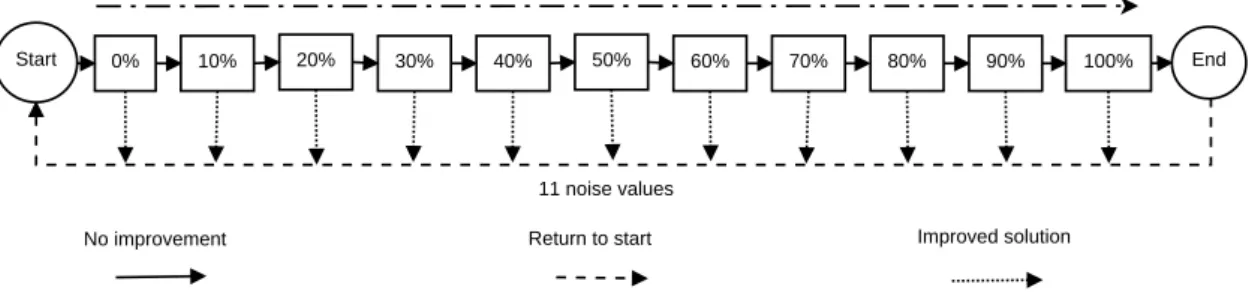
Dynamic noise procedure: 11 different noise values. Starts at 0%, ends at
100%, increments by 10%. The arrows specifies the possible transitions.
. .
24
6.4
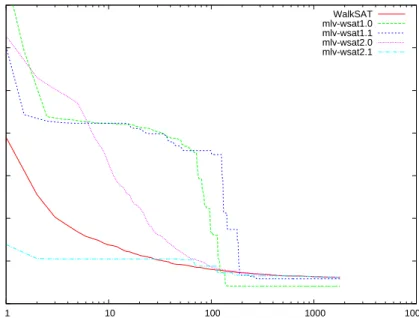
Log plot: Problem instance divider-problem.dimacs_3.filtered.cnf, |variables|
= 216 900, |clauses| = 711 249. Vertical axis gives the number of unsatisfied
clauses, horizontal axis gives the time in seconds. . . .
27
6.5
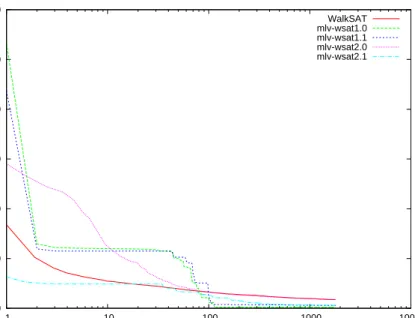
Log plot: Problem instance dividers_multivec1.dimacs.filtered.cnf,
|vari-ables| = 106 128, |clauses| = 397 650. Vertical axis gives the number of
unsatisfied clauses, horizontal axis gives the time in seconds. . . .
27
6.6
Log plot: Problem instance i2c_master1.dimacs.filtered.cnf, |variables| =
82 429, |clauses| = 285 987. Vertical axis gives the number of unsatisfied
clauses, horizontal axis gives the time in seconds. . . .
28
6.7
Log plot: Problem instance rsdecoder1_blackbox_CSEEblock-problem.dimacs_32.
filtered.cnf, |variables| =277 950, |clauses| = 806 460. Vertical axis gives the
number of unsatisfied clauses, horizontal axis gives the time in seconds.
. .
28
LIST OF FIGURES
6.8
Log plot: Problem dividers_multivec1.dimacs.filtered.cnf, |variables| = 106
128, |clauses| = 397 650. Vertical axis gives the number of unsatisfied
clauses, horizontal axis gives the time in seconds. The vertical bars
indi-cate level transitions.
. . . .
29
6.9
Log plot: Problem instance spi2.dimacs.filtered.cnf, |variables| = 124 260,
|clauses| = 515 813. Vertical axis gives the number of unsatisfied clauses,
horizontal axis gives the time in seconds. . . .
29
7.1
Interaction between an agent and its environment. . . .
32
7.2
Learning automaton states, actions, rewards and penalties, and their effects. 33
7.3
Left: Learning automaton state mirroring mechanism. Right: Learning
Au-tomata WalkSAT with one state per action. . . .
36
7.4
Problem instance divider-problem.dimacs_3.filtered.cnf. |variables| = 216
900, |clauses| = 711 249. Vertical axis gives the number of unsatisfied
clauses, horizontal axis gives the number of states per Learning
automa-ton.
. . . .
38
7.5
Problem instance fpu8-problem.dimacs_24.filtered.cnf. |variables| = 160
232, |clauses| = 548 848. Vertical axis gives the number of unsatisfied
clauses, horizontal axis gives the number of states per Learning
automa-ton.
. . . .
38
7.6
Problem instance SM_RX_TOP.dimacs.filtered.cnf. |variables| = 235 456,
|clauses| =934 091. Vertical axis gives the number of unsatisfied clauses,
horizontal axis gives the number of states per Learning automaton. . . .
39
7.7
Log plot: Problem instance divider-problem.dimacs_3.filtered.cnf |variables|
= 216 900, |clauses| = 711 249. Vertical axis gives the number of unsatisfied
clauses, horizontal axis gives the time in seconds. . . .
41
7.8
Log plot: Problem instance dividers6_hack.dimacs.filtered.cnf |variables| =
35 376, |clauses| = 132 699. Vertical axis gives the number of unsatisfied
clauses, horizontal axis gives the time in seconds. . . .
42
7.9
Log plot: Problem instance spi2.dimacs.filtered.cnf |variables| = 124 260,
|clauses| = 515 813. Vertical axis gives the number of unsatisfied clauses,
horizontal axis gives the time in seconds. . . .
42
8.1
Log plot: Problem instance divider-problem.dimacs_3.filtered.cnf |variables|
= 216 900, |clauses| = 711 249. Vertical axis gives the number of unsatisfied
clauses, horizontal axis gives the time in seconds. . . .
45
8.2
Log plot: Problem instance fpu8-problem.dimacs_24.filtered.cnf |variables|
= 160 232, |clauses| = 548 848. Vertical axis gives the number of unsatisfied
clauses, horizontal axis gives the time in seconds. . . .
46
8.3
Log plot: Problem instance dividers_multivec1.dimacs.filtered.cnf |variables|
=106 128, |clauses| = 397 650. Vertical axis gives the number of unsatisfied
clauses, horizontal axis gives the time in seconds. . . .
46
LIST OF FIGURES
8.4
Log plot: Problem instance i2c_master1.dimacs.filtered.cnf |variables| =
82 429, |clauses| = 285 987. Vertical axis gives the number of unsatisfied
clauses, horizontal axis gives the time in seconds. . . .
47
9.1
Log plot: Problem dividers_multivec1.dimacs.filtered.cnf, |variables| = 106
128, |clauses| = 397 650. Vertical axis gives the number of unsatisfied
clauses, horizontal axis gives the time in seconds. The vertical bars
indi-cate level transitions.
. . . .
50
List of Tables
2.1
Truth tables for logical operations. . . .
6
2.2
Truth table for formula
g
. . . .
6
5.1
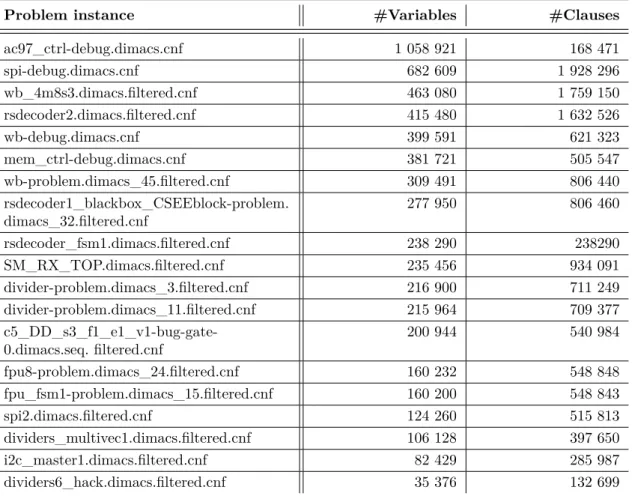
Problem instances used in the experiments, 9 in total. Listed with number
of variables and clauses. . . .
17
5.2
Industrial problem instances with the optimal noise for WalkSAT.
. . . . .
19
6.1
Multilevel WalkSAT variants and their differences. . . .
23
6.2
Problem instances used in the experiment, 20 in total. Listed with number
of variables and clauses. . . .
26
6.3
Results from the experiment. Multilevel WalkSAT variants and WalkSAT. .
31
7.1
Learning Automata WalkSAT variants and their differences. . . .
36
7.2
Problem instances used in the experiments, 8 in total. Listed with number
of variables and clauses. . . .
37
7.3
Results from the experiment. Problem instances given with optimal number
of states for both Learning Automata WalkSAT variants.
. . . .
39
7.4
Results from experiment. Learning Automata WalkSAT variants and
Walk-SAT. . . .
43
8.1
Multilevel Learning Automata WalkSAT building blocks.
. . . .
44
8.2
Results from experiment. Multilevel WalkSAT, Learning Automata
Walk-SAT, multilevel Learning Automata WalkSAT and WalkSAT. . . .
48
9.1
Multilevel consecutive reduction example. Contains levels, %PVA
(percent-age of possible variable assignments) and total amount of variables in a
hypothetical MAXSAT problem with 100 variables at level 0. Note that we
have 2 variables per cluster. . . .
50
A.1 Results from benchmarking. Multilevel WalkSAT variants and WalkSAT.
.
59
A.2 Results from benchmarking. Multilevel WalkSAT variants and WalkSAT.
.
60
LIST OF TABLES
A.4 Results from benchmarking. Learning Automata WalkSAT variants and
WalkSAT. . . .
62
A.5 Results from benchmarking. Learning Automata WalkSAT variants and
WalkSAT. . . .
63
A.6 Results from benchmarking. Multilevel WalkSAT, Learning Automata
Walk-SAT, multilevel Learning Automata WalkSAT and WalkSAT. . . .
64
A.7 Results from benchmarking. Multilevel WalkSAT, Learning Automata
Walk-SAT, multilevel Learning Automata WalkSAT and WalkSAT. . . .
65
A.8 Results from benchmarking. Multilevel WalkSAT, Learning Automata
List of Algorithms
1
SAT-SLS
. . . .
10
2
WalkSAT architecture . . . .
14
3
WalkSAT . . . .
15
4
The multilevel paradigm . . . .
22
5
Multilevel WalkSAT . . . .
23
List of Definitions
1
Thesis definition . . . .
2
2
Satisfiability . . . .
7
3
The SAT problem
. . . .
8
4
The unweighted MAXSAT problem . . . .
8
5
Break-count . . . .
15
6
Cluster flip . . . .
24
7
Multilevel-multiplier . . . .
24
Chapter 1
Introduction
In this chapter we briefly put forward the Maximum Satisfiability Problem (MAXSAT).
We introduce the problem area, its importance, and our motivation behind this research
in section 1.1. The thesis definition is given in section 1.2, research questions based on
the definition are formed in section 1.3. The steps of conducting our research are given
in section 1.4. We highlight our contribution to knowledge in section 1.5 followed by
limitations and key assumptions in section 1.6. The chapter ends with an outline of the
thesis in section 1.7.
1.1
Importance of topic and motivation
Research on solving MAXSAT has great importance. It is mainly important because there
are many theoretical and practical problems that can be encoded as MAXSAT problems.
Circuit design and debugging, scheduling of how an observation satellite captures photos of
Earth, and protein structure alignment (bioinformatics) are all applications and problems
from the industry that can be translated to MAXSAT [1–3].
MAXSAT is the optimization variant of the propositional satisfiability problem known
as SAT. Due to the MAXSAT problem’s structure, the complexity grows exponentially
depending on the problem size, hence the time it would take to test all the different
solutions could easily be too long. In order to solve a MAXSAT problem efficiently, it is
not sufficient to have a fast implementation, but also to be able to move around in the
search space in an intelligent manner using various methods and techniques. By doing so, a
large number of solutions will be visited and evaluated, thereby increasing the probability
for reaching the best possible solution. Hence, the solver will perform more efficiently.
Another important factor for researching on MAXSAT solvers is that if there is a MAXSAT
problem, it can be solved by any MAXSAT solver
1. However, some solvers might work
better on specific problem types, and worse on others. It is therefore important to have
this in mind when developing a MAXSAT solver.
Stochastic Local Search (SLS) algorithms are known to perform well on SAT problems
[4–6]. Therefore, it is interesting to see if it is possible to enhance the performance of SLS
algorithms by applying various techniques for solving MAXSAT. Extending an existing
SLS algorithm is the integral part of our research, with the goal being that it will be able
to solve MAXSAT problems in a more efficient manner. Our research will focus on an
1
Any MAXSAT problem can essentially be solved by any MAXSAT solver, assuming the problem format is supported.
CHAPTER 1. INTRODUCTION
algorithm called
WalkSAT
that will be combined with Learning Automata and multilevel
techniques. We then explore the effects of extending
WalkSAT
with the aforementioned
methods. Especially, we want to compare the performance of
WalkSAT
to our proposed
extensions of
WalkSAT
on industrial MAXSAT problem instances.
1.2
Thesis definition
Our thesis definition is given below.
Definition 1
Thesis definition: The MAXSAT problem is known to be NP-hard and
is an optimization variant of the SAT problem. The performance of many optimization
techniques deteriorates very rapidly mostly due to two reasons. First, the complexity
of the problem usually increases with its size, and second, the solution space of the
problem increases exponentially with the problem size. Therefore it is beneficial for
MAXSAT solvers to move around in the solution space in a smart and efficient
man-ner to reach the optimal or the best possible solution. In the paper A Multilevel Memetic
Algorithm for Large SAT-Encoded Problems, Bouhmala proposes a multilevel approach
for solving bounded model checking problems. In Using Learning Automata to Enhance
Local-Search Based SAT Solvers with Learning Capability by Granmo and Bouhmala,
they introduce a novel approach of using machine learning in a SAT context. Results
from the multilevel and machine learning methods proved to be promising. The purpose
of this master thesis is to see whether combining state of the art stochastic local search
methods with multilevel-techniques and Learning Automata for solving MAXSAT
re-sults in better performance.
1.3
Research questions
Based on the thesis definition we establish four research questions. These questions will
function as our main objectives. They are important subjects of the study that we will
answer by the end of this work.
1.
Learning Automata and multilevel techniques combined with other SAT
solvers have recently been used to solve SAT. What will be the outcome
when
WalkSAT
is extended with the aforementioned techniques for solving
MAXSAT?
Previous successful research shows that Learning Automata paired with
GSATRW and RW [7], and multilevel techniques paired with a memetic algorithm [8]
for solving SAT problems gave great improvement. However, it is not hereby given
that the results will be the same for MAXSAT problems. Further, SLS solvers that
perform well in SAT does not necessarily perform equally well in MAXSAT [1].
It might be the case that the structure and semantics of
WalkSAT
will increase or
decrease the significance of Learning Automata and multilevel techniques.
2.
Assuming we experiment with different combinations of
WalkSAT
with
mul-tilevel techniques, and
WalkSAT
with Learning Automata. What is the
op-timal combination in both aspects?
WalkSAT’s
structure opens for a degree of
freedom for extension. How the combination is done may play an important role. We
will therefore experiment with different combinations.
3.
If
WalkSAT
extended with Learning Automata and multilevel techniques
separately yields good results, what will be the result of
WalkSAT
combined
CHAPTER 1. INTRODUCTION
with both techniques?
The two techniques differs from each other, and it might
be the case that one of the two will boost the other to achieve an overall higher
performance when combined.
4.
Is there an optimal configuration of Learning Automata when coupled
with
WalkSAT?
A Learning automaton is a kind of a finite state machine that can be
configured in several ways. The number of internal states can affect the performance.
1.4
Research approach
In order to achieve the goals of this thesis the research is divided into four parts. Figure
1.1 illustrates the research approach and the four parts. First, we implement the original
version of
WalkSAT
, second, we combine multilevel techniques with
WalkSAT
. In the third
part we combine Learning Automata and
WalkSAT
. Finally, we combine both multilevel
techniques and Learning Automata with
WalkSAT
at the same time.
WalkSAT WalkSAT WalkSAT Learning Automata 1 2 3 4 WalkSAT Multilevel techniques Multilevel techniques Learning Automata
Figure 1.1: The parts of the research approach.
In all parts we perform experiments and compare our proposed algorithms with each other
and with
WalkSAT
. Findings from part 2 and 3 will be used as a basis for part 4.
1.5
Contribution to knowledge
The main contribution of our research will be the combination of the well-known stochastic
local search algorithm
WalkSAT
with multilevel techniques and Learning Automata. It will
provide valuable information on how multilevel techniques and Learning Automata affect
the performance of
WalkSAT
. Additionally, this research will function as a foundation and
reference point for possible future work.
1.6
Limitations and key assumptions
All the implemented algorithms presented in this thesis are not to be seen as complete
algorithms that can serve as final products. They are rather unoptimized prototypes of
what can be, and at this stage they only satisfy our needs required to complete and
pursue the goals of this thesis. Hence the results displayed in tables and graphs might
not correspond to optimized versions. Due to this, the results are not to be compared
CHAPTER 1. INTRODUCTION
with competing solvers from MAXSAT competitions and evaluations where computational
speed plays an important role.
1.7
Thesis outline
The remainder of the paper is organized as follows: Chapter 2 holds the problem area of
this research, namely the MAXSAT problem. In chapter 3 we present methods for solving
MAXSAT, and we also introduce prior research with emphasis on Learning Automata and
multilevel techniques for SAT. Notes on experimental design are put forward in chapter 4.
In chapter 5 the
WalkSAT
algorithm is set forth and examined in-depth. Chapter 6 contains
WalkSAT
combined with multilevel techniques, and in chapter 7
WalkSAT
is combined with
Learning Automata. We present
WalkSAT
combined with both multilevel techniques and
Learning Automata in chapter 8. Then, in chapter 9 we discuss results and observations
found from all experiments we have performed in chapter 6, 7 and 8. Finally, we conclude
our research and introduce possible further work in chapter 10.
Chapter 2
The Maximum Satisfiability
Problem
In this chapter we present the Maximum Satisfiability (MAXSAT) Problem. The chapter
comprises preliminary background information that helps the reader get acquainted with
MAXSAT.
We start by introducing propositional logic in section 2.1, which is the core structure
of a MAXSAT problem. In section 2.2 we show how propositional logic formulas can be
transformed into a form called CNF, which is used as input for many SAT and MAXSAT
solvers. We then turn the attention to MAXSAT. Due to the close relationship between
SAT and MAXSAT, we first introduce SAT in section 2.3, and then we introduce MAXSAT
in section 2.4. These sections also point out applications and definitions.
2.1
Review of propositional logic
Propositional logic is a system where the interest lies within propositions and their
inter-relationships. A proposition is a statement that can be assigned two values, either
T RU E
or
F ALSE
, also equivalent to 1 and 0, hereafter known as truth values. The logical
op-erations, also known as connectives, include
∨
(OR and logical disjunction),
∧
(AND and
logical conjunction),
¬
(NOT and logical negation),
→
(implication), and
↔
(equivalence).
These can be applied on two propositions, but
¬
can only be applied on one proposition.
When applied, the outcome is another proposition.
A formula with propositions can be evaluated as
T RU E
or
F ALSE
. Examples of
proposi-tions from real life are
x
1=
It is
−
5
degrees Celsius outside today in Grimstad
, and
x
2=
I
will wear my scarf and mittens today
. These propositions are primitive propositions which
can be combined to a compound proposition by using logical conjunction:
It is
−
5
degrees
Celsius outside today in Grimstad
, AND
I will wear my scarf and mittens today
. With
symbols this can be expressed as (
x
1∧
x
2).
A truth table is used to show the semantics for a logical operation. Table 2.1 gives the
truth tables for the mentioned logical operations.
CHAPTER 2. THE MAXIMUM SATISFIABILITY PROBLEM
X Y X∨Y X∧Y ¬X X↔Y X→Y 0 0 0 0 1 1 1 1 0 1 0 0 0 0 0 1 1 0 1 0 1 1 1 1 1 0 1 1Table 2.1: Truth tables for logical operations.
An example of a propositional logic formula
g
with propositions, or variables,
x
1, x
2, x
3,
and
x
4is given below.
g
= (
¬
x
1∨
(
¬
x
2→
x
3))
↔
x
4(2.1)
The truth table for this formula is given in table 2.2. Each entry in the table shows the
truth values
x
1, x
2, x
3, and
x
4take to evaluate
g
as
T RU E/
1 or
F ALSE/
0. This can be
observed in the rightmost column.
x1 x2 x3 x4 g 1 1 1 1 1 1 1 1 0 0 1 1 0 1 1 1 1 0 0 0 1 0 1 1 1 1 0 1 0 0 1 0 0 1 0 1 0 0 0 1 0 1 1 1 1 0 1 1 0 0 0 1 0 1 1 0 1 0 0 0 0 0 1 1 1 0 0 1 0 0 0 0 0 1 1 0 0 0 0 0
Table 2.2: Truth table for formulag.
2.2
Conjunctive normal form
A possible encoding form for propositional logic formulas is the Conjunctive Normal Form
(CNF). This form is widely used for describing SAT and MAXSAT problems. A CNF
formula consists of a conjunction of clauses,
Vi
C
i. Each clause
C
iis a disjunction of
literals,
Wj
x
i,j, where a literal is a propositional variable
x
(
T RU E
or
F ALSE
) or its
negation
¬
x
[9]. A CNF formula can be expressed as in equation 2.2 and 2.3, where
m
is
the number of clauses and
x
is a literal in a given clause. Equation 2.4 shows an instance
of a CNF formula with four variables
x
1, x
2, x
3, x
4and four clauses.
CHAPTER 2. THE MAXIMUM SATISFIABILITY PROBLEM
f
=
m ^ i=1C
i(2.2)
C
i=
ki _ j=1x
i,j(2.3)
f
= (
x
1∨
x
4)
∧
(
¬
x
2∨
x
4)
∧
(
¬
x
3∨
x
4)
∧
(
¬
x
4∨ ¬
x
1∨
x
2∨
x
3)
(2.4)
A formula expressed in CNF is satisfied if all its clauses are satisfied, i.e. all clauses evaluate
to
T RU E
. For a clause to be satisfied at least one of the literals must evaluate to
T RU E
,
because of the disjunctions of literals. In formula 2.4 there are four variables
x
1,
x
2,
x
3and
x
4, which means there are 2
4= 16 possible variable assignments of truth values. On the
other hand, if the formula has 500 variables then there are 3
.
27339061
×
10
150assignments.
In a SAT/MAXSAT context these possible variable assignments are referred to as the
search space. One of the assignments of equation 2.4, where
x
1=
T RU E
,
x
2=
F ALSE
,
x
3=
T RU E
,
x
4=
T RU E
, makes
f
evaluate to
T RU E
. Hence, this assignment is called
a solution. This can also be seen from the truth table for the formula
g
(table above),
table 2.2 and equation 2.1. Since
g
can be transformed into CNF yielding
f
, the table is
also valid for
f
. The table reports that there exists eight solutions, eight rows where the
rightmost column holds the value 1 (the rows that are colored gray). Based on this we
define
satisfiability
in respect to propositional logic as following:
Definition 2
Satisfiability: Given a propositional formula
f
. If an assignment of truth
values to the variables in
f
evaluates
f
to
T RU E
, the assignment
satisfies
f
. Further,
f
is claimed to be
satisfiable
if and only if there exists at least one assignment that
satisfies
f
[6].
According to definition 2 we can claim that formula
f
is satisfiable since there is at least one
assignment of truth values that satisfies the formula, thus makes the formula satisfiable.
2.2.1
Transformation of propositional logic formulas to CNF
The main idea behind transforming a propositional logic formula to CNF is by using
logic transformation rules, where the goal is to create clauses with literals by only using
the logical connectives
∧
,
∨
and
¬
. The listing below shows how the propositional logic
formula
g
given in equation 2.1 can be transformed into CNF by using De Morgan’s law,
double negative law and the distributive law. We also need to decompose the connective
double implication
↔
: (
x
1↔
x
2)
⇔
(
x
1→
x
2)
∧
(
x
2→
x
1), and the logical connective
implication
→
: (
x
1→
x
2)
⇔
(
¬
x
1∨
x
2) [10].
(
¬
x
1∨
(
¬
x
2→
x
3))
↔
x
4⇔
((
¬
x
1∨
(
¬
x
2→
x
3))
→
x
4)
∧
(
x
4→
(
¬
x
1∨
(
¬
x
2→
x
3)))
⇔
(
¬
(
¬
x
1∨
(
¬
x
2→
x
3) )
∨
x
4)
∧
(
¬
x
4∨
(
¬
x
1∨
(
¬
x
2→
x
3)))
⇔
(
¬
(
¬
x
1∨
(
x
2∨
x
3) )
∨
x
4)
∧
(
¬
x
4∨
(
¬
x
1∨
(
x
2∨
x
3)))
⇔
((
x
1∧ ¬
(
x
2∨
x
3) )
∨
x
4)
∧
(
¬
x
4∨
(
¬
x
1∨
(
x
2∨
x
3)))
⇔
((
x
1∧
(
¬
x
2∧ ¬
x
3))
∨
x
4)
∧
(
¬
x
4∨
(
¬
x
1∨
(
x
2∨
x
3)))
CHAPTER 2. THE MAXIMUM SATISFIABILITY PROBLEM
⇔
((
x
1∧ ¬
x
2∧ ¬
x
3)
∨
x
4)
∧
(
¬
x
4∨ ¬
x
1∨
x
2∨
x
3)
⇔
(
x
1∨
x
4)
∧
(
¬
x
2∨
x
4)
∧
(
¬
x
3∨
x
4)
∧
(
¬
x
4∨ ¬
x
1∨
x
2∨
x
3)
The expression in the last line in the listing above is the same as given in equation 2.1,
hence the propositional logic formula has been transformed into CNF. As can be seen
from the final result, negation (
¬
) now only appears on single literals inside clauses. The
only logic connectives left are
∧
and
∨
, and all the occurrences of
↔
and
→
have been
decomposed.
2.3
The Propositional Satisfiability Problem
The Propositional Satisfiability Problem, also known as the SAT problem, is essential
in mathematical logic and computing theory, but it also has interests in applications
belonging to the practical domain. As can be understood from the name, the structure of
the SAT problem builds on the propositional logic presented in the previous sections.
Real-world problems and applications include Blocks World (planning problem in the AI
domain), graph coloring, circuit design and hardware verification can all be encoded as
SAT problems [1]. The SAT problem is under the NP-complete class of problems [9], and
the goal is to determine whether there exists an assignment of truth values to the variables
in a given CNF formula such that it becomes satisfiable [6]. We define the SAT problem
as following:
Definition 3
The SAT problem: Given a propositional formula
f
, does there exist an
assignment of truth values to the variables such that
f
becomes satisfiable?
2.4
The Maximum Satisfiability Problem
The Maximum Satisfiability (MAXSAT) Problem is an optimization variant of the SAT
problem. The complexity of such problems is known to be NP-hard [9]. Applications and
problems from the industry involve bioinformatics [3], scheduling [2] and integrated circuits
such as field-programmable gate array (FPGA) routing [11].
MAXSAT has several variants: the weighted MAXSAT problem, the unweighted MAXSAT
problem, the partial MAXSAT problem and the weighted partial MAXSAT problem [12].
In the weighted variants each clause in a problem has an associated weight, and where
the goal is to maximize the total weight of the satisfied clauses. For unweighted MAXSAT
the goal is to minimize the amount of unsatisfied clauses
1in a given CNF formula [6]. We
define the unweighted MAXSAT problem as following:
Definition 4
The unweighted MAXSAT problem: Given a propositional formula
f
,
does there exist an assignment of truth values to the variables that maximizes the
number of satisfied clauses in
f
?
The difference between SAT and MAXSAT is now evident according to definition 3 and
4: SAT is a decision based problem, while MAXSAT is an optimization based problem.
Our focus lies on unweighted MAXSAT, and therefore for the rest of this thesis the term
MAXSAT refers to unweighted MAXSAT.
1
Chapter 3
Solvers for MAXSAT
This chapter comprises methods for solving MAXSAT and introduces prior significant
work for solving SAT through the employment of multilevel techniques, and algorithms
with learning capabilities. We also present a selection of MAXSAT solvers.
An introduction to SAT and MAXSAT solvers is given in section 3.1, where the two main
branches of solvers, stochastic local search algorithms and systematic search algorithms,
are discussed in more detail in section 3.1.2 and 3.1.1. Since stochastic local search
algo-rithms is our main focus we provide more information on this subject.
Section 3.2 introduces prior work where various stochastic local search algorithms have
been paired with Learning Automata. A memetic algorithm and an algorithm called
GSAT
combined with multilevel techniques are set forth in section 3.3. The chapter ends with
section 3.4 that contains a brief overview of prominent MAXSAT solvers.
3.1
Algorithms for SAT and MAXSAT
SAT and MAXSAT solvers, or algorithms, are used to solve propositional problem
in-stances. Due to the definitions of SAT and MAXSAT the goals for these solvers are
dif-ferent, see definition 3 and 4. The goal for a SAT solver is to achieve satisfiability for a
given problem. However, a MAXSAT solver seeks to maximize the amount of satisfied
clauses. Hence, it might not solve all clauses, but the problem might be satisfied according
to given constraints. The goals are realized by
flipping
variables in the problem, where
flipping means to negate the truth value of a variable.
As we pointed out in section 2.2, a propositional formula that consists of 500 variables
has 3
.
27339061
×
10
150different variable assignments. This illustrates the magnitude of
dealing with propositional logic formulas with a high number of variables. It is therefore
clear that solvers need to be designed efficiently to obtain good coverage of the search
space and find optimal solutions within reasonable time.
Solvers are generally divided into two branches: Stochastic local search algorithms, and
systematic search algorithms. The two types of solvers are discussed in more detail in the
next sections.
CHAPTER 3. SOLVERS FOR MAXSAT
3.1.1
Stochastic local search algorithms
Solvers that are based on Stochastic Local Search (SLS) are often said to be incomplete.
An incomplete solver does not guarantee that it will provide a satisfying assignment, or
claim that the problem instance is unsatisfiable. Most of the solvers are concerned with
reporting satisfying assignments, if there exists one. Incomplete algorithms often run until
a constraint has been met, e.g. a time limit, max amount of flips or other such properties.
Systematic search algorithms used to dominate the field of solving large SAT problem
instances. However, in the 1990’s stochastic local search algorithms proved its strength
for solving large and hard SAT problems [13]. Two of the most important solvers among
incomplete solvers that paved the way for SLS algorithms for SAT were
GSAT
[5] and
WalkSAT
[4].
GSAT
was one of the first SLS SAT solvers presented in 1992 and
WalkSAT
was introduced in 1994 which originated from
GSAT
with slight modifications.
The strength and approach for SLS algorithms are the usage of local information. With
this approach SLS algorithms are able to find good solutions without exploring the entire
search space. They start by examining the search space at some position and then move
to a position nearby. From the latter position the decision about the next move is decided
by the information from the local neighborhood, where the neighborhood can be seen as
a variable assignment. The search is stochastic in the sense that the decisions and moves
can be based on stochastic properties. On the other hand, one of the weaknesses of SLS
algorithm is that they can get stuck in a state known as local minima
1. There are several
suggested ways to deal with this issue. Restart
2and non-improving steps are common
mechanisms used in many algorithms [14].
In most cases SLS algorithms have an associated objective function. The objective function
is often denoted as the number of unsatisfied clauses under a given assignment.
Conse-quently, SLS algorithms try to minimize this function [14]. In general, each variable
x
in
a given problem has a score associated with it, in respect to an assignment. There are
different scoring functions of measuring this score, depending on the algorithm (e.g.
GSAT
,
WalkSAT
or other SLS algorithms).
Algorithm 1
SAT-SLS
1:{
Input:
CNF formula G}
2:
{
Output:
Satisfied assignment for G, or ’no solution exists’}
3:
for
i
←
0 to MAX_TRIES
do
4:T
←
random_assignment()
5:for
j
←
0 to MAX_FLIPS
do
6:if
T is satisfied
then
7:return
T
8:else
9:/* heuristics */
10:
variable
←
select
_
variable
()
11:end if
12:
flip(variable)
13:
end for
14:
end for
1
A local minimum is a point in the search space where the local neighborhood does not have a point that is better (i.e. lower number of unsatisfied clauses).
2
CHAPTER 3. SOLVERS FOR MAXSAT
In algorithm 1 above (reproduced from [15]) a generic outline of SLS algorithms for SAT is
given. In the initialization phase all the variables in a given formula are randomly assigned a
truth value. Then the algorithm selects a variable and flips its. This is done in an iterative
process and can also be seen as a trial and error approach. The heuristics of variable
selection is what changes from one SLS algorithm to another. The selection is often done
according to the scoring function, and has significant impact on the overall performance [6].
Further, according to algorithm 1 the SLS algorithm will repeat selecting variables and
doing flips until MAX_FLIPS is reached. If no solution is found, the algorithm restarts
with a new random assignment. The algorithm stops executing when it has reached a
predefined number of allowed restarts denoted as MAX_TRIES.
The algorithm presented in the outline is for solving SAT problems, but it is also valid for
MAXSAT with minor modifications. Generally, all SLS algorithms can be modified and
adapted to solve unweighted MAXSAT problems. However, this does not imply that SLS
solvers performing well in SAT yield the same performance in MAXSAT [6].
3.1.2
Systematic search algorithms
Solvers that are classified as systematic search algorithms are known as complete solvers.
In comparison to incomplete solvers complete solvers are guaranteed to find a satisfying
assignment if one exists, or prove unsatisfiability. Hence, systematic search algorithms
search the entire solution space (all possible variable assignments) of the given problem.
Because of this complete solvers may be more computationally expensive, and have often
difficulties solving large problems.
Many of the complete solvers are based on
DPLL
[16] that was introduced in 1962, which
is also based on the
DP
[17] algorithm from 1960.
DPLL
builds a binary tree by assigning
truth values to variables, and uses backtracking and branching as its main components.
Successful algorithms based on
DPLL/DP
are
GRASP
[18],
SATO
[19],
TABLEAU
[20] and
SATZ
[21].
3.2
Solvers combined with Learning Automata
Previous work in the field of SAT solvers and machine learning have shown that mixing
(stochastic) local search SAT algorithms with Learning Automata has given promising
results. The goal is to let a SAT solver learn and decide what steps are the best ones to
achive better performance than without learning. The machine learning technique that has
been used by Granmo and Bouhmala was a Tsetlin automaton. Granmo and Bouhmala’s
work on fusing Learning Automata (LA) with both
Random Walk
[22] and
GSATRW
[22],
giving
LARW
and
LA-GSATRW
respectively, had a higher success rate and better performance
than their non-LA counterparts on selected problems from the SATLIB benchmarks in [23].
3.3
Solvers combined with multilevel techniques
Bouhmala proposed the multilevel memetic algorithm
MLVLMA
in [8] for solving large SAT
Bounded Model Checking problem instances. His research shows how a memetic algorithm
3can utilize the multilevel paradigm. The multilevel paradigm is a method for splitting large
3
CHAPTER 3. SOLVERS FOR MAXSAT
and difficult problems into smaller problems. These problems are expectedly less complex
and therefore easier to solve. The results show that combining a memetic algorithm with
the multilevel paradigm can improve the quality of the solution up to 77% in some cases.
In [25] the multilevel paradigm is combined with the stochastic local search algorithm
GSAT
. Conclusions drawn from the results indicate that the multilevel paradigm speeds up
GSAT
and improves its convergence.
3.4
Other prominent MAXSAT solvers
Solvers that distinguished themselves in the Max-SAT Evaluation 2006
4are
MAXSATZ
[27]
and
MAX-DPLL
[28]. The former was the best unweighted MAXSAT solver, and the latter
was pointed out as the best solver for weighted MAXSAT.
MAX-DPLL
was also announced
as the second best unweighted solver [29, 30].
Other algorithms related to our work that are based on SLS for solving MAXSAT are
SAPS
[31] and
DLS-MC
[32]. Both of these algorithms use a technique called Dynamic
Local Search (DLS). DLS is used to avoid getting stuck in local minima. This is done by
dynamically altering the evaluation function of solutions at run time. Further, DLS allows
the search space to be dynamically changed and modified, thus the solver is guided to
avoid local minima.
4
The MAXSAT Evaluation [26] is an affiliated event of International Conferences on Theory and
Chapter 4
Experimental Design
In this chapter we give general information on how the experiments and benchmarking of
algorithms have been performed. We present the problem suite in section 4.1. Information
about the setup of the experiments is given in section 4.2, and in section 4.3 we report notes
on the algorithms’ implementation, and system specifications for our test environment.
4.1
Problem suite
In our experiments and benchmarks we use a selection of the same problems as used in
the MAXSAT Evaluations. All the problems follow the DIMACS CNF file format [33]. We
are focusing on industrial problems, and all of these are available at MAXSAT Evaluation
websites found at http://www.maxsat.udl.cat/. Our problem suite is a mixture of the
problems used in MAXSAT Evaluation 2008, 2009, 2010 and 2011.
4.2
Experiment setup
All the algorithms run 10 times on the same problem instance due the random nature in
stochastic local search algorithms. We calculate the mean results from these 10 times to
get an overview of how the algorithms perform in general. These mean results are used as
a basis for all the graphs and numbers in tables occurring in this thesis. In addition, all the
algorithms have an execution duration of
x
seconds, or
y
flips. When presenting figures,
graphs and tables we use the notation |.| for size (e.g. |clauses| = 4), and # for "number
of" (e.g. #Unsatisfied clauses equals "number of Unsatisfied clauses"). We also use graphs
in logarithmic and arithmetic scale to visualize data and results. For some results we also
give sample variance and sample standard deviation.
4.3
Implementation and machine specifications
All algorithms have been implemented by using the
C++
programming language, and run
on a machine with the following specifications:
• Central processing unit (CPU): 2x Intel Xeon Six Core E5645 2.4 GHz with 12 MB Cache
• Memory (RAM): 24 GB DDR
Chapter 5
WalkSAT
In chapter 3 we introduced methods for solving the MAXSAT problem. We especially focused on the branch called stochastic local search algorithms. In this chapter we take a closer look at the algorithm calledWalkSAT.
Introduction to the WalkSAT family is given in section 5.1, while in section 5.2 we introduce
WalkSAT/SKC which is our focus in this thesis. In section 5.3 we point out the implementation of this algorithm, and in section 5.4 we present results from noise evaluation.
5.1
The WalkSAT family
TheWalkSATfamily, often referred to as an architecture, is a collective term for successful stochastic local search algorithms for solving propositional logic problems. There exists a great amount of
WalkSATvariants such asWalkSAT/SKC,Novelty,Novelty+,Adaptive Novelty+,R-noveltyand
Walk-SAT/Tabu[6]. Nonetheless, all the variants have the same basis for variable selection and is done in two stages: In stage one a currently unsatisfied clause is picked at random.
Algorithm 2
WalkSAT architecture
1:{
Input:
CNF formula G}
2:
{
Output:
Satisfied assignment for G, or ’no solution exists’}
3:
for
i
←
0 to MAX_TRIES
do
4:T
←
random_assignment()
5:for
j
←
0 to MAX_FLIPS
do
6:if
T is satisfied
then
7:return
T
8:end if
9:/* stage 1*/
10:C
k←
random_unsatisfied_clause()
11:/* stage 2*/
12:
variable
←
random
_
variable
(
C
k)
13:
flip(variable)
14:
end for
15:
end for
In stage two a variable that occurs in the unsatisfied clause is chosen at random. A generic outline of theWalkSAT architecture is given in algorithm 2. The main difference between all variants is how the variable is selected, as we will see in the next section. Due to this two-stage process, we observe that WalkSAT has 2-way randomness built in. In addition, these algorithms incorporate
CHAPTER 5. WALKSAT
randomized behaviour, such that during the execution they will perform a random move according to a given probability on how to select a variable. This probability is the so-called noise parameter. As with any other stochastic local search algorithms, the noise parameter is also one of the key elements that influences the performance for allWalkSATvariants.
5.2
WalkSAT/SKC
TheWalkSAT/SKC [4] algorithm was introduced by Selman, Kautz, and Cohen in 1994. It was the first algorithm belonging to theWalkSATarchitecture, and is the algorithm of interest in our thesis. For simplicity, we will for the rest of this paper refer toWalkSAT/SKC asWalkSAT.
As stated earlier, SLS algorithms and variants ofWalkSATmainly differ in the variable selection.
WalkSATcontains three moves for variable selection: (1) a side move/best move, (2) a greedy move, and (3) a random move. The pseudo code forWalkSATis given in algorithm 3.
Algorithm 3
WalkSAT
1:{
Input:
CNF formula G}
2:
{
Output:
Satisfied assignment for G, or ’no solution exists’}
3:Initialization:
p
noise∈
[0, 1]
4:for
i
←
0 to MAX_TRIES
do
5:T
←
random_assignment
6:for
j
←
0 to MAX_FLIPS
do
7:if
T is satisfied
then
8:return
T
9:end if
10:C
k←
random_unsatisfied_clause()
11:
/* best move/side move */
12:
if
∃
variable
v
∈
C
kwith break-count = 0
then
13:
variable
←
v
14:
else
15:
if
random(0, 1)
< p
noisethen
16:
/* random move*/
17:
variable
←
random
_
variable
(
C
k)
18:
else
19:
/* greedy move*/
20:
variable
←
random
_
lowest
_
breakcount
_
variable
(
C
k)
21:
end if
22:
end if
23:
flip(variable)
24:
end for
25:
end for
The scoring function for WalkSAT is the break-count, and is defined as the number of clauses that currently are satisfied but will become unsatisfied after a variable is flipped, see definition 5. Consequently, each variable has its own break-count.
Definition 5 Break-count: The number of clauses that are currently satisfied but will become broken (unsatisfied) after a variable is flipped [6].
WalkSATstarts with an initialization phase that generates a random truth assignment for all vari-ables in a given problem. Then an unsatisfied clause is picked at random. At line 12 in algorithm 3 the side move is chosen if there exists a variable or multiple variables with break-count = 0.
CHAPTER 5. WALKSAT
In the case of multiple variables, one variable is chosen at random at line 13. The side move is said to be a side move because it does not improve or worsen the quality of the solution, but the variable assignment is different. Therefore, it can also be seen as a best move, because no clauses will break if the selected variable is flipped. This move is crucial for the performance, and it also helpsWalkSATto get out of local minima. At line 14, if the break-count6= 0, then the variable will be chosen either by the random move, or by the greedy move.
The random move at line 16 randomly picks a variable in the chosen unsatisfied clause. This move is also referred to as the walk move. It might not be a beneficial move, but it helps to get a better coverage of the search space. The probability for making the random move is denoted asp. This is the so-called noise parameter, where p∈ [0.0,1.0], and 1.0 is equal to 100%. In other words, the noise parameter also controls the greediness (greedy move) ofWalkSAT. There is no standard value for thepparameter, as it varies and depends on the problem type and size. Therefore, the optimal noise value is not easily obtained without extensive empirical tuning1 [35]. However, for Random 3-SAT problems, a type of problem where each clause has exactly 3 literals,pis often set to≈0.55 [36].
With the probability 1−p the greedy move is taken. The greedy move selects a variable by computing the score (break-count) for each variable within the unsatisfied clause by using the scoring function. The variable with the lowest score is chosen, or if there are multiple variables with the same lowest score then one is chosen at random.
The remaining part of the algorithm follows the WalkSAT architecture; the solver will continue flipping variables at line 23 chosen by the side, random or greedy move until the problem is satis-fied, or until MAX_FLIPS has been reached. If no solution has been found during MAX_FLIPS then the algorithm restarts with a new random truth assignment. When it has iterated through MAX_TRIES the algorithm stops executing.
It is implied thatWalkSATcan be used to solve MAXSAT problems. The only modification needed is that the algorithm keeps record of the best number of satisfied clauses, or equally, the lowest number of unsatisfied clauses. This does not change the behavior and workings ofWalkSAT, but the output of the algorithm will be the lowest number of unsatisfied clauses instead of a satisfying assignment.
5.3
WalkSAT implementation
Our implementation ofWalkSATis based on algorithm 3. This is the version that was introduced by Selman, Cohen and Kautz in [4]. A version ofWalkSATwith source code by Henry Kautz is available at http://www.cs.rochester.edu/u/kautz/walksat/. We have verified that our implementation of
WalkSAT behaves correctly and produces the same results. This has been done by running the same problems with the same amount of flips, and then compared the results. The results show that our implementation is valid, however, it is not optimized and cannot compete in terms of speed.
1
CHAPTER 5. WALKSAT
5.4
Experiment - WalkSAT noise evaluation
In this section we perform noise evaluation ofWalkSAT. We examine the importance of the noise parameter in respect to industrial problem instances. The goal is to find the optimal value for the noise parameter. By optimal noise we mean the noise that gives the least number of unsatisfied clauses when the algorithm has finished executing. The noise value discovered will be used to run
WalkSATon other industrial problem instances throughout the thesis.
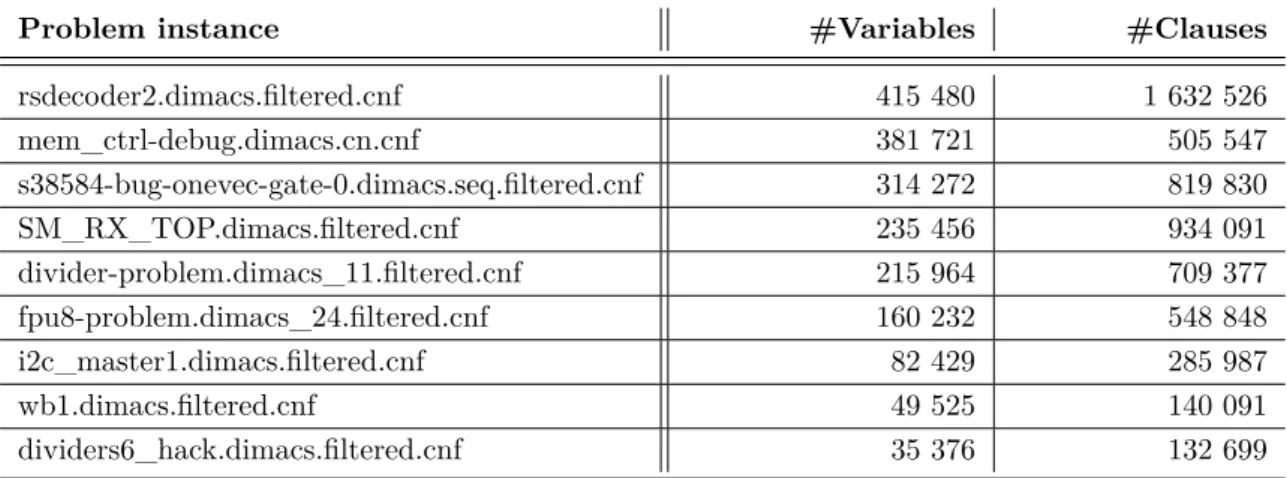
In the experiment we runWalkSATwith the noise-setp= [0.0,0.1,0.2,0.3,0.4,0.5,0.6,0.7,0.8,0.9,1.0], and MAX_FLIPS is set to 300 000 000. We use problem instances listed in table 5.1.
Problem instance #Variables #Clauses
rsdecoder2.dimacs.filtered.cnf 415 480 1 632 526 mem_ctrl-debug.dimacs.cn.cnf 381 721 505 547 s38584-bug-onevec-gate-0.dimacs.seq.filtered.cnf 314 272 819 830 SM_RX_TOP.dimacs.filtered.cnf 235 456 934 091 divider-problem.dimacs_11.filtered.cnf 215 964 709 377 fpu8-problem.dimacs_24.filtered.cnf 160 232 548 848 i2c_master1.dimacs.filtered.cnf 82 429 285 987 wb1.dimacs.filtered.cnf 49 525 140 091 dividers6_hack.dimacs.filtered.cnf 35 376 132 699
Table 5.1: Problem instances used in the experiments, 9 in total. Listed with number of variables and clauses.
5.4.1
Results
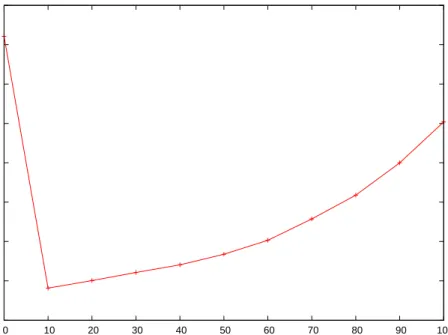
Figure 5.1 shows a noise graph for the problem fpu8-problem.dimacs_24.filtered.cnf. We observe that a bigger noise value increases the number of unsatisfied clauses.
3000 4000 5000 6000 7000 8000 9000 10000 11000 12000 0 10 20 30 40 50 60 70 80 90 100 #Unsatisfied Clauses Noise (%)
Figure 5.1: Problem instance fpu8-problem.dimacs_24.filtered.cnf, |variables| =160 232, |clauses| = 548 848. Vertical axis gives the number of unsatisfied clauses, horizontal axis represents the noise p.
CHAPTER 5. WALKSAT
The figure below shows WalkSAT solving wb1.dimacs.filtered.cnf. We observe that p= 10% is a good value for the noise parameter.
400 600 800 1000 1200 1400 1600 0 10 20 30 40 50 60 70 80 90 100 #Unsatisfied Clauses Noise (%)
Figure 5.2: Problem instance wb1.dimacs.filtered.cnf, |variables| = 49 525, |clauses| = 140 091. Vertical
axis gives the number of unsatisfied clauses, horizontal axis represents the noisep.
1000 2000 3000 4000 5000 6000 7000 8000 9000 0 10 20 30 40 50 60 70 80 90 100 #Unsatisfied Clauses Noise (%)
Figure 5.3: Problem instance 38584-bug-onevec-gate-0.dimacs.seq.filtered.cnf, |variables| = 314 272,
|clauses| = 819 830. Vertical axis gives the number of unsatisfied clauses, horizontal axis
rep-resents the noisep.
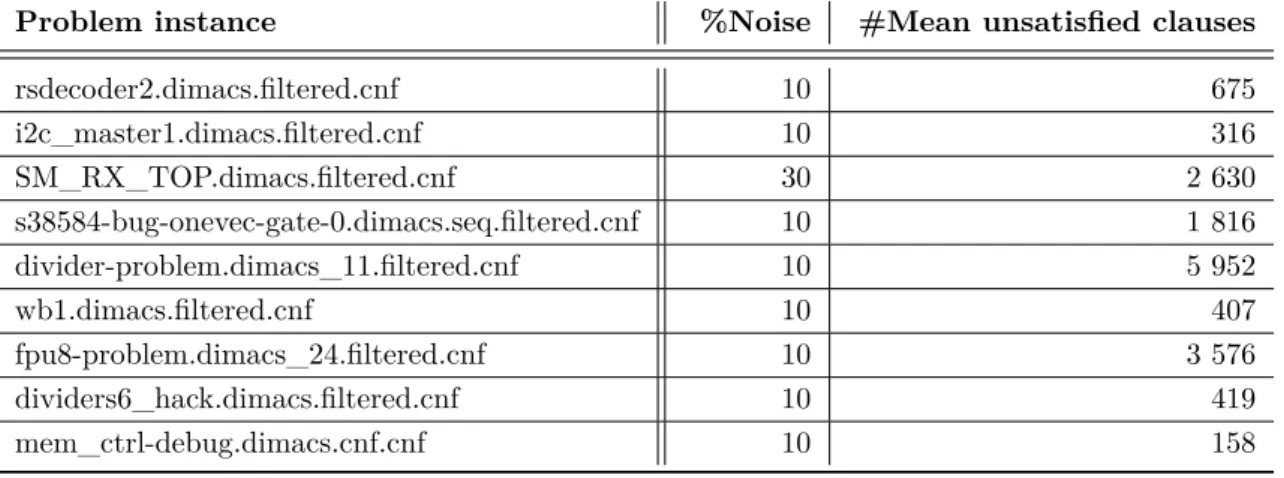
We see that the number of unsatisfied clauses in figures 5.2 and 5.3 is very high at 0% noise, and the same for 100%. The optimal noise seems to be 10% for these two as well. Remaining results are given in table 5.2 below, with optimal noise and number of unsatisfied clauses for each problem.
CHAPTER 5. WALKSAT
Problem instance %Noise #Mean unsatisfied clauses rsdecoder2.dimacs.filtered.cnf 10 675 i2c_master1.dimacs.filtered.cnf 10 316 SM_RX_TOP.dimacs.filtered.cnf 30 2 630 s38584-bug-onevec-gate-0.dimacs.seq.filtered.cnf 10 1 816 divider-problem.dimacs_11.filtered.cnf 10 5 952 wb1.dimacs.filtered.cnf 10 407 fpu8-problem.dimacs_24.filtered.cnf 10 3 576 dividers6_hack.dimacs.filtered.cnf 10 419 mem_ctrl-debug.dimacs.cnf.cnf 10 158
Table 5.2: Industrial problem instances with the optimal noise for WalkSAT.
The results suggest that WalkSAT prefers 10% noise on most of the industrial problems shown in table 5.2. The results also indicate that WalkSATneeds a rather fair amount of greedy moves compared to random moves when solving industrial MAXSAT problems. Based on this we conclude thatp= 10% is the optimal noise for these problems.
Chapter 6
Combining WalkSAT with
Multilevel Techniques
In this chapter we extend WalkSAT with multilevel techniques. We start with an introduction of the multilevel paradigm in section 6.1. How this paradigm can be applied in a MAXSAT context is given in section 6.2. In section 6.3 we present our solution where we extendWalkSATwith multilevel techniques. Section 6.4 ends this chapter with benchmarking and corresponding results.
6.1
Introduction to multilevel techniques
We give an informal introduction to the multilevel paradigm by the following everyday example: Imagine you have bought a new house and you are in the process of moving your belongings from your old apartment to your new house. There are several ways to do this. It is possible to think of this as an optimization problem, where the goal is to avoid unnecessary back-and-forth trips between your old and new home. Let us say we have a large amount of objects in different shapes and sizes that we want to move. Obviously, moving these objects one-by-one would not be very efficient. If we had chosen this method, we would have spent a lot of time and trips. However, if we packed several objects into one box, we would be able to move more objects at the same time. Basically what we do is to gather, or cluster, several objects into one object, see figure 6.1. We have gone from one big problem, many single objects, to a smaller problem where the single objects can be seen as one object. Our problem now consists of one box that encapsulates several objects. Hopefully, it now becomes more efficient and easier to move your belongings to your new house.
multilevel techniques
1 object 5 objects
Figure 6.1: Clustering single objects. Single objects can be seen as one object when clustered.
With the example above in mind, there exists several problems where multilevel techniques can and have been applied. Multilevel techniques have been utilized in Graph Coloring [37] and on the well-known combinatorial optimization problem called The Travelling Salesman Problem (TSP) [38,39]. In the next section we explain how the multilevel paradigm can be applied to solve MAXSAT problems.
CHAPTER 6. COMBINING WALKSAT WITH MULTILEVEL TECHNIQUES
6.2
Multilevel techniques in a MAXSAT context
In chapter 3 we briefly reviewed Bouhmala’s work on solving the SAT problem with multilevel techniques. We will now go into more details, and explain multilevel techniques in a SAT context. Due to the similarities between SAT and MAXSAT, we assume the reader acknowledges that this technique is applicable to MAXSAT in an identical way.
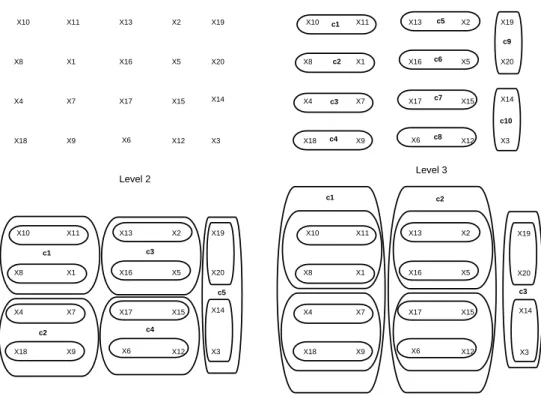
The multilevel algorithm, or paradigm, consists of 4 steps or phases: (1) reduction, (2) initial solution, (3) projection, and (4) refinement. The idea is that the SAT problem can be split up into smaller problems, i.e. multiple levels starting from the start state (level 0) to a given maximum reduced state (level N). Each level is simpler than the previous level. An illustration of the reduction phase is given in figure 6.2.
X3 X6 X5 X1 X4 X7 X9 X8 X2 X10 X11 X12 X13 X14 X15 X16 X17 X18 X20 Level 0 X19 Level 1 X3 X6 X5 X1 X4 X7 X9 X8 X2 X10 X11 X12 X13 X14 X15 X16 X17 X18 X20 X19 X3 X6 X5 X1 X4 X7 X9 X8 X2 X10 X11 X12 X13 X14 X15 X16 X17 X18 X20 X19 X3 X6 X5 X1 X4 X7 X9 X8 X2 X10 X11 X12 X13 X14 X15 X16 X17 X18 X20 X19 Level 2 Level 3 c1 c2 c3 c1 c2 c3 c4 c5 c1 c2 c3 c4 c5 c6 c7 c8 c9 c10
Figure 6.2: Clustering and reduction of variables. |Variables| = 20, |variables per cluster| = 2, |levels| = 3
(not counting level 0).X denotes a variable, andcdenotes a cluster.
The first step, or the reduction process, combines two variables at random1from level 0 (also called
the top level in multilevel terminology) into a cluster, and continues doing the same operation
until there are no more variables to combine. All the clusters that have been made, are said to be contained in level 1. This means one such reduction step, takes us from level X to level X+1. Be aware that below level 0, instead of combining variables, the process would combine clusters since there are no more variables. Note that if there is only one variable or cluster left after all the other variables or clusters have been combined, then this variable or cluster is copied to the next level. An example of this can be seen in figure 6.2; clusterc5 in level 2 is copied to level 3 as clusterc3. In algorithm 4 below (an algorithm from [8] and slightly modified) we can see that reduction continues until the desired amount of levels has been created. In multilevel terminology we call the final level either the lowest level, bottom level or level N. As is evident from the illustration in figure 6.2 we see that level N corresponds to level 3. We also see that there are 20 variables in level 0, and in level 1 two and two of these variables areclustered together. Then at level 2, we have clusters of two and two clusters from level 1. Finally in level 3 we have clusters of two and two clusters from level 2.
1
Note that due to illustrational purposes, figure 6.2 contains clusters with variables combined in an orderly fashion.
CHAPTER 6. COMBINING WALKSAT WITH MULTILEVEL TECHNIQUES
When we have finished reducing the problem according to some level limit (e.g. maximum of 3 levels) then we are left with level N. We now choose to assign an initial solution to each of the clusters in level N. In a SAT or MAXSAT context, this initial solution is a cluster assignment of truth values. Looking at the illustration in figure 6.2 this corresponds to setting each clus-ter in level 3 to either T RU E or F ALSE. An example of such a cluster assignment would be
c1=T RU E, c2=T RU E, c3=F ALSE. Note that we can either think of a cluster as a single vari-able, or as a collection of variables. If we think of the clusters as collections of variables, we say that if a cluster is assigned a truth value then all subclusters and hence all subvariables are assigned that same truth value.
Algorithm 4
The multilevel paradigm
1:{
Input:
SAT problem
P
0}
2:
{
Output:
Solution
S
f inal(P0)}
3: