CDAS: A Crowdsourcing Data Analytics System
Xuan Liu
†, Meiyu Lu
†, Beng Chin Ooi
†, Yanyan Shen
†, Sai Wu
§, Meihui Zhang
††
School of Computing, National University of Singapore, Singapore§
College of Computer Science, Zhejiang University, Hangzhou, P.R. China †{liuxuan, lumeiyu, ooibc, shenyanyan, mhzhang}@comp.nus.edu.sg,§[email protected]ABSTRACT
Some complex problems, such as image tagging and natural lan-guage processing, are very challenging for computers, where even state-of-the-art technology is yet able to provide satisfactory accu-racy. Therefore, rather than relying solely on developing new and better algorithms to handle such tasks, we look to the crowdsourc-ing solution – employcrowdsourc-ing human participation – to make good the shortfall in current technology. Crowdsourcing is a good supple-ment to many computer tasks. A complex job may be divided into computer-oriented tasks and human-oriented tasks, which are then assigned to machines and humans respectively.
To leverage the power of crowdsourcing, we design and imple-ment a Crowdsourcing Data Analytics System, CDAS. CDAS is a framework designed to support the deployment of various crowd-sourcing applications. The core part of CDAS is a quality-sensitive answering model, which guides the crowdsourcing engine to pro-cess and monitor the human tasks. In this paper, we introduce the principles of our quality-sensitive model. To satisfy user required accuracy, the model guides the crowdsourcing query engine for the design and processing of the corresponding crowdsourcing jobs. It provides an estimated accuracy for each generated result based on the human workers’ historical performances. When verifying the quality of the result, the model employs an online strategy to reduce waiting time. To show the effectiveness of the model, we implement and deploy two analytics jobs on CDAS, a twitter sen-timent analytics job and an image tagging job. We use real Twitter and Flickr data as our queries respectively. We compare our ap-proaches with state-of-the-art classification and image annotation techniques. The results show that the human-assisted methods can indeed achieve a much higher accuracy. By embedding the quality-sensitive model into crowdsourcing query engine, we effectively reduce the processing cost while maintaining the required query answer quality.
1. INTRODUCTION
Crowdsourcing is widely adopted in Web 2.0 sites. For exam-ple, Wikipedia benefits from thousands of subscribers, who con-tinually write and edit articles for the site. Another example is
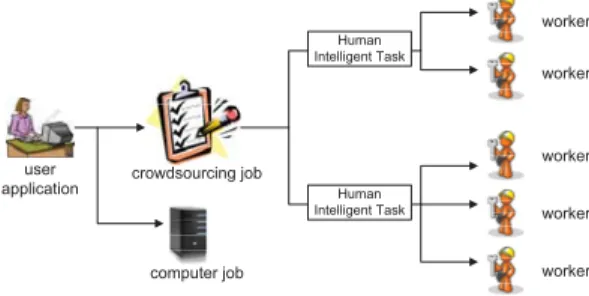
XVHU DSSOLFDWLRQ FURZGVRXUFLQJMRE FRPSXWHUMRE ZRUNHU ZRUNHU ZRUNHU ZRUNHU ZRUNHU +XPDQ ,QWHOOLJHQW7DVN +XPDQ ,QWHOOLJHQW7DVN
Figure 1: Crowdsourcing Application
Yahoo! Answers, where users submit and answer questions. In Web 2.0 sites, most of the contents are created by individual users, not service providers. Crowdsourcing is the driving force of these web sites. To facilitate the development of crowdsourcing appli-cations, Amazon provides the Mechanical Turk (AMT)1platform. Computer programmers can exploit AMT’s API to publish jobs for human workers, who are good at some complex jobs, such as im-age tagging and natural languim-age processing. The collective intel-ligence helps solve many computationally difficult tasks, thereby improving the quality of output and users’ experience. Figure 1 il-lustrates the idea of using crowdsourcing techniques to divide up jobs. CrowdDB [6], HumanGS [19] and CrowdSearch [23] are re-cent examples of applications on Amazon’s AMT crowdsourcing platform.
Crowdsourcing relies on human workers to complete a job, but humans are prone to errors, which can make the results of crowd-sourcing arbitrarily bad. The reason is two-fold. First, to obtain re-wards, a malicious worker can submit random answers to all ques-tions. This can significantly degrade the quality of the results. Sec-ond, for a complex job, the worker may lack the required knowl-edge for handling it. As a result, an incorrect answer may be pro-vided. To address the above problems, in AMT, a job is split into many HITs (Human Intelligence Tasks) and each HIT is assigned to multiple workers so that replicated answers are obtained. If con-flicting answers are observed, the system will compare the answers of different workers and determine the correct one. For example, in the CrowdDB [6], the voting strategy is adopted.
The replication strategy, however, does not fully solve the answer diversity problem. Suppose we want the precision of our image tags to be 95% and the cost of worker per HIT is $0.01. If we assign each HIT to too many workers, we will have to pay a high cost. On the other hand, if few workers provide tags, we will not have enough clue to infer the correct tags. Given an expected accuracy, we therefore need an adaptive query engine that guarantees high accuracy with high probability and incurs as little cost as possible.
In this paper, we propose a quality-sensitive answering model for the crowdsourcing systems, which is designed to significantly improve the quality of query results and effectively reduce the cessing cost at the same time. This model is the core of our pro-posed Crowdsourcing Data Analytics System (CDAS). CDAS ex-ploits the crowd intelligence to improve the performance of differ-ent data analytics jobs, such as image tagging and sdiffer-entimdiffer-ent analy-sis. CDAS transforms the analytics jobs into human jobs and com-puter jobs, which are then processed by different modules. The hu-man jobs are handled by the crowdsourcing engine, which adopts a two-phase processing strategy. The quality-sensitive answering model is correspondingly split into two sub-models, a prediction model and a verification model. The sub-models are applied to dif-ferent phases, respectively.
In thefirst phase, the engine employs the prediction model to estimate how many workers are required to achieve a specific accu-racy. The model generates its estimation by collecting the distribu-tion of all workers’ historical performances. Based on the model’s result, the engine creates and submits the HIT to the crowdsourc-ing platform. In the second phase, the engine obtains the answers from the human workers and refines them as different workers may return different results for the same question. To verify the an-swers from different human workers, the voting strategy is used in CrowdDB to select the correct one. In the simplest case, each HIT is sent tonworkers (nis odd). A result is assumed to be “correct” and accepted, if no less thann
2workers return it. The
voting strategy is simple, but is not very effective in the crowd-sourcing scenario. Suppose we have a set of product reviews and want to know the opinion of each review. We set the score to ei-ther “positive”, “negative” or “neutral”. If 30% of the workers vote “positive”, 30% of the workers vote “negative” and the remaining workers vote “neutral”, the voting strategy cannot decide which answer is more trustable. Moreover, even if more than 50% of the workers vote “negative”, we cannot accept the answer directly – some malicious workers may collude to produce a false answer. To improve the accuracy of the crowdsourcing results, CDAS adopts a probabilistic approach.
First, a verification model is employed to replace the voting strat-egy. It relies on workers’ past performances (i.e., the workers’ ac-curacies for historical queries) and combines vote distribution and workers’ performances. Intuitively, the system is more likely to ac-cept the answers provided by the worker with a good accuracy. A random sampling approach is designed to estimate the workers’ ac-curacies in each job. By applying the probability-based verification model, we can significantly improve the result quality.
Second, instead of waiting for all the results, the adaptive query engine provides an approximate result with confidence and refines it gradually as more answers are returned. This technique has been designed based on our observation that in AMT, workersfinish their jobs asynchronously. Therefore, it is important to offer the option of an approximate answer that is gradually improved as more re-sults are available, instead of letting the user wait for the comple-tion of the query. This strategy is similar to the tradicomple-tional online query processing in philosophy and serves to improve users’ expe-rience.
To evaluate our model and the performance of CDAS, we im-plement two practical crowdsourcing jobs, a twitter sentiment an-alytics (TSA) job and an image tagging (IT) job. In TSA job, we submit a set of movie titles as our queries and try tofind the opin-ions of Twitter users. In IT job, we use the images of Flickr as the queries and ask the human workers to choose the correct tags. We will show the effectiveness of our crowdsourcing engine based on the quality-sensitive answering model in the experimental section.
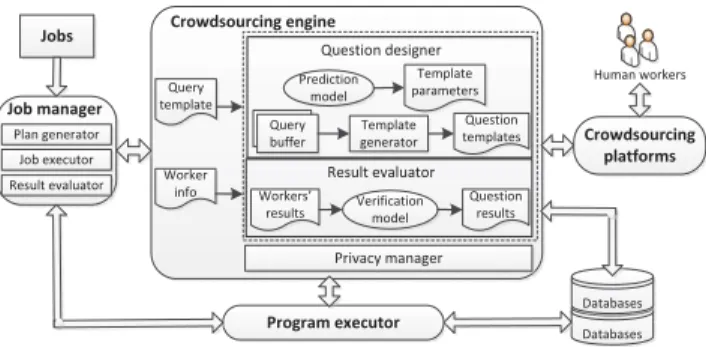
ƌŽǁĚƐŽƵƌĐŝŶŐĞŶŐŝŶĞ :ŽďƐ WůĂŶŐĞŶĞƌĂƚŽƌ :ŽďŵĂŶĂŐĞƌ :ŽďĞdžĞĐƵƚŽƌ ZĞƐƵůƚĞǀĂůƵĂƚŽƌ ,ƵŵĂŶǁŽƌŬĞƌƐ ĂƚĂďĂƐĞƐ ĂƚĂďĂƐĞƐ YƵĞƌLJ ďƵĨĨĞƌ dĞŵƉůĂƚĞ ŐĞŶĞƌĂƚŽƌ WƌĞĚŝĐƚŝŽŶ ŵŽĚĞů dĞŵƉůĂƚĞ ƉĂƌĂŵĞƚĞƌƐ YƵĞƐƚŝŽŶ ƚĞŵƉůĂƚĞƐ YƵĞƐƚŝŽŶĚĞƐŝŐŶĞƌ tŽƌŬĞƌƐ͛ ƌĞƐƵůƚƐ sĞƌŝĨŝĐĂƚŝŽŶŵŽĚĞů YƵĞƐƚŝŽŶ ƌĞƐƵůƚƐ ZĞƐƵůƚĞǀĂůƵĂƚŽƌ YƵĞƌLJ ƚĞŵƉůĂƚĞ tŽƌŬĞƌ ŝŶĨŽ WƌŝǀĂĐLJŵĂŶĂŐĞƌ ƌŽǁĚƐŽƵƌĐŝŶŐ ƉůĂƚĨŽƌŵƐ WƌŽŐƌĂŵĞdžĞĐƵƚŽƌ
Figure 2: CDAS Architecture
The remainder of the paper is organized as follows. In Section 2, we present the architecture of CDAS, and introduce the appli-cations implemented over CDAS. In Section 3, we introduce our prediction model for estimating a proper number of workers for each job. To improve the result accuracy, a probability-based ver-ification model is proposed in Section 4, which can be extended to support online processing. We evaluate the performance of our models in CDAS in Section 5, and discuss some related work in Section 6. We conclude the paper in Section 7.
2. OVERVIEW
In this section, we introduce the architecture of our Crowdsourc-ing Data Analytics System, CDAS, and discuss how to implement applications on top of CDAS.
2.1 Architecture of CDAS
CDAS is the system that exploits the crowdsourcing techniques to improve the performance of data analytics jobs. The core differ-ence between CDAS and the conventional analytics systems lies in the processing mechanism. CDAS employs human workers to as-sist the analytics tasks, while other systems rely solely on computer systems to answer the queries. Figure 2 shows the architecture of CDAS. CDAS consists of three major components: job manager, crowdsourcing engine and program executor. The job manager accepts the submitted analytics jobs and transforms them into a processing plan, which describes how the other two components (crowdsourcing engine and program executor) should collaborate for the job. In particular, the job manager partitions the job into two parts, one for the computers and one for the human workers. For example, in human-assisted image search, the human workers are responsible for providing the tags for each image, while the image classification and index construction are handled by the computer programs. In most cases, the two parts interact with each other dur-ing processdur-ing. The program executor summarizes the results of crowdsourcing engine, and the engine may change its job schedule due to the requests of program executor.
The crowdsourcing engine processes human jobs in two phases. 1. In thefirst phase, the engine generates a query template for the specific type of human jobs. The query template follows the format of the crowdsourcing platform, such as AMT, and should be easily understood by human workers. The en-gine then translates each job from the job manager into a set of crowdsourcing tasks and publishes them into the crowd-sourcing platform. To reduce the crowdcrowd-sourcing cost, the en-gine employs a prediction model, which estimates the num-ber of required human workers for a specific task based on the distribution of workers’ performance.
Figure 3: Query Template
2. In the second phase, the human workers’ answers are turned to the crowdsourcing engine, which combines the re-sults and removes the ambiguity. A verification model is de-veloped to select the correct answer based on the probability estimation.
Sometimes, the human tasks need to disclose some sensitive data to the public. We design a privacy manager inside the engine to address the problem. The privacy manager may adaptively change the formats of the generated questions for human workers. It may also reject some workers for a specific task.
The performance of crowdsourcing engine is determined by the two models, the prediction model and verification model. We shall introduce the two models in the following sections and discuss the implementation of two practical applications, a twitter sentiment analytics (TSA) job and an image tagging (IT) job, to validate the performance of our models.
2.2 Deploying Applications on CDAS
In this section, we use the TSA job as a running example to show how to deploy an application on CDAS. TSA job is typically pro-cessed using machine learning and information retrieval techniques [2][22]. However, as shown in the experimental section, CDAS can achieve a much higher accuracy than some of these traditional ap-proaches for the TSA job.
In the TSA job, the query is formally defined as follows. DEFINITION 1. Query in TSA
The query in TSA follows the format of(S, C, R, t, w), whereS is a set of keywords,C denotes the required accuracy, R is the domain of answers,tis the timestamp of the query andwis the time window of the query.
For example, suppose the user wants to know the public opinions foriPhone4S fromOct-14-2011 toOct-23-2011, the correspond-ing query can be expressed as:Q=({iPhone4S, iPhone 4S}, 95%, {Best Ever, Good, Not Satisfied}, Oct-14-2011, 10). The answer to the query consists of two parts. Thefirst part is the percentage of each opinion and the second part comprises the reasons. For the above query, one possible answer is that most people perceive
iPhone4Sis a good product thanks to the features of Siri and iOS 5, while a smaller but significant number of people are not satisfied with its display and battery performance.
Table 1: Users’ Opinion on iPhone4S
Opinions Percentages Reasons
Best Ever 60% Siri, iOS 5, Performance
Good 10% Siri, 1080P
Not Satisfied 30% iPhone4, Display, Battery
The query definition of TSA is registered in the job manager, which then generates the corresponding processing plan. The pro-gram executor is responsible for retrieving the twitter stream and checking whether the query keyword (S=iP hone4Sin above ex-ample) exists in a tweet. The candidate tweets are fed to the crowd-sourcing engine, which will generate a query template as shown in Figure 3.
When the crowdsourcing engine collects enough tweets in its buffer, it starts to generate the HIT (Human Intelligence Task). In particular, it creates an HTML section (bounded by <div>and </div>) for each tweet using the query’s template. For all the tweets in the buffer, we concatenate their HTML sections to form our HIT description. Therefore, one HIT in the TSA job contains questions for multiple tweets about the same product, movie, per-son or event.
The HIT is then published into the AMT for processing. Algo-rithm 1 summarizes the two-phase query processing in the crowd-sourcing engine (note that Algorithm 1 describes the general query processing strategy, not just for the TSA job). In the preprocessing, the engine generates a HIT job for the tweets using the query tem-plate (line 1-6). In thefirst phase, it applies the prediction model to estimate the number of workers required to satisfy the prede-fined accuracy (line 7). In the second phase, it submits the HIT to AMT and waits for the answers (line 8-10). The verification model is used to select the correct answers. In line 7, Q.Cdenotes the accuracy requirement specified by queryQ.
Algorithm 1 queryProcessing ( ArrayList<T weet>
buf f er, Query Q )
1: HtmlDescH= new HtmlDesc() 2: fori= 0tobuf f er.size-1do 3: Tweett=buf f er.get(i)
4: HtmlSectionhs= new HtmlSection(Q.template(),t) 5: H.concatenate(hs)
6: HITtask= new HIT(H)
7: intn=predictWorkerNumber(Q.C) 8: submit(task,n)
9: whilenot all answers receiveddo
10: verifyAnswer()
In Algorithm 1, the two models direct the whole procedure of query processing, which are also the focus of this paper and will be presented in the following sections.
3. PREDICTION MODEL
3.1 Economic Model in AMT
The prediction model is designed to ensure high-quality answers and to reduce cost. It is highly related to how the crowdsourcing platform charges the requesters. Therefore, wefirst briefly intro-duce the economic model of AMT.
In AMT, a HIT is published and broadcasted to all candidate workers. Any candidate worker can accept the task. Thus, ifn an-swers for a HIT are required, from the point of view of CDAS, there will ben random workers providing the answers. AMT charges CDAS for each HIT using the following rules:
1. Every worker is paid afixed amount of moneymc.
2. CDAS pays afixed amount of moneymsper worker to the AMT system for each HIT.
Therefore, we spend(mc+ms)nfor each HIT. Take queryQ= (S, C, R, t, w)in TSA as an example, if we getKavailable tweets
for each time unit, the cost of processingQis(mc+ms)nKw. In our predication model, the number of workers is correlated to the required accuracyC. We use functiongto denote the relationship betweenCandn. Consequently, the query cost can be represented as(mc+ms)wK×g(C). Before we present the technical details, we summarize the notations used in the paper in Table 2.
Table 2: Table of Notations
U the set of workers
ui thei-th worker
n the number of workers
Pn
2 the probability of at least
n
2
workers provide the correct answer
A the set of accuracy of workers ai the accuracy of workerui
μ the mean value of worker accuracy f(ui) the answer provided by workerui
Ω the observation of distribution of answers P(r|Ω) the probability of answerrbeing correct
under the observationΩ m the number of all possible answers ci the confidence of workerui ρ(ri) the confidence of answerri
3.2 Voting-based Prediction
Givenn(nis odd) answers from workersU={u1, u2, ..., un}, the voting strategy accepts an answer if at leastn
2workers return
the same answer. While the voting strategy guarantees that no other answers have more votes of being the correct answer, it however does not address the problem of how to selectn.
To address the above problem, we propose a voting-based pre-diction model. Given an accuracy requirement, the prepre-diction model estimates the number of workers required. That is, the goal of the prediction model is to derive the functiongfor each query. We prove in Section 4 that the model can also produce a bound for our probability-based verification approach.
3.2.1 A Conservative Estimation
We compute the probability that at leastn
2workers provide
the correct answer. We usePn
2 to denote the probability. Suppose the accuracy of allnworkers areA = {a1, a2,· · ·, an}, where the accuracy means the probability of a worker providing a correct answer. By the definition ofPn
2, we have the following equation: Pn 2 = U⊆U,|U|n 2 ( ui∈U ai uj∈U (1−aj))
Udenotes a subset of user setUwith size no smaller thann
2. The
above equation enumerates all the possible cases that the correct answer can be obtained by voting.
The workers of a HIT can be considered as random workers from AMT. Letμdenote the mean value of the workers’ accuracy. We have the following theorem to compute the expectation of the prob-ability that at leastn
2workers return the correct answer:
THEOREM 1. If workers answer the queries independently,
E[Pn 2] = n k=n 2 n k μk(1−μ)n−k
PROOF. As all workers are randomly picked,aiandajare in-dependent for anyi=j. Similarly,aiand1−ajare also
indepen-dent. Thus, E[Pn 2] = E[ U⊂U,|U|n 2 ( ui∈U ai uj∈U (1−aj))] = E[ n k=n 2 ( U⊂U,|U|=k ( ui∈U ai uj∈U (1−aj)))] = n k=n 2 ( U⊂U,|U|=k ( ui∈U E[ai] uj∈U E[(1−aj)])) We haveE[ai] =μandE[1−ai] = 1−μ. Therefore,E[Pn
2]can be computed as: E[Pn 2] = n k=n 2 ( U⊂U,|U|=k ( ui∈U μ uj∈U (1−μ))) = n k=n 2 ( U⊂U,|U|=k μk(1−μ)n−k) = n k=n 2 n k μk(1−μ)n−k
For a given query, we requireE(Pn
2)to be no less than a given accuracy C, i.e., E(Pn
2) C. Furthermore, we derive a lower bound ofE(Pn
2)that can be easily computed as follows. THEOREM 2. E[Pn
2]1−e
−2n(μ−1
2)2 PROOF. By Chernoff Bound,
n k=n2 +1 n k μk(1−μ)n−k1−e−2n(μ−12)2 Moreover, for any oddn, we have
n2+ 1 =n2 Therefore, E[Pn 2] = n k=n 2 n k μk(1−μ)n−k = n k=n 2 +1 n k μk(1−μ)n−k1−e−2n(μ−12)2
By requiring1−e−2n(μ−12)2C, we guarantee thatE[Pn
2] C(i.e., the expected accuracy of the query result is no less thanC). Consequently, we obtain a sufficient condition for the quality of the crowdsourcing query engine:
THEOREM 3. Given required accuracyCand the mean value of workers’ accuracyμ, choosing
n −ln(1−C) 2(μ−12)2
workers ensures the expected accuracy of the crowdsourcing result no less thanC.
Note thatnis an odd integer, so the minimum value of n is 2−ln(1−C)
4(μ−1 2)2
3.2.2 Optimization with Binary Search
Settingnto2−ln(1−C) 4(μ−1
2)2
+ 1ensures the expected accuracy of results. However, it is well known that Chernoff Bound provides a tight estimation only for a large enoughn. In some HITs, only a few workers participate in processing. Therefore, Theorem 3 gen-erates a conservative estimation that may cause too many workers to be involved. To address this problem, we use Theorem 3 as an upper bound and apply a binary search algorithm (on odd numbers) tofind a tighter estimation, i.e. the minimum oddnthat satisfies E[Pn
2]C.
Algorithm 2binarySearch(double C)
//Cis the required accuracy 1: ints= 1, inte= 2−ln(1−C) 4(μ−1 2)2 + 1 2: whiles < edo 3: intm= 2s+4e+12 −1 4: intEm=computeExpectedProb(m) 5: ifEmCthen 6: e=m 7: else 8: s=m+ 2 9: returne Algorithm 3computeExpectedProb(int x) 1: doubleE=0,δ=μx 2: forinti=x tox 2do 3: E=E+δ 4: δ=δ×μ((1x−−μi+1))i 5: returnE
Algorithm 2 shows the idea of binary search. We initialize the domain ofnto be[1,2−4(ln(1μ−−1C)
2)2
+ 1](line 1). At each step, we compute the expected accuracy of usingmworkers (line 4), until we reach the minimummthat satisfies the accuracy requirement. Algorithm 3 illustrates the process of computing the expected ac-curacy. Its correctness is based on the fact that k−n1/nk = k/(n−k+ 1). Obviously, the time complexity of Algorithm 3 isO(n). Therefore, we can get a tighter bound of the number of workers required using Algorithm 2 inO(nlogn)time.
3.3 Sampling-based Accuracy Estimation
In the previous two prediction models, we rely on the statistics of workers’ accuracy distribution. However, not all crowdsourcing platforms provide such information due to the privacy issue. Even if some platforms provide certain statistics, they cannot be directly used as workers’ accuracy. For example, AMT system records the approval rate of each worker. Approval rate shows the percentage of answers approved by the requester. However, we have observed that the approval rate is not consistent with the accuracy of the worker in CDAS. There are two main reasons. First, the worker’s accuracy may vary widely across jobs. Second, some requesters set automatic approval for all answers without verification. The difference of approval rate and accuracy is studied through experi-ments. To resolve the above problem, we design a sampling-based approach. Specifically, for a registered query, we randomly embed mquestions, whose ground truth are known beforehand. These questions are used as our testing samples to estimate the workers’ accuracy.
Here we use TSA application to illustrate the sampling method. As mentioned previously, each HIT contains the questions ofB
tweets. To get unbiased results, we randomly injectαBsamples
Algorithm 4doSampling(HIT H)
1: WorkerSetU=H.getWorkers() 2: Double[]rate= new Double[U.size] 3: whileH.nextQuestion()=nulldo
4: Questionq=H.getNextQuestion() 5: ifqis a testing samplethen
6: fori= 0toU.sizedo
7: Workeru=U.get(i)
8: ifu.getAnswer(q)==q.groundTruththen
9: rate[i] =rate[i] +αB.size1
into a HIT. In other words, each HIT hasαBtesting samples and (1−α)Bnew tweets. In our current implementation,αandBare set to 0.2 and 100, respectively. We evaluate the effect of sampling rateαin our experiments, and the results confirm that even a low sampling rate can produce an acceptable estimation.
In the sampling process, CDAS collects the accuracy of partici-pating workers. Algorithm 4 shows the procedure. After the sam-pling, the statistics are used in both the prediction model and the verification model.
4. VERIFICATION MODEL
In the voting-based verification, if more than half of the work-ers return the same answer, the query engine will accept it as the correct answer. Despite the fact that our predication model tries to guarantee that at least half of the workers submit the correct an-swer, the voting-based verification occasionally fails to provide an answer.
For a specific question, different workers may provide different answers, and in some cases, no answer gets an agreement above 50%. Moreover, the voting strategy assumes that all the workers provide the correct answer with the same probability, which is not true as the accuracy of different workers varies a lot and the work-ers with higher accuracy are more trustable. In this section, we propose a probability-based verification method to determine the best answer.
4.1 Probability-based Veri
fi
cation
Probability-based verification tries to evaluate the quality of an-swers through workers’ historical performances (i.e. accuracy). In particular, given the probability distribution of workers’ perfor-mances, we apply the Bayesian theorem to estimate the accuracy of each result. We adopt and extend the approach proposed in the data fusion [4] for integrating conflicting results in the CDAS.
Suppose a HIT is answered bynworkers{u1, u2,· · ·, un}with accuracy{a1, a2,· · ·, an}. We define functionf(ui)to represent
the answer provided by worker ui. Based on Bayesian analysis, the probability of a specific answerr¯∈ Rbeing the correct an-swer given the observation of the anan-swer’s distributionΩ(i.e. the answers provided bynworkers) can be computed as:
P(¯r|Ω) = P(Ω|r¯)P(¯r) P(Ω) = P(Ω|r¯)P(¯r)
ri∈RP(Ω|ri)P(ri)
Suppose the size of the answer domain|R|=m. Without a priori knowledge, each answerri∈Rappears with equal probability of
1
m. Then the above equation can be transformed into:
P(¯r|Ω) = P(Ω|¯r)
ri∈RP(Ω|ri)
Letr¯be the correct answer. The probability for workeruj pro-viding the correct answer isaj(i.e. accuracy). Without any
pri-ori knowledge, each incorrect answer provided byujappears with equal probability1−aj
m−1. Therefore,P(Ω|r¯)can be computed as: P(Ω|r¯) = f(uj)=¯r aj f(uj)=¯r 1−aj m−1 (2)
Combining Equation 1 and 2, we have P(¯r|Ω) = f(uj)=¯r aj f(u j)=¯r 1−aj m−1 ri∈R( f(uj)=riaj f(uj)=ri 1−aj m−1) = f(uj)=¯r (m−1)aj 1−aj ri∈R( f(uj)=ri (m−1)aj 1−aj ) (3) For ease of illustration, we define theWorker Confidence for an answer as follows.
DEFINITION 2. Worker Confidence
Letajbe the accuracy of workeruj. The confidencecjof worker ujis defined as:
cj= ln(m1−−1)aj
aj = ln(m−1) + ln aj 1−aj
From the above definition, we can see that high-accuracy workers will get large confidence values. This is consistent with the intu-ition that workers with higher accuracy are more trustable.
Based on the definition of worker confidence and the equation 3, we define theAnswer Confidenceas below.
DEFINITION 3. Answer Confidence
The confidence of an answerr¯equals to the probability ofr¯being the correct answer:
ρ(¯r) =P(¯r|Ω) = e f(uj)=¯rcj ri∈R(e f(uj)=ricj) (4)
In our CDAS, the answer with the highest confidence is accepted as thefinal result. In fact, the confidence of an answer represents a variant of voting, whereecj is used as the weight for worker
uj. Apparently, the worker with a higher confidence gets more weight. To speed up the computation ofP(¯r|Ω), we cache the valueln aj
1−aj for each known worker.
We can prove that using Theorem 1 to estimate the number of workers required also produces a quality bound for our probability-based verification approach.
THEOREM 4. IfE[Pn
2] Cand let¯rbe the correct answer,
we have that our probability-based verification model returnsr¯as the result with a probability no less thanC.
PROOF. Based on Theorem 1,
E[Pn 2] = n k=n 2 n k μk(1−μ)n−kC
Namely, the expected number of workers, who provide the correct answer, is larger thann
2 with a probability larger thanC. The
con-fidences of all workers are independent and identically distributed
(i.i.d.), because the accuracies of the workers are i.i.d. LetEc de-note the mean value of workers’ confidences. As a result, the total number of expected votes for answerr¯is
E[ f(uj)=¯r cj] = f(uj)=r E[cj] = Ec· |{uj|f(uj) =r}| > n 2Ec
Note that in Equation 4, all answers share the same denominator. The value ofP(¯r|Ω)is proportional toe
f(uj)=¯rcj. Thus,r¯is the
answer with the largest expected confidence and is returned as the result in expectation. Otherwise, if another answerrhas a larger expected probability thanr¯, i.e.,
E[P(r|Ω)]> E[P(¯r|Ω)] Therefore, E[ f(uj)=r cj]> E[ f(uj)=¯r cj]> n 2Ec We will have E[ f(uj)=r cj] +E[ f(uj)=¯r cj]> nEc
In fact, the sum of workers’ confidences is equal to the sum of confidences for every answer:
nEc=E[
ri∈Rp
(
f(uj)=ri
cj)]
This results in a contradiction that the sum of confidences ofr¯and rexceeds the sum of all confidences. Therefore, our probability-based verification model returnsr¯as the result with a probability no less thanC.
The only unknown parameter in Equation 4 ism, the size ofR. We can simply setm=|R|. However, in our experimental study, we have found that not all answers inRare picked by the workers. For example, if a question asks a worker to rank a product based on some tweets and the score ranges from 0 to 100, the scores will fol-low a very skewed distribution. Some fol-low-probability answers are never selected, but they do reduce the weight of a correct answer. Thus, we need to select a goodmto prune the noise.
After a HIT completes, the crowdsourcing engine getskdistinct answers for a specific question fromnworkers (k ≤ n). In this observation, we selectkdistinct answers amongmpossible ones. The probability of this selection can be computed as(mk)
mk. Suppose
this is not a very rare observation and the probability of this obser-vation is larger than(e.g., we prune the low-probability noise). The following lemma provides a lower bound form.
LEMMA 1. m > k−1 Hk−1−(k−1)(k)k−11 , whereHk= k i=1 1 i
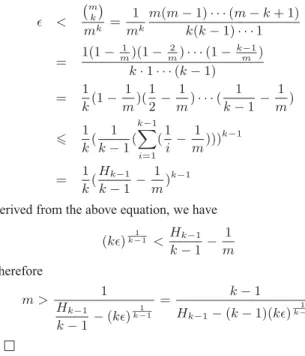
PROOF. < m k mk = 1 mk m(m−1)· · ·(m−k+ 1) k(k−1)· · ·1 = 1(1−m1)(1−m2)· · ·(1−km−1) k·1· · ·(k−1) = 1 k(1− 1 m)( 1 2− 1 m)· · ·( 1 k−1− 1 m) 1 k( 1 k−1( k−1 i=1 (1 i − 1 m))) k−1 = 1 k( Hk−1 k−1− 1 m) k−1
Derived from the above equation, we have (k)k−11 <Hk−1 k−1 − 1 m Therefore m > 1 Hk−1 k−1−(k) 1 k−1 = k−1 Hk−1−(k−1)(k)k−11
For a largek, the above lower bound is too loose. Instead, we propose a tighter lower bound form:
LEMMA 2. m > k−1
1−k
ek
PROOF. From Lemma 1, we have < k i=1(1− i−1 m ) k i=1i Therefore, ln < k i=1 ln1−i−m1 i Obviously, k i=1 ln1−i−m1 i > kln 1−k−1 m k By settingkln1− k−1 m
k >ln, we get a tighter bound: m > k−1 1−k ek THEOREM 5. m >max{ k−1 Hk−1−(k−1)(k)k−11 , k−1 1−k ek }
PROOF. Directly from Lemma 1 and 2.
In our verification, we setto 0.05 based on Fisher’s exact test [5], which is widely adopted in practice. We then use Theorem 5 to estimate the value ofm.
We now give an example in TSA to show the benefit of apply-ing our probability-based verification model. Table 3 shows the
Table 3: An Example of Workers’ Answers
Movie Title Green Latern
Tweet Oh. My. GOD. “Green Lantern” movie isterrible. Like, “Lost In Space” movie terrible.
Worker ID w1 w2 w3 w4 w5
Accuracy 0.54 0.31 0.49 0.73 0.46
Answer pos pos neu neg pos
Table 4: Results of Verification Models
pos neu neg Answer
Half-Voting 3 1 1 pos
Majority-Voting 3 1 1 pos
Verification 0.329 0.176 0.495 neg
example. Five workers with different accuracies provide three dif-ferent answers, namelyPositive,NeutralandNegative. The results of the three verification models are shown in Table 4. Both the
Half-Votingmodel and theMajority-Votingmodel choosePositive
as the results since three workers out offive provide the answer
Positive. However, our verification model can correctly choose
Negativeas the result because the worker answeringNegativehas a much higher accuracy. As a result, our verification model gets more accurate answers than the other two voting-based models.
4.2 Online Processing
The workers submit their answers asynchronously in the AMT and CDAS has to wait for sufficient number of answers to be sub-mitted. As a consequence, query response time in CDAS (and other crowdsourcing systems for that matter) is expected to be longer than that of non-crowdsourcing systems. To alleviate such a prob-lem and also to improve users’ experience, we adopt online pro-cessing techniques in CDAS. Instead of waiting for all workers to complete their tasks, CDAS provides an approximate result based on the answers received so far. As we have previously discussed, uncertainty and approximation cannot be avoided in crowdsourcing systems, which makes online processing a perfectfit for the query processing in CDAS.
To resolve the uncertainty, we extend the techniques of data fu-sion [4][14] to estimate the answer’s confidence. However, the same approach cannot be directly applied to the online process-ing in CDAS, as in the crowdsourcprocess-ing systems, the human workers compete for the tasks and CDAS does not have the profile (i.e. ac-curacy) for a specific user until he/she returns the answer. In our case, the accuracy of the answer provided by an unseen worker can only be estimated by the distribution of all workers’ accuracies.
4.2.1 Finding the Correct Answer Online
We apply Equation 4 to continuously update the probability of each received answer. Suppose a HIT is assigned tonworkers and the query engine receives answers fromn(n< n) workers. Un-like Equation 4, in this case, we only receive a partial observation Ωfor the answer distribution. For the remainingn−nworkers, we have no idea about what answers they may provide. Lets de-note a possible answer set by the remaining workers and we useS
to represent all the possibles.
LetA={an+1, an+2, ..., an}be the accuracies of the remain-ingn−nworkers. As we do not know the identities of the remain-ingn−nworkers, we consider all the possibilities. We useAto represent all the possible permutations ofA. The confidence of an answerr being the correct one can be estimated as the expected probabilityP(r|Ω, s)overSandA, i.e.,
The following theorem shows that Equation 4 can be applied to computeρ(r).
THEOREM 6. Assume that workers process the query indepen-dently and the answers are submitted in a random order. ρ(r) = P(r|Ω)
PROOF. Based on the assumption, we have: ρ(r) = Es∈S,A∈A[P(r|Ω, s)]
= EA∈A[Es∈S[P(r|Ω, s)]]
In fact, the answer set of the remaining workerssdoes not affect the computation of the above equation. As shown in [14],
Es∈S[P(r|Ω, s)] =P(r|Ω) The computation ofρ(r)can be further simplified as:
ρ(r) = EA∈A[Es∈S[P(r|Ω, s)]] = EA∈A[P(r|Ω)]
= P(r|Ω)
Theorem 6 shows that the confidence of a partial result can also be computed by Equation 4. Therefore, we select the answer with maximal confidence as our correct answer.
4.2.2 Early Termination
When the current answers are good enough, we can terminate the HIT to reduce cost. The major challenge of early termination is how to measure the quality of the current results. Intuitively, we can stop accepting answers from new workers as soon as we are sure that the current resultrwill not change by the answers we choose to forgo.
In particular, letr1andr2be the best and second best answers based on their confidence, respectively. We have P(r1|Ω) > P(r2|Ω). Let(u1, u2, ..., un)be the set of workers. Supposen workers have submitted answers andn−n answers remain un-filled. Assume an answer sets={f(ui) =r2|n+ 1in}. Using similar techniques in paper [14], we can prove the theorem of minimal possible value ofP(r1|Ω)and the maximal possible value ofP(r2|Ω):
minP(r1|Ω) =P(r1|Ω, s) (5)
maxP(r2|Ω) =P(r2|Ω, s) (6)
Note thatminP(r1|Ω)andmaxP(r2|Ω)are related to the ran-dom variablesan+1, an+2,· · ·, an. In our algorithm, we use
the expected value of minP(r1|Ω) and maxP(r2|Ω), namely, EA∈A[minP(r1|Ω)]andEA∈A[maxP(r2|Ω)]. However, it is dif-ficult to compute the expected values directly. Therefore, in prac-tice, we use the approximate values ofEA∈A[minP(r1|Ω)]and EA∈A[maxP(r2|Ω)]. We assume every remaining worker has the same accuracyE[ai]and use it in the Equation 5 and 6. Empirical
results show that the approximations work well in practice. We propose three different strategies as the termination condi-tion:
MinMax EA∈A[minP(r1|Ω)]> EA∈A[maxP(r2|Ω)]
MinExp EA∈A[minP(r1|Ω)]> P(r2|Ω)
ExpMax P(r1|Ω)> EA∈A[maxP(r2|Ω)]
Figure 4: Reviews for Kung Fu Panda 2
MinMaxguarantees that the answer output by our system is stable when the termination condition is achieved. However, it is too con-servative.MinExpandExpMaxcan terminate the processing much earlier, but may lead to low-quality results. We study the effect of the three strategies in our experiments.
Algorithm 5onlineProcessing(Question q)
1: Setanswer=new Set()
2: Map< Answer, f loat > result= new Map() 3: whilenot all answers are returneddo
4: AnswerA= getNextAnswer(q) 5: answer.add(A)
6: SetdistinctAnswer= getDistinctAnswer(answer) 7: fori= 0 todistinctAnswer.size-1do
8: AnswerA=distinctAnswer.get(i) 9: floatconf idence= computeConfidence(A) 10: result.put(A,conf idence)
11: ifcanTerminate(result)then
12: break
13: returnresult
Algorithm 5 outlines the online processing strategy adopted in CDAS. The query engine continuously updates the confidence of each answer (line 3-13) until the termination condition is satisfied. We apply Equation 4 to estimate the confidence of each answer (line 9) and apply one of the three termination strategies to decide whether to stop the processing (line 11).
4.3 Result Presentation
In theonlineProcessingAlgorithm (Algorithm 5), if there
is an answer that meets the termination condition, online processing will stop and CDAS will accept the answer. Otherwise, if none of the answers is good enough, CDAS will update the confidence of each answer according to Equation 4.
We take queries in TSA as an example to illustrate the result pre-sentation. Given a list of tweetst1, t2, ..., tN, let functionhti(r) return the score of answerrfor tweetti. hti(r)is defined as fol-lows: hti(r) = ⎧ ⎨ ⎩ 1 if r is accepted forti
0 if another answer is accepted ρti(r) none of the answers are accepted
The percentage of answerris then computed as 1
N
N
i=1hti(r).
Moreover, we generate a set of keywords as reasons for each an-swerr. These keywords are the most frequent keywords submitted by the workers who have provided the answerr. The results are updated as new tweets are being streamed into TSA.
Figure 4 shows the online processing interface of TSA for the review results ofKung Fu Panda 2. It summarizes Twitter users’ opinions into three categories. The time window of the query is set to 12 minutes and in the elapsed time (4 minutes), 20 tweets are fed to TSA, among which 70% of tweets sayKung Fu Panda 2is a good movie. TSA updates the result upon new tweets arriving. Users can click an answer to expand the view. TSA will list the corresponding tweets for the answer. The tweets are sorted based on timestamps from the newest to the oldest. The user can also check the progress of the current running HIT.
5. PERFORMANCE EVALUATION
To evaluate the effectiveness of the quality-sensitive answering model in CDAS, we developed two crowdsourcing applications, a twitter sentiment analytics (TSA) job and an image tagging (IT) job. We present the comprehensive experimental results over TSA, and due to the space constraint, we shall only provide the compar-ison with an online image tagging toolkit for the IT application. The results for the other experiments over IT exhibit similar trends to those of TSA.
By default, our approach applies the probability-based verifi ca-tion model (denoted asVerification) to select the best answer. For comparison, theHalf-VotingandMajority-Votingmodels are used as two alternative verification approaches. Supposen(nis odd) workers are employed for a particular task. In the Half-Voting
model, the answerri is accepted only if no less than n
2 workers
return it as their answers. In theMajority-Votingmodel, letv(ri)
denote the votes for answerri. The answerriis accepted if for any other answerrj,v(ri)> v(rj).
5.1 Application 1: TSA
We deploy TSA on AMT and use 200 movie titles as our queries. The selected titles are the most recent movies listed in IMDB (Inter-net Movie Database). The query follows the format ofQ=({movie name}, accuracy requirement,{Positive, Neural, Negative}, Oct-1-2011, 1 day). Namely, the queries are processed against one-day tweets. For each HIT, 30 workers are employed to perform the re-view categorization task. We manually check each of the rere-views to generate our ground truth.
5.1.1 Crowdsourcing vs. SVM Algorithm
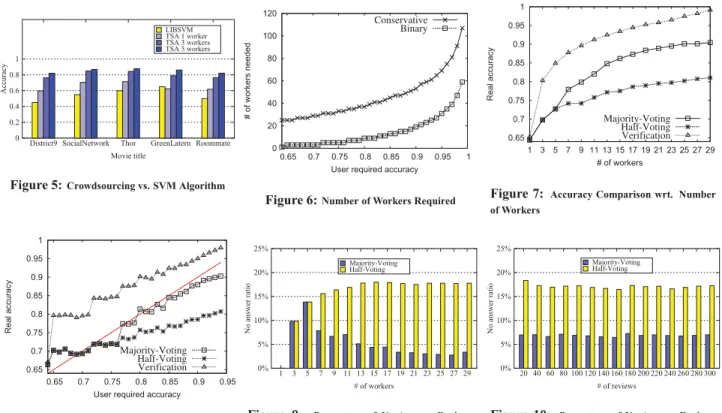
Wefirst show the advantages of crowdsourcing techniques over computer programs. We compare the results of TSA with LIB-SVM2. To build an automatic classification model using LIBSVM, tweet reviews aboutfive movies are selected as the test data, and tweets about the rest 195 movies are used as training data. After a stream of tweets passes thefilters of TSA, we also send it to LIB-SVM and collect the corresponding results. We then compare the results against our ground truth. In TSA, we vary the number of workers from 1 to 5. Figure 5 shows the accuracies of both sys-tems forfive movies, each with 200 tweet reviews. In most cases, TSA can achieve a higher accuracy than LIBSVM, even if only one worker is employed. This indicates that humans are much better at natural language understanding than machines. For such tasks, if high accurate results are required, crowdsourcing is a promising approach.
2http://www.csie.ntu.edu.tw/∼cjlin/libsvm/
5.1.2 Accuracy Analysis
In TSA, we first apply Theorem 1 to estimate the number of workers required. This is a conservative estimation. To reduce cost, binary search is used to refine the estimation. Figure 6 compares the conservative estimation with the refined estimation generated by the binary search. We change the user required accuracy from 0.65 to 0.99 andfind that the refined estimation is less than half of the conservative estimation. In the remaining experiments, we use the refined estimation to determine the number of workers required for each HIT.
We next present the accuracy for the three verification models, namelyHalf-Voting,Majority-Votingand our proposed Probability-based Verificationmodel. Figure 7 shows that when the number of workers increases, we can get a higher accuracy. Among the three verification models, our probability-based approach achieves a much higher accuracy than the other two. When 29 workers are employed, the probability-based model improves the accuracy to 0.99. This verifies the benefit of considering workers’ historical performance.
We proceed to investigate the effectiveness of the three verifi -cation models with respect to a user required accuracy. Figure 8 shows the result. When the requester specifies a required accuracy, TSA estimates the number of workers needed to achieve that ac-curacy. The real accuracy is computed by comparing the workers’ answers with the ground truth. The red line in thefigure denotes the user required accuracy. We observe that the probability-based verification model always provides a satisfactory result while the results of the other two models are below the required accuracy in most cases.
We can observe that the accuracy of theHalf-Votingmodel is worse than our estimation. The reason is as follows. First, the estimated number of workers ties to users’ mean accuracy. The mean accuracy used in the prediction model is an overall accuracy, which is collected across various questions. However, for some difficult questions, workers’ accuracies could be much lower. As a result, the number of workers needed in voting models is more than the estimated number. For example, the following tweet about movie The Last Airbender expresses a positive opinion whereas most workers classify it into the negative category because of the word “sucks”.
My nephew just said that Avatar: The Last Airbender sucks... I’m disowning him.
The second reason can be explained based on the results of Fig-ure 9 and FigFig-ure 10. FigFig-ure 9 shows the percentage of tweets with no answers in the two voting-based models. In some cases, the
Half-VotingandMajority-Votingmodels fail to provide a result as none of the answers is discriminative (All answers get no more than half votes or more than one answers get the same number of votes). When the number of workers increases,Majority-Votingcan solve the tie more easily. However, for theHalf-Votingstrategy, there are still about 15% of the tweets that cannot obtain answers with more than half the amount of votes. In Figure 10, when we vary the number of tweet reviews, we observe that the percentage of no-answer reviews is fairly stable. This phenomenon indicates that the reviews with non-discriminative answers are almost uniformly distributed among all reviews.
5.1.3 Online Processing
One advantage of our crowdsourcing engine is its ability in sup-porting online processing. It can provide an approximate result without waiting for all the workers tofinish their jobs. Specifically,
0 0.2 0.4 0.6 0.8 1
District9 SocialNetwork Thor GreenLatern Roommate
Accuracy Movie title LIBSVM TSA 1 worker TSA 3 workers TSA 5 workers
Figure 5:Crowdsourcing vs. SVM Algorithm
0 20 40 60 80 100 120 0.65 0.7 0.75 0.8 0.85 0.9 0.95 1 # of workers needed
User required accuracy
Conservative Binary
Figure 6:Number of Workers Required
0.65 0.7 0.75 0.8 0.85 0.9 0.95 1 29 27 25 23 21 19 17 15 13 11 9 7 5 3 1 Real accuracy # of workers Majority-Voting Half-Voting Verification
Figure 7: Accuracy Comparison wrt. Number of Workers 0.65 0.7 0.75 0.8 0.85 0.9 0.95 1 0.65 0.7 0.75 0.8 0.85 0.9 0.95 Real accuracy
User required accuracy
Majority-Voting Half-Voting Verification
Figure 8:Accuracy Comparison wrt. User Re-quired Accuracy 0% 5% 10% 15% 20% 25% 29 27 25 23 21 19 17 15 13 11 9 7 5 3 1 No answer ratio # of workers Majority-Voting Half-Voting
Figure 9: Percentage of No-Answer Reviews wrt. Number of Workers 0% 5% 10% 15% 20% 25% 300 280 260 240 220 200 180 160 140 120 100 80 60 40 20 No answer ratio # of reviews Majority-Voting Half-Voting
Figure 10: Percentage of No-Answer Reviews wrt. Number of Reviews
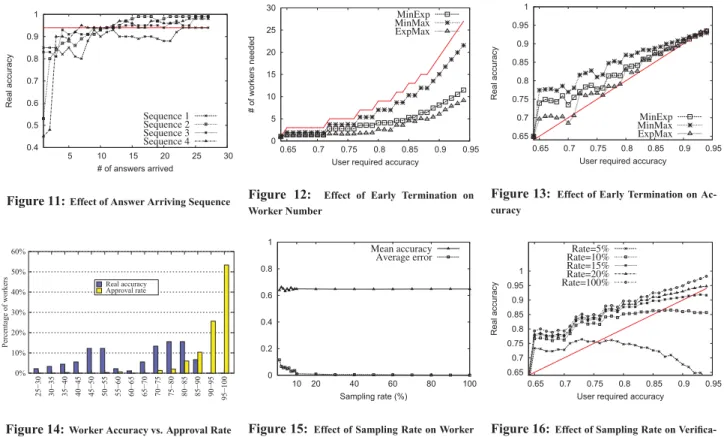
TSA will generate an initial result as soon as thefirst answer is re-turned. Then it will gradually refine the results as more answers arrive until the termination condition is satisfied. This allows us to terminate a HIT and cap the processing cost3.
One interesting observation in our experiments is that the ac-curacy of the approximate result varies significantly for different answer arriving sequences. Figure 11 shows the accuracy of the same HIT under four different answer sequences. The red line is the user-required accuracy 0.94. Sequence 4 results in a low start-ing accuracy because thefirst two workers of sequence 4 provide incorrect answers. Therefore, in online processing, we must up-date the confidence of the current result dynamically based on the answers received as early termination may potentially degrade the accuracy.
We evaluate the three termination strategies as discussed in Sec-tion 4.2.2. Figure 12 shows the effect of early terminaSec-tion on the number of workers. The red line denotes the estimated number of workers via our refined prediction model. TheMinMaxstrategy generates the most conservative estimation, but it still reduces the number of workers by 20%. TheExpMaxstrategy is the most ag-gressive one, which can save more than 50% of workers. In Figure 13, we show the accuracies of the different termination strategies. The x-axis is the accuracy requirement specified by the user and the y-axis is the real accuracy measured against the ground truth. We can see that theMinMaxandExpMaxstrategies satisfy the user required accuracy (denoted as red line) in all cases whileMinExp
fails to meet the requirement at a few points. In view of the need for reducing the number of workers while maintaining good accuracy, we propose to adopt theExpMaxtermination strategy.
3In AMT, we can cancel a HIT when we detect that the answers are good enough. By doing so, we do not need to pay workers who have yet submitted their answers.
5.1.4 Effect of Sampling
TSA verifies the answers using the probability-based verification model, which relies on workers’ historical performance. The AMT system records an approval rate for each worker, which implies his accuracy in general. However, the workers’ approval rates are not public due to privacy concerns. To collect the statistics, we publish 500 HITs requiring workers tofill in their approval rate. We also compute the workers’ accuracies of answering TSA queries. We observe the distribution of their approval rate in AMT is very different from that of real accuracy in TSA, as shown in Figure 14. The reasons are two-fold. On one hand, there are various types of tasks in AMT and it is natural that people cannot be experts in all domains. On the other hand, some requesters set automatic approval for all workers without checking the answers. This results in a high average approval rate in AMT. Therefore, we adopt a sampling approach to estimate workers’ accuracy.
Givennworks, we compute their accuraciesAj={aj1, aj2, ..., ajn}under a sampling ratej%. We vary the sampling rate and plot the mean accuracyμjand average absolute errorerrjin Fig-ure 15, whereμjanderrjare defined as follows:
μj= 1 n n i=1 aji, errj= 1 n n i=1 |aji−a100i |
As shown, both mean accuracy and average error are stable when the sampling rate is higher than 10%. More precisely, mean accu-racy remains nearly constant and average error approaches 0.
We also study the effect of sampling rate on accuracy in our verification model. Figure 16 plots the result. We vary the sam-pling rate from 5%, 10% to 20% and compare the result to 100%-sampling accuracy. The red line represents the user required ac-curacy. We can see that the verification has a better accuracy with a higher sampling rate. When the user required accuracy is lower
0.4 0.5 0.6 0.7 0.8 0.9 1 5 10 15 20 25 30 Real accuracy # of answers arrived Sequence 1 Sequence 2 Sequence 3 Sequence 4
Figure 11:Effect of Answer Arriving Sequence
0 5 10 15 20 25 30 0.65 0.7 0.75 0.8 0.85 0.9 0.95 # of workers needed
User required accuracy
MinExp MinMax ExpMax
Figure 12: Effect of Early Termination on Worker Number 0.65 0.7 0.75 0.8 0.85 0.9 0.95 1 0.65 0.7 0.75 0.8 0.85 0.9 0.95 Real accuracy
User required accuracy
MinExp MinMax ExpMax
Figure 13: Effect of Early Termination on Ac-curacy 0% 10% 20% 30% 40% 50% 60% 95 − 100 90 − 95 85 − 90 80 − 85 75 − 80 70 − 75 65 − 70 60 − 65 55 − 60 50 − 55 45 − 50 40 − 45 35 − 40 30 − 35 25 − 30 Percentage of workers Real accuracy Approval rate
Figure 14:Worker Accuracy vs. Approval Rate
0 0.2 0.4 0.6 0.8 1 10 20 40 60 80 100 Sampling rate (%) Mean accuracy Average error
Figure 15: Effect of Sampling Rate on Worker Accuracy 0.65 0.7 0.75 0.8 0.85 0.9 0.95 1 0.65 0.7 0.75 0.8 0.85 0.9 0.95 Real accuracy
User required accuracy
Rate=5% Rate=10% Rate=15% Rate=20% Rate=100%
Figure 16:Effect of Sampling Rate on Verifica-tion Accuracy
than 0.75, all sampling rates are satisfactory. The result meets all of the user required accuracy only with a sampling rate no less than 20%. Moreover, the accuracy under 20% sampling rate has only a small gap compared to that under 100% sampling. We use 20% sampling rate in all of our verification experiments.
5.2 Application 2: IT
In this experiment, we evaluate our model in the context of image tagging application. We use 100 Flicker images as our queries. For each image, we give a set of candidate tags and let 30 workers to choose the related ones. The candidate tags include Flicker tags and some embedded noise tags.
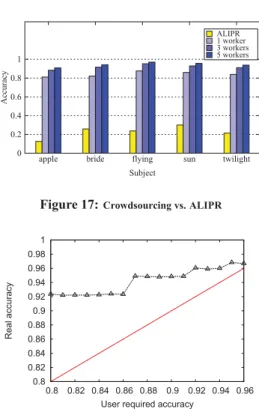
Again, wefirst show the advantages of crowdsourcing over the applications on dealing with image tagging task. We compare our result with ALIPR4. ALIPR[13] is an automatic image annotation system which applies 2-D Hidden Markov model and clustering techniques. The accuracy comparison result is shown in Figure 17. We use 5 groups of images. Each group contains top 20 Flicker images returned by a tag. Thefigure clearly shows the accuracy gap between ALIPR and crowdsourcing approach. ALIPR achieves its best accuracy 30% on tagsunand has only 12.6% accuracy on tag
apple, whereas in our crowdsourcing system, we can reach more
than 80% even with only one worker employed.
We next study the effectiveness of our model. Recall that our modelfirst estimates the number of workers for a specified accu-racy requirement and then applies a probability-based model to ver-ify the result. Figure 18 shows the accuracy achieved with respect to the user required accuracy. As before, the red line denotes the user required accuracy. It can be seen from thefigure that our model can always satisfy user’s requirement.
4http://alipr.com/
6. RELATED WORK
The emergence of Web 2.0 systems has significantly increased the applicability and usefulness of crowdsourcing techniques. A complex job can be split into many small tasks and assigned to different online workers. Amazon’s AMT and CrowdFlower5are popular crowdsourcing platforms. Studies show that users exhibit different behaviors in such micro-task markets [11]. A good incen-tive model is required in task design [10].
Recently, crowdsourcing has been adopted in software devel-opment. Instead of answering all requests with computer algo-rithms, some human-expert tasks are published on crowdsourcing platforms for human workers to process. Typical tasks include im-age annotation [21][18], information retrieval [1][8] and natural language processing [3][12][17]. These are tasks that even state-of-the-art technologies cannot accomplish with satisfactory accuracy, but could be easily and correctly done by humans.
Crowdsourcing techniques have also been introduced into the database design. Qurk [16][15] and CrowdDB [6] are two exam-ples of databases with crowdsourcing support. In these database systems, queries are partially answered by AMT platform. Our system, CDAS, adopts a similar design. On top of the crowdsourc-ing database, new query languages, such as hQuery [20], have been proposed, which allows users to exploit the power of crowdsourc-ing. Other database applications, such as graph search [19], can be enhanced with crowdsourcing techniques as well.
One main obstacle that prevents enterprise-wide deployment of crowdsourcing-based applications is quality control. Human work-ers’ behaviors are unpredictable, and hence, their answers may be arbitrarily bad. To encourage them to provide high-quality answers, monetary rewards are required. Munro et al. [17] showed how to design a good incentive model to optimize workers’ participation
0 0.2 0.4 0.6 0.8 1
apple bride flying sun twilight
Accuracy Subject ALIPR 1 worker 3 workers 5 workers
Figure 17:Crowdsourcing vs. ALIPR
0.8 0.82 0.84 0.86 0.88 0.9 0.92 0.94 0.96 0.98 1 0.8 0.82 0.84 0.86 0.88 0.9 0.92 0.94 0.96 Real accuracy
User required accuracy
Figure 18:Accuracy Obtained wrt. User Required Accuracy
and contributions. Ipeirotis et al. [9] presented a scheme to rank the qualities of workers while Ghosh et al. [7] tried to accurately identify abusive content. Unlike previous efforts, in this paper, we have designed a feasible model that balances monetary cost and ac-curacy, and proposed a crowdsourcing query engine with quality control. One of the main challenges of our query engine is how to integrate the conflicting results of human workers. The similar problem has been well studied in the data fusion systems, for exam-ples [4][14]. We extended the models proposed in [4][14] to select and verify the crowdsourcing results in our CDAS.
7. CONCLUSION
Crowdsourcing techniques allow application developers to har-ness the natural expertise of human workers to perform complex tasks that are very challenging for computers. However, as humans are prone to errors, there is no guarantee for the results of crowd-sourcing. In this paper, we introduced the quality-sensitive answer-ing model in our Crowdsourcanswer-ing Data Analytics System, CDAS. The model guides the query engine to generate proper query plans based on the accuracy requirement. It consists of two sub-models, the prediction model and the verification model. The prediction model estimates the number of workers required for a specific task while the verification model selects the best answer from all turned ones. To improve users’ experience, when verifying the re-sults, our model embraces online processing techniques to update answers gradually. By adopting the models, CDAS can provide high-quality results for different crowdsourcing jobs. In this pa-per, we have implemented a twitter sentiment analytics job and an image tagging job on CDAS. We used real Twitter data and Flickr data as our queries. Amazon Mechanical Turk was employed as our crowdsourcing platform. The results show that our proposed model can provide high-quality answers while keeping the total cost low.
8. ACKNOWLEDGEMENT
The work of this paper was in part supported by Singapore MDA grant R-252-000-376-279.
9. REFERENCES
[1] O. Alonso, D. E. Rose, and B. Stewart. Crowdsourcing for relevance evaluation. InSIGIR Forum, 42(2):9–15, 2008.
[2] J. Bollen, A. Pepe, and H. Mao. Modeling public mood and emotion: Twitter sentiment and socio-economic phenomena. InCoRR, abs/0911.1583, 2009.
[3] C. Callison-Burch and M. Dredze. Creating speech and language data with amazon’s mechanical turk. InNAACL HLT Workshop, pages 1–12, 2010.
[4] X. L. Dong, L. Berti-Equille, and D. Srivastava. Integrating conflicting data: The role of source dependence. InPVLDB, 2(1):550–561, 2009.
[5] R. Fisher. Statistical methods for research workers.Oliver and Boyd, 1954.
[6] M. J. Franklin, D. Kossmann, T. Kraska, S. Ramesh, and R. Xin. Crowddb: answering queries with crowdsourcing. InSIGMOD, pages 61–72, 2011.
[7] A. Ghosh, S. Kale, and P. McAfee. Who moderates the moderators?: crowdsourcing abuse detection in user-generated content. InEC, pages 167–176, 2011.
[8] C. Grady and M. Lease. Crowdsourcing document relevance assessment with mechanical turk. InNAACL HLT Workshop, pages 172–179, 2010.
[9] P. G. Ipeirotis, F. Provost, and J. Wang. Quality management on amazon mechanical turk. InSIGKDD Workshop, pages 64–67, 2010. [10] G. Kazai, J. Kamps, M. Koolen, and N. Milic-Frayling.
Crowdsourcing for book search evaluation: impact of hit design on comparative system ranking. InSIGIR, pages 205–214, 2011. [11] A. Kittur, E. H. Chi, and B. Suh. Crowdsourcing user studies with
mechanical turk. InSIGCHI, pages 453–456, 2008.
[12] J. Ledlie, B. Odero, E. Minkov, I. Kiss, and J. Polifroni. Crowd translator: on building localized speech recognizers through micropayments. InSIGOPS Oper. Syst. Rev., 43(4):84–89, 2010. [13] J. Li and J. Z. Wang. Real-time computerized annotation of pictures.
InIEEE Trans. Pattern Anal. Mach. Intell., 30(6):985–1002, June 2008.
[14] X. Liu, X. L. Dong, B. C. Ooi, and D. Srivastava. Online data fusion. InPVLDB, 4(11):932–943, 2011.
[15] A. Marcus, E. Wu, D. R. Karger, S. Madden, and R. C. Miller. Demonstration of qurk: a query processor for humanoperators. In
SIGMOD, pages 1315–1318, 2011.
[16] A. Marcus, E. Wu, S. Madden, and R. C. Miller. Crowdsourced databases: Query processing with people. InCIDR, pages 211–214, 2011.
[17] R. Munro, S. Bethard, V. Kuperman, V. T. Lai, R. Melnick, C. Potts, T. Schnoebelen, and H. Tily. Crowdsourcing and language studies: the new generation of linguistic data. InNAACL HLT Workshop, pages 122–130, 2010.
[18] S. Nowak and S. R¨uger. How reliable are annotations via crowdsourcing: a study about inter-annotator agreement for multi-label image annotation. InMIR, pages 557–566, 2010. [19] A. Parameswaran, A. D. Sarma, H. Garcia-Molina, N. Polyzotis, and
J. Widom. Human-assisted graph search: it’s okay to ask questions. InPVLDB, 4(5):267–278, 2011.
[20] A. G. Parameswaran and N. Polyzotis. Answering queries using humans, algorithms and databases. InCIDR, pages 160–166, 2011. [21] C. Rashtchian, P. Young, M. Hodosh, and J. Hockenmaier. Collecting
image annotations using amazon’s mechanical turk. InNAACL HLT Workshop, pages 139–147, 2010.
[22] R. V. Wanzeele, K. Verbeeck, A. Vorstermans, T. Tourwe, and E. Tsiporkova. Extracting emotions out of twitters microblogs. In
BNAIC, pages 304–311, 2011.
[23] T. Yan, V. Kumar, and D. Ganesan. Crowdsearch: exploiting crowds for accurate real-time image search on mobile phones. InMobiSys, pages 77–90, 2010.