CSAE WPS/2008-19
Need, Merit or Self-Interest –
What Determines the Allocation of Aid?
Anke Hoeffler
and
Verity Outram
Centre for the Study of African Economies
Department of Economics
University of Oxford
This document is an output from a project funded by the UK Department for International Development (DFID) for the benefit of developing countries. The views expressed are not necessarily those of DFID.
Abstract
Previous studies into aid allocation have concluded that foreign aid is allocated not only according to development needs but also according to donor self-interest. We revisit this topic and allow for donor as well as recipient specific effects in our analysis. Our results indicate that roughly half of the predicted value of aid is determined by donor specific effects. Of the remaining variation, recipient need accounts for 36 percent and donor self-interest for about 16 percent. This suggests that the previous literature has overstated the importance of donor self-interest. However, bilateral donors seem to place little importance on recipient merit. Recipient merit, measured by growth, democracy and human rights, accounts for only two percent of predicted aid.
1.Introduction
Do donors allocate aid according to development needs or according to their own interests? Donors state very different aims in their allocation of aid. Take for example the German and American development assistance goals. The reduction of poverty, protection of the environment, peace building, realizing democracy and promoting equitable forms of globalization are the guiding principles of Germany development assistance1. This mission statement suggests that German aid is solely provided according to the recipients’ need and not according to German self-interest. This can be contrasted to the American aims: “U.S. foreign assistance has always had the twofold purpose of furthering America's foreign policy interests in expanding democracy and free markets while improving the lives of the citizens of the developing world.”2 This mission statement suggests that self-interest is important in American development assistance. However, despite the difference in principles it may be that the actual aid allocation does not reflect these different principles. It may, for example, be the case that German aid is also allocated with self-interest in mind.
The determinants of foreign aid allocation have received much attention in the development literature from the 1970s to the present. The majority of work in this area has claimed that donor self-interest plays a large role in determining how much aid a country receives, potentially undermining the efficiency of development aid. Research on aid effectiveness suggests that the marginal effectiveness of aid is highest when there is a good policy environment or where there is greatest need (Burnside and Dollar 2000; Collier and Dollar 2002; Wood 2007). However, the importance of geo-political ties has been found by many, most notably Alesina and Dollar (2000), to substantially outweigh developmental motives.
The aim of our paper is twofold. First, we revisit the questions whether recipient need, merit and donor self-interest motivate the allocation of aid. Second, we move beyond existing studies and evaluate the relative importance of recipient need, merit and donor self-interest. Our analysis is structured in the following way. Section 2 presents some empirical background and a brief overview of the relevant literature. Section 3 describes
1 http://www.bmz.de (July 2008) 2 http://www.usaid.gov (July 2008)
the dataset and discusses the choice of estimation methods employed. The penultimate Section presents the regression results and provides an analysis of the relative importance of the determinants of foreign aid allocation. Section 5 concludes.
2. Background
Patterns of Aid
Despite a recent increase of aid from the Organisation of Petroleum Exporting Countries (OPEC), China and India, about 95 percent of bilateral aid is provided by the Development Assistance Committee (DAC) members of the Organisation for Economic Cooperation and Development (OECD)3. As Figure 1 shows, over three-quarters of this DAC bilateral aid over the period 1980-2004 ($840bn in constant 2003 dollars) was provided by five donors: the USA, Japan, France, Germany and the UK. The remaining 23 percent was given by the other 17 DAC member countries. Throughout this paper, we focus our attention on the top five donors and we aim to investigate their aid allocation.
--- Figure 1 about here ---
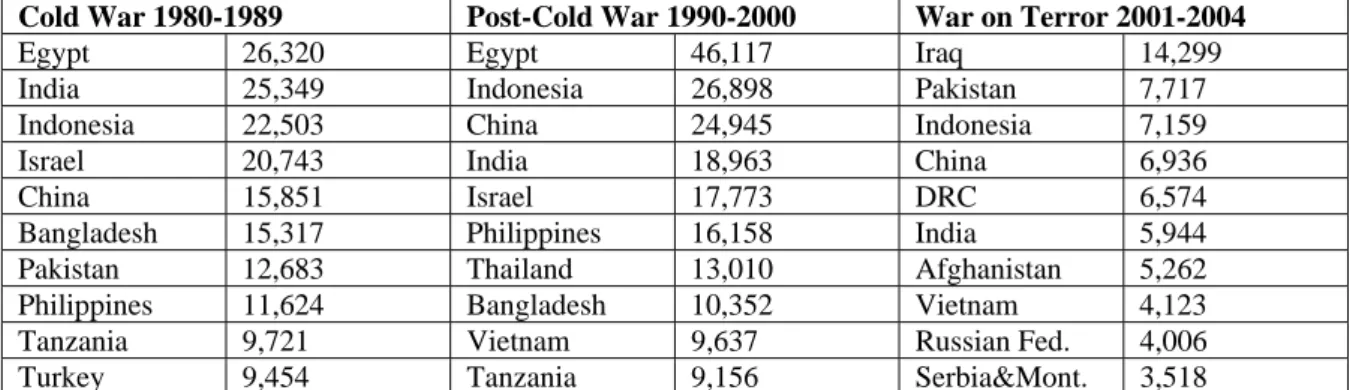
Like many previous studies our research is motivated by the question whether aid is provided with the main aim of development or whether other motives are important drivers in the allocation of aid. Looking at the list of top aid recipients in Table 1 (separated into the periods pre-Cold War, post-Cold War and post-September 11th 2001) raises the suspicion that development may not be the main aim in the allocation of aid. Egypt and Israel, which had global rankings of 98th and 23rd out of 208 in terms of GDP per capita in 1980, received large volumes of foreign aid during all periods. In particular, this is accounted for by the USA who has been a major supporter of both countries; over 40 percent of USA bilateral aid goes to these two countries alone. Similarly, much of Japanese aid has tended to flow to Asian countries in the neighbourhood such as Vietnam and Indonesia. France and the UK provide a lot of foreign aid to their ex-colonies (Table 2). In recent years, Iraq and Afghanistan have entered the top ten recipients following military interventions in these countries.4
--- Table 1 about here ---
3
OECD (2007) 4
---Table 2 about here ---
Based on these preliminary observations we ask the question of what determines aid allocation and a number of related issues: how do geo-political motives compare to developmental motives? Has the relative importance of these motives have changed over the period of analysis? Do the top five donors significantly differ from each other and from the rest of the donors in how they allocate foreign aid?
Literature
There is a large literature on the motivation behind foreign aid. McGillivray and White (1995) provide a comprehensive survey of the literature prior to 1990, while Berthelemy (2006b) and Dollar and Levin (2006) provide surveys of more recent studies.
In the early literature (in particular see McKinlay and Little 1978a, 1978b 1979; Maizels and Nissanke 1984; Mosley 1981), allocation was estimated via two separate equations, one estimating the developmental concerns of the donor and the other estimating strategic interests. Later studies use a combined model which includes recipient characteristics as well as donor interest variables. Virtually without exception, the research so far has found that the political and economic interests of donors outweigh the developmental needs or merits of the recipients. Perhaps the best known of these aid allocation studies is Alesina and Dollar (2000), who suggest that bilateral donors care more about strategic and historical factors than the developmental needs of aid recipients. They focused on the tendency of major donors to give considerably more aid to ex-colonies than the efficient allocation of aid would warrant. Furthermore, they demonstrated a strong link between UN voting patterns and aid commitments (once other factors had been controlled for).
However, their estimation relied on Ordinary Least Squares (OLS) and thus was potentially biased due to the presence of time-invariant unobservables correlated with explanatory variables – a common feature of cross-country panel data. More recently, Berthelemy and Tichit (2004) and Berthelemy (2006a, 2006b) have sought to address some of the econometric problems in the estimation of aid allocation models. In their work they allows for both sample selection and time-invariant unobservable heterogeneity. Although using more sophisticated methods, Berthelemy and Tichit’s results broadly support the previous findings of Alesina and Dollar: donor self-interest is an important determinant in the allocation of development aid.
3. Methodology and Data
Aid Data
Our dataset covers the years 1980 to 2004 and is made up of data on the 22 Development Assistance Committee (DAC) donors and 186 recipient countries. Thus, our data consists of directed dyads that identify a recipient-donor pair for each year.
The data on aid comes from the OECD online statistics database which provides data on DAC donor aid flows.5 Aid is defined as grants or loans to recipient countries which are undertaken by the official sector for the promotion of economic development and welfare. This definition of aid includes emergency and distress relief. Aid must be provided on concessional terms, with loans having a minimum grant element of 25 percent. Aid includes technical assistance but excludes grants, loans and credit for military purposes or transfers to individuals. As is convention in the aid allocation literature, we use aid commitments rather than disbursements which provide a more accurate picture of intended aid allocation by donors in a given year (whereas there are many reasons that may prevent the aid from actually being disbursed.) Aid is reported in constant 2003 dollars, thus accounting for inflation over the period.
This dataset is to our knowledge the largest of its kind, providing 92,400 potential observations (186 recipients · 22 donors · 25 years), although it only contains 45,289 strictly positive ones given that not all donors give aid to all recipients in all years.
Estimation Method
The most common estimation method in the aid allocation literature is to estimate separate equation per donor. For example Alesina and Dollar (2000) analyse each donor’s
behaviour in the following way:
Donor 1: (1)
Donor 2: (2)
5
We include both Official Development Assistance (ODA) to Part I countries and Official Aid (OA) to Part II countries as defined by the OECD. Many studies chose to exclude the Part II countries, which consist of more advanced developing countries and Newly Independent States of the Former Soviet Union, because of the incompleteness of information prior to 1995. However, given the potential substitutability of aid between these two groups, we have incorporated them both in our analysis. Furthermore, over 25 countries (such as Bermuda, Kuwait and Netherland Antilles) have moved from Part I to Part II over the sample period. In 2005, the OECD abolished the definition of Part II countries and has reverted to a single list of recipient countries.
Donor 3: (3)
Where subscript j denotes the recipient and t time. represents a vector of explanatory variables, a constant and the error term. The coefficients are then compared to draw conclusions about individual donor behaviour. The most commonly used estimation method is OLS. One problem with this approach is that donors do not allocate aid to each recipient and thus equations (1)-(3) are estimated using different samples. The coefficients are therefore not directly comparable. Cross-country regressions tend to be sensitive to the inclusion/exclusion of countries, thus estimation over different samples may potentially provide misleading results.6
One way of addressing the issue of comparability is to estimate the set of equations on the same sample. Equivalently the following model could be estimated:
. (4)
where is a dummy variable for introduced for all but one of the donors, as well as an interaction term, . between each of these donor dummies and each of the explanatory variables. The omitted donor is the base category and the coefficents in (4) will be equal to the estimated coefficients from equations (1)-(3) for that donor. If the coefficient on the interaction term is significantly different from zero, this can be interpreted as evidence that donor i behaves significantly differently from the base donor in relation to the characteristic in question. This estimation strategy is suggested by Berthelemy and Tichit (2004) and their main innovation is that they allow for recipient specific effects in equation (4):
. (5)
Model (5) is then estimated with a fixed effects estimator. However, there are two potential problems with their analysis. First, they do not include donor dummies which will bias the coefficients. Second, they only report the coefficients for one of the interaction terms and it is unclear whether all of the interaction terms were included.
6
For example, Roodman (2007) examines Burnside and Dollar (2000) and finds that “all the original OLS and 2SLS results rely on outliers for some or all of their significance.”
For our empirical analysis we use two different samples. First, we only us those recipient-year observations that are common to all five top donors. This enables us to compare the coefficients across these donors and examine whether they allocate aid differently. We estimate model (4) using OLS and model (5) using a fixed effects estimator. Second, we then proceed to use the entire sample for all 22 DAC donors and estimate the difference between the top five donors and the “average” donor by including a donor dummy for each of the top five donors and an interaction term for each of the explanatory variables and the donor dummy.
Methodological Issues
The nature of the data poses significant challenges in estimating the allocation of aid. Not all donors give aid to all countries, i.e. the aid variable is zero for a large number of cases and we thus face a potential sample selection problem. McGillivray (2002) discusses the estimation options and problems in detail. One option is to focus on actual recipients, where aid is positive. This therefore ignores the issue of selection by donors of aid recipients. Alternatively, non-recipients can be included in the sample. However, this results in the coefficients being biased if the zeros are a consequence of a non-random allocation process. A number of studies have applied the Tobit estimator in order to account for the censored nature of the data, though few find that there are significant differences from estimation using OLS (Alesina and Dollar (2000), McGillivray and White (1993), Thiele, Nunnenkamp and Dreher (2007), McGillivray (2002)).
More recently Berthelemy (2006a, 2006b) and Fleck and Kilby (2007) have used two-stage estimators to tackle this issue by estimating the selection decision first, followed by the allocation decision. Generally, the two-stage Heckman model relies on the ability to identify a variable that determines selection, but not allocation. In the foreign aid selection and allocation decision it is difficult to find a variable that explains the former but not the latter. Thus, Berthelemy (2006a, 2006b) and Fleck and Kilby (2007) estimate the selection and allocation equations with an identical set of explanatory variables. However, the Heckman two-stage estimator does not perform well when the same explanatory variables are used in both the selection and allocation equations as identification then solely rests on the non-linearity of the inverse Mills ratio (Kennedy, 2003). In any case, those who have followed this procedure have found little correlation between the residuals in the allocation and selection equations. This indicates that the allocation equation is independent of the
selection equation. Based on these results we chose to estimate the allocation equation without correcting for selection, since it does not seem to result in a significant bias. Explanatory Variables
This leads us to the identification of the explanatory variables within our empirical model. Following the specification of previous studies our allocation model includes four categories of explanatory variables: recipient need, recipient merit, donor self-interest and controls.
Recipient Need
The need of the recipient is captured in this model by two variables: recipient income per capita and the amount of aid per capita received from other bilateral donors. Despite many potential explanatory variables that could capture recipient need (e.g. life expectancy or infant mortality), income per capita is the most straightforward to measure– if aid is allocated according to recipient need then there should be a negative relationship between aid and income per capita.
Aid received from other donors captures either a substitution or complimentary effect between bilateral aid donors. Donors may chose to reduce aid to a recipient if other donors provide more aid, or display “herding” behaviour if we observe donors increasing aid to a country simultaneously. Although the presence of economies of scale could suggest that a positive relationship between donor’s aid disbursements is an efficient allocation, there is a history of aid “darlings and orphans” – with some countries attracting a high level of donor support and others getting very little.
Recipient Merit
Burnside and Dollar (2000) suggest that development aid is more effective when given to countries with good policies. Our “merit” variables analyse whether donors allocate more aid to recipients with better economic policies and more democratic regimes.
We proxy economic policies by the growth of GDP per capita. We lag growth by one period to reduce the potential for the reverse causality of aid on growth, which Clemens et al (2004) show can be significant in the short-term. If donors consider good economic policies in their aid allocation we expect a positive relationship between aid and growth. However, as Feeny and McGillivray (2008) argue, donors could also interpret low growth
as an indicator of high need. In this case the relationship between aid and growth would be negative.
Other proxies of recipient merit are democracy and human rights. Democracy is measured using the Polity IV data set, which provides a rating between -10 and 10 to indicate the level of political openness, with higher values indicating more democratic regimes (Jaggers 1995). Human rights violations are measured using the Political Terror Scale, which is based on information by the US State Department and Amnesty International (Cornett, Gibney and Wood, 2006)7. The index is measured on a scale of 1 to 5, with higher numbers indicating more human rights abuses. The correlation coefficient between human rights and democracy is low (-0.15), suggesting that these variables estimate different aspects of political rights. As with the growth variable we lag both the democracy and human rights scores to reduce the possibility of feedback.
Donor Self-Interest
We included two measures of donor self interest: trade and voting allegiance in the United Nations (UN).
The trade variable is included as an indicator of how donors’ commercial interests influence aid allocation, measured as the flow of import and exports between a donor and a recipient, as a percentage of donor GDP. There is the potential of reverse causality between trade and aid i.e. increased aid may cause increased trade rather than the other way around if aid is tied to the consumption of donor goods. To overcome this we lag the trade variable by one year.
The “UN Friend” variable has been used as an indicator of donor self-interest, representing a geopolitical motivation for providing aid to recipient countries. Although there is a history of analysing UN voting allegiance and foreign aid in the political science literature (Dreher at al (2006), Kegley and Hook (1991), Rai (1980)), the importance of this variable gained prominence in Alesina and Dollar (2000). It is not possible to assume exogeneity of this variable: it is unclear whether aid rewards voting allegiance or vice versa, leading some to question it’s validity as an explanatory variable (Berthelemy 2006b). However, as argued by Alesina and Dollar (2000) it can be interpreted as an
7
We use the State Department data in this paper, using the Amnesty International data did not change our results substantively.
indicator of similar geopolitical interests despite not being able to infer a causal relationship.
There are a number of issues when constructing the UN Friend variable (Dreher and Sturm, 2007). First, is the choice of how to deal with abstentions and absenteeism. Second, there is a great deal of variation in the importance of votes in the General Assembly and many votes are of little strategic importance to donor countries. However, given that there is no categorization of votes according to their importance and the subjective nature of what should be deemed “important”, all votes are included in our analysis. We use UN voting data constructed according to the method described by Kegley and Hook (1991). They calculate the number of times a recipient country votes alongside the donor countries (i.e. both voting yes or no) but discard abstentions and absenteeism, which are likely to be influenced by many factors other than geopolitical ties, particularly for developing countries. Our UN voting variable takes values between zero and one.
Controls
In addition to the above mentioned variables, we include controls for population and the total volume of aid each donor provides. As discussed by Berthelemy (2006b), these variables control for scale effects.
The period over which the data spans also allows us to investigate how aid allocation changed both after the end of the Cold War (1990-2001) and more recently since the beginning of the “war on terror” after September 11th 2001 (the final three years of the dataset). The end of the cold war coincided with a global economic downturn in the early 1990s that saw a contraction of aid budgets. Conversely, the turn of the century has been a time of renewed commitment to the achievement of the Millennium Development Goals (MDGs) through increased aid flows to poor countries. Therefore the coefficients on these dummy variables may be picking up more than the geopolitical changes.
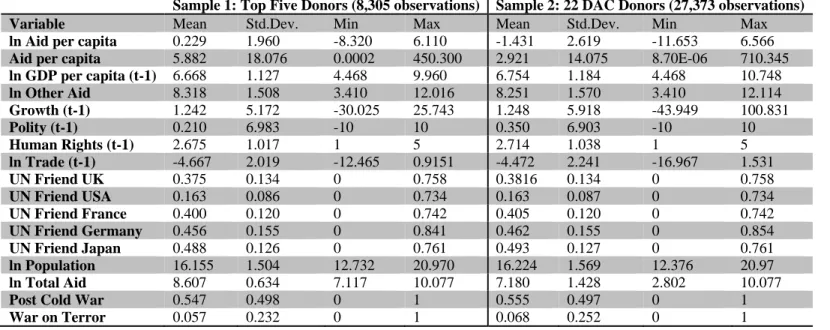
The descriptive statistics of all these variables for both samples (five top donors and all 22 DAC donors) are presented in the Appendix Table A1.
4. Results
We begin our empirical analysis by examining the top five donors’ aid allocation, in line with Alesina and Dollar (2000). However, we restrict the sample to the observations that are common to all donors (1661 observations) and present our estimates our aid allocation model donor by donor in Table 3. This presentation makes it easy to compare the donors with each other.
--- Table 3 about here ---
The OLS results in Table 3 show that all of the major donors allocate more aid to poor countries. The coefficient on income per capita is the largest for the UK and the smallest for Germany. We also ran these regressions using all available observations per donor and we find that restricting our sample to only common observation has no significant impact on our results apart from the coefficient on income. This is probably due to the fact that a number of poor countries only receive aid from some of the donors in a particular year. Removing these countries from our sample, to ensure comparability of the donors’ coefficients, makes all donors appear less poverty focused. Although constricting the sample makes the donors’ coefficients directly comparable, we lose information about their true allocation behaviour – illustrating the major drawback to this approach.
Our other proxy for recipient need, aid from other donors, is only significant for Germany. The positive coefficient indicates that Germany gives more aid to countries that already receive a lot of aid. This may indicate that Germany is not so much guided by recipient need but by other donors’ behaviour. Following Feeny and McGillivray (2008) we carried out tests for the joint significance of the recipient need variables, the results indicate that they are jointly significant for all countries.
Recipient merit also appears important to the aid allocation decision of the donors. The UK is the only donor that rewards good economic policies as well as democracy, but does not reward countries with better human rights. France, Germany and Japan all take human rights abuses into account - higher values of the index indicate more human rights abuses, therefore the negative coefficient is evidence that donors reward better human rights. For the USA this coefficient is positive, countries with poorer human rights receive more aid. All donors bar France favour more democratic recipients. For all countries the merit variables were jointly significant (for France this was only true at the five percent level).
Our results also show that donor self-interest is a motivation for foreign aid allocation. All donors provide more aid to trading partners and all donors except Germany give more aid to countries that regularly vote in line with them in the UN. Again, a test of joint significance indicates that our donor self-interest variables are significant for all countries. In accord with previous studies, we find some evidence of the so-called “small country bias”. Recipients with a smaller population receive more aid but this result only holds for the UK and Germany. The positive coefficient on the Cold War dummy confirms previous findings (Gupta et al 2006) that aid increased as a result of the end of the Cold war from the UK, France and Japan, ceteris paribus. However, we find a negative coefficient for both the USA and Germany. For the USA this may be a result of changing strategic motivations for foreign aid that existed during the Cold War era. Germany spent a lot of resources on German unification and international aid decreased during this time.8
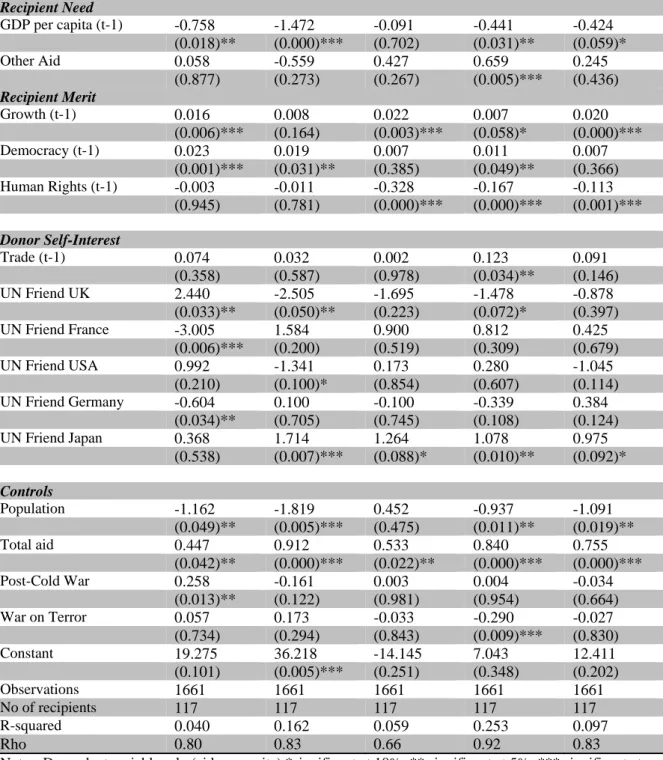
It is likely that there will be unobserved time-invariant heterogeneity among recipients that bias the OLS results if the unobservables are correlated with our explanatory variables. We attempt to control for time-invariant factors such as the special relations between certain donors and recipients (for example, the well known special relations between the USA, Israel and Egypt or Japan and Vietnam), colonial history (of particular importance to both the UK and France) and omitted recipient institutional quality variables by using a fixed effects estimator. Accounting for recipient-specific fixed effects changes a number of the coefficients on our explanatory variables (see Appendix Table A2). In particular, the trade and UN voting variables loose significance. This contradicts the findings of Alesina and Dollar (2000). A joint test of the donor self-interest variable indicates that they are not jointly significant at the one percent level. For Germany the test indicates joint significance at the five percent level. These results suggest that the donor self-interest variables are in fact not as important as much of the previous literature indicates.
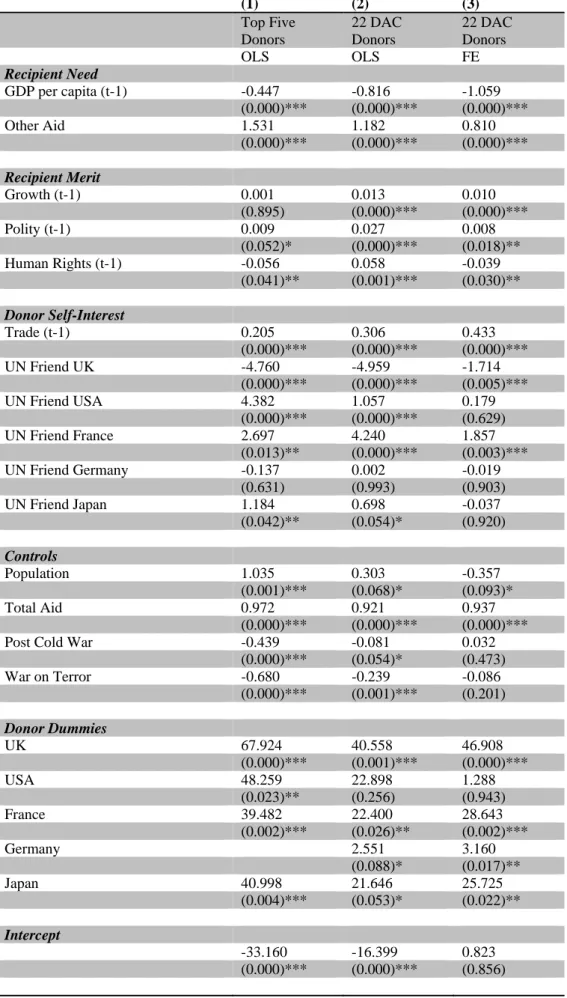
So far the results from the ‘Alesina and Dollar’ model allowed us to compare the top five donors to each other. In Table 4 we contrast these results to a model that considers data from all of the 22 DAC donors.
--- Table 4 about here ---
8
For the period 1990-2000 Burda and Hunt (2001) state that the transfers to Eastern Germany were in excess of DM 1.5 trillion. In 2000 these transfers were equivalent to about five percent of GDP.
In column 1 we repeat the results from Table 3. In this model Germany is the base category and all of the explanatory variables are interacted with a dummy for each of the other major donors. Since we constrain the sample to observations common to all top five donors the coefficients on the explanatory variables are the same as for the German aid allocation model in Table 3. Accounting for the interaction terms gives us the values for the UK, USA, France and Japan. In the next column we use the full dataset on aid from all 22 DAC donors. This enables us to compare the top five donors to the “average” donor’s allocation behaviour. Despite concerns that the donors’ samples are not directly comparable, we can not constrain this sample over only common observations because the newer, less wealthy donors (e.g. Greece) give a limited amount of aid in each year, and our sample would be too small to draw inference. Column 2 supports our previous results, like the top five donors the average donor allocates aid according to recipient need, recipient merit and self-interest. As a next step we allow for fixed recipient effects in this model (Column 3 of Table 5). The coefficient on the logarithm of per capita income, which denotes the elasticity of aid with respect to income, is not significantly different from -1. A one percentage increase in income results in a one percent average decrease in per capita aid i.e. donors view an extra dollar of aid and income as equivalent. The average recipient receives $2.92 in per capita aid from a donor, thus a unity elasticity of aid to income equates to an average decrease of roughly three US cents per capita per one percent increase in GDP, ceteris paribus. The UK is the only one of the top five donors who is significantly more responsive to poverty than the average donor. Conversely, Germany is found to be significantly less poverty-focused than the average donor.
Growing economies receive more aid, on average aid increases by one percent for every one percent of growth – a difference of onlythree US cents per capita. The coefficients on the USA-growth and German-growth interaction terms are larger than -1, this means growing economies receive less aid. Recipients with better human rights and democracy receive more aid from the average donor. An improvement in democracy, whereby a country increases their Polity score by one point, results in a 0.8 percent increase in aid equivalent to about two US cents. The UK is the only major donor giving significantly more to democratic recipient countries, for a one point increase in the Polity score a recipient receives an additional 15 US cents. The effect of human rights is small. Although donors give more aid to countries with fewer human rights abuses, a decrease of one point in the index (which denotes fewer human rights abuses i.e. an improvement) results in
around a four percent increase in aid per capita. Japan gives significantly more than the average donor to countries with better human rights, a one point improvement results in an extra $1.08 in aid.
The average donor allocates more aid to trading partners, the elasticity of aid with respect to trade is about 0.43. This equates to about one extra US cent in aid per one extra percent trade. This elasticity varies across the major five donors. For the UK and France the elasticity is unity, for Germany and Japan about 0.6 and for the USA only 0.3. Variables on UN voting indicate that the average donor gives more aid to recipients voting in line with France and less to those voting in line with the UK. The other UN voting variables are not statistically significant. The top five donors’ allocation behaviour is different with respect to UN voting. The USA, the UK and Japan give more aid to recipients voting in line with them while France and Germany provide less aid. The average recipient votes 16 percent of the time with the USA, an increase to 17 percent is associated with a 8.7 percent increase in aid (25 US cents).
The small country bias is also present in the aggregate data. A one percent increase in population is associated with an average 0.36 percent decrease in aid per capita, roughly 1 US cent. This is below the elasticity of -1 previously estimated by Alesina and Dollar (2000) and Berthelemy (2006a).
Evaluation
The final section of this paper moves beyond the analysis of previous studies by discussing the decomposition of the estimated relationship between aid allocation and the categories of explanatory variables. Using the estimated coefficients from our last regression (Column 3, Table 4) we first predict the average aid per capita and assess the relative importance of need, merit and donor self-interest at the mean of the variables.
The donor specific factors are very important in our model, they account for about as much in the explanation of aid as all the other determinants put together. These dummies are likely to proxy for colonial history and the geopolitical ties that are not accounted for by either trade or UN voting patterns. We also experimented by including dummy variables for former colonies in our model and found that they had little impact on the significance of UN voting but that their inclusion did have an effect on the significance of the donor
dummies9. Thus, the donor dummies seem to partly capture historical ties. Although many studies have criticised the concentration of aid to former colonies, this may in fact be an efficient mechanism of partitioning the “market” for foreign aid between donors.
Given this result, we hypothesise that donors allocate aid predominantly according to historical ties and then adjust aid in relation to the other criteria in the model. Using the estimates from Table 4, column 3 and predicting aid per capita for the average values of the explanatory variables, we analyse the relative importance of recipient need, merit and donor self-interest in the allocation of per capita aid. Table 5 shows the percentage of aid per capita that is determined by each of the allocation criteria other than those picked up by the donor dummy variables:
--- Table 5 about here ---
The largest proportion of predicted aid is explained by the control variables (44 percent), followed by recipient need (36 percent) and donor self-interest (16 percent). Recipient merit (two percent) and the recipient dummies (one percent) only play a marginal role in the allocation of aid.
Based on our results donor self-interest is an important determinant of aid allocation, but its role has been overstated by previous studies such as that of Alesina and Dollar (2000). Furthermore, recipient merit only accounts for about two percent of the residual predicted per capita aid. Given that in the short to medium term merit is arguably the only factor that a developing country has the ability to change, our results indicate that donors are unlikely to allocate substantially more aid to countries with “good policy/governance”.
We illustrate this by calculating how much more aid countries in Sub-Saharan Africa would receive if they radically improved their record of democracy, human rights or economic policies compared to increasing linkages with the donor via increased trade. First, we use the average values for Sub-Saharan in order to predict aid per capita. A country with these characteristics would receive $2.8110. We then vary one explanatory
9
Dummies for former colonies can only be included in the OLS estimation. In the fixed effect model these time-invariant recipient dummies would drop out, thus we follow Bertelemy (2006a) and interact the colony dummies with the donor dummies in order to be able to estimate the fixed effects model. To assess the difference between the donors would mean interacting these interaction terms making the model unwieldy and difficult to interpret. We thus excluded colonial ties from our model.
10
The predicted level of aid per capita was obtained following Wooldridge (2005:219/20). Based on the
variable while holding all others constant. For example if this hypothetical country grew not at the average Sub-Saharan value of 0.54 percent, but tripled it to the average of non-African recipients of 1.67 percent, donors would increase their aid by only four US cents to $2.85. Increasing the polity score from -2.95 to the non-African average of 2.33 would result in an increase of 13 cents to $2.94. The average of our human rights proxy is the same for recipients within and outside Sub-Saharan Africa and thus aid per capita remains unchanged. Africa’s international trade has been marginal, the average Sub-Saharan country only trades at 0.01 percent of the average donors’ GDP. If this were to increase to the average of other recipients it would have to rise to 0.11 percent. This tenfold increase would result in a massive increase in aid, this hypothetical country would then receive $6.74. Table 6 summarizes these policy experiments.
--- Table 6 about here ---
5. Conclusion
Previous studies into aid allocation found that foreign aid is allocated not only according to the needs and merits of the recipient country but also according to the donors’ self-interest. We revisit this topic using a large, three-dimensional dataset covering the period 1980-2004. By controlling for time-invariant donor and recipient effects, we analyse the differences in foreign aid allocation between the top five donors and how they differ from the average DAC donor. We go beyond the analysis of previous research by determining the relative importance of recipient need and merit relative to donor self-interest. Our results suggest that roughly half of the predicted value of aid is determined by donor specific effects, illustrating the fact that conventional aid allocation models are a relatively poor predictor of donor behaviour. Analysing the variation due to factors other than the donor effects we find that recipient need accounts for about 36 percent of the explained variation while donor self-interest accounts for about 16 percent. This suggests that previous literature has overplayed the importance of donor self-interest variables, such as trade and UN voting. Recipient merit accounts for only 2 percent of predicted aid per capita, indicating that the bilateral donors place little importance on recipient merit.
obtained a predicted value for each observation, , and took the exponential exp . We then regressed the level of aid on , and obtained the predicted level of aid by
However, these are among the only factors that developing countries have the ability to change in the short to medium term. In terms of receiving increased aid, recipients have very little incentive to initiate reform.
References
Akram, T. (2003) “The International Foreign Aid Regime: Who gets Foreign Aid and How Much?”, Applied Economics, 35, pp. 1351-1356.
Alesina, A. and D. Dollar (2000.) “Who gives foreign aid to whom and why?” Journal of Economic Growth, 5(1), pp. 33–63.
Berthelemy, J.-C. (2006a) “Bilateral Donors’ Interest vs. Recipients’ Development Motives in Aid Allocation: Do All Donors Behave the Same?” Review of Development Economics, 10 (2), pp. 179-194.
Berthelemy, J.-C.(2006b), “Aid Allocation: Comparing Donors Behaviour” Swedish Economic Policy Review, 13, pp.75-109.
Berthelemy, J.-C. and A. Tichit (2004) “Bilateral donors’ aid allocation decisions: A three-dimensional panel analysis.” International Review of Economics and Finance, 13, pp. 253-274.
Burnside, C. and D. Dollar (2000) “Aid, Growth and Policies,” American Economic Review, 90(4), pp. 847-68.
Burda, M. C. and J. Hunt, 2001. “From Reunification to Economic Integration: Productivity and the Labor Market in Eastern Germany”. Brookings Papers on Economic Activity 2001(2), pp. 1-92.
Clemens, M., Radelet, S. and R. Bhavnani (2004), “Counting Chickens When they Hatch: The Short Term Effect of Aid on Growth” Working Paper No. 44, Centre for Global Development.
Collier, P. and D. Dollar (2002) “Aid Allocation and Poverty Reduction,” European Economic Review, 46(8), pp.1475-1500.
Gibney, M., Cornett, L. and R. Wood (2006) Political Terror Scale 1976-2006. Retrieved from the Political Terror Scale Web site: http://www.politicalterrorscale.org/ (November 2006).
Dollar, D. and V. Levin (2006) “The increasing selectivity of foreign aid, 1984-2003”,
World Development, 34(12), pp. 2034-2046.
Dreher, A., Nunnenkamp, P. and R. Thiele. (2006) “Does US Aid buy UN General Assembly Votes? A Disaggregated Analysis” ETH Zürich, KOF Swiss Economic Institute, Working papers 138.
Dreher, A. and J.E. Sturm (2006) “Do IMF and World Bank influence voting in the UN General Assembly? ETH Zürich, KOF Swiss Economic Institute, Working papers 137. Dudley, L. and C. Montmarquette, (1976) “A model of the supply of bilateral foreign aid.”
American Economic Review, 66 (1), pp. 132–142.
Feeny, S. and M. McGillivray (2008) “What Determines Bilateral Aid Allocations? Evidence from Time Series Data”, Review of Development Economics. Forthcoming. Fleck, R. and C. Kilby (2007). “Changing Aid Regimes? US Foreign Aid from the Cold
War to the War on Terror”, unpublished. Available at:
http://ipes2007.stanford.edu/afs/ir/dept/rde /WWW/ipes2007/papers/Kilby-Paper.pdf
Gupta, S., Pattillo, C. and S. Wagh (2006) “Are Donors Giving More or Less Aid?”, Review of Development Economics, 10, pp. 535-552.
Jaggers, K. (1995) “Tracking Democracy Third Wave with the Polity III Data”, Journal of Peace Research, 32 (4), pp. 469-482.
Kegley, C. and P. Hook (1991) “UN Foreign Aid and UN Voting”, International Studies Quarterly, 35(3), pp. 295-312.
Kennedy, P. (2003) A Guide to Econometrics. 5th ed. Oxford UK: Blackwells.
Kuziemko, I. and E. Werker. (2006) “How Much is a Seat on the Security Council Worth? Foreign Aid and Bribery at the United Nations”, Journal of Political economy, 114(5), pp. 905-930.
McGillivray, M. and H. White (1993) “Explanatory Studies of Aid Allocation Among Developing Countries: A Critical Survey”, Working Paper 148, Institute of Social Studies; The Hague
McGillivray, M. and H. White (1995) “How well is aid allocated? Descriptive measures of aid allocation: A survey of methodology and results.” Development and Change, 26 (1), pp. 163–183.
McKinley, R.D. and R. Little (1977) “A foreign policy model of US bilateral aid allocation.” World Politics 30 (1), pp. 58–86.
Mosley, P. ( 1978) “Models of the aid allocation process: A comment on McKinlay and Little”, Political Studies, 24(2), pp. 245-253.
Neumayer, E. (2003) Explaining the Pattern of Aid Giving, Routledge, London.
OECD (2007) 2006Development Co-operation Report, Volume 8 (1), Organisation for Economic Co-operation and Development: Paris.
Rai, K. (1980) “Foreign Aid and Voting in the UN General Assembly: 1967-1976”
Journal of Peace Research; 17(3); 269-277
Roodman, D. (2007) “The Anarchy of Numbers: Aid, Development and Cross-Country Empirics”, World Bank Economic Review, 21(2), pp. 255-277
Thiele, R., Nunnenkamp, P. and A. Dreher (2007) “Do Donors Target Aid in Line with the MDGs: A Sector Perspective of Aid Allocation”, Review of World Economics 143(4) pp. 596-630.
Thorbecke, E. (2006) “The Evolution of the Development Doctrine and the Role of Foreign Aid” in F. Tarp and P. Hjertholm (eds), Foreign Aid and Development, Oxon: Routledge.
Trumbull, W. and H. White (1994) “Estimating Aid Allocation Criteria with Panel Data”,
Economic Journal, 104 (425), pp. 876-82.
Wang, T. (1999) “U.S. Foreign Aid and UN Voting: An Analysis of Important Issues”, International Studies Quarterly, 43, pp.119-210.
Wooldridge, J.M. (2006) “Introductory Econometrics: A Modern Approach” 3rd ed. Mason, Ohio: Thomson South-Western.
Tables
Table 1: Top 10 Recipients of DAC Aid (Millions $US)
Cold War 1980-1989 Post-Cold War 1990-2000 War on Terror 2001-2004
Egypt 26,320 Egypt 46,117 Iraq 14,299
India 25,349 Indonesia 26,898 Pakistan 7,717
Indonesia 22,503 China 24,945 Indonesia 7,159
Israel 20,743 India 18,963 China 6,936 China 15,851 Israel 17,773 DRC 6,574
Bangladesh 15,317 Philippines 16,158 India 5,944
Pakistan 12,683 Thailand 13,010 Afghanistan 5,262
Philippines 11,624 Bangladesh 10,352 Vietnam 4,123
Tanzania 9,721 Vietnam 9,637 Russian Fed. 4,006
Turkey 9,454 Tanzania 9,156 Serbia&Mont. 3,518
Source: OECD Online Statistics
Table 2: Bilateral Aid from the Top Five Donors to Former Colonies (1980-2004)
Donor Aid to Former Colonies
(%)
Aid to Former Colonies (Million US$) UK 71% 36,798 France 51% 67,748 USA 3% 7,465 Germany 3% 4,263 Japan 0.0% 70
Source: OECD Online Statistics
Table 3: How Do the Top Five Donors Allocate Aid?
UK USA Japan Germany France
Recipient Need GDP per capita (t-1) -1.315 -0.510 -0.710 -0.447 -0.769 (0.000)*** (0.000)*** (0.000)*** (0.000)*** (0.000)*** Other Aid -0.268 -0.396 0.045 1.531 0.350 (0.584) (0.661) (0.928) (0.000)*** (0.433) Recipient Merit Growth (t-1) 0.023 -0.006 0.015 0.001 0.007 (0.006)*** (0.469) (0.116) (0.895) (0.394) Democracy (t-1) 0.056 0.035 0.037 0.009 0.004 (0.000)*** (0.000)*** (0.000)*** (0.052)* (0.545) Human Rights (t-1) 0.025 0.280 -0.280 -0.056 -0.122 (0.554) (0.000)*** (0.000)*** (0.041)** (0.001)***
Donor Self Interest
Trade (t-1) 0.841 0.129 0.461 0.205 0.866 (0.000)*** (0.000)*** (0.000)*** (0.000)*** (0.000)*** UN Friend UK 3.505 -3.230 -1.948 -4.760 -4.062 (0.032)** (0.046)** (0.211) (0.000)*** (0.002)*** UN Friend France -1.688 -1.266 -1.382 2.697 2.676 (0.296) (0.457) (0.398) (0.013)** (0.065)* UN Friend USA -4.424 7.112 -1.007 4.382 -1.048 (0.000)*** (0.000)*** (0.218) (0.000)*** (0.114) UN Friend Germany -0.613 0.356 -0.603 -0.137 -0.047 (0.166) (0.392) (0.119) (0.631) (0.905) UN Friend Japan 0.571 1.680 4.746 1.184 1.656 (0.531) (0.070)* (0.000)*** (0.042)** (0.049)** Controls Population -1.325 -1.196 -0.475 1.035 -0.686 (0.007)*** (0.186) (0.341) (0.001)*** (0.126) Total aid -0.015 1.272 0.772 0.972 1.255 (0.963) (0.000)*** (0.011)** (0.000)*** (0.000)*** Post-Cold War 0.547 -0.781 0.308 -0.439 0.203 (0.000)*** (0.000)*** (0.019)** (0.000)*** (0.035)** War on Terror 0.172 -0.165 0.252 -0.680 -0.150 (0.452) (0.438) (0.207) (0.000)*** (0.398) Constant 34.764 15.100 7.838 -33.160 6.322 (0.002)*** (0.447) (0.516) (0.000)*** (0.538) Observations 1661 1661 1661 1661 1661 R-squared 0.418 0.316 0.209 0.337 0.484
Note: Dependent variable = ln (aid per capita). * significant at 10%; ** significant at 5%; *** significant at 1%. Robust p values in parentheses.
Table 4: Aid Allocation (1) (2) (3) Top Five Donors 22 DAC Donors 22 DAC Donors OLS OLS FE Recipient Need GDP per capita (t-1) -0.447 -0.816 -1.059 (0.000)*** (0.000)*** (0.000)*** Other Aid 1.531 1.182 0.810 (0.000)*** (0.000)*** (0.000)*** Recipient Merit Growth (t-1) 0.001 0.013 0.010 (0.895) (0.000)*** (0.000)*** Polity (t-1) 0.009 0.027 0.008 (0.052)* (0.000)*** (0.018)** Human Rights (t-1) -0.056 0.058 -0.039 (0.041)** (0.001)*** (0.030)** Donor Self-Interest Trade (t-1) 0.205 0.306 0.433 (0.000)*** (0.000)*** (0.000)*** UN Friend UK -4.760 -4.959 -1.714 (0.000)*** (0.000)*** (0.005)*** UN Friend USA 4.382 1.057 0.179 (0.000)*** (0.000)*** (0.629) UN Friend France 2.697 4.240 1.857 (0.013)** (0.000)*** (0.003)*** UN Friend Germany -0.137 0.002 -0.019 (0.631) (0.993) (0.903) UN Friend Japan 1.184 0.698 -0.037 (0.042)** (0.054)* (0.920) Controls Population 1.035 0.303 -0.357 (0.001)*** (0.068)* (0.093)* Total Aid 0.972 0.921 0.937 (0.000)*** (0.000)*** (0.000)***
Post Cold War -0.439 -0.081 0.032
(0.000)*** (0.054)* (0.473) War on Terror -0.680 -0.239 -0.086 (0.000)*** (0.001)*** (0.201) Donor Dummies UK 67.924 40.558 46.908 (0.000)*** (0.001)*** (0.000)*** USA 48.259 22.898 1.288 (0.023)** (0.256) (0.943) France 39.482 22.400 28.643 (0.002)*** (0.026)** (0.002)*** Germany 2.551 3.160 (0.088)* (0.017)** Japan 40.998 21.646 25.725 (0.004)*** (0.053)* (0.022)** Intercept -33.160 -16.399 0.823 (0.000)*** (0.000)*** (0.856)
Interaction Terms
UK*GDP per capita (t-1) -0.868 -0.590 -0.660
(0.000)*** (0.000)*** (0.000)***
USA*GDP per capita (t-1) -0.063 0.185 0.057
(0.417) (0.007)*** (0.375)
Germany*GDP per capita (t-1) 0.206 0.108
(0.000)*** (0.001)***
Japan*GDP per capita (t-1) -0.263 -0.075 -0.023
(0.000)*** (0.108) (0.609)
France*GDP per capita (t-1) -0.322 -0.069 -0.035
(0.000)*** (0.093)* (0.339) UK*Population -2.361 -1.206 -1.579 (0.000)*** (0.018)** (0.001)*** USA*Population -2.231 -1.063 -0.020 (0.020)** (0.246) (0.981) France*Population -1.721 -0.851 -1.115 (0.002)*** (0.051)* (0.007)*** Germany*Population -0.000 -0.000 (0.000)*** (0.000)*** Japan*Population -1.511 -0.620 -0.956 (0.011)** (0.181) (0.040)** UK*Growth (t-1) 0.022 0.001 -0.000 (0.025)** (0.927) (0.963) USA*Growth (t-1) -0.007 -0.023 -0.025 (0.499) (0.003)*** (0.001)*** France*Growth (t-1) 0.006 -0.002 -0.005 (0.528) (0.845) (0.509) Germany*Growth (t-1) -0.008 -0.013 (0.213) (0.005)*** Japan*Growth (t-1) 0.014 0.015 0.006 (0.196) (0.091)* (0.476) UK*Total Aid -0.987 -0.896 -0.499 (0.007)*** (0.004)*** (0.079)* USA*Total Aid 0.300 0.285 -0.090 (0.380) (0.327) (0.732) France*Total Aid 0.282 -0.027 -0.086 (0.436) (0.927) (0.748) Germany*Total Aid 0.186 0.023 (0.272) (0.879) Japan*Total Aid -0.200 -0.218 0.135 (0.567) (0.421) (0.610) UK*Other Aid -1.799 -0.986 -1.284 (0.002)*** (0.052)* (0.005)*** USA*Other Aid -1.927 -1.178 -0.067 (0.044)** (0.198) (0.935) France*Other Aid -1.181 -0.643 -0.787 (0.031)** (0.138) (0.054)* Germany*Other Aid -0.545 -0.259 (0.000)*** (0.000)*** Japan*Other Aid -1.487 -0.925 -1.178 (0.011)** (0.045)** (0.011)** UK*Trade (t-1) 0.636 0.508 0.593 (0.000)*** (0.000)*** (0.000)*** USA*Trade (t-1) -0.076 -0.123 -0.100 (0.098)* (0.001)*** (0.002)*** France*Trade (t-1) 0.661 0.500 0.623 (0.000)*** (0.000)*** (0.000)*** Germany*Trade (t-1) -0.087 0.139 (0.003)*** (0.000)*** Japan*Trade (t-1) 0.256 0.163 0.187
(0.000)*** (0.000)*** (0.000)*** UK*Polity (t-1) 0.047 0.045 0.043 (0.000)*** (0.000)*** (0.000)*** USA*Polity (t-1) 0.026 0.009 0.003 (0.004)*** (0.261) (0.720) France*Polity (t-1) -0.005 -0.012 -0.011 (0.575) (0.051)* (0.054)* Germany*Polity (t-1) 0.005 -0.003 (0.365) (0.566) Japan*Polity (t-1) 0.028 0.020 0.008 (0.001)*** (0.001)*** (0.186) UK*Human Rights (t-1) 0.081 -0.058 -0.043 (0.107) (0.185) (0.281) USA*Human Rights (t-1) 0.336 0.159 0.111 (0.000)*** (0.002)*** (0.020)** France*Human Rights (t-1) -0.066 -0.114 -0.080 (0.154) (0.002)*** (0.025)** Germany*Human Rights (t-1) -0.146 -0.132 (0.000)*** (0.000)*** Japan*Human Rights (t-1) -0.224 -0.351 -0.333 (0.000)*** (0.000)*** (0.000)*** UK*UN Friend UK 8.265 7.602 7.124 (0.000)*** (0.000)*** (0.000)***
UK*UN Friend USA -8.806 -4.126 -4.009
(0.000)*** (0.000)*** (0.000)***
UK*UN Friend Germany -0.476 -0.819 -1.038
(0.366) (0.076)* (0.013)**
UK*UN Friend Japan -0.613 0.302 0.148
(0.571) (0.747) (0.860)
UK*UN Friend France -4.385 -5.360 -4.859
(0.024)** (0.001)*** (0.001)***
USA*UN Friend USA 2.731 7.844 8.500
(0.025)** (0.000)*** (0.000)***
USA*UN Friend UK 1.530 1.535 1.534
(0.422) (0.361) (0.309)
USA*UN Friend Germany 0.493 0.455 0.518
(0.328) (0.312) (0.206)
USA*UN Friend France -3.963 -5.645 -4.950
(0.050)** (0.001)*** (0.002)***
USA*UN Friend Japan 0.496 0.671 0.096
(0.650) (0.482) (0.912)
France*UN Friend France -0.021 -2.839 -3.274
(0.991) (0.046)** (0.011)**
France*UN Friend Germany 0.090 -0.036 -0.206
(0.855) (0.924) (0.543)
France*UN Friend UK 0.698 2.642 3.120
(0.673) (0.043)** (0.008)***
France*UN Friend Japan 0.472 0.515 0.651
(0.644) (0.534) (0.387)
France*UN Friend USA -5.430 -1.872 -2.647
(0.000)*** (0.003)*** (0.000)***
Germany*UN Friend Germany -0.345 -0.644
(0.309) (0.031)**
Germany*UN Friend UK 0.967 1.230
(0.396) (0.217)
Germany*UN Friend Japan 0.091 1.098
(0.891) (0.062)*
Germany*UN Friend USA 3.586 2.691
(0.000)*** (0.000)***
(0.161) (0.008)***
Japan*UN Friend Japan 3.562 3.289 2.723
(0.001)*** (0.000)*** (0.001)***
Japan*UN Friend Germany -0.466 -0.660 -0.566
(0.332) (0.109) (0.159)
Japan*UN Friend France -4.078 -4.207 -3.815
(0.038)** (0.009)*** (0.013)**
Japan*UN Friend UK 2.812 2.833 3.368
(0.129) (0.066)* (0.022)**
Japan*UN Friend USA -5.388 -2.269 -2.587
(0.000)*** (0.001)*** (0.000)***
UK*Post Cold War 0.986 0.461 0.639
(0.000)*** (0.000)*** (0.000)***
USA* Post Cold War -0.342 -0.771 -0.795
(0.020)** (0.000)*** (0.000)***
France* Post Cold War 0.642 0.139 0.286
(0.000)*** (0.140) (0.001)***
Germany*Post Cold War -0.388 -0.101
(0.000)*** (0.145)
Japan* Post Cold War 0.748 0.360 0.397
(0.000)*** (0.003)*** (0.001)*** UK*War on Terror 0.853 0.334 0.383 (0.002)*** (0.148) (0.075)* USA*War on Terror 0.515 -0.183 -0.096 (0.046)** (0.440) (0.657) France*War on Terror 0.531 0.098 0.163 (0.020)** (0.557) (0.302) Germany*War on Terror -0.412 -0.264 (0.006)*** (0.054)* Japan*War on Terror 0.932 0.427 0.590 (0.000)*** (0.031)** (0.002)*** Observations 8305 27373 27373 R-squared 0.443 0.518 0.601
Notes: Dependent variable = ln (aid per capita). Germany is the base donor in model (1). * significant at 10%; ** significant at 5%; *** significant at 1%. Robust p values in parentheses.
Table 5: Proportions of predicted aid attributed to each category of allocation
Category Predicted Aid
Controls 44% Need 36% Donor Self-Interest 16%
Merit 2% Recipient Dummies 1%
Table 6: Predicted aid per capita to Sub-Saharan Africa Predicted aid per capita $2.81
Improved growth $2.85 Improved democracy $2.94 Improved human rights $2.81 Improved trade $6.74
Figures
Other DAC 23% US 24% Japan 24% France 12% Germany 12% UK 5%
Figure
1:Total
bilateral
aid
allocation
by
major
donors
Appendix
Table A1: Descriptive Statistics
Sample 1: Top Five Donors (8,305 observations) Sample 2: 22 DAC Donors (27,373 observations)
Variable Mean Std.Dev. Min Max Mean Std.Dev. Min Max
ln Aid per capita 0.229 1.960 -8.320 6.110 -1.431 2.619 -11.653 6.566
Aid per capita 5.882 18.076 0.0002 450.300 2.921 14.075 8.70E-06 710.345
ln GDP per capita (t-1) 6.668 1.127 4.468 9.960 6.754 1.184 4.468 10.748 ln Other Aid 8.318 1.508 3.410 12.016 8.251 1.570 3.410 12.114 Growth (t-1) 1.242 5.172 -30.025 25.743 1.248 5.918 -43.949 100.831 Polity (t-1) 0.210 6.983 -10 10 0.350 6.903 -10 10 Human Rights (t-1) 2.675 1.017 1 5 2.714 1.038 1 5 ln Trade (t-1) -4.667 2.019 -12.465 0.9151 -4.472 2.241 -16.967 1.531 UN Friend UK 0.375 0.134 0 0.758 0.3816 0.134 0 0.758 UN Friend USA 0.163 0.086 0 0.734 0.163 0.087 0 0.734 UN Friend France 0.400 0.120 0 0.742 0.405 0.120 0 0.742 UN Friend Germany 0.456 0.155 0 0.841 0.462 0.155 0 0.854 UN Friend Japan 0.488 0.126 0 0.761 0.493 0.127 0 0.761 ln Population 16.155 1.504 12.732 20.970 16.224 1.569 12.376 20.97 ln Total Aid 8.607 0.634 7.117 10.077 7.180 1.428 2.802 10.077
Post Cold War 0.547 0.498 0 1 0.555 0.497 0 1
Table A2: Aid Allocation - Fixed Effects Results
UK USA Japan Germany France
Recipient Need GDP per capita (t-1) -0.758 -1.472 -0.091 -0.441 -0.424 (0.018)** (0.000)*** (0.702) (0.031)** (0.059)* Other Aid 0.058 -0.559 0.427 0.659 0.245 (0.877) (0.273) (0.267) (0.005)*** (0.436) Recipient Merit Growth (t-1) 0.016 0.008 0.022 0.007 0.020 (0.006)*** (0.164) (0.003)*** (0.058)* (0.000)*** Democracy (t-1) 0.023 0.019 0.007 0.011 0.007 (0.001)*** (0.031)** (0.385) (0.049)** (0.366) Human Rights (t-1) -0.003 -0.011 -0.328 -0.167 -0.113 (0.945) (0.781) (0.000)*** (0.000)*** (0.001)*** Donor Self-Interest Trade (t-1) 0.074 0.032 0.002 0.123 0.091 (0.358) (0.587) (0.978) (0.034)** (0.146) UN Friend UK 2.440 -2.505 -1.695 -1.478 -0.878 (0.033)** (0.050)** (0.223) (0.072)* (0.397) UN Friend France -3.005 1.584 0.900 0.812 0.425 (0.006)*** (0.200) (0.519) (0.309) (0.679) UN Friend USA 0.992 -1.341 0.173 0.280 -1.045 (0.210) (0.100)* (0.854) (0.607) (0.114) UN Friend Germany -0.604 0.100 -0.100 -0.339 0.384 (0.034)** (0.705) (0.745) (0.108) (0.124) UN Friend Japan 0.368 1.714 1.264 1.078 0.975 (0.538) (0.007)*** (0.088)* (0.010)** (0.092)* Controls Population -1.162 -1.819 0.452 -0.937 -1.091 (0.049)** (0.005)*** (0.475) (0.011)** (0.019)** Total aid 0.447 0.912 0.533 0.840 0.755 (0.042)** (0.000)*** (0.022)** (0.000)*** (0.000)*** Post-Cold War 0.258 -0.161 0.003 0.004 -0.034 (0.013)** (0.122) (0.981) (0.954) (0.664) War on Terror 0.057 0.173 -0.033 -0.290 -0.027 (0.734) (0.294) (0.843) (0.009)*** (0.830) Constant 19.275 36.218 -14.145 7.043 12.411 (0.101) (0.005)*** (0.251) (0.348) (0.202) Observations 1661 1661 1661 1661 1661 No of recipients 117 117 117 117 117 R-squared 0.040 0.162 0.059 0.253 0.097 Rho 0.80 0.83 0.66 0.92 0.83
Notes: Dependent variable = ln (aid per capita) *significant at 10%; ** significant at 5%; *** significant at 1%. Standard errors calculated with White’s correction for heteroskedasticity. Robust p values in