Worcester Polytechnic Institute
Digital WPI
Interactive Qualifying Projects (All Years) Interactive Qualifying Projects
February 2013
Subdivided Housing Issues of Hong Kong: Causes
and Solutions
Daniel Joseph Dwan
Worcester Polytechnic Institute
Jeffery Wilson Wong
Worcester Polytechnic Institute
Meghan Elizabeth Sawicki
Worcester Polytechnic Institute
Follow this and additional works at:https://digitalcommons.wpi.edu/iqp-all
This Unrestricted is brought to you for free and open access by the Interactive Qualifying Projects at Digital WPI. It has been accepted for inclusion in Interactive Qualifying Projects (All Years) by an authorized administrator of Digital WPI. For more information, please [email protected]. Repository Citation
Dwan, D. J., Wong, J. W., & Sawicki, M. E. (2013).Subdivided Housing Issues of Hong Kong: Causes and Solutions. Retrieved from
Subdivided Housing Issues of Hong Kong: Causes and Solutions
An Interactive Qualifying Project
Sponsoring Agency: Hong Kong Institute of Education
Submitted to:
On-Site Liason: Dr. Dennis Lai Hang Hui, Lecturer, Dept. of Social Science, HKIEd
Project Advisor: Dr.Jianyu Liang, WPI Professor
Project Advisor: Dr. Svetlana Nikitina, WPI Professor
Submitted by:
Daniel Dwan Meghan Sawicki
Jeffery Wong
1
Abstract
Subdivided housing poses a multitude of health and safety risks to thousands of citizens who have no choice but to endure such conditions because of their economic limitations. Our recommendations, which include allocating more land for residential construction, an overall increase in construction plans for public housing, reform of public housing policies, and a crackdown on landlords, are meant to aid Hong Kong’s policymakers in amending the
subdivided housing issue that currently plagues Hong Kong. Our recommendations were based on extensive archival research and first-hand interviews with Hong Kong’s citizens that provided an accurate account of such areas affecting the subdivided housing issue as the shortage of public housing units, the lack of residential construction land supply, and astronomically high housing prices.
2
Acknowledgements
We would like to thank our sponsor, the Hong Kong Institute of Education (HKIEd), for enabling the opportunity to work on such a tremendous project. In particular, we would like to thank our on-site liaison, Dr. Dennis Lai Hang Hui, for his efforts in guiding and advising our team. We undoubtedly would not have been able to finish this project without his help. Also, we would like to thank Steven Wu from the HKIEd for his help translating and conducting interviews with our team.
Our team would like to thank Angel Tong. Without any personal investment or responsibility in our project, Angel graciously sacrificed time from her own project to aid our team in conducting interviews and providing lengthy translations. Without her, the majority of our data would have been useless.
Our group also extends its thanks to Zibo Wang. Although we did not distribute our target goal for our survey, Zibo also took time away from his project work to translate our survey into Chinese; a feat our team would not have been able to accomplish on our own.
Finally, we would like to thank our project advisers: Dr. Jianyu Liang and Dr. Svetlana Nikitina. For nearly five months, our advisers oversaw our project, ensuring a high standard of work through their support and feedback. Without their diligence and help, this project would have been impossible.
3
Table of Contents
Abstract ... 1 Acknowledgements ... 2 Table of Figures ... 6 Executive Summary ... 7 1.0 Introduction ... 11 2.0 Background ... 142.1 The Development of Hong Kong the City ... 14
2.1.1 Brief History of Urban Development Leading to Subdivisions ... 14
2.1.2 Current Housing Policy ... 17
2.1.3 Stakeholders in Housing Market Reform ... 20
2.2 Overview of Subdivided Housing ... 21
2.2.1 Subdivided Flats ... 22
2.2.2 Subdivided Housing in Converted Industrial Buildings ... 23
2.2.3 Building Code Violations ... 25
2.2.4 Fire Safety Violations ... 26
2.2.5 Environmental Hygiene Issues ... 26
2.6 Summary ... 28
3.0 Methodology ... 29
3.1 Archival Research ... 29
3.2 Survey and Analysis ... 30
3.3 Interviews ... 35
3.4 Summary ... 38
4.0 Results and Analysis ... 39
4.1 Causes of Widespread Subdivided Housing ... 39
4.1.1 Lack of Space for Development in Existing Urban Areas ... 40
4.1.2 Constricted Supply of Land for Further Development... 41
4.1.3 Public Housing Supply ... 43
4.1.4 Cost of Private Housing ... 45
4.1.5 Profits of Subdivision for Landlords ... 46
4.1.6 Displacement of Hong Kong’s Poorest Residents ... 47
4
4.2 Position of Hong Kong’s Government on Subdivided Housing ... 49
4.2.1 Government Response in the Past ... 49
4.2.2 New Government, Heightened Concern ... 51
4.2.3 Conclusion ... 53
4.3 The Hong Kong Public’s Perspective of Subdivided Housing ... 54
4.3.1 Upper and Middle Classes’ Perspective ... 54
4.3.2 Opinions of the Lower Class ... 57
4.3.3 Analysis of Survey Data ... 60
4.3.4 Perspectives of the Mr. Paul Kwok Lai and the PCSHIHK ... 65
4.3.5 Observational Evidence ... 68
4.3.6 Conclusion ... 73
5.0 Conclusions ... 75
6.0 Recommendations ... 77
6.1 Increase Land Availability for Residential Construction... 77
6.1.1 Benefits of Increased Residential Land Allocation... 79
6.1.2 Potential Drawbacks of Increased Land Allocation ... 81
6.2 Expand and Accelerate Public Rental Housing Construction Plans ... 82
6.2.1 Increase Public Housing Construction ... 83
6.2.2 Expedite Current Public Housing Construction Plans ... 84
6.2.3 Emphasize Public Rental Housing Marketability ... 84
6.2.4 Build Interim Public Housing ... 85
6.3 Reform Public Rental Housing Policies ... 86
6.3.1 Utilize a Case-by-Case Eligibility System for Public Housing ... 86
6.3.2 Subsidize Rent for Waiting List Members ... 88
6.3.3 Re-evaluate Plot Ratios ... 89
6.4 Crackdown on Landlords ... 90
6.4.1 Require Building Repairs and Renovations ... 90
6.4.2 Enforce Written Rental Agreements... 92
6.5 Concluding Remarks ... 93
References ... 94
Appendix A: Hong Kong Institute of Education Background ... 104
Appendix B: Subdivided Housing Tenant Survey ... 108
5
Appendix D: Subdivided Housing Tenant Interview Protocol ... 116
Appendix E: Tennant of Subdivided Housing Interview Transcript ... 118
Appendix F: Public Interview Protocol ... 120
Appendix G: Upper and Middle Classes Interview Transcripts... 121
Appendix H: Lower Class Public Interview Transcripts ... 133
Appendix I: Mr. Lai Kin-Kwok of the Platform Concerning Subdivided Housing and Issues in Hong Kong Interview Protocol ... 139
Appendix J: Mr. Lai Kin-Kwok Interview Transcript ... 141
6
Table of Figures
FIGURE 1: HONG KONG MONTHLY INCOME DISTRIBUTION. ... 15
FIGURE 2: TIMELINE OF SIGNIFICANT EVENTS IN HONG KONG HOUSING ... 17
FIGURE 3: PUBLIC RENTAL HOUSING FINANCIAL ELIGIBILITY ... 18
FIGURE 4: HONG KONG SUBDIVIDED HOUSING STAKEHOLDERS AND RELATIONSHIPS ... 21
FIGURE 5 (LEFT): NINE APARTMENTS IN 645 FT 2. ROBERTS, ANNE (2010) ... 23
FIGURE 6 (RIGHT): CORRIDOR WITH 22 APARTMENTS ON TWO LEVELS. ROBERTS, ANNE (2010) ... 23
FIGURE 7 (LEFT): TWO MEN LIVING IN METAL “CAGES HOMES.” ROBERTS, ANNE (2010) ... 25
FIGURE 8 (RIGHT): MAN LIVING IN 3.5FT TALL “CUBICLE HOME.” ROBERTS, ANNE (2010) ... 25
FIGURE 9 (LEFT): A KITCHEN SHARED BY 21 PEOPLE. ROBERTS, ANNE (2010) ... 27
FIGURE 10 (RIGHT): A TOILET SHARED BY 22 SUBDIVIDED UNITS. ROBERTS, ANNE (2010) ... 27
FIGURE 11: LAND UTILIZATION IN HONG KONG. ... 42
FIGURE 12: PUBLIC RENTAL HOSING PRODUCTION VS WAITING LIST SIZE. ... 44
FIGURE 13: COMPARISONS BETWEEN OPINIONS OF THE UPPER/MIDDLE CLASSES AND THE LOWER CLASS ... 58
FIGURE 14: HOUSING TYPES OF TENANTS OF SUBDIVDED HOUSING FROM PCSHIHK SURVEY. . 60
FIGURE 15: QUANTITY OF UNITS BUILT IN PCSHIHK STUDY PARTICIPANTS’ SUBDIVIDED FLATS. 61 FIGURE 16: PCSHIHK STUDY PARTICIPANTS' RENT PER MONTH. ... 62
FIGURE 17: EDUCATION LEVELS OF PCSHIHK STUDY PARTICIPANTS. ... 63
FIGURE 18: FREQUENCY OF INSUFFICIENT VENTILATION IN PCSHIHK STUDY PARTICIPANTS' FLATS. ... 64
FIGURE 19: PCSHIHK STUDY PARTICIPANTS’ OPINIONS ON EFFECTIVENESS OF VARIOUS REFORM MEASURES... 65
FIGURE 20: AN EXAMPLE OF DANGEROUS ELECTRICAL WIRING NOTICED BY OUR TEAM IN A SUBDIVIDED BUILDING. ... 69
FIGURE 21: AN EXAMPLE OF A CAGE DOOR LEADING TO A BLOCK OF SUBDIVIDED UNITS. ... 70
FIGURE 22: FLOOR PLAN WITH ESTIMATED FLOOR SPACE AREAS OF OUR SUBDIVIDED HOUSING INTERVIEWEE’S HOME. NOTE: DRAWING NOT TO SCALE ... 72
FIGURE 23 (LEFT): OUR INTERVIEWEE'S BATHROOM FROM A SUBDIVIDED UNIT. ... 72
FIGURE 24 (RIGHT): OUR INTERVIEWEE'S BEDROOM FROM A SUBDIVIDED UNIT. ... 72
7
Executive Summary
Modern Hong Kong, known for its prolific status as a center of Asian trade, has become one of the most densely populated cities in the world. Lacking a sufficient space for
development, the city has resorted to large-scale construction of high-rise apartments and business centers. Population increase and development in Hong Kong has led to widespread overcrowding in residential areas (Grange, 2004; Hui, 2011; Yeh, 2011). As a result, the price of housing in Hong Kong is astronomically high, leading to severe inadequacies in low-income residences (“Residential Prices Surging,” 2013).
Subdividing a flat refers to the act of dividing a traditional single-family apartment into two or more individual dwellings to accommodate additional families (Buildings Department, 2013). Demand for these tiny subdivided flats has continued to grow throughout recent years due to the inability of low-income families to afford standard housing, an insufficient supply of public housing units, and a lack of residential construction (Hong Kong Housing Authority, 2012; Information Services Department, 2012; “Mid-Levels They Ain’t”, 2011). Although the
government is increasing the number of public units, the amount provided by Hong Kong’s Housing Authority will not be enough to accommodate Hong Kong’s lower class (Chiu, 2012). In response to the ongoing shortage of affordable living spaces, low-income families have been forced to take up residence in a variety of different forms of subdivided housing units (Buildings Department, 2013; Census and Statistics Department, 2013; Chiu, 2012; Hong Kong Housing Authority, 2012; Hui, 2011; Lee, 2012; “Mid-Levels They Ain’t”, 2011; “Residential Prices Surging,” 2013). These dwellings are often extremely cramped, unventilated, unsanitary, and generally hazardous to residents (Buildings Department, 2013).
8
The goal of this project is to develop a set of recommendations to aid reforming the subdivided housing issue. In order to attain the necessary knowledge to produce well-rounded suggestions, we developed three research objectives and utilized various methodologies to address them:
Research Objective 1: Trace and explain the development of subdivided units in Hong Kong with reference to its socio-economic context: We conducted in-depth archival research in order to uncover the main factors that have given rise to widespread subdivisions that we see today.
Research Objective 2: Analyze the position of Hong Kong’s government on subdivided housing: Using extensive archival research, we were able to gain an understanding of the government’s current position on the issue of subdivided housing.
Research Objective 3: Survey and analyze the public’s perception of the city’s housing
situation: We attempted to survey a large sample of lower class citizens being directly affected by apartment subdividing in order to understand their views of subdivided housing. Due to a lack participation determined as the result of a cultural reluctance to offer opinions, our team analyzed data from a reputable, prior study. In order to gain additional, more qualitative insight into the public’s perspective, we conducted additional one-on-one interviews with citizens from various economic backgrounds and the Platform Concerning Subdivided Housing and Issues in Hong Kong, a concerned non-government organization.
Based on the data and analyses our projected yielded, we have concluded that the subdivided housing problem is the result of a failing housing system plagued by a major imbalance between the supply and demand for housing (Buildings Department, 2013; Census
9
and Statistics Department, 2013; Chiu, 2012; Hong Kong Housing Authority, 2012; Hui, 2011; Lee, 2012; “Mid-Levels They Ain’t”, 2011; “Residential Prices Surging,” 2013). The government, although it has acknowledged the issue of subdivided housing, has lacked in its previous efforts to combat the problem, which have come mostly as reactions to widely publicized accidents and horrible conditions in subdivided units (Chan, 2012a; Ho & Lee, 2013; Leung, 2013; “New Hong Kong Chief,” 2012). The public on the other hand, regardless of individual economic standing, demands that the subdivided housing issue be resolved as quickly as possible, stressing the importance of increased government attention and action (Subdivided Flat Study Summary, 2012).
Considering our data and analyses, our team has formulated a set of recommendations to aid in resolving the subdivided housing issue. First we recommend that the government release more land to be developed for residential purposes to combat the supply and demand imbalance we recognized. By increasing land availability, more housing units can be constructed to alleviate the need for subdividing units.
Second, we suggest an overall increase in construction of public rental housing units, and the expediting of all current construction plans. By increasing and fast-tracking
construction of new public housing units, more residents of subdivided housing can be granted access to better living conditions with affordable rent.
Third, we recommend that Hong Kong’s government reform their public housing policies. Current public housing policies force some locals to forgo raises in order to maintain eligibility for public housing; an inequity that must be resolved through case-by-case
10
been waiting for public housing at least three years, the expected waiting period for applicants specified by the government.
Finally, our team recommends that the Hong Kong government cracks down on landlord injustices against tenants of subdivided housing. We feel that on a short-term timetable,
demanding landlords repair buildings with inadequate conditions and enforcing the use of written contracts between themselves and their tenants can at least make existing structures more livable.
The subdivided housing issue in Hong Kong should be a priority for reform. Without reform and legislation, current trends in public housing supply and residential land allocation suggest that the problem will only persist. Our recommendations will assist Hong Kong’s
policymakers to begin this important reformation process and help address its housing issues as a whole.
11
1.0 Introduction
The city of Hong Kong is recognized today for its key position as an economic hub for trade in Asia as well as being one of the most densely urbanized cities in the world. Although urbanization has been occurring globally, Hong Kong faces an additional challenge brought on by its geography. With minimal land to build upon, Hong Kong, to a greater degree than most cities, grew upwards rather than outwards. Today, Hong Kong’s skyline is filled with a variety of towering high-rise buildings (Carroll, 2007). Yet, the city’s expansion has come with a price: overcrowding. Hong Kong has been struck with an extensive apartment subdivision problem (Hui, 2011). The practice of subdividing apartments has extensive consequences that some citizens must live with on a day-to-day basis, ranging from poor ventilation to overloading of structures (Buildings Department, 2013). If these problems are to be resolved, swift and immediate action is mandatory.
The Hong Kong Institute of Education (HKIEd) has revealed to us a core problem: many citizens of Hong Kong are subdividing their flats; an issue that will only get worse with time if no action is taken. There are currently an estimated 280,000 subdivided units across the entire city (Subdivided Flat Study Summary, 2012). For example, recently an old industrial building in Tai Kok Tsui was found containing 39 subdivided flats on a single floor, where 40 residents share two bathrooms (Yeung, 2011). Furthermore, some of these subdivided units called “cage homes,” confine residents to chicken wire cages, sometimes comprised of less than 1.5 square meters of living space (Hong Kong’s Poor, 2013). Conditions in many of these buildings are deplorable, sometimes consisting of crumbling concrete, dangerous electrical wiring, and overall filth.
12
Subdividing units in Hong Kong leads to many serious consequences that compromise the health and safety of residents. Violated building codes, structural alterations, and extra weight threaten buildings with the risk of collapsing. Subdividing also creates fire hazards as exit routes are left obstructed and precautionary measures are destroyed in the alteration process. Moreover, improper air circulation and incompetent drainage systems jeopardize the health of all residents because of the potential for spread of disease and exposure to pathogens and toxic fumes (Buildings Department, 2013).
Although there has been some research done on the subdivided units that are plaguing Hong Kong’s lower class, more investigation is still needed (Chiu, 2012). The underlying causes for the existence of subdivided housing must be better understood to support changes that can improve the quality of life in subdivided units.
This project looks to create a set of recommendations to facilitate the reform process of the subdivided housing issue. To achieve this goal, we developed three research objectives. Our research objectives included first investigating the causes and stimuli for the continued sub-letting of flats. Second, we looked at the Hong Kong Government’s official position regarding sub-divisions and how that may drive or hinder potential reform. Finally, we documented the public’s perception of the current housing situation, looking at the opinions of the upper and middles classes, the lower class, and also the Platform Concerning Subdivided Housing and Issues in Hong Kong, a non-government organization. After addressing our research objectives, we made long-term and short-term recommendations based upon historical background, our collected data and analyses, and Hong Kong’s social context to facilitate positive change. We hope these recommendations encourage policymakers to consider appropriate reforms to help
13
decrease the scale of the consequences of sub-dividing and improve the quality of life of residents.
14
2.0 Background
The low-income urban areas of Hong Kong, specifically the Kowloon Peninsula, are currently facing severe overcrowding and a problematic housing market. However, the
problem of sustainable housing has been in existence since the early 1950’s. In this chapter, we will examine how Hong Kong’s housing issues came about, including a history of urban
development and housing policy. Additionally, our team will provide an outline of the city’s public housing system. Moreover, we will identify the various stakeholders in the city’s housing market and their respective roles. Finally, we will examine the process of subdividing units, its various forms, and its numerous negative consequences.
2.1
The Development of Hong Kong the City
The vast majority of Hong Kong’s population currently resides in the heavily occupied northern shore of Hong Kong Island, including the Kowloon Peninsula and ten new towns.
About 60% of the population is concentrated in a mere 80 square kilometersof land area,
making Hong Kong one of the most densely populated cities in the world (Grange, 2004). Hong Kong’s residential climate comprises mainly of high-rise apartment complexes, usually
containing several buildings over forty floors high. The high congestion and population density found in Hong Kong have arisen due to large-scale population growth and rapid urbanization (Grange, 2004).
2.1.1 Brief History of Urban Development Leading to Subdivisions
Due to political turmoil in mainland China, the 1950’s brought with it a large influx of Chinese immigrants to Hong Kong, inevitably leading to widespread squatting and
15
homelessness (Public Housing Development, 2012). Due to the lack of education and skill level among many of these immigrants, the number of low-income households in Hong Kong rose considerably. This stimulated a steady increase in income disparity that has continued into the present day (Half-Yearly Economic Report, 2012). Figure 1 depicts a graph of Hong Kong’s income distribution created using population data provided by the Information Services Department of the HKSAR (2012).
FIGURE 1: HONG KONG MONTHLY INCOME DISTRIBUTION.
The graph visualizes the substantial amount of low-income individuals currently residing in Hong Kong. More than one-quarter of the population has an income lower than HK$10,000 per
7.7% 5.7% 6.8% 6.7% 14.8% 12.2% 10.4% 7.1% 6.3% 4.0% 3.5% 2.3% 3.7% 3.9% 1.9% 3.0% 0 0.02 0.04 0.06 0.08 0.1 0.12 0.14
0.16
Hong Kong Income Distribution
Monthly Income (HK$)
Per
cen
t
of
Tot
al
Popul
at
ion
16
month, with nearly 8% of the population having a monthly income lower than HK$4,000 (Information Services Department, 2012).
The steady increase in the amount of low-income families, largely attributed to the influx of Chinese immigrants to Hong Kong that began in the 1950’s, helped spark the beginning of Hong Kong’s welfare system, specifically in the housing market (Half-Yearly Economic Report, 2012). Until the mid-1950’s, virtually no public housing existed in Hong Kong. In 1953, following a fire in the Shek Kip Mei squatter settlement that left 40,000 residents homeless, the
government of Hong Kong began involving itself extensively in the creation of public housing (Grange, 2004). In 1961, the Government Low-Cost Housing Program was implemented to provide people with inexpensive housing without sacrificing the quality of residences. By 1965, high-rise apartment blocks had arisen throughout Hong Kong’s major urban areas, and the number of people in public housing had reached one million. In 1972, the government began a new ten-year housing program that planned for new public housing that would accommodate 1.8 million people. The following year, the Hong Kong Housing Authority was established to spearhead the government’s housing program, and has continued to lead development of public housing in Hong Kong through the present day (Public Housing Development, 2012). Figure 2 on the following page depicts a timeline of influential events regarding Hong Kong’s housing market since the 1950’s.
17
FIGURE 2: TIMELINE OF SIGNIFICANT EVENTS IN HONG KONG HOUSING 2.1.2 Current Housing Policy
The price of housing in Hong Kong has been soaring for the past three years
(“Residential Prices Surging,” 2013). In 2012 alone, the average price of residential property increased by nearly 24% (“Residential Prices Surging,” 2013). In April 2012, The Economist, an international affairs newspaper, calculated Hong Kong’s home-price index to be 58% above fair value, making its housing market the second-most overvalued in the world, behind only
Singapore. This index, put simply, is a long-term average of the ratio of housing prices to rents and incomes (“Mid-Levels They Ain’t,” 2012). The average price of an apartment smaller than 40 square meters was HK$122,346 as of November 2012. Property analysts expect prices to continue to rise in 2013, although at a slower rate (“Residential Prices Surging,” 2013).
Public Rental Housing (PRH) provided by the Hong Kong Housing Authority is the main source of subsidized residence for the more fortunate of Hong Kong’s lower class. A total of
1953 - Fire in Shek Kip Mei squatter settlement leaves 40,000 residents homeless; Government of Hong Kong became involved in creation of public housing 1961 - Government Low-Cost Housing Program implemented to provide people with inexpensive housing without sacrificing the quality of residences 1962 - Hong Kong Housing Authority established 1997 - United Kingdom relinquishes control of Hong Kong to China; becomes Hong Kong Special Administrative Republic 2004 - New legislation gives landlords more in rental agreements (Li, 2004) 2013 - Chief Executive Leung Chun-Ying gives policy address; highlights housing as his administration's biggest priority
18
722,000 subdivided Public Rental Housing units currently exist in Hong Kong, 70,000 of which were constructed over the past decade. Moreover, approximately 215,000 people, nearly thirty percent of Hong Kong’s total population, currently reside in Public Rental Housing units (Hong Kong Housing Authority, 2012). However, to be eligible for public housing, a family must have lived in Hong Kong for a minimum of 7 years, and must have a total income below a certain level, depending on how many persons there are in the household. Figure 3 below shows the Hong Kong Housing Authority’s (2012) standards for maximum net income and assets by family size to qualify for public housing.
Family Size Maximum Income Limit (per month)
Total Net Asset Limit
1 Person $8,740 $203,000 2 Persons $13,410 $274,000 3 Persons $17,060 $359,000 4 Persons $20,710 $418,000 5 Persons $23,640 $465,000 6 Persons $26,590 $503,000 7 Persons $29,560 $537,000 8 Persons $31,620 $563,000 9 Persons $35,360 $622,000 10 or more Persons $37,150 $670,000
FIGURE 3: PUBLIC RENTAL HOUSING FINANCIAL ELIGIBILITY. ADAPTED FROM INCOME AND ASSET LIMITS, APRIL 2012, HONG KONG HOUSING AUTHORITY
19
Despite the Housing Authority’s comprehensive public housing system, there are still an enormous number of eligible citizens unable to obtain this type of housing. Currently, all Public Rental Housing units are in use, and applying for PRH is relatively futile. According to the Hong Kong Special Administrative Republic’s Information Services Department (2012), the waiting list for public housing comprises of approximately 189,500 applicants, with an average wait time of 2.6 years.
One goal illustrated by the Hong Kong government since the 1980’s has been the privatization of the public housing sector (Grange, 2004). After the political recuperation of Hong Kong with China in 1997, the government carried out a series of significant housing modifications. Furthermore, the government envisioned that by 2007, Hong Kong would have an overall home ownership rate of 70% (Grange, 2004). As of 2010, the overall home ownership rate had only reached 53% (Public Consultation on Subsidizing Home Ownership, 2010).
Furthermore, although the city’s legislative branches have instituted multiple rounds of inspections and building demolitions over the past several years, many of these moves have been seen less as progressive towards overall housing reform, and rather as reactionary political moves to horrifying incidents caused by subdivided housing (Bowring, 2010).
In July 2012, Hong Kong’s latest Chief Executive, Leung Chun-Ying, took office, carrying promises of housing policy reform. Little time has passed since his election, but there have been very few housing initiatives. Leung’s plans mainly focus on bolstering residential sales and subsidizing existing public housing. In addition, Leung has stated plans to convert old industrial buildings into residences, which could yield 11,900 new homes. In August of 2012, Hong Kong’s government announced that it would increase public housing by twenty percent. However, the
20
Hong Kong Housing Authority projects that only 14,100 new units will be produced per year in 2013 and 2014, which will accommodate only thirteen percent of the current waiting list for public housing (Chiu, 2012). However, the Chief Executive has promised 65,000 new private sector homes within the next four years, and 75,000 new public housing units within the next five (McMillan & Pomfret, 2012). Many property analysts do not believe the proposed
measures will have much, if any, effect on the housing market’s current state of disarray. Analysts claim that these proposed policies are fairly comparable to past policies and therefore will be unable to cool property prices (McMillan & Pomfret, 2012).
2.1.3 Stakeholders in Housing Market Reform
Reform of Hong Kong’s housing market heavily depends on the input of its various stakeholders. The stakeholders can be defined as the individuals and organizations who can affect or who are affected by the state of the housing market in Hong Kong. These stakeholders have the ability to demand change, influence policymakers, and/or potentially cause the issue to persist if they desire.
The Hong Kong Housing Authority has made it a priority in its actions to involve stakeholders as much as possible in the decision making and recommendation process for legislation. For instance, the Housing Authority has made it a point not only to listen to residents about their needs, but to consult with Housing Authority business partners and contractors to listen to their corporate needs as well (Hong Kong Housing Authority, 2009). This plan of action follows the mindset illustrated by Yang and Yang (2009), where “the different perceptions, roles and incentives of stakeholders, who inevitably need to ensure their benefits
21
and commercial returns, should be highlighted and acted upon” by taking into account the needs of all stakeholders (Yang & Yang, 2009).
Figure 4 below, depicts various stakeholders of the housing market and the subdivided housing issue, as well as inter-stakeholder relationships.
FIGURE 4: HONG KONG SUBDIVIDED HOUSING STAKEHOLDERS AND RELATIONSHIPS
2.2
Overview of Subdivided Housing
In response to the many shortcomings of Hong Kong’s housing market, a widespread presence of subdivided housing has arisen to accommodate the city’s poorer citizens.
22
accommodate more tenants. The subdivision of flats in Hong Kong leads to many problems and numerous imminent dangers for poverty-stricken residents (Buildings Department, 2013). Far too often, people are found living in squalor and filth, confronted with terrible conditions. Blatant disregard for building codes during the construction of these units frequently results in significant safety threats to tenants. Absence of proper fire safety procedures and exit
strategies has led to large-scale disasters (Associated Free Press, 2010). In addition to obvious discomfort, crowding in subdivided homes creates an environment that fosters uncleanliness and the spread of disease. The combination of these shortcomings makes subdivided housing in Hong Kong highly conducive to poor health and poses imminent threats to the safety of
residents.
2.2.1 Subdivided Flats
Subdivided flats are the simplest and most prevalent form of subdivided housing. The subdivision of a flat refers to the practice of dividing a traditional single-family apartment into two or more individual dwellings to accommodate additional families. In order for this action to be legal, owners are required to adhere to the Hong Kong Building Ordinance by hiring licensed professionals to the perform necessary construction. However, quite often these renovations are done illegally, violating building codes and jeopardizing the overall safety of tenants (Buildings Department, 2013). These flats are claustrophobic, usually containing only 10-15 square meters of floor area (Chiu, 2012). According to the Platform Concerning Subdivided Flats and Relevant Issues of Hong Kong, an estimated 280,000 subdivided units exist in Hong Kong (2012). This number includes not only typical subdivided flats, but also much lower-quality and more extreme types of subdivided housing.
23
[5] [6]
FIGURE 5 (LEFT): NINE APARTMENTS IN 645 FT 2. ROBERTS, ANNE (2010)
FIGURE 6 (RIGHT): CORRIDOR WITH 22 APARTMENTS ON TWO LEVELS. ROBERTS, ANNE (2010) 2.2.2 Subdivided Housing in Converted Industrial Buildings
Many of Hong Kong’s poorest citizens are currently subjected to even worse conditions than those of average subdivided homes, as some citizens choose to live in units constructed inside converted industrial buildings (Yeung, 2011). This practice is not uncommon, despite the fact that establishing residence in an industrial building is illegal (Chan, 2012a).
Fairly common in these converted industrial buildings are “cubicle homes,” which are crudely constructed wooden sections usually left uncovered at the top to allow for ventilation (Chan, 2012a). On a single floor in a converted factory building in Tai Kok Tsui, 39 rooms,
24
averaging less than 15 square meters each, are home to 40 people, who are forced to share two bathrooms and three showers (Yeung, 2011). There is very little space for creature comforts.
An especially tiny, cramped class of subdivided living spaces known as “coffin homes” provides shelter to some of Hong Kong’s poorest families. These units, less than two square meters in floor area, are so small that tenants are literally packed on top of one another “like sardines” (Gottlieb & Hang, 2011). According to CNN (2011), one particular “coffin home” building in Wan Chai accommodated twenty tenants, forcing them to share one bathroom and shower. The hallways of the building were covered in exposed makeshift wiring, creating a threat of electric shock, and ventilation was almost nonexistent (Gottlieb & Hang, 2011). One resident, who chose to remain anonymous, described life in his “coffin home” to CNN
reporters:
“I can skip meals, ignore the dirt, bedbugs, and stuffiness, but the biggest problem we have here is safety. There have been close calls over the years. We're stacked like sardines, and there are no regulations. We'd all be dead if a fire were to start (2011).” An even further extreme in substandard living is seen in what are known as “cage homes.” These subdivided housing units are typically 1.5 square meters in floor space and are partitioned into cubicles made of mesh wire and stacked on top of one another (Hong Kong’s Poor, 2013). Temperatures are unbearably hot in these units, remaining constantly over 35°C (Yoon, 2009).
25
[7] [8]
FIGURE 7 (LEFT): TWO MEN LIVING IN METAL “CAGES HOMES.” ROBERTS, ANNE (2010) FIGURE 8 (RIGHT): MAN LIVING IN 3.5FT TALL “CUBICLE HOME.” ROBERTS, ANNE (2010) 2.2.3 Building Code Violations
More often than not, subdivided units in Hong Kong have been constructed with complete disregard for building codes and ordinances. Original partition walls are frequently removed from flats in order to make room for many new non-loadbearing walls. These new walls add to the stress on floors and loadbearing walls, threatening the structural integrity of entire buildings (Buildings Department, 2013).
Hong Kong is home to numerous residential structures whose ages exceed 50 years (Leung, 2010). Consequently, building collapse is a relatively common occurrence in Hong Kong. On January 29, 2010, a five-story residential building in Kowloon collapsed suddenly, killing four people, seriously injuring two others, and leaving 100 tenants without housing (Associated Free Press, 2010). In April of 2010, Hong Kong’s Buildings Department conducted an in-depth
investigation in order to better understand the January collapse. The resulting report listed several contributing factors to the building’s structural failure: additional loading due to flat subdivision on all upper floors, a degraded state of the building’s construction materials, and a lack of proper maintenance (“Report on the Collapse”, 2010). After a follow-up investigation, of
26
4,011 similarly styled residential buildings, 2,302 residences were declared to have some sort of structural defect (“Column Damage Caused Building Collapse: Report”, 2010).
2.2.4 Fire Safety Violations
Amongst the obvious consequences from overlooking building codes, arguably the most imminent threat to tenants is that of fire. Fire escape plans rarely exist, and where they do, escape routes are often blocked or are inaccessible due to the illegal construction of partition walls intended to subdivide units. In addition, fire-rated doors, meant to impede the spread of fire, are also uncommon, compounding the risk of a fire growing out of control. In the case of a fire, with no ventilation or means of escape, tenants can easily be trapped and killed. Because fire spreads quickly through densely populated places like a subdivided structure, even a small fire from an external source can be catastrophic to a subdivided building (Buildings
Department, 2013). In November 2011 for instance, a fire began at a market in the Mongkok district of Kowloon and almost immediately engulfed the residential flats above. As a result, nine people were killed in the four-alarm fire, while 30 more people were hospitalized (Associated Free Press, 2010).
2.2.5 Environmental Hygiene Issues
Deficient environmental hygiene is another problem that exists in subdivided housing units. When flats are subdivided, additional plumbing fixtures such as toilets and sinks are commonly installed by landlords or in some cases by tenants themselves. Improper installation of such fixtures frequently leads to water seepage, which can cause corrosion and create dangerous molds that can prove harmful, or even fatal to tenants (Buildings Department,
27
2013). Additionally, since most units lack windows and proper ventilation, air circulation is a foreign concept. As a result, residents live in filthy, cramped apartments where disease is able to run rampant (Buildings Department, 2013). In fact, a large number of subdivided flats in Hong Kong have been reported by the Hong Kong Housing Authority (2010) containing
asbestos, a material that when inhaled consistently over a long period of time can cause serious illness including cancer. Transmittable diseases, SARS for example, run rampant in close-quarter housing complexes in Hong Kong. One particular 33-floor apartment block in the Amoy Gardens complex in Kowloon was home to 131 cases of SARS as of April 2003. Following the outbreak, 241 additional residents were quarantined to prevent further spread of the disease (Cyranoski & Abbott, 2003)
[9] [10]
FIGURE 9 (LEFT): A KITCHEN SHARED BY 21 PEOPLE. ROBERTS, ANNE (2010)
28
2.6
Summary
Studying Hong Kong’s history of urban development and its progression has helped us to better understand the territory’s economic backdrop. Furthermore, looking at current housing policies allowed us to find flaws and opportunities for change. By examining the conditions and consequences of buildings containing subdivided units, we were able to narrow our focus and gain an understanding of specific problems associated with subdivided housing. With this preliminary investigation of the housing predicament in Hong Kong, we were able to gain valuable insight that provided us with a strong basis of knowledge to begin the extensive research outlined in our methodology chapter.
29
3.0 Methodology
The ultimate goal of this project was to develop a set of recommendations to Hong Kong’s policymakers to aid in reform process of the city’s subdivided housing problem. To enable these recommendations, we established three research objectives:
1. Trace and explain the development of subdivided units in Hong Kong with reference to the socio-economic context
2. Analyze the position of Hong Kong’s government on subdivided housing
3. Survey and analyze the public’s perception of the city’s housing situation
In this chapter, we document the methods we used to attain these goals.
3.1
Archival Research
As part of answering all of our research questions, our team relied heavily on the
methodology of archival research. Archival research, although dependent on secondary sources of information, was one of the most useful forms of research our team could use because of the abundant amount of information on the subjects we looked to investigate (Maxwell, 2012). Furthermore, by sampling information from reputable sources like government published statistics and respected newsprints, we could infer that data our team sampled was valid.
Our team developed a systematic plan to sample our data. First, we would consider the research question we were looking to answer. Depending on the research question at hand, we determined the various subjects our team would need to investigate; statements given by tenants of subdivided housing for example. Then, we decided on specific areas to gather data from, newsprints for example. Finally, after finding an article or text that pertained to our topic
30
of interest, if we determined that the source was both reputable and contained information that was applicable to our research question, we chose to sample it for data.
We relied on multiple areas to sample our data from. One particular type of source we relied heavily upon was local newsprints. Newspapers, primarily the South China Morning Post and the China Daily, supported our team with relevant, expansive, and up to date information about the subdivided housing issue. In fact, some of the articles we harvested data from were released over the course of our stay in Hong Kong, meaning data was as recent as physically possible. Our team also commonly sampled from statistics published by the HKSAR. These statistics were not only comprehensive, but were an inherently valid source of data being published based on government sponsored records. Finally, our team analyzed the opinions of experts on the subdivided housing subject. Persons well-versed on the subdivided housing issue, who have completed independent studies and understand the economic and social ramifications of the subdivided housing problem, offered our team informed statements which we could apply towards our overall conclusions of our research questions.
3.2
Survey and Analysis
For our first attempt to begin understanding the public’s perception of the subdivided housing issue, our team tried to conduct a survey among individuals living in subdivided units. The primary focus of our project’s survey was to collect information about the opinions on the current state of subdivided housing from individuals who live in subdivided units. To attain a clear picture of tenants’ opinions, our survey asked questions related to the many hazards and consequences caused by subdivided housing we discovered from our initial research. For instance, our survey asked questions about people’s feelings regarding safety in the event of a
31
fire, sanitary conditions in subdivided units, and other areas of concern to better develop our understanding of how residents truly feel about their situation. A transcript of our survey can be found in Appendixes B and C.
Along with gathering data about tenants’ opinions of subdivided housing, our survey also attempted to collect personal information about the participants to supplement our research by analyzing any trends in responses based on demographics. By asking questions about participants’ gender, annual salary, and family size, we wanted to be able to scrutinize our opinion-based responses by investigating how individuals from various demographics answered our initial questions, allowing us to recognize any existing biases. Furthermore, we then wanted to build relationships between tenants’ backgrounds and how they felt about subdivided housing, if possible.
To facilitate the success of our study, when planning our survey we also took into careful consideration the means of distribution and its format. We opted to utilize a paper survey rather than an electronic or online survey because many of the individuals living in subdivided units are not particularly wealthy and may not have had easy access to a computer or internet connection. Moreover, by using a paper survey, we believed that we would be able to travel to our sample buildings and individually distribute our surveys door to door. We predicted that this would ensure that our study would have been accessible to our sample population and hopefully encourage participation. A paper survey would also have been beneficial to our sponsor, as it would have minimized operation costs for the study to mere printing costs. Finally, we wanted to setup a collection point near a common entrance of each building in the form of a locked box which would have provided participants with a convenient
32
means of submitting their surveys, giving us, as researchers, an easy way to physically collect them, and prevent any potential tampering of results.
Our initial plan was to sample 4 buildings on the Kowloon peninsula: 2 containing legal subdivided units and 2 containing illegal subdivided units. We chose to survey both illegal and legal buildings in order to attain data from individuals living in both types of units. Furthermore, by sampling illegal and legal subdivisions, we would have been able to add depth and diversity to our overall sample population. We then wanted to distribute 600 surveys equally amongst each of the buildings. We determined using the fundamental equations for confidence intervals and confidence levels that in order to have a 95% confidence level with a 5% confidence
interval based on the total number subdivided units in Hong Kong to detect a medium level effect (in this case a sample mean difference between the buildings), we needed a minimum of 380 total responses on our survey (“Calculating Sample Size”, 2012; “Confidence Intervals,” 1998). By distributing a total of 600 surveys (300 per building), we then only would have required a 63% participation rate to have statistically valid data. However, we would like to emphasize that comparing the sample means would have only been part of the reason we conducted the survey. We were also interested in characterizing perceptions toward this issue and so we would have performed descriptive statistics on our entire data set.
However, much to our dismay, the reality of performing our study was much different than we anticipated. We had a very difficult time eliciting any participation for our survey. After an entire day trying to distribute our study, we yielded zero participants. Upon reassessment of our survey, we determined that it would be impossible for our team to complete our study as planned. Although a zero response rate on our survey was still a usable
33
point of data, we did need to develop an alternative method for quantitatively understanding the public’s opinion of subdivided housing. After speaking with our sponsor liaison and
advisors, we decided to analyze data collected from a previous study that was closely related to the data we proposed to collect.
The Platform Concerning Subdivided Housing and Issues in Hong Kong (PCSHIHK) performed a study in 2012 that surveyed residents of various types of subdivided housing. The survey questioned residents about various subjects: personal demographics, economic and housing backgrounds, opinions about living conditions and public housing, and potential
effectiveness possible policies (Subdivided Flat Study Summary, 2012). We chose to analyze this particular study because the data it yielded coincided with many of the areas our initially
proposed survey intended to research.
Considering the quantitative data that the study yielded, our team drew conclusions about how members of the subdivided housing community viewed various aspects of the subdivided housing problem. These conclusions about subdivided housing tenants’ perspectives then supplemented our overall conclusions about how the Hong Kong public feels as a whole toward the subdivided housing issue and answer our research question. To draw these conclusions, our team analyzed the responses from the various areas the survey considered using the same methodology we proposed for our original survey. We produced graphs and charts to create easily understandable representations of the data, which allowed us to quickly and efficiently see trends in how participants answered questions. Unfortunately, because our team was not able to attain the raw data from the surveys, only to look at the overall printed results, we could not draw the correlations between demographics and other responses as we
34
desired to with our proposed survey. However, because many questions yielded responses where a majority of participants answered in a uniform manner, we were able to easily see consensuses of opinions. As a result, we were able to draw accurate conclusions to answer our research question about the public’s perspective of subdivided housing. Moreover, the study offered us data on how tenants felt about different policy proposals, as well as enriched our general knowledge about the lives of families living in subdivided units; both of these areas helped shape our final recommendations.
Just as validity was important when we designed our initial survey, it was also important to us when analyzing the PCSHIHK’s study. Fortunately, the PCSHIHK paid close attention to detail when designing their survey for validity. First, because of the overall nature of subdivided housing, sampling was required to complete the study. To create their sample, the PCSHIHK first drew at random 6 of the 18 Hong Kong districts to evaluate. Upon selecting the overall districts to study, the PCSHIHK then chose one area per district to sample from: Kwun Tong, Tai Kok Tsui, To Kwan Wan, Central and Western District, Kwai Chung, and Sham Shui Po were the areas studied. From these areas, the PCSHIHK then used a computer generated simple random sample to pick from buildings over 30 years of age (buildings with highest likelihood of
containing subdivided units) in these areas to distribute surveys. This system allowed for any biases based on selection of a sample to be avoided. Furthermore, as we mentioned previously, based upon the estimated total number of subdivided units in Hong Kong, we looked to acquire at least 380 responses per question to consider responses statistically valid. Conveniently, many of the questions our team analyzed from the PCSHIHK received response rates higher than the minimum we set, which reinforced our confidence in drawing valid conclusions.
35
3.3
Interviews
From analyzing the study done by the PCSHIHK, we were able to acquire and analyze a large amount of quantitative data regarding the Hong Kong public’s opinions of subdivided housing. In addition, we supplemented that data with qualitative interviews. Through the interviews we want to attain a truthful understanding of how people feel about the issue at hand. The interviews allowed participants to speak openly on different areas of the subdivided housing issue, ranging from the general thoughts and areas of concern, to their opinion on the government’s actions (or inactions) and what needs to be done to resolve the issue. However, like our survey, we also had a lack of participation in some of our proposed interviews and therefore had to modify our original plans to adapt to the cultural and social norms of Hong Kong to attain useful information.
For our first set of interviews, we looked at the opinions of the upper class and those who were not likely to be directly affected by the subdivided housing issue. We traveled to Hong Kong Island, specifically the Central and Lan Kwai Fong areas, which are more
predominantly upper class, characterized by their ritzy shopping districts and ultra-high-end stores. Rather than stop people on the street and attempt an interview, which we immediately found to be futile, we interviewed people in cafés and shopping areas, where we found
individuals were more relaxed and willing to participate in our study. By joint decision between our project team and our sponsor liaison, we decided that for the purpose and scope of our study, ten subjects was an appropriate number to sample for our interviews. The objective of
these interviews was to help us understand how the entire Hong Kong public feels about the
36
understanding of whether or not there was legitimate concern for this issue amongst those who weren’t directly affected, and to what degree. Furthermore, this sample set, because their socioeconomic status, were not only able to articulate the issue at hand better to us, but gave us deeper insight into areas that we did not originally observe, adding depth to our
understanding and helping us tremendously in our policy recommendations.
For our second set of interviews, we wanted to obtain the opinions of the actual residents of subdivided housing. We again decided that a set of 10 residents was an
appropriate size. However, in contrast to our interviews with the upper classes, which were concerned with the broader issue, our studies with the residents would have faced subdivided housing at a more personal level. Furthermore, we sought after tenants’ opinions about various consequences of subdivided housing we recognized in our initial research like ventilation and fire safety. These interviews would have served a dual role as triangulation points for our attempted survey as well. We intended to compare data collected from survey and interviews to validate them. However, much like our attempts to survey these individuals, our attempted interviews with them were equally futile for the same reason: we were not able to actively elicit enough participation from residents to complete our initially proposed study.
We did, however, succeed in one instance interviewing a subdivided resident in Tai Kok Tsui. After several hours of searching, one tenant kindly allowed us access beyond the metal cage door to a set of subdivided units; one belonging to herself and her daughter. We not only took full advantage the opportunity to conduct the interview, but also took multiple pictures and observations. Upon the conclusion of the interview, we then analyzed the tenant’s answers as well applied the observations towards our policy recommendations. Since relying on the
37
interview of a single tenant to determine the opinion of all subdivided unit tenants is unrealistic, we applied the results of this interview toward the public’s overall opinion of subdivided housing, an area where we were able to collect a much greater quantity of data.
In response to our less successful attempts interview residents in subdivided units, our team decided to interview residents of lower class areas. Our team conducted interviews with the locals of Tai Kok Tsui, a lower class area with a previously confirmed widespread existence of subdivided units. Similar to our interviews with the upper and middle class, we talked to locals waiting for buses and shopping at local markets, as they were the most likely to participate in our study. To achieve consistency and a point of comparison between our responses from the upper and middle classes, we used the same interview guide to question the lower class citizens. Our initial goal was to interview a minimum of 10 residents, again. However, the lower class was still much more reluctant to participate in our study. After many hours attempting to solicit responses, we were only able to complete five interviews to analyze and apply to our recommendation process.
Upon translating and compiling responses from our interviews with the upper and lower classes, besides making conclusions about how each individual party felt about subdivided housing, we were also able to draw comparisons between the responses. This gave our team the opportunity to understand the similarities and differences between the views of these two groups on the same issue.
Finally, our team performed an interview with Mr. Paul Kwok Lai, a member of the PCSHIHK; the same group that conducted the study we analyzed. Mr. Paul Kwok Lai is one of the PCSHIHK’s founding members, and is a highly educated individual on the subdivided
38
housing issue. The intention of our interview with Mr. Lai was to supplement our overall understanding of the public’s perspective on subdivided housing with the knowledge and opinions from a well-informed person on the matter. Furthermore, our interview with Mr. Lai also gave our team the opportunity to understand the goals and views of non-government organization that has investigated the issue. We asked a wide variety of questions pertaining to all of our research objectives. We were careful when applying their opinions to our research questions because we realize that their views, although many were based on facts, are still biased towards their own goals. Yet, the views of Mr. Lai and the PCSHIHK were still very valuable because they informed us about different areas of the subdivided housing issue and contributed to broadening our overall conclusions on the Hong Kong public’s perspective.
3.4
Summary
It was unfortunate, in retrospect, that our team was not able to solicit better
participation from Hong Kong’s subdivided unit tenants. However, their non-participation is a data point, and we successfully altered part of the research process to adapt to variable change
Our methods provided an immense amount of relevant data. From the information we gathered, our team was able to make careful analyses and draw conclusions to answer our research questions, as detailed in the following chapter. As a result, our team was able to formulate realistic, well-rounded recommendations addressing Hong Kong’s subdivided housing problem.
39
4.0 Results and Analysis
Our team’s fundamental objective for this research project was to develop a set of recommendations to assist in reform and solve Hong Kong’s subdivided housing problem. We recognized the various areas that Hong Kong’s housing market was deficient in and that were actively perpetuating the subdivided housing issue itself. In response, our team then
formulated recommendations based on the information we gathered from our interviews, observations, and archival research that would help reform these deficiencies and aid policymakers in solving the subdivided housing issue. This chapter discusses our data and results as well as the analyses our team utilized to formulate our final recommendations.
4.1
Causes of Widespread Subdivided Housing
Our first research objective was to investigate the underlying causes of the widespread subdividing of housing that occurs in Hong Kong’s urban districts. By researching government websites and well-known, highly reputable news sources including, but not limited to, the South China Morning Post, the Wall Street Journal, and the China Daily, we were able to successfully determine a comprehensive group of policies, occurrences, and other factors that have facilitated and enabled this problem’s prevalence. We found that many of these factors, which have combined to cause the significant presence of subdivided housing, are intertwined, rather than completely independent of one another. At the surface of our research, we
discovered that there is a significant imbalance between supply and demand in Hong Kong’s real estate market. In order to understand the reasons for this imbalance, extensive
40
4.1.1 Lack of Space for Development in Existing Urban Areas
Hong Kong is notorious for its extremely condensed urban areas and unparalleled population density. By investigating official statistics found on the HKSAR’s government web network, we were able to understand the territory’s population and spatial circumstances. The entire territory, including Kowloon, Hong Kong Island, the New Territories, and all other islands, is home to a population of 7,108,100. With a total land area of 1,104 square kilometers, the region boasts a total population density of 6,580 persons per square kilometer (Census and Statistics Department, 2012).
However, only one-quarter of Hong Kong’s total land area has been built-up and urbanized (Yeh, 2011), and only 7% of the total land area has been designated for residential use (Hui, 2011), contributing to the far more extreme population density statistics found in the urban regions of Hong Kong Island and Kowloon. Hong Kong Island has a land area of 80.6 square kilometers and a population density of 16,320 persons per square kilometer. Kowloon, with a land area of 46.9 square kilometers, has an astonishing population density of 44,760 persons per square kilometer (Yeh, 2011). This number is astounding when compared to one of the most densely populated cities in the United States, Los Angeles, California, which only has a population density of 2,400 persons per square kilometer (Demographia, 2013).
From all of this information, it is clear that Hong Kong’s urban areas are some of the most densely populated in the world. The population density statistics above prove that there is a major shortage in supply of new land for development in these areas. Additionally, such large population densities are a major contributing factor in Hong Kong’s demand for space, and consequently housing. The fact that only one-quarter of Hong Kong’s total land has been
41
developed makes it quite evident that a vast amount of land is available outside major urban centers. From this information, our team was faced with the task of investigating the reason for the major under-utilization of this available land.
4.1.2 Constricted Supply of Land for Further Development
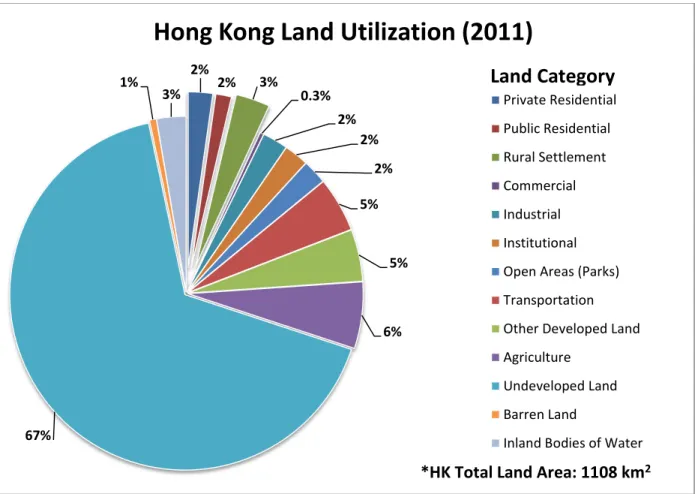
It is apparent that land for development is being severely limited, despite the copious amount of undeveloped land that currently exists throughout Hong Kong. Chau Kwong-wing, chair professor of real estate and construction at the University of Hong Kong claimed that, “Hong Kong isn’t short of land,” but the problem is that, “[Hong Kong’s] land-use design has failed to catch up with the changes in society” (Hui, 2011). The reason for the absence of development of available space is rooted in the government’s complete monopoly of the available land. Hong Kong’s government has the power to auction off land parcels, yet only does so when they consider it necessary. C.K. Lau, a real estate broker at Jones Lang LaSalle, stated that since 2002, officials have sustained “extremely tight land supplies” (“Mid-Levels They Ain’t”, 2011). This lack of land supply, of course, results in fewer homes being built. Moreover, during the 1990’s, an average of 23,000 new homes were constructed each year, compared to 11,000 over the past decade (“Mid-Levels They Ain’t”, 2011). Figure 11 is a chart created from Planning Department (2012) data representing the distribution of land by type.
42
FIGURE 11: LAND UTILIZATION IN HONG KONG.
Alice Poon, a former executive of a Hong Kong real estate development company and
author of “Land and the Ruling Class in Hong Kong,” attributed Hong Kong’s under-utilization of
land resources to the government’s “over-reliance on land-sale revenue for its fiscal health” (Hui, 2011). Furthermore, Francis Lui, a professor of economics at the Hong Kong University of Science and Technology, claimed that, “The lack of government resources for identifying and developing residential sites is the ultimate root of the problem” (Hui, 2011). Regarding the
housing issue, Chief Executive Donald Tsang told lawmakers“I have always believed we must
first tackle market demand and land supply” (Hui, 2011).
From the information we have gathered, it is quite clear that government policy
regarding land development has been inadequate as of late. Our research, including the general
2% 2% 3% 0.3% 2% 2% 2% 5% 5% 6% 67% 1% 3%
Hong Kong Land Utilization (2011)
Private Residential Public Residential Rural Settlement Commercial Industrial Institutional Open Areas (Parks) Transportation Other Developed Land Agriculture
Undeveloped Land Barren Land
Inland Bodies of Water *HK Total Land Area: 1108 km2
43
consensus we have discovered among experts, has led us to believe that Hong Kong’s government has, for some time, whether purposely or with neglect, severely limited the amount of land allowed to be sold. This constricted supply of land for auction clearly inhibits new residential development, which is highly detrimental to the housing market. A low supply of real estate, as in any market with a low supply and significant demand, facilitates high prices.
4.1.3 Public Housing Supply
After the large influx of mainland Chinese immigrants to Hong Kong occurred in the 1950’s, the region was prompted to create one of the world’s largest and most comprehensive public housing systems in the world (Hui, 2011). The overwhelming majority of public housing falls under the category of Public Rental Housing (Hong Kong Housing Authority, 2012). These public housing units generally accommodate low-income families with rent subsidization, allowing them to pay a rent significantly less than market value (Lok-Sang, 2011a).
To qualify for PRH, applicants must meet an inflexible set of household income
requirements (Refer to 2.1.2). This inflexibility can be very problematic for many of Hong Kong’s poor. For example, if a family eligible for public housing were to have an increase in income, due to a salary raise for example, placing them as little as one dollar above the threshold, they become ineligible for public housing. This obstinacy is very problematic, as people will often refuse to accept a raise, knowing that it will cause ineligibility for public housing (Lok-Sang, 2011b).
It is evident that the demand for public housing in Hong Kong significantly outweighs its supply. According to the Hong Kong Housing Authority (2012), there are 189,500 eligible families currently on the waiting list for PRH. These families wait an average of nearly three
44
years for accommodation (Information Services Department, 2012). Figure 12 below is a graph depicting the yearly production of Public Rental Housing since 2008, including projected construction through 2017, compared with the overall Public Rental Housing waiting list size (2012).
FIGURE 12: PUBLIC RENTAL HOSING PRODUCTION VS WAITING LIST SIZE.
After comparing the size of the waiting list to the amount of new units created, it is apparent that the PRH supply is heavily outweighed by its demand. In order to accommodate every family currently on the waiting list, the PRH supply would need to increase by 26%, assuming the list does not grow in size. From the Housing Authority data, our team calculated the average production of new PRH flats projected over the next five years to be 15,120 units per year. Even if it is assumed that the waiting list holds steady at 189,500 families, it will take
111600 125300 145000 165300 189500 13100 14100 12700 20400 15300 13726 19050 15389 13672 11186 0 20000 40000 60000 80000 100000 120000 140000 160000 180000 200000 0 5000 10000 15000 20000 25000 30000 35000 40000 2008 2009 2010 2011 2012 2013 2014 2015 2016 2017
Ho
u
seholds
o
n
PRH
W
ai
ting
Lis
t
Un
its
Pr
od
u
ce
d
Year
PRH Production VS Waiting List Size
PRH Waiting List Size Forecasted PRH Production Previous PRH Production
45
12.5 years to provide PRH for all of them. Although public housing is generally a very realistic option for low-income families, in Hong Kong, public housing is unavailable to a large portion of the city’s poorest people. Many people who are unable to afford most private housing and in desperate need of subsidized housing are not able to receive it, and therefore are forced to seek out alternative forms of affordable private housing, particularly subdivided units.
4.1.4 Cost of Private Housing
A severely limited supply of land combined with a strong demand for construction has inevitably led to astronomical property prices in Hong Kong. Currently in Hong Kong, the cost of private residential property is at an all-time high. Refer to section 2.1.2 for information on overall trends in housing prices of Hong Kong.
Especially for poor families, even the smallest, lowest quality illegally subdivided apartments are nearly impossible to afford because of these inflated prices. The average price of a private home has risen 76% since 2008 (Hui, 2011). Subdivided homes in residential buildings that measure 10 square meters in area are rented for an average of HK$5000 per month (Kang-Chung, 2012). Smaller versions of this type of flat, measuring 8 square meters in floor space, cost HK$3000 per month (Kang-Chung, 2012). “Cubicle homes” in converted industrial buildings, on average, cost HK$1,400 per month with a HK$300 deposit (Ho, 2012). Furthermore, despite clear inflation of prices in the private housing market, Hong Kong’s government has neglected to put forth any type of rental control on properties containing subdivided flats (Florcuz, 2012).
When comparing the cost of even the cheapest, lowest-quality, and in some cases illegal private housing with typical salary figures of Hong Kong’s poor, it is not difficult to understand
46
the disparity that exists. Refer to section 2.1.1 for graphical representation regarding Hong Kong’s income distribution. One quarter of households have a combined monthly income lower than HK$10,000 and nearly 8% of households have a combined monthly income less than HK$4,000 (Information Services Department, 2012). Despite the existence of Comprehensive Social Security Assistance, a widespread government welfare program, only 10% of households eligible for such assistance actually take advantage of the program (Lee, 2012b). With such low incomes, Hong Kong’s poor have a truly difficult time affording even the cheapest private housing that exists.
From this information, we see that the prices of even the smallest flats in Hong Kong are extremely high. After comparing the prices of low-quality real estate with the average incomes of Hong Kong’s lower-class, the disparity is clear: incomes are insufficient to afford any type of standard apartment. The only private homes that are realistically attainable with such an income are sub-divided flats, cubicles, or cages and thus, have led to their uses.
4.1.5 Profits of Subdivision for Landlords
Signifi