Pa
ge
49
Research in Business and
Social Science
IJRBSVol7No1, ISSN: 2147-4478
Contents available at www.ssbfnet.com/ojs https://doi.org/10.20525/ijrbs.v7i1.859Performance of Incubator Centres in Kenya: The
Pivotal Role of Entrepreneurial Management
Miriti Jane Kinya
Corresponding Author: Department of Business and Entrepreneurship, Karatina University,
Nairobi, Kenya. +254-722-826-584)
Kenneth Lawrence Wanjau
Prof, Department of Business and Entrepreneurship, Karatina University, Nairobi, Kenya.
Humphrey R. Omondi
Dr. Department of Ecomics, University, Karatina University, Nairobi, Kenya.
Abstract
Globally, countries are strategically positioning themselves for market leadership due to dynamic business environment. Entrepreneurial spirit is seen as the strategy that will deliver this agenda. This spirit, is believed to be behind the innovative business that revolutionizes the business world. In a dynamic and complex environment, the success of any business is pegged on the entrepreneurial operations of a firm. Entrepreneurial-oriented firms have been proven to be ahead of competition because they are always introduced new products and services and in turn improve their financial results. Scholars believe that learning and development can occur amongst people who actively engage in a common enterprise. This makes learning empowering and productive and thus sustains entrepreneurial orientation. This in turn produces communities of entrepreneurial practice. The role of the entrepreneurial manager is to nurture communities of growth-oriented firms where entrepreneurial learning takes place. The purpose of this study is to assess the relationship between entrepreneurial management and performance of incubator centres in Kenya. The study used a correlation design because it focused on a causal-effect relationship. The study population was 41 incubator managers in Kenya. After missing data analysis two respondents were expunged leaving 39 respondents. Secondary data was obtained from published sources such as company reports, manuals and research done by other scholars. Structural Equation Modelling (SEM) approach was used to analyze the measurement model and test the hypothesized relationship in this study. Simple linear regression model was used to measure the strength of the relationship between entrepreneurial management and performance incubator centre in Kenya. The joint effect model results indicated that entrepreneurial management had a significant relationship with performance of incubator centre.
Key words
Entrepreneurial management, entrepreneurial orientation, performance of incubator
centres’, structural equation modelling
Peer-reviewed Academic Journal published by SSBFNET with respect to copyright holders.
Pa
ge
50
Introduction
Business environment is dynamic and complex (Ahmad & Ingle, 2011) posing a challenge to management as they seek a balance between continuous innovation and stability through efficiency (Hortovanyi, 2012). The scholar opines that entrepreneurial managers who are opportunity driven irrespective of resources availability and high propensity of change and act with ambition, beyond the resources under their control in exploiting opportunities leading to the critical question, how do entrepreneurial managers create and sustain successful firms? These entrepreneurial firms have been proven to be ahead of competition because they are always introducing new products and services and in turn improve their financial results (Zhou and Wit, 2009). Kimuli (2011) argues that, in such environments that are highly turbulent, Strategic entrepreneurship is important calling for management to integrate strategic function with entrepreneurial actions. In turn, organizations achieve their main goal of continuously creating competitive advantage that maximizes wealth creation.
In light of the above, entrepreneurial managers embrace business incubation as a strategy to transform a business idea into an efficient economic organization that hatches enterprises (Bruneel, Ratinho, Claryssea and Groenc, 2012). Best practice demands business incubators to be managed as businesses, with a mission, goals, objectives, strategies, payroll, staff, cash flow, and other business characteristics to help create and nurture new businesses (Lewis, Anderson and Molnar, 2011). Hróbjartsson (2014) spelt out requirements of incubation management to achieve success. They need experience with certain skills necessary for effective operation of an incubator, facilitate clients networking among themselves and other important players in their industry, and train clients in readiness for unsupported operations. Wiggins & Gibson (2003) argue that, another important characteristic of staff is they should have entrepreneurial mindset. The entrepreneurial staff must have the “can-do” attitude, ability to solve problems, focus on results, and work hard. Theodorakopoulos, Kakabadse, and McGowan (2014) posit that there is a significant gap that exists on how management can support entrepreneurial development among incubatees and recommend that incubation management should nurture entrepreneurial skills among the incubatees that can assure communities of growth-oriented firms. It is evident that management skills and experience is an important aspect of incubation program success. The quality of management and staff is crucial in the performance of incubators.
Scott (2000) as cited in (Kimuli, 2011) argues that, all firms incubators included, face an increasingly dynamic and complex environment that is characterized by industry globalization, mergers, shorter product life cycles, technology, and fast-changing competitive approaches that impact on overall performance. To stay relevant in such an environment, firms compete on the basis of their resources and capabilities for sustainable competitive advantage (Peteraf and Bergen, 2003). Foss and Knudsen (2003) advocate for an inward-looking approach to analyze the strategic issues that give rise to conditions for sustained competitive advantage and diversification.
To achieve this performance differential, Barney (1991) opines that a firm’s resources must be valuable, rare, and imperfectly imitable and unsubstitutable so as to be a source of sustained competitive advantage. Incubators are mechanisms of awarding stock of tangible and intangible resources to incubatee firms resulting in access to new knowledge, expertise and networks that finally lead to superior differential performance based on the resources availed in the incubator.
Peer-reviewed Academic Journal published by SSBFNET with respect to copyright holders.
Pa
ge
51
Literature Review
As discussed in the introduction, this paper attempts to study the performance of incubator centres in Kenya by analysing the pivotal role of entrepreneurial management. To summarize this management practice four out of six dimensions, entrepreneurial culture, reward philosophy, control of resources and strategic oriention studied by Gurbuz and Aykol (2009) were adopted. The study also included non-financial indicators of performance of incubator centres in Kenya.
Entrepreneurial Management dimensions
Some organizations are not controlled by the amount of resources when it comes to opportunity generation and exploitation (Brown, Davidsson and Wiklund, 2001). The scholars purport that such organizations are characterized by an entrepreneurial culture of creativity and innovation that motivates employees to be on the lookout for new ideas, more than the resources an organization controls. This scenario, calls for new ways of exploiting the opportunities and in the end, these organizations achieve superior performance unlike other firms that dependent on resources contolled by the organization (Stevenson & Gumpet, 1985). Research revealed that 85 percent of incubator ecosystems have not embraced the culture of tolerating risks or failure (Khalil & Olafsen, 2009). This high rate explains why learning will not take place in the incubator facility, hence negating the purpose of their existence, to become communities of practice (Theodorakopoulos, et al., 2014).
Naturally, people want to be appreciated for good work done. Similarly, in work places, employees who add value demand recognition for value addition (Gurbuz and Aykol, 2009). The scholars argue that management must communicate to all employees what is expected of them, this ensures they are all working towards a common goal. Understanding firm’s sustained competitive advantage is the concern of management (Ferreira & Azevedo, 2008). The researchers insist that firms need to identify resources that enhance efficiency and effectiveness. This identification, aids in making decisions on whether to rent or own resources to exploit opportunities (Gurbuz and Aykol, 2009). Strategic orientation is an organization’s orientation in creating strategies. Firms create strategies based on opportunities or resources controlled by a firm (Gurbuz and Aykol, 2009). The scholars present two management behaviours in pursuit of opportunities. These are promoter and trustee firms. The promoter firm, is not controlled by the amount of resources controlled by a firm hence exhibiting entrepreneurial behaviour and the trustee firm, use its resources efficiently, exhibiting administrative behaviour. Literature reveals that, small firm managers spend less time on strategic issues of a firm but instead apportion more time to operational and administrative activities, justifying why the growth process of small firms keeps declining or failing (Tell, 2012).
Performance of incubator centres
Performance measure is a value preposition process to objects and events (Khan, Baharun, Rahim and Zakuan, 2011). Traditionally firms use financial dimensions to measure performance (Kennerley & Neely, 2003) a move the scholars challenge and term it as historical because it ignores competitors and customers who are equally important in the evaluation of performance of a firm. They recommend a multidimensional approach. Evaluatng business incubators present definitional challenge hence not possible to propose a one fit suit (Ayatse, Kwahar and Iyortsuun, 2017). Literature revealed that multidimensional factors can be used to measure performance of business incubators (Phan, Siegel and Wright,2005) The scholars identified factors such as profitability, revenues, finance, Venture capital funds, sales growth, job creation, registered patents, graduation from incubator program, firm survival, ability to share knowledge and technology among others. Lewis,Harper-Anderson, and Molnar (2011) support that the main goal of an incubator is release of financially stable and free standing firms after incubation. This signifies survivability of incubated firms. This study focused on start ups hence survivability of firms is important. Hence the study focused on increase in number to measure performance of incubators, targeting three areas, that is, increase in number of incubatees, failed and exited incubator and number still in operation after graduation
Peer-reviewed Academic Journal published by SSBFNET with respect to copyright holders.
Pa
ge
52
Hypotheses
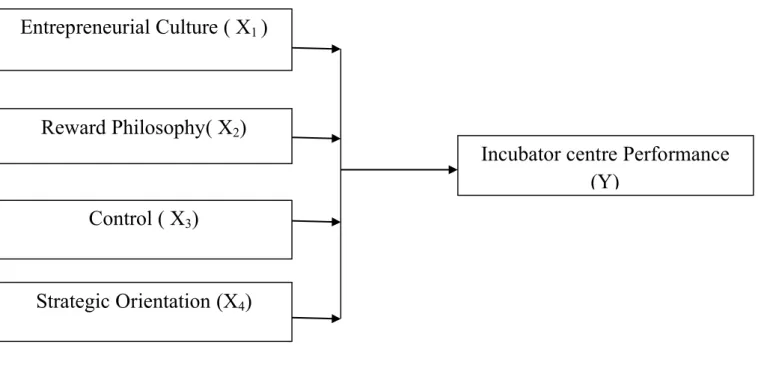
Entrepreneurial management dimensions have been discussed and the non-financial indicates of performance. There are interactions that yield some effects that impact performance of incubator centres. The conceptual model is shown in figure 1.
H01Entrepreneurial culture has no significant influence on Incubator centre performance.
H02Reward philosophy has no significant influence on Incubator centre performance
H03Control has no significant influence on Incubator centre performance.
H04 Strategic orientation has no significant influence on Incubator centre performance.
Figure 1: Conceptual Model.
Research and Methodology
Questionnaire Development
The questionnaire developed focused around entrepreneurial management main dimensions: entrepreneurial culture, reward philosophy, management control, strategic orientation as shown in figure 1. Questions were mainly structured to elicit closed binary/multiple choice responses in the expectation that this would facilitate a good response rate. Likert scale was used to examine how strongly subjects agree or disagree with a statement (Cooper & Schindler, 2011). The scale was best suited because the value sought was a belief or opinion, and the effect or value sought cannot be given with definite precision, or it was considered sensitive. Dichotomous scale and open-ended questions were also used to allow respondents to provide extra information not included in the Likert scale. The study used a multi-dimensional scale to measure performance of incubator centres. Lechner and Vidar (2014) adopted survival, business strength and weaknesses to measure their dependent variable. This study modified these dimensions to number of graduating incubatees, number exiting the incubator and number operating after graduation. Performance was measured as an increase in number in the above-mentioned dimensions between 2012 and 2016. Phan., Siegel and Wright (2005) opine that incubator performance is multi-dimensional with no existing literature on the acceptable measure in incubation, resulting in numerous performance measures by researchers. This is attributed to the definitional challenge of the concept of incubation hence, coming up with a single acceptable measure of performance is a challenge (Ayatse, Kwahar and Iyortsuun, 2017).
Entrepreneurial Culture ( X
1)
Reward Philosophy( X
2)
Control ( X
3)
Strategic Orientation (X
4)
Incubator centre Performance
(Y)
Peer-reviewed Academic Journal published by SSBFNET with respect to copyright holders.
Pa
ge
53
Sampling and Data Collection
A total of 51 questionnaires were distribued to 51 incubators. There were 41 (80.39%) questionnaires returned. A missing data analysis was carried out to check and adjust the data for completeness. Mugenda (2008) and Tabachnick &Fidell (2007) opine that, one of the most common problems when analysing data is missing data. Missing data occurs when respondents leave certain questions unanswered. There are suggestions that less 10% of missing data does not display a large amount of missing data (Cohen & Cohen, West, Aiken, 2003). Only 5% of the questionnaires returned exhibited more than 10% of missing data. The 2 (5%) questionnaires that had up to 11% missing data were expunged resulting to 39 respondents being retained that constituted 95% of the total questionnaires returned. The current study adopted a census approach considering the small population of 51 incubator managers that target SME start-ups. Israel (2012) purport that, a census is cost effective and thus attractive for small populations such as 200 or less. No sampling was adopted in this study.
Primary data was obtained from incubator managers as key informants. Secondary data sources included books, documented research, journal articles, and electronically stored information (internet). Primary data was obtained by use of semi-structured self administered questionnaire. The questionnaires yielded both qualitative and quantitative data in the following sections: Section one- background information; Section two- entrepreneurial management; Section three- performance of incubator centres.
The researcher dropped and picked the questionnaires. Most incubator managers were busy serving clients, hence had no time within office hours to fill the questionnaires. The researcher established a rapport with the respondents to motivate them to fill the questionnaires and mitigate the non response cases by calling the respondents prior to the exercise and introduced herself and the purpose of the exercise.
Analysis
A structural equation model (SEM) was fitted and the model estimations used to test hypotheses and draw conclusions. The IBM AMOS package (Analysis of Moment Structure) version 23 was used to carry out SEM which involved two stages; the measurement model and the structural model. Cronbach alpha statistic was used to test reliability. Construct validity was tested considering both convergent and discriminant validity of the collected data. Average variances extracted (AVEs) for the latent variables were computed to test for convergent validity while discriminant validity was explored by comparing the AVEs against the square multiple correlations. The structural equation modeling technique used was based on maximum likelihood estimation (MLE) thus the classical assumptions of MLE were tested to ensure that the model fitted met the assumptions. Goodness of fit tests were also carried out for the fitted model to gauge how well the model fits the data. SEM is used for estimation based on various sampling conditions. Generalizing sample size requirements guidelines is difficult (MacCallum, Widaman, Zhang, & Hong, 1999). There are rules of thumb that have been proposed which also include sample sizes below 100. Considering the proposal by Nunnally (1967) of 10 cases per latent variable, the size of 51 respondents considered in the study was found to be adequately above the requirement for 5 latent variables (10 x 5 = 50).
Findings
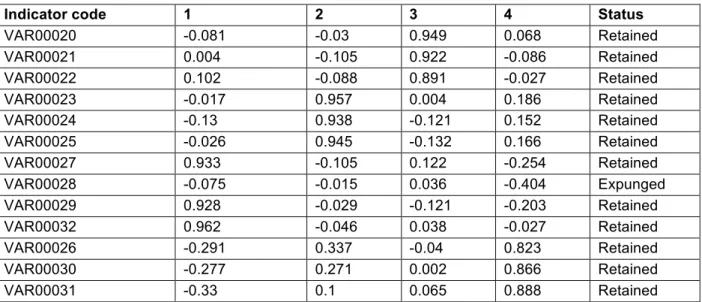
Exploratory factor analysis revealed that all the indicators of the latent variables at least had adequate factor loadings and were retained except for one indicator that was expunged as it loaded none of the variables above 0.4 as shown in table 1. The KMO statistic for entrepreneurial management was found to be 0.87 which tends to one and Bartlett’s chi-square statistics found to have a p-value less than 0.05. This implies compactness and that the factor analysis results were reliable. The average variances extracted for each latent variable were computed which were all found to be above 0.5 implying convergent validity. All the square multiple correlations for each variable were found to be less than the respective average variance extracted (AVE) implying discriminant validity. The results therefore confirmed construct validity and reliability of the measurements to the latent variables. Table 2 shows the summary of measurement reliability and validity statistics.
Peer-reviewed Academic Journal published by SSBFNET with respect to copyright holders.
Pa
ge
54
Table 1: EFA factor loadings
Indicator code 1 2 3 4 Status
VAR00020 -0.081 -0.03 0.949 0.068 Retained VAR00021 0.004 -0.105 0.922 -0.086 Retained VAR00022 0.102 -0.088 0.891 -0.027 Retained VAR00023 -0.017 0.957 0.004 0.186 Retained VAR00024 -0.13 0.938 -0.121 0.152 Retained VAR00025 -0.026 0.945 -0.132 0.166 Retained VAR00027 0.933 -0.105 0.122 -0.254 Retained VAR00028 -0.075 -0.015 0.036 -0.404 Expunged VAR00029 0.928 -0.029 -0.121 -0.203 Retained VAR00032 0.962 -0.046 0.038 -0.027 Retained VAR00026 -0.291 0.337 -0.04 0.823 Retained VAR00030 -0.277 0.271 0.002 0.866 Retained VAR00031 -0.33 0.1 0.065 0.888 Retained
Source: Research Data
Table 2: Reliability and validity
Latent variable Indicator Loading Squared
multiple correlations AVE Cronbach Entrepreneurial management Entrepreneurial culture VAR00020 0.946 0.907 0.924 0.869 VAR00021 0.925 0.767 VAR00022 0.901 0.682 Reward Philosophy VAR00023 0.971 0.92 0.968 0.963 VAR00024 0.964 0.884 VAR00025 0.968 0.907 Control VAR00027 0.973 0.891 0.960 0.938 VAR00029 0.944 0.772 VAR00032 0.963 0.864 Strategic orientation VAR00026 0.957 0.885 0.954 0.945 VAR00030 0.962 0.906 VAR00031 0.944 0.806
Incubator centre performance VAR00044 0.967 0.832 0.923 0.913
VAR00043 0.860 0.523
VAR00042 0.942 0.736
Source: Research Data
The causal relationships of the conceptual model were explored by fitting the confirmatory factor analysis structural model. The Model fitted was tested for goodness of fit using both absolute and incremental fitness indices. The absolute fit indices used were GFI and RMSEA which were found to be 0.914 and 0.013 respectively indicating good fit of model (Byrne, 2001) and (Arbuckle &Wothke, 1999).Other fit measures showed that model adequately fit the observed data as shown in table 3. The likelihood chi-square (χ 2 = 134.632; DF = 80; p = 0.000) showed significant fitness since p <.05.
Peer-reviewed Academic Journal published by SSBFNET with respect to copyright holders.
Pa
ge
55
Model Chi-square CFI NFI GFI AGFI RMSEA
χ2 df P-value
Statistic 134.632 80 0.000 0.914 0.818 .942 .813 0.013 Cut-off P-value <0.05 ≥ 0.90 ≥ 0.8 ≥ 0.90 ≥ 0.8 ≤ 0.08
Source: Research Data
It was noted that three of the four sub dimensions of entrepreneurial management significantly influence incubator centre performance as shown in table 3. The estimates of entrepreneurial culture (β1=0.305, C.R
=2.391) show that, the entrepreneurial culture has a significant influence on incubator performance as shown by the critical ration (C.R) which is more than 1.96. This implies that the incubator centres have embraced a culture of creativity and innovation to ensure the resources a centre controls will not determine the opportunities exploited. They will look for alternative resources to exploit opportunities and hence achieve superior performance. Reward philosophy and control with estimates (β1=-1.63, C.R =-2.037) and (β3= -0.2,
C.R = -2.01) respectively, also show /CR/ statistics that are greater than 1.96 implying significant influence on incubator performance. Employees working in centres where management compensates staff for the innovations introduced in the incubation centres stand to benefit myriad of innovations. These findings contradict the findings of Gurbuz and Aykol, (2009) study, which investigated the relationship between entrepreneurial orientation and entrepreneurial management and their impact on growth of small firms in Turkey. This study adopted four of the six entrepreneurial management dimensions and out of four, only one was insignificant, but in the turkey study all the four-dimension adopted in this study yielded insignificant results. This might be attributed to contextual, methodological and conceptual difference of the two studies. The path diagram of the structural equation model is shown in figure 2.
Table 4: Model Coefficient Estimates
Estimate S.E. C.R. P ICP <--- EC 0.305 0.128 2.391 0.017 ICP <--- C -0.2 0.099 -2.01 0.044 ICP <--- RP -1.63 0.800 -2.037 0.014 ICP <--- SO 0.05 0.118 0.424 0.672 VAR00032 <--- C 0.585 0.043 13.595 *** VAR00029 <--- C 0.669 0.064 10.519 *** VAR00027 <--- C 1 VAR00025 <--- RP 9 VAR00024 <--- RP 10.311 0.841 12.254 *** VAR00023 <--- RP 9.458 0.707 13.372 *** VAR00020 <--- EC 1 VAR00042 <--- ICP 1 VAR00043 <--- ICP 0.676 0.112 6.023 *** VAR00044 <--- ICP 0.832 0.072 11.531 *** VAR00022 <--- EC 1.11 0.153 7.242 *** VAR00021 <--- EC 0.556 0.068 8.13 *** VAR00026 <--- SO 0.876 0.091 9.671 *** VAR00030 <--- SO 0.846 0.085 9.937 *** VAR00031 <--- SO 1
Peer-reviewed Academic Journal published by SSBFNET with respect to copyright holders.
Pa
ge
56
Figure2:Structural Equation Model Path Diagram
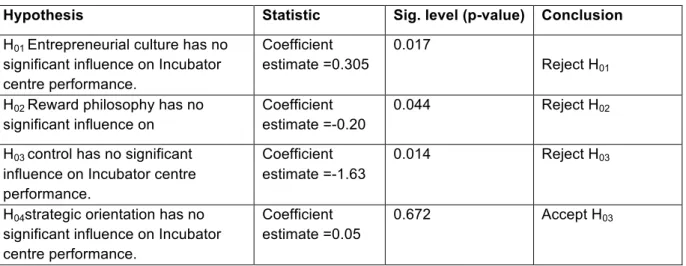
The results support the hypotheses that 3 sub-dimensions of entrepreneurial management significantly influence incubator performance. The results however do not support the influence of the sub dimensions strategic orientation. Research shows that there is low tolerance for risk or failure in business incubation (Khalil& Olafsen, 2009). hence discouraging their incubatees to embrace a culture of accepting failure as an opportunity to learn. In firms where risk tolerance is high, incubatees are encouraged to try out new things, and in-turn discover new opportunities and resources to exploit the identified opportunities. These firms achieve superior performance because the resources controlled are not what determine the opportunities to be exploited. The other implication would be, due to inadequate resources in our Kenyan incubators, these facilities want to efficiently utilize resources and hence exhibit trustee behaviour and not the promoter behaviour as explained by Gurbuz and Aykol, (2009). The hypotheses results are presented in table 5.
Peer-reviewed Academic Journal published by SSBFNET with respect to copyright holders.
Pa
ge
57
Table 5: Hypothesis Testing Results
Hypothesis Statistic Sig. level (p-value) Conclusion
H01 Entrepreneurial culture has no
significant influence on Incubator centre performance.
Coefficient estimate =0.305
0.017
Reject H01
H02 Reward philosophy has no
significant influence on
Coefficient estimate =-0.20
0.044 Reject H02
H03 control has no significant
influence on Incubator centre performance.
Coefficient estimate =-1.63
0.014 Reject H03
H04strategic orientation has no
significant influence on Incubator centre performance.
Coefficient estimate =0.05
0.672 Accept H03
In summary, entrepreneurial management with a special emphasis on entrepreneurial culture, reward philosophy and control of resources dimension affect the performance of incubator centres in Kenya. Therefore entrepreneurial management plays a pivotal role in impacting the performance of incubator centres in Kenya. Incubator centres must communicate to all employees what the centres expect of them and create an enabling environment for the employees to exploit their potential and in the end, the centres achieve superior performance. They must also formulate compensation plans for innovative employees in the firm to encourage them to be more innovative. Firms must embrace the promoter behavior, where firms seek opportunities irrespective of the resources under their control, this force employees to be innovative and in turn achieve superior performance. These incubator centres, increase the survival rate of firms in the incubator programs and after graduation (Khalil& Olafsen, 2009). The high failure rate of SMEs is reduced and increase the productivity of SMEs that, are believed to the engine of any economy (Dey, 2012).
Conclusion
The study contributes in various ways, entrepreneurial management empirical studies are rare especially in Kenya so the findings of this study will contribute to knowledge in the field of entrepreneurship. Entrepreneurial orientation and performance has been widely studied, but investigating this relationship in the context of business incubation is also rare. This will help incubator management embrace the entrepreneurial management perspective and do away with the traditional management styles, to be consistent with the preposition of Lewis, et al. (2011) which stipulates that incubators exist to release financially stable firms after the incubation program. This realization will assist in the creation of over 200,000 jobs earmarked in President Uhuru Kenyatta’s big four agenda under the manufacturing sector in Kenya. Entrepreneurial staff be recruited in incubator Centres and other institutions dealing with incubation activities. This approach will help the staff understand the importance of entrepreneurial culture, introduce reward philosophy, control management and persue strategic orientation. This will be enhanced if the centres training ahead to keep abreast with the changes in the business environment, and in turn keep the centre thriving
The study recommends that to minimize failure of incubator centres, management must involve all staff in decision making and allow they create ideas that work in the organization. This helps them buy ownership of the organization through the innovations they have contributed.
The role of the executives in reputation building cannot be underestimated in this dynamic and complex business environment. Under visionary and committed entrepreneurial managers they will be instrumental in making firms be respected internationally, regionally and locally.
Peer-reviewed Academic Journal published by SSBFNET with respect to copyright holders.
Pa
ge
58
Kenyan government needs to structure the incubation industry to ensure data is collected periodically, to facilitate scholars who would wish to conduct longitudinal studies in the country in the incubation industry that is currently lacking.
Acknowledgement
We wish also to thank the management of the incubator centres who made this study possible by finding time despite the tight schedules to respond to our questionnaireand the management and Staff of Centre for training and Integrated Research in ASAL Development (CETRAD), Nanyuki, for the opportunity to share on the topic of study in an endeavour to improve the research process.
References
Ahmad, A.J. and Ingle, S. (2011). Relationships Matter: Case Study of a University Campus Incubator.International Journal of Entrepreneurship Behaviour and Research, 17 (6),626-644. Ayatse, F.A.,Kwahar, N.and Iyortsuun, A.S. (2017). Business Incubation process and firm performance: an
empirical review.7: 2. Doi: 10.1186/s40497-016-0059-6
Barney, J. (1991). “Firm Resources and Sustained Competitive Advantage”, Journal of Management, 17(1), 99-120.
Brown, T.E.,Davidsson, P. and Wiklund, J. (2001). ‘‘An operationalization of stevenson’s conceptualization of entrepreneurship as opportunity based behavior’’, Strategic Management Journal, 22.( 10), 953-68.
Bruneel, J., Ratinho, T. and claryssea, B. G., (2012). The Evolution of Business Incubator Groups Specialization: Comparing Demand and Supply of Business Incubation Services across Different Incubator Generations. Technovation, 32 (2), 110-1.
Byrne, B. M. (2001). Structural Equation Modeling with AMOS, Basic Concepts, Applications, and Programming. Hillsdale, New Jersey: Lawrence Erlbaum Associates.
Cohen, J.,Cohen, P., West, S. G. & Aiken, L. S. (2003). Applied Multiple Regression/ Correlation Analysis for the Behavioral Sciences. Journal of the American Medical Information Association, 14 (2), 239-243.
Cooper,D.R.and Schindler, P.S. (2011). Business Research Methods.(11th ed.). New York: McGraw-Hill. Dey, P. (2012). Incubation of Micro and Small Enterprises- an approach to Local Economic Development.
International Journal of Science & Engineering Research, 3 (5).
Ferreira, J., Azevedo, S. C. (2008). “Entrepreneurial Orientation and growth of firms: Key lessons for managers and business professionals”, Problems and perspectives in management, 6(1), 82-88. Foss, N.and Knudsen, T. (2003). “The Resource-Based Tangle: Towards a Sustainable Explanation of
Competitive Advantage”, Managerial and Decision Economics, 24(4), 291-307.
Gürbüz, G. and Aykol, S. (2009). Entrepreneurial Management, Entrepreneurial Orientation and Turkish Small Firm Growth. Management Research News, 32(4), 321-336.
Hortovanyi, L.(2012). Entrepreneural Management. AULA Kiado Kft, Hungary.
Hrobjartsson, K.A. (2014). Measuring the effectiveness of NMI’s incubators.A study of public business incubators in Iceland.
Israel, G. D. (2012). Sampling: Determining Sample Size. (U. o. Extension, Ed.)
Khalil, M.A. and Olafsen, E. (2009). Enabling Innovative Entrepreneurship through Business Incubation. In Lopez- Claros, (A). (Ed.). The Innovation for Development Report 2009-2010. Strengenthening Innovation for the prosperity of Nations.
Peer-reviewed Academic Journal published by SSBFNET with respect to copyright holders.
Pa
ge
59
Kennerley, M. and Neely, A. (2003). Measuring performance in a changing business environment. International Journal of Operations & Production Management, 23(2), 213–229. doi:10.1108/01443570310458465.CrossRefGoogle Scholar
Khan, M. N., Baharun, R., Rahim, K. A. and Zakuan, N. (2011). An empirical evidence of performance measurement of audit firms in Malaysia. International Business Research, 4(4), 191–198. doi:10.5539/ibr.v4n4p191.CrossRefGoogle Scholar
Kimuli, S.N.L. (2011). Strategic Entrepreneurship and Performance of Selected Private Schools in Wakisio District. (Masters thesis, Makerere University.)
Lechner, C. and Vidar, S.(2014). Entrepreneural Orientation, firm strategy and small firm performance, 32,36. Doi: 101177/0266242612455034
Lewis, D.A., Harper-Anderson, K. and Molnar, L. A.(2011). Incubating Success Incubation: Best Practices that Lead to Successful New Ventures. Institute for Research on Labour, Employment, and the Economy, University of Michigan, Ann Arbor, MI.
MacCallum, R.C., Widaman, K.F, Zhang, S. and Hong, S. (1999).Sample size in factor analysis. Psychological Methods, 4,84–99
Mugenda, A. (2008). Social Science Research: Conception, Methodology and Analysis. Nairobi: Kenya Applied Research and Training Services.
Nunnally JC. (1967). Psychometric Theory. New York, NY: McGraw-Hill
Peteraf, M. and Bergen, M.(2003). Scanning dynamic competitive landscapes: a market-based and resource-based framework, Strategic Management Journal, (24), 1027-1041..
Phan, P., Siegel, D.S. and Wright, M. (2005). Science parks and incubators: Observations, synthesis and future research. Journal of Business Venturing, 20 (2), 165–182. doi:10.1016/j.jbusvent.2003.12.001.CrossRefGoogle Scholar
Stevenson, H. and Gumpert, D. (1985). ‘‘The heart of entrepreneurship’’, Harvard Business Review,March-April, pp. 85-94.
Tabachnick, B. G., & Fidell, L.s. (2007). Using Multivariate Statistics, (2nd ed). New York: HarperCollins. Tell, J. (2012). Managerial strategies in small, fast-growing manufacturing firms. The Journal of Management
Development, 31(7), 700-710.
Theodorakopoulos, N., Kakabadse, N. K. and McGowan, C. (2014). What Matters in Business Incubation? A Literature Review and a Suggestion for Situated Theorizing .Journal of small Business and Enterprise Development, 21(4); 602-622.
Wiggins, J. and Gibsons. J. (2003). Overview of US Incubators and the case of the Austin Technology Incubator. International Journal of Entrepreneurship and Innovation Management, 56-66.