2016
Pay It Forward? Law and the Problem of Restricted-Spending
Pay It Forward? Law and the Problem of Restricted-Spending
Philanthropy
Philanthropy
Brian Galle
Georgetown University Law Center, [email protected]
This paper can be downloaded free of charge from: https://scholarship.law.georgetown.edu/facpub/1847 https://ssrn.com/abstract=2599109
93 Wash. U. L. Rev. 1143 (2015-2016)
This open-access article is brought to you by the Georgetown Law Library. Posted with permission of the author. Follow this and additional works at: https://scholarship.law.georgetown.edu/facpub
Law Review
VOLUME 93 NUMBER 5 2016
PAY IT FORWARD? LAW AND THE PROBLEM
OF RESTRICTED-SPENDING PHILANTHROPY
BRIAN GALLE*
ABSTRACT
American foundations and other philanthropic giving entities hold about $1 trillion in investment assets, and that figure continues to grow every year. Even as urgent contemporary needs go unmet, philanthropic organizations spend only a tiny fraction of their wealth each year, mostly due to restrictive terms in contracts between donors and firms limiting the rate at which donations can be distributed. Law has played a critical role in underwriting and encouraging this buildup of philanthropic wealth. For instance, contributors can typically take a full tax deduction for the value of their contributions today, no matter when the foundation spends their money, and pay no tax on the investment earnings the organization reaps in the meantime.
What, if anything, justifies public support for "restricted spending" charity? This Article offers the first comprehensive assessment of that question and supplies original empirical evidence on several key aspects of it. I argue that restricted spending sacrifices crucial information, leaves superior opportunities on the table, and on average transfers funds to times when they are less useful. While there is a place for large and
long-* Professor of Law, Georgetown University Law Center. I am grateful for helpful comments from Bill Bagley, Tom Brennan, Neil Buchanan, Roger Colinvaux, John Colombo, Vic Fleischer, Dan Halperin, Louis Kaplow, Michael Klausner, Don Langevoort, Ben Leff, Yair Listokin, Ray Madoff, Jim Repetti, Diane Ring, Natalya Shnitser, Josh Teitelbaum, Mark Wolfson, and attendees of presentations at the Forum on Effective Philanthropy, the University of Southern California Sol Price School of Public Policy, the National Tax Association, Georgetown University Law Center, and Boston College Law School.
lived philanthropic organizations in American society, that role does not require public support for restricted spending. As long as foundations can demonstrate their value to new donors, they will continue to thrive. I set out a series of policy recommendations aimed at better reconciling nonprofit law and the principles that justify it.
I support my claims with new evidence drawn from a data set of over 200, 000 firm-year observations of private foundations. For example, Ifind that foundations earn about twice as much money per year as in earlier studies funded by foundation-industry lobbyists and that they are growing three times faster than those earlier studies suggested. This finding implies that the law could require a much higher annual "payout" from foundations. I also find that new laws introduced in about a dozen states since 2006 have significantly slowed foundation spending in the enacting states. Last, I offer simulations of several policy proposals for making foundations more effective at fighting recessions.
TABLE OF CONTENTS
IN TRO D U CTION ... 1145
I. B A CK G RO UN D ... 1149
II. THE TIME VALUE OF CHARITY: A FRAMEWORK FOR ANALYSIS ... 1153
A. Time D iscounting: A Review ... 1154
B. Is Time Moneyfor Foundations? ... 1156
III. THE COSTS OF W AITING ... 1159
A . Opportunity C osts ... 1159
B. Diminishing Marginal Returns: Redistribution and the Growth of the Foundation Sector ... 1160
C. Project Selection, Agency Costs, and Information ... 1162
D . Let Charity D ecide? ... 1166
IV. THE VALUE OF FUTURE SPENDING ... 1168
A. Prior Justifications for Restricted Spending ... 1168
1. Donor Preferencesfor Restricted Spending ... 1169
2. Firm -Specifi c Value ... 1171
3. Real Option Value of Waiting ... 1175
B. New Arguments for Restricted Spending ... 1176
1. C risis Spending ... 1177
2. A Federal A lternative ... 1179
C . A R eview ... 118 1 V. POLICY IMPLICATIONS: PAYOUT RULES AND BEYOND ... 1182
A. Existing Subsidies Are Hard to Repeal ... 1182
C. Section 4942: Federally Required Payouts ... 1185
1. New Data on Real Rates of Return ... 1186
2. New Data on Growth in Overall Foundation Assets ... 1190
3. Summary and Caveats ... 1192
D. Section 4940: Federal Tax on Net Investment Earnings ... 1193
E. Countercyclical Payouts ... 1196
F. Closing Donor-Advised-Fund Loopholes ... 1198
G . State L aw ... 1200
C O N CLU SIO N ... 1202
INTRODUCTION
If the US philanthropic sector were the output of a nation, it would rank as the product of the world's sixteenth-largest economy, just behind Mexico, and ahead of Turkey, Saudi Arabia, and Sweden.1 Philanthropic institutions on this scale are uniquely American.2 Other wealthy nations, such as Great Britain and Germany, have recently begun to develop modest philanthropic sectors, but nothing to rival ours.3 Some of this phenomenon is cultural, an outgrowth of the ideals of the decentralized American state.4 Much of it, though, likely owes its success to legal rules that have encouraged the accumulation of philanthropic wealth, including a set of generous federal and state tax subsidies.5 In a modern era where wealth and power are growing ever more concentrated, what justifies this use of public funds to underwrite private, if charitable, wealth?
The growth of philanthropic wealth depends on law's willingness to embrace what I will call a policy of restricted spending. At many charitable organizations, managers are free to spend most or all of the firm's revenues on current needs, whether they be housing the indigent or curing deadly diseases. Foundations, in contrast, almost uniformly are governed by agreements that prohibit managers from spending more than
1. See GDP Ranking, THE WORLD BANK, http://data.worldbank.org/data-catalog/GDP-ranking-table (last updated Apr. 11, 2016), archived at https://perma.cc78YB-ZSZ4. If we only compared changes in US philanthropic wealth to world GDPs, US philanthropy would rank around sixtieth, behind New Zealand but ahead of Hungary. Id.
2. Helmut K. Anheier & Stefan Toepler, Philanthropic Foundations: An International Perspective, in PRIVATE FUNDS, PUBLIC PURPOSE: PHILANTHROPIC FOUNDATIONS IN INTERNATIONAL PERSPECTIVE 3, 8 (Helmut K. Anheier & Stefan Toepler eds., 1999).
3. Id. at 3-5.
4. DAVID C. HAMMACK & HELMUT K. ANHEIER, A VERSATILE AMERICAN INSTITUTION: THE CHANGING IDEALS AND REALITIES OF PHILANTHROPIC FOUNDATIONS 19-42 (2013).
a small portion of the value of a given donor's gift in any given year.6 By holding spending down below the annual investment earnings and other income of the foundation, the restricted-spending rules permit the organization to grow ever larger.
Law assists the project of restricted spending in a variety of ways. The federal government, and most states, award generous tax incentives for making donations to charity. Those incentives do not depend at all on when the charity spends the donated funds; the government offers the same reward at the time of donation whether the charitable acts actually occur the same year or centuries in the future. Because donors can usually invest their tax savings for a profit over time, this structure provides a powerful incentive to donate first and spend later. In some ways, as I'll detail, the tax rewards for giving are even higher for gifts to organizations that restrict their spending. Further, state organizational law imposes a duty on managers to safeguard the wishes of donors who want to see their money last in "perpetuity"; and, in more than a dozen states, the law actually presumes that managers have failed that duty simply by spending more than seven percent or so of their organization's assets in any year.
The result is that nearly a trillion dollars of philanthropic wealth now sits on the sidelines, held in abeyance not just for tomorrow, but for the indefinite future.8 Taxes paid by current taxpayers have bolstered these funds in considerable measure.9 Yet the benefits, if they ever arrive, will be enjoyed mostly by future generations.
Surprisingly, there has been little serious scholarly attention to law's role in restricted spending and the buildup of the philanthropic sector. A handful of think-tank white papers and public policy journal articles have batted around some basic ideas, such as whether we should care about whether public funds pay for charity now or later.10 The closest to a
6. See LOREN RENZ & DAVID WOLCHECK, FOUND. CTR., PERPETUITY OR LIMITED LIFESPAN: How Do FAMILY FOUNDATIONS DECIDE? 4 (2009), available at http://foundationcenter.org/ gainknowledge/research/pdf/perpetuity2009.pdf.
7. For detail on the points in this paragraph, see infra Part I.
8. See Aggregate Fiscal Data of Foundations in the U.S., 2012, FOUND. CTR., http://data.foundationcenter.org/#/foundations/all/nationwide/total/list/2012 (last visited Apr. 19, 2016), archived at https://perma.cc/AP7R-DHPE.
9. See Michelle H. Yetman & Robert J. Yetman, How Does the Incentive Effect of the Charitable Deduction Vary Across Charities?, 88 ACCT. REV. 1069, 1071 (2012) (reporting that private foundation donors are highly sensitive to tax incentives).
10. Bill Bradley et al., The Nonprofit Sector's $100 Billion Opportunity, HARV. Bus. REV., May 2003, at 3, 3-11; Ren6e A. Irvin, Endowments: Stable Largesse or Distortion of the Polity?, 67 PUB.
ADMIN. REV. 445, 445 (2007); Akash Deep & Peter Frumkin, The Foundation Payout Puzzle 1-31 (Hauser Ctr. for Nonprofit Orgs., Working Paper No. 9, 2001), available at https://www.hks.harvard. edu/content/download/68878/1248322/version/1/file/workingpaper 9.pdf. Some foundation leaders
complete exploration is an eight-page monograph from Stanford Professor Michael Klausner." There has been no systematic examination of the arguments for and against government support for restricted-spending foundations and little effort to link the policy arguments to concrete legal rules. This gap in theorizing has also produced a gap in empirical data: because few people have been formulating the questions, we have not had much research to tell us the answers.
This Article attempts to begin all these tasks. I critically examine prior justifications for restricted spending and offer some new possibilities for consideration. I show that in some cases theory doesn't take us all the way to a conclusion and that we need more facts about how donors and foundation managers actually behave. I attempt to fill in some of those facts with original empirical data. And I then connect these tentative findings with some basic principles for reforming the current underpinnings of the law of restricted spending.
To preview the analysis in a bit more detail, I first examine the social costs of restricted-spending rules. As others have acknowledged, setting aside funds for the future reduces the efficacy of the resulting spending by worsening the fit between society's needs and the donor's goals, and heightens the cost of separating the uses of the money from the owner's control.12 I add that waiting imposes other kinds of costs on governments,
beneficiaries, and the foundations themselves. Waiting sacrifices the opportunity to learn from and build on charitable successes and failures, and to invest in social programs with long-term rewards. It also shifts money from a time when resources are relatively scarce (now) to a period
have weighed in, usually on the side of perpetual foundations. E.g., PAUL BREST & HAL HARVEY, MONEY WELL SPENT: A STRATEGIC PLAN FOR SMART PHILANTHROPY 259-66 (2008); JOEL L. FLEISHMAN, THE FOUNDATION: A GREAT AMERICAN SECRET 236-48 (2007); Carl J. Schramm, Law Outside the Market: The Social Utility of the Private Foundation, 30 HARV. J.L. & PUB. POL'Y 355,
398-407 (2006). Evelyn Brody also has provided a fine overview of the history of the endowment
debate. Evelyn Brody, Charitable Endowments and the Democratization of Dynasty, 39 ARIZ. L. REV.
873,899-944 (1997).
There have been notable articles analyzing the related question of wealth accumulation by operating charities, such as universities and hospitals. See, e.g., Daniel Halperin, Tax Policy and Endowments: Is Excessive Accumulation Subsidized?, 67 EXEMPT ORG. TAX REV. 17 (2011); Henry Hansmann, Why Do Universities Have Endowments?, 19 J. LEGAL STUD. 3, 14-39 (1990); Sarah E. Waldeck, The Coming Showdown over University Endowments: Enlisting the Donors, 77 FORDHAM L. REV. 1795 (2009). As we will see, that question has some overlap with foundation spending, but also many points of departure. See Waldeck, supra, at 1814 ("[Private-foundation] rule[s] ... reflect[]
policy concerns that are largely absent in the university context.").
11. Michael Klausner, When Time Isn't Money: Foundation Payouts and the Time Value of
Money, 1 STAN. SOC. INNOVATION REV. 51, 51-59 (2003).
12. See Jesse Dukeminier & James E. Krier, The Rise of the Perpetual Trust, 50 UCLA L. REV. 1303, 1327-39 (2003).
(the future) when, as I demonstrate with some new evidence, foundations will be flush with cash.
On the other side, I argue that while there are strong arguments for encouraging savings by charities, these arguments mostly don't support current restricted-spending rules. For example, it is true that foundations can develop expertise in their chosen policy areas and can serve as laboratories and incubators for new ideas.13 But preserving these incubators doesn't demand restricted spending, as long as managers are willing to seek out new funding-as indeed most commentators believe they should. I also suggest that charity can usefully save to prepare for times of future great need-but this implies that the organization should also be free to spend profligately when the need arrives.
These analyses supply some basic principles for reforming current law. While I leave development of exact details to await later work and better data, I argue that at a minimum federal law should require many foundations to pay out a considerably larger share of their assets each year than it now does. Congress also should close the loopholes presented by lightly regulated alternatives to the foundation form, especially those offered by the so-called donor-advised funds. At the same time, good policy might additionally include rewards or other positive incentives, especially incentives for foundations to spend or loan out money during recessions. State tax law could mirror these changes, and states should likely abandon the current movement to impose a legal cap on annual foundation spending.
At each stage of the analysis I supplement my argument with original empirical data. Drawing on a database spanning twenty-five years and thousands of foundations, I am able to offer at least preliminary evidence on several key questions underlying the restricted-spending debate. I find, for example, that foundation investments grow at about double the rate claimed in earlier work funded by the foundation industry. I also find that, including new contributions, foundation wealth is growing at more than triple the rate advocates of restricted spending have suggested. The data suggest that state laws setting a defeasible cap on spending in fact have diminished spending. And I am able to run simulations to compare several different policies for curing the problem of pro-cyclical foundation spending. While these findings are hardly the last word on foundation spending, they helpfully fill in holes in our current understanding.
Part I of the Article lays out more detailed background on philanthropy and the laws that subsidize it. In Part II, I consider Professor Klausner's arguments that the concept of the time value of money should not apply to foundations and show several significant gaps in his claims. Part III delves into the social costs of restricted spending, while Part IV reviews old and new arguments in its favor. Part V synthesizes the two into a set of policy implications. The Appendix sets out technical details of the empirical analysis appearing throughout.
I. BACKGROUND
Let's begin by clearing up some terminology. A foundation, in the ordinary use of that word, is a charitable institution that exists to give away money, usually to other charities. The tax code's definition doesn't quite line up with general English usage. In tax lingo, a "private foundation" is an organization that draws revenue from just a few sources.14
In contrast, a "public charity" is generally one that derives support from a relatively broad cross-section of the public.15 Private foundations are subject to rules and regulations, and even a small tax, from which public charities are exempted. 16
Thus, some entities that the general public would think of as "foundations" are not foundations for tax purposes. A common example are the so-called "community foundations," which collect small donations from the public and spend them in a concentrated geographic area.1
7 Other
entities that the tax code treats as "private foundations" may distribute few funds, and instead focus on direct charitable service; the code calls these private "operating foundation[s]. AS For simplicity, in this Article I use the
term "foundation" to refer generically to grant-making institutions, whether they are treated as private foundations by the tax code or not.
A major recent alternative to the foundation form is the donor-advised fund, or "DAF." A DAF is just an account, managed by a "sponsoring"
14. See ROBERT J. DESIDERIO, PLANNING TAX-EXEMPT ORGANIZATIONS § 16.03 (LexisNexis
Matthew Bender 2016). 15. See id. § 17.08.
16. George Johnson & David Jones, K. Community Foundations, in INTERNAL REVENUE SERV., EXEMPT ORGANIZATIONS CONTINUING PROFESSIONAL EDUCATION (CPE) TECHNICAL INSTRUCTION
PROGRAM FOR FISCAL YEAR 1994 (1994), available at http://www.irs.gov/pub/irs-tege/
eotopick94.pdf.
17. For a helpful overview, see Tanya D. Marsh, A Dubious Distinction: Rethinking Tax Treatment of Private Foundations and Public Charities, 22 VA. TAX REV. 137, 141-42 (2002).
nonprofit, holding assets contributed by a donor.1 9 The donor retains the right to "advise" the nonprofit on how to spend the money. Once placed in the account, the donated funds can be used only to support the sponsor or other charities.20 Since sponsors know they won't receive new
contributions if they ignore their donors' "advice," as a practical matter, the donor remains in control of the funds.21 Nonetheless, the donor can claim a full deduction at the time the money is placed in the account. Often, the sponsor will qualify as a "public charity," since by sponsoring many accounts it can claim that its revenues derive from a broad cross-section of the community.23 From the donor's perspective, though, the DAF works much like a mini foundation, albeit not subject to the extra rules that usually go with the foundation form.
The vast majority of foundations follow a policy of what I will call "restricted spending., 24 Through the firm's organizational documents and governing state law, the foundation's managers are constrained to spend only a small fraction of the available assets each year. Sometimes this constraint will be phrased as a percentage of the value of the firm's assets, while in other instances it will be a more general instruction to pursue a strategy that will preserve the organization's assets "in perpetuity., 25
As other scholars have demonstrated, the law is not simply neutral towards restricted spending and the goal of perpetuity, but rather actively supports them.26 The charitable contribution deduction is the first, and probably largest, support. The federal government and most states allow taxpayers to reduce their taxable income by the amount of any donation to an eligible charity.27 Similarly, decedents' estates can deduct the amount of any money left to charity from the amount subject to federal tax.28
In effect, the deduction is a matching grant for the production of charitable goods.2 9
19. Id. § 170(f)(18).
20. HowARD HUSOCK, MANHATTAN INST., GROWING GIVING: AMERICAN PHILANTHROPY AND THE POTENTIAL OF DONOR-ADVISED FuNDS 2 (2015), available at https://www.manhattan-institute.o rg/sites/default/files/cr 97.pdf.
21. See Marsh, supra note 17, at 170-71. 22. HUSOCK, supra note 20, at 2. 23. See Marsh, supra note 17, at 147. 24. See supra note 6 and accompanying text.
25. Susan N. Gary, Charities, Endowments, and Donor Intent: The Uniform Prudent Management of Institutional Funds Act, 41 GA. L. REV. 1277, 1282-83, 1305-06 (2007).
26. See, e.g., Daniel Halperin, Is Income Tax Exemption for Charities a Subsidy?, 64 TAX L. REV. 283, 306-07 (2011); Hansmann, supra note 10, at 20; Irvin, supra note 10, at 454.
27. J.R.C. § 170(a)(1) (2014).
28. Id. § 2055.
Allowing foundation donors to claim their deduction at the time of contribution creates powerful incentives to give far in advance of when the donor wants the money spent.30 By accelerating her donation, the donor
can get the benefit of the government's subsidy sooner and invest that money in the interim. This allows her to spend more in the future, or, alternatively, to obtain the same future spending amount with a smaller
out-of-pocket outlay.
Commentators disagree about whether these incentives are costly to the government. Michael Klausner argues that in many circumstances delayed spending does not cost the government anything.31 Assuming that the foundation's assets are invested as profitably as the government's money would have been, the delay does not reduce the present value of the government's subsidy.32
An immediate deduction also makes restricted spending appealing if the donor can make partial use of her money in the interim. For example, commentators note that control of a foundation and its resources gives the donor prestige, power, and influence. In the case of entrepreneurs who donate corporate stock, the private foundation's founders and their heirs
can sit on its board and direct how the shares it holds are voted,
maintaining de facto control of the firm whose ownership they have in form surrendered.34 To the extent that donating money directly to an operating charity would not bring these same rewards, establishing a foundation looks relatively more attractive.
(2013); Saul Levmore, Taxes as Ballots, 65 U. C-i. L. REV. 387, 405 (1998).
30. Daniel Halperin, Tax Policy and Endowments: Is Excessive Accumulation Subsidized? (Part
II), 67 EXEMPT ORG. TAX REV. 125 (2011); Hansmann, supra note 10, at 20; Irvin, supra note 10, at 447; Ray D. Madoff, What Leona Helmsley Can Teach Us About the Charitable Deduction, 85 C-1.-KENT L. REV. 957, 968 (2010). For a formal mathematical analysis, see Carolyn B. Levine & Richard
C. Sansing, The Private Foundation Minimum Distribution Requirement and Public Policy, 36 J. AM.
TAX'N ASS'N 165, 167, 169-70 (2014).
31. Klausner, supra note 11, at 54. But see Michael E. Porter & Mark R. Kramer, Philanthropy's New Agenda: Creating Value, HARV. Bus. REV., Nov.-Dec. 1999, at 121, 121-22.
32. Klausner, supra note 11, at 54.
33. Levine & Sansing, supra note 30, at 169. This can be true of the estate tax deduction, as well. For instance, suppose that Leona calculates that her heirs will want to give some money to charity during their lifetimes, If she sets aside some money from her estate into a family foundation, she can give her heirs three benefits: money to spend on charity, the power and prestige of the foundation, and relief from the estate tax. If she simply left them the money, they would get only the cash left after the estate tax's bite.
34. See I.R.C. § 4943(c)(2) (2014). Private foundations can't hold more than twenty percent of a business, id., but this is a large enough block of a publicly traded firm to give effective control in many instances. And firms can exceed the cap for as long as ten years after the gift. Id. § 4943(c)(6)-(7).
Even more flexibility is possible by using contingent voting rights or by setting voting thresholds for certain key corporate actions in a way that gives the foundation an effective veto. Treas. Reg. § 53.4943-3 (2015).
A less-familiar aspect of the rule allowing full deductibility for restricted-spending gifts is that it facilitates tax planning. Donors can contribute at the moment that the deduction will generate maximum value-usually when their tax rate is highest or the value of the assets they are contributing is at its peak-again without having to trade off that goal against their preference for when to fund charitable projects.35
Thus, a common piece of tax advice given to entrepreneurs whose firms are about to go public is that they should contribute a portion of their stock to a new foundation or DAF.16 Assuming that the entrepreneur was planning to donate someday, donating at the moment of the IPO accelerates the deduction during a year when the entrepreneur's tax rate is as high as it will ever be. It also allows the entrepreneur to claim the value of the donated stock as a deduction at a time when that value, too, may be at its peak.3 Government loses not only because of the timing and the rate shift, but also because the value of the stock at the time it's ultimately sold for charitable purposes may be less than the value of the deduction the donor claimed.
As Dan Halperin has shown, another major tax subsidy for restricted spending is the exclusion of foundation investment earnings from the corporate income tax." By contributing their investment assets to a foundation earlier than they want the funds spent, donors can allow those investments to grow tax-free. In contrast, if they held the investments themselves, they would often have to pay tax on any appreciation.
Professor Halperin acknowledges the counterargument that other tax rules might allow for effectively the same treatment,39 but this may be an unnecessary concession. Donors who contribute publicly traded stock to a foundation can deduct the full value of the gift without paying tax on their built-in gains, seemingly achieving the same end result as early contribution.4 0
To avoid all tax on her donated assets, though, the donor must never exchange them, from the day she acquires them until the day they are donated. This lock-in is itself economically costly, since it
35. See Marsh, supra note 17, at 171 (noting that DAFs allow donors to claim deductions in high-income years).
36. E.g., Ryan Boland, The First (and Often Forgotten) Rule of Impactful Giving: Give the Right Asset, PRAC. TAX STRATEGIES, Oct. 2014, at 148, 152-53. DAFs have the advantage that they allow a
full market value deduction for the founder's stock, even if not publicly traded. See id. at 152.
37. See David Yermack, Deductio' ad absurdum: CEOs Donating Their Own Stock to Their Own Family Foundations, 94 J. FIN. ECON. 107, 110-11 (2009) (reporting that stock donated to foundations tends to decline in value after donation).
38. Halperin, supra note 26, at 288, 302, 305. 39. See id. at 308.
prevents the donor from switching away from underperforming investments.4 1 At the margin, we would expect donors to accept a lock-in
cost of just a hair short of the full amount of the tax saved.4 2 So the ability to contribute built-in-gain securities with no tax is less valuable than it appears at first glance.
Finally, in addition to tax law, other legal rules help to underwrite restricted spending. The state law of nonprofit organizations obliges managers to obey the wishes of a donor who chooses to limit the uses of her money.43 Charitable trusts are exempt from the rule against perpetuities.44 Other rules set a default that managers must operate a foundation with the goal of preserving its resources in perpetuity.45 As with the laws of contract and business corporations, the existence of a judicial apparatus for enforcing these guidelines is itself a modest subsidy.4 6 More significantly, and unlike an ordinary business corporation, state attorneys general are charged with enforcing managers' adherence to
nonprofit law.47 Few do so with
much vigor,48 but donors can and often do choose to incorporate in states, such as New York and California, with the
most active attorney general offices.4 9
In sum, the law not only tolerates restricted spending, but also actively encourages donations to restricted-spending organizations. My goal for the remainder of this Article will be to try to understand what, if anything, can justify that choice.
II. THE TIME VALUE OF CHARITY: A FRAMEWORK FOR ANALYSIS
Restricted-spending policies defer charitable good deeds into the future. How should policy makers compare charity now against the benefit of charity later? One standard tool in most policy contexts is present-value
41. See generally James M. Poterba, Taxation, Risk-Taking, and Household Portfolio Behavior, in 3 HANDBOOK OF PUBLIC ECONOMICS 1109-71 (Alan J. Auerbach & Martin Feldstein eds., 2002) (describing effects of taxation on portfolio allocation).
42. Id.
43. Brody, supra note 10, at 877-80. 44. Id. at 877.
45. UNIF. PRUDENT MGMT. OF INSTITUTIONAL FUNDS ACT § 4(a), (d) (2006). 46. Brian Galle, Keep Charity Charitable, 88 Tx. L. REV. 1213, 1219 (2010).
47. MARION R. FREMONT-SMITH, GOVERNING NONPROFIT ORGANIZATIONS: FEDERAL AND STATE LAW AND REGULATION 305-06 (2004).
48. See Geoffrey A. Manne, Agency Costs and the Oversight of Charitable Organizations, 1999
WIS. L. REV. 227,250-52.
49. See Garry W. Jenkins, Incorporation Choice, Uniformity, and the Reform of Nonprofit State Law, 41 GA. L. REV. 1113, 1128-29 (2007) (reporting number of each state's attorney general employees assigned to charitable oversight).
analysis, also called time discounting. Over the rest of this Article, I will employ time-discounting analysis to evaluate restricted-spending policies. The basic process is intuitive: I will ask whether the social welfare produced by subsidizing restricted-spending policies is greater or less than other possible uses of the government's money. Before I do that, though, I must deal with a major critique of time discounting raised by Professor Klausner, who claims that time discounting is "irrelevant" to the merits of restricted spending.> In this Part, I will show that Klausner's description of the significance of time discounting is no longer the most persuasive and that, in the end, present value is and must be a key part of serious policy analysis. That will set the stage for the two Parts to follow, each of which is in a sense aimed at identifying what components should go into our present-value analysis.
A. Time Discounting: A Review
It may be useful for some readers to begin with a review of the idea of the time value of money. Most readers know that, all else equal, the average investor would rather have money now than later.52 Suppose Kent loans money to Lois. While Lois has the funds, Kent cannot invest them. Therefore, Kent will want Lois to compensate him for the alternative investments he could have made in the meantime. To simplify a bit, these alternative investments are the time value of Kent's money.53 We might then describe the value of some future promise to pay in terms of its "discounted present value."54 By this we just mean: how much money would Kent have to invest today in order to have that much money at the time of Lois's promised payment? The "discount rate" is the rate of return
55
that Kent would have earned on his money.
We can extend this same concept to governments. When a policy maker is considering "investing" in some policy that will pay off in the future, she should want to think about her opportunity cost. Which will have a better payoff: building this bridge or instead investing the same
50. RICHARD A. BREALEY & STEWART C. MYERS, PRINCIPLES OF CORPORATE FINANCE 16 (6th ed. 2000).
51. Klausner, supra note 11, at 53.
52. BREALEY & MYERS, supra note 50, at 16.
53. Id. at 22. A more complete version of the tale would also account for the risk Kent takes that Lois might not repay the debt. We might then separate the time value of money into purely riskless waiting, "the risk-free rate of return," and a component that reflects the risky aspects. But that nuance is not particularly important for our analysis here.
54. Id. at 18-19. 55. Id. at 17.
money, collecting the proceeds, and spending the money later (on a bridge or something else)? Using present-value analysis to appraise the future value of projects implicitly builds in this opportunity-cost calculation: the policy maker is deciding how many future dollars she is giving up, assuming she could invest at the chosen discount rate.56
It isn't always easy to decide the correct discount rate. Sometimes, the government is comparing two different cash payoffs-that is the easy case. But many times, the government is comparing the non-cash payoff from a policy "investment" against the cash payoff from investing the policy's cost instead, or even against the non-cash payoffs from implementing a different policyi While commentators mostly agree that the discount rate is important to any inter-temporal policy choice, these non-cash situations can raise special considerations that go into choosing the correct rate.58 Comparing cash to non-cash payoffs requires that both
payoffs be converted into some common denominator, such as "utility" or well-being. Government shouldn't give up $500,000 worth of present consumption unless the utility of the future payoff is greater than the utility earned by investing the money. 9
Another complication is that investments may have different payoffs at different points in time. Humans experience diminishing marginal utility from wealth; each dollar is more important to us when we have only a handful of them than when we have vaults stuffed with them.60 If future beneficiaries of government spending will be richer than we are in the present-as everyone expects they will be, on average-then the future utility payoff from government spending is correspondingly lower.61
56. Id. at 16.
57. KENNETH J. ARROW & MORDECAI KURZ, PUBLIC INVESTMENT, THE RATE OF RETURN, AND
OPTIMAL FISCAL POLICY xxv (1971).
58. Richard L. Revesz & Matthew R. Shahabian, Climate Change and Future Generations, 84 S. CAL. L. REV. 1097, 1101-20 (2011), and David Weisbach & Cass R. Sunstein, Climate Change and Discounting the Future: A Guide for the Perplexed, 27 YALE L. & POL'Y REV. 433, 438-49 (2009), summarize the debate. See also Revesz & Shahabian, supra, at 1145 (conceding the importance of discounting but raising special considerations in the context of climate change).
59. See Bradley et al., supra note 10, at 7.
60. JONATHAN GRUBER, PUBLIC FINANCE AND PUBLIC POLICY 322 (3d ed. 2011).
61. See Kenneth J. Arrow et al., Intertemporal Equity, Discounting, and Economic Efficiency, in
CLIMATE CHANGE 1995: ECONOMIC AND SOCIAL DIMENSIONS OF CLIMATE CHANGE 130, 131 (James
P. Bruce, Hoesung Lee & Erik F. Haites eds., 1996); Partha Dasgupta, Discounting Climate Change, 37 J. RISK & UNCERTAINTY 141, 150-64 (2008).
B. Is Time Money for Foundations?
Let's turn now to Klausner's critique. Although Professor Klausner makes much of his rejection of time discounting,62
at the end of the day he accepts most of this framework. He agrees that the relative wealth of current and future generations is an important factor in the spend/save decision.63 And, consistent with the discounting literature, he concludes that charities should consider "how cost-effective a grant to current charity would be, compared to future charity"-that is, that foundations should consider opportunity costs.64 He maintains, though, that foundation savings shouldn't be compared against the government's potential investment return or against the payoffs from short-run charitable projects
65
the foundation could have chosen to fund. Both these claims rest on
66
unlikely assumptions.
First, Klausner's description of the reason planners discount future payoffs by the government's investment rate is less convincing than other accounts. Klausner claims that "by discounting future grants to present value, we would be saying that" future people's lives are less important "simply because [they] live at different times.',67 As David Weisbach and Cass Sunstein have explained, however, we could value future and present lives equally and still want to consider the government's opportunity
costs.68 Indeed, to do otherwise would be unethical: it would be throwing money away, money that could benefit the present and future both. Again,
62. Klausner, supra note 11, at 52-55.
63. Id. at 57; see also Hansmann, supra note 10, at 14.
64. Klausner, supra note 11, at 57; see also Schramm, supra note 10, at 400. 65. Klausner, supra note 11, at 58.
66. In conversations after he generously agreed to read this draft, Professor Klausner suggests that his article is not best read to make the argument I attribute to him here. Instead, he makes two distinct points. First, that there should be no "pure time preference," that is, no discounting of the returns to projects that benefit future generations solely because they are in the future. And, while he agrees that saving should be compared with the opportunity cost of spending, he believes that using the time value of money is an inapt way of accounting for opportunity cost.
Framed in this way, it may be that my differences with Professor Klausner are semantic. We both would compare the total returns available throughout time from a spending project against those available from investing funds instead. My view is that we can use the language and methodology of time discounting to engage in that comparison, albeit using a "social" discount rate that reflects the
returns to spending projects, as well as a potentially negative adjustment to the rate of return earned by
investments to account for the costs of deferred spending I describe in the next Part. Klausner would avoid using discount rates altogether, as he seems to believe they are too easily confused with pure time preferences. He would instead simply add the value of each alternative over its expected life. And he appears to conclude that there are a relatively narrow, albeit potentially important, set of spending projects with the potential for long-term payoffs.
67. Id. at 53-54.
by applying a market discount rate, in effect we are asking, "Which would produce more wealth for the future: funding this project or investing the money?" If the project would pay less than an investment would, how does it serve the future to fund the project?
Klausner also is unpersuasive when he suggests that foundations (and, presumably, the society that subsidizes them) need not weigh the benefit of restricted spending against the lost opportunity to fund short-term projects.69 That is, his view seems to be that foundations don't have to show that their investment returns exceed the "return" that spending could produce. There are many ways charitable spending today could benefit the future. Economic development might create a path of economic growth that enriches later generations.70 Future research could build on present-day discoveries.7 But Klausner seemingly would consider these alternatives only if the social return "continues in perpetuity" and
"produces benefits that compound .. .at a higher rate than assets in the foundation's portfolio." 2
It looks, therefore, as though Klausner's objection to considering opportunity costs is about math. The idea seems to be that, over an infinite amount of time, a foundation's investment returns will outstrip the value of any finite spending project. Only spending projects whose benefits continue indefinitely are a better choice than investing, and even then only if their "rates of return" are consistently higher. This fits with standard models of capital budgeting-that is, plans for how to allocate firm resources over time-which suggest that firms spend so as to obtain an equal marginal return on their expenditures in each time period. v If the firm plans to exist for an indefinite period, and if we assume that on average the returns on expenditures are similar each year, it should spend roughly its net-of-inflation investment returns each year. Spending out of principal would reduce the marginal payoff in future periods, unless that extra spending could itself provide value in future years in excess of the investment return.
While the math here is right, the assumption that foundations will exist literally forever is very implausible. Realistically, no foundation will live
69. Klausner, supra note 11, at 55.
70. See BREST & HARVEY, supra note 10, at 261; Deep & Frumkin, supra note 10, at 4-5.
71. See Irvin, supra note 10, at 448. 72. Klausner, supra note 11, at 55, 57.
73. See ARROW & KURZ, supra note 57, at xx-xxi.
74. Perry Mehrling, Endowment Spending Policy: An Economist's Perspective, in FUTURES
FORUM 2004 53, 53-55 (2004); John E. Core & Thomas Donaldson, An Economic and Ethical
on in perpetuity, even if we can't now predict its exact end date. So it is inaccurate to compute the value of investing by assuming an infinite life. But how long should we assume? Often, the answer doesn't matter. Imagine that we are comparing the value of investing against a spending project, using the standard compound-returns formula to compute each one:
(Ui =P0(1 + ri)n) > < (U, =P0(1 + r) m) (1)
where U and U, are the utility payoffs from investing and spending, r is the annual rate of return on each option, and n and m are the expected life spans of the foundation and the spending project, respectively. If n and m are equal, then we can cancel them from each side of the inequality, with the result that we would choose whichever option has a higher rate of
return.
The expected life of the foundation will often drop out of our calculations in this way because many projects a foundation takes on will have an expected life as long as the foundation itself. Perhaps investing in advances in chemotherapy will not have an infinite payout, assuming that someday gene therapy will supersede chemo as a leading cancer treatment. Will that day come before or after foundations are no longer a sensible social arrangement, laws change, or future managers of the foundation find a way to bring its operations to a halt?75 We don't know, and that makes
the expected life of the investment effectively the same as that of the foundation.
Where then does this analysis leave us? As Klausner concedes, foundations' decisions to restrict their spending should be measured against the lost opportunities this decision presents .6 Doing otherwise would cheat future generations as much as it would cheat present-day taxpayers. In addition, I've argued here that to justify government support for restricted spending, foundation savings should have to beat two benchmarks. First, the utility payoff to future spending-net of all the costs and benefits that delay might bring-should exceed the government's investment opportunity: when the government gives foundations a dollar, the utility of future spending should equal or exceed the utility we could get from a dollar of present spending. Second, the net payoff should exceed any returns that the foundation could achieve by
75. Cf Weisbach & Sunstein, supra note 58, at 454-55 (noting that the duration of any inter-generational transfer is uncertain because of the possibility of acts by intervening generations).
spending now on projects whose useful life is expected to be just as "perpetual" as the foundation itself
III. THE COSTS OF WAITING
My argument so far is that it is important to consider whether the future payoffs that a restricted-spending foundation can deliver are better than the alternatives of unrestricted spending, or of eliminating the government's subsidy and investing that money for some other kind of future spending instead. In this Part, therefore, I examine some factors that might potentially diminish the value of charitable spending deferred by foundations into the future. I show that short-term spending can have long-lasting impact, that future charitable spending is likely to be less valuable because the growing philanthropic sector will have to turn to lower-priority projects, and that spreading spending out over time introduces several different forms of agency and information costs. In the last Subpart, I'll discuss a counterargument that might apply to all these points: that the charitable contribution deduction, by its very nature, commits the decision to accept these costs to charities, not the government.
A. Opportunity Costs
First, as we saw in Part II.B, even proponents of restricted spending agree that foundations could increase returns to society by investing in projects that last in perpetuity. Realistically speaking, those projects don't have to last forever to, in expectation, beat foundation savings; they just have to have an expected life that approximates the foundation's own. Every one of these projects that goes unfunded due to government policies favoring foundation savings is a waste of resources. If projects with this kind of indefinitely lived value are rare, though, perhaps this is a minor concern.
In fact, though, because foundations are engines for innovation, it very well could be that almost every project in which a foundation engages potentially has value that could continue growing as long as or longer than the foundation itself. It might be the case that grants to provide hospice care for the terminally ill won't benefit the future much directly, but discovering new methods for delivering that care likely will. Every project the foundation engages in can potentially be a source of information for
the next grant, for other operating charities, and for other foundations." Foundation advocates claim repeatedly that foundations are almost unique in society in their power to use their grant-making ability to experiment, measure outcomes, and derive lessons for the future.7
8 If so, though, delays in grant-making also deny the world the opportunity to benefit from those lessons.
Even if not every project has this informational value, the claim that time-limited projects inevitably pale in comparison to an opportunity to invest forever is overstated. Again, it is unrealistic to believe foundations really are timeless. Few foundations in the world today are more than one hundred years old. 9
Compound interest for one or two hundred years is powerful, but many time-limited projects could well rival that return, especially if we expect that the product could outlive the foundations themselves.
B. Diminishing Marginal Returns: Redistribution and the Growth of the Foundation Sector
Next, future spending might deliver a smaller payoff than spending today because of diminishing marginal returns. We have already seen one aspect of that argument: future generations could be wealthier than ours, on average. That implies that, if anything, we should borrow money from the future and spend it today.8o
Another possibility, with similar implications, is that the foundation sector itself could be growing. Let's assume that foundations tend to fund their highest-value projects first, however subjectively "value" is defined.81 As the foundation sector expands, it will have to choose projects lower and lower down on its list. The same is true of each individual foundation, assuming that foundation managers have somewhat idiosyncratic tastes relative to other managers: as the foundation gets richer, its marginal project has a lower payoff. Standard capital budgeting theory, we've seen, prescribes that a firm in that situation should shift the money to a time period when its marginal returns will be higher.8 2
77. FLEISHMAN, supra note 10, at 3-9; Porter & Kramer, supra note 31, at 123-25. 78. BREST & HARVEY, supra note 10, at 262463; Schramm, supra note 10, at 398-400,404. 79. ZUNZ, supra note 5, at 37-68.
80. Hansmann, supra note 10, at 14.
81. See BREALEY & MYERS, supra note 50, at 257-82 (describing methods of prioritizing
projects for firms).
82. Cf Timothy R. Yoder & Brian P. McAllister, Do Private Foundations Increase Current
What's happening to the size of foundations and to the foundation sector overall? In Part V.C.2, I report new empirical findings on the rate of growth of foundation assets. To preview briefly, I find steady growth in the real (i.e., net of inflation) value of private foundations' assets, including investment income and new donations but omitting expenditures-in other words, in the amount of money that would be available for spending. Together, new contributions and investment earnings offer a mean growth rate of about eighteen percent, after inflation. The foundation sector, in other words, is growing rapidly, and those figures do not include the even faster expansion of donor-advised funds.
Unless Congress has some reason to believe that the marginal value of future charitable spending will be higher than present charitable spending, this trend seems to fly in the face of the capital budgeting principles I've just outlined. Today's foundations should to some extent borrow against the value of future foundation growth by spending down their assets and letting new money replace those funds." To equalize marginal returns in each period, assuming that on average projects of equal value are available each year, foundations could spend up to their growth rate each year-here, on the order of eighteen percent of their assets annually.
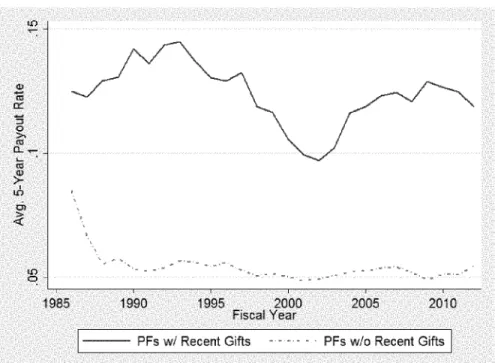
Current spending levels are considerably lower. Drawing on the sample of tax returns described in the Appendix, I computed average payout rates for organizations categorized as private foundations for tax purposes over several recent decades.8 4 I separated spending rates according to whether organizations have received any recent donations.8 5 This division is intended to reflect the possibility that firms with active donors may behave differently from those whose donors are deceased or otherwise no longer actively involved with the firm. Figure 1 below summarizes the result.
("By distributing assets contemporaneously, foundations reduce their ability to distribute assets in the future when a higher philanthropic return may be available."); Halperin, supra note 10 (suggesting that
endowment spending rules should account for future contributions).
83. Cf Deep & Fruinkin, supra note 10, at 8 ("The availability of... new funds for giving in the future should make higher levels of giving today more appealing."). Admittedly, it is possible that the
marginal returns curve on foundation spending is very flat-that is, that marginal returns diminish very slowly. This might be the case if foundations are now reaching only a small fraction of the neediest charities.
84. My computation is simply an averaging across firms of the mean payout rate each firm reported on its tax return for the five-year period ending in the return year. New firms, of course, may report a period of fewer than five years, but for simplicity I include these together with other firms. I winsorize the sample and weight firm observations by assets, as described in the Appendix.
FIGURE 1: SELF-REPORTED PAYOUT RATES AT PRIVATE FOUNDATIONS, BY RECENT GIVING STATUS
Notes: Seltreported 5-year payout ratios. Winsorized and asset weighted. "Recent gifts are gifts within 5 years of current period. Source: PF-SO1 2011 Cumulative File.
As Figure 1 demonstrates, average payout rates reported by private foundations are well below sustainable levels. Indeed, among foundations without recent gifts, payouts hover close to the statutory minimum of five percent annually.
C. Project Selection, Agency Costs, and Information
As many prior commentators have observed, stretching foundation spending over time tends to reduce the value of that spending through two additional mechanisms. One is agency costs: over time, it becomes harder for donors to constrain the impulses of managers who may prefer to hold down spending in order to shield themselves from risk and reduce effort or to spend in ways that contravene the donors' preferences.86 Another is
86. See Lester M. Salamon, Foundations as Investment Managers Part I: The Process, 3
information: even if donors could perfectly control their agents, the donor's ability to best target her spending will get ever more stale over time.87 In this Subpart, I want to add some less-familiar aspects of these
problems.
First, and most simply, a relatively unfamiliar argument about restricted spending is that it presents an informational dilemma for the government as well as for donors. In theory, government subsidies or other incentives should be attuned so that the marginal social benefit generated by another dollar of charitable activity is equal to the incentive's marginal cost.88 Restricted spending forces the government to forecast both,89 and the more restricted the spending is, the longer the range of the forecast. As the forecast gets fuzzier, the likelihood increases that the government will do something socially wasteful: either overpay to encourage behavior that is not cost-effective or underpay and leave some beneficial behavior still on the table.90 Some scholars have argued that when the government faces this level of uncertainty about the payoff from its policies, it should not award up-front subsidies at all, but should instead wait until after the behavior it wants to encourage occurs.9 1
Second, recent work on the psychology of foundation managers suggests yet another possible wedge that time might drive between the manager and donor. Studies report that foundation managers are often motivated in significant part by the amount of the assets under their control, rather than by what those assets can accomplish-a classic example of "empire building. 92 Managers also tend to favor accumulation
& Frumkin, supra note 10, at 7-8, 10-11 (noting, inter alia, that managers prefer restricted spending because it protects their jobs, but describing this as an argument in favor of the practice). For evidence,
see John E. Core, Wayne R. Guay & Rodrigo S. Verdi, Agency Problems of Excess Endowment Holdings in Not-for-Profit Firms, 41 J. AcCT. & ECON. 307, 309 (2006), and Mihir A. Desai & Robert J. Yetman, Constraining Managers Without Owners: Governance of the Not-for-Profit Enterprise, 4 J. GOVERNMENTAL & NONPROFIT AcCT. 53, 70 (2015).
87. Hansmann, supra note 10, at 33-34; Irvin, supra note 10, at 449; see also Brody, supra note 10, at 919, 922, 942. But see FLEISHMAN, supra note 10, at 246-47 (arguing that foundations are valuable because they "allow the values of past generations to provide a counterweight to ... the
present").
88. See GRUBER, supra note 60, at 135.
89. Recall that under current law, restricted spending is subsidized both through an up-front tax deduction and also by an ongoing exemption for the investment returns of the charity.
90. See Steven Shavell, Corrective Taxation Versus Liability as a Solution to the Problem of Harmful Externalities, 54 J.L. & ECON. S249, S256 (2011).
91. See Donald Wittman, Prior Regulation Versus Post Liability: The Choice Between Input and Output Monitoring, 6 J. LEGAL STUD. 193, 200 (1977).
92. Gian Paolo Barbetta et al., The Impact of Fiscal Rules on the Grant-Making Behavior of American Foundations 16 (UniversitAi Cattolica del Sacro Cuore, Working Paper No. 9, 2012); Deep & Frumkin, supra note 10, at 16-18.
over program activities because of measurability bias: it is easier to evaluate the performance of the firm's investments than of its programs, and hence managers favor investing over spending.93
A last point also deals with information, but it will take a bit of unpacking. Let's begin by returning to the idea that firms optimally allocate their resources when they equalize the marginal returns to spending in each time period. This is as true of donee firms, the operating charities, as it is for foundations. Restricted spending can interfere with operating charities' ability to allocate their money. In essence, restricted spending forces some operating charities to wait to obtain resources that in some cases could have been spent more efficiently in earlier periods. For instance, it is unlikely that the best use of a soup kitchen's money is to have zero dollars for four years and then a million dollars in the fifth, rather than $200,000 each year. Of course, if the operating foundation could borrow, this wouldn't be a problem, but most charities are severely credit-constrained,94 and many nonprofit managers are averse to taking on debt that could increase the risk of bankruptcy.95
Foundations could overcome this problem if they had perfect information about the plans and operations of the donee firms. A perfectly informed foundation would parcel out more or less money to each donee each year, depending on the payoff. In other words, the foundation would make grants that match the spending pattern the operating foundation would choose. The problem, of course, is that the foundation managers don't have that information, and they usually can't rely on the donee firm to provide it. This information asymmetry problem comes up in many other contexts, such as government grants and insurer-insured relationships.96 In the literatures studying those fields, scholars report that information transfers are imperfect because one party may have incentives to only convey information favorable to its interests, because information gathering is costly, and because some crucial information may be hard to reduce to writing.9
93. Deep & Frunkin, supra note 10, at 16.
94. Henry B. Hansmann, The Role of Nonprofit Enterprise, 89 YALE L.J. 835, 877 (1980); see
also Brody, supra note 10, at 889.
95. See Hansmann, supra note 10, at 36.
96. See, e.g., Paul M. Healy & Krishna G. Palepu, Information Asymmetry, Corporate Disclosure, and the Capital Markets: A Review of the Empirical Disclosure Literature, 31 J. ACCT. &
ECON. 405, 420-26 (2001); Jonas Prager, Contracting Out Government Services: Lessons from the
Private Sector, 54 PUB. ADMIN. REv. 176, 179 (1994).
97. See KENNETH S. ABRAHAM, DISTRIBUTING RISK: INSURANCE, LEGAL THEORY, AND PUBLIC
An alternative strategy for the foundation would be simply to award all the money it plans to give to an operating charity up front and let the donee firm allocate those funds over time, but that plan also has problems. Once the donee firm has the funds, its managers may slack or diverge from the plans they promised. Those managers also are unlikely to surrender the funds in the event some other, more productive project appears at another firm. Therefore, a donor might be willing to incur the information costs of holding back funds in order to obtain greater accountability and flexibility.98
While at first glance this theory seems to support restricted spending by foundations, in fact it undermines it. Individual donors could obtain the benefits of accountability and flexibility by holding donated funds in their own name and then contributing directly to operating charities when the time seems right.99 Adding a foundation in between, and directing it to restrict its spending, introduces exactly the two problems that waiting supposedly solves: it allows the foundation managers to diverge from the donor's preferences, and it reduces flexibility. Once funds are contributed to the foundation, they cannot lawfully be returned to the donor.100 This means that if the donor comes upon a highly productive investment opportunity, she can't shift money from the foundation to that use (and then potentially back again).01
In short, restricted-spending foundations are likely to be less efficient than foundations that award their funds quickly, because donee firms have better information about when that money should be spent. Although donors may be willing to pay that information cost in order to gain
98. See Michael C. Jensen, Agency Costs of Free Cash Flow, Corporate Finance, and Takeovers, 76 AM. ECON. REv. 323, 323-24 (1986) (arguing that the need to return to funders for additional capital can reduce agency costs); Edward L. Glaeser, The Governance of Not-for-Profit Firms 37-44 (Harvard Inst. of Econ. Research, Discussion Paper No. 1954, 2002) (same). David Walker and I report evidence that this theory also has some traction in the nonprofit setting, finding that dependence on outside donors can affect the managerial decisions of university presidents. Brian Galle & David I. Walker, Nonprofit Executive Pay as an Agency Problem: Evidence from U.S. Colleges and
Universities, 94 B.U. L. REv. 1881, 1917-18 (2014).
99. See FLEISWmAN, supra note 10, at 240-41 (2007) (noting that the two options are often
equivalent).
100. See LR.C. §§ 170(f)(3), 2055(e)(2) (2014).
101. Of course, the foundation could also pursue the investment opportunity available to the
donor. We know from recent work in international taxation, however, that the "lock up" of assets inside a firm can create severe economic distortions. The identity of the owner of an investment can
matter a lot to how well that investment pays off. See Mihir A. Desai & James R. Hines Jr., Old Rules
and New Realities: Corporate Tax Policy in a Global Setting, 57 NAT'L TAX J. 937, 956-57 (2004). Professors Klick and Sitkoff have shown evidence that the ownership of assets affects value in the foundation context. Jonathan Klick & Robert H. Sitkoff, Agency Costs, Charitable Trusts, and