Northumbria Research Link
Citation: Ogwu, Suzannah (2019) An exploratory study of the application of mindsight in virtual communication: the case of email. Doctoral thesis, Northumbria University.
This version was downloaded from Northumbria Research Link: http://nrl.northumbria.ac.uk/42076/ Northumbria University has developed Northumbria Research Link (NRL) to enable users to access the University’s research output. Copyright © and moral rights for items on NRL are retained by the individual author(s) and/or other copyright owners. Single copies of full items can be reproduced, displayed or performed, and given to third parties in any format or medium for personal research or study, educational, or not-for-profit purposes without prior permission or charge, provided the authors, title and full bibliographic details are given, as well as a hyperlink and/or URL to the original metadata page. The content must not be changed in any way. Full items must not be sold commercially in any format or medium without formal permission of the copyright holder. The full policy is available online: http://nrl.northumbria.ac.uk/pol i cies.html
AN EXPLORATORY STUDY OF
THE APPLICATION OF
MINDSIGHT IN VIRTUAL
COMMUNICATION: THE CASE OF
S.A. OGWU
PHD
2
AN EXPLORATORY STUDY OF
THE APPLICATION OF
MINDSIGHT IN VIRTUAL
COMMUNICATION: THE CASE OF
A thesis submitted in partial fulfilment of
the requirements of the University of
Northumbria at Newcastle
for the degree of
Doctor of Philosophy
Research undertaken in the Faculty of
Engineering and Environment
3 Abstract
Virtual communication is powerful because it gives the ability to communicate with one another instantly: overcoming time and distance barriers. As well as providing such opportunities as immediacy and reachability, it poses challenges such as articulation and discernment of content, issues relating to frequency of use, as well as the emotional and social intelligence of users. Many scholars have documented the problems encountered when people engage with virtual communication. These problems may include misunderstanding and information overload. Such problems can disrupt workflow and cause stress among workers. These problems are common in both the corporate and academic world, especially among people who have to use email communication continuously due to the nature of their jobs and activities. It is believed that every work environment utilizes one form of email communication or another on several levels and for different purposes.
Researchers have suggested technical and policy-related solutions to virtual communication problems. They have not, however, taken into cognisance the holistic views of issues such as sensory, bodily, mental and social states of individuals. Therefore, recent research has attempted to gain an in depth understanding of human issues which are connected with virtual communication and have explored what it means to address the challenges mention above (such as emotional, environmental issues and self-awareness of users). In order to address this gap, Mindsight Theory (Siegel 1999 to 2016) has been suggested. The Mindsight Theory centres around mental health issues but has not yet been applied to virtual communication. This approach has used the combination of mindfultech email observation developed by David Levy and Mindsight Theory formulated by Daniel Siegel. The combined practise and theory were adopted to form the Mindsight utility for virtual communication. The crux of the exercise was to encourage people to cultivate empathy, compassion, emotional intelligence and self-reflection on virtual communication in particular on email communication. This was developed to engage users in experiencing self-awareness and awareness of others. It allowed them to develop their guidelines for virtual communication. The email observation practice is a set of exercises that has been developed to enable people to identify their email habits over a duration of time to establish a change of attitude towards electronic communication.
In this research, an exploratory study has been conducted using an interpretive paradigm to understand the implications of the theory of Mindsight on self-awareness and awareness of others on virtual communication. A pilot study was conducted to streamline the exercise. Three case studies were completed: two with university students and one with a social entrepreneurship organisation. The findings suggest that heightened awareness of sensory, bodily, mental activities and social awareness were experienced among the participants. The findings correlate with the personal guidelines formulated by the participants. The outcomes of the research addressed the gaps identified.
4 Table of Contents Abstract ... 3 List of Figures ... 8 List of Tables ... 8 Acknowledgements ... 10 Declaration ... 12
Chapter One: Introduction ... 14
1.0 Background ... 14
1.1 Mindsight Theory and Awareness ... 15
1.2 Rationale for Research ... 17
1.3 Research Question, Aim and Objectives ... 18
1.4 Contribution to Knowledge ... 18
1.5 The Beneficiaries of the Research ... 19
1.6 Thesis Structure ... 19
Chapter Two: Literature Review ... 20
2.0 Introduction ... 20
2.1 Virtual Communication ... 20
2.1.1 The use of Virtual Communication in Business, Education and Research ... 20
2.1.2 Communities Enabled by Virtual Communication ... 22
2.2 Email Communication ... 24
2.3 The Problems Associated with Virtual Communication via Email ... 24
2.4 Methods of Minimizing Virtual Communication Problems via Email ... 27
2.4 Mindsight Theory ... 29 2.4.1 The Mind ... 29 2.4.2 Mindsight ... 30 2.5 Integration ... 32 2.5.1 Integration of Awareness ... 32 2.6 Chapter Summary ... 36
Chapter Three: Methodology ... 37
3.0 Introducing the Research ... 37
3.1 Research Approach ... 37
3.1.1 Justification for a Qualitative Methods Approach ... 38
5
3.2.1 The Case Studies ... 40
3.2.2 Action Research ... 41
3.3 Designing of the Field Study ... 44
3.4 Gaining Access ... 45
3.5 Sample of Study ... 46
3.6 Data Collection ... 46
3.6.1 Development of Exercise ... 46
3.6.2 Diaries ... 47
3.7 Qualitative Data Analysis Strategy ... 48
3.7.0 Data Analysis Technique of Diary Entries ... 48
3.7.1 First Stage ... 48
3.7.2 Second Stage ... 48
3.7.3 Third Stage ... 49
3.8 Validity and Reliability ... 49
3.9 Resources ... 50
3.10 Research Ethics ... 50
3.11 Chapter Summary ... 51
Chapter Four: Analysis ... 52
4.0 Introduction ... 52
4.1 Steps Taken for the Thematic Analysis ... 52
4.1.1. Pre-Analysis Stage ... 52
4.1.2 Categorizations and Themes ... 53
4.1.3 Analysis Stages ... 55
4.2 Analysis of the Pilot Study ... 58
4.2.1 Sensory Awareness ... 58
4.2.2 Bodily Awareness ... 58
4.2.3 Mental Activity Awareness ... 59
4.2.4 Interconnection Awareness ... 60
4.3 First Case Study ... 63
4.3.1 How Participants were Recruited and the Method of Analysis ... 63
4.3.2 Sensory Awareness ... 63
4.3.3 Bodily Awareness ... 64
4.3.4 Mental Activity Awareness ... 65
4.3.5 Interconnectedness Awareness ... 70
4.3.6 Collective Findings from First Case (Postgraduate Students). ... 71
6
4.3.6.2 Awareness of Mental Activities ... 72
4.3.6.3 Interconnection Awareness ... 79
4.4 Chapter Summary ... 81
Chapter Five: Second Case Study Analysis of Diaries from Nongovernmental Organisation in United States of America ... 82
5.0 Introduction ... 82
5.1 Analysis of Participant ED’s Diary ... 83
5.1.1 Sensory Awareness ... 84
5.1.2 Bodily Awareness ... 86
5.1.3 Mental Activity Awareness ... 87
5.1.4 Interconnectedness Awareness ... 89
5.2 Collective Participant Analysis ... 91
5.2.1 Sensory Awareness ... 91
5.2.2 Bodily Awareness ... 93
5.2.3 Mental activity awareness ... 95
5.2.4 Interconnectedness Awareness ... 101
5.3 Third case study ... 104
5.3.1 Sensory awareness ... 104
5.3.2 Bodily awareness ... 105
5.3.3 Mental activity awareness ... 107
5.3.4 Interconnectedness Awareness ... 111
5.4 Comparing Outcomes between the Educational and Organisational Contexts ... 115
5.5 Summary ... 117
Chapter Six: Discussion ... 120
6.0 Introduction ... 120
6.1 Themes in the Participants’ Experience of Applying Mindsight to Virtual Communication via Email ... 120
6.2 Perceived Implication for improved Communication in Virtual Communication ... 128
6.2.1 A Recap the Gap in Knowledge ... 128
6.2.2 Perceived Implication for improved Communication in Virtual Communication... 130
6.2.3 Practical outcomes for virtual communication ... 132
6.2.4 The Implication for personal development ... 135
6.2.5 The Implication for Organisations and Stakeholders ... 137
6.2.3 Practical outcomes for virtual communication ... 139
6.3 Virtual Communication Process for Individuals and Organizations ... 142
7
Chapter Seven: Conclusion ... 144
7.1 Purpose of the Research ... 144
7.2 Summary of Research Question... 144
7.3 Contribution to Knowledge ... 146
7.4 Limitations and Recommendations of the Study ... 146
References ... 148
Appendices ... 159
Appendix A: Version one of MUVC: Used for the pilot study ... 159
Appendix B: Second Version of MUVC used for the first case study ... 164
Appendix C: Third and Final Version of Exercise used in the Research ... 167
Appendix D: Mindsight Process Refined at the End of PhD Research ... 170
Appendix E: Example of a Participant’s Diary ... 173
Appendix F: The Domains of Integration ... 181
Appendix G: E-learning Conference 2016 ... 184
8 List of Figures
Figure 2.1: Triangle of wellbeing (Siegel, 2010b) ... 31
Figure 2.2: The Wheel of Awareness (Siegel 2007) ... 34
Figure 3.1: Action research for participants adopted from Kemmis et al. (2014) ... 43
Figure 3.2: Research Design ... 44
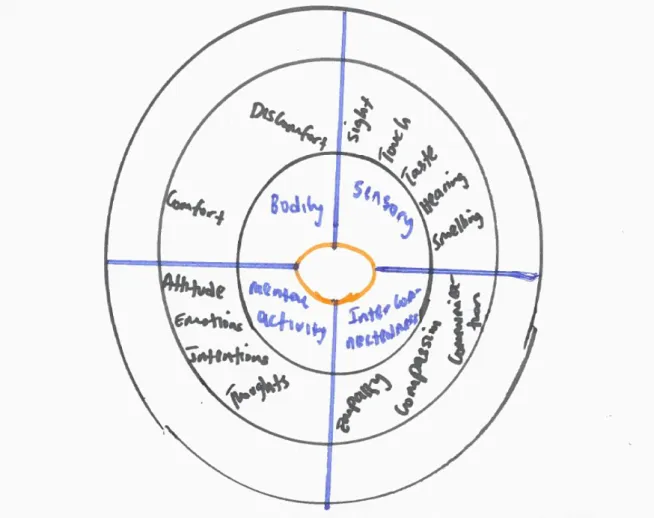
Figure 4.1: Wheel of awareness for the thematic analysis ... 57
Figure 4.2: Participant 5 diary analysis through the wheel of awareness ... 62
Figure 4.3: Charts of sensory and bodily awareness sensations of the first case study ... 71
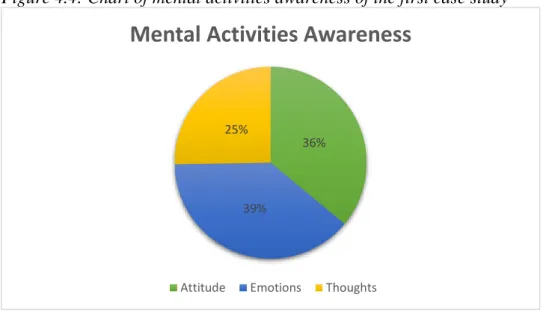
Figure 4.4: Chart of mental activities awareness of the first case study ... 72
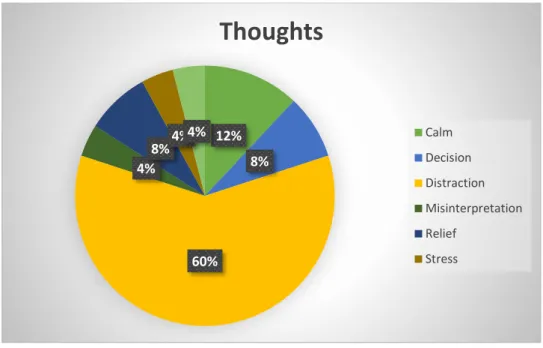
Figure 4.5:The chart of thoughts from the mental awareness of the first case study ... 75
Figure 4.6: Chart of Interconnected awareness experienced by the participants of the first case study... 80
Figure 5.1: Participants' nodes comparaison (An example) ... 84
List of Tables Table 2.1: Virtual communication problems presented in literature ... 27
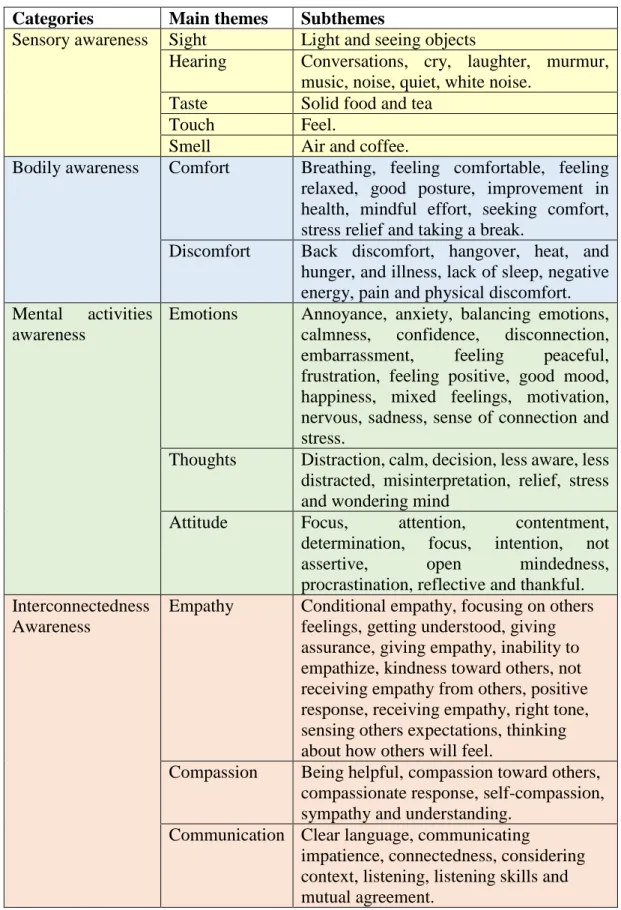
Table 4.1: Categories and main themes from literature review ... 53
Table 4.2: Categories, main themes and sub theme (sub themes emerged out of data analysis) ... 54
Table 5.1: Facilitators/inhibitors to virtual communication ... 118
Table 6.1: Perceived implications for improved virtual communication by participants .... 131
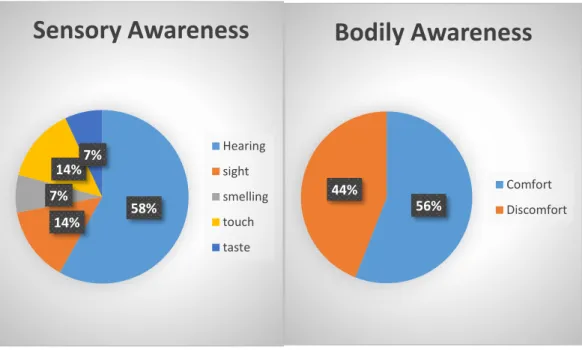
Figure 6.1: Sensory awareness and sensory themes among participants. 52% of participants reported they experienced awareness of their senses. From this, 37% were aware of their hearing, 21% were sight aware, 24% were taste aware, 17% were touch aware, and 1% were smell aware. ... 122
Figure 6.2: Bodily awareness and awareness themes among Participants. 72% of participants reported they experienced awareness of their bodies. From this, 42% of the 72% were aware of the discomfort and 58% were aware of their comfort. ... 123
9
Figure 6.3: Mental activities awareness and mental activities awareness themes among participants. 91% of participants reported they experienced awareness of mental activities. From this 39% were aware of their emotions, 34% were aware of their attitude and 27% were aware of their thoughts. ... 124 Figure 6.4: Interconnectedness awareness themes among participants. 72% of participants reported that they experienced interconnectedness awareness. From this 43% were aware of compassion, 36% were communication aware and, 21% were empathy aware. ... 127 Figure 6.5: Practical Solutions to Virtual Communication Problems ... 135 Figure 6.5: Practical Solutions to Virtual Communication Problems ... 142
10 Acknowledgements
I want to give thanks to God, the maker of heaven and earth who gave me the grace and strength to do this work these past four years. I give Him all the glory. Secondly, I would like to thank my principal supervisor Petia Sice, whom, in my perception is a genius. I have watched in awe of her innovative capacity so much so that I feel privileged to be guided by her. Her professional and motherly support has seen me through my studies. I mean to say that I stood on the shoulder of a giant. I would not have come to this stage of completion without her, both intellectually and morally. She has been a pillar for me and her compassionate leadership style has been a source of inspiration for me. I hope to implement that as I go through life’s journey.
I also like to thank my secondary supervisor Shelagh Keogh who has also provided guidance throughout my studies. She is very approachable and dedicated. Her intellectual approach to matters has been a compass through which my research was guided. Her eye for details and professionalism has been inspiring to me. Both of my supervisors deserve a national award for going above and beyond to support myself and other students of Northumbria University. Their services are priceless.
Thirdly, to my parents Mr. and Mrs. Alexander Yargawa for providing my tuition fees and all of the application fees that I had to pay. I am also grateful for all of their spiritual and parental support throughout my life. If not for them my life would have been miserable. They stood with me through thick and thin. They have never turned their backs on me in many situations and they faced challenges in the process of standing by me in spite of what the world thinks of me. I am eternally grateful to the both of you.
I am very grateful for my baby Lisa who is the reason I wake up in the morning, the reason I have a dream, the goal I strive to be a better person. Your love for me is endless. There were times in which you came home every single day with a handmade card that said: “I love you, Mum.” You have been patient and understanding throughout my studies and have always prayed for my success. Thank you very much. My gratitude goes to Dr. Friday Ogwu for his support for Lisa and myself during my studies; we are very grateful. I would also like to thank Mr. and Mrs. Yetti Mathias for all their lovely support and concern throughout my studies and they have never looked back since helping me.
My siblings: Deborah, Judith, Peace, Emmanuel, Josiah, Nita, Tati. Thank you so much for all your love and care. Life would have been empty if not for all your enduring love for myself and Lisa. You are part of my major support network.
To Judith who has been a confidant and a friend. You have never been tired of hearing my endless dramas and phone calls at odd hours of the day. In tears and joy, you have been a reliable source of encouragement to me. I am very grateful, and words cannot express my gratitude to you. You have shared your money with Lisa and myself and you have endlessly provided for our needs. You have been the family member that has been with us in a foreign land and has not failed to visit us consistently during the years. To Talatu who has given me a taste of family in Newcastle. Thank you for your love and support.
A million thanks to Chief and Lolo Chukwuetu for their care for Lisa and myself during my studies. You have been our parents in Newcastle who have been a source
11
of protection and financial support during my studies. Your home has been open to us and we feel part of the family.
I am grateful to Pastor and Mrs. J.T. Apofure who have sent daily spiritual and moral encouragement throughout my years of study. I have never seen such dedication and commitment to the soul. I also extend my gratitude to Pastor and Mrs. Samuel Ohiomakhare for their pastoral care and guidance to Lisa and myself. You have not failed to ask for our welfare and to pray for us.
I will like to thank my best friend, mentor and counsellor Dr. Dorine Lugendo who has always checked in on me from far away in Kenya. I adopted your lone parent researcher framework and I scaled through. You never left my side and I appreciate your friendship.
To my boss, Colin Goodlet, in my first and current job at Northumbria University. Thank you for mentoring, believing and accommodating me and my mistakes. You are the kind of boss every new employee should have.
My gratitude goes to my pastors Stephen, Salvation and Absalom. You always pray for me and have not failed to expound on the words of the Bible. I have grown in faith as a result of my association with you. Your theology of great dimensions has left me seeking more knowledge. Thank you very much. I would also like to thank my Uncle Major Sakamanha Glenn for his continued financial and moral support throughout my studies. I would also like to thank my Uncle Mr. Edwin Kibikiwa for always hosting me whenever I have visited Nigeria and for all the odd trips to the airport.
My appreciation goes to the special people that have looked after Lisa when I went to University or conferences. The summer holidays would have seen the end of my research but your support has enabled me to weather through while you took care of my baby as I went to study. Some of you even picked up and dropped Lisa off at school. These special people are Mr. and Mrs. Ezekiel Rodrigues, Mr. and Dr. Oriuwa, Mr and Mrs, Michael Eje, Mrs. and Mrs. Idika, Mariam Jatto, Kermilis Darling and Chief and Lolo Chukwuetu and family.
To my friends in church: Margeret Idika and Richard Okorie - for your moral and spiritual support, Dr. Tolu Kolawole - for your concern and constant inspiration, Dr. Emmanuel Ogundimu, Henry, Tobi and John for your friendliness and love and to all the members of Deeper Life Bible Church, Newcastle upon Tyne. Thank you for your continued prayers and devotion. I will like to appreciate the Barnabas Life group and the Life Vineyard Church Newcastle members. You have been lovely and supporting and I have been exposed to another dimension of Christian living.
To my Colleagues within the University: Aham, Dele, Kush, Paul, Wafa, Paras, Pratik, Ismahan, Steven, Shirin and David. Thank you all for making the journey worthwhile. To my Federal Government Girls College Yola, secondary school classmates and class of the year 2000 for all the love and solidarity. Since we formed the group in November 2016 it has been all joy and laughter. They say one bee cannot make honey, thanks a million!
12 Declaration
Declaration I declare that the work contained in this thesis has not been submitted for any other award and that it is all my own work. I also confirm that this work fully acknowledges opinions, ideas and contributions from the work of others.
Any ethical clearance for the research presented in this thesis has been approved. Approval has been sought and granted by Northumbria University Ethics Committee I declare that the Word Count of this Thesis is 46,332 words.
Name: Suzannah Adejoh Ogwu
Signature:
13
I dedicate this work to my Parents Elizabeth and Alexander Yargawa and to my daughter Lisa.
14 Chapter One: Introduction
“We function more effectively and more healthfully online when we are more attentive, relaxed, and emotionally balanced. This can also be stated in the negative: We operate less effectively and less healthfully when we are distracted, physically uncomfortable, and emotionally upset. Moreover, many of us now are often distracted and stressed out when we’re online” (Levy, 2016 p.3).
1.0 Background
Scholars have focused on organisational or cross organisational structure or distributed project teams that are supported by advanced technology infrastructure. The nature of the remote communication that is needed to support such work is referred to as virtual communication. Virtual communication is computer mediated communication (Myers 2007). Therefore, virtual communication is essential to organisations; because they depend on effective communication to achieve their goals (Malmelin, 2007) The success of any organisational virtual communication depends on every individual employee in that organisation. Therefore, the nucleus of the communication process is the people. It is not about the technology but how the communication is being done. Communication is a process where one mind affects another and it is mostly through this process that individuals produce their perceptions and act collaboratively with others (Hedman and Valo, 2015). This implies creating social worlds instead of just disseminating information between people. The fact that communication is not just a method used to disseminate information but also a means of developing social entities that enable us to co-creation understanding with others. This perceptionshould lead individuals to approach communication with a sense of awareness of ourselves and others. Regrettably, this is an experience that eludes many, as De Paoli et al (2014) report that some people find it difficult to communicate effectively with others virtually. This might be because people come from different backgrounds and they do not know one another before communicating online. If communication is not only a mere exchange of information then how can effective communication, especially virtual communication, be achieved? Some of the problems encountered with virtual communication can be: not knowing the other party, difficulties in connecting with people, lack of trust, lack of interpersonal clues, reduction in communication quality, lack of connection and not having shared knowledge (Soucek and Moser, 2010;
15
Januska, 2011; Galambos et al., 2012; Morgan et al., 2014; De Paoli 2015; Hedman and Valo 2015; Gupta et al., 2016). There is a need for a holistic approach taking into consideration the physical, mental and social state of being and the qualia (quality as perceived by an individual) of the person’s experience. The theory of Mindsight offers such an approach. Mindsight is said to enable individuals to envision what is going on within themselves and helps them to understand their minds and to resonate with their experiences. This enables them to be mindful of mental operations and stops them from being carried away by them (Siegel, 2010). The next section introduces Mindsight.
1.1 Mindsight Theory and Awareness
Mindsight is a theory that was first developed in the field of in psychotherapy by Dr Daniel Siegel (2010). He discovered that when he talked with his patients, they explained that they felt ‘felt’ by him (Siegel, 2010, p. 27). They had a sense that he understood what they meant and felt. There was no term to describe this process of feeling ‘felt’ in the field of mental health at the time and he coined the term Mindsight. Mindsight is the ability to discern sensations, thoughts and emotions while identifying them as activities of the mind. It is also able to appreciate or notice the thoughts of others so we can understand their point of view which enables our responses to be compassionate. Mindsight enables people to monitor and manage their feelings and thoughts and not be driven by them (Siegel, 2010). Mindsight can be considered to be a powerful lens through which we can understand our inner lives with more clarity, integrate the brain and enhance our relationships with others. It is a kind of focused attention that allows us to see the internal workings of our minds.
The Theory of Mindsight defines the mind as an embodied (personified) and relational process emerging from the mutual interconnectedness of the physical, mental and relational (both human and environmental) domains of human reality. The mind, as an emergent property of the body and relationships, is created within the internal neurophysiological processes and relational experiences. In other words, the mind is a process that emerges from the distributed nervous system extending throughout the entire body and also from the communication patterns that occur within relationships (Siegel, 2009). Relationships refer to how energy and information are managed and shared among persons (Siegel, 2010). These relationships can be at a personal or
16
broader level, for example within communities, countries, etc. (Clinton and Sibcy, 2012).
To put it simply, human connections shape neural connections. Relationships and neural linkages together shape the mind (Siegel 2009; Siegel 2016) The brain (the embodied nervous system), mind and relationships are aspects of one reality and need to be considered together. The body provides the biological structure for hosting human experience and the mind is an embodied and relational process that regulates the information and energy flow, in the brain and in relationships with others and the environment (Siegel, 2016). The term ‘embodied brain’ refers to the whole nervous system, not only the brain. The triangle of well-being shows the nature of the reality of energy and information flow. The mind is a regulatory mechanism of the brain and relationships.
Therefore, the regulation of energy and information flow is achieved through the management of intention and attention (Siegel, 2010b). Intention determines the direction of attention. Attention acts like ‘a scalpel’, as the direction and scope of attention can trigger changes in the brain (neural plasticity) and the communication further influences our mental activity, brain and relationship patterns in mutual interaction (Sice, et al., 2013). The intention of ‘seeing reality’ more clearly and continuously enhances our awareness and reflection capability in making sense of reality. This requires the integration and stabilizing of attention in the monitoring of body sensations, mental activity and relationships.
In Western culture, a heightened state of awareness is often referred to as mindfulness. This terminology is widely accepted in the West, where the state of mindfulness is defined as the opposite of mindlessness, that is, where we are functioning on autopilot, or merely downloading our mental models, assumptions and prejudices rather than witnessing present experience as it unfolds (Kabat-Zinn, 2009). The author, therefore, provides an operational working definition of mindfulness as the awareness that emerges through deliberately paying attention in the present moment and without judgment to the unfolding of experience moment by moment. It is important to clarify that our understanding of mindfulness as paying attention to experience as it unfolds is not only connected to present moment sensations but connected to accepting and witnessing our present moment experience, which may involve some or all aspects of
17
experience, that is, sensations, mental activity (thoughts, feelings, memory, intentions, beliefs, attitudes, etc.) and relational experience (connectedness to others, to our planet, to nature, etc.) (Sice et al., 2013). Therefore, individuals taking part in virtual communication need some reminder that the connections that exist are beyond mere virtual communication but are a process of interconnection with others.
1.2 Rationale for Research
Virtual communication is utilized in organisations, businesses and organisation run projects in the form of business or research collaboration. The ability of the people involved in a project to communicate effectively is essential to the success of the projects. Some of the problems that lie in virtual communication are a lack of mutual trust and extensive communication between possible partners (Januska, 2011). Scholars have reported some of the issues people face when using virtual communication. These have included difficulty in relating to people (De Paoli, 2015). Others have claimed some of the difficulties in connecting to people arise because of different backgrounds (Januska 2011 and Galambos; Weidig et al., 2012), lack of trust and disagreements (Hedman and Valo, 2015), lack of interpersonal clues, lack of connection (Morgan et al., 2014) and reduction in the quality of communication (Gupta et al., 2016). It was thought that if an organisation is to achieve the purpose of collaborating, then a solution for meaningful communication should be suggested. Mindsight is a theory that has been used extensively in relationships between parents and their children and doctors and their patients by first encouraging an understanding of oneself and then an ability to understand the other person (Siegel, 2010a). To date, there has not yet been an application of this theory in virtual communication. It has been considered that a better understanding of ourselves leads to better and more effective communication with others. Better communication leads to better relationships and better relationships enhance good business relationships i.e. the types that are built on empathy. Hernez-Broome (2011) rightly argued that Mindsight facilitates the connection with ourselves and others through a combination of insight and empathy. It was with great interest that the present investigation into the exploratory application of Mindsight and the virtual communication process was conducted.
18 1.3 Research Question, Aim and Objectives
This research question narrows down the research and helps propel it toward its primary goal and signposts the project to its audience. That is why a research question must be written carefully (Creswell, 2013).
Aim:
To explore the application of mindsight to virtual communication with the intention of providing a utility which will aid personal awareness, reflection, and action. Research Question
Can the qualia (quality as perceived by an individual) of experience reported by participants applying mindsight in virtual communication indicate improved communication as perceived by participants?
Objectives
The objectives of this study are:
1. To critically evaluate the literature on mindsight and virtual communication in organisational and business contexts and identify the gaps that Mindsight addresses. 2. To develop a utility of engaging Mindsight when using virtual communication which includes self-awareness enhancement, monitoring and managing self in the communication process.
3. To conduct a pilot study to test the application of the Mindsight virtual communication utility.
4. To conduct primary research by applying the Mindsight communication process in academic and business contexts.
5. To compare findings from different contexts. 1.4 Contribution to Knowledge
1. Insights into the exploration of Mindsight and virtual communication.
2. The development of a utility for engagement and the application of mindsight in virtual communication via email for individuals and organisations.
19 1.5 The Beneficiaries of the Research
This research will be beneficial to businesses, governmental organisations, educational institutions and private individuals in understanding their virtual communication process.
1.6 Thesis Structure
This thesis is structured into five chapters:
Chapter one presents an overview of the research, giving the background of the study. An introduction to virtual communication and Mindsight is provided and there is a brief reference to mindlessness. Following this, the aim, objectives and the research question of the study are presented. Finally, a summary of the contribution and benefits of the research are presented.
Chapter Two presents the literature review and establishes the gaps in knowledge in virtual communication literature. Moreover, it presents the problems identified and the solutions that were suggested by scholars.
Chapter Three presents the methodology and the philosophical stance of the research. It explains why a qualitative study was undertaken. It gives details of the action research within the case studies. The chapter also explains the data collection instrument and facilities that were used. Furthermore, it introduces the method of analysis and validation.
Chapter Four presents the analysis of the qualitative data obtained from participants’ diaries. It explains how the analysis utilized the wheel of awareness (mindsight practice) to provide the initial categories for the thematic analysis.
Chapter Five presents a discussion of the research findings and describes the factors perceived by the participants that improved their virtual communication. It also shows the implication of the findings for individuals and organizations. It discusses the contribution to knowledge made by this research before, finally, presenting the whole process of improved virtual communication.
20 Chapter Two: Literature Review
2.0 Introduction
2.1 Virtual Communication
Virtual communication is any communication that is computer-mediated (Myers 2007), it is different from face to face communication because the communication is done in a virtual space. This therefore means that ‘virtual’ is a functionality that is aided by computer networks and ‘space’ is an interactive setting. It is the conceptualization of the interactions that happen over a computer network (Chandler and Munday 2011, Welinder, et al. 2014). These interactions are said to be enhanced through digital connections for information exchange among people while they are in different locations (Yu and Shaw, 2008). Therefore, the virtual space is likened to a room that is created employing a computer application installed solely for content sharing among people for communication and interaction (Welinder, et al. 2014). Therefore, virtual communication has made life flexible and people are no longer constrained by time and place to perform certain activities: they can function virtually (Shaw and Yu, 2009). This has paved the way for individuals who live in distant places to be cognitively close to one another (Rodríguez, et al. 2010) and has positively altered the way people interact with themselves (Yu and Shaw, 2008). A shift has taken place transposing the traditional or natural communication of face-to-face communication to virtual communication thus altering human existence from real beings to virtual ones and impacting interpersonal relationships (Baeva, 2016). Going beyond the realm of the individuals, enterprises can now partner with other organisations beyond their geographic and organisational horizon (Godwin and Rennecker, 2000). Activities and tasks required in jobs have been made drastically changed by way of virtual distribution (Ale, et al. 2009). This collaboration is made possible via emails, websites and video conferencing facilities (Bosch-Sijtsema and Sivunen 2013, De Paoli, et al. 2014).
2.1.1 The use of Virtual Communication in Business, Education and Research Until recent times, many people were not interested in communication that was electronically enabled due to the fact that it was too expensive and distant from the reach of most people. It was not easy then to reach out to people without having first
21
to penetrate their personal associations, affiliations and connections. Modernised communication has altered this phenomenon and has changed people’s interests (Carey, 2008).
The utilization of virtual communication is now in almost every facet of society including entertainment, business, education and cultural heritage (Sköld, 2011). For instance, manufacturing companies employ a synchronised collaboration among stakeholders operating in different sites. This enhances flexible production and joint decision-making processes. Companies within this sector are multinational. They employ virtual collaboration among stakeholders that enable easy adaptation to grow changes in market demand and a network of suppliers with the goal of making an adequate profit (Galambos, et al. 2012). Such stakeholders are sometimes organised into virtual teams and they provide avenues for local expertise to be utilized globally as well as satisfying global demand for products (Montoya, et al. 2009).
Communication between leaders and employees is now done differently in business. Men (2015) reported that in the early 1980s and 1990s, CEOs were more comfortable to use conventional means of communication (face to face communication and telephone conversations) to communicate with their employees but the exploit of web2.0 innovations over the past ten years has changed the face of internal communication in organisations. Company leaders and organisations engage employees through virtual platforms such as blogs, instant messaging, intranets and social media networks. Technology with rich media components enable more presencing (blend of presence and sensing) through audio and video conferencing and comment and sharing functions have enabled closer communication. Through these technologies, bottlenecks in organisations are reduced, employees are now more able to gain access to leaders and they communicate in a more relaxed and friendly manner. This kind of atmosphere enables employees to express their views and opinions about organisational issues freely (Men, 2015).
Similarly, in an educational setting, virtual learning has been highlighted among scholars for example, Skold (2011) claims that the effect of virtual communication on learning features in diverse academic fields like psychology, the study of education, sociology, game studies, architectural and information studies. Biasutti (2015) explains that online learning helps time management because it provides learners with
22
the flexibility to choose comfortable locations. They can also access their learning materials via the internet where they are located in the world. This process gives learners the opportunity to reduce travel expenses. The utilization of virtual communication is not limited to a single setting or setup because virtual communication has given rise to virtual work in organisations so that companies and businesses rely on teams that operate virtually to achieve set goals. This kind of team makes up different types of virtual communities such as virtual collaborative research groups or virtual enterprises to mention but a few.
2.1.2 Communities Enabled by Virtual Communication
Organisations deploy team work to achieve their goals. Sometimes they utilize virtual teams to cope with the demand of the fast-changing world due to the impact of globalisation (Schaubroeck and Yu, 2017). Sometimes companies rely on virtual teams to to reduce running cost and provide swift solutions to complicated problems (Powell, Piccoli, et al. 2004, Ale, et al. 2009). The teams are not usually located in the same place and so use virtual communication to enhance their activities (Schaubroeck and Yu, 2017).
Therefore, a virtual team is a temporal workgroup that communicates electronically and is dispersed geographically, culturally (Pauleen and Yoong, 2001, Powell, et al. 2004) and sometimes organisationally (Montoya, et al. 2009). The collaboration is through an interconnected task that is governed by a common goal (Montoya, et al. 2009). Although this definition can also be true of traditional teams, it is essential to state that teams could emerge at any time and in any organisation to achieve a task or goal. Schaubroeck and Yu (2017) argued that the virtual team varies to the degree that it utilizes virtual communication. Marlow et al. (2017) recalled that virtual teams primarily depend on virtual communication and they vary according to the degree they utilize technology in their communication. Based on these scholarly assertions, it could be assumed that there might not be a clear-cut distinction between a traditional team and a virtual team, except to the degree that the teams involve virtual communication in their activities. It can be conceptualized that a virtual team is a team (traditional or virtual) that utilizes virtual communication to achieve its goal or task as the need arises. A virtual team could therefore consist of marketers located in the United States of America and developers of software in India or design engineers located in Germany and manufacturers in China (Montoya, et al. 2009).
23
Other scholars perceive the virtual team as a global virtual team. They state that the global virtual teams work and live in different parts of the world. Usually, the group is accountable for the making and implementation of decisions that are vital to the programme of the organisation. The team communicates using the support of technology and they use this means more than face to face communication (Pinjani and Palvia, 2013). The team might be set up by one organisation and be utilized by a multinational company. Additionally, other virtual teams could be made up of individuals from different organisations. These virtual empower organisations to harness skills and competence of employees to achieve a common goal (Ale, et al. 2009).
In academia, virtual teams work in virtual collaborative research which consists of virtual communities that are formed by people who may be geographically dispersed but cognitively close. A research team can consist of people that are not necessarily from the same institution or nation but the only prerequisite they need is to have a joint research group. The concept of virtualization has the impression that groups are not a collection of people but an outcome of a network of the representative of systems, reflections, and practices. (Rodríguez, et al. 2010).
Businesses utilize virtual enterprise (VE), which is a temporal collaboration of enterprises or businesses that combine resources and expertise in order to respond to business opportunities (Davidsson and Jacobsson 2009, Cezar, et al. 2011, Januska 2011). These businesses provide services, production processes and training development (Minjie and Wei, 2010). At other times, organisations need individuals that can deliver project, such people possess specific skill sets needed to accomplish the project. Most often these individuals are geographically dispersed and due to that they must rely on virtual communication to enhance their operations (Schaubroeck and Yu, 2017). These companies retain their independent entities such as their information systems, people, physical assets and their modes of operation. Member companies in a VE are located around the globe. This nature enhances their ability to cope in volatile market environments (Davidsson and Jacobsson, 2009). They utilize virtual collaborative tools of synchronous (video conferencing, audio conferencing, chatrooms) and asynchronous (emails, corporate websites and discussion boards) applications to communicate tasks and their experiences with one another (Cezar, et al. 2011). Communication is the key to virtual enterprises (Januska, 2011) and team
24
working competences which include the ability to resolve conflicts, comprehension of group norms and the capacity to be tolerant to differences (Suter, et al. 2009) are essential to for the smooth running of such setups. The most popular technology used among these teams is email communication.
2.2 Email Communication
Email communication provides a means through which information can be rapidly exchanged. This makes communication accessible in large organizations that are geographically dispersed (Soucek and Moser 2010; Morgan et al. 2014). Email communication is the most popular type of communication that is used in organizations and is an integral aspect of work life (Soucek and Moser 2010; Jerejian et al.2013; Kushlev and Dunn 2015; Levy 2016; Whittaker and Sidner 1996; Hanrahan and Pérez-Quiñones 2015). It has been reported that 183 billion emails circulate the world on a daily basis (Kushlev and Dunn, 2015) and it has been estimated that by 2018 there will be approximately 5 billion email addresses in the world (Levy, 2016). This shows how much the world relies on this form of communication (Levy, 2016) and how it has drastically changed the way we exchange our ideas and thoughts within organizations and among workers (Jerejian et al. 2013). These figures contribute to the prediction that was made over 30 years ago by Rice and Bair (1984) who stated that the use of virtual communication might enhance both individual and corporate efficiency. The mailboxes of people have become an integral aspect of their lives and it will be challenging to end the use of email communication. Therefore, a significant amount of employee time is spent on email communication (Jerejian et al. 2013). Some workers spend up to half of their working time replying to and sending emails (Levy, 2016). When email communication is used prudently, it yields excellent benefits to the people within a network by enhancing their participation level (Gupta et al. 2016). 2.3 The Problems Associated with Virtual Communication via Email
For the past 30 years researchers have highlighted the problem with virtual communication (Baeva, 2016) as virtual communication has been said to trigger some issues more than other forms of communication. People who do not know one another have to communicate sensitive issues (De Paoli, 2015) and communication done over the internet is usually different from face-to-face communication (Prieto-Arranz, et al. 2013). Consequently, there have been complaints about difficulties in communicating and connecting with people from different countries, religions, and identities.
25
Sometimes people do not know one another outside of their virtual communication and have not physically met before (Januska 2011; De Paoli 2015). This also happens in a virtual enterprises, as the companies that form the enterprise are often multinational and communication can often get complicated due to entities that are geographically scattered and culturally diverse (Galambos, et al. 2012). Similarly, Hedman and Valo (2015) observed that communication among management teams faces challenges such as distance barriers, time and cultural differences among teams that are geographically dispersed which can typically lead to lack of trust and disagreements.
It is perhaps important to focus on the problems to email communication, since it is the most popular kind of virtual communication. It has been reported that it comes with some challenges to people in organizations. One of these problems is the lack of interpersonal clues. Communication that is done face-to-face has the possibility of gaining more context through interpersonal interactions and body language. Face-to-face communication gains meaning and depth through these pointers as the receiver can gain understanding by decoding the feelings of the sender. These clues are missing in virtual communication, however, because replies may be delayed and with a lack of face-to-face interaction receivers are often not able to see physical clues which may lead to misunderstandings and misinterpretations (Morgan et al. 2014). On the contrary, people in face-to-face communication have the opportunity to interact and develop a shared understanding of the processes they need to take in order to achieve their common goal. This is not the case with virtual communication as the chances of interacting frequently is limited and the capacity to develop a shared knowledge of processes is distorted due to distance and time differences. As a result, having a shared knowledge and feeling connected to one another becomes a problem (Morgan et al. 2014).
Other problems with email communication are information overload. The constant dependence of organizations on electronic communication has led to a rapid increase in the volume of emails received by employees nowadays which is an issue of concern. It has been reported that information overload is affecting workers (Soucek and Moser, 2010). This increases levels of stress among workers as they receive a significant number of emails (Jerejian et al. 2013; Pignata, et al. 2015). Information overload occurs when individuals receive information that is beyond their processing ability
26
(Soucek and Moser, 2010). The problem occurs when there is too much distribution of messages that an individual can cope, which causes, disruption in workflow (Soucek and Moser, 2010). The result is that the quality of communication is reduced (Gupta et al. 2016). For example, employees could lose track of their workflow due to a variety of emails that need action. This means that employees can also lose attention on their work because of the constant influx of emails interrupting them and making them lose track of the direction of their communication (Soucek and Moser, 2010). Similarly, receiving many random and varied messages reduces people’s effectiveness in communication as they have to separate relevant from less essential messages (Gupta et al. 2016).
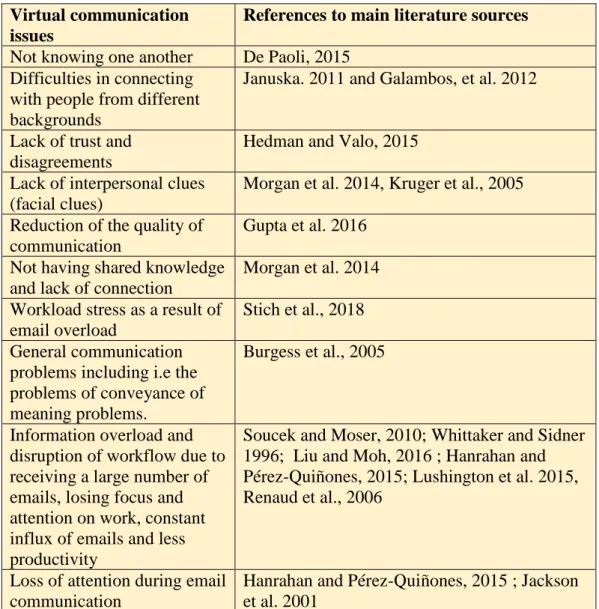
Communication deficiency happens when workers have a lot of emails they are not able to respond to. As a result, communication becomes impromptu and then they approach it with informal attitude. This kind of casual disposition towards email affects the quality of messages written so that the emails are inconclusive without sufficient information for the reader to act upon which may cause misunderstanding. The effect of ambiguity in emails happens when rules of communication, contexts and societal clues are misplaced as a result of obscure messages. This gives gaps in communication so that receivers are unable to take the desired actions that the senders expect within a particular time period (Soucek and Moser, 2010). Therefore, it can be seen from the problems highlighted at the beginning of this section above, that people or organizations might not be able to harness the benefits of using virtual communication if the problems are not addressed. Table 2.1 presents the issues of virtual communication presented in literature.
27
Table 2.1: Virtual communication problems presented in literature Virtual communication
issues
References to main literature sources Not knowing one another De Paoli, 2015
Difficulties in connecting with people from different backgrounds
Januska. 2011 and Galambos, et al. 2012
Lack of trust and disagreements
Hedman and Valo, 2015 Lack of interpersonal clues
(facial clues)
Morgan et al. 2014, Kruger et al., 2005 Reduction of the quality of
communication
Gupta et al. 2016 Not having shared knowledge
and lack of connection
Morgan et al. 2014 Workload stress as a result of
email overload
Stich et al., 2018 General communication
problems including i.e the problems of conveyance of meaning problems.
Burgess et al., 2005
Information overload and disruption of workflow due to receiving a large number of emails, losing focus and attention on work, constant influx of emails and less productivity
Soucek and Moser, 2010; Whittaker and Sidner 1996; Liu and Moh, 2016 ; Hanrahan and Pérez-Quiñones, 2015; Lushington et al. 2015, Renaud et al., 2006
Loss of attention during email communication
Hanrahan and Pérez-Quiñones, 2015 ; Jackson et al. 2001
2.4 Methods of Minimizing Virtual Communication Problems via Email
Researchers have put forward recommendations of how people can interact with virtual communication (especially email communication) and solutions to overcome stress and overload issues in addition to other problems they may face (see Table 2.1 for a summary of the problems). It has been suggested that people should be taught how to apply techniques that will enable them to manage their emails (Burgess et al, 2005; McMurtry, 2014 and Soucek and Moser, 2010). These include processes that decrease the number of messages an individual receives which makes a significant difference. For example, some organizations have been advised to provide intervention in the form of messaging filters that helps to separate essential emails from unrequested emails, (Jerejian et al. 2013; Freed et al., 2008). Others have suggested that companies should produce drafted guidelines on how companies’
28
emails should be utilized (Soucek and Moser, 2010). Similarly, Pignata et al. (2015) and Jackson et al. (2001) recommended that employees should be given training on how to manage their emails. Moreover, Soucek and Moser (2010) made some recommendation about email overload, they suggested some processes that would increase people’s capability of processing information. These include training that will enable people to manage enormous volumes of email communication.
Others like Jerejian et al. (2013) and Liu and Moh (2016) suggested that people utilize techniques such as manual filtering of emails and continuous monitoring of emails. There are different types of filtering strategies which include spam detection (Iyengar et al, 2017) and spam classification (Kumaresan and Palanisamy 2017). A more focused approach on important communication recommends that inboxes should be automatically deleted after they are read (Levy 2016). This suggestion, however, might not have considered the effect deleting emails might have on work flow. One other suggestion made by researchers is to attend to emails at set times to avoid constantly checking them (Levy 2016; Kushlev and Dunn, 2015).
Gupta et al. (2016) supports the above measures because they have reported that reducing the number of emails employees receive in an organization improves their work quality and reduces their levels of stress. They claim that other publications focus on the recipient of the emails approach to issues. Therefore, theirfocus on addressing the senders of emails by a way of suggesting email optimization will mean that the sender will have to determine if the email they are about to send is more or less important to the receiver.
Table 2.1 shows the solutions recommended by other researchers to address the problems of email communication. They came up with several suggestions which were either mechanical or behavioural. Levy (2016) developed an observational approach that addresses the relationship between the communicator and the facility while others focused on the receivers of email communication (although Levy did suggest ways through which emails should be read from a receiver’s perspective). It has been observed that people tend to check their emails unnecessarily and proposed that emails should be checked at set times of the day in order to harness better attention from the individual. Levy (2016) also addressed the attention issues of individuals and attempted to reduce information overload tendencies by developing a reflective
29
exercise that prompts people to observe themselves and to learn from their behaviour. The exercise brings awareness research into virtual communication, the approach focuses on reflection, which encourages individuals to develop guidelines for themselves personally. The exercise does not prescriptive what people needed to do differently. In conclusion, the above solutions focused mainly on environment and people’s behaviour but failed to address:
The awareness of virtual communication tendencies and behaviours.
The investigation of enhanced awareness on individuals and the effect of the environment on them while they communicate virtually.
Providing support to what people can become aware of through the development of guidelines.
Recent advancement in the theory of Mindsight provides insight and tools for awareness development. In summary, the skills of awareness and reflection need to be developed within the communication processes of organizations (Sice et al. 2018a). 2.4 Mindsight Theory
2.4.1 The Mind
“The mind is an embodied and relational process that regulates the flow of energy and information”. (Siegel 2016, pp 37). It is also a self-organising process that regulates the flow of energy and information” (Siegel 2016, pp.38).
Mindsight tries to explore what is going on in the mind of the self and that of others. The mind is both a neural and social product. It implies that the mind happens within and between people. It occurs within the body including the brain and within people as the flow of energy and information in the form of communication which flows through speech or written words (Siegel 2016).
Siegel (2010a) suggests that the brain and mind are interconnected. The mind is beyond the brain and the skin and it lives between people. This is because the mind has interpersonal qualities that indicate that it is not just the activity of the brain. Energy and information flow lie not just in the brain, but also throughout the entire body. This means that the brain is a part of something bigger called the nervous system which runs from the head into the gut and other parts of the body. Research reveals that the intestines are lined with neurotransmitters that directly influence our mental
30
state and health. These mental states can include feelings, thoughts, emotions, behaviours, and intentions (Siegel, 2015). It can be concluded at this point that this is the same system that is also responsible for the generation of the mind (Siegel, 2016). Therefore, the mind is an emanating property of relationships and the body from the distribution of the nervous system which spreads throughout the entire body (Siegel, 2015). The mind is not just the activity of the brain but the mind occurs both within and outside of ourselves when we communicate and relate to others. This demonstrates that the mind is multifaceted (Siegel, 2016). Therefore, the feelings, thoughts, and memories we experience are linked to the activities of the mind. They are a part of the subjective activities of the mind and the mind is the subjective experience of the energy flow patterns that contains information (Siegel, 2016). Since the mind is not limited to an individual but also encompasses relationships with others through communication of energy and information, the energy and information it produces should be channeled to the benefit of the owner of the mind and those it is transmitting to. The theory of mindsight tries to reveal what is going on in the mind of the self and others.
2.4.2 Mindsight
Mindsight is a theory developed by psychologist Daniel Siegel. He discovered that when he talked with his patients, they said they felt, that he understood how how they felt. They had a sense that he understood what they meant and felt his understanding in response. There was no term to describe the process of feeling felt in the field of mental health and at that time he coined the term Mindsight (Siegel, 2010a). Mindsight is the ability to discern thoughts and identify them as activities of the mind. It is also able to appreciate or notice the thoughts of others in order to understand their point of view, which enables our responses to be compassionate and effective (Siegel, 2010a).
Mindsight enables people to direct their feelings and thoughts and not to be driven by them. They are then able to balance their emotions and to achieve a state of equilibrium (Siegel, 2010b). This is based on the premise that the mind is related to internal experience and processes of consciousness and awareness. Therefore, the mind can be described as a process that coordinates the flow of energy and information inside the body and in relationships, producing our mental activities which are our emotions, thoughts, and memories. Thus, mental activities have an impact on our internal lives
31
and occupy our awareness. Our aspirations, motives, and reasoning are also included in our mental activities (Siegel, 2012). The mind does not live in isolation, it exists in the triangle of wellbeing with two other elements: the brain and relationships (see figure 2.1).
The triangle of well-being shows the nature of the reality of energy and information flow. The mind is a regulatory mechanism of the brain and relationships (Siegel, 2010). Relationships do not only apply to personal levels but can be applied to larger entities like communities (Clinton and Sibcy, 2012). Therefore, it has been concluded that Mindsight forms the bases for social and emotional intelligence (Hernez-Broome, 2011). For instance, Heydenfeldt (2010) confirmed that companies that nurture socially intelligent behaviour (awareness, empathy, flexibility, and resilience) have a better chance of surviving crisis and can prosper in the midst of it. This shows that there is a linkage between mindsight, relationships and the brain demonstrated by Figure 2.1.
Figure 2.1: Triangle of wellbeing (Siegel, 2010b)
At birth, the brain is made up of differentiated neurons which later become circuits assigned for specific functions to regulate emotions, control impulse and monitor skills
32
(Siegel, 2010b). A highly integrated brain is one in which the neurocircuits required for thinking, feeling, communicating, relating and problem-solving work together in a collaborative fashion (Clinton and Sibcy, 2012).The product of mindsight is an integrated individual that can harness all possibilities towards a wholesome life. 2.5 Integration
2.5.1 Integration of Awareness
Integration is the basis of health and wellbeing. It promotes the linkages of different parts in a system. These parts are different in the sense that the components that make up are different from one another. Some examples are, individuals in a family, they are unified but are distinctive). This is demonstrated when members of the family interact with each other. Although the members are different, but are connected to one another (Siegel, 2012). Therefore, promoting differentiation does not only promote integration but it is the combination of differentiation and linkages that leads to integration.
The circuitry that allows people to connect with themselves is the same circuitry that allows them to connect with other people. When they experience some forms of self-awareness (such as self-awareness of their bodies) and connect to their bodily experience, it means that they are not self-indulgent but are in the process of understanding themselves which leads to self-compassion. When they know themselves profoundly it means that they are able to understand their inner world (understanding their emotions, attitudes and thoughts). This enables them to understand other people. They use the same techniques to understand themselves as to study other people (Siegel, 2007).
Therefore, a well-integrated mind is characterised by coherence, flexibility and adaptability. A mind that is not integrated is characterized by chaos and rigidity. That is why it is essential to observe the way an individual can integrate their mind, brain and relationships because integration enhances attuned communication, insight, empathy, body regulation, emotional balance, flexibility, intuition, fear extinction and morality (Siegel, 2007). Attuned communication leads to proper interpersonal relationships. This happens when people are open to the concept that their bodies are radars that help them to understand their internal state. This understanding leads to compassion and empathy where they can imagine being another person. Thus, they
33
develop an attuned communication, where communication comes from the bottom up where the communicator is receptive in listening and talking. This is different, and it is not communicating from the point of intrinsic memory that could be come from childhood or some negative experiences that stand in the way (Siegel, 2007). The different domains that an individual could achieve in integration can be found in Appendix F.
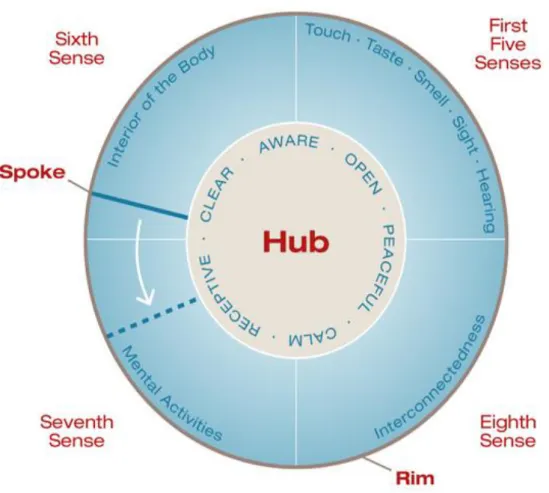
This research, however, focuses on the integration of consciousness and interpersonal integration. This is because the integration of consciousness and interpersonal integration is what the research aims to achieve by applying the wheel of awareness through mindsight in order to address the problems identified by virtual communication. Mindsight provides a practice called the wheel of awareness which seeks to develop the integration of consciousness and interpersonal relationships. Thus, “consciousness is our ability to be aware and have a sense of knowing” (Siegel 2016, pp38). The wheel of awareness (WOA) is a symbol of the mind (see Fig 2.2), the hub representing an open awareness. The wheel spokes symbolize an individual’s attention and focus. Connecting the hub to the rim with the exterior part symbolizes anything the individual can be aware of. This can be anything that is well-known and contained in the consciousness of the person. The imaginary wheel enables the person to categorize their awareness. This is expressed by the wheel hub and the rim of the wheel represents the person’s awareness and consciousness (Baldini, et al. 2014). The WOA involves a commitment to an intended object or impression. Therefore, the interior of the body is what is known as the sixth sense, that is, the awareness of the inner sensations of the body: how the body feels internally. Therefore, when people are aware of their bodies they tend to be more compassionate and have empathy. Research shows that the more people are attuned to themselves, the more they are attuned to others and the more they are compassionate to themselves the more they are compassionate towards others (Siegel, 2010a).
The seventh sense is the awareness of mental activities of thoughts, feelings, attitudes and intentions. All these are the sensations of the 7th sense which is mental activity. People can also observe themselves having the thought, they can also think about the concept of the thought they are having, conceiving the concept of the thought. A person can also have the knowing. Knowing can help them make a decision. The
34
individual, however, must possess the ability to differentiate between sensing and observing and the concept of the thought. These give filters through which rim elements can come into the hub of the WOA (Siegel, 2010a).
The eighth sense is known as interconnectedness awareness. This awareness enable people to see each other as ‘we’. This is what is known as a ‘we map’ which allows people to accept and be aware that they are connected to others. It is a shared interconnectedness. Being aware aids response flexibility. People can move from probabilities to the openness of responses, and then to possibilities (Siegel, 2012). Figure 2.2: The Wheel of Awareness (Siegel 2007)
A compassionate communication between people appreciates their differences and promote their linkages. This fosters an integrated relationship with one other and thus promotes the growth of integrative fibres within the brain. That is why children in an abusive and neglected relationship have impaired growth of their integrated fibres (Siegel, 2010b). The triangle of mind, brain and relationships (see Figure 2.1) can help
35
people to allow themselves to go deeply into the awareness of human realities. Where relationships the brain relate to each other and when the mind is included. Therefore, the mind has a regulatory function in the embodied brain and relationships. When all these are brought together, they produce a coherent mind (Siegel, 2010b).
The next section defines mindfulness, and demonstrates the relationship of mindfulness to communication and its relevance to virtual communication.
“The capacity of the mind to intentionally focus attention, monitor thoughts, feelings and physical sensations and to ultimately direct the flow of energy and information within the triangle of wellbeing-mind, brain, and relationships"(Clinton and Sibcy 2012, p.142).
Mindfulness is defined as a state of consciousness that enhances attention to what is happening within and around an individual (Bryant and Wildi 2008, Boyatzis and Yeganeh, 2012, Baas, et al. 2014, Dane and Brummel 2014) rather than being caught up in past guilt and future worries (Babu 2014). Pavlovich and Corner (2014) describe this as consciousness and consciousness is also similar to awareness (Pavlovich and Corner, 2014). Mindfulness is about being aware of the here and the now, about being linked to experience and enjoying the sense of unity between your mind and body (Collard and Walsh, 2008; Baldini, et al. 2014). It focuses on the mind and tends to reduce distractions that hinder clear observation of what is taking place in the moment. The mind focuses on feelings, intentions and the thinking process (Kull, 2005). The act of in the moment awareness is the backbone of mindfulness (Baldini, Parker, et al. 2014).
The mindfulness approach helps individuals and organisations to attempt to solve problems differently. It also reflects on how they utilize information in the dynamic world around them (Bryant and Wildi, 2008; Ndubisi 2014). From an individual’s perspective Langer (1992) defines mindfulness as an attitude of being consciously aware through active sensitivity. This helps the individual to be open to innovation and conscious to both situation and ideas.
The majority of research on mindfulness is in psychology and education (Gazella, 2005; Valorinta, 2009; Ndubisi, 2014). There is insufficient research and