Copyright belongs to the author. Small sections of the text, not exceeding three paragraphs, can be used provided proper acknowledgement is given.
The Rimini Centre for Economic Analysis (RCEA) was established in March 2007. RCEA is a private, nonprofit organization dedicated to independent research in Applied and Theoretical Economics and related fields. RCEA organizes seminars and workshops, sponsors a general interest journal The Review of Economic Analysis,and organizes a biennial conference:The Rimini Conference in Economics and Finance (RCEF) . The RCEA has a Canadian branch: The Rimini Centre for Economic Analysis in Canada (RCEA-Canada). Scientific work contributed by the RCEA Scholars is published in the RCEA Working Papers and Professional Report series.
The views expressed in this paper are those of the authors. No responsibility for them should be attributed to the Rimini Centre for Economic Analysis.
The Rimini Centre for Economic Analysis
Legal address: Via Angherà, 22 – Head office: Via Patara, 3 - 47900 Rimini (RN) – Italy www.rcfea.org - [email protected]
WP 12-06
Luciano Fanti
University of Pisa, Italy
Nicola Meccheri
University of Pisa, Italy
The Rimini Centre for Economic Analysis (RCEA), Italy
P
ROFITS AND
C
OMPETITION IN A
U
NIONIZED
D
UOPOLY
M
ODEL WITH
P
RODUCT
D
IFFERENTIATION AND
L
ABOUR
Profits and competition in a unionized duopoly model with product
differentiation and labour decreasing returns
Luciano Fanti and Nicola Meccheri
*Department of Economics, University of Pisa, Via C. Ridolfi, 10, I–56124 Pisa (PI), Italy
February 6, 2012
Abstract:
In this paper, we aim at investigating if the conventional wisdom, that an increase of competition linked to a decrease in the degree of product differentiation always reduces firms’ profits, remains true in a unionized duopoly model with labour decreasing returns. In this context, mixed results emerge. In particular, we show that a decrease in the degree of product differentiation may affect wages, hence profits, differently, depending on both the mode of competition in the product market (Cournot or Bertrand competition) and the particular unionization structure (firm-specific or industry-wide union(s)). Interestingly, it is shown that the conventional wisdom can actually be reversed, even if under Bertrand competition only.
Keywords: unionized duopoly, labour decreasing returns, product differentiation, profits
JEL codes: J43, J50, L13
2
1 Introduction
A conventional wisdom in industrial economics suggests that a decrease in the degree of product differentiation always reduces firms’ profits by increasing the intensity of product market competition, irrespective of the fact that firms compete à la Cournot or à la Bertrand in the product market (e.g. Shy 1995, pp. 138-140). The reason behind this result can be understood by referring to the standard differentiated duopoly model, due to Singh and Vives (1984), in which a decrease in the degree of product market differentiation diminishes total demand and induces firms to compete more aggressively under both modes of competition, leading unambiguously to lower firms’ profits. Whilst in the standard Singh and Vives’s (1984) model firms’ marginal production costs are assumed to be constant and exogenously given, the growing literature on unionized oligopolies (see, e.g., the seminal works by Horn and Wolinsky 1988 and Dowrick 1989) relaxes such assumption by admitting that (labour) costs are the outcome of a strategic game played between firms and unions before the former compete between themselves in the product market.
This paper investigates, in a unionized duopoly model, the effects on firms’ profits of an increase in competition linked to a decrease in the degree of product differentiation. In particular, in relation to the unionization structure, we will consider the case of monopoly union that can be either firm-specific or centralized (industry-wide).1 Indeed, a salient dimension that differentiates national
unionization structures is the degree of wage setting centralization (Calmfors and Driffill 1988; Freeman 1988; Layard and Nickell 1999; Flanagan 1999). At the industry level, a decentralized wage setting structure, involving firm-specific unions, is commonly contrasted with a completely centralized one, in which a single industry union sets a standard wage for the entire industry. Particularly, while centralized unions representing all workers in an industry are widespread in Continental Europe, firm-specific unions and decentralized wage setting are largely predominant in UK, North America and Japan (e.g. Iversen 1998; Flanagan 1999).2
Furthermore, we also introduce another important novelty into the analysis by assuming that the production technology exhibits diminishing returns to labour, which also implies increasing marginal costs. Indeed, although the latter hypothesis features as the most common in
1 In the unionized oligopoly literature, the case of monopoly union is adopted, e.g., by Brekke (2004) and
Lommerud et al. (2005).
2 Recent contributions in the unionized oligopoly literature analyze the role of unionization structure
(decentralized vs. centralized) in affecting innovation incentives (Haucap and Wey 2004; Mukherjee and Pennings 2011), incentives for foreign direct investment (Mukherjee and Zhao 2007) as well as profitability and welfare effects of downstream mergers (Brekke 2004; Lommerud et al. 2005; Symeonidis 2010).
3
microeconomic modelling (at least, with reference to the short-run) and is adopted by other strands in oligopoly theory,3 the effects that its introduction produces in a unionized oligopoly framework have so far not been investigated.4
Our main results can be summarized as follows. Even in the presence of labour decreasing returns, when wages are exogenously determined, the standard result that firms’ profits always decrease when competition increases (i.e. the degree of product differentiation decreases) remains valid. However, when unions endogenously fix wages, more mixed results do emerge. In such a case, when product differentiation decreases, another important effect acts in affecting profits, together with the standard competition effect. Furthermore, whilst the latter always operates in reducing profits, the former, that we term endogenous or union wage effect, can affect wages, hence profits, differently, depending on both the mode of competition in the product market and the particular unionization structure. Particularly, when wages are fixed by a central (industry-wide) union and firms compete à la Cournot in the product market, the union wage effect operates in same direction of the standard competition effect, hence it reinforces the latter in reducing profits when competition increases. By contrast, in the other possible cases (that is, Cournot competition with firm-specific unions and Bertrand competition, regardless of the unionization structure) it operates against the competition effect, at least for a certain range of the product differentiation parameter. At the same time, however, we show that, even when the union wage effect operates against the competition effect, the former can outweigh the latter only when firms compete à la Bertrand. Hence, only under this mode of competition in the product market, the conventional wisdom can actually be reversed.
We note that Zanchettin (2006, section 4) also deals with the issue of this paper, i.e. the impact of the degree of product differentiation on equilibrium profits under Cournot and Bertrand competition. In particular, Zanchettin (2006) modifies the Singh and Vives’s (1984) original framework by allowing for a wider range of cost and demand asymmetry between firms, and finds that, under both modes of competition, the efficient firm’s profit and industry profits as a whole can
3 See, e.g., White (1996) for mixed oligopoly models (De Fraja and Delbono 1990) and Perry and Porter
(1985) and Heywood and McGinty (2007) in relation to the “merger paradox” in oligopolies.
4 An exception is Fanti and Meccheri (2011) in which decreasing returns to labour have been introduced in a
unionized duopoly model in order to compare profits under Cournot and Bertrand competition. In particular, it is shown that decreasing returns tend to reinforce the mechanisms that contribute to the “reversal result” (i.e. higher profits under Bertrand instead of under Cournot competition), making this event possible for a wider range of situations, with respect to those identified by the previous literature (Correa-López and Naylor 2004).
4
decrease with the degree of product differentiation.5 Our paper differs from Zanchettin (2006) mainly because we relax the Singh and Vives’s standard assumptions by introducing, instead of the presence of asymmetric firms, the role of unions and labour decreasing returns into the analysis. As a consequence, our results and the mechanisms behind them are different. Indeed, our findings have to be mainly ascribed to the interaction between modes of competition, decreasing returns to labour and unionization structure, which is clearly absent in Zanchettin (2006).
The remaining part of the paper is organized as follows. Section 2 describes the basic model and characterizes Cournot and Bertrand equilibria under exogenous wages. Section 3 introduces the role played by (firm-specific and central) unions in determining wages into the analysis. Main results on the relationship between the degree of product differentiation (or market competition) and profits under different modes of competition and unionization structures are presented and discussed in Section 4. Finally, Section 5 concludes.
2 Model
We consider a model of differentiated product market duopoly, in which each firm sets its output, given pre-determined wages, to maximize profits. Preferences of the representative consumer are given by: (1) ! U(qi, qj) = "(qi + qj)# qi 2 + 2$qiqj + q2j
(
)
2where qi and qj denote outputs by firm i and j (i, j = 1, 2, i≠ j), respectively, α > 0, and γ∈ (0, 1)
denotes the extent of product differentiation, with goods assumed to be imperfect substitutes. In particular, notice that if γ would be equal to 1, the products of the two firms would be
undifferentiated, hence firms compete in the same market. At the other extreme, if γ would be equal
to 0, a monopoly would apply in this market. Hence, the higher γ, the higher the degree of
competition in the product market. The derived product market demand for the representative firm i
is linear and given by: (2)
!
pi(qi, qj) = " # $qj # qi .
5 Zanchettin’s (2006) main focus is, however, comparing Bertrand and Cournot equilibria in a differentiated
5
Let assume that only labour input is used for production. As already discussed in the Introduction, another literature’s standard assumption is that labour exhibits constant returns, which implies firms face constant marginal costs. In this paper, instead, we modify such hypothesis by introducing labour decreasing returns. In particular, we assume the following production technology: (3) ! qi = li where !
li =qi2 represents the number of workers employed by the firm i to produce q
i output units
of the variety i. The choice of such specific technology, described by the functional form of (3), allows for analytical results and also implies that firms have quadratic costs, which is a typical example of increasing costs in the literature.
Hence, the firm i’s profit can be written as:
(4)
!
"i =piqi#wiqi 2
where wi is the per-worker wage paid by firm i, with wi < α. In what follows, we will consider the
benchmark cases, in which wages are exogenously given for firms. In Section 3, instead, we will introduce the role of unions in determining wages into the analysis.
2.1 Cournot competition with exogenous wages
Taking (2) and (4) into account, profit-maximization under Cournot competition leads to the following firm i’s best-reply function in the output space:
(5)
!
qi(qj)= " # $qj 2(1+wi).
As γ > 0, the best-reply functions are downward-sloping, that is, under the Cournot
assumption, the product market game is played in strategic substitutes. From (5), and its equivalent for firm j, we can obtain the firm i’s output for given wi and wj as:
6 (6) ! qi(wi,wj)= "
[
2(1+wj)#$]
4(1+wi)(1+wj)#$ 2and, by substituting (6) in (4), the firm i’s profit as: (7) ! "i(wi,wj)= #2(1+wi)
[
$%2(1+wj)]
2 4(1+wi)(1+wj)%$ 2[
]
2 .By assuming exogenous wages, we have
!
wi=wj =w , hence, by substituting in (6) and (7), we get, respectively: (8) ! qi =qj =qC = " 2(1+w )+# (9) ! "i ="j ="C = # 2(1 +w ) 2(1+w )+$
[
]
2which represent the equilibrium output and profit, respectively, with exogenous wages and where the subscript C recalls that they are obtained under Cournot competition in the product market. As regards the object of this paper, it is easy to see from (9) that profit is positively correlated with the degree of product differentiation (which is decreasing in γ) or, in other words, is negatively
correlated with the degree of market competition (which is increasing in γ). 2.2 Bertrand competition with exogenous wages
We consider now the case in which the product market game is characterized by price-setting behavior by firms, i.e. competition occurs à la Bertrand. From (2) and its counterpart for the firm j, we can write product demand for the firm i as:
(10)
!
qi(pi,pj)=
"(1#$)#pi+$pj
(1#$2)
hence, using (4), the firm i’s profit is given by:
(11) ! "i =pi #(1$%)$pi+%pj (1$%2) & ' ( ) * + $wi #(1$%)$pi+%pj (1$%2) & ' ( ) * + 2 .
7
From (11), the first-order condition for profit-maximization gives the firm i’s price choice, as a function of the price chosen by the firm j, as:
(12) ! pi(pj)= 1+2wi"#2
(
)
[
$(1"#)+#pj]
2(1+wi"# 2 )thus, for γ > 0, the Bertrand product market game is played in strategic complements. By
substituting in (12) the corresponding equation for the firm j and solving for pi, we get the Bertrand
equilibrium price for given wages, wi and wj:
(13) ! pi(wi,wj)= " 1+2wi#$ 2
(
)
[
2(1+wj)#$(1+$)]
4(1+wi)(1+wj)+$2[
$2#2(wi+wj)#5]
.Hence, by substituting in (10), we get the sub-game perfect output as a function of wages as:
(14)
!
qi(wi,wj)= "
[
2(1+wj)#$(1+$)]
4(1+wi)(1+wj)+$2
[
$2#2(wi+wj)#5]
and, by using (13) and (11), the firm i’s profit as:
(15) ! "i(wi,wj)= # 2 2(1 +wj)$%(1+%)
[
]
2(
1+wi$%2)
4(1+wi)(1+wj)$%2[
2(wi+wj)+5$%2]
[
]
2.Again, by assuming exogenous wages, we have
! wi =wj =w , hence, by substituting in (14) and (15), we get: (16) ! qi =qj =qB = " 2(1+w )+#(1$#) (17) ! "i ="j ="B = # 2 1+w $%2
(
)
2(1+w )+%(1$%)[
]
2which represent the equilibrium output and profit, respectively, with exogenous wages and where the subscript B recalls that it is obtained under Bertrand competition in the product market. Note
8
that, as in the Cournot case, it is easy to check from (17) that profit is clearly positively correlated with the degree of product differentiation, i.e. equilibrium profit decreases when competition between firms increases.
3 The unionized duopoly
A common feature of the standard literature is that it implicitly assumes that the input markets are perfectly competitive, thus ignoring a possible role of the input markets in determining the relationship between profits and the degree of market competition (i.e. product differentiation). In many cases, however, such assumption does not properly represent real world situations. For instance, labour markets are often unionized and an increasing literature on unionized oligopoly has been recently developed (e.g. Horn and Wolinsky 1988; Dowrick 1989; Naylor 1998, 1999; Correa-López and Naylor 2004; Brekke, 2004; Lommerud et al. 2005; Correa-Correa-López 2007). In this section, we join such literature by admitting that labour cost is no longer exogenously given for firms, but it is the outcome of a strategic game played between each firm and a labour union. Firm’s and union’s behaviour incorporates two stages of decision. Decisions are taken at each stage anticipating the outcome of subsequent stages.
Following the backward induction logic, in stage 2, as already analyzed in Section 2, each firm decides, according to the product market competition regime, its optimal level of output, hence, given the technology, of factor inputs and the input price (i.e. the wage) as determined in the prior stage. In stage 1, instead, a monopoly union fixes wages. As well known, union objectives are not necessarily dominated by wages. In particular, in order to derive tractable results for wage determination, we assume – following many other works (e.g. Pencavel 1985; Dowrick and Spencer 1994; Petrakis and Vlassis 2000) – that the union i’s utility takes the Stone-Geary functional form
!
Vi=(wi"w°)#l
i, where w° is the reservation wage that, for simplicity, we normalize to zero (w° =
0),6 while
θ > 0 is a parameter that represents the degree of the union’s orientation towards wages,
with respect to employment. In particular, a value of θ = 1 gives the rent-maximizing case, whilst
smaller θ’s values imply that the union is less concerned about wages and more concerned about
employment. Furthermore, as well known, unionization structure may differ significantly around the world. In this paper, we will concentrate our attention on two alternative unionization structures: a) firm-specific unions; and b) central union.
9
3.1 Firm-specific unions
When there are firm-specific unions, each of them concerns only about wages and employment of its own firm. Hence, recalling production technology given by (3), in this case the union i’s utility is given by: (18) ! Vi=w"iq i 2.
Since both firms are unionized, each union’s choices take place simultaneously across firms, taking the other firm’s wages as given. Hence, by substituting (6), for the Cournot case, and (14), for the Bertrand case, in (18) and maximizing with respect to wi, we get, according to the type of
competition in the product market, the sub-game perfect best-reply function in relation to the wage,
wi(wj), as, respectively: (19) ! wi(wj)C = " 4(1+wj)#$ 2
[
]
4(2#")(1+wj) (20) ! wi(wj)B =" 4(1+wj)+# 2 (#2$2wj$5)[
]
2(2$") 2(1[
+wj)$#2]
.In symmetric sub-game perfect equilibrium wi = wj = w, hence, from (19) and (20),
equilibrium wages in different competitive contexts are given by, respectively:
(21) ! wCFS =2(" #1)+ $ 2 "(" #2)+4 2(2#") (22) ! wBFS =(" #1)(2#$ 2) + $2
[
$2+"(" #2)#4]
+4 2(2#")where the apex FS recalls that they are obtained with firm-specific unions.
Finally, in order to derive explicit equilibrium solutions for firms’ profits, we use (21), (22), (9) and (17) and obtain:
(23) ! "C FS = #2(2$%) 2
[
+ &2%(% $2)+4]
2 2[
+&(2$%)+ &2%(% $2)+4]
210 (24) ! "B FS =
#2(2$%) 2
[
+&2(%$3)+ &2[
&2+%(%$2)$4]
+4]
2 2[
+&(
2$&$%)
+ &2[
&2+%(%$2)$4]
+4]
2 .
3.2 Central (industry-wide) union
We consider now the case in which workers are organized in one industry-wide union. In such a case, since the central union takes industry employment as a whole (li + lj) into account and fixes a
single (uniform) wage for both firms in the industry (wi = wj = w), its utility (recalling (3))
becomes:7 (25) ! V =w"(q i 2 +q2j).
By substituting (6) and (14) in (25) and maximizing with respect to w, we get the central union’s optimal wage, according to the type of competition in the product market, as, respectively:
(26) ! wC C ="(2+#) 2(2$") (27) ! wBC ="
[
2+#(# $1)]
2(2$")where the apex C recalls that they are obtained with a central union.
Finally, by using (26), (27), (9) and (17), we can get, for this case, equilibrium profits as, respectively: (28) ! "CC =# 2 (2$%)(4+&%) 8(2+&)2 (29) ! "BC =# 2(2 $%) 4
[
$&(4$%)]
8(1+&)(2$&)2 .7 Also notice that since, is such a case, there is only one union in the market, we do not need to denote its
11
Before turning to analyze the profits’ behaviour according to degree of product market competition (i.e. product differentiation) in different contexts, we note that, as expected, wages increase with the wage-orientation parameter θ under both Cournot and Bertrand competition and
with both firm-specific and central union(s) (see (21), (22), (26) and (27)). Moreover, wages are (strictly) positive for θ < 2. Hence, in order to preserve the economic meaningfulness of the model, in what follows we will admit that, and concentrate our analysis on the case with, θ∈ (0, 2).
4 Product market differentiation, competition and profits
Basing on previous analysis, in this section, we are able to answer to the following issue: do the standard results with exogenous wages described in Section 2, that increasing competition (i.e. passing from product full differentiation to no differentiation) always decreases profits, holds true in the presence of unions in the labour market? In what follows, we will argue that, if unions are sufficiently wage-interested, the answer to the question is negative. Furthermore, we will also show that both the type of competition in the product market and the particular nature of union’s structure play a role in answering to that question.
In order to deeply analyze the issue, consider first that when, e.g., the degree of product market differentiation decreases, hence product market competition increases, two distinct effects affect firms’ profits. On the one hand, a direct effect of increasing market competition, which is clearly profit-reducing (we label this effect as “competition effect”). On the other hand, when wages are endogenously determined, there is also an indirect effect operating via wages (that we term “endogenous or union wage effect”) and its role in affecting profits is not clear-cut.
In particular, when wages are exogenously given, the derivative of w with respect to γ is obviously zero, hence the endogenous wage effect is null. In such a case, only the standard competition effect operates and, as already discussed in Section 2, we get the result that, regardless of the mode of competition in the product market, profits always decrease with increasing competition.
However, when unions endogenously fix wages,
!
"w "# is no longer zero (see (21), (22) and (26), (27)). Moreover, if the endogenous wage effect is positive and dominates the competition effect, the conventional finding on profits behaviour according to degree of product market competition may be reversed. Obviously, for such a result realizes, a crucial role is played, firstly, by how wages react to changing γ. Hence, we begin by presenting some preliminary results as
12
regards the wage setting behaviour under alternative unionization structures, as well as the resulting relationships between wages and the degree of product differentiation.
Lemma 1. Under both Cournot and Bertrand competition, a central union always sets higher wages than a firm-specific union.
Proof. Lemma 1 straightforwardly follows from the comparison between equilibrium wages with firm-specific unions and central union ((21) with (22) and (26) with (27)):
! "wC =wCFS#wCC =#2+$% # $ 2 %(% #2)+4 2(2#%) <0, ! "#$(0,1) and % $(0,2) ! "wB =wBFS#wBC =#2($ 2 %+1)#$($+%)# $2
[
$2+%(% #2)#4]
+4 2(2#%) <0, ! "#$(0,1) and % $(0,2). □For a better understanding of the Lemma 1,8 it is worth remarking which are the main differences between firm-specific and central unions’ behavior. A firm-specific union only takes care of employment at its own firm. Hence, in wage setting, unions tend to undercut each other in order to capture a larger fraction of the overall employment for their own firm. A central union, instead, takes care of total employment at the industry-wide level, which reduces the tendency to undercut wages. Therefore, we can claim that reducing inter-union competition in the labour market produces an higher wage, as stated by Lemma 1.
Lemma 2. Under both Cournot and Bertrand competition, when competition increases (i.e. product differentiation decreases), the wage chosen by a firm-specific union decreases.
Proof. By differentiating (21) and (22) with respect to the degree of product differentiation γ, we get: ! "wCFS "# =$ #% 2 #2%(% $2)+4 <0, ! "#$(0,1) and % $(0,2)
8 Notice that Lemma 1 extends the well-known result by Horn and Wolinsky (1988, Prop. 1) to the
13 ! "wBFS "# = # $($ %2)+2#2 %4+2(1%$) #2
[
#2+$($ %2)%4]
+4[
]
2(2%$) $($ %2)+2#2 %4+2(1%$) #2[
#2+$($ %2)%4]
+4[
]
<0, ! "# $(0,1) and %$(0,2). □Lemma 3. While under Cournot competition the wage chosen by a central union always increases when market competition increases (i.e. product differentiation decreases), under Bertrand competition the relationship between the wage chosen by a central union and the degree of market competition is “humped”: the wage increases (decreases) with increasing competition depending
on whether the product differentiation parameter is lower (higher) than ½.
Proof. By differentiating (26) with respect to the degree of product differentiation γ, we get:
! "wCC "# = $ 2(2%$)>0, ! "#$(0,2).
Instead, by differentiating (25) with respect to the degree of product differentiation γ, we get: ! "wBC "# = $(1%2#) 2(2%$) > <0&# < >0.5, ! "# $(0,2). □
Lemmas 2 and 3 are not trivial and deserve some more comments.9 Indeed, the reason why, when product market competition increases, results change according to the mode of competition and/or to the unionization structure could not appear straightforward. In order to explain the intuition behind the previous findings, recall, firstly, that higher wages always imply lower output (i.e. employment), irrespective of whether unions are centralized or firm-specific, as well as whether firms compete à la Cournot or à la Bertrand. However, in alternative scenarios employment adjusts differently to wage changes, also depending on the degree of product differentiation. In particular the trade-off between employment at the firm level and wage claims is more or less intense depending on the level of product differentiation.
9 The arguments that follow are based on analytical investigations that, for sake of space, are omitted and are
14
Moreover, the direction of the relationship between the intensity of the trade-off and the product differentiation degree depends on whether the union structure is centralized or decentralized. In the latter case, the higher the degree of substitutability, the more likely the response of the labour demand to increasing wages is negative. As a consequence, firm-specific unions dampen their wage claims irrespective from the competition regime in the product market.
By contrast, under a centralized union, the relationship between the intensity of the trade-off and the product differentiation degree depends crucially on the mode of competition.10 Under Cournot, the negative effect of increasing wages on employment increases when competition (products substitutability) decreases. This means that lower degrees of competition dampen wage claims and this is in stark contrast with the case of decentralized unions. Under Bertrand competition, instead, an increase in competition plays the role to “amplify” (“dampen”) the negative effect of wage increases on the employment when the outstanding degree of product differentiation is sufficiently high (low). This implies that an increase of product substitutability is associated to relatively higher (lower) wage claims when product differentiation is high (low).11
To sum up, the above arguments imply that in the case of Cournot competition and central union a fiercer product competition (a higher γ) reduces profits more than in the case with exogenous wages. This is because the “union wage effect” adds to the standard competition effect. By contrast, in all other cases such effects operate one against the other in affecting profits. However, which effect is able to outweigh the other needs to be investigated more in detail.
Result 1 [Cournot & firm-specific unions]. Under Cournot competition, firm-specific unions and labour decreasing returns, firms’ profits always decrease for increasing market competition (i.e. decreasing product differentiation).
Proof. Define
!
A" #2$($%2)+4. By differentiating (23) with respect to the degree of product differentiation γ, we get:
10 It is worth noting that, due to the presence in this context of decreasing returns to labour, such results are at
odds with the well-known “wage rigidity result” (Dhillon and Petrakis 2002), according to which a monopoly central union always charges the same wage independently from the regime and the degree of competition in the product market.
11 These opposite effects depend crucially on the fact that under Bertrand competition and decreasing returns
15 ! "#C FS "$ =% &2(2%')2
[
2(2+A)(2%')(A+$')+$'[
2+(2%')$+A]
]
2A[
2+$(2%')+A]
3 <0, ! "# $(0,1) and %$(0,2). □Hence, when firms compete à la Cournot in the product market, the endogenous wage effect that, with firm-specific unions, operates in reducing the wage when γ increases, is not sufficiently strong (with respect to the competition effect) to overturn the standard result according to which profits decrease with increasing competition.
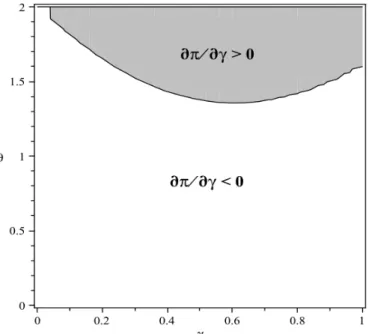
Result 2 [Bertrand & firm-specific unions]. Under Bertrand competition, firm-specific unions and labour decreasing returns, provided that unions are sufficiently more wage- than employment-oriented, there exist a range for γ∈ (0,1) for which firms’ profits increase with γ.
Unfortunately, the nonlinearity of the expression for firms’ profit under Bertrand competition (see (24)) prevents us from using algebraic methods to derive a formal proof of Result 2. However, we can refer to numerical simulations, which are graphically illustrated by Figure 1 below, to provide a confirmation of such result.
Fig. 1. Bertrand competition and firm-specific unions: profits’ behavior according to γ in {γ-θ} space
16
Indeed, in Figure 1 a graphical analysis of Result 2 is provided, by plotting as profits (related to the case under discussion) behave as a function of γ (∂π/∂γ) for different γ-θ pairs and for
a selected value of α(α= 2).12 In particular, the pairs belonging to the grey (white) area imply that
profits increase (decrease) as the degree of product differentiation increases (i.e. competition in the product market increases). Hence, from the figure it clearly emerges that if θ is sufficiently low we get the conventional result that profits always decrease when product differentiation decreases (i.e. competition increases). However, starting from a given threshold for θ the “reversal result” begins to apply and, as θ increases, the range for γ ∈ (0,1) for which profits increase with competition
becomes larger and larger.
Result 3 [Cournot & central union]. Under Cournot competition, central union and labour decreasing returns, firms’ profits always decrease for increasing market competition (i.e. decreasing product differentiation).
Proof. By differentiating (28) with respect to the degree of product differentiation γ, we get:
!
"#CC "$ =
%2
[
&[
12'$(2'&)'2&]
'16]
8(2+$)3 <0,!
"# $(0,1) and %$(0,2).□
Notice that Result 3 was expected a fortiori, since, in this case, we knew from Lemma 3 that, when product differentiation decreases, the endogenous wage effect strengthens the standard competition effect in reducing profits.
Result 4 [Bertrand & central union]. Under Bertrand competition, central union and labour decreasing returns, firms’ profits increase for increasing market competition (i.e. decreasing product differentiation), provided that the central union is rather wage-oriented, that is for θ> 1.6, and γ is higher than a given threshold, which (negatively) depends on θ.
Proof. By differentiating (29) with respect to the degree of product differentiation γ, we get:
! "#BC "$ = %2(2&')B 8(1+$)2(2 &$)3 , ! "# $(0,1) and %$(0,2), 12 Notice that
αdoes not affect the sign of
!
"#B FS
17 where ! B"8
[
#(1$#)$1]
+% #[
(1+2#)+2]
. It follows that: ! "#B C "$ > <0%B > <0 , ! "# $(0,1) and %$(0,2).By recalling Lemma 3, the necessary condition for profits to be increasing with γ is that γ > 0.5. Furthermore, for any given γ, the value of B depends on θ. In particular, by solving B with respect to θ, we get: ! "#B C "$ > <0%B > <0%& > <& = 8 1
[
'$(1'$)]
$(1+2$)+2 , ! "#$(0,1) and % $(0,2). Notice that, if γ = 0.5, ! " =2 while, if γ → 1, !" #1.6. Hence, considering that B is always increasing in θ and increasing in γ for any
!
"#(1.6, 2), we have that, for any
! "#(1.6, 2), there will be a ! "(#)$(0.5, 1), such that: ! "#BC "$ > <0%B > <0%$ > <$(&) , ! "# $(0,1) and %$(1.6,2). □
Fig.2. Bertrand competition with central (vs. firm-specific) union: profits’ behaviour according to γ in
18
Figure 2 above provides a graphical illustration of Result 4 (similarly to the case of firm-specific unions, represented in Figure 1, α does not affect the sign of
!
"#B C
"$ and it has been set
equal to 2). In particular, the γ-θ pairs for which the reversal result applies under Bertrand
competition and central union are those located in the top-right corner of the box, which is delimitated by the solid curve and where both γ’s and θ’s values are sufficiently large. Moreover,
the higher the weight the central union places on wages (with respect to employment), the larger the range of γ’s values for which the unconventional result holds true. In particular, when θ is only
slightly higher than 1.6, profits increase with competition only if γ is very close to one, while if θ is
approaching to 2, this unconventional result already applies as soon as γ exceeds 0.5.
Finally, also notice that if we compare the range of γ-θvalues for which the reversal result
applies with central union and firm-specific unions, respectively, it arises that in the former case the unconventional result may occur but with a lower probability, as well as a lower “intensity”, than in the latter. This clearly appears in Figure 2 where the range of values for which the reversal result applies with central union is a subset of that (delimitated by the dotted curve taken from Figure 1) for which it occurs under firm-specific unions.
5 Concluding remarks
In this paper we have investigated if the conventional wisdom, that an increase in the degree of competition linked to a decrease of product differentiation always reduces firms’ profits, remains true in a unionized duopoly model with labour decreasing returns. In this context, mixed results have arisen. This is because, when product differentiation decreases and competition becomes fiercer, further than the standard competition effect (that always tends to reduce profits), another effect, which indirectly operates via wages, affects profits. Furthermore, this indirect effect, that we have termed endogenous or union wage effect, operates differently over wages, hence over profits, depending on both the mode of competition in the product market (i.e. competition in quantities or in prices) and the particular unionization structure (i.e. industry-wide or firm-specific unions). In this regard, the following table summarizes our main findings by showing the sign of different effects of decreasing product differentiation (or increasing competition) on profits and suggesting that, only under Bertrand competition, the endogenous wage effect may outweigh the competition effect, hence reversing (for some degree of product differentiation) the conventional wisdom.
19 Competition mode Unionization structure Competition effect
Union wage effect (on profits) Total effect Firm-specific – + – Cournot Central – – – Firm-specific – + +/– Bertrand Central – +/– +/–
Tab. 1. Effects of increasing competition (decreasing product differentiation) on profits
To sum up, the essential message deriving from this work is that, under decreasing returns to labour and sufficiently wage-oriented unions (regardless of whether centralized or decentralized), fiercer product market competition (linked to a decrease of the degree of product differentiation) and profits may be, unexpectedly, positively linked when firms compete in prices. Instead, if firms compete in quantities, then the conventional wisdom cannot be reversed.
References
Brekke, K.R., 2004, “Competition or Coordination in Hospital Markets with Unionised Labour,”
International Journal of Health Care Finance and Economics, 4, 65-89.
Calmfors, L., and Driffill, J., 1988, “Centralisation and Wage Bargaining”, Economic Policy, 6, 13-61.
Correa-López, M., 2007, “Price and Quantity Competition in a Differentiated Duopoly with Upstream Suppliers, Journal of Economics & Management Strategy, 169, 469-505.
Correa-López, M. and Naylor, R.A., 2004, “The Cournot–Bertrand Profit Differential: A Reversal Result in a Differentiated Duopoly with Wage Bargaining,” European Economic Review, 48, 681-696.
De Fraja, G., and Delbono, F., 1990, “Game-Theoretic Models of Mixed Oligopoly,”, Journal of
Economic Surveys, 4, 1-17.
Dowrick, S.J., 1989, “Union-Oligopoly Bargaining,” Economic Journal, 99, 1123-1142.
Dowrick, S.J. and Spencer, B.J., 1994, “Union Attitudes to Labor-Saving Innovation: When Are Unions Luddites,” Journal of Labor Economics, 12, 316-344.
20
Fanti, L. and Meccheri, N., 2011, “The Cournot-Bertrand profit differential in a differentiated duopoly with unions and labour decreasing returns”, Economics Bulletin, 31, 233-244.
Flanagan, R.J., 1999, “Macroeconomic Performance and Collective Bargaining: An International Perspective”, Journal of Economic Literature, 37, 1150-1175.
Freeman, R., 1988, “Labour Markets”, Economic Policy, 6, 63-80.
Haucup, J. and Wey, C., 2004, “Unionisation Structures and Innovation Incentives,” Economic
Journal 114, 149-165.
Heywood, J.S., and McGinty, M., 2007, “Convex Costs and the Merger Paradox Revisited,”
Economic Inquiry 45, 342-349.
Horn, H. and Wolinsky, A., 1988, “Bilateral Monopolies and Incentives for Merger,” RAND
Journal of Economics, 19, 408-419.
Iversen, T., 1998, “Wage Bargaining, Central Bank Independence and the Real Effects of Money,” International Organization, 52, 469-504.
Layard, R. and Nickell, S., 1999, “Labor Market Institutions and Economic Performance,” in Ashenfelter, O.C. and Card, D., (eds.) Handbook of Labor Economics, 3A, Amsterdam: North Holland.
Lommerud, K.E., Straume, O.R. and Sørgard, L., 2005, “Downstream Merger with Upstream Market Power,” European Economic Review, 49, 717-743.
Mukherjee, A. and Zhao, L., 2007, “Unionization Structure and the Incentives for Foreign Direct Investment,” Discussion Paper Series 202, Research Institute for Economics & Business Administration, Kobe University.
Mukherjee, A. and Pennings, E., 2011, “Unionization Structure, Licensing and Innovation,”
International Journal of Industrial Organization 29, 232-241.
Naylor, R.A., 1998, “International Trade and Economic Integration when Labour Markets Are Generally Unionised,” European Economic Review, 42, 1251-1267.
Naylor, R.A., 1999, “Union Wage Strategies and International Trade,” Economic Journal, 109, 102-125.
21
Pencavel, J., 1985, “Wages and Employment under Trade Unionism: Micro-economic Models and Macroeconomic Applications,” Scandinavian Journal of Economics, 87, 197-225.
Perry, M., and Porter, R. H., 1985, “Oligopoly and Incentive for Horizontal Merger,” American
Economic Review 75, 219-227.
Petrakis, E. and Vlassis, M., 2000, “Endogenous Scope of Bargaining in a Union-Oligopoly Model: When will Firms and Unions Bargain over Employment?,” Labour Economics, 7, 261-281.
Shy, O., 1995, Industrial Organization: Theory and Application, Cambridge MA: MIT Press. Singh, N. and Vives, X., 1984, “Price and Quantity Competition in a Differentiated Duopoly,”
RAND Journal of Economics, 15, 546-554.
Symeonidis, G., 2010, “Downstream Merger and Welfare in a Bilateral Oligopoly,” International
Journal of Industrial Organization 28, 230-243.
White, M.D., 1996, “Mixed Oligopoly, Privatization and Subsidization,” Economics Letters, 53, 189-195.
Zanchettin, P., 2006, “Differentiated Duopoly with Asymmetric Costs,” Journal of Economics &