Automatic vs. conventional feeding systems in robotic milking
dairy farms: a survey in The Netherlands
Carlo Bisaglia
1*, Zacharie Belle
2, Gijsbert van den Berg
2,3, Johanna C.A.M. Pompe
21CRA-ING, Laboratory of Treviglio, via Milano 43, 24047Treviglio (BG), Italy 2Wageningen University, Farm Technology Group, Droevendaalsesteeg 1, 6708 PD
Wageningen, The Netherlands
3CAH Dronten University of Applied Sciences, De Drieslag 1, 8251 JZ Dronten, The
Netherlands
*Corresponding author. E-mail: [email protected]
Abstract
Automatic feeding (AF) systems for totally or partially mixed rations (TMR or PMR) are expected to reduce labour demand and stimulate cows’ activity promoting visits to both the feeding devices and the automatic milking (AM) system. AF’s have recently been introduced in commercial dairy farms and little experience is available. Objective of this paper was to identify differences in the lay-out of the barns and operation of the feeding systems between early adopters of automatic feeding systems (AF) as compared to farmers with conventional feeding systems (CF). We surveyed 22 dairy farms in the Netherlands that were all using automatic milking systems. 54.5% of these farms fed their milking cows with an AF system while 45.5% used a conventional feeding system. The herd sizes were similar for the two groups of AF and CF farms as were the milk production while the number of cow groups was higher in the AF farms. The feeding alleys in the AF farms were narrower (2.7 m) compared to those in the CF ones (5.3 m), while the average number of cows per feeding place was similar (1.0 for the AF farms compared with 0.9 for the CF). The most striking differences were related to the feeding distribution pattern, the feeding frequency and the feeding intervals. 80% of the farms with CF distributed the feed once per day while the number of feed push ups for those farms was 3.5 1.6 times day-1. The AF farms distributed the feed 7.8 2.0 times day-1 with intervals between feedings of 3.1 0.9 hours and with automatic push ups of the feed. The farmers who fed with automatic feeding systems were positive about their overall performance, especially about the management aspects. The query revealed a decrease in labour requirement for feeding from 33.2 s cow-1 day-1 with CF to 16.4 s cow-1 day-1 with AF.
Keywords: dairy, barn design, feeding, milking, automation.
1. Introduction
Increasing labour cost and herd sizes have led to significant interest in the use of automation. In dairies, automatic milking (AM) systems have been available commercially since the beginning of the 90s and have gained a large popularity across the developed countries (de Koning, 2010). Most recently, the concept of precision dairy farm has been introduced thanks to the availability of sensor-based management tools that define animal needs, and robotic equipment that automatically delivers individual cow management applications (Bewley, 2010). However, automation of feeding dairy cows has been limited to the delivery of some components of the ration such as concentrates or forages.
Since the beginning of 2000, automatic feeding (AF) systems for total or partial mixed rations (TMR or PMR) have been developed (Hollander et al., 2005), but commercial farms have only shown interest in the technology since the last 5-6 years. The primary difference between conventional feeding (CF) systems for TMR or PMR and AF systems is that with AF the farmer is not directly involved in feed preparation and delivery, and the feed delivery is programmable, which makes it easy to increase the feeding frequency.
Few studies have investigated this technology; most report the possibility of reducing human labour or making the work schedule more flexible. Pompe et al. (2007) and Belle et al., (2012) investigated the effects of the combination of AM and AF systems on cow behaviour. No information was found on typical characteristics of AF systems and barn lay-out as applied by practicing farms.
The Netherlands - with more than 2000 AM farms - is the country with the largest number of AM farms in north-western Europe (de Koning, 2010). The first AF systems were introduced in 2004 and the installation of this technology was adopted by about 50 farms in 2010 (A. de Leeuw, DeLaval, Steenwijk, The Netherlands; personal communication, 2010). According to a recent survey (Bisaglia et al., 2010) three manufactures of AF systems (about 18% of the overall worldwide) are established in the Netherlands and Dutch farmers expect to grow in herd size (more than 5% in the coming five years) and farm investments (more than 2000 € cow-1 within the next 12 months) (Lassen et al., 2010). These conditions provided a sound base for the objective of our study: to identify changes in the features of barn lay-out and feeding systems by early adopters of automatic feeding systems as compared to farmers with conventional feeding systems in the Netherlands.
2. Materials and methods
To identify these features we conducted a survey between December 2009 and February 2010 involving 22 Dutch dairy farms. The farms where identified with the cooperation of the manufacturers of both AM and AF systems; main criteria were that the whole group of farms had to milk cows automatically and that any of the AF systems had to be applied by at least two farms. The farms were divided into two groups where the first one (n=12) utilized automatic feeding systems (the AFS farms), while the second group (n=10) had AM systems and conventional feeding systems (the CFS farms). The survey was conducted in-person to each farm by means of a questionnaire. During the interviews, which lasted about 2 h, the following information was obtained: i) farm characteristics, ii) feeding systems, iii) feeding strategies, iv) barn lay-out and v) management and economic aspects. After the interview we observed the feeding systems in operation during one distribution of the ration in order to classify the technology following a method proposed by Bisaglia et al. (2010) for the AF systems and by Kammel (1998) for the CF systems.
3. Results
3.1. Farm characteristics
The farm characteristics of the CFS and AFS farms with respect to the cultivation plan and herd size were found to be similar, but the crop area showed differences. Grass, maize and other forage crops represented, in this order, the main crops and were similar for the two groups of farms (respectively 77, 20 and 3% of the useable agricultural area for the AFS farms and 73, 22 and 5% for the CFS farms). The average crop area was 84.4 ha for the AFS farms and 55.0 ha for the other ones. The average number of dairy cows was 88.9 lactating cows in the AFS farms and 88.2 in the CFS ones, while the cow/AM-stall ratio was 41.6 for the AFS farms and 42.4 for the CFS ones. The breed at 85% of all participating farms was Holstein Friesian; farms with automatic feeding systems produced 8900 kg cow-1 year-1 compared to the partially automated farms that produced 8705 kg cow-1 year-1. Top milk yields (10.000 kg cow-1 year-1) were found in 17% of the AFS farms and in the 10% of the CFA ones.
3.2. Feeding systems
The most striking differences in the two surveyed groups were related to the feeding systems. Four manufacturers of AF devices were included in the study. Their entire systems featured rail suspended feeders or mixer-feeder wagons, electric powered, with nominal
volume ranging from 3.0 to 4.0 m3 (av. 3.2 m3) that were filled, on average, at 55% of their capacity. They delivered feed with an average frequency of 7.8 times per day (see below), so that they prepared 13.7 m3 of feed daily. This corresponds to a ratio of 6.1 cows fed per cubic metre.
The AF systems comprised either stationary mixers or mechanic temporary storages for roughages and concentrates. These mixers or storages must be sheltered to prevent spoilage of the feedstuffs. The farmers loaded them with the various feedstuffs.
80% of the CFS farms delivered a TMR or PMR by mixer-feeder wagons (MFWs). The remaining 20% of these farms offered single ration components by means of a self-loading wagon, a block cutter or a front loader mounted on a tractor. The nominal volume of the MFWs ranged from 8 to 20 m3 (average 14 m3) - following the herd size and the feeding frequency - which corresponds to a ratio of 6.3 cows per cubic meter fed. All MFWs in the study featured a vertical auger mixing system with 1 or 2 augers. Table 1 summarizes the main features of the feeding systems at the AFS and CFS farms in the study.
TABLE 1: Summary of the average feeding mechanization features for AFS and CFS farms
Parameter Feeding system
AFS CFS
Capacity of feeder wagon (m3) 3.2 14.0
Feeding frequency (No. day-1) 7.8 1.4
Feeding ratio (cow m-3) 6.1 6.3
3.3. Feeding strategies
The two groups of farms adopted the same approach with respect to the ration composition but very different feeding strategies. The majority of the farms (56% of the whole group of 22 farms) provided only one ration to the lactating cows grouped in one group; the single group arrangement was more frequent in the AFS farms (67%) compared to the CFS ones (40%); only 13% of the surveyed farms formed 3 groups but, in this case, the higher frequency was recorded for the AFS group (17% vs. 10%). We recorded 7 different types of roughages and 6 different types of concentrates but the ones used for ration composition ranged from 2 to 5 for the roughages (the grass silage was the most important in the majority of the rations) and from 1 to 3 for the concentrates. The AF systems and the CF systems showed a comparable feeding capacity as the average daily quantity offered per cow as TMR or PMR (considering the single group or the high-yielding group rations) resulted in 42.6 kg cow-1 (wet basis, w.b.) with the AFS farms and 42.2 kg cow-1 with the CFS ones.
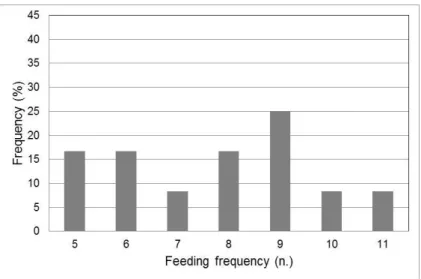
The AFS farms distributed the ration automatically at programmed frequencies and intervals. The CFS farms performed 1-4 daily distributions (average 1.4±1 distribution day-1) with a variable number of push ups (range 1-5, av. 3.5±1.6 times day-1), while the AFS farms distributed the feed an average of 7.8±2 times daily with a range of a minimum of 5 to a maximum of 11 distribution day-1 (Fig.1).
The average of 3h feeding intervals was recorded in the AFS farms with deliveries during the day and throughout the night. However, an increase in feeding interval was observed between 2300 and 0400h. All farmers fed following the recommendations of their feed consultants. The leftover on the feed bunk estimated by the farmers resulted, on average, of 1.5% of the daily feed quantity offered in the AFS farms against 3.2% in the CFS ones.
FIGURE 1: Feeding frequency in AFS farms 3.4. Barn lay-out
All CFS barns were older than 5 years, while in half of the cases the AFS barns were considered new (less than 5 years old). In both the groups of farms, most of the barns (70%) had a free access to the AM systems without a waiting area in front of the milking stalls; 67% of the AFS farms and 60% of the CFS ones applied automatic dispensers for concentrate which, in most of the cases, were placed alongside the cross alleys. The preferred barn layout observed in the surveyed farms allowed free cow traffic with unrestricted access to the concentrate dispensers, milking stalls and feeding area. Only one example of semi-free cow traffic (Feed-First™) – that gives priority of access to the feed bunk by means of selection gates – was denoted per group of farm.
The feeding area showed the greatest differences between the two groups despite the similar ratio of cows per feeding place found (1.0 for the AFS farms and 0.9 for the CFS). For this parameter, 80% of the CFS barns has shown a number of cow ratio each feeding place smaller than one against the 64% recorded for the AFS according with the common feeding strategy in use at the surveyed CFS farms with the delivery of the ration once or twice per day and, consequently, the contemporary presence of quite the entire herd at the feeding bunk. On the other hand, the higher incidence of cow/feeding place ratio greater than one in the AFS barns was attributed to the higher delivery frequency of the ration with the consequence that not all the cows have to be contemporary present at the manger.
The alley size has shown strong differences between the two groups of farms. The feeding alley width in the AFS barns was about half of that measured in the CFS ones averaging 2715±650 mm against 5353±420 mm. The AFS barns comprised a supplementary covered room ranging from 45 to 110 m2 to accommodate the stationary mixer or the temporary feed storages. All of the farms of the study milked automatically and none of the barns comprised a waiting area in front of the AM stalls.
3.5. Management and economic aspects
As expected, the most frequent reason to install an AFS was the need for improving labour efficacy (24%), but the efficient use of the building room and the better cooperation between AM and AF systems – with particular concern to stimulating cows’ activity and cows’ visits to both the milking stall and the feeding bunk – scored the same 19% frequency in the farmers answers. 15% of the farmers mentioned a better feeding efficiency (as the sum of “offer different rations” and “feed precisely” frequencies) indicating the interest to improve the feedstuffs management.
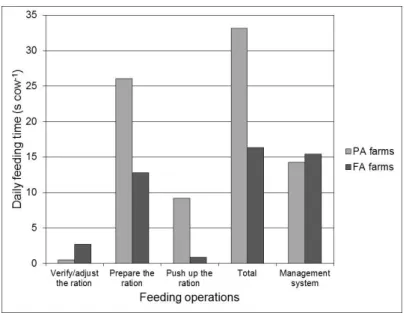
The answers related to the labour demand are summarized in Fig. 2. They showed, an increase in the time to verify and adjust the ration in all AFS farms in comparison with the
CFS ones, due to the man/machine interface that need more attention and due to the increase in interventions to manage the feeding system. This resulted in an extra time of 2.2 s cow-1 day-1.
FIGURE 2: Labour requirements for feeding and manage the rations in CFS and AFS farms. Time to prepare the ration was reduced of 50,9% in the AFS farms and limited to the filling operations of the temporary storages. Following the impressions of the farmers, the time saving for this phase is not the only advantage of the AF systems; they also value the fact that this operation can be carried out when time is available during the day, so that it becomes a very flexible task. The filling of the temporary storages was performed every two or three days, even if only during winter. The total working time for feeding cows was halved in the AFS farms compared to the CFS ones. The daily time required for the use of the management system differed of approximately 1 s cow-1 between the two groups of farms ranging from 14.3 s cow-1 in the CFS farms to15.4 s cow-1 in the AFS ones.
The investment for the feeding machinery depended - for the CFS farms - on the MFWs volume and type (trailed or self-propelled) and were found to amount to an average of 400 € cow-1 (160-600 € cow-1 range). For the AFS farms the investment varied with the complexity of the design and the level of building works: an average of 1230 € cow-1 (850-1650 € cow-1
range), was found.
4. Discussion and conclusion
The features of the surveyed farms with regard to herd size, breed, crop repartition, robotic milking system and feed approach were similar. Farmers with AFS pursued strategies of integrating milking and feeding technologies with the main goals to reduce labour demand, improve barn design, increase feed efficiency and milk production and stimulate cow activity. The AFS farmers in this study supported the suggestion that automatic feeding reduces labour demand for feeding. They increased the frequency of feed distribution with low-volume, rail suspended, electric-powered feeder wagons. The width of the feeding alleys in the AFS barns was smaller, but additional sheltered space is necessary to cover the mechanic temporary storages.
Only a few of the AFS farmers exploited the potential of AF systems to feed their cows in groups and better tune the rations to the feed demands of the animals. The AFS farmers claimed lower feed left overs as a result of the high feed delivery frequency (every 3.1h, on average), but conclusive support of these claims requires more extensive research. The average investment costs per cow for the feeding systems at the AFS farms were more than three times greater than those at the CFS farms.
Acknowledgements
This project was funded by an international internship program promoted by the Agriculture Research Council (IT) and by Wageningen University, Farm Technology Group (NL). The work would not have been possible without the cooperation of the dairy farmers and the manufacturers of the feeding and milking systems. We greatly appreciate the hospitality of the farmers and their families.
References
Belle, Z., André, G., Pompe, J.C.A.M. (2012). Effect of automatic feeding of total mixed rations on the diurnal visiting pattern of dairy cows to an automatic milking system. Biosystems Engineering (111) 1, 33-39.
Bewley, J. (2010). Precision dairy farming: advanced analysis solutions for future profitability. 1st North American Conf. on Precision Dairy Management, 2-5 March, Toronto, Canada. Bisaglia, C., Nydegger, F., Grothmann, A., Pompe, J.C.A.M. (2010). Automatic and frequency-programmable systems for feeding TMR: state of the art and available technologies. XVII World Congress of the CIGR, 13-17 June, Québec City, Canada.
de Koning, C.J.A.M. (2010). Automatic milking - Common practice on dairy farms. Proc. of the 1st North American Conf. on Precision Dairy Management, 2-5 March, Toronto, Canada. Hollander, C.J., Blanken, K., Gotink, A., van Duinkerken, G., Dijk, G., Lensinck, F., de Koning, C.J.A.M. (2005). Voersystemen in de melkveehouderij [Feeding systems in dairy]. PraktijkRapport Rundvee 73. ISSN 1570 – 8616.
Kammel, D.W. (1998). Design, selection and use of TMR mixers. In: Proc. of Tri-State Conference, 21-22 April, Grand Wayne Centre, Indiana, USA, 122-129.
Lassen, B., Garrido, C.L., Oskarsson, M. (2010). EDF-agri benchmark snapshot 2010. Proc. of EDF Conf. “Dairy Farming under Mediterranean Conditions”, 23-25 June, Saluzzo, Italy. Pompe, J.C.A.M., Alders, D.H.J., Heutinck, L.F.M., Lokhorst C. (2007). Automatic individual feeding systems for dairy cows: observations of facility utilization, Cox, S. (Ed.), Precision Livestock Farming '07, Wageningen Academic Publishers, Skiathos, Greece, 45-51.