Jay B Kestent
In light of recent developments in auction theory, this Article re-examines Delaware corporate law governing directors' actions when structuring the sale ofa corporation. A foundational doctrine ofDelaware law is that when the board of directors resolves to sell a corporation, it must obtain the highest price reasonably available. Auction theory posits that, in certain circumstances germane to corporate takeovers, revenues can be maximized through the use of ex ante precommitments to the rules ofthe auction. Delaware law, however, does not fully endorse directors' ability to make such precommitments, primarily out of the concern that the board will lock up a transaction for self-interested reasons.
The Article's core claim is that current Delaware law is unduly averse to precommitment devices that set the rules ofthe game in corporate auctions. Such devices can help maximize shareholder value and do not create the positional conflict that animates much of corporate takeover jurisprudence. Courts should draw a distinction between ex ante precommitments, characterized by
ambivalence concerning the identity of the winning bidders, versus midstream or ex post lock-ups, in which the board favors a known buyer.
Introduction... ... 46
I. Auction Theory and Optimal Mechanism Design .... ... 51
A. A Typology ofAuctions and Equilibrium Bidder Strategies ... 54
B. Revenue Equivalence Theorem and Its Assumptions . ... 56
1. Risk-Averse Buyers ... 57
2. Risk-Averse Sellers... 59
3. Affiliated Values.. ... 59
4. Asymmetrical Valuation Distributions ... ... 61
5. Optimal Mechanism Design: A Summary ... ... 63
II. Structuring Corporate Auctions in the Real World: Empirical Evidence from the Takeover Market ... 64
A. Risk Aversion in Corporate Takeovers ... 64
B. Asymmetric Bidders and Their Incentives to Bid... ... 67
III. The Fiduciary Obligations of a Selling Board ... ... 69
A. Revlon's Auctioneers ... ... 69
B. Legal Limits on Structured Sales: Unocal, Omnicare and the Fiduciary Precommitment Constraint...71
Yale Journal on Regulation Vol. 32, 2015 C. Modern Developments: Standstill Agreements and Simulated
FPSB Auctions ... ... 76
IV. A Principled Framework For The Judicial Oversight of Structured Corporate Auctions... 80
A. A Per Se Rule Barring the Precommitments Necessary for Structured Sales Would Inappropriately Undermine Revlon's Foundational Policy... 81
B. Revlon Alone Should Govern Neutral Ex Ante Structured Sales ... 84
C. Applying Revlon to Simulated FPSB Auctions... ... 86
Conclusion ... ... 88
Introduction When a board of directors resolves to sell the corporation, it must structure the sale so as to obtain the highest price reasonably available. In the landmark case Revlon, Inc. v. MacAndrews & Forbes Holdings, Inc., the Delaware Supreme Court held that, when a sale of the corporation becomes inevitable, the "directors' role change[s] from defenders of the corporate bastion to auctioneers charged with getting the best price for the stockholders . . . ."' Post-Revlon, auctions2 have become a pervasive feature of the modem takeover landscape.3 Indeed, a recent survey of four hundred large-scale takeovers with a total deal value of over $1 trillion found that over half of the sales involved a process of competitive bidding rather than private negotiations with selected buyers.4 Yet, Delaware corporate law currently leaves in doubt the legality of a tool useful to the value-maximizing auctioneer: the ability to pre-commit to the rules t Assistant Professor, Florida State University School of Law. The author thanks Kelli Alces, Shawn Bayern, Barbara Banoff, Brian Broughman, John Coyle, Frank Gevurtz, Joan Heminway, Shi-Ling Hsu, Ed lacobucci, Lea Johnston, Jeffrey Kahn, David Landau, Jake Linford, Andrew Lund, Glynn Lunney, Mohsen Manesh, David Millon, Rebecca Morrow, Murat Mungan, Shuyi Oei, Bo Rutledge, Richard Saver, Megan Shaner, Mark Spottswood, Franita Tolson, Andrew Tuch, Urska Velikonja, Manuel Utset, Don Weidner, Hannah Wiseman, Sam Wiseman, as well as participants at the National Business Law Scholars Conference, the Canadian Law and Economics Association Conference, the South Eastern Association of Law Schools annual meeting, and workshops at the Emory University School of Law and Florida State University College of Law for their helpful comments on earlier drafts. S 1. 506 A.2d 173, 182 (Del. 1986). This Article follows standard practice within the literature by focusing on Delaware corporate law due to the jurisdiction's status as the national leader in corporate matters. The arguments presented herein are generalizable to any jurisdiction whose law imposes Revlon-like obligations on corporate fiduciaries. 2. As used herein, "auction" refers generally to any competitive bidding process, as opposed to private negotiations between a buyer and seller. The related term "structured sale" or "structured auction" (used interchangeably herein) refers to a competitive bidding process in which the rules of the game differ from the standard ascending-price auction described in Part 1. 3. Paul Povel & Rajdeep Singh, Takeover Contests with Asymmetric Bidders, 19 REv. FIN. STUD. 1399, 1399 (2006) ("Selling finns by inviting competitive bids has become increasingly popular in practice .... .").
4. Audra L. Boone & J. Harold Mulherin, How Are Firms Sold?, 62 J. FIN. 847,
of the auction.' In-a series of recent cases, the Delaware courts have struggled with the fiduciary propriety of these precommitments and have reached
ambiguous and sometimes contradictory decisions.6 Indeed, one
Vice-Chancellor questioned, in dicta, whether such agreements are ever enforceable.7 Looming over these cases is the Delaware Supreme Court's decision in Omnicare, Inc. v. NCS Healthcare, Inc., which forbids a target (i.e., selling) board from fully locking up a transaction with a particular counterparty. Instead, the board is legally obliged to include a "fiduciary out" clause in the acquisition agreement, which contractually preserves the target board's right to cancel the agreement should it subsequently receive a better offer.9
Such restriction, which in other work I term the fiduciary precommitment constraint,10 would likely foreclose the use of First Price Sealed Bid ("FPSB") auctions, in which bidders agree to make their best and final offers and the seller agrees that the highest bidder wins the auction at the price bid. Absent the seller's ability to credibly commit to those rules, bidders will alter their strategies. Specifically, as the losing bidders can simply top the winning bidder after the initial auction ends, the bidders will treat the structured sales process as if it were a standard ascending price auction (also known as an "English" auction), in which bidders iteratively increase their offering prices until only one bidder remains. Auction theory, the branch of applied economics that studies auction design, posits that English auctions are not necessarily optimal from the seller's perspective." Thus, modem auction theory finds itself at odds with Delaware takeover jurisprudence.
This tension is particularly problematic because the Delaware courts derive both of these aspects of Delaware law, i.e., the value maximization mandate and the restrictions on precommitments, from principles of fiduciary obligation.12 Takeovers are one of the most important events in the life cycle of a corporation and are of particular financial significance to the corporation's shareholders. The
5. Stephen M. Bainbridge, Precommitment Strategies in Corporate Law: The Case of
Dead Hand and No Hand Pills, 29 J. CoRP. L. 1, 26 (2003) (noting that Delaware merger and acquisition
jurisprudence exhibits "hostility to precommitment strategies"); Povel & Singh, supra note 3, at 1412 ("The ability to credibly commit to the [auction] procedure is, of course, central to its success in extracting the highest possible transaction price.").
6. See infra Part III.C.
7. In re RehabCare Grp., Inc. S'holders Litig., C.A. No. 6197-VCL, tr. at 46 (Del. Ch.
Sept. 8, 2011).
8. 818 A.2d 914, 938-39 (Del. 2003) (holding that a fully locked-up merger was void
as a per se violation of the target board's fiduciary obligations).
9. Id. at 938 ("We hold that the NCS board did not have authority to accede to the Genesis demand for an absolute 'lock-up'. . . .Instead of agreeing to the absolute defense of the Genesis merger from a superior offer, however, the NCS board was required to negotiate a fiduciary out clause to protect the NCS stockholders if the Genesis transaction became an inferior offer.").
10. See Jay B Kesten, Shareholder Political Primacy, 9 VA. L. & Bus. REV.
(forthcoming Sept. 2015); Jay B Kesten, Towards a Moral Agency Theory of the Shareholder Bylaw
Power, 85 TEMP. L. REV. 485, 498 (2013). 11. See infra Part I.B.
Yale Journal on Regulation
value-maximization norm acknowledges that a sale of the company represents shareholders' last chance to receive a premium price for their equity. The restriction on precommitments is a prophylactic rule, which prevents potentially unfaithful directors from locking up transactions motivated by self-interest. Thus far, Delaware courts have struggled to balance these competing policy considerations and have failed to provide a principled standard for reviewing directors' decisions when conducting a corporate auction.13
This Article develops a theoretically rigorous position on the use of ex ante precommitment devices to facilitate value-maximizing corporate sales. In particular, this Article synthesizes recent developments in auction theory, which models optimal auction mechanism design (but pays little attention to the dynamics of fiduciary obligation), with sensitivity to the need for judicial oversight of corporate fiduciary behavior in the high-stakes context of corporate mergers and acquisitions. The notion that corporate precommitment devices can, in the abstract, create value is not novel. Other commentators have examined the merits of commitment strategies in several corporate law contexts, such as merger lock-ups,14 anti-takeover devices, 5 and board governance.1 6 However, there has been no sustained effort to analyze the merits of ex ante precommitments to the rules of the auction itself and, in particular, the use of contractual precommitment devices to simulate FPSB auctions.'7
This Article's core claim is that Delaware corporate law should allow neutral ex ante precommitment devices that facilitate a FPSB auction, as such mechanisms can maximize shareholder value and do not create the positional conflict that animates much of Delaware's takeover jurisprudence. Courts should draw a principled distinction between ex ante precommitments, characterized by ambivalence concerning the identity of the winning bidders, versus midstream
13. See infra Part III.C.
14. Sean J. Griffith, The Costs and Benefits of Precommitment: An Appraisal of Omnicare v. NCS Healthcare, 29 J. CORP. L. 569, 605-13 (2004) (applying game theory to model the economic benefits of offering deal lock-ups during the course of merger negotiations).
15. Bainbridge, supra note 5, at 22-23 (discussing anti-takeover mechanisms, such as "fair price shark repellents" and nonredeemable poison pills, as precommitment devices); Marcel Kahan
& Edward B. Rock, Corporate Constitutionalism: Antitakeover Charter Provisions as Precommitment, 152 U. PA. L. REv. 473, 476 (2003) (arguing that "shareholders may rationally entrench board power [with
respect to negotiating takeovers and adopting takeover defenses] because shareholders on their own cannot pursue an effective selling strategy").
16. See, e.g., Lynn Stout, The Shareholder as Ulysses: Some Empirical Evidence on
Why Investors in Public Corporations Tolerate Board Governance, 152 U. PA. L. REV. 667, 669 (2004) (arguing that "investors may be serving their own interests by binding themselves to board [governance]").
17. See, e.g., William T. Allen, Overview of Process Issues in Going Private Transaction, in GOING PRIVATE 2011: DOING THE DEAL RIGHT 52 (2011) (querying whether "an auction
or quasi-auction process [that] contractually obligates bidders not to overbid ...is ...enforceable. . ."); Kahan & Rock, supra note 15, at 477 (noting that the process of "devising and implementing a selling strategy ...has not been properly emphasized in the takeover literature"). One notable exception is Christina M. Sautter, Auction Theory and Standstills: Dealing with Friends and Foes in a Sale of
Corporate Control, 64 CASE W. RES. L. REv. 521,527-31 (2013), which discusses some aspects of auction
theory in the takeover context. This Article differs significantly from Professor Sautter's contribution as to both methodology and policy prescription.
or ex post lock-ups, in which the board favors a known buyer. The latter should be subjected to the more searching analysis governing takeover defenses and deal protection devices; the former should be governed only by Revlon's range of reasonableness review and not the more rigid frameworks set out in Unocal/Unitrin (which bars deal protection devices that are either coercive or preclusive) or Omnicare (i.e., the fiduciary precommitment constraint described above). 18
Resolving these issues is both timely and necessary in light of recent efforts by target boards to simulate FPSB auctions via intricate contractual agreements with potential bidders.19 Briefly, targets require bidders to sign a "standstill" agreement in order to gain access to the target's confidential financial (or other) information prior to commencing the auction process. The standstill prohibits losing bidders from making subsequent bids. One particularly strong form of standstill, termed a "Don't Ask, Don't Waive" agreement, prevents bidders from even requesting that the target board waive the no-subsequent-bids condition.20 As noted above, the Delaware Chancery Court has wrestled with the interplay between these standstills and target boards' fiduciary obligations, but it has reached varying (and limited) conclusions as to the propriety of target boards' conduct.21 The Delaware Supreme Court has not yet addressed the issue squarely, but its fiduciary precommitment jurisprudence casts substantial-and, in my
view, improper-doubt on the legality of these structures.
Before proceeding, several caveats are in order concerning the scope of this Article and its claims. First, this Article does not attempt to resolve the ongoing uncertainty about which transactions trigger Revlon obligations. While subsequent cases attempt to draw those boundaries,22 several commentators
18. See Part III.A-B for more detail on these lines of cases.
19. Both judges and academic commentators have noted the increasing importance of these contractual devices. See, e.g., Plaintiffs Motion for Preliminary Injunction and the Court's Ruling,
In re Ancestry.com S'holder Litig., C.A. No. 7988-CS at 19 (Del. Ch. Dec. 17, 2012) (remarking that
judicial review of these agreements was an important "emerging issue" for corporate law); Guhan Subramanian, Bargaining in the Shadow of Takeover Defenses, 113 YALE L.J. 621, 659 (2004) ("Surprisingly, despite their important implications for the interplay between negotiated and hostile acquisitions, standstill agreements have not received attention from modem academic commentators.").
20. See Part IlI.C. for a more detailed treatment of these contractual arrangements. 21. See, e.g., Koehler v. NetSpend Holdings. Inc., C.A. No. 8373-VCG, 2013 WL 2181518, at *19-20 (Del. Ch. May 21, 2013) (finding that standstill agreement contributed to
unreasonableness of board conduct); Plaintiff's Motion for Preliminary Injunction and the Court's Ruling,
In re Ancestry.com S'holder Litig., C.A. No. 7988-CS (advising, without deciding, that standstill
agreement was not per se invalid but cautioning against improper use); Telephonic Oral Argument and the Court's Ruling, In re Complete Genomics, Inc. S'holder Litig., C.A. No. 7888-VCL (Del. Ch. Nov.
27, 2012) (enjoining enforcement of standstill agreement).
22. See, e.g., Arnold v. Soc'y for Say. Bancorp, Inc., 650 A.2d 1270, 1289-90 (Del.
1994) (holding that Revlon applies "in at least the following three scenarios: (1) when a corporation initiates an active bidding process seeking to sell itself or to effect a business reorganization involving a clear break-up of the company; (2) where, in response to a bidder's offer, a target abandons its long-term strategy and seeks an alternative transaction involving the break-up of the company; or (3) when approval of a transaction results in a sale or change of control") (footnotes omitted) (citations omitted).
Yale Journal on Regulation
observe that the categories remain far from clear.23 This Article sets aside that doctrinal dispute: the discussion herein assumes Revlon's applicability, i.e., that the board is obliged to conduct a value-maximizing sale. Second, this Article takes no position on the normative desirability of Revlon's value-maximization principle, which has been challenged, especially in the financial literature, on grounds of allocative efficiency.2 4
The analysis herein adopts the traditional corporate law perspective that directors' fiduciary obligations in this context run to the shareholders alone and do not require them to balance social welfare or economic efficiency considerations.2 5
Finally, nothing in this Article should be read to suggest that FPSB auctions are always value maximizing. As discussed further below, certain conditions favor other types of auctions, including the standard English auction. Moreover, a robust literature examines the relative merits of auctions versus private negotiations,26 and recent scholarship suggests that the optimal sales strategy may depend in part on the unique circumstances of the selling firm and universe of potential buyers.2 7
The arguments presented in this Article pertain only to transactions in which the board conducts a structured sale that invites competitive bidding.
The Article proceeds in four parts. Part I describes the theoretical determinants of optimal auction design. Recent advances in auction theory suggest that there is no single optimal auction structure. If certain conditions obtain, FPSB auctions may generate higher returns for the seller than English
23. See, e.g., WILLIAM T. ALLEN ET AL., COMMENTARIES AND CASES ON THE LAW OF BUSINESS ORGANIZATION 545 (4th ed. 2012) ("The questions of what Revlon duties are and when they
are triggered continue to haunt Delaware law."); Stephen M. Bainbridge, The Geography ofRevlon-Land,
81 FORDHAM L. REV. 3277, 3281 (2013) ("In recent years ... the Delaware Chancery Court has gotten lost in Revlon-land. A number of chancery decisions have drifted away from the doctrinal parameters laid down by the Delaware Supreme Court.").
24. See, e.g., Peter Cramton & Alan Schwartz, Using Auction Theory to Inform Takeover Regulation, 7 J.L. EcON. & ORG. 27, 29 (1991) (arguing that the law should bar corporate
auctions entirely because, inter alia, "[t]here is ...no moral or distributional case for benefitting target shareholders as a group rather than benefitting society as a whole").
25. Indeed, a target board would almost certainly breach its fiduciary duty if it proposed a transaction at a price lower than the highest bid made because it believed the bidder's CEO was unduly optimistic about the potential synergies between the firms.
26. See generally Audra L. Boone & J. Harold Mulherin, Is There One Best Way to Sell a Company? Auctions Versus Negotiations and Controlled Sales, 21 J. APPLIED CORP. FIN. 28 (2009);
Robert G. Hansen, Auctions of Companies, 39 ECON. INQUIRY 30 (2001); Jeremy Bulow & Paul Klemperer, Auctions Versus Negotiations, 86 AM. ECON. REV. 180 (1996); Kenneth R. French & Robert
E. McCormick, Sealed Bids, Sunk Costs, and the Process of Competition, 57 J. BUS. 417 (1984). 27. Boone & Mulherin, supra note 26, at 28 ("The main lesson ... from our research on the M&A sales process is that one size does not fit all. Where conventional wisdom and common sense suggest that all sellers should implement a wide-ranging auction, our findings suggest that information costs between sellers and buyers can severely limit the apparent benefits of an auction. And so decisions
by sellers to impose constraints on the number and kinds of bidders and otherwise 'manage' the selling
process to reduce information costs can actually create value."); accord Boone & Mulherin, supra note 4, at 871 (conducting an empirical analysis, and finding that "that the wealth effects to targets are comparable in both auctions and negotiations").
auctions.28
Specifically, the outcome of the auction depends on the risk preferences of the bidders and the target, the number of potential bidders, the distribution of those bidders' valuations for the asset at auction, and the relative strength of the bidders who choose to participate in the structured sale. Part II maps these theoretical insights onto target boards' decision-making processes and illustrates that (i) several factors weighing in favor of FPSB auctions likely exist in many circumstances germane to real-world corporate takeovers; and (ii) structuring a value-maximizing sale is a complex matter, rife with decisions requiring the board's business judgment. Part III turns to the current legal landscape governing corporate auctions, and it describes recent attempts to simulate FPSB auctions and the legal responses thereto. This Part demonstrates that FPSB auctions, when employed by a well-informed and properly motivated board, are consistent with the foundational policy concerns underlying Revlon and its progeny, even though they may run afoul of Delaware courts' antipathy towards precommitment devices. This antipathy is largely misplaced, and Part IV develops in more detail the framework for judicial oversight of the auction process described above. Recognizing that not all boards are properly motivated, this Part also identifies relevant criteria by which to measure the reasonableness
of the board's actions, even given a facially neutral precommitment device. I. Auction Theory and Optimal Mechanism Design
Auction theory is a rapidly developing branch of applied economics with a meaningful record of successful real-world applications.29 Governmental and regulatory bodies have applied its insights to construct complex mechanisms for the sale of assets as varied as spectrum licenses for radio, television and cellular coverage, carbon dioxide abatement, electrical power, timber, and U.S. Government Treasury bills.30
Auction theory's two main goals are: (i) to model the strategic behavior of bidders in the context of various auction structures; and (ii) based on these findings, to predict the optimal mechanism design from the perspective of the seller.31 As such, auction theory provides important guidance for sellers seeking
to maximize their gains-a matter of critical importance for a loyal corporate
28. Some commentators suggest that the optimal procedure in many cases involves a sequential strategy that includes a FPSB auction. See Povel & Singh, supra note 3, at 1400. The merits and limitations of the Povel & Singh mechanism are discussed further in Part IV.
29. FLAVIO M. MENEZES & PAULO K. MONTEIRO, AN INTRODUCTION TO AUCTION THEORY 1 (2005) ("The theory of auctions is one of the most successful modem economic theories. Its
success is reflected in a coherent body of theory but also in its ability to provide insights into many practical policy issues.").
30. PAUL MILGROM, PUTTING AUCTION THEORY TO WORK xii-1 (2004).
31. Ken Hendricks & Robert H. Porter, An Empirical Perspective on Auctions, in 3
HANDBOOK OF INDUSTRIAL ORGANIZATION 2073 (M. Armstrong & R. Porter eds., 2007). Some auction
theorists also investigate allocative efficiency. See, e.g., MILGROM, supra note 30, at 33-34; William Samuelson, Auctions in Theory and Practice, in GAME THEORY AND BUSINESS APPLICATIONS 295, 298 (Kalyan Chatterjee & William F. Samuelson eds., 2001).
Yale Journal on Regulation
board, which must use its business judgment to structure a sale of the company reasonably aimed at obtaining the best deal for shareholders.
This Part begins with an overview of the game-theoretical methodology employed to model auctions. As a threshold matter, these models require classification of the type of good for sale into private value, common value, or affiliated value items, terms that will be explained below. Corporations are typically treated as private or affiliated value goods. Next, this Part describes the four basic auction structures (English, Dutch, FPSB, and Second Price Sealed Bid) and the associated equilibrium bidder strategies for each. This Article focuses primarily on the distinctions between English and FPSB auctions. By modeling bidder behavior, one can determine the seller's expected revenue for each structure. These results depend on several features of the seller, bidders, and bidding environment, such as risk aversion, the distribution of bidders' values for the item at auction, the number of potential bidders, and the relative strength of those bidders. This Part concludes with a summary of these theoretical findings and draws conclusions about the determinants of optimal auction design for target corporations.
Auction theory's central insight is that competitive bidding processes can be modeled as Bayesian games, i.e., games in which players have imperfect information.32 This modeling involves solving for the Bayesian-Nash equilibrium, which is the set of strategies that constitute each player's best response(s) given her beliefs about other players' actions.3 3
Put plainly, a Bayesian-Nash equilibrium is the situation in which each player would truthfully answer "yes" if asked whether she was choosing the best action for herself, based on what she thinks the other players will do.34
By deriving bidders' equilibrium strategies, these models generate predictions about optimal auction design from the perspective of the seller.35
32. MENEZES & MONTEIRO, supra note 29, at 11. Technically, a Bayesian game is one
in which at least some players do not know the payoffs of the others, and are thus said to have incomplete information. See DREW FUDENBERG & JEAN TIROLE, GAME THEORY 209 (1995). To model these games, it is necessary to introduce a prior move by nature, which determines each player's "type" (in the context of auctions, his valuation of the item for sale) from a probability distribution. This transforms the game from one of incomplete information into one of imperfect information in which players are merely uninformed about prior moves in the game. John C. Harsanyi, Games with Incomplete Information Played by "Bayesian "Players, I-II. Part I. The Basic Model, 14 MGMT. SCI. 159 (1967). From there, the game can be analyzed with standard game theory techniques.
33. MENEZES & MONTEIRO, supra note 29, at 7 ("[E]ach player chooses a strategy
contingent on his type-that is, he uses a Bayesian decision function. We can then apply the Nash equilibrium notion to these decision functions: each player forms a best response strategy of choosing the best Bayesian decision functions, based on the best response strategies of other players (who are choosing their Bayesian decision functions."); Sudipto Dasgupta & Robert G. Hansen, Auctions in Corporate
Finance, in 2 BIDDING STRATEGIES, FINANCING AND CONTROL, MODERN EMPIRICAL DEVELOPMENTS 87
(B. Espen Eckbo ed., 2010).
34. LOuIs KAPLOW & STEVEN SHAVELL, DECISION ANALYSIS, GAME THEORY, AND INFORMATION 46 (2004).
35. Id. at 65-68.
In an auction, bidders lack important information.36 In a private value auction, each bidder knows her own subjective valuation for the object being sold, but she is unaware of other bidders' valuations, which almost certainly differ from her own.37 The textbook example of a private value auction is the sale of artwork, in which bidders have idiosyncratic views of the merits of a unique item. Making some assumptions about bidders' beliefs concerning other bidders' valuations, we can model this uncertainty to determine equilibrium bidder strategies.
In common value auctions, the actual value of the object being sold is the same for all potential bidders, but bidders have varying levels of information about that true value.39 The prototypical example is the sale of mineral rights, where bidders have sufficiently similar costs of extraction.40 Here, too, we can determine equilibrium bidder strategies because when a bidder reveals information about her estimate of value (i.e., her "signal"), that revelation will affect the remaining bidders' own estimates.4 1
In the real world, most auctions are neither purely private value nor purely common value. These mixed auctions are typically referred to as affiliated value auctions. Sales of companies illustrate this point. At one level, the resale value of the target's assets or the future cash flows from those assets as currently deployed are uncertain (in the sense that they cannot be estimated with great precision), but the present value of those assets and cash flows is the same for all potential acquirors at the initial stage.42 Yet, at least some acquirors also have an element of private value resulting from idiosyncratic synergies with the target or unique business plans moving forward. These mixed-value auctions can be modeled as well.
It is also worth distinguishing between financial and strategic buyers. Financial buyers are typically investment firms that acquire companies for three possible purposes: (i) to break them up and sell off their component parts; (ii) to hold in their portfolio and derive the benefits of the target's cash flows; or (iii) to fix some managerial or operational defect within the target and then re-sell the firm at a profit (or some combination of these three purposes). The economic literature typically treats financial buyers as common value actors,43 but this is an oversimplification. For example, while the former two categories listed above
36. If all parties had perfect information about the value of the object and about other
bidders' valuations, modeling auctions would be trivial. PAUL KLEMPERER, AUCTIONS: THEORY AND PRACTICE 12 (2004).
37. Id. at 13.
38. Samuelson, supra note 31, at 296-300.
39. Id.
40. JOHN H. KAGEL & DAN LEVIN, COMMON VALUE AUCTIONS AND THE WINNER'S
CURSE 2 (2002).
41. Dasgupta & Hansen, supra note 33, at 69. 42. Id.
43. See, e.g., Povel & Singh, supra note 3, at 1400 (asserting that the "situation with
Yale Journal on Regulation
reflect largely common value elements of the target, the last includes an element of private value that depends on the buyer's skill at corporate turnarounds.44 Moreover, active financial buyers may also derive synergies across their portfolio companies.
By contrast, strategic buyers generally are operating companies that view the target's assets as complementary to their own. For example, they might seek an acquisition as: (i) part of a vertical integration strategy; (ii) a way of quickly creating economies of scale; (iii) a method of increasing market share; or (iv) an attempt to diversify their holdings. The value created as a result of those synergies largely depends on the unique combination of assets between the target and the acquiror and thus includes substantial elements of private value.4 5
For these reasons, this Article focuses on private and affiliated value models.
The following sections build on this background to model the determinants of a seller's optimal auction design, beginning with a description of the standard auction mechanisms and the associated equilibrium bidder behavior.
A. A Typology ofAuctions and Equilibrium Bidder Strategies
Four basic auction types have been analyzed extensively. The most familiar is the ascending-bid or English auction, in which the auctioneer opens the bidding at a particular level-often the reserve price below which a seller will not sell-and then successively raises the price until only one bidder remains. That final bidder wins the object and must pay the value of her top bid.4 6
A descending-bid auction (also called a "Dutch" auction)47 works in
reverse: the auctioneer opens the bidding at a high price and then successively lowers the price until one bidder accepts the object at the offered price. That bidder wins the object at the stated price.48
In addition to these dynamic auctions, there are two standard forms of static or "sealed bid" mechanisms. In the FPSB auction described briefly in the Introduction, each bidder independently submits a single bid without seeing any of the other bidders' bids.4 9
The highest bidder wins the object at the price that
44. B. Espen Eckbo, Bidding Strategies and Takeover Premiums: A Review, 15 J. CORP. FIN. 149, 166 (2009) ("Since bidders tend to have different skill levels in terms of managing the target assets, it is often assumed that the valuations ... are uncorrelated across bidders-a private value.").
45. Povel & Singh, supra note 3, at 1400 ("[T]rade buyers may be interested in a target because of possible synergies that are not available to other bidders; this situation can be modeled as a private values environment.").
46. KLEMPERER, supra note 36, at 11.
47. This terminology is slightly confusing since many investment bankers use the term "Dutch Auction" to refer to the second-price sealed bid auction. See id. at 11 n.10.
48. Id. at 12. 49. Id.
she bid.5o Second-price sealed bid ("SPSB") auctions follow the same structure, but the winning bidder pays a price equal to the second-highest bid.51
Given these auction structures, how should a rational bidder bid? With private values, the English and SPSB auctions have the clearest dominant strategy: truth telling.52 In an ascending auction, the dominant strategy is to remain in the bidding until the price reaches your own estimate of value; this strategy performs at least as well as any other, regardless of what the other players do.53
If the second-highest bidder drops out of the bidding before you, you will win the auction and pay that bidder's price (plus any minimum bidding increment). If the bidding continues past your true value, you cannot improve your position by making additional bids since they will only result in a net loss
if you win the auction.
A similar dominant strategy obtains in the SPSB auction. Assume your true value is v, the highest bid other than yours is a, and your actual bid is x. If you bid less than your true value (v - x), but your discounted bid remains higher than a, then you win the auction and pay a for the object-the same amount you would have paid if you bid v. If a > v (i.e., there is a bid higher than your valuation), then you lose the auction regardless of whether you bid your true value or less. However, if v > a > v - x, then you will have lost an auction that you otherwise could have won. Thus, you do not gain by bidding less than your true value, and you may well lose out on winning the auction and obtaining the surplus v - a.
Similarly, bidding more than your true value (v + x) fares no better. If v > a, then you win in either event and still pay only a, i.e., the same amount as if you had bid your true value. If a > v + x, then you lose regardless of your bid. If, however, v + x > a > v, then you will "win" the auction but with a net loss of a
-v. Thus, bidding higher than your true value can hurt you, but it can never help you. Given these two results, it is optimal to bid your true valuation, regardless of what the other players do.54
Thus, in private value auctions, the English auction is strategically equivalent to the SPSB auction.5 5
If there are elements of common value, this equivalence may not fully hold because bidders will update their own beliefs about the true value of the object if they can observe other bidders dropping out (which they can do in an English auction but not in a SPSB structure)."
50. Id.
51. Id. SPSB auctions are also termed Vickrey auctions, in recognition of William
Vickrey's foundational paper on auction theory. See also William Vickrey, Counterspeculation, Auctions,
and Competitive Sealed Tenders, 16 J. FIN. 8 (1961).
52. KLEMPERER, supra note 36, at 13-14; Dasgupta & Hansen, supra note 33, at 61.
53. Samuelson, supra note 31, at 301.
54. For a similar derivation, see KLEMPERER, supra note 36, at 14 n.20.
55. See MENEZES & MONTEIRO, supra note 29, at 20. 56. See KLEMPERER, supra note 36, at 14.
Yale Journal on Regulation
However, even in common value auctions, the equivalence remains if there are only two bidders.5 This is, in fact, the norm in corporate takeovers.
The Dutch and FPSB auctions are also strategically equivalent, though equilibrium behavior is more complicated to model.59 Here, truth telling is no longer a dominant strategy. Because the winning bidder pays her bid price, bidders will not bid an amount equal to their private value as this would guarantee a payoff of zero if theirs was the winning bid.60 Instead, the optimal strategy is a function of both the probability of winning the auction (which increases with the amount bid) and the payoff (which decreases with the amount bid).6 1
Bidders' equilibrium strategy is thus to assume they have the highest private value and to shade their bid lower-but by how much?
The amount of shading depends on a bidder's beliefs about the distribution of other bidders' private values and specifically on her view of the probability that she will win the auction given any particular bid.62 More formally, bidders in a FPSB auction attempt to maximize their own expected utility (ui) given their private valuation of the object (vi), the likelihood of their winning the auction (Pr(win)), and the price they must pay if they win. In a FPSB auction, the winner pays her bid price, so price = bi. Thus, ui= Pr(win) * (vi -bi). If private values are independently distributed along an interval [0,1] and there are two symmetrical bidders,6 3
player i's equilibrium bid function is bi (vi) = (1/2) * vi. Extending the bid function to an auction with N players, player i's equilibrium bid function is bi (vi) = (N-i/N) * vi.64
In other words, player i's bid shading decreases as the number of bidders increases.65
B. Revenue Equivalence Theorem and Its Assumptions
Given these equilibrium bidding strategies, one can draw some preliminary and rather startling conclusions about the relative expected revenue generated for each of the auction structures described above. Assuming each bidder is
risk-57. Id.
58. See Boone & Mulherin, supra note 4, at 852 (finding that there were, on average, 1.57 private bidders and 1.24 public bidders in the auctions in their sample).
59. See VIJAY KRISHNA, AUCTION THEORY 16-20 (2002); MENEZES & MONTEIRO, supra note 29, at 17; Samuelson, supra note 31, at 300.
60. KRISHNA, supra note 59, at 16. 61. MILGROM, supra note 30, at 113.
62. The intuition concerning the Dutch, descending auction is as follows: before each incremental decrease in bid, the bidder asks herself whether the bid price is at or below her private value.
If so, she makes a determination of the likelihood that the next step down is, in fact, the next-highest
bidders' likely bid. For a mathematical proof of the above description, see KRISHNA, supra note 59, at 16-20; and MENEZES & MONTEIRO, supra note 29, at 17. This Article does not analyze in any detail the use of Dutch auctions in the sale of companies.
63. In this context, symmetrical denotes that all players believe their values are drawn from the same distribution.
64. For derivations, see Samuelson, supra note 31, at 302-03; and KRISHNA, supra note
59, at 16-20.
65. MENEZES & MONTEIRO, supra note 29, at 17.
neutral and has a private value independently drawn from the same probability distribution as all of the other bidders',66 all four standard auctions will generate the same expected revenue for the seller.6 7 This result is described as the Revenue
Equivalence Theorem,6 8 and the assumptions on which it rests are termed the benchmark model.
If revenue equivalence held strongly in the real world, then auction design would be more or less irrelevant. However, the benchmark model does not necessarily approximate real-world bidder behavior. The empirical research related to the Revenue Equivalence Theorem is voluminous.69 However, broadly speaking, actual bidding behavior tends to approximate the equilibrium predictions for English and SPSB auctions but does not track as well the equilibrium prediction for the FPSB auction.7 0
Specifically, in many cases, FPSB auctions generate greater than expected revenue for the seller.71 In other cases, English auctions are preferable. Determining why and when is of substantial importance for a seller attempting to structure a sale that maximizes her revenue. This Section surveys the impact of relaxing several key assumptions from the benchmark model.
1. Risk-Averse Buyers
The benchmark case assumes that buyers are risk-neutral.72 That is, they seek to maximize their expected profits without regard to variance (i.e., risk). To illustrate with a simple example, a risk-neutral actor would be ambivalent between a guaranteed payment of $50 and a coin-flip in which he receives $100 if the coin lands heads and $0 if the coin lands tails. Each option has the same expected value ($50). A risk-averse actor, by contrast, prefers the more certain outcome. Accordingly, a risk-averse actor would always opt for the guaranteed $50 rather than the more variable opportunity to win $100. In other words, risk-averse actors must be compensated for the variance to which they are subjected. In the example above, a risk-averse actor might even opt for a sum-certain of less than $50 (say, $45) rather than a 50% chance of winning $100.
66. The benchmark model also takes for granted a fixed number of auction participants (N > 1). See KLEMPERER, supra note 36, at 131.
67. For the foundational findings, see Vickrey, supra note 51; Roger B. Myerson,
Optimal Auction Design, 6 MATHEMATICS OPERATIONS RES. 58 (1981); and John G. Riley & William F.
Samuelson, Optimal Auctions, 71 AM. ECON. REv. 381 (1981).
68. See, e.g., KLEMPERER, supra note 36, at 16-19.
69. Though, as Samuelson notes, much of this empirical work derives from controlled auction experiments. See Samuelson, supra note 31, at 302.
70. Id. at 305 ("Given symmetric independent private values, actual bidding behavior
approximates the equilibrium prediction for the [SPSB] auction and exceeds the risk-neutral equilibrium prediction for the [FPSB] auction. The [FPSB] auction generates greater expected revenue with an accompanying modest reduction in efficiency.").
71. Id. Samuelson notes that this increase in revenue may come at the expense of allocative efficiency. Id.
Yale Journal on Regulation
If bidders are risk-averse (but all other assumptions are held constant), the revenue equivalence principle no longer holds; FPSB auctions are likely to generate greater expected revenues than English auctions.7 Risk-averse actors seek to maximize their utility rather than their expected profits.74 For risk-averse
bidders, the effect of a slightly lower surplus (by virtue of having won the auction
by making a higher bid) has smaller utility consequences than does the possibility
that making a lower bid causes them to lose an auction that they could have won if only they had bid more.75 Thus, risk-averse bidders will bid higher than the equilibrium strategy predicts if it increases their odds of winning the auction, even though it may yield a smaller surplus.7 6
Accordingly, risk aversion does not impact strategies in an English auction. The dominant strategy-even for risk averse bidders-remains to bid up to one's true valuation.7 7 Bidding higher than that can only lead to winning the auction
but suffering a loss in the process.
On the other hand, in a FPSB auction, risk-averse bidders will bid more aggressively, i.e., shade their bids less than the equilibrium strategy predicts (though they will still bid less than their true valuation), thus increasing their probability of winning the auction at the cost of a reduced surplus from having won the auction.7 8 More aggressive bidding in the FPSB auction leads to higher
average bids, which in turn generates greater expected revenue for the seller. The magnitude of this effect depends on the extent of the winning bidder's risk aversion. Samuelson reports that in experimental settings "subjects place average bids that are significantly above the risk-neutral equilibrium prediction . . . ."7 This gap is most pronounced with only two bidders and gradually decreases as the number of bidders increases.8 0 Accordingly,
Samuelson suggests that a seller auctioning an item to risk-averse bidders may be best served by conducting an English auction to narrow the field down to two final-round bidders and employing a final-round FPSB auction to determine the winner between the remaining two.8 1
73. Id. at 38-42. Krishna demonstrates that this result obtains regardless of whether one
employs a constant relative risk aversion or constant absolute risk aversion utility function. Id. at 40-42. 74. Id. at 40.
75. Id.
76. Id. Krishna analogizes this behavior to buying insurance against the possibility of
losing the auction. Id.
77. KLEMPERER, supra note 36, at 19. If there are common-value components,
participants likely alter this strategy slightly to accommodate the auction rules regarding tie-breaking. Id. at 19 n.37.
78. Id. at 19; MENEZES & MONTEIRO, supra note 29, at 34. 79. Samuelson, supra note 31, at 302.
80. Id. at 302-03. 81. Id. at 303.
2. Risk-Averse Sellers
The benchmark model also assumes that sellers are risk-neutral. Assuming revenue equivalence holds, risk-neutral sellers should be ambivalent between the various auctions, which all generate the same expected revenues. A risk-averse seller, however, will select the auction structure with the least variance in outcomes. This behavior is analogous to the coin-flip example described above: if all else is equal, a risk-averse seller must be compensated for increased variability.
FPSB auctions are less variable than English and SPSB auctions.82
In a SPSB auction, the winner pays a price that is set by the second-highest bidder.8 By revenue equivalence, the winner of a FPSB auction will bid the expectation of that price.84 Thus, in a FPSB auction, the seller's revenue is fixed-it depends only on the high bidder's bid. In an English or SPSB auction, however, revenue is variable (depending on the private value of the second-highest bidder) along a distribution with the same mean.8 5 Thus, all else being equal, a risk-averse seller should prefer FPSB auctions to English and SPSB auctions.86
3. Affiliated Values
The benchmark model assumes that private values are independently drawn from the same distribution. In other words, none of the bidders' private values depends on any of the other bidders' valuations. This is, obviously, an artificial assumption in the context of corporate takeovers, since acquirors' estimates of value will include both idiosyncratic private value attributable to their unique plans for the target as well as elements of common value arising from the target's cash flows and assets.8 7 In other words, the bidders' values are affiliated, not independent. In this context, affiliation means that if one bidder's signal (i.e., her estimation of value) is high, it is more likely that other bidders' signals are high as well.
If the bidders' signals are affiliated, but all other assumptions of the benchmark model hold, English auctions will generate more expected revenues
82. For a mathematical proof, see Keith Waehrer et al., Auction Form Preferences of
Risk-Averse Bid Takers, 29 RAND J. EcON. 179, 181-85 (1998). 83. KLEMPERER, supra note 36, at 19.
84. Id.
85. Id.; Waehrer et al., supra note 82, at 180 ("[C]onditioned on the highest signal,
revenue in a [FPSB auction] is nonstochastic; under the same conditioning, revenue in other auctions retains its randomness.").
86. KLEMPERER, supra note 36, at 19. In cases where private values are independently
distributed, risk-averse sellers should also prefer SPSB auctions to standard English auctions. Id.
87. See MENEZES & MONTEIRO, supra note 29, at 57 (describing affiliated values as
incorporating both private-value and common-value components); Samuelson, supra note 31, at 305 (same).
88. KLEMPERER, supra note 36, at 48. Affiliated signals differ from merely correlated
Yale Journal on Regulation
than SPSB auctions, which in turn will generate more expected revenues than FPSB auctions.8 9 This result obtains largely because of the "winner's curse"
phenomenon in common-value auctions.90 Recall that in a pure common-value auction the object for sale has identical value for all bidders, but each bidder has imperfect information about that true value. Accordingly, the winner of the auction will always be the bidder with the most optimistic estimate of that value. By definition, the bidder with the most optimistic estimate is also the most likely to have overvalued the object for sale-thus, the winner's curse.
In a FPSB auction, bidders are not only unaware of the item's true value; they are also unaware of how their estimate compares with those of other bidders. Thus, they must discount their estimates before making a bid. If all participants in the auction follow this pattern, the sale will generate less revenue.91 The same dynamic applies to SPSB auctions, but here the participants will rationally discount their values slightly less since the winner need only pay the second-highest bidder's price. In an open English auction with more than two participants, however, bidders obtain valuable information by watching other parties bid and/or drop out. They can then gauge whether their initial estimate was overly optimistic and are thus more likely to bid closer to the true value of the object for sale.92 The same basic rationale applies when bidders have affiliated values with a meaningful common-value component; bidders will discount their estimates more in auctions that provide them with less information about the optimism of their signal.93 Thus, all else being equal, English auctions are expected to generate at least as much revenue as SPSB auctions and more revenue than FPSB auctions when values are affiliated.
Several commentators, however, question the magnitude of this revenue advantage from both modeling and empirical perspectives. Li and Riley find that, in a two-bidder auction (the case most likely to exhibit a pronounced effect and also the most likely in a corporate takeover context),94 the expected revenue advantage of the English auction is only one quarter of one standard deviation, even for very highly correlated values (p=0.7).95
Similarly, Klemperer notes, "numerical analysis suggests the effects of affiliation are often tiny, even when bidders who exactly fit the assumptions of the theory compute their bids exactly
89. KRISHNA, supra note 59, at 96.
90. KAGEL & LEVIN, supra note 40, at 1-4 (describing the winner's curse phenomenon). 91. Klemperer suggests that the mathematical results are better explained by types of
private information revealed via the various auction processes. See KLEMPERER, supra note 36, at
127-28.
92. This holds true only if the auction structure allows bidders to observe this information. If not, then a given bidder can only ascertain that at least one other bidder remains, and the bidders' strategies converge towards a SPSB auction.
93. For a different explanation of this phenomenon, see KLEMPERER, supra note 36, at 48-50.
94. Boone & Mulherin, supra note 4, at 852 (reporting that corporate sellers receive, on average, fewer than two public bids).
95. Huagang Li & John G. Riley, 25 INT'L J. INDUS. ORG. 1269, 1282-84 (2007).
using the theory."96 Samuelson reports several laboratory and field studies that find pervasive evidence of the winner's curse, suggesting that bidders do not discount their values as much as the equilibrium model predicts.9 7 Menzes and Monteiro demonstrate that the effects of risk-aversion given risk-averse buyers (discussed above) reduce, and may overtake, the affiliation effect.98
Finally, Krishna shows that sellers can increase expected revenues in affiliated FPSB auctions by releasing private information concerning the common-value elements of the object for sale.99 Ultimately, Klemperer concludes that "there is no empirical evidence ... that argues the affiliation effect is important."'00
4. Asymmetrical Valuation Distributions
Finally, the benchmark model assumes that bidders' values are symmetric, in the sense that they are drawn from the same distribution. But there may exist categorically "strong" and "weak" bidders, whose valuations are drawn from different distributions altogether.'0 If so, this too may favor FPSB auctions.102 In a SPSB or English two-bidder auction, the weak bidder's value determines the price a strong bidder must pay. If the weak bidder's value is sufficiently low, the winning bidder may win the auction for less than her equilibrium strategy bid in a FPSB auction.'o3
In a FPSB auction, when a bidder is recognized as stronger, competing bidders will likely bid more aggressively (i.e., closer to their own value) in the hopes that the strong bidder overplays her hand by shading her bid too far. 104 A
rational, sophisticated strong bidder may compensate for this increased competition by shading her bid less than she would have otherwise. Both of these possibilities generate higher expected revenues for the seller. However, this dynamic is absent entirely from an English auction since a stronger bidder need
96. KLEMPERER, supra note 36, at 129.
97. Samuelson, supra note 31, at 307-11. Empirical evidence on the magnitude of the winner's curse in corporate takeovers is mixed. Many commentators conclude that the winner's curse holds in the corporate takeover market. See, e.g., Malcolm Baker et al., Behavioral Corporate Finance, in
THE HANDBOOK OF CORPORATE FINANCE 145 (B. Espen Eckbo, ed., 2007); Nicholas Barberis & Richard Thaler, A Survey of Behavioral Finance, in HANDBOOK OF THE ECONOMICs OF FINANCE 1053 (George M. Constantinides et al., eds., 2003); Richard Thaler, Anomalies: The Winner's Curse, 2 J. ECON. PERSP. 191 (1988). A recent study disputes those findings. See Audra L. Boone & Harold Mulherin, Do Auctions Induce a Winner's Curse? New Evidence from the Corporate Takeover Market, 89 J. FIN. ECON. 1, 18 (2008) (arguing that the empirical evidence "do[es] not support the presence of a winner's curse in the
corporate takeover market").
98. MENEZES & MONTEIRO, supra note 29, at 73. But see Li & Riley, supra note 95, at 1269 (suggesting that-at least in their model-the effects of risk aversion were small as well).
99. KRISHNA, supra note 59, at 106-07. 100. KLEMPERER, supra note 36, at 130.
101. Part II.B provides examples of strong and weak bidders in the corporate takeover context.
102. KLEMPERER, supra note 36, at 129 (concluding that asymmetry can easily
overtake the effects of affiliation).
103. Samuelson, supra note 31, at 312. 104. KLEMPERER, supra note 36, at 22.
Yale Journal on Regulation
only wait until the weaker bidder exits the auction at approximately her true lower value. Thus, in some cases, FPSB auctions will generate greater additional revenue than will English auctions.1os Here, the wealth effect depends on the shapes of the bidders' value distributions. Klemperer explains that FPSB auctions are expected to generate more revenue where the distributions have similar shapes but different supports, i.e., upper and lower bounds. Conversely, English auctions are preferable where the distributions have different shapes but the same supports.10 6
. Numerical analysis demonstrates that the wealth effect of asymmetric value distributions is particularly salient where there is a single strong bidder.o10 Where there are two or more strong bidders, however, revenue differences between the auction types are inconsequential. 0 8
This result has a critical implication for an aspect of the auction process overlooked entirely in the benchmark model: the number of bidders who actually participate in the process.0 9 The expected profitability of an auction depends critically on the number of bidders." 0 Indeed, Bulow and Klemperer demonstrate that a simple ascending auction with N+1 bidders is more profitable than any type of auction that can be run with N bidders.'' Recall, for example that, in equilibrium, bid-shading in a FPSB auction is inversely proportional to the number of participants. Without at least two bidders, there is no auction at all.
In English auctions, the bidder with the highest valuation always wins. Thus, weaker bidders may simply not participate if the costs of entry are too high.112 In real-world FPSB auctions, however, a strong bidder might submit a
lowball bid, and a weaker bidder that is willing to bid aggressively may prevail. This is especially true if the strong bidder is less risk-averse than the weaker bidders. Thus, given asymmetric bidders, a FPSB auction is more likely to attract multiple bidders than an English auction.1 1 3
Recently, Povel and Singh have suggested that bidder asymmetries can be exploited even further in the context of corporate takeovers to form an "optimal"
105. MILGROM, supra note 30, at 151.
106. KLEMPERER, supra note 36, at 22 ("[R]oughly speaking, [the FPSB] auction generates more revenue than the [SPSB] auction when bidders have distributions with the same shape (but different supports), whereas the open auction dominates when, across bidders, distributions have different shapes but approximately the same support.").
107. Li & Riley, supra note 95, at 1288; Eric Maskin & John Riley, Asymmetric
Auctions, 67 REV. ECON. STUD. 413, 416 (2000). 108. Samuelson, supra note 31, at 313.
109. KLEMPERER, supra note 36, at 131 (noting that the benchmark model takes as given N bidders, where N>1).
110. Samuelson, supra note 31, at 296.
111. Bulow & Klemperer, supra note 26, at 180.
112. Griffith makes a similar point, employing an extensive-form game theoretical analysis. See Griffith, supra note 14, at 605-13.
113. Maskin & Riley, supra note 107 (finding that strong buyers prefer second-price auctions, whereas weaker buyers prefer first-price auctions).
sequential sales structure.'1 4 They suggest that targets should identify a strong bidder (in this case, defined as better-informed about the true value of the target corporation) and a weak bidder. The target then communicates exclusively with the strong bidder and informs her that she can buy the company if her price is sufficiently high. If so, the deal will be concluded without any competition. If not, she has the option to participate in a FPSB auction with the weaker bidder, but only if she is willing to bid a certain reserve amount. If she is unwilling to do either, the target will offer the company to the weak bidder at a price that the weak bidder is unlikely to reject. Povel and Singh argue that treating asymmetrical bidders differently by offering the strong bidder the carrot of certainty accompanied by the stick of losing the target to a weaker bidder if she tries to lowball generates the highest expected outcomes for the target."'5
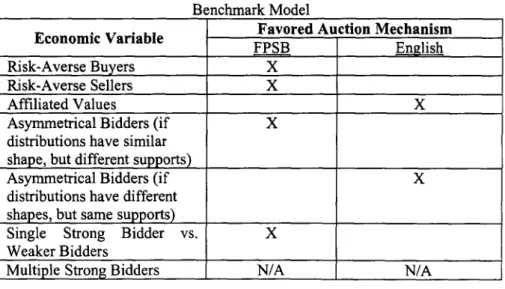
5. Optimal Mechanism Design: A Summary
Relaxing the assumptions of the benchmark model illustrates that the choice of structure may matter a lot to a seller designing a value-maximizing auction. Table 1 summarizes these determinants of optimal auction design.
Table 1: The Determinants of Optimal Auction Structure: Departures From the Benchmark Model
Economic Variable Favored Auction Mechanism
ditibtonmi haesiiar
FPSB English
Risk-Averse Buyers X
Risk-Averse Sellers X
Affiliated Values X
Asymmetrical Bidders (if X
distributions have similar shape, but different supports)
Asymmetrical Bidders (if X
distributions have different shapes, but same supports)
Single Strong Bidder vs. X
Weaker Bidders
Multiple Strong Bidders N/A N/A
Ultimately, standard English auctions may generate the highest expected revenues (or at least revenues that are not substantially dissimilar from other structures) in some cases. If certain conditions obtain, such as risk-aversion among the participants or certain asymmetrical value distributions among the
114. Povel & Singh, supra note 3, at 1400-01. The remainder of this paragraph describing their proposed structure is drawn from the same source.
115. In Part IV, Povel and Singh's proposal is re-examined in light of the judicial review framework proposed in that Part.