Behavior-Based Access Control for Distributed
Healthcare Systems
Mohammad H. Yarmand, Kamran Sartipi, and Douglas G. Down Department of Computing and Software, McMaster University,
Hamilton, ON, L8S 4K1, Canada
Abstract
Sensitivity of clinical data and strict rules regarding data sharing have caused privacy and security to be critical requirements for using patient profiles in distributed healthcare systems. The amalgamation of new information tech-nology with traditional healthcare workflows for sharing patient profiles has made the whole system vulnerable to privacy and security breaches. Stan-dardization organizations are developing specifications to satisfy the required privacy and security requirements. In this paper we present a novel access control model compliant with healthcare standards based on a framework designed for data and service interoperability in the healthcare domain. The proposed model for customizable access control captures the dynamic behav-ior of the user and determines access rights accordingly.
The model is generic and flexible in the sense that an access control engine dynamically receives security effective parameters from the subject user, and identifies the privilege level in accessing data using different spe-cialized components within the engine. Standard data representation formats and ontologies are used to make the model compatible with different health-care systems. The access control engine employs an approach to follow the user’s behavior and navigates among engine components to provide the user’s privilege to access a resource. A simulation environment is implemented to evaluate and test the proposed model.
Keywords: Access Control, Healthcare Standards, User Behavior, Privacy Specification, Interoperability
Email address: yarmanmh,sartipi,[email protected](Mohammad H. Yarmand, Kamran Sartipi, and Douglas G. Down)
1.
Introduction
The cost of healthcare in developed countries is rising rapidly due to the population’s expectation for a higher quality of health service including: broad accessibility, customizability, cost efficiency, and most importantly re-liability and security. Also, integrating computer applications within the healthcare domain has caused health professionals to embrace quickly grow-ing distributed information and communication technologies. The new pro-posals for national and international healthcare standardization meet most of these requirements.
While solving the problem of interoperability among heterogeneous sys-tems, these proposals introduce many security and privacy issues, as natural consequences of providing customizable services. Regarding confidentiality, integrity and availability requirements of patient data, a major concern is to avoid disclosure of these data to unqualified users. Access by unautho-rized users to patient data may result in misdiagnosis, delays in treatment, or mistreatment. Other consequences may include financial problems such as denial of insurance coverage and loss of job opportunities [40].
Authentication and authorization methods at inter-/intra-organizational levels should be employed to provide the required security. In this context, several methods have been proposed namely role-based [25, 48, 54, 63], team-based [26], attribute-team-based [21], content-team-based [27], scenario-team-based [46, 51], situation-aware [61], context-aware [7, 11, 37, 63], and context sensitive [38] access control methods. Only a few consider the problem in distributed systems [11, 37, 48, 61]. Moreover, most access control methods deal only with static systems. However, dynamism and configurability are two require-ments of models for distributed systems [37, 48, 61, 62]. There are a small number of approaches that propose models adherent to healthcare standards [12, 45, 39].
In very large scale distributed systems, the integrity, flexibility, generality, and robustness of the model becomes critical. Due to the high complexity of these systems, any errors in the operation of the access control model can be difficult to detect. In order to apply a generic model to healthcare systems, the corresponding specific requirements should be considered. They define the architecture, clinical data model, and transportation protocol for integration.
Given the above issues, the specific problem which is targeted in this paper is: propose an access control model for distributed healthcare systems that is interoperable with various organizational data formats and security rules, so that the specific healthcare requirements and standards are satisfied. A novel access control model is designed which is dynamic, system inde-pendent, and configurable. The model uses interactions and data flows be-tween different types of system entities (such as users, roles, and resources) to adjust access control decisions. These interactions are recorded and an-alyzed to extract the behavior of the entities. Healthcare standards obliga-tions about security, architectural specificaobliga-tions, data modeling, and system integration are carefully studied to make the access control model compati-ble with these standards. Access control decisions are based on constraints defined for roles, teams, contexts, and delegation rules.
The contributions of this paper are as follows. I) An access control model is provided that satisfies a comprehensive set of healthcare requirements and conforms to the healthcare standards dealing with access control. II) The model is formally defined. In particular the concept of user behavior is in-troduced to configure the access control model based on user requirements. III) To enhance interoperability, a common data model is proposed. IV) Im-plementation issues are discussed. The model is tested with simulated data. It should be highlighted that the contributions listed here are not unrelated. In particular the user behavior concept is designed in a way that refines healthcare standards requirements. A preliminary version of this work can be found in [60].
2.
Healthcare standards
The healthcare industry has many organizations developing specifica-tions and standards to support information exchange and system integration. These specifications are used to provide interoperability for a wide spectrum of healthcare applications. Here the security (particularly access control) specifications of these standards are outlined.
HL7. The Health Level 7 Security Technical Committee (HL7 STC) sug-gests using scenario driven access control based on dividing scenarios into work profiles and tasks. HL7 STC has released a list of healthcare scenar-ios that encompass security issues [31], and has introduced a hierarchy of healthcare roles and their access privileges [33]. These specifications should
be used together to determine the access rights of a role for completing an HL7 scenario [32].
Canada Health Infoway. The Privacy and Security Architecture (PSA) group has not yet suggested an architecture to serve security requirements but it has offered two useful documents: EHR Privacy and Security Require-ments [15] which discusses general security requirements in the healthcare domain and refers to data usage restrictions under privacy rules; and EHRi Privacy and Security Conceptual Architecture [16] which expresses the spec-ifications of the communication and common services. PSA suggests the use of role and work group based and discretionary access control.
HIPAA.The Health Insurance Portability and Accountability Act (HIPAA) [2] provides a list of security and privacy suggestions and legal requirements. The access control requirements suggested by HIPAA [29] contain unique user identification, emergency access procedure, automatic log-off, and en-cryption and deen-cryption.
IHE. Integrating the Healthcare Enterprise (IHE) [3] is an initiative de-signed to promote standard-based methods of data integration in healthcare. The technical security specification of IHE [42] includes authorization (role management, user/role certificate management, assertion rights, delegation rights, validity time), node authentication, information access, information integrity (document update and maintenance policy, document digital signa-ture policy, folder policy), ethics, audit trail, and risk analysis.
Requirements. We have extracted a number of healthcare specific require-ments from the standardization docurequire-ments. In the following we list and briefly explain them.
• “emergency access”: in emergency or life-threatening conditions, by-pass access must be available so that security restrictions do not pre-vent offering essential healthcare services. In an “emergency access” case, the user requests a permission he does not already have [14, 35]. • “consent”: is when the patient delegates part of his authorities or limits access. Consent can be implicit (e.g., when a patient visits a physician) or explicit (e.g., when a patient allows others to make decisions on his behalf) [15, 41].
• “workgroup access”: supports assigning the patient to a care group such as geographical, organizational, or circle-of-care work groups [15]. • “audit trail / monitoring”: all access requests together with support-ing reasons should be logged and the record owner should be notified. Monitoring should be developed jointly with audit logging [15, 18, 41]. • “context awareness”: permissions of care givers are altered based on the context they are working in, represented as context constraints. Contextual properties include separation of duties, time-dependency, mutual exclusivity, cardinality, and location [34, 35, 41].
3.
Access control model
In this section we define the basic concepts that are employed in the proposed model. In Section 3.1 we explain why a new access control approach is required. In Section 3.2, the user behavior concept, employed to visualize user activities, is informally defined. Different types of behaviors and their usage in making access control decisions are described. In Section 3.3, we formally define the basic concepts of the security domain and also the user behavior. Examples from the healthcare domain are used to further explain the formal definitions.
3.1. Motivating our approach
As will be discussed in Section 7, several access control models have been proposed for the healthcare domain. However very few of them consider the standards requirements discussed in Section 2. Therefore we intend to propose an access control method to target these requirements. More specif-ically this concept is used to i) express access history related constraints (identified as a requirement in [24, 28]) ii) formalize audit trails; iii) moni-tor access related activities (continuously logging system, regularly reviewing logs, reporting every access to a patient record, reporting security incidents are part of requirements described in [15, 18, 41]); iv) detect patterns of misuse (stated as requirement 46 in [15]).
Sample rules that can be expressed with the new concept (in Section 3.2) are:
• A user ui can not access a resource res1 more than n1 times between times t1 and t2.
• If a user ui is in location loce, he can only join teams tmx and tmy. • A user ui cannot make access requests from locations loce, locf in less
than tm time units.
Another aspect of an access control model is its administration. To the best of our knowledge, there has been little effort toward improving access control models based on dynamic access requirements and characteristics of the target environment. In order to extract these requirements, it is nec-essary to visualize the activities of users of the system. The usage pattern can be analyzed to refine access privileges and provide suggestions for sys-tem configuration (in the form of filtering attributes domains, explained in Section 4.2.6). For example, by monitoring denied access requests, it might be determined that the governing policy rule should be modified to allow a particular access.
3.2. Action and behavior
In order to capture the behavior of a user, we need to record a set of run time contexts, whenever the user interacts with the system. We call each interaction an action and represent it by a tuple, namely an action tuple. An action is any interaction which either requests a resource or changes the level of access privilege. The action tuple is composed of several attributes, as follows:
Action = <User, Role, User Location, Server Location, Time of Day, Team, Delegation, Requested Profile Status, Service Invo-cation Type, Requested Data Type, Login/Logout Event, Emer-gency>
where User is the user identification; Role is the user security role; User Location is the current location of the user; Server Location is where the requested resource is located; Team refers to the team to which the user currently belongs; Delegation explains the access rights given or taken by the delegation rules or consents; Requested Profile Status refers to attributes of the Resource Context class (explained in Section 4.1), for the requested profile; Requested Data Type refers to the clinical data type that the user
has requested; Service Invocation Type is the type of service requested; Lo-gin/Logout Event records login and logout events; Emergency declares an emergency situation. The value that each of these attributes takes is called the attribute value.
A Behavior is defined as a sequence of actions that can be manifested in the following forms: A record of a sequence of actions performed during a specified time interval, e.g., during the last five hours, a day, a month, etc. Each observation might include a portion of the attributes of the action tuple. For example, in one day different tasks performed by a person are recorded as action tuples and their collective effect is considered as behavior. Whenever anattribute value of the action tuple of a user changes, a new tuple is recorded. A new tuple may be recorded even if the user has not requested access to a resource. For example when a user joins a team, his privileges change and therefore a new tuple should be recorded even if the user does not request access to a resource.
3.2.1. Behavior based access control
The concept of user behavior can be used in different ways to make access control decisions. Here we introduce three different approaches.
Single actionrepresents a single action tuple. Given a single action tuple we choose one of the action attributes as a key attribute and use it to constrain the domains of other attributes. If Role is the key attribute, the domain of other attributes would be limited based on Role. In order to determine how attribute domains are filtered according to the Role value, general clinical guidelines or hospital policies defined for that specific role can be used. If User is the key attribute, the domains of other attributes would be limited based on that specific user. This makes our model dynamic and flexible in the sense that attribute domains are loaded for the specific user. In order to determine how the domains are filtered according to a specific user, the his-tory of action tuples recorded for that user is analyzed to extract associated domain values.
Daily behaviorconsists of a sequence of action tuples recorded in one day for a given user. Some access control processes require more than a single tuple to be able to make an access control decision. Examples are: log-in/out pat-tern; location proximity of consecutive requests; requested profile category and instance diversity; access request frequency; sequence of service
invoca-tion; policy rules explicitly defined over time such as access restrictions of a user on particular days.
Having defined theuser behavior, we define expected behavior as follows: the behavior that users are expected to follow which are entered as rules by the system security administrator. The user behavior concept is sufficiently rich to allow the enforcement of different kinds of rules to express theexpected behavior. Some of the possible rules are:
• Ordering: requiring that values occur in a certain sequence; limiting the number of values appearing between specific items of a sequence • Timing: limiting the occurrence frequency of a certain value; asserting
time interval constraints between occurrences of certain values in a sequence; defining absolute time constraints such as enforcing part of a sequence to occur before a certain time
• Association: enforcing that the occurrence ofval1 foratt1 should result in val2 for att2 (e.g. limiting value scope based on location)
• Combination of the above items: examples are statements such as de-tecting a particular order for att1 should result in val2 for att2; oc-currence of a particular order for att1 before a particular time should result in a particular sequence for att2
A third concept, based on user behavior, called common behavior is de-fined as: the behavior of a user analyzed and extracted from the user behavior history. The system is capable of analyzing behavior histories to extract the different behavior criteria defined in the expected behavior. One of the ap-proaches of this analysis is extracting the sequence of attribute values that an attribute takes most of the time, in the action tuples of a user (this approach is specified in Algorithm 2 of Section 4). Ideally, when users act according to their expected behaviors, the distance between common and expected behav-iors should be minimal. Alsocommon behavior can be used to adjustexpected behavior rules, in cases where the distance is significant. In order to come up with the expected behaviors the administrator can use organization specific guidelines, based on the analysis of organization workflows. For example in the nursing domain, the Canadian Nurses Association (CNA) [1] provides guidelines for Canadian nurses. They released a document called Advanced
Nursing Practice - a national framework [20] which describes competencies and regulations for nurses.
The last topic we discuss in this subsection is handling access requests in emergency situations. “Emergency access” offers broader privileges to care givers by extending their existing privileges to access protected health infor-mation when timely access is needed to prevent harm or risk to life. Although no standard procedure exists on how to handle these requests, suggestions have been made by healthcare standards initiatives (see for example [14, 35]). During these situations, emphasis should be placed on providing needed in-formation instead of trying to enforce very tight security constraints.
When an emergency access request is made (assuming the user’s current privilege does not include the requested permission), the access is granted unless the patient’s consent directives state otherwise. The user is warned about being closely monitored and that he is subject to legal penalties in case he is committing an access violation. At the same time a notification is sent to the security officer to closely monitor the user’s activities. In this sense emergency access works closely with the audit trail.
3.3. Formal definitions
In this section we first introduce the high level specification of our model using an algorithm and corresponding primitive types, relations, and exam-ples from the healthcare domain.
Algorithm 1 accepts an access request as input and employs the relations between sessions, roles, teams, and delegations together with different con-straints on actions and behaviors to find a matching access control policy to make the access control decision. The consistency among these relations and constraints is ensured by the order in which the algorithm treats them. For example if consent directives deny an access while an emergency situation is reported, consent directives are followed and the access is denied (see Lines 1-9).
Variables of Algorithm 1
Variables Explanation Variables Explanation
ui, uj user (∈U) RArray active (team) roles in sessionses
pg, pf, p0g, p0f requested permission (∈P) a.e emergency situation declaration (∈E) b(ui) behavior of userui (∈B) PArray array of active permissions gained
a action tuple (∈A) from applying PRto active roles
ses session (∈S) c, c0 conjunction of constraints Table 1: Variables of Algorithm 1
Algorithm 1 Access Control Mechanism (<ui, pg, b(ui), a> ∈ AR)
1: if (∃<uj, pg, ui, t,false>∈D. current time ≤t)then
2: Deny Access 3: gotoexit
4: end if
5: if (a.eistrue)then
6: Grant Access
7: Notify Security Administrator 8: gotoexit
9: end if
10: ses :=SessionUser−1(ui)
11: RArray :=SessionRole(ses)∪SessionTeamRole(ses)
12: for(r∈RArray) do
13: PArray :=PArray ∪ {p|<p, r>∈PR} 14: end for
15: if pg∈PArray then
16: if ((∃acp1 =<ui, pf, c,true>∈ACP. pg⊆pf ∧
cis trueby checking AC∧BC∧LC) ∧
(@ acp2=<ui, p0f, c0,false>∈ACP. pg ⊆p0f ∧ c0 is true∧ (acp2, acp1)∈PP))then
17: Grant Access 18: gotoexit
19: end if
20: end if
21: if (∃<uj, pg, ui, t,true>∈D. current time ≤t
∧ ∃ <uj, pg, c0>∈ACP. c0 is true) then
22: Grant Access 23: else
24: Deny Access 25: end if
Table 1 defines the variables used in Algorithm 1. Lines 1-4 of the algo-rithm state that ifpg includes accessing a resource which has been blocked for user ui by the resource’s owner, the access request is denied. In the health-care setting, patient consent directives can be enforced by these lines. Lines 5-9 address an emergency access. In lines 10-20 first a session ses dedicated to user ui is retrieved and the active roles are assigned to the RArray vari-able. Then PermissionRoleAssignment is applied on RArray to load the active permissions in the PArray variable. Afterwards if the requested per-mission pg belongs to PArray, the list of AccessControlPolicies is browsed to check if an access control policy exists that satisfies the access request and the action, behavior, and logical constraints. If such an access control policy is found, access is granted if no higher priority access control policy revokes the requested privilege. In lines 21-25 we check if permission pg is given to user ui via a delegation relation. Finally line 26 updates b(ui) and records the access decision made.
We now discuss the details of Algorithm 1. A number of primitive types are introduced to define the collection of sets required to provide a formal definition of the model. These primitive types are as follows: users U, roles R, resources Res, sessions S, teams Tm, login/logouts Log, data types DT, emergency situations E ={true, f alse}, and purposes of use Pr.
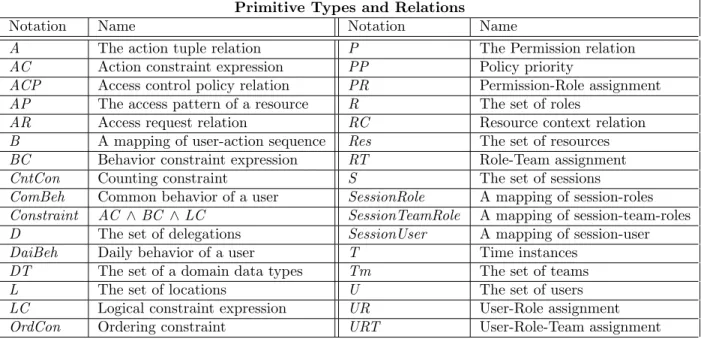
We now use these primitive types to express entities and relations for the proposed access control model. These relations are finally employed to state an access request, an access control policy, and the access control method. Table 2 provides a summary of the notations used.
Session
SessionUser: S 7→ U, is a function mapping each session to a single user. The user is constant for a session lifetime.
SessionRole: S 7→ R, is a function mapping each session to an active role. The set of active permissions for a session can be inferred by using the com-position of the UR and PR relations.
SessionTeamRole: S 7→RT, is a function mapping each session to an active team-role pair.
Primitive Types and Relations
Notation Name Notation Name
A The action tuple relation P The Permission relation
AC Action constraint expression PP Policy priority
ACP Access control policy relation PR Permission-Role assignment AP The access pattern of a resource R The set of roles
AR Access request relation RC Resource context relation
B A mapping of user-action sequence Res The set of resources BC Behavior constraint expression RT Role-Team assignment
CntCon Counting constraint S The set of sessions
ComBeh Common behavior of a user SessionRole A mapping of session-roles Constraint AC ∧BC ∧LC SessionTeamRole A mapping of session-team-roles D The set of delegations SessionUser A mapping of session-user
DaiBeh Daily behavior of a user T Time instances
DT The set of a domain data types Tm The set of teams
L The set of locations U The set of users
LC Logical constraint expression UR User-Role assignment
OrdCon Ordering constraint URT User-Role-Team assignment
Table 2: List of primitive types and relations
a single role per session. However this would violate healthcare domain re-quirements and can also cause policy conflict [41]. Hierarchal design for roles can be used to overcome this restriction (of one role per session). Here we assume the user can have a dedicated role and a role from its participating team.
Assignments
Permission: P ⊆OP×Res×Pr, whereOP defines the operations that can be performed on resources (e.g. {read, append, delete, update}) for the spec-ified purpose. For example P ={p1, p2} where p1 =<update, JaneAccount, AccountUpdate>, p2 =<update, JaneAccount, NewDietOrder>.
Adding ’purpose of use’ to the definition of the Permission relation has a number of justifications in the healthcare domain [32, 36, 41]. Permissions are assigned to certain scenarios that describe use purpose. Further patient consent might specify different privileges for different access purposes of a given requester. In case of inter-organization access control, one way to re-solve policy conflicts is to map use purposes among organizations.
UserRoleAssignment: UR ⊆U×R, defines the roles that a user can have. For example U R={<Jane, user>,<Jane, nurse>, <Nero, patient>, <Nancy, patient>}.
PermissionRoleAssignment: PR ⊆ P ×R, defines the permissions a role can have. For example P R={<p1,nurse>,<p2,user>}.
RoleTeamAssignment: RT ⊆R×T m, defines the roles that can participate in a team. For exampleRT={rt1}wherert1=<nurse, diabeticNursingTeam>. The workgroup requirement stated earlier can be formalized with this rela-tion.
UserRoleTeamAssignment: URT ⊆ U ×RT, defines the set of users that participate in a team and their roles in the team. For example
URT ={<J ane, rt1>}.
Delegation: D⊆U×P×U×T×GR, whereGR has a boolean value, defines a function that a delegator uses to grant/revoke a permission to a delegatee for a specified time period. For example Jane allows Nero to update Jane’s profile in the next hour D = {<Jane, p1,Nero, 2010.12.16 - 02:51, true>} given the delegation happens at 2010.12.16 - 01:51. Patient consent direc-tives can be expressed with this relation. To grant/revoke an access (e.g. to a family member or a physician) the value of GR is set to true/false. A permanent/temporary delegation sets the value ofT toinfinity/sometime in the future. A specific application of this relation in the healthcare domain is when a care giver asks a colleague for a second opinion on a medical case [63]. Action and behavior
Action: A⊆U×R×L×T ×Tm×D×RC×Res×OP×DT ×Log×E, is the action tuple defined in Section 3.2. For example
a1 =<Jane, nurse, l1, t1,diabeticNursingTeam, nil, rc1,NancyProfile, append, {diabeticInfo},nil, f alse>
Behavior: B :U 7→2A, is a function mapping a user to a sequence of actions that composes the behavior of the given user u. For example B(Jane) = [a1, a2, a3].
DailyBehavior: DaiBeh : U ×ATT 7→ 2attval, is a function returning the
sequence of attribute values (attval) of the attribute att ∈ AT T in the be-havior records of user u, where ATT is the set of action tuple attributes. This function describes the daily behavior (see Section 3.2). For example DaiBeh(Jane, role) ={user, nurse, nurse, researcher}.
CommonBehavior: ComBeh : U ×ATT 7→ 2attval, is a function returning
the sequence of attribute values (attval) of the attribute att ∈ATT by ana-lyzing the behavior records of user u. This function describes thecommon behavior (see Section 3.2).
Access request and policy
AccessControlPolicy: ACP ⊆Subject×P×Constraint×GR, whereSubject is a user or a role. ACP is a relation which defines the constraint that should be satisfied so that a permission is granted/revoked to a subject. For exam-ple acp1 =<Jane, p1, constraint1,true>.
AccessRequest: AR⊆U ×reqPerm ×B(u)×A, where reqPerm is the re-quested permission. For example ar1 =<Jane,<read, NeroProfile>,
B(Jane), a1>.
PolicyPriority: P P ⊆ACP×ACP, is a relation defining priority among ac-cess control policies. (acp1, acp2)∈PPassumingacp1.subject =acp2.subject∧ acp1.GR 6= acp2.GR, acp1.constraint and acp2.constraint are satisfiable at the same time, andacp1.p∪acp2.p6= Ø, meansacp1 has higher priority than acp2.
Constraints
ActionCondition := λ att att0. att op att0 (λ is lambda notation) where att refers to the values of an attribute of the action tuple,op is a logical operator in the set{>,≥, <,≤,6=,=}, and att0is a value of the same type asatt. The Boolean value resulted from applying operation op to values att and att0 is returned as the output.
ActionConstraint: AC, is a predicate consisting of disjunction and/or con-junction of ActionCondition expressions. For example ac1 =
(team = diabeticNursingTeam)∧(data type6=confidential). Simple context related constraints can be stated here.
BehaviorConstraint: BC, is defined as the result of checking different kinds of expected behavior (i.e. OrdCon, AssCon, TimCon, ComCon and ConCon described in the following). If a given DaiBeh satisfies all of the constraints defined by these rules,BC istrue; otherwiseBC isfalse. We formally define OrdCon and CntCon and move the rest to Appendix A.
OrderConstraint: OrdCon :U×ATT 7→2attval×Mandatory ×MinLength,
is a function returning the sequence of attribute values (attval) (of a mini-mum length N and mandatory/optional occurrence of attribute values is the sequence based on Mandatory) of the attribute att ∈ AT T in the behavior records of user u, whereMandatory = {true, false}andN ∈N. For example OrdCon(Jane, requested profile) = [<JaneAccount, true, 3>,
<SaraProfile, true, 3>,<NeroProfile, false, 3>,<NancyProfile, true, 3>].
CountConstraint: CntCon :U×ATT 7→N×T ×T, is a function express-ing the valid number of times n ∈ N that a user u can access att ∈ ATT in the time interval [t1, t2] where t1, t2 ∈ T. This relation targets counting constraints in the healthcare domain (see [24, 28, 57] for examples).
LogicalConstraint: LC is a logical expression that can not be expressed with either AC or BC. Constraints that use resource contexts are defined here. For example lc1 =isMemberOfDiabetesDepartment.
Constraint:=LC∧AC∧BC. For example constraint1 =lc1∧ac1∧bc1. Context
Location: L,is a set of locations. For example l1 =diabeticNursingStation.
Time: T,represents time instances in the following format year.month.day-hour:minute). For example t1 =2010.12.25-09:05.
AccessPattern: AP ⊆ 2L×T, is a subset of location-time pairs (which is employed to record the location and time stamp of the users who access a resource). For example ap1 =<l1, t1>.
ResourceContext: RC ⊆Res×AP ×2U×DT, is a collection of attributes and contexts recorded for resources. For example rc1 =<JaneAccount, ap1, Jane, reminder>.
4.
Access control model architecture
In this section an architecture is introduced that supports the features of the proposed access control model. A common data model is created to provide interoperability for collecting the information that the architecture requires. The architecture specifies how to apply the definitions offered in Section 3.
4.1. Security effective parameters
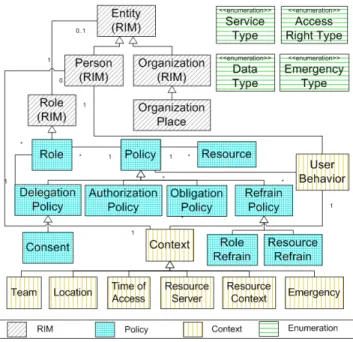
In order to keep the model as general as possible, different security pa-rameters should be both identified and captured in different environments. They are used as parameters for the privacy and security rules. These pa-rameters are modeled in a class diagram shown in Figure 1.
In order to establish interoperability and reusability, the relations between our class diagram and standard clinical data are defined. The interoperation between policy rules of two legacy systems can be facilitated through map-ping the elements of their policy model to the model presented in Figure 1. Our class diagram is connected to the HL7 Reference Information Model (RIM), an object model that is a representation of clinical data. A few classes of HL7 RIM have been used. The service type class (top right) represents a list of services that a user invokes; this list is mapped to Infoway storyboards and transactions of standard healthcare scenarios [17]. The data type class (top right) expresses the type of clinical data and is specified by the hierar-chial object definitions from healthcare standards [36] (currently 100 types). Moreover, resources are structured according to the HL7 Clinical Document Architecture (CDA) [30] to increase access granularity (e.g. observations, procedures, diagnostic images, financial transactions). The access right type class defines different operations specified by [36] (currently 26 types).
There are four categories of classes: i) HL7 classes; ii) context hierarchy classes; iii) core security classes, and iv) enumeration classes. We extend the policy classification offered by the Ponder project [22] to represent different policies. The remainder of this section explains the major classes.
The policy class regulates the conditions a user should meet, in order to access a resource. The policies are divided into four different categories. ‘Authorization’ policies define the actions that different roles are allowed to perform on resources. ‘Delegation’ policies determine temporal states under which users can delegate their access rights to other users. ‘Refrain’ policies revoke permission even if permission is given by other policies and are categorized as role refrain and resource refrain based on the target of their restriction. ‘Obligation’ policies specify the action (such as administrative actions) that must be performed when certain events occur.
Context Aware Systems (CAS) offer a number of benefits such as autho-rizing users based on their context, adjusting security levels automatically, and sharing services [9, 43, 44, 52]. Healthcare security standards use con-texts to express different constraints [34, 35, 41]. Context aware models define logical constraints over context and restrict the set of possible context configurations. These constraints are placed in the policy class to maintain model integrity. A major portion of the class diagram has been allocated to represent security related contexts derived from the context class. In the formal definitions in Section 3.3, these contexts are represented as action tuple attributes (location and time are conventionally shown as context in
the formal definitions).
The user behavior class uses the context class and audit trails for re-sources and users to extract information to model the behavior of a user. The resource context class considers contexts over resources such as the ac-cess pattern made to a resource, the type of data the resource contains, and users who have previously accessed the resource.
4.2. Proposed architecture
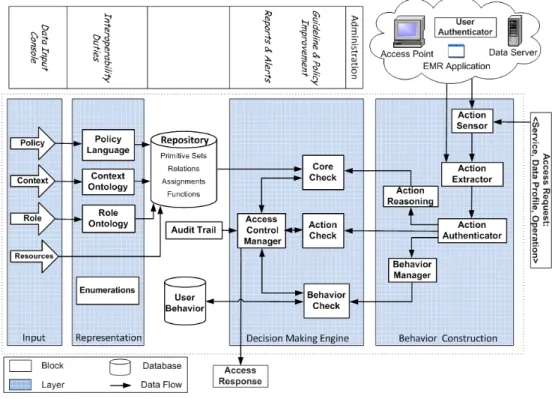
An architecture is designed to use the concepts introduced so far and deliver the desired access control functionality. The architecture is shown in Figure 2. The figure is divided into different layers that provide a high level categorization of different blocks (each box is called a block) of the model. The blocks of a layer perform a common major task.
Figure 2: The architecture of the proposed access control model
An administrator configures the system dynamically by entering data through the input layer. This task tailors the generic model to a specific
environment and provides interoperability and configurability. The model receives an access request and captures the context of the requesting user, checks for different policy rules, applies the results of behavior based con-straints and returns the final access decision. In this section all blocks of the model are introduced and their responsibilities and specifications are explained.
4.2.1. Input
The inputs are the same as the security effective parameters explained in Section 4.1.
4.2.2. Representation
In order to make the system interoperable and usable in different en-vironments, we have to map input parameters (from the input layer) to a common standard format. In this way when a workflow spans multiple orga-nizations with different security architectures, no change to internal security architectures is required. In the healthcare domain, HL7 RIM provides a hier-archy for clinical and security roles which we adopt as our standard ontology [32, 33]. The Policy Languages box supports a common policy language (Rei) to facilitate interconnection.
4.2.3. Repository
The repository resides between the input and decision making engine layers as an interface for the engine. The repository is used to maintain model generality by making the engine independent of any particular data format. The input data are stored in the repository. The dynamic attributes of system entities such as user and resource contexts are also stored here. 4.2.4. Decision making engine
This layer uses access requests and the data gathered from other layers to make the access control decision. We now give the detailed specification of the major blocks of the decision making engine layer.
A policy specification language is chosen that is capable of expressing the desired policies. Access requests are entered as inputs to this block and a rule based process is followed to yield the final access control decision. In Section 6.2 the policy specification language and its supporting packages are introduced.
Access control manager. This block is responsible for determining the ac-cess decision based on the results gained from the other blocks of this layer. It first sends requests to the action check block and if valid sends them to the core check block to make decisions. This block would call the behavior check block if behavior related constraints are defined. If all of the defined constraints are satisfied, access is granted; otherwise access is denied. This block interacts with the Administration layer for monitoring and improve-ment purposes. While the tasks for making an access control decision are performed online (i.e. per each access request), the administrative tasks are performed offline and through the user behavior repository.
Action check. The single action part of the behavior based access control (defined in Sections 3.2 and 3.3) is specified here. This block accepts an action tuple as input and checks if the attribute values of the action tuple conform to the specified rules.
Core check. This block implements Algorithm 1. All of the policies defined in this algorithm such as constraining roles, resources, times, delegations, and teams are enforced in this block.
Behavior check. This block checks behavior related constraints by retriev-ing the daily behavior from the behavior manager block and comparing it with the expected behavior (defined in Section 3.3). An instance of express-ing these rules usexpress-ing a policy specification language is shown in Appendix B.
Audit trail. Many security breaches are the results of individuals with le-gitimate access rights who view patient information that they should not be viewing as part of their duty. A suitable way to detect such breaches is to let the patient review the audit trails of their chart. Theaudit trail block estab-lishes a historical record of user or system actions. Healthcare standards have specified the audit trail from different aspects [15, 18, 42]. They have sug-gested a list of auditable events including: node-authentication-failure, order-record-event, patient-care-assignment, patient-order-record-event, query-information, consent-directive-override, and user-authentication. They also express the minimum information to be logged including: user ID and role, user organi-zation, patient ID, performed function, time stamp, supporting reason. This information can be extracted from the action tuple. In other words, it is possible to record action tuples as audit logs. This block is also responsible
for making the records available to appropriate personnel. 4.2.5. Behavior construction
This layer is responsible for constructing basic data for thedecision mak-ing engine layer, i.e. the action and behavior concepts. Different blocks are required to capture and represent these concepts. Action sensor senses any changes in the attributes of the action tuple. Action extractor composes the action tuple based on the data sensed by action sensor.
Action authenticator authenticates the context itself. Different methods such as statistical analysis, distributed reputation, and confidence value, are used for authenticating contexts [59]. Attribute values are checked for com-pleteness and correctness. Erroneous values for critical attributes (such as user, role, team, requested profile and requested service) are rejected in order to maintain data consistency.
Behavior manager composes the behavior based on the input action tuple and the past history of user behavior and updates the user behavior reposi-tory. Theaction reasoning block uses context inference rules, input through the input layer, to infer the contexts that cannot be directly sensed. These data are passed to the core check block to apply relevant rules.
4.2.6. Administration
In order to improve the constraints defined by a security administrator, the system provides the capability of analyzing access related data to extract common behaviors of users (representing the current behaviors of users). The administrator can measure the distance between common and expected behaviors that he has defined. Ideally, if users tend to respect the access constraints defined for them, the gap betweencommonandexpected behaviors should be small. The administrator can use this distance as a measure to adjust the expected behavior, if necessary (i.e. adjusting the rules so that the users experience fewer unintended access denials while they respect their access constraints). In order to extract a common behavior, the following problem should be solved: given a list of actions for a user, find the common sequences for each attribute (if such sequences exist) to construct the user behavior.
Algorithm 2 is one possible solution to the stated problem. Giving the main ideas required, it can be used as a starting point for further refinement. This algorithm has two functionalities: finding the common attribute values
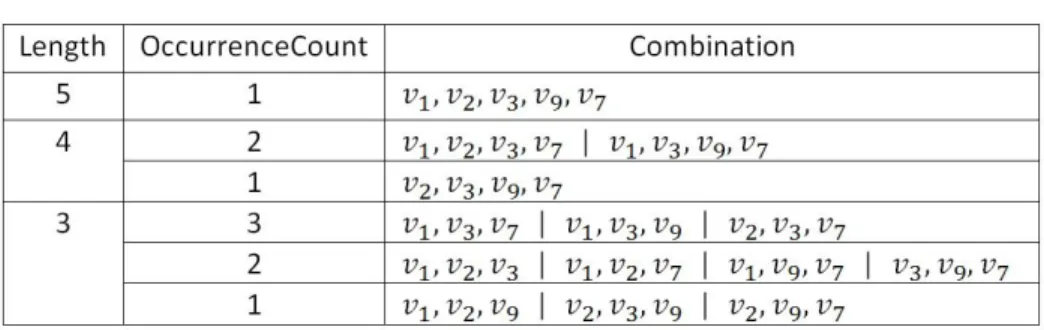
and determining the order of a sequence of attribute values. Algorithm 2 can be run for sequences with different lengths and for different sets of attributes. Figure 3 shows an example of applying Algorithm 2. Given values for an action attribute for five days, Algorithm 2 creates lists of activities for each day and calculates the cumulative list. Then assuming N = 5, the first five values are identified. Finally, behavior is represented, as a set ofcombinations of action attributes with different sizes (length) and occurrence frequencies (occurrenceCount).
Algorithm 2Extract behavior sequence for an attribute value from a set of action tuples
Input: i) List of user action records; ii) threshold
Output: behavior, as a set ofcombinations of action attributes with different sizes and occurrence frequencies greater thanthreshold
1: List the values that appear in user action records for a given attribute 2: foreach day do
3: Initialize an instance of the list (of step 1) to 0
4: Mark an attribute value as 1 if the user has used it in thisday
5: end for
6: CumulativeList := Sum up the list of different days (used in steps 2-5) 7: TopNList := attribute values with the greatest frequency of occurrence 8: forlength: N to 2do
9: for each combination with size length of the first N elements of TopNList
do
10: occurrenceCount = number of matches in all days with thiscombination
11: if occurrenceCount > threshold then
12: behavior :=behavior ∪ combination
13: end if
14: end for
15: end for
16: return behavior
A second functionality proposed here (not specified completely) is to con-figure the action tuple based on the environment. The user behavior repos-itory is reviewed to determine if certain attributes of the action tuple are not used. If so, the action tuple can be condensed. For example in an en-vironment where no security teams exist, there is no need to keep the team attribute in the tuple. This helps to reduce unnecessary complexities in the model.
Figure 3: An example illustrating Algorithm 2
Ideally, system characteristics can be observed to extract a security con-figuration that better serves security requirements. Some of the system char-acteristics to consider are: interactions of instances of different roles, user assignment to different roles, type of requested data or service, resource re-quest frequency, delegation frequency between roles, denied access rere-quests and data flow at inter and intra organizational levels. The access control pol-icy can be configured based on these characteristics to satisfy dynamic user access requirements such as extending user access rights by adding new per-missions, modifying delegation rules between roles, and increasing resource accessibility.
5.
Access control model evaluation
In this section we discuss the complexity of our framework. We also clarify for what purposes the behavior concept is and is not employed during the access control decision process.
In the following we examine the complexity of our framework from dif-ferent perspectives, and suggest that the imposed complexity is reasonable.
• Inherent complexities. Our framework provides a number of facilities which allow security administrators to express different privacy policy rules. However, the framework does not impose any obligations on the administrators to use complicated rules, unless such rules are inherent to their system. Therefore the complexity of the rules depends on the nature of the underlying system.
• Usability complexities. A major factor in usability complexity is related to configuring the generic framework for a specific system. This issue is discussed in Section 6.2. The administrator should become familiar with the syntaxes chosen for modeling policies and contexts in theinput layer. To address this concern, a graphical interface is prototyped and explained in Section 6.3.
• Process complexities. We define security rules and provide a corre-sponding engine to grant or deny access requests. This generic ap-proach is common in the literature [11, 33, 55, 58, 59]. We further optionally provide a facility for behavior analysis.
• Time complexity. Algorithm 1, which covers major functionalities of the framework, has polynomial time complexity proportional to max(number of permissions defined for the given user, number of access control policies(ACP)). The running time of Algorithm 2 is O(number of days in the user history * N!) where N is the maximum length of sequence of attributes we are looking for. However N is fixed and small (typically less than 10 in practice). This makes the running time complexity polynomial in terms of the number of days.
Here we want to clarify more how we use the behavior concept in making an access control decision. In addition we explicitly describe the type of usage that we avoid. Assume we modify Algorithm 1 such that it automatically uses behavior analysis results in making the access control decision. Consider an extreme case where there are noexpected behavior constraints (BC is not passed in line 16). In Algorithm 1 replace checking the expected behavior constraint (BC) with the following predicate: extract the common behavior of user ui and compare it with b(ui), his daily behavior; if the distance of the two behaviors is more than a certain threshold (see Algorithm 3 for one possible measurement method), the expression is evaluated to false (and therefore the access is denied); otherwise it is evaluated to true.
Such an algorithm causes different concerns and questions including: • how to determine threshold variables (see Algorithm 3) to decide if a
given behavior follows a common behavior or not. Is comparing daily behavior good enough or should we be considering behavior over a week? How far do we need to go back in time to createcommon behav-ior?
• the common behavior concept reflects the average and usual behavior of the user. Common behavior is not an exact representation of every instance of a user behavior. However the access control requires exact verifiable rules rather than statistical and threshold-based rules. Also it is not possible to control how restrictive acommon behavior constraint can become. Could this impose further constraints on top of a user’s workflow and regulation in order to access a resource?
• how to verify that a common behavior is actually a correct behavior from the access control point of view. There might be a case that common behavior represents a user’s habit rather than the user’s com-pliance to an authorization regulation. A scenario can be imagined where frequent invalid requests of a user eventually authorizes an in-valid privilege. In such a case denying or granting access based on habit is not a correct decision.
These concerns could lead into access control vulnerabilities. To avoid these issues we have done the following. Firstly, we introduce the expected behavior concept. Dissimilar tocommon behavior, expected behavior defined by the administrator is an exact rule, not based on statistical data, and therefore does not suffer from the above issues. Secondly, we use the analysis results as suggestions and not directly including them in the decision making process. The analysis results once recognized and refined by human judge-ment, become free from the above shortcomings and are translated to exact rules to be used.
A large distance between two orders is the sign of either a user making frequent privilege violations (or a possible attack if no specific pattern can be determined) or anexpected behavior rule that enforces invalid constraints. Therefore the administrator can either upgrade theexpected behavior to cover a user’s requirements or warn the user of frequent access request violations (or investigate the possibility of an attack). Expected behavior adjustment for
the case of anorderConstraint is performed by reordering values that caused violations. Other types of expected behaviors are measured and adjusted in a similar manner. Algorithm 3 is one simplistic possibility for comparing ordering constraints among a common and an expected behavior.
Algorithm 3 Measure the difference between two orders and notify if the distance is large
Input: i) acommon order and anexpected order; ii) threshold
Output: boolean, as distance measurement result 1: orderViolation = 0
2: for∀v1, v2 . v1=6 v2∧v1, v2 ∈expected order do
3: if occurrence order of v1 and v2 is different incommon order then 4: orderViolation =orderViolation + 1
5: end if
6: end for
7: if orderViolation > threshold then
8: return false
9: else
10: return true
11: end if
In an environment like healthcare with a dedicated and trustful audience (compared to a public environment with potential attackers), it is not normal to find many access violations. Therefore suggestions are meant to reduce the number of violations. On the other hand, results can be used to discover new rules that can refine user access scope in case they are initially defined too broadly. The administrator can run this algorithm periodically to ensure current permissions fit the need-to-know principle discussed in the literature. 6.
Simulated Environment
In this section we provide an implementation for the architecture of our proposed access control model. This implementation aims to provide a pro-totype for different sections of the architecture. The current implementation is not intended to be used in real projects as it is not a complete instance of the proposed architecture.
The standard three-tier architecture is used for this prototype. It includes the data access layer which acts as an interface for the database. The busi-ness layer contains the core logic. Finally, the presentation layer offers a
user interface. The following technologies and tools are used: Java, Eclipse Enterprise Edition, and MySql database. The database is created with the MySql Database Management System (DBMS).
6.1. Ontology specification
The Role hierarchy and context classes of the class diagram are repre-sented by the Web Ontology Language (OWL). OWL is also used to map between specific system hierarchies and the hierarchy ontology offered by the model. Theowl:equivalent feature is employed to define equivalency between attributes of hierarchies. Also, contexts and their relations are modeled using the owl:objectProperty and owl:dataTypeProperty features.
6.2. Policy specification languages
Several policy specification languages can be used. Amongst these, Pon-der [5] and Rei [6] are two languages that support the requirements of our model. Here we explain how to use the Rei language to specify policies. Rei is a language based on OWL that allows policies to be specified as constraints over allowable and obligated actions on resources in the environment. Re-garding the difficulties of using available tools, we implemented an engine for interpreting and applying the Rei specifications, explained in Section 6.4. The policy specification is divided into separate files, each describing a dif-ferent portion.
Ontology file. Different entities, contexts, and the general concepts (classes) of Figure 1 are introduced in an ontology file. As an example, some of the entries of the ontology file (in the form entity(attribute)) are: Person(name, affiliation, isCareGiver) and Patient (locatedIn, associatedCareGiver).
Instance file. This file contains class definitions that are subclasses of the classes introduced in the ontology file and have constraints over entries of the instance file. In the following example an action called NursDiabAction is shown that represents those actions that a nurse of the Diabetes Department performs. <owl:Class rdf:ID="NursDiabAction"> <rdfs:subClassOf rdf:resource="DiabAction"/> <rdfs:subClassOf rdf:resource="MajorProfChg"/> <rdfs:subClassOf> <owl:Restriction>
<owl:onProperty rdf:resource="actor"/> <owl:allValuesFrom rdf:resource="Nurse"/> </owl:Restriction>
</rdfs:subClassOf> </owl:Class>
Other entries of the instance file are direct instances of defined classes. The following example shows how to introduce a patient to the system: <hosp:Patient rdf:ID="Nero"> <hosp:associatedCareGiver rdf:resource="Jane"/> <hosp:affiliation rdf:resource="DiabetesDept"/> <hosp:PatientProfile rdf:resource="NeroEHR"/> <hosp:locatedIn rdf:resource="room223"/> </hosp:Patient>
Policy file. Policy files contain constraints, different types of policies and meta policies, and the collection of active policies. Constraints are logical expressions restricting the attribute values of objects. The following example describes the constraint of someone being a member of the Diabetes Depart-ment. <constraint:SimpleConstraint rdf:ID="IsMemberOfDiab"> <constraint:subject rdf:resource="var1"/> <constraint:predicate rdf:resource="affiliation"/> <constraint:object rdf:resource="DiabetesDept"/> <policy:desc>
All members of Diabetes Department </policy:desc>
</constraint:SimpleConstraint >
Policies are described usingpermission/prohibition,delegation/revocation, and obligation tags. Different policies (role, team, and context) are modeled based on the constraints that must be checked prior to giving permission to a user. Policies can be specific or generic. The former assigns access rights to individuals while the latter describes the general conditions under which an access right is granted or denied. An example of giving specific permission to Jane, a nurse of the Diabetes Department, to perform an action defined by nurses in the Diabetes Department is:
<deontic:Permission rdf:ID="Perm_Jane"> <deontic:actor rdf:resource="&inst;Jane"/>
<deontic:action rdf:resource= "&inst;ANursDiabAction"/> </deontic:Permission>
Different expected behaviors can be expressed with Rei in a similar man-ner. Interested readers are encouraged to check Appendix B for these spec-ifications.
6.3. Administrator interface
We have developed a prototype for administrators in order to reduce the complexity of employing the model and facilitate the interactions with the model defined in theAdministration layer. This prototype provides a Graph-ical User Interface (GUI) as an alternative for the syntactGraph-ical representation introduced in Section 6.2.
The prototype has a menu for each of the sets, relations, and constraints of the formalisms defined in Section 3.3. It also provides a monitoring menu, consisting of retrieving common behavior and viewing audit trails.
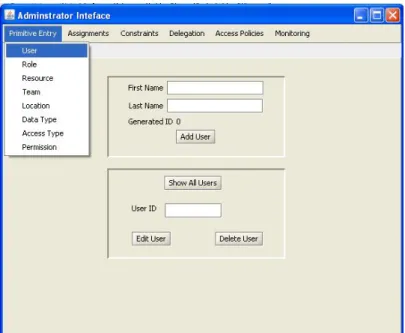
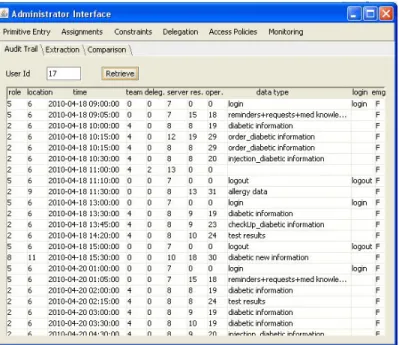
Figures 4, 5, and 6 provide a number of snapshots of the prototype. Figure 4 shows items of the “primitive” menu for entering primitive data type values. Figure 5 presents the access control policy creation page. A list of available values for each of the items of this relation is shown on the right. Once a valid value is entered for all items, the relation can be created. Figure 6 illustrates the audit trail page for a given user.
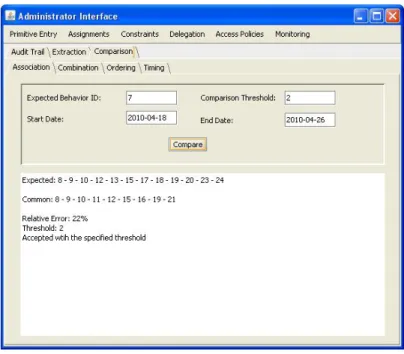
Figure 7 shows how to check for an existing or potential association-Constraint relation by passing a user id, an action attribute value, and a time period as inputs. In this example, the filtering attribute is team with value of diabeticDeptNursingTeam. Figure 8 shows the results of comparing a common and an expected behavior. The common behavior is extracted using the user attribute of the relevant associationOrder. In this example the associationOrder filters user location withdiabeticNusringStation. 6.4. Implementation classes
The classes that are used to implement the simulation environment are shown in the class diagram of Figure 9.
TheACmodelclass initializes the model by entering the policy rules. Ac-cess requests are sent to the model through this class. These requests are objects of theUserBehaviorclass which are sent to theACmanagerclass. The DBmanager class resides in the data layer and is the interface between the data layer and other classes. The FileScannerParser class is responsible for inserting the policy rules from the Rei policy specification files into appro-priate tables of the database. The CoreCheck,ActionCheck,BehaviorCheck, and ACmanager classes perform the responsibilities of the decision making
Figure 4: Administrator’s user page
Figure 6: Audit trail page of the administrator interface for a typical user (User Id 17)
Figure 8: AssociationConstraint comparison page
engine and administration layers. Finally the AdministratorInterface class represents the administrator interface described in Section 6.3.
6.5. Simulation result
Different ways of modeling and categorizing tasks of care givers exist. These models have differing degrees of commonality. For example the model in [50] describes nursing tasks as direct case (physical and psychological), direct cure, and adjunct activities, while the model in [53] expresses tasks as assessment, nursing diagnosis, planning, implementation, and evaluation; these models have both overlapping and disjoint parts. The rules governing healthcare institutions also vary depending on the nature of the institutions and the decisions made by local managers of those institutions. After talk-ing to a number of care givers in the McMaster University Medical Centre (MUMC) and consulting the literature ([4, 47, 50, 53]), we extracted typi-cal common activities and daily schedules. We focused on ward nurses to develop a case study covering different rules that require access control.
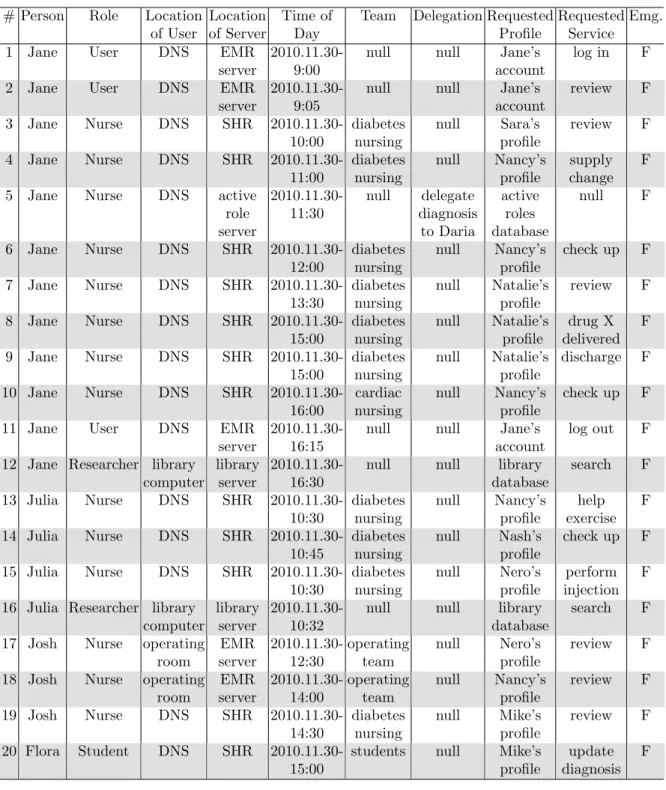
In this simulation, access requests for a number of care givers in a day are represented. We have chosen these requests such that different rules and constraints discussed in the paper are covered. We have avoided consider-ing similar repetitive requests, as we believe they do not provide additional insight for understanding the model. In these requests, all personnel are affiliated with the Diabetes Department. Involved parties are nurses: Jane, Julia, Josh; students: Flora; unlicensed assistive personnel: Daria; patients: Nero, Nancy, Natalie, Mike, Nash, Sara. Locations are EMR server, Shared Health Record (SHR), Active Role Server, library computer, Diabetes Nurs-ing Station (DNS). Table 3 represents the requests in plain English. Table 4 shows requests expressed by action tuples corresponding to Table 3.
The following rules are assumed (based on our consultation with care givers and the literature):
1. Care givers can only access patient profiles within their departments. 2. There must be a time interval of at least 5 minutes between access
requests from the Diabetes Department and the library (due to their distance).
3. Nurses are not allowed to delegate certain procedures (such as assess-ments and nursing diagnosis) to unlicensed assistive personnel while they are allowed to delegate some others (such as taking vital signs and intake and output).
# Description
1 Jane logs into her account information and registers as the responsible nurse. 2 Jane reviews her account
3 Jane joins the Diabetes Department team and tries to reviewSara’s profile, a patient not assigned toJane.
4 Jane updates supply change information ofNancy, a patient assigned toJane. 5 As a nurseJane delegates her diagnosis authority toDaria, a nurse in the same team. 6 Jane updates check up information ofNancy, a patient assigned toJane.
7 Jane reviewsNatalia’s profile, a patient assigned toJane.
8 Jane updates drug information ofNatalia, a patient assigned toJane. 9 As a nurseJane tries to dischargeNancy, a patient assigned toJane. 10 As a member of Cardiac Department teamJane tries to update check up
information ofNancy, a patient assigned toJane. 11Jane logs out of her account.
12Jane commits some search request from the library.
13Julia tries to update exercise information ofNancy, a patient not assigned to Julia. (assumeJulia has logged in and registered earlier in the day)
14Julia tries to update check up information ofNash, a patient assigned toJulia. 15Julia updates injection information ofNero, a patient assigned toJulia. 16Julia tries to perform a search from a resource library.
17 As a member of the surgery teamJosh reviewsNero’s profile.
18 As a member of the surgery teamJosh tries to access aNancy’s profile in a different operation.
19 As a member of Diabetes Department team,Josh tries to reviewMike’s profile, a patient assigned toJosh.
20Flora as a student tries to update the diagnosis information ofMikes’s profile in absence of an attending physician.
# Person Role Location Location Time of Team Delegation Requested Requested Emg.
of User of Server Day Profile Service
1 Jane User DNS EMR 2010.11.30- null null Jane’s log in F
server 9:00 account
2 Jane User DNS EMR 2010.11.30- null null Jane’s review F
server 9:05 account
3 Jane Nurse DNS SHR 2010.11.30- diabetes null Sara’s review F
10:00 nursing profile
4 Jane Nurse DNS SHR 2010.11.30- diabetes null Nancy’s supply F
11:00 nursing profile change
5 Jane Nurse DNS active 2010.11.30- null delegate active null F
role 11:30 diagnosis roles
server to Daria database
6 Jane Nurse DNS SHR 2010.11.30- diabetes null Nancy’s check up F
12:00 nursing profile
7 Jane Nurse DNS SHR 2010.11.30- diabetes null Natalie’s review F
13:30 nursing profile
8 Jane Nurse DNS SHR 2010.11.30- diabetes null Natalie’s drug X F 15:00 nursing profile delivered 9 Jane Nurse DNS SHR 2010.11.30- diabetes null Natalie’s discharge F
15:00 nursing profile
10 Jane Nurse DNS SHR 2010.11.30- cardiac null Nancy’s check up F
16:00 nursing profile
11 Jane User DNS EMR 2010.11.30- null null Jane’s log out F
server 16:15 account
12 Jane Researcher library library 2010.11.30- null null library search F
computer server 16:30 database
13 Julia Nurse DNS SHR 2010.11.30- diabetes null Nancy’s help F 10:30 nursing profile exercise 14 Julia Nurse DNS SHR 2010.11.30- diabetes null Nash’s check up F
10:45 nursing profile
15 Julia Nurse DNS SHR 2010.11.30- diabetes null Nero’s perform F 10:30 nursing profile injection 16 Julia Researcher library library 2010.11.30- null null library search F
computer server 10:32 database
17 Josh Nurse operating EMR 2010.11.30- operating null Nero’s review F
room server 12:30 team profile
18 Josh Nurse operating EMR 2010.11.30- operating null Nancy’s review F
room server 14:00 team profile
19 Josh Nurse DNS SHR 2010.11.30- diabetes null Mike’s review F
14:30 nursing profile
20 Flora Student DNS SHR 2010.11.30- students null Mike’s update F
15:00 profile diagnosis
Table 4: A portion of access requests made to the model in one day (corresponding to Table 3), represented in the form of action tuples
4. Nurse Julia should visit patients in the following order: Nero-Nash. 5. A care giver must not participate in surgeries which are less than 3
hours apart.
6. The patients assigned to nurse Julia are: Nero and Nash.
7. Care givers should register as responsible for their shift, before they are allowed to do anything else.
8. There are certain procedures which require confirmation of a care giver with higher permission levels.
9. Students gain access through a delegation made by their attending physicians.
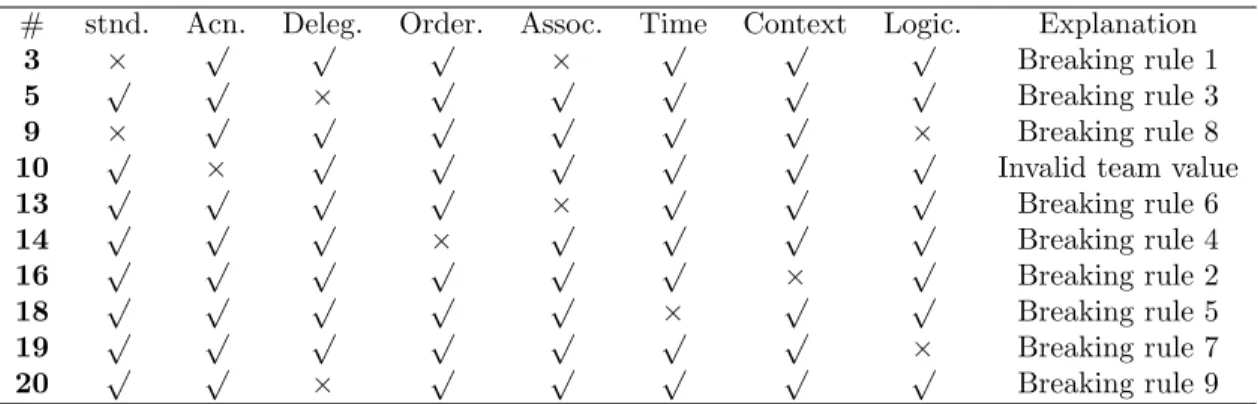
The accesses which are denied are given in Table 5. For each access the type of unsatisfied constraint and the rule violated are shown. All other accesses are granted.
# stnd. Acn. Deleg. Order. Assoc. Time Context Logic. Explanation
3 × √ √ √ × √ √ √ Breaking rule 1
5 √ √ × √ √ √ √ √ Breaking rule 3
9 × √ √ √ √ √ √ × Breaking rule 8
10 √ × √ √ √ √ √ √ Invalid team value
13 √ √ √ √ × √ √ √ Breaking rule 6 14 √ √ √ × √ √ √ √ Breaking rule 4 16 √ √ √ √ √ √ × √ Breaking rule 2 18 √ √ √ √ √ × √ √ Breaking rule 5 19 √ √ √ √ √ √ √ × Breaking rule 7 20 √ √ × √ √ √ √ √ Breaking rule 9
Table 5: Denied access requests supported by corresponding violated constraints and rules Table 6 shows details of the action tuples and the results of each of the constraints for two of the above access controls. For each request, a portion of the results of the blocks of thedecision making engine layer is shown. We will not represent the action tuples and result details for other requests as they look similar to the Table 6 entries and are generated using Tables 4 and 5.
7.
Related work
In this section, the literature is reviewed for specific access control models for the healthcare domain.
Action tupletime:11:00:00.0, user:Jane, role:Nurse, user location: diabeticNursingStation, server location:sharedHealthRecord, team:
DiabeticDeptNursingTeam, requested profile:NancyEHR, requested service: DiabReview, requested data:diabetic information, emergency:false
Core: Access granted with generic inferred permission
Action: All arguments are valid!
Behavior: Expected behavior is followed!
Logical: Logical constraints are satisfied!
Delegation: No delegation applies!
FINAL DECISION: Access is GRANTED!
Action tupletime:14:00:00.0, user:Josh, role:Nurse, user location:operatingRoom, server location:EMRserver, team:OperatingTeam, requested profile:NancyEHR, requested service:SignIn, requested data:SignIn, emergency:false
Core: Access granted with generic inferred permission
Action: All arguments are valid!
Behavior: A time constraint is violated!
FINAL DECISION: Access is DENIED!
Table 6: Sample simulation results for two requests, including action tuples and results of checking different constraints
According to Ferreira et al. [25], who reviewed 59 articles on access control in the healthcare domain, 22 out of 40 selected articles used Role Based Access Control (RBAC). A few of these access control models are described here. Li et al. [49] extend RBAC for a laboratory information system. They define constraints on the permission relation. They extract the different roles and their associated job functions. The access privilege is specified up to accessing particular tables or data records within tables. Aspect Oriented Programming (AOP) 1 is used to implement this model. This allows a quite easy integration of the access control model into an existing system without changing the existing code.
Hung [39] provides an extended RBAC model that focuses on privacy. He investigates the privacy requirements identified by HIPAA (see Section 2). He determines the major privacy concerns as 1) the acquisition, storage,
1AOP is based on the idea that computer systems are better programmed by separately specifying the various concerns of a system and some description of their relationships, and then relying on mechanisms in the underlying AOP environment to weave or compose them together into a coherent program [23].
and processing of data, 2) consent for processing and disclosure of data, 3) the rights of subjects to access and modify their datasets. Schwartmann [55] proposes an attributable RBAC. The idea is to attach constraints in the form of attribute-values (e.g. attending physician of a specified patient) to the permissions.
Jih et al. [45] offer Context Aware Access Control (CAAC) explaining a sample scenario, with sensing and collecting contexts. The proposed context-aware rule engine is intended to run on resource-limited mobile devices. Jahnke et al. [44] provide a context-aware information service for healthcare systems. They introduce an ontology-based context management system that allows a user to define contexts employing terms from the medical field. Their context ontology is composed of domain independent (e.g. time and location) and domain dependent (following HL7 RIM) parts. Toninelli et al. [56] present a secure collaboration mechanism. They use CAS and semantic modeling technologies to provide a semantic CAAC framework. Semantic technologies are used for context/policy specification to allow high-level de-scription and reasoning.
Hung et al. [40] discuss issues in developing a privacy access control model for supporting mobile and ad hoc healthcare applications. They develop their model, considering privacy rules for Protected Health Informatics (i.e. limitation on collection, disclosure, use, and retention) and mobility. They use a policy specification language to specify and for further implementation. Blobel [13] proposes a generic access control model for electronic health record systems that deals with policy description including policy agree-ments, authentication, certification, and directory services. These elements form a privilege management infrastructure. A model is proposed for each of the following areas: domain, policy, role, privilege management, and formation distance (between originator, producer, and administrator of in-formation) [12].
Hafner et al. [28] identify a number of use cases in the healthcare domain such as dynamic access control, delegation, break glass, 4-eyes-principle, and usage control. They specialize the SELECT-Framework for model driven se-curity for the healthcare domain based on UCON (a sese-curity policy model for usage control). They use UML and OCL to express constraints and re-lations. Verhanneman et al. [58] support usage of fine-grained and dynamic policies in the healthcare domain. They focus on a reconfigurable imple-mentation and identify a number of shortcomings of current technologies for aiding their implementation. Chandramouli [19] identifies the emergency