The Contracts Course Survey
Marc L. Roark
In the summer of 2009, I submitted a proposal to participate on a panel at the Southeastern Association of Law Schools (SEALS) annual meeting on contracts and pedagogy. Following the esteemed path of others before me,1 I elected to talk about trends in teaching contracts, rather than offer any advice, which would clearly have been underwhelming given my limited experience in the academy. Three months prior to the conference I surveyed the then 196 ABA accredited law schools. The survey was designed to compile standard information regarding how law schools teach contracts. The survey focused on the environment of teaching contracts or the institutional setting, not the core classroom material covered.2
The survey was distributed to admissions directors, registrars and associate deans at these institutions through a web link. In total, 128 institutions responded to the online surveys (see Appendix A). Information on other schools was gathered by direct contact or by consulting the institution’s
1. See e.g., Peter Wendell & Robert Popovich, The State of the Property Course: A Statistical Analysis, 56 J. Legal Ed. 216, 216 (2006) (Peter wrote, “Wondering why anyone would care what [I] thought about the topic, [I] decided to avoid the topic the issue by conducting a survey of all [p]roperty professors to get a sense of what the [p]roperty course looks like nation wide, and what we, as [p]roperty professors, look like.”) Certainly Professor Wendell’s advice felt well suited for someone with my experience.
2. The survey asked nine questions (1) Which institution do you represent?; (2) How many cumulative credit hours of contracts are required of 1L’s in your institution: 7, 6, 5, 4, 3?; (3) Are the cumulative hours of contracts taught in one semester or two?; (4) If your institution splits contracts into two semesters, what are the credit requirements in each semester: Fall 3/ Spring 3; Fall 3/ Spring 2; Fall 2/ Spring 3; Fall 4/ Spring 2; Fall 2/ Spring 4; Fall 4/ Spring 3; Fall 3/ Spring 4; N/A?; (5) In the event that your school splits contracts into more than one semester, does your institution retain the same instructor to teach successive semesters of that course to the same students (i.e., do your students retain the same instructor in Contracts I and Contracts II): Always Yes; If Possible Yes; We have no stated preference; N/A.; (6) Does your institution offer a course beyond the first year curriculum that has the word “contracts” in the course title? (7) Does your institution offer a course beyond the first year curriculum titled “drafting legal instruments” or something similar? (8) What is the average size of the first year contracts section in your institution?: Less than 25; 26–35; 36–45; 46–55; 56–65; 66–75; 76–85; More than 85. (9) Has your institution made an effort to create a “small” section of contracts for all first year students?; By small section, I mean smaller class sizes than other substantive first year subject courses.
Journal of Legal Education, Volume 61, Number 3 (February 2012)
Marc L. Roark is Assistant Professor of Law, University of La Verne College of Law. I would like to thank Adam Hussein, Larry Hoekstra, and Jeremy Cranfield for their assistance in the tedious work of gathering and confirming the data.
website (see Appendix B). For convenience purposes, the data is presented according to tiers as defined by U.S. News & World Report’s law school rankings for the year 2009,3 and readers interested in the raw data may contact me. In the tables below, “P.A. Schools” represents provisionally accredited schools.
The data collected reveals an interesting picture of the American contracts course. The average hourly credit total for the contracts course is 5.04 hours.4 Higher quartile institutions generally required fewer hours of contracts than lower quartile institutions.5 Most schools teach contracts across multiple semesters, though whether a school organizes its curriculum this way is usually determined by the number of credit hours required.6 For example, every school that offers contracts as a four-credit course teaches contracts in just one semester, and thirteen schools teach contracts in a one-semester, five credit hour component; the other twenty-six schools that require five units of contracts teach the course across two semesters.7 Likewise, the number of credit hours is often an important variable in determining how those semesters are split. The most common hourly formation was three credit hours in the fall semester and three credit hours in the spring semester. Several schools retain contracts instructors over multiple semesters.
The contracts course is also taught beyond the first year in a number of institutions. A good number of respondents indicated that they maintained courses in the upper division with the word “contracts” in the title. Other schools indicated that they taught a course similar in scope to one called “drafting legal instruments.” Finally, the class size of the contracts course 3. Best Graduate Schools, 46–5 (U.S. News & World Report, 2009 ed.).
4. Compared to Wendell and Popovich’s study of the property course, it appears that law schools still deem substantial hourly coverage in contracts as a significant part of the first year educational curriculum. See Wendell & Popovich, supra note 1, at 218. Anecdotal evidence might suggest the same. During the SEALS conference, one of the participants who taught at a school that required six credit hours said that the reason that contracts remains a six hour course in his institution is “the faculty’s commitment to the belief that contracts forms the underlying basis of most legal interactions, either by analogy or in actuality.” Unknown commentator, Panel on Contracts Pedagogy, SEALS conference (August 2009).
5. The average hourly requirement for first tier schools is 4.45. The average hourly requirement for second tier schools is 4.74. The average hour requirement for third tier schools is 5.46. The average hour requirement for fourth tier schools is 5.58. The average hour requirement for provisionally accredited schools is 5.9. Interestingly, number of required credit hours increases as the tiers move up.
6. For a similar observation, see Wendell & Popovich, supra note 1, at 217 (“the institutional variable that intuitively has the greatest potential impact on a professor’s responses is the number of credit hours allocated to the basic property class”).
7. The thirteen schools are: Brooklyn School of Law, Catholic University of America, Chicago-Kent School of Law, Fordham, Northeastern, Seton Hall University, Syracuse University, University of California—Berkeley, University of California—Davis, UCLA, University of Nevada, University of North Carolina, and University of Washington.
varied dramatically.8 Many schools indicated that they maintained a policy for creating a small section specifically for first year contracts courses.
Table 1. Cumulative Credit Hours
How many cumulative credit hours of contracts are required of 1L’s at your institution?9 3 4 5 6 7 Total Overall 6 63 39 82 1 191 Tier 1 1 31 11 6 0 49 Tier 2 4 21 11 16 0 52 Tier 3 0 6 9 25 0 40 Tier 4 1 4 6 28 0 39 P.A. Schools 0 1 2 7 1 11
Table 2. Number of Semesters of Contracts
Are the cumulative hours of contracts taught in one semester or two?
One Semester Two Semesters Total
Overall 81 111 192 Tier 1 38 11 49 Tier 2 31 21 52 Tier 3 6 34 40 Tier 4 5 35 40 P.A. Schools 1 10 11
8. Compare Wendell & Popovich, supra note 1, at 219 (“the size of the typical property class runs the gamut”).
9. In reviewing the data, it is unclear whether institutions that teach contracts in three credit hours require a second course that does not include the word contracts in the course title, i.e. sales and leases, sale of goods, etc. An inverse problem is schools that identify a second required course in contracts but which teach it strictly as an Article 2 sales course. For purposes of this survey, an Article 2 sales course that is required in the first year curriculum was deemed to be a first year contracts course, whereas a non-required sales and leases course would be deemed to be an upper level contracts course. Likewise, the Louisiana civilian curriculum schools presented a similar problem in computing courses that are not denominated as contracts, i.e., obligations. Thus, for purposes of this survey, if the institution required obligations as a part of its first year curriculum, then the obligations course was computed as a contracts course; if it was merely an elective, the course was counted as an upper-level contracts course.
Table 3. Hours by Semester of Contracts
If your institution splits contracts into two semesters, what are the credit requirements in each semester?10
2/4 4/2 4/3 3/3 3/2 2/3 Total Overall 0 2 1 79 16 11 109 First tier 0 0 0 6 1 4 11 Second Tier 0 1 0 15 3 2 21 Third Tier 0 1 0 24 5 3 33 Fourth Tier 0 0 0 27 6 1 34 P.A. Schools 0 0 1 7 1 1 10
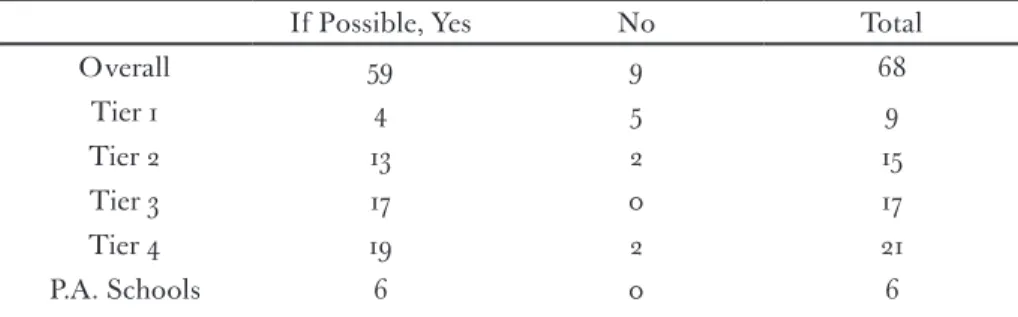
Table 4. Retention of Instructors
In the event that your school splits contracts into more than one semester, does your institution retain the same instructor to teach that course to the same students?
If Possible, Yes No Total
Overall 59 9 68 Tier 1 4 5 9 Tier 2 13 2 15 Tier 3 17 0 17 Tier 4 19 2 21 P.A. Schools 6 0 6
10. Because no school teaching contracts in four unit hours or fewer offered the course in more than one semester, the data is presented only for schools teaching contracts in five, six, and seven credit hours.
Table 5. Course Beyond First year with Contracts in Title
Does your institution offer a course beyond the first year curriculum that has the word “contracts” in the course title?
Yes No Total Overall 65 60 125 Tier 1 22 17 39 Tier 2 19 14 33 Tier 3 10 12 22 Tier 4 10 14 24 P.A. Schools 4 3 7
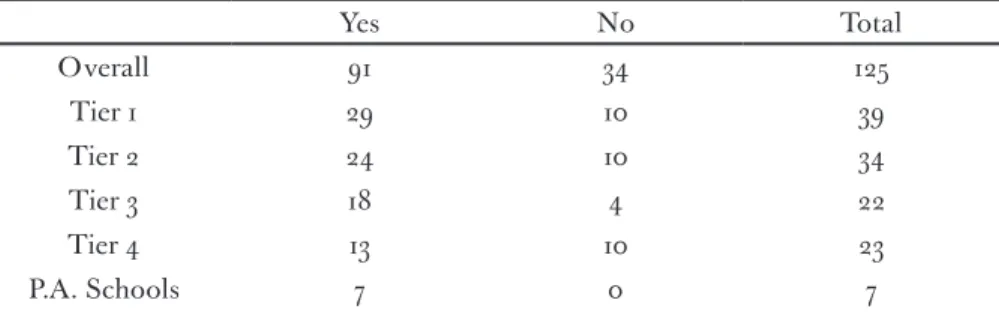
Table 6. Drafting Legal Instruments Course Beyond First Year Does your institution offer a course beyond the first year curriculum titled “drafting legal instruments” or something similar?
Yes No Total Overall 91 34 125 Tier 1 29 10 39 Tier 2 24 10 34 Tier 3 18 4 22 Tier 4 13 10 23 P.A. Schools 7 0 7
Table 7. Section Size of Contracts Course
What is the average size of the first year contracts section in your institution: Less than 25; 26–35; 36–45; 46–55; 56–65; 66–75; 76–85; More than 85.
<25 26–35 36–45 46–55 56–65 66–75 76–85 >85 Total Overall 2 5 8 13 19 24 31 19 121 Tier 1 1 2 5 2 5 4 6 13 38 Tier 2 0 2 2 3 4 8 12 2 33 Tier 3 1 1 0 4 3 4 7 2 22 Tier 4 0 0 1 3 3 7 5 2 21 P.A. Schools 0 0 0 1 4 1 1 0 7
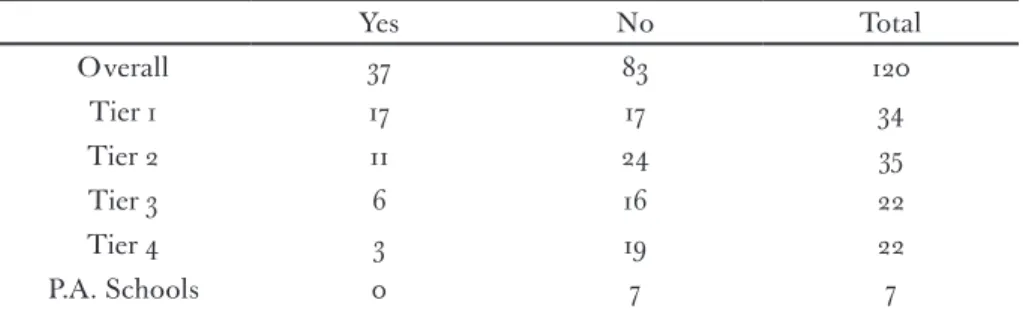
Table 8. Small Section Size
Has your institution made an effort to create a “small” section of contracts for all first year students; i.e., smaller than other substantive first year courses?
Yes No Total Overall 37 83 120 Tier 1 17 17 34 Tier 2 11 24 35 Tier 3 6 16 22 Tier 4 3 19 22 P.A. Schools 0 7 7
Conclusion
This data presented is important for a number of reasons. The American Bar Association, through its accreditation process, has exerted new pressures on law schools to reform their curriculums in light of bar passage outcomes and the desire to improve skills based training. The specter of more stringent ABA standards relating to bar passage11 along with the increased pressure on schools to fulfill academic support standards for all students (not just students who fall into at risk categories),12 increases pressure on schools for more individualized attention. Similarly, the ABA’s focus on skills-based learning places additional pressure on schools to provide skills components in courses as early as the first year.13 Law schools attempting to meet these demands within the traditional law school curriculum find themselves competing for hours against the curriculum. As Michael Fitts has suggested, “in spite of—or perhaps because of—the preeminence of our system of legal education, the last thirty years have seen sustained debates over questions surrounding where legal education should develop most and the nature and extent of the regulatory framework that helps oversee its development.”14 In short, new ABA standards and pressures have caused an “hours” problem for schools attempting to comply, while also offering level-appropriate coverage for students.
One statistic that stands out in our survey is the increase in contracts contact hours at lower-ranked schools. Schools in the first quartile overwhelmingly taught contracts in one-semester, four unit courses (though there was variation). In the second quartile, the responses were nearly even (twenty-five schools required four or fewer hours, while twenty-eight schools required 11. The proposed change in bar pass standards are reflected in the new proposed interpretation of ABA Standard 301-6. The current standard requires that law schools have a 75 percent ultimate bar pass rate or that students pass at a rate no lower than 15 percent below the blended bar pass rates for graduates from ABA accredited law schools. The proposed interpretation changes those rates to an ultimate rate of 80 percent and a first time rate no lower than 10 percent of the pass rate from takers from ABA institutions. See Society of American Law Teachers Statement On Proposed Changes to Increase the Bar Passage Requirements in Interpretation 301-6, available at http://www.saltlaw.org/userfiles/7-6-11SALTInterpretation301-6.pdf.
12. See Matthew D. Staver & Anita L. Staver, Lifting the Veil: An Expose’ on the American Bar Association’s Capricious Accreditation Process, 49 Wayne L. Rev. 1, 85 (2003) (describing Barry Law’s ABA accreditaton process and the emphasis on academic support in inquiry of the program of legal education). Of course, academic support has changed over the years from an interventionist program to a program designed to enhance learning. See Ellen Y, Suni, Academic Support at the Crossroads: From Minority Retention to Bar Prep and Beyond—Will Academic Support Change Legal Education or Itself be Fundamentally Changed?, 73 UMKC L. Rev. 497, 501 (2004).
13. See American Bar Association, Section of Legal Education and Admissions to the Bar, Report of the Outcome Measures Committee, available at http://apps.americanbar.org/ legaled/committees/subcomm/Outcome%20Measures%20Final%20Report.pdf.
14. Michael A. Fitts, What Will Our Future Look Like and How Will We Respond?, 96 Iowa L. Rev. 1539, 1539 (2011).
five or more hours). However, in the third and fourth quartiles and among provisionally accredited institutions, a vast majority of schools required six unit hours of contracts (third quartile: twenty-five out of forty schools; fourth quartile: thirty-six out of fifty; and provisionally accredited schools: eight out of eleven).
This could be explained in a number of ways. One reason could be that lower quartile schools perceive the need for more contact hours for students to be successful on the bar exam. That perception may be based on the assumption that students require more time to absorb the material presented (i.e. that students at lower tier schools do not understand material as quickly as students at higher tier schools); or it could be built around the assumption that significant class time is necessary to cover all the material in a particular course because instructors cannot rely on students at lower tier institutions to learn it outside of the classroom.15 Another explanation, perhaps intuitive, may be that higher ranked schools offer more resources in the form of other courses, clinics, and opportunities for learning that fill the hours-gap that lower tiered schools (or more poorly funded schools) cannot afford. This multi-versed approach could account for providing students with a more diverse perspective on contracts, outside of the normal contracts course. And, of course, the answer may be pieces of all of these responses and assumptions.
Whatever the reasons may be for schools electing to teach contracts in the manner that they do, it is clear that schools will have to make hard choices under varying institutional constraints.
15. For two studies of curriculum reform towards bar success describing this conflict, see Donald Zeigler, Joanne Ingham & David Chang, Curriculum Design and Bar Passage: New York Law School’s Experience, 59 J. Legal Educ. 393, 399–400 (2010); and Derek Alphran, Tanya Washington & Vincent Eagan, Yes We Can, Pass the Bar: University of the District of Columbia; David A. Clarke, School of Law Bar Passage Initiatives and Bar Pass Rates— From the Titanic to the Queen Mary, 14 U.D.C.L. Rev. 9, 21 (2011) (describing the tension between curriculum change and other factors in bar success).
Appendix A
Law Schools That Responded to the Online Survey Columbia University
University of California, Berkeley University of Chicago University of Pennsylvania Northwestern University University of Michigan Duke University Cornell University
University of California, Los Angeles Vanderbilt University
University of Southern California Washington University
University of Alabama Law School University of California, Davis University of Georgia
University of Wisconsin University of Arizona University of North Carolina University of California, Hastings Wake Forest University
University of Colorado American University Brigham Young University University of Florida Arizona State University Florida State University University of Connecticut Cardozo School of Law
Case Western Reserve University Temple University
University of Houston Lewis & Clark College University of San Diego Villanova University
Brooklyn Law School Baylor University
Dickinson School of Law Georgia State University
University of Missouri—Columbia Loyola Law School, Los Angeles University of Kansas
Louisiana State University University of Nevada, Las Vegas Chicago-Kent College of Law Rutgers University, Newark University of Denver
Seattle University Law School University of Miami
Santa Clara University Loyola University, Chicago University of South Carolina De Paul University
Catholic University of America Marquette University
St. Louis University
University of Louisville, Louis D. Brandeis School of Law University of San Francisco
Gonzaga University Hofstra University
State University of New York, Buffalo Cleveland State University
Creighton University School of Law Samford University
University of Akron Law School University of Arkansas, Little Rock University of Hawaii at Manoa
University of Memphis, Cecil C. Humphreys School of Law University of Mississippi
University of North Dakota
University of the Pacific, McGeorge School of Law University of South Dakota
University of St. Thomas School of Law Wayne State University
West Virginia University
William Mitchell College of Law Ave Maria School of Law Barry University, Orlando
California Western School of Law Campbell University School of Law Capital University Law School Florida Coastal School of Law Florida International University Golden Gate University
John Marshall Law School
Mississippi College School of Law Northern Illinois University Northern Kentucky University Roger Williams University Southern Illinois University
St. Thomas University School of Law Texas Wesleyan University
Touro College, Jacob D. Fuchsberg Law Center University of D.C., David A. Clarke School of Law University of Tulsa
University of Dayton University of Detroit Mercy Washburn University Whittier Law School Charleston School of Law Charlotte School of Law
Drexel University, Earle Mack School of Law Elon University
Faulkner University University of Puerto Rico University of La Verne Western State University
Appendix B
Schools With Information From Institution Website Yale Law School
Harvard Law School Stanford Law School New York University University of Virginia University of Texas Emory University University of Minnesota University of Notre Dame Washington and Lee University University of Illinois College of Law Ohio State University
George Mason University University of Maryland Tulane University
Southern Methodist University
University of Utah, S.J. Quinney College of Law University of Tennessee, Knoxville
University of Cincinnati University of Kentucky Pepperdine University Seton Hall University
Indiana University School of Law, Indianapolis University of New Mexico
University of Oklahoma University of Richmond University of Nebraska University of Pittsburgh Rutgers University, Camden University of Oregon Northeastern University St. John’s University Syracuse University Albany Law School
Chapman University School of Law Hamline University
Howard University University of Maine University of Montana New York Law School Ohio Northern University Pace University
Stetson University Suffolk University Texas Tech University
University of Missouri, Kansas City University of Arkansas University of Baltimore University of Idaho University of Vermont Willamette University University of Wyoming Appalachian School of Law CUNY School of Law Duquesne University New England School of Law North Carolina Central University Nova Southeastern University Oklahoma City University Regent University
South Texas College of Law Southern University Law Center Southwestern Law School St. Mary’s School of Law
Texas Southern University, Thurgood Marshall School of Law Thomas M. Cooley School of Law
Thomas Jefferson School of Law Valparaiso University
Western New England University Widener University
Florida A&M University Liberty University Phoenix School of Law