ISSN 1440-771X
Australia
Department of Econometrics and Business Statistics
http://www.buseco.monash.edu.au/depts/ebs/pubs/wpapers/
November 2011
Working Paper 24/11
Bayesian semiparametric GARCH models
Bayesian semiparametric GARCH models
Xibin Zhang
1,Maxwell L. King
Department of Econometrics and Business Statistics, Monash University
November 3, 2011
Abstract: This paper aims to investigate a Bayesian sampling approach to parameter estima-tion in the semiparametric GARCH model with an unknown condiestima-tional error density, which we approximate by a mixture of Gaussian densities centered at individual errors and scaled by a common standard deviation. This mixture density has the form of a kernel density estimator of the errors with its bandwidth being the standard deviation. The proposed investigation is motivated by the lack of robustness in GARCH models with any parametric assumption of the error density for the purpose of error-density based inference such as value-at-risk (VaR) estimation. The contribution of the paper is to construct the likelihood and posterior of model and bandwidth parameters under the proposed mixture error density, and to forecast the one-step out-of-sample density of asset returns. The resulting VaR measure therefore would be distribution-free. Applying the semiparametric GARCH(1,1) model to daily stock-index returns in eight stock markets, we find that this semiparametric GARCH model is favored against the GARCH(1,1) model with Studentterrors for five indices, and that the GARCH model underestimates VaR compared to its semiparametric counterpart. We also investigate the use and benefit of localized bandwidths in the proposed mixture density of the errors.
Key Words: Bayes factors, kernel-form error density, localized bandwidths, Markov chain Monte Carlo, value-at-risk
JEL Classification:C11, C14, C15, G15
1Address: 900 Dandenong Road, Caulfield East, Victoria 3145, Australia. Telephone: +61-3-99032130.
1 Introduction
The autoregressive conditional heteroscedasticity (ARCH) model ofEngle(1982) and the generalized ARCH (GARCH) model ofBollerslev (1986) have proven to be very useful in modelling volatilities of financial asset returns, and the assumption of conditional normality of the error term has contributed to early successes of GARCH models. Weiss(1986) and Bollerslev and Wooldridge(1992) showed that under the assumption of conditional normality of the errors, the quasi maximum likelihood estimator (QMLE) of the vector of parameters is consistent when the first two moments of the underlying GARCH process are correctly specified. However, the Gaussian QMLE suffers from efficiency loss when the conditional error density is non-Gaussian.Engle and González-Rivera(1991) investigated the efficiency loss of the Gaussian QMLE through Monte Carlo simulations when the conditional error distribution is non-Gaussian. In the literature on GARCH models, enough evidence found by theoretical and empirical studies has shown that it is possible to reject the assumption of conditional normality (Singleton and Wingender,1986;Bollerslev,1986;Badrinath and Chatterjee,1988, among others). This has motivated the investigation of other specifications of the conditional distribution of errors in GARCH models, such as the Studenttand other heavy-tailed densities (see for example,Hall and Yao, 2003). In this paper, we aim to investigate the estimation of parameters and error density in a GARCH model with an unknown error density. Our investigation is motivated by the lack of robustness in a GARCH model with any parametric assumption about its error density for the purpose of error-density based inference.
Engle and González-Rivera(1991) highlighted the importance of investigating the issue of nonparametric estimation of the conditional density of errors at the same time when parameters are estimated. They proposed a semiparametric GARCH model without any assumption on the analytical form of error density. The error density was estimated by the discrete maximum penalized likelihood estimate (DMPLE) ofTapia and Thompson(1978) based on residuals, which were computed by applying either the ordinary least squares or
QMLE (under conditional normality) to the same model. The parameters of the semiparamet-ric GARCH model were then estimated by maximizing the log-likelihood function constructed through the estimated error density based on initially derived residuals. The Monte Carlo simulation results obtained byEngle and González-Rivera(1991) showed that this semipara-metric estimation approach could improve the efficiency of parameter estimates up to 50% against QMLEs obtained under conditional normality. However, their likelihood function is affected by initial parameter estimates, which might be inaccurate. Their semiparametric estimation method uses the data twice because residuals have to be pre-fitted in order to construct the likelihood. Moreover, the derived semiparametric estimates of parameters will not be used again to improve the accuracy of the error density estimator.
This paper aims to investigate how we can simultaneously estimate the parameters and conditional error density using information provided by the data without specifying the form of the error density. It would be very attractive to impose minimal assumptions on the form of error density in a GARCH model, because the resulting semiparametric model would gain robustness in terms of specifications of the error density (see for example,Durham and Geweke,2011). In this situation, being able to estimate the error density is as important as estimating parameters in the parametric component of the GARCH model because any error-density-based inference would be robust with respect to specifications of error density. Moreover, we can forecast the density of the underlying asset’s return. Lety=(y1,y2, . . . ,yn)0
be a vector ofnobservations of an asset’s return. A GARCH(1,1) model is expressed as
yt=σt εt,
σ2
t =ω+αyt2−1+βσ2t−1, (1)
whereεt, fort=1, 2, . . . ,n, are independent. It is often assumed thatω>0,α≥0,β≥0 and
α+β<1, and that conditional on information available att−1 denoted asIt−1,εt follows a
known distribution. Strictly speaking, we will never know the true density ofεt. To estimate
known form such as the standard Gaussian or Studentt density. Any assumed density is only an approximation to the true unknown error density. In this paper, we assume that the unknown density ofεt denoted asf(εt), is approximated by a location-mixture density:
f(εt;h)= 1 n n X j=1 1 hφ ³εt−εj h ´ , (2)
whereφ(·) is the density of the standard Gaussian distribution. The Gaussian components have a common varianceh2and different mean values at individual errors. From the view of error-density specification,f(ε;h) is a well-defined probability density characterized by
h2. From the view of density estimation, f(εt;h) is the kernel estimator of the error density
withφ(·) the kernel function andhthe bandwidth. In terms of density estimation based on directly observed data,Silverman(1978) proved the strong uniform consistency of the kernel density estimator under some regularity conditions. Consequently, it is reasonable to expect that conditional on model parameters,f(ε;h) approachesf(ε) as the sample size increases, even thoughf(ε) has an unknown form. The performance of this kernel-form error density would be only second to that of an oracle who knows the true error density. Most importantly, the proposed kernel-form error density is completely determined by a single parameter, the bandwidth or the standard deviation of the component Gaussians.
The location-mixture density given by (2) is actually the arithmetic mean ofn density functions ofN(εi,h2), fori=1, 2, . . . ,n. It is a well-defined density function with one
param-eter, which is the common variance of the component Gaussian densities. Therefore, from a Bayesian’s view, conditional on the parameters that characterize the GARCH model, this location-mixture density can be used to construct the likelihood and therefore, the posterior. In the literature, the use of a scale-mixture density of Gaussian densities as the error density in a regression model has been investigated with the Gaussian components usually assumed to have a zero mean and different variances (see for example,Jensen and Maheu, 2010). Therefore, the use of such a scale-mixture density is at the cost of dramatically increasing the number of parameters. In contrast, our location-mixture error density places its locations at
the individual realized errors and has only one parameter, which we still call the bandwidth due to its smoothing role.
Instead of using frequency approaches to investigate parameter estimation under an unknown error density, we propose to derive an approximate posterior of the GARCH param-eters and the bandwidths up to a normalizing constant, where the likelihood is approximated through the location-mixture density of the errors. The priors of GARCH parameters are the uniform density on (0, 1), and the prior of the squared bandwidth is an inverse Gamma density. Therefore, both types of parameters are estimable through Bayesian sampling.
Bayesian sampling techniques have been used to estimate parameters of a GARCH model when the error density is specified (see for example,Bauwens and Lubrano,1998;Nakatsuma, 2000;Vrontos, Dellaportas, and Politis,2000). However, the posterior of the parameters, on which those sampling methods were developed, is unavailable when the conditional density of the errors is unknown. One contribution of this paper is to derive an approximate posterior of the parameters through the proposed kernel-form conditional error density, which is determined by the bandwidth parameter.
It is not rare to investigate Bayesian approaches to parameter estimation in a GARCH model with an unspecified error density. To deal with the problem of possible misspecification of the error density and impose inequality constraints on some parameters in the quasi likelihood,Koop(1994) presented Bayesian semiparametric ARCH models, where the quasi likelihood was constructed through a sequence of complicated polynomials. His finding indicates that the use of Bayesian and semiparametric approaches to parameter estimation in GARCH models is feasible and necessary. Our proposed Bayesian approach differs from his in that we use a leave-one-out version of the kernel-form error density given by (2) to construct the likelihood function, which is actually the full conditional composite likelihood (see for example,Mardia, Kent, Hughes, and Taylor,2009).
pre-fitted residuals, which is often used to construct a quasi likelihood for adaptive estimation of parameters in many models including (G)ARCH models investigated byLinton(1993)
and Drost and Klaassen (1997). The conclusion drawn from their investigations is that
(G)ARCH parameters are approximately adaptively estimable. This type of estimation is often conducted in a two-step procedure that uses the data twice.Di and Gangopadhyay(2011) presented a semiparametric maximum likelihood estimator of parameters in GARCH models. All those methods for the semiparametric GARCH model are based on pre-fitted residuals, and therefore are second-stage methods. However, our kernel-form error density is a well-defined probability density, which depends on the errors rather than the pre-fitted residuals. Our proposed Bayesian sampling procedure is able to estimate the GARCH parameters and bandwidth simultaneously.
Applying our proposed Bayesian sampling method to the semiparametric GARCH(1,1) model of daily continuously compounded returns of the S&P 500 index, we find that according to Bayes factors, this semiparametric model is favored with very strong evidence against the GARCH(1,1) with Studentterrors known as thet-GARCH(1,1) model. Although the estimate of (α,β) derived under the semiparametric GARCH model is similar to that derived under thet-GARCH model, the estimated density of the one-step out-of-sample return under the semiparametric model is clearly different from the Studentt density. Moreover, we find that the proposed semiparametric model is favored with very strong evidence against thet -GARCH(1,1) model for another three out of seven stock-index return series. In these situations, the forecasted return densities under both models are clearly different from each other.
An important use of the estimated density of the one-step out-of-sample return derived under the semiparametric GARCH model is to calculate the conditional value-at-risk (VaR), and the resulting VaR would be robust in terms of different specifications of the error density (Jorion,1997, among others). We derive the VaRs for seven return series under the semipara-metric model and its competing model, respectively. In comparison to the semiparasemipara-metric
GARCH model, thet-GARCH model underestimates the conditional VaR for the four index return series in the USA market.
We also investigate the issue of assigning different bandwidths to different realized errors by incorporating their absolute values into the bandwidth. We find that the use of localized bandwidths increases the competitiveness of our semiparametric GARCH model against the
t-GARCH model. Even though the use of localized bandwidths leads to a slightly smaller VaR than that of a global bandwidth, thet-GARCH model still underestimates the VaR in comparison to its semiparametric counterpart. This is a warning to any risk-avoiding financial institution that uses thet-GARCH model for estimating conditional VaR.
The rest of the paper is organized as follows. In the next section, we discuss the validity and benefit of the kernel-form error density and derive the posterior. In Section3, we apply the semiparametric GARCH(1,1) model to daily returns of the S&P 500 index, where Bayes factors are used for model comparison, and VaRs are computed. Section4presents an empirical study on the application of the semiparametric GARCH model to another seven index-return series. In Section5, we introduce localized bandwidths into the semiparametric GARCH model, which is applied to the eight return series. Section6concludes the paper.
2 Bayesian estimation for the semiparametric GARCH model
2.1 A mixture of Gaussian densities
Let {x1,x2, . . . ,xn} denote a sample of independent observations drawn from an unknown
probability density functiong0(x;κ) with an unbounded support, whereκis the parameter
vector. In order to make statistical inference based on the sample, one has to make assump-tions about the analytical form ofg0(x;κ) based on some descriptive statistics such as the
histogram of the observations. Strictly speaking, any specification of the true density is only an approximation tog(x;κ). One such approximation is given by
e g(x;h)= 1 n n X i=1 1 hφ((x−xi)/h), (3)
which is a location-mixture density ofnGaussian components with the same varianceh2and different mean values at individual observations. This mixture density is also known as the kernel estimator ofg0(x;κ), whereφ(·) is the kernel function, andhis the bandwidth. From
the view of specifications of the underlying true density, this mixture density is a well-defined density.Silverman(1978) proved that whenh→0, (nh)−1lnn→0 asn→ ∞, andg0(x;κ) is
uniformly continuous inx, ˜g(x;h) is strongly uniformly consistent.
In this paper, we investigate how we can use this mixture density of Gaussian components as an approximation to the unknown error density in a parametric regression model. Under this assumption, a realization of this mixture density of the errors is equivalent to the kernel density estimator of pre-fitted residuals, which is employed to construct a quasi likelihood for adaptive estimation in the sense ofBickel(1982). Therefore, parameters can be estimated by maximizing the quasi likelihood. One of the main issues in adaptive estimation is the efficiency of the resulting parameter estimates when the sample size increases. It has been found that parameters can be asymptotically adaptively estimable for a range of parametric models. However, a major problem in adaptive estimation is that the bandwidth has to be pre-chosen based on pre-fitted residuals through initial estimates of parameters. Therefore, the sample is used twice, and the chosen bandwidth depends on inaccurate initial estimates of parameters.
We propose to approximate the unknown error density in a regression model by the mixture density given by (3), where the variance parameter of the Gaussian components, or equivalently the squared bandwidth, is treated as a parameter in addition to the parameters that characterize the regression model. Taking the GARCH model as an example, we investi-gate how we can derive the likelihood and consequently, the posterior of all parameters. One might be concerned that the bandwidth will be decreasing toward zero at a certain rate as the sample size increases. Nonetheless, under the criterion of asymptotic mean integrated squared errors (AMISE), the bandwidth converges to zero at the rate ofn−1/5(see for example,
Scott,1992). Therefore, we propose to re-parameterizehas
h=τn−1/5, (4)
whereτis treated as a parameter.2When a sample of a fixed number of observations is under investigation within the Bayesian domain, we can treat eitherτorhas a parameter. From Bayesian perspectives, there are only known and unknown quantities in a sample. A Bayesian would make inference based on the posterior of unknown quantities conditional on known quantities.
2.2 Kernel-form conditional density of errors
Consider the GARCH(1,1) model given by (1), in which we assume thatω>0,α≥0,β≥0 andα+β<1. Strictly speaking, the true density ofεt denoted as f(εt), is unknown. To
estimate parameters and make statistical inference, one usually specifies a density such as the standard Gaussian density, as an approximation to the true unknown error density. As a consequence, a quasi likelihood could be set up, and the QMLEs of parameters could be obtained. However, any specification of the error density is subject to doubt. This motivates numerous investigations on different specifications of the error density in GARCH models, including those on estimating the error density through pre-fitted residuals.
We propose to approximate the unknown true error density of (1) by the mixture ofn
Gaussian densities given by (2), in which the standard deviation of the component Gaussian densities, or equivalently the bandwidth,h, is re-parameterized asτn−1/5withτbeing treated as a parameter. Hereafter, we usehn=τn−1/5to represent the bandwidth. In addition to the
parameters that characterize the parametric component of the GARCH model,τis treated as a parameter that depends on {ε1,ε2,· · ·,εn}. Such a re-parameterization makes sense to
classical inference becausehremains dependent onn, butτis data-driven. In our view,h
can be treated as a parameter for a finite sample.
As an approximation to the true error density, this mixture density is well-defined and is completely characterized byτ, or equivalentlyhnfor a sample of a fixed number of
obser-vations. On the other hand, this mixture density, as a kernel density estimator of the errors, is determined by its bandwidth. This GARCH model is referred to as the semiparametric GARCH(1,1) model due to the fact that the proposed mixture density of the errors is of the kernel form. Due to the consistency result derived bySilverman(1978) for a kernel density estimator of directly observed data, it is reasonable to expect thatf(ε;hn) approachesf(ε) as
the same size increases.
Remark 1: The mixture density of Gaussian components is a well-defined density function, which we propose to approximate the true density of the errors. The component Gaussian densities have means at individual errors and variances a constant. If the component Gaussian densities were allowed a constant mean at zero, this mixture density would become a Gaussian density with a zero mean and constant variance. Moreover, ifε∼f(ε;hn), we have
E(ε)=ε, V ar(ε)=h2n+s2ε,
whereε=1/nPn
i=1εi, andsε2=1/n
Pn
i=1(εi−ε)2. According to the law of large numbers,εand
s2εconverge respectively, to the mean and variance ofεasn→ ∞.
The proposed mixture density of the errors differs from the kernel density estimator of residuals calculated through pre-estimated model parameters. This mixture density is defined conditional on model parameters, and we can rewrite it as
f(εt;hn)= 1 n n X i=1 1 hn φ µε t−yi/σi hn ¶ , (5)
whereσ2i =ω+αyi2−1+βσ2i−1, fori =1, 2, . . . ,n. From a Bayesian’s view, this mixture density has a closed form conditional on two types of parameters, which are the model parameters and smoothing parameter. Therefore, both the likelihood and posterior can be constructed through this mixture error density. However, the kernel density estimator of residuals used by adaptive estimation relies on the residuals calculated through the pre-estimated parameters.
Remark 2: When using the density ofεt to construct likelihood ofy, we use the
leave-one-out version of the mixture density given by
f(εt|ε(t);hn)= 1 n−1 n X i=1 i6=t 1 hnφ µε t−εj hn ¶ , (6)
whereε(t)isε=(ε1,ε2, . . . ,εn)0withoutεt, fort=1, 2, . . . ,n. The purpose for leavingεt out
of the summation in (2) or (5) is to excludeφ(0/hn)/hn, which can be made arbitrarily large
be allowinghnto be arbitrarily small, from the resulting likelihood. Otherwise, a numerical
maximization of the likelihood with respect toτ, or any posterior simulator based on the resulting posterior, would encounter problems.
The proposed mixture density represents a meaningful approximation to (or estimation of ) the error density, because the sample of observed returns contains information on the dis-tributional properties of the errors. When the error density is unknown, we can approximate (or estimate) it by the mixture ofn−1 Gaussian densities with their means at the components of the standardizedy(t), wherey(t) denotes the vector of observed returns without yt. In
this sense, any parametric assumption about the error density in GARCH models ignores distributional information about errors conveyed by the observed sample.
Remark 3: The functional form of f(εt|ε(t);hn) does not depend ontbecause it can also
be expressed as f(εt|ε(t);hn)= 1 (n−1)hn ( n X j=1 φ µε t−εj hn ¶ −φ(0) ) , (7) fort=1, 2, . . . ,n.
Remark 4: The density ofyt is estimated by
fY ¡ yt|y(t);θ ¢ = 1 (n−1)σt n X i=1 i6=t 1 hn φ µ yt/σt−yi/σi hn ¶ , (8)
which is actually the leave-one-out kernel density estimator ofyt through the transformation
of standardization, fort=1, 2, . . . ,n. A kernel density estimator of the direct observations ofyis likely to be limited because the return series {yt :t =1, 2, . . . ,n} are heteroskedastic.
However, scaling the returns by their conditional standard deviations, we can approximately assume the standardized returns being independent and identically distributed. Therefore, the kernel density estimator of observed returns given by (8) is meaningful. We have to make it clear that the kernel density ofyt given by (8) is conditional on the bandwidth parameter
and model parameters. Therefore, a likelihood function can be set up.
In this paper, our purpose is to derive the posterior of all parameters when the density of errors is assumed to be of the mixture form given by (2) or (5). Hence, we can estimate not only the model parameters and the bandwidth parameter but also the error density through posterior simulations. Once these parameters are estimated, the closed-form error density is given by (5). As a result, we can calculate the conditional VaR according to the estimated density of errors.
2.3 Likelihood
Letθ0=
¡
ω,α,β,σ20¢0denote the vector of parameters of the GARCH(1,1) model given by (1). Whenf(ε) is known, the likelihood ofyfor givenθ0is
`0 ¡ y|θ0 ¢ = n Y t=1 1 σt f ¡ yt/σt ¢ .
According to Bayes theorem, the posterior ofθ0is proportional to the product of`0(y|θ0)
and the prior ofθ0. In this situation, the posterior ofθ0(up to a normalizing constant) could
be easily derived (see for example,Bauwens and Lubrano,1998;Nakatsuma,2000;Vrontos, Dellaportas, and Politis,2000;Zhang and King,2008).
When the analytical form off(ε) is unknown, we propose using the Gaussian-component mixture density given by (5) as an approximation to f(ε). The density ofyt is given by (8),
wherehnandσt always appear in the form of the product of the two. We found that
hn2σ2t =h2nω+h2nαyt2−1+βhn2σ2t−1, (9) whereh2nandω, as well ash2nandα, cannot be separately identified. Ifω(orα) is assumed to be a known constant, all the other parameters can be separately identified. In the situation
of adaptive estimation for ARCH models,ωwas restricted to be zero byLinton(1993) and one byDrost and Klaassen(1997). In light of the fact that the unconditional variance ofyt is
ω/(1−α−β), we assume thatω=(1−α−β)s2y, wheres2y=(n−1)−1Pn
i=1(yt−y)2is the sample
variance ofyt. When the return series is pre-standardized, the value ofωwould be assumed
to be (1−α−β), which is the same as whatEngle and González-Rivera(1991) assumed forω in their GARCH model.
The starting value of the conditional variance series,σ20, is unknown and is treated as a parameter. Therefore, under the specification of the mixture Gaussian density as an approxi-mation to the unknown true error density, the parameter vector isθ=¡σ20,α,β,τ2¢0
, where the bandwidth ishn=τn−1/5, and the restrictions on the parameter space are that 0≤α<1,
0≤β<1 and 0≤α+β<1. The likelihood ofy, for givenθ, is
`(y|θ)= n Y t=1 fY(yt|y(t);θ)= n Y t=1 1 (n−1)σt n X i=1 i6=t 1 hn φ µ yt/σt−yi/σi hn ¶ . (10)
which is an approximate likelihood ofyfor givenθ. Conditional on model parameters, this likelihood function is the one used by the likelihood cross-validation in choosing bandwidth for the kernel density estimator of the standardized yi, for i =1, 2, . . . ,n (see for example,
Bowman, Hall, and Titterington,1984).
Remark 5: It is important to note that the likelihood function given by (10) has the form of a full conditional composite likelihood in the sense that the density ofyt is defined
conditional ony(t). This feature has not been noted to the current literature even though
composite likelihood has been extensively investigated.3
Remark 6: The likelihood function given by (10) is related to the so-called kernel likeli-hood functions derived byYuan and de Gooijer(2007) andYuan(2009) for semiparametric regression models and byGrillenzoni(2009) for dynamic time-series regression models, where their likelihood functions were set up based on pre-fitted residuals. In contrast, our likelihood
given by (10) is constructed based on a well-defined error density, which is a mixture ofn−1 Gaussian densities centered at individual errors and scaled by a common standard deviation. If the proposed Gaussian-component mixture error density is to replace the DMPLE den-sity estimator in the semiparametric estimation procedure suggested byEngle and González-Rivera(1991), the implementation of their estimation method becomes an issue of choosing bandwidth and maximizing the quasi likelihood, which was constructed through the kernel-form error density, with respect to the parameters. It could be possible to maximize the constructed likelihood with respect to the parameters and bandwidth. Therefore, the initial parameter estimates in their semiparametric estimation procedure would have no effect on the resulting parameter estimates that maximize the quasi likelihood. Nonetheless, we confine our investigation within Bayesian sampling.
2.4 Priors
The prior ofαis the uniform density defined on (0, 1), while the prior ofβis the uniform density defined on (0, 1−α). The two priors represent the restriction of the two parameters. As¡τn−1/5¢2
is the squared bandwidth, which is the variance parameter of the component Gaussian densities in the mixture density given by (5), we assume¡τn−1/5¢2
follows an inverse Gamma prior distribution denoted as IG(aτ,bτ). Therefore, the prior ofτ2is
p(τ2)= b aτ τ Γ(aτ) µ 1 τ2n−2/5 ¶aτ+1 exp ½ − bτ τ2n−2/5 ¾ n−2/5, (11)
whereaτandbτare hyperparameters, which are chosen as 1 and 0.05 throughout this paper. The prior ofσ20is assumed to be either the log normal density with mean zero and variance one or the density of IG(1, 0.05). In our experience, the posterior estimate ofθ, as well as the error-density estimator, is insensitive to the prior choice ofσ20.
Working with finite samples, one may also treathnas a parameter and choose its prior
as the uniform density on (0,cn), wherecnis a function of the sample sizenand reflects the
In this paper, we prefer using the density given by (11) as the prior ofτ2, because¡τn−1/5¢2is the variance of each Gaussian component in the mixture density of the errors given by (5), and the prior of the variance of a Gaussian distribution is usually the inverse Gamma density (see for example,Geweke,2009). Nonetheless, according to our experience, the truncated Cauchy prior ofZhang, King, and Hyndman(2006) and the aforementioned uniform prior work reasonably well for the bandwidth parameterhnin posterior simulations.
2.5 Posterior of parameters
The joint prior ofθdenoted asp(θ), is the product of the marginal priors ofα,β,τ2andσ20. The posterior ofθfor givenyis proportional to the product of the joint prior ofθand the likelihood ofyfor givenθ. In the semiparametric GARCH model given by (1), the posterior of
θis (up to a normalizing constant)
π(θ|y)∝p(θ)×`(y|θ), (12)
which is well explained in terms of conditional posteriors. Conditional onτ2, the Gaussian-component mixture density of the errors is well defined, and then the posterior of (α,β,σ20)0 can be derived. Similarly, conditional on (α,β,σ20)0, we can compute the errors, or equiva-lently the standardized returns, and then derive the posterior ofτ2constructed through the assumption of the Gaussian-component mixture density of errors.
We use the Markov chain Monte Carlo (MCMC) simulation technique to sampleθfrom its posterior given by (12). In this paper, we use the random-walk Metropolis algorithm to simulateθ, and the sampling procedure is as follows.
Step 1: Randomly choose initial values denoted asθ(0).
Step 2: Updateθusing the random-walk Metropolis algorithm with the acceptance probabil-ity computed throughπ(θ|y). Letθ(1)denote the updatedθ.
Step 3: RepeatStep 2until the chain {θ(i):i =1, 2, . . . } achieves reasonable mixing perfor-mance.
When the sampling procedure is completed, the ergodic average of the sampled values of
θis used as an estimate ofθ, and the analytical form of the kernel-form error density can be derived by plugging-in the estimated value ofθ.
The second step of the above sampling procedure can also be implemented as follows. First, conditional on the current value ofτ2, we update (α,β,σ20) using the random-walk Metropolis algorithm with the acceptance probability computed through (12). This sampling algorithm would be the same as the one developed by Zhang and King(2008) for the t -GARCH(1,1) model with the Studenttdensity replaced by our proposed Gaussian-component mixture density of the errors. Second, conditional on the updated (α,β,σ20), we sampleτ2 from the posterior given by (12) using the random-walk Metropolis algorithm. This algorithm is the same as the one proposed byZhang et al.(2006) for kernel density estimation of directly observed data, which are now, replaced by the standardized returns.
3 GARCH(1,1) models of S&P 500 daily returns
3.1 Data
In this section, we use the proposed sampling algorithm to estimate the parameters of the GARCH(1,1) model of daily continuously compounded returns of the S&P 500 index, where the conditional error density is assumed to be unknown. The sample period is from the 3rd January 2007 to the 30th June 2011 with 1, 132 observations. The starting value of the return series is the first observation in the sample. Thus, the actual sample size isn=1, 131.
3.2 Models
First, we considered the semiparametric GARCH(1,1) model given by (1), in which the un-known error density was assumed to be approximated by the mixture of Gaussian densities
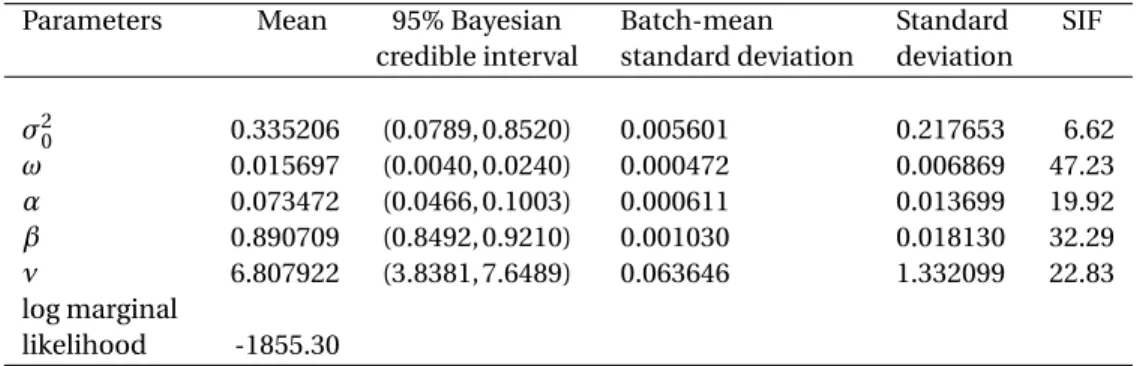
given by (2). The sampling algorithm presented in Section2was used to sampleθfrom its posterior defined by (12). A summary of the results is presented in Table1.
Second, we used the sampling algorithm proposed byZhang and King(2008) to sample parameters of thet-GARCH(1,1) model, where the Studentterrors haveνdegrees of freedom (ν>3), and the vector of parameters is¡
ω,α,β,σ20,ν¢0
. The prior ofωis the uniform density on (0, 1). The prior ofαis the uniform density on (0, 1), while the prior ofβis the uniform density on (0, 1−α). The priorσ20is the same as that previously proposed for the semiparametric GARCH model. The prior ofνis the density ofN(10, 52), which is truncated at 3 in order to restrict the support of this density to be (3,∞). After implementing the sampling algorithm, we obtained the parameter estimates and their associated statistics, which are reported in Table2.
3.3 Simulation results
When implementing the sampling algorithms for the two GARCH models, we discarded 2000 iterations in the burn-in period, after which 10,000 iterations were recorded. The acceptance rate was controlled to be between 20% and 30%. We calculated the batch-mean standard deviation and simulation inefficiency factor (SIF) for each parameter in each model. The batch-mean standard deviation is an approximation to the standard deviation of the posterior average of the simulated chain. If the mixing performance is reasonably good, the batch-mean standard deviation will decrease at a reasonable speed as the number of iterations increases (see for example,Roberts,1996).
The SIF is approximately interpreted as the number of draws needed to derive indepen-dent draws, because the simulated chain is a Markov chain (Kim, Shepherd, and Chib,1998, among others). For example, a SIF value of 20 means that approximately, we should retain one draw for every 20 draws to obtain independent draws in this sampling procedure. According to our experience, a sampler usually achieves reasonable mixing performances when its SIF values of all parameters are below 100.
The estimate of each parameter is the mean of the sampled values of this parameter. The batch-mean standard deviation and SIF were employed to monitor the mixing perfor-mance. We have no doubts about the mixing performance of the sampling algorithm for the
t-GARCH(1,1) model, because it has been justified in the literature (Bauwens and Lubrano, 1998;Zhang and King,2008, among others). Our simulation results presented in Table1also indicate that this sampler has achieved reasonable mixing performance.
As our proposed Bayesian sampling algorithm for the semiparametric GARCH model with the Gaussian-component mixture error density is new, researchers may have concerns about its mixing performance. According to our experience with the simulation study, the batch-mean standard deviation of each parameter becomes smaller and smaller as the number of iterations increases, and the SIF is very small for each parameter. Therefore, we conclude that our sampling algorithm has achieved a reasonable mixing performance.
Tables1and2present the estimate and 95% Bayesian credible interval of each parameter, as well as some associated statistics, under each model. The estimates ofαandβfor the semiparametric GARCH(1,1) model are quite similar to those for thet-GARCH(1,1) model. Nonetheless, we would like to make a decision on whether one model is favored against the other according to a chosen information criteria, one of which is the Bayes factor.
3.4 Bayes factors for model comparison
The Bayes factor for a model denoted asA0, against a competing model denoted asA1, is
defined by (Spiegelhalter and Smith,1982)
B01=m(y|A0)/m(y|A1),
wherem(y|A0) andm(y|A1) are marginal likelihoods derived underA0andA1, respectively. Marginal likelihood is the expectation of the likelihood under the prior density of parameters and is often intractable in Bayesian inference. Nonetheless, there are several methods to numerically approximate the marginal likelihood (Newton and Raftery,1994;Chib,1995;
Geweke,1999, among others). LetθA denote a vector of parameters under the modelA, which can be eitherA0orA1. The marginal likelihood is
m(y|A)=
Z
L(y|θA,A)p(θA|A)dθA, (13)
whereL(y|θA,A) is the likelihood ofy, andp(θA|A) is the prior ofθA.
WhenθA is simulated through a posterior simulator with the simulated chain denoted as
n
θ(i)
A :i=1, 2, . . . ,M o
,Geweke(1999) showed that the marginal likelihood given by (13) could be approximated by e m(y|A)= 1 M−1PM i=1g(θ (i) A)/ n p(θA(i)|A)L(y|θ(Ai),A)o , (14)
whereg(·) is the density ofθA and is often assumed to be a Gaussian density with its mean and variance estimated throughnθ(Ai):i=1, 2, . . . ,Mo.Geweke(1999) indicated thatme(y|A) is a modified version of the harmonic mean ofL(y|θA(i),A), fori=1, 2, . . . ,M, which was proposed as an approximation to the marginal likelihood byNewton and Raftery (1994). Geweke (1999) showed thatme(y|A) is simulation-consistent wheng(θA)/{p(θA|A)L(y|θA,A)} is
bounded. Therefore,g(·) is often truncated at both tails to guarantee the boundedness of
g(θA)/{p(θA|A)L(y|θA,A)}.
Letme(y|A0) andme(y|A1) denote the marginal likelihoods derived under the
semipara-metric GARCH(1,1) andt-GARCH(1,1) models, respectively. The Bayes factor of the former model against the latter is
f
B F01=me(y|A0)/me(y|A1).
We computed the approximate marginal likelihoods under both models according to (14). The log marginal likelihoods derived under the semiparametric GARCH andt-GARCH models are respectively,−1839.72 and−1855.30. Therefore, the Bayes factor of the semiparametric GARCH model against thet-GARCH model is exp(15.58), which indicates that the former model is favored against the latter with very strong evidence according to theJeffreys(1961) scales modified byKass and Raftery(1995).
3.5 Density estimators of the S&P 500 return
Letθbdenote the posterior estimate ofθ obtained under the semiparametric GARCH(1,1)
model with its error density assumed to be the mixture of Gaussian densities. The density estimator ofyt conditional onσbt, is b fY(yt;θb)= 1 (n−1)σbt n X i=1 i6=t 1 ˆ hn φ µ yt/σbt−yi/σbi b hn ¶ , (15) wherehbn=τbn−1/5andσb2t =ω0+αbyt2 −1+βbσb2t
−1, fort=1, 2, . . . ,n. The conditional variance of
yn+1is estimated by b σ2 n+1=ω0+αby 2 n+βbσb2n.
Therefore, the density ofyn+1conditional onIn, is estimated as
b fY(yn+1;θb)= 1 (n−1)σbn+1 n X i=1 1 b hn φ µ yn+1/σbn+1−yi/σbi b hn ¶ . (16) LetθeA1 = ¡ e σ2 0,ωe,αe,βe,νe ¢0
denote the vector of estimated parameters derived under the
t-GARCH(1,1) model. The conditional variance ofyn+1is estimated byσe
2 n+1=ωe+αey 2 n+βeσe2n, whereσe 2 i =ω0+αey 2 i−1+βeσe2
i−1, fori =1, 2, . . . ,n. The density ofyn+1conditional onIn, is
derived by plugging-in the parameter estimates into the Studenttdensity and is given as
e fY ¡ yn+1;θeA1 ¢ =f e ν,t ¡ yn+1/σen+1 ¢ /σen+1, wheref e
ν,t(·) is the Studenttdensity witheνdegrees of freedom.
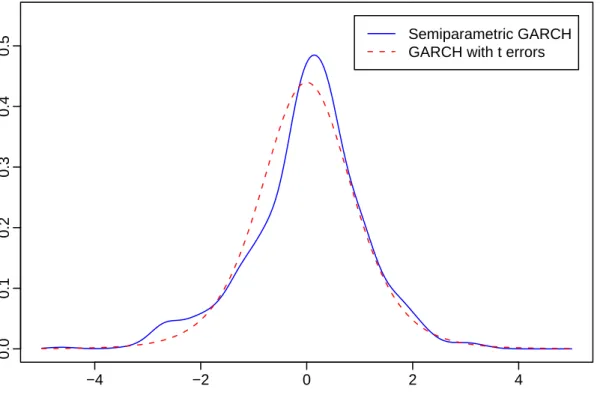
The graphs offbY(yn+1;θb) and feY(yn+1;θeA1) are presented in Figure1(1), where we find
that the forecasted conditional density ofyn+1derived under the semiparametric GARCH
model is obviously different from that derived under thet-GARCH model in the peak and the negative-return areas, especially the left-tail area.
3.6 Conditional VaR
At a given confidence level denoted as 100(1−λ)% withλ∈(0, 1), the VaR of an investment is defined as a threshold value, such that the probability that the maximum expected loss on
this investment over a specified time horizon exceeds this value is no more thanλ(see for example,Jorion,1997). The VaR has been a widely used risk measure to control huge losses of a financial position by investment institutions.
The VaR for holding an asset is often estimated through the distribution of the asset return. When this distribution is modeled conditional on time-varying volatilities, the resulting VaR is referred to as the conditional VaR. For example, GARCH models are often used to estimate the conditional VaR. For a given sample©
y1,y2, . . . ,yn
ª
, the conditional VaR with 100(1−λ)% confidence is defined as
yλ=inf©y:P¡yn+1≤y|y0,y1, . . . ,yn
¢
≥λª, (17) where the value ofλis often chosen as either 5% or 1%.
Under the estimated semiparametric GARCH(1,1) model with the kernel-form errors, we derived the estimated conditional cumulative density function (CDF) of yn+1. We also
obtained the conditional CDF ofyn+1under the estimatedt-GARCH(1,1) model. Figure1(2)
presents the graphs of the two CDFs, which were used to compute the conditional VaRs under these two models. At the 95% confidence level, the one-day conditional VaRs are $2.0324 and $1.6643 for every $100 investment on the S&P 500 index, under the semiparametric andt-GARCH models, respectively. This finding indicates that thet-GARCH(1,1) model underestimates the conditional VaR by $0.3681 for a $100 investment on the S&P 500 index in comparison with its semiparametric counterpart.
Moreover, according to the estimated conditional CDF of the one-step out-of-sample S&P 500 return, thet-GARCH(1,1) model always results in an underestimated conditional VaR compared to the semiparametric GARCH(1,1) model, at the 100(1−λ)% confidence level with
λ∈(0, 0.1941). This is a warning to any financial institution that uses thet-GARCH(1,1) model to estimate the conditional VaR for its investment on the S&P 500 index, because the resulting conditional VaR is quite likely to underestimate the actual amount of investment that is at risk. The proposed semiparametric GARCH(1,1) model is favored with very strong evidence
against thet-GARCH(1,1) model and thus should be used for such a purpose.
From the point of view of kernel density estimation, one may argue that the use of a global bandwidth in the kernel-form error density of the semiparametric GARCH(1,1) model may have produced a spurious bump in the left tail of the forecasted conditional density of
yn+1, because large errors may heavily affect the resulting estimate of the bandwidth. If such
reasoning is correct, we should assign a large bandwidth to large errors and a small bandwidth to small errors. However, such reasoning is not always correct especially when the bump represents the true distributional behaviour of large negative errors. We investigate the issue of using localized bandwidths in the kernel-form error density in Section5.
4 Semiparametric GARCH(1,1) models of other stock-index
returns
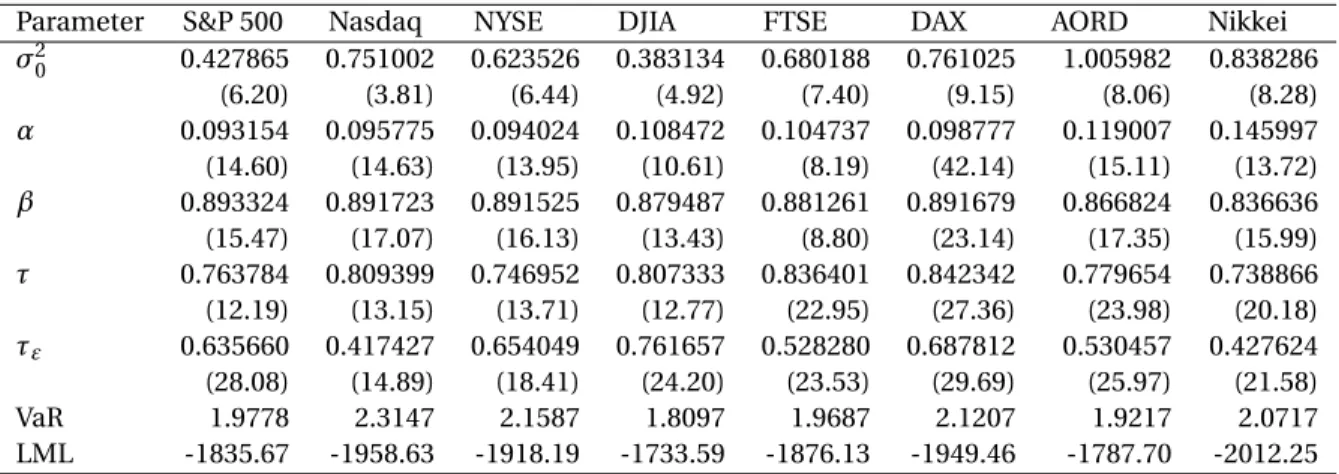
In this section, we applied the proposed Bayesian sampling algorithm to the semiparametric GARCH(1,1) models of another seven stock-index returns. These indices are the Nasdaq100, NYSE composite and DJIA indices in the USA stock market, and the FTSE, DAX, All Ordinar-ies (AORD) and Nikkei 225 indices in other mature stock markets. As a competing model, thet-GARCH(1,1) model was estimated for each return series using the Bayesian sampling algorithm presented byZhang and King(2008). Table3presents the parameter estimates, VaR value estimated through the resulting error density, and log marginal likelihood for each model fitted to each return series.
4.1 Model comparison via Bayes factors
We found the following empirical evidence. First, the estimates ofαandβunder the semi-parametric GARCH(1,1) model are quite similar to those obtained under thet-GARCH(1,1) model. This finding is consistent with what has been found in empirical studies of GARCH models, where researchers have found that the parameter estimates do not change obviously for different specifications of the error density.
Second, the Bayes factors of the semiparametric GARCH model against thet-GARCH model are respectively, exp(13.72) for Nasdaq, exp(12.13) for NYSE, exp(9.72) for Nikkei and exp(2.11) for DJIA. According to the modified Jeffreys scales of Bayes factors, the proposed semiparametric GARCH model is favored with very strong evidence against thet-GARCH model for the return series of Nasdaq, NYSE and Nikkei indices; and the former model is favored with positive evidence against the latter for the DJIA return series.
Third, the Bayes factors of thet-GARCH model against the semiparametric GARCH model are exp(5.94) for FTSE, exp(5.39) for DAX and exp(2.38) for AORD, respectively. Therefore, the
t-GARCH model is favored with very strong evidence against the semiparametric GARCH model for the return series of FTSE and DAX indices; and the former model is favored against the latter with positive evidence for the AORD index.
4.2 Error-density estimator and conditional VaR
The estimates ofαandβobtained under the semiparametric GARCH(1,1) model are similar to those obtained under thet-GARCH(1,1) model for each of the seven return series. This finding is not surprising, because many empirical studies have revealed that the parameter estimates of a GARCH model do not vary obviously for different specifications of the error density. However, the return-density estimator derived under the semiparametric model clearly differs from that derived under the Studenttmodel for each series.
When a stock index of the USA stock market was under investigation, we could find a very thick left tail of the density of daily returns. During the global financial crisis, the frequency of observed deep downs was higher than that during the previous non-crisis period. As a consequence, the left tail of the density estimator of daily returns under the semiparametric GARCH model is obviously fatter than that under thet-GARCH model, where the latter model fails to capture the left-tail dynamics of the index-return density in the USA stock market. The left-tail difference between the two estimated densities would have an obvious effect on the computation of conditional VaR under the two different GARCH models.
Thet-GARCH model tends to underestimate the conditional VaR in comparison to the semiparametric GARCH model. At the 95% confidence level, we computed the one-day conditional VaR under each model for each of the eight return series, and the VaR values are presented in Table3. Whichever index of the USA stock market was under investigation, the
t-GARCH model underestimates the conditional VaR in comparison to the semiparametric GARCH model. The same conclusion could be made for the Nikkei 225 index. Although thet -GARCH model is favored against the semiparametric -GARCH model for FTSE, DAX and AORD, we still found that thet-GARCH model leads to a smaller VaR than the semiparametric GARCH model. This problem is the consequence of the assumption of Studentterror density, which fails to capture the distributional behavior in the left tail of each return density. However, our proposed location-mixture Gaussian error density does capture such distributional behavior. Therefore, this semiparametric GARCH model results in a more reasonable conditional VaR than thet-GARCH model.
5 Localized bandwidths for the kernel-form error density
In Section2, we proposed using the leave-one-out version of the Gaussian-component mix-ture error density to approximate the unknown error density. In terms of kernel density estimation of directly observed data, it has been known that the leave-one-out estimator is heavily affected by extreme observations in the sample (see for example,Bowman,1984). Consequently, when the true error density has sufficient long tails, the leave-one-out kernel density estimator with its bandwidth selected under the Kullback-Leibler criterion, is likely to overestimate the tails density. One may argue that this phenomenon is likely to be caused by the use of a global bandwidth. A remedy to this problem in that situation is to use variable bandwidths or localized bandwidths (see for example,Silverman,1986).The approximate likelihood given by (10) was built up through the leave-one-out kernel-form density based on random errors. In the empirical finance literature, there is enough
evidence indicating that the density of the standardized errors is heavy-tailed. Therefore, we have to be cautious about large standardized errors when the kernel-form error density given by (2) is used for constructing the posterior for the semiparametric GARCH(1,1) model. In this section, we investigate the issue of using localized bandwidths in the kernel-form error density.
5.1 Posterior under the localized bandwidths
The recent development on kernel density estimation of directly observed data with adaptive or variable bandwidths suggests that small bandwidths should be assigned to the observations in the high-density region and larger bandwidths should be assigned to those in the low-density region. One of the key issues on the use of adaptive bandwidths is how we could choose different bandwidths for different groups of observations.Brewer(2000) suggested assigning different bandwidths to different observations and obtaining the posterior estimates of the bandwidths. As we treat bandwidths as parameters, we do not want so many parameters in addition to the existing parameters characterizing the parametric component of the GARCH model.
In light of the above-mentioned intuitive idea on using variable bandwidths for kernel density estimation, we assume that the underlying true error density is unimodal. Therefore, large absolute errors should be assigned relatively large bandwidths, while small absolute errors should be assigned relatively small bandwidths. Thus, we propose the following error density estimator: fa(εt;τ,τε)= 1 n−1 n X i=1 i6=t 1 τn−1/5(1+τ ε|εi|) φ µ ε t−εi τn−1/5(1+τ ε|εi|) ¶ , (18)
whereτn−1/5(1+τε|εi|) is the bandwidth assigned toεi, fort=1, 2, . . . ,n, and the vector of
parameters is nowθa=
¡
σ2
0,α,β,τ,τε
¢0
. The meaning of this kernel-form error density is also clear. The density ofεt is approximated by a mixture ofn−1 Gaussian densities with their
Similarly, we obtained the approximate likelihood ofyfor givenθa: `a ¡ y|θa ¢ = n Y i=1 1 σi fa ¡ yi/σi;τ,τε ¢ . (19) We assume that¡ τn−1/5¢2
follows the inverse Gamma distribution denoted as IG(aτ,bτ). Therefore, the prior ofτ2is the same as the one given by (11). The prior ofτεis the uniform density on (0, 1). The priors ofαandβare the same as those in the situation of using a global bandwidth. The joint prior ofθadenoted aspa(θa), is the product of these marginal priors.
Therefore, the posterior ofθais (up to a normalizing constant)
πa(θa|y)∝pa(θa)×`a(y|θa), (20)
from which we sampleθausing the random-walk Metropolis algorithm.
5.2 Model comparison via Bayes factors
With localized bandwidths, we implemented the Bayesian sampling procedure to the pro-posed semiparametric GARCH(1,1) model of each return series computed through each of the eight daily return indices. The results are given in Table4. For each return series, the sampling algorithm has achieved reasonable mixing performance according to the SIF and batch-mean standard deviation values, the latter of which is not presented here to save space. For each of the eight return series, we calculated the log marginal likelihood, which is presented in the last row of Table4.
The use of localized bandwidths in the kernel-form error density of the semiparametric GARCH(1,1) model increases the model competitiveness. For each of the eight return series, the marginal likelihood derived through localized bandwidths is larger than that derived through a global bandwidth. Most importantly, the Bayes factors of semiparametric model with localized bandwidths against the same model with a global bandwidth are exp(4.05) for S&P 500, exp(6.66) for NYSE, exp(14.44) for DJIA, exp(4.16) for FTSE, exp(6.49) for DAX and exp(3.34) for AORD. Therefore, the use of localized bandwidths is favored with either
very strong or strong evidence against the use of a global bandwidth for these series. Thus, localized bandwidths should be used in the semiparametric GARCH models of these return series.
Thet-GARCH model loses its strong competitiveness against the semiparametric GARCH model with localized bandwidths for FTSE and DAX indices. The Bayes factors of thet-GARCH model against the semiparametric model decreased respectively, from exp(5.94) to exp(1.78) for the FTSE, and from exp(5.39) to exp(−1.1) for the DAX. Of the eight return series, FTSE is the only one, for which thet-GARCH is favored against the semiparametric GARCH with positive evidence. Thus, the competitiveness of the semiparametric GARCH model against thet-GARCH model is increased through the use of localized bandwidths.
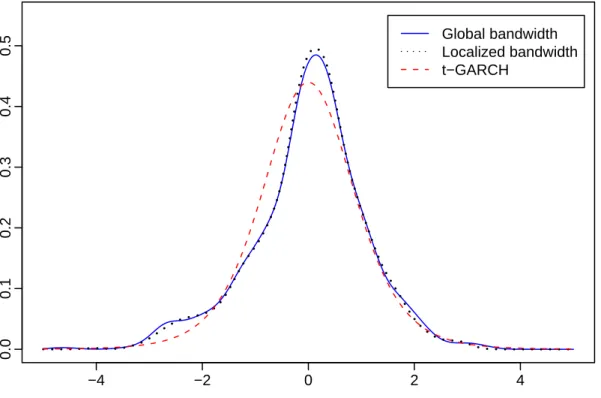
Figure2(1) plots the conditional densities of the one-step out-of-sample return derived under each of the three specifications of the error density in the GARCH(1,1) model of the S&P 500 return series. The density graph derived through localized bandwidths for the semiparametric model is clearly different from that derived through a global bandwidth for the same model in the peaks-and tail-areas. This is because the use of localized bandwidths is supported against the use of a global bandwidth. Moreover, both density graphs clearly differ from the density graph derived under the Studenttassumption.
In Figure2(2), we plotted the conditional densities of the one-step out-of-sample return for the FTSE under the three specifications of the error density. There is no obvious differ-ence between the two density graphs derived under the semiparametric GARCH models with a global bandwidth and localized bandwidths, respectively. This phenomenon is the consequence of the fact that neither the use of a global bandwidth nor the use of localized bandwidth is favored against the other with enough evidence according to Bayes factors. However, the density graph derived under each semiparametric model is different from that derived under thet-GARCH model, because the semiparametric GARCH model with either a global bandwidth or localized bandwidths is favored against thet-GARCH model with strong
evidence.
5.3 Conditional VaRs
At the 95% confidence level, we derived the one-day conditional VaRs under the semiparamet-ric GARCH(1,1) model with localized bandwidths for the eight return series. These VaRs are presented in the second last row of Table4. The use of localized bandwidths leads to a slightly smaller VaR value than the use of a global bandwidth. In comparison with the use of a global bandwidth, the use of localized bandwidths reduced the VaR value by an amount between $0.018 and $0.088 for a $100 investment on each of the eight indices. The reduced amount relative to the VaR derived though a global bandwidth is between 0.77% and 3.98%. Therefore, the use of localized bandwidths does not obviously reduce the VaR that is computed through a global bandwidth.
In comparison to the semiparametric GARCH model with localized bandwidths, thet -GARCH model underestimates the VaR by an amount that is between $0.168 and $0.356 for a $100 investment when the semiparametric model is favored against its competitor. Even though the semiparametric GARCH model is not favored against thet-GARCH model for FTSE, DAX and AORD return series, thet-GARCH model still underestimates the VaR by an amount and between $0.13 and $0.20 for a $100 investment. This is not surprising. Due to the fallout of high volatilities that originated from the USA stock market during the global financial crisis, the frequency of observed deep downs during this period was higher than that during non-crisis periods in any mature stock market. Consequently, the left tail of the return density is thicker than the right tail. However, the symmetric Studenttdensity fails to capture the asymmetric thickness between the two tails of a return density.
To conclude, in terms of model comparison, the use of localized bandwidths increases the competitiveness of the semiparametric GARCH model against its competitor, thet-GARCH model. Nonetheless, the use of localized bandwidths slightly reduces the VaR value compared to the use of a global bandwidth, but the relative change is less than 4% and is therefore, not
obvious. Thet-GARCH model underestimates VaR in comparison to the semiparametric GARCH model with either a global bandwidth or localized bandwidths.
6 Conclusion
We have presented a Bayesian approach to parameter estimation for a GARCH(1,1) model with an unknown error density, which we propose to approximate by the mixture ofn Gaus-sian component densities centered at individual errors and scaled by a standard deviation parameter. This mixture density has the form of a kernel density estimator of the errors with Gaussian kernel and bandwidth being the standard deviation. Assuming an inverse Gamma prior of the bandwidth parameter and noninformative priors of model parameters, we have derived an approximate posterior of both types of parameters, where the likelihood is derived through the proposed kernel-form error density. The random-walk Metropolis algorithm has been used to sample these parameters simultaneously during MCMC iterations. To address the concern about the performance of a global bandwidth in the kernel-form error density, we considered the use of localized bandwidths and derived the posterior of all parameters. Most importantly, the proposed mixture error density allows us to estimate the conditional density of the one-step out-of-sample return, which can be used to compute value-at-risk. Moreover, the semiparametric GARCH model gains robustness in terms of error specifications compared to its parametric counterparts.
Applying the proposed semiparametric GARCH(1,1) model to the daily return series of the S&P 500 index, we have found that the proposed sampling algorithms have achieved reasonable mixing performance. The semiparametric GARCH(1,1) model is favored with very strong evidence against thet-GARCH(1,1) model according to Bayes factors. Moreover, the semiparametric GARCH model has been found to be favored against thet-GARCH model for Nasdaq, NYSE and Nikkei 225 indices among another seven stock indices.
density. It has been found that the use of localized bandwidths in the semiparametric GARCH model increases the model competitiveness against thet-GARCH model. Consequently, the semiparametric GARCH model with localized bandwidths is favored with very strong evidence against thet-GARCH model for the S&P 500, Nasdaq, NYSE, DJIA, and Nikkei 225 indices.
We derived the conditional VaR through the estimated conditional density of the one-step out-of-sample return. We found that compared to the proposed semiparametric GARCH model, thet-GARCH model underestimates the conditional VaR whichever index of the USA stock market is under investigation. This problem becomes less severe when localized bandwidths are used. During the global financial crisis, we did observe a higher frequency of deep downs than during the previous non-crisis period. Thet-GARCH model fails to capture such distributional dynamics in the left tail. Therefore, we believe that the semiparametric GARCH(1,1) model leads to a reasonable estimate of the conditional VaR.
Our investigation is only focused on the GARCH(1,1) specification proposed byBollerslev (1986). The proposed kernel-form error density can be employed to replace any parametric assumption of the error density in any parametric GARCH models. Moreover, the proposed Bayesian sampling algorithm can be modified accordingly without any increased difficulty.
Acknowledgements
We extend our sincere thanks to John Geweke for his very insightful comments on an early draft of this paper. Thanks also go to Jiti Gao, Hsein Kew and Farshid Vahid forad hoc
discussion, and the Victorian Partnership for Advanced Computing (VPAC) for its quality facility. This research was supported under the Australian Research Council’s Discovery Projects funding scheme (project number DP1095838).
References
Badrinath, S. G., Chatterjee, S., 1988. On measuring skewness and elongation in common stock return distributions: The case of the market index. Journal of Business 61 (4), 451–472. Bauwens, L., Lubrano, M., 1998. Bayesian inference on GARCH models using the Gibbs
sampler. Econometrics Journal 1 (1), 23–46.
Bickel, P. J., 1982. On adaptive estimation. The Annals of Statistics 10 (3), 647–671.
Bollerslev, T., 1986. Generalized autoregressive conditional heteroskedasticity. Journal of Econometrics 31 (3), 307–327.
Bollerslev, T., Wooldridge, J. M., 1992. Quasi-maximum likelihood estimation and inference in dynamic models with time-varying covariances. Econometric Reviews 11 (2), 143–172. Bowman, A. W., 1984. An alternative method of cross-validation for the smoothing of density
estimates. Biometrika 71 (2), 353–360.
Bowman, A. W., Hall, P., Titterington, D. M., 1984. Cross-validation in nonparametric estima-tion of probabilities and probability densities. Biometrika 71 (2), 341–351.
Brewer, M. J., 2000. A Bayesian model for local smoothing in kernel density estimation. Statis-tics and Computing 10 (4), 299–309.
Chib, S., 1995. Marginal likelihood from the Gibbs output. Journal of the American Statistical Association 90 (432), 1313–1321.
Di, J., Gangopadhyay, A., 2011. On the efficiency of a semi-parametric garch model. Econo-metrics Journal 14 (2), 257–277.
Drost, F. C., Klaassen, C. A. J., 1997. Efficient estimation in semiparametric GARCH models. Journal of Econometrics 81 (1), 193–221.
Durham, G., Geweke, J., 2011. Improving asset price prediction when all models are false. Manuscript, University of Technology, Sydney.
URLhttp://www.censoc.uts.edu.au/pdfs/geweke_papers/gp_working_5b.pdf Engle, R. F., 1982. Autoregressive conditional heteroscedasticity with estimates of the variance
of United Kingdom inflation. Econometrica 50 (4), 987–1007.
Engle, R. F., González-Rivera, G., 1991. Semiparametric ARCH models. Journal of Business and Economic Statistics 9 (4), 345–359.
Geweke, J., 1999. Using simulation methods for Bayesian econometric models: Inference, development, and communication. Econometric Reviews 18 (1), 1–73.
Geweke, J., 2009. Complete and Incomplete Econometric Models. Princeton University Press, New Jersey.
Grillenzoni, C., 2009. Kernel likelihood inference for time series. Scandinavian Journal of Statistics 36 (1), 127–140.
Hall, P., Yao, Q., 2003. Inference in ARCH and GARCH models with heavy-tailed errors. Econo-metrica 71 (1), 285–317.
Jeffreys, H., 1961. Theory of Probability. Oxford University Press, Oxford, U.K.
Jensen, M. J., Maheu, J. M., 2010. Bayesian semiparametric multivariate GARCH modeling. Manuscript, Queens Unversity.
URLhttp://qed.econ.queensu.ca/paper/maheu.pdf
Jorion, P., 1997. Value at Risk: The New Benchmark for Controlling Market Risk. McGraw-Hill, New York.
Kass, R. E., Raftery, A. E., 1995. Bayes factors. Journal of the American Statistical Association 90 (430), 773–795.
Kim, S., Shepherd, N., Chib, S., 1998. Stochastic volatility: Likelihood inference and compari-son with ARCH models. Review of Economic Studies 65 (3), 361–393.
Koop, G., 1994. Bayesian semi-nonparametric ARCH models. The Review of Economics and Statistics 76 (1), 176–181.
Linton, O., 1993. Adaptive estimation in ARCH models. Econometric Theory 9 (4), 539–569. Mardia, K. V., Kent, J. T., Hughes, G., Taylor, C. C., 2009. Maximum likelihood estimation using
composite likelihoods for closed exponential families. Biometrika 96 (4), 975–982.
Nakatsuma, T., 2000. Bayesian analysis of ARMA-GARCH models: A Markov chain sampling approach. Journal of Econometrics 95 (1), 57–69.
Newton, M. A., Raftery, A. E., 1994. Approximate Bayesian inference with the weighted likeli-hood bootstrap. Journal of the Royal Statistical Society, Series B 56 (1), 3–48.
Roberts, G. O., 1996. Markov chain concepts related to sampling algorithms. In: Gilks, W. R., Richardson, S., Spiegelhalter, D. J. (Eds.), Markov Chain Monte Carlo in Practice. Chapman & Hall, London, pp. 45–57.
Scott, D. W., 1992. Multivariate Density Estimation: Theory, Practice, and Visualization. Wiley-Interscience.
Silverman, B. W., 1978. Weak and strong uniform consistency of the kernel estimate of a density and its derivatives. The Annals of Statistics 6 (1), 177–184.
Silverman, B. W., 1986. Density Estimation for Statistics and Data Analysis. Chapman and Hall, London.
Singleton, J. C., Wingender, J., 1986. Skewness persistence in common stock returns. Journal of Financial and Quantitative Analysis 21 (3), 335–341.
Spiegelhalter, D. J., Smith, A. F. M., 1982. Bayes factors for linear and log-linear models with vague prior information. Journal of the Royal Statistical Society, Series B 44 (3), 377–387. Tapia, R. A., Thompson, J. R., 1978. Nonparametric Probability Density Estimation. Johns
Hopkins University Press, Baltimore.
Varin, C., Reid, N., Firth, D., 2011. An overview of composite likelihood methods. Statistica Sinica 21, 5–42.
Vrontos, I. D., Dellaportas, P., Politis, D. N., 2000. Full Bayesian inference for GARCH and EGARCH models. Journal of Business and Economic Statistics 18 (2), 187–198.
Weiss, A. A., 1986. Asymptotic theory for ARCH models: Estimation and testing. Econometric Theory 2 (1), 107–131.
Yuan, A., 2009. Semiparametric inference with kernel likelihood. Journal of Nonparametric Statistics 21 (2), 207–228.
Yuan, A., de Gooijer, J. G., 2007. Semiparametric regression with kernel error model. Scandi-navian Journal of Statistics 34 (4), 841–869.
Zhang, X., King, M. L., 2008. Box-Cox stochastic volatility models with heavy-tails and corre-lated errors. Journal of Empirical Finance 15 (3), 549–566.
Zhang, X., King, M. L., Hyndman, R. J., 2006. A Bayesian approach to bandwidth selection for multivariate kernel density estimation. Computational Statistics & Data Analysis 50 (11), 3009–3031.