Efficient Data Storage and Analysis for Generic
Biomolecular Simulation Data
Muan Hong Ng1, Steven Johnston1, Stuart Murdock2, Bing Wu3, Kaihsu Tai4, Hans Fangohr1, Simon Cox1, Jonathan W. Essex2, Mark Sansom4and Paul Jeffreys3
1Southampton e-Science Centre and2School of Chemistry, University of Southampton, UK 3Oxford e-Science Centre and4Department of Biochemistry, University of Oxford, UK
correspondent email: [email protected]
Abstract. BioSimGrid aims to deliver a biomolecular simulation data repository to enable more efficient storage, access and exchange of biomolecular simulation data. This is an ongoing project still in development that seeks to exploit the concept of the Grid where large computational and data resources are made available to users in a highly accessible manner. The ability to submit, search, query, retrieve, and post pro-cess biomolecular data in a uniform way is vital for the biochemistry community for more efficient data sharing. The study of biomolecular simulation data, which encap-sulates the motions of molecules are key contributions to applications such as drug discovery. This paper describes the BioSimGrid project and relates it to other recent work on grid-enabled data storage. We describe the middleware that enables the work flow of BioSimGrid and finally discuss the future work.
1
Biomolecular Simulation and
BioSimGrid
Computer simulations play a vital role in biochemical research. By simulating the in-teractions of all atoms within a molecule or protein, the biochemical properties of the structure can be revealed. One impor-tant application of such Molecular Dynam-ics and Monte Carlo simulations is predic-tive modelling in drug discovery, where the motion of proteins is important. These simu-lations are computationally demanding and they produce huge amounts of data (up to 10 GB each) which is analysed by a variety of methods in order to obtain biochemical properties. Generally, these data are stored at the laboratory where they have been computed in a proprietary format which is unique to the simulation code that has been used. This constrains the sharing of data and results within the biochemistry community: (i) the different simulation results are usu-ally not available to other groups and (ii) even if they are exchanged, for example via FTP, then the data can generally not be com-pared easily with post-processing tools due to the varying data formats. This missing ability of sharing and comparing the simu-lation data is regarded as a major
impedi-ment to the discovery of new science in the biochemical community.
BioSimGrid [1] seeks to tackle this prob-lem by enabling biochemists to deposit their simulation data of varying formats to a shared repository. This will allow bio-chemists to retrieve a slice or part of a pro-tein in a uniform way for post-simulation analysis. By providing a uniform data stor-age and data retrieval mechanism, different proteins can be compared easily.
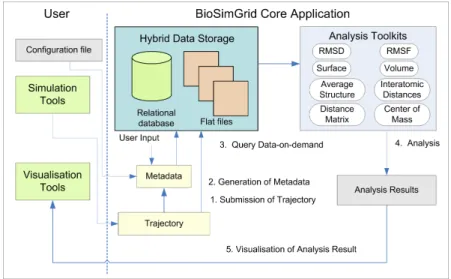
Figure 1 demonstrates typical scenarios of using the BioSimGrid project. The comple-tion of a biomolecular simulacomple-tion delivers simulation data, which is called a “trajec-tory”. A trajectory consists of many frames (corresponding to time steps in the simu-lation process) of simusimu-lation data record-ing the positions and velocities of all atoms. The first step is to submit the new trajec-tory and all the relevant meta-data (which describes the simulation and will allow so-phisticated querying of all submitted trajec-tories) to the database. The extraction of the meta-data (from the simulation configura-tion files) and the trajectories (from the sim-ulation data files) is fully automated, but the user has the option to provide additional information, such as publication references which cannot be extracted from the simula-tion configurasimula-tion and data files.
Fig. 1:A schematic sketch of the work flow in the BioSimGrid project.
Once the data is stored in the database, users can query different slices of one or more trajectories and perform a number of standard analysis computations (a selection is shown in the figure) on these data. The work flow is then completed by the graph-ical display of the analysis results (either as vector graphics, bitmaps, movies or us-ing interactive 3-dimensional environments such as Visual Molecular Dynamics [2] and PyMol [3]). The results are, of course, also available in text or data files.
The following section of the paper dis-cusses two related work on grid-enabled data storage. Section 3 describes the archi-tecture of BioSimGrid where the data stor-age layer, the middleware layer and the user interface layer are discussed in details. Sec-tion 4 gives a brief outline on the current is-sues and the future work on the next proto-type, and we finally conclude in section 5.
2
Related Work
2.1 GridPP and the European DataGrid Project
GridPP [4] is a collaboration project be-tween Particle Physicists and Computer Sci-entist from the UK and Cern aiming to build a Grid for Particle Physics. One of the key components of GridPP is the Eu-ropean DataGrid Project (EDG) [5] which deals with managing a large quantity of sharable data reliably, efficiently and
scal-ably. EDG aims at enabling access to geo-graphically distributed computing and stor-age facilities. It provides resources to pro-cess huge amounts of data from three dis-ciplines: High Energy physics, Biology and Earth Observation. EDG has a file replica-tion service to optimise data access by stor-ing multiple copies of local data at several locations. This replication framework has an optimisation component to minimise file ac-cess by pointing acac-cess request to appropri-ate replicas and proactively replicating fre-quently used files based on access statistics. As compared to DataGrid, BioSimGrid aims to provide a mechanism of data access at a finer granularity level, by delivering a slice of a trajectory rather than a whole file. Hence the concept of file replication of Data-Grid can potentially be adopted and modi-fied to suit a finer granularity level of data access.
2.2 OGSA-DAI
OGSA-DAI (Open Grid Services Architec-ture - Data Access and Integration) [6] is a grid middleware that has been developed to allow access and integration of heteroge-neous data sources as though they were a single, logical data resource. It is well suited particularly for database applications that involve legacy databases of different ven-dors. Its services offer data federation and distributed query processing to allow joint table query from multiple disparate data
sources. To enable integration of heteroge-nous databases, OGSA-DAI data query ser-vice introduces an extra middle layer on top of the data sources before data is brought into the processing environment. This po-tentially introduces a layer of overhead in the middleware. DAI is an OGSA-referenced implementation of grid services. With the deprecation of OGSI which is the architectural implementation of OGSA, OGSA-DAI is currently migrating to web services standard space [7]. Hence to date, it is still an ongoing project which is yet to prove its maturity. One of the reasons OGSA-DAI is not employed in BioSimGrid is that the heterogeneity of data sources is minimal in this project, as we do not deal with legacy databases. Furthermore, BioSimGrid has multiple databases storing identical metadata (please refer to section 3.1), hence the functionality of distributed querying is not immediately required.
3
The Architecture of BioSimGrid
BioSimGrid seeks to fulfil the following cri-teria in its implementation:
– to minimise data storage, in order to store as many trajectories as possible in a fixed amount of storage space.
– to maximise data transfer rate, in terms of the speed of delivering data to the computational elements, in this case the post processing tools.
– to provide an abstraction of the data layer, where biochemists are freed from the complication of using and under-standing data quering languages and the data storage structure in their scien-tific research.
– to provide a transparency of data loca-tion to the users, where actual physical location of the data is hidden.
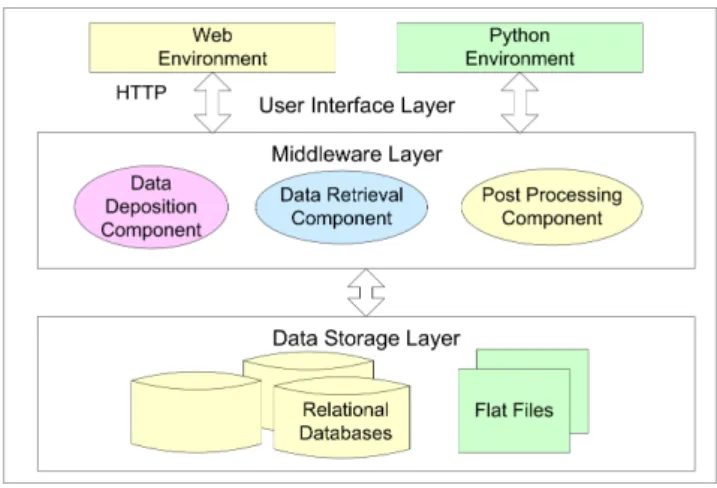
As shown in figure 2, the architecture of BioSimGrid encompasses three layers: the data storage layer, the middleware and the user interface layer. Each of these will be de-scribed in the following sections.
3.1 BioSimGrid Data Storage Layer
The data storage layer is responsible for managing the data on a single machine and
exposes methods which are used by the Data Retrieval component to provide the user with data. This layer is required on each machine that is storing trajectory data, ini-tially there will be six remote sites each run-ning this layer. It provides an API which ab-stracts from the method used to store the data and provides simple access methods for both querying and retrieving data. The trajectory data is divided into two key sec-tions, the metadata and the coordinate data.
Trajectory Metadata
The metadata is additional information about the trajectory which can either be sup-plied by the user, the input files or calculated at a later stage. It also includes the topology which describes the structure of the protein (chains and residues). This metadata is com-paratively small and can be replicated across all sites using standard database replication tools. The advantage of replicating the meta-data across all sites is so that a user can query all the trajectories stored in the sys-tem by querying and single machine and expect a timely response. This design also helps with scalability and load balancing: since the volume of metadata is small, ad-ditional nodes can be added to the system and easily incorporated by simply replicat-ing the database. Since each node stores the topology of all the trajectories, users can use any node to query and process data helping to balance the load across the system.
Trajectory Coordinate Data
The coordinates for every atom for every timestep are stored resulting in a large vol-ume of data which has to be managed. We have devised a fast, efficient way to store the coordinates using flatfiles which reduces the storage requirements as well as improv-ing performance results. This flatfile method was implemented using Python pickle [8] and it was compared with a commercial database (DB2) as well as an existing flat-file method (NetCDF [9]). The performance results are shown in Table 1. These results show that a flatfile method is well suited to our application for both random and serial data access.
We selected our own method for flexibil-ity as a whole trajectory is broken into a set
Fig. 2:The architecture of BioSimGrid depicting the data storage layer, middleware layer and user interface layer
of files which are then replicated to at least one other node. This helps to load balance the coordinate data requests as well as pro-vides offsite backups of the data. This ab-straction layer also permits the use of dif-ferent storage methods which can include compression and custom formats, which are completely transparent to the user.
Currently only the coordinates are stored using this method but the next version will store both coordinates as well a velocities, using the same method.
DB2 netCDF Python pickle Size(GB) 7.5 3.0 3.0 Random Access (Sec) 560.8 16.4 18.6 Sequential Access (Sec) 389.0 4.9 5.5
Table 1:Summary of performance results com-paring different flatfile methods with a commercial database (DB2)
3.2 BioSimGrid Middleware
The middleware of BioSimGrid is imple-mented on a modular architecture to enable easy extension and future plug in. It is written in Python [8], a free, open-source and platform-independent high-level object-oriented programming language.
Python is chosen for several reasons: (i) the biomolecular simulation community are moving towards Python as the preferred environment for post-processing analysis and several mature post-processing tools written in Python exist already (for ex-ample, MMTK [10] and PyMOL [3]). (ii) Python can easily integrate and interface to compiled codes so that other existing tools (typically written in Fortran or C) can be re-used immediately. (iii) Python comes with a substantial set of standard libraries which can be used in this project and avoid re-coding common tasks.
Data Deposition Component
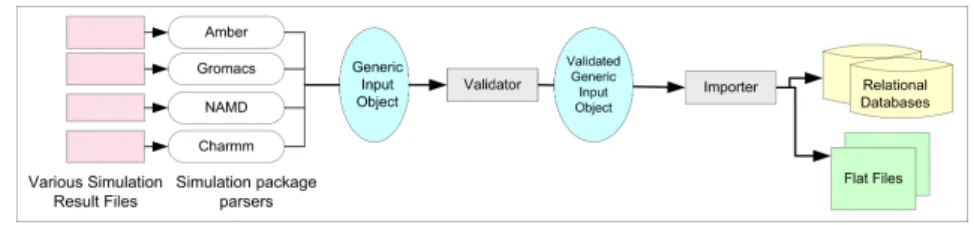
The process of depositing a trajectory into the BioSimGrid database is completely au-tomated and the complication of the under-lying storage structure is abstracted from the users. One of the challenges is to cater for different simulation packages that pro-duce simulation data in various file formats. To deal with this, the deposition compo-nent consists of different parsers for differ-ent simulation packages to parse the simu-lation data files into a generic input object. This object is then parsed through a valida-tor to check for correct data type and their validity against various dictionaries (e.g. the existence of a residue in the dictionary). The process is completed when the vali-dated generic input object is deposited into the flat files (coordinates and velocities) and database (metadata) through an importer. With the modular approach as shown in
Fig. 3:The modular implementation of a data deposition component which includes a set of parsers, a validater and an importer. New parsers can be easily added to this modularised component.
from Deposit.NAMDDeposit import NAMDDeposit files ={‘coordinates’: ‘/path/coordFiles’,
‘topology’:‘/path/topoFile’, ‘parameter’:‘/path/paraFile’} g = NAMDDeposit(files)
Fig. 4:An example of a user script to deposit a NAMD trajectory. The underlying complexity of pars-ing, validating and importing of trajectory into the database is hidden from the users
figure 3, new parsers can easily be added for any new simulation package if required. The underlying complexity of parsing, vali-dating and importing of trajectory into the database is hidden from the users. A bio-chemist needs only to run 3 lines of code to deposit their trajectories by specifying the path for their simulation data files, as shown in figure 4.
For the next prototype, the data deposi-tion component will be extended to cater for the distributed nature of the application. We envisage an implementation of multi-ple deposition points to avoid single point failure and performance bottlenecks. In this case, a global identifier will be assigned to uniquely identify a trajectory and facilitate the synchronisation of multiple metadata databases. To deposit a trajectory from a re-mote location the generic input object will be serialised at the deposition client and de-serialised at the deposition server.
Data Retrieval Component
The data retrieval component provides a single point of entry for all the trajectories stored on any of the sites. Each site will be running a data retrieval component and a user can use any site to query the data in the entire system. This component queries the local database to retrieve any metadata that is requested, so the user can query in-formation about a trajectory on a different site without having the overhead of
con-tacting the hosting site. This component ab-stracts the location of the trajectory data from the user and is responsible for getting coordinates from external sites if they are not stored locally.
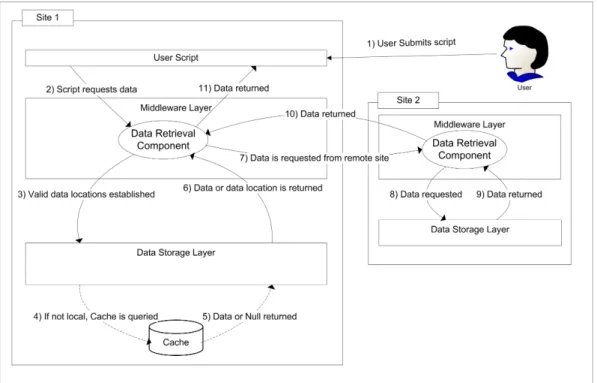
Figure 5 shows how the data is transpar-ently retrieved from a remote site so that it can be used by a users script. In step 1 and 2 the user submits a script that re-quests request for a set of coordinates from the Data Retrieval Component. This compo-nent first looks at the metadata database to retrieve the locations of the requested coor-dinate flatfiles (step 3). If the data is stored locally then it is returned otherwise a list of remote data source locations are returned to the Data Retrieval Component (step 6). A data source is then selected from the list and a request is made to the Data Retrieval Com-ponent on the remote site for the required data (step 7). As this source is listed as a valid data source it is guaranteed to store the data locally, hence it will not attempt to re-trieve the data from another remote site. The data is then passed back to the requesting site (step 10) and the Data Retrieval Compo-nent returns the data to the user script (step 11) in the same way as a locally stored data set.
There are two key opportunities to save retrieval times when retrieving large amounts of data. The first is to look at the list of sites that store the trajectory and ask multiple sites to provide different parts of the trajectory. This will reduce the load on
Fig. 5:Schematic showing how a remote data request is returned. Caching mechanism is used to improve the speed of data transfer.
sites by distributing it across multiple sites as well as improving the speed that data is received.
The second is a cache (not implemented in the current prototype). Each frame that is retrieved from an external site will be stored using the same flatfile storage method. If a whole trajectory is then cached it can be moved to the main database and marked as a valid location to retrieve data for that tra-jectory. So when a data query requires data that is not stored on the database then the cache is consulted first to see if it has been retrieved previously (step 4 and 5 in Figure 5 if not then the hosting site is queried. There is a limit to the number of frames that are held in the cache and this is defined by a site specific limit, which also includes the whole trajectories that are added to the local data store. The aim of storing whole trajectories on additional sites is to attempt to move the data closer to the processing. If a site contin-ually requests a trajectory it makes sense to store the trajectory on that site.
Currently each site has an excess of stor-age space and we can utilise this space to gain a performance boost however more jectories can still be added as temporary
tra-jectories can simply be deleted and removed from the metadata database to make more room as required.
The Data Retrieval Component is not only responsible for getting the data from the distributes sources but it is also responsi-ble for making the data transparently avail-able to the users in an environment of their choice, in this case Python. This results in Python numeric arrays being made avail-able to users who have no idea where or how the data is stored. This has currently been implemented and a series of analy-sis tools for the Post Processing Component have been built on this design. This design also permits extensions for other languages like Perl to assist the users to migrate and utilise the BioSimGrid project.
Post Processing Component
For the post processing component, a set of analysis tools are written for standard and generic analysis on the simulation data, e.g. the calculation of Root Mean Square Deriva-tion (RMSD) and the computaDeriva-tion of the av-erage structure and interatomic distances. Each analysis is exposed as a module and the modularity approach enables the tool
FC = FrameCollection(‘2, 100-200’) myRMSD = RMSD(FC)
myRMSD.createPNG()
Fig. 6:An example of a user script to run a RMSD analysis using frame 100th to 200th from trajectory 2
set to be extended easily. An example of an analysis script is shown in figure 6 to demonstrate how to use the post process-ing tools. The first line of the script speci-fies a frame collection - the part of a pro-tein to be used to perform the analysis, in this case frame 100th to 200th from trajec-tory 2. The next line requests a RMSD anal-ysis by taking the frame collection as its in-put parameter. Finally, the third line speci-fies the format of the result to be generated, which in this case is the output of an image file in PNG format. The ease of selecting dif-ferent data set and difdif-ferent post processing tools allows biochemists with little compu-tational experience to perform an analysis on the simulation data and obtain meaning-ful results.
3.3 User Interface Layer
BioSimGrid user application level offers two modes of interaction: via a graphical web based interface or via the Python script-ing environment. The graphical interface is just another layer on top of the underly-ing Python codes. The scriptunderly-ing environ-ment caters for advanced users who would like to connect to BioSimGrid in a script-ing environment and utilise its data submis-sion, retrieval and post-processing API in a fully programmable way. In this environ-ment, biochemists can choose to run existing analysis toolkits provided by BioSimGrid. Alternatively for more specific analysis, they can use the available data retrieval packages to write their own script. The graphical in-terface provides a more user friendly envi-ronment to cater for novice users. It allows users to perform standard analysis runs and provides an overview of the available data and processing options. In this mode, a user first selects an analysis from a drop down menu, then proceeds to select a trajectory and the relevant frames to perform the anal-ysis on. All these operations are done by clicks of buttons on a web browser.
4
Current Issues and Next
Proto-type
BioSimGrid is in its early stage of devel-opment. Current prototypes that have been developed are based on architecture where both the application and database server are implemented as client server architecture, running at a single location. We have mod-ularised our components and have devel-oped a basic set of functionalities of BioSim-Grid for data deposition, data retrieval and analysis of post simulation data. The mod-ularity approach of the components enables easy plug-in and future extension of various functionalities, such as adding more anal-ysis tools or extending the data deposition tools to cater for new simulation result for-mats.
The next prototype of BioSimGrid will concentrate on tackling the geographically distributed databases and applications. Es-tablishing secure asynchronous network communication, handling data latency and data recovery is non trivial in this case. We are investigating Python twisted framework [11] and Pyro [12] for programming network services and applications. For a more reli-able data transmission, the next prototype will incorporate MD5 [13] hashes to help manage corruptions in file transfer. We also envisage the use of standard protocols such as secure socket layer (openSSL) to provide secure point to point communication.
The issue of security is also a major con-cern in BioSimGrid. We envisage the use of digital certificate-based authentication to authorise users into the system and provide mechanism to set various permission levels for different user groups to authorise them to different resources and transactions.
In the future work, we plan to implement web service based interfaces in order to pro-vide a platform and language independent way of accessing the existing middleware components.
5
Conclusion
In summary, BioSimGrid provides a trajec-tory storage system which allows users to submit simulation data from a wide range of simulation packages and to run cross simulation comparisons independent of the source of the data. We have developed the current version of the system together with biochemists who provide constant feedback on the usability of the project, and we are currently expanding the user base and the number of available trajectories in the sys-tem.
Acknowledgements
We would like to thank our collaborators D. Moss, C. Laughton, L. Caves, O. Smart and A. Mulholland. This project is funded by BB-SRC.
References
1. Bing Wu, Kaihsu Tai, Stuart Murdock, Muan Hong Ng, Steven Johnston, Hans Fan-gohr, Paul Jeffreys, Simon Cox, Jonathan Es-sex, and Mark S.P. Sansom. Biosimgrid: a distributed database for biomolecular simu-lations. In Simon J. Cox, editor,Proceedings of UK e-Science All Hands Meeting 2003, pages 412–419, Swindon, 2003. EPSRC.
2. Andrew Dalke William Humphrey and Klaus Schulten. Vmd — vi-sual molecular dynamics. Journal of Molecular Graphics, 14:33-38, 1996. http://www.ks.uiuc.edu/Research/vmd/. 3. W.L. DeLano. The PyMOL molecular
graphics system. DeLano Scientific, 2002. http://www.pymol.org.
4. The GridPP Project.
http://www.gridpp.ac.uk.
5. The EU DataGrid Project. http://www.eu-datagrid.org.
6. The OGSA-DAI Project. http://www.ogsa-dai.org.uk.
7. OGSA-DAI: Two Years On, GGF10, Data Area Workshop, Humboldt University, Berlin Ger-many, 2004.
8. Fred L. Drake Jr. Guido van Rossum. Python library reference. Computer Science Depart-ment of Algorithmics and Architecture, CS-R9524, 1995. http://www.python.org.
9. Unidata - netcdf.
http://my.unidata.ucar.edu/content/software/ netcdf/index.html.
10. The Molecular Modeling Toolkit: a case study of a large scientific application in Python, http://starship.python.net/crew/hinsen/MMTK, 1997.
11. Twisted Matrix Laboratories. http://www.twistedmatrix.com.
12. PYRO - Python Remote Objects. http://pyro.sourceforge.net/index.html. 13. RFC 1321 - The MD5
Mes-sage Digest Algorithmn. http://www.faqs.org/rfcs/rfc1321.html.