Volume 3, Issue 4, July 2014
Abstract—for years the information system (IS) community has been struggling with the delivery of low quality software applications. However, software process improvement (SPI) programs are widely accepted in the community as one of the remedies to overcome this problem, with process maturity being a key element. But most of the studies on process maturity have been conducted in the United States. It is imperative that we seek to understand the practices that can enhance process maturity in other context. This study evaluated the practices with the greatest influence on process maturity in Canadian software development firms; using ten established CMMI levels 2 and 3 practices as a baseline for the analysis. The ten practices were all found to be significant vis-à-vis process maturity, with project planning having the greatest influence. These findings are consistent with prior studies and can assist practitioners in their desire to produce higher quality software applications.
Index Terms—Capability maturity model integration, Information systems quality, Process maturity, Software development firms
I. INTRODUCTION
For years the information system (IS) community has been struggling with the delivery of low quality software applications and unsuccessful IS projects [30], which by extension negatively affects the intended benefits to the respective firms [39]. Several people, technology and process maturity initiatives have been tried but with little success.
Reference [10] posited that a „silver pellet‟ approach should be taken in which developers and users chip away at the monster that create terror with the delivery of poor quality software applications. This view is in alignment with the people paradigm. Other scholars of the technology paradigm believe that the application of computer aided software engineering (CASE) tools and object-oriented methodology can dramatically reduce the number of errors in the delivered software product [16]. While those in the process paradigm believe that process maturity and process improvement can help the development of higher-quality software [39]. However, whatever paradigm is taken it is known that some software development firms may have less capacity to absorb such failures [17]; [24], because they may suffer from resource constraints [21].
In an effort to reverse this trend by delivering high quality software applications, it is important that IS professionals (i.e. analysts, developers, project managers, IS managers and practitioners) have a better understanding of the key factors that impact process maturity [20]. Process maturity is an indication of how close an evolving process is near to completion, and is capable of continuous improvement through performance measures and feedback [37]. High levels of process maturity can enhance the likelihood of producing higher quality software applications [18]; [31]; [35]. Hence, providing a competitive advantage [37] and enhancing the chances of winning global contracts [30]; [40].
However, most studies on the determinants of process maturity and the delivery of higher quality software applications are conducted in large firms in developed countries [15]; [16], and in particular the U.S., with less focus on Canada. In a study commissioned by the „Industry Canada‟ it was discovered that Canadian software developers are among the most prolific in the world but they are also the most likely to produce flawed software applications [41]. As a result, Canada‟s software organizations decided to embark upon a plan to correct the delivery of poor quality software applications, through the adoption and implementation of SPI programs [41]. These reasons have motivated this study, in which the research question seeks to ascertain, “what factors influence process maturity in Canadian software development firms?”
The Impact of CMMI Levels 2 and 3 Practices on
Process Maturity in Canadian Software
Development Firms
Volume 3, Issue 4, July 2014
In identifying the factors to be considered, the capability maturity model integration – for development (CMMI-DEV), a popular and well established software process improvement (SPI) framework was selected [1]; [22]; [44]. The staged representation of the framework was used and it has five maturity levels, from level 1-5 [36]. Each maturity level has established process areas, except level 1 in which there are no process areas. All together there are twenty-two process areas from levels 2 – 5. A process area is a cluster of related best practices in an area, which when implemented collectively, satisfy a set of goals considered important for making significant improvement in that area [36]. For example, the seven process areas at level 2 are broadly considered project management practices and these include some process areas like (1) requirements management, (2) project management, and (3) project monitoring and control. These along with the other four process areas are established project management practices during the development and delivery of software applications. Against this background, throughout the rest of the paper process areas will be referred to as practices.
An improved understanding of the impact of each CMMI practices on process maturity can increase the delivery of higher quality software applications, assist with the development of more successful IS project [2]; [32], as well as increase the likelihood of winning global contracts. As a result, the expected contribution of the study is for IS professionals in Canadian software development firms to gain rich insights regarding the factors with the greatest influence on process maturity, and IS researchers to refine the proposed research model.
II. LITERATUREREVIEW
Building and delivering high quality information systems has been an elusive target for many years [23]. This condition has led to the perception of the „software crisis‟, a state in which there is the delivery of many low quality software applications and unsuccessful IS projects [5]; [25]; [28]; [38]; [42]. This is supported by [4] and [45] who suggested that the main contributor of IS project failure is the delivery of poor quality software applications. Several initiatives have been tried and implemented in an effort to overcome the problem but scholars are still resolute that there is no „silver bullet‟ to resolve the issue. Hence, a disciplined and multisource attack on the problem is necessary [10]. This has led to the widely accepted view in the IS community that people, technology and process maturity are major determinants of IS quality [11]; [16].
However, many scholars believe that careful analysis and design of the IS delivery process is the most impactful of all the factors that influence IS quality [18]; [31]. This view is largely responsible for the popularity of software process improvement (SPI) initiatives. Advocates of the process paradigm [34] states that “everyone realizes the importance of having a motivated workforce, quality work force and the latest technology, but even the finest people can‟t perform at their best when the process is not understood or operating at its best.” (p.9). It is for these reasons that people and technology were scoped out of this study and the emphasis is placed on process maturity and its determinants.
The capability maturity model integration (CMMI) a popular and well established process assessment framework [1]; [3]; [19] was selected as the baseline for this analysis. It is a major framework in the areas of process assessment, process maturity and process improvement. It details a list of clearly defined and well established practices from levels 2 – 5 which can be used to assess a firm‟s process maturity, as well as provide a guideline for process maturity advancement. These prescribed practices if understood, followed and institutionalized during the development cycle can increase the likelihood of producing high quality software applications.
Most studies on the determinants of process maturity and the delivery of higher quality software products are conducted in large firms in developed countries [15]; [16], and in particular the U.S., with less focus on Canada. In a study commissioned by the „Industry Canada‟ it was discovered that Canadian software developers are among the most prolific in the world but they are also the most likely to produce flawed software applications [41]. The same study found that Canadian software development companies offered their employees little training, even though they planned to correct this poor software quality problem through the adoption and implementation of SPI programs [41].
In addition, statistics show that 55% of the organizations appraised against the CMMI models were outside the US, with Canada accounting for a small percent within this group [46]. Reference [6] shows that only 48% of Canadian
Volume 3, Issue 4, July 2014
However, to persist and grow, Canadian companies need efficient and effective software applications, through the intervention of SPI programs.
Based on the above factors it is important to identify the process maturity practices which can increase the chances of delivering high quality IS projects [33] in Canadian software development firms. Process maturity in this study is defined as the degree, to which a process is defined, managed, measured and continuously improved [9].
The indicator variables for the process maturity construct in [7] simplified software process improvement framework were used as the applicable CMMI practices in this study. This simplified framework was developed in focus group sessions using the nominal group technique (NGT). The objective in these sessions was to identify relevant and applicable CMMI practices from the list of established eighteen levels 2 and 3 practices. The derived top ten practices were considered relevant and applicable in software development firms with constraints and where process maturity was not well developed. It is believed that process maturity practices are not embedded and institutionalized in Canadian firms during system development [6]. In addition, there was an appeal in the literature to validate and possibly refine the proposed simplified software process improvement framework [7].
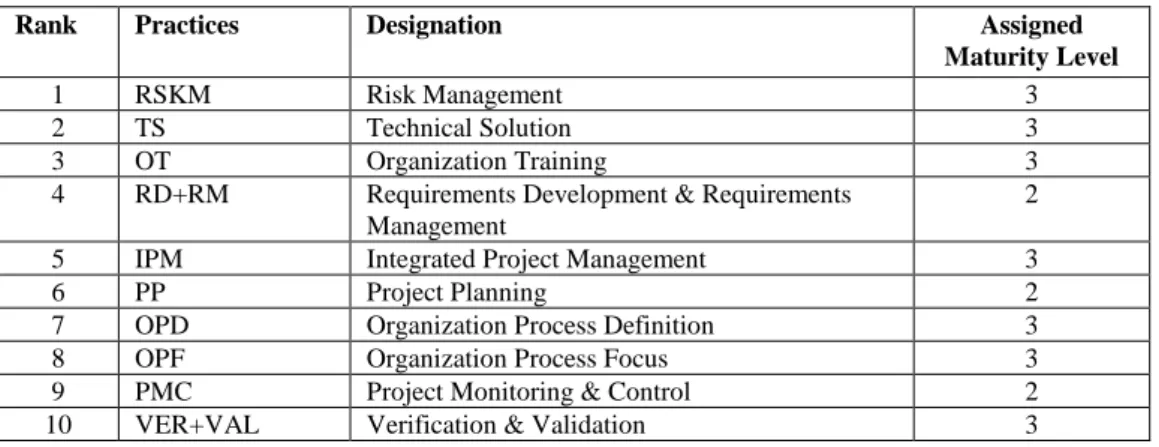
The resulting top ten CMMI levels 2 and 3 practices for the process maturity construct in the simplified framework were risk management, technical solution, organization training, requirements development + requirements management (a merged practice), integrated process management, project planning, organization process definition, organization process focus, project monitoring and control and verification + validation (a merged practice). The resulting top ranked CMMI practices are shown in Table 1 in descending order.
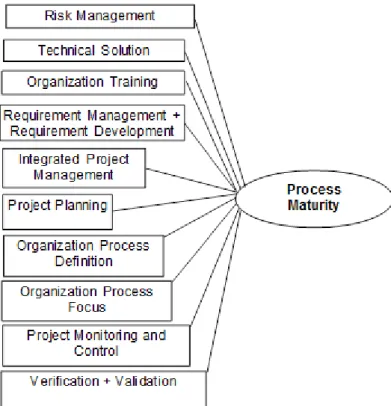
The definition of the ten top ranked practices was adapted from [47] paper. These derived practices were incorporated in the proposed research model as determinants of process maturity in Canadian software development firms (as shown in Figure 1). A survey was conducted in an attempt to validate the research model, by assessing the strength of each practice on the process maturity construct.
Table 1: The Top Ranked CMMI Practices in Descending Order
Rank Practices Designation Assigned
Maturity Level
1 RSKM Risk Management 3
2 TS Technical Solution 3
3 OT Organization Training 3
4 RD+RM Requirements Development & Requirements Management
2
5 IPM Integrated Project Management 3
6 PP Project Planning 2
7 OPD Organization Process Definition 3
8 OPF Organization Process Focus 3
9 PMC Project Monitoring & Control 2
10 VER+VAL Verification & Validation 3
III. THESURVEY
The main survey method was on-line but face-to-face, telephone calls and postal mailing methods were employed. The unit of analysis was IS project and a cross-sectional study was done shortly after the project implementation (less than eighteen months). Ethical approval was received to conduct the survey and invitation letters with link to the on-line survey was sent to 344 potential respondents. Respondents were selected from a sample frame that was developed through the Canadian Company Capabilities Database and personal referrals. The sample frame was developed through the database search with keywords such as information technology, software, software development. In addition, assistance was sought through two IT/IS professional associations in Canada in which one head office was in Ottawa and the other in Toronto. In some cases contacts were made with the presidents, chief executive officers (CEOs) and chief information officers (CIOs) of firms who provided our research team with the names and email addresses of relevant member(s) of a recently implemented IS project.
Volume 3, Issue 4, July 2014
The survey items were derived from the literature using a 7-point Likert-type scale anchored as (1) strongly disagree and (7) strongly agree [47]. A total of 61 responses were collected, but 6 were incomplete and had to be discarded. Hence only 55 responses were considered good and analyzed. This gave a 16% response rate. The profile of the respondents included 44 males and 11 females. They were 42 developers (which encompass analysts, programmers, developers and project managers) and 13 CIOs.
The survey items in the questionnaire were seeking answers to ten hypotheses, as shown below: H1: Risk management will have a positive impact on process maturity
H2: Technical solution will have a positive impact on process maturity H3: Organizational training will have a positive impact on process maturity
H4: Requirements management + Requirements development will have a positive impact on process maturity H5: Integrated project management will have a positive impact on process maturity
H6: Project planning will have a positive impact on process maturity
H7: Organization process definition will have a positive impact on process maturity H8: Organization process focus will have a positive impact on process maturity H9: Project monitoring and control will have a positive impact on process maturity H10: Verification + Validation will have a positive impact on process maturity
Fig. 1: The Research Model A. Findings and Analysis
Statistical package for the social sciences (SPSS) and partial least squares (PLS) were used as the statistical tools to determine the path significance of the model and other statistical measures. SPSS is a popular tool [43] used to conduct inferential statistics (p. 27), while PLS-Graph – a structural equation modeling technique - was selected based on its ability to handle small sample sizes [8].
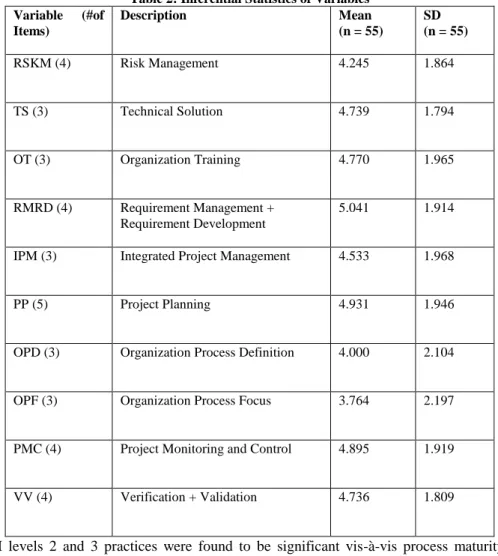
Inferential statistics (mean and standard deviation) are shown in Table 1, while discriminant validity was established because the diagonal readings in Table 2 are higher than their vertical and horizontal readings. In addition, the composite reliabilities and average variance extracted are shown in Table 3. In terms of the mean
Volume 3, Issue 4, July 2014
most were ranked above the mid-range, with 3.764 being the lowest on a 1-7 scale. Reliability was established in all variables because all the readings were between 0.928-0.981 which is above the 0.7 threshold [14]. Convergent validity was established through the average variance extracted (AVE) scores. All AVE readings in Table 2 are above the 0.5 threshold [13].
Table 2: Inferential Statistics of Variables Variable (#of Items) Description Mean (n = 55) SD (n = 55) RSKM (4) Risk Management 4.245 1.864 TS (3) Technical Solution 4.739 1.794 OT (3) Organization Training 4.770 1.965 RMRD (4) Requirement Management + Requirement Development 5.041 1.914
IPM (3) Integrated Project Management 4.533 1.968
PP (5) Project Planning 4.931 1.946
OPD (3) Organization Process Definition 4.000 2.104
OPF (3) Organization Process Focus 3.764 2.197
PMC (4) Project Monitoring and Control 4.895 1.919
VV (4) Verification + Validation 4.736 1.809
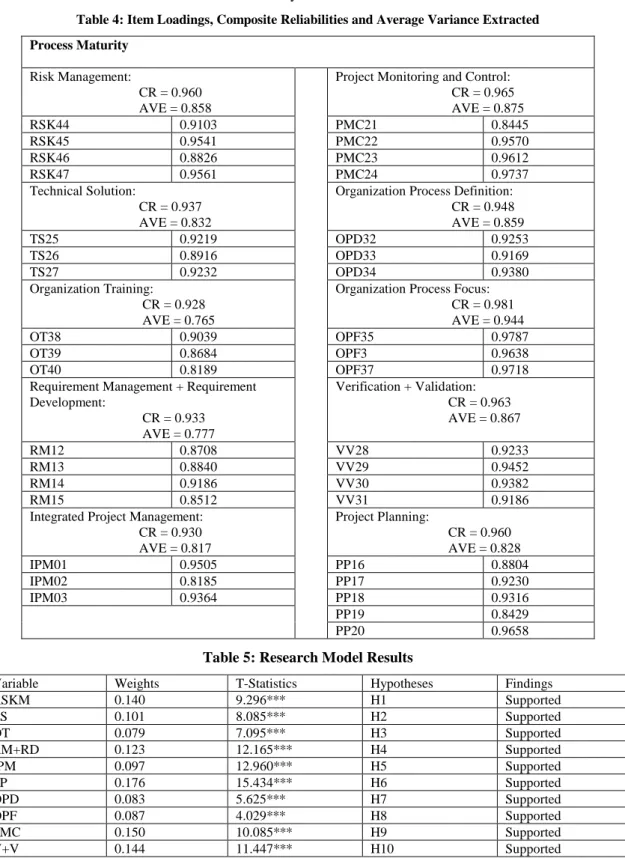
All ten CMMI levels 2 and 3 practices were found to be significant vis-à-vis process maturity, with project planning having the greatest influence (see Table 4). This means that the ten derived CMMI practices are embedded and institutionalized in the development of systems in Canadian software development firms. This finding is consistent with studies in other developed countries in which these ten CMMI practices impact process maturity. Based on these findings it could be argued that the process maturity of firms in Canada is above average – perhaps operating at level 2 and above.
Table 3: Discriminant Validity
RSK TS OT RM IPM PP OPD OPF PMC VV RSK 0.926 TS 0.738 0.912 OT 0.636 0.687 0.875 RM 0.694 0.789 0.663 0.882 IPM 0.798 0.724 0.538 0.645 0.904 PP 0.690 0.889 0.664 0.858 0.662 0.909 OPD 0.617 0.683 0.310 0.504 0.699 0.525 0.927 OPF 0.546 0.598 0.257 0.413 0.629 0.474 0.838 0.972 PM C 0.689 0.858 0.584 0.858 0.707 0.904 0.590 0.561 0.935 VV 0.692 0.846 0.727 0.734 0.602 0.801 0.567 0.454 0.700 0.931
Volume 3, Issue 4, July 2014
The diagonal elements are the square root of the average variance extracted (AVE). These values exceed the inter-variable correlations. Hence discriminant validity is established in all instances.
Table 4: Item Loadings, Composite Reliabilities and Average Variance Extracted Process Maturity
Risk Management:
CR = 0.960 AVE = 0.858
Project Monitoring and Control: CR = 0.965 AVE = 0.875 RSK44 0.9103 PMC21 0.8445 RSK45 0.9541 PMC22 0.9570 RSK46 0.8826 PMC23 0.9612 RSK47 0.9561 PMC24 0.9737 Technical Solution: CR = 0.937 AVE = 0.832
Organization Process Definition: CR = 0.948 AVE = 0.859 TS25 0.9219 OPD32 0.9253 TS26 0.8916 OPD33 0.9169 TS27 0.9232 OPD34 0.9380 Organization Training: CR = 0.928 AVE = 0.765
Organization Process Focus: CR = 0.981 AVE = 0.944
OT38 0.9039 OPF35 0.9787
OT39 0.8684 OPF3 0.9638
OT40 0.8189 OPF37 0.9718
Requirement Management + Requirement Development: CR = 0.933 AVE = 0.777 Verification + Validation: CR = 0.963 AVE = 0.867 RM12 0.8708 VV28 0.9233 RM13 0.8840 VV29 0.9452 RM14 0.9186 VV30 0.9382 RM15 0.8512 VV31 0.9186
Integrated Project Management: CR = 0.930 AVE = 0.817 Project Planning: CR = 0.960 AVE = 0.828 IPM01 0.9505 PP16 0.8804 IPM02 0.8185 PP17 0.9230 IPM03 0.9364 PP18 0.9316 PP19 0.8429 PP20 0.9658
Table 5: Research Model Results
Variable Weights T-Statistics Hypotheses Findings
RSKM 0.140 9.296*** H1 Supported TS 0.101 8.085*** H2 Supported OT 0.079 7.095*** H3 Supported RM+RD 0.123 12.165*** H4 Supported IPM 0.097 12.960*** H5 Supported PP 0.176 15.434*** H6 Supported OPD 0.083 5.625*** H7 Supported OPF 0.087 4.029*** H8 Supported PMC 0.150 10.085*** H9 Supported V+V 0.144 11.447*** H10 Supported Note: *** Significant at p < 0.01
Volume 3, Issue 4, July 2014 IV. DISCUSSION
Clients are demanding the delivery of high quality software applications [12]; [27]. As a result both IS researchers and practitioners are paying keen attention to the perpetual problem of delivering low quality systems [26]. Low quality systems can lead to unused or underutilized systems which can cost firms millions of dollars each year [29]. A mature process can increase the possibility of producing high quality software applications [1]; [12]. Hence, the performance of IS professionals (analysts, developers, project managers, IS managers and practitioners) can improve if they are knowledgeable about the determinants of process maturity. As a result, Canadian companies should seek to reverse the trend by offering training to key IS personnel about the use and benefits of SPI programs. Such knowledge can positively impact the outcome of IS projects, improve firms‟ performance [2]; [20] and enhance the likelihood of winning global contracts [30]; [40].
Based on the fact that all ten practices were found to be significant, it is reasonable to suggest that software development firms in Canada are operating at level 2 and above. This discovery is consistent with the [6] report which shows that 48% of Canadian firms using the staged representation for CMMI appraisals are at level 3, and only 5% being assessed at level 4. Although most of the mean scores in Table 1 are above the mid-range, more work is needed to increase the awareness and create a state of institutionalization of the practices.
However, because this study only considered ten out of the established eighteen CMMI levels 2 and 3 practices, it is important that future research incorporate the remaining eight practices and assess their impact on process maturity. These additional practices might contribute to improved CMMI appraisal results, as well as assist towards the pursuit of delivering higher quality software applications and by extension win global contracts and earn foreign exchange.
In addition, the study provides guidance for the adoption and institutionalization of process maturity practices as a precursor to deliver higher quality software applications. Selecting the practice which can provide the greatest influence – project planning - in a reasonable timeframe is critical to IS practitioners (chief information officers, project managers and developers). The CMMI continuous representation approach could be adopted by emerging firms in an effort to increase their process maturity. The CMMI continuous representation approach is one in which firms embark on specific practices and seek to achieve high levels of capability [36]. In this case firms would firstly seek to institutionalize project planning to a high level of capability before embarking on other key influential practices. For this study project planning is to establish and maintain the plans that define project activities as distilled by [47] study.
Other CMMI practices like requirements management + requirements development (a merged practice), or integrated project management or verification + validation (a merged practice) could be considered after the institutionalization of project planning in the developmental process. The goal would be to increase the capability of these practices where they are embedded and a culture of continuous improvement prevails.
V. CONCLUSION
It is important to understanding those factors that enhance the delivery of high quality software applications and successful IS projects. Process maturity can enhance to likelihood of delivering higher quality systems. Hence this study assessed the impact of ten CMMI levels 2 and 3 practices on process maturity in Canadian software development firms. The study found that all ten practices were significant vis-à-vis process maturity, with project planning having the greatest impact. But a limitation of the study is the small sample size and so it is difficult to generalize the results.
However, it is hoped that the findings of the study will provide useful insights for both IS researchers and practitioners in their desire to produce higher quality software. This by extension can increase the likelihood of winning global contracts. These chains of events can improve the productivity of workers, increase the performance of firms, as well as provide a competitive advantage.
REFERENCES
[1] Agrawal, M., & Chari, K. (2007). Software effort, quality, and cycle time: A study of CMM level 5 projects. IEEE Transactions on Software Engineering, 33(3), 145-156.
Volume 3, Issue 4, July 2014
[2] Anderson, E. S., Birchall, D., Jessen, S. A., & Money, A. H. (2006). Exploring project success. Baltic Journal of Management, 1(2), 127-147.
[3] Beecham, S., Hall, T., & Rainer, A. (2005). Defining a Requirements Process improvement Model. Software Quality Journal, 13, 247-279.
[4] Brooks, F. (1987). No Silver Bullet: Essence and Accidents of Software Engineering. Computer Magazine, 1-13. [5] Bulatovic, J. (2011). Key issues in information systems management: A Serbia's perspective (Delphi study). Global
Journal of Computer Science and Technology, 11(19), 34-50.
[6] Carnegie Mellon. (2013). Published CMMI Appraisal Results of Canadian Firms: Staged representation. CMMI Institute. [7] Chevers, D. A., Moore, S., Duggan, E. W., & Mills, A. M. (2008). Identifying key software development practices in the English-speaking Caribbean using the nominal group technique. Paper presented at the the 19th Australasian Conference on Information Systems (ACIS), Christchurch, New Zealand.
[8] Chin, W. W. (2010). How to write-up and report PLS analysis. Berlin Heidelberg: Springer - Verlag.
[9] Dooley, K., Subra, A., & Anderson, J. (2001). Maturity and its impact on new product development project performance. Research in Engineering Design, 13(1), 23-29.
[10]Duggan. (2003). Silver Pellets for Improving Software Quality. Information Resources Management Journal, 17(2), 1-21. [11]Ebert, C., & De Man, J. (2008). Effectively utilizing project, product and process knowledge. Information and Software
Technology, 50, 579-594.
[12]Espinosa-Curiel, I. E., Rodriguez-Jacobo, J., & Fernandez-Zepeda, J. A. (2013). A framework for evaluation and control of the factors that influence the software process improvement in small organizations. Journal of Software: Evolution and Process, 25, 393-406.
[13]Fornell, C., & Larcker, D. (1981). Evaluating structural equation models with unobservable variables and measurement error. Journal of Marketing Research, 18(1), 39-50.
[14]Gefen, D., Straub, D., & Boudreau, M. (2000). Structural Equation Modeling and Regression: Guidelines for Research Practice. Communications of the Association for Information Systems, 4(7), 1-77.
[15]Gefen, D., & Zviran, M. (2006). What can be learned from CMMI failures? Communications of the Association for Information Systems, 17, 801-817.
[16]Gorla, N., & Lin, S. (2010). Determinants of software quality: A survey of information systems project managers. Information and Software Technology, 52, 602-610.
[17]Heeks, R. (2002). Information systems and developing countries: Failure, success, and local improvisations. The Information Society, 18, 101-112.
[18]Humphrey, W. (1989). Managing the Software Process. Reading, MA.: Addison-Wesley.
[19]Jiang, J. J., Klein, G., Hwang, H. G., Huang, J., & Hung, S. Y. (2004). An exploration of the relationship between software development process maturity and project performance. Information & Management, 41(3), 279-288.
[20]Kamhawi, E. M. (2007). Critical factors for implementation success of ERP systems: An empirical investigation from Bahrain. International Journal of Enterprise Information Systems, 3(2).
[21]Kimaro, H. C. (2006). Strategies for developing human resource capacity to support sustainability of ICT based health information systems: A case study from Tanzania. The Electronic Journal of Information Systems in Developing Countries, 26(2), 1-23.
[22]Kishore, R., Swinarski, M. E., Jackson, E., & Rao, H. R. (2012). A quality-distinction model of IT capabilities: Conceptualization and two-stage empirical validation using CMMI processes. IEEE Transactions on Engineering Management, 59(3), 457-469.
[23]Kitchenham, B., & Pfleeger, S. (1996). Software Quality: The Elusive Target. IEEE Software. [24]Lawler, E. E. (1997). Rethinking Organization Size. Organizational Dynamics, 26(2), 24-36.
[25]Li, D., Huang, W. W., Luftman, J., & Sha, W. (2010). Key issues in information systems management: An empirical investigation from a developing country's perspective. Journal of Global Information Management, 18(4), 19-35. [26]Livari, J. (2005). An empirical test of the DeLone-McLean model of information system success. Database for Advances
Volume 3, Issue 4, July 2014
[27]Lucio-Nieto, T., Colomo-Palacios, R., & Soto-Acosta, P. (2012). Implementing an IT service information management framework: The case of COTEMAR. International Journal of Information Management, 32, 589-594.
[28]Luftman, J., & Ben-Zvi, T. (2010). Key issues for IT Executives 2010: Judicious IT investments continue post-recession. MISQ Executive.
[29]Markus, M. L., & Keil, M. (1994). If we build it they will come: Designing information systems that users want to use. Sloan Management Review, 35(4), 11-25.
[30]Niazi, M., Babar, M. A., & Verner, J. M. (2010). Software process improvement barriers: A cross-cultural comparison. Information and Software Technology, 52, 1204-1216.
[31]Paulk, Weber. C.V., Curtis, B., & Chrissis, M. B. (1995). The Capability Maturity Model: Guidelines for Improving the Software Process. Reading, Massachusetts: Addison Wesley Longman, Inc.
[32]Peslak, A. R. (2006). Enterprise resource planning success. Industrial Management & Data Systems, 106(9), 1288-1303. [33]Rodriquez-Repiso, L., Rossitza, S., & Salmeron, J. (2007). Modelling IT projects success: Emerging methodologies
reviewed. Technovation, 27(10), 582-594.
[34]SEI. (2005). Capability Maturity Model Integration (CMMI) version 1.1 Overview. Accessed on February 9, 2007 from www.sei.cmu.edu/cmmi/adoption/pdf/cmmi-overview05.pdf., 9.
[35]SEI. (2006). CMMI for development, Version 1.2. Carnegie Mellon University, Software Engineering Institute, Pittsburgh.
[36]SEI. (2010). CMMI for Development, Version 1.3. Carnegie Mellon University, Software Engineering Institute, CMU/SEI-2010-TR-033.
[37]Srinivasan, S. a. M., M.A.N. (2010). Process maturity model can help give a business an edge. SixSigma Newsletter, 1, 1-7.
[38]Standish Group, T. (2009). The rise and fall of the Chaos Report figures. IEEE Software, 30-36.
[39]Staples, M., & Niazi, M. (2008). Systematic review of organizational motivations for adopting CMM-based SPI. Information and Software Technology, 50, 605-620.
[40]Sulayman, M., Urquhart, C., Mendes, E., & Seidel, S. (2012). Software process improvement success factors for small and medium Web companies: A qualitative study. Information and Software Technology, 54, 479-500.
[41]Tantara, I. (2000). Software process improvement in Canada. Small Business, 1-4.
[42]Thong, J. Y. L., Yap, C., & Raman, K. S. (1996). Top Management Support, External Expertise and Information Systems Implementation in Small Businesses. Information Systems Research, 7(2), 248-267.
[43]Vogt, W. P. (2007). Quantitative Research Methods for Professionals. Boston, MA: Pearson.
[44]von Wangenheim, C. G., Hauck, J. C. R., Zoucas, A., Salviano, C. F., McCaffery, F., & Shull, F. (2010). Creating Software Process Capability/Maturity Models. IEEE Computer Society, 92-94.
[45]Walia, G. S., & Carver, J. C. (2009). A systematic literature review to identify and classify software requirements errors. Information and Software Technology, 51, 1087-1109.
[46]Zubrow, D. (2003, November 3-6, 2003). Current trends in the adoption of the CMMI Product Suite. Paper presented at the 27th Annual International Computer Software and Applications Conference, Washington, DC.
[47]Zubrow, D., Hayes, W., Siegel, J., & Goldenson, D. (1994). Maturity Questionnaire. Accessed on January 5, 2006 from www.sei.cmu.edu/publications/documents/94.reports/94.sr.007.html, 7.
AUTHOR BIOGRAPHY
Delroy Chevers is a lecturer of Operations Management and Information Systems at the University of the West Indies, Mona. He holds a PhD in Information Systems from the University of the West Indies. His research interests are software process improvement (SPI), information systems quality and success, information technology adoption and project management. He is currently conducting research on the adoption of software process improvement programs in software development organizations in Canada and the English-speaking Caribbean.