(will be inserted by the editor)
Purpose Based Access Control for Privacy Protection
in Relational Database Systems
⋆Ji-Won Byun, Ninghui Li
CERIAS and Department of Computer Sciences, Purdue University e-mail:{byunj, ninghui}@cs.purdue.edu
Received: date / Revised version: date
Abstract In this article, we present a comprehensive ap-proach for privacy preserving access control based on the notion of purpose. In our model, purpose information asso-ciated with a given data element specifies the intended use of the data element. A key feature of our model is that it al-lows multiple purposes to be associated with each data el-ement and also supports explicit prohibitions, thus allowing privacy officers to specify that some data should not be used for certain purposes. An important issue addressed in this ar-ticle is the granularity of data labeling, that is, the units of data with which purposes can be associated. We address this issue in the context of relational databases and propose four different labeling schemes, each providing a different granu-larity. We also propose an approach to representing purpose information, which results in low storage overhead, and we exploit query modification techniques to support access con-trol based on purpose information. Another contribution of our work is that we address the problem of how to deter-mine the purpose for which certain data are accessed by a given user. Our proposed solution relies on Role-Based Ac-cess Control (RBAC) models as well as the notion of condi-tional role which is based on the notions of role attribute and system attribute.
Key words Privacy – Access Control – Purpose – Private Data Management
1 Introduction
While current information technology enables people to carry out their business virtually at any time in any place, it also provides the capability to store various types of information the users reveal during their activities. Indeed, a study con-ducted by the Federal Trade Commission in May 2000 [12] ⋆ This material is based upon work supported by the National
Sci-ence Foundation under Grant No. 0430274 and the sponsors of CE-RIAS.
shows that 97 percent of web sites were collecting at least one type of identifying information such as name, e-mail address, or postal address of consumers. The fact that the personal in-formation can be collected, stored and used without any con-sent or awareness creates fear for privacy violation for many people.
The advance of database technology has also significantly increased privacy concerns. The current database technology makes it possible to collect and store a massive amount of person-specific data, and the use of innovative knowledge ex-traction techniques combined with advanced data integration and correlation techniques [10, 13, 27] makes it possible to automatically extract a large body of information from the available databases and from a large variety of information repositories available on the web.
Even though the direct victims of privacy violations are consumers, many enterprises and organizations are deeply concerned about privacy issues as well. Many companies, such as IBM and the Royal Bank Financial Group, use pri-vacy as a brand differentiator [3]. By demonstrating good privacy practices, many businesses try to build solid trust to customers, thereby attracting more customers [3]. Potential lawsuits by consumers and recently enacted privacy legisla-tions also require organizalegisla-tions to pay close attention to the management of private data.
As privacy becomes a major concern for both consumers and enterprises, many privacy protecting access control mod-els have been proposed [1, 3, 17, 21]. We emphasize that pri-vacy protection cannot be easily achieved by traditional ac-cess control models. The first reason is that while traditional access control models focus on which user is performing which action on which data object, privacy policies are con-cerned with which data object is used for which purpose(s). For example, a typical privacy policy such as “we will collect and use customer identifiable information for billing purposes and to enable us to anticipate and resolve problems with your service” does not specify who can access the customer infor-mation, but only states that the information can be accessed for the purposes of billing, customer service, and possibly some analysis. Another difficulty of privacy protection is that
the comfort level of data usage varies from individual to in-dividual. For example, some online consumers may feel that it is acceptable to disclose their purchase history or browsing habits in return for better service, such as site personaliza-tion [19]. Other customers, however, may believe that such techniques violate their privacy.
Observing these challenges, we believe that in order to protect data privacy, the notion of purpose must play a ma-jor role in access control models and that an appropriate metadata model must be developed to support such privacy-centric access control models. In this article, we address this goal by presenting a comprehensive approach to purpose management, which is the fundamental building block on which purpose-based access control can be developed. Our approach is based on intended purposes, which specify the intended usage of data, and access purposes, which specify the purposes for which a given data element is accessed. Both intended purposes and access purposes are specified with re-spect to a hierarchical structure that organizes a set of pur-poses for a given enterprise. A key feature of our proposed model is that it also supports explicit prohibitions, thus allow-ing privacy officers to specify that data should not be used for a given set of purposes. We also formally define the notion of purpose compliance, which is the basis for verifying that the purpose of a data access complies with the intended purposes of the data.
An important issue that we also address in this article is the granularity of data labeling; that is, the units of data with which purposes can be associated. We address this issue in the context of relational databases and propose four different labeling schemes, each providing a different granularity. Us-ing our approach it is thus possible to associate a purpose (or a set of purposes) with an entire table, with each column within a table, with each tuple within a table, or with each attribute within a tuple. We also propose an approach to representing purpose information, which results in very low storage over-head. Furthermore, we exploit query modification techniques to support data filtering based on purpose information. Such techniques ensure efficient query processing even in the case of fine-grained purpose labeling.
Another key contribution of our work is that we address the problem of how to determine the purpose for which cer-tain data are accessed by a given user. We believe that this is-sue may be satisfactorily addressed by relying on Role-Based Access Control (RBAC) models [2, 14, 15]. However, in or-der to support policies specifying for which purpose a certain data can be accessed by a given role, we expand conventional RBAC models with the notion of conditional role which is based on the notions of role attribute and system attribute.
The remainder of this article is organized as follows. In Section 2, we provide a brief overview for privacy related technologies available today. We formally defines the notion of purpose in Section 3 and describe our purpose labeling model in Section 5. We introduce the notion of conditional role and presents a method for determining access purposes in Section 4. In Section 6 we present our implementation, and
we report experimental results in Section 7. We suggest future work and conclude our discussion in Section 8.
2 Related Work
Our work is related to several topics in the area of privacy and security for data management, namely privacy policy spec-ification, privacy-preserving data management systems and multilevel secure database systems. We now briefly survey the most relevant approaches in these areas and point out the differences of our work with respect to these approaches.
The W3C’s Platform for Privacy Preference (P3P) [30] is an industry standard that intends to provide an automated method for users to gain control over the use of their personal information collected by the web sites they visit. P3P al-lows web sites to encode their privacy practice in a machine-readable format, such as what data is collected, who can access the data for what purposes, and how long the data will be stored by the sites. P3P enabled browsers can read this privacy policy automatically and compare it to the con-sumer’s set of privacy preferences which are specified in a privacy preference language such as A P3P Preference Ex-change Language (APPEL) [29], also designed by the W3C.
Even though P3P provides a standard means for enter-prises to make privacy promises to their users, P3P does not provide any mechanism to ensure that these promises are con-sistent with the internal data processing. Thus, P3P is merely a tool for making promises and does not help enterprises to keep their promises. Note that publishing an attractive P3P policy without any adequate enforcement mechanism may put an enterprise at risk of reputation damage and potential lawsuits.
The Enterprise Privacy Authorization Language (EPAL) [17] proposed by IBM is a formal language for writing enterprise privacy policies to govern data handling practices in IT systems. An EPAL policy defines hierarchies of data-categories, user-categories, and purposes. User-categories are the entities (users/groups) that use collected data, and data-categories define different categories of collected data. Purposes model the services for which data is intended to be used. An EPAL policy also defines sets of actions, obligations, and conditions. Actions model how the data is used (e.g., read or write), and obligations define actions that must be taken by the environment of EPAL. Lastly, conditions are boolean expressions that evaluate the context. Privacy authorization rules are defined using these elements, and each rule allows or denies actions on data-categories by user-categories for certain purposes under certain conditions while mandating certain obligations.
While providing a language for specifying policies on data categories, EPAL does not provide support for linking the data categories with data stored in databases. Nor does the EPAL work address the issue of how to efficiently enforce these policies when data is accessed.
Previous work on multilevel secure relational data-bases [6, 9, 24, 26] also provides many valuable insights for
designing a fine-grained secure data model. In a multilevel relational database system, every piece of information is clas-sified into a security level, and every user is assigned a secu-rity clearance. The system ensures that each user gains access to only the data for which he has proper clearance, according to the well known basic restrictions [5]. These constraints en-sure that there is no information flow from a higher security level to a lower security level and that subjects with different clearances see different versions of multilevel relations.
A major difference of our approach with respect to mul-tilevel secure databases is that in our approach each data ele-ment is associated with set of purposes, as opposed to a sin-gle security level. Also, the purposes form a hierarchy and can vary dynamically. These requirements are more complex than those concerning traditional multilevel secure applica-tions. On the other hand, we are not concerned with informa-tion flow issues in this article.
The concept of Hippocratic databases, incorporating pri-vacy protection within relational database systems, was intro-duced by Agrawal et al. [1]. The proposed architecture uses privacy metadata, which consist of privacy policies and pri-vacy authorizations stored in two tables. A pripri-vacy policy de-fines for each attribute of a table the usage purpose(s), the external-recipients and retention period, while a privacy au-thorization defines which purposes each user is authorized to use.
Lefevre et al. [21] present an approach to enforcing pri-vacy policy in database environments. Their work focuses on ensuring limited data disclosure, based on the premise that data providers (i.e., the subjects about whom the data is stored) have control over who is allowed to see their personal data and for what purpose. In their work, they introduce two models of cell-level limited disclosure enforcement (table se-mantics and query sese-mantics) and suggest an implementation based on query modification techniques.
Although the work on the Hippocratic databases [1, 21] is closely related to ours, our approach has some notable dif-ferences. First, we introduce more sophisticated concepts of purpose; i.e., purposes are organized in a hierarchy. Our ex-perimental result shows that our approach, even though more sophisticated, does not increase the complexity of data man-agement, nor does it introduce much overhead. The second difference is that we support the explicit prohibition of pur-pose and the association of a set of purpur-poses with a data ele-ment, which their approach does not provide. Third, we pro-vide a comprehensive framework for purpose and data man-agement, which are not considered in their work.
Role-based access control (RBAC) [2, 14, 15], which has made a significant impact on many access control systems, greatly simplifies the specification and management of secu-rity policies within an enterprise. The basic concept of RBAC is as follows: permissions are assigned to functional roles within an enterprise and individual users are then authorized to the necessary permissions by being assigned to a role or a set of roles. Most RBAC models also include a role hierar-chy, a partial order defining a relationship between roles, to facilitate the administration tasks.
The idea of incorporating attributes into RBAC mod-els has been proposed to address some distinct problems in RBAC. Chen et al. [8] introduced the attributes associ-ated with roles in order to enforce global constraints such as the principle of separation of duty. They discuss various at-tributes for roles, permissions, users and sessions and suggest a practical way to specify and enforce constraints based on these attributes. The notion of role attribute is also presented in [16, 20] to provide more flexibility to the access control in RBAC. In [20], Kumar et al. introduce the notion of role con-text (i.e., role attributes) and concon-text filter (i.e., constraints) to limit the applicability of the role’s of permissions to a sub-set of the target objects. Goh et al. [16] discuss various con-straints which utilize role attributes; for instance, conditional activation and deactivation of roles and qualification for role membership.
Our notion of role attributes is closely related to the no-tions presented in [16, 20] in that it enables the specifica-tion and enforcement of context-sensitive policies in RBAC. However, we build upon and further elaborate the existing notions with the presence of role hierarchy to achieve fine-grained administrative control in RBAC by incorporating log-ical constraints [4].
3 Purpose
As previously mentioned, a privacy policy mainly concerns with which data object is used for which purpose(s). Conse-quently, purpose is a central concept in many privacy protect-ing access control models [1, 3, 17, 21]. However, the concept of purpose has not yet been thoroughly investigated. In this section, we formally define the notion of purpose and discuss key related issues.
3.1 Definition of Purpose
In order to preserve the privacy of data providers, every data access must comply with the privacy policies on which data providers have agreed. A typical privacy policy for a data ele-ment includes purpose(s), retention, condition and obligation. It states that the particular data element can be accessed only for the specific purpose(s) on the specific condition. The re-tention indicates how long the data element can be retained, and the obligation designates the actions that must be fol-lowed after an access to the data element is alfol-lowed. The aspect that is most interesting to us is the purpose, as the purpose directly dictates how accesses to data items should be controlled. P3P defines purpose as “the reason(s) for data collection and use” and specifies a set of purposes, includ-ing current, admin, develop, contact, telemarketinclud-ing [30]. In common business environments, however, purposes naturally have a hierarchical relationships among them; i.e., general-ization and specialgeneral-ization relationships. For instance, a group of purposes such as direct-marketing and third-party market-ing can be represented by a more general purpose, marketmarket-ing. This suggests that purposes can be organized according to the
Fig. 1 Purpose Tree
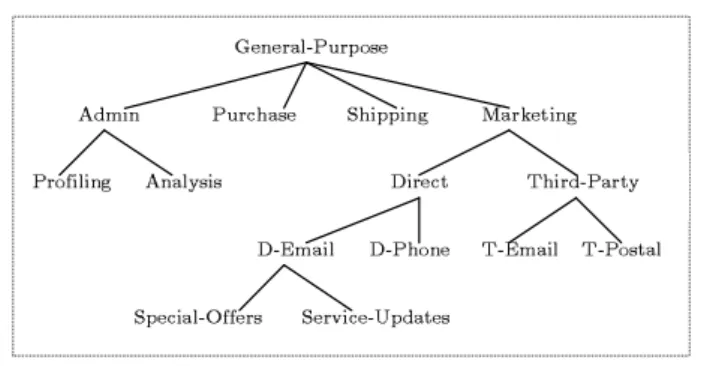
hierarchical relationships to simplify the management of pur-poses. The next definition formalizes the above discussion. Definition 1 (Purpose and Purpose Tree) A purpose de-scribes the reason(s) for data collection and data access. A set of purposes, denoted asP, is organized in a tree structure, referred to as Purpose Tree and denoted asPT, where each node represents a purpose in P and each edge represents a hierarchical relation (i.e., specialization and generalization) between two purposes. Letpi,pjbe two purposes inPT. We say thatpiis an ancestor ofpj(orpjis a descendent ofpi) if there exists a downward path frompitopjinPT. Figure 1 gives an example of purpose tree. One can ar-gue that it would be more advantageous to organize purposes according to a partial order relation (e.g., directed acyclic graph) instead of a tree, as it would allow a single node to as-sociate with multiple parent nodes. However, as we show in Section 6, a tree structure allows an efficient design for stor-ing and processstor-ing purposes. The followstor-ing notations will be used throughout this article.
Notations (Ancestors and Descendants) LetPT be a pur-pose tree andPbe the set of purposes inPT. LetP ⊆ P be a set of purposes inPT.
– Ancestors(P), denoted byP↑, is the set of all nodes that are ancestors of nodes inP, including nodes inP them-selves.
– Descendants(P), denoted byP↓, is the set of all nodes that are descendants of nodes inP, including nodes inP themselves.
– We usePl to denote the set of all nodes that are either ancestors or descendants of nodes in P, that is, Pl = P↑∪P↓
Example 1 LetPT be the purpose tree in Figure 1.
1. Ancestors(Analysis) = (Analysis)↑ = {Analysis, Admin, General-Purpose}
2. Descendants(Third-Party) = (Third-Party)↓ = {Third-Party, T-Email, T-Postal}
Intuitively, an access to a specific data element should be allowed if the allowed purposes for the data, stated by the pri-vacy policies, include or imply the purpose of the data access.
We refer to purposes associated with data and thus regulat-ing data accesses as intended purposes, and to purposes for accessing data as access purposes. Intended purposes can be viewed as brief summaries of privacy policies for data, stating for which purposes data can be accessed. When an access to a data item is requested, the access purpose is checked against the intended purposes for the data item.
Most privacy policies and privacy preferences are permis-sive in nature in that they selectively allow data access for a set of purposes. Thus, the absence of a particular purpose from the set of allowed purposes is interpreted as that data ac-cess for the purpose is not allowed. This concept is adopted in privacy policy languages such as P3P [30]. However, some privacy policies may explicitly prohibit access to data for cer-tain purposes. For example, suppose that in order to comply with COPPA [11], a company decides not to use any informa-tion about children of age under 13 for the marketing purpose. This policy is prohibitive in nature as it explicitly disallows access to the data items belonging to minors for the particular purpose.
Our design of intended purposes supports both permissive and prohibitive privacy policies. An intended purpose con-sists of two components: Allowed Intended Purposes (AIP for short) and Prohibited Intended Purposes (PIP for short). This structure allows more compact and flexible policies in our model. Moreover, by using PIP, we can guarantee that data accesses for particular purposes are never allowed. Con-flicts between the AIP and the PIP for the same data element are resolved by applying the denial-takes-precedence policy where PIP overrides AIP.
Definition 2 (Intended Purpose) LetPT be a purpose tree andPbe the set of purposes inPT. An intended purposeIP
is a tuplehAIP,PIPi, whereAIP⊆ PandPIP⊆ Pare two sets of purposes.AIP is called the set of allowed intended purposes andPIP the set of prohibited intended purposes. The set of purposes implied byIP, denoted byIP∗, is defined
to beAIP↓ − PIPl.
Example 2 SupposeIP = h{Admin, Direct},{D-Email}iis defined over the purpose tree given in Figure 1.
1.AIP↓ = (Admin)↓ ∪ (Direct)↓ = {Admin, Profiling, Analysis, Direct, D-Email, D-Phone, Special-Offers, Service-Updates}
2.PIPl= (D-Email)↓ ∪(D-Email)↑={D-Email,
Special-Offers, Service-Updates, D-Email, Direct, Marketing, General-Purpose}
3.IP∗=AIP↓ − PIPl={Admin, Profiling, Analysis} We note that the use of both AIP and PIP is not strictly necessary. In fact, IP = hAIP,PIPi can be always
trans-formed intoIP′=hAIP′, ∅i, whereAIP′=AIP↓−PIPl. IP and IP′are semantically equivalent. However, we decided to use both AIP and PIP in our model for the following reasons. First, as previously mentioned, some privacy poli-cies are naturally permissive whereas some are naturally pro-hibitive. A direct support for both types of policies is valuable
as it minimizes the possibility of implementation errors. Sec-ond, using PIP as exceptions, IP can be expressed in a more compact manner. For instance, suppose a privacy policy al-lows data access for any purpose except for Third-Party in Figure 1. This can be simply expressed asIP = h{General-Purpose},{Third-Party}iusing both AIP and PIP while us-ing AIP only, IP = h{Admin, Purchase, Shipping, Direct}, ∅i. Lastly, using PIP one can make sure that data access for particular purpose(s) is never allowed. This guarantee is of-ten required for organizations who want to keep their data management practice in compliance with privacy laws.
An access purpose is the purpose of a particular data ac-cess, which is determined or validated by the system when the data access is requested. How to determine or verify access purposes is not trivial, and this issue has not been thoroughly investigated in previously proposed models. We discuss this issue in detail in Section 4.
As already discussed, an access decision is made based on the relationship between the access purpose and the intended purpose of data. That is, an access is allowed only if the ac-cess purpose is included in the implication of the intended purpose; in this case we say the access purpose is compliant with the intended purpose. The access is denied if the impli-cation of the intended purpose does not include the access purpose; we then say that the access purpose is not compliant with the intended purpose.
Definition 3 (Access Purpose Compliance) LetPT be a pur-pose tree. LetIP=hAIP,PIPiandAPbe an intended
pur-pose and an access purpur-pose defined over PT, respectively.
AP is said to be compliant with IP according to PT, de-noted asAP⇐PT IP, if and only ifAP ∈IP∗. Example 3 LetPT be the purpose tree in Figure 1, and let
IP andAP be an intended purpose and an access purpose
defined based onPT, respectively.
1. Suppose IP = h{General-Purpose},{Third-Party}i. If
AP = Marketing, then AP ⇐PT IP as Marketing ∈ PIPl. However, ifAP = Admin, thenAP ⇐PT IP, as Marketing∈/PIPland Marketing∈AIP↓.
2. SupposeIP =h{Admin, Purchase, Shipping}, {General-Purpose}i. Then noAP defined over PT is compliant
withIP.
3. SupposeIP=h{General-Purpose},∅i. AnyAP defined
overPT is compliant withIP.
3.2 Intended Purpose Management
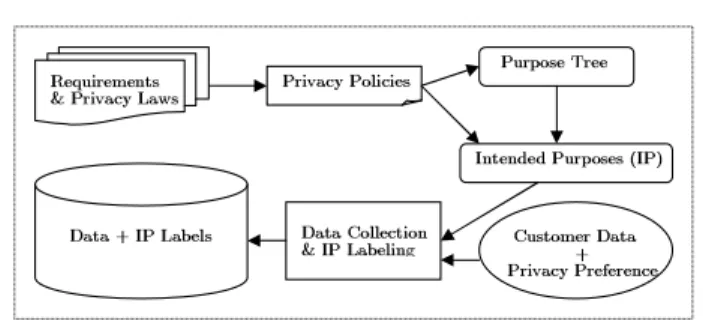
Based on the purpose tree, an intended purpose is speci-fied for each data element according to the privacy policy on which the data provider has agreed. We assume that the organization has already established a set of comprehensive privacy policies which are compliant with existing privacy laws and that, as a part of the data collection process, data providers are informed of and agree to the privacy policies
! "#$% &'() *'+,-.'/'0!) 1$.-2 34% 5) $.-2 34$6(-3-') $,.76)'8.'' #0!'09'9$,.76)'):#$; <,)!6/'. ! " $.-2 34$.'='.'03' ! <6(('3!-60 1#$% &'(-0>
Fig. 2 Intended Purpose Management Process
via some mechanism such as P3P [30]. Under this assump-tion, the privacy policy concerning each data element is pre-determined; consequently, the intended purposes of most data items are predetermined.
We use the phrase “most data items” deliberately as in some exceptional cases the intended purpose for certain data can vary depending on individual data providers. For in-stance, enterprises who wish to fully comply with COPPA should have a different set of intended purposes concern-ing data collected from children under thirteen. Another ex-ample can be found in enterprises whose business activities span multiple nations. As different regions have different pri-vacy requirements, such enterprises must carefully differenti-ate data providers from various regions and apply appropridifferenti-ate privacy policies (e.g., a set of intended purposes) to the col-lected data. The intended purposes can also vary due to ad-ditional options provided by enterprises. A common example of these options is the enrollment of a mailing-list. Whether or not the email address of a particular customer can be used for sending information about new services is dependent on the explicit decision of the customer. Note that the intended purposes can be further individualized upon the requests from data providers after data collection as well. The overall orga-nization of the purpose management process is illustrated in Figure 2.
Example 4 Suppose a company has established the following privacy policies.
– We use your information for purchasing purposes, to pro-vide services to you, and to inform you of services that may better meet your needs.
– We will not disclose your information to third parties who want to market products to you unless you allow us to do so.
– We do not use information of children under thirteen for any purpose other than providing requested services. – The web server administrators may collect some data
such as your IP address, referrer, and your web browser information. We do not make use of this information, but it may be used by system administrators to provide better service to you.
Table 1 illustrates the intended purposes for the data col-lected by the company, based on the privacy policies above and the purpose tree in Figure 1. Group 1 represents cus-tomers who are not children and have given consents for
Under 13 Group 1 Group 2
name h{G},{A,M}i h{G},∅i h{G},{T}i
address h{G},{A,M}i h{G},∅i h{G},{T}i
phone h{G},{A,M}i h{G},∅i h{G},{T}i
order-history h{G},{A,M}i h{G},∅i h{G},{T}i
web-log h{A},{A,M}i h{A},∅i h{A},{T}i
General, Admin, Purchase, Shipping, Marketing, Third-party Table 1 Predetermined Intended Purposes
third-party marketing, and Group 2 represents customers who are not children and have not given consents for third-party marketing.
4 Access Purpose Determination
An access purpose is the reason for accessing a data item, and it must be determined by the system when a data access is requested. Evidently, how the system determines the purpose of an access request is crucial as the decision of whether or not the access should be allowed is directly based upon the access purpose. In this section we present a possible method for determining access purposes.
4.1 Preliminaries
There are various possible strategies to determine access pose. First, the users can be required to state their access pur-pose(s) along with the requests for data access. Even though this method is simple and can be easily implemented, it re-quires complete trust on the users and the overall privacy that the system is able to provide entirely relies on the users’ trust-worthiness. Another possible method is to register each plication or stored-procedure with an access purpose. As ap-plications or stored-procedures have limited capabilities and can perform only specific tasks, it can be ensured that data users use them to carry out only certain actions with the as-sociated access purpose. This method, however, cannot be used for complex stored-procedures or applications as they may access various data for multiple purposes. Lastly, the ac-cess purposes can be dynamically determined by the system, based on the current context. For example, suppose an em-ployee in the shipping department is requesting to access the address of a customer by using a particular application in a normal business hour. From this context (i.e., the job function (i.e., role), the nature of data to be accessed, the application identification, and the time of the request), the system can reasonably infer that the purpose of the data access must be shipping. The key challenge for implementing this method is that it may be difficult to infer the access purposes both accu-rately and efficiently.
In this article, we utilize the first method where the users are required to explicitly state their access purpose(s) when they try to access data. That is, the users provide an access purpose for each query they issue. To make our discussion more concrete, we extend SQL queries as well as update
commands by adding an additional clause for access pur-poses1. For instance, a simple select statement “SELECT name FROM customer” is extended to a form of “SELECT name FROM customer FOR marketing”. Our proposed SQL extensions are provided in the Appendix. We note that this particular extension does not require significant modification to underlying query processing mechanisms, as our approach relies on query modification. We provide more detailed dis-cussion on our approach and query modification in Section 6. We further extend this approach by adding a validation process which verifies the stated access purposes. That is, users are required to state their access purposes along with their queries, and the system validates the stated access pur-poses by ensuring that the users are indeed allowed to access data for the particular purposes.
To ease the management of access purpose authoriza-tions, users are granted authorizations through their roles; i.e., access purpose authorizations are granted to roles, not directly to individual users. This method has a great deploy-ment advantage as many systems are already using RBAC mechanisms for the management of access permissions. This approach is also reasonable as access purposes can be granted to the tasks or functionalities over which roles are defined within an organization. However, using an RBAC mechanism for the management of both access permissions and access purposes may increase the complexity of the role engineering tasks. To address this problem, we introduce a simple exten-sion to RBAC, which simplifies the role administration and also provides increased flexibility.
In this section, we first present our extended RBAC model and discuss the details of the access purpose authorization and verification based on this model. We do not discuss the general concepts of RBAC, assuming that readers are already familiar with them. For interested readers, we refer to [2, 14, 15].
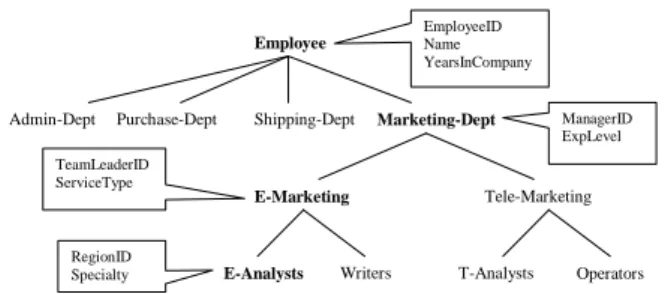
4.2 Role Attributes, System Attributes and Conditional Roles Role hierarchies are considered a key component of RBAC models, and in this article, our extension also assumes hierar-chical RBAC [2, 15]. More specifically, we assume inverted tree hierarchies which are used to facilitate sharing of re-sources [25]. Figure 3 illustrates an inverted tree hierarchy in a hypothetical enterprise. In this hierarchy, the root of the hierarchy, “Employee”, represents the most general role (i.e., the junior-most role), and a permission assigned to a role is inherited downward and becomes available to all of its senior roles.
As the role hierarchy is predefined primarily for the ac-cess permission assignments, it is possible that the existing role definitions do not adequately specify the set of users to whom we wish to grant an access purpose. For instance, con-sider the purpose tree in Figure 1 and the role hierarchy in
1 We are currently investigating approaches that can be
imple-mented on top of commercial DBMS without requiring any exten-sion to the DBMS internal or to SQL.
Employee
Admin-Dept Shipping-Dept Marketing-Dept
E-Marketing Tele-Marketing
Writers
E-Analysts T-Analysts Operators EmployeeID Name YearsInCompany ManagerID ExpLevel TeamLeaderID ServiceType RegionID Specialty Purchase-Dept
Fig. 3 Role Hierarchy and Role Attributes
Figure 3. Suppose that we wish to allow some users in the E-Marketing team to access data for the purpose of “Service-Update”. Under the “E-Marketing” role, there are two de-scendant roles: “E-Analysts” and “Writers”. “E-Analysts” are the users who analyze the customer information and prepare the contents of emails, and “Writers” are the users who write and send out emails to customers. Note that these two roles are defined based on the access permission assignments in that the permissions to access the customer profiles are ex-clusively assigned to the “E-Analysts” role while the permis-sions to access the email addresses of the customers are ex-clusively assigned to the “Writers” role. However, as we want to assign the access purpose only to the users who are re-sponsible for the specific task of sending out updated service information, neither the definition of “E-Analysts” or “Writ-ers” matches our intention. Moreover, assigning the access purpose to the “E-Marketing” role is not desirable as it will allow all the users with the “E-Marketing” role to access data with the access purpose. An alternative solution is to split the “E-Marketing” role or the “E-Analysts” and the “Writers” roles into more specific roles. However, this method requires the reconstruction of both the user assignments and the per-mission assignments for the modified roles. Authorizing the access purpose on an individual basis is not an elegant solu-tion either, as it does not utilize the existing role hierarchy and thus is not scalable. In order to address these issues, we introduce a new concept, conditional role, which is based on the notion of role attribute and system attribute.
Role attributes are the pre-assigned, specific descriptions associated with each role. The role attributes of each role are defined by system administrators at the time of role creation, and each role inherits the role attributes that are defined at the ancestor roles. When a user is assigned to a role, the values of the role attributes (both defined and inherited role attributes) are specified according to the relevant information of the par-ticular user. Then when the user activates the role, the values of the role attributes are loaded and made available to the access control system until the user deactivates the role. As such, the role attributes can be viewed as a cached user infor-mation that is relevant to the specific roles.
Definition 4 (Role Attributes) LetRbe the set of roles de-fined in the system. Every roler∈ Rhas a set of attributes, denoted byr.Attributes = {r.attr1, . . . , r.attrn}, that are defined forror inherited from the ancestor roles ofr. Each attributer.attri is associated with a data typeτi which
de-termines the set of values that can be assigned to this at-tribute (called the domain of this atat-tribute and denoted by domain(τi)) and the set of binary predicates that can be ap-plied to values of this type (denoted bypreds(τi)). For exam-ple, if a data typeτiis an ordered type, thenpreds(τi) ={<, ≤,>,≥, =,6=}. Each data type determines the interpretation of these predicates.
The values of the role attributes for a particular rolerare specified within the domains for each user when a user is as-signed tor. The specified role attribute values of a useru un-derr, denoted byr(u).Attributes, are available to the access control system from the time the user activatesrto the time
the user deactivatesr.
Figure 3 shows an inverted tree role hierarchy and the role attributes. Role “Employee” has three role attributes: EmployeeID, Name, and YearsInCompany, and the roles be-low “Employee” all inherit the role attributes of “Employee”. For instance, the role attributes of the “Marketing-Dept” role include the role attributes of “Employee” as well as Man-agerID and YearsInDept. Even though any role can be asso-ciated with a set of attributes, we only show the role attributes of a few selected roles in the figure for simplicity. We do not show the inherited role attributes for the same reason.
Using the role attributes we can assign an access purpose to a specific subset of users in the same role; that is, we can assign a particular access purpose to a role with a set of con-ditions that must be satisfied by the users of the role in order to access data with the access purpose. For instance, consider the previous scenario where we wish to assign the access pur-pose “Service-Update” to a particular group of users in the E-Marketing team. Provided that the attribute ServiceType is defined for the role “E-Marketing” as in Figure 3, we first set the value of this attribute to, say, “Update-Info” only for the users who are responsible for the task. Then by assigning the access purpose to the “E-Marketing” role with a condi-tion saying that the user’s value of the attribute ServiceType must be equal to “Update-Info”, we can authorize the access purpose “Service-Update” only to the users whom we wish to grant the access purpose.
When authorizing access purposes, one may also need to consider the states of the system where the authorizations should become effective (or ineffective). For instance, we may wish to allow an access purpose to be used by a set of users only in a specific time interval (e.g., business hours) or only when the users are logged into specific machines (e.g., machine identification number). Thus, the system informa-tion that affects the access purpose authorizainforma-tions must be clearly defined and available to the access control system. We refer to this system information as system attributes.
Definition 5 (System Attributes) Let S be a target system. Then S is described by a set of attributes, denoted by S.Attributes = {S.attr1, . . . ,S.attrn}, and these at-tributes are available to the access control system at all times. Each attribute is associated with a data type which deter-mines the domain of the attribute and the set of applicable
binary predicates. The system attributes are defined by sys-tem administrators for the application needs, and the val-ues of the system attributes in a system state s, denoted by S(s).Attributes, specify the environment of the system in
the states.
Now we introduce the notion of conditional role which utilizes both the role attributes and the system attributes to describe a specific set of users in a particular system environ-ment.
Definition 6 (Conditional Roles) LetRbe the set of roles de-fined in the systemS. A conditional rolecris defined as a pair hr, Ci, wherer∈ RandCis a propositional logic formula that can be constructed from primitive constraints using ∧ (AND),∨(OR), and¬(NOT). Each primitive constraint inC is of the formx φ y, wherex∈r.Attributes∪ S.Attributes, y∈r.Attributes∪ S.Attributes∪domain(τ), whereτis the data type ofx, andφ ∈ preds(τ). Ify is an attribute name in r.Attributes∪ S.Attributes, then it must have the same type asτ. We say that a user u belongs to a conditional role cri =hri, Ciiin a system statesif and only if the following conditions are satisfied:
1. The useruhas activated a rolerthat dominates the role ri.
2. When attribute names in Ci are replaced with the corresponding values in r(u).Attributes and S(s).Attributes, the constraintCievaluates to true. The logical operators∧, ∨, and¬ are evaluated using their
standard semantics.
More specifically, if r = ri and the second condition is satisfied, we say that r explicitly belongs to cri. On the other hand, if r∈Descendants(ri), but r6=ri, and the second con-dition is satisfied, then we say that r implicitly belongs to cri.
4.3 Access Purpose Authorization and Verification
As discussed in the previous section, access purposes are au-thorized to users through conditional roles. The use of condi-tional roles provides great flexibility in that the authorizations are sensitive to both the user profiles and the system environ-ments. In this section, we formally define the access purpose authorization and its verification.
Definition 7 (Access Purpose Authorization) Let PT be a purpose tree,P be the set of purposes inPT, andRbe the set of roles defined in the systemS. An access purpose is au-thorized to a specific set of users by a pairhap, cri, where ap ∈ Pand cr is a conditional role defined overRandS.
Note that both the access purpose and the conditional roles are organized in hierarchies. Consequently, an access purpose authorization has its implications; i.e., authorizing an access purpose ap for a conditional role cr implies that the users belonging to cr either explicitly or implicitly are autho-rized to access data with ap as well as all the descendants of
ap in the purpose tree. The definition of access purpose veri-fication below captures these implications of access purpose authorizations.
Definition 8 (Access Purpose Verification) LetPT be a pur-pose tree andP be the set of purposes defined overPT. Let Rbe the set of roles defined in the systemS. Given an ac-cess purpose ap and a role r activated by a user u, ap is valid for u under r if there exists an access purpose authorization hapi, crji, where api∈ P and crj=hrj, Cjiis a conditional role defined overRandS, satisfying the following two con-ditions:
1. ap∈Descendants(api)
2. The user u belongs to the conditional role crj either
ex-plicitly or imex-plicitly.
For example, the access purpose “Service-Update” in the previous scenario can be assigned tohE-Marketing, (Service-Type = “Update-Info”)∧(timeofday≥9) ∧(timeofday≤ 17)i, assuming timeofday is defined as a system attribute. Then only the users who activate the role “E-Marketing” (or the two descendant roles) with their ServiceType attribute equal to “Update-Info” can access data with the purpose of “Service-Update” between 9 am and 5 pm.
5 Data Labeling Model
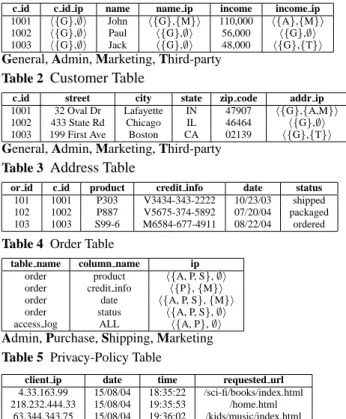
In order to build an access control model based on the notion of purpose, we must consider a specific data model and devise a proper labeling scheme based on the model. One question here is how intended purposes are associated with data. More specifically, we have to determine at what level of granularity data will be associated with intended purposes. Under rela-tional data models, intended purpose can be assigned to every relation, to every tuple in every relation, to every attribute in every relation, or to every data element in every relation. In this section, we discuss this issue of data granularity.
Data providers (e.g., customers) are usually reluctant to allow any use of their information unless it is absolutely nec-essary. At the same time, data users (e.g., enterprises) want to make use of the collected data for the necessary tasks as well as other tasks such as analysis and marketing. Consequently, some form of negotiating process may occur between these two parties through opt-in/opt-out procedures. Note that the comfort level of privacy can considerably vary from individ-ual to individindivid-ual.
Consider a data category purchase history, which con-sists of name, financial-info, product, and purchase-date. As this category includes sensitive information such as financial-info, many customers would not want to allow any use of the information in this category. However, information such as name, product, and purchase-date can be valuable for enter-prises as they can use such information for analyzing their sale patterns or profiling customers. It is obvious that in order to make the best use of data while at the same time ensure that data providers feel comfortable, the granularity of the data la-beling model must be fine. Thus, the lala-beling model should
c id c id ip name name ip income income ip 1001 h{G},∅i John h{G},{M}i 110,000 h{A},{M}i
1002 h{G},∅i Paul h{G},∅i 56,000 h{G},∅i
1003 h{G},∅i Jack h{G},∅i 48,000 h{G},{T}i General, Admin, Marketing, Third-party
Table 2 Customer Table
c id street city state zip code addr ip 1001 32 Oval Dr Lafayette IN 47907 h{G},{A,M}i
1002 433 State Rd Chicago IL 46464 h{G},∅i
1003 199 First Ave Boston CA 02139 h{G},{T}i General, Admin, Marketing, Third-party
Table 3 Address Table
or id c id product credit info date status 101 1001 P303 V3434-343-2222 10/23/03 shipped 102 1002 P887 V5675-374-5892 07/20/04 packaged 103 1003 S99-6 M6584-677-4911 08/22/04 ordered
Table 4 Order Table
table name column name ip order product h{A, P, S},∅i
order credit info h{P},{M}i
order date h{A, P, S},{M}i
order status h{A, P, S},∅i
access log ALL h{A, P},∅i Admin, Purchase, Shipping, Marketing Table 5 Privacy-Policy Table
client ip date time requested url 4.33.163.99 15/08/04 18:35:22 /sci-fi/books/index.html 218.232.444.33 15/08/04 19:35:53 /home.html
63.344.343.75 15/08/04 19:36:02 /kids/music/index.html
Table 6 Access-Log Table
allow the assignments of intended purposes with data at the most fine-grained level. That is, we should be able to assign an intended purpose to each data element in every tuple; e.g., for each attribute and for each data provider (see Table 2).
However, this most fine-grained approach is not always necessary. For instance, some data naturally have a hierar-chical structure. Suppose that the addresses of customers are stored in a relation that consists of street, city, state, and Zip-code. Typically, a customer allows or prohibits access to the entire address, not to the individual sub-elements. Thus, it is not necessary to associate each data element with an in-tended purpose because labeling at the element-level granu-larity would result in storing an identical intended purpose for every data element redundantly. However, intended pur-pose for the address can vary depending on each individual. To address these concerns, the labeling model should allow the assignment of intended purpose to each tuple of a relation (see Table 3).
Another case we should consider is that there exists some information for which corresponding privacy policies are mandated by enterprises or by laws; i.e., data providers do not have a choice to opt-out from the required intended purposes. An example is the Order information in Table 4. As such in-formation must be accessed to perform necessary tasks, enter-prises can choose not to give customers any option to change the privacy policies governing this information. In such cases, the data elements in each column in the relation have the identical intended purpose. Thus, in order to avoid any redun-dancy, intended purposes should be assigned to each attribute of a relation using a privacy policy table (see Table 5). It is
also possible that the intended purposes of every attribute in a relation be identical. Such cases occur when information in a relation is meaningful as a whole tuple, but individual ele-ments or tuples do not have any usefulness. The Access-Log table in Table 6 is one such relation. In this case, the intended purposes are assigned to the entire relation by using a single entry in the privacy policy table (see Table 5).
Now we formally define our labeling model which incor-porates the above discussion.
Definition 9 (Relation, Attribute, Tuple, and Element) As in the standard relational model, data are stored in relations. A relation is characterized by the following two components.
1. A state-invariant relation scheme R(A1,. . ., An), where Ris the name of the relation and each Ai is an attribute over some domain Di. Attributes(R) denotes the set of names of attributes inR.
2. A state-dependent relation instance ri overRcomposed of distinct tuples of the form (a1,. . ., an), where each element aiis a value in domain Di.
Definition 10 (Intended Purpose Labeling) LetPT be a pur-pose tree andPbe the set of purposes inPT. LetIPbe a set of all possible intended purposes defined overP andR(A1, . . .,An) be a relation. In our data labeling model, intended purposes are associated withRaccording to one of the fol-lowing methods.
1. (Relation-based) A relation-based labeling is a pair hR, ipi, whereip ∈ IP. Access to any data element in instances ofRis governed byip.
2. (Attribute-based) An attribute-based labeling is a set {hAi, ipii |Ai ∈ Attributes(R)∧ipi ∈ IP}. Access to data element ai in any instance ofRis governed by
ipi.
3. (Tuple-based) A tuple-based labeling is a relation scheme Rtl(A1, . . . , An, ℓ), whereℓis a column havingIPfor its domain, such thatR=QA
1,...,An(Rtl). Access to any data element in the jth tuple in any instance ofRis governed byℓj.
4. (Element-based) An element-based labeling is a relation scheme Rel(A1, ℓ1, . . . , An, ℓn), whereℓi(i = 1, . . . , n) is a column having IP for its domain, such that R =
Q
A1,...,An(Rel). Access to data elementaiin any instance
ofRis governed byℓi.
The first two types of labeling are intensional labeling schemes as they are defined at schema level. On the other hand, the third and fourth types are extensional labeling schemes as they are associated with data elements inside re-lation extensions.
The element-based labeling scheme is illustrated by Ta-ble 2, where each data element is labeled with an intended purpose. Table 3 is an example of the tuple-based labeling scheme, and here intended purposes are associated with each tuple. Tables 4 and 6, together with the privacy policy table in Table 5, illustrate the attribute- and relation-based labeling schemes. Note that these tables only represent a conceptual
view2. We discuss actual implementation strategies in Sec-tion 6.
6 Implementation
In this section we discuss two important implementation is-sues. The first is related to approaches for storing purpose information and for recording which purposes are associated with which data elements. The other issue is related to query modification techniques supporting data filtering with respect to the notion of purpose.
6.1 Privacy Metadata Storage
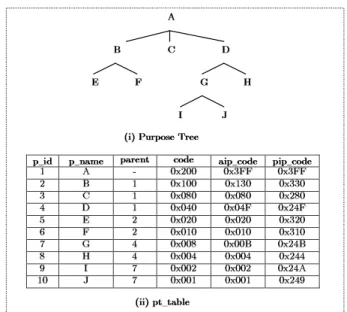
For both storage and performance efficiency, purposes are en-coded as bit strings. Consider the purpose tree in Figure 4(i). This purpose tree is encoded into a relation pt table as shown in Figure 4(ii). The first column p id represents the identi-fication number of each purpose node, which is determined according to the breadth-first search order3 of the tree. The
second column p name represents the name of each purpose node, and the third column parent is used to capture the hier-archical relationships among the purpose nodes. The column code is the binary encoding of each purpose. For instance, in Figure 4 the purpose A is encoded as ‘0x200’ in hexadecimal representation, while the purpose D is encoded as ‘0x040’ in hexadecimal form. Note that a binary representation provides significant advantages in that it is efficient in terms of storage and computation.
The last two columns aip code and pip code are pre-calculated encodings of purpose implications. As described in Section 3, when a purposepiis used as an AIP, it implies that every descendant ofpi, includingpiitself, is allowed. For instance, the purpose B in Figure 4(i) used as an AIP implies that access is allowed for the purpose of B as well as E and F. Thus, the aip code of B contains the implied set of B, which is the sum of the encodings of B, E and F. The pip code of a particular purpose pi is computed similarly by summing the encodings of every descendant and ancestor of pi with the encoding ofpi itself. Note that the last three columns of the pt table can be automatically generated based on the first three columns using a simple procedure.
The other type of metadata to be stored is the intended purposes for the actual data. As described in Section 5, data elements are associated with intended purposes according to one of the intended purpose labeling schemes. When using
2
The tables are represented as nested relations to illustrate our labeling scheme. However, our implementation does not necessarily require nested relations.
3 In this approach, any update on the purpose tree can be
expen-sive. However, note that a change on the purpose tree (i.e., the pri-vacy policy) is a very infrequent event. Our approach is thus de-signed to make storage and performance efficient rather than to op-timize updates. Nevertheless, one can easily improve the efficiency of updates by allowing extra nodes in the purpose tree for future expansions. ?@ABCDEFGHIDHH E _ @J E _KLM H E L DH KN O FJH L @E _O FJH E@E _O FJH P Q R STUSS STVWW STVWW U X P STPSS STPVS STVVS V Y P STSZS STSZS STUZS [ \ P STS[S STS[W STU[W ] ^ U STSUS STSUS STVUS _ W U STSPS STSPS STVPS ` a [ STSSZ STSSX STU[X Z b [ STSS[ STSS[ STU[[ c d ` STSSU STSSU STU[Q PS e ` STSSP STSSP STU[c ?@@AE N_NLfg H h i j k l m n o p q
Fig. 4 Purpose Tree Storage
the element-based labeling scheme, a table with n columns is extended to (n + 2n) columns4; n data columns plus 2n
columns for AIP and PIP. When using the tuple-based label-ing scheme, a table with n columns is extended to (n + 2) columns; n data columns plus 2 columns for AIP and PIP. While the element- and tuple-based labeling schemes require extensions to data tables, the attribute-based labeling scheme for a table with n columns requires n entries in the privacy policy table as shown in Table 5. Similarly, the relation-based labeling scheme for a table requires a single entry in the pri-vacy policy table.
Intended purposes are encoded using the purpose encod-ings in the pt table. As intended purposes have their implica-tions, purposes are encoded using values from the aip code or the pip code instead of using their own encodings. Also, purposes can be combined by performing bitwise OR oper-ations on the encodings of the purposes. Consider, for ex-ample, the intended purpose of a data element ish{B, C}, {G}i with respect to the purpose tree in Figure 4(i). Then the AIP of the data element is encoded as ‘0x1B0’, which is the result of (0x130|0x080), where|is bitwiseOR
op-erator. Note that using stored procedures and GUI tools, the management of intended purposes can be easily carried out. We also emphasize that intended purposes should be mod-ified only by trusted users (e.g., privacy officers). This can be easily achieved by authorizing normal users only the read privileges for the columns and tables that contain the intended purposes.
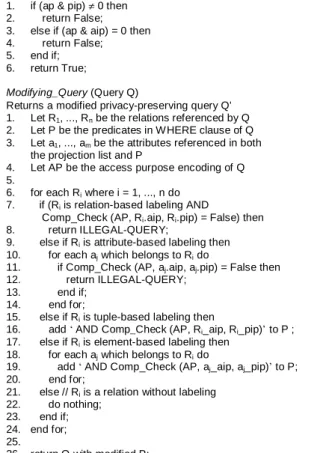
With the encoding methods described above, the purpose compliance can be efficiently checked. Recall that an access purpose is compliant with an intended purpose if and only if the access purpose is not prohibited by PIP and it is allowed
4
A different method is to store intended purposes in separate tables. While storing data and intended purpose in separate tables causes additional overhead introduced by join operations, this ap-proach does not require any change to existing data schemas.
Comp_Check (Number ap, Number aip, Number pip) Returns Boolean
1. if (ap & pip) ≠ 0 then 2. return False; 3. else if (ap & aip) = 0 then 4. return False; 5. end if; 6. return True;
Modifying_Query (Query Q)
Returns a modified privacy-preserving query Q’ 1. Let R1, ..., Rn be the relations referenced by Q
2. Let P be the predicates in WHERE clause of Q 3. Let a1, ..., am be the attributes referenced in both
the projection list and P
4. Let AP be the access purpose encoding of Q 5.
6. for each Ri where i = 1, ..., n do
7. if (Ri is relation-based labeling AND
Comp_Check (AP, Ri.aip, Ri.pip) = False) then
8. return ILLEGAL-QUERY;
9. else if Ri is attribute-based labeling then
10. for each aj which belongs to Ri do
11. if Comp_Check (AP, aj.aip, aj.pip) = False then
12. return ILLEGAL-QUERY; 13. end if;
14. end for;
15. else if Ri is tuple-based labeling then
16. add ‘ AND Comp_Check (AP, Ri_aip, Ri_pip)’ to P ;
17. else if Ri is element-based labeling then
18. for each aj which belongs to Ri do
19. add ‘ AND Comp_Check (AP, aj_aip, aj_pip)’ to P;
20. end for;
21. else // Ri is a relation without labeling
22. do nothing; 23. end if; 24. end for; 25.
26. return Q with modified P;
Fig. 5 Query Modification Algorithm
by AIP. Thus, the purpose compliance check can be done with two bitwiseANDoperations as follows. Given the encodings
of an access purpose5, AIP and PIP, say ap code, aip code
and pip code respectively, the access purpose is compliant with the intended purpose if and only if (ap code & pip code) = 0∧(ap code & aip code)6=0, where & is bitwiseAND
op-erator and∧is logicalAND operator. Method Comp Check
in Figure 5 illustrates the computation for purpose compli-ance check.
6.2 Access Control Using Query Modification
Privacy-preserving access control mechanisms must ensure that a query result contains only the data items that are al-lowed for the access purpose of the query. In other words, the system must check the intended purpose of each data element accessed by the query and filter out any data el-ement if the access purpose is not compliant with the in-tended purpose of the data element. In our implementation, this fine-grained access control is achieved using query mod-ification [28]. Note that query modmod-ification provides power-ful and flexible controls without requiring any alteration in underlying mechanisms and that it is supported in a major commercial DBMS [22, 23].
5
Access purposes are represented using the values in the code of the pt table.
Our query modification algorithm is outlined in Figure 5. Method Comp Check returns the result of the purpose com-pliance check for the given purpose labels as described in Section 6.1, and method Modifying Query modifies the given query by attaching additional condition for the purpose com-pliance check. The complexity of our query modification al-gorithm is inO(n), wherenis the number of attributes ac-cessed by the given query, provided that every relation is labeled with the element-based scheme. Note that method Modifying Query is invoked only if the access purpose of the query is verified to be acceptable by the validate function, as described in Section 3. If the access purpose is not acceptable, then the query is rejected without further being processed.
In Lines 7 and 9 the compliance checks for relations with the relation- or attribute-based labeling schemes are executed statically by the query modification method. On the other hand, the compliance checks for relations with the tuple- or element-based labeling schemes are performed during query processing by the predicates which are added by the query modification algorithm (Lines 15 and 17).
The query modification algorithm checks both the at-tributes referenced in the projection list and the atat-tributes ref-erenced in predicates (Line 3). As the attributes in the projec-tion list determine what data items will be included in the re-sult relation of a query, it may seem enough to enforce privacy policy based only on the attributes in the projection list. How-ever, the result of a query also depends on the predicates, and not enforcing privacy constraints on the predicates may intro-duce inference channels. For example, consider the follow-ing query: “SELECT name FROM customer WHERE in-come>100000 FOR Third-Party”. Suppose that according to the established privacy policies, name can be accessed for the purpose of Third-Party, but income is prohibited for this purpose. If the privacy constraint is not enforced on the pred-icates, this query will return a record containing the names of customers whose income is greater than 100,000. This is highly undesirable as this result implicitly conveys informa-tion about the customers’ income. Note that if the privacy policy is enforced at the predicate level, such inference chan-nels cannot be created.
Notice that the provided algorithm filters out a tuple if any of its elements that are accessed is prohibited with respect to the given access purpose. For instance, consider the follow-ing query: “SELECT name, phone FROM customer FOR Marketing”. Suppose there is a customer record of which the name is allowed for marketing, but the phone is prohibited for this purpose. Then our algorithm excludes the record from the query result. We note that in the environments where partially incomplete information is acceptable, the query modification algorithm can be easily modified to mask prohibited values with null values using the case expression in SQL.
Example 5 Table 7 illustrates how queries are modified by our algorithm. Tables 2-6 are used for this example. Note that the purpose encodings of Marketing and Shipping are assumed to be ‘0x200’ and ‘0x400’, respectively.
Query Modified Query SELECT name, phone SELECT name, phone FROM customer FROM customer
FOR Marketing WHERE Comp Check(‘0x200’, name aip, name pip) AND Comp Check(‘0x200’, phone aip, phone pip) SELECT name, city SELECT name, city
FROM customer AS C, FROM customer AS C, address AS A address AS A WHERE C.c id = A.c id
WHERE C.c id = A.c id AND Comp Check(‘0x400’, addr aip, addr pip) FOR Shipping AND Comp Check(‘0x400’, name aip, name pip)
AND Comp Check(‘0x400’, A.c id aip, A.c id pip) SELECT product SELECT product
FROM order FROM order
WHERE c id = 1101 WHERE c id = 1101 FOR Profiliing
Table 7 Query Modification Examples
7 Experimental Evaluation
The main goal of our experiments is to investigate per-formance and storage overheads of our approach. As the relation- and attribute-based labeling schemes do not add sig-nificant runtime overheads, we mainly focus on the tuple-and element-based labeling schemes. We consider the im-pact of the purpose hierarchy and compare the performance overheads of different labeling schemes. We also examine the response times of queries, varying the numbers of attributes accessed. Lastly, we test the scalability of our approach by experimenting with relations of different cardinalities.
7.1 Experimental Setup
The experiments were performed on a 2.66 GHz Intel ma-chine with 1 GB of memory. The operating system on the machine was Microsoft Windows XP Professional Edition, and Oracle Database 10g Enterprise Edition Release 1 was used as our DBMS.
For the experiment, we generated synthetic datasets, which were simpler versions of the Wisconsin Bench-mark [7]. Specifically, each of our datasets consists of two numeric and five string columns, and the data values were generated according to the specification given in [7]. Then we extended each relation by adding intended purpose label columns, according to our labeling schemes described in Sec-tion 5. In order to compare the overheads of different intended purpose labeling schemes precisely, we set the selectivity of all data elements to 100 percent; i.e., all intended purpose la-bels are set to allow access for every access purpose.
After creating all necessary relations, we measured the re-sponse times of various queries and the modified versions6of
those queries. As the main purpose of our experiments was to investigate the overhead introduced by our purpose compli-ance checks, all of the tested queries were devised to select all the tuples in the target dataset. However, we varied the columns that were accessed by each query. To measure the response time of a query, we measured the time to retrieve
6
As we had not implemented the query modification algorithm, each query was modified manually before the experiment. Our fu-ture work includes a full implementation of the query modification method in a public domain DBMS.
6 8 10 12 14 16 18 20 1 2 3 4 5 6 7
Response Time (seconds)
Number of Attributes Accessed 100K Medium Size Tuples, PT Size = 14
No Label Tuple-Based(AIP only) Tuple-Based(AIP,PIP) Element-Based(AIP,PIP)
Fig. 6 Labeling Scheme and Performance
8 10 12 14 16 18 20 1 2 3 4 5 6 7
Response Time (seconds)
Number of Attributes Accessed 100K Medium Size Tuples
Tuple-Based(PT Size=5) Tuple-Based(PT Size=14) Element-Based(PT Size=5) Element-Based(PT Size=14)
Fig. 7 Purpose Size and Performance
the selected tuples into a relation; thus, the reported response times here include the time for inserting the selected tuples, in addition to the time for retrieving the tuples. We ran each query ten times, flushing the buffer cache and the shared pool before each run.
7.2 Impact of Labeling Schemes and Purpose Hierarchy Figure 6 shows the response times of queries against rela-tions with various labeling schemes. As shown, the response time increases as the granularity of labeling scheme becomes finer. This increase is indeed expected as more purpose-compliance checks are needed for finer labeling schemes. For the element-based labeling scheme, the number of at-tributes accessed by queries is also a major factor. As the element-based labeling scheme requires a compliance check for every element a query is accessing, the overhead for com-pliance checks becomes more significant as the number of accessed attributes increases. However, as the tuple-based la-beling scheme requires only one purpose-compliance check for each tuple, the number of accessed attributes does not have any impact on the tuple-based labeling scheme. Figure 6 also shows that the use of both AIP and PIP does not intro-duce much overhead, compared to the case where only AIP is used. This is a reasonable result as using AIP and PIP requires
only one additional bitwise-AND operation for a compliance check.
Figure 7 shows the results of our experiments with two different sizes of purpose trees. The first purpose tree has five nodes with the height of two, and it requires five bits to en-code all possible intended purposes. The second purpose tree has 14 nodes with the height of five, requiring 14 bits for all possible intended purpose encodings. As the result shows, the size of purpose tree does not make any substantial difference in either the tuple- or element-based labeling scheme. The reason for this indifference is that bitwise-AND operations are very efficient regardless of the length of encodings.
7.3 Storage Overhead vs. Performance Overhead
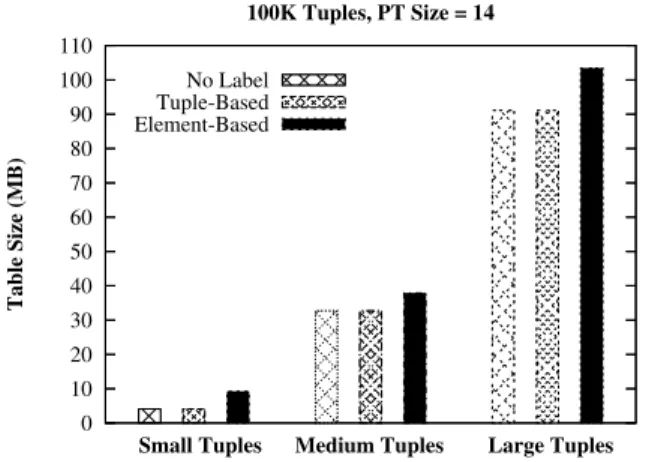
In this section, we consider the storage overhead introduced by our intended purpose labeling schemes. In fact, the stor-age overheads of labeling schemes can be easily calculated as follows. Letrc be the cardinality of the relationR,tsbe the size of a tuple andnc be the number of columns inR. Also letpsbe the size of the purpose tree, andℓsbe the size of an intended purpose label;ℓs= (ps/8) in bytes. Then the size of the unextended relation is (rc×ts), and assuming the element-base labeling scheme, the size of the extended rela-tionRextbecomesrc×(ts+ 2×nc×ℓs). We remind read-ers that the element-based labeling scheme extends a relation withn columns to a relation with with (n+ 2n) columns; n data columns plus 2n columns for AIP and PIP. Thus, the storage overhead rate of the element labeling scheme be-comes1−[Size(Rext)/Size(R)] = (2×nc×ℓs)/ts. This clearly suggests that if the original relation contains large data elements (which we believe is a common case for databases storing information about individuals), the storage overhead of our labeling scheme becomes negligible. Figure 8 shows the storage overheads of the element-based labeling scheme with relations of three different tuple sizes; small, medium and large. Note that all three relations have the same cardi-nality of 100K.
The storage overhead has an effect on the performance of modified queries as well. Figure 9 shows performance over-head ratios of modified queries for relations with three dif-ferent tuples sizes. Here, the overhead ratio is measured as [(response time of the modified query)/(response time of the unmodified query)]. In particular, the table with small-sized tuple is doubled in its size by intended purpose labeling, and the performance overhead on this extended table becomes very large. However, this is an extreme case as typical pri-vate data would be much larger in its size than the size of an intended purpose label.
7.4 Scalability
As our method filters out prohibited values by performing a purpose-compliance check for each tuple in case of the tuple-based labeling scheme or for each element in case of the element-based labeling scheme, the cardinality of relations
0 10 20 30 40 50 60 70 80 90 100 110 Table Size (MB)
Small Tuples Medium Tuples Large Tuples 100K Tuples, PT Size = 14
No Label Tuple-Based Element-Based
Fig. 8 Storage and Labeling Scheme
1 1.5 2 2.5 3 1 2 3 4 5 6 7 Overhead Ratios
Number of Attributes Accessed 100K Tuples, Element-Based, PT Size = 14
Small Tuples Medium Tuples Large Tuples
Fig. 9 Storage and Performance
can significantly impact performance. For instance, querying a relation with one million tuples will require at least one million compliance checks. Even though our implementation of the compliance check is merely two bitwise-AND opera-tions, the runtime compliance checks can be a heavy burden for large databases. Figure 10 shows the performance over-head rates of the element-based labeling scheme for relations with various cardinalities. As expected, the performance be-comes poorer as the cardinality of relations increases. How-ever, this problem can be easily addressed by using function-based indexes [23]. The function-function-based index allows creating indexes on a function by pre-computing the given function. Thus, we can pre-build a function-based index for each pos-sible access purpose and use these indexes when queries are executed. Figure 11 displays the results of our experiment with two indexes; a bitmap index and a B+ tree index. No-tice that as the compliance check is always evaluated to ei-ther true or false (0 or 1), the bitmap index performs slightly better than B+ tree index. Nonetheless, a huge performance improvement is gained when either type of index is used. This shows that using indexes, our approach introduces very min-imal performance overhead and is highly scalable.