Updating progress, promoting best practice
Foreword
It has been an eventful 15 months since we published our first report on Board Effectiveness in September 2011. The ‘Shareholder Spring’ has shown more than ever the important role that institutional investors play in our economy, holding companies to account and ensuring that they are run in the long term interests of shareholders and to maximise shareholder value.
In this report, we provide an update on progress and highlight best practice in the core areas of diversity, succession planning and board evaluation as vital components of board effectiveness. This year, we extend our analysis on board evaluation and include the results of our survey of FTSE 350 company secretaries on the market for external board evaluators. We also include a new section on the role of the chairman, drawing together the perspectives of chairmen on the skills they consider to be most important in creating an effective board.
The ABI’s Report on Board Effectiveness continues to be a robust and carefully researched piece of best practice guidance. It is put together after months of careful analysis of FTSE 350 annual reports and drawing on experience of the ABI’s Institutional Voting Information Service (IVIS).
We hope that you find the information and recommendations helpful as we move toward the next reporting season. As ever, a continued and close dialogue between companies and their shareholders is crucial. We will continue to champion shareholder interests in building sustainable, successful, long term businesses for the good of the entire UK economy into 2013 and beyond – and we look forward to working with you as we do this.
Otto Thoresen
Director General
Contents
Foreword 3
Summary and Recommendations 5
The Role of the Chairman 5
Board Diversity 6 Succession Planning 7 Board Evaluation 8 Methodology 9 Acknowledgements 10 Introduction 11
The Role of the Chairman 13
The Role of Non-Executive Directors and the Senior Independent Director 15
The Role of Board Committees 15
Board Diversity 16
Board Succession 16
Board Evaluation 16
Shareholder Relations 16
Conclusion and Recommendation 17
Board Diversity 18
Diversity of Perspective 18
Women on Boards 19
Addressing the Challenge of Supply 26
Recommendations 28
Examples of Best Practice 29
Succession Planning 31
Succession Planning Disclosures 31
Recommendations 35
Examples of Best Practice 36
Board Evaluation 38
External Evaluations 38
External Board Evaluators 39
Board Evaluation Survey 40
Conclusions 46
Recommendations 46
Examples of Best Practice 47
Appendix 52
FTSE 250 Companies with no Women on their Boards 52
References 53
Summary and Recommendations
In this year’s report we provide an update on the current state of reporting and highlight current best practice in three areas that we believe are fundamental to improving board effectiveness. We set out examples of best practice and draw together recommendations on board diversity, succession planning and board evaluation. In addition, we extend our analysis of board evaluation to external board evaluations and the market for external board evaluators. We conducted a survey of FTSE 350 company secretaries to develop a better understanding of the current market.
New to this year’s report is a section on the role of chairmen in ensuring effective boards. As noted in the Cadbury Report, tests of board effectiveness include the way in which the members of the board as a whole work together under the chairman, whose role in corporate governance is fundamental, and their collective ability to provide both the leadership and the checks and balances which effective governance demands.1 We conducted interviews with a selection of FTSE 350 chairmen to gather
their views on the role of the chairman in creating an effective board.
It is our hope that, through the identification of best practice and as significant investors in UK companies, this guidance document will help to raise the corporate governance standards within UK listed companies.
The Role of the Chairman
The chairman is key to an effective board. There is no ‘one size fits all’ approach to the role, with different chairmen having different approaches based on what is best for the individual company and board. However there was a significant amount of consensus about the role and responsibilities of the chairman.
Chairmen emphasised a number of aspects to their role, all a variation on the following five themes:
• Creating the right board dynamic and having the right people around the boardroom table;
• Helping to set the board agenda, ensuring the board has the right information and is debating the right issues;
• Managing the board’s relationship with the executives and in particular the chief executive;
• Being an ambassador for the company; and
• Being fully engaged in the business and understanding what is happening on the ground.
The chairmen saw the main role of the non-executive directors as providing constructive challenge to the executive team within a supportive yet challenging environment. The chairmen felt that they were getting the right level of
engagement from their shareholders and it had improved in recent years.
1 Cadbury Report (1992), Report of the Committee on the Financial Aspects of Corporate Governance: The Code of
Our recommendation:
• Chairmen should outline in their annual report their role in creating an effective board and how the board has been set up to respond to the business structure and any challenges which the company faces.
Board Diversity
Board diversity in its broadest sense is an essential driver of board effectiveness. A board that is diverse in its composition is more likely to make better decisions and break down the tendency towards ‘group think’. Chairmen are dedicating more time to reviewing the composition of their board to ensure they have the right mix of skills, experience and backgrounds. However, the majority of disclosures on this issue are, at best, boiler-plate or, worse, absent. Nonetheless, we are encouraged to find some examples of good practice.
Given the importance of board diversity, and the proposed legislative changes to address gender diversity in the boardroom, we conducted an analysis of FTSE 350 annual reports to highlight what companies are doing to address this issue. We also analysed board appointments in the year to 30 November 2012. We find that: • The number of women being appointed to boards is increasing. 26.1% of FTSE
100 and 30.6% of FTSE 250 board appointments were women compared with 18.5% and 11.9% respectively, as highlighted in our last report.
• 17.4% of FTSE 100 and 11.8% of FTSE 250 board members are women, compared with 14.2% and 8.4%, respectively, last year.
• However, the lack of women executives in the boardroom remains a key concern for shareholders. Only 6.6% of FTSE 100 and 4.9% of FTSE 250 executive directors are women (two women FTSE 100 CEOs will leave their board in the next six months).
• The level of disclosure on gender diversity is improving. 63.6% of FTSE 100 and 38.1% of FTSE 250 companies provide a material statement in their annual report. This compares with 19.2% and 6.6%, respectively, in last year’s report. Meaningful disclosures made by companies include the skills and experience that they will need on their boards to guarantee effectiveness, the challenges they are facing in achieving board diversity, disclosures on board diversity policies and the steps they are taking to improve gender diversity within their organisations. Our recommendations are:
• Companies should disclose the steps they are taking to promote a diversity of perspective in their boardroom. These disclosures should be clear and company specific.
• Companies should seek to provide more forward-looking and candid disclosures on the steps they are taking to ensure they have the right balance of skills and experience in their boardrooms.
• Companies, led by their chairmen, should show that they are responsive to the voluntary approach to gender diversity. They should ensure that they are providing meaningful disclosures about the board appointment process, the barriers they face in appointing women to their boards, and how they seek to address this issue.
• Companies should begin disclosing the proportion of women not only on their board, but also in senior management and in the whole organisation, prior to the regulatory changes coming into force for year ends after 1 October 2013. • Companies should recognise their role in supporting women to overcome the
barriers they face in rising to the top of the management structure.
• Companies should develop and disclose the initiatives they have in place to develop women in their organisation and the impact they are having.
Succession Planning
Succession planning is a material concern to shareholders. However, disclosure on succession planning continues to be minimal and expressed in boiler-plate language. We find that:
• 80% of FTSE 100 and 50% of FTSE 250 CEOs appointed in the 12 months to September 2012 were internal appointments.
• 62.5% of FTSE 100 and 44.4% of FTSE 250 CFOs appointed over the same period were internal appointments.
• 39.4% FTSE of 100 and 33.5% of FTSE 250 companies identify succession planning as essential to mitigating the risk of key personnel in their organisations. • 50% of FTSE 100 and 59.7% of FTSE 250 companies that disclose their
evaluation outcomes state that succession planning was one of the areas identified for improvement.
In providing meaningful disclosure on succession planning, companies include a description of the skills and experience that the board is seeking for upcoming appointments, open discussion on the challenges faced with regard to CEO succession and disclosure on how the nomination committee ensures that they have oversight of the succession planning process below board level.
Our recommendations are:
• Companies should ensure that they are providing meaningful disclosures on their succession plans.
• Companies, led by their chairmen and nomination committees, should ensure that they are actively engaged in planning for the succession of their board members and senior management.
• Below board level, companies should report on the initiatives they have to develop the next cadre of senior management, irrespective of whether changes are expected in the short or long term.
Board Evaluation
Two years into the first three year cycle, the number of companies conducting external evaluations is increasing. For those companies listed in both 2010/11 and 2011/12:
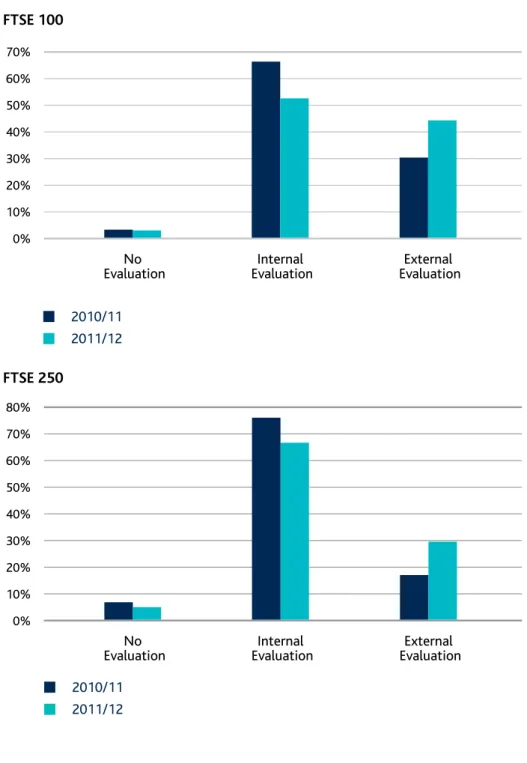
• 44.4% of FTSE 100 and 29.9% of FTSE 250 companies conducted an external evaluation, up from 30.5% and 17.1% in the previous year.
• 13.7% of FTSE 100 and 7% of FTSE 250 companies conducted external evaluations in both years.
• 47.9% of FTSE 100 and 33.7% of FTSE 250 companies disclosed the outcomes of their evaluation. This compares with 31.3% of FTSE 100 and 10.2% of FTSE 250 company disclosures in the previous year.
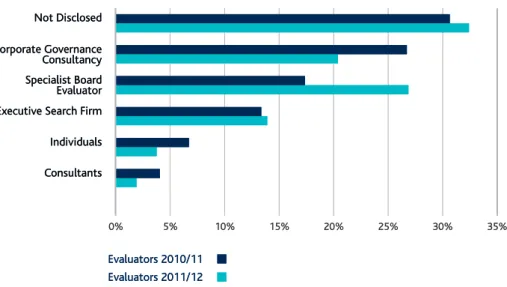
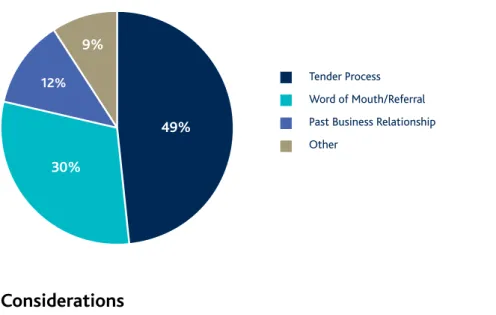
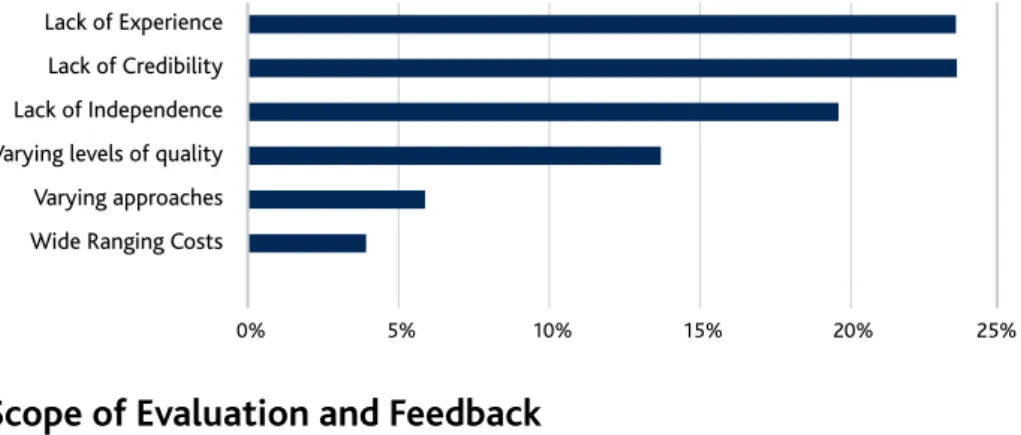
We conducted a survey of FTSE 350 company secretaries to develop an understanding of the current market for external board evaluators. Even though the market is still developing, companies are concerned about the lack of experience, credibility and independence of the available practitioners. However, irrespective of these concerns, when appointing an evaluator, company secretaries cite independence as the least important consideration. More important is the experience and gravitas of the evaluator. A small proportion of companies prefer to use an evaluator with whom they have a past business relationship. This in part explains the presence of executive search agencies in, and the entrance of auditors into, this industry.
We are encouraged that boards derive benefit from external evaluations. The greatest value of this experience is drawn from the independence and objectivity of the evaluator, and the fresh insight that they have to offer the board. This reinforces our view that external board evaluations should be conducted by an independent third party.
Our recommendations are:
• External board evaluations should be carried out by an independent party not subject to a conflict of interest. This should preclude those who provide other services to the company such as search agents who assist in the recruitment of directors, auditors and remuneration consultants.
• Companies who choose to appoint an evaluator with a past business relationship should explain in their annual report the previous relationship and how any potential conflict of interest has been managed.
• Companies should explain the perfomance evaluation process and disclose any significant recommendations and the changes or improvements that the board has committed to following the review. We expect the outcomes of these evaluations to be different year-on-year.
Methodology
Our sample group consisted of all companies within the FTSE 350. We excluded 56 investment trusts because, as the UK Corporate Governance Code states, externally managed investment companies typically have a different board structure which may affect the relevance of particular Code provisions. We reviewed annual reports covering company year ends between 31 March 2011 and 30 April 2012.
We reviewed the narrative of annual reports to assess how effectively companies have been communicating their approach to diversity, succession planning and board performance evaluation to their shareholders. We believe the annual report should contain all material information that is relevant to shareholders, particularly as it relates to governance issues. Therefore, we did not consider separate
sustainability reports, company websites, or any announcements that may have been made throughout the year outside the annual report.
For the section relating to board diversity, the ABI’s Institutional Voting Information Service (IVIS) monitored all director appointments in the FTSE 350 excluding investment trusts between 1 December 2011 and 30 November 2012. On board evaluation, we invited 294 of the FTSE 350 company secretaries to participate in an online survey. We received 78 responses. The survey consisted of both open ended and multiple choice questions. We coded the responses to the open ended questions to draw out key themes as part of our analysis. For the section relating to the role of the chairman, we conducted one-to-one interviews with a range of FTSE 350 chairmen.
Acknowledgements
We would like to thank the FTSE 350 chairmen who participated in the interviews and the FTSE 350 company secretaries who took the time to fill in the external board evaluation survey.
We would also like to thank all the companies that have taken the time to engage with us on the issues raised in the first ABI Report on Board Effectiveness. This engagement has been instrumental in informing the approach to this year’s report.
Introduction
The country’s economy depends on the drive and efficiency of its companies. Thus the effectiveness with which their boards discharge their responsibilities determines Britain’s competitive position. They must be free to drive their companies forward, but exercise that freedom within a framework of effective accountability. This is the essence of any system of good corporate governance.
The Cadbury Report
20 years since the publication of the Cadbury Report, it remains true that
companies with high standards of corporate governance are the most likely to gain the confidence of investors and support for the development of their businesses. More recently, the Walker Review noted that the cultural changes needed to ensure that boards are effective are best achieved through clearer identification of best practice, so that boards and their major shareholders feel “ownership” of good corporate governance.2
In September 2011, the ABI published ‘Report on Board Effectiveness, Highlighting Best Practice: Encouraging Progress’ that focused on three areas fundamental to improving corporate governance standards. We set out examples of best practice and drew together recommendations in these areas. They are:
• Board diversity;
• Succession planning; and • Board evaluation.
These issues are important, because selecting the right individuals from a diverse talent pool, planning for succession and replacement and regularly evaluating the board to determine its effectiveness, cover the life cycle of the board. We committed to:
• Engage with companies on the issues they are facing on diversity; • Engage with companies on succession planning;
• Engage with companies on the issues they face when disclosing board evaluation outcomes and external facilitators and monitor disclosures through IVIS; and • Continue monitoring best practice and report on progress in 2012.
In this year’s report, we provide an update on the current state of reporting and again highlight best practice in each of these areas.
2 Walker Review (2009), A Review of Corporate Governance in UK Banks and Other Financial Industry Entities:
One key theme that continued to emerge as part of our engagement with companies concerned the market for external board evaluators. Therefore, we conducted a survey of FTSE 350 company secretaries to develop an understanding of the current market and to make recommendations on how the provision of services could be further developed.
New to this year’s report is a section on the role of the chairman in ensuring an effective board. As noted in the Cadbury Report, tests of board effectiveness include the way in which the members of the board as a whole work together under the chairman, whose role in corporate governance is fundamental, and their collective ability to provide both the leadership and the checks and balances which effective governance demands.3
The annual report is the cornerstone of a company’s communication with its shareholders. It must be clear, concise and company specific. This not only offers investors a better understanding of the business, but can also act as a catalyst for more effective engagement and facilitate improvements in corporate governance and board effectiveness. We hope that, through the identification of best practice, this guidance document will continue to raise corporate governance and company reporting standards amongst UK listed companies.
The Role of the Chairman
The chairman is key to an effective board. Many companies are now considering how they can reflect this role in their annual reports, with numerous companies providing a letter or statement at the start of the corporate governance report, in which the chairman outlines how the board and governance arrangements are appropriate for the individual company’s business model.
We therefore wanted to get the perspective of chairmen on the skills they consider to be the most important and so conducted interviews with a range of FTSE 350 chairmen. Several currently hold, or have held over their career, a number of chairmanships. Our aim is not to create case studies of how individual chairmen operate but to highlight the recurring themes raised. There is no ‘one size fits all’, with different chairmen having different approaches based on what is best for the individual company and board.
The interviews covered the role of the chairman, the skills required to be an effective chairman and how to get the most out of the board and board committees, views on diversity, succession planning and board evaluation and finally, their relationship with shareholders.
The chairmen emphasised a number of aspects to their role, all a variation on the following five themes:
• Creating the right board dynamic and having the right people around the boardroom table;
• Helping to set the board agenda, ensuring the board has the right information and is debating the right issues;
• Managing the board’s relationship with the executives and in particular the chief executive;
• Being an ambassador for the company; and
• Being fully engaged in the business and understanding what is happening on the ground.
The attributes required to be an effective chairman were; to be a successful communicator, people manager and facilitator.
Creating the right dynamic and setting the agenda
All of the chairmen emphasised the need to ensure that they had the right skills and attributes around the boardroom table. Specifically, they focussed on the diversity of perspective needed for the business; having the right individuals with a range of expertise, providing the right balance of skills to address issues or discussions from a variety of angles. Having a diversity of perspective in its broadest sense meant that boards considered issues thoroughly and were best placed to make good decisions.
Fostering the right environment and dynamic around the board table is also critical to ensuring that constructive challenge is possible. Many chairmen noted the importance of working with the chief executive in setting the board agenda, so that the board can have visibility and input into key decisions at an early stage. Specifically, chairmen needed to prioritise which areas were of concern to them. These might relate to ‘softer’ issues such as corporate culture.
Several chairmen outlined the processes they have in place to ensure that the board and individual members are given access to the business, by visiting different sites or operations or meeting individual management teams. This was an important aspect of both the chairman’s and non-executives’ role. Non-executives must be fully informed about the business and receive the right level of information on the performance of the business and the decisions which the board are being asked to make. There is a challenge for ensuring that the board papers contain sufficient detail, but not too much information which will overload the non-executives. Several of the chairmen discussed the work they have put in with their executives and company secretaries to get the right level of detail into board papers.
To ensure that all the non-executive directors are contributing to the board, most chairmen had in place an appraisal process, so that, on an annual basis, they formally talked to the individual non-executive directors about their performance. There is no room for individuals who do not contribute. All the chairmen stated that, if they believed that a non-executive was not giving sufficient commitment or input, or was adversely affecting the board dynamic, they would not wait for the formal appraisal process to address the issue.
Relationship with Executives
The chairmen emphasised that they are not executive and should not encroach on the role of the chief executive. Chairmen run the board not the company. However, many felt that the role of chief executive is a lonely one. Therefore, the chairman should build a good relationship with the chief executive as a confidant, providing a sounding board and being a key advisor. Views on how chairmen should interact with the other members of the executive team were mixed. Some felt that all communication should be through the chief executive, whilst others were more open to having dialogue with many or all of the executives. They were however clear that their role is as advisor rather than line manager.
Ambassador
All the chairmen saw themselves as an ambassador to shareholders, politicians, regulators and other key stakeholders, promoting and being a public face of the company.
The Role of Non-Executive Directors and the
Senior Independent Director
The main role of the non-executive directors is to provide constructive challenge to the executive team with a supportive yet challenging environment, with one chairman describing non-executives as “critical friends”. Once a decision has been discussed and made, then the non-executives should support that approach and ensure that they are supporting the executives to execute that decision. Destructive challenge can adversely affect the board meeting and the overall performance of the board.
Opinions on the role of the Senior Independent Director (SID) varied. Some chairmen saw the SID as a role to be used at times of stress, to perform the chairman’s performance evaluation or, as the UK Corporate Governance Code suggests, to be a focal point for shareholders when they have an issue with the chief executive or chairman, which has failed to be resolved. Others believed that the SID played an important role as the sounding board for the chairman. One chairman said he would speak to his SID regularly, to keep him updated on current issues and to have a general discussion about the board’s approach. Others would only contact their SID when there was a specific issue which needed a second opinion. One chairman reiterated the importance of keeping the SID updated on the views of shareholders and feedback from individual meetings. Others said that they would not necessarily go to the SID as a matter of course; instead they would talk to the chief executive or the most relevant non-executive, depending on the issue to be discussed.
The Role of Board Committees
The chairmen believed that the current committee structure was fit for purpose and was an appropriate means of addressing some more operational issues. The majority of chairmen we interviewed chaired the nomination committee, were a member of the remuneration committee and regularly attended, but were not a formal member of, the audit committee. Some felt that, given they were regular attendees at the audit committee, it might be appropriate for them formally to join it.
Most chairmen were members of the remuneration committee, because as chairmen, they had a significant role in the management of the relationship between the chief executive and the remuneration committee. In particular, it would be considered odd if there was a conversation on the performance of the chief executive and what he/she should be paid without the chairman being present. Others also felt that, given that remuneration is so high profile with shareholders, the media and politicians, they had to be part of the remuneration committee to ensure they were fully aware of the company’s approach to such a publicly sensitive issue.
There were a range of views on who should have the ultimate say on what the chief executive should be paid if there was a difference in view between the chairman and the chairman of the remuneration committee. This would clearly be an unsatisfactory position to have reached, but the majority felt that the chairman should have the decisive say.
Board Diversity
All chairmen acknowledged the importance of diversity and the need to appoint more women directors, but felt that quotas would be the wrong approach. However, one chairman believed that the general objection to quotas should not be used as an excuse for not addressing the fundamental issue of needing to achieve greater gender diversity on boards and within management teams.
Board Succession
All the chairmen spoke about their succession plans for new non-executive directors. These would often have a 3-5 year horizon, analysing the skills which are missing or could be missing in future and how different personalities would fit around the table. The chairmen had both formal and informal processes in place to appoint new non-executives, using both search firms and existing contacts to find appropriate candidates. On the whole, there was a sufficient pool of talent for non-executive positions, despite the growing time commitments and other pressures increasingly exerted on directors. For executives, identifying the right candidate and ensuring an orderly transition can be a lengthy process, perhaps 12-18 months.
Board Evaluation
All the chairmen had used both internal and external board evaluation processes. Normally, the internal process revolved around a questionnaire or open ended questions and a conversation with the chairman. The majority believed that the external evaluation process was valuable, although they felt it would be of more relevance if the board had had problems or had to deal with major change (e.g. M&A activity). The market for external evaluators was still in its infancy and it was important, in terms of perception at least, that the evaluator should be independent of the company and not subject to any conflict of interest. However, if a search firm was used to conduct the external evaluation that did not necessary preclude them from providing search services in the future. A number of chairmen talked of the continuity that the same evaluator can provide if they are used for a second time to give a perspective of what has changed on the board. However, these chairmen also thought that a change in evaluator in the longer term would be important to provide a different perspective and bring fresh insight.
Shareholder Relations
The majority of chairmen regularly sought (as opposed to just offering) to meet the company’s largest shareholders on a one-to-one basis. This gives the shareholders and chairmen the opportunity to discuss any relevant governance or strategic issues. These meetings were seen to be of particular importance at times of strain or following a significant event for the company. The chairmen reported a mixed reception from shareholders when offering these meetings, but they are perceived these meetings as a good way of opening the communication lines which could be important should a major issue materialised.
The majority of chairmen do not participate in the results roadshow with the chief executive or finance director, but some find it beneficial to attend some meetings to hear the approach taken by the management and shareholder’s questions. Generally, the chairmen considered that they were getting the right level of engagement from their shareholders. There was a sense that UK based shareholders had recently picked up their game. There is still a perception from some chairmen that fund managers and governance specialists were not as integrated as they could be, but all commented that this had improved recently.
Conclusion and Recommendation
There is no ‘one size fits all’ approach to the role of a chairman, with different chairmen having different approaches based on what is best for the individual company and board. However, the chairmen we interviewed highlighted their role in ensuring that the board had the right mix of individuals and creating the right dynamic between the board members with the right information. A number of chairmen set out in the annual report how the governance arrangements in their company are appropriate for the individual circumstances, history and business model of the company.
We recommend that all chairmen should outline in their annual report their role in creating an effective board and how the board has been set up to respond to the business structure and any challenges which the company faces.
Board Diversity
Board diversity in its broadest sense is an essential driver of board effectiveness. A board that is diverse in its composition is more likely to make better decisions and break down the tendency towards ‘group think’. Not only do board members with different perspectives challenge the status quo, they also introduce multiple views on the risks, consequences and possible implications of any board decision. Given the complexity of today’s businesses, it is important that the board is able to draw on a wide range of experiences to understand opportunities and anticipate challenges. In addition, a diverse board enables the company to anticipate better and consider the views of key stakeholders, including employees and shareholders. In short, board diversity is integral to building a successful long term business. Given the importance of board diversity, including gender, we conducted a thorough analysis of the annual reports of companies in the FTSE 350 to highlight what companies are doing to address this issue. We highlight best practice on how companies are achieving a diversity of perspective in the boardroom and how they have implemented Lord Davies’s recommendations on improving gender diversity. We focus on what companies say they are doing to support women as they progress through their careers and to ensure that they are gaining the necessary experience to allow them to serve on boards in the future.
Diversity of Perspective
The chairman, with the assistance of the nomination committee, is responsible for ensuring that the board is composed of diverse individuals capable of introducing different perspectives. Together, they should review the skills required, identify the gaps in knowledge and experience, taking into account diversity of psychological type, background and gender, to ensure that the board is not composed solely of like-minded individuals. This should then inform the succession planning process.4
Our engagement with chairmen has shown that they are dedicating more time to reviewing the composition of their board to ensure they have the right mix of skills, experience and backgrounds. However, the majority of disclosures on this issue are, at best, boiler-plate or, worse, absent. Nonetheless, we are encouraged to find some examples of good practice. Following a review of their board composition, the best reporters set out the skills and experience they will need on the board to guarantee its effectiveness, in both the short and long term.
Standard Chartered: On long term needs
We have commenced a comprehensive review of our Board’s composition, looking forward to 2015 and beyond. This review is being facilitated through our Nomination Committee. Geographic and gender diversity together with key technical specialisms in banking, risk, accounting, finance, technology and international business experience will form core components of our Board succession.
Corporate Governance Report
In addition, as chairmen continue to focus on the optimal balance and composition of their boards, they are openly discussing the challenges they face in recruiting new members with the relevant experience as their companies continue to grow and expand.
BG Group: Challenges in recruiting to ensure a diversity of perspective
The BG Group Board’s continued focus on its own optimal balance and composition is particularly important given the increased size, complexity and international reach of the Group’s global operations today.
In view of the complex and technical nature of our business, one of the principal challenges that we have faced in recruiting new members to the Board has been securing relevant geographic and sector experience. At the same time, gender is an important aspect of the overall diversity to which chairmen of boards and nomination committees should pay due regard when assessing the most effective balance within the boardroom.
Chairman’s Corporate Governance Statement
We continue to encourage companies, led by their chairmen, to provide similar disclosures on the steps they are taking to achieve a diversity of perspective in their boardroom. This should include disclosure on the challenges they face in seeking out the relevant skills and experience. This information assures shareholders that the chairman is actively engaged in ensuring the company has the right leadership.
Women on Boards
The publication of the Davies Review, Women on Boards, in 2011 highlighted the role that women can play in introducing a diversity of perspective into the boardroom5 and ensured that gender diversity was an agenda item for most boards
and nomination committees this year.
The Financial Reporting Council (FRC) published changes to the UK Corporate Governance Code in line with Lord Davies’s recommendations on a ‘comply-or-explain’ basis. The Code now states that the disclosures on the work of the nomination committee should include, ‘a description of the board’s policy on diversity, including gender, any measurable objectives that it has set for implementing the policy, and progress on achieving the objectives’.6 In addition, company boards
should consider the ‘balance of skills, experience, independence and knowledge of the company on the board, its diversity, including gender, how the board works together as a unit, and other factors relevant to its effectiveness’ as part of their board evaluation process.7 While the changes will only apply formally to companies
with financial years beginning on or after 1 October 2012. The FRC has encouraged compliance for annual reports published before then.
In October 2011, the Department of Business Innovation & Skills (BIS) published draft regulations proposing changes to narrative reporting requirements. These regulations will require quoted companies to report on the proportion of women and men on the board, in senior executive positions and within the whole organisation.8
The regulations will be applicable for companies with year ends after 1 October 2013.
5 Davies (2011), Women on Boards, Department of Business Innovation and Skills, London 6 FRC(2012) The UK Corporate Governance Code, Financial Reporting Council, London, Section B.2.4 7 Ibid. Section B.6
8 BIS (2012), The Future of Narrative Reporting: A New Structure for Narrative Reporting in the UK, Department of
In November 2011, the European Commission proposed legislation that sets an objective for listed companies to achieve 40% female representation of their non-executive directors by 2020. Companies must ensure that they have clear, gender-neutral criteria for choosing non-executive directors. If candidates are found to be equally qualified, then preference must be given to the under-represented sex.9 We
are supportive of the move for companies to boost gender diversity. However, we are sceptical of adopting a legislative approach to achieve this.
Board appointments are not only about qualifications. They include considerations of non-executive director independence, the ability for the non-executive to fulfil the required time commitment, and the diversity of personal attributes among directors already on the board. We are concerned that a legislative approach will adversely affect the ability of companies to appoint the individuals that they feel are the most suited to the role when other factors are taken into account. In addition, legislation targeted at non-executive director roles fails to address the underlying issue of how women progress through their organisation. This approach to gender diversity may set a regulatory precedent for dealing with other aspects of diversity. This would be detrimental for the company and its shareholders, as board appointments could become a box ticking exercise at the cost of companies securing the right balance of skills.
In the UK, Lord Davies recommended that companies should set out the percentage of women they aim to have on boards by 2013 and 2015. FTSE 100 companies should aim to have a minimum of 25% female representation by 2015. In his view a business-led approach could increase the number of women on company boards and that board appointments should be made on the basis of business needs, skills and ability.10
Our members believe that it is imperative to maintain flexibility, which can only be achieved through voluntary targets. Voluntary targets set a benchmark towards which a company should aspire, whilst providing the necessary flexibility for the board to appoint directors from different backgrounds who can introduce a wider range of perspectives.
This voluntary approach has already led to improvements in the number of women being appointed to the boards of listed companies. In the year to 31 November 2012, 26.1% of FTSE 100 and 30.6% of FTSE 250 board
appointments were women. This compares with 18.5% and 11.9% respectively as highlighted in our last report.11 In addition, 17.4% of FTSE 100 and 11.8% of FTSE
250 board members are women, compared with 14.2% and 8.4%, respectively. We believe that this change will continue as best practice continues to develop and as changes to the UK Corporate Governance Code are allowed to bed down. However, the onus remains on companies to show how they are implementing the voluntary approach; through the disclosure of targets and the policies they have in place to improve gender diversity both at board level and across the rest of the workforce. This is best achieved through disclosure in their annual report.
9 European Commission (2012), Proposal for a Directive of the European Parliament and of the Council on Improving
the Gender Balance among Non-Executive Directors of Listed Companies on Stock Exchanges and Related Measures, European Commission, Brussels
10 Ibid. 4, p.18-19
Percentage of Women on Boards
The number of women being appointed to the boards of FTSE 350 companies continues to increase. Compared to the findings in our last report, in the year to 30 November 2012:
Board appointments:
• 26.1% of FTSE 100 and 30.6% of FTSE 250 board appointments were women compared with 18.5% and 11.9% respectively in the year to 31 August 2011.
Percentage of women on boards:
• 17.4% of FTSE 100 and 11.8% of FTSE 250 board members are women. This compares with 14.2% and 8.4%, respectively, in the year to 31 August 2011. • 21.7% of FTSE 100 and 15.4% of FTSE 250 non-executives are women,
compared with 17.3% and 11.1%, respectively, in the year to 31 August 2011.
25% representation of women on boards:
• 25.7% of FTSE 100 and 9.4% of FTSE 250 companies have achieved the 25% target compared with 12.9% and 6.8%, respectively, in the year to 31 August 2011.
• 6.9% of FTSE 100 and 29.2% of FTSE 250 companies have no women on their boards; this is down from 14% and 47.8%, respectively, in the year to 31 August 2011.
Female chairmen:
• There is only one woman chairman of a FTSE 100 Company (Alison Carnwath at Land Securities Plc); and
• There are three women chairmen of FTSE 250 companies (Valerie Gooding at Premier Farnell Plc, Dame Helen Alexander at UBM Plc and Anita Frew at Victrex Plc).
The FTSE 100 companies with no women on their boards are: • Croda International Plc. • Glencore International Plc. • Kazakhmys Plc. • Melrose Industries Plc. • Randgold Resources Ltd. • Vedanta Resources Plc. • Xstrata Plc.
There are 59 FTSE 250 companies with no women on their boards (see appendix)
Disclosures
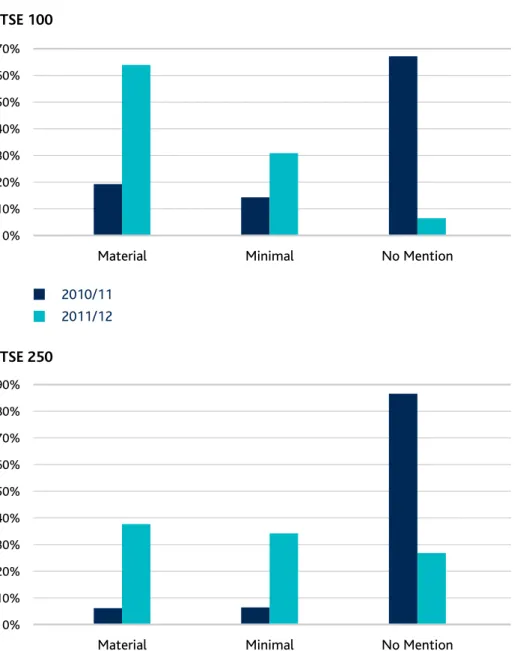
Overall, the level of disclosure on gender diversity is improving. 63.6% of FTSE 100 and 38.1% of FTSE 250 companies provide a material statement in their annual reports. This compares with 19.2% and 6.63%, respectively, in the previous year. In addition, the number of companies that do not mention diversity has decreased dramatically, from 66.7% of FTSE 100 and 86.8% of FTSE 250 last year, to 6.1% and 27.3% respectively, in the year to September 2012.
Figure 1: Statements on Gender Diversity FTSE 100
FTSE 250
Two-thirds of companies that provide material disclosures include disclosure on their board diversity policy. This includes, in some cases, a commitment to only engaging search firms that have signed up to the Voluntary Code of Conduct that requires them to ensure at least 30% of the candidates are women. Some companies are also actively seeking candidates for non-executive director roles with the relevant background and experience but without previous board experience.
70% 60% 50% 40% 30% 20% 10% 0%
Material Minimal No Mention
2010/11 2011/12 90% 80% 70% 60% 50% 40% 30% 20% 10% 0%
Material Minimal No Mention
2010/11 2011/12
33.3% of FTSE 100 and 20.3% FTSE 250 companies without any women on their board provide a material statement on the steps that they are taking to address the gender imbalance in their boardrooms.
Vedanta: No women on the board but provide a material statement
We announced our aspirations for Board diversity during the year which is to have 25% of women on the Board by 2015. However, all appointments will continue to be made on merit. To achieve this target we will ensure that women candidates are considered routinely as part of the recruitment process. We will also monitor and encourage the progress of women in senior positions throughout the Group. Vedanta operates within a traditionally male dominated industry. The current proportion of men to women within the Group is 92% men and 8% women whereas in the professional population the proportion is 88% men and 12% women. We are pleased to report that we do have a number of women in senior positions including in the areas of legal, Investor relation and Corporate Finance. We have also constantly improved the women professionals’ intake from campuses from 10% to 20% thus ensuring improved talent pipeline for senior leadership roles in the future.
Nomination Committee Report
35.4% of FTSE 100 and 10.8% of FTSE 250 companies have set aspirational targets. However, 11.1% of FTSE 100 and 22.6% of FTSE 250 companies state that they have chosen not to set a target.
Figure 2: Targets for Women on Boards
FTSE 100 FTSE 250
Companies’ targets range from 18% women on the board to 25% non-executive directors. Against the backdrop of the current debate in Europe, some companies have already set a target to ensure that 40% of their non-executive directors are women.
22.6% 66.6%
10.8%
No mention of targets Have chosen not to set a targets Have set targets
No mention of targets Have chosen not to set a targets Have set targets
No mention of targets Have chosen not to set a targets Have set targets
11.1% 53.7%
35.4%
No mention of targets Have chosen not to set a targets Have set targets
No mention of targets Have chosen not to set a targets Have set targets
11.1% 53.7%
Telecity: 40% of Non-executive directors on the board
In relation to the future appointment of non-executive directors, we will aim to make appointments of each gender in equal numbers subject to the merits and diversity in general of the available candidates. This aim will be taken account of in succession planning for these roles. On this basis, as appointments are made, we expect the proportion of female non-executive directors on our Board to increase towards 40% based on the current Board size and structure. We accordingly consider quotas to be both inappropriate and unnecessary, as well as likely to be counterproductive.
Nomination Committee Report
Some of the companies that have chosen not to set a target have already met the 25% aspiration for women on their board. However, in his recent review of progress, Lord Davies noted that 25% should be the minimum starting point, not the ultimate achievement for companies. He encourages these companies to set targets as an incentive to build on their progress to date and work toward real gender parity, avoiding any risk of complacency or inertia.13
The quality of explanations provided by companies that have chosen not to set a target varies. There are some companies that simply state – ‘Following a discussion of the recommendations of the Lord Davies report on boardroom diversity, the committee determined not to set a specific female board member target. All appointments to the board will continue to be based on the diversity of contribution, experience and required skills, irrespective of gender’, or a variation of this statement. Such a statement fails to provide any insight into the reasons the board decided not to set targets. Companies should ensure that their disclosures are open, candid and specific to their circumstances.
D.S Smith: On targets
As regards diversity, the Board of DS Smith has considered carefully Lord Davies’ recommendations. We have a small Board, comprising two Executive Directors, three non-Executive Directors and a non-Executive Chairman, and therefore believe it difficult to set targets or timescales for the percentage of women, or any other group, on our Board. We are committed to ensuring our Board continues to have both relevant experience and appropriate diversity. We believe the Board would be strengthened by the addition of women with the right skills and experience and will continue to seek to identify suitable candidates. In view of this, we are optimistic that the targets for Board composition set out in the Davies recommendations can be met.
Corporate Government Statement
We are encouraged to find that some companies that have chosen not to set a target disclose their diversity policy and the steps they are taking to ensure gender diversity is considered when appointing new directors to the board. This includes ensuring the board has visibility of women candidates as part of their recruitment process.
Elementis: Against targets but ensure visibility of female candidates
As the Board is currently engaged in a succession planning process that is likely only to be fully completed in 2014/2015, it does not consider that it would be appropriate to set targets for the number of women on the Elementis Board. However, a specific requirement of the appointed recruitment adviser will be to ensure any long list and short list of candidates presented to the Board for consideration is in line with the Davies recommendations – that is, at least 25 per cent should be women considered to have met the essential criteria for the role in question.
Nomination Committee Report
As proponents of the comply-or-explain approach to corporate governance, we do not believe that it should be mandatory for companies to adopt targets. We support the current approach on gender diversity and the flexibility that it offers companies to adopt diversity policies that suit their individual needs. However, companies, led by their chairmen, need to show that they are responsive to the voluntary approach to improving gender diversity. They should ensure they provide meaningful disclosures on the board appointment process, the barriers they face in appointing women to their board, and how they will address gender diversity, as part of the wider consideration of ensuring a diversity of perspective on the board.
Marks & Spencer: Board diversity policy
Our Board diversity policy introduced this year seeks to ensure that diversity in its broadest sense continues to remain a significant feature of the M&S Board. We will report against the objectives below in 2012/13:
• Maintain a level of at least 30% female directors on the Board over the short to medium term;
• Assist the development of a pipeline of high-calibre candidates by encouraging a broad range of senior individuals within the business to take on additional roles to gain valuable board experience;
• Consider candidates for appointment as non-executive directors from a wider pool including those with little or no listed company board experience; • Ensure non-executive directors ‘long lists’ include 50% women candidates; • Only engage executive search firms who have signed up to the voluntary Code of
Conduct on gender diversity and best practice;
• Report annually against these objectives and other initiatives taking place within the Company which promote gender and other forms of diversity; and
• Report annually on the outcome of the Board evaluation, the composition and structure of the Board as well as any issues and challenges the Board is facing when considering the diverse make-up of the Company.
Addressing the challenge of supply
Whilst gender diversity in the boardroom is improving, a key area of concern for shareholders remains the lack of women executives in boardrooms. The lack of women executives has a subsequent impact on the number of women who become non-executive directors as the vast majority come from the corporate sector. The low number of women on boards is in part a symptom of insufficient numbers emerging at the top of the management structure and the under-representation of women in senior management generally.14
Because of this, Lord Davies recommended that quoted companies should be required to disclose annually, not only the proportion of women on the board, but also women in senior executive positions and women employees in the whole organisation.15 Measuring and reporting on the proportion of women in the
whole organisation should help chairmen and chief executives to understand the composition of their workforce and monitor the rates of attrition among their female employees.
As highlighted in our previous report, these issues are societal and not limited to UK Plc.16 Grant Thornton’s International Business Report found that in 2012,
only 21% of senior management roles globally are held by women compared to 19% in 2004. However, the UK remains below this average with 20% of senior management roles in 2012 being held by women compared to 18% in 2004.17
The reasons for this are complex.
A recent survey by Ernst and Young found that age, motherhood, qualifications and experience and a lack of role models are the key barriers to career progression for today’s working women in the UK.18 It is clear from this research that employers
need to provide better support to help women overcome these obstacles. The Women Matter 2012 Report by McKinsey highlights the key features that initiatives within companies require to increase the number of women rising to the top of their organisations. This includes a visible commitment from chief executives to ensure that gender diversity is part of their company strategy. This commitment should be communicated throughout their organisations. In addition, companies should ensure that they have a detailed understanding of the representation of women at every level of their organisation, both to track progress and to know where the obstacles lie. Companies should also seek to influence the underlying attitudes that prevent change both within their organisation and in the societies in which they operate. Finally, companies should tailor their initiatives to address the individual challenges they face.19
We analysed company disclosures on the initiatives they have in place to promote women in their organisation. Whilst recognising that initiatives to improve diversity at executive level will take time to have an impact, companies need to act now to ensure that there is a steady stream of women who are capable of taking up executive positions in the future.
14 Davies (2011), p.15 15 Ibid. 12, p.18-19
16 ABI (2011), Report on Board Effectiveness, Highlighting Best Practice: Encouraging Progress, Association of British
Insurers, London, p.23-24
17 Grant Thornton (2012), Women in Senior Management: Still Not Enough, Grant Thornton International Business
Report 2012, Grant Thornton Ltd.
18 Ernst and Young (2012), The Glass Ceiling is an Outdated Concept. Available at: http://www.ey.com/UK/en/
Newsroom/News-releases/12-08-23---The-glass-ceiling-is-dead-as-a-concept-for-todays-modern-career
• In the year to 30 November 2012, one woman executive director has been appointed to a FTSE 100 board and no FTSE 250 executive appointments have been women;
• 6.6% of FTSE 100 and 4.9% of FTSE 250 executive directors are women (two female FTSE 100 CEOs will leave their board in the next 6 months). This compares with 6.5% of FTSE 100 and 3.7% of FTSE 250 executives in August 2011; and • 27.3% of FTSE 100 and 14.4% of FTSE 250 companies disclose the proportion
of women, senior executives and women employees in the whole organisation. However, these disclosures are not always made as part of a wider discussion on gender diversity.
Most companies report on the talent and development initiatives they have implemented to ensure they are investing in the career progression of their
employees. Companies also report on the steps they are taking to improve equality and diversity in their organisations, including the non-discrimination policies that they have in place. However, there remains a low level of disclosure on the steps that companies are taking to develop the potential of women in their organisation. Companies that do disclose the initiatives they have to improve gender
diversity are:
• Creating and implementing personal development programmes for their women employees from the top down;
• Engaging with their employees to develop suitable policies on gender diversity and taking into account the experience of women in their organisation; • Focusing on recruitment at graduate level to improve gender diversity in
industries that are considered traditionally male;
• Developing initiatives to address gender diversity in communities with traditionally low female representation in the workforce; and
• Engaging with local communities to combat cultural trends that discourage women from working.
We continue to encourage companies to recognise their role in developing the potential of women in the corporate pipeline. Reporting on the proportion of women in the organisation provides a good starting point. In the long term, this should encourage companies to develop more targeted initiatives to enable their women employees to progress in their careers. The old adage remains true, what gets measured gets managed.
Recommendations
• Companies should disclose the steps they are taking to promote a diversity of perspective in their boardroom. These disclosures should be clear and company specific.
• Companies should seek to provide more forward-looking and candid disclosures on the steps they are taking to ensure that they have the right balance of skills and experience in their boardrooms.
• Companies, led by their chairmen, should show that they are responsive to the voluntary approach to gender diversity. They should ensure that they are providing meaningful disclosures about the board appointment process, the barriers they face in appointing women to their boards, and how they seek to address this issue.
• Companies should begin disclosing the proportion of women not only on their board, but also in senior management and in the whole organisation, prior to the regulatory changes coming into force for year ends after 1 October 2013. • Companies should recognise their role in supporting women to overcome the
barriers they face in rising to the top of the management structure.
• Companies should develop and disclose the initiatives they have in place to develop women in their organisation and the impact they are having.
Examples of Best Practice
United Utilities: Setting out their ‘top down’ approach for the development of women below board level
At United Utilities, 36 per cent at the executive level are women. All members of our executive and business leadership group have a dedicated personal
development plan and are participating in our strategic management development programme with Manchester Business School. The development plans for female executives and business leaders are tailored to each individual’s needs and often include executive coaching to support their development as senior women both internally in the organisation and externally.
However, as well as supporting senior women in our organisation we need to be more proactive and are therefore putting a greater emphasis on our emerging female talent. We have identified our first cohort of emerging talent of which 56 per cent are women. This group participates in a fast track development programme which will include identifying senior male and female mentors to support their career development and a ‘women in work’ module which will cover impacting and influencing skills and effective networking.
As we start to be more proactive in developing women at work we are developing plans for further initiatives which include the introduction of focus groups to facilitate discussion on topics such as career paths taken by award winning directors and senior managers and analysis of our attraction rates for female applicants to our apprentice and graduate programmes. As we are predominantly recruiting talented engineers and potential engineers currently both programmes are male dominated and only 15 per cent of our apprentices and graduates are women. We are therefore reviewing our recruitment process to look at how we could target potential female applicants and continuing our work with schools to promote science, technology, engineering and maths (stem) subjects at the earliest opportunity to young people.
Nomination Committee Report
UBM: Engaging with employees to develop suitable diversity policies
In 2011, UBM established a goal to increase the number of women in senior business leadership roles and put in place a number of initiatives to ensure that our talented female employees can achieve their career aspirations with UBM. A series of workshops was held in May, during which 85 of UBM’s high potential women shared their experiences of developing their careers with the Group. As an outcome of these workshops, UBM has put in place guidelines to ensure that all job opportunities are posted openly internally, and to ensure that shortlists for executive roles include qualified female candidates. A pilot of a training program for senior executives to develop awareness of unconscious bias is underway, and all Divisions are being encouraged to promote greater take-up of flexible working policies. The Group’s succession planning and talent review process has highlighted a number of high potential women who UBM will be investing in through targeted development activity.
SSE: Promoting flexible working
Although the number of women in senior and other management roles in SSE is increasing, it is recognised that more work needs to be done to secure greater gender diversity.
In support of this a number of steps are being taken, and a survey of over 200 senior managers in SSE was carried out to establish attitudes to, perceptions of and steps needed to support greater gender diversity in SSE. The principal finding of the survey was that SSE could do more to advance a culture of flexible and family-friendly working for both women and men. This and other actions will be addressed by SSE’s newly-established Diversity Working Group in the course of 2012/13.
The SSE Team, Corporate Governance Report
Babcock: Focusing on recruitment at graduate level to improve diversity
It also has to borne in mind when judging how a company might be performing on broadening gender diversity that companies have very different histories and backgrounds that have led to where they are today. Some, like Babcock, operate principally in sectors that might be regarded as ‘traditionally male’, such as engineering or working with the armed forces. Inevitably such companies tend to be starting from a background of relatively low female participation, especially in management positions, which reflects a wider social context.
But things are changing and Babcock now has […]
• Taken the decision to focus its graduate recruitment programme particularly of engineering graduates, on those universities that have a richer undergraduate mix so as to improve the diversity of the pool of talent from which it recruits its engineers and managers of the future – this is already bearing fruit and female graduates now make up close to 20% of the annual intake, with numbers rising each year;
• And the senior management team is also actively considering how to make management roles more attractive and amenable to female candidates so as to increase the numbers interested in applying for them.
Corporate Governance Report
Antofagasta: Addressing gender diversity in sectors and communities with low female representation
Antofagasta Minerals has introduced a number of initiatives to increase representation of women including a training plan for local women near to the El Tesoro and Esperanza mines. The low number of women in the mining sector presents an opportunity to boost female employment and the number of people working in mining overall. Recruiting and training more women is a key part of the Group’s talent strategy, particularly because only 37% of Chilean women participate in the job market.
Succession Planning
Succession planning is one of the key elements of board effectiveness. Succession planning allows the board to analyse the balance of skills, experience and knowledge in the boardroom, and identify and address any gaps as part of the natural
refreshment of the board. Good succession planning requires this refreshment process to be well managed and to happen progressively. This ensures that the fresh insight that new board members bring is complemented by the accumulated company knowledge and understanding that longer serving members provide. Below board level, succession planning safeguards the pipeline of talented individuals within the organisation who are capable of succeeding the chief executive and other members of the executive management team in the short, medium or long term. Succession planning is also critical in promoting gender diversity.
For shareholders, the requirement for the board to ensure that a company has the best quality leadership now and in the future is of paramount importance. As we highlighted in the last report, the departure of a member of the management team can be highly disruptive. Depending on how this disruption is managed, it can have a positive or negative impact on a company’s long term performance and ultimately on shareholder value. Boards that are engaged in succession planning will be more capable of handling unforeseen events and mitigating any negative impact of expected or unexpected departures.
Succession Planning Disclosures
The majority of companies comply with the UK Corporate Governance Code provision to ‘describe the work of the nomination committee, including the process it has used in relation to board appointments.’20 However, these disclosures are
often backward looking, describing the work that the nomination committee has conducted over the past year and the appointment process where relevant. Where no appointments have been made, the majority of companies simply provide a generic description of the role of the nomination committee. Often companies state that they are engaged in succession planning both at and below board level, but the information provided tends to be minimal and expressed in boiler-plate language. In contrast, when we engage with companies, they tell us that they consider their succession planning on a three to five year time line for both executive and non-executive directors. This leads us to conclude that some companies may be adopting a box-ticking approach to their disclosures on the role of the nomination committee and on wider succession-planning issues.
We analysed FTSE 350 annual reports to highlight best practice. Where companies avoid boiler-plate disclosures, they discuss a wide range of issues about succession.
Executive appointments:
• 80% of FTSE 100 and 50% of FTSE 250 CEOs appointed in the 12 months to September 2012 were internal appointments; and
• 62.5% of FTSE 100 and 44.4% of FTSE 250 CFOs appointed over the same period were internal appointments.
Succession planning as risk mitigation:
• 39.4% FTSE of 100 and 33.5% of FTSE 250 companies identify succession planning as essential to mitigating the risk of key personnel leaving their organisations.
On corporate governance reporting, the Code encourages chairmen to make a personal statement on how they have applied the Code’s principles on the role and effectiveness of the board. Some companies are extending this practice to the chairmen of their main board committees, including the nomination committee.
Smiths Group: Introduction from the chairman on the nomination committee
The role of the Nomination Committee is to review the structure, size and composition of the Board and the Board Committees and consider succession planning for directors and senior management, to ensure that the Company has the correct balance of skills, experience and knowledge to meet the changing needs of the Company. The Nomination Committee supports the Board with the review of the ‘talent pipeline’ for senior management roles. This is particularly important in a multi-industry global company with a five division structure, where talented individuals in one division may not be personally known to the leadership team in another division.
In July 2012 the Nomination Committee carried out a detailed review of talent management and succession planning across the Group, facilitated by the Group HR director and the Group Director of Leadership and Talent. Particular focus was given to the resources available to the Company in emerging markets and the challenges of retaining managers in fast-growing economies.
During the year the Nomination Committee also considered diversity issues, in the context of Lord Davies’ Report entitled ‘Women on Boards’ and the particular challenges facing the engineering industry, with its bias towards male candidates from entry level upwards.