Modeling Individual Differences in Category Learning
Michael R. Webb ([email protected])
Command and Control Division, Defence Science and Technology Organisation Edinburgh, South Australia, 5111, AUSTRALIA
Michael D. Lee ([email protected])
Department of Psychology, University of AdelaideSouth Australia, 5005, AUSTRALIA Abstract
Many evaluations of cognitive models rely on data that have been averaged or aggregated across all ex-perimental subjects, and so fail to consider the possi-bility that there are important individual differences between subjects. Other evaluations are done at the single-subject level, and so fail to benefit from the reduction of noise that data averaging or aggrega-tion potentially provides. To overcome these weak-nesses, we develop a general approach to modeling individual differences usingfamiliesof cognitive mod-els, where different groups of subjects are identified as having different psychological behavior. Separate models with separate parameterizations are applied to each group of subjects, and Bayesian model selec-tion is used to determine the appropriate number of groups. We demonstrate the general approach in a concrete and detailed way using the ALCOVE model of category learning and data from four previously analysed category learning experiments. Meaningful individual differences are found for three of the four experiments, and ALCOVE is able to account for this variation through psychologically interpretable differ-ences in parameterization. The results highlight the potential of extending cognitive models to consider in-dividual differences.
Introduction
Much of cognitive psychology, as with other empiri-cal sciences, involves the development and evaluation of models. Models provide formal accounts of the ex-planations proposed by theories, and have been de-veloped to address diverse cognitive phenomena rang-ing from stimulus representation (e.g., Shepard 1980), to memory retention (e.g., Anderson & Schooler 1991; Estes 1997), to category learning (e.g., Ashby & Per-rin 1988; Berretty, Todd, & Martignon 1999; Kruschke 1992; Tenenbaum 1999). One recurrent shortcoming of these models, however, is that (whether intentionally, or as an unintended consequence of methodology) hu-mans are usually modeled as ‘invariants’, and not as ‘individuals’. This occurs because, most often, mod-els are evaluated against data that have been averaged or aggregated across subjects, and so the modeling as-sumes that there are no individual differences between subjects.
The potential benefit of averaging data is that, if the performance of subjects really is the same except for ‘noise’ (i.e., variation the model is not attempting to explain), the averaging process will tend to remove the noise, and the resultant data will more accurately re-flect the underlying psychological phenomenon. When the performance of subjects has genuine differences, however, it is well known (e.g., Estes 1956; Myung, Kim, & Pitt 2000) that averaging produces data that do not accurately represent the behavior of individuals, and provide a misleading basis for modeling.
Even more fundamentally, the practice of averaging data restricts the focus of cognitive modeling to issues of how people are the same. While modeling invariants is fundamental, it is also important to ask how people are different. Experimental data reveal individual dif-ferences in cognitive processes, and in the psychological variables that control those processes, that also need to be modeled.
Cognitive modeling that attempts to accommodate individual differences usually assumes that each sub-ject behaves in accordance with a different parame-terization of the same basic model, and so the model is evaluated against the data from each subject sep-arately (e.g, Ashby, Maddox, & Lee 1994; Nosofsky 1986; Wixted & Ebbesen 1997). Although this avoids the problem of corrupting the underlying pattern of the data, it also foregoes the potential benefits of aver-aging, and guarantees that models are fit to all of the noise in the data.
Another problem with individual subject analysis, from a model theoretic perspective, is that fitting each additional subject requires an extra set of free parame-ters, and so leads to a progressively more complicated accounts of the data as a whole. As has been pointed out repeatedly in the psychological literature recently (e.g., Myung & Pitt 1997; Pitt, Myung, & Zhang 2002), it is important both to maximize goodness-of-fit and minimize model complexity to achieve the basic goals of modeling. Unnecessarily complicated models that “over-fit” data often do not provide any insight or explanation of the cognitive processes they address, and are less capable of making accurate predictions when generalizing to new or different situations.
A better approach, therefore, is to partition subjects according to their individual differences, and model the averaged or aggregated data from each group. Under this approach, data are addressed by a set of models, called a modelfamily, where a different parameteriza-tion is applied to each group of subjects. Where av-eraging is appropriate, within groups of subjects, it is applied. Where averaging is not appropriate, between groups of subjects, it is not applied.
In this paper, we apply these ideas to model individ-ual differences in category learning, using Kruschke’s (1992) well known, empirically successful, and widely used ALCOVE model. Our basic approach, however, is applicable to any model of category learning or, in-deed, models of other cognitive phenomena.
Modeling Individual Differences in
Category Learning
Formally, a model family M partitions the subjects
S into G groups S → {S1, . . . , SG}, and so parti-tions the complete data D into Gaveraged data sets
D→ {D1, . . . , DG}. For theith data set, a model fam-ily also specifies a model parameterizationθi. Any pos-sible partitioning of subjects can be considered, includ-ing the possibility that all subjects are in the same par-tition (corresponding to aggregating across subjects), or that each has their own partition (corresponding to a complete individual analysis). Differences in the cat-egory learning processes between groups are revealed by differences in the parameter values they use.
Because of the enormous flexibility allowed by model families, they can be made almost arbitrarily compli-cated, and could potentially fit any data set perfectly by adding new models, with extra parameters, to ac-count for any remaining unexplained variation in data. It is necessary, therefore, for model fitting methods to use model selection criteria that balance goodness-of-fit and model complexity. The application of Bayesian model selection criteria (e.g., Pittet al. 2002) is most easily pursued by specifying a probabilistic account, in the form of a likelihood function, of the relationship between a parameterized model family and empirical data.
To develop a likelihood function for category learn-ing, suppose, under a proposed partitioning of sub-jects, the ith partition has ki subjects, and that the
ncategory learning trials are divided into blocks, with thejth block havingbjtrials. Choosing one block with
b1 = n corresponds to an analysis of the average
re-sponse probabilities over all trials. Choosing nblocks with allbj= 1 corresponds to a trial-by-trial analysis. In a two category learning experiment, the data take the form of counts, dij, of the number of correct re-sponses made by all of the subjects in the ith par-tition on the jth block of learning trials. Suppose also that a category learning model M, with its
pa-rameterization θi, predicts a correct response proba-bility of γij at the ith group of subjects on the jth block. Then the likelihood of the data arising un-der the model is given by the binomial distribution:
p(dij|Mi, θi) = bdjki ij γdij ij (1−γij) bjki−dij. The like-lihood of a model family simply extends this result to consider every block of trials and every partition, so that p(D| M) =Y i Y j b jki dij γdij ij (1−γij) bjki−dij. (1)
The extension of this likelihood function to more gen-eral category learning experiments with more than two possible category responses, using a multinomial dis-tribution, is straightforward.
Having defined the likelihood function, the Bayesian Information Criterion (BIC: Schwarz 1978) can be ap-plied to balance goodness-of-fit with the complexity of a model family. The BIC is given by:
BIC =−2 lnp(D|θ∗) +PlnN, (2) where P is the number of parameters in the model family (i.e., the sum of all the parameters used by the models for each group),Nis the total number of data, and θ∗ is the maximum likelihood parameterization over all the models. Different possible model families, corresponding to different groupings of subjects, can be compared in terms of their BIC values, with the mini-mum BIC corresponding to the most likely account of the data.
Demonstration Using ALCOVE
Kruschke’s (1993) Study
ALCOVE is a model of category learning that uses an exemplar-based stimulus representation, similarity-based generalization that is mediated by selective at-tention, and error-based learning from external feed-back. The standard ALCOVE model Kruschke (1992) uses four free parameters. These control the rate of learning for attention weights (λa), the rate of learning for the associations between stimulus representations and category responses (λw), the gradient of the gen-eralization function that measures stimulus similarity (c), and the way in which different levels of evidence for category alternatives are mapped onto response prob-abilities (φ).
Kruschke (1993) considered the ability of ALCOVE to model human category learning for filtration and condensation Categorization tasks (Garner 1974). The results of four separate experiments were reported, covering two filtration tasks (called position-relevant and height-relevant, due to the nature of the stimuli) and two condensation tasks (called condensation A and
Second Component
First Component
28
12
Figure 1: The application of the heuristic for partition-ing subjects to find two groups for the position-relevant filtration data.
condensation B). The data involved a total of 160 sub-jects, with 40 completing each task. Kruschke (1993) fit ALCOVE to all four sets of experimental results simultaneously, using trial-by-trial data formed by av-eraging across all 40 subjects. An examination of the individual learning curves in the raw data, however, reveals a large degree of variation between subjects within each experiment, and raises the possibility that there are psychologically meaningful individual differ-ences in category learning.
Heuristic for Partitioning Subjects
In classification and clustering, an essential require-ment for the determination of homogenous classes is a calculable similarity or distance measure between ob-jects being compared (Gordon 1999). For category learning, the objects are the individual experimen-tal observations for each subject, (i.e., each subject’s learning curve). A candidate measure for describing the similarities between these curves is the correlation coefficient, which we used in a two-stage heuristic. In the first stage, singular value decomposition is applied to produce an ordered eigenvector-based representa-tion of the similarities between the learning curves of subjects. In the second stage, a simple k-means clus-tering algorithm is applied to this representation to find clusters of subjects.
For each of Kruschke’s (1993) four category learning tasks, this heuristic was applied to produce a range of partitions of the data, from a single group with all 40 subjects, to seven groups with differing numbers of subjects in each group. As a concrete example of this process, the clusters found when the subjects were
di-1 2 3 4 5 6 7 50 100 150 200 250 300 350 400 450
Number of ALCOVE Models
BIC
FP
FH CA CB
Figure 2: The pattern of change in BIC values for each clustering of the position-relevant filtration (FP), heigh-relevant filtration (FH), condensation A (CA) and condensation B (CB) category learning data.
vided into two groups for the position-relevant filtra-tion task are shown in Figure 1. Each circle represents the learning curve of a subject, represented according to their values along the first two component eigen-vectors. The two groups of subjects identified by k -mean clustering are superimposed using broken lines. One cluster on the left encompasses 28 of the subjects, while a much tighter cluster on the right encompasses the remaining 12 subjects.
Model Fitting and Evaluation
For each of the clusterings for each task, maximum likelihood fits of ALCOVE were found using a different parameterization for each group according to Eq. (1). BIC values were then calculated for each model family using Eq. (2), giving the results1 shown in Figure 2.
It is clear that the minimum BIC for three of the four tasks (position-relevant filtration, condensation A and condensation B) is achieved when two separate groups of subjects are considered, while the height-relevant filtration data are best modeled by considering all of the subjects as learning in the same way.
Figures 3 and 4 give more detailed results for, respec-tively, the position-relevant filtration and condensation
1
The full range of BIC values for the CB task is not shown because, when four or more groups are considered, at least one of the groups contains only subjects who be-come less accurate as learning blocks progress. ALCOVE is qualitatively unable to accommodate the decrease in the averaged learning curve for this type of group, leading to very poor fit, and very large BIC values. We have omitted these values.
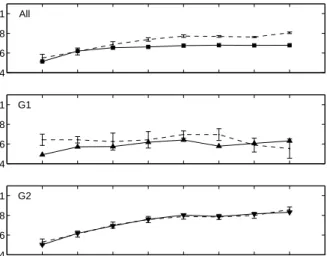
0.4 0.6 0.8 1 All 0.4 0.6 0.8 1 Pr (Correct) G1 1 2 3 4 5 6 7 8 0.4 0.6 0.8 1 Block G2
Figure 3: The change in accuracy across learning blocks for the subjects (broken lines) and ALCOVE (solid lines), for the one group (“All”) and two group (“G1” and “G2”) model families on the position-relevant filtration task.
A tasks. In both of these figures, the top panel, labeled “All”, shows the average accuracy of all subjects across the eight learning blocks, and the maximum likelihood fit of ALCOVE to these data. The middle and bottom panels show the first (G1) and second (G2) groups of subjects proposed by the two-group model family that is prefered by the complexity analysis. These panels show the average accuracy for both groups of subjects separately, together with the maximum likelihood AL-COVE learning curve.
Figure 3 shows that the moderate learning evident when treating the subjects as having no individual dif-ferences is better modeled as coming from two dis-tinct groups of subjects. Some subjects, in the first group, maintain near-perfect accuracy throughout the category learning task. Other subjects, in the sec-ond group, learn more gradually, only achieving near-perfect accuracy in the last few learning blocks. Figure 3 shows that, with the exception of the rapid achieve-ment of accuracy in the first block for the first group of subjects, ALCOVE is able to model both of these patterns of learning2.
In a similar way, Figure 4 shows that the gradual in-crease in accuracy, evident when treating the subjects as having no individual differences, is better modeled
2
It is possible the application of one of ALCOVE’s de-scendents, such as RASHNL (Kruschke & Johansen 1999) or the unified mixture of experts model (Kruschke 2001), which emphasize rule-oriented learning and incorporate a rapid attention shifting capability (Kruschke 1996), could overcome the deficiency.
0.4 0.6 0.8 1 All 0.4 0.6 0.8 1 Pr (Correct) G1 1 2 3 4 5 6 7 8 0.4 0.6 0.8 1 Block G2
Figure 4: The change in accuracy across learning blocks for the subjects (broken lines) and ALCOVE (solid lines), for the one group (“All”) and two group (“G1” and “G2”) model families on the condensation A task.
as coming from two distinct groups of subjects. The first group exhibits almost no learning, while the sec-ond learns at a moderate rate. Once again, ALCOVE is able to model both of these patterns of learning. In fact, ALCOVE has more difficulty accommodating the learning data resulting from averaging across all of the subjects. What the individual differences analy-sis developed here suggests is that this inability may not indicate a fundamental weakness in ALCOVE, but rather that the averaging process involved in summa-rizing human performance has masked important indi-vidual differences, and corrupted the underlying learn-ing patterns in the original data.
Table 1 shows the maximum likelihood parameter values for each group of subjects in the model family with the lowest BIC value, for all four learning tasks. These parameter values are generally interpretable in terms of the different learning behavior revealed by the individual differences analysis. For example, for the position-relevant filtration task, the first group of sub-jects have a greater λw value than the second group, consistent with their more rapid learning. For this task, both groups have high φvalues, consistent with their decisiveness (or ‘confidence’) in mapping evidence into response probabilities. Both groups of subjects in the condensation A task, however, have much lowerφ
values, consistent with their inferior learning perfor-mance, and the first group in this task, who basically fail to learn, have a very low φ value. Other com-parisons of this type, both within and across tasks, generally have meaningful and useful interpretations,
Table 1: Maximum likelihood parameter values for each group of subjects in the model family with the lowest BIC value, for all four learning tasks. FP=position-relevant filtration, FH=height-relevant filtration, CA=condensation A, CB=condensation B.
Task Group λw λa c φ FP G1 0.38 0.49 1.68 3.20 G2 0.06 27.0 6.83 2.66 FH All 0.23 0.58 1.56 1.00 CA G1 0.47 1.14 2.53 0.27 G2 0.24 0.38 7.52 0.93 CB G1 0.41 0.32 0.79 0.31 G2 0.17 0 .02 3.37 1.09
and highlight the ability of ALCOVE to represent psy-chologically important variations in category learning through its free parameters.
Discussion
There are at least two conclusions that can be drawn from modeling individual differences in Kruschke’s (1993) category learning data using ALCOVE. The first is that there is strong evidence for large and mean-ingful differences in the learning behavior of groups of subjects for three out of the four tasks. Previous analy-ses, adopting the standard cognitive modeling practice of considering all of the subjects as a single group, are insensitive to these potentially important patterns of variation. The second conclusion is that, for these data, the basic ALCOVE model is generally able to capture the individual differences in learning, when asked to model appropriate groups of subjects. It does this by applying different psychologically meaningful parameterizations to accommodate variations in learn-ing behavior. In this sense, what the results presented here demonstrate is that accounting for individual dif-ferences using model families has the potential to ex-tend and increase the usefulness of existing cognitive models significantly.
From this promising start, there are a number of directions in which the basic approach described here can be refined and extended. Most generally, the ex-tension to other cognitive phenomena provides a rich set of opportunities for future research. As with cat-egory learning, there is evidence of individual differ-ences in the similarity data used to model stimulus representations (e.g., Ashby et al. 1994), and in the curves of forgetting used to model memory retention (e.g., Anderson & Tweney 1997; Heathcote, Brown, & Mewhort 2000; Myung, Kim, & Pitt 2000; Wixted & Ebbesen 1997), and in a range of other data from which cognitive models have been developed.
Considering a broader range of cognitive phenomena
highlights the possibility of extending individual differ-ence accounts to incorporate fundamentally different models to capture between-subject variation, rather than relying solely on parametric variation within the same basic model. In memory retention, for exam-ple, one group of subjects could be modeled using a power function while another group is modeled using an exponential decay function. For stimulus represen-tation, some groups of subject could be modeled us-ing a featural representation while others use a dimen-sional representation. In the category learning con-text considered here, it may make sense to model some subject groups using ALCOVE or its descendants, but apply a very different category learning model to oth-ers, such as the fast and frugal account provided by Categorization-By-Elimination (Berretyet al. 1999).
One of the weaknesses of the demonstration pre-sented here is the reliance on the BIC to compare dif-ferent competing individual differences models. While the BIC is conceptually and computationally straight-forward, it is insensitive to the complexity effects aris-ing from the functional form of parametric interaction within the individual models (Myung & Pitt 1997). This is a potentially important shortcoming, especially if fundamentally different models are used to explain performance for different subject groups. There are, for example, many competing models of retention that use two parameters (Rubin & Wenzel 1996), with dif-ferent complexities that the BIC is unable to distin-guish. The obvious remedy for this problem is to use more sophisticated model selection criteria that are sensitive to all of the components of model complex-ity. These include measures such as the Stochastic Complexity Criterion (SCC: Rissanen 1996) and Nor-malized Maximum Likelihood (NML: Rissanen 2001). For cognitive models that resist the formal analysis needed to derive these measures, an alternative is to use numerical methods, such Markov Chain Monte Carlo (e.g., Gilks, Richards, & Spiegelhalter 1996) to approximate the Bayesian posterior distributions that compare model families.
A final possibility for refining the approach demon-strated here is to use a more principled optimization approach to determine the groupings of subjects. The method used here, based onk-means clustering of cor-relations, is a sensible heuristic one. It is particularly well suited to a model like ALCOVE that requires con-siderable computation effort when finding maximum likelihood parameter values. The clustering heuris-tic is designed to identify good partitions of the sub-jects into groups, and only requires parameter fitting to be done once for each possible number of subject groups. For other models, however, such as analytic models of memory retention, finding maximum like-lihood parameterizations is straightforward. In these cases, a more explicit optimization approach to find-ing partitions could be adopted, because repeated
pa-rameter fitting is possible. For example, a stochastic hill-climbing procedure could be used to find subject groups that minimize the BIC, SCC or NML of the model family.
Collectively, these possibilities describe a principled and general approach for building and evaluating cog-nitive models, using a variety of basic models and num-bers of parameterizations, to accommodate individual differences. It is a more general approach to cognitive modeling than one that averages data, assuming there are no individual differences. It is a more powerful and succinct approach than one that uses subject-by-subject analysis. While much of the work to realize this potential remains to be done, the demonstration pre-sented here, using multiple ALCOVE models to cap-ture differences in category learning, provides a good concrete example of its potential. It shows how using model families, and relying on principled model selec-tion criteria, can be used to develop detailed and inter-pretable accounts of both how people are cognitively the same,and how they are different.
Acknowledgments
This research was supported by Australian Research Council Grant DP0451793.
References
Anderson, J. R., & Schooler, L. J. (1991). Reflections of the environment in memory. Psychological Sci-ence 2(6), 396–408.
Anderson, J. R., & Tweney, R. D. (1997). Artifactual power curves in forgetting.Memory & Cognition 25, 724–730.
Ashby, F. G., Maddox, W. T., & Lee, W. W. (1994). On the dangers of averaging across subjects when us-ing multidimensional scalus-ing or the similarity-choice model.Psychological Science 5(3), 144–151.
Ashby, F. G., & Perrin, N. A. (1988).Toward a unified theory of similarity and recognition. Psychological Review 95(1), 124–150.
Berretty, P. M., Todd, P. M., & Martignon, L. (1999). Categorization by elimination. In G. Gigerenzer & P. M. Todd (Eds.),Simple Heuristics That Make Us Smart, pp. 235–254. New York: Oxford University Press.
Estes, W. K. (1956). The problem of inference from curves based on group data. Psychological Bul-letin 53(2), 134–140.
Estes, W. K. (1997). Processes of memory loss, recov-ery, and distortion. Psychological Review 104(1), 148–169.
Garner, W. R. (1974). The Processing of Information and Structure. Potomac, MD: Erlbaum.
Gilks, W. R., Richardson, S., & Spiegelhalter, D. J. (1996). Markov Chain Monte Carlo in Practice. London: Chapman and Hall.
Gordon, A. D. (1999). Classification (Second ed.). London: Chapman & Hall/CRC Press.
Heathcote, A., Brown, S., & Mewhort, D. J. K. (2000). The power law repealed: The case for an exponen-tial law of practice. Psychonomic Bulletin & Re-view 7(2), 185–207.
Kruschke, J. K. (1992). ALCOVE: An exemplar-based connectionist model of category learning. Psycho-logical Review 99(1), 22–44.
Kruschke, J. K. (1993). Human category learning: Im-plications for backpropagation models. Connection Science 5, 3–36.
Kruschke, J. K. (1996). Base rates in category learn-ing. Journal of Experimental Psychology: Learning, Memory & Cognition 22, 3–26.
Kruschke, J. K. (2001). Toward a unified model of attention in associative learning. Journal of Mathe-matical Psychology 45, 812–863.
Kruschke, J. K., & Johansen, M. K. (1999). A model of probabilistic category learning. Journal of Exper-imental Psychology: Learning, Memory and Cogni-tion 25(5), 1083–1119.
Myung, I. J., Kim, C., & Pitt, M. A. (2000). Toward an explanation of the power law artifact: Insights from response surface analysis. Memory & Cogni-tion 28(5), 832–840.
Myung, I. J., & Pitt, M. A. (1997). Applying Occam’s razor in modeling cognition: A Bayesian approach.
Psychonomic Bulletin & Review 4(1), 79–95. Nosofsky, R. M. (1986). Attention, similarity, and the
identification-categorization relationship. Journal of Experimental Psychology: General 115(1), 39–57. Pitt, M. A., Myung, I. J., & Zhang, S. (2002). Toward a method of selecting among computational models of cognition. Psychological Review 109(3), 472–491. Rissanen, J. (1996). Fisher information and stochas-tic complexity. IEEE Transactions on Information Theory 42(1), 40–47.
Rissanen, J. (2001). Strong optimality of the normal-ized ML models as universal codes and information in data. IEEE Transactions on Information The-ory 47(5), 1712–1717.
Rubin, D. C., & Wenzel, A. E. (1996). One hundred years of forgetting: A quantitative description of re-tention. Psychological Review 103(4), 734–760. Schwarz, G. (1978). Estimating the dimension of a
model. Annals of Statistics 6(2), 461–464.
Shepard, R. N. (1980). Multidimensional scaling, tree-fitting, and clustering. Science 210, 390–398. Tenenbaum, J. B. (1999). Bayesian modeling of
hu-man concept learning. In M. S. Kearns, S. A. Solla, & D. A. Cohn (Eds.), Advances in Neural Infor-mation Processing Systems 11, Cambridge, MA, pp. 59–65. MIT Press.
Wixted, J. T., & Ebbesen, E. B. (1997). Genuine power curves in forgetting: A quantitative analysis of individual subject forgetting functions. Memory & Cognition 25(5), 731–739.